They Held His Mother at Gunpoint… Until Her Navy SEAL Son and His Dog Came Through the Door
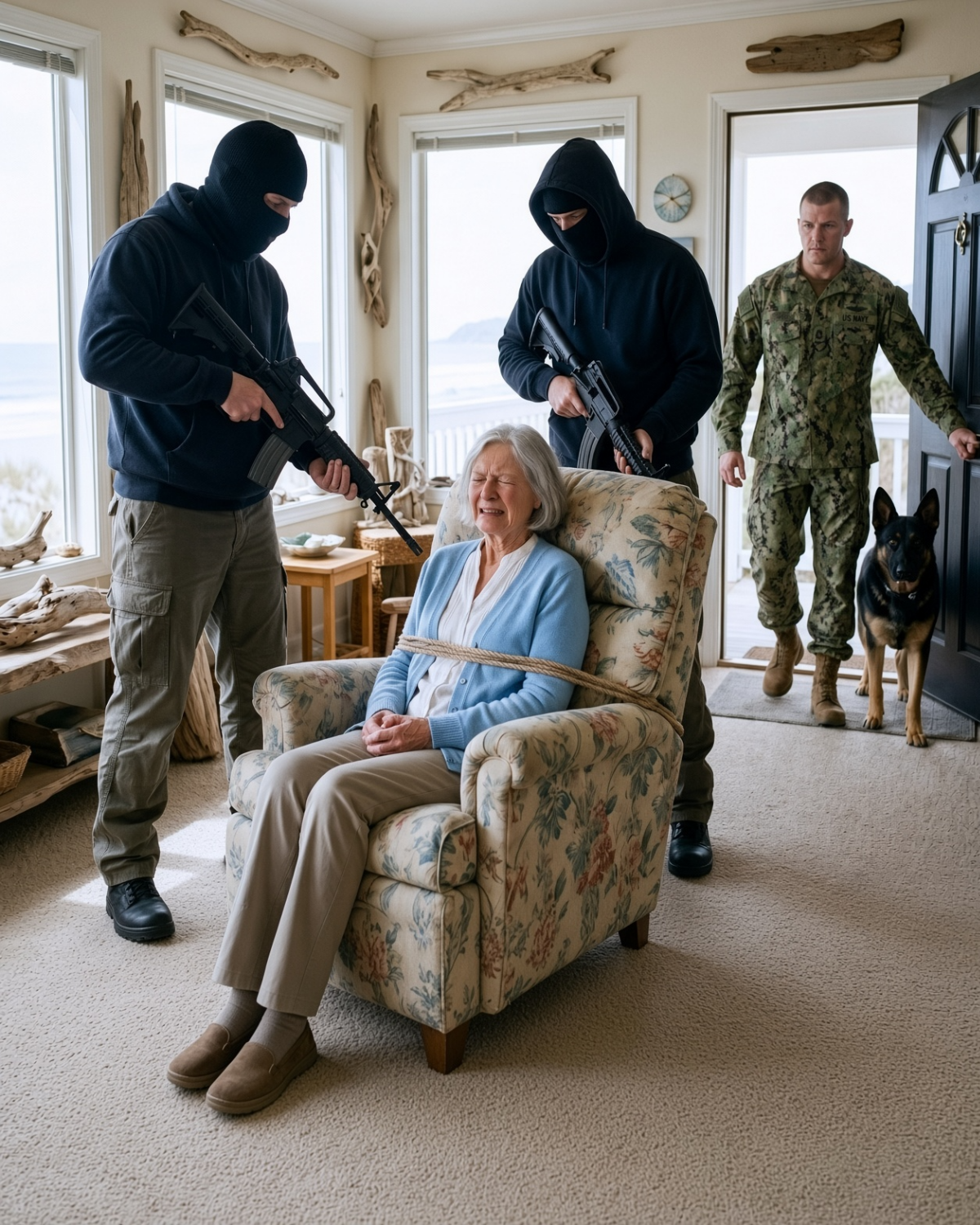
One man stood directly in front of her with a pistol. Another was tearing family photographs from the shelves. A third had already knocked over her coffee table.
They thought they had found an easy target.
They thought a sixty-seven-year-old widow living alone on a quiet barrier island in North Carolina would be too frightened to resist them.
What they didn’t know was that her son was less than a mile away.
And he wasn’t coming home alone.
At 5:47 on a foggy October evening, a black pickup truck rolled silently off the coastal highway, carrying a Navy SEAL, a retired military working dog, and a son who had no idea that the next few minutes would change everything he believed about his mother’s strength.
His name was Nolan Shepherd.
And the dog beside him was named Axel.
The drive from Camp Lejeune to the Outer Banks of North Carolina usually took about three and a half hours.
Nolan had made it in just under three.
He hadn’t planned to take leave until December, but after eight consecutive months in rotation, his unit commander had practically pushed him out the door.
“Go home, Shepherd,” Captain Reeves had told him that morning.
“Go see your mother. The mountains will still be there when you get back.”
Nolan hadn’t corrected him.
It wasn’t mountains.
It was a barrier island off the coast, a narrow strip of sand, salt grass, weathered wooden houses, and roads that seemed to disappear into the Atlantic fog.
It was a place where the air smelled of low tide and cedar.
It was the only place on Earth where Nolan could remember what it felt like to be completely still.
For eight months, he’d slept in unfamiliar places, watched unfamiliar horizons, and learned to recognize danger in the smallest changes around him.
He’d spent enough time away to understand that coming home wasn’t simply about changing locations.
It was about remembering who you were before the world started asking you to become someone else.
Axel sat upright in the passenger seat.
The four-year-old German Shepherd was black and tan, broad across the shoulders, and built like a small wolf.
He had been trained through the same military working-dog program that supplied highly specialized dogs to Navy SEAL teams.
A fragment from an improvised explosive device had struck his shoulder during a deployment in Helmand.
The injury had ended his active field service earlier than expected.
Nolan had driven three states to pick him up personally.
He hadn’t regretted that decision once.
Axel was more than a former military working dog.
He was Nolan’s partner, his shadow, and the one companion who understood the strange silence that followed a difficult deployment.
The dog watched the passing landscape with professional patience.
Every so often, his ears moved toward a sound Nolan couldn’t hear.
“Almost there, buddy,” Nolan said.
Axel turned his head.
“Your favorite place.”
The dog returned his attention to the window.
The bridge onto the island appeared through the gray afternoon haze.
Nolan exhaled and cracked the window an inch.
Salt air slipped into the cab.
Axel immediately pressed his nose toward the opening, taking in the familiar coastal scent.
For a moment, Nolan smiled.
He remembered being twelve years old, riding in the passenger seat of his mother’s old station wagon, with the windows down and the same ocean air blowing through his hair.
Back then, his mother had driven slowly.
She had always said there was no reason to hurry when the road was taking you home.
Nolan had spent much of his adult life doing exactly the opposite.
Pelican Shore wasn’t a tourist destination in October.
The summer renters were gone.
The boardwalk ice cream stands were boarded up, the beach umbrellas had disappeared, and the little seafood restaurants were preparing for the colder months.
The only people left were the families who had always lived there.
Their grandparents had built the houses by hand.
Their parents had repaired the roofs after hurricanes.
They painted the porches every spring and refused to sell, no matter how many times developers called with increasingly attractive offers.
His mother, Evelyn Shepherd, was one of those people.
She lived in a white clapboard house three properties back from the beach.
She had lived there for forty-two years.
She had raised Nolan there alone after his father died, maintained a small garden beside the house, made fig preserves every fall, and walked the shoreline every morning at six, regardless of the season.
She was sixty-seven, bird-boned, and stubborn as a barnacle.
Nolan often joked that the Atlantic would have to move before his mother considered moving away.
She never found that particularly funny.
“That house isn’t going anywhere,” she’d tell him.
And she meant it.
The house had a small front porch, a blue reading chair beside the living room window, and an old wooden sign hanging near the entrance.
WELCOME HOME.
Nolan had made the sign in a high school woodworking class.
His mother had kept it through forty years of storms, renovations, and arguments about whether it needed replacing.
Every time he returned from deployment, he saw it before anything else.
But as he turned onto the narrow road running parallel to the shoreline, something felt wrong.
The clouds were low.
Fog pressed close to the ground, reducing visibility to perhaps forty yards.
Nolan slowed as he approached the familiar rusted mailbox.
Then he saw the house.
The front porch light was off.
He stopped breathing for half a second.
Evelyn left that light on every night.
Every single night.
She had started doing it thirty years earlier, after Nolan returned home from boot camp for the first time.
He remembered stepping out of a taxi just after midnight.
He’d been exhausted, carrying a duffel bag, and uncertain whether the person coming home was still the boy who had left.
His mother had been standing behind the screen door.
The porch light had illuminated her face.
“I told you I’d leave it on,” she’d said.
It had become their tradition.
A small habit.
A large promise.
No matter how late he arrived, the light would be waiting.
Nolan took his foot off the accelerator.
He let the truck coast.
The familiar driveway appeared through the fog.
But something else caught his attention.
The curtains in the front room were drawn.
Evelyn never closed them before dinner.
She liked the afternoon light.
The side gate hung open at an unnatural angle, one hinge visibly damaged.
And in the shell driveway beside the carport sat a black Chevrolet Suburban.
No license plates.
The vehicle sat low in the rear, as though carrying considerable weight.
Nolan didn’t pull into the driveway.
He guided the truck onto the grass, easing it behind the thick oleander hedge that ran along the property line.
He cut the engine.
Axel was already standing.
The dog’s ears had rotated forward.
His nose moved in short, rapid pulls toward the window.
A low vibration began in his chest.
Nolan looked at him.
“What is it?”
Axel didn’t look away from the house.
The road trip was over.
Whatever waited ahead had already changed the dog’s entire posture.
Nolan reached into the back seat and retrieved his concealed carry equipment.
He checked his weapon, secured it, and took a moment to study the property.
He wasn’t going to rush into a situation he didn’t understand.
He had learned that the first few seconds of a dangerous situation often determined everything that followed.
He opened the driver’s door carefully.
Axel came out beside him.
The dog’s body remained close to Nolan’s left leg.
No excitement.
No road-trip curiosity.
Only focused attention.
Nolan studied the windows again.
The porch light remained dark.
The old wooden WELCOME HOME sign was still hanging beside the front door.
For reasons he couldn’t explain, seeing that sign while everything else looked wrong made his stomach tighten.
He remembered his mother standing there with a paintbrush the previous spring, insisting she could repair the porch railing herself.
He had offered to hire someone.
She had refused.
“I raised you to be independent, Nolan. Don’t start treating me like I can’t change a lightbulb.”
He had laughed.
Now he wished he had argued a little longer.
He moved toward the drainage ditch along the southern edge of the property.
Axel stayed beside him.
The wet ground pulled at his boots.
Fog softened every sound.
They approached the eastern side of the house without going near the front windows.
Nolan stopped beneath the living room window.
A small gap remained between the curtain and the frame.
He leaned toward it.
And the world became very small.
Inside, the pale amber light of a single lamp illuminated a room he knew better than almost any other place.
The couch had been pushed aside.
The coffee table was overturned.
Family photographs lay scattered across the floor.
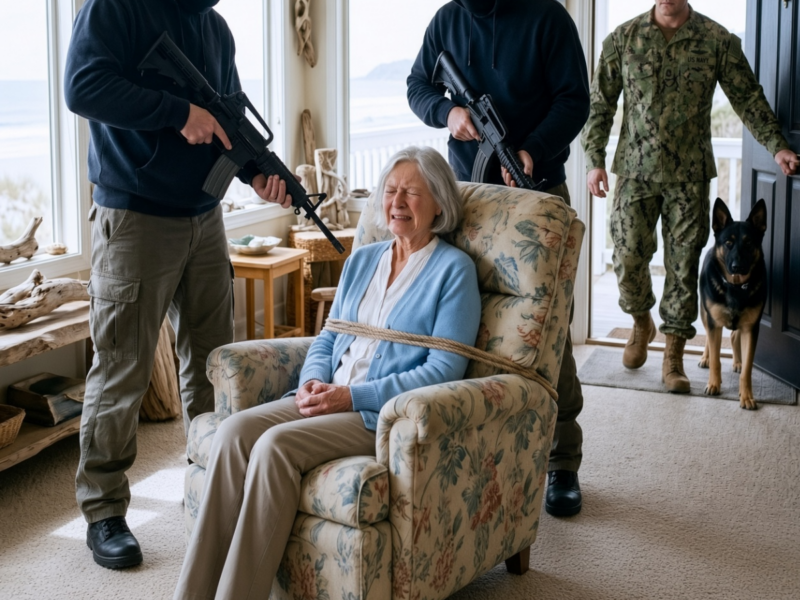
Three men wearing dark clothing and face coverings occupied the living room.
Two carried rifles.
A third held a pistol directly toward Evelyn’s face.
His mother sat in her blue reading chair.
The one with the loose armrest she’d been promising to repair for months.
Her hands were tied behind her.
Her white hair had come loose from its braid.
But her chin was raised.
She wasn’t crying.
She wasn’t begging.
She was looking directly at the man holding the pistol.
Another man searched the built-in bookshelves, pulling out framed photographs and throwing them aside.
A fourth stood near the hallway, watching the interior.
Nolan pulled away from the window.
He pressed his shoulder blades against the siding and closed his eyes for one second.
He breathed slowly.
Anger arrived.
He recognized it.
He let it pass through him without allowing it to make his decisions.
Four men inside.
Three rifles or firearms accounted for, including the pistol.
Tactical clothing.
A vehicle without plates.
A deliberate search.
This wasn’t a random break-in.
And the more important question was still unanswered.
Why Evelyn?
Axel sat quietly against the base of the house.
Nolan looked down at him.
“Stay with me, buddy.”
The dog watched his face.
They had worked together long enough to understand that neither needed many words.
Nolan considered the layout.
Back door through the utility room.
Kitchen connected to the living room.
Main staircase near the opposite side.
Second-floor access through the narrow stairs beside the refrigerator.
He knew the house because he had grown up in it.
He knew which floorboards complained.
He knew which doors stuck when the humidity rose.
He knew where his mother kept the spare batteries and which cabinet contained the emergency flashlight.
And he knew that there were places in that house where a stranger could hide for hours without realizing someone had been standing only a few feet away.
He looked toward Axel.
The dog was waiting.
Nolan gave him a quiet hand signal.
Axel moved away into the fog.
Nolan remained near the house, studying the property and the vehicle.
Through the Suburban’s driver’s window, he could see several items inside.
Bolt cutters.
Heavy plastic bags.
A duffel.
And a small red external hard drive resting on the center console.
He stared at the drive.
It was an unusual thing to carry into a residential break-in.
The men weren’t simply looking for valuables.
They wanted something specific.
Something that could contain information.
Something they believed Evelyn possessed.
A document, perhaps.
A computer file.
A record of ownership.
He filed the observation away.
Then he heard a faint sound from the rear of the house.
A cigarette lighter.
Nolan shifted his attention toward the back door.
A man stood there, leaning against the frame.
He held a rifle loosely and smoked as though he were waiting for someone to finish a routine job.
The man looked toward the yard occasionally.
He was the exterior guard.
That meant there were five men.
Not four.
Five armed strangers had entered his mother’s house.
Nolan looked toward the fog.
For the first time since leaving Camp Lejeune, he wished he had arrived ten minutes earlier.
But wishes didn’t change the situation.
Decisions did.
He watched the guard.
The man trusted the fence line and rarely looked toward the cedar tree near the northwestern corner.
He had become comfortable.
Nolan remained patient.
Then a familiar shape appeared through the fog.
Axel.
The German Shepherd moved low and fast across the yard.
The guard barely had time to turn.
The dog struck his wrist, knocking the rifle away from his grip, then drove his weight into the man’s center.
The guard stumbled backward against the doorframe.
Axel released and held position, his body between the man and the house.
The guard tried to regain his balance.
Nolan was already there.
He controlled the situation, brought the man down, and secured his hands with a restraint taken from the man’s own equipment.
It happened quickly.
The man was alive, conscious, and no longer in control of the yard.
Nolan checked him, then looked at Axel.
He placed one hand behind the dog’s ears.
“Good boy.”
Axel exhaled.
His eyes returned to the house.
Nolan followed them.
Four men remained inside.
One had a pistol pointed at Evelyn.
And the night was getting darker.
He moved to the back door.
The handle turned.
Unlocked.
They had entered through the utility room and apparently hadn’t bothered securing it afterward.
Nolan opened it just enough to look inside.
The washer.
The detergent shelf.
The coat hooks.
The faint smell of cedar and mildew.
Everything looked exactly as it had during his last visit.
Except now there were strangers in his mother’s living room.
He entered quietly.
The utility room opened into the kitchen.
The kitchen was dark.
Through the doorway to the left, he could see part of the living room.
He lowered himself behind the counter.
Three men were visible.
The man near the bookshelf had found something.
He was holding a framed document.
Nolan couldn’t read the details from his position, but the paper appeared old.
The man spoke quickly.
The pistol holder turned toward him.
“Is that it?”
“I think so.”
“Then give it to me.”
The man hesitated.
“There’s something missing.”
“Then keep looking.”
Evelyn said something.
Nolan couldn’t hear every word.
But he recognized the tone.
It was the same tone she used when someone tried to tell her what to do in her own kitchen.
“You’ve already searched the room,” she said.
The man holding the document turned toward her.
“Then tell us where the rest of it is.”
“I’ve told you. I don’t have anything else.”
The pistol holder stepped closer.
“You’re running out of chances.”
Evelyn looked at him.
“You boys have made quite a mess of my living room.”
The man stared at her.
Even now, she sounded annoyed about the furniture.
Nolan almost smiled.
Almost.
Then Evelyn’s eyes moved toward the kitchen.
She found him.
For one second, their eyes met.
Her expression didn’t change.
No surprise.
No panic.
She simply recognized her son.
Nolan raised two fingers and pointed toward the floor.
She understood.
He had taught her that signal years earlier, during an ordinary conversation about what to do if she ever found herself in an emergency.
They had never expected to use it.
Evelyn shifted her weight.
Then she deliberately leaned hard to one side.
Her reading chair toppled.
She went down with it, taking herself below the doorway’s line of sight.
The man near the bookshelf shouted.
“Hey!”
The two riflemen turned toward her.
And Nolan moved.
He came through the kitchen doorway, keeping the breakfast bar between himself and the nearest armed man.
A shot rang out.
One of the men dropped his rifle and stumbled against the bookshelf.
The second tried to turn.
Nolan closed the distance, controlled the weapon, and brought the man down before he could bring it into position.
The man with the pistol raised his arm.
Axel appeared through the kitchen doorway.
The German Shepherd crossed the room in a flash.
His jaws caught the man’s forearm.
The pistol discharged once.
The shot struck the ceiling.
White plaster fell across the living room like snow.
The man cried out and dropped to his knees.
Axel pulled his arm away from Evelyn’s position.
Nolan turned toward the hallway.
The fourth man had appeared.
He carried a rifle.
He moved quickly, using the doorway for cover.
Nolan reacted, but the man disappeared behind the wall.
Two rounds struck the doorframe.
Nolan didn’t pursue blindly.
His mother was still on the floor.
He reached her first.
“Nolan!”
Her voice shook.
But it was her voice.
“I’m here.”
He pulled the fallen chair aside and freed her wrists.
His hands moved quickly.
“Are you hurt?”
“No.”
“Did they hit you?”
“No, but one of them nearly broke my favorite lamp.”
He looked at her.
“Mom.”
“I know. I’m fine.”
He checked her wrists.
They were red from the restraints.
He looked at her face.
She had a small mark near her cheek, but she appeared otherwise uninjured.
He helped her behind the couch.
“Listen carefully. I need you in the back bedroom.”
“Nolan, there are five of them.”
“Not anymore.”
“That isn’t what I mean.”
“I know.”
She looked at him.
For a moment, he wasn’t a Navy SEAL.
He was the boy who had once come home with a broken arm and insisted he hadn’t fallen off his bicycle.
“Go to the bedroom,” he said.
“Lock the door. Move the dresser in front of it. Don’t open it until I come back.”
Evelyn glanced toward Axel.
The dog was standing between the couch and the hallway.
“He’s all right?”
“He’s fine.”
“Good.”
Then she looked back at Nolan.
“Come back in one piece.”
“I will.”
She hesitated.
Then she disappeared down the hallway.
Nolan turned toward the living room.
The man with the pistol was on the floor.
Axel stood over him, watching.
The two riflemen were incapacitated.
One was holding his shoulder.
The other wasn’t moving much.
Nolan secured the more mobile man and checked the second.
The hallway remained quiet.
Too quiet.
He looked at Axel.
The dog stared toward the same doorway.
The fourth man was still somewhere beyond it.
And he knew the house.
At least enough to use the hallway.
Nolan studied the room.
He considered the front staircase.
Then he looked toward the kitchen.
The narrow door beside the refrigerator was still there.
The old staircase.
His mother rarely used it.
Most visitors didn’t even know it existed.
But Nolan remembered.
When he was a child, he had used those stairs to sneak downstairs after bedtime.
His father had called them the secret stairs.
His mother had always known when he used them because the fourth step creaked.
He looked at Axel.
“Remember the old way?”
The dog tilted his head.
Nolan moved toward the narrow door.
He opened it carefully.
The staircase was dark.
Steep.
Tight.
Exactly as he remembered.
He climbed with care, avoiding the fourth step.
At the top, he emerged through the linen closet on the second floor.
The hallway was dark.
He paused.
Below him, the remaining intruder stood near the living room entrance.
His rifle was raised.
He was looking toward the couch.
He believed Nolan was still downstairs.
Nolan had no clear view of the man’s face.
But he could see enough to understand that the situation had become a waiting game.
The man was using the hallway as protection.
Nolan needed him to move.
He listened.
A floorboard creaked.
The man shifted his weight.
Then Nolan heard a sound from below.
A quiet whistle.
It was his own signal.
Axel moved.
The dog came up the main staircase from the living room side.
The intruder turned toward the sound.
For one brief second, he looked in the wrong direction.
Axel reached him.
The impact knocked the man’s balance away.
The rifle discharged into the wall.
Nolan came out of the linen closet.
Within seconds, the last intruder was on the floor.
The fight was over.
Nolan secured him, checked his condition, and then listened.
Nothing.
No footsteps.
No voices.
No movement from the living room.
Only the faint sound of the wind pressing against the windows.
He checked every room.
The second floor.
The bathroom.
The guest bedroom.
The narrow staircase.
The kitchen.
The utility room.
Then the living room again.
Five men.
Five restrained or incapacitated intruders.
No one else inside.
He stood near the overturned coffee table and looked at the scattered photographs.
One showed his father holding him as a newborn.
Another showed Evelyn standing beside a freshly painted porch.
A third showed Nolan in his first military uniform.
He bent down and picked up the photograph.
The frame had cracked.
He brushed a small piece of glass from its edge.
For a moment, he simply looked at it.
Then he placed it carefully on the shelf.
Some things deserved to remain standing.
He walked to the back bedroom.
Two short knocks.
One long.
The pattern he had used as a child to tell his mother he was home.
A dresser scraped across the floor.
The lock turned.
The door opened.
Evelyn stood there.
She looked at Nolan.
Then she looked at Axel.
The German Shepherd sat beside his hip, breathing steadily.
Evelyn’s face changed.
Not dramatically.
Not all at once.
Just enough for the fear she’d been holding back to finally become visible.
She crossed the room and wrapped both arms around her son.
She pressed her face against his chest.
Nolan held her.
He hadn’t held his mother like that since the morning he’d left for his first deployment.
She was shaking.
He could feel it through his uniform.
“It’s over,” he whispered.
She didn’t answer immediately.
Then she pulled back.
Her hands moved to his jaw.
She checked his face, his neck, and his arms.
The same way she had done after every childhood football game, every fall from a bicycle, and every homecoming after deployment.
“You’re bleeding.”
“Not mine.”
She looked at Axel.
“Is he hurt?”
“No.”
“Are you sure?”
“He’s okay, Mom.”
She touched the dog’s head.
“Good boy.”
Axel leaned into her hand.
Then Evelyn looked past Nolan toward the hallway.
“Come downstairs.”
“Why?”
“There’s something you need to see.”
Nolan frowned.
“Is it what they were looking for?”
She nodded.
He followed her.
Axel walked between them.
The living room looked even worse now that the immediate danger had passed.
The overturned furniture.
The broken lamp.
The scattered photographs.
Evelyn stopped beside the built-in bookshelves.
“Third shelf,” she said.
Nolan looked.
Behind a family photograph sat a framed document.
The glass had been removed.
The paper inside was old, yellowed, and carefully folded.
He lifted it.
The document was a registered deed of trust.
It concerned the beachside property adjacent to Evelyn’s house.
The land had been deeded to a local Pelican Shore family in 1958.
The document bore a raised notary seal and a faded signature belonging to a man named William Arthur Gentry.
Nolan read the name twice.
“What is this?”
“It’s Percy’s.”
“Percy?”
“Percy Whitaker. You remember him.”
Nolan did.
Percy was an eighty-year-old neighbor who lived in the weathered blue house closer to the water.
He had been friends with Evelyn for decades.
He used to bring Nolan fresh fish when he was a boy.
He had taught him how to repair a fence and how to recognize the difference between a harmless coastal snake and one that should be left alone.
“He asked me to keep it safe,” Evelyn explained.
“Why?”
“Because of the developers.”
Nolan looked at the document again.
“What developers?”
“Atlantic Crest Development.”
The name meant nothing to him.
Evelyn continued.
“They’ve been trying to buy Percy’s property for almost two years.”
She walked to the kitchen.
Nolan followed.
Axel settled near the doorway.
“At first, they were polite,” she said.
“They sent letters. They offered money. They talked about improvements, new homes, and a marina.”
“How much?”
“More than Percy could have imagined receiving for that land.”
“Then why didn’t he sell?”
“Because it wasn’t just his land to sell.”
Nolan waited.
Evelyn poured herself a glass of water.
“His grandfather bought that property. The family has lived there for generations. Percy has children and grandchildren. He wanted them to have the choice to stay.”
She sat at the kitchen table.
“Then the offers became more complicated.”
“What does that mean?”
“Documents arrived claiming there were problems with the title. Old boundaries. Questions about the original transfer. They suggested the family might not have a clear claim to the waterfront section.”
Nolan looked at the deed.
“And this proves otherwise?”
“It helps establish the chain of ownership.”
“Where did it come from?”
“Percy found it in a locked cabinet after his brother passed away. His family had kept it for decades.”
“Why was it here?”
“Because he didn’t trust his house anymore.”
Nolan looked toward the window.
Outside, the fog still covered the yard.
His mind returned to the red hard drive in the Suburban.
The men hadn’t simply wanted to frighten an elderly woman.
They had come prepared to search her house, remove documents, and take electronic records.
“Why didn’t you tell me?”
Evelyn looked at him.
“You were deployed.”
“That isn’t an answer.”
“It was the only answer I needed.”
“Mom, five men came into this house.”
“I know.”
“They tied you to a chair.”
“I noticed.”
“One of them held a gun in your face.”
Her expression softened.
“I know that too, Nolan.”
He looked away.
He had spent years learning how to remain composed when things went wrong.
He could process complicated situations.
He could make decisions.
He could accept uncertainty.
But seeing his mother sitting in that chair had brought something into him that no training could prepare him for.
“I should have been here,” he said.
Evelyn shook her head.
“You can’t spend your life standing guard over every person you love.”
“Maybe not.”
“But you can answer the phone when they call.”
He looked at her.
She held his gaze.
“They came twice before.”
Nolan’s expression changed.
“When?”
“In September.”
“And you didn’t call me?”
“I told you they were asking questions. I didn’t tell you everything because I didn’t want you worrying from halfway around the world.”
“Mom.”
“I know what you’re going to say.”
“You should have called.”
“Yes. I probably should have.”
She wrapped both hands around her glass.
“But Percy trusted me with that paper. I gave him my word.”
Nolan looked down at the document.
There it was.
The reason.
A simple promise.
No money.
No contract.
No grand arrangement.
An eighty-year-old neighbor had asked a sixty-seven-year-old woman to keep something safe.
And she had agreed.
Nolan sat across from her.
“Tell me everything.”
Evelyn began at the beginning.
The first representative from Atlantic Crest had arrived in early September.
He had been polite, wearing an expensive jacket and carrying a leather folder.
He introduced himself as a consultant working with the company.
He asked whether Evelyn knew anything about Percy’s property.
She said she knew Percy.
The man asked whether Percy had mentioned any old documents.
She said no.
The representative smiled.
He left a business card.
A week later, another man arrived.
This one was less polite.
He asked whether Evelyn was storing anything for Percy.
She denied it.
The man looked toward the built-in shelves.
Then he looked at the side of the house.
He asked whether she lived alone.
She told him that wasn’t his concern.
He left.
After that, strange vehicles appeared along the road.
A dark sedan.
A white utility van.
Once, someone had walked slowly around Percy’s empty property with a camera.
Evelyn had written down the dates.
She had also saved every letter.
Nolan looked at her.
“You kept records?”
“Of course.”
She stood and opened a drawer.
Inside was a neat folder.
Every letter.
Every business card.
Every notice.
Every handwritten date.
Nolan looked through the papers.
His mother had organized the entire history of the dispute.
At the top of the folder was a handwritten note.
SEPTEMBER 12 — SECOND VISIT.
Beneath it was another.
SEPTEMBER 19 — BLACK SEDAN, TWO MEN.
And then:
SEPTEMBER 26 — PHONE CALL FROM ATLANTIC CREST.
Nolan looked up.
“Why didn’t you give this to the police?”
“I intended to.”
“When?”
“Tomorrow.”
He stared at her.
She gave him a small, tired smile.
“Well, I suppose tonight changed the schedule.”
For the first time, Nolan let out a short laugh.
It wasn’t because anything was funny.
It was because his mother was still his mother.
Even after five men had torn through her home, she was already thinking about tomorrow’s errands.
He pulled out his phone.
“I’ve already made a call.”
Evelyn looked at him.
“To whom?”
“An old teammate. He works with a federal field office in Raleigh now.”
“Who?”
“Stafford.”
“Marcus Stafford?”
Nolan nodded.
“He and I served together. He moved into federal investigations after his second knee surgery.”
“Is he still as serious as he used to be?”
“More.”
“That’s unfortunate.”
Nolan almost smiled again.
He explained that he had contacted Stafford as soon as Evelyn was safely behind the bedroom door.
He had provided the basic details.
The unregistered vehicle.
The armed intruders.
The document.
The possible connection to the development company.
Stafford had immediately begun coordinating with local law enforcement.
There were already officers moving toward Pelican Shore.
Additional federal investigators were being contacted because the circumstances suggested a wider criminal operation.
Nolan had been careful not to make assumptions.
The men had been caught inside the house.
Their identities, communications, vehicle registration trail, and equipment would provide the evidence.
The red hard drive might also matter.
But the authorities would have to establish what it contained and who had authorized the break-in.
Evelyn listened.
Then she looked toward the living room.
“Will they come back?”
“Not tonight.”
“How do you know?”
“Because they’ll have to answer for what happened here.”
She nodded.
Then she looked down at the deed.
“Percy will be upset.”
Nolan blinked.
“Mom, five men just broke into your house.”
“I know.”
“They could have seriously hurt you.”
“I know that too.”
“And you’re worried about Percy?”
She looked at him.
“His family has been fighting to keep that property for longer than you’ve been alive.”
Nolan said nothing.
Evelyn carefully placed the deed on the table.
“He trusted me with something that mattered to him. I won’t pretend it was an ordinary favor.”
Nolan studied her.
He had seen people do extraordinary things for money, recognition, and personal ambition.
He had watched people take risks because they believed they had something to gain.
But this was different.
His mother had no financial interest in Percy’s property.
She wasn’t going to receive a reward.
She hadn’t even told anyone what she was protecting.
She had simply kept a promise.
And that promise had brought five armed men into her living room.
Nolan looked at the old document.
A piece of paper.
A raised seal.
A faded signature.
It seemed almost absurd that something so ordinary could cause so much trouble.
But land was never just land to the people who had built their lives on it.
It was where children learned to ride bicycles.
Where families gathered for Thanksgiving.
Where grandparents planted trees they would never see fully grown.
Where people buried loved ones and returned to remember them.
To a development company, a waterfront lot might be a line on a financial projection.
To Percy, it was the place where his family belonged.
And to Evelyn, protecting it was simply the right thing to do.
The first emergency vehicles appeared at the end of the road.
Their lights moved slowly through the fog.
There were no sirens.
Just the quiet approach of people who understood they were arriving at a serious scene.
Nolan stood.
“Stay here.”
Evelyn raised an eyebrow.
“Where exactly do you think I’m going?”
He looked at her.
She looked back.
Then he shook his head.
“Fair enough.”
Axel rose and followed him toward the front door.
Outside, the fog had begun to lift.
The first vehicle stopped near the driveway.
Two officers stepped out.
Behind them came another vehicle.
Then a dark SUV.
A man with a gray, close-cropped beard emerged from the driver’s seat.
Marcus Stafford.
He looked older than Nolan remembered.
His hair had gone mostly gray, and the lines around his eyes suggested years of difficult work.
But his expression was unchanged.
He approached the porch.
“Shepherd.”
“Stafford.”
Stafford looked at the house.
“Everyone alive?”
“Yes.”
“Your mother?”
“Uninjured, as far as I can tell. Her wrists need checking.”
Stafford nodded.
Then he looked at Axel.
The dog sat beside Nolan.
“That’s Axel?”
“That’s him.”
“Good-looking animal.”
“He’s earned the retirement.”
Stafford looked at the dog’s shoulder.
“Still bothering him?”
“Only when the weather changes.”
“Sounds familiar.”
For a moment, the two men stood quietly.
Then Stafford looked at Nolan.
“Walk me through it.”
Nolan gave him a concise account.
The vehicle.
The exterior guard.
The intruders.
The document.
The red hard drive.
He described the condition of the house and the locations of the men.
Stafford listened without interrupting.
When Nolan finished, he glanced toward the living room.
“You should have called 911 before entering.”
“Yes.”
“Your mother could have been hurt.”
“I know.”
Stafford studied him.
“Then don’t make me say it twice.”
Nolan nodded.
“Understood.”
Stafford lowered his voice.
“How is she really?”
Nolan looked through the open doorway.
Evelyn was standing in the kitchen.
She had found a dish towel and was folding it.
“She’s my mother.”
Stafford gave a small nod.
“That tells me enough.”
The investigators entered.
Local officers secured the property.
Medical personnel checked Evelyn’s wrists and asked whether she wanted to go to the emergency room.
She declined after an initial examination.
She was shaken, exhausted, and sore, but she was not seriously injured.
Nolan remained close.
Axel stayed at her side.
When an officer approached the dog too quickly, Axel simply turned his head and watched.
Evelyn placed a hand on his back.
“He’s all right,” she said.
The officer smiled.
“I can see that.”
The investigators documented the damage.
The overturned furniture.
The broken lamp.
The damaged gate.
The scattered photographs.
They collected the weapons and secured the vehicle.
The black Suburban was examined.
Its interior contained equipment that suggested the men had planned to remove property and transport whatever they found.
The red external drive was placed into evidence.
Stafford asked Evelyn about the development company.
She provided the folder.
Every letter.
Every business card.
Every handwritten note.
The lead investigator read through the material.
His expression changed as he reached the final pages.
“Mrs. Shepherd, do you understand how important these records may be?”
Evelyn looked at him.
“I understand they’re important to Percy.”
The investigator nodded.
“That may be enough to help establish what happened here.”
Nolan watched the exchange.
He noticed that the investigator treated his mother differently after seeing the folder.
At first, she had been an elderly homeowner whose house had been entered by armed men.
Now she was also a witness who had kept a detailed record of suspicious approaches, unwanted visits, and a developing property dispute.
Her notes had dates.
Her documents had signatures.
Her memory had details.
And she had preserved everything.
Stafford returned to Nolan near the front porch.
“We’re going to need the original deed.”
“Of course.”
“And every communication involving Atlantic Crest.”
“My mother has them organized.”
Stafford glanced toward Evelyn.
“She does?”
“Better than I organize my equipment.”
Stafford gave a brief smile.
“Then we might be in good hands.”
He lowered his voice.
“One more thing. The men inside aren’t the only part of this investigation.”
Nolan looked at him.
“What have you found?”
“We’re still confirming it. But the vehicle’s history is interesting.”
“How?”
“Ownership records have been transferred through several companies. The most recent registration is tied to a business that has connections to Atlantic Crest.”
Nolan looked toward the driveway.
“That’s not proof of who sent them.”
“No. But it gives us somewhere to look.”
Stafford paused.
“And the development company has been the subject of complaints from other property owners.”
Nolan felt his attention sharpen.
“Other families?”
“Several.”
Stafford explained that investigators had received reports of questionable property notices, disputed documents, and pressure on homeowners who refused to sell.
Some complaints involved elderly residents.
Others involved families who had inherited coastal property but lacked the resources to navigate complicated legal proceedings.
The pattern wasn’t yet established.
But it was concerning enough to warrant a closer examination.
Nolan looked toward his mother.
She was sitting at the kitchen table now.
Axel rested beside her chair.
She had placed the deed in front of her.
The document that had brought five men into her home was now sitting in the middle of a table covered with ordinary household things.
A sugar bowl.
A folded newspaper.
A pair of reading glasses.
A small ceramic dish containing spare keys.
The contrast was difficult to understand.
Stafford followed Nolan’s gaze.
“She’s tougher than you thought.”
Nolan didn’t answer immediately.
Then he said, “No.”
Stafford looked at him.
“I knew she was tough.”
He paused.
“I just forgot how much.”
The investigators continued working until late in the evening.
The five men were taken into custody after receiving medical attention where necessary.
Their identities were being verified.
Their connections to the development company remained under investigation.
The authorities also began reviewing whether the red drive contained material related to the property dispute.
No one could yet say how far the investigation would reach.
But the first important thing had happened.
The men had failed to take the deed.
And Evelyn had survived the night.
When the last investigator left the living room, Stafford approached the door.
He shook Nolan’s hand.
“Your statement will be needed again.”
“I’ll be available.”
Stafford looked toward Evelyn.
“Mrs. Shepherd, I’m sorry this happened to you.”
She gave him a tired smile.
“Thank you.”
“We’ll be in touch about the property documents.”
“I’ll have everything ready.”
Stafford nodded.
Then he looked down at Axel.
“Good dog.”
Nolan rested a hand on the German Shepherd’s neck.
“He knows.”
Stafford smiled.
“Apparently.”
When the last vehicle finally pulled away, the road became quiet again.
The fog was thinning.
A faint wind had begun moving in from the ocean.
Nolan closed the front door.
For the first time since arriving, he looked around the living room without searching for danger.
The broken lamp.
The overturned coffee table.
The scattered cushions.
The family photographs.
The house was damaged.
But it was still standing.
He picked up the lamp and set it on the side table.
Then he straightened the coffee table.
Axel watched him.
Evelyn appeared in the kitchen doorway.
“Leave that.”
“It’s all right.”
“I’ll fix it tomorrow.”
“You’ve done enough.”
She crossed her arms.
“That lamp was a wedding present.”
Nolan looked at it.
“Then we’ll find another one.”
“Your father bought it.”
He stopped.
Evelyn looked at the broken shade.
“He saved for it.”
Nolan turned the lamp gently.
A small memory returned.
His father carrying the lamp through the front door.
His mother laughing because he had nearly knocked over the porch railing.
The two of them arguing about where it should go.
Nolan had been a child.
He remembered sitting on the floor with a toy truck while his parents arranged the living room.
The lamp had been there ever since.
He looked at his mother.
“I’ll see if it can be repaired.”
She nodded.
That was enough.
He walked into the kitchen.
The coffee pot was empty.
Evelyn had already started filling it.
“Sit down,” she said.
“Mom, you should rest.”
“I will rest after coffee.”
“That’s not how resting works.”
“It’s how it works in this house.”
Nolan pulled out a chair.
Axel walked over and settled beside Evelyn.
She placed her hand on his broad head.
The gesture was automatic.
Warm.
Trusting.
The same way she had touched Nolan’s hair when he was a boy.
“He’s a good companion,” she said.
“He is.”
“Does he sleep in your room?”
“Usually.”
“Then he’s going to need a blanket. The nights are getting colder.”
Nolan looked at her.
“You’re already making plans for him?”
“Of course. He’s a guest.”
Axel raised his head.
Evelyn smiled.
“An unusually large guest.”
For the first time that evening, Nolan felt his shoulders begin to relax.
He watched her move around the kitchen.
She was slower than usual.
Her hands still trembled slightly when she reached for the coffee filters.
But she was moving.
She was home.
And she was doing what she had done for forty-two years.
Making coffee.
The next morning, Nolan woke before sunrise.
He had slept in the guest room.
Axel was lying near the door.
For a few seconds, Nolan didn’t remember where he was.
Then he heard the ocean.
He heard a distant gull.
He smelled coffee.
Home.
He got up and walked downstairs.
The front porch light was still off.
He stopped at the window.
The old wooden WELCOME HOME sign hung beside the door.
He looked at it for a long moment.
Then he stepped outside.
The air was cold.
The fog had almost disappeared.
Beyond the houses, the Atlantic moved beneath a pale gray sky.
Nolan walked toward the porch railing.
He noticed the small bulb beside the front door.
It was still intact.
The light itself hadn’t been broken.
It had simply been switched off.
He reached for the switch.
Then he stopped.
For thirty years, his mother had turned that light on for him.
Maybe it was time he took care of it for her.
He switched it on.
A warm glow appeared beneath the morning sky.
Behind him, the screen door opened.
“You’re up early,” Evelyn said.
He turned.
She wore a light sweater and carried two mugs.
“Couldn’t sleep.”
She handed him one.
“Bad dreams?”
“No.”
She looked at him.
“Don’t lie to your mother.”
He looked down at the coffee.
“Just thinking.”
“About what?”
“The light.”
Evelyn glanced toward the porch bulb.
Then she smiled.
“You don’t have to leave it on during the day.”
“I know.”
“Electricity isn’t free.”
“I know that too.”
She shook her head.
But she didn’t turn it off.
They stood together for a while.
Then Nolan asked the question he had been avoiding.
“Do you regret keeping the deed?”
Evelyn looked toward the water.
“Do you mean last night?”
“I mean all of it.”
She was quiet.
A gull crossed above the rooftops.
Then she said, “No.”
“Even after what happened?”
“Especially after what happened.”
He turned toward her.
“Why?”
“Because if I had given it to them, Percy would have lost something his family trusted him to protect.”
“They might have come back.”
“They might have.”
“You could have been hurt.”
She nodded.
“I could have.”
Nolan waited.
Evelyn took a sip of coffee.
“Your father used to say that a person’s word is only worth something when keeping it becomes inconvenient.”
Nolan looked at her.
He remembered his father saying something similar.
He had been a quiet man.
Not particularly strong-looking.
He worked with his hands and never raised his voice unless something truly mattered.
But when he promised something, he did it.
Evelyn continued.
“Percy asked me to keep that document safe. He didn’t have anyone else he trusted with it.”
“Why you?”
“Because I’ve lived here forty-two years. Because I know his family. Because I know what that property means.”
She looked toward the neighboring house.
“Sometimes people don’t need someone to save them. They just need someone who won’t walk away when things get difficult.”
Nolan thought about that.
He had spent years learning to protect people in circumstances that most civilians would never experience.
He had learned how to recognize danger.
How to make decisions.
How to remain calm when the world became unpredictable.
But he had rarely thought about the quiet forms of courage that happened far from a battlefield.
The kind that didn’t come with medals.
The kind that didn’t make the news.
The kind that looked like an old woman sitting in a reading chair with her hands tied, refusing to tell strangers where she had hidden a neighbor’s property document.
“You’re stubborn,” he said.
Evelyn smiled.
“Your father used to say that.”
“He was right.”
“He usually was.”
They went back inside.
The kitchen was warm.
The fig preserves lined the back shelf.
Nolan looked at the jars.
His mother had made them in September.
He remembered helping her pick the figs the year before.
He had been home for only three days, and she had insisted that he carry the basket while she chose the ripest fruit.
He had complained about the heat.
She had told him to stop complaining.
Now he looked at the jars and realized how much he had missed.
Not the big occasions.
Not birthdays or holidays.
The ordinary things.
The small conversations.
The sound of his mother’s footsteps.
The smell of coffee.
The way she always insisted on doing things herself.
He had been in sixteen countries.
He had worked in deserts, mountain passes, and equatorial jungles.
He had made decisions under pressure that would stay with him for the rest of his life.
Yet the most important thing waiting for him at home was a woman who had never once believed that age or fear should decide what she was allowed to protect.
The phone rang.
Evelyn answered.
“Hello?”
A familiar voice came through the speaker.
It was Percy.
She listened for a moment.
Then her expression softened.
“Percy, it’s all right.”
Nolan looked up.
She held the phone closer.
“Yes, I still have it.”
A pause.
“No. They didn’t get it.”
Another pause.
“Yes, I’m sure.”
She glanced toward Nolan.
“My son is home.”
Percy said something.
Evelyn smiled.
“He’s fine. The dog is fine too.”
Then her expression became serious.
“Percy, you need to come home when it’s safe. There’s something you should know.”
She listened.
Then she said, “They came looking for the deed.”
Nolan watched her.
Percy’s voice grew louder.
Evelyn closed her eyes.
“I know.”
A moment passed.
Then she said the words that made Nolan understand how much the document meant to the old man.
“Your family isn’t losing that house.”
She ended the call.
For a moment, neither of them spoke.
Then Nolan asked, “What did he say?”
“He said thank you.”
“That’s all?”
“He said he didn’t know how to repay me.”
Nolan looked toward the deed.
“Tell him he doesn’t have to.”
Evelyn nodded.
“I already did.”
Over the next several days, the investigation expanded.
The five men were formally identified.
Investigators examined their communications, financial connections, and relationships with companies involved in the coastal development project.
The Suburban’s ownership trail led to a business connected to a private security contractor.
That contractor had previously provided services to Atlantic Crest Development.
The red hard drive contained files that investigators believed were relevant to the property dispute.
Those files were not enough by themselves to establish every allegation, but they provided leads.
Additional records were obtained.
Other homeowners came forward.
One elderly couple described receiving repeated visits after refusing to sell their land.
A retired fisherman reported that someone had attempted to persuade him to sign documents he didn’t fully understand.
A widow living farther down the island said she had received letters claiming that part of her property was subject to a boundary dispute.
The stories were different.
But the pattern was similar.
The company had been trying to assemble a large stretch of waterfront property.
Some owners had accepted offers.
Others had refused.
A handful had become involved in complicated title questions.
And the families who lacked money for prolonged legal disputes were the most vulnerable.
The investigation eventually uncovered evidence of a coordinated effort to pressure several homeowners.
The five men who entered Evelyn’s house were not acting as ordinary burglars.
Their activities were connected to a wider attempt to obtain documents that could be used to challenge or interfere with property ownership.
The authorities continued building the case.
Atlantic Crest publicly denied wrongdoing.
Its executives stated that the company had no knowledge of the break-in.
But investigators examined the connections between the men, the security contractor, and the business.
The case moved into the legal system.
For Percy, the most important development was that the original deed had survived.
A property attorney reviewed the document, verified its registration history, and compared it with the county records.
The deed became part of a broader effort to establish the family’s ownership rights.
The legal process wasn’t simple.
There were hearings.
There were requests for additional records.
There were questions about historical boundaries.
But Percy was no longer fighting alone.
Other property owners began sharing their experiences.
Local residents attended meetings.
A neighborhood association organized legal assistance.
People who had previously been too embarrassed or frightened to discuss the pressure they had experienced began speaking openly.
The quiet island community had found something it hadn’t realized it possessed.
A collective voice.
And it began with one document that an elderly woman had refused to surrender.
Two weeks after the break-in, Nolan accompanied Evelyn to Percy’s house.
Percy stood on the porch wearing an old fishing sweater.
He looked smaller than Nolan remembered.
But his eyes were bright.
When he saw Evelyn, he came down the steps.
“You didn’t have to do that,” he said.
Evelyn smiled.
“Good morning to you too, Percy.”
He looked at Nolan.
“Your boy saved her.”
Nolan shook his head.
“She did most of the work.”
Percy frowned.
“What do you mean?”
Evelyn gave him a look.
“Don’t start.”
Percy laughed.
It was the first time Nolan had heard him laugh in years.
They went inside.
Percy’s house smelled of old wood, salt, and coffee.
Family photographs covered the walls.
One showed his grandfather standing beside the original house.
Another showed three generations gathered on the beach.
Percy placed the deed on the dining table.
For a long moment, he simply looked at it.
“I thought it was gone,” he said.
Evelyn sat across from him.
“It’s safe.”
He reached toward the document.
His hand trembled.
“My father used to say this land was the only thing his father ever owned outright.”
He looked at Nolan.
“He worked his whole life for it.”
Nolan nodded.
Percy continued.
“People came along every few years offering money. Some offers were fair. Some weren’t. But it was never just about the money.”
He looked at the photograph on the wall.
“My grandchildren know that beach. They know where their great-grandfather built the first fence. They know where we used to pull the boats in after a storm.”
His voice softened.
“I wanted them to have a choice.”
Evelyn reached across the table.
“And they will.”
Percy looked at her.
Then he nodded.
He placed the deed back into its frame.
But this time, he didn’t ask Evelyn to keep it.
He decided to place it in a secure location with his attorney.
The original document would be preserved.
Certified copies would be used for the legal proceedings.
The family would no longer depend on one elderly neighbor to protect something that mattered to generations of people.
Nolan thought that was the right decision.
And Evelyn agreed.
Before they left, Percy walked them to the porch.
He stopped beside Nolan.
“Your mother is a remarkable woman.”
“I know.”
“No, son. I don’t think you do.”
Nolan looked at him.
Percy glanced toward Evelyn.
“She could have walked away. Nobody would have blamed her. Nobody would have expected her to risk anything.”
He paused.
“But she didn’t.”
Nolan watched his mother standing near the railing.
She was talking to Percy about the weather.
As though the past two weeks had been nothing more than an inconvenience.
“Yes,” Nolan said quietly.
“I know.”
The following month, the community held a meeting at the small Pelican Shore civic hall.
It was an ordinary building.
White walls.
Folding chairs.
A coffee station near the entrance.
A bulletin board covered with notices about fishing permits, school events, and hurricane preparation.
But that evening, almost every chair was occupied.
Families came from different parts of the island.
Some had lived there for generations.
Others had moved in more recently.
They shared one concern.
They wanted to know whether their homes and properties were safe.
A local attorney explained the importance of keeping original deeds, reviewing legal notices, and seeking independent advice before signing anything related to property ownership.
A representative from the county answered questions.
Several residents described their experiences.
Evelyn sat in the second row.
Nolan sat beside her.
Axel rested quietly at their feet.
At one point, a woman stood near the back.
She was seventy-four and lived alone in a small house near the marsh.
She looked toward Evelyn.
“I heard about what happened to you.”
Evelyn nodded.
The woman hesitated.
“I’ve been getting letters too.”
The room became quiet.
Evelyn stood.
“Then keep every one of them.”
The woman looked surprised.
“All of them?”
“Every letter. Every envelope. Every business card. Write down when people visit. Don’t throw anything away.”
The woman nodded.
Evelyn continued.
“And don’t be embarrassed to ask for help.”
A few people exchanged glances.
“You don’t have to fight every battle alone,” Evelyn said.
Nolan looked at her.
He realized she wasn’t speaking only about property.
She was speaking about something she had learned the hard way.
People often became vulnerable because they believed their problems were too small to bother anyone else.
They stayed quiet.
They handled things privately.
They convinced themselves that asking for help meant admitting weakness.
But sometimes silence was exactly what allowed someone else to take advantage.
That night, the community agreed to create a shared support network.
Residents would report suspicious visits.
The neighborhood association would maintain contact information for legal resources.
Older homeowners would have access to volunteers who could help them understand official notices and arrange independent reviews.
The meeting lasted nearly three hours.
When it ended, people remained in the parking lot talking.
Some exchanged phone numbers.
Others promised to check on neighbors.
A few residents who hadn’t spoken during the meeting approached Evelyn privately.
They thanked her.
She accepted their gratitude without making much of it.
On the drive home, Nolan looked at her.
“You started something.”
Evelyn looked out the window.
“I didn’t start anything.”
“You did.”
“All I did was keep a promise.”
Nolan smiled faintly.
“Sometimes that’s how things start.”
She didn’t answer.
Axel rested his head against Nolan’s leg.
The island passed slowly outside.
Porch lights glowed in the distance.
Some houses were dark.
Others had warm yellow light behind their curtains.
Nolan noticed how many front doors had small signs or decorations.
WELCOME.
HOME.
FAMILY.
He thought about how little he had noticed those things before.
He had spent years looking at buildings as structures.
Places to enter.
Places to leave.
Places to secure.
Now he was beginning to understand that a home was something else entirely.
It was the accumulation of ordinary promises.
The next morning, Nolan called Captain Reeves.
“How’s your mother?” the captain asked.
“She’s fine.”
“And the dog?”
“Also fine.”
“Then why do you sound like you’ve been through another deployment?”
Nolan looked toward the kitchen.
Evelyn was arranging jars of fig preserves.
Axel was lying beside her.
“Long story.”
“I’ve got time.”
Nolan explained what had happened.
He described the men, the document, the investigation, and the property dispute.
Reeves listened.
When Nolan finished, the captain was quiet for a moment.
“Your mother sounds like someone I’d want on my team.”
Nolan smiled.
“She’d probably run the whole operation.”
“Probably better than you.”
“Wouldn’t surprise me.”
Reeves laughed.
Then his voice softened.
“Take the time you need, Shepherd.”
“Thank you, sir.”
“That’s an order.”
Nolan looked at the kitchen again.
“Understood.”
He ended the call.
For the first time in a long while, he didn’t feel the need to hurry.
His leave had originally been scheduled as a short break between rotations.
Now he understood that it was something more important.
A chance to be present.
To help repair the house.
To spend time with his mother.
To walk the beach with Axel.
To remember what life looked like when it wasn’t organized around the next mission.
The following afternoon, Nolan found Evelyn in the living room.
She was standing beside the built-in shelves.
The framed photograph of his father had been returned to its place.
The broken lamp was gone.
In its place stood a small wooden lamp with a simple white shade.
Nolan stopped.
“New lamp?”
Evelyn turned.
“Your father would have liked it.”
He walked closer.
The old lamp had been repaired by a local shop.
The crack in the base remained, but it had been carefully restored.
He touched it.
“They fixed it?”
“Mostly.”
“It looks good.”
“I told them not to replace anything they didn’t need to.”
He smiled.
“Of course you did.”
Evelyn looked toward the shelf.
The old wooden WELCOME HOME sign had been brought inside temporarily.
She had placed it against the wall.
One corner had been damaged during the break-in.
Nolan picked it up.
“Want me to repair this?”
She looked at him.
“Can you?”
“I made it.”
“You were seventeen.”
“I remember.”
“You nearly cut your finger off making that thing.”
“I did not.”
“You needed three bandages.”
“That was different.”
Evelyn laughed.
Nolan turned the sign over.
The back still carried his name and the date.
He remembered the school workshop.
The smell of sawdust.
The teacher showing him how to smooth the edges.
His father waiting outside to drive him home.
His mother had hung it on the porch that same evening.
He carried it toward the kitchen.
“I’ll fix it.”
“Don’t make it too perfect,” Evelyn said.
“Why?”
“Because then it won’t look like yours.”
He glanced back at her.
She smiled.
And he understood.
The imperfections were part of the memory.
That evening, Nolan sat on the porch repairing the sign.
Axel lay beside him.
The ocean breeze moved through the grass.
Evelyn brought out two cups of tea.
She placed one on the railing.
Then she looked at the sign.
“You’re doing a good job.”
“Thank you.”
“Your father would be proud.”
Nolan continued working.
After a moment, he said, “I wish he’d been here.”
Evelyn sat beside him.
“So do I.”
They watched the sunset.
The sky turned pale orange over the water.
For a long time, neither spoke.
Then Evelyn said, “He would have liked Axel.”
Nolan looked down at the dog.
“He does.”
“I think he would have spoiled him.”
“Definitely.”
“Your father always wanted a dog.”
Nolan raised an eyebrow.
“You told me we couldn’t have one.”
“Because I knew your father.”
They both laughed.
Axel lifted his head.
Evelyn reached down and rubbed his ears.
“Don’t worry. You’re allowed.”
The next morning, Nolan finished repairing the wooden sign.
He carried it to the front porch.
The damaged corner had been smoothed.
The letters had been cleaned.
He had preserved the original paint rather than replacing it.
He found two new screws and hung it beside the front door.
WELCOME HOME.
Evelyn stood behind him.
“That’s where it belongs.”
Nolan stepped back.
The sign looked almost exactly as it had when he first made it.
The porch light was on.
The house was quiet.
The ocean moved beyond the trees.
And for the first time since arriving, Nolan felt that everything had returned to its proper place.
Not because nothing bad had happened.
But because the people who belonged there had refused to let the bad things decide what came next.
Several weeks later, the legal proceedings reached an important stage.
The investigators had gathered enough material to pursue additional action against individuals connected to the attempted property scheme.
The development company faced growing scrutiny.
Its public statements continued to deny involvement in the break-in.
But the evidence concerning the men, the vehicle, and their connections to the contractor was becoming increasingly difficult to dismiss.
Percy’s family also received an important legal update.
The original deed and supporting county records strengthened their position.
The disputed waterfront property would remain protected while the ownership questions were resolved.
It wasn’t the end of the legal process.
But it was a meaningful victory.
The community celebrated quietly.
Percy brought a box of fresh seafood to Evelyn’s house.
Another neighbor brought a homemade pie.
Someone else left flowers on the porch.
Evelyn complained that everyone was making too much fuss.
But she kept every gift.
Nolan watched the small gathering from the kitchen doorway.
Axel lay on the floor.
Children played in the yard.
Older residents stood on the porch talking about the coming winter.
The house was alive again.
The broken lamp had been repaired.
The photographs had been returned.
The blue reading chair had a new armrest.
And the old wooden WELCOME HOME sign hung beside the front door.
Nolan had spent his career learning how to enter dangerous places.
Now he was learning how important it was to have somewhere worth returning to.
One evening, after the neighbors had gone home, he sat at the kitchen table with his mother.
She was looking through a small stack of photographs.
“Remember this one?” she asked.
Nolan leaned closer.
It showed him at ten years old, standing beside his father near the shoreline.
He wore an oversized baseball cap.
His father held a fishing rod.
The water behind them was bright blue.
“I remember that day.”
“You caught nothing.”
“I caught something.”
“A piece of seaweed.”
“It was a big piece.”
Evelyn laughed.
Then she placed the photograph beside the coffee pot.
Nolan looked around the kitchen.
The fig preserves.
The old clock.
The small scratch on the table where he had once carved his initials.
The familiar curtains.
He thought about the five men who had entered the house.
They had seen an elderly woman.
They had seen a quiet property.
They had seen an opportunity.
But they had failed to see the history contained within those walls.
They hadn’t understood the relationship between Percy and Evelyn.
They hadn’t understood the significance of the document.
And they certainly hadn’t understood the son who would recognize that something was wrong before he even stepped out of his truck.
But there was something else they hadn’t understood.
Evelyn wasn’t brave because her son was a Navy SEAL.
She had been brave long before Nolan ever put on a uniform.
She had raised a child alone.
She had rebuilt her life after losing her husband.
She had endured storms, financial difficulties, long winters, and the quiet loneliness that sometimes came with living on an island after everyone else had gone home.
She had spent forty-two years caring for a house that meant more to her than its market value.
And she had kept her word when it would have been easier to break it.
Nolan had arrived expecting to protect his mother.
Instead, he had discovered another lesson about protection.
Sometimes it meant standing between someone you loved and a danger they couldn’t face alone.
Other times, it meant trusting them to remain exactly who they were, even when the world gave them every reason to change.
He looked at Evelyn.
“Mom?”
She glanced up.
“What?”
“I’m glad I came home.”
She smiled.
“So am I.”
Axel walked over from the doorway.
He placed his heavy head on Nolan’s knee.
Nolan rested a hand on the dog’s neck.
Evelyn reached across the table and touched the German Shepherd’s head.
For a moment, the three of them sat together.
No radio calls.
No hurried decisions.
No unfamiliar surroundings.
Just the quiet kitchen, the smell of coffee, and the sound of the Atlantic moving beyond the windows.
Outside, the porch light glowed.
It was the same small light Evelyn had left on for thirty years.
The same light that had greeted Nolan after boot camp.
The same light he had noticed was missing on the evening he arrived home.
He looked toward the front door.
“Keep that light on tonight,” he said.
Evelyn smiled.
“I always do.”
Nolan nodded.
He knew she would.
And he understood something he hadn’t fully understood before.
A home wasn’t simply a place you returned to.
It was a place where someone kept a promise that you would always have somewhere to go.
His mother had kept that promise for thirty years.
She had kept another promise to Percy.
And when five armed men came looking for something they believed they could take, she had refused to let them decide what belonged to whom.
Nolan had arrived with a military-trained dog and years of experience.
But the strongest person in that house had been sitting in a blue reading chair the entire time.
He had seen her that night.
Not as a frightened elderly woman.
Not as someone waiting to be rescued.
But as the woman who had raised him.
The woman who had taught him that a promise mattered.
The woman who had left the porch light on through every storm, every deployment, and every long night when she didn’t know when her son would return.
Outside, Axel settled across the back doorway.
He rested his chin on his paws and closed his eyes.
Nolan leaned back in his chair.
Evelyn began preparing the next day’s coffee.
The house was quiet again.
And when the first light of morning eventually came across the beach, it would find the same white clapboard house standing three properties back from the water.
The same old wooden sign beside the door.
The same blue reading chair beside the window.
And the same woman who had spent forty-two years refusing to let go of the place she called home.
There are houses that get taken.
There are houses that are sold, abandoned, forgotten, or reduced to numbers on a developer’s spreadsheet.
And then there are houses that hold.
They hold because someone remembers who built them.
They hold because someone refuses to surrender what was entrusted to them.
They hold because love sometimes looks less like a grand declaration and more like an ordinary person keeping an ordinary promise when the cost becomes extraordinary.
That night, five men entered Evelyn Shepherd’s house believing they had found an easy target.
They found a woman who would not betray her neighbor.
A son who had come home.
And a German Shepherd who knew exactly where he belonged.
The porch light was on again.
The old sign still read WELCOME HOME.
And for Nolan Shepherd, after sixteen countries, countless difficult assignments, and eight months away from the people who mattered most, there was no place in the world he would rather be.
Because the greatest thing he had protected that night wasn’t a document, a piece of land, or even a house.
It was the promise that the people he loved would never have to face the darkness alone.
And sometimes, that is what makes a home worth fighting for.