No One Could Touch the Dangerous K9—But One SEAL Remembered Him
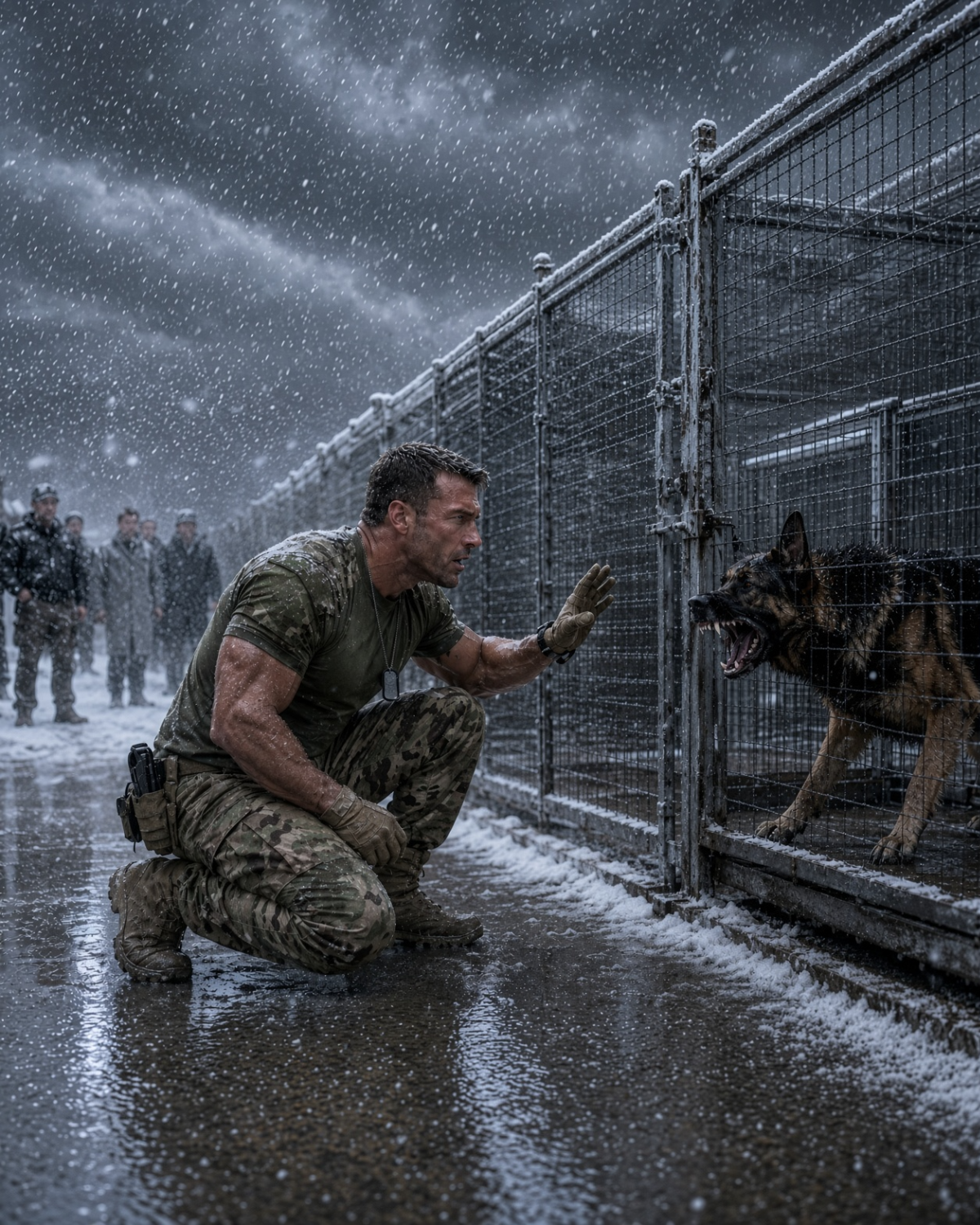
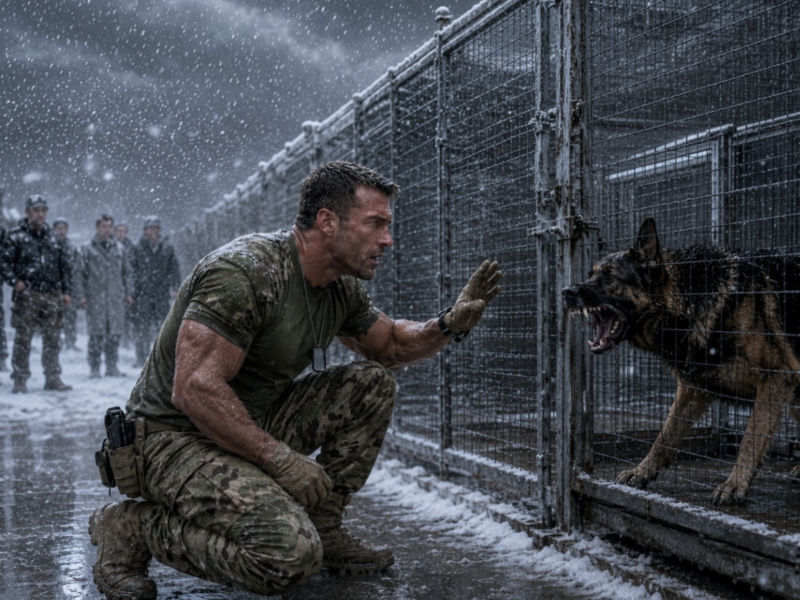
Former Navy SEAL Ryan Callahan saw something else in one blurry rescue photograph.
The white scar above the dog’s right eye. The missing triangle from his left ear. The familiar way he held his weight, ready to protect someone even when nobody was coming to help him.
Three years earlier, Ryan had watched that dog disappear into smoke during a mission overseas. The military had declared him lost. Ryan had mourned him, carried his old leash, and learned to live with an empty space that never quite stopped hurting.
Now, with less than two hours before the shelter’s deadline, Ryan had one chance to prove that the monster behind the steel gate was actually the soldier who had saved his life.
And one familiar command would change everything.
Morning arrived in Chesapeake, Virginia, beneath a thin gray drizzle that made the city shelter smell sharper than usual.
Bleach hung heavily in the air. Wet fur clung to the concrete floors. Somewhere near the intake desk, a pot of cheap coffee had been burning long enough to develop a personality of its own.
At the far end of the isolation wing, kennel 17 had two padlocks on its gate, a red warning card clipped to the chain link, and a yellow line painted across the floor six feet from the entrance.
Nobody crossed that line anymore unless absolutely necessary.
Lauren Whittaker stood behind it with a clipboard pressed against her chest.
She had directed Chesapeake Animal Care and Control for eleven years. During that time, she had learned that fear wore different faces.
Sometimes it barked.
Sometimes it whimpered.
Sometimes it looked like a young volunteer pretending her hands weren’t shaking.
Today, fear looked like a sable German Shepherd standing motionless in the center of a ten-by-ten kennel.
His head was lowered. His shoulders were powerful. His amber eyes followed every person who approached the gate, calculating distances with an intelligence that made the staff uncomfortable.
His official designation was Stray 617.
Male. Approximately six years old. No readable microchip. Severe aggression. Public safety risk.
The employees had given him other names.
Beast.
Demon.
The dog from hell.
Lauren hated those names, but she understood how they had appeared.
Three days earlier, two animal control officers had trapped the dog behind a seafood warehouse near the Elizabeth River.
He had been bleeding from one paw, his ribs visible beneath a coat covered in old scars.
When Officer Eddie Mason attempted to guide him into a transport crate, the animal had folded an aluminum catch pole like soft wire.
Eddie had worked animal control for twenty-six years.
He had scars on both forearms and a story behind every one of them.
He didn’t scare easily.
Yet now he stood beside Lauren, his right shoulder taped beneath his uniform, watching kennel 17 with the careful posture of a man who had learned respect through experience.
“He isn’t bluffing,” Eddie said.
Dr. Natalie Brooks, the shelter’s veterinary behaviorist, crouched behind the yellow line.
She was a calm woman with dark hair pinned up, narrow glasses slipping down her nose, and a habit of speaking as if panic were simply an interruption she refused to entertain.
Even she had grown quiet.
Stray 617 didn’t throw himself randomly against the gate.
He didn’t bark until his throat gave out.
He didn’t spin in circles or chew his own skin.
He patrolled.
Four steps along the back wall.
Turn.
Three steps toward the gate.
Stop.
Eyes on the humans.
His sable coat carried a broad black saddle across his back and shoulders. His chest was a rich tan, dulled by grime, and gray had begun spreading around his muzzle.
A white streak crossed the fur above his right eye.
The tip of his left ear was missing a small, clean triangle.
He was beautiful in the way broken glass could be beautiful when sunlight caught it.
And dangerous in a way nobody could ignore.
On Tuesday, twenty-four-year-old volunteer Paige Sullivan had attempted to slide a bowl of chicken and rice through the feeding slot.
She had been speaking softly, telling the dog he was safe, telling him nobody wanted to hurt him.
He had gone completely still.
Then he had launched toward the opening.
His teeth struck the steel frame with a sound that silenced every kennel in the row.
Paige dropped the bowl.
Rice scattered across the floor.
She stumbled backward into a stack of towels and sat there, white-faced, one hand clamped over her mouth.
She hadn’t entered isolation alone since.
“That wasn’t hunger,” Natalie said.
Lauren looked at her.
“It was a boundary response. He believes we’re entering his perimeter. To him, that gate isn’t a kennel door. It’s the last line he has left.”
Lauren rubbed her forehead.
“Can we sedate him?”
Natalie hesitated.
“Not safely enough. He tracks the syringe. He waits until the person commits.”
Eddie gave a weak grunt.
“Yesterday he bit the casing and pulled me against the gate. If I hadn’t released it, my shoulder would have filed a much more serious complaint.”
Nobody laughed.
Lauren looked down at the paperwork.
The shelter was full.
Two additional bite cases had arrived overnight. A litter of puppies exposed to parvovirus needed isolation space. Every kennel mattered.
Three working-dog rescue organizations had reviewed the footage.
One declined within twenty minutes.
Another said the liability could bankrupt them.
The last director had watched the video twice before telling Lauren something she hadn’t wanted to hear.
“That dog is either too far gone or too trained for an ordinary home. Either way, you can’t keep asking your staff to bleed for hope.”
Hope.
Lauren had built her career around that troublesome little word.
But the legal hold was ending.
Stray 617 had no readable identification, no collar, no verified owner, and a documented history of dangerous behavior.
The euthanasia appointment was scheduled for eight Friday morning.
Lauren’s pen hovered above the authorization line.
Paige appeared in the isolation doorway carrying a laundry basket.
“Maybe his chip is military or police.”
Eddie sighed.
“We tried two scanners.”
“Civilian scanners,” Paige replied.
She lowered her eyes.
“I just mean dogs like him don’t fall out of the sky.”
Natalie looked through the gate.
“No. They don’t.”
Then she added quietly, “But sometimes they fall out of places nobody wants to remember.”
Lauren signed the paperwork.
“Prepare the medication tonight. We’ll keep the process as peaceful as possible. Nobody opens that gate.”
Paige’s breath caught.
Eddie looked away.
Natalie said nothing.
Inside kennel 17, the German Shepherd turned from them and resumed his patrol.
Four steps.
Turn.
Three steps.
Stop.
That evening, when the shelter lights dimmed, he stood near the gate with his nose lifted toward the east.
Beyond the concrete walls, beyond the rain, beyond the strange people who had failed to recognize him, something seemed to hold his attention.
As though somewhere in the distance, a familiar voice still owed him a command.
And that voice was closer than anyone imagined.
At 5:12 Friday morning, Ryan Callahan woke with his hand reaching for a dog who wasn’t there.
The dream remained for a moment.
A doorway in Yemen.
Dust hanging in the air.
Radio chatter.
The heavy thud of rotor blades overhead.
And Ranger’s body driving into him just before another burst of gunfire tore across the room.
Then the ceiling of his small apartment appeared.
Water-stained.
Familiar.
Empty.
Ryan sat up and waited for his breathing to settle.
He was thirty-nine, six-foot-two, lean in the hard, spare way of a man who sometimes forgot meals until his hands began shaking.
His dark blond hair was cut close. A pale scar traveled from his right cheekbone down the side of his neck, disappearing beneath his gray T-shirt.
His right knee throbbed inside a titanium brace.
Old shrapnel and bad weather had become permanent roommates.
On the chair beside his bed lay an olive field jacket, jeans, work boots, a scratched military watch, and a folded length of green webbing.
Ranger’s leash.
Ryan had carried it for three years without admitting what that meant.
The official report described military working dog Ranger as killed in action following hostile contact and structural collapse.
No body recovered because of active fire.
Ryan had read those lines so often that the words had lost their edges.
They didn’t say Ranger had dragged him across broken tile by his harness when his injured leg stopped responding.
They didn’t say Ryan had been barely conscious when medics pulled him into the evacuation helicopter.
They didn’t say his last clear memory was a sable German Shepherd turning back into the smoke.
Ranger had always hated unfinished rooms.
Apparently, even that day, he had believed there was still someone to save.
Ryan swung his feet to the floor.
His apartment smelled of engine oil from the boat repair shop downstairs, old coffee, damp wood, and leather.
His phone buzzed.
Commander Mark Ellis.
Mark had been with the team the day Ranger passed selection.
He had watched the young German Shepherd take his first training sleeve with the enthusiasm of an animal who considered every challenge a personal insult.
Now Mark wore a cleaner uniform, carried more rank, and still knew how to send a message that kicked open doors.
Bro, I know this sounds insane. Code-red post from Chesapeake Rescue. Last dog. Look at the eye.
Ryan stared at the screen.
His thumb didn’t move.
Mark had sent similar messages before.
Missing German Shepherds.
Retired working dogs.
Strays with familiar markings.
Every time, Ryan had opened the photographs.
Every time, he had found an ordinary dog who wasn’t Ranger.
He had trained himself against hope.
Hope made you see ghosts.
Still, he tapped the link.
The rescue page loaded slowly.
URGENT.
FRIDAY EUTHANASIA LIST.
CHESAPEAKE ANIMAL CARE AND CONTROL.
The first photographs showed a frightened beagle, two mixed-breed puppies, and a senior hound wrapped in a towel.
Ryan scrolled.
Then the final image appeared.
A German Shepherd captured through blurry chain link.
His teeth were visible. His amber eyes reflected the camera flash. His body was low, his shoulders ready.
The caption read:
STRAY 617. SEVERE AGGRESSION. UNAPPROACHABLE. NO RESCUE COMMITMENT. SCHEDULED 8:00 A.M.
Ryan stopped breathing.
It wasn’t the teeth.
It wasn’t the expression.
It was the white lightning mark above the right eye.
The missing triangle from the left ear.
And the way the dog held his weight over his rear legs, ready to control an opening.
Ryan knew that posture.
He had watched it hundreds of times.
He had trusted it with his life.
His phone slipped from his hand and struck the floor.
The screen cracked across the photograph.
Ryan dropped beside it, his knee sending pain through his thigh.
He barely noticed.
He touched the white mark with one finger.
“Ranger?”
The name sounded unfamiliar after three years of silence.
Then it sounded like the only word he had ever known.
He opened the photograph again.
The dog’s left ear.
The scar.
The eyes.
There was something else.
A small dark notch on the dog’s shoulder where an old training injury had left a permanent mark.
Ryan had once treated that wound himself in a tent outside Marib.
He remembered the antiseptic.
The stubborn dog refusing to lie down.
The way Ranger had eventually rested his head on Ryan’s boot.
It was him.
Not a look-alike.
Not a coincidence.
Ranger.
Alive.
Ryan checked the clock.
6:09 a.m.
Less than two hours.
He called the shelter.
Busy.
Again.
Busy.
He called the number on the rescue post and reached voicemail.
“This is Ryan Callahan. The German Shepherd in kennel 17 is a military working dog named Ranger. His identification chip is encrypted. Your civilian scanner won’t recognize it. Do not put him down. Contact Joint Expeditionary Base Little Creek and Commander Mark Ellis. I’m coming.”
He hung up.
Then he realized he had been shouting.
A broom handle struck the ceiling from the bait shop below.
Ryan grabbed his jacket.
Boots.
Keys.
Wallet.
The old leash.
He nearly forgot the envelope containing Ranger’s original records and photographs.
Then he turned back.
Inside was a folded letter he had written three years earlier.
He had never sent it.
It began:
Dear whoever finds him,
Ryan stared at the words.
Then he slipped the envelope under his arm and ran downstairs.
Outside, mist covered Shore Drive.
He started the pickup and pulled into traffic.
Every red light seemed personal.
Every car in front of him moved as if its driver had nowhere important to be.
He wanted to lean on the horn.
Instead, he gripped the steering wheel and forced himself to breathe.
At a traffic light, he called Mark.
“Tell me you saw it.”
“I saw it.”
“It’s him.”
Silence.
Then Mark exhaled.
“Ryan, I need you to listen. I’m contacting the military working dog liaison at Little Creek.”
“They’re killing him at eight.”
“Drive. I’ll work the phones.”
Ryan looked at the photograph glowing on the passenger seat.
For three years, he had believed he was driving away from a battlefield without the one teammate who had never left his side.
Now the battlefield was a shelter six miles away.
And the clock was running.
At 7:31, Ryan passed the Chesapeake city limit sign.
At 7:43, his pickup stopped crooked across two visitor spaces outside Chesapeake Animal Care and Control.
The engine was still running when he jumped out.
His right knee nearly buckled.
He caught the handrail and kept moving.
Inside, the lobby smelled of disinfectant, wet clothing, and printer paper.
The receptionist looked up with a coffee cup halfway to her mouth.
Paige Sullivan stood beside the counter holding a stack of intake folders.
Ryan planted both hands on the desk.
“Kennel 17.”
The receptionist blinked.
“Excuse me?”
“Stray 617. Where is he?”
“Public hours don’t begin until ten.”
“I’m not here for public hours.”
Paige stepped forward.
“Are you with a rescue organization?”
Ryan pulled out his cracked phone.
“I’m with the dog.”
He showed her the photograph.
“That’s Ranger. United States Navy military working dog. He has an encrypted Department of Defense chip. Your scanner won’t read it.”
Paige stared at the picture.
Then at Ryan.
“Ranger?”
“Where is he?”
Before she could answer, a door opened.
Lauren Whitaker appeared at the end of the hallway.
Behind her stood Eddie Mason.
Lauren recognized the urgency in Ryan’s face immediately.
She had seen it before.
People arriving at shelters after receiving photographs of animals they had once loved.
People who had spent the night driving because they were afraid of arriving too late.
But this man carried something different.
“I’m Lauren Whitaker, shelter director. I need you to step back.”
Ryan didn’t move.
“You were about to euthanize my dog.”
“We have no verified ownership, and that animal has injured staff.”
“He was declared killed in action three years ago.”
Lauren’s expression changed.
“What?”
“His name is Ranger. He served with Naval Special Warfare Support Operations. His identification is military. Call Joint Expeditionary Base Little Creek. Ask for Commander Mark Ellis or Sergeant Dana Reeves.”
Eddie stepped forward.
“Sir, lower your voice.”
Ryan glanced at the tape around Eddie’s shoulder.
Then back at Lauren.
“But don’t put a needle in that dog.”
Lauren’s jaw tightened.
“He nearly injured a volunteer.”
Paige looked down.
“He didn’t nearly bite me,” she whispered.
Everyone turned.
“He warned me. I was too close to the feeding slot.”
Ryan heard the words.
Something in his expression softened.
Then a metallic sound came from behind the isolation doors.
A pole striking concrete.
A kennel gate vibrating.
Ryan turned.
His entire body reacted.
“Where’s isolation?”
Lauren stepped into his path.
“You cannot go back there.”
Ryan moved around her.
Eddie reached for his arm.
Ryan turned with a controlled motion, allowing Eddie’s hand to slide away without striking him.
The officer stumbled into a brochure rack.
Pamphlets scattered across the floor.
“I’m sorry,” Ryan said.
Then he pushed through the double doors.
The noise of the shelter swallowed him.
Dogs barked from adoption.
Metal bowls clattered.
A cart squeaked along the corridor.
But beneath all of it was a sound he knew.
A heavy body striking chain link.
Then resetting.
Not panic.
Engagement.
Ryan followed the sound.
At the end of isolation, Dr. Natalie Brooks stood outside kennel 17 with a pole syringe.
Inside, the German Shepherd was slamming against the gate whenever the needle approached.
“Stop!” Ryan shouted.
Natalie startled.
The dog lunged again.
Ryan grabbed the pole and lowered it.
The needle scraped across the concrete.
Natalie stepped backward.
“Are you insane?”
“Not today.”
Ryan crossed the yellow line.
Lauren shouted behind him.
“Get back!”
The German Shepherd hit the gate so hard the chain link bowed outward.
His teeth flashed inches from Ryan’s face.
Paige screamed.
Eddie swore.
Natalie raised one hand.
“Sir, he will bite you!”
Ryan didn’t move.
Up close, Ranger looked worse than the photograph.
His ribs showed.
His fur was rubbed raw beneath his neck.
His left canine was cracked.
His eyes were wide with a terror so practiced that it had learned to disguise itself as anger.
Ryan saw all of it.
But beneath the injuries, beneath the fear, he recognized the dog who had once slept beside his boots in a desert tent.
He lowered his voice.
“Everybody quiet.”
The corridor slowly settled.
Ryan leaned toward the gate.
“Ranger.”
The dog froze.
His jaws remained open.
His growl continued for another second, then weakened.
Ryan pressed his forehead close to the wire.
“It’s me, buddy.”
Ranger’s amber eyes searched his face.
His nose moved.
He smelled bleach.
Wet concrete.
Strange uniforms.
Fear.
And beneath it all, something familiar.
Engine oil.
Salt.
Leather.
Gun-cleaning solvent.
The man who had shared water with him in the desert.
The man whose heartbeat he had learned to recognize.
Ryan’s voice cracked.
“Stand down.”
For several seconds, nothing happened.
Then Ranger’s growl thinned into a broken whine.
His ears moved forward.
Then backward.
Then forward again.
Ryan closed his hand around the old green leash.
“Down.”
The command was quiet.
It was also unmistakable.
Ranger trembled.
His legs bent.
His chest touched the concrete.
The German Shepherd who had frightened an entire shelter obeyed as if three years had disappeared.
Nobody spoke.
Paige began crying.
Eddie’s hand fell away from the baton he had been holding.
Natalie stared through the gate.
“That dog was trying to come through the fence ten seconds ago.”
Ryan didn’t look away.
“He was protecting his perimeter.”
Lauren slowly lowered her clipboard.
“Who are you?”
“Ryan Callahan. His handler.”
The answer came without hesitation.
Then Ranger made a small, broken sound.
Ryan pulled the faded green leash from his jacket.
The brass clip was scratched and worn.
There were tiny tooth marks near the handle.
Ranger’s eyes locked onto it.
He crawled forward.
One inch.
Then another.
He pressed his muzzle against the chain link, trying to push his nose through the openings.
The dog everyone had called a monster began whining like a puppy who had finally heard someone return home.
Eddie stared.
“Well, I feel like an idiot.”
Natalie swallowed.
“You’re in crowded company.”
Lauren looked at Ryan.
“You said his chip is military?”
“Encrypted. A civilian scanner won’t identify it.”
“I cannot release an animal to someone simply because he recognizes a name.”
“Then don’t release him yet.”
Ryan looked directly at her.
“Just don’t kill him.”
The words stripped the hallway of everything except the truth.
Lauren reached for the office phone.
“Who do I call?”
Commander Mark Ellis answered on the first ring.
Lauren placed him on speaker.
“This is Lauren Whitaker at Chesapeake Animal Care and Control. I have a man claiming stray 617 is a Navy military working dog named Ranger.”
Mark’s response came immediately.
“He is. I’m with Sergeant Dana Reeves now. She’s the military working dog liaison at Little Creek. We’re coming with an authorized scanner.”
Lauren looked toward kennel 17.
“How long?”
“Twenty-five to thirty minutes.”
“His scheduled procedure is at eight.”
“Then put it on hold.”
There was a firmness in Mark’s voice that left no room for discussion.
“Do not sedate him unless there is an immediate threat to life. If Ryan Callahan has him under command, let Ryan maintain control.”
Lauren looked at the dog.
Then at the man crouched outside the gate.
“Understood.”
She ended the call.
The euthanasia order was suspended.
The paperwork changed.
The staff were instructed to remain clear of isolation.
For the first time that morning, the shelter had something more important than a deadline.
It had a possibility.
Ryan remained beside the gate.
His knees were beginning to shake.
Ranger stayed down, his nose pressed against the wire.
“I looked for you,” Ryan whispered.
The dog breathed against his fingers.
“Every month. Every place I could think of.”
He held up the leash.
“I kept this.”
Ranger’s eyes followed it.
“I should have come sooner.”
The dog closed his eyes.
As if the apology wasn’t necessary.
As if hearing his handler’s voice was enough.
Twenty-seven minutes later, tires hissed across the wet parking lot.
Sergeant Dana Reeves entered isolation carrying a black equipment case.
Commander Mark Ellis followed her.
Dana stopped behind the yellow line.
“Ryan?”
“Scan him.”
She opened the case.
The scanner came alive.
Dana approached the gate carefully and passed the device near Ranger’s shoulder.
A single electronic chirp sounded.
The screen displayed a code.
Dana stared.
Mark removed his cap.
Ryan closed his eyes.
“Confirmed,” Dana said.
“Military working dog Ranger. Formerly attached to Naval Special Warfare Support Operations.”
She looked at Ryan.
“Status listed as killed in action.”
Ryan nodded.
“Not anymore.”
Dana looked at the dog.
“No. Not anymore.”
Lauren reached for the first padlock.
Her fingers trembled.
She had spent years making difficult decisions.
But she had never before been asked to unlock a gate that separated a living soldier from the man who had mourned him.
The first lock clicked.
The second stuck.
Eddie muttered something about the maintenance department.
Nobody laughed.
Ryan remained crouched outside the kennel.
Lauren looked at him.
“Tell me exactly what to do.”
“Open it six inches. Step behind me. Nobody reaches for him.”
Eddie raised an eyebrow.
“I talk when I’m nervous.”
“Then suffer nobly.”
Paige let out a small laugh.
Lauren drew the bolt.
The metal scraped.
Ranger’s lips twitched.
Ryan breathed one word.
“Hold.”
The dog remained still.
Lauren opened the gate.
Ryan stepped inside.
For several seconds, Ranger didn’t move.
Then the German Shepherd began crawling toward him.
All seventy-five pounds of scarred muscle flattened against the concrete.
His tail was tucked.
His body trembled.
Ryan dropped to both knees.
Ranger reached the titanium brace on his right leg and pressed his muzzle against it.
He sniffed.
Then lifted his head.
And pushed into Ryan’s chest with enough force to knock him backward against the kennel wall.
Ryan wrapped both arms around his neck.
“I got you.”
His voice broke.
“I got you, buddy.”
Ranger trembled against him.
His cracked canine caught in Ryan’s jacket.
His paws scraped against the floor as he tried to get closer.
Then came a long, shuddering whine.
A sound that made everyone in the hallway understand that the dangerous dog had never stopped waiting.
Paige wiped her face.
“He thought everyone forgot him.”
Natalie looked at her.
“Maybe he thought everyone except one person had.”
Ryan buried his face in Ranger’s coat.
He smelled wet fur, old fear, iodine, and the faint familiar scent of desert dust.
He ran his hands over the dog’s body.
Ribs too sharp.
Left shoulder hot.
Paw pads split.
A thick scar beneath the neck.
A hard ridge near the shoulder that didn’t belong.
His expression changed.
“What happened to you?”
Ranger lifted his head and licked Ryan’s jaw.
Then he pressed his forehead beneath Ryan’s chin.
For the first time in three years, Ryan stopped scanning the room.
He simply held his dog.
Dana cleared her throat.
“We need a medical evaluation before transporting him.”
“He goes where I go.”
“That can be arranged if you follow instructions.”
Ryan glanced at her.
“I’m famous for that.”
Mark coughed.
Eddie looked toward the ceiling.
Natalie entered the kennel slowly.
She carried no tools.
She stopped several feet away and lowered herself onto the concrete.
“Hello, Ranger.”
The dog stiffened.
Ryan rested a hand on his shoulder.
“Easy.”
Natalie kept her hands visible.
“I’m the person who almost made a terrible mistake. I’m going to try not to make another.”
Ranger watched her.
He didn’t growl.
It wasn’t friendship.
It was an armistice.
And Natalie accepted it.
The next hour was filled with paperwork, phone calls, and medical arrangements.
Lauren revoked the euthanasia order.
Dana completed a temporary transfer of custody for military verification.
Mark signed as a witness.
Paige brought towels, water, and a clean blanket.
She stopped five feet from the kennel entrance.
Ryan noticed.
“Set it there. Slide it slowly.”
Paige crouched.
Her hands shook as she pushed the folded blanket across the concrete.
Ranger watched the movement.
Then lowered his head and sniffed it.
He placed one paw on the edge.
Paige smiled through her tears.
“Thank you.”
Nobody asked whom she was thanking.
When it was time to leave, Ryan clipped the old brass hook onto Ranger’s collar ring.
The familiar metallic click changed the dog’s posture.
He stood beside Ryan’s left leg.
Not in front.
Not behind.
Exactly where he belonged.
The hallway had filled with employees.
Some stood with gloves still on.
One kennel technician held a mop like a flag he had forgotten to lower.
Eddie stepped forward.
Ryan’s shoulders tightened.
But the officer kept both hands behind his back.
“I called him a monster,” Eddie said.
He looked at Ranger.
“I was wrong.”
Ranger stared at him.
Eddie swallowed.
“Very wrong.”
Ryan nodded.
“He has heard worse.”
“Does he accept apologies?”
“Depends what you brought.”
Eddie blinked.
Ryan’s mouth twitched.
“Just kidding.”
Paige laughed.
Ranger’s ear flicked toward her.
Then they reached the exit.
Ryan opened the rear door of his pickup.
But Ranger didn’t jump inside.
Instead, the dog turned east.
His nose lifted.
His body stiffened.
A low growl rolled through his chest.
He was staring toward the industrial roads leading to Portsmouth.
Ryan felt the leash tighten.
“Ranger?”
The dog remained fixed on something beyond the shelter buildings.
Dana stepped closer.
“What’s happening?”
Ryan watched the dog’s ears.
“Something out there.”
The growl deepened.
And for the first time since coming home, Ranger wasn’t looking at the past.
He was warning them about the present.
That night, rain tapped against the roof of Dr. Natalie’s emergency veterinary clinic.
The treatment room smelled of iodine, clean blankets, damp fur, and old heaters.
Ranger refused the padded examination table.
One look at the stainless-steel lift was enough.
He planted his paws and made his position clear.
Natalie spread blankets on the floor.
“Fine. We’ll negotiate.”
Ryan sat beside him with his back against the cabinets.
His right leg stretched stiffly in front of him.
One hand rested on Ranger’s shoulder.
Whenever Ryan moved it away for more than a few seconds, Ranger lifted his head.
He wasn’t frantic.
He was checking.
Making sure the man had not disappeared again.
Dana stood near the counter reviewing the records.
Mark had returned to base to retrieve older files.
Lauren sat in a plastic chair near the door.
Paige had arrived with clean towels and chicken broth.
Eddie had promised not to name any animal after a horror movie again unless the animal specifically requested it.
Natalie worked slowly.
She examined Ranger’s paws, cleaned the abrasions along his belly, and drew blood.
Ranger tolerated the needle.
Then the thermometer appeared.
He gave Natalie a look of such profound disappointment that she lowered it.
“Fair enough. We’re not close friends yet.”
Paige covered a smile.
The results were concerning.
Ranger was dehydrated.
His temperature was elevated.
He had lost considerable weight.
An infection had developed beneath the skin near his left shoulder.
X-rays revealed a small metal fragment embedded deep in the muscle.
It wasn’t from the Yemen incident.
It was too rough to have come from a surgical procedure.
Natalie examined the thick scar beneath his neck.
“This isn’t from his military collar.”
Ryan’s hand tightened against the blanket.
“What is it?”
“Possibly a restraint cable. Something heavy enough to leave permanent damage.”
Dana moved closer.
“Can you tell when?”
“Not precisely. But this wasn’t a single accident.”
Ryan stared at the scar.
For three years, he had imagined Ranger’s final moments in a desert building.
Now he was learning that his dog might have survived that day only to spend years somewhere else, waiting for someone who believed he was gone.
Natalie examined the old chip location.
Then she frowned.
“There is a burn mark here.”
Dana leaned closer.
“Someone tried to damage the identification site.”
“Why?”
Ryan answered without looking up.
“So he couldn’t be traced.”
The room became quiet.
Natalie moved Ranger’s fur aside and found something caught near the collar scar.
At first, it looked like a piece of packaging.
She carefully removed it with tweezers.
A small black plastic tag.
Scratched.
Half-hidden beneath dried blood.
There was no name or phone number.
Only a faded shield-shaped logo over blue waves.
The words beneath it were barely readable.
HARBOR SHIELD SECURITY.
Dana went still.
Ryan noticed.
“You know them?”
“I know of them. Private security contractor. Maritime operations. Overseas support contracts.”
“Officially?”
Dana looked at the tag.
“Officially, nothing involving recovered military working dogs.”
Ryan stared at the plastic.
“Then let’s find out what happened unofficially.”
Natalie sealed the tag inside a specimen bag.
Lauren photographed it.
Paige stood near the towel warmer, holding a folded blanket.
She had spent three days thinking Ranger was dangerous.
Now she was looking at evidence that someone had tried to erase his identity.
Ranger lifted his muzzle.
His eyes turned toward the dark windows facing Portsmouth.
A low growl escaped him.
Ryan rested his hand against the dog’s neck.
“Easy, buddy.”
But he understood.
The old green leash had brought them together.
Now another small object was pointing toward the people who had separated them.
The next morning, Dana returned with new information.
Harbor Shield Security had held maritime security contracts in the region, including work near Portsmouth.
An old logistics report suggested that a private recovery team had collected damaged communications equipment from the Yemen mission site two days after Ryan’s evacuation.
The contractor’s name was partially redacted.
Mark was trying to retrieve the original file.
Lauren placed the plastic tag in the center of the clinic table.
“We know someone attempted to damage Ranger’s identification chip. We know he was carrying this.”
Natalie nodded.
“And his injuries are inconsistent with ordinary wear.”
Ryan sat at the end of the table.
Ranger’s head rested on his boot.
“Call Harbor Shield.”
Dana looked at him.
“If I call, they prepare a statement. If law enforcement contacts them without enough evidence, they’ll deny everything.”
“We need evidence.”
Paige opened her notebook.
“What if there’s already a trail?”
Everyone turned.
She pushed three printed intake reports across the table.
“I searched the shelter database last night. Historical records. Dogs with unusual collar scars, shaved chip locations, military-style markings, or severe fear responses.”
Lauren raised her eyebrows.
“You have access to those records?”
“Volunteer read-only access. I didn’t change anything.”
Natalie examined the pages.
One was a Belgian Malinois found near a trucking yard six months earlier.
Another was a black shepherd mix with no readable chip.
The third was a Labrador-type dog with a tattoo inside one ear.
The descriptions were different.
The circumstances were strangely similar.
“Two were found within five miles of Harbor Shield properties,” Paige added.
Lauren closed her eyes.
“Why didn’t anyone connect these?”
“Different weeks. Different officers. Different descriptions.”
Paige looked down.
“And because when an animal scares us, we sometimes stop asking complicated questions.”
She glanced toward Ranger.
“I did that too.”
Ryan looked at her.
“You’re asking them now.”
Paige nodded.
Dana photographed the records.
“Good work.”
Then Mark called.
He had found the original logistics memo.
Harbor Shield had been listed as a subcontracted recovery team at the Yemen site.
The contract had later been terminated following irregularities.
Nothing criminal had appeared in the public summary.
But the original paperwork was still missing.
Mark had found the name of the company founder.
Warren Pike.
Lauren searched the company website.
A silver-haired man in an expensive navy suit stood beside a dock, smiling beneath a sunset.
The kind of photograph designed to make investors feel safe.
Harbor Shield’s website described maritime risk management, executive protection, and international crisis response.
Ryan stared at the picture.
“That’s him?”
Dana nodded.
“That’s the founder.”
Lauren called the listed office number.
After two transfers, a man answered.
“Harbor Shield. Warren Pike speaking.”
Lauren introduced herself.
She explained that a German Shepherd had arrived at the shelter carrying an item bearing the company’s logo.
She asked whether the animal had ever been in Harbor Shield custody.
Pike’s voice remained warm.
“Ms. Whitaker, I appreciate the work shelters do. Truly noble. But we don’t operate kennels.”
“This animal may be a former military working dog.”
A pause.
Tiny.
But present.
“Then I would suggest contacting the appropriate military authority.”
“We have.”
“Excellent. Old branded equipment circulates everywhere. We donate gear, sponsor events, lose tags at work sites. I would hate to see a misunderstanding become stressful for your organization.”
Ryan’s hand closed around the table edge.
Pike continued.
“Perhaps Harbor Shield could cover the veterinary expenses as a gesture of goodwill. No admission, of course. Simply neighborly.”
Lauren’s voice chilled.
“That won’t be necessary.”
Pike sighed.
“Be careful, Ms. Whitaker. Dangerous dogs and wounded veterans make emotional stories. Emotional stories make poor evidence.”
Ryan stood so quickly his chair scraped backward.
Ranger rose with him.
Dana ended the call before he could speak.
“No.”
Ryan turned.
“He knows something.”
“Maybe. And now he knows we’re investigating. We need to be smarter than he expects.”
Ranger stepped across Ryan’s path and leaned his full weight against his thigh.
Ryan looked down.
“You’re bossy when you’re recovering.”
Ranger’s tail moved once.
Paige opened her notebook again.
“There’s something else.”
She explained that an anonymous voicemail had arrived at the shelter at 2:14 that morning.
A man working near Portsmouth Marine Terminal had reported seeing crates moved after a recent warehouse raid.
One crate had claw marks inside.
He had refused to leave his name.
But the caller ID had provided a number.
Dana copied it.
By noon, they had a name.
Miguel Ortiz.
A warehouse inventory clerk.
No criminal history.
One noise complaint from a neighbor who disliked his motorcycle.
Dana called him.
He answered on the fifth ring.
At first, he nearly hung up.
But Dana spoke quietly.
She explained the dog.
The tag.
The military connection.
Finally, Miguel spoke.
“I didn’t touch those crates. They told us it was training equipment.”
“Who told you?”
Silence.
“Mr. Pike came himself one night.”
Ryan looked at Ranger.
Miguel continued.
“There was a raid at another warehouse. After that, some Harbor Shield guys panicked. They moved containers. One crate had blood on the latch. I heard scratching after they left.”
“Did you open it?”
“I opened the outer container. The crate inside was already broken. Whatever was in there had gotten out.”
Ryan’s throat tightened.
“When?”
“Six days ago.”
“Do you have a photograph?”
“One. It’s blurry.”
A minute later, Dana’s phone chimed.
The image showed a broken crate beneath a hanging work light.
In the corner lay a strip of green webbing.
Ryan pulled Ranger’s old leash from his pocket.
He placed it beside the phone.
Same width.
Same weave.
Same faded military green.
Paige stared.
“That’s the leash material.”
Ryan nodded.
“Someone had him.”
Ranger rose slowly.
His joints were stiff.
He moved toward the clinic door facing the highway.
His nose lifted.
For the first time, Ryan saw something in his eyes that resembled the dog he remembered from deployment.
A mission had begun.
And Ranger knew where it led.
By late afternoon, the wind off the Elizabeth River had sharpened.
Ryan stood outside the Portsmouth Marine Terminal security gate with Ranger at his left side.
Dana had made the rules clear.
Port police and military liaison personnel would enter the active search area.
Lauren would document animal welfare evidence.
Natalie would provide medical documentation.
Miguel would accompany them as a reporting witness.
Ryan was to remain outside the restricted area unless specifically authorized.
“Conflict of interest,” Dana had explained.
“Personal involvement,” Mark had added.
“You also look ready to bite someone,” Lauren had observed.
Ranger had sniffed Ryan’s sleeve.
So Ryan waited.
Miguel met the team near a row of blue and rust-red containers.
He was a lean man with dark hair beneath a knit cap.
His hands never stopped moving.
Keys.
Radio.
Pockets.
Keys again.
“I’m not trying to get fired,” he said.
“I have rent. My mother lives with me. My manager says Harbor Shield pays on time and doesn’t like questions.”
Dana remained calm.
“We’re not here to punish you for asking one.”
Miguel looked through the fence at Ranger.
“Is that him?”
“That’s Ranger,” Paige answered.
Miguel swallowed.
“He looks better than he sounded.”
Nobody asked what he meant.
Port police cut the seal on container nine.
The doors groaned open.
A smell rolled out.
Metal.
Stale air.
Old straw.
Something unpleasant trapped inside plastic and wood.
Paige covered her nose.
Inside were broken plywood dividers, two steel crates with their doors removed, strips of black rubber matting, and hair caught along the seams.
Natalie began photographing everything.
“Multiple animals,” she said.
“Blood here. Dried saliva along the wire.”
Lauren’s face changed.
“Document every inch.”
Miguel pointed toward the back corner.
“That’s where I saw the green strap. It was gone when I returned with security.”
Dana photographed drag marks on the floor.
Paige found a water bowl bolted to the wall.
It was dry.
“How long were they in here?”
Natalie didn’t answer directly.
“Long enough.”
Outside the fence, Ranger began reacting.
His head lifted.
The fur along his shoulders rose.
He pulled once toward a service road behind the container stacks.
Ryan tightened the leash.
“Hold.”
Ranger obeyed.
But the leash vibrated in Ryan’s hand.
Dana looked through the fence.
“What’s he detecting?”
“Something along that road.”
Miguel went pale.
“There’s a maintenance gate. Harbor Shield used it for after-hours equipment pickups.”
Dana contacted port police.
A second team moved toward the road.
Ryan was permitted to follow outside the fence line with Ranger.
The dog limped.
Every step cost him.
But his attention was absolute.
Forklifts beeped.
Trucks idled.
Gulls screamed overhead.
Ranger ignored everything.
At the maintenance gate, officers found fresh scratches near the latch.
A strip of fur clung to the lower hinge.
The lock showed no signs of forced entry.
Dana examined it.
“Key access.”
Miguel nodded.
“Only supervisors and authorized contractors.”
The search continued toward a smaller storage yard.
An office trailer stood beside several pallets.
Paige noticed a wad of gauze inside a trash bin.
Using tongs, she carefully removed it.
Inside were two metal identification tags.
The numbers had almost been ground away.
Dana examined them.
“Training identifiers, possibly.”
Natalie found expired veterinary sedatives in a locked cabinet.
The quantities were far beyond anything needed for routine guard dog handling.
Lauren photographed the labels.
Ryan watched from behind the fence.
His vision narrowed.
Ranger pressed against his leg.
The dog was the one who deserved comfort.
Yet somehow he was the one holding Ryan upright.
At 5:18 p.m., a black SUV arrived.
A silver-haired man stepped out wearing a tailored navy suit beneath his raincoat.
Warren Pike.
His lawyer followed carrying a leather folder.
“Sergeant Reeves,” Pike called pleasantly. “I wish someone had called before opening leased equipment areas.”
Dana didn’t move.
“This is an authorized search.”
“Of course. Cooperation matters.”
Pike glanced at Lauren.
Then Paige.
Then his eyes landed on Ranger.
His smile remained.
But something behind it went still.
Ranger didn’t bark.
He didn’t lunge.
He sat.
His amber eyes fixed on Pike.
The dog recognized something.
Perhaps the scent.
Perhaps the posture.
Perhaps the memory of a hand that had once held a restraint cable.
Pike looked away first.
Ryan noticed.
So did Paige.
So did Dana.
The lawyer began speaking about leased property, chain of custody, and misunderstandings between agencies.
His words turned the air into fog.
Dana ended the search for the evening.
Every piece of evidence was sealed and logged.
As the team walked back toward the gate, Miguel approached Paige.
“There is another place.”
She stopped.
“Where?”
“Suffolk. An old farm property. Harbor Shield rented it through another company.”
“Tell Dana.”
Miguel looked toward Pike.
“If he knows I spoke…”
Ranger turned his head.
His eyes settled on Miguel.
The warehouse clerk swallowed.
Then he straightened.
“Okay. I’ll tell her.”
Behind them, Warren Pike stood beneath a storage yard light.
For the first time, his expression looked less like confidence and more like a man watching a locked door begin to open.
At 2:17 the following morning, Ryan stood in the small room at Natalie’s clinic apartment with his jacket in his hands.
He hadn’t slept.
Ranger lay beside the bed.
One paw touched Ryan’s boot.
The Suffolk address was written on a sticky note inside Dana’s locked case.
Somewhere beyond the city, other animals might still be waiting.
Ryan took one step toward the door.
Ranger rose.
He moved directly in front of him and planted himself across the path.
Ryan stared down.
“Are you blocking me?”
Ranger’s ears stood tall.
“Traitor.”
The dog yawned in his face.
Ryan almost smiled.
Then he sat heavily on the edge of the bed.
His knees had made their decision.
Ranger had apparently won the argument.
At 2:22, someone knocked.
Ryan reached for the nearest solid object.
A lamp shaped like a seashell.
Not exactly the equipment he would have chosen.
Ranger stepped between him and the door.
“Ryan Callahan?”
A woman’s voice.
“If you hit me with whatever you’re holding, I will haunt you while still alive.”
Ryan closed his eyes.
“Mom?”
Ruth Callahan stood in the hallway wearing a raincoat, sneakers, and the expression of a woman who had raised children, buried a husband, and developed a very low tolerance for nonsense.
At sixty-six, she was small.
But she carried herself like church bells.
Paige stood behind her.
Guilty.
Ryan looked between them.
“How did you—”
“I called her,” Paige admitted.
Ruth stepped inside.
“You look like a man who might do something heroic and foolish.”
Ryan set down the lamp.
“Good morning to you too.”
“It’s two in the morning. I’m making soup.”
“That’s not necessary.”
“Wonderful. Then there will be more for me.”
Ranger sniffed her hand.
Then leaned into it.
Ruth’s expression softened.
“Oh, sweetheart.”
She knelt with some difficulty and placed both hands gently along his cheeks.
“You found your way back.”
Ryan looked away.
His mother noticed.
She always did.
“Sit down,” she ordered.
Ryan obeyed.
Paige settled into a chair.
Ranger rested his head against Ruth’s knee.
For a moment, the room felt like a home instead of a temporary stopping point between emergencies.
Then Ruth placed a bowl of soup in front of Ryan.
“Eat.”
He looked at the bowl.
“I’ve got work to do.”
“You can work after you eat. Bad decisions hate soup.”
Paige nodded solemnly.
“Medical fact.”
Ryan laughed.
It was the first real laugh Ruth had heard from him in years.
By dawn, Dana had obtained the necessary approvals for the Suffolk search.
A federal judge had authorized the warrant.
Port police were coordinating the operation.
Mark had arranged military liaison support.
Ruth packed additional food.
Paige brought her notebook.
And Ranger watched every movement as though he understood that the next door mattered.
The Suffolk property sat beneath a bright but cold morning sky.
The farm had been abandoned long enough for vines to claim the fence.
Pine needles filled the driveway.
An equipment barn sagged near a field gone brown for winter.
Harbor Shield had rented the property through a shell company called Coastal Training Storage.
Ryan was allowed onto the scene under strict conditions.
Stay behind Dana.
Keep Ranger controlled.
Don’t open doors.
And don’t begin any speeches with “You people.”
Lauren had added the last rule.
The barn doors groaned as deputies pulled them open.
The smell arrived first.
Waste.
Old straw.
Chemical sedatives.
Fear soaked into wood.
Ranger’s body locked.
Ryan felt the leash tighten.
“With me.”
The dog remained beside him.
Inside were six empty cages.
Two occupied ones.
The first held a black Labrador-type dog with a graying muzzle and ribs visible beneath its coat.
A torn tactical vest hung loosely around his chest.
The second contained a Belgian Malinois curled tightly in the corner.
Her eyes were dull.
Until Ranger stepped into view.
Then her head lifted.
For a moment, the two dogs simply stared at each other.
No barking.
No movement.
Just recognition.
Natalie approached carefully.
“We have two survivors.”
Paige moved forward.
Then stopped.
“Can I?”
Natalie nodded.
“Slowly.”
Paige crouched three feet from the Labrador’s crate.
“Hi there. I’m not here to be brave at you. I’m just here.”
Her hand shook as she opened a water bottle.
She didn’t spill a drop.
Ryan watched her.
A few days earlier, she had been afraid to enter isolation.
Now she was kneeling beside an animal who had been forgotten behind a locked barn.
Courage, he was learning, didn’t always arrive fully formed.
Sometimes it grew one shaking hand at a time.
Dana and port police photographed forged vaccination records, invoices, sedation logs, and a wall map marked with ports and private airfields.
Lauren found a drawer filled with shaved identification tags.
Natalie found syringes stored beside bags of dog food.
Miguel stood near the doorway.
His face had gone pale.
“I carried boxes here once.”
He looked at the cages.
“I didn’t know.”
Ruth, waiting near the vehicles, called out.
“Knowing starts when you stop pretending not to know, honey.”
Miguel wiped his eyes.
Then he began answering questions.
Ranger pulled Ryan toward the back corner.
He stopped near a patch of dirt beneath loose straw.
His nose moved.
Then he pawed carefully.
Ryan looked at Dana.
She nodded to a deputy.
The straw was cleared.
A small metal case emerged.
Inside were broken military identifiers, a damaged memory card, and Ranger’s original training tag.
The number remained readable beneath the scratches.
Ryan stared at it.
His hand moved forward.
Then stopped.
Evidence.
Dana bagged it.
Beneath the tag lay a USB drive wrapped in waterproof tape.
Six words had been written across the tape in black marker.
IF I DIE, CALL LITTLE CREEK.
Paige read them aloud.
Nobody moved.
Ranger leaned against Ryan’s leg.
The old barn creaked around them.
And somewhere inside that forgotten property, the truth had finally begun to speak.
The USB drive was processed under federal supervision.
It contained warehouse security footage, internal emails, payment records, and photographs of animals transported through several private facilities.
The language in the emails was chilling.
Unclaimed canine inventory.
Recovered assets.
Transfer authorization.
Words designed to turn living animals into equipment.
There were records connecting Harbor Shield shell companies to overseas contractors and private training brokers.
There were also photographs of dogs inside crates.
Some had identification markings.
Others had been deliberately obscured.
Ranger appeared in one video.
Seven seconds.
That was all.
Ryan watched the recording.
His dog was thinner than he remembered.
A cable restraint ran around his neck.
Two men attempted to guide him into a metal crate.
Ranger resisted.
He twisted.
He planted his paws.
He fought to remain standing.
Then the video ended.
Ryan watched those seven seconds once.
Afterward, Mark closed the laptop.
“I’ve seen enough.”
Ryan said nothing.
He didn’t need to.
The image was already somewhere he couldn’t close.
The emergency hearing in Norfolk began beneath a bright winter morning.
The room smelled of polished wood, paper, and stale air.
Ryan sat at a long table with Dana, Mark, and a federal investigator.
Ranger lay beneath the table with his head resting on Ryan’s boot.
A service animal waiver had been granted after Dana explained that separating the dog from his handler might create a larger security concern than allowing him into the room.
Lauren sat behind them beside Natalie.
Paige sat with Miguel.
Ruth Callahan sat beside the warehouse clerk and had already fixed his crooked tie.
“There,” she whispered. “Now you look terrified but respectful.”
Miguel almost laughed.
Warren Pike entered with two attorneys.
He wore a charcoal suit and carried the expression of a man attending a misunderstanding he expected money to solve.
When proceedings began, his lead attorney spoke about contractual confusion, jurisdictional overlap, and chain-of-custody concerns.
Ryan listened.
He heard the strategy.
Exhaust ordinary people with complicated words until they stopped asking questions.
Pike testified briefly.
He denied knowledge of illegal animal transport.
He described Harbor Shield as a patriotic company that had served government partners in difficult environments.
He expressed sadness about any suffering animals.
Sadness was apparently cheaper than responsibility.
Then he looked at Ryan.
“Mr. Callahan has endured great trauma. I would never minimize that.”
His voice was gentle.
Almost sympathetic.
“But trauma can convince good men that ghosts are speaking. A dog resembling one he lost does not prove a conspiracy.”
Ryan’s left hand began to tremble.
He pressed it against his thigh.
Ranger lifted his head and placed his muzzle across Ryan’s knee.
The tremor slowed.
Dana presented the military scanner report.
Mark provided the original logistics memo.
Natalie documented the restraint injuries.
Lauren explained how the shelter had lacked a protocol for identifying military working dogs with unreadable civilian chips.
“That failure almost cost Ranger his life,” she said.
The room became quiet.
“It will not remain our failure.”
Miguel testified next.
His voice shook at first.
He described the broken crate, the green webbing, Pike’s visits, and the Suffolk address.
Paige was called afterward.
She walked to the witness table with her notebook clutched in one hand.
Her cheeks were pale.
Her chin remained steady.
“When Ranger first arrived, I was afraid of him,” she began.
“He lunged at the feeding slot. I thought he was vicious. I wanted him gone because I didn’t want anyone hurt.”
She swallowed.
“But fear isn’t evidence.”
Ryan looked over.
Ranger watched her from beneath the table.
“If we let fear make every decision, we stop seeing what’s actually in front of us. Ranger wasn’t just attacking. He was guarding. He had training injuries and a chip our scanners couldn’t read.”
She paused.
“I missed that. The system missed that. Mr. Pike’s company counted on people like us being too scared or too busy to ask one more question.”
Pike’s attorney objected.
The judge allowed the factual portions of her testimony.
Paige submitted the three previous shelter records.
Then she returned to her seat.
Ruth touched her hand.
“Your father would have stood for that.”
Paige looked down.
Her father, Daniel Sullivan, had been a Navy corpsman.
He had patched up sailors and Marines.
He had once mailed home a photograph of himself holding a stray puppy in one hand and a roll of bandages in the other.
He had died overseas when Paige was nineteen.
For years, she had been angry at everything connected to his uniform.
She had told herself that dogs were simpler.
Dogs could be saved.
But Ranger had changed that.
He had forced her to confront the difference between fear and understanding.
The hearing continued for hours.
By afternoon, federal investigators had enough evidence to request expanded warrants.
Pike’s calm began to thin.
During a recess, he passed behind Ryan’s chair.
Ranger lifted his head.
Pike leaned close enough that only Ryan could hear him.
“Keep going, and old mission files come out. Yemen wasn’t as clean as your memorial speeches made it sound. Some families may not enjoy learning that.”
Ryan stopped breathing.
Pike continued walking.
His smile returned for the room.
The threat lodged beneath Ryan’s ribs.
There were things in every mission file that looked different under fluorescent lights than they had under fire.
Choices made with incomplete information.
Delays.
Radio calls.
Men who had died while others had survived.
And the decision to withdraw when the situation became impossible.
Ryan had carried those memories for three years.
Now Pike was threatening to use them.
Ranger pressed his muzzle harder against Ryan’s knee.
Present.
Here.
Not Yemen.
Ryan closed his hand around the old green leash.
The next battle had begun.
The following morning, Ryan sat in the last pew of a small brick church near Ruth’s house.
He hadn’t planned to pray.
His mother had taken his truck keys and announced that they were going somewhere quiet before he ruined breakfast with his expression.
Ranger lay across his boots.
Sunlight crossed the floor in pale rectangles.
Ruth lit a candle for Daniel Sullivan.
Then another for the men from Ryan’s mission who hadn’t come home.
Then one for the dogs whose names nobody had written down.
She didn’t make a speech.
Her faith wasn’t decorative.
It was the kind that made soup, drove through the night, and sat beside pain without trying to tidy it up.
Ryan stared at the flames.
Pike’s threat kept repeating in his head.
Mark Ellis slid into the pew beside him.
“Your mom said I’d find you here.”
“She’s developing command authority.”
“She’s always had it.”
Mark leaned forward.
“Pike is trying to scare you because the expanded warrants are bad for him. Federal agents hit two Harbor Shield offices this morning.”
“How many dogs?”
“We don’t know yet.”
“How many dead?”
Mark didn’t answer.
Ryan closed his eyes.
“The mission files.”
Mark’s jaw tightened.
“Some details may surface in court. Names will be protected where possible. Families will be notified through proper channels.”
Ryan shook his head.
“Families trusted the clean version.”
“Families trusted us to do the best we could in the worst room available.”
“That sounds like something we say when we want to sleep.”
“Maybe. Still true.”
Ruth turned from the pew ahead.
“Truth doesn’t become cruel because a cruel man threatens to use it.”
Ryan looked at her.
“You were listening.”
“I’m a mother in a quiet church. I can hear eyebrows move.”
Mark wisely said nothing.
Ruth’s expression softened.
“Son, you’ve been living like coming home was something you failed at because Ranger didn’t come with you.”
Ryan looked down.
“Now he’s here. Don’t let that man make you trade one prison for another.”
Ranger shifted against his boot.
Ryan rested a hand on his head.
He thought of the seven-second video.
The Labrador.
The Malinois.
The people who had believed the company logo meant something trustworthy.
He thought of Lauren signing the euthanasia authorization because she had no better information.
And Paige standing before a room full of strangers, admitting that fear had made her wrong.
Courage, Ryan was learning, often looked less like charging through a door and more like refusing to hide from the paperwork afterward.
“If I sign a full statement and allow the relevant mission records to be reviewed, will it help?”
Mark nodded.
“Yes.”
“Will it hurt people?”
“Possibly. We can request protections. We can notify families properly. We can keep Pike from telling the story in pieces.”
Ryan looked down at Ranger.
“You vote yes?”
Ranger opened one eye.
Then placed his paw on Ryan’s boot.
The decision was made.
By noon, Ryan had signed his statement.
He described the Yemen operation.
The blast.
Ranger’s last known position.
The evacuation.
The confusion.
He did not polish himself.
He did not turn the team into heroes made of marble.
He said he had been injured and disoriented.
He said he had argued for a continued search until command ordered the team to withdraw because the area had become too dangerous.
He said he had spent three years believing Ranger died because Ryan had survived.
Dana accepted the statement.
“This will matter.”
“It better.”
It did.
Two days later, Warren Pike was arrested following the expanded investigation.
The charges included fraud, illegal transport, obstruction, and animal cruelty.
The news showed him leaving his office beneath a coat thrown over his expensive suit.
His expression was no longer warm.
Ryan watched five seconds.
Then turned off the television.
Victory didn’t taste like revenge.
It tasted like cold coffee and a room where somebody had finally stopped lying.
At Chesapeake Animal Care, Paige presented a proposal to Lauren.
She had written it between classes, volunteer shifts, and too many cups of vending-machine tea.
The title was simple.
LAST CHECK PROTOCOL.
Any animal showing severe aggression and unknown origins would receive an expanded identification review before a final decision.
Multiple chip scans.
Photographic review for working-dog characteristics.
Consultation with police or military working-dog liaisons when indicated.
A mandatory pause when evidence suggested specialized training.
Lauren read every line.
Natalie read it twice.
Eddie leaned over the page.
“Needs a box for ‘Did Eddie invent a dumb nickname?'”
Paige added one.
“Staff language review.”
Eddie nodded.
“Excellent.”
The program began as a pilot.
Dana secured access to a better scanner.
Mark arranged liaison contacts.
Lauren revised the shelter’s intake procedures.
Miguel, who had been protected as a witness, helped identify two additional properties.
The rescued Labrador went to a veteran foster.
The Malinois survived surgery and developed an immediate dislike of one federal agent’s clipboard.
Nobody blamed her.
Three weeks later, Ranger’s retirement paperwork arrived.
It came in a plain envelope.
The documents formally recognized his service and authorized Ryan to adopt him after medical stabilization.
Ryan held the pen above the signature line.
Lauren, Natalie, Paige, Dana, Mark, and Ruth stood nearby.
Nobody crowded him.
Ranger sat beside the chair.
His head was high.
His body was still thin, but his eyes were clear.
Ryan realized signing the papers would not bring back the missing years.
It wouldn’t erase the kennel.
The restraint.
The crate.
The doorway in Yemen.
It would only open the next door.
His hand shook.
Ranger placed one paw on his boot.
Ryan signed.
Then he leaned down and rested his forehead against the dog’s.
“Officially home, buddy.”
Ranger’s tail moved once.
One year later, morning arrived clean and cold along Virginia Beach.
The Atlantic folded itself onto the sand in silver lines.
The sun rose behind a thin veil of cloud, turning the water pale gold.
Ryan Callahan walked near the surf with Ranger at his left side.
There was no leash between them.
He carried one in his jacket pocket anyway.
Some habits weren’t wounds.
Some were promises.
Ranger’s sable coat had thickened again.
His black saddle shone beneath the winter light.
His tan chest was broad.
His muzzle had grown grayer, but the hollow look was gone.
The white lightning mark above his right eye remained.
So did the missing triangle from his left ear.
That small imperfection gave him the appearance of a soldier who had heard too many bad plans and survived them all.
Ryan’s right knee still ached when the weather turned cold.
His left hand occasionally trembled after a difficult night.
But he no longer lived above the boat repair shop as if one chair and four walls could protect him from needing people.
He had moved into a small house near Norfolk.
Close enough for Ruth to arrive with soup before sadness finished putting on its boots.
He still repaired engines at Lynnhaven Inlet.
His hands remained black with grease.
Customers had learned that Ranger inspected every boat as if maritime safety depended on canine approval.
On Tuesday evenings, Ryan helped with a retired working-dog support program.
He taught handlers to recognize stress before it became dangerous.
He also learned that giving help didn’t mean he was finished needing it.
Ranger had opinions about every class.
He especially disliked a rubber training dummy named Captain Bidey.
Paige had given it that name after a particularly long night.
Paige Sullivan had become the coordinator of the Last Check program at Chesapeake Animal Care and Control.
She wore the job with the seriousness that made Eddie salute her with a clipboard whenever she entered isolation.
She was applying to veterinary school.
Lauren asked her about it constantly.
Natalie wrote recommendation letters so blunt and glowing they could have cut glass.
Eddie trained new officers to describe behavior instead of inventing monster names.
A laminated sign near the isolation wing read:
WORDS SHAPE DECISIONS. USE BETTER ONES.
Underneath, someone had added in Eddie’s handwriting:
ESPECIALLY YOU, MASON.
Ranger’s photograph hung in the Last Check room.
Not as a decoration.
Not as a miracle poster.
It hung beside the scanner, liaison phone list, and identification protocol.
The picture showed Ranger sitting beside Ryan outside kennel 17 on the day he was released from medical hold.
He was still too thin.
Still watchful.
But one paw rested on Ryan’s boot.
Staff looked at that photograph before making difficult decisions.
Sometimes the answer was still tragic.
Some animals couldn’t be safely rehabilitated.
Lauren never lied about that.
But the shelter now paused longer.
Looked closer.
Scanned better.
Called farther.
Three dogs had already been identified through the program as former police, security, or military working dogs whose chips couldn’t be read by ordinary equipment.
Two had gone to qualified handlers.
The third, a grizzled shepherd mix with a remarkable talent for stealing muffins, now lived with Eddie.
Eddie insisted the muffins had been planted.
Miguel worked in the shelter supply warehouse.
He had become popular with frightened animals because he never rushed them.
Warren Pike’s company was gone.
Its logo had been removed from trucks, documents, and uniforms.
Pike faced prison after pleading to several charges, with additional civil cases continuing.
The investigation had identified other properties and uncovered records involving additional animals.
Not every dog had survived.
Justice couldn’t restore every lost life.
It couldn’t refund every night Ranger had spent inside a crate.
It couldn’t give Ryan back the mornings he had awakened reaching for an absence.
But it could prevent the same story from happening quietly again.
And sometimes that was where meaningful change began.
At the anniversary gathering, Chesapeake Animal Care opened its doors to staff, adopters, veterans, and a few reporters Lauren trusted not to turn pain into entertainment.
Ruth brought three trays of brownies.
She warned everyone that one pan contained walnuts and that anyone who ignored the warning would be personally responsible for their own bad decisions.
Mark Ellis arrived in civilian clothes.
Dana Reeves stood near the refreshments, pretending not to enjoy the brownie with the corner piece.
Natalie checked Ranger’s shoulder scar in the hallway.
A veterinarian’s hand apparently couldn’t pass a former patient without becoming a professional nuisance.
Ranger endured the examination with the expression of a king tolerating taxes.
Paige stood near the front with a list of names.
The names of animals helped by Last Check during its first year.
She read them slowly.
Her voice shook only once.
It happened when she reached the black shepherd mix from the old intake record.
The one who had been euthanized before anyone thought to question the circumstances.
“We remember the ones we were too late for,” she said.
“So we don’t stay too late for the next one.”
Ryan stood at the back.
Ranger pressed against his leg.
He watched Paige finish.
He saw her father in the way she held herself when she was afraid and continued anyway.
He saw Lauren wiping her eyes with a tissue she claimed was for allergies.
He saw Eddie pretending to inspect a door hinge.
He saw his mother watching him with something different in her expression.
Not worry alone.
Relief.
The fierce relief of someone seeing a loved one choose life in public.
When Paige finished, she looked toward Ryan.
He shook his head once.
He didn’t want to speak.
She smiled and didn’t call on him.
That was love, too.
Later, after the room emptied and the shelter settled into evening quiet, Ryan walked Ranger down the isolation hallway.
The lights hummed overhead.
The floors smelled faintly of disinfectant.
The same yellow line remained in front of kennel 17.
But the two padlocks were gone.
The gate stood open.
Ryan stopped.
Ranger stepped inside.
He sniffed the corners.
The back wall.
The feeding slot.
The place where he had once spent hours pacing.
Then he turned.
And walked straight back out.
No command required.
No perimeter to defend.
Ryan crouched, ignoring the protest in his knee, and placed both hands around the dog’s scarred neck.
“Home.”
Ranger leaned into him.
Not hold.
Not search.
Not attack.
Home.
The word seemed to settle into the hallway.
Ryan looked at the empty kennel.
He remembered the blurry photograph.
The red warning card.
The euthanasia paperwork.
The old green leash.
He remembered how close the world had come to ending Ranger’s life simply because nobody had known how to read his scars.
And he remembered the people who had changed their minds.
Lauren, who admitted her decision had been wrong.
Natalie, who had learned to approach a frightened animal without forcing the encounter.
Eddie, who had replaced careless labels with better questions.
Paige, who had turned fear into responsibility.
Dana and Mark, who had followed the evidence instead of settling for the easiest explanation.
Miguel, who had risked his livelihood to tell the truth.
And Ruth, who had arrived at two in the morning carrying soup because sometimes saving a life required feeding the people trying to save it.
Outside, the evening sky had turned pale orange.
Ryan walked toward the parking lot with Ranger beside him.
The old green leash rested in his jacket pocket.
It had begun as a reminder of loss.
Then it had become evidence.
Now it was something else.
A promise that the past would never again be mistaken for the end of the story.
The next morning, Ryan and Ranger returned to the beach.
Gulls lifted from the wet sand.
The tide erased their footprints almost as soon as they made them.
Ryan looked out over the water.
For years, he had imagined that coming home meant returning to the life he had before the mission.
He understood now that some lives couldn’t be returned to.
They had to be rebuilt.
One morning.
One conversation.
One recovered dog.
One familiar voice at a time.
He placed his hand on Ranger’s head.
“Stand down, buddy.”
Ranger looked up.
Ryan smiled.
“We’re home.”
The dog pressed his shoulder against Ryan’s leg.
Warm.
Solid.
Alive.
And for the first time in years, the perimeter wasn’t a battlefield.
It was a shoreline.
It was safe.
Sometimes mercy arrives through a voice we thought we would never hear again.
Sometimes it arrives through a friend who refuses to stop looking.
And sometimes it comes through a wounded animal who teaches us to pause before judging what we don’t understand.
Ranger had looked dangerous because pain had taught him to survive.
But one familiar word revealed the loyal heart still waiting beneath the scars.
The world had called him a monster.
One man remembered his name.
And that made all the difference.