Entitled Karen Faked an Injury for $100,000 — Judge Judy’s One Question EXPOSED Everything
The silence in the courtroom had the texture of a held breath.
Not the peaceful kind. The kind that comes right before a balloon pops.
The gallery was packed shoulder to shoulder, a cross-section of America in its natural habitat: retirees in windbreakers, law students with laptops, two off-duty nurses still in scrubs, and a man in the back row eating a soft pretzel with the slow, deliberate patience of someone who had waited all morning for a show.
Cameras rolled.
Court TV had sent a producer with a clipboard and the expression of a woman who had seen everything and been impressed by none of it.
Everyone expected another ordinary injury claim. Another plaintiff blaming a business. Another defendant insisting the story was exaggerated.
Another sixty minutes of he-said, she-said before the gavel came down and everyone went back to their lives.
Then Karen Whitmore stepped through the double doors, and the energy in the room changed as if someone had flipped a switch marked “expensive.”
She did not walk in like a woman seeking justice. She walked in like a woman arriving to collect a prize she believed already had her name on it.
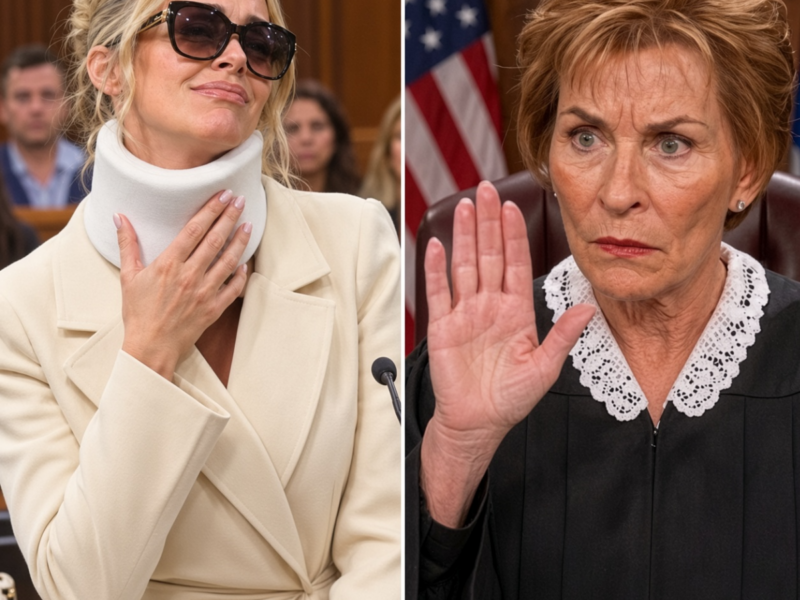
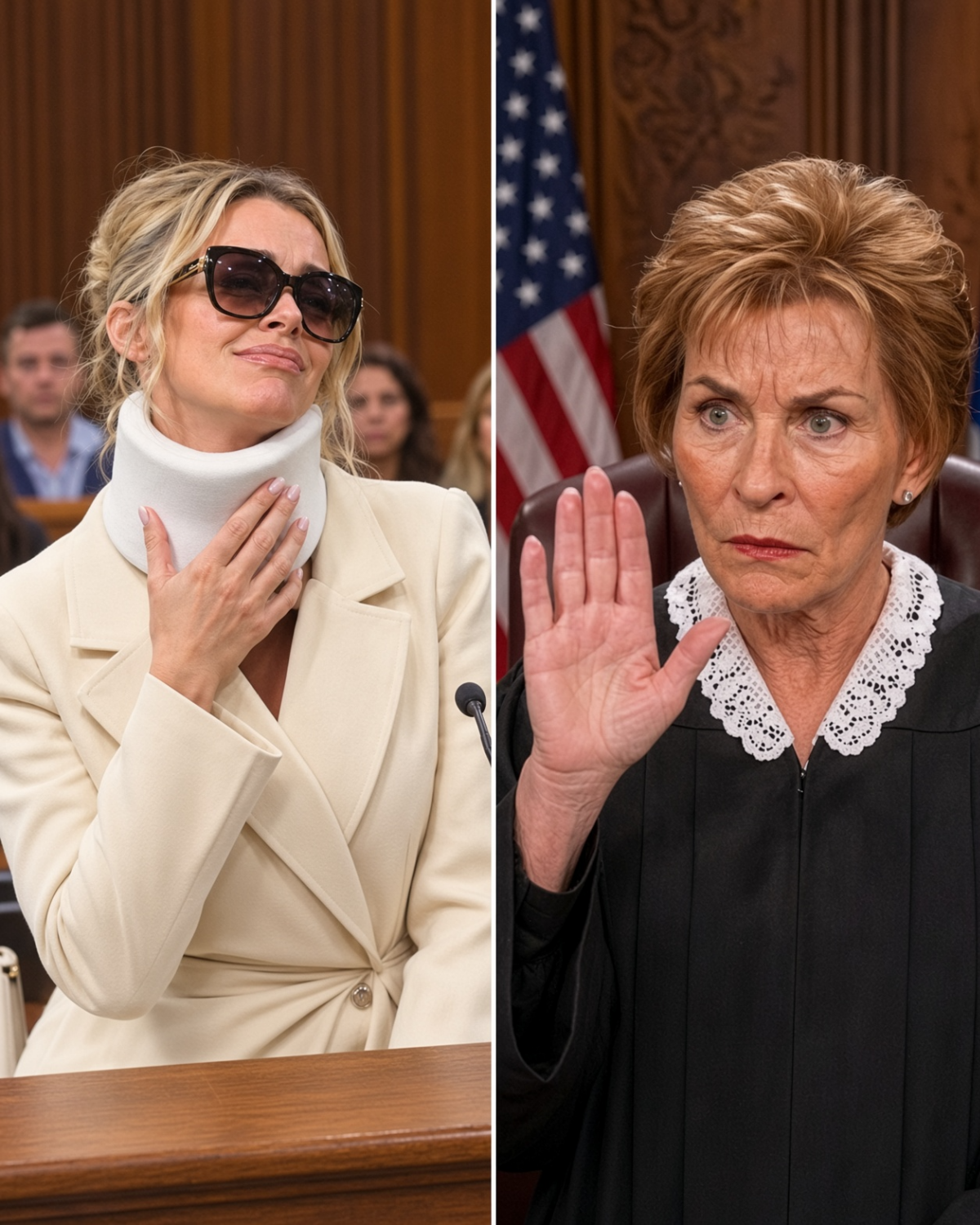
Karen wore oversized dark sunglasses indoors, a cream-colored designer coat that cost more than most people’s monthly rent, and a stiff white neck brace that looked almost too clean, too new, too perfectly placed, like a prop pulled fresh from the packaging.
Her steps were slow and theatrical. Each one came with a tiny wince, a micro-flinch, as if she wanted every person in the room to notice her pain.
But there was something strange about the way she moved. The limp came and went.
When she passed the gallery, she leaned heavily to one side, gripping the edge of a bench for support. But when she adjusted her handbag, she twisted at the waist without hesitation, smooth as a woman reaching for a latte.
When she thought no one was looking, her expression was not pained. It was satisfied. It was the expression of a woman who had already spent the money.
She was suing a small grocery store owner named Miguel Alvarez for $100,000.
According to Karen, she had walked into Alvarez Family Market on a rainy Tuesday afternoon, slipped on a wet floor, crashed to the ground, and suffered a severe back injury that destroyed her life overnight.
She claimed she could no longer walk normally, could not sleep, could not work, could not drive, could not enjoy even the simplest parts of her daily routine.
In her paperwork, she described herself as physically limited, emotionally devastated, and financially harmed beyond repair.
She used the word “devastated” four times in three pages. She used the word “agony” twice. She used the word “unbearable” so often that it started to feel like the opposite of what it meant.
Judge Judy had seen enough cases to know when suffering was real and when someone was performing suffering like a bad actress in a cheap community theater production of a legal drama.
She watched Karen before Karen ever spoke a word.
She watched the way Karen scanned the courtroom like a woman checking the exits. She watched the way Karen glanced at the cameras, then quickly away, as if she wanted to be famous but not caught wanting it.
She watched the way Karen’s mouth curled into a small smirk when Mr. Alvarez, the defendant, quietly arranged his papers with trembling hands.
Mr. Alvarez was the opposite of Karen in every possible way.
He was in his late sixties with tired eyes, rough hands, and the kind of posture that comes from spending forty years standing behind a counter.
He wore a simple gray suit that looked like it had been saved for weddings, funerals, and days like this. Days when a man’s entire reputation sat on a table in front of a judge.
He owned one small neighborhood grocery store, the kind of place where customers were greeted by name, where children were allowed to take a piece of candy from a jar near the register, and where families who were short a few dollars were told, “Pay me next time.”
He had built that store from nothing. He had stocked shelves at dawn, mopped floors at midnight, and learned English from the labels on the products he sold.
But Karen did not look at him like a man. She looked at him like an obstacle. She looked at him like a slot machine that had finally come loose from its bolts.
When the bailiff called the case, Karen lifted her chin, placed one hand dramatically against her neck brace, and stepped forward.
Mr. Alvarez stood more slowly, gathering his documents with nervous care.
Karen leaned toward the woman beside her and whispered just loud enough for the front row to hear, “This is easy money.”
A few people in the gallery shifted uncomfortably. Mr. Alvarez heard it too. His face dropped, but he said nothing.
Judge Judy heard it. Her eyes moved from the file to Karen. Not quickly, not dramatically, just enough to show that the first mistake had already been made.
Judge Judy adjusted her glasses and looked down at the complaint.
“Miss Whitmore,” she said, her voice calm but sharp enough to make the room sit straighter. “You are suing Mr. Alvarez for $100,000 because you claim you suffered a serious injury inside his store.”
Karen nodded slowly, as though every movement caused unbearable pain. “That is correct, Your Honor. My life has been completely ruined by his negligence.”
Mr. Alvarez looked up, startled by the word “ruined.” His lips parted, but before he could speak, Karen continued.
“I used to be very active. I had a career. I had a social life. I drove myself everywhere. Since the fall, I can barely get out of bed. I can’t sleep through the night. I can’t exercise. I can’t even carry groceries anymore, which is ironic considering his store is the reason I’m like this.”
Judge Judy did not blink. “And you say there was water on the floor?”
“A large puddle,” Karen said immediately. “No warning sign. No employee nearby. Nothing. It was completely unsafe.”
Mr. Alvarez raised his hands slightly. “Your Honor, that is not what happened.”
Karen rolled her eyes so openly that half the courtroom saw it. “Of course he’s going to say that.”
Judge Judy’s head turned. The room cooled by ten degrees.
Mr. Alvarez swallowed and tried again. “Your Honor, I am sorry she says she was hurt. I would never want anyone hurt in my store. But there was no puddle. There was no report that day. She did not tell anyone she fell. She bought her items and left.”
Karen let out a sharp, humorless laugh. “That’s ridiculous.”
Judge Judy’s gaze snapped back to her. “Did I ask you to speak?”
Karen’s lips pressed together, but the attitude remained. “I’m just saying, Your Honor. With all due respect, he owns a business. He has insurance. He can afford it.”
The courtroom went completely silent. Even the bailiff’s expression changed.
Judge Judy leaned back slowly, studying Karen as though she had just revealed the entire case without realizing it.
“He can afford it,” she repeated.
Karen shifted, suddenly aware that the sentence had landed badly. “I mean, that’s what insurance is for.”
“No,” Judge Judy said, leaning forward. “Insurance is not a jackpot for people who think a small business is an ATM. This is not a lottery, madam. This is a courtroom. If you came here looking for a payday instead of the truth, you came to the wrong place.”
A murmur moved through the gallery. Mr. Alvarez lowered his eyes, visibly emotional.
Karen, however, gave a tiny laugh under her breath. Not loud, not obvious, but enough.
Judge Judy heard that too. And that laugh became the first real signal that Karen Whitmore had no idea what was coming for her.
Judge Judy opened the medical file in front of her. Her eyes moved across the first page, then the second, then she stopped.
The courtroom seemed to hold its breath as her expression changed from irritation to something much colder.
She looked up slowly. “Miss Whitmore,” Judge Judy said, her voice quiet now. “Before we talk about your injury, I have one question.”
Karen’s smirk faded. The courtroom froze.
Karen stood there with one hand still pressed against her neck brace, trying to keep the same wounded expression on her face. But something had changed.
A few moments earlier, she had looked untouchable, like a woman who believed the courtroom was just a formality before the money arrived. Now, Judge Judy’s quiet words had cut through that confidence like a blade.
“Before we talk about your injury,” Judge Judy repeated, “I want to talk about your story.”
Karen blinked. “My story?”
“Yes,” Judge Judy said. “Because when someone asks this court for $100,000, I expect their story to stay the same for more than thirty seconds.”
The gallery murmured. Mr. Alvarez sat perfectly still, his hands folded over his documents. He looked less like a businessman defending himself and more like a tired grandfather praying someone would finally listen.
Judge Judy looked down at the complaint. “You wrote here that the incident happened at approximately 2:00 in the afternoon.”
Karen nodded quickly. “Yes, around then.”
Judge Judy lifted another page. “But in your insurance statement, you said it happened closer to 4:00.”
Karen’s mouth tightened. “Well, I was injured. I wasn’t exactly watching the clock.”
“Interesting,” Judge Judy said. “You remembered the emotional devastation, the financial harm, the exact amount of money you wanted, but not whether you fell at 2:00 or 4:00.”
A few people in the courtroom reacted quietly. Karen’s face flushed.
“It was a traumatic event,” Karen said. “People get confused after trauma.”
Judge Judy’s eyes narrowed. “People also get confused when they’re inventing details.”
Karen stiffened. “Excuse me?”
“You heard me.”
The room fell silent again.
Judge Judy turned to Mr. Alvarez. “Sir, did anyone report a fall in your store that day?”
Mr. Alvarez shook his head. “No, Your Honor. No one. Not an employee, not a customer. Not Miss Whitmore.”
Karen scoffed. “That’s not true. A cashier saw me.”
Judge Judy looked back at her. “What cashier?”
Karen hesitated. “A young man. Teenager, probably. Dark hair.”
Mr. Alvarez frowned. “Your Honor, I had no teenage cashier working that day. It was me, my daughter Elena, and Mrs. Patel in the back doing inventory.”
Karen threw up one hand, then immediately remembered her supposed pain and lowered it slowly. “Well, maybe he looked young. I don’t know. I was on the floor.”
Judge Judy leaned forward. “Were you?”
Karen froze. “Was I what?”
“On the floor.”
“Of course I was.”
“For how long?”
Karen looked annoyed. “I don’t know. A few minutes.”
Judge Judy turned another page. “In your written claim, you said you lay there for nearly fifteen minutes screaming for help.”
Karen swallowed. “It felt like fifteen minutes. But now it was a few minutes. I was in pain.”
“And yet no one heard you scream.”
Karen’s voice sharpened. “Maybe they ignored me.”
Mr. Alvarez flinched at that, as if the accusation hurt more than the lawsuit. Judge Judy noticed.
“You should be careful,” she said coldly. “Accusing a man of ignoring an injured customer is a serious thing, especially when you have not yet proven there was an injury, a fall, or a puddle.”
Karen’s confidence began to crack, but her arrogance rushed in to cover it. “Your Honor, I didn’t come here to be interrogated. I came here because I was injured.”
Judge Judy did not move. “You came here asking for $100,000. That means you brought the interrogation with you.”
The gallery stirred again. Karen looked toward her friend, but her friend was now staring down at the floor.
Judge Judy turned to Mr. Alvarez. “Do you have the store incident report?”
“Yes, Your Honor.”
His hands trembled slightly as he passed the paper to the bailiff.
Judge Judy read aloud. “No fall reported on the date in question. No wet floor documented. No employee witness. Customer returned three days later claiming injury.”
She looked up. “Three days later, Miss Whitmore.”
Karen lifted her chin. “I was trying to be kind. I didn’t want to make a scene.”
Judge Judy’s expression hardened. “You didn’t want to make a scene, but now you want $100,000.”
Karen said nothing.
Judge Judy continued. “And according to this, when you returned three days later, you did not ask for medical help. You asked for the store’s insurance information.”
Karen snapped. “Because I knew my rights.”
“No,” Judge Judy said. “You knew there might be money.”
That landed hard.
Mr. Alvarez’s eyes watered, though he quickly looked down. Karen saw it and rolled her eyes again as if his emotion annoyed her.
Judge Judy’s voice turned icy. “Roll your eyes one more time, and you will find out how little patience I have for bad manners and worse evidence.”
Karen’s lips parted, but no words came out. For the first time, she looked uncertain.
Then Judge Judy reached for the medical records. The sound of paper turning seemed louder than it should have been.
She scanned the first page, her brow lifted slightly, then she paused on one line.
“Miss Whitmore,” she said slowly. “According to your first doctor’s note, you walked into the clinic without assistance.”
Karen’s face tightened.
Judge Judy looked over her glasses. “No cane, no brace, no limp documented.”
The courtroom froze again. Karen’s wounded expression disappeared for half a second. And Judge Judy saw it.
Karen Whitmore stood frozen for half a second too long.
It was not much, just a tiny pause, the kind most people might miss. But Judge Judy did not miss it.
She had built an entire career on noticing the split second when confidence becomes calculation, when a liar stops performing and starts searching for an escape.
Karen’s hand remained pressed against the side of her neck brace, but her eyes had changed. The outrage was still there. The entitlement was still there. But underneath it now was something sharper.
Fear.
Judge Judy looked back down at the medical report. Her voice was steady, almost quiet, which somehow made the words hit harder.
“The doctor’s note says you walked into the clinic without assistance. No cane, no wheelchair, no visible difficulty walking. No swelling, no bruising, no emergency distress. That is what your own medical record says.”
Karen’s lips parted. “That doctor barely looked at me.”
Judge Judy lifted her eyes. “Barely looked at you?”
“Yes,” Karen said quickly, sensing a possible escape and grabbing it. “He rushed the appointment. Doctors do that all the time. They don’t listen to women. I was in serious pain and he dismissed me.”
There was a small murmur from the gallery, but Judge Judy raised one finger and the room fell silent.
“Miss Whitmore,” she said, “I am not here to debate the entire medical profession with you. I am here to determine whether Mr. Alvarez owes you $100,000 because you allegedly suffered a severe injury inside his grocery store.”
Karen nodded, trying to regain control. “Exactly. And I did.”
“Then why,” Judge Judy said, tapping the report with her finger, “did you refuse X-rays?”
Karen blinked. Mr. Alvarez looked up.
Judge Judy read from the file. “Patient declined imaging. Patient declined referral for emergency evaluation. Patient requested written documentation for insurance purposes.”
She paused and looked over her glasses. “That is unusual, isn’t it?”
Karen shook her head. “No, I was scared. I don’t like hospitals.”
“You don’t like hospitals?” Judge Judy repeated. “But you like lawsuits?”
Karen’s face reddened. “That’s not fair.”
“What’s not fair?” Judge Judy snapped. “Is dragging a small business owner into court with a claim for $100,000 while your own paperwork says you declined the very tests that could have supported your case.”
Karen shifted her weight. For a woman claiming she could barely stand, she moved surprisingly quickly, then seemed to remember herself and let out a soft theatrical groan.
Judge Judy saw that too.
Mr. Alvarez sat quietly holding the edge of the table. His daughter Elena sat behind him in the gallery, her hands clasped tightly in her lap.
She had grown up inside that grocery store. She had stocked shelves after school, helped elderly customers carry bags to their cars, translated bills for her father when the paperwork got complicated.
To Karen, Alvarez Family Market was a target. To Elena, it was her father’s life.
Judge Judy turned another page. “You claim here that you could not sleep after the accident.”
“That’s right,” Karen said. “The pain was unbearable.”
“You claim you could not drive.”
“Yes.”
“You claim you could not walk without assistance.”
“Yes.”
“You claim you could not lift anything heavier than a purse.”
Karen nodded, now becoming cautious. “That’s what my pain felt like.”
Judge Judy leaned back. “Your pain felt like that?”
“I mean, that was my condition.”
“Your condition,” Judge Judy said, “appears to change depending on who is asking the question.”
Karen’s jaw tightened. “I am not a liar.”
“I didn’t call you a liar,” Judge Judy said. “Not yet.”
The courtroom went still. Karen looked away.
Judge Judy turned to Mr. Alvarez. “Sir, do you have the receipts from the day Miss Whitmore says this life-altering injury occurred?”
Mr. Alvarez nodded. “Yes, Your Honor.”
He passed a small stack of papers to the bailiff, who handed them to the bench.
Judge Judy took them, glanced through the first receipt, and her eyebrows rose just enough to make the gallery lean forward.
“Miss Whitmore,” Judge Judy said, “after this alleged fall, did you purchase items from Mr. Alvarez’s store?”
Karen hesitated. “I may have. I was shaken. I don’t remember every little thing.”
Judge Judy held up the receipt. “Let me help your memory. You purchased two bottles of wine, a case of sparkling water, a jar of imported olives, and a twenty-pound bag of dog food.”
A ripple moved through the courtroom. Karen’s face hardened. “So?”
“So,” Judge Judy repeated, “you are telling this court you suffered a serious back injury so severe that you could not sleep, drive, walk, work, or lift ordinary household items. But immediately after this alleged injury, you continued shopping.”
“I was in shock,” Karen said.
“You were in shock,” Judge Judy said, “but still selective enough to choose imported olives.”
A few people in the gallery reacted before catching themselves. Karen glared toward them.
Judge Judy continued. “And you carried these items out.”
“No,” Karen said quickly. “Someone helped me.”
Mr. Alvarez shook his head. “No, Your Honor. She carried them herself.”
Karen snapped toward him. “You don’t remember that.”
Mr. Alvarez’s voice remained quiet. “I remember because the dog food was on the bottom shelf. She bent down to get it.”
The gallery stirred louder this time. Elena covered her mouth.
Karen gave a sharp laugh. “That’s absurd. He’s making that up because he doesn’t want to pay.”
Judge Judy’s voice cut through the room. “Stop saying he doesn’t want to pay. As if that proves anything. Nobody wants to pay a false claim. That doesn’t make them guilty. It makes them sane.”
Karen’s eyes flashed. “It wasn’t false.”
Judge Judy looked down at the receipt again. “Did you bend down to pick up the dog food?”
Karen shook her head. “No.”
“Did someone put it in your cart?”
“Yes.”
“Who?”
Karen opened her mouth, then closed it. “I don’t know. An employee.”
Mr. Alvarez leaned forward. “Your Honor, we do not have carts. Only hand baskets.”
The room went silent.
Judge Judy slowly turned her head back toward Karen.
Karen blinked fast. “I meant basket. I was using the word generally.”
“No,” Judge Judy said. “You were using the word desperately.”
Karen’s confidence was shrinking by the second, but she was not finished fighting. Entitled people rarely surrender when truth first appears. They attack the person holding it.
“This is ridiculous,” Karen said, her voice rising. “I am the victim here. I was humiliated. I was hurt. I had to deal with pain because his store was unsafe.”
Judge Judy lowered the receipt. “Then why didn’t you call 911?”
“I told you, I don’t like hospitals.”
“Why didn’t you tell Mr. Alvarez you fell?”
“I was embarrassed.”
“Why didn’t you report it until three days later?”
“I was trying to process what happened.”
“Why did you ask for insurance information before asking for medical help?”
Karen’s mouth opened, but no answer came.
Judge Judy leaned forward. “That one is harder, isn’t it?”
Karen’s face flushed deeper. “I knew I had a claim.”
“Yes,” Judge Judy said. “That much is becoming very clear.”
Mr. Alvarez lowered his head. For the first time, the courtroom could see the exhaustion on his face.
This lawsuit had not just been paperwork to him. It had been months of fear, months of wondering whether the store he built from nothing would survive.
Months of being treated like a villain by a woman who had walked into his business and then walked back out with groceries in her arms.
Judge Judy looked at him. “Mr. Alvarez, did your insurance company investigate this?”
“Yes, Your Honor,” he said softly. “They asked me for everything. Reports, schedules, photos, video. They said if the claim went badly, my rates could go very high. I was scared. My store is small. We are not rich people.”
Karen rolled her eyes again, but this time she tried to hide it.
Judge Judy did not even look directly at her before speaking. “Miss Whitmore, I warned you.”
Karen froze.
Judge Judy turned slowly. “Do you find his fear amusing?”
“No,” Karen said quickly.
“Then fix your face.”
The courtroom fell into a heavy silence.
Judge Judy reached for another page in the file. “Now, according to your complaint, you say that from the moment you fell, you were unable to move normally.”
“That’s correct,” Karen said, though her voice had lost some of its force.
“You say you had immediate pain?”
“Yes.”
“You say the injury began inside the store?”
“Yes.”
“And you say you were visibly struggling when you left?”
“Yes.”
Judge Judy looked at Mr. Alvarez. “Do you have anything that shows her leaving the store?”
Mr. Alvarez looked nervous. “Yes, Your Honor. We have security video.”
Karen’s head snapped toward him. For the first time since walking into the courtroom, her expression was not smug, irritated, or offended. It was alarmed.
Judge Judy noticed. The gallery noticed. Even Karen’s friend noticed.
Karen forced a laugh. “If there was video, they would have shown it already.”
Judge Judy did not smile. “Maybe they were waiting for you to finish lying first.”
Karen’s mouth fell open.
Judge Judy looked to the bailiff. “Set up the video.”
The courtroom seemed to tighten around Karen. The monitor was turned so everyone could see.
Mr. Alvarez kept his eyes down as if he did not enjoy what was about to happen. Elena leaned forward, holding her breath.
Karen adjusted her neck brace with trembling fingers. The footage began.
There she was. Karen Whitmore, walking into Alvarez Family Market on the afternoon in question.
No limp, no brace, no hesitation. She moved smoothly through the entrance.
Sunglasses pushed up on her head, phone in one hand, handbag on her shoulder. She stopped near the produce section, checked a message, laughed at something on her screen, and continued down the aisle.
Judge Judy watched without expression. Karen stared at the monitor like it had betrayed her personally.
The footage showed her walking past a clearly dry floor. No puddle, no water trail, no fallen sign, nothing.
Then came the moment that made the entire courtroom lean forward.
Karen entered the aisle where she claimed her life had been destroyed. She paused, looked around, and glanced toward the ceiling. Toward the camera.
Judge Judy leaned forward slightly. Karen’s face went pale.
The video kept rolling.
Karen moved a few steps deeper into the aisle. There was no rushing customer behind her, no employee pushing a cart, no wet floor sign missing from a dangerous puddle, no sudden slip.
Instead, she paused again, adjusted her handbag, bent her knees slightly, and lowered herself toward the floor in a slow, controlled motion.
The gallery gasped. Mr. Alvarez closed his eyes. Elena, his daughter, began to cry quietly behind him.
Karen hit the tile lightly, not with the violent crash she had described, but with the caution of someone sitting down in an uncomfortable place.
Then she looked around again.
Only after several seconds did she place one hand against her back and open her mouth as though preparing to call for help. But she did not scream. She did not writhe in pain. She did not appear trapped, injured, or confused.
She simply waited.
Judge Judy finally paused the video.
The still image showed Karen lying on the floor, one elbow propping her up, her face turned not toward the supposed puddle, not toward help, but toward the end of the aisle.
Judge Judy slowly turned to her. “That was your fall.”
Karen’s face was red now. “I lost my balance.”
“You lost your balance in slow motion?”
“I was trying to protect myself.”
Judge Judy leaned forward. “People who slip do not check for witnesses first.”
A low murmur spread through the courtroom.
Karen’s voice rose. “You don’t know what I was thinking. I was scared.”
“No,” Judge Judy said sharply. “You were calculating. There is a difference.”
Karen shook her head, but the confidence was gone. Her neck brace, once the centerpiece of her performance, suddenly looked absurd beneath the courtroom lights.
Judge Judy pressed play again.
The footage continued. After nearly a minute on the floor, Karen slowly stood up by herself.
She did not grab a shelf. She did not cry out. She did not limp. She brushed off her coat, picked up her handbag, looked around, and continued shopping.
This time, the gallery’s reaction was louder.
Judge Judy paused the video again. “Miss Whitmore, you testified that after this fall, you could barely move.”
Karen swallowed. “Adrenaline.”
“Adrenaline,” Judge Judy repeated. “That magical substance that allows people with supposedly destroyed backs to finish grocery shopping.”
Karen glared. “I was trying to get home.”
“By purchasing wine, olives, sparkling water, and dog food.”
Karen’s mouth opened, but nothing came out.
Mr. Alvarez finally spoke, his voice thick with emotion. “Your Honor, she did not say anything to me. She came to the register. She paid. She smiled. She left. Three days later, I got a letter saying she was hurt in my store and wanted insurance.”
Judge Judy looked at him. “And what happened after that?”
He breathed in slowly. “My insurance company started asking questions. My rates were under review. People in the neighborhood heard rumors that my store was unsafe. Some customers stopped coming. My daughter cried because she thought we would lose everything.”
Elena wiped her face quickly, embarrassed by her tears.
Karen looked irritated. “That is not my fault.”
Judge Judy’s head snapped toward her. “Not your fault?”
Karen lifted her chin, trying to summon the old arrogance. “If his store had better cameras and better safety policies, none of this would be happening.”
The room went cold.
Judge Judy stared at her for a long moment. “Better cameras are exactly why this is happening.”
The gallery reacted again. Karen looked away.
Judge Judy’s voice hardened. “You tried to turn a hardworking man’s business into your personal payday. You thought because he had insurance, because he was quiet, because he was nervous, that he would fold. But you made one mistake.”
Karen’s lips trembled. “What mistake?”
“You assumed no one would look closely.”
The words landed heavily.
Then Judge Judy turned to the bailiff. “Is there more?”
Mr. Alvarez nodded before the bailiff could answer. “Yes, Your Honor. My daughter found something.”
Karen’s eyes flicked toward Elena.
Elena stood slowly from the gallery holding a printed stack of pages. Her hands were shaking, but her voice was clear.
“After the claim came in, I searched online. I didn’t want to, but I was scared. And I found her public social media posts.”
Karen snapped. “You stalked me.”
Judge Judy barked. “Sit down and stop talking.”
Karen sat.
Elena handed the pages forward. Judge Judy took them and looked at the first printout. Her expression changed almost instantly.
“Miss Whitmore,” Judge Judy said. “You claim that two days after this incident, you could not stand without pain.”
Karen’s voice was small now. “Yes.”
Judge Judy held up the photo. “Then why are you dancing at a rooftop party in high heels?”
The courtroom exploded in gasps.
Karen shook her head violently. “That’s an old picture.”
Judge Judy turned the page. “It is dated two days after the alleged fall.”
“People post old photos all the time.”
Judge Judy looked again. “The caption says, ‘Still unstoppable.'”
Karen blinked.
“And in the background,” Judge Judy continued, “there is a weather alert on the television for the storm that hit the city that exact evening.”
Karen’s mouth opened, then closed.
Judge Judy was not done. She turned another page. “Here you are holding a champagne glass.”
“That doesn’t mean I was dancing.”
“The previous photo means you were dancing.”
Karen’s friend lowered her head.
Judge Judy turned another page and paused. This pause was different. Slower, colder.
The gallery felt it. Karen felt it.
Judge Judy looked up over her glasses. “Miss Whitmore, would you like to explain why a woman with a destroyed back was riding a mechanical bull three days after the accident?”
The courtroom erupted.
Karen went pale. Mr. Alvarez stared at the table, overwhelmed, while Elena covered her face and cried harder.
For months, her father had been treated like a careless business owner. For months, Karen’s accusation had hung over their family like a storm cloud.
And now, piece by piece, the storm was turning back on the woman who created it.
Karen’s voice cracked. “It was a joke.”
Judge Judy leaned forward. “The injury or the lawsuit?”
Karen had no answer.
Judge Judy held the photo in the air. “You came into this courtroom with sunglasses, a neck brace, and a limp. But on this page, three days after your so-called life-changing injury, you are laughing on a mechanical bull.”
Karen whispered, “I can explain.”
Judge Judy’s eyes narrowed. “I sincerely doubt that.”
Judge Judy placed the social media photos on top of the medical records, then looked at Karen with the calm of someone who already knew the ending.
“Now,” she said, “we are getting to the question that exposes everything.”
Karen Whitmore’s face had changed completely.
The woman who had entered the courtroom with sunglasses, a neck brace, and a smirk now looked trapped inside her own performance.
Her hand kept drifting toward the brace as if it could still protect her, as if a piece of foam and Velcro could somehow hold together a story that was falling apart in front of everyone.
But the photos were on the bench. The medical records were on the bench. The receipt was on the bench. The security footage had already played.
And every piece of evidence pointed in the same direction.
Judge Judy leaned back and let the silence do its work.
Karen tried to fill it. “Your Honor, those pictures don’t prove what you think they prove.”
Judge Judy raised an eyebrow. “They prove you were standing.”
“I can stand sometimes.”
“They prove you were wearing high heels.”
“I was only wearing them for the photo.”
“They prove you were at a party.”
“I was trying to keep my spirits up.”
“They prove you were riding a mechanical bull.”
Karen swallowed hard. “It was barely moving.”
The gallery reacted instantly. A few people gasped. Someone whispered, “Unbelievable.”
Mr. Alvarez looked down at his hands, shaking his head like he could not understand how anyone could lie this easily when another person’s life and business were at stake.
Judge Judy’s expression hardened. “Miss Whitmore, do you hear yourself?”
Karen’s eyes filled, but the tears did not look like pain. They looked like panic.
“I was injured,” Karen insisted. “Maybe I tried to act normal because I didn’t want people to know how much pain I was in.”
Judge Judy tapped one finger against the file. “You didn’t want people to know you were in pain, but you wanted an insurance company, a small business owner, and this court to know you were in pain to the tune of $100,000.”
Karen shook her head. “You’re twisting my words.”
“No,” Judge Judy snapped. “Your words are twisting themselves.”
The courtroom went still again.
Judge Judy looked down at the complaint. “Let us be very clear. You are telling this court that from the moment you allegedly fell inside Mr. Alvarez’s store, your back injury was severe.”
“Yes,” Karen said weakly.
“You could not bend.”
“Yes.”
“You could not twist.”
“Yes.”
“You could not lift.”
“Yes.”
“You could not walk normally.”
“Yes.”
“You could not exercise.”
Karen hesitated. “Not without pain.”
Judge Judy leaned forward. “That is not what your lawsuit says. Your lawsuit says you were physically unable.”
Karen looked toward her friend again, but her friend would not meet her eyes.
Judge Judy continued. “So I want you to answer carefully. Since the alleged fall, have you participated in any physical activity?”
Karen blinked. “No. None.”
“No dancing.”
Karen’s jaw tightened. “Not really.”
“No mechanical bull.”
“That was not serious physical activity.”
“No running.”
Karen froze.
The silence that followed was different from all the others. It was heavier, sharper.
It felt like the whole room suddenly understood that Judge Judy was not asking randomly. She had been walking Karen toward a cliff, one question at a time.
Karen tried to recover. “I don’t run. I mean, not since the accident.”
Judge Judy slowly picked up a final document from the file. “That is fascinating.”
Karen’s breathing changed.
Judge Judy held the paper in front of her. “Because this is a signed waiver for a charity 5K race.”
Karen’s lips parted.
Judge Judy continued, her voice calm and devastating. “Dated the morning after the alleged injury.”
The gallery erupted in whispers.
Judge Judy raised the paper slightly. “And on this waiver, in your own handwriting, you certified that you were participating voluntarily and that you were, and I quote, ‘in perfect physical health.'”
Karen’s face went pale.
Judge Judy looked directly at her. “Miss Whitmore, if your back was destroyed in Mr. Alvarez’s store, why did you sign a race waiver the next morning saying you were in perfect physical health?”
The courtroom froze.
That was the question. Not loud, not dramatic, not complicated. Just one clean question placed exactly where Karen’s lie could not survive it.
Karen opened her mouth, but no sound came out.
Judge Judy waited. Mr. Alvarez slowly lifted his eyes. Elena covered her mouth.
Karen finally whispered, “I forgot.”
Judge Judy stared at her. “You forgot you ran a race.”
“I didn’t run the whole thing.”
Judge Judy lifted another page. “This is a photo from the event website. Is that you crossing the finish line?”
Karen’s eyes moved to the image.
There she was, smiling, both arms in the air. No brace, no limp, no visible pain. Wearing running shoes and a race number pinned to her shirt.
Karen’s voice cracked. “It was for charity.”
Judge Judy leaned forward. “Charity does not heal a destroyed spine.”
The gallery murmured again.
Karen’s tears started then, not gently, but suddenly, as if the last wall of her performance had collapsed.
“I was under stress,” she said. “I made a mistake. I didn’t think it would go this far.”
Mr. Alvarez looked up sharply at those words.
Judge Judy caught them immediately. “You didn’t think what would go this far?”
Karen wiped at her face. “I mean the case. The insurance. Everything.”
Judge Judy’s voice turned cold. “No, Miss Whitmore. What you mean is that you thought Mr. Alvarez would be frightened into settling before anyone checked the facts.”
Karen sobbed harder. “I’m sorry.”
Judge Judy did not soften. “You are not sorry you lied. You are sorry the lie had a receipt, a video, medical records, party photos, and a race waiver.”
Karen lowered her head.
Judge Judy placed the document on top of the others. “You didn’t come here injured,” she said. “You came here greedy. You saw a hardworking man with a small business and decided his insurance policy was your personal ATM.”
Mr. Alvarez’s eyes filled with tears.
Karen whispered again. “I’m sorry.”
Judge Judy’s gaze did not move. “Now,” she said, reaching for the final folder, “we are going to discuss what a lie costs when it walks into my courtroom.”
The courtroom sat in stunned silence as Judge Judy placed the race waiver on top of the evidence pile.
Karen Whitmore stood with her head lowered, tears streaking down her face, but no one in the room seemed moved by them anymore.
The tears had come too late. They had not appeared when Mr. Alvarez described nearly losing his store. They had not appeared when his daughter cried in the gallery.
They had appeared only when Karen realized the $100,000 she came to collect had turned into something far more dangerous.
Judge Judy looked at her coldly. “Your claim is dismissed.”
Karen’s shoulders shook. “Please, Your Honor.”
“No,” Judge Judy snapped. “You had your chance to tell the truth. Instead, you brought props.”
The gallery went silent again.
Judge Judy continued. “A neck brace is not evidence. Sunglasses are not evidence. A fake limp is not evidence. Evidence is a medical record. Evidence is a receipt. Evidence is video. Evidence is a race waiver signed by your own hand.”
Karen wiped her face, barely able to speak. “I can’t afford to pay anything.”
Judge Judy leaned forward. “Then you should not have tried to steal from a man who could afford it even less.”
Mr. Alvarez closed his eyes, overcome.
His daughter Elena put a hand over her mouth, tears falling freely now.
Judge Judy turned to him. “Mr. Alvarez, your counterclaim for documented expenses, lost time, and costs related to defending this false claim is granted.”
Karen looked up in horror. “Counterclaim?”
Judge Judy’s eyes flashed. “Yes, madam. The part of the case you ignored because you were too busy planning your payday.”
Karen began sobbing harder.
But Mr. Alvarez did not smile. He did not celebrate. He simply whispered, “I just wanted the truth.”
That sentence changed the room. Because this had never really been about money for him.
It was about his name, his business, his family, and the years of honest work Karen had tried to damage with one fake fall.
Judge Judy looked back at Karen. “A courtroom is not a casino. You don’t walk in with a fake story and hope truth doesn’t show up. Because it always does.”
Karen nodded weakly.
As she turned to leave, something strange happened.
The limp vanished. No dramatic pause, no hand against the wall, no painful steps. She walked normally toward the exit.
Judge Judy watched her go. Then came the final line.
“Interesting,” she said. “Justice appears to be the best medicine.”
The courtroom erupted.
Mr. Alvarez lowered his head as Elena rushed forward and hugged him. For months, their family had lived under fear. In one afternoon, the truth gave them their dignity back.
Karen walked in expecting easy money. She walked out as a warning.
Lies may enter a courtroom wearing confidence, but truth always leaves with the verdict.
The cameras kept rolling as the gallery emptied, as Mr. Alvarez shook hands with strangers who had watched his vindication, as Elena wiped her eyes and laughed at something her father whispered.
Karen Whitmore disappeared through the double doors without looking back.
The neck brace was gone. The sunglasses were gone. The limp was gone.
What remained was the paperwork, the evidence, and the number that would follow her for a long time: $100,000.
The amount she tried to steal. The amount she would now have to repay.
And somewhere in the back of the courtroom, the man with the soft pretzel finished his snack, folded his napkin, and said to no one in particular, “Best show in town.”