A Lonely Marine Had One Place He Called Home—Until a Young Woman Put Up a Closing Sign…
Laurel Fenley had heard those words before, but they still hurt.
The man standing across from her had once promised to build a life with her. Now he was offering to save the diner her mother had spent thirty years building, provided Laurel agreed to a price that had very little to do with money.
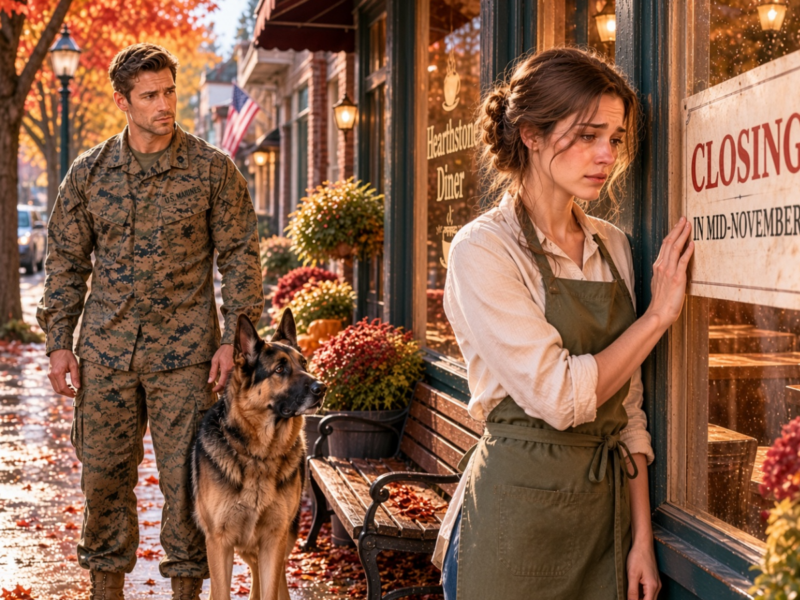
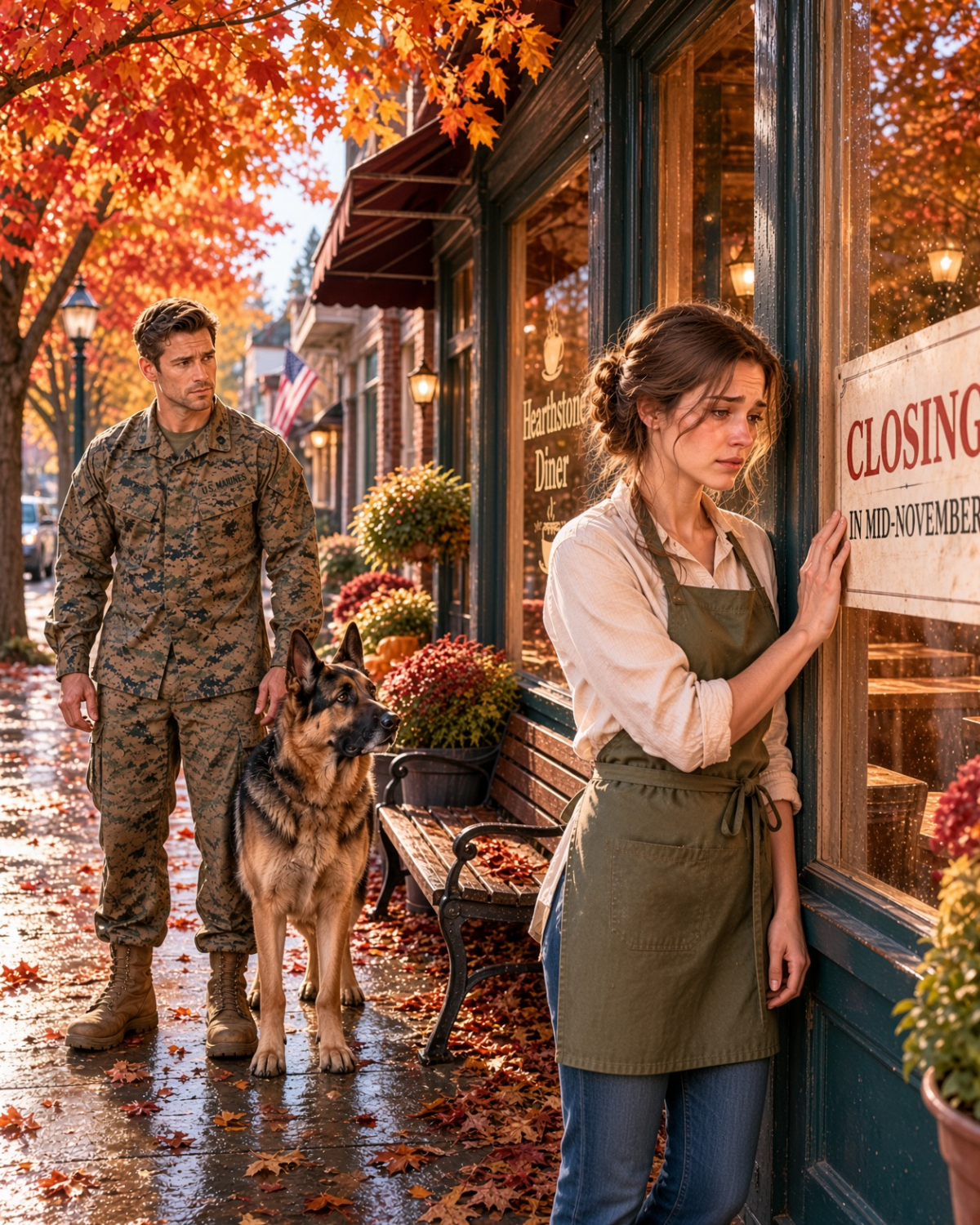
Outside, late October rain swept through Yellow Springs, Ohio. Red maple leaves clung to the windows of Hearthstone Diner, where a handwritten notice announced that the doors would close in mid-November.
At the window table, a retired Marine sat with a German Shepherd beside him, unaware that the little diner he had called home for nearly a year was about to disappear.
He had already lost one life he thought would last forever.
He wasn’t prepared to watch another one disappear without trying to save it.
But neither he nor the exhausted young woman behind the counter understood that the next few weeks would test everything they believed about love, loyalty, and starting over.
And the most important thing they would discover had nothing to do with saving a building.
It had to do with learning when to let something change.
Before we begin, where are you watching from today? Share your location in the comments, and afterward, tell us what this story meant to you.
Thank you for being here.
The rain had started before sunrise.
By seven thirty that Friday morning, the sidewalks along Xenia Avenue in Yellow Springs were dark with water, and the small storefronts along the street reflected the gray October sky.
A delivery truck rolled past the intersection.
Someone hurried beneath a blue umbrella, holding a paper coffee cup against their chest.
Inside Hearthstone Diner, the smell of fresh coffee and yesterday’s cinnamon still lingered.
Merrick Dalloway stopped outside the entrance.
At thirty-nine, the former Marine Staff Sergeant was a broad-shouldered man with close-cropped brown hair, a weathered face, and a slight stiffness in his left knee.
He wore a dark canvas jacket and carried a small toolbox.
Beside him walked Bryer, his eight-year-old black-and-tan German Shepherd.
Bryer had spent years as a military patrol and explosives-detection K9 before retiring from service.
He was healthy, well-trained, and remarkably calm for a dog whose younger years had been spent in demanding environments.
Merrick had brought him home after retirement, and the two had gradually learned how to live without the routines that had once defined their days.
Every Friday morning, they visited Hearthstone.
Merrick ordered two eggs, toast, and black coffee.
Bryer rested in a designated private staff room behind the dining area, away from food preparation and customer service.
It was a routine neither had any intention of changing.
Until that morning.
A white sheet of paper had been taped to the front window.
CLOSING IN MID-NOVEMBER.
Merrick read it once.
Then again.
He looked through the glass.
The familiar table beside the window was empty.
Behind the counter, Laurel Fenley was counting bills with one hand while holding a pencil between her teeth.
At thirty, she had chestnut hair usually tied loosely behind her head, warm brown eyes, and a smile that had once made customers feel like regulars after a single visit.
That smile had become increasingly rare.
Her mother, Evelyn Fenley, had owned Hearthstone for thirty years.
When Evelyn passed away, Laurel inherited the diner, its aging equipment, its loyal customers, and a collection of financial obligations that had grown steadily more difficult to manage.
She had also inherited her mother’s handwritten recipe book.
It sat on a shelf behind the counter, its brown leather cover worn smooth around the edges.
Laurel looked up when the door opened.
“Morning, Merrick.”
“Morning.”
He glanced toward the notice.
“You’re closing?”
Laurel removed the pencil from her mouth.
“In a couple of weeks, unless something changes.”
Merrick looked at the paper again.
“How long have you known?”
“Long enough to stop pretending the numbers are going to improve.”
He walked toward his usual table.
The chair wobbled when he pulled it out.
He steadied it with one hand.
“What’s happened?”
Laurel placed the bills into the register.
“Everything costs more. Food, electricity, insurance, repairs. And fewer people are coming in during the afternoon.”
“Have you tried changing the hours?”
“I’ve tried changing almost everything.”
She glanced toward the kitchen.
“The refrigerator under the counter stopped working. The dishwasher needs attention. One of the ovens has been temperamental for months. I paid for repairs twice, and now the contractor says there’s another problem.”
Merrick examined the room.
A cabinet door hung crookedly.
One chair leaned slightly to the left.
A section of the counter had been patched with a different shade of laminate.
Hearthstone wasn’t dirty or neglected.
It simply looked tired.
Like someone who had been trying to stay awake for too many nights.
“How much do you owe on the repairs?” he asked.
Laurel hesitated.
“Enough.”
“That’s not a number.”
“It’s also not your problem.”
Merrick pulled out the chair.
“I can fix some of this.”
She shook her head.
“I can’t afford another contractor.”
“I’m a maintenance contractor.”
“I know.”
“Then let me inspect what needs doing. I’ll give you a price, and we can agree on payments.”
Laurel studied him.
“Why?”
He looked confused.
“Why what?”
“Why would you spend your time fixing a diner that’s closing?”
Merrick glanced toward the window.
The table beside it had become his regular place almost a year earlier.
Back then, he had recently returned from a long period of adjusting to civilian life.
His knee injury had ended the kind of military work he once expected to do indefinitely.
His marriage had ended not long afterward.
He had spent several months moving between maintenance jobs, repairing houses and small businesses while trying to figure out what his life was supposed to look like.
Hearthstone had become one of the few places where nobody asked him to explain himself.
Evelyn had simply remembered his coffee.
Laurel had remembered his eggs.
And Bryer had been given a quiet room where he could rest.
“Because this place matters,” Merrick answered.
Laurel lowered her eyes.
“That doesn’t mean it can survive.”
“No. But we can find out what’s actually wrong before deciding it can’t.”
For several seconds, she said nothing.
Then she reached beneath the counter and pulled out a small notebook.
“Fine. But I’m writing down every expense.”
“Good.”
“And I’m paying you.”
“That’s what contractors usually do.”
She almost smiled.
It was the first time that morning her expression had softened.
Neither of them realized that the simple agreement would become the first promise they would have to keep.
That evening, Merrick returned after closing.
He brought his toolbox, a measuring tape, and a list of repairs he could safely handle.
Laurel had prepared a small pot of coffee.
“You don’t have to stay all night,” she said.
“I’m not planning to.”
“That’s what people say before they stay all night.”
He placed his toolbox beside the crooked cabinet.
“Then I’ll try not to disappoint you.”
She laughed quietly.
It was a small sound, but Merrick noticed.
He started with the loose chairs.
Two needed tightening.
One required a replacement bracket.
The cabinet hinges were inexpensive, and the damaged drawer could be repaired without replacing the entire unit.
He made a separate list of electrical and appliance concerns that required licensed professionals.
Laurel watched him work while updating her expense notebook.
“You’re very organized.”
“Military habit.”
“Does the military teach you how to fix everything?”
“No. Mostly how to make a list of things you can’t fix.”
She looked at him.
“That’s unexpectedly depressing.”
“It’s also accurate.”
Over the next two evenings, Merrick returned.
He repaired chairs, replaced cabinet hinges, and helped reorganize the storage area so Laurel could prepare takeaway orders more efficiently.
He also suggested moving a small shelf closer to the entrance.
That would give customers collecting pre-ordered breakfasts a place to wait without crowding the dining area.
Laurel questioned the measurements twice.
Merrick adjusted them.
She recorded the cost of every screw and replacement part.
By Wednesday evening, the diner looked slightly different.
Not new.
Not renovated.
But cared for.
Merrick was tightening the final screw on a chair when pain traveled through his left knee.
He straightened too quickly and gripped the backrest.
Laurel noticed.
“Sit down.”
“I’m fine.”
“That’s not what I asked.”
He looked at her.
She pointed toward the nearest chair.
“You’re allowed to sit, you know.”
Merrick almost smiled.
“Yes, ma’am.”
“Don’t ma’am me.”
She brought him a glass of water.
He sat.
For a moment, he looked uncomfortable being on the receiving end of someone else’s concern.
Laurel recognized the expression.
She had worn it herself for months.
“You tell everyone else when something needs fixing,” she said. “Does that rule not apply to you?”
Merrick looked down at his knee.
“Apparently, I have a very difficult customer.”
“You’re welcome.”
He laughed.
And somewhere between the repaired chair and the cooling coffee, something changed.
They stopped feeling like a struggling business owner and a hired contractor.
They started feeling like two people who had discovered that the other understood more than they expected.
But Hearthstone’s problems were not limited to loose hinges and broken appliances.
The next afternoon, a polished black sedan stopped outside.
A man stepped out wearing an expensive charcoal coat.
Vaughn Sedgewick.
He was thirty-five, well-connected in the local business community, and the owner of a regional event-planning company.
He also happened to be the man Laurel had once planned to marry.
He entered without knocking.
“Still keeping the old place alive, I see.”
Laurel’s shoulders stiffened.
“What do you want, Vaughn?”
He looked around.
“I heard you’re having financial problems.”
“People talk.”
“I also heard you’re closing.”
“Then you already know everything.”
Vaughn smiled.
It was the kind of smile that made people feel he was being generous simply by standing in front of them.
“My company is selecting breakfast suppliers for an upcoming community program. I thought Hearthstone might be interested.”
Laurel paused.
For a moment, she allowed herself to imagine what a regular catering contract might mean.
Reliable orders.
Predictable revenue.
Enough customers to keep the lights on.
“How many breakfasts?” she asked.
“That depends on the final arrangement.”
“What’s the expected volume?”
“We can discuss that.”
“What’s the payment schedule?”
Vaughn tilted his head.
“You’re still very practical.”
“I’m trying to run a business.”
He glanced toward Merrick, who was repairing a chair near the window.
“So, you found yourself a handyman to save the day.”
Laurel followed his gaze.
“He’s a contractor I’ve hired.”
Vaughn smiled.
“How much is he charging you?”
“That’s between us.”
“Of course.”
Merrick continued working.
He had heard enough to understand that the visitor wasn’t particularly welcome.
Vaughn stepped closer to the counter.
“You know, Laurel, you threw away your future in Chicago because you couldn’t let go of someone who was dying.”
The room seemed to become quieter.
Laurel’s fingers tightened around the pencil.
“Don’t.”
“Now you’re doing the same thing with this diner.”
Merrick set down his screwdriver.
But Laurel raised one hand slightly.
She didn’t need him to defend her.
Not this time.
“You can leave now, Vaughn.”
He looked surprised.
“Excuse me?”
“Send the catering details by email. I’ll review them like any other business proposal. But we’re finished discussing my personal life.”
His expression hardened.
“You’re making a mistake.”
“Then I’ll make it myself.”
Vaughn collected his coat.
Before leaving, he glanced toward Merrick.
“Good luck with the repairs.”
The door closed.
Laurel returned to wiping the counter.
She continued long after the surface was clean.
Merrick watched her for a moment.
He wanted to say something.
But he understood that some wounds became worse when someone tried to touch them too quickly.
That evening, he stepped outside to collect his remaining tools.
When he returned, Laurel was sitting on the rear steps.
Her hands were folded together.
Her face was lowered.
Bryer, resting nearby after Merrick had brought him outside, lifted his head when Laurel quietly called his name.
The German Shepherd approached.
He leaned gently against her leg.
She stroked the thick fur around his neck.
Merrick stopped in the doorway.
“Would you rather be alone?”
Laurel shook her head.
He sat several feet away.
For a while, they listened to the rain dripping from the gutter.
Then Laurel spoke.
“The night my mother died, I called Vaughn.”
Merrick remained quiet.
“I knew we’d already fallen apart. I knew he wasn’t coming back. But I still thought he’d answer.”
She rubbed Bryer’s shoulder.
“He didn’t.”
Merrick looked toward the dark parking lot.
“What happened between you?”
Laurel drew a slow breath.
“When my mother became ill, I was working in Chicago. I had a good job, a small apartment, and a future that looked exactly like the one Vaughn wanted.”
She paused.
“Then Mom needed help.”
At first, Laurel had tried to manage everything from a distance.
She arranged appointments.
Paid bills.
Traveled to Ohio whenever she could.
But eventually, the trips became longer.
The responsibilities became heavier.
And one day, she realized she was spending more time worrying about her mother than building the life she had planned.
“So I came home,” she continued. “I told Vaughn I needed time.”
“What did he say?”
“He said I was throwing away everything we’d worked for.”
Merrick listened.
“Then he said he’d wait.”
Laurel looked at the ground.
“He didn’t.”
For several seconds, she stroked Bryer’s neck without speaking.
“When Mom got worse, I asked him to visit. He said he had a conference. I asked him to call. He said he was busy.”
Her voice became quieter.
“The night she died, I called anyway.”
Merrick looked at her.
“And he didn’t answer.”
“No.”
She swallowed.
“Afterward, I kept wondering whether staying here had ruined everything.”
Merrick considered his answer.
“Did you want to leave your mother?”
“No.”
“Then don’t let him make that decision something you’re ashamed of.”
Laurel turned toward him.
“You make it sound simple.”
“It isn’t.”
He rested his hands on his knees.
“I know what it’s like to believe that if you had made one different decision, everything would have worked out.”
She looked at him.
“Do you?”
“My marriage ended after I came home from service. I kept thinking I could fix everything if I worked hard enough.”
“What happened?”
“I stopped talking.”
He looked toward Bryer.
“My wife wanted to know what I was thinking. What I was afraid of. What hurt. I thought telling her would make me look weak.”
“And did it?”
“No. Keeping everything to myself did.”
Laurel looked at the German Shepherd.
“Maybe we’re both better at taking care of other people than ourselves.”
“Maybe.”
For a while, neither spoke.
Then Laurel admitted something she had been avoiding.
“I’ve contacted a company about selling the equipment.”
Merrick turned toward her.
“They’ll collect everything after my final service. The refrigerator, the oven, the tables. Everything they can resell.”
“When?”
“Mid-November.”
He considered the empty dining room.
“What if you stop trying to run the whole diner?”
Laurel frowned.
“What do you mean?”
“Shorter hours. Smaller menu. Breakfast and pre-orders. You stop preparing food for customers who might come and start preparing for customers who already ordered.”
“That won’t magically save it.”
“No.”
He looked at her.
“But it might tell you whether there’s something worth building on.”
Laurel considered the suggestion.
“What kind of trial?”
“Two weeks to start. You calculate everything. If the numbers don’t work, you call the equipment buyer yourself.”
She studied him.
“No promises?”
“No promises.”
“Good.”
They shook hands.
Bryer rested his head against Laurel’s knee.
And the first real plan to save Hearthstone was made on a cold concrete step beneath a leaking gutter.
The next morning, an email arrived from Vaughn’s company.
Hearthstone had not been selected for the community breakfast program.
There was no detailed explanation.
Laurel read the message twice.
She couldn’t know whether Vaughn had influenced the decision, and she had no evidence that he had.
But minutes later, a private message appeared.
Vaughn offered to discuss how the decision might still be changed.
Laurel stared at the screen.
On the counter lay her latest bank statement.
Across the room, the closing notice remained visible through the front window.
She looked at the message again.
Then she deleted it.
Merrick was tightening the last screw on the window-side chair when she approached.
“If this place has one chance left,” she said, “I want to earn it. Not get it by going back to him.”
Merrick put down his screwdriver.
“Then let’s find out what that chance costs.”
Laurel pulled out the chair he had repaired.
For the first time in weeks, she opened her accounts without turning away from the final balance.
It wasn’t encouraging.
But it was honest.
And honesty, she was beginning to understand, was a better foundation than any promise Vaughn could make.
The next two weeks became an experiment.
Laurel reduced Hearthstone’s opening hours.
She removed several expensive menu items.
She introduced advance breakfast orders and limited pickup times.
Instead of preparing twenty portions of something and hoping customers would buy them, she started preparing food according to confirmed orders.
It was a small change.
But small changes mattered when every dollar had a purpose.
Merrick arrived before sunrise on Monday carrying his toolbox and two paper cups of coffee.
Laurel looked at the second cup.
“I thought you only drank yours black.”
“I do.”
“Then why are there two?”
“Yours has cream.”
She looked at him.
“You remembered.”
“You remembered my eggs for almost a year.”
Laurel accepted the cup.
For a moment, she couldn’t think of anything to say.
Then she turned toward the kitchen.
“You’re going to make me spoiled.”
“That would be a serious development.”
He adjusted the pickup shelf while she prepared the first orders.
They worked without needing to explain every movement.
When Laurel shifted the shelf six inches to make more room for customers, Merrick moved it.
When he noticed that a cabinet door was catching against a nearby drawer, he adjusted the hinge.
He never questioned her menu prices.
He never told her how to run the business.
And he never treated her like someone who needed rescuing.
That mattered more than he knew.
By Wednesday, several regulars had returned.
A group of office workers ordered breakfast for the following morning.
One customer placed an order for eight cinnamon French toast portions.
Another requested a dozen breakfast sandwiches for a local construction crew.
Laurel wrote everything down.
For the first time in months, she could estimate how much food she needed before opening the kitchen.
The waste decreased.
The morning became calmer.
And the register began showing small improvements.
Not enough to solve everything.
But enough to make the next day worth attempting.
One morning, Merrick stood beside the counter stretching his injured knee after carrying a box of supplies.
Laurel noticed.
“Does it always hurt?”
“Not always.”
“That’s a carefully chosen answer.”
He smiled faintly.
“Some days are better.”
She poured his coffee.
Then she waited.
Merrick looked toward the window.
“After I left the Marines, I thought I’d find another job where being strong was enough.”
“And?”
“My knee wouldn’t cooperate. I kept pretending it would.”
Laurel leaned against the counter.
“And your marriage?”
Merrick looked into his cup.
“I stopped telling my wife when things were difficult. I thought if I couldn’t handle my own problems, I wasn’t much of a husband.”
“Did she believe that?”
“No.”
He paused.
“That was the problem. She wanted to be included. I kept shutting her out.”
Laurel understood more than she wanted to admit.
During the months her mother had needed help dressing, eating, and walking between rooms, Laurel had learned to perform tasks she had never imagined doing.
She had also learned to smile when she was exhausted.
There had been evenings when she cried in the pantry because she didn’t want her mother to hear.
“I sometimes wish someone would take over for one hour,” she confessed.
“Then I’d feel guilty for wishing it.”
Merrick didn’t tell her she was brave.
He didn’t tell her everything would be fine.
He simply pulled out the chair beside him.
She sat.
They remained there until the first customer arrived.
It was a quiet moment.
Neither knew that within days, a single overlooked electrical problem would threaten the very progress they had worked so hard to make.
Friday evening arrived with a cold wind moving through Yellow Springs.
Laurel was labeling Saturday’s breakfast containers when Bryer lifted his head from his mat in the private staff room.
His ears turned toward the rear counter.
He stood.
Took several attentive steps.
Then stopped.
Merrick noticed immediately.
“What is it, boy?”
Bryer remained still.
He wasn’t barking.
He wasn’t showing aggression.
He was listening.
Merrick followed the direction of his attention.
Near the old refrigerator marked OUT OF ORDER, he heard a faint crackling sound.
Then he noticed the smell.
Heated plastic.
“Laurel, step away from the counter.”
Something in his voice made her obey.
Merrick took Bryer outside and asked Laurel to leave the building with him.
He called the fire department for guidance about the suspected electrical hazard.
They were told not to re-enter or touch the equipment until it had been assessed.
A licensed electrician was contacted.
The discovery was worse than Laurel expected.
The refrigerator had been taken out of service weeks earlier.
But its power supply had never been properly isolated.
A deteriorated electrical connection had been generating heat, damaging the surrounding insulation.
The electrician examined the affected circuit.
“You were fortunate somebody noticed this before it became a much bigger problem.”
Laurel looked toward Bryer.
The German Shepherd was resting quietly beside Merrick.
She had seen him lie beneath that table hundreds of times.
She had never imagined that one day his attention might protect the entire building.
The electrician explained that the damaged connection required replacement components, inspection, and testing.
The affected equipment and work area could not safely return to service until the work was complete.
It would not be finished that night.
Laurel looked at her phone.
Saturday’s orders were already confirmed.
There were twenty-seven breakfasts scheduled for pickup.
Twenty-seven meals that had already been paid for or reserved.
She had been counting on the money.
She called every customer herself.
“I’m sorry. I can’t prepare your order safely tomorrow.”
Some customers agreed to reschedule.
Others couldn’t.
The office breakfast was for a meeting that wouldn’t happen twice.
Laurel refunded those customers in full.
Even though losing the order hurt more than she wanted to admit.
When the electrician returned the following day, he completed the repair and confirmed the affected circuit was safe.
Only then did Laurel allow the work area to return to normal operation.
She paid the invoice from the reserve she had been protecting for weeks.
By the time Merrick returned with Bryer, Laurel was sitting at the window table.
The invoice lay in front of her.
She was crying quietly.
“I thought I was finally getting somewhere,” she said.
Merrick pulled out the chair opposite her.
“What’s the total?”
She turned the paper toward him.
The repair had cost $1,480.
That was money she had planned to use for the next month’s operating expenses.
“I lost the Saturday orders, paid for the repair, and now I have to start the week with less money than I had on Monday.”
Merrick sat.
“You made the right call.”
“The right call still emptied half my emergency fund.”
“I know.”
She wiped her cheeks.
“Have you ever worked so hard at something and still felt like you were losing?”
Merrick considered the question.
“After my divorce, I took every repair job I could get. Even the ones my knee couldn’t handle.”
“Why?”
“I thought working harder would make me feel useful again.”
“Did it?”
“For a while.”
He looked at the table.
“Then I couldn’t climb the stairs to my apartment without stopping.”
Laurel looked at his hands.
He had never told her that.
“What changed?”
“I started turning down jobs I couldn’t do safely. Found work I could manage. It took me longer than it should have.”
She glanced toward the private room.
“Bryer noticed something neither of us did.”
“He did.”
“I was lucky you paid attention.”
Merrick shook his head.
“You were lucky the electrician could come quickly. Bryer noticed an unusual sound and smell. We still had to get everyone outside and have the equipment checked.”
Laurel nodded.
She reached across the table and rested her fingers over his hand.
“I’m glad you did.”
He turned his hand beneath hers.
Neither moved closer.
For several seconds, the diner was silent.
Then Laurel gave a small laugh.
“Do you know what’s ridiculous?”
“What?”
“I’ve spent months trying to save this place, and the thing that almost ruined it was a refrigerator I wasn’t even using.”
Merrick smiled.
“Sometimes the problems nobody is using are the ones that need the most attention.”
She laughed again.
And this time, the sound stayed.
On Sunday, Laurel reopened the pre-order sale.
She offered fewer menu items and carefully spaced pickup times.
Customers arrived steadily throughout the morning.
One woman ordered extra breakfast for coworkers who had heard about Hearthstone.
Another customer asked whether Laurel would bring back her mother’s cinnamon French toast.
Laurel looked toward the old recipe book.
“Yes,” she answered. “That one isn’t going anywhere.”
By closing time, she had sold more than expected.
Not enough to erase the electrician’s bill.
Not enough to replace the lost office order.
But she had sold every portion she prepared.
Without throwing away a single meal.
Merrick was wiping down the empty pickup shelf when she approached.
“You helped make today possible.”
“You did the cooking.”
“And you made sure I had somewhere safe to cook.”
He shrugged.
“That’s part of the job.”
Laurel looked at him.
Then she rose onto her toes and kissed his cheek.
Merrick dropped the towel.
For one astonished second, they stared at each other.
Then Laurel laughed.
A warm, unguarded sound he hadn’t heard from her before.
He bent to retrieve the towel.
“Well,” he said, “I wasn’t expecting that.”
“Neither was I.”
“Should I prepare a report?”
“Only if you include the part where you dropped the towel.”
He smiled.
But when Laurel turned toward the register, her eyes fell on the repair invoice beside her updated cash-flow forecast.
Even with Sunday’s encouraging sales, the numbers showed how little time remained before the original closing date.
Merrick noticed her expression change.
“What is it?”
She touched the edge of the invoice.
“Today was wonderful.”
He waited.
“But I still don’t know if I can keep this place.”
He stood beside her.
Their shoulders nearly touched.
Outside, afternoon sunlight reached the empty tables.
Inside, they had begun to find something worth protecting.
Yet neither pretended the financial problem had disappeared.
And that was the difference between hope and a promise.
Hope gave them a reason to continue.
The numbers would decide how.
By the second week of November, Yellow Springs had grown noticeably colder.
The trees along the quieter streets had nearly lost their leaves.
A few remaining red ones clung stubbornly to branches above the sidewalks.
Inside Hearthstone, Laurel was learning how to run a smaller business.
She had stopped opening during the slowest afternoon hours.
She had reduced the menu.
She had introduced a limited Saturday breakfast sale.
And she had begun recording every expense in a spreadsheet rather than relying on memory.
The changes were uncomfortable.
Some customers complained about the shorter hours.
One older man told her that his favorite thing about Hearthstone had always been being able to stop by whenever he wanted.
Laurel apologized and explained that the changes were temporary.
He considered the new schedule.
Then he placed an order for the following Friday.
“Your mother would have understood,” he told her.
Laurel smiled.
She hoped he was right.
On Monday afternoon, she closed early and walked through town with Merrick and Bryer.
The German Shepherd moved comfortably beside Merrick, occasionally stopping to investigate fallen leaves.
They passed the bookstore.
Laurel slowed.
“I’ve never been inside.”
Merrick looked at her.
“You’ve lived here your whole life.”
“I know. I’ve always been busy.”
“That’s unfortunate.”
“Why?”
“Because this is where they keep the books.”
She gave him a look.
“That was terrible.”
“I’ve been practicing.”
They entered.
The store smelled of old paper and coffee.
Laurel wandered toward a shelf of cookbooks.
Merrick found a book about repairing vintage furniture.
He read the back cover with an expression of complete seriousness.
“Apparently, this book claims I can restore an antique chair in twelve easy steps.”
“Can you?”
“No.”
“Then why are you buying it?”
“To find out which eleven steps I’ve been doing wrong.”
Laurel laughed.
It surprised her how easily she could laugh around him.
For months, nearly every conversation had involved bills, appointments, equipment, or memories of her mother.
With Merrick, she sometimes forgot that she was supposed to be worried.
They continued walking.
At the park, Laurel sat on a bench while Bryer rested beneath it.
She described the small bakery counter she had once wanted to open inside Hearthstone.
“I used to imagine cinnamon rolls cooling beside the register. Seasonal pies. Maybe a few shelves of local products.”
“Why didn’t you try it?”
She looked toward the trees.
“After Mom died, changing anything felt wrong. Even moving a table.”
Merrick sat beside her.
“Did she want everything kept the same?”
Laurel shook her head.
“No. She used to tell me the place was supposed to grow with me.”
She smiled faintly.
“I thought I’d have time to figure out what that meant.”
Merrick looked toward Bryer.
“Maybe you still do.”
Laurel reached for his hand.
This time, neither pretended it was accidental.
For a few minutes, they sat without speaking.
And Laurel realized something she hadn’t expected.
She wasn’t only afraid of losing the diner anymore.
She was afraid of losing the possibility of having a life beyond it.
That same evening, Merrick received an email.
A maintenance company in Columbus had reviewed his application.
They were offering him an interview for a three-month contract.
The work involved scheduled inspections and manageable repairs at several commercial properties.
It paid steadily.
It was also the kind of work Merrick had been searching for since leaving active military service.
No heavy construction.
No unnecessary strain on his knee.
A predictable schedule.
The possibility of financial stability.
He read the invitation twice.
Then he looked toward Bryer.
The dog was resting beside the door.
Merrick thought about Laurel.
He imagined telling her.
Then he imagined her standing beneath the closing notice, already trying to calculate how much money she needed to keep Hearthstone open.
He closed the email.
He told himself he would discuss it once he knew whether the opportunity was real.
It seemed reasonable.
It also repeated a mistake he had spent years trying to understand.
On Thursday, Vaughn Sedgewick returned.
This time, he carried a printed proposal.
Laurel was packing breakfast orders when he entered.
“I have something for you.”
She continued sealing a container.
“Email would have worked.”
“I wanted to discuss it personally.”
He placed the proposal on the counter.
“My company can give you a recurring breakfast contract.”
Laurel stopped.
“How many orders?”
“An average of sixty per week, with additional orders for scheduled events.”
She examined the projected revenue.
It was tempting.
Very tempting.
Sixty breakfasts a week could make a meaningful difference.
But then she reached the promotional conditions.
The agreement required her to appear alongside Vaughn at a sponsored community event.
She would publicly credit the Sedgewick family with rescuing Hearthstone.
There was also a clause allowing his company to use her image in promotional material.
Laurel read the final page.
Then she looked up.
“You’ve included our relationship in a catering agreement.”
Vaughn smiled.
“I’m offering you more than catering.”
“I only asked for catering.”
He lowered his voice.
“Don’t let that handyman convince you this is beneath you. He can fix a chair, Laurel. He can’t give you a future.”
She placed the proposal on the counter.
“Send me an agreement based on prices, deliveries, and services. Leave everything else out.”
“That’s not the offer.”
“Then I can’t accept it.”
Vaughn studied her.
“You’ve always been too proud to recognize who could help you.”
Laurel met his eyes.
“You can choose your suppliers, Vaughn. You don’t get to choose my life.”
He collected his coat.
“The offer expires before you close.”
After he left, Laurel sat down.
She didn’t throw away the proposal.
She calculated what the contract might actually earn.
The additional food purchases.
The labor.
The packaging.
The transportation.
The cost of handling orders that might change at the last minute.
By the time she finished, the attractive revenue figure had become considerably less impressive.
Depending on one large customer would also leave Hearthstone vulnerable.
If Vaughn withdrew the orders, she could be left with extra supplies and expenses she couldn’t cover.
The proposal offered a possible lifeline.
But it also placed the future of the diner in someone else’s hands.
Laurel put it aside.
That evening, Merrick arrived to help move a few lightweight boxes into storage.
Laurel showed him her revised operating plan.
Fewer opening hours.
A shorter menu.
A ninety-day trial.
Strict spending limits.
“I think I can test it for three months,” she said.
“But only if I stop treating every dollar in the register as money I can spend.”
She pointed to the spreadsheet.
“I’ve set aside payroll, rent, and a minimum safety reserve. If the figures fail twice in a row, I stop and reconsider.”
Merrick studied the page.
“That sounds like a decision you can defend, even if it hurts.”
“Would you still be available for occasional maintenance work?”
“Of course.”
“Paid, obviously.”
He hesitated.
Laurel noticed immediately.
“What?”
Merrick looked toward the window.
“There’s something I should have mentioned.”
He explained the Columbus interview.
The possible three-month contract.
The overnight stays.
The travel schedule.
Laurel listened without interrupting.
“When did you find out?”
“Wednesday.”
“It’s Friday.”
“I didn’t know whether anything would come of it.”
“You knew you wanted to go.”
He looked away.
“I didn’t want you thinking I was leaving when you’ve already got so much happening.”
Laurel folded the operating plan carefully.
“I never asked you to stay.”
“I know.”
“I only thought you trusted me enough to tell me you might leave.”
Merrick opened his mouth.
Then stopped.
He recognized the expression on her face.
Not anger alone.
It was the quiet hurt of someone discovering that she had been kept outside an important decision.
“I was trying not to make things harder,” he said.
Laurel looked directly at him.
“Did you think I’d ask you to turn it down?”
“No.”
“Then why didn’t you tell me?”
He had no answer that didn’t sound like an excuse.
“I want you to have that job if it’s right for you,” she continued. “But I don’t want to keep wondering what else you’re afraid to tell me.”
“I’m sorry.”
“I believe you.”
She took a breath.
“I just need some time.”
Merrick nodded.
He finished moving the boxes.
Then he gathered his tools and left without asking her to make the evening easier for him.
At home, he began putting away the equipment he usually carried to Hearthstone.
Bryer watched from the doorway.
The dog turned toward the familiar jacket hanging beside Merrick’s keys.
He approached it briefly.
Then returned to his mat.
Merrick stood holding a wrench.
Every morning at the diner, Bryer had watched him reach for that jacket.
The ordinary routine reminded Merrick how quickly he had begun making room for Laurel in his life.
It also reminded him how readily he had retreated when honesty became uncomfortable.
He set the wrench down.
His former wife had once asked why she always learned about his problems after he had already made his decisions.
He had never understood how lonely that must have felt.
Until Laurel said almost the same thing.
Merrick sat beside Bryer.
“I think I did it again, buddy.”
Bryer lifted his head.
Merrick rubbed the dog’s neck.
“I thought I was protecting her.”
The dog leaned against his leg.
Merrick looked toward the phone.
He wanted to call Laurel.
But she had asked for time.
So he respected that.
Instead, he reopened the Columbus interview details.
He needed to ask about the actual travel schedule.
He needed to arrange safe daytime care for Bryer during working hours.
He needed to know whether the accommodation would allow the dog.
And he needed to stop treating Laurel’s feelings as something he could manage by withholding information.
Across town, Laurel remained at the window table long after closing.
She recalculated her proposed hours, food costs, and minimum weekly revenue.
Her mother’s old schedule had kept Hearthstone open from early morning until evening.
But the numbers no longer supported it.
Laurel drew a line through the afternoon hours.
For several seconds, she stared at the change.
Then she left it there.
It was only a line on a page.
But it felt like the first real decision she had made for herself in years.
The following morning, Vaughn’s final proposal arrived by email.
The acceptance deadline was before the diner’s scheduled closure.
Laurel printed it.
She placed it beside her ninety-day business plan.
One offered immediate orders under conditions she couldn’t accept without surrendering control of her own public story.
The other offered no guarantee at all.
Worse, Vaughn’s projected revenue ignored the extra staff hours and upfront food purchases his contract required.
Laurel checked the numbers twice.
Even the supposed rescue could leave her short of cash.
She placed the proposal in a folder.
Then she opened her mother’s old recipe book.
The cinnamon French toast recipe was written in Evelyn’s familiar handwriting.
At the bottom of the page, there was a small note.
“Make enough for everyone, but never so much that good food goes to waste.”
Laurel ran her finger over the words.
She remembered her mother standing in the kitchen.
The apron.
The wooden spoon.
The way Evelyn always tasted the cinnamon mixture before pouring it into the dish.
She remembered complaining about the long hours.
And she remembered her mother’s answer.
“One day, sweetheart, you’ll understand that a business isn’t supposed to own your entire life.”
Laurel closed the book.
For the first time, she understood that keeping Hearthstone exactly as it had been might be the opposite of what her mother wanted.
That afternoon, she took the closing notice down from the window.
Not to throw it away.
She wanted to clean the glass beneath it.
But when she held the paper in her hands, she noticed the date.
November 15.
Five days away.
She folded it carefully.
Then placed it on the counter.
There were two possible futures in front of her.
Neither came with a promise that she would be happy.
And for the first time, Laurel understood that choosing one meant accepting the possibility of losing the other.
A hard November frost silvered the rooftops of Yellow Springs.
Inside Hearthstone, Laurel stood beneath the dim kitchen lights.
Vaughn’s contract lay on the counter.
Her ninety-day operating plan rested beside it.
She had spent most of the night checking ingredient costs, utility bills, rent, insurance, and the remaining emergency reserve.
She had also calculated how much she needed to earn each week to pay her part-time employee and keep the business operating safely.
The minimum number was $1,850 in weekly sales.
That was the amount Hearthstone needed to reach consistently before she could consider expanding again.
At the moment, she was averaging considerably less.
Still, she had a plan.
And for the first time, it belonged entirely to her.
Laurel read Vaughn’s promotional conditions one more time.
Then she opened her email.
“Thank you for your proposal. Hearthstone cannot accept the personal and promotional conditions attached to this agreement. I remain open to future business arrangements based solely on commercial terms.”
She read it once.
Then pressed send.
The decision didn’t make the bills disappear.
It didn’t bring back the customers she had lost.
But it gave her something she hadn’t felt in a long time.
Control.
She folded the closing notice and put it in a drawer.
Then she taped a new schedule to the front window.
LIMITED BREAKFAST HOURS.
ADVANCE ORDERS AVAILABLE.
NINETY-DAY TRIAL.
Beneath it, she posted a smaller notice inviting customers to leave feedback.
She had already spoken with her part-time employee about the reduced shifts.
She offered to help her find additional hours elsewhere and promised to keep her informed if the schedule changed again.
Her mother had opened Hearthstone early and kept it running until evening.
Laurel could still remember the sound of her voice calling orders across the kitchen.
Changing those hours felt strangely harder than refusing Vaughn.
But her mother had also hated throwing away good food.
And Laurel knew Evelyn would have understood why a smaller operation made sense.
The first regular customer arrived shortly after opening.
He frowned at the new schedule.
“No afternoon coffee anymore?”
“Not for now.”
He looked disappointed.
“That’s a shame.”
“I know.”
“But you can still get your usual breakfast on Fridays.”
He considered that.
Then he placed an order for the following week.
Other customers asked questions.
Some disliked the shorter hours.
Others appreciated being able to order ahead.
Laurel wrote down their requests without promising she could accommodate everything.
By late morning, the register held a modest amount of money.
Her notebook contained figures she could actually use.
She was recording the day’s sales when Vaughn appeared just before closing.
He looked around the half-empty dining room.
“I saw the new sign.”
Laurel put down her pen.
“Then you know the hours.”
“You’re seriously betting everything on this?”
“I’m testing a smaller business.”
“Those few orders won’t save you.”
“They might not.”
He looked surprised by the answer.
Laurel continued.
“That’s why I’ve written down when I’ll stop. I’m not gambling anyone else’s wages on hope.”
Her response seemed to unsettle him more than an argument would have.
“My family could have given you something better.”
“A fair catering contract would have been welcome. The conditions you attached weren’t.”
He leaned against the counter.
“You could have had a different life, Laurel. Chicago. A proper future.”
She felt the familiar sting.
But she didn’t look away.
“Instead, you stayed here watching your mother die, and now you’re clinging to what’s left.”
Laurel took a slow breath.
“I would stay with her again.”
Vaughn’s expression changed.
“Even knowing how it ended?”
“Yes.”
“That choice cost you everything.”
“It cost me things I wanted.”
She paused.
“It also gave me time with her. You never understood that both could be true.”
Vaughn straightened.
“And when this place closes?”
“Then I’ll decide what comes next.”
She looked directly at him.
“It won’t mean you were right about my life.”
For a moment, he seemed to search for another argument.
Finding none, he collected his coat.
The door closed behind him.
Laurel returned to her notebook.
Her hands were steady enough to finish recording the day’s sales.
A few minutes later, she looked at the old recipe book.
She didn’t feel like crying.
That surprised her.
Perhaps she had finally stopped trying to convince someone else that her choices had been worth making.
And perhaps that was its own kind of freedom.
That afternoon, Merrick Dalloway arrived with Bryer.
The retired German Shepherd walked calmly beside him, his black-and-tan coat catching the pale sunlight.
Merrick stopped near the counter.
He didn’t immediately approach Laurel.
“Could we talk after you close?”
She looked at him.
“Yes.”
When the last customer had gone, Merrick settled Bryer in the familiar private staff room, away from the food service area.
Then he joined Laurel at the table by the window.
He placed a folder on the table.
“I went to Columbus.”
Laurel nodded.
“They offered me the three-month contract.”
“Are you taking it?”
“Yes.”
She looked down.
Merrick continued.
“The work is scheduled in short visits. I confirmed the travel dates and found accommodation that accepts Bryer. I’ll be home between assignments.”
He placed the written schedule on the table.
But he didn’t push it toward her.
“I should have told you about the interview when I received the invitation.”
Laurel listened.
“I was afraid you’d think I was leaving you, so I made that decision for you without asking what you actually thought.”
He paused.
“I did the same thing in my marriage. I told myself I’d never do it again.”
Laurel traced the edge of her coffee cup.
“I wasn’t asking you to give up your work.”
“I know that now.”
“Do you?”
Merrick met her eyes.
“I want this job. I also want to see you. And I don’t want to keep making you guess which parts of my life I’m willing to share.”
She picked up the schedule.
There were overnight stays.
There were also weekends at home and several stretches when he could continue taking local work.
“I can live with distance,” she said.
He waited.
“I can’t live with being kept outside the conversation.”
“Then I’ll tell you when plans change. Even when the conversation is uncomfortable.”
Laurel looked at him.
“And if you don’t know what comes next?”
“I’ll say that instead of pretending I have it handled.”
She nodded slowly.
“I need to do that, too.”
Merrick glanced toward the kitchen.
Her revised operating plan lay beside the register.
“I was so frightened of losing Hearthstone that I nearly made keeping it exactly the same more important than keeping myself afloat.”
He listened.
“I don’t know whether this ninety-day plan will work. But I’m going to try it honestly.”
“That’s all anyone can ask.”
For a moment, neither spoke.
Then Merrick looked down at his hands.
“After my knee injury and the divorce, I thought I’d become someone nobody would choose unless I was useful.”
He glanced toward the private room.
“Bryer never cared whether I could still do the things I used to do.”
Laurel reached across the table.
“I didn’t fall for you because you repaired my chairs.”
He looked at her.
“I fell for the man who kept his promises and came back to admit when he’d broken one.”
Merrick seemed almost unable to believe what he had heard.
Laurel continued.
“You don’t have to be the strongest person in every room, Merrick.”
He turned his hand beneath hers.
“Neither do you.”
She rose.
Then crossed the small distance between them.
Their kiss was gentle.
Unhurried.
It wasn’t a promise that nothing would go wrong.
It was an agreement that neither would pretend everything was fine when it wasn’t.
Merrick held her carefully.
For the first time in years, he didn’t feel that being loved depended on how much he could carry alone.
And Laurel didn’t feel that accepting someone’s affection meant surrendering the life she had built.
Outside, the November wind moved through the bare branches.
Inside Hearthstone, two people who had spent years trying to manage everything by themselves had finally decided to share the uncertainty.
The next few weeks were not easy.
Some mornings were profitable.
Others barely covered expenses.
Laurel continued tracking every figure.
She refused to accept large last-minute orders when they required more supplies than she could safely sell.
She learned to tell customers no without apologizing for ten minutes afterward.
She also learned that not every customer would return.
One regular moved his breakfast routine to another diner because Hearthstone no longer offered afternoon service.
Laurel was disappointed.
But she didn’t change her hours just to keep one person happy.
Her part-time employee found additional work at a nearby store.
She continued working several mornings at Hearthstone.
And the pre-order system gradually became more reliable.
Merrick began his first Columbus assignment.
The schedule required several overnight stays.
He arranged appropriate care for Bryer during working hours at a reputable daytime boarding facility.
The dog traveled with him when practical, rested safely during the journey, and returned home according to the agreed schedule.
Merrick called Laurel every evening.
Sometimes they talked for five minutes.
Sometimes for an hour.
They discussed ordinary things.
A customer who had ordered twelve breakfast sandwiches and forgotten to collect them.
A repair job Merrick had completed.
The weather.
Bryer’s latest discovery that a particular blanket was apparently the best thing in the world.
One evening, Laurel admitted that she had nearly called the equipment buyer.
“What stopped you?” Merrick asked.
“I looked at the numbers again.”
“And?”
“I realized I was thinking about selling everything because I was frightened, not because the plan had actually failed.”
He was quiet for a moment.
“Those are two different things.”
“I know.”
“Are you still above your minimum reserve?”
“Yes.”
“Then keep watching the numbers.”
She smiled.
“You’re beginning to sound like my accountant.”
“That’s unfortunate. I was hoping for a more impressive title.”
“How about temporary chair inspector?”
“I’ll accept.”
When Merrick returned from his first assignment, he entered Hearthstone on a bright November morning.
He stopped near the entrance.
Something was different.
The table beside the window was gone.
He looked around.
“Did somebody steal my seat?”
Laurel laughed from beside the new pre-order shelf.
“Look over there.”
The familiar table stood in another corner.
It was still touched by the morning sunlight.
But its former position now provided space for customers collecting breakfast orders.
Merrick walked closer.
“You moved it.”
“I did.”
“Why?”
Laurel looked around the room.
“Mom always said I could rearrange this place however I wanted.”
She touched the back of the old chair.
“I just couldn’t bring myself to do it. Every time I thought about moving something, it felt like I was changing the last thing she left me.”
Merrick studied the table.
“And now?”
“Now I think she’d like being able to get through the room without bumping into three chairs.”
He smiled.
Laurel looked toward the kitchen.
“I also found the old bakery counter plans.”
“Really?”
“They’re in a drawer. Mom drew them years ago.”
“Are you going to build it?”
“Not yet.”
She shook her head.
“First I want to make sure the business can support itself. But maybe someday.”
Merrick nodded.
“Someday sounds good.”
Laurel handed him a clean apron.
Then paused.
“Actually, I have a better idea.”
He looked at her.
“Sit for a minute. You’ve just driven home.”
She pointed toward several flattened cardboard boxes.
“I can take those out myself.”
“You don’t have to do everything,” she added.
Merrick looked at her.
“Neither do you.”
He sat at the relocated table.
Laurel carried the lightweight cardboard outside.
When she returned, she brought two cups of coffee.
One black.
One with cream.
She sat across from him.
Bryer rested comfortably in his familiar private room.
Outside, the new opening hours remained posted on the glass.
A customer paused to read them.
Then stepped inside to place an order for the next morning.
Laurel rose to greet her.
Merrick watched her speak with the customer.
He noticed something that hadn’t been there when he first walked into Hearthstone.
She wasn’t looking over her shoulder.
She wasn’t waiting for someone to tell her whether she was making the right decision.
She was simply doing the work.
And for the first time, he understood that helping someone didn’t always mean taking something off their hands.
Sometimes it meant giving them enough confidence to carry it differently.
By the end of November, Hearthstone had completed its first full month under the reduced schedule.
The numbers were better.
Not spectacular.
Not enough to justify expanding.
But the business had covered its regular operating expenses, paid its employee, and maintained its minimum reserve.
Laurel wrote the final total into her notebook.
$1,925 in weekly sales.
It was the first time she had exceeded her $1,850 target.
She stared at the figure.
Then checked it again.
She had done it.
Not because Vaughn had rescued her.
Not because someone had handed her a check.
Because she had changed the way she worked, listened to her customers, and learned to stop spending money she didn’t have.
She called Merrick.
He answered from his truck.
“Everything okay?”
Laurel smiled.
“I hit the number.”
“What number?”
“The weekly sales target.”
There was a pause.
“How much?”
“One thousand nine hundred and twenty-five dollars.”
Merrick laughed.
“Then I think somebody deserves a celebration.”
“I was thinking cinnamon French toast.”
“That sounds reasonable.”
“And coffee.”
“Even more reasonable.”
She looked toward the old recipe book.
“Mom would have liked today.”
Merrick’s voice softened.
“I think she would have.”
For the first time since Evelyn’s passing, Laurel felt that remembering her mother didn’t have to hurt quite so much.
The memories were still there.
The empty kitchen chair.
The handwritten recipes.
The sound of the old front door opening.
But now they were mixed with new things.
The repaired chairs.
The relocated table.
The customers who had returned.
The sound of Merrick laughing in the kitchen.
And a German Shepherd who had somehow become part of the diner’s daily rhythm.
A few days later, Vaughn sent another message.
He asked whether Laurel had reconsidered his proposal.
She read it.
Then looked around the room.
The old closing notice remained folded inside the drawer.
She hadn’t needed it again.
Laurel typed a brief response.
“Thank you for following up. Hearthstone is continuing under its revised operating plan. I remain open to ordinary commercial proposals, but my personal life is not part of any business agreement.”
She sent it.
Then put her phone away.
There was no dramatic confrontation.
No final argument.
No moment when Vaughn suddenly understood everything he had done wrong.
He simply stopped being the person whose opinion determined how Laurel felt about herself.
And that was enough.
On the first Saturday of December, Laurel decided to test a small seasonal breakfast special.
She prepared cinnamon French toast using her mother’s recipe.
She limited the number of portions to twenty-four.
Each serving came with fresh fruit and a little maple syrup.
She announced the sale through the diner’s customer list.
By eight thirty, the first twelve portions were gone.
By nine fifteen, only three remained.
Laurel looked at the order sheet.
Then at the recipe book.
Her mother had always made the French toast on cold mornings.
She used to say that cinnamon made a kitchen feel warmer even before the oven had finished heating.
Laurel had never forgotten that.
She prepared the final three portions carefully.
When Merrick arrived, Bryer walking calmly beside him, the diner smelled like Evelyn’s kitchen.
“Something smells different,” he said.
“Seasonal special.”
He looked at the counter.
“Is it the French toast?”
“Maybe.”
“Can I ask for one?”
Laurel smiled.
“You can order one.”
“That seems fair.”
She placed a serving in front of him.
He took a bite.
Then looked up.
“That’s good.”
“Just good?”
“Outstanding.”
“Better.”
She sat opposite him.
For a while, they ate quietly.
Then Merrick reached into his jacket pocket.
“I brought you something.”
Laurel looked at him.
“What?”
He placed a small envelope on the table.
Inside was a photograph.
It showed Hearthstone on a summer afternoon several years earlier.
The windows were open.
The tables were full.
A woman stood near the entrance wearing a pale blue apron.
Laurel recognized her immediately.
Her mother.
She looked younger than Laurel remembered.
Happy.
And standing beside her was a much younger Laurel, holding a tray.
“Where did you get this?”
“One of the regulars found it in an old album. He said your mother used to keep copies of photographs from community events.”
Laurel stared at the image.
“She never showed me this.”
“Maybe she thought you already knew.”
Laurel ran her thumb along the edge.
For a moment, she was unable to speak.
Then she looked at Merrick.
“Thank you.”
He nodded.
She placed the photograph beside the recipe book.
For years, she had believed that keeping her mother’s memory alive meant preserving everything exactly as it had been.
The same hours.
The same furniture.
The same menu.
The same arrangement of tables.
But the photograph showed something different.
Her mother had been laughing.
The room had been full of people.
And Laurel had been standing beside her, not because she was afraid to leave, but because she wanted to be there.
Perhaps that was what she needed to remember.
Not the shape of the building.
Not the position of the chairs.
But the reason people had loved it.
Later that afternoon, Laurel walked to the front window.
The closing notice was still in the drawer.
She took it out.
For several seconds, she held it in both hands.
Then she folded it one final time and placed it in the back of her recipe book.
It wasn’t a promise that Hearthstone would survive forever.
It wasn’t a denial of the difficult months ahead.
It was simply a reminder of how close she had come to believing that an ending was the only possible outcome.
Merrick approached from behind.
“Everything okay?”
She nodded.
“Yes.”
He looked at the book.
“What are you doing?”
“Keeping something.”
“What’s that?”
“The sign.”
He understood.
Laurel closed the recipe book.
Then she looked toward the relocated table.
“Do you know what I used to think?”
“What?”
“That if I changed this place, I would be changing the last thing Mom left me.”
Merrick waited.
“But I think I was wrong.”
She looked around the room.
“Maybe the point was never to keep everything where she left it. Maybe the point was to keep making something worth coming back to.”
Merrick smiled.
“That sounds like a good reason to move a table.”
She laughed.
Then she took his hand.
Bryer approached and rested his head against Merrick’s leg.
Outside, the December sky was turning pale gold.
A customer entered to collect an order.
Laurel greeted her.
The bell above the door rang.
And Hearthstone continued.
Not as it had been.
Not exactly as Evelyn had built it.
But as Laurel had chosen to make it.
Months later, the diner would still face challenges.
Some weeks would be difficult.
The equipment would need further attention.
There would be days when Laurel questioned whether she had made the right decision.
Merrick’s contract would eventually end, and they would have to decide what kind of work he wanted next.
Neither could guarantee that everything would work out exactly as they hoped.
But they had learned something important.
A life didn’t have to remain unchanged to remain meaningful.
A person didn’t have to be useful every minute to deserve love.
And honoring someone who was gone didn’t require sacrificing every possibility that remained.
One evening, after the final customer had left, Laurel stood beside the window.
The old table was in its new position.
The chairs were straight.
The kitchen was clean.
The recipe book rested behind the counter.
Merrick was collecting his tools.
Bryer was lying comfortably in the private staff room.
Laurel looked toward the door.
Then at the small sign announcing the following morning’s breakfast hours.
For nearly a year, Merrick had come to Hearthstone every Friday.
He had believed the diner was simply a place where he could drink coffee, eat breakfast, and sit quietly with his dog.
He hadn’t realized how much he needed that routine until he saw the closing notice.
And Laurel had believed that losing the diner would mean losing the last part of her mother she could still touch.
She hadn’t realized that the memories could travel with her, even if the furniture moved.
Merrick approached.
“Ready?”
Laurel nodded.
She turned off the kitchen lights.
Then she paused.
“Wait.”
She walked back to the counter and picked up her mother’s recipe book.
She checked that the photograph was still inside.
It was.
Then she closed the cover and carried it toward the door.
Merrick held it open.
Bryer walked out beside them.
The evening air was cold.
A few remaining leaves moved along the sidewalk.
Laurel locked the diner.
She looked back through the window.
For the first time, the room didn’t look like something she was about to lose.
It looked like something she was still building.
Merrick reached for her hand.
“See you tomorrow?”
Laurel smiled.
“Breakfast is at seven.”
“Two eggs?”
“Two eggs.”
“Black coffee?”
“Already planned.”
“And Bryer?”
“His room will be ready.”
Merrick laughed.
They began walking down the sidewalk.
Behind them, the lights of Hearthstone glowed softly against the winter evening.
The diner might still close someday.
No one could promise otherwise.
But that night, it was open.
And tomorrow, someone would arrive for breakfast.
Sometimes the hardest thing to let go of is not a place, a dream, or even a person.
It is the belief that changing something means betraying what we once loved.
Laurel learned that honoring her mother did not require keeping every chair in its original place.
It meant carrying forward the warmth Evelyn had created and finding a way to make room for the life Laurel still had ahead of her.
Merrick learned that strength was not measured by how much pain a person could carry alone.
It was measured by the courage to let someone share it.
And Bryer, the quiet retired K9 who had spent years protecting others, reminded them both that sometimes the smallest signs deserve the greatest attention.
A sound nobody else notices.
A hand that reaches for yours.
A chair pulled out when you need to sit.
A cup of coffee made exactly the way you like it.
A familiar place that welcomes you back, even when everything around it has changed.
Perhaps God’s quietest blessings arrive this way.
Not always as sudden answers.
Sometimes they come through a faithful companion who notices danger, a stranger who becomes a friend, or the grace to begin again without knowing how everything will end.
Laurel had once believed that her future ended the day she returned to Ohio.
Merrick had believed his best years were behind him when he left the Marines and lost his marriage.
Neither had expected to find a new beginning at a small diner with a closing notice taped to its front window.
But life had not finished offering them possibilities.
And perhaps that is the most important lesson of all.
A different tomorrow does not erase the beauty of yesterday.
If you’re facing a difficult change, may you find the courage to move the table, open the door, and make room for something new.
May you remember that the people you love remain part of you, even when life no longer looks the way it once did.
And may you find someone who understands that being strong doesn’t mean never needing help.
If this story touched your heart, share it with someone who might need a little encouragement today.
Tell us your thoughts in the comments.
And may God bless you and your family with peace, good health, enduring love, and renewed hope.