Joan Kennedy’s Marriage With Ted Was Much Nastier Than You Thought
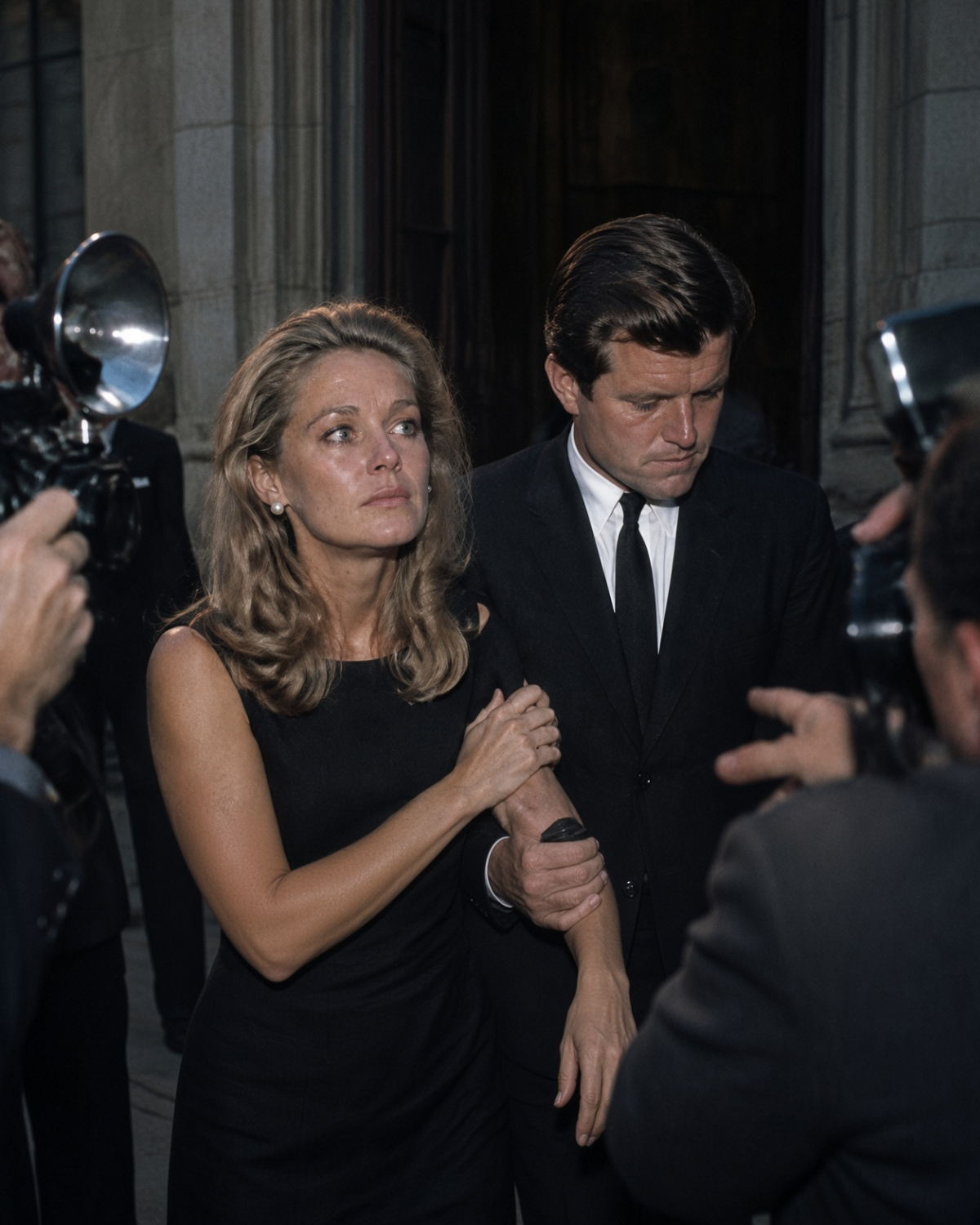
The photographs showed a devoted wife standing beside a grieving husband. They did not show what had happened before she arrived. According to accounts by Kennedy biographers, the first telephone call Ted made after the accident did not go to Joan. While political advisers gathered downstairs to prepare the speech that might save his career, Joan was reportedly kept upstairs, away from the discussion. And within weeks, she would lose the baby she had been carrying.
For years, America remembered the accident, the senator, and the political consequences. Far fewer people stopped to consider the woman standing beside him. Why did Joan Kennedy keep appearing in those photographs? Why did she continue defending a marriage that seemed to be breaking her apart? And who, exactly, was asking her to keep smiling?
The answer reaches back to a wedding in 1958, to a powerful family that understood the value of appearances, and to a young woman who would spend decades trying to discover where the Kennedy family ended and her own life began.
If you want to understand what the famous photographs left out, stay with this story. Because the most revealing part of Joan Kennedy’s marriage was not what the public saw when the cameras were rolling. It was what happened after everyone went home.
In October 1957, at a college gymnasium dedication in New York, a young woman named Virginia Joan Bennett was introduced to a young man from one of America’s most powerful political families.
Joan was 21 years old. Born on September 2, 1936, she was a trained pianist, blonde, reserved, and much more comfortable sitting at a keyboard than standing in a crowded room.
The young man was Edward Moore Kennedy, known to everyone as Ted. He was studying law at the University of Virginia and was the youngest son of Joseph Kennedy, the businessman and political patriarch whose ambitions had already carried two of his sons into the highest levels of American politics.
Ted was also the younger brother of President John F. Kennedy.
The introduction came through his sister, Jean Kennedy Smith. According to the Boston Globe, Jean noticed Joan in the crowd and brought her over to meet her brother.
The family story later preserved by the newspaper was that Ted’s first reaction was remarkably simple.
“Who’s the blonde?”
It was hardly a declaration of love, but the courtship moved quickly.
By one account, Ted called Joan every evening. Their dates were often chaperoned, and the young couple spent time together in the company of the extended Kennedy family.
Joan remembered the moment she realized her feelings had become serious.
During a ski trip to Stowe, Vermont, something changed. Years later, she recalled the experience to the Boston Globe.
“He was tall and he was gorgeous.”
She also remembered the moment she fell in love with him.
“It was then that I fell in love with him.”
By one account, Ted proposed at Hyannis Port in 1957.
But behind the romance, there was already a warning sign.
After the engagement, Joan became nervous. She was about to marry a man she did not feel she knew particularly well, and according to Kennedy biographer Adam Clymer, she began having doubts.
A young woman might ordinarily have asked to postpone the wedding. She might have requested more time, more conversations, or simply the freedom to reconsider.
But Joan was not marrying an ordinary young man.
According to Clymer’s account, Joseph Kennedy insisted that the wedding proceed.
The plans continued.
That single decision would become one of the most revealing details in the history of their marriage. Joan had expressed uncertainty about spending the rest of her life with Ted, but the family’s expectations appeared to carry more weight than her hesitation.
On November 29, 1958, they married at St. Joseph’s Church in Bronxville, New York.
Cardinal Francis Spellman performed the ceremony. A reception followed at a nearby country club.
The photographs presented an almost perfect American political-family romance: a beautiful young Catholic woman, a handsome Kennedy son, a cardinal, an elegant wedding, and a future that seemed filled with promise.
Yet there was something about those vows that made the marriage especially difficult to leave.
For Joan, Catholicism was not simply a family tradition or a ceremonial detail. The Church taught that marriage was indissoluble. Divorce did not automatically free a Catholic to marry again within the Church, and an annulment required a separate determination that a valid marriage had not existed in the first place.
The vows were meant to last.
Whether the promises behind them were equally secure would become a question that followed the couple for decades.
Nearly twenty years later, Joan looked back at the wedding photographs with a tenderness that suggested she hardly recognized the young woman standing in them.
She described herself as a nice young girl marrying a nice young man.
Then she added something that seemed to explain everything that followed.
“I had no idea what I was getting into.”
She was entering a family that already had two highly visible daughters-in-law: Jacqueline Kennedy and Ethel Kennedy.
Joan became the third.
But she never occupied quite the same position.
In his book The Kennedy Imprisonment, writer Garry Wills described her as being distant from the family’s central personality. The New York Times later characterized her as shy and reserved compared with relatives who were more competitive, athletic, and outspoken.
Adam Clymer also described Joan as a particularly reserved person who did not naturally fit the Kennedy family’s social style.
She brought something else into the marriage, too.
Years later, Ted mentioned during an oral history interview at the University of Virginia’s Miller Center that Joan’s parents had both died of alcoholism.
It was a painful family history, one that would become increasingly relevant as the marriage progressed.
For a while, however, life appeared genuinely happy.
The couple lived in Charlottesville while Ted completed law school. Their first child, Kara, was born on February 27, 1960. Their son, Edward Jr., followed on September 26, 1961.
Joan later described those early years simply.
“Very happy. I didn’t have any trouble coping.”
The young family had children, money, political connections, and a seemingly limitless future.
But in 1962, Ted decided to run for the United States Senate seat his brother John had previously held.
And that campaign would reveal the first serious cracks in the marriage.
At the beginning of the campaign, Ted noticed something about his wife.
He later discussed it himself during the Miller Center interviews.
“At the beginning of the campaign, I noticed that my wife drank.”
He remembered entering a room and seeing that Joan was unsteady.
What followed was particularly revealing.
Ted acknowledged that he was not sure he had handled the situation well. He described thinking about how to get through the immediate political challenge.
“Get through it until the election.”
Those words would become an uncomfortable summary of the marriage’s larger pattern.
A young woman was struggling with something that could be connected to the alcoholism in her family history. Her husband recognized it, but the campaign was approaching, and the political machine needed to keep moving.
The election came first.
Ted won the Senate seat in 1962.
And the family had another reason to need Joan.
In June 1964, a small plane carrying Ted to a Democratic convention in West Springfield, Massachusetts, crashed.
Joan had originally been expected to travel with him. Instead, she had attended an antiques auction.
Years later, she explained how close she had come to being on that plane.
“If I hadn’t been at the auction, I would have been on the plane in the front seat.”
The crash killed two men: Ted’s aide Edward Moss and the pilot, Edwin Zimny.
Ted survived with three broken vertebrae, two broken ribs, and a collapsed lung.
He spent months recovering at New England Baptist Hospital.
For much of that autumn, he could not campaign personally.
The Senate seat still needed to be defended.
So Joan stepped into the political spotlight.
She traveled, spoke to voters, represented her husband, and carried the campaign while he remained hospitalized.
The historian Barbara Perry later described her as a political surrogate who proved she could perform the demanding public role.
Joan remembered that period with surprising warmth.
“I had a lot of freedom.”
And then she explained why it mattered.
“I really felt needed.”
It was one of the few times in her public recollections when she seemed to describe the political demands of the Kennedy family as something that gave her genuine satisfaction.
But there was another side to the marriage.
While Joan was helping protect Ted’s political future, rumors about his relationships with other women were becoming increasingly difficult to ignore.
The Boston Globe later described Ted’s sexual wanderings and the family’s fierce political ambition as forces that began to wear Joan down.
She would eventually acknowledge that the gossip contributed to her drinking, although she said she had never believed the rumors.
Her response was not to confront Ted.
It was to avoid asking questions.
Marcia Chellis, Joan’s former aide, preserved a revealing explanation in her 1985 book about the Kennedy family.
Joan had explained that rather than become angry or question her husband about the women he was rumored to be seeing, she found another way to quiet her feelings.
“It was easier for me to just go and have a few drinks and calm myself down.”
It was a remarkably honest description of a destructive emotional routine.
The rumors arrived.
Joan felt hurt.
She drank.
And the subject disappeared beneath another layer of family silence.
In a 1978 People magazine interview, she described that silence in a sentence that would later become one of the most memorable statements of her life.
“Everyone knew, but no one ever asked about it to my face.”
Think about the loneliness contained in those words.
The stories were circulating. Friends and acquaintances were aware of the rumors. Newspapers occasionally hinted at them.
Yet Joan felt that nobody was willing to speak to her honestly.
The Boston Globe later reported that she was pitied by the press, criticized by some members of her own family, and increasingly troubled by insecurity.
The New York Times would eventually summarize the pattern by noting that Ted became less discreet about his infidelities and excessive drinking while Joan increasingly turned to alcohol herself.
The marriage was becoming a private arrangement built around public appearances.
And then the family suffered two devastating political losses.
President John F. Kennedy was assassinated in Dallas in November 1963.
Robert Kennedy was shot in Los Angeles in June 1968.
Joan had reportedly played piano at some of Robert’s campaign events during the 1968 presidential campaign.
After Robert’s death, Ted became the last surviving Kennedy brother.
The expectations surrounding him grew enormously.
He was no longer simply a younger senator with a famous last name. He was the remaining political heir to a family whose ambitions had been shaped by two brothers who were gone.
The pressure affected everyone around him.
Joan was still raising their children, still managing her own emotional difficulties, and still trying to maintain a marriage that seemed increasingly disconnected from the life she had imagined.
Their third child, Patrick, had been born on July 14, 1967.
But by the summer of 1969, Joan had already experienced two miscarriages.
When she became pregnant again, her doctors wanted her on strict bed rest.
She was carrying their fourth child.
Her husband, meanwhile, was preparing to attend the Edgartown Regatta on Martha’s Vineyard.
The weekend of July 18, 1969, would become the defining moment of their marriage.
And it would begin with a telephone call that Joan apparently did not receive.
On the evening of July 18, Joan was at the Kennedy summer home on Squaw Island in Hyannis Port.
She was resting under medical instructions.
Ted had traveled to Martha’s Vineyard for the regatta and a gathering on Chappaquiddick Island.
His wife was not there.
When Ted later explained her absence to the American public, he used a carefully chosen phrase.
She had stayed home for reasons of health.
Time magazine reported on August 1 that Joan was expecting their fourth child around the beginning of the following year.
The magazine also included another observation that deserved attention.
“There is no question that they are frequently separated.”
The accident that followed would become one of the most controversial episodes in American political history.
Ted Kennedy left a gathering on Chappaquiddick shortly before midnight. He was driving a car carrying 28-year-old Mary Jo Kopechne.
The vehicle went off Dike Bridge and entered the water.
Kopechne drowned.
Ted survived.
But he did not report the accident to police until the following morning.
The delay became a central issue in the investigation and in the public controversy that followed.
For Joan, however, another detail would become significant.
What did Ted do during the hours after the accident?
Who did he call?
And why did the first call, according to several biographers, go somewhere other than the home where his pregnant wife was resting?
In his book The Kennedy Women, biographer Lawrence Leamer identified a woman named Helga Wagner as the first person Ted contacted.
Another biographer, Burton Hersh, also named Wagner in his account.
The Washington Post columnist Maxine Cheshire offered a somewhat different explanation in 1980. According to her reporting, Ted contacted Wagner because he needed a telephone number for Steven Smith, a Kennedy family adviser.
The accounts differed over the reason for the call.
But they agreed on the recipient.
According to these accounts, Joan was not the first person Ted contacted.
For a wife already living with rumors about other women, that detail carried a painful significance.
It was not simply about the mechanics of an emergency telephone call.
It was about whom a husband turned to when the most serious crisis of his public life suddenly unfolded.
And the next few days would reveal an even more troubling imbalance.
The Kennedy advisers gathered at Hyannis Port.
According to an account by writer Edward Klein, quoted by ABC News, prominent political figures including Robert McNamara, Arthur Schlesinger, and Theodore Sorensen participated in discussions about the statement Ted would deliver to the nation.
They needed to construct an explanation that would address the accident, the delay in reporting it, and the senator’s future.
The meeting reportedly took place downstairs.
Joan was upstairs.
Klein wrote that she was not allowed to come down because the advisers did not want her to hear the discussion.
Consider the picture.
Downstairs, some of the most experienced political advisers in America were preparing the words that would determine whether Ted Kennedy could continue his career.
Upstairs, his pregnant wife was resting under medical orders.
The speech would eventually refer to her health as the explanation for why she had not accompanied him to the regatta.
Her pregnancy had become part of the public explanation.
Yet, according to the account, she was excluded from the room where that explanation was being prepared.
The family needed the image of a devoted wife.
But the woman behind the image was not necessarily being treated as a partner in the decisions that shaped it.
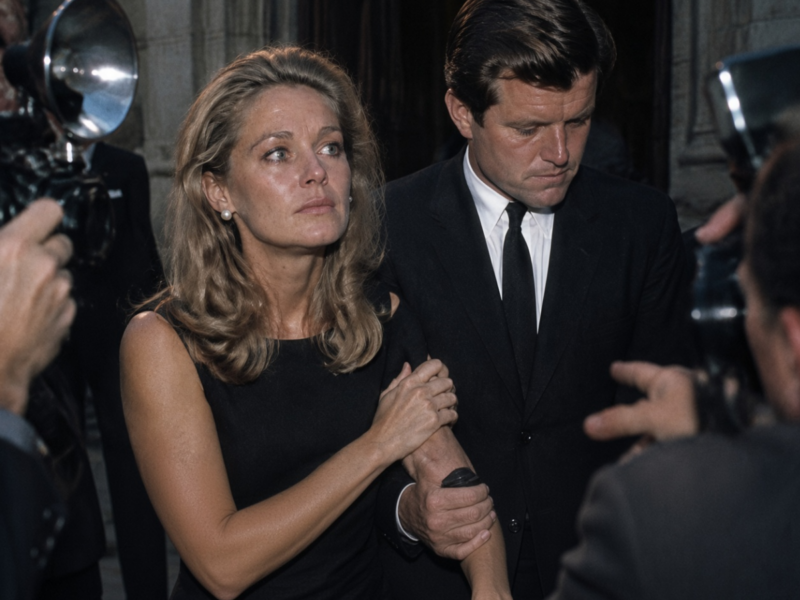
The funeral came next.
On July 22, 1969, Mary Jo Kopechne was buried in Plymouth, Pennsylvania.
Ted attended with Joan beside him.
The Boston Globe later recorded that Joan stood with her husband at the funeral and met Mary Jo’s parents.
It was an extraordinary and painful situation.
A pregnant woman, already ordered to rest after two miscarriages, was standing before the parents of a young woman who had died in a car driven by her husband.
Whatever Joan was feeling, the cameras recorded her holding Ted’s arm.
One later account suggested that Joan and Rose Kennedy were among the only family members who personally expressed sympathy to the Kopechne family. That claim has not been independently established and should be treated cautiously.
But the broader image remains.
Joan went.
She stood beside Ted.
And she played the role expected of a senator’s wife during one of the most difficult public moments the family had ever faced.
Sally Jacobs of the Boston Globe later described her as the pregnant wife who played the devoted partner, clinging to her husband’s arm through the funeral and beyond.
The word “played” is especially revealing.
Because the photograph showed loyalty.
It could not show whether loyalty was something Joan felt freely or something she believed she had no choice but to demonstrate.
Three days later, on July 25, Ted appeared in an Edgartown courthouse.
He pleaded guilty to leaving the scene of an accident.
Judge James Boyle imposed a two-month suspended sentence.
That evening, at 7 p.m., Ted delivered his televised address.
He explained why Joan had not attended the regatta.
Her absence, he said, was due to reasons of health.
The explanation was accurate in one sense.
She had indeed been under medical instructions to remain at home.
But the public did not know what would happen next.
In her 1978 People interview, Joan disclosed that she had experienced three miscarriages.
The third had occurred during the summer of 1969, in her fourth month of pregnancy.
The Boston Globe placed the loss at the end of August.
Barbara Perry’s historical account also recorded that Joan’s pregnancy ended in miscarriage after the Chappaquiddick episode.
ABC News later reported that Joan herself connected the loss to the events surrounding the accident.
There was no way to reverse what had happened.
And there was no way to make the public photographs tell the whole story.
Years later, Joan spoke to Lawrence Leamer about the period following Chappaquiddick.
Her words were devastatingly simple.
“It became worse.”
She explained that for a few months, everyone had to maintain the appearance that everything was normal.
Then she reached a point where she could no longer pretend.
“Everyone had to put on this show.”
She described losing hope for the future.
“I just saw no future.”
And then she explained when her drinking became something much more serious.
“That’s when I truly became an alcoholic.”
There was a difference between the woman the public saw in July 1969 and the woman who spoke to the biographer years later.
In 1974, Joan had described the accident in a People magazine interview as tragic and unfortunate.
She also offered a public statement of support.
“I believe everything he said.”
Both statements belonged to the same woman.
One was delivered while she was still living inside the Kennedy family’s public world.
The other came after years of distance and reflection.
The contrast does not require us to assume that one statement was entirely false.
It tells us something more complicated: Joan could publicly support her husband while privately feeling that the marriage had become unbearable.
The summer of 1969 had not simply damaged their public image.
It had changed the way she understood her own life.
And the next several years would show just how difficult it was for her to get help.
In November 1973, another family crisis arrived.
Edward Kennedy Jr., then 12 years old, was diagnosed with bone cancer.
Doctors decided that his right leg had to be amputated.
The operation took place at Georgetown Hospital on November 17.
Ted spent part of that day attending the wedding of his niece Kathleen, walking her down the aisle before returning to the hospital.
The New York Times reported the unusual combination of events.
Thirteen days later, Edward Jr. left the hospital on crutches, accompanied by both parents.
Photographers recorded the moment.
The images showed a courageous young boy, a concerned father, and a mother standing beside her son.
But Joan was struggling under the emotional weight of the experience.
Time magazine later reported that during her son’s illness, she had at one point collapsed under the strain.
By 1974, her difficulties were becoming increasingly difficult to conceal.
After traveling to the Soviet Union with Ted, Joan entered Silver Hill Foundation in Connecticut on the recommendation of her doctor.
The facility provided treatment for people dealing with alcoholism and other difficulties.
Time reported that it was not her first stay.
A short item in the magazine included a detail that revealed something about the relationship.
A longtime confidant reportedly remembered how difficult it had been to get Ted to agree to Joan seeing a psychiatrist.
Read that again.
The woman was struggling.
People close to her recognized the need for professional help.
Yet someone who knew her well remembered the husband’s agreement as an obstacle.
Time also quoted a friend explaining that even a relatively small amount of alcohol could have a substantial effect on Joan.
An insider warned that her stay might not be the end of the treatment process.
It was described as a furlough, with the possibility that she would need to return.
That same year, Joan was arrested for driving under the influence in Virginia.
Her driver’s license was suspended for six months.
It was the beginning of a long public struggle that would include further arrests and repeated efforts to recover.
The contrast with 1964 was difficult to ignore.
Ten years earlier, Joan had traveled around Massachusetts to protect her husband’s Senate seat while he lay in a hospital bed.
She had felt needed.
Now she was the one receiving treatment, and the people around her were discussing whether her husband would agree to psychiatric care.
Her life had changed dramatically.
Yet the public still received carefully selected glimpses of the marriage.
In 1974, People magazine featured Joan on its cover.
She described Chappaquiddick as a tragic accident and said she believed her husband.
The public saw a wife expressing support.
The magazine’s readers did not necessarily see the woman who had been admitted to Silver Hill.
Those two realities existed at the same time.
In 1979, Ted would tell Time that Joan was making great progress.
It was a reassuring statement.
But the magazine would later describe the seriousness of her drinking, noting that two drinks could leave her glassy-eyed and three could sometimes cause her to pass out.
Joan tried different approaches to recovery.
She consulted psychiatrists.
She attended treatment facilities.
She experimented with vitamin therapy.
She attended Alcoholics Anonymous meetings.
At times, she checked into McLean Hospital.
The list was long because the struggle was long.
And the Kennedy family’s concern about publicity sometimes made the process even more difficult.
The Boston Globe reported that the family’s press representatives moved quickly to manage the public narrative surrounding Joan.
She feared that seeking professional help would become a newspaper story.
In a family where public image was a valuable political asset, the concern was understandable.
A Kennedy wife receiving treatment could become a headline.
A Kennedy wife smiling on a magazine cover could become reassurance.
Lawrence Leamer later described the exhausting cycle to ABC News.
He remembered Joan saying she was doing wonderfully and appearing on the cover of a women’s magazine.
By the time the magazine reached the newsstands, however, she might be drinking again.
The photographs suggested recovery.
The reality was more complicated.
Years later, Joan described her married life to the Boston Globe in a sentence that brought the entire period into focus.
“So much of my married life was about keeping secrets and pretending that I was doing great and was happy.”
That was the life she had finally decided she could no longer continue.
Around 1977 or early 1978, Joan left the family home in McLean, Virginia, and moved into an apartment in Boston’s Back Bay.
The accounts differ slightly about the exact timing.
The Boston Globe placed her departure in 1977. Time described the move as occurring early in 1978. People magazine reported in August 1978 that more than six months had passed since she decided to move out.
Whatever the precise date, the meaning was unmistakable.
The couple were now living separate lives.
Ted remained deeply involved in Washington politics.
Joan established a home in Boston.
Time described the apartment as a place without political memorabilia.
There was, however, one important possession.
A Steinway baby grand piano.
The instrument represented something that had existed before the Kennedy marriage: Joan’s relationship with music.
When her children visited, she made a point of explaining that this was mommy’s apartment, not daddy’s.
The distinction was small but meaningful.
For years, her identity had been connected to her husband’s political career and the family’s expectations.
Now she had a place that belonged to her.
Time also reported that Ted had spent approximately $100,000 on the apartment.
It was an unusual arrangement.
The senator was financing a home where his wife lived separately from him.
Money could provide the apartment.
It could not repair the marriage.
In Boston, Joan began attending Alcoholics Anonymous meetings.
She also started working toward a master’s degree in education.
And she began speaking publicly about the problems she had spent years trying to conceal.
In an interview with McCall’s magazine, she acknowledged her alcoholism.
Time later reported that she relapsed within days of the interview appearing.
But she did not retreat into silence.
In August 1978, People magazine published a lengthy cover story that gave readers an unusually direct look at her life.
Joan explained why she drank.
“At times I drank to feel less inhibited, to relax at parties.”
But there was another reason.
“Other times I drank to block out unhappiness, to drown my sorrows.”
She also discussed the difficulty of living among the Kennedys.
“I tried to be like the Kennedys. I could never be that. That’s not me.”
She described the differences between herself and Ted.
“Ted and I are so different.”
She even compared their parenting styles.
“He’s a super dad. I’m not a super mom.”
But perhaps the most important statement was about how she had changed.
“I used to say yes, dear to everything, and now I can say no.”
That sentence represented something more significant than a disagreement between husband and wife.
For the first time, Joan was publicly describing the possibility of having her own voice.
She was no longer simply the woman standing beside a Kennedy senator.
She was a woman explaining what the marriage had done to her.
And she was not finished.
In November 1979, Time magazine published an extensive profile of Ted as speculation grew about a possible presidential campaign.
The article included reports of affairs with several women.
The names included Amanda Burden, Susie Chaffee, Paige Lee Hufty, and Margaret Trudeau, among others.
These were reported allegations, not established findings, and the distinction matters.
But the fact that the magazine printed the names was itself significant.
Ted’s personal reputation was becoming a political issue.
When asked about the reports, he offered a brief denial.
“It doesn’t happen.”
The same profile described him as troubled by the breakdown of his marriage.
Yet the article also discussed the reported relationships that had contributed to Joan’s insecurity.
Time published a companion piece about Joan under the headline “The Vulnerable Soul of Joan.”
She was asked directly about the stories.
“Of course, they hurt my feelings.”
Then she explained how deeply the reports affected her.
“They went to the core of my self-esteem.”
By that point, the marriage had lasted more than twenty years.
They had three children.
Joan had experienced three miscarriages.
She was living in an apartment away from her husband.
And the country’s most influential news magazine was now printing the names of women reportedly connected to him.
The private difficulties were becoming impossible to keep separate from the public campaign.
Time had already warned in July 1979 that a presidential run would bring additional attention from political reporters, gossip writers, psychiatrists, and investigative journalists.
That prediction proved accurate.
On November 4, 1979, CBS broadcast a special featuring correspondent Roger Mudd interviewing Ted Kennedy.
Mudd asked about the marriage.
“What is the present state of your marriage? Are you separated?”
He also asked whether Joan might soon return to live with him in Washington.
The questions were direct.
The senator was considering a presidential campaign while his wife maintained a separate residence.
Even the interview later became the subject of a dispute over when it had been recorded.
Mudd and Ted disagreed about the timeline, and Mudd subsequently described the senator’s account as a complete fabrication.
It was another reminder that the public story surrounding the Kennedy marriage was often contested, even when the underlying subject was simple.
The couple were no longer living together.
And three days after the broadcast, the campaign would once again need Joan’s presence.
On November 7, 1979, at Faneuil Hall in Boston, Ted Kennedy announced his candidacy for president.
Joan stood beside him.
The photograph was exactly what the campaign needed.
A famous senator.
A historic political family.
A wife standing at his side.
The image suggested stability at a moment when questions about his marriage were becoming increasingly difficult to ignore.
But behind that photograph was a private agreement.
Time had reported that Joan supported his decision to run.
She was willing to campaign, but she wanted to complete her master’s degree first.
She also refused to commit herself to living in the White House.
She would appear beside him.
She would support the campaign.
But she was not promising to return to the life she had left.
That distinction was important.
The campaign wanted a united family image.
Joan wanted to preserve some independence.
In January 1980, as the Iowa caucuses approached, reporters continued asking about the marriage and the allegations surrounding Ted.
Joan responded directly.
“Yes, I believe my husband’s story.”
She also asked the press not to give the rumors attention during such an important moment in the campaign.
Time recorded her request and observed that it was unlikely to be fulfilled.
She continued campaigning.
By one account, she sometimes opened rallies by playing the piano.
The image was familiar, but there was something different about it.
The pianist who had been introduced to Ted at a college event more than twenty years earlier was now using her own musical ability as part of a presidential campaign.
Thomas Oliphant, a Boston Globe columnist who discussed the period in an oral history at the Miller Center, recalled that reporters traveling with Joan became careful about how they handled alcohol around her.
Some would hide their drinks when they saw her approaching.
He remembered it as a relatively good period in her life.
But he also acknowledged the political reason for her continued presence.
She campaigned because Ted needed her.
That was the familiar pattern.
The campaign needed Joan’s face.
And Joan, still struggling with her own recovery and the consequences of the marriage, continued to provide it.
A bumper sticker circulating during that period captured the public’s discomfort with the situation.
“Vote for Jimmy Carter. Free Joan Kennedy.”
It was intended as a joke.
But it also reflected something many observers believed they could see.
The marriage appeared so strained that some people thought Joan deserved to be released from it.
The campaign ultimately failed.
At the Democratic National Convention in New York on August 11, 1980, Ted withdrew from the presidential race.
Joan stood beside him once again.
The following evening, he delivered the speech at Madison Square Garden that became known as “The Dream Shall Never Die.”
The political dream had ended.
The marriage, however, was already approaching its conclusion.
In October, during a visit to Boston’s North End, Joan watched Ted shake hands with President Jimmy Carter.
The campaign chapter was over.
The separation remained.
By January 1981, the Christian Science Monitor was reporting that divorce was approaching.
Joan was also speaking about her recovery.
“I’m so lucky to have isolated my problem and done something about it.”
It was a different kind of statement from the ones she had made during the early years of the marriage.
She was talking about her own life.
Her own problem.
Her own work.
On December 13, 1982, Time reported that Joan and Ted planned to file divorce papers after approximately three years of separation.
They had been married for more than two decades.
The exact length varied among reports. The Christian Science Monitor had described the marriage as lasting 22 years, while Time later referred to 24 years.
The difference reflected the varying dates used by the publications.
Ted announced the decision alongside his declaration that he would not run for president in 1984.
“The decision Joan and I have made about our marriage has been painful for our children.”
The divorce settlement was kept private.
The probate court in Barnstable, Massachusetts, sealed the records.
Reports placed the financial settlement between approximately $4 million and $5 million, with additional alimony and child support for Patrick.
The Boston Globe also reported that Joan retained the Back Bay condominium and the summer home on Squaw Island.
The settlement was not simply a financial conclusion.
It represented the end of a marriage that had been publicly displayed for nearly a quarter of a century.
The woman who had once stood beside Ted at a presidential announcement now had a separate home, her own academic ambitions, and a life that no longer depended on appearing as his political partner.
But the story of their marriage was not entirely over.
In September 1994, Joan hired a Boston divorce attorney named Monroe Inker.
He went to the Barnstable probate court seeking access to the sealed records from the divorce settlement.
Twelve years had passed.
Joan wanted to revisit the terms.
By then, she had earned a master’s degree in education from Lesley College in Cambridge.
She had also published The Joy of Classical Music in 1992, a book intended to help families understand and appreciate classical music.
It was a meaningful return to the world she had known before becoming a Kennedy wife.
But her difficulties with alcohol had not completely disappeared.
On July 5, 1988, her car struck a fence in Craigville on Cape Cod.
She was charged with driving under the influence and pleaded not guilty.
In 1991, she faced another arrest and was ordered to enter treatment.
A fourth arrest would follow on Cape Cod in 2000, resulting in two years of probation.
According to the Boston Globe, Joan sometimes referred to these episodes with a dark sense of humor.
“My famous one-nighters.”
It was an unusual expression, but it suggested a woman who had learned to acknowledge the public incidents without allowing them to define every part of her identity.
The early 1990s also brought renewed attention to Ted.
On March 29, 1991, he spent an evening in Palm Beach with his son Patrick and his nephew William Kennedy Smith.
Smith was later tried in a highly publicized rape case and acquitted on December 11, 1991.
Although the trial concerned the nephew, Ted’s conduct and judgment also attracted criticism.
The Christian Science Monitor reported that Ted was viewed by some observers as having failed in his role as a father figure during the events surrounding the case.
A Boston Herald poll placed him behind Massachusetts Governor William Weld in a hypothetical political contest, with Weld leading 55 percent to 32 percent.
Ted acknowledged shortcomings in a speech at Harvard later that year.
Then, on July 3, 1992, he married Victoria Reggie.
For the former senator, a new chapter had begun.
Historian Barbara Perry later observed that Ted appeared to find the marital happiness that had eluded him during his relationship with Joan.
But Joan’s story was still unfolding.
By 1994, she had spent years rebuilding her life while dealing with the consequences of alcoholism, public scrutiny, and a marriage that had ended under unusually complicated circumstances.
Her lawyer was not particularly cautious when discussing the reason for reopening the settlement.
He said Joan believed she had been victimized.
According to reporting by the Deseret News, Inker said she felt she had been treated unfairly by her former husband and was outraged by what had happened during the divorce settlement.
The timing attracted attention because Ted was preparing for another Senate election.
His campaign responded that it was the first it had heard of the matter.
The dispute was eventually settled privately in 1996, according to the Boston Globe.
But another development in 1995 would bring the marriage back into public discussion.
It involved the Catholic Church.
Ted was a Catholic who had remarried after divorcing Joan.
Under Catholic teaching, a divorced person whose first marriage remains recognized by the Church cannot simply enter another valid Catholic marriage.
An annulment is a separate determination by a Church tribunal that the original marriage was not valid from its beginning.
In 1995, during the funeral of his mother, Rose Kennedy, Ted received Communion.
The Associated Press reported that this was how the public learned the Church had granted him an annulment.
According to the Associated Press, he reportedly received it after acknowledging that he had not been honest when promising Joan he would remain faithful.
Ted never publicly discussed the annulment.
Joan’s account, preserved by biographer Adam Clymer, was brief.
She said Ted had requested the annulment and that she did not oppose it.
The basis was that his promise of fidelity had not been honestly made.
The significance was difficult to miss.
Nearly four decades earlier, a cardinal had performed the wedding ceremony between a nervous young pianist and a Kennedy heir.
According to Clymer, the patriarch had insisted that the wedding proceed despite Joan’s doubts.
Now the Church was examining the marriage through the question of whether the promise at its center had ever been sincere.
The annulment did not erase the years.
It did not erase the children, the miscarriages, the funeral in Pennsylvania, or the years Joan spent supporting Ted’s political career.
But it added a remarkable final dimension to the story.
The promise that Joan had been asked to trust was reportedly acknowledged as something Ted had not honestly made.
For a woman who had spent decades questioning her own worth and struggling to understand her husband’s relationships, the development carried a meaning that no photograph could capture.
And still, Joan did not turn it into a public spectacle.
She had already spent enough of her life inside someone else’s political narrative.
By the early 2000s, the question surrounding Joan’s life was no longer whether she would remain married to Ted.
It was whether she could continue managing her own affairs independently.
In July 2004, a judge ruled that Joan was incapable of taking care of herself because of mental illness.
She did not contest the determination.
Boston magazine reported that Judge Robert Terry of Barnstable made the ruling after a petition from her children.
Edward Kennedy Jr., the son who had undergone a leg amputation at age 12, was appointed her guardian.
He was now responsible for helping protect the mother who had once stood beside his hospital bed while he recovered.
The reversal was extraordinary.
The boy whose medical crisis had placed such an emotional burden on Joan was now an adult charged with helping safeguard her future.
In March 2005, a passerby found Joan lying in a Boston street.
She had suffered a concussion and a broken shoulder and was taken to Massachusetts General Hospital.
The accounts differed by a day regarding the exact date.
Her son Patrick publicly thanked the stranger who had found her.
“We’re indebted to some anonymous pedestrian who found her and picked her up and got her help.”
Ted also spoke.
“This has been a sad time. We’re hoping for the best.”
He later told the Associated Press that the situation had been a long and difficult struggle.
It was a painful chapter for the family.
But another dispute soon emerged.
This time, it involved Joan’s finances.
Boston magazine reported that a second cousin on her mother’s side, Webster Jansen, a Connecticut financial planner, had been managing an estate estimated at approximately $9 million.
The assets included the Back Bay condominium and the Squaw Island property.
According to the magazine’s reporting, Jansen established two trusts with himself as the sole trustee and attempted to place the summer home on the market despite a court order restricting the sale.
He defended his work and questioned the criticism.
The family disagreed.
Joan’s children went to court to stop the proposed sale.
The dispute became another reminder that even after the marriage had ended, Joan’s property and independence remained subjects of conflict.
In June 2005, the family reached a settlement reported by the Associated Press.
Two trustees would oversee her estate, including an oceanfront property valued at approximately $6.4 million.
A guardian ad litem would monitor her finances and health and report to the judge.
Importantly, that guardian would not have the authority to make decisions for her.
Joan also agreed to enter treatment for alcoholism.
The hearing concerning a permanent guardian was canceled.
The legal distinction mattered.
After years in which other people had made decisions about her public image, her marriage, and her political responsibilities, the arrangement attempted to preserve whatever independence she could still exercise.
People close to Joan later reported that she remained sober after treatment.
It was a significant development.
Her life had been marked by repeated efforts to recover, and the years of difficulty had not prevented her from continuing to seek help.
Then, on August 25, 2009, Ted Kennedy died.
Joan attended a Mass at the family compound.
ABC News reported that an unnamed relative made a striking remark about her presence.
“She’s no longer under house arrest.”
The relative did not explain the statement.
But after everything that had happened, it was difficult not to hear the complicated history behind it.
Ted was gone.
The marriage had been over for decades.
And Joan was still living with the consequences of the life they had built together.
In 2011, their daughter Kara died at the age of 51.
Joan had now outlived both her former husband and her daughter.
The family would continue debating the subject of alcoholism and secrecy.
In 2015, Patrick Kennedy published his memoir, A Common Struggle.
He described alcoholism within the family as being surrounded by a conspiracy of silence.
Joan told the Boston Globe that she had not even known he was writing the book.
Her son Edward expressed heartbreak over Patrick’s decision, describing what he considered an inaccurate and unfair portrayal of the family.
The brothers disagreed about how the family’s history should be presented.
But their mother had already spoken about the central issue decades earlier.
In 1978, she had told a national magazine that everyone knew what was happening, yet nobody asked her about it directly.
She had described the drinking.
She had described the unhappiness.
She had acknowledged that she could never become the kind of person the Kennedys expected her to be.
Her words had been printed long before the family memoirs and public disagreements.
Joan Kennedy died peacefully in her sleep at her home in Boston on October 8, 2025.
She was 89 years old.
The Kennedy family statement described her as a quiet pioneer who publicly addressed challenges involving alcoholism and depression.
It praised her courage and candor, noting that her willingness to speak openly helped reduce stigma and encouraged others to seek help.
Her son Edward said he would always admire her for facing her difficulties with grace, courage, humility, and honesty.
She left nine grandchildren and one great-grandchild.
Patrick also remembered her as an example to millions of people living with mental health challenges.
Her funeral Mass was held at St. Anthony Shrine in Boston.
Both of her sons spoke.
The priest delivering the homily reflected on her journey, describing how she had found strength through guidance, faith, and support, eventually bringing hope to others who were struggling.
There was no need to pretend her life had been easy.
It had not.
But there was something remarkable about the distance between the young woman in the 1958 wedding photographs and the 89-year-old woman whose life was being remembered.
The first had entered a famous family with a piano, a Catholic upbringing, and a belief that marriage meant making a lifelong commitment.
The second had lived through public humiliation, private grief, repeated treatment, separation, divorce, legal disputes, and the loss of people she loved.
And yet, her identity was never entirely defined by those experiences.
She had returned to music.
She had earned an advanced degree.
She had written a book.
She had spoken openly about alcoholism at a time when many people were still afraid to discuss it.
She had also demonstrated that recovery was not always a straight line.
There were setbacks.
There were public mistakes.
There were years when the struggle seemed to repeat itself.
But there were also moments of determination.
The figures of her life tell part of the story.
Twenty-four years of marriage, according to some accounts.
Three children.
Three miscarriages.
A reported $100,000 apartment in Boston.
A settlement estimated at $4 million to $5 million.
An estate later valued at approximately $9 million.
An oceanfront home worth $6.4 million.
Nine grandchildren.
Eighty-nine years.
But none of those numbers can fully explain what Joan experienced.
The more revealing evidence was contained in her own words.
“Everyone knew, but no one ever asked about it to my face.”
That sentence deserves to be remembered.
Because it explains something about the Kennedy marriage that political biographies often struggle to capture.
Joan was not simply a woman who married a powerful man and later struggled with alcohol.
She was a woman whose private difficulties existed alongside a public expectation that she remain composed.
She was expected to support her husband.
She was expected to protect the family image.
She was expected to appear at funerals, political announcements, campaigns, and public celebrations.
And even when she was struggling, the photographs continued to show a woman standing beside a Kennedy.
The photograph from July 22, 1969, remains especially difficult to forget.
A pregnant woman walks into a funeral in Pennsylvania.
Her doctor’s instructions are to rest.
She has already experienced two miscarriages.
The man beside her is dealing with the aftermath of an accident that has placed his political future in danger.
She holds his arm.
The cameras capture the image.
For years, that photograph could be interpreted as a portrait of loyalty.
But perhaps it was also a portrait of a woman who had learned that keeping the family together mattered more than explaining what was happening inside her.
There is another image worth remembering.
Joan in her Boston apartment, sitting beside her Steinway baby grand.
No political memorabilia.
No campaign decorations.
No carefully arranged family photographs designed for a magazine profile.
Just a piano and a woman trying to reclaim something that had belonged to her before the Kennedy name became part of her identity.
The piano was there before the marriage.
It remained after the marriage.
And in some ways, it represented the part of Joan Kennedy that had never completely disappeared.
She had been a pianist before she became a political wife.
She was still a pianist after the divorce.
That distinction matters because the public spent so many years viewing her through the lens of her husband.
Ted Kennedy’s political career was measured in elections, legislative achievements, presidential ambitions, controversies, and historical judgments.
Joan’s life was often measured by whether she appeared beside him, whether she was drinking, whether she was receiving treatment, and whether the marriage could survive.
But her life was larger than that.
Her decision to speak publicly about alcoholism in 1978 was significant.
Her willingness to acknowledge unhappiness was significant.
Her attempts to recover were significant.
And her ability to continue building a life after the divorce deserves to be recognized independently of the Kennedy family.
Her grandson Edward Kennedy III later acknowledged that she had lived a complicated life.
He spoke about her struggles with alcohol, but also emphasized the importance of remembering her as his grandmother.
He thanked the people of Boston for embracing her when she was rebuilding her life after the divorce.
That may be one of the most meaningful parts of her legacy.
For years, the Kennedy family had been associated with national politics, wealth, influence, and public attention.
But in Boston, Joan was able to become something different.
She was a woman living in her own community.
She was someone who had made mistakes, experienced setbacks, and continued trying.
She was someone whose story could help other people understand that alcoholism was not a private moral failure that could be solved by pretending it did not exist.
It was a serious struggle that required honesty, support, and often repeated efforts to recover.
And perhaps that is why the old photograph from Pennsylvania deserves another look.
In 1969, Joan Kennedy walked into a funeral holding tightly to her husband’s arm.
She was expected to look devoted.
She was expected to stand beside him.
She was expected to help the family move through another political crisis.
But the woman who eventually emerged from the marriage was not simply the wife in that photograph.
She was the woman who learned to say no.
The woman who found a separate apartment.
The woman who returned to music and education.
The woman who spoke about the secrets everyone knew but nobody wanted to discuss.
And the woman who continued fighting for her own life long after the cameras had stopped following her.
The Kennedy family will always be remembered for its political ambitions and extraordinary public history.
But Joan Kennedy’s story deserves to stand on its own.
Not as a footnote to Ted Kennedy.
Not simply as the wife who appeared at Chappaquiddick.
And not as the woman whose struggles became tabloid headlines.
She deserves to be remembered as someone who spent much of her life trying to find her own voice in a family that was always speaking for itself.
The piano was waiting in Boston.
The apartment was hers.
And eventually, the life she built there became something that did not require her to stand beside anyone else.
In July 1969, she held on to Ted Kennedy’s arm as she walked into a funeral.
In the years that followed, she learned something much harder.
How to keep walking without it.
And perhaps that is the part of Joan Kennedy’s story we should remember most.