Cop Tosses His Navy SEAL Card in the Trash and Cuffs Him in Front of His German Shepherd…
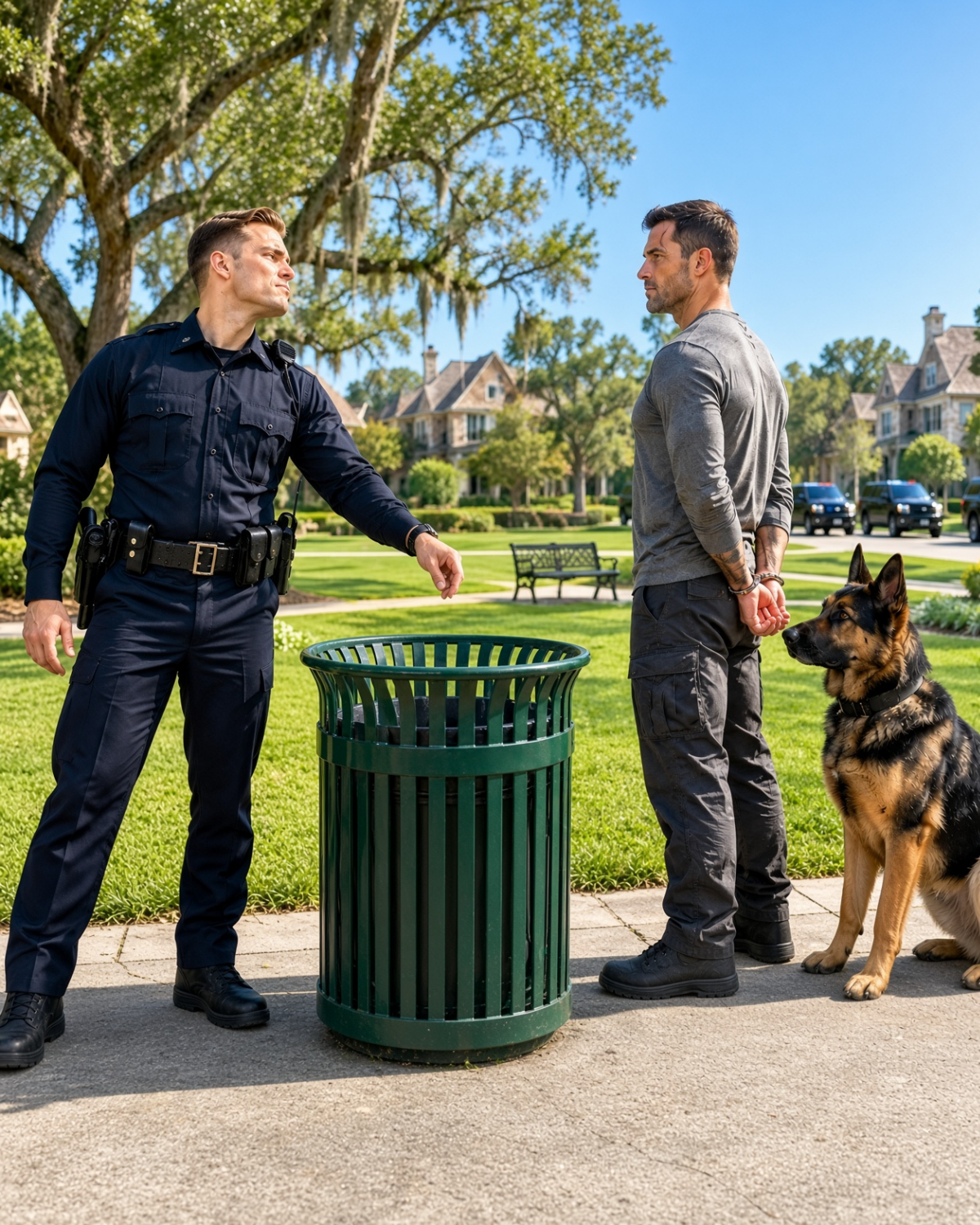
The card struck the bottom with a hollow metallic ring.
For three seconds, the man said nothing.
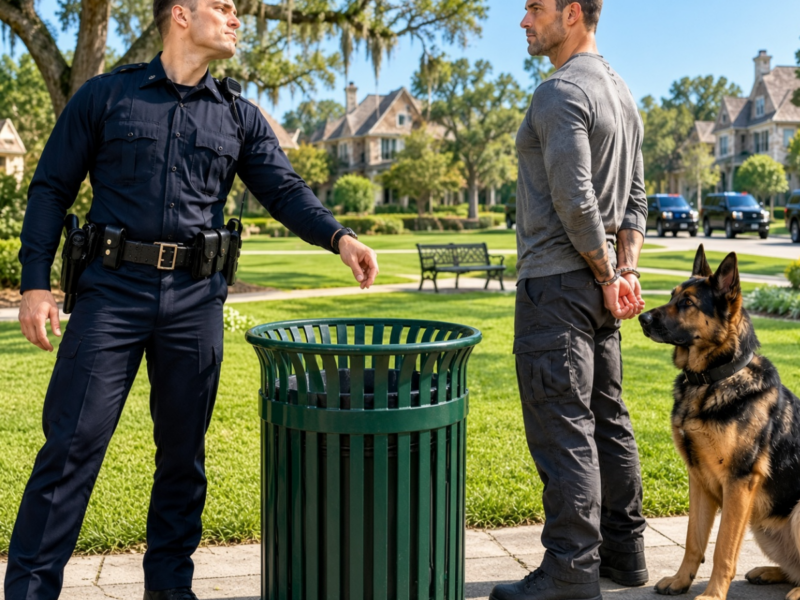
He stood on the manicured grass of Savannah, Georgia’s most exclusive residential community, his wrists resting behind his back as a pair of steel handcuffs tightened around them.
Beside him, a German Shepherd sat perfectly still.
The dog watched the officer with amber eyes, his ears slightly forward, his powerful body controlled by a discipline most people would never understand.
The officer believed he had just caught an impostor.
He had no idea that four black government SUVs were already moving toward the neighborhood.
And he certainly had no idea that the man he had just humiliated was the reason those vehicles were coming.
His name was Owen Mercer.
He was thirty-eight years old, an active-duty Navy SEAL, and a man who had spent nearly two decades learning that the most dangerous mistake a person could make was deciding they understood a situation before gathering the facts.
That afternoon, however, Owen wasn’t thinking about missions, intelligence reports, or the complicated responsibilities of his job.
He was thinking about his brother’s house, a quiet afternoon, and getting his retired military dog some exercise.
It was supposed to be the simplest visit he’d made in months.
Instead, it would become the afternoon an entire neighborhood learned the difference between authority and arrogance.
And one young police officer would discover that the small plastic identification card he had thrown away was worth considerably more than he imagined.
Owen stepped out of his silver pickup truck and closed the driver’s door without making a sound.
He was six feet tall, broad through the shoulders, and built with the economical strength of someone who had spent years carrying equipment through difficult terrain.
His dark brown hair was cut short.
A faint scar ran along his right temple, disappearing into his hairline.
His hands were rough, with slightly swollen knuckles and the occasional small mark that never seemed to disappear completely.
He wore a plain gray long-sleeved shirt, dark cargo pants, and black boots with worn toes.
Nothing about his clothing suggested wealth or status.
There was no expensive watch on his wrist.
No designer sunglasses.
No polished shoes.
He carried no briefcase, no equipment bag, and nothing that would attract attention.
He looked like a man who had driven a long distance and wanted to stretch his legs.
Owen opened the rear door of the truck.
“Out, Koda.”
A large German Shepherd dropped onto the pavement.
The dog landed silently, his black-and-tan coat catching the warm afternoon sunlight.
Koda was almost seven years old.
His shoulders were broad, his chest deep, and his movements carried the unmistakable precision of a working dog.
He had served alongside Owen during two overseas deployments before a shrapnel injury ended his active field career eighteen months earlier.
The injury had healed enough for ordinary movement, but it had permanently changed the way Koda used his rear leg after prolonged activity.
He could still run.
He could still work.
But he could no longer be expected to perform the demanding duties that had once defined his life.
Owen had adopted him without hesitation.
They had slept in the same dirt on three different continents.
They had spent nights listening to distant engines, unfamiliar footsteps, and sounds that neither man nor dog could afford to misunderstand.
Koda had learned Owen’s breathing patterns.
Owen had learned the smallest movements of Koda’s ears.
They trusted each other in a way that required very few words.
Leaving the dog behind after retirement had never been an option.
Koda moved immediately to Owen’s left side and sat.
Owen rested a hand against his head.
“Good to see you moving around, old man.”
Koda looked up at him.
His tail moved once.
Owen glanced toward the neighborhood entrance.
Whitmore Reserve was the kind of residential community where the lawns were trimmed twice a week, the houses had stone facades, and visitors needed a gate code or an invitation from a resident.
Owen had both.
His older brother, Derek Mercer, had lived there for four years with his wife, Lauren, and their two children.
Derek was a civil engineer turned contractor who had built a successful business designing and managing large commercial projects.
He had worked hard for everything he owned.
Owen was proud of him, although the brothers rarely discussed such things directly.
They had grown up in a modest house outside Jacksonville, Florida.
Their father had worked maintenance at a shipping terminal.
Their mother had been a school administrator.
There had never been much extra money, but there had always been dinner on the table and someone waiting at the door when the boys came home.
Derek had stayed close to home.
Owen had joined the Navy.
Their lives had taken very different directions, but they had never lost the habit of showing up for each other.
Owen visited once a year when his schedule allowed.
Sometimes less.
Derek had texted him an hour earlier.
“Running late. Meeting went over. Key is under the back mat. Walk around if you want. I’ll be home by five.”
It was just after four.
Owen looked at Koda.
The dog had been sitting in the truck since early morning.
He needed to move.
“Let’s take a walk.”
They started down the sidewalk together.
Koda stayed aligned with Owen’s left knee, his head level, his movements controlled.
The neighborhood was almost unnaturally clean.
Wide lawns stretched toward expensive homes.
Sprinklers ticked beneath carefully arranged flower beds.
A fountain operated behind a tall privacy wall.
Somewhere nearby, a homeowner was grilling dinner.
The air carried the smell of fresh mulch, cut grass, and barbecue smoke.
Owen appreciated the quiet, but he had never been particularly comfortable in places where everything seemed designed to look perfect.
Years of military training had left him with habits he no longer needed but couldn’t completely abandon.
He noticed entrances.
He noticed parked vehicles.
He noticed which houses had people behind their windows.
He noticed the landscaping truck parked near a service entrance and the delivery van positioned beside a mailbox.
It wasn’t paranoia.
It was simply the way his mind worked.
He had spent too many years learning that ordinary surroundings could conceal extraordinary problems.
But today, there was no mission.
No briefing.
No deadline.
Only a warm Georgia afternoon and a dog who deserved a good run.
They reached the neighborhood’s central common area.
It was a square of green grass bordered by a stone walking path, with several wooden benches beneath old live oak trees.
A low iron fence marked the eastern boundary.
Owen stopped near the center.
He reached into his cargo pocket and pulled out a small rubber ball.
Koda noticed immediately.
His ears moved forward.
His hindquarters tightened.
For the first time since leaving the truck, the dog looked genuinely excited.
Owen smiled.
“Ready?”
Koda gave a quiet breath through his nose.
“Go.”
Owen threw the ball across the grass.
Koda accelerated.
His paws barely seemed to touch the ground.
Within seconds, he reached the ball, caught it on the first bounce, pivoted, and raced back.
He stopped directly in front of Owen and dropped the ball at his boots.
“Good boy.”
Owen threw it again.
And again.
For a while, the world became beautifully simple.
Ball.
Run.
Return.
Sit.
There were no mission parameters.
No encrypted messages.
No command briefings.
No one asking him to calculate the consequences of a decision before sunrise.
There was just a German Shepherd enjoying the grass.
Owen felt something loosen inside his chest.
The previous nine months had been difficult.
His last deployment had demanded more than he had expected, and returning home had not immediately restored the person he had been before leaving.
He slept lightly.
He woke early.
He sometimes found himself studying ordinary conversations as if they were briefings.
Derek had noticed.
“You ever think about taking an actual vacation?” his brother had asked during their last phone call.
“I just did.”
“Driving to see your family for one afternoon doesn’t count.”
“It counts if I don’t have to pack a bag.”
Derek had laughed.
Owen had laughed, too.
It wasn’t a complete solution, but it was something.
Now, watching Koda sprint across the grass, he felt the weight of the last several months begin to lift.
He didn’t notice the residents watching at first.
But Koda did.
The dog’s ears shifted.
His head turned slightly toward the walking path.
Owen felt the change almost immediately.
He had learned to recognize the moment a relaxed environment began to tighten.
A woman in exercise clothes had stopped walking.
She was speaking quietly to another woman, both of them looking toward the grass.
A man sitting on a nearby bench had closed his book.
Two residents stood on their front porches with coffee cups in their hands.
Nobody approached.
Nobody said anything.
But the atmosphere had changed.
Owen put the ball into his pocket.
“Close, Koda.”
The dog returned to his left side and sat.
Owen looked around without making the movement obvious.
He recognized the feeling.
It was the same feeling he had encountered in other places, under very different circumstances.
People had already decided something was wrong.
They were simply waiting for someone else to say it first.
Across the street, behind a large picture window, Patricia Holden was watching.
Patricia had lived in Whitmore Reserve for nine years.
She was active in the homeowners association and served on the community standards board.
She knew which residents had approved landscaping changes, which homeowners had violated exterior lighting rules, and which visitors had parked too close to the entrance.
She considered herself responsible.
She also believed that a neighborhood with an annual association fee of $20,000 had every right to maintain strict standards.
Her husband, Richard, often told her she worried too much about things that didn’t concern her.
Patricia disagreed.
She believed that ignoring small problems was how larger problems began.
That afternoon, she noticed the silver pickup outside the common area.
It had a temporary Georgia vehicle pass on the windshield.
She noticed the man wearing dark cargo pants and worn boots.
She noticed the German Shepherd.
What she did not know was that the man had been invited by a homeowner.
She did not know the dog had served in the military.
And she did not know that the man had spent years working in places where judging someone by their appearance could be a serious mistake.
She only knew that she did not recognize him.
She picked up her phone.
Her first instinct was to call the neighborhood security office.
Then she reconsidered.
She opened her contacts and called the police non-emergency line.
As she described the situation, she watched Owen bend slightly and speak to the dog.
The dispatcher asked whether anyone had threatened her.
“No,” Patricia answered.
“Has the individual approached anyone?”
“No, but he’s walking around the common area.”
“Is there an immediate danger?”
Patricia hesitated.
She watched Koda sit beside Owen.
“Well, the dog is quite large.”
“Is the dog behaving aggressively?”
Patricia looked again.
The animal wasn’t barking.
It wasn’t pulling toward anyone.
It wasn’t moving toward the houses.
“No,” she said. “But it’s intimidating.”
The dispatcher explained that a unit could be sent to check the situation.
Patricia thanked her.
She was about to end the call when she saw Owen throw the ball again.
The dog ran across the grass.
Something about the scene bothered her.
She decided that a non-emergency response might not be enough.
She called 911.
This time, she described a suspicious individual in a private residential community.
She mentioned the dog twice.
She used the word threatening once, then changed it to intimidating.
She said she did not know whether the man belonged there.
The dispatcher asked whether he had a weapon.
“I haven’t seen one.”
“Has he threatened anyone?”
“No.”
“All right. We’ll send an officer to check.”
Patricia thanked her and returned to the window.
Seven minutes later, a patrol vehicle entered Whitmore Reserve.
It came through the main entrance faster than she expected.
The emergency lights flashed briefly as it approached the common area.
Officer Harlan stepped out before the vehicle had completely settled.
He was twenty-nine years old.
He had a high fade haircut, freshly polished boots, and a uniform that looked almost new.
He had been with the department for three years.
His supervisors described him as energetic.
His colleagues had other words.
Harlan liked control.
He liked situations where people immediately recognized his authority.
He especially disliked being questioned in front of an audience.
He had already decided, during the drive, that the call was probably about someone who didn’t belong in the neighborhood.
The moment he saw Owen, his assumptions became stronger.
He noticed the truck.
He noticed the clothes.
He noticed the dog.
He did not notice the temporary visitor pass until much later.
He walked across the grass with one hand resting near his duty belt.
Owen watched him approach.
His hands remained open and visible.
Koda stayed seated.
Harlan stopped approximately eight feet away.
“What’s your business in this neighborhood?”
Owen answered without changing his expression.
“Visiting my brother. He lives on Sanderson Court.”
“You live here?”
“No. I’m visiting.”
“This is a private community.”
“I know.”
“Residents only in the common areas. How’d you get through the gate?”
“My brother gave me the code. He also cleared a temporary vehicle pass.”
Harlan glanced toward the truck.
Then he looked back at Owen.
“That your vehicle?”
“Yes.”
“Who’s your brother?”
“Derek Mercer.”
“Never heard of him.”
Owen said nothing.
Harlan looked at Koda.
“That dog on a leash?”
“No.”
“That’s a problem.”
“He’s under control.”
“I didn’t ask whether he’s under control. I asked whether he’s on a leash.”
Owen kept his voice even.
“No.”
Harlan nodded.
“There’s a leash ordinance in this city. Dogs off leash in public areas can receive a citation.”
“This is a private common area.”
Harlan took a step forward.
“Do you have identification?”
Owen considered the question for a moment.
Then he slowly reached into his pocket and produced a thin black wallet.
He opened it.
He removed a hard plastic identification card and held it out.
The card carried the official Department of Defense seal.
His photograph appeared on the front.
His name, military status, and service information were clearly printed.
Active duty.
United States Navy.
Harlan took it.
He looked at the card.
Then he looked at Owen.
His eyes narrowed.
A short laugh escaped his mouth.
“Navy SEAL?”
“Yes.”
Harlan looked at the card again.
“You’re telling me you’re a Navy SEAL?”
“That’s what the card says.”
Harlan looked at Owen’s gray shirt.
His dark cargo pants.
His scuffed boots.
He seemed to find something amusing about the combination.
“You expect me to believe this?”
“You can verify it.”
“How?”
“Call the number on the back. Defense Manpower Data Center. They can confirm my status.”
Harlan turned the card over.
He didn’t call.
He didn’t attempt to contact a military liaison.
He didn’t request additional identification.
Instead, he looked at Owen as if the entire situation had become a personal challenge.
“You know how many fake military IDs I’ve seen?”
Owen didn’t answer.
“People buy these things online. They use them for discounts. They pretend to be veterans. Sometimes they use them to get out of trouble.”
“Then verify it.”
“I’m not calling anyone.”
Owen looked at him.
“Why not?”
Harlan’s expression tightened.
“Because I’m the one conducting this investigation.”
“Then conduct it.”
The words were not disrespectful.
They were not aggressive.
They were simply an invitation to do the job properly.
But Harlan heard something else.
He heard a challenge.
He looked toward the residents.
Several people were watching.
He didn’t want them to see uncertainty.
He wanted them to see an officer in control.
“Look at yourself,” Harlan said.
His voice grew louder.
“You don’t look like any operator I’ve ever seen. You look like you’ve been living out of that truck for a week.”
Owen remained still.
“Verify the card.”
Harlan looked at him.
For a moment, he seemed to expect the man to become angry.
He expected a raised voice.
An argument.
An explanation.
Anything that would give him a reason to take the situation further.
But Owen offered none of those things.
The silence irritated him.
He walked toward the nearby green metal trash can.
It was bolted to the stone path beside a wooden bench.
He held the identification card between his thumb and index finger.
Then he turned toward Owen.
“This is where this kind of thing belongs.”
He opened his fingers.
The card fell into the barrel.
A hollow metallic ring echoed through the common area.
Nobody spoke.
Patricia pressed a hand against her mouth.
The man on the bench lowered his eyes.
Even Harlan seemed to recognize that the gesture had gone further than he intended.
But he had already committed to it.
Owen looked at the trash can for three seconds.
Then he looked back at the officer.
He didn’t shout.
He didn’t move toward the card.
He didn’t threaten to call anyone.
He simply waited.
And that was when the situation became much more serious.
Harlan stepped closer.
“Turn around. Hands behind your back.”
Koda’s ears flattened.
A low vibration began deep in the dog’s chest.
It was barely audible.
Owen felt the change immediately.
“Koda. Stay.”
The dog stopped.
His body remained upright.
His eyes stayed on the officer.
Owen turned around slowly.
He placed his feet shoulder-width apart and brought his hands behind his back.
He knew exactly what was happening.
He also knew that any sudden movement could create a danger that had nothing to do with the original situation.
He had spent years learning the difference between winning an argument and protecting the people who depended on him.
Today, Koda depended on him.
So Owen stayed calm.
Harlan grabbed his left wrist.
The first handcuff closed.
Then the second.
The steel pressed tightly against Owen’s skin.
Harlan stepped around to face him.
“You’re under arrest.”
Owen looked at him.
“For what?”
“Trespassing. Resisting an officer. Presenting fraudulent federal documentation.”
Owen’s expression did not change.
“I haven’t resisted you.”
“You’re going to let the courts sort that out.”
“You should be careful about what you’re doing.”
Harlan reached for his radio.
“I think I’ll manage.”
He never got the opportunity to finish his call.
Because something was approaching from the main entrance.
At first, it was only a low engine sound.
Then another.
Then two more.
The sound grew louder, rolling through the quiet streets of Whitmore Reserve.
Harlan glanced toward the entrance.
Four black government SUVs appeared around the corner.
They were moving in a close formation.
Their windows were dark.
Red and blue lights flashed behind their front grilles.
The vehicles slowed together and approached the common area.
Harlan lowered his radio.
For one brief moment, he assumed he was about to receive support from senior officers.
He straightened his uniform.
He adjusted his posture.
He looked toward the approaching vehicles with the confidence of someone who believed the situation was about to prove him right.
Then the first SUV stopped.
The second pulled in behind it.
The third and fourth positioned themselves along the edge of the grass.
All four doors opened almost simultaneously.
Several men stepped out.
Two wore dark tactical clothing.
Two wore the dark blue uniforms of Naval Special Warfare Command.
The last man to exit the lead vehicle was Rear Admiral James Whitford.
He was sixty-one years old.
Medium height.
Lean.
Silver hair cut close to his head.
Four gold stars on his collar.
He possessed the quiet authority of someone who had spent decades making decisions that other people depended on.
He did not hurry.
He did not shout instructions.
He simply started walking.
Two NCIS agents moved with him.
One was Agent Daniel Castillo, a former Marine with fifteen years of federal investigative experience.
The other was Agent Rebecca Shaw, whose expression was already changing as she took in the scene.
They had received an unusual message from the military liaison office.
A senior Navy operator had requested a simple identity confirmation.
The request had come through an official channel.
The operator’s location had been confirmed.
But the report had also mentioned that a local police officer had taken possession of his identification.
When the liaison attempted to contact the patrol unit, the situation became complicated.
The officer had apparently reported an arrest.
The military office had requested immediate clarification.
And Admiral Whitford, who had known Owen for several years, decided he wanted to see the situation himself.
Now he was standing in the middle of a quiet residential neighborhood.
Looking at a man he knew.
With handcuffs around his wrists.
Whitford stopped walking.
His eyes moved from Owen’s face to the restraints.
Then to Koda.
The dog was still sitting in exactly the same position.
Whitford’s expression hardened.
Harlan stepped forward.
“Admiral, I’ve got a situation here under control.”
Whitford did not respond.
Harlan continued.
“This individual was trespassing in a private community and presented what appears to be fraudulent federal—”
“Who put those cuffs on him?”
Whitford’s voice was quiet.
But every person in the common area heard it.
Harlan stopped speaking.
He opened his mouth.
Nothing came out.
Whitford looked directly at him.
“I asked you a question.”
Harlan glanced at Owen.
Then at the admiral.
“I did, sir.”
“Who authorized it?”
“Well, sir, the individual was being investigated for—”
“That wasn’t my question.”
The silence stretched.
Agent Castillo stepped forward and displayed his badge.
“Agent Castillo, Naval Criminal Investigative Service. Officer, I need you to remove those restraints immediately.”
Harlan looked confused.
“Sir, this man—”
Whitford raised one hand.
“Stop.”
He looked at Owen.
“Owen Mercer. Senior enlisted operator with SEAL Team 3.”
He turned back toward Harlan.
“He’s on approved leave following a nine-month deployment. He’s also the individual my office has contracted to design and lead a close-quarters urban engagement course for NCIS field agents beginning Monday morning.”
The admiral paused.
“He was visiting family.”
The words seemed to settle over the grass.
Patricia Holden felt the blood drain from her face.
Harlan’s expression changed.
He looked at Owen again.
This time, he seemed to be seeing something entirely different.
Whitford continued.
“You arrested an active-duty military operator in a residential neighborhood after he presented valid federal identification.”
Harlan swallowed.
“Sir, I didn’t know.”
“That is precisely the problem.”
The admiral stepped closer.
“You didn’t know, and instead of verifying what was placed in your hand, you decided to destroy it.”
Harlan looked toward the green trash can.
Whitford followed his gaze.
“Get those cuffs off him.”
Harlan reached for his key ring.
His fingers weren’t working properly.
He tried once.
Then again.
On the third attempt, he found the correct key.
He stepped behind Owen and unlocked the first restraint.
Then the second.
The steel came away.
Owen brought his arms forward.
He rotated his wrists once.
There were red marks around both.
He didn’t complain.
He looked down at Koda.
“Easy, buddy.”
Koda’s tail moved once.
The dog remained seated.
He had watched every second without breaking position.
Whitford walked toward Owen.
“Owen.”
“Admiral.”
“I apologize for this.”
“It’s handled, sir.”
“No. Not yet.”
Whitford turned toward Harlan.
“Where is his identification?”
Harlan looked at the trash can.
The admiral followed his eyes.
“Go get it.”
Harlan walked across the stone path.
He reached into the metal barrel and moved aside a discarded coffee cup and a paper bag.
His fingers found the card.
He pulled it out.
A brown smear crossed one corner.
He wiped it against his uniform sleeve.
Then he realized how inadequate that looked.
He tried again with a cleaner part of the fabric.
He returned to Owen and held the card out with both hands.
“Here, sir.”
Owen accepted it.
He examined the surface.
The card was dirty, but still intact.
He slid it into his wallet.
For a moment, he looked at Harlan.
The officer couldn’t maintain eye contact.
He looked down at the grass.
Owen waited.
Eventually, Harlan raised his eyes.
“You made a decision today,” Owen said.
His voice was quiet.
“You made it in the first ten seconds, before I had even finished answering your questions.”
Harlan said nothing.
“You looked at my clothes. You looked at my truck. You looked at my dog. And you decided I didn’t belong here.”
Owen paused.
“Everything after that was you trying to protect the decision you’d already made.”
Harlan’s jaw tightened.
Owen continued.
“I’ve been in places where that kind of thinking gets people hurt. You walk into a building with a conclusion already formed, and you stop seeing what’s actually in front of you.”
He glanced toward the identification card in his wallet.
“You stop listening. You stop checking. You stop thinking. You just execute the story you’ve already written.”
The neighborhood remained silent.
“That’s not bravery. That’s not authority. That’s fear wearing a uniform.”
Harlan’s eyes had become wet.
“I’m not angry at you,” Owen said.
“I’ve seen worse from men with better excuses. But you need to understand something.”
He looked directly at the officer.
“The next person you do this to might not have an admiral in a black SUV on the way.”
Nobody moved.
The words were not delivered as a threat.
They were a warning about the responsibility that came with a badge.
Whitford stepped forward.
“Officer Harlan, you’ll surrender your badge and weapon to Agent Castillo. You’ll report to your department’s internal review office at 0800 tomorrow morning.”
Harlan looked at him.
“I will be providing a written account of this incident to your commanding officer tonight.”
The admiral paused.
“And you will think very carefully about why you chose this profession.”
Harlan slowly unfastened his duty belt.
He handed it to Castillo.
The badge came next.
Without it, the young officer looked considerably smaller.
The people watching from their porches no longer seemed interested in the man in the gray shirt.
They were watching Harlan.
They were watching the consequences of a decision that had taken less than a minute to make.
And somewhere behind the picture window, Patricia Holden was beginning to understand her part in it.
She opened her front door.
For several seconds, she stood on the porch.
Her husband appeared behind her.
“Patricia?”
She didn’t answer.
She walked down the steps.
She crossed the lawn slowly.
When she reached the common area, she stopped several feet from Owen.
“I’m the one who called.”
Owen turned toward her.
He waited.
Patricia clasped her hands together.
“I called the police. I told them there was a suspicious man in the neighborhood.”
Nobody interrupted.
“I saw you walking with your dog. I didn’t recognize you. I thought you didn’t belong here.”
Her voice remained steady, but her face had lost its earlier confidence.
“I didn’t know who you were.”
Owen looked at her.
Patricia swallowed.
“I want you to know I understand that’s not a good enough reason.”
Owen studied her for a moment.
He could have said several things.
He could have reminded her that she had called 911 without witnessing any threat.
He could have asked whether she would have made the same call if he had been wearing a suit.
He could have pointed toward the truck and the temporary pass that had been visible from the street.
Instead, he gave a small nod.
“No,” he said. “It’s not. But it’s a start.”
Patricia looked down.
She had expected anger.
Perhaps a lecture.
Perhaps a demand that she apologize in front of everyone.
The quiet response was somehow harder to receive.
It left her with nothing to argue against.
She turned and walked back toward her house.
But she didn’t go inside immediately.
She stood on the porch and looked at the green trash can.
The same green trash can that had held the identification card only minutes earlier.
She would remember it for a long time.
Whitford placed a hand briefly on Owen’s shoulder.
“Your brother’s house is on Sanderson Court?”
“Yes, sir.”
“We’ll give you a ride. The debrief can wait until Monday.”
Owen nodded.
He looked down at Koda.
The German Shepherd was sitting squarely on the grass.
His eyes moved between the admiral, the agents, and the vehicles.
Whitford looked down.
“Still keeping everyone in line, I see.”
Owen allowed himself a faint smile.
“He’s better at it than I am.”
The admiral laughed softly.
Koda’s ears moved forward.
“Good boy,” Owen said.
He reached down and ran a hand along the dog’s neck.
For the first time since the patrol car had arrived, the tension seemed to disappear.
It was simply a man and his dog on a warm afternoon in Georgia.
Nothing more complicated than that.
But the story wasn’t quite finished.
Because what happened in the common area was only the beginning of a much larger reckoning.
And the first person to discover that would be Patricia Holden.
The following morning, Whitmore Reserve’s homeowners association held an emergency meeting.
The meeting had originally been scheduled to discuss landscaping contracts, security expenses, and a proposed change to the visitor parking rules.
By eight-thirty, nobody was interested in discussing flower beds.
A video had appeared in the neighborhood’s private messaging group.
It had been recorded by a resident standing on a second-floor balcony.
The video began with Harlan holding Owen’s identification card.
It captured the moment he dropped it into the trash can.
It showed Owen turning around.
It showed the handcuffs.
And it captured the arrival of the four black SUVs.
The recording was not particularly clear.
But the audio was.
Everyone could hear Harlan say, “This is where this kind of thing belongs.”
They could hear the metallic ring.
They could hear the admiral ask who had put the cuffs on Owen.
And they could hear the explanation that followed.
Within hours, the video had been shared among several neighborhood residents.
Some people were embarrassed.
Others were angry.
A few tried to defend the officer.
One resident wrote that Harlan had simply been doing his job.
Another responded with a question.
“Since when does doing your job mean throwing away someone’s identification instead of verifying it?”
That question remained unanswered.
Patricia attended the meeting.
She sat in the second row.
Her husband sat beside her.
The association president, Martin Caldwell, opened with a statement about the importance of maintaining a safe and welcoming community.
Then he played the video.
Nobody spoke during the first viewing.
Afterward, Martin turned off the television.
“Patricia, would you like to explain what happened?”
She stood.
“I made the call.”
A few residents shifted in their chairs.
“I saw a man I didn’t recognize walking through the common area with a large dog. I became concerned. I called the police.”
“Did you know he was visiting a resident?” Martin asked.
“No.”
“Did you ask?”
“No.”
“Did you see him threaten anyone?”
“No.”
“Did the dog approach anyone?”
“No.”
Martin folded his hands.
“Then what exactly caused you to describe him as suspicious?”
Patricia looked toward the floor.
“I didn’t recognize him.”
A man near the back spoke.
“That’s not a crime.”
“I know that now.”
“Did you know it yesterday?”
Patricia didn’t answer immediately.
Her husband reached for her hand.
She pulled in a slow breath.
“I thought I was protecting the neighborhood. I thought I was doing the responsible thing. But I didn’t actually know what was happening.”
She looked around the room.
“I made assumptions about a man because of his appearance. Then I gave those assumptions to the police as if they were facts.”
Nobody interrupted.
“I can’t blame the officer for every part of what happened. He made his own decisions. But I started the chain of events.”
The association president nodded slowly.
“Thank you for being honest.”
Patricia sat down.
For the first time in nine years, she had no desire to discuss the neighborhood’s standards.
The police department had its own response.
At 0800, Officer Harlan arrived at the internal review office.
He surrendered his written statement.
He was interviewed by two supervisors and an internal affairs investigator.
Agent Castillo provided the federal account of the incident.
The department requested copies of the available video.
The military liaison office confirmed Owen’s service status through official channels.
The Department of Defense identification was valid.
The card had not been fraudulent.
Owen had not resisted arrest.
He had not threatened the officer.
The available footage showed that he had complied with every instruction.
The investigation also established that the officer had not made a reasonable effort to verify the identification before discarding it.
The department placed Harlan on administrative duty pending review.
His weapon and badge remained surrendered.
He was required to complete additional training before any return to patrol would be considered.
The matter was no longer a disagreement about a leash.
It had become a question about judgment, procedure, and the responsibilities of law enforcement.
Meanwhile, Owen had returned to his brother’s house.
Derek opened the door before Owen could knock.
He looked at the black SUVs parked outside.
Then at his younger brother.
Then at Koda.
“What happened?”
Owen stepped inside.
“Long story.”
Derek stared at the red marks around his wrists.
“That looks like a very long story.”
Koda walked past him and headed toward the living room.
Lauren appeared from the kitchen.
“Is everything okay?”
Derek pointed toward Owen.
“Apparently, my little brother has been arrested in my neighborhood.”
Lauren stopped.
“What?”
Owen shook his head.
“Nobody’s hurt. It’s being handled.”
Derek closed the front door.
“Start talking.”
Owen gave them the short version.
He explained the call.
The officer.
The identification card.
The handcuffs.
The arrival of the admiral.
Derek listened without interrupting.
By the time Owen finished, his brother’s expression had changed several times.
“Wait,” Derek said. “He threw your military ID into a trash can?”
“Yes.”
“And then arrested you?”
“Yes.”
“While Koda was sitting right there?”
Owen glanced toward the living room.
“Pretty much.”
Derek shook his head.
“I’ve lived here four years. I paid the association fees. I gave you the gate code. I cleared your truck with security. How did nobody check any of that?”
“Apparently, nobody asked.”
Derek looked furious.
“I want to talk to the association.”
“You can.”
“I want to talk to the police chief.”
“You can do that, too.”
“And I want that officer to understand he can’t just—”
“Derek.”
Owen’s voice was gentle.
His brother stopped.
Owen looked at him.
“I understand you’re angry.”
“Of course I’m angry.”
“But don’t turn this into something it doesn’t need to be. Let the process work.”
Derek shook his head.
“You always do that.”
“Do what?”
“Act like nothing bothers you.”
Owen considered the statement.
Then he glanced toward Koda.
The dog had settled on the living room rug.
His injured leg was stretched slightly to one side.
Owen sat on the couch.
“Some things bother me more than others.”
Derek lowered himself into the chair opposite him.
“What bothers you about this?”
Owen took a moment before answering.
“The card wasn’t the problem.”
“What do you mean?”
“He could have thrown it into the street. He could have torn it in half. It wouldn’t have changed who I am.”
Owen looked toward the window.
“The problem was that he decided he knew what kind of person I was before he even asked my name.”
Derek was quiet.
“That’s what worries me. Not what happened to me. What happens when the next person doesn’t know how to stay calm?”
His brother looked at him.
Owen continued.
“What happens when someone doesn’t have the patience to explain? What happens when the person being questioned is frightened, confused, or unable to communicate clearly?”
He paused.
“That’s when a bad decision becomes dangerous.”
Derek leaned back.
For a while, neither brother spoke.
Then Lauren brought coffee.
The afternoon gradually returned to normal.
The children came home from school.
They ran toward Koda.
“Uncle Owen!”
Koda lifted his head.
The younger child knelt beside him.
“Did you bring him?”
“Who else would I bring?”
The child laughed.
Owen watched them.
He had missed too many ordinary afternoons.
He had missed birthdays, school events, holidays, and countless little moments that families rarely think about until someone is gone.
This was why he had driven to Savannah.
Not to discuss his career.
Not to meet an admiral.
Not to demonstrate anything.
He had come because his brother had invited him for dinner.
And because a dog who had given him years of loyalty deserved a peaceful afternoon.
The next Monday, Owen reported for his scheduled course.
The NCIS training facility was already busy when he arrived.
Agent Castillo met him near the entrance.
“Morning, Mercer.”
“Morning.”
Castillo glanced at his wrists.
“How are those?”
“Fine.”
“I saw the photographs.”
Owen gave a small nod.
“Not exactly how I wanted to spend my leave.”
Castillo smiled.
“Whitford has been talking about it all weekend.”
“That sounds unfortunate.”
“He wants the course to include a section on judgment under pressure.”
Owen raised an eyebrow.
“That wasn’t in the original syllabus.”
“It is now.”
Castillo handed him a folder.
“Apparently, the admiral thinks there’s a lesson here that everyone needs to hear.”
Owen opened the folder.
The training plan had been revised.
A new section had been added.
It was titled “The Cost of Premature Conclusions.”
Owen read the title twice.
Then he closed the folder.
“All right.”
Castillo studied him.
“You’re not going to make a joke about it?”
“Wouldn’t be much of a joke.”
The agent nodded.
They walked inside.
The course began at nine.
Owen stood in front of a group of federal agents and introduced himself.
He didn’t mention the arrest.
He didn’t mention the neighborhood.
He didn’t mention the officer.
He began with a simple question.
“How many of you have ever walked into a situation and decided what was happening before the other person finished speaking?”
Several hands went up.
Owen nodded.
“Good. At least we’re starting honestly.”
A few agents smiled.
He continued.
“Now, how many of you have ever been wrong?”
More hands.
This time, almost everyone raised one.
Owen placed the folder on the table.
“That’s the part we’re going to work on.”
He explained that experience could become a dangerous shortcut.
That confidence could make people stop asking questions.
That a uniform could create authority without automatically creating good judgment.
He spoke about observation.
Verification.
Communication.
The difference between what someone had actually witnessed and what they had merely assumed.
He didn’t present himself as a perfect example.
He told them about times he had misread a situation.
He described how a small assumption could influence an entire decision-making process.
And he reminded them that the first interpretation of an event was not necessarily the correct one.
At the end of the morning, an agent approached him.
“Sir, can I ask something?”
“Go ahead.”
“Do you think the officer who arrested you should lose his job?”
Owen considered the question.
“I don’t know enough to decide that.”
The agent looked surprised.
“After what happened?”
“Especially after what happened.”
Owen leaned against the table.
“Accountability matters. So does fairness. If someone makes a serious mistake, the response should be based on evidence, policy, and the full circumstances.”
He paused.
“But don’t confuse accountability with revenge.”
The agent nodded.
Owen continued.
“The goal should be making sure it doesn’t happen again. Not just making someone miserable because we’re angry.”
The conversation ended there.
But the question stayed with the agent.
It would stay with several others, too.
Over the following weeks, the story spread beyond Whitmore Reserve.
A local news outlet eventually obtained a copy of the police department’s public incident report.
The headline focused on the unusual encounter between a Navy SEAL and a patrol officer.
The story included the four government SUVs, the discarded identification card, and the officer’s administrative review.
The neighborhood’s name appeared in the report.
Residents began receiving questions from friends.
Some were embarrassed.
Others insisted that the incident had been exaggerated.
Patricia refused to comment publicly.
She had already said what she needed to say at the association meeting.
But she made one change.
She volunteered to help revise the neighborhood’s visitor procedures.
The new guidelines required security personnel to confirm resident authorization before reporting an unfamiliar visitor as suspicious.
They also clarified that residents should report observable behavior rather than speculate about someone’s intentions.
Patricia insisted that the document include one additional sentence.
“An unfamiliar person is not automatically a threatening person.”
The association president approved it.
The sentence appeared on the updated community notice board.
Some residents considered it unnecessary.
Patricia did not.
Three weeks after the incident, she saw Owen again.
He was standing near the entrance to Derek’s house.
Koda was beside him.
Patricia had been walking back from the mailbox when she noticed them.
She stopped.
“Mr. Mercer?”
Owen turned.
“Hello.”
She approached slowly.
“I wanted to ask how you’re doing.”
“I’m fine.”
“And the dog?”
Owen looked down.
“Koda’s doing well.”
Patricia smiled slightly.
“He looks very healthy.”
“He has his good days.”
She glanced at the dog’s rear leg.
“Is that from his service?”
“An old injury.”
Patricia nodded.
“I didn’t know.”
Owen didn’t answer.
She looked uncomfortable again.
“I’ve thought about that afternoon a lot.”
“I imagine you have.”
“I used to think being careful meant noticing everything that seemed unusual.”
Owen listened.
“But I realize now that I was only noticing the things that made me uncomfortable.”
She looked toward the street.
“I wasn’t asking what was actually happening. I was looking for reasons to believe what I already thought.”
Owen nodded once.
“That’s easy to do.”
“Doesn’t make it right.”
“No.”
Patricia looked at him.
“Do you think people can change?”
Owen considered the question.
“I think people can make better decisions than they made yesterday.”
She smiled faintly.
“That’s not quite the same answer.”
“No. It isn’t.”
Koda shifted his weight.
Owen rested a hand against the dog’s neck.
Patricia looked down.
“I hope you have a better visit this time.”
“Thank you.”
She turned to leave.
Then she stopped.
“Mr. Mercer?”
“Yes?”
“I never asked your brother to tell me who you were.”
Owen looked at her.
“Would it have changed anything?”
She thought about it.
“Probably.”
“Then that’s something worth thinking about.”
Patricia nodded.
She walked away.
Owen watched her return to her house.
Then he looked at Koda.
“Come on, old man.”
The dog stood.
They walked toward the common area.
The green trash can was still there.
It had been emptied and cleaned.
Someone had recently painted the metal rim.
The wooden bench stood beneath the oak tree.
The grass had been cut.
The neighborhood looked exactly as it had on the day of the incident.
But Owen noticed something different.
A small sign had been placed beside the walking path.
It read:
PLEASE KEEP OUR COMMUNITY WELCOMING TO ALL AUTHORIZED VISITORS.
It wasn’t a particularly impressive sign.
It wasn’t a dramatic statement.
But it was a start.
Owen stopped beside the bench.
He reached into his pocket.
The same rubber ball was there.
Koda saw it.
His ears moved forward.
Owen smiled.
“One more?”
Koda’s tail began to move.
Owen threw the ball across the grass.
The dog ran.
For a few seconds, everything was simple again.
The dog reached the ball, caught it, and returned.
He dropped it at Owen’s feet.
Owen picked it up.
“Good boy.”
He threw it a second time.
Then a third.
And each time, Koda returned to the same spot.
The same patch of grass.
The same quiet place where a few weeks earlier, an officer had mistaken restraint for weakness.
Owen didn’t think about the officer anymore.
He didn’t think about the admiral’s arrival.
He didn’t think about the video or the investigation or the neighborhood meeting.
He watched his dog.
That was enough.
A few miles away, Officer Harlan was still working through the consequences of his decision.
His administrative review had required him to revisit the incident repeatedly.
He had watched the body-camera footage.
He had read the statements.
He had answered questions from supervisors.
And every time he reached the moment when Owen offered his identification, he saw the same thing.
A valid card.
A clear opportunity to verify it.
A decision not to.
He had been convinced that the man in front of him was pretending to be someone important.
He had treated uncertainty as an insult.
He had used his authority to protect his pride.
The department’s final review required additional training and formal disciplinary action.
Harlan was not returned to regular patrol immediately.
He had to demonstrate that he understood the seriousness of the incident.
The consequences were professional.
But the more difficult consequences were personal.
He had told his father about the arrest.
His father had listened without interrupting.
Then he had asked one question.
“Did the man actually do anything wrong?”
Harlan had tried to explain the call.
The dog.
The neighborhood.
The identification card.
His father had listened.
Then he asked again.
“Did the man actually do anything wrong?”
Harlan hadn’t answered.
His father had spent thirty years as a public school principal.
He had dealt with difficult parents, angry students, and people who believed authority existed to make their lives easier.
He had taught Harlan that responsibility meant doing the right thing even when nobody was watching.
That evening, Harlan’s father said something his son would remember.
“Being in charge doesn’t mean you get to stop being fair.”
Harlan had no response.
Months later, he would still remember the sound of that identification card hitting the bottom of the trash can.
He would remember the silence that followed.
And he would remember Owen standing with his hands behind his back, making no attempt to prove anything to a man who had already decided not to listen.
The image stayed with him because it contradicted everything he had believed about authority.
He had expected resistance.
He had expected fear.
He had expected the situation to become a contest.
Instead, the man had remained calm.
And the dog had remained still.
The most disciplined people in that common area had not been the ones wearing uniforms.
They had been the man in the gray shirt and the German Shepherd sitting beside him.
That realization was difficult to accept.
But it was necessary.
One afternoon, several months after the incident, Harlan received a letter through the department’s training office.
It was a copy of a revised professional standards memorandum.
The document included a section about identifying military personnel, handling unfamiliar credentials, and documenting the verification process.
At the bottom was a paragraph about the incident in Savannah.
The names had been removed.
The lesson had not.
Harlan read it twice.
Then he placed it in his desk drawer.
He didn’t keep it because he wanted to remember the humiliation.
He kept it because he needed to remember the mistake.
And somewhere in Savannah, Owen Mercer continued doing what he had always done.
He worked.
He trained.
He visited his brother when his schedule allowed.
He took Koda on long walks.
He kept the old rubber ball in his cargo pocket.
The military identification card went back into his wallet.
It had a faint brown mark on one corner that never completely disappeared.
He could have requested a replacement.
He never did.
Not because the card itself was important.
But because he remembered the sound it made when it struck the metal bottom of that green trash can.
He remembered how quickly an ordinary afternoon had changed.
And he remembered that the most important thing he had done that day wasn’t proving who he was.
It was refusing to let someone else’s poor judgment turn him into someone he wasn’t.
One evening, Derek asked him about the incident again.
They were sitting on the back porch.
The children were inside.
Koda was lying beside Owen’s chair.
Derek handed his brother a cold drink.
“Does it still bother you?”
Owen looked at him.
“What?”
“What happened with that officer.”
Owen took a sip.
“Sometimes.”
“Why?”
Owen glanced down at Koda.
“Because it didn’t have to happen.”
Derek nodded.
“That’s what I keep thinking.”
Owen leaned back.
“People make mistakes. That’s part of being human.”
“Throwing someone’s ID in a trash can isn’t exactly a small mistake.”
“No.”
“Then why are you so calm about it?”
Owen thought for a moment.
“Because I can’t spend the rest of my life carrying every bad decision someone else makes.”
Derek looked toward the yard.
Koda had lifted his head.
His ears were pointed toward the house.
Owen reached down and touched the dog’s shoulder.
“Besides, I have enough to take care of.”
Derek smiled.
“Like him?”
“Especially him.”
Koda’s tail moved against the porch boards.
The brothers sat quietly for another few minutes.
There were no military stories.
No dramatic speeches.
No discussion of the news.
Just two brothers sharing an ordinary evening.
It was the kind of moment Owen had wanted when he first drove into Whitmore Reserve.
And in the end, it was the moment he remembered most clearly.
The four black SUVs had come and gone.
The admiral had returned to his responsibilities.
The police department had completed its review.
The neighborhood had changed its procedures.
Patricia had learned to question her assumptions.
Harlan had been forced to confront his own.
But the green trash can remained beside the stone path.
And the old rubber ball remained in Owen’s pocket.
Sometimes, when Owen walked past it, he would remember the afternoon when an officer had looked at a quiet man, seen worn boots and an ordinary truck, and decided he knew everything that mattered.
He would remember the handcuffs.
The watching residents.
The dog who never moved.
And the moment four black vehicles appeared at the end of the street.
But the greatest lesson had never been about the arrival of an admiral.
It wasn’t about military rank.
It wasn’t about a government vehicle or a federal identification card.
It wasn’t even about the consequences that followed.
It was about the few seconds before a person decides what someone else deserves.
Owen had spent much of his adult life learning to control his reactions.
He knew that strength did not require constant demonstration.
He knew that authority did not need to announce itself.
And he knew that a person who could remain calm when treated unfairly possessed something that no badge, title, or uniform could provide.
Self-control.
Koda understood that lesson without needing anyone to explain it.
The dog had been trained to wait.
To listen.
To trust.
To remain still when the world around him became uncertain.
And on that afternoon in Savannah, he had done exactly that.
The officer had mistaken his stillness for a lack of danger.
He had mistaken Owen’s silence for weakness.
He had mistaken an ordinary appearance for an ordinary life.
And by the time the truth arrived, the damage had already been done.
Some people only learn the value of patience after losing it.
Some only understand the importance of verification after refusing to verify.
And some only discover the weight of authority when they finally realize that wearing a uniform does not make every decision correct.
The next time Owen walked through Whitmore Reserve, nobody stopped him.
Nobody questioned the truck.
Nobody called 911.
Koda walked beside him, shoulder aligned with Owen’s left knee.
At the center of the neighborhood, they passed the green metal trash can.
Owen reached into his pocket.
The rubber ball was still there.
He looked down at his old partner.
“Ready?”
Koda’s ears came forward.
Owen smiled.
“Go.”
And the dog ran across the grass, free to enjoy an ordinary afternoon that neither of them had ever taken for granted again.