The Story of the Alderlys (1865, Appalachia) — The Family That Fed the Youngest First, Always
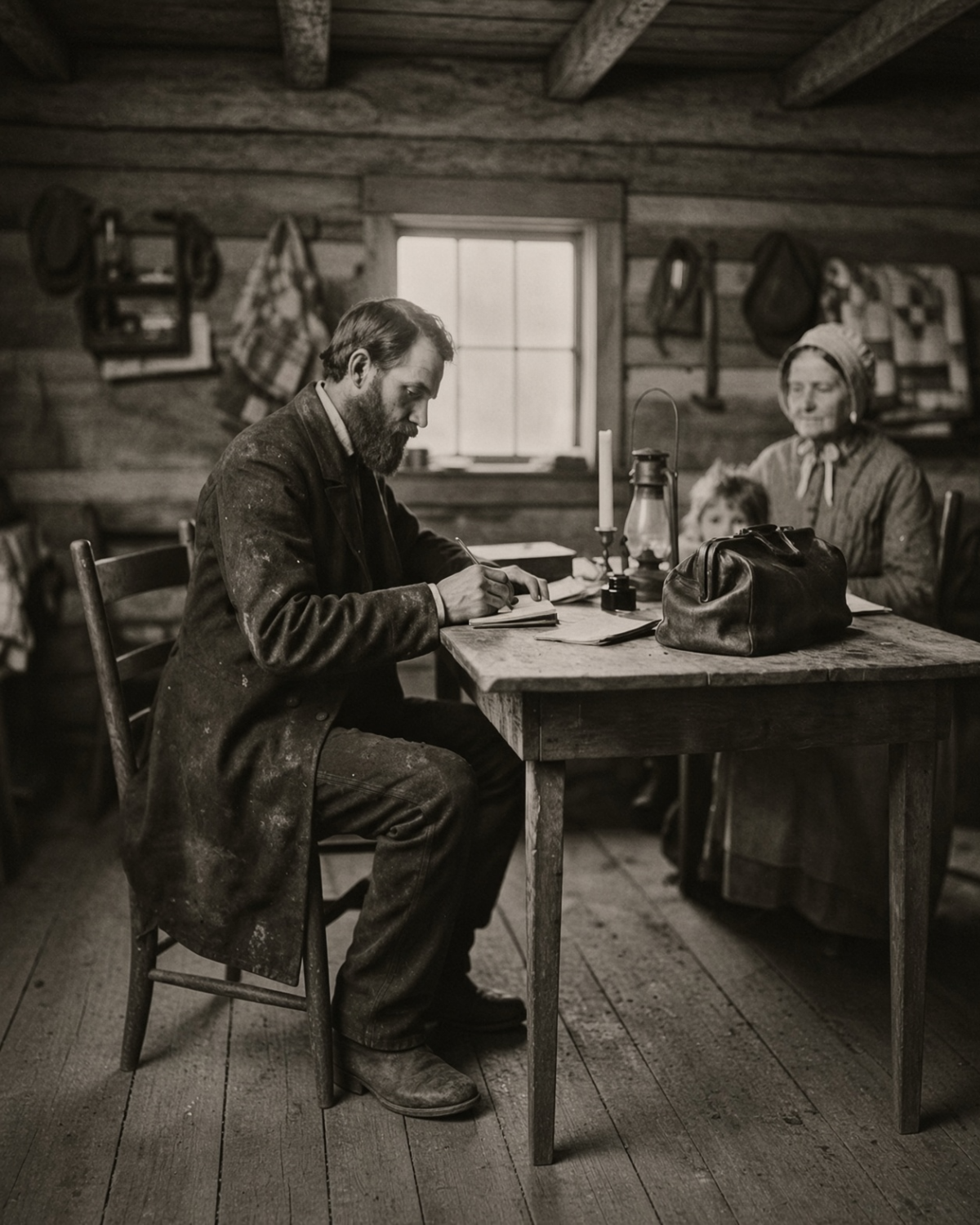
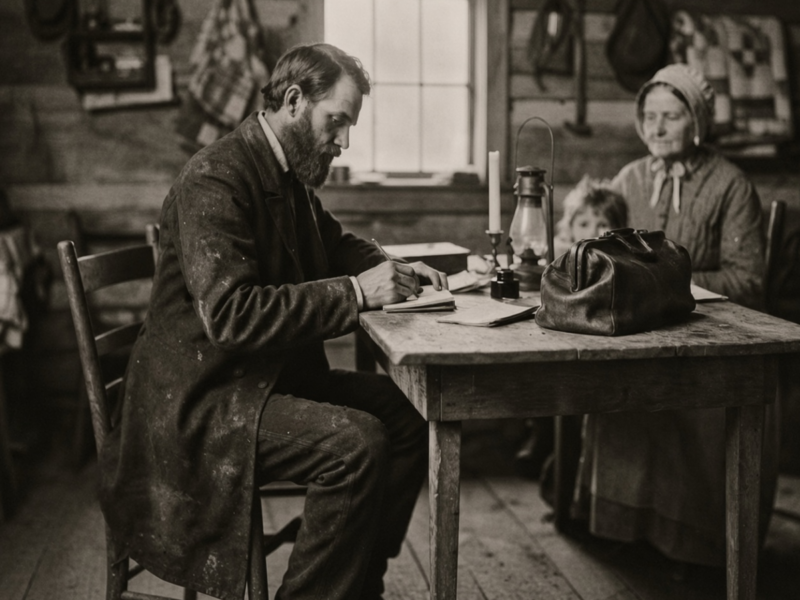
In the fall of 1865, a circuit doctor named Corwin Leam was called up a hollow in the western Carolina mountains to look at a boy who would not stop shaking.
The boy was eleven years old.
He was the second youngest of six children in the Alderly family, and by the time Leam reached the cabin, the boy had been shaking for nine hours straight, eyes open the whole time, saying the same four words over and over.
He was not calling for his mother.
He was not calling for God.
He kept saying again and again in the same flat voice, “I ate before Lark.”
Lark was his baby sister.
She was three years old, and in the Alderly house, no one—not the father, not the mother, not any child, no matter how hungry or how sick or how young—was permitted to eat before Lark did.
That rule had held in that family for eleven years, without one single exception.
On the night Leam arrived, it had been broken for the first time by accident, by a boy too weak with fever to wait his turn.
Leam wrote in his daybook that he expected to find a case of nervous shock brought on by guilt.
He did not expect to find, three days later, that the boy who broke the rule would be dead, and that the family would tell him calmly, without tears, that they had known he would be.
If you are watching this from somewhere in the world tonight, tell us where in the comments and make sure you are subscribed, because what happened to the Alderly family over the next four years does not stop with one boy.
It gets into every one of them.
One at a time, in an order nobody in that hollow could ever explain.
The Alderly family lived in a hollow the locals called Cold Water, tucked under a limestone shelf in what was then Garnet County, in the far western mountains of North Carolina.
The county no longer exists on any modern map.
It was folded into two neighboring counties in 1907, and most of its records burned in a courthouse fire in 1931, which is part of why this story sat unread for so long in boxes in three attics until a records researcher named Pearl Hartzel pulled the pieces together in the early 2000s.
Before we continue, a quick word.
What we show in these videos only ever scratches the surface.
There is more to every story than an hour of narration can hold, and there are parts we cannot go into on YouTube.
So I wrote the Grim Codex collection—four volumes, 253 cases, accounts, and rules.
No censorship.
QR code is on your screen.
Link is in the description.
Now, back to it.
The rule the family kept did not begin with Ezra Alderly.
It began with his grandfather, a man named Obadiah Alderly, who settled Cold Water Hollow around 1789, after a winter so hard that three families on the far side of the ridge lost every child under the age of six.
Obadiah’s own journal—five pages of which survived, folded inside a Bible now held by a descendant in Tennessee—describes a spring behind the cabin that never went dry, even in the worst drought years, and a strange understanding he claimed to have reached with it, though he never explains how the understanding was reached or with whom exactly he believed he was dealing.
His words, copied faithfully by Hartzel in 2004, read as follows.
“The spring will keep this family fed so long as this family keeps its own order. Feed the youngest first, always, whole and full, before any other mouth touches food, and there will be food. Break that order once, and the ground will collect what it is owed.”
For seventy-six years, the Alderly family kept that order without deviation.
Whoever was youngest in the house at every single meal ate first and ate as much as they wanted before anyone else, including the parents, touched a plate.
When a new child was born, the rule simply passed to them, and the family member who had been the youngest a week before quietly moved one place down the line and never complained about it.
Because by 1865, the rule was not a superstition to them.
It was closer to a law of physics.
Ezra Alderly, forty-four years old that fall, had grown up under it.
His wife Naomi, thirty-nine, had married into it and kept it without question for twenty years.
Their six children—Solomon, eighteen; Ruth, sixteen; Caleb, fourteen; Hosea, eleven; Delia, eight; and Lark, the baby, just three years old that October—had never known a meal any other way.
The hollow itself was poor, but never starving, even through the worst years of the war, which neighbors on both sides of the ridge noted with a kind of uneasy respect.
Crops failed elsewhere, and somehow held at Cold Water.
Livestock sickened elsewhere, and somehow stayed sound in the Alderly barn.
Dr. Corwin Leam, the circuit physician who served four counties on horseback, wrote in an earlier entry dated spring 1863 that he had never in eleven years of practice treated a single Alderly for anything resembling malnutrition, in a hollow where he treated it constantly in every other family.
He noted this as a point of professional curiosity, nothing more at the time.
The night the rule broke was an ordinary Tuesday in late October, three days before Leam was called up.
Naomi had put on a pot of cornmeal mush and a small side of salted pork.
Not much, but enough, and she set the table the way it was always set, with Lark’s bowl filled first and set in front of her before any other bowl left the pot.
Hosea, the second youngest, had been running a fever since morning—the kind that makes a child’s hand shake before they can stop themselves.
By his sister Delia’s later account, given to Reverend Micah Sentell and recorded in the church register the following spring, Hosea reached across the table while Lark was still being settled into her chair, took a spoonful of mush meant for his own bowl, which had not yet been filled, and ate it, standing up, three full seconds before Lark took her first bite.
Naomi, by every account, went white.
Ezra did not shout.
He did not strike the boy.
He simply set down his own spoon, looked at his son, and said, according to Delia, only this: “Now we wait and see what it wants back.”
The family finished the meal in total silence, Hosea included, and put the children to bed at the normal hour.
Sometime past midnight, Hosea woke screaming that something was standing at the foot of the loft ladder, looking up.
By the time Naomi got a lamp lit, he had stopped screaming and started shaking, and did not stop shaking for nine hours—through the whole ride Ezra made down the ridge to fetch Dr. Leam, through the examination, through everything—saying the same four words on a loop that Leam eventually stopped trying to interrupt.
I ate before Lark.
Leam’s daybook records a thorough exam that found nothing conclusive.
No fever high enough to account for it.
No wound, no poison, no sign of seizure disorder in the boy’s history.
He gave instructions for rest and rode back out the next morning, expecting the tremor to pass on its own.
It did not pass.
Three days later, Ezra Alderly rode down to Leam’s house himself, alone, and asked him to come back up—not because the boy had worsened, but because the boy had died in the night, sitting upright at the foot of his own bed, eyes open, and the family wanted a death certified before word got around the hollow that something else had happened up there.
What Leam found on that second visit is the part of his daybook that Hartzel says she read four times before she believed she had copied it correctly.
Hosea’s body showed no mark of violence and no sign of the fever finally breaking him.
His stomach, Leam wrote, was concave in a way he had only ever seen in men who had gone weeks without food, though the boy had eaten a full supper the night before and, by his mother’s account, had shown no loss of appetite in the days between the broken rule and his death.
His lips were cracked as if from long thirst.
His hands, when Leam lifted them, were curled the way a much older man’s hands curl from a lifetime of gripping tools—not the hands of an eleven-year-old boy.
Leam wrote that he had the distinct impression, one he was embarrassed to put on paper and put on paper anyway, that something had continued eating the boy from the inside for three straight days after the boy himself had stopped being able to eat anything at all.
Just a quick reminder—if you like these kinds of stories, there are four volumes of it in the Grim Codex collection, and they go deeper than we can here.
Link below, QR code on screen.
Back to it.
Ezra buried his son on family ground above the spring, not in the church cemetery down in the settlement—a decision the minister noted with some concern.
When Sentell rode up to offer a burial service, Ezra told him plainly that Hosea belonged to the hollow now in a way the churchyard could not account for, and the family would say their own words over him.
Sentell’s account describes standing at the edge of the small cleared plot and feeling, in his own phrase, as though the ground itself was listening with unusual attention to every word spoken over the grave, and that Naomi Alderly, dry-eyed through the whole service, said only one thing after the last word was spoken.
“He knows now he wasn’t supposed to be first.”
After Hosea’s death, the family tightened around the rule the way a hand tightens around something it has almost dropped.
Naomi began weighing portions before any meal, to be certain there was no ambiguity about what belonged to Lark and what belonged to everyone else.
Ezra built a second small table just for Lark, set apart from the main table, so even the appearance of a shared dish could not create confusion in a moment of hunger.
Delia, only eight, took to standing behind Lark’s chair at every meal like a small sentry, watching everyone else’s hands, ready to speak up the instant anyone moved too soon.
For nearly a year, it worked.
The spring kept running.
The crops held through a dry summer that failed three neighboring farms.
Leam, visiting on unrelated business that following spring, noted only that the family seemed unusually quiet and unusually careful with each other, in a way he chalked up to ordinary grief.
The second break came in March of 1866, five months after Hosea’s death, and it was not the family’s fault in any way that could be called careless.
Solomon, the eldest, had been gone with a Confederate cavalry unit since 1863, and came home that spring on foot—thin, sick with something that had been going around the camps, having walked most of two hundred miles alone.
He arrived at Cold Water after dark, past the hour the family normally ate, and Naomi, overjoyed and half convinced she was looking at a ghost, put bread and broth in front of her eldest son before she had even finished waking Lark from sleep to bring her to the table.
It was an honest mistake, made in the confusion of a homecoming nobody had expected to survive the war.
Solomon ate two full bites before Naomi realized what she had done and snatched the bowl away, but by then it did not matter.
Delia’s later account, again recorded by Sentell, says the whole family simply stood in the kitchen for a long moment, looking at each other, understanding without saying it aloud that the order had been broken a second time.
Nothing happened to Solomon.
That was the detail that unsettled Leam most when he heard the full account years later from Sentell, who had heard it from Delia, who by then was the only Alderly child still willing to speak about any of it.
Solomon recovered from his illness within the week and lived, by every surviving record, into old age—dying in 1911 in a different county of nothing more unusual than a stroke at seventy-one.
The debt from his broken meal did not fall on him.
It fell six weeks later on Ruth.
Ruth was sixteen, the second eldest, and by every account the family member with the least connection to the broken rule that March night.
She had not been present in the room when Solomon took his two bites.
She had, in fact, been out at the springhouse fetching milk at the exact moment it happened.
Sentell’s account describes her death in language nearly identical to Hosea’s.
Found seated upright at the edge of her own bed on a morning in late April.
No mark of violence.
Stomach hollowed as if from weeks of starvation, despite the full supper the night before.
Lips cracked.
Hands curled like an old woman’s.
Naomi told Sentell at the graveside a sentence that Hartzel believes is the single most important line in the entire record, because it is the moment the family understood what kind of debt they were actually paying.
“It does not take the one who broke it. It takes in order, starting from the top, until it reaches the one it was always owed.”
It took the family the better part of a year to understand the shape of what Naomi had said at Ruth’s graveside, and they understood it in the end only because Solomon gave them the missing piece without meaning to.
Within three weeks of Ruth’s death, Solomon left Cold Water Hollow for good, telling his father only that he could not sleep another night on that ground and did not intend to try.
He walked out with a single pack and did not come back.
Not for a visit, not for a funeral, not once in the next forty-five years.
And nothing more ever happened to him.
No sickness, no early death, no second toll.
Ezra, working through his own grief with the kind of grim arithmetic a man reaches for when he has run out of other explanations, came to believe that his son’s departure had removed him from whatever count the ground was keeping.
The debt, Ezra told Sentell that winter, only reaches as far as the ground itself.
Leave the ground and you leave the debt behind you.
Stay and your place in line holds.
If that was true, it explained everything that came next in the worst possible way, because the family had a choice they had not understood they were making, and most of them chose, out of loyalty or stubbornness, to stay.
Caleb, fourteen, was next in the order after Ruth, and he died in September of 1866, five months after his sister, in the same posture, the same hollowed stomach, the same cracked lips—found seated at the foot of his bed, as though he had simply sat down there sometime in the night and stopped.
Leam, called up for the third time in under a year, wrote in his daybook that he no longer had any medical language adequate to what he was seeing, and that he had begun privately to keep a second, unofficial page in the back of the book, where he recorded details he did not intend to put in any official report—including the fact that on each of the three visits he had noticed the spring behind the house running noticeably louder than usual for several days afterward, as though something in it had been satisfied and was, in his own private word for it, digesting.
Delia, eight when Hosea died and ten by the time Caleb followed him, was the one member of the family, besides Lark, who survived the whole ordeal.
And she survived it because Naomi made a decision that cost her more than Sentell’s account can describe.
In late 1866, with Caleb three months in the ground and only Naomi, Ezra, and the two youngest girls having lived on the land through the toll so far, Naomi sent Delia away to live with a cousin two counties over, on the stated reason that the girl needed schooling the hollow could not provide.
Sentell’s account makes clear that everyone involved understood the real reason.
Delia was next in the order after Caleb, and sending her off the ground was the only way anyone had found to break a place in line without dying to earn it.
It worked.
Delia lived a full life in the county over—married, raised four children of her own, and was the source, decades later, for nearly everything Sentell eventually wrote down, because she was the only Alderly still alive who was willing to talk about what she remembered.
That left Naomi and Ezra on the ground with only Lark.
And by the family’s own grim understanding of the order, one of the two of them was next.
It was Naomi.
She died in February of 1867, sixteen months after Hosea, found by Ezra himself, seated at the small foot table built for Lark’s separate meals, in the same posture the other three had died in, her own untouched bowl of breakfast mush still warm on the table in front of her.
Because on that final morning, by every account, she had fed Lark first, watched her finish, and then simply never picked up her own spoon at all.
Ezra buried his wife beside his three dead children on the rise above the spring, and lived alone with Lark, then not yet five years old, for two more years.
Neighbors who checked on him during that time, according to Sentell’s later notes gathered from several families in the hollow, describe a man who had stopped speaking almost entirely except to his daughter, who fed her first at every single meal with an exactness that bordered on ritual, weighing and measuring portions the way Naomi once had, and who told at least two visitors almost identically the same sentence.
“I am the last one owed. When I am gone, it will have all of us but her, and it will stop.”
Ezra Alderly died in the spring of 1869, found the same way as the others, on the same rise.
And Lark, six years old, was found by a passing neighbor sitting quietly beside her father’s body, having apparently sat with him through the whole night, unharmed, and by every account that survives, calm.
Lark Alderly went to live with her sister Delia in the county over and was raised, by every account, as an ordinary child with no memory of her own early years sharp enough to trouble her.
She married in 1884, had five children of her own, and according to Hartzel’s research, kept one habit for the rest of her life that none of her own children ever understood the reason for.
At every meal, in every house she ever kept, whoever was youngest at the table ate first, fully, before anyone else touched a plate.
And Lark would not sit down herself until she had watched that child finish.
Her own grandchildren remembered it as a sweet, old-fashioned kindness.
None of them, as far as Hartzel was able to determine, were ever told why.
Cold Water Hollow itself did not stay empty for long.
A different family, the Turleys, bought the land cheap in 1871, apparently without asking too many questions about why an entire family had died out on it in under four years, and lived there through the 1890s.
Church rolls from the receiving parish two ridges over show the family transferred their membership out of the hollow in 1893, and a single surviving letter from the eldest Turley daughter, kept by a descendant and shared with Hartzel in 2007, mentions in passing that her mother refused to let any child at their table touch food until the youngest had been served first and had eaten their fill—a habit the daughter assumed was simply her mother’s way and never once questioned, until she read decades later what had happened to the family before them.
The letter closes with a single line the daughter herself seemed unable to explain, written and underlined twice.
“We never asked why we kept it. We only knew what happened when a meal at that house ran short.”
A state land surveyor named Alden Grace passed through in 1911, drawing boundary lines for the reorganization that would soon erase Garnet County from the map, and his eleven-page field report, misfiled for decades before Hartzel found it, includes a strange half-page note that has nothing to do with boundary lines.
Grace wrote that the spring behind the old Alderly cabin, by then abandoned again, ran unusually loud the evening he camped nearby, and that he woke twice in the night with the distinct sense that something very close by was hungry and waiting—and not for him specifically—and that he broke camp before dawn rather than spend a second night on that particular rise, a decision he described, with visible embarrassment even on the page, as having nothing to do with reason and everything to do with an instinct he did not care to argue with.
Hartzel visited the site herself in 2006.
The cabin is long gone.
The five graves above the spring are still there, unmarked now, though the ground above them, she noted, stays noticeably greener than the surrounding slope, even in dry years—a detail she photographed but could never get a local historian to explain.
The spring still runs cold and constant, and locals who fish the creek it feeds still repeat an old piece of hollow wisdom with no context attached.
Feed the little one first, and don’t ever forget why.