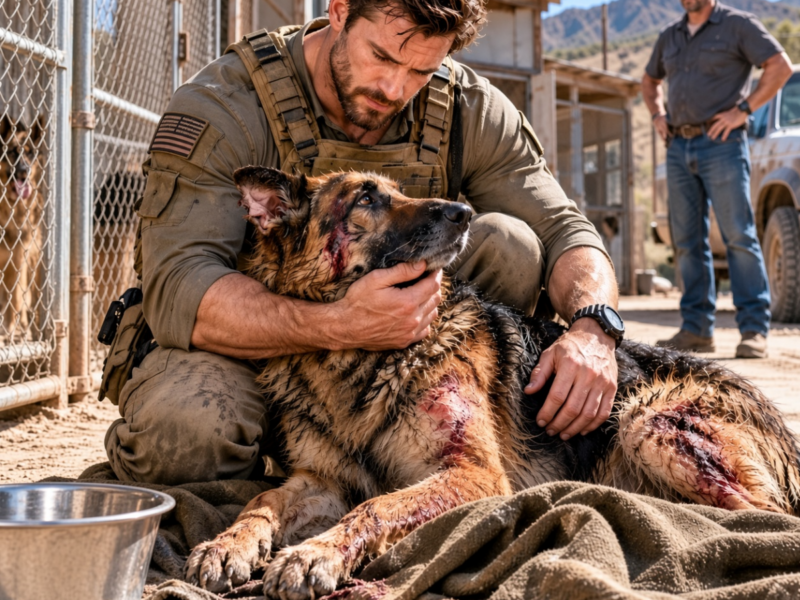
A Navy SEAL Saved a Dying K9 for $100—Two Years Later, He Was Priceless
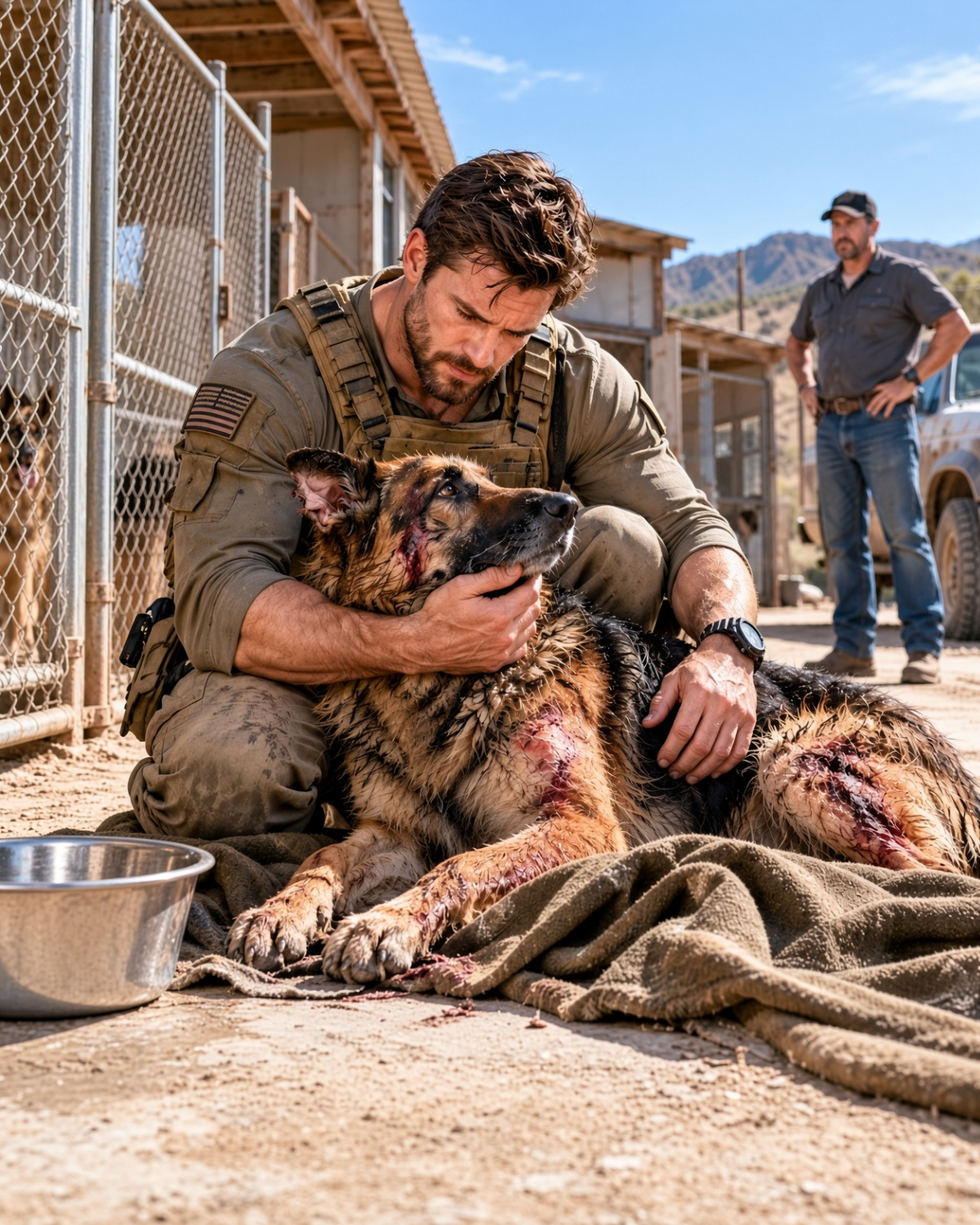
The kennel owner called the animal worthless. The veterinarian warned Wyatt that the odds of survival were terrible. Even the dog seemed to have accepted that his story was over.
Wyatt bought him anyway.
He had no idea that the decision would eventually lead to a classified military secret, a half-million-dollar bounty, and four armed men standing outside his cabin in the middle of a blizzard.
Two years later, when Wyatt’s injured leg gave way and an enemy stood over him, the dog everyone had dismissed as a lost cause would repay that crumpled hundred-dollar bill in a way no amount of money could ever measure.
But before Odin became the most valuable companion Wyatt had ever known, both of them had to survive the one thing neither believed they deserved anymore.
A second chance.
The Mojave sun was merciless that afternoon, baking the cracked earth until the air shimmered above the asphalt and turning the rusted corrugated roof of Ironclad K9 Security into an enormous oven.
Wyatt Hayes switched off the engine of his battered Ford Bronco and sat motionless behind the steering wheel.
He had spent three years learning how to live with silence.
Some mornings, he managed it.
Other mornings, silence was worse than gunfire.
His cabin in the San Bernardino Mountains stood among towering pines, far enough from the nearest neighbor that he could go several days without hearing another human voice. He had chosen it because nobody there knew his history, nobody asked about the limp in his left leg, and nobody looked at him with the uncomfortable expression people wore when they realized a decorated veteran wasn’t getting better as quickly as they thought he should.
The cabin was supposed to be peaceful.
Instead, every quiet room had become an invitation for the past to return.
The smell of woodsmoke became the smell of burning vehicle insulation. A branch snapping outside became a rifle shot. The low rumble of a passing truck could transport him back to a dusty road in Syria, where a routine movement had turned into a nightmare that ended the careers of men who had once believed they were invincible.
Wyatt had survived an improvised explosive device that tore through his squad’s convoy.
His leg had required multiple surgeries. His rehabilitation had lasted months. Eventually, military doctors had delivered the verdict he had dreaded more than any diagnosis.
He was medically discharged.
The Navy had awarded him medals, thanked him for his service, and helped him find the door.
None of that had taught him how to sleep through the night.
His former commanding officer, a man who understood that a soldier could leave a battlefield without ever truly escaping it, had suggested an animal companion.
Wyatt had dismissed the idea immediately.
“I’m not getting a golden retriever,” he had told him over the phone.
His former commander had laughed.
“Nobody said you had to get a golden retriever, Hayes. Just stop pretending that living alone with your ghosts is some kind of tactical advantage.”
Wyatt hadn’t answered.
Three days later, the same man sent him the address of a private security kennel liquidating its remaining animals and equipment.
Wyatt had told himself he was only going to look.
Now, staring at the faded sign above the compound gate, he wondered whether he had made another mistake.
He opened the door and stepped into the heat.
A man with a thinning hairline and a damp shirt emerged from a small office. He looked Wyatt up and down, pausing briefly at the military posture, the old scars, and the uneven way he distributed his weight.
“You’re the Navy guy?”
“Wyatt Hayes.”
“Greg Farnsworth. Owner.”
Farnsworth extended a clammy hand.
Wyatt ignored it and glanced toward the kennels.
“Let’s see what you’ve got.”
Farnsworth’s smile tightened, but he quickly recovered.
“Got some excellent working dogs. Belgian Malinois, Dutch Shepherds, some with serious bite-work training. Executives, private security companies, people with money—they love this kind of inventory.”
“I’m not an executive.”
“Then I’ll give you a military discount.”
“I haven’t asked for a price.”
Farnsworth’s smile faded.
He led Wyatt through the main kennel area, where several powerful dogs paced behind chain-link fencing. Their barking echoed across the compound, mixing with the metallic rattle of gates and the harsh buzzing of flies.
Wyatt watched them carefully.
Some were healthy, alert, and responsive. Others showed signs of poor handling, reacting to every movement with frantic excitement.
They were capable animals, but something about the place bothered him.
A good working dog needed more than aggression. Training required trust, discipline, and the ability to remain calm when every instinct demanded a reaction.
Here, fear had been mistaken for obedience.
Wyatt felt an old pressure gathering beneath his ribs.
He had seen what happened when people confused intimidation with control.
“Show me the others,” he said.
Farnsworth stopped walking.
“These are the premium dogs.”
“The others.”
The kennel owner exhaled sharply.
“Everything in the back is scheduled to be put down this afternoon. Washouts. Too aggressive, too nervous, too expensive to maintain. You don’t want those.”
Wyatt looked directly at him.
“Show me.”
For a moment, Farnsworth seemed ready to argue.
Then he shrugged and motioned toward a narrow path behind the main buildings.
“Suit yourself.”
They passed a stack of broken pallets and an abandoned equipment trailer before reaching a dilapidated wooden shed at the rear of the property.
The smell struck Wyatt before he reached the door.
Ammonia. Damp wood. Infected wounds. Food left to rot.
It reminded him of a makeshift medical station he had visited overseas after a particularly bad night.
His jaw tightened.
Farnsworth opened the shed.
“Unit Seventy-Three.”
The dog lay in the darkest corner of the last enclosure.
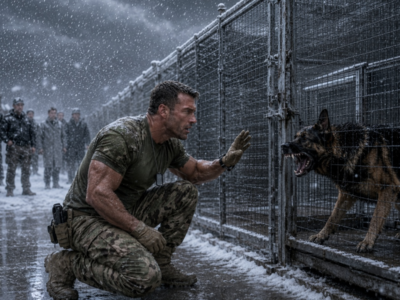
At first, Wyatt could barely distinguish the animal from the filthy blanket beneath him. The German Shepherd’s coat had become a patchy mixture of black and tan, matted against a skeletal frame. His ribs stood out sharply. Deep scars crossed his muzzle, and his left ear had been torn halfway through.
A metal water bowl sat near the cage door.
It was empty.
The dog did not bark.
He did not rise.
He barely moved.
Only his eyes shifted when Wyatt approached the fencing.
Amber.
Clouded with pain, exhaustion, and something that made Wyatt’s throat tighten unexpectedly.
Recognition.
Not recognition of Wyatt himself, but of the particular kind of defeat that came after a person—or an animal—had fought for too long without knowing whether anyone was coming.
Wyatt knew that look.
He had seen it in the faces of men who had run out of words, in the eyes of wounded teammates waiting for evacuation, and in his own reflection after the nightmares became too frequent to deny.
“What happened to him?” Wyatt asked.
Farnsworth gave a dismissive snort.
“Bought him from a liquidator in Texas. Previous owner said he was a high-end working dog. Some cartel buyer wanted a trained animal for his collection, so I figured I could rehabilitate him and make a profit.”
“And?”
“Nearly took my arm off the first week.”
Wyatt studied the scars.
“How did he get these?”
“Who knows? Dogs fight. Owners get rough. It’s the business.”
The casualness of the answer made Wyatt’s hands curl.
Farnsworth continued.
“Then the dog stopped eating. Stopped responding. We tried keeping him separate, but he just got worse. He’s been nothing but a liability.”
Wyatt crouched in front of the cage.
The German Shepherd’s breathing was shallow. His sides moved with visible effort.
“How long has he been like this?”
“Long enough.”
“That’s not an answer.”
“Couple of weeks. Maybe longer.”
“And you’re putting him down today?”
“Vet’s coming in an hour.”
Wyatt stared at the dog.
He had arrived looking for a companion, something that might help him find a reason to leave his cabin more often than necessary.
He had expected an ordinary decision.
Pick a dog. Pay a fee. Go home.
Instead, he found himself staring at an animal whose entire life had been reduced to a number on a cage.
Unit Seventy-Three.
No name.
No history.
No future.
Wyatt slipped his hand into his pocket and pulled out a crumpled $100 bill. The paper was creased from weeks of being carried in his wallet, and a dark stain marked one corner.
He had intended to use it for groceries on the drive home.
He pushed the bill through a gap in the chain-link fencing. It fluttered to the concrete.
“Unlock the cage.”
Farnsworth stared at him.
“Excuse me?”
“You heard me.”
“That dog is dangerous.”
“Unlock it.”
“He bites. He’s unstable. I’m telling you, I won’t be responsible if—”
“Greg.”
Wyatt rose to his full height.
He was six feet two inches tall, broad-shouldered despite the weight he had lost during rehabilitation, and possessed the kind of stillness that made people reconsider whether an argument was worth having.
His pale blue eyes remained fixed on Farnsworth.
“That hundred dollars is yours. The dog is mine. Unlock the cage.”
Farnsworth swallowed.
“You can’t just—”
“Watch me.”
The kennel owner glanced toward the main buildings, perhaps hoping someone might appear to support him. Nobody did.
Finally, he snatched the bill from the floor, pulled a ring of keys from his pocket, and opened the padlock.
“Don’t say I didn’t warn you.”
Wyatt stepped inside.
The dog flinched when he moved, then forced himself to remain still.
Wyatt did not reach for his head. He did not make sudden gestures or demand that the animal trust him.
Instead, he removed his heavy canvas jacket and slowly lowered himself onto one knee.
“It’s all right, buddy.”
The German Shepherd’s ears twitched.
“I know. You’ve had a rough time.”
Wyatt spread the jacket over the animal’s trembling body.
For several seconds, neither moved.
Then Wyatt slipped one arm beneath the dog’s chest and the other beneath his hindquarters.
The animal weighed far less than he should have.
As Wyatt lifted him, a faint sound escaped the dog’s throat. It was not quite a whimper, but it carried enough pain to make Wyatt’s expression harden.
“Easy,” he whispered. “I’ve got you.”
The dog did not struggle.
Farnsworth watched from the doorway.
“You’re making a mistake.”
Wyatt carried the German Shepherd outside.
“Maybe.”
He adjusted the jacket around the dog’s body and headed toward his Bronco.
“But it’s my mistake to make.”
And for the first time in years, Wyatt Hayes had made a decision without asking himself whether he deserved something good in return.
He simply refused to leave someone behind.
Forty-five minutes later, the doors of an emergency veterinary clinic in Riverside swung open hard enough to startle the receptionist.
Wyatt entered with the bundled dog in his arms.
“Please tell me someone can help him.”
The receptionist rose immediately.
A veterinary technician hurried forward, followed by Dr. Natalie Brooks, a no-nonsense veterinarian in her forties whose calm expression changed the moment she saw the animal.
“Put him here.”
Wyatt lowered the dog onto the stainless-steel examination table.
Dr. Brooks examined his gums, checked his breathing, and listened to his heart.
“Get me an IV line. Start warmed fluids. I want bloodwork, a chemistry panel, and a complete assessment of those wounds. Prepare antibiotics and get a warming unit in here.”
The staff moved quickly.
Wyatt stood near the wall, his hands stained with blood from the dog’s injuries.
Dr. Brooks glanced at him.
“How long have you had him?”
“About forty-five minutes.”
“Do you know his medical history?”
“No.”
“Vaccinations?”
“No.”
“Age?”
“No.”
“Name?”
Wyatt looked through the glass toward the treatment area, where the dog lay beneath a warming blanket.
For a moment, he considered calling him Seventy-Three.
Then he remembered the amber eyes.
“Odin,” he said.
Dr. Brooks paused.
“Odin?”
“Felt right.”
“All right. Odin it is.”
She turned back toward her team.
The next two hours passed in a blur of examinations, tests, and urgent treatment.
Eventually, Dr. Brooks returned with a clipboard.
“He is severely malnourished. His wounds are infected, and he has signs of a systemic bacterial infection. We’re also concerned about tick-borne disease.”
“Can you save him?”
She did not answer immediately.
That worried Wyatt more than a quick refusal would have.
“We can treat him. I need you to understand that treatment and recovery are two different things. He’s dangerously weak, and his body has very little reserve left.”
“What are his chances?”
“Not good enough for me to make promises.”
Wyatt glanced toward Odin.
The dog lay motionless, his dark coat barely visible beneath the blanket.
“What do you need from me?”
“Right now? Nothing. We need time, and he needs intensive care.”
Wyatt nodded.
“Then take the time.”
Dr. Brooks studied him.
“Mr. Hayes, treatment could become expensive.”
“How expensive?”
“Depending on how he responds, several thousand dollars. Possibly more.”
Wyatt had spent months learning to live on his military benefits and savings. His cabin needed repairs, his truck was overdue for maintenance, and he had been putting off several medical appointments because the bills made him uncomfortable.
He looked at Odin again.
“Do whatever gives him a fair chance.”
Dr. Brooks held his gaze for a moment before nodding.
“All right. We’ll do everything we reasonably can.”
For the next forty-eight hours, Wyatt barely left the clinic.
He slept in a hard plastic chair beside the recovery ward, waking whenever a technician entered the room. He drank coffee from paper cups and ate whatever food he could find in the vending machine.
He watched the monitors.
He watched Odin breathe.
And whenever the memories began creeping in, he focused on the simple rhythm of the dog’s chest rising and falling.
On the second night, at approximately 3:00 a.m., that rhythm changed.
A monitor began sounding an urgent alarm.
Wyatt was on his feet before he fully understood what was happening.
Technicians rushed into the room. Dr. Brooks appeared moments later, moving directly to Odin’s side.
Wyatt stood frozen behind the glass.
For a split second, the clinic disappeared.
He was back inside a military helicopter, the cabin shaking beneath him while a wounded teammate struggled to breathe. He could hear shouted instructions, feel the vibration of the aircraft, and remember the horrible certainty that sometimes a person could do everything right and still lose someone.
His fingers tightened around the edge of the counter.
Not again.
He had spent years trying to convince himself that survival was a matter of discipline, preparation, and luck.
But there were moments when none of those things seemed sufficient.
“Come on, buddy,” he whispered.
Dr. Brooks and her team continued working.
Wyatt pressed his forehead against the cool glass.
“Don’t tap out now. You hear me? You’ve made it this far.”
The monitor’s warning continued.
Then, slowly, the frantic rhythm began to settle.
One of the technicians adjusted the equipment and checked the readings.
Dr. Brooks exhaled.
“He’s stabilizing.”
Wyatt’s knees nearly gave way.
He lowered himself into the chair and covered his face with both hands.
For several seconds, he could not speak.
Then he looked through the glass at the battered German Shepherd.
“That’s it,” he whispered. “That’s it, Odin. Keep fighting.”
He stayed until dawn.
And somewhere in the quiet space between exhaustion and relief, the first small crack appeared in the wall he had built around himself.
It was not happiness.
Not yet.
It was the possibility that something in his life might still be worth protecting.
The next several months were not the easy recovery story Wyatt had secretly hoped for.
There were no miraculous mornings when Odin suddenly leaped from his bed, raced through the grass, and greeted the world as though nothing bad had ever happened.
Recovery came in smaller pieces.
A few bites of food.
A successful walk across the veterinary ward.
A night without a fever.
The first time Odin lifted his head when Wyatt entered the room.
Each victory was followed by another problem.
His digestive system struggled to tolerate regular meals. His muscles had wasted away, leaving him weak and unsteady. The infection required careful monitoring, and his damaged ear needed continued attention.
Dr. Brooks developed a treatment plan that included controlled nutrition, medication, rehabilitation, and gradual conditioning.
Wyatt followed it with the same attention to detail he had once given mission briefings.
He measured food portions, recorded medication times, and kept notes about Odin’s behavior.
He learned which sounds frightened the dog and which movements caused him to retreat.
Most importantly, he learned when not to push.
One afternoon, after several weeks of treatment, Wyatt sat beside Odin’s kennel and held out a small piece of chicken.
Odin stared at it.
“Your loss, buddy. This is the good stuff.”
The dog remained motionless.
Wyatt shrugged and placed the chicken in the bowl.
“No pressure.”
He turned away to speak with Dr. Brooks.
When he looked back, the chicken was gone.
Wyatt raised an eyebrow.
“Well, look at that.”
Odin lowered his head again, pretending the entire event had been an accident.
Wyatt laughed.
It was a small, rusty sound, as if his body had forgotten how to produce it.
But it was real.
Dr. Brooks noticed.
“That’s the first time I’ve heard you laugh.”
“Don’t spread it around.”
“I’ll try to keep your reputation intact.”
For the first time since leaving the Navy, Wyatt found himself looking forward to the next day.
Six weeks after the rescue, Odin was strong enough to leave the clinic.
His weight had improved, his wounds were healing, and his bloodwork showed encouraging progress.
Dr. Brooks stood beside Wyatt as he prepared the dog for the drive to Big Bear.
“He’s not ready for strenuous exercise. Keep his meals controlled, follow the medication schedule, and bring him back for his checkup.”
“I will.”
“And remember that physical recovery doesn’t necessarily mean the behavioral issues are gone.”
Wyatt looked at Odin, who stood close to his leg with a cautious, uncertain expression.
“I know.”
Dr. Brooks softened.
“He’s going to need patience.”
Wyatt rested a hand against the dog’s shoulder.
“So am I.”
The drive into the mountains took longer than usual because Wyatt stopped twice to let Odin settle and drink water.
When they finally reached the cabin, the late-afternoon sunlight was filtering through the pine trees.
Wyatt opened the door.
“Welcome home.”
Odin stepped inside.
He sniffed the entryway, examined the living room, and moved cautiously toward the fireplace.
Then he turned around and looked at Wyatt.
For the first time, the dog’s expression seemed to contain a question rather than an expectation of pain.
Wyatt shut the door behind them.
“Yeah,” he said quietly. “It’s just us.”
He had no idea how much that simple arrangement would change both their lives.
The first month at the cabin was a study in patience.
Odin followed Wyatt from room to room but rarely approached him directly. Sudden movements made the dog retreat, and loud noises sent him scrambling toward the nearest corner.
A branch snapping outside could make him flatten himself against the floor.
The first time Wyatt dropped a metal pan in the kitchen, Odin bolted into the bedroom and remained beneath the bed for nearly an hour.
Wyatt did not drag him out.
He sat on the floor nearby and spoke in a quiet voice until the dog finally emerged.
“You’re safe here,” Wyatt told him.
He repeated the words so often that they became part of the house.
You’re safe here.
When the wind rattled the windows, Wyatt said it.
When a delivery truck passed on the road, Wyatt said it.
When Odin woke from a restless sleep and stood trembling beside the bedroom door, Wyatt said it again.
Sometimes, he wondered whether he was speaking to the dog or himself.
At night, Odin refused to sleep anywhere except directly across the threshold of Wyatt’s bedroom.
Wyatt bought him a thick dog bed and placed it near the fireplace.
Odin ignored it.
He tried moving the bed beside his own.
Odin chose the doorway.
Eventually, Wyatt stopped arguing.
“If you insist on being a security system, at least try to get some sleep.”
Odin lowered his head onto his paws.
Wyatt turned off the light.
For the first time in a long while, the silence in the cabin no longer felt completely empty.
It had breathing in it.
It had warmth.
It had a living presence that asked nothing of him except that he remain.
The change in Odin’s body was gradual but remarkable.
Under Dr. Brooks’s supervision and Wyatt’s careful routine, the dog’s weight eventually reached seventy-five pounds. His coat thickened into a rich mahogany-and-black pattern, and the powerful frame hidden beneath the malnutrition began to emerge.
His scars remained.
A piece of his left ear was missing, and a jagged line of pale hair crossed his muzzle.
Wyatt never tried to conceal them.
They were part of Odin’s history, and Wyatt had no intention of pretending the past could be erased simply because the future had improved.
By the sixth month, Odin could accompany him on short walks through the forest.
Wyatt used a sturdy leash and kept the pace slow, allowing his own injured leg to dictate the distance.
The walks became a routine.
They followed the same trail through the pines, passed a fallen tree, and stopped near a clearing where the mountains opened into a broad view of the valley.
Wyatt began talking during those walks.
At first, it was ordinary conversation.
The weather.
The trail conditions.
The neighbor who kept driving too fast down the mountain road.
Then, without quite deciding to do it, Wyatt began talking about the men he had lost.
He told Odin about a teammate who had insisted on bringing terrible instant coffee on every deployment because he claimed it was the only way to maintain morale.
He talked about a young operator who could never remember where he had left his gloves.
He spoke about the last mission, about the explosion, and about the long stretch of time afterward when he could not understand why he had returned home while others had not.
Odin never interrupted.
He walked beside Wyatt, occasionally pausing to investigate a scent before returning to his side.
Wyatt found the silence easier to bear when it was shared.
But healing was not a straight line.
Some nights were worse than others.
The nightmares continued, sometimes several nights in a row. Wyatt would wake with his heart pounding, his muscles rigid, and his damaged leg aching as though the injury had happened moments earlier.
He had sought treatment from professionals and continued working with his therapist, but progress came unevenly.
Some days, he could discuss the past without losing his footing.
Other days, the smallest reminder sent him spiraling into a memory he had spent years trying to outrun.
Odin seemed to understand the difference.
On difficult mornings, the dog stayed close.
On better days, he gave Wyatt more room, following him at a comfortable distance rather than pressing against his leg.
Their relationship developed through a thousand quiet decisions.
Wyatt learned not to force affection.
Odin learned that a raised hand did not automatically mean danger.
Wyatt discovered that a dog could offer companionship without demanding an explanation for every silence.
Odin discovered that the man who had carried him out of the kennel would never use his weakness against him.
Neither understood that these lessons were preparing them for something far beyond the quiet life they had built.
The first clue appeared on a bitter November night.
A heavy blizzard had settled over the San Bernardino Mountains, burying the trail beneath fresh snow and rattling the cabin windows with powerful gusts of wind.
The weather reminded Wyatt of the nights when helicopters struggled against crosswinds and the sound of the rotors seemed to merge with the world itself.
He had checked the forecast, secured the porch furniture, and made sure the generator was ready.
Odin lay across the bedroom doorway.
Wyatt had taken his prescribed medication, completed his usual evening routine, and gone to bed early.
For a few hours, everything was quiet.
Then the nightmare came.
In his mind, Wyatt was back inside a damaged building overseas. Dust filled the air, the walls seemed to tremble around him, and a teammate was calling for help somewhere beyond a collapsed doorway.
Wyatt tried to move.
His injured leg refused.
He shouted a command, but the words seemed to disappear into the noise.
Then came the sound of gunfire.
Wyatt’s body jerked violently beneath the blankets.
His hands clenched.
He shouted names that had not been spoken in his cabin for years.
Odin lifted his head.
The dog’s ears angled forward, and his entire posture changed.
Wyatt thrashed again.
Odin rose, crossed the bedroom, and placed his front paws on the mattress.
Then he climbed carefully onto the bed and settled his substantial weight across Wyatt’s upper chest and shoulders.
The sudden pressure startled Wyatt awake.
His eyes flew open.
For an instant, he saw only a dark shape above him.
His combat instincts surged before his conscious mind could catch up. His hand reached toward the bedside table, and his muscles tightened as he tried to push the weight away.
Then he heard a low, steady sound.
Odin was breathing calmly.
The dog remained in place, pressing gently but firmly against Wyatt, giving him a solid physical point of contact while the nightmare loosened its grip.
Wyatt blinked.
The room returned in fragments.
The wooden ceiling.
The faint glow of the digital clock.
The snow tapping against the window.
And Odin’s amber eyes, fixed on his face.
“Easy,” Wyatt whispered, though he wasn’t sure which of them he was addressing.
Odin did not move.
Wyatt’s breathing slowed.
He placed both hands against the dog’s shoulders and felt the warmth of the animal beneath his palms.
The nightmare receded, leaving behind the familiar exhaustion and a sheen of cold sweat.
For several minutes, neither moved.
Then Wyatt let out a shaky breath.
“Where did you learn that, buddy?”
Odin tilted his head slightly.
Wyatt rubbed the dog’s neck.
“Seriously. Where did you learn that?”
There was no answer, of course.
But the question stayed with him until morning.
The next day, the storm had passed, leaving the forest covered in pristine white snow.
Wyatt made coffee, checked the weather, and took Odin outside for their usual walk.
His mind kept returning to the night before.
Dogs could learn to respond to distress. A carefully trained service animal might use physical contact to help a person regulate breathing and regain awareness during a panic episode.
But Odin’s behavior had seemed unusually deliberate.
He had recognized Wyatt’s distress, chosen a specific intervention, and maintained it until Wyatt regained his bearings.
It was not proof of anything by itself.
Still, Wyatt had spent enough time around military working dogs to recognize when an animal displayed behavior that suggested specialized training.
He decided to test a theory.
They reached a broad clearing surrounded by towering pines. Wyatt stopped, adjusted his stance to protect his injured leg, and watched Odin investigate a frozen pine cone.
“Odin.”
The dog looked up.
Wyatt took a breath.
Then he used a short, guttural command in German, one he remembered from training environments where handlers worked with military canines.
“Hier.”
Odin abandoned the pine cone instantly.
He crossed the clearing and stopped beside Wyatt’s left leg, sitting so precisely that his shoulder aligned with Wyatt’s knee.
Wyatt went still.
The dog watched his face.
“Fuß.”
Odin shifted position.
Wyatt’s pulse quickened.
He tried another command, one associated with a controlled search.
“Such.”
Odin moved.
The change was immediate and astonishing.
The cautious companion who had spent months flinching at snapping branches disappeared beneath a layer of disciplined purpose. Odin lowered his body and began moving through the clearing, checking the area with a systematic pattern.
He examined the spaces between trees, investigated the sheltered side of a fallen trunk, and moved along the edge of the clearing with an efficiency that could not be explained by ordinary curiosity alone.
Wyatt watched carefully.
He gave a sharp whistle and tapped his chest.
Odin turned immediately and returned, stopping in front of him.
The dog sat.
His gaze never left Wyatt’s face.
For several seconds, Wyatt could hear nothing except the wind moving through the pines.
He knew enough about working dogs to understand what he had just seen.
That was not the behavior of a frightened animal that happened to know a few tricks.
It suggested structured training, repeated conditioning, and a handler who had invested an enormous amount of time developing precise responses.
Wyatt knelt slowly.
“Who were you before me, buddy?”
Odin leaned forward and touched his nose to Wyatt’s hand.
The gesture was gentle.
It did nothing to explain the mystery.
But Wyatt had spent years learning that unanswered questions could become dangerous when ignored.
He took Odin back to the cabin and called someone he had not spoken to in nearly three years.
Brody Mitchell answered on the third ring.
“Well, I’ll be damned. Wyatt Hayes is alive.”
“Still here.”
“I was beginning to think you’d moved to Alaska and changed your name.”
“Not a bad idea.”
“How’s retirement treating you?”
Wyatt looked toward the fireplace, where Odin had settled on his bed.
“That’s why I’m calling.”
Brody’s tone changed.
“What happened?”
“I need you to investigate a microchip number.”
There was a pause.
“You need me to investigate a what?”
“A dog’s RFID tag. Military prefix, apparently. Standard veterinary registries don’t recognize it.”
Brody sighed.
“Wyatt, I work in private cybersecurity. I investigate secure networks, compromised systems, and people who think encryption is a personality trait. I don’t work for a pet store.”
“Good thing I didn’t call a pet store.”
“You’re still impossible.”
“Can you run it?”
Brody was silent for a moment.
“Send me the number.”
Wyatt read the identification sequence Dr. Brooks had recorded when she scanned Odin’s chip.
Brody repeated it to make sure he had copied it correctly.
“Give me a few minutes.”
The call went quiet.
Wyatt made another cup of coffee and sat at the kitchen table. Odin watched him from beside the fireplace.
Several minutes passed.
Then Brody returned.
His voice had lost its humor.
“Wyatt, where exactly did you get this dog?”
“A liquidation kennel in Southern California. The owner said he bought him from someone in Texas.”
“What’s the dog’s name?”
“Odin.”
“Was that the name when you got him?”
“No. The kennel called him Unit Seventy-Three.”
Brody exhaled slowly.
“All right. I need you to listen carefully. The identifier appears to match a restricted military working-dog record. I can’t access every associated file from where I am, but the available records point to a special operations canine.”
Wyatt looked at Odin.
“Go on.”
“The designation is K9 Titan.”
Wyatt said nothing.
Brody continued.
“According to the accessible record, Titan was classified as killed in action approximately two and a half years ago. The incident took place during a night operation in Helmand Province, Afghanistan.”
Wyatt felt the muscles in his back tighten.
“How did he die?”
“The official report says the handler was killed during the operation. Titan reportedly remained beside the handler’s body while the team attempted to secure the site. The final entry lists the dog as deceased.”
Wyatt looked at the scar across Odin’s muzzle.
“He wasn’t deceased.”
“No. Apparently, someone made a serious mistake.”
“Or someone lied.”
Brody did not answer immediately.
Wyatt stood and walked to the fireplace.
Odin lifted his head.
“Keep going,” Wyatt said.
“I’m searching the associated recovery records. There’s a contractor listed in the site-clearance documentation. Aegis Solutions.”
Wyatt knew the name.
He had heard it discussed in military circles, usually in connection with expensive private security contracts and operations that seemed to attract more controversy than accountability.
“Who’s the site manager?”
“Trenton Graves.”
The name landed like a weight.
Graves was a former Army Ranger who had left government service under a cloud of allegations and built a private contracting business with a reputation for operating in the gray areas of international security.
Some people considered him a ruthless businessman.
Others believed his organization profited from the movement of weapons, equipment, and restricted technology through channels that were difficult to trace.
Wyatt had never met him.
He had heard enough to know he did not want to.
“Tell me about the recovery operation,” Wyatt said.
Brody began reading through the limited records.
“The original mission went sideways. The handler was killed, and the team withdrew under difficult conditions. Aegis was contracted to assist with recovery and site clearance after the operation.”
“And Titan?”
“Officially dead. But if the microchip is authentic, someone must have removed him from the site before the records were finalized—or altered the records afterward.”
Wyatt stared at the dog.
Odin had returned to chewing his bone, apparently indifferent to the revelation that his entire identity might be built on a lie.
“Why would anyone do that?”
Brody’s keyboard clacked through the receiver.
“There’s another detail. Titan’s breeding lineage is classified, but the records I can access indicate he came from a particularly valuable military working-dog program.”
“Valuable how?”
“Genetics, performance history, temperament, training potential. The bloodline has connections to some of the most successful working canines in the program. People in private security and certain criminal networks pay extraordinary amounts for dogs with those characteristics.”
“How much?”
“I don’t have a confirmed sale price. But if someone was selling access to that bloodline, the money could be substantial.”
Wyatt glanced at the scarred shepherd.
“How substantial?”
Brody hesitated.
“Possibly hundreds of thousands of dollars, depending on what the buyer thought he was getting.”
Wyatt let out a slow breath.
The dog he had purchased for a hundred dollars had once been a highly trained military asset.
Someone had apparently falsified his death, moved him through private hands, and treated him as a commodity.
When his grief and injuries made him difficult to control, he had been passed from one owner to another until he ended up in a neglected kennel scheduled to put him down.
Wyatt felt something cold settle behind his ribs.
“Does Graves know the dog survived?”
“I don’t know.”
“Can you find out?”
“I’m looking.”
Brody paused.
“Wyatt, there is something else you need to understand. If Graves believes Titan is still alive, he may see the dog as both a valuable asset and a loose end. If the original records were falsified, the survival of the animal could expose the people responsible.”
Wyatt rested his hand against Odin’s head.
The dog’s amber eyes turned toward him.
“Let them come,” Wyatt said quietly.
“Don’t do that.”
“Do what?”
“Talk like you’re still on deployment. You’re retired. Your leg is in bad shape, and you live in an isolated cabin. If Graves has a team, this isn’t a problem you should handle alone.”
Wyatt looked through the window toward the snow-covered trees.
For years, he had done everything possible to avoid being pulled back into the world he had left behind.
Now the past had found him anyway.
“I’m not looking for a fight, Brody.”
“Good.”
“But I’m not handing him over, either.”
“Wyatt—”
“I bought this dog for a hundred dollars. I gave him a name. I brought him home. Whatever he was before, he’s not a piece of equipment anymore.”
Brody fell silent.
Then he said, “I’ll keep digging. But you need to be careful. If the records are accurate, this is bigger than a stolen dog.”
Wyatt ended the call.
For a long time, he remained beside the fireplace.
Odin eventually rose and approached him, resting his head against Wyatt’s thigh.
Wyatt ran his fingers through the dog’s thick fur.
“You hear that, buddy? Apparently, you used to be important.”
Odin’s tail moved once against the floor.
“Don’t let it go to your head.”
The dog leaned closer.
Wyatt smiled faintly.
But the smile did not last.
He had spent months believing the cabin was a refuge, a place where the world could not reach him unless he invited it inside.
Now he understood that the past had never been as distant as he wanted to believe.
Somewhere beyond the mountains, someone had built a business around the belief that everything—including a living creature’s identity—could be bought, sold, or erased.
And that person might soon discover that one of his most valuable assets had learned to belong to someone else.
The first thing Wyatt did was call Dr. Brooks.
He explained what Brody had found and asked whether Odin’s microchip and medical records could be preserved.
Dr. Brooks listened without interrupting.
When he finished, she said, “I can provide a complete veterinary record and document the condition he was in when you brought him to me. I can also record the microchip information and any relevant medical findings.”
“Would that help establish his history?”
“It would establish what we can verify. It wouldn’t prove who owned him before you.”
“Understood.”
“And Wyatt?”
“Yeah?”
“If you think someone may try to take him, don’t turn this into a confrontation. Contact the authorities. Preserve the records. Let people with the appropriate jurisdiction handle the investigation.”
“I hear you.”
“I mean it.”
“So do I.”
He thanked her and ended the call.
Next, he contacted a local attorney who handled property disputes and veteran-related matters. The attorney explained that the case could involve several legal questions, including ownership, fraudulent records, and the status of a restricted military working animal.
Wyatt was advised to keep every document, avoid threatening anyone, and contact law enforcement if someone attempted to remove Odin from his property.
For the first time in months, the cabin’s kitchen table became a working space.
Medical records sat beside printed chip information. Brody sent a summary of the accessible military documentation, carefully noting what had been verified and what remained uncertain.
Wyatt organized the files into a folder.
On the front, he wrote one word.
ODIN.
He kept the folder beside the original receipt from Ironclad K9 Security.
The receipt was little more than a faded scrap of paper bearing the date, the kennel’s name, and a handwritten entry for $100.
It was not much.
But it was a beginning.
And Wyatt had learned long ago that beginnings mattered.
For the next three weeks, he and Odin continued their routine.
They walked the trails when the weather permitted. Wyatt attended his appointments and maintained contact with his therapist. Odin continued gaining confidence, learning to relax around unfamiliar sounds and tolerate the presence of people outside the small circle he trusted.
The dog was no longer the fragile animal Wyatt had carried out of the kennel.
He could run short distances, climb over fallen logs, and navigate the uneven forest floor with impressive coordination.
Yet Wyatt noticed that certain behaviors remained unchanged.
Odin always positioned himself where he could see the cabin’s entrance.
He reacted to unfamiliar vehicles before Wyatt heard them.
And when someone approached the property, he became quiet rather than noisy, watching the movement with an intensity that seemed almost out of place in a peaceful mountain home.
Wyatt did not encourage aggression.
He worked with a qualified trainer to reinforce calm responses and reliable recall, taking care not to confuse Odin’s history with a need to turn him into a weapon again.
The dog had already spent too much of his life being valued for what he could do to other people.
Wyatt wanted him to experience something different.
Still, he could not ignore the instincts Odin displayed.
One afternoon, a delivery driver came up the narrow road with a package.
Odin noticed the vehicle before it reached the cabin.
He stood beside Wyatt, alert but controlled, and watched the driver approach.
When the man stepped out, Odin remained at Wyatt’s side.
No barking.
No lunging.
Just a steady gaze and a quiet readiness.
The driver handed over the package.
“Beautiful dog.”
Wyatt glanced down.
“He’s a good one.”
“Looks like he takes his job seriously.”
Wyatt scratched behind Odin’s ear.
“He’s learning that he doesn’t have to work every minute of the day.”
The driver laughed and returned to his vehicle.
After the truck disappeared down the road, Wyatt looked at Odin.
“You heard that? We’re retired.”
Odin followed him inside.
Wyatt almost believed they could remain that way.
Then Brody called again.
“Wyatt, I found something.”
Wyatt set down the screwdriver he had been using to repair a loose cabinet hinge.
“Tell me.”
“I’ve traced a sequence of communications tied to Aegis Solutions. I can’t prove every message came from Graves personally, but the timing is interesting. Someone has been asking questions about Titan’s status.”
Wyatt’s expression changed.
“What kind of questions?”
“Whether the animal’s remains were ever recovered. Whether the identification records were independently verified. Whether the handler’s report had been closed.”
“Someone’s checking the paperwork.”
“Exactly.”
“Do they know about me?”
“Not from anything I can see. But there’s a second trail. A buyer associated with a private security network has been asking about a German Shepherd matching Titan’s description. The buyer apparently believes the dog may still be available.”
Wyatt glanced toward Odin, who was sleeping near the fireplace.
“Available.”
“That’s the word they used.”
Wyatt’s jaw tightened.
“Any indication of a price?”
“Nothing confirmed. But the people involved are talking about the bloodline, not just the individual dog. If the buyer believes Titan is alive and genetically valuable, the figure could be significant.”
Brody paused.
“Wyatt, this is the part where I tell you to consider relocating temporarily.”
“No.”
“You didn’t even let me finish.”
“I heard you.”
“You’re living alone in the mountains. If someone decides to retrieve that dog, you’re at a disadvantage.”
Wyatt looked at the medical brace beside the kitchen door.
He knew exactly what Brody meant.
His leg was not reliable under sudden strain. He could walk, drive, work around the cabin, and manage ordinary life, but he could no longer assume his body would obey every command.
The thought made him angry.
Not because Brody was wrong.
Because he was right.
“I’m not going to pretend I can do everything I did five years ago,” Wyatt said. “But I’m not going to abandon Odin because somebody with money thinks he owns him.”
“Then involve the authorities now.”
“I will.”
“And don’t wait until someone is standing at your door.”
Wyatt looked at the window.
“I won’t.”
He contacted the county sheriff’s office and explained that he had acquired a dog whose identification appeared connected to a possible military ownership dispute. He provided the available documentation and asked what steps he should take if someone attempted to seize the animal.
The deputy who spoke with him advised him to keep copies of all records, document any suspicious activity, and call 911 if he faced an immediate threat.
Wyatt followed the advice.
He also installed additional exterior lighting and replaced the worn latch on the front door. He checked the smoke detectors, charged his phone, and made sure his emergency supplies were organized.
These were sensible precautions.
He refused to turn the cabin into a battlefield.
But he also refused to ignore the possibility that someone might come looking for Odin.
Three weeks after Brody’s warning, the weather changed.
A deep winter system moved over the mountains, bringing heavy snow, bitter winds, and visibility so poor that the road beyond Wyatt’s property became nearly indistinguishable from the surrounding forest.
Wyatt checked the forecast and decided to remain home.
He stocked the woodpile, filled the generator’s fuel tank, and brought enough supplies inside to avoid unnecessary trips outdoors.
Odin watched him move from room to room.
“Don’t start,” Wyatt said when the dog followed him into the kitchen for the third time.
Odin sat.
“I’m not going anywhere.”
The dog blinked.
Wyatt shook his head.
“You’re worse than my old commanding officer.”
That evening, he cooked dinner, watched a documentary he barely followed, and went to bed shortly after ten.
The cabin settled around him.
Wind moved through the pines.
Snow gathered against the windows.
For several hours, the world seemed peaceful.
Then, at 2:07 a.m., Odin raised his head.
He had been sleeping beside Wyatt’s bed.
Now he stood perfectly still, ears forward, staring toward the front door.
A low growl vibrated in his chest.
Wyatt opened his eyes.
“What is it?”
Odin did not look at him.
He moved toward the doorway, then stopped and glanced back.
Wyatt sat up slowly.
The exterior motion lights had not activated.
The sensors showed no obvious movement.
But Odin was not reacting to the wind.
Wyatt had spent enough time around trained working dogs to know that an animal could notice subtle sounds and scents long before a person recognized them.
He slipped out of bed, reached for his phone, and checked the security feed.
The front camera showed only blowing snow.
The side camera showed the same.
He was about to dismiss the warning when a dark shape appeared at the edge of the rear feed.
It remained visible for less than a second before disappearing behind a tree.
Wyatt’s stomach tightened.
He checked the feed again.
Nothing.
Then a second shape moved near the driveway.
Someone was outside.
Wyatt quietly called 911 and reported suspicious activity around his remote property. He gave the dispatcher his location and explained that he believed several people might be approaching his cabin during the storm.
The dispatcher instructed him to remain inside, avoid confrontation, and follow the responding officers’ directions.
Wyatt acknowledged the instructions.
He ended the call and moved away from the windows.
Odin followed him, his posture controlled and focused.
Wyatt took a flashlight, checked that his phone remained connected, and moved toward the kitchen where he could see the front entrance without standing directly beside it.
The wind howled outside.
Then came the sound of boots crunching through the snow.
One set.
Then another.
Then several more.
Wyatt felt the old machinery of his mind begin to turn.
He forced himself to breathe.
He was not overseas.
He was not on deployment.
He was a retired veteran in his own home, with an injured leg and a dog who had already survived more than enough.
He would follow the emergency dispatcher’s instructions and avoid escalating the situation.
The footsteps stopped.
A muffled impact sounded at the front door.
Then another.
The reinforced lock held.
A man’s voice carried faintly through the storm.
“Try the other side.”
Wyatt’s blood ran cold.
They were not lost hikers.
They were not neighbors checking on him.
They had come for Odin.
A second later, the cabin’s front door shuddered under a heavy blow.
Odin moved closer to Wyatt, placing himself between the kitchen and the entrance.
Wyatt looked down at him.
“Stay with me.”
The dog remained still.
Outside, someone muttered an impatient curse.
Then the door gave way.
The heavy wooden panel swung inward, striking the wall as snow blew across the entryway.
Three men entered wearing winter camouflage and dark tactical equipment. Their faces were partly obscured, and they moved with the confidence of people accustomed to working together.
A fourth figure remained somewhere beyond the entrance.
“Check the living room,” the lead man ordered.
His voice was low and controlled.
“Find the dog. The SEAL is secondary.”
Wyatt’s heart hammered.
The lead man was tall, with broad shoulders and a dark beard visible beneath his face covering.
Wyatt recognized the manner of movement before he recognized the voice.
Professional.
Deliberate.
Dangerous.
The man turned toward the kitchen.
“Hayes.”
Wyatt remained behind the counter.
The intruder smiled without warmth.
“Trenton Graves sends his regards.”
The name confirmed what Wyatt had feared.
“You’re a long way from wherever you came from,” Wyatt replied.
“Not really. We’re here for company property.”
“That dog isn’t property.”
“That’s not your decision.”
The man moved farther into the room.
Wyatt heard the others separating, searching the cabin.
He knew he was at a disadvantage. His leg was stiff from the cold, and the cramped layout gave him few options if the situation turned violent.
He had already called for help.
Now he needed to keep the situation from getting worse until assistance arrived.
“What’s your name?” Wyatt asked.
“Logan.”
“Logan, you can walk back out that door.”
Logan chuckled.
“You think this is a negotiation?”
“I think you have a choice.”
“No, Hayes. You had a choice when you bought something that didn’t belong to you.”
Wyatt’s expression hardened.
“I bought a starving dog from a man who was going to have him put down. If you believe he belongs to someone else, you can explain that to the authorities.”
Logan’s smile disappeared.
“You’re making this complicated.”
“No. You are.”
For a moment, neither moved.
Then one of the other men called from the hallway.
“Found him.”
Odin stood at the edge of the kitchen.
His body was tense, but he did not rush forward.
The second man approached with a restraint lead in his hand.
“Come here, boy.”
Odin’s ears flattened slightly.
The man took another step.
“Come on. Let’s go.”
Odin retreated half a pace and looked at Wyatt.
That single glance carried more weight than any growl could have.
Wyatt had promised the dog safety.
He had promised him a home.
He would not hand him over to strangers simply because they had arrived with equipment and confidence.
“Back away from him,” Wyatt said.
The man ignored him.
Logan raised a hand.
“Don’t damage the dog. That’s the whole point of this operation.”
Wyatt stared at him.
“You’re talking about him like a piece of machinery.”
“He’s worth more than you’ll make in the rest of your life.”
“Then you should have taken better care of him.”
Logan’s jaw tightened.
“You have no idea what you’re involved in.”
“I know enough.”
The lead man glanced toward his companions.
“Get the dog. We’ll deal with Hayes afterward.”
The second man stepped forward.
Odin moved sideways, keeping Wyatt between himself and the intruder.
The man reached for the dog’s collar.
Everything happened quickly.
Odin slipped away from the reaching hand, placing his body between the stranger and Wyatt.
The man cursed and tried again.
This time, Odin’s warning growl filled the kitchen.
“Control your dog!” Logan snapped.
Wyatt’s voice remained steady.
“Leave him alone.”
The intruder ignored the warning and grabbed for Odin’s collar a third time.
Odin reacted.
He surged forward, knocking the man off balance and forcing him backward into the kitchen island. The man’s restraint lead fell from his hand.
The sudden movement broke the tense stillness of the room.
One of the other intruders raised his weapon.
Wyatt shouted, “Stop!”
The man hesitated.
Logan’s face twisted with anger.
“Get that animal under control!”
Odin stayed close to Wyatt, watching the men.
Wyatt reached for his phone, which he had placed on the counter after speaking with the dispatcher.
Logan noticed.
“Put it down.”
“No.”
Logan stepped closer.
“You really want to die over a dog?”
Wyatt looked at him.
“No. I want you to leave.”
Logan raised his weapon.
At that instant, a sharp crack sounded from outside as a heavy branch snapped beneath the weight of the snow.
One of the intruders turned toward the sound.
Wyatt moved instinctively away from the counter, trying to put distance between himself and the approaching man.
His injured leg buckled.
Pain shot through his thigh, and he crashed against the edge of the kitchen island.
The phone slid to the floor.
Logan saw the opening.
He crossed the room in two quick steps, bringing his weapon up.
“End of the line, Hayes.”
Wyatt tried to straighten, but his leg refused to cooperate.
The floor tilted beneath him.
He could hear the storm through the broken doorway and the harsh breathing of the man standing over him.
For one terrible moment, he was back in the desert, trapped beneath the weight of a world that had suddenly become too heavy to move.
Then Odin stepped forward.
The dog did not bark wildly or charge without purpose.
He moved with astonishing speed, striking Logan high in the chest and knocking him off balance. Logan stumbled backward, his weapon slipping from its intended line.
Odin remained between him and Wyatt.
The other men shouted.
One tried to move around the kitchen island, but the narrow space forced him to slow down.
Wyatt dragged himself away from the counter, reaching for his phone.
Logan recovered and attempted to regain control of the room.
“Get the dog!”
The order came too late.
Odin darted away from the first man’s reaching hands and returned to Wyatt’s side, refusing to leave him exposed.
The intruder stumbled against a chair.
Another man moved toward the dog, but Wyatt shouted a sharp German release command.
“AUS!”
Odin immediately disengaged and stepped back.
The response was so precise that Logan hesitated.
For the first time since entering the cabin, the contractor seemed uncertain.
He had expected a frightened civilian dog or perhaps an aggressive animal that could be subdued with the right equipment.
He had not expected a highly trained working dog whose obedience remained intact under pressure.
Wyatt struggled upright, using the counter for support.
His leg trembled.
He kept his phone in one hand and watched the intruders carefully.
“You’re finished,” he said.
Logan stared at him.
“You think this changes anything?”
“It changes what happens next.”
A siren sounded faintly through the storm.
Logan’s expression changed.
The sound grew louder.
The intruders exchanged quick glances.
One moved toward the door.
Another swore under his breath.
Logan backed away from Wyatt, his eyes never leaving Odin.
“This isn’t over.”
Wyatt remained beside the counter.
“It is for tonight.”
Logan made a final gesture toward his companions.
They retreated through the broken entrance, abandoning the equipment they had brought and disappearing into the swirling snow.
Wyatt did not follow them.
He stayed inside, listening to the approaching sirens and keeping Odin beside him.
When the first deputies entered the cabin, they found a shattered doorway, overturned furniture, several abandoned pieces of equipment, and a retired Navy SEAL whose injured leg was shaking beneath him.
Beside him stood a scarred German Shepherd with amber eyes.
The dog remained alert until Wyatt rested a hand on his neck.
“It’s all right, buddy.”
Odin looked up at him.
The deputies secured the property and began documenting the scene. An ambulance crew examined Wyatt’s leg, which had been badly aggravated during the confrontation.
He was advised to go to the emergency department for further evaluation.
This time, he did not argue.
Before leaving, he crouched as carefully as his injury allowed and placed both hands against Odin’s shoulders.
“You did good.”
Odin nudged his face.
Wyatt rested his forehead briefly against the dog’s.
“I’ve got you.”
The words had begun as a promise made to a dying animal in a filthy kennel.
Now, standing amid the wreckage of the cabin, Wyatt understood that they meant something more.
He had promised Odin a home.
Odin had given him a reason to defend it.
And neither of them was going to face what came next alone.
By sunrise, the storm had begun to weaken.
Wyatt returned from the emergency department with instructions to rest, manage his pain, and follow up with his medical team. His leg had suffered a serious flare-up, but imaging showed no new major structural injury.
The cabin, however, had taken a beating.
The front door was damaged beyond immediate repair. Furniture had been overturned, a window had cracked, and snow had drifted across the living room floor.
Odin walked through the wreckage beside Wyatt.
He paused near the entrance, sniffed the air, and then turned back toward the fireplace.
Wyatt let out a tired laugh.
“You’re taking this remarkably well.”
Odin lay down beside his bed.
Wyatt lowered himself into a chair.
For several minutes, he simply watched the dog.
He had spent years measuring his worth by the things he could endure, the missions he could complete, and the responsibilities he could carry without asking for help.
When the injury ended his career, he had interpreted the loss as a verdict on his usefulness.
He had survived, but survival had seemed like a consolation prize.
Then Odin had arrived.
A dying animal had given Wyatt something he had not realized he needed: a responsibility that was not defined by rank, performance, or the ability to stand in the middle of danger.
Wyatt had cared for Odin because the dog needed him.
Odin had stayed because Wyatt had become his safe place.
Neither relationship required a medal.
Neither could be measured in money.
His phone rang.
Brody.
Wyatt answered.
“You’re alive.”
“Good morning to you, too.”
“Did they find you?”
“They found the cabin.”
Brody swore quietly.
“How bad?”
“Broken door. Damaged furniture. My leg took a beating. Odin is fine.”
“Did you call the police?”
“Yes. Deputies responded, documented the scene, and took statements. I’ve been told not to interfere with the investigation.”
“Good. That’s exactly what you should do.”
Wyatt looked at the front entrance.
“They knew who I was. They knew where I lived. They came specifically for Odin.”
“I suspected this might happen.”
“Can you connect them to Graves?”
“I’m working on it. The communications trail has become more active since the dog appeared in the private buyer network. I can’t yet prove that Graves personally ordered the operation, but the timing is difficult to ignore.”
Wyatt rubbed his forehead.
“What happens now?”
“Now we preserve everything. The police have the physical evidence. Your attorney can coordinate with investigators, and I’ll continue examining the records I can lawfully access.”
“Any word from the buyer?”
“Not directly. But there’s a number being discussed in the network.”
Wyatt waited.
“Five hundred thousand dollars,” Brody said. “Possibly more, depending on the terms.”
Wyatt glanced at Odin.
The dog was asleep, his head resting on his front paws.
“Half a million dollars.”
“That’s what the available messages suggest. I can’t verify a completed offer, but the figure keeps appearing alongside references to Titan’s bloodline.”
Wyatt shook his head.
“That’s a lot of money for a dog.”
“It’s a lot of money for what they think he represents.”
“He’s not a breeding program. He’s not a contract. He’s not a piece of military equipment.”
“I know.”
Wyatt’s voice softened.
“He’s Odin.”
Brody was quiet for a moment.
“Then make sure the authorities know that, too.”
The investigation continued over the following days.
Deputies collected evidence from the cabin and interviewed Wyatt about the intruders. His attorney helped organize the veterinary records, the microchip information, the purchase receipt, and the communications supplied by Brody.
The case was complicated.
The men who had entered the cabin had left behind equipment and other evidence, but identifying the people responsible required more than Wyatt’s account alone.
Investigators pursued leads connected to the contractor network while Brody continued examining the historical records.
Wyatt cooperated fully.
He did not go looking for Graves.
He did not send threats or make promises about revenge.
He had learned that anger could feel like strength while quietly taking control of every decision a person made.
This time, he chose patience.
The cabin was repaired with help from two neighbors and a local contractor who specialized in mountain properties.
Wyatt’s attorney recommended additional security measures and advised him to avoid discussing the case publicly while investigators worked.
Wyatt followed that advice.
Odin’s routine changed temporarily. They took shorter walks, avoided isolated trails, and spent more time indoors while the property was assessed.
The dog adapted without complaint.
If anything, he seemed more attentive to Wyatt’s needs after the confrontation.
When Wyatt struggled to stand, Odin waited.
When the pain in his leg made him move slowly, Odin matched his pace.
When Wyatt woke from a difficult dream, Odin approached the bed and rested his head beside his hand.
The dog never demanded that Wyatt be the man he had been before the explosion.
He accepted the man who was there.
That, Wyatt began to understand, was a kind of loyalty he had rarely encountered in his former life.
Two weeks after the intrusion, Brody called with a significant update.
“The records are coming together.”
Wyatt sat at the kitchen table, the repaired front door visible beyond the hallway.
“Tell me.”
“The military documentation shows that Titan was officially recorded as deceased after the operation in Afghanistan. However, the recovery paperwork has inconsistencies. The chain of custody is incomplete, and several entries don’t match the dates in the contractor records.”
“So someone manipulated the report.”
“That’s one possibility. Investigators will have to determine what happened. But the records suggest that Titan may have been transferred out of official custody during the recovery process.”
“To Aegis.”
“Possibly. The available documents place Aegis personnel at the site, but they don’t establish every step of the transfer.”
Wyatt listened carefully.
“Can you prove Graves ordered the cabin intrusion?”
“Not yet. I have communications linking people in his network to inquiries about Titan. The timing suggests that someone became aware of the dog’s survival and began looking for him. That’s important, but it isn’t the same as proving who issued the order.”
Wyatt appreciated the distinction.
“Keep going.”
“There are also indications that Titan’s history was being used to attract private buyers. Some of the material describes him as an elite working animal with exceptional training and breeding value.”
Wyatt glanced toward Odin.
“He’s worth half a million dollars to these people.”
“Apparently.”
“And they never asked whether he was happy.”
“No.”
Wyatt looked down at his hands.
He remembered the kennel.
The empty water bowl.
The matted fur.
The way Odin had lain in the darkest corner, waiting for the end because every person who had owned him had treated his suffering as an inconvenience.
The thought made him feel sick.
“What happens to the people responsible?”
“That depends on what investigators establish. There may be allegations involving fraud, unlawful transfer of restricted property, and the attempted seizure of the dog. But we need to let the evidence speak.”
Wyatt nodded, though Brody could not see him.
“Understood.”
After the call, Wyatt took the folder from the kitchen table.
The original $100 receipt was tucked inside the front cover.
He pulled it out and studied the faded ink.
One hundred dollars.
It seemed almost absurd that such a small transaction had connected him to a story involving military records, private contractors, and a potential half-million-dollar sale.
He folded the receipt carefully and returned it to the folder.
Then he went outside.
The snow had begun to melt beneath the afternoon sun, revealing patches of brown earth around the pines.
Odin followed him to the porch.
Wyatt sat on the top step and patted the space beside him.
The dog settled against his good leg.
For a while, they watched the mountains.
“Do you ever wonder what your life would have been like if I’d driven past that kennel?” Wyatt asked.
Odin blinked.
“Probably not. You’d have been too busy being mysterious.”
The dog’s tail thumped once.
Wyatt smiled.
“I wouldn’t have blamed you if you’d given up. You had every reason to.”
He rubbed the scarred fur along Odin’s muzzle.
“But you didn’t.”
Odin leaned into his hand.
Wyatt felt his throat tighten.
Neither of them had been healed by a single dramatic moment.
Odin’s recovery had required months of treatment, routine, and trust.
Wyatt’s recovery had required professional help, difficult conversations, and the willingness to acknowledge that surviving an injury did not mean he had to spend the rest of his life punishing himself for it.
They had not erased the past.
They had learned to live beyond it.
And that was enough to begin with.
The next major development came three days later.
Brody called shortly after noon.
“I have news.”
Wyatt was repairing a section of fencing near the driveway.
“Good news or bad?”
“Potentially good. The investigators have identified additional links between the contractor network and the people who came to your cabin. I can’t give you every detail, but the evidence is becoming more substantial.”
Wyatt set down his tools.
“Does Graves know?”
“I can’t confirm what he knows. But the network has gone quiet in several places. Some associated accounts have been deactivated, and there are indications that assets connected to Aegis are being transferred or liquidated.”
“He’s running.”
“Possibly. The investigators are looking into it.”
Wyatt looked toward the mountains.
“What about Odin?”
“His status is now part of the investigation. The military authorities have been notified of the microchip record, and the veterinary documentation you provided is helping establish the dog’s condition and timeline.”
“Does that mean someone can take him?”
“Not automatically. Ownership and custody will have to be resolved through the proper channels. Your attorney should coordinate with the relevant authorities before making any assumptions.”
Wyatt nodded.
“All right.”
Brody paused.
“There’s one more thing. The buyer network has apparently been told that Titan is no longer available.”
Wyatt frowned.
“By whom?”
“I don’t know. It could be someone trying to limit exposure, or someone who has realized the dog isn’t worth the trouble. I can’t prove the reason.”
Wyatt looked at Odin, who had come over to inspect the tools.
“Good.”
“Wyatt, don’t assume this is finished until the investigators say so.”
“I won’t.”
“Keep doing what you’ve been doing. Preserve the records, follow your attorney’s advice, and stay away from anyone connected to Graves.”
“That’s the plan.”
After the call, Wyatt returned to the cabin and prepared lunch.
Odin settled near the kitchen table, watching him cut chicken into small pieces.
Wyatt placed a portion in the dog’s bowl and another on his own plate.
“You know,” he said, “for a dog who supposedly died two and a half years ago, you’ve created an unreasonable amount of paperwork.”
Odin began eating.
“At least pretend to be sorry.”
The dog’s tail moved once.
Wyatt laughed.
This time, the sound came easily.
Weeks passed.
The investigation continued, and Wyatt received occasional updates through his attorney. He learned that several individuals associated with the attempted seizure were being investigated, while the broader inquiry into the contractor’s activities remained ongoing.
He was careful not to assume that every allegation had been proven.
There were still unanswered questions about Titan’s transfer, the falsified or incomplete records, and the people who had profited from moving the dog through private hands.
But one thing was no longer in doubt.
Odin had survived.
The dog whose official record declared him dead was sleeping beside a fireplace in California, recovering from his past and learning how to live without fear.
Wyatt’s own life began to expand again.
He resumed regular appointments with his therapist and started taking longer walks when his leg allowed it. He repaired the remaining damage to the cabin, reconnected with a few former teammates, and began accepting invitations he would previously have declined.
He even agreed to meet his former commanding officer for lunch.
The older man arrived wearing a faded baseball cap and the expression of someone who had already decided the conversation would be entertaining.
“So,” he said, settling into a booth at a small diner, “I hear you bought yourself a dog.”
Wyatt took a sip of coffee.
“Apparently, the entire military community knows.”
“Hard not to. You called Brody about a microchip, and now half the people I know are asking whether you found a retired war hero with four legs.”
Wyatt shook his head.
“That’s an exaggeration.”
“Is it?”
“Maybe a little.”
His former commander leaned back.
“How’s he doing?”
“Better. Much better.”
“And you?”
Wyatt looked out the window at the parking lot.
For years, he had hated that question.
It required him to summarize something he barely understood himself.
This time, he considered the answer.
“I’m working on it.”
His commander nodded.
“That’s a good answer.”
They talked for nearly an hour.
They discussed old teammates, military changes, and the strange experience of watching younger people enter a profession that had once consumed every waking moment of their lives.
Eventually, the commander asked about the attempted seizure.
Wyatt explained what he could without interfering with the investigation.
The older man listened, his expression becoming serious.
“They wanted the dog back because he was valuable.”
“That’s what it looks like.”
“And you wouldn’t give him up.”
“No.”
“Why?”
Wyatt looked at him.
The answer seemed so obvious that he almost laughed.
“Because he’s not theirs to take.”
His former commander studied him for a moment.
Then he smiled faintly.
“That’s the first time I’ve heard you sound certain about something in a long time.”
Wyatt had no immediate response.
But the observation stayed with him on the drive home.
When he reached the cabin, Odin was waiting near the front door.
The dog stood, stretched, and approached him with the relaxed confidence of an animal who knew exactly where he belonged.
Wyatt knelt and rubbed his ears.
“Hey, buddy.”
Odin pressed his forehead against Wyatt’s shoulder.
Wyatt closed his eyes.
For years, he had believed that certainty belonged to the battlefield, where orders were clear and decisions had immediate consequences.
He was beginning to understand that some of the most important decisions were much quieter.
A hundred-dollar bill.
An open cage.
A jacket placed over a trembling body.
A promise made without knowing whether either of them would survive long enough to keep it.
The following spring, the mountains began to thaw.
Snow receded from the trails, wildflowers appeared along the road, and the afternoons grew warm enough for Wyatt to sit on the porch without a heavy coat.
Odin’s coat shone in the sunlight.
The dog had become strong and healthy, though his scars remained visible.
Wyatt no longer saw those scars as evidence of what had been done to him.
They were reminders of what he had endured.
There was a difference.
One morning, Wyatt found himself looking through the old folder of documents again.
The investigation had progressed, and his attorney had confirmed that the relevant authorities were continuing to address the ownership and transfer issues. Some details remained confidential, but the case had moved beyond the initial uncertainty that followed the break-in.
The original receipt lay at the bottom of the folder.
Wyatt took it outside.
Odin was resting beneath the pine tree beside the porch.
“Come here.”
The dog rose and approached.
Wyatt held up the crumpled paper.
“You know what this is?”
Odin sniffed it.
“This is the most expensive hundred dollars I ever spent.”
The dog looked unimpressed.
Wyatt laughed and folded the receipt.
“All right. Maybe not expensive. But definitely the best.”
He placed it back in his pocket.
Then he sat on the porch, and Odin settled beside him.
They watched a pair of birds move through the branches.
A car passed on the distant road.
Somewhere beyond the property, the world continued its endless business of making promises, breaking them, and trying to decide what things were worth.
Wyatt no longer felt compelled to measure himself against it.
He had lost his career.
He had lost friends.
He had lost the future he once imagined.
But he had found something he had not known how to ask for.
A companion who did not care whether he walked with a limp.
A living presence that stayed beside him when the memories returned.
A reason to rise each morning and do something useful, even when the day offered no grand purpose.
Odin had not cured him.
Wyatt understood that now.
No animal, no friendship, and no single act of kindness could erase the consequences of trauma.
But Odin had helped him rediscover the possibility of connection, and that had changed the direction of his life.
The dog had been rescued from a cage.
Wyatt had been rescued from a kind of isolation he had mistaken for strength.
Neither had done it alone.
Several months later, Brody called with a final update on the immediate threat.
“The investigators have made progress,” he said. “The people connected to the attempted seizure are facing serious scrutiny, and the network around Graves has been disrupted. I can’t tell you that every part of the case is closed, but the immediate pressure on you and Odin appears to have eased.”
Wyatt sat beside the fireplace.
“That’s good to hear.”
“The half-million-dollar figure is still being examined as part of the investigation. It appears to have been associated with private interest in the dog’s working lineage, although the exact nature of any proposed transaction remains uncertain.”
Wyatt looked at Odin, who was sleeping with his head against the edge of the dog bed.
“Half a million dollars.”
“That’s what the records suggest.”
Wyatt shook his head.
“People really will put a price on anything.”
“They will.”
“Even something they don’t understand.”
Brody was quiet.
Then he said, “You understand him better than they ever did.”
Wyatt rested a hand on Odin’s back.
“I hope so.”
“How’s your leg?”
“Still attached.”
“Your bedside manner hasn’t improved.”
“Neither has yours.”
Brody laughed.
They spoke for another few minutes before ending the call.
Wyatt remained beside the fireplace.
The cabin was quiet, but the silence no longer seemed to contain an accusation.
It was simply silence.
The fire crackled softly.
Odin shifted in his sleep, stretched his front legs, and settled again.
Wyatt reached for the pocket where he kept the original $100 receipt.
He had carried it for months, not because it proved the dog belonged to him, but because it reminded him of the moment he had made a decision without knowing how the story would end.
He had not known Odin’s military designation.
He had not known about the disputed records, the private contractors, or the half-million-dollar figure.
He had not known that armed men would eventually come to his cabin looking for the dog.
He had known only that an animal was suffering and that he had the ability to help.
For years, Wyatt had believed that the defining moments of his life were the ones that demanded extraordinary courage.
He had imagined courage as something loud and unmistakable: a difficult mission, a dangerous rescue, a decision made under fire.
But the hundred-dollar bill had taught him something different.
Sometimes courage was simply refusing to walk away.
Sometimes it was staying beside someone whose recovery was uncertain.
Sometimes it was accepting help when pride insisted you should be able to manage alone.
Wyatt looked down at Odin.
The dog opened one amber eye.
“What?” Wyatt whispered.
Odin lifted his head and rested it against Wyatt’s knee.
Wyatt smiled.
“Nothing, buddy. Just thinking.”
He scratched the dog’s neck and looked toward the window.
The mountains stood beneath a darkening sky, their peaks catching the final light of the day.
There would still be difficult mornings.
There would still be memories that arrived without warning, and days when Wyatt’s leg reminded him of everything he could no longer do.
Odin would have his own bad days, too.
The scars would not disappear.
But they had built something that did not depend on either of them being perfect.
They had built trust.
And trust, Wyatt had learned, was not the absence of fear.
It was the decision to remain beside someone even when fear returned.
He reached into his pocket one last time and unfolded the crumpled $100 receipt.
The paper was worn now, its edges softened by months of handling.
Wyatt studied the faded ink, then looked at the dog beside him.
“One hundred dollars,” he murmured. “That was the deal.”
Odin’s tail thumped against the floor.
Wyatt folded the paper and placed it back in his pocket.
“But you and I both know that wasn’t what I bought.”
He rested his hand on the dog’s head.
“I bought you a chance.”
Odin leaned into him.
“And you gave me one.”
Outside, the last sunlight disappeared behind the mountains.
Inside the cabin, the fire continued to burn, warming the room where a former Navy SEAL and a once-abandoned German Shepherd had finally found a place to rest.
The world might have valued Odin at half a million dollars.
It might have measured his bloodline, his training, his performance, and the extraordinary history hidden behind a military identification number.
Wyatt knew the truth was simpler.
Odin was the dog who stayed beside him when the nights became difficult.
The dog who trusted him after learning that trust could be dangerous.
The dog who had stood between him and the men who came to take him away.
And the dog who had quietly reminded him, day after day, that a wounded life could still become a meaningful one.
Two years earlier, Wyatt had carried a dying animal out of a cage because he could not bear the thought of leaving him there.
He had believed he was saving Odin.
Now, as the dog rested beside him, Wyatt understood that rescue had never belonged to just one of them.
They had brought each other home.
And no amount of money could ever put a price on that.