
“You’re a Thief!” the Billionaire’s Fiancée Accused the Maid—Then Her Little Girl Exposed the Truth
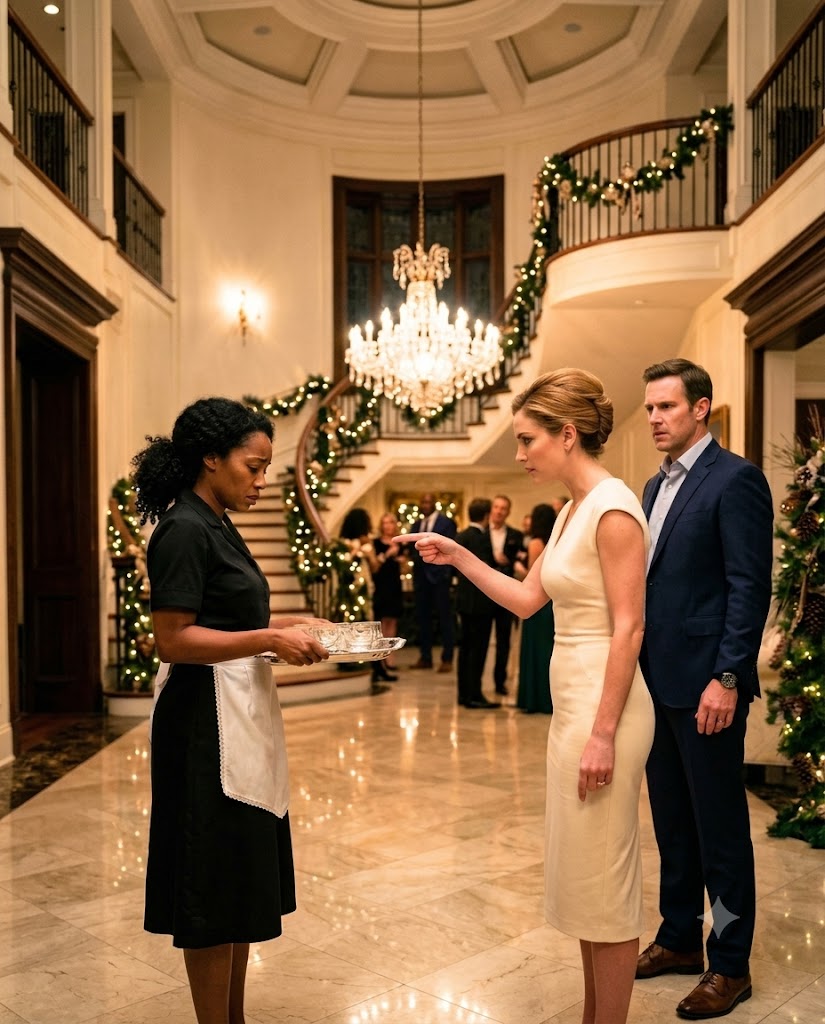
The little girl’s whisper was so small, yet it stopped every breath inside the Whitmore estate. Naomi Carter stood frozen in the grand marble hallway, her black maid’s uniform suddenly feeling like a target, a silver tray trembling in her hands. Thirty wealthy guests stared at her as if a verdict had already been written across her face. Across from her stood Bianca Sterling—beautiful, pale, and cold in a cream-colored dress.
Only seconds earlier, she had pointed one manicured finger at Naomi and delivered the words that would echo through the night. “No honest woman should ever have to hear this. You stole my diamond bracelet.” Security was already walking toward Naomi. Her job was about to vanish.
Her small room in the staff wing was about to vanish. And with it, the only safe place her four-year-old daughter—who struggled to breathe—had left in the world. But at the top of the staircase stood Ava Carter, barefoot in faded yellow pajamas, clutching her worn gray rabbit. Her dark curls were wild from sleep, and her little chest rose and fell too quickly from the cold night air. Her tiny finger pointed straight toward Bianca. No one in that room would ever forget what happened next.
Before that night, Naomi had learned how to be invisible. At thirty-two, she moved through the Whitmore estate quietly, polishing glass tables, folding expensive sheets, wiping fingerprints from mirrors she was never meant to admire herself in. She did her work with care—not because the house deserved her heart, but because her daughter deserved a roof.
Naomi had grown up in rural Georgia, raised by a mother who cleaned motel rooms and still came home humming church songs. Ruth Carter had taught her only one thing that truly stayed. “Baby, don’t let hard times make you hard.” Naomi tried. She had once dreamed of becoming a nurse.
She had passed her first year of community college with secondhand books and tired eyes, believing effort could still open doors. Then Ruth’s heart began to fail. Hospital bills arrived. Classes were missed. Naomi left school to sit beside her mother’s bed until there was no hand left to hold. Three months after the funeral, Naomi found out she was pregnant. The man who had promised to stay disappeared before the first ultrasound.
So Naomi became a mother with no savings, no husband, and no one to catch her if she fell. Ava came into the world small but loud—with warm brown skin, bright eyes, and a cry that made Naomi feel needed in a way that both frightened and saved her. Naomi held her close and whispered, “You and me, baby. We’re going to make it.” But love did not pay rent. Love did not buy medicine. When Ava turned two, the coughing began.
At first, Naomi thought it was a cold. Then came the nights when Ava woke gasping, tiny fingers gripping Naomi’s shirt while Naomi counted each breath like a prayer. The clinic called it mild asthma, but there was nothing mild about watching your child fight for air.
That was why Naomi accepted the job at the Whitmore estate. The agency promised steady pay, health coverage after ninety days, and a small room in the staff wing. The room was narrow. The window faced a brick wall. The radiator clicked all night like old bones—but it was warm. It had a lock. It kept Ava safe.
To Naomi, that was almost luxury. Julian Whitmore, the owner of the estate, was forty-one—a billionaire who had built Whitmore Medical Technologies from nothing. His company made breathing devices and hospital equipment used across the country.
People called him brilliant, generous, and focused. Naomi knew him only as the tall man in dark suits who said good morning to the staff but rarely saw what happened beneath his own roof. That changed when Bianca Sterling arrived. Bianca was Julian’s fiancée—twenty-nine, polished and proud, with honey-blonde hair and a smile that never reached her eyes. She never shouted at Naomi. She did something worse.
She looked through her. “The maid can take that.” “The maid missed a spot.” “The maid should not bring her child near the main house.” Naomi swallowed every word because pride could not refill an inhaler. By December, the estate glowed with white lights and holiday garlands.
Bianca had planned an engagement dinner for thirty guests, and everything had to be perfect. Naomi worked from six in the morning until night—carrying trays, polishing glasses, checking her phone whenever she could. Ava was sleeping in the staff wing with Mrs. Evelyn Moore, the elderly housekeeper who watched over them like family. At 8:40 p.m., Mrs. Moore texted: “Ava is sleeping. Breathing fine.” Naomi closed her eyes and thanked God. Twenty minutes later, Bianca screamed. “My diamond bracelet is gone.”
The music stopped. Guests turned. Julian followed Bianca into the hallway, his face tense. Bianca’s eyes swept the room and landed on Naomi. “You cleaned my sitting room today.” “Yes, ma’am,” Naomi said carefully. “My bracelet was there. Now it is missing.” “I didn’t touch it.” Bianca stepped closer. “Search her room.” Naomi’s heart dropped. There was nothing in that little room but Ava’s medicine, secondhand clothes, and a gray rabbit with one button eye missing. But a search meant strangers touching her child’s blanket. It meant shame dressed up as proof. “Please,” Naomi whispered. “My daughter is sleeping.” Bianca’s smile stayed cold. “Then let’s hope she sleeps through it.” At that moment, a small cough came from the staircase. Ava stood barefoot at the top, trembling, her rabbit tucked beneath her chin. “Mommy—” Naomi took one step forward. “Baby, go back to Mrs. Moore.” But Ava’s tired eyes moved from Naomi to Bianca, then to the crystal vase beside the fireplace, filled with winter branches and gold ribbon. The little girl raised one shaking finger. “Mommy,” she whispered. “Why did that pretty lady hide the bracelet?” And suddenly, in a house full of powerful people, the smallest voice became the only one strong enough to carry the truth.
For a moment, the whole Whitmore estate forgot how to breathe. Ava Carter stood barefoot at the top of the staircase, her small finger still pointing toward the fireplace. Her yellow pajamas hung loose on her thin little frame. The worn gray rabbit dangled from one hand, and every few seconds, a soft cough shook her chest. Naomi wanted to run to her daughter, but the room held her still. Thirty guests turned toward the crystal vase beside the fireplace. It was tall and clear, filled with winter branches, white silk flowers, gold ribbon, and silver ornaments Bianca had arranged herself that morning. Under the chandelier light, everything inside it glittered. Bianca’s face changed only for a second—but Naomi saw it. Julian saw it, too. “Julian,” Bianca said quickly, her voice too sharp to be calm. “She’s a child. She doesn’t know what she’s saying.” Ava coughed again. That sound broke Naomi’s stillness. “My daughter needs her inhaler,” Naomi said. One of the security men shifted awkwardly, still standing near the staircase. Julian turned his head, and his voice came out low, controlled, and firm. “Move.” The guard stepped aside at once.
Naomi hurried up the stairs and gathered Ava into her arms. The little girl’s hands were cold, her breathing quick and shallow. Naomi pressed Ava close, feeling the faint whistle beneath each breath. “Baby, why did you come out here?” Ava tucked her face into Naomi’s neck. “Bunny wanted Mommy.” A few guests looked away, ashamed, without knowing where to put their eyes. Julian walked toward the fireplace. Bianca reached for his arm. “Please don’t make this dramatic.” He looked at her hand until she let go. Then he stepped to the vase. The room watched as Julian lifted the winter branches one by one. Gold ribbon slipped between his fingers. A silver ornament rolled softly against the glass. Then something bright fell. It struck the marble hearth with a tiny sound. The diamond bracelet. No one spoke. Julian bent down and picked it up. It hung from his hand, shining under the warm lights—beautiful and terrible at the same time. Naomi closed her eyes for half a second. The truth had appeared. But it did not feel like rescue. It felt like standing in the rain after the storm had already ruined everything. Bianca swallowed. “I must have taken it off without realizing. I was decorating. I was under pressure. It was an honest mistake.” Naomi looked at her. An honest mistake. The words felt smaller than the wound. Mrs. Evelyn Moore appeared from the side hallway, breathless, her silver hair slightly loose from its pins. She saw Ava in Naomi’s arms, then the bracelet in Julian’s hand, and her face tightened with sorrow. “She did not forget what she called Naomi,” Mrs. Moore said quietly. Bianca turned. “Excuse me?” The older housekeeper lifted her chin. “You heard me, Miss Sterling.” A heavy silence fell over the room. Julian looked at Bianca with a kind of clarity that had not been there before. “You accused an innocent woman in front of my guests,” he said. “I said I made a mistake.” “No,” Julian replied. “You found someone you thought no one would defend.” Bianca’s lips parted, but no answer came.
Naomi did not stay to hear more. Ava’s breathing was growing worse. She carried her daughter down the side hallway toward the staff wing with Mrs. Moore following close behind. The grand music faded behind them. The polished marble gave way to plain carpet. The scent of pine and expensive perfume disappeared, replaced by laundry soap and radiator heat. Their room was small, but it was theirs. Naomi sat on the bed, reached for the inhaler on the table, and helped Ava take one careful breath, then another. Slowly, the little girl’s shoulders eased. Naomi brushed the curls from Ava’s damp forehead and kissed her there. Mrs. Moore stood near the door, one hand over her heart. “I am sorry, child.” Naomi shook her head. “You didn’t do this.” “No,” Mrs. Moore said softly. “But I have been quiet too many times.” Naomi looked around the little room. Ava’s picture books were stacked beside the bed. Her medicine sat next to a plastic cup of water. The gray rabbit, missing one button eye, rested in her lap like the only witness that had never judged them. “I can’t stay here,” Naomi whispered. Mrs. Moore’s eyes filled. “Naomi—” “I have swallowed a lot because my daughter needed a roof. But tonight, she heard them call her mother a thief.” Naomi’s voice broke, but only slightly. “I cannot teach her dignity while letting people take mine.”
Back in the grand hallway, Julian still stood by the fireplace, the bracelet cold in his hand. Bianca stepped closer, lowering her voice. “You are embarrassing me.” Julian stared at the woman he had planned to marry. For months, he had mistaken polish for goodness. He had mistaken beauty for warmth. He had ignored the small ways she made people feel small because it had been easier than seeing the truth. But tonight, a poor mother had stood with more grace under accusation than Bianca had shown under truth. Julian reached into his jacket pocket and felt the small velvet ring box he had carried all evening. Bianca saw the movement. Her face softened with sudden fear. “Julian,” she whispered. He looked toward the hallway where Naomi had carried her child away. Then he looked back at Bianca. “I was going to ask you to marry me tonight.” The room went still again. Bianca’s eyes widened. “Please—” Julian closed his hand around the box. “And I thank God I waited.” The bracelet slipped from his fingers onto the mantel, and with that, the celebration ended.
By midnight, the Whitmore estate no longer looked like a place prepared for celebration. The white lights still glowed along the staircase. The silver bells still hung from the doorways. Half-filled glasses stood abandoned on polished tables, and the untouched engagement cake waited in the dining room beneath a glass cover—beautiful and useless. The guests left quietly. No one laughed on the way out. No one asked for coats with the easy confidence they had brought in only hours earlier. They spoke in low voices, avoiding Bianca Sterling’s eyes, avoiding Julian Whitmore’s silence, avoiding the hallway where a poor mother had almost been ruined in front of them. Bianca was the last to leave the grand room. Her diamond bracelet was back on her wrist, but it no longer looked like a treasure. It looked like evidence. “Julian,” she said, following him toward the library. “You are making this bigger than it is.” He stopped. The house was quiet enough that the ticking of the old clock near the study sounded loud. “You called Naomi a thief,” he said. “I was upset.” “You ordered men to search the room where her child sleeps.” Bianca’s mouth tightened. “I did not know the child was having breathing trouble.” Julian turned fully then, and the tiredness in his face made him look older than forty-one. “You did not need to know that to treat her mother like a human being.” For once, Bianca had no polished answer ready.
Julian looked down at the ring box still in his hand. He had carried it all evening, waiting for the perfect moment. He had imagined soft applause, Bianca’s surprised smile, his guests raising their glasses. He had imagined the future as something elegant and simple. Now the little velvet box felt heavier than any business decision he had ever made. “You should go home,” he said. Bianca stared at him. “You can’t be serious.” “I am.” “Over a mistake?” Julian’s voice dropped. “Over what that mistake revealed.” Bianca’s eyes flashed for a second. Her beauty hardened into something almost ugly. “You are throwing away our future because of a maid.” “No,” Julian said. “I am refusing to build a future with someone who can destroy another person’s dignity and still call it an inconvenience.” Her face changed again, this time with real fear—but Julian was already done speaking.
Across the estate in the staff wing, Naomi Carter sat on the edge of her narrow bed with Ava asleep against her lap. The inhaler had helped. Ava’s breathing had steadied. Her little hand rested open against Naomi’s knee, fingers curled slightly, as if still holding on to some dream. The gray rabbit lay tucked under her chin, one button eye shining in the dim lamplight. Naomi had not moved for a long time. Mrs. Evelyn Moore sat in the wooden chair by the door, still wearing her black housekeeper’s dress, her silver hair loose now around her tired face. “You can sleep here tonight,” Mrs. Moore said gently. “No one will make you leave in the dark.” Naomi looked at the small room—the folded clothes in the corner, Ava’s picture books, the plastic drawer where she kept the clinic papers, and a photograph of her mother in a blue church hat. It was not much, but it had been the first place in years where Naomi could close a door and feel almost safe. Almost. That word hurt now. “I know,” Naomi whispered. “But morning comes fast.” Mrs. Moore leaned forward. “Where will you go?” Naomi swallowed. “There’s a women’s shelter near Decatur. I called them once before I got this job. Maybe they still have space.” With Ava’s breathing, Naomi closed her eyes. That was the part she could not bear to say aloud. A shelter meant shared air, cold nights, long lines, and no guarantee of quiet. It meant carrying Ava’s medicine in her purse like a fragile promise. It meant starting over with less than she had yesterday. But staying meant something, too. It meant letting Ava remember that a beautiful woman in a bright room had called her mother a thief, and everyone had watched. “I can be poor,” Naomi said softly. “I have been poor before. But I cannot raise my daughter inside a place that teaches her we must accept shame to survive.” Mrs. Moore’s eyes filled. “You sound like your mother.” Naomi looked up. The older woman smiled sadly. “You told me once what Ruth used to say. About not letting hard times make you hard.” Naomi brushed Ava’s curls from her forehead. “I’m trying not to.”
A soft knock came at the door. Mrs. Moore stood, but Naomi lifted one hand. “I’ll answer.” She eased Ava gently onto the pillow, covered her with the faded blanket, then opened the door. Julian Whitmore stood in the hallway. He had removed his tie. His jacket was gone. Without the armor of the evening, he looked less like a billionaire and more like a man who had finally seen the damage inside his own home. He did not step inside. That mattered to Naomi. “Mrs. Carter,” he said quietly. “May I speak with you?” Naomi held the door only halfway open. “My daughter is sleeping.” “I know. I won’t be long.” Mrs. Moore moved toward the hallway. “I’ll sit with Ava.” Naomi hesitated, then stepped outside and closed the door softly behind her. For several seconds, Julian said nothing. Then he lowered his head. “I am sorry.” Naomi had heard apologies before—thin ones, convenient ones. Words given to quiet a room, not heal a wound. So she waited. Julian looked up, and his eyes were tired but steady. “What happened tonight should have been stopped before your child had to walk into it. I should have stopped it. I saw enough before tonight to know Bianca treated you poorly. I told myself I was being unfair to her. I told myself it was stress. I told myself many things because they were easier than the truth.” Naomi’s throat tightened. Julian continued. “That was cowardice. Mine.” The hallway seemed to grow very still. Naomi had expected money. Excuses. A request to keep quiet. She had not expected that word. Cowardice.
Julian took an envelope from his hand and held it out, but not close enough to force her to take it. “This is not payment for silence. It is your full wages through the end of the month plus the overtime you were owed for tonight. Payroll should have included that already. It did not. That will be corrected for everyone.” Naomi looked at the envelope, then at him. “I’m leaving in the morning,” she said. Pain crossed his face, but he did not argue. “I understand.” That surprised her more than anything. Julian looked toward the closed door where Ava slept on the other side. “Is she all right?” Naomi’s voice softened despite herself. “For now.” “For now,” Julian repeated. And something in him seemed to break quietly around those two words. A man who made breathing machines for children in hospitals had not known there was a little girl under his own roof counting breaths in the dark. He looked back at Naomi. “Mrs. Carter, I cannot undo tonight.” “No,” she said. “You can’t.” “But I would like to make sure you and Ava have somewhere safe to go tomorrow. Not as charity, not as control—just as responsibility.” Naomi’s hand tightened around the envelope. “I don’t want pity.” Julian nodded. “Then I won’t offer it.” For the first time that night, Naomi believed him. Not completely, but enough to keep listening. And sometimes, after a long season of being unseen, being heard is the first crack where morning enters.
**Part 2**
Morning came gray and cold over the Whitmore estate—the kind of morning that made every window look tired. Naomi Carter had not slept. She had folded Ava’s clothes before sunrise, placing each little shirt into the old brown suitcase with the careful hands of a woman trying not to fall apart. Ava’s inhaler went into the front pocket of Naomi’s purse. The clinic papers went into a blue folder. The photograph of Ruth Carter in her church hat went between two sweaters where it would not bend. Ava sat on the bed wrapped in her blanket, watching her mother pack. Her gray rabbit rested in her lap. “Are we going on a trip?” Ava asked. Naomi paused. Children had a way of making hard truths sound even harder. “Yes, baby,” she said gently. “A little trip.” “To Grandma Ruth’s house?” Naomi’s chest tightened. “No, sweetheart.” Ava looked down at the rabbit’s missing button eye. “Is it because the pretty lady was mad?” Naomi closed the suitcase slowly. For a long second, she could not answer. She wanted to protect Ava from the ugliness of the night before, but Ava had stood on the staircase. Ava had heard the word thief. Ava had seen adults stare at her mother like she was something broken on the floor. Naomi sat beside her daughter and took her small hand. “Sometimes grown-ups say wrong things,” she said. “And sometimes we have to leave places where people forget how to be kind.” Ava thought about this with the serious expression only a four-year-old can have. “Mr. Tall Man was kind.” Naomi knew who she meant. “Julian? He tried to be.” “Can he come on the trip?” Despite everything, Naomi almost smiled. “No, baby. He lives here.” Ava nodded as if this explained a great sorrow. Then she leaned her head against Naomi’s arm.
In the hallway, Mrs. Evelyn Moore stood with a tray she had not needed to bring—toast, tea, apple slices for Ava. Her eyes fell to the suitcase, and she tried to hide the pain on her face. “You don’t have to go before breakfast,” she said. “If I wait,” Naomi replied softly, “I may lose my courage.” Mrs. Moore set the tray down on the small table. “I packed some sandwiches,” she said. “And there’s cash in the napkin.” Naomi looked up quickly. “Mrs. Moore, I can’t take your money.” “You can and you will,” the older woman said, her voice suddenly firm. “It is not charity. It is one woman standing beside another.” Naomi’s eyes burned. Before she could answer, another knock came at the open door. Julian Whitmore stood in the hallway wearing a dark overcoat, his face pale from a sleepless night. He did not look past Naomi into the room. He kept his eyes on her, waiting for permission to speak. Naomi stood. “Ava,” she said. “Stay with Mrs. Moore for a minute.” Ava lifted the rabbit. “Bunny too?” “Bunny too.” Naomi stepped into the hallway and pulled the door almost closed behind her. Julian looked at the suitcase near the bed, then back at Naomi. “You’re leaving?” “Yes.” He nodded once, as if he had no right to be surprised. “I made some calls this morning,” he said. “There is a family apartment available at the Whitmore employee residence downtown. It is not part of this estate. It is private, secure, and close to Children’s Health Atlanta. You would have your own lease, your own key. No one could ask you to leave without proper notice.” Naomi stared at him.
Julian continued, careful with every word. “I also contacted our human resources director. Your employment here can end today if that is what you want. You would still receive the health coverage you earned. I was told there had been delays in processing staff benefits. That should never have happened.” Naomi felt her fingers grow cold. Health coverage. Ava’s inhalers, clinic visits, breathing tests. She had worked ninety days for that promise. “You’re saying I can leave and still keep it?” “You earned it,” Julian said. “It was never mine to give as a favor.” That answer did something to Naomi. It did not heal the wound—not yet—but it kept him from making a new one. She looked down the hall toward the grand part of the house where chandeliers still glowed above marble floors. Last night, that brightness had felt like judgment. This morning, it only looked empty. “And what happens to Bianca?” Naomi asked. Julian’s face changed. “She left before dawn. The engagement is over.” Naomi had expected to feel satisfaction. She did not. Maybe because one woman’s fall could not return the piece stolen from another. “I’m not glad,” Naomi said quietly. “I know.” “I don’t want revenge.” “I know that, too.” “Then why are you doing all this?” Julian looked toward the window at the end of the staff hallway. Outside, bare winter branches moved in the wind. “Because my company puts my name on devices that help strangers breathe,” he said. “And last night, under my own roof, your daughter was fighting for breath while I was standing in a room full of people worried about a bracelet.” His voice lowered. “I cannot be proud of the first thing and ignore the second.” Naomi looked at him then—really looked. Not at the billionaire. Not at the employer. At the man who had finally allowed shame to become responsibility instead of excuse. Still, she held herself steady. “If I accept the apartment,” she said, “it will be because Ava needs safety, not because I owe you forgiveness.” Julian nodded. “I understand.” “And I want everything in writing.” “For your protection,” he said. “For mine,” Naomi corrected. A faint sadness touched his mouth. “Yes. For yours.”
Behind the door, Ava coughed once. Naomi turned immediately. Julian stepped back, giving her space. “I can have a car ready whenever you are.” Naomi opened the door, then paused. “Mr. Whitmore?” “Yes?” She looked at him with tired, clear eyes. “You should learn the names of every person who works in this house.” Julian lowered his head. “I will.” Naomi went back inside and lifted Ava into her arms. The little girl rested her cheek on her mother’s shoulder, rabbit tucked between them. “Are we going now?” Ava whispered. Naomi looked at the small room one last time, then at the hallway beyond it. “Yes, baby,” she said. “But this time, we are not running away.” She picked up the suitcase. “We are walking out.”
The car that took Naomi and Ava away from the Whitmore estate was not a limousine. Naomi was grateful for that. It was a simple black sedan with warm air coming through the vents and a quiet driver who did not ask questions. Ava sat beside her in the back seat, buckled into a booster seat Julian had somehow arranged before they reached the front door. The gray rabbit rested in Ava’s lap, facing forward like a tired little passenger. Outside the window, the estates grew smaller behind them. The iron gates opened, then closed. Naomi watched them disappear in the side mirror and felt something inside her loosen and ache at the same time. She had not loved that house, but she had depended on it—and sometimes dependence can feel so close to safety that leaving it hurts, even when staying would have hurt more. Ava leaned against her arm. “Mommy?” “Yes, baby?” “Did we do something bad?” Naomi turned so quickly her heart almost broke. “No.” She took Ava’s small hand and held it between both of hers. “No, sweetheart. We did not do anything bad.” “Then why did we leave?” Naomi looked at her daughter’s face—four years old, too young for the world’s sharp edges, yet already touched by them. “Because sometimes,” Naomi said carefully, “leaving is how you remember what you are worth.” Ava frowned, thinking hard. “Are we worth a lot?” For the first time that morning, Naomi smiled. “More than diamonds.” Ava seemed satisfied with that. She hugged the rabbit and looked out the window at the gray Atlanta morning.
The apartment was on the third floor of a clean brick building downtown—part of an employee residence Julian’s company used for workers relocating to the city. It was not fancy. The hallway smelled faintly of lemon cleaner and someone’s breakfast, but the door had a new lock. The windows opened to real sunlight, and the small bedroom had enough space for Ava’s bed beside Naomi’s. Mrs. Evelyn Moore had ridden in a second car and arrived with two grocery bags, three folded blankets, and the fierce expression of a woman daring anyone to tell her she had brought too much. “This place needs curtains,” Mrs. Moore said, stepping inside. “And a proper kettle.” Naomi almost laughed. “We just got here.” “All the more reason to start.” Ava walked slowly from room to room, still in her coat, inspecting everything. She opened the closet. She looked under the sink. She placed her gray rabbit on the windowsill as if introducing him to the new view. Then she turned to Naomi. “Can Bunny sleep here?” Naomi knelt before her. “Yes, baby. Bunny can sleep here. So can we.” Ava’s face softened with relief so pure Naomi had to look away for a moment.
By noon, Mrs. Moore had made tea. Ava had eaten half a sandwich and fallen asleep on the couch beneath a blanket. Naomi stood by the kitchen counter, looking at the envelope Julian had given her the night before. Inside were her wages, overtime, printed benefit papers, and a letter from human resources confirming her health coverage would continue. There was also a second page—a formal offer. Not for charity, not for a handout. A paid administrative training position at Whitmore Medical Technologies, beginning in two weeks, with flexible hours and tuition assistance for employees pursuing healthcare education. Naomi read the page three times. Mrs. Moore watched her quietly. “What does it say?” she asked. Naomi swallowed. “It says I could work in their patient support office. Answer calls, help families with equipment forms, learn the system.” “That sounds like something you would be good at.” “It also says tuition assistance after six months.” Mrs. Moore’s eyes warmed. “Your nursing degree?” Naomi folded the paper with careful hands. A dream can be a dangerous thing when life has already taken too much. Hope, Naomi knew, could lift you. It could also drop you from a terrible height. “I don’t know,” she said. Mrs. Moore did not push. She only looked toward Ava sleeping on the couch. “You do not have to decide today.”
That evening, after Mrs. Moore left, Naomi unpacked slowly. She placed Ruth’s photograph on the bedroom dresser. Her mother smiled from beneath the blue church hat—eyes bright, chin lifted. Naomi stood there a long time. “I’m trying, Mama,” she whispered. The phone rang just after seven. Unknown number. Naomi almost ignored it, then answered. “Mrs. Carter?” a woman’s voice said. “This is Dr. Helen Brooks from Children’s Health Atlanta.” Naomi straightened. “Yes?” “We received Ava’s basic medical information through the benefits office, and we had a cancellation tomorrow morning. We understand your daughter has been having breathing difficulty.” Naomi looked at the paperwork on the counter. Julian had not sent money. He had sent access. That was different. Still, her voice remained cautious. “Will I be billed?” There was a pause—gentle but professional. “Your insurance is active, Mrs. Carter. There may be a small co-pay, but we can review that with you before anything is done.” Naomi closed her eyes. Active. One word. But to a mother who had counted medicine by doses and dollars, it sounded almost like mercy.
After the call, Naomi sat beside Ava on the couch. The little girl stirred and opened her eyes. “Mommy?” “Yes, baby?” “Do we live here now?” Naomi looked around the small apartment—the bare windows, the grocery bags, the old suitcase still half open on the floor. It was not much, but no one here had called her a thief. No one here could search her child’s room. No one here could make her feel small unless she handed them that power. She touched Ava’s cheek. “For now,” she said. “And maybe for a while.” Ava smiled sleepily. “Good. Bunny likes it.” Naomi laughed softly, then pulled her daughter close. Outside, the city lights began to blink on one by one, and for the first time in many months, Naomi did not feel like she was hiding from the world. She felt quietly and carefully as if she had stepped back into it.
The next morning, Naomi Carter woke before the alarm. For a moment, she did not know where she was. There was no radiator clicking like tired bones, no footsteps in the staff hallway, no distant sound of silverware being set for people who would never know her name. Only the quiet hum of the apartment refrigerator and the soft sound of Ava breathing on the mattress beside her. Naomi turned her head. Ava was asleep on her side, one hand tucked beneath her cheek, the gray rabbit pressed close to her chest. Her breathing was not perfect, but it was steadier than the night before. Naomi lay still and listened. Mothers of healthy children, she sometimes thought, did not know the strange education of fear. They did not know how to hear a whistle beneath a breath from across a room. They did not know how quickly love could become counting. One breath. Two. Three. She got up quietly, made coffee, and read the clinic papers again while the city outside turned pale with morning.
At nine, a company car arrived to take them to Children’s Health Atlanta. Naomi almost refused it, then looked at Ava’s small face and decided pride did not need to walk three bus transfers in winter. The clinic was bright, clean, and full of children. Some ran between chairs with stickers on their shirts. Some slept against tired parents. Some carried stuffed animals like soldiers returning from a small war. Ava sat on Naomi’s lap clutching Bunny under one arm. “Will it hurt?” she asked. “No, baby. They just want to help you breathe better.” Dr. Helen Brooks was a calm woman in her fifties with kind eyes and silver at her temples. She did not rush. She did not speak over Naomi. She asked questions and waited for the answers. How often did Ava cough at night? How many times had Naomi used the rescue inhaler? Had there been mold in their previous room? Naomi hesitated at that question. Then she told the truth. “The room was warm,” she said carefully. “But the window frame was damp sometimes. I cleaned it when I could, Doctor.” Brooks nodded—not with judgment, but with understanding. After the breathing test, the doctor adjusted Ava’s medication, explained each step, and handed Naomi a printed care plan. “This should help,” Dr. Brooks said. “And I want to see her again in four weeks.” Naomi looked down at the papers. For years, care had felt like something she had to beg for, explain for, prove herself worthy of. Here, it was being offered in complete sentences. “Thank you,” Naomi whispered. Dr. Brooks smiled. “You are doing a good job, Mrs. Carter.” Those words nearly undid her. Not because they were grand—because they were simple. Because no one had said them in a very long time.
When they returned to the apartment, a large envelope waited by the door. Naomi recognized the company logo on the corner and felt her guard rise at once. Inside was a lease agreement for the apartment in her name at a reduced employee rate, with clear terms and no hidden conditions. Attached was the job offer again—this time with a handwritten note from Julian. “Mrs. Carter, you asked for everything in writing. You were right to ask. The apartment is yours to accept or decline. The position is yours to consider, not an obligation. Your health coverage is active because you earned it. I am reviewing every staff policy at the estate and in the company. That night showed me a failure I should have seen sooner. — Julian Whitmore.” Naomi read the note twice. There was no “please forgive me.” No dramatic promise. No attempt to sound like a hero. That made it harder to dismiss. Ava climbed onto a chair at the kitchen table and began coloring on the back of an old envelope. Her rabbit sat beside the crayons, supervising. “What are you drawing?” Naomi asked. “A house,” Ava said. “With no scary lady.” Naomi’s hand tightened around the note. Children remembered, even when adults hoped they would not.
That afternoon, Naomi called the number on the job offer. Her voice shook once, but she steadied it before the human resources director answered. “I would like to ask some questions before I decide,” Naomi said. “Of course, Mrs. Carter.” No one sounded surprised. No one sounded annoyed. Naomi asked about pay, hours, childcare flexibility, training, and whether accepting the job would require any private arrangement with Julian. The answer came clearly. No—it was a regular employee position. Documented, supervised, protected. By the end of the call, Naomi had not accepted, but she had not refused. That was enough for one day.
Across town, Julian Whitmore stood in the staff wing of his own estate with a clipboard in his hand and shame in his chest. The maintenance supervisor pointed to the walls. “Some dampness near the windows,” he said. “Old insulation. We can repair it.” Julian looked at the small room where Naomi and Ava had slept. He saw the narrow bed frame, the brick wall outside the window, the place where a child’s medicine had sat beside a plastic cup. His company’s name was printed on hospital machines across America. Yet a little girl had been breathing bad air under his roof. “Repair this room,” Julian said. “Then inspect every staff room. Not next month—now.” The supervisor nodded. Julian turned to Mrs. Moore, who stood near the doorway, watching him with careful eyes. “How many times did staff report these problems?” he asked. Mrs. Moore looked at him for a long moment. “Enough times, Mr. Whitmore.” The answer hurt because it deserved to. Julian lowered his eyes. “Then I failed them.” Mrs. Moore did not comfort him. Good, he thought. Some discomfort should not be rushed away.
That evening, Naomi tucked Ava into bed in the new apartment. The little girl’s breathing was softer now. Her face looked peaceful in the lamplight. “Mommy,” Ava murmured. “Yes, baby?” “Are you still sad?” Naomi sat beside her. “A little.” “Did I say the wrong thing?” Naomi’s heart broke cleanly. She gathered Ava close. “No, sweetheart. You told the truth.” Ava blinked sleepily. “Is truth good?” Naomi kissed her forehead. “Yes,” she whispered. “But sometimes truth is heavy before it becomes good.” Ava seemed to think about this. Then she held up Bunny. “He says we are brave.” Naomi smiled through the ache in her chest. “Bunny is very wise.” Ava drifted back to sleep. Naomi stayed beside her, watching the rise and fall of her daughter’s chest. Outside the window, Atlanta moved on with its headlights, sirens, and winter wind. For the first time, Naomi allowed herself to imagine a future that was not built only around surviving the next bill. A job where she could help families. A degree she had once buried. A daughter who might grow up remembering not only the night her mother was accused, but the morning her mother chose not to stay small. Naomi reached for the job offer on the bedside table. She did not sign it yet, but she placed it beside Ruth’s photograph—and somewhere deep inside her, a door she thought life had closed forever opened just a little.
**Part 3**
Naomi Carter signed the job offer three days later. She did it at the kitchen table after Ava had fallen asleep, with Ruth Carter’s photograph watching from the dresser and the city lights glowing softly beyond the apartment window. Her hand trembled only once. Not because she was afraid of work—Naomi had never been afraid of work. She had carried trays until her feet burned, scrubbed floors until her back ached, and folded other people’s clean sheets while her own life felt like it was coming apart at the seams. No, what frightened her was hope. Hope had a way of sounding gentle while asking you to trust the ground again.
The next Monday morning, Naomi arrived at Whitmore Medical Technologies wearing a navy blouse Mrs. Moore had insisted on ironing herself and a pair of black flats that pinched slightly at the heel. Ava stayed at the apartment with Mrs. Moore, who had arrived before sunrise with oatmeal, crayons, and the calm authority of a grandmother God had sent by appointment. The company building rose from downtown Atlanta in glass and steel, reflecting the pale winter sky. Naomi stood outside for a moment, holding her employee badge in one hand. “Patient Support Associate—Trainee,” she read the words twice. Not maid. Not thief. Not charity case. Trainee. Inside, the lobby was bright and busy. People crossed the marble floor carrying laptops and coffee cups. Security greeted her by name because her badge had already been entered into the system. A woman from human resources met her near the elevators. “Mrs. Carter? I’m Denise Hall. We spoke on the phone.” Denise was warm, professional, and direct. She showed Naomi her desk, the break room, the training schedule, and the small, quiet room where employees could take private calls if there was a family emergency. “We work with parents here,” Denise said. “Not against them.” Naomi nodded but said nothing. She was still learning how to believe sentences that sounded too kind.
Her first task was simple. She listened to recorded calls from families who needed help using portable breathing equipment. Mothers asking about replacement tubes. Fathers confused by insurance forms. Grandparents trying to understand instructions written too small. By noon, Naomi understood something that settled deep inside her. She knew these voices—not their names, not their faces. But the sound beneath their words. The quiet panic of people trying to stay polite while fear sat beside them. The exhaustion of loving someone who needed more care than money could easily provide. When Denise asked how the morning felt, Naomi answered honestly. “It feels familiar.” Denise looked at her with understanding, not pity. “That may make you very good at it.”
At two o’clock, Julian Whitmore walked past the training room. He stopped when he saw Naomi, then seemed to think better of interrupting. He gave only a small nod through the glass and continued down the hallway with two executives beside him. Naomi appreciated that more than she expected. He did not come in to display his kindness. He did not turn her first day into a scene. He let her belong to the work, not to his apology. By the end of the week, Naomi could answer basic calls under supervision. She learned how to explain shipping delays without sounding cold. How to guide a frightened parent through a replacement request. How to say, “Let me stay with you on the line,” and mean it. One afternoon, an elderly man from Kentucky called about a machine for his wife. His voice shook as he explained that he could not read the small numbers on the instruction sheet. Naomi slowed her voice. “That’s all right, Mr. Barnes. We’ll do it together.” It took twenty-three minutes. When the call ended, he said, “Ma’am, you made me feel like I wasn’t foolish.” Naomi sat very still after he hung up. For years, the world had made her feel small in quiet, practiced ways. Now, from a desk near a window, she had helped someone else feel tall again.
That evening, she walked home with a tired body and a lighter spirit. Ava met her at the apartment door wearing socks that did not match and a paper crown covered in crayon hearts. “Mommy has an office job,” Ava announced. Naomi laughed and lifted her carefully. “Who told you that?” “Mrs. Moore and Bunny.” “Well, Bunny knows everything.” Ava touched the employee badge around Naomi’s neck. “Does it say hero?” Naomi kissed her cheek. “No, baby. It says trainee.” Ava frowned. “That is a funny way to spell hero.” Naomi held her close a little longer than necessary.
Two weeks passed, then three. Ava’s new medicine began to work. The coughing did not vanish completely, but the nights grew less frightening. Naomi no longer woke every hour counting breaths. Sometimes she slept for four full hours and woke startled by the mercy of it. Julian continued his review of the estate and company policies. Damp rooms were repaired. Staff benefits were audited. A new complaint process was created outside the household chain of command. Names were learned. Overtime was paid. But one change mattered most to Naomi. No employee housing could be tied to one person’s mood, temper, or private household conflict again. Mrs. Moore told Naomi this with tears in her eyes. “You did that,” the older woman said. Naomi shook her head. “No. Ava told the truth.” “And you walked out with dignity,” Mrs. Moore replied. “Truth needs legs sometimes.”
One Friday evening, Naomi found an envelope on her desk. Inside was a tuition assistance approval form. Her nursing prerequisites could begin in the spring. For a long time, she simply stared at the page. Then she pressed one hand over her mouth and turned away from the glass wall so no one would see her cry. Not the kind of cry that comes from breaking. The kind that comes when something inside you—buried but not dead—hears its name called again. That night, after Ava fell asleep, Naomi opened her old canvas bag from the closet. At the bottom were two nursing textbooks she had kept through every move, every unpaid bill, every season when keeping them had made no practical sense. The covers were worn. The pages were marked with notes written by a younger Naomi—a girl who had believed the future was waiting. Naomi ran her fingers over the handwriting. Then she whispered into the quiet apartment, “I’m coming back.” Outside, winter held the city in its cold hands. But inside that small apartment, beside a sleeping child and a gray rabbit with one missing eye, spring had already begun.
Spring came to Atlanta quietly that year. It did not arrive all at once. It came first in the soft green edge of trees outside Naomi Carter’s apartment window, then in the warmer light that stayed a little longer each evening, then in Ava’s laughter, which returned to the rooms like music someone had almost forgotten how to play. Ava still carried Bunny everywhere. The gray rabbit sat beside her at breakfast, on the couch during cartoons, and once—to Naomi’s embarrassment—in the middle of Dr. Brooks’s examination table, as if he also needed his lungs checked. Dr. Brooks had smiled and placed the stethoscope gently against Bunny’s chest. “Excellent breathing,” she said. Ava nodded seriously. “He takes care of me.” Naomi stood beside them and felt a piece so tender it almost hurt.
The medicine was working. The apartment stayed dry and warm. The nights were no longer ruled by fear. Ava still coughed sometimes, but the sound no longer sent Naomi running from one room to another with her heart in her throat. At work, Naomi had become someone people asked for by name. Not everyone, of course. She was still learning. She still made notes on sticky pads and kept a list of equipment terms taped beside her monitor. But she had a gift Denise Hall noticed before Naomi did. Naomi knew how to hear worry. When a mother from Alabama called because her son’s breathing device had not arrived, Naomi did not treat the call like a ticket number. She stayed on the line, checked the order, called shipping, and then called the mother back herself before leaving for the day. When an elderly veteran from Ohio could not understand his wife’s monitor, Naomi walked him through the steps slowly, then mailed a larger-print copy of the instructions. “You make people feel less alone,” Denise told her one afternoon. Naomi looked down, uncomfortable with praise. “I just know what alone sounds like.” Denise did not answer. She did not need to.
By April, Naomi had begun two evening classes for her nursing prerequisites. Every Tuesday and Thursday after work, she sat at the kitchen table with textbooks open, a pencil behind one ear, and Ava coloring beside her. “What are you learning?” Ava asked one night. “About the human body.” Ava touched her own chest. “This part?” “Yes, baby.” “That part, too. Because I have noisy breathing.” Naomi smiled gently. “Because one day Mommy wants to help people with all kinds of breathing.” Ava thought about that. “Like Dr. Brooks?” “Maybe a little.” Ava leaned over and kissed Naomi’s arm. “You can be Dr. Mommy.” Naomi laughed so softly it turned into tears. She wiped them quickly. But Ava saw. “Happy tears?” “Yes,” Naomi whispered. “Happy tears.”
It was near the end of April when Julian Whitmore appeared at the patient support floor again. This time he did not simply pass by. He came with Denise, carrying a folder and a quiet expression. Naomi saw him from her desk and felt the old caution rise in her chest. Not fear, exactly—something more careful. A woman who had learned that powerful people could change the temperature of a room without raising their voices did not forget that lesson quickly. Denise stopped beside Naomi’s desk. “Mrs. Carter, Julian wanted to ask about the family instruction sheets you’ve been marking up.” Naomi blinked. “My notes?” Julian nodded. “Denise showed me a few. You’ve been rewriting some of the steps in simpler language.” Naomi felt heat rise in her face. “Only for myself at first. Some families get confused because the instructions sound like they were written by engineers for other engineers.” A small smile touched Julian’s mouth. “They were.” Naomi did not smile back right away. “The people using them are scared parents and tired husbands,” she said. “They don’t need impressive words. They need clear ones.” Julian looked at her for a long second. Then he opened the folder. “I agree. I’d like to form a review group with patient support, nursing consultants, and product design. Paid hours—no extra work hidden under good intentions. Denise recommended you for it.” Naomi looked at Denise. Denise smiled. “You earned the recommendation.” There was that word again. Earned. Naomi took the folder slowly. “I’ll read it.” Julian nodded. “That is all I’m asking.” He started to leave, then paused. “How is Ava?” Naomi’s fingers tightened slightly on the folder. The question was gentle—not possessive, not too familiar. “She’s better,” Naomi said. “Her medicine is helping.” “I’m glad.” A silence passed between them—not uncomfortable, just full. Then Julian said, “Please tell her Bunny remains one of the bravest people I have ever met, despite himself.” Naomi smiled. “I’ll tell him.” His eyes warmed, but he did not step closer. “Good afternoon, Mrs. Carter.” “Good afternoon, Mr. Whitmore.”
After he left, Denise leaned one hip against the desk. “He respects you.” Naomi opened the folder, pretending to study the first page. “Respect is a good place to stop.” Denise smiled, wise enough not to push. “Sometimes it is also a good place to start.” Naomi said nothing, but the words stayed with her. That evening, Ava sat on the apartment floor building a house out of blocks. Bunny lay in the center room wrapped in a washcloth blanket. “Mr. Tall Man says Bunny is brave,” Naomi told her. Ava’s face lit up. “He remembers Bunny.” “Yes.” Ava nodded with deep approval. “Then he can visit our house.” Naomi looked at the little block house on the floor. Its walls leaned, its roof was crooked, but Bunny was safe inside. “Maybe one day,” she said. Ava placed one more block at the door. “Only if he knocks.” Naomi laughed. Then she looked around the apartment—at the textbooks on the table, the medicine chart on the fridge, the lease in her own name, and her daughter breathing easy on the floor. “Yes,” Naomi said softly. “Only if he knocks.” And for the first time, the thought of someone entering their life did not feel like danger. It felt like a door Naomi might someday choose to open.
**Part 4**
By early summer, Naomi Carter had learned a new rhythm. Work in the morning, Ava’s medicine chart before dinner, nursing classes after bedtime, laundry on Saturdays, church with Mrs. Moore on Sundays when Ava felt well enough to sit through the hymns without getting restless. It was not an easy life. Naomi still counted dollars before grocery trips. She still packed lunch more often than she bought it. She still woke some nights and reached for Ava before remembering the worst of the coughing had passed. But the fear no longer ruled every room. That alone felt like wealth.
At Whitmore Medical Technologies, the review group for patient instructions had become more important than anyone expected. Naomi sat at a conference table every Wednesday afternoon with designers, nurses, engineers, and one quiet billionaire who listened more than he spoke. At first, the engineers seemed unsure what to do with her. Naomi was not loud. She did not use technical language to impress anyone. She simply read a sentence from an instruction sheet and asked, “Would a tired grandmother understand this at two in the morning?” More often than not, the room went silent. Then someone rewrote the sentence. One afternoon, Julian watched her explain why a diagram needed fewer arrows and larger labels. “When a child is struggling to breathe,” Naomi said, tapping the paper gently, “a parent does not need a puzzle. They need the next right step.” No one argued.
After the meeting, Julian walked beside her toward the elevators, keeping enough distance that Naomi never felt crowded. “You have changed more in this company in two months than some consultants have changed in two years,” he said. Naomi looked straight ahead. “Consultants probably cost more.” Julian smiled. “They do.” She almost smiled too. The elevator arrived. They stepped inside alone for three floors. Neither spoke. Then Julian said quietly, “Ava’s birthday is next week, isn’t it?” Naomi turned to him, surprised. “How did you know that?” “Mrs. Moore mentioned it. Only the date—nothing private.” Naomi studied his face. There had been a time when she would have heard a question like that as danger. Powerful people often believe that knowing a detail gave them permission to enter a life. But Julian stood with his hands at his sides, waiting for whatever boundary she chose. “She’ll be five,” Naomi said. “That is a big year.” “She thinks so.” “What does she like?” Naomi’s caution returned. Julian noticed immediately. He lowered his voice. “I am not asking to do anything grand. I only wondered if there was a book she might enjoy. From Bunny, perhaps.” That broke something small and warm in Naomi’s chest. “Bunny is on a budget,” she said. Julian nodded gravely. “Of course. A modest book, then.” This time Naomi did smile. “Ava likes stories about brave animals. Especially rabbits.” “I will inform Bunny’s office.” The elevator doors opened, and Naomi stepped out before he could see how much she was still smiling.
Ava’s birthday fell on a warm Saturday. Naomi planned it carefully. Not big, not expensive. A homemade vanilla cake, paper streamers from the dollar store. Mrs. Moore brought fried chicken and a peach cobbler. Denise Hall came with a children’s puzzle. Dr. Brooks mailed a birthday card with a sticker of a smiling lung that made Ava laugh for ten full minutes. At noon, there was a knock at the apartment door. Ava ran to answer, then stopped and looked back at Naomi. “Only if he knocks,” she whispered. Naomi’s heart remembered. She opened the door. Julian stood in the hallway wearing a simple blue shirt—no suit jacket—holding one wrapped book and a small bouquet of daisies. Not roses. Not anything too grand. “Daisies for the birthday girl,” he said. Ava stepped forward, her eyes wide. “Is it from Bunny?” Julian crouched to her level. “Bunny approved it personally.” Ava accepted the package with great seriousness. Inside was a picture book about a small rabbit who helped lost animals find their way home. Ava hugged it to her chest. Then, without warning, she hugged Julian, too. Naomi saw the moment his face changed. Not pride. Not victory. Something quieter—a man being trusted by a child and understanding the weight of it. He looked over Ava’s curls at Naomi. Naomi gave one small nod. Permission to stay. Not forever. Just for cake.
That afternoon, Julian sat at the kitchen table while Ava wore a paper crown and explained the rules of her stuffed animal hospital. Mrs. Moore watched him closely, the way an old housekeeper watches weather before deciding whether to trust the sky. He passed the test by not trying too hard. He washed dishes after cake. He let Ava teach him how to bandage Bunny’s ear. He listened when Mrs. Moore told a story about Ruth Carter, though he had never met her. And when Naomi stepped onto the small balcony for air, Julian followed only as far as the doorway. “May I?” he asked. Naomi looked back. The question mattered. “Yes.” He stepped outside, leaving the door open behind him. For a while, they watched the city together. “You built a good home here,” Julian said. Naomi glanced at him. “It’s small.” “That is not what I said.” The words settled between them, gentle and exact. Naomi looked through the open door. Ava was laughing as Mrs. Moore pretended to examine Bunny with a spoon for a stethoscope. “I used to think a home was just a place no one could throw us out of,” Naomi said. Julian’s expression softened. “And now?” “Now I think it’s a place where my daughter can breathe.” Julian lowered his eyes. “I am sorry my house was not that place.” Naomi did not rush to comfort him. The apology deserved to stand on its own. After a moment, she said, “You are different than you were that night.” “I hope so.” “Hope is not proof.” “No,” he said. “Time is.” Naomi looked at him then. That was the right answer. Not perfect. Not poetic. Just honest. Behind them, Ava called, “Mommy, Mr. Tall Man is Bunny’s nurse now.” Naomi laughed softly. Julian smiled. And something fragile—something neither of them dared name yet—stepped quietly into the room with them. Not love. Not yet. But trust, perhaps. And for Naomi Carter, trust was no small thing.
**Part 5**
One year after the night of the bracelet, Naomi Carter stood beneath the soft lights of a small auditorium and listened to her name being called. “Naomi Ruth Carter.” For one breath, she did not move. The name sounded different in that room—not because it had changed, but because life had finally stopped saying it with pity. Around her, men and women in navy graduation gowns rose from their seats and walked toward the stage. Some were young. Some had silver in their hair. Some had children waving from the back rows. All of them carried stories no diploma could fully explain. Naomi carried Ava. Not in her arms anymore, though a part of her heart always would. Ava sat in the front row between Mrs. Evelyn Moore and Julian Whitmore, wearing a yellow dress and holding Bunny against her chest. Her curls were tied back with two white ribbons, and her little face shone with pride so bright it almost hurt to look at. “Mommy,” Ava whispered loudly, forgetting she was supposed to be quiet. “That’s you.” A few people laughed softly. Naomi smiled through tears and walked across the stage. Her hands were steady when she accepted the certificate for completing her first year of nursing prerequisites with honors. It was not the full degree yet. Not the final dream. But it was a door reopened. It was proof that what had been delayed had not been destroyed. When she turned toward the audience, she saw Mrs. Moore crying openly into a folded handkerchief. She saw Denise Hall clapping with both hands high. And she saw Julian. He did not clap louder than anyone else. He did not make himself the center of the moment. He simply stood there with quiet pride in his eyes—as if witnessing Naomi rise was a privilege he had not earned but had been allowed to see. That mattered to her.
After the ceremony, Ava ran into Naomi’s arms so fast Bunny nearly flew from her hand. “Mommy, you did it!” Naomi lifted her and laughed. “We did it, baby.” “No,” Ava said seriously, placing both small hands on Naomi’s cheeks. “You did it. I just helped.” Naomi closed her eyes and held her daughter close. “You helped more than you know.” Julian approached slowly, carrying a small bouquet of daisies. He stopped a few feet away, the way he always did now, giving Naomi the choice of distance. “Congratulations, Mrs. Carter,” he said. Naomi looked at the flowers, then at him. “You still call me that when you’re nervous.” A rare embarrassment crossed his face. “I suppose I do.” Mrs. Moore gave a satisfied little hum behind them, as if she had been waiting months for someone to say it aloud. Naomi took the daisies. “Thank you, Julian.” His name felt gentle in her mouth. Not dangerous. Not too much. Just honest.
They all went to dinner afterward at a small family restaurant Ava had chosen because it had pancakes at night. Julian sat across from Naomi while Ava explained in great detail that Bunny intended to become a doctor, a firefighter, and possibly a mayor. Julian listened as if the future of the nation depended on it. Later, when Mrs. Moore took Ava to choose a slice of pie from the front counter, Naomi and Julian found themselves alone for the first time that evening. For a while, neither spoke. Then Julian said, “I have been thinking about what you told me on Ava’s birthday.” Naomi looked at him. “Which part?” “That hope is not proof.” She remembered. He continued. “You were right. I cannot ask you to trust who I say I am—only who I continue to become.” Naomi folded her hands on the table. “And who are you becoming?” Julian looked toward Ava, who was pointing at a chocolate pie with both hands while Mrs. Moore pretended to negotiate. “Someone slower,” he said. “Someone less impressed with his own good intentions. Someone who understands that kindness is not a feeling unless it becomes a habit.” Naomi studied him. A year ago, she would not have believed such words from a man like Julian Whitmore. Maybe she would not have believed them from any man. Life had taught her that promises could sound warm and still leave a person cold. But a year is a long time when it is filled with quiet proof. He had changed policies no one applauded him for. He had repaired rooms Naomi would never sleep in again. He had listened to staff whose names he once barely knew. He had never once asked Naomi to be grateful in place of being respected. And when he came near her life, he knocked. Always.
Naomi looked down at the daisies beside her plate. “I’m still not easy,” she said softly. Julian smiled a little. “I never hoped for easy.” “I have a daughter.” “I know.” “She comes first.” “She should.” “I have school, work, bills, tired mornings, and edges I did not choose but still carry.” Julian’s voice softened. “Then I will not ask you to put them down before they are ready.” Naomi felt something quiet open inside her. Not the wild kind of love from stories that sweep people away. Something better. A love that stood at the door and waited to be invited.
Ava returned then with pie, saving them from saying too much too soon. She climbed into the booth beside Julian and handed him a fork. “You can have some because you knocked,” she said. Julian looked at Naomi, confused and deeply honored. Naomi laughed. “That is a very high compliment.”
Months passed after that evening. Naomi kept studying. Ava kept growing stronger. Julian kept showing up—slowly, carefully. Never as a rescuer. Never as a hero. But as a man learning how to love without taking over. By the following spring, Naomi was accepted into the nursing program. At the same time, Whitmore Medical Technologies launched a new family support division built partly from Naomi’s notes. Instruction sheets were rewritten. Patient calls were handled with more patience. Emergency replacement requests moved faster. Parents who were frightened at two in the morning heard clearer words on the other end of the line. Naomi never called it her legacy, but Julian did.
One Sunday afternoon, they visited the garden behind the old Whitmore estate. The staff wing had been fully renovated. Every room was dry, warm, and inspected. No employee lived there without a written agreement and independent protection. Naomi stood outside the room where she and Ava had once slept. For a moment, the past rose up—the narrow bed, the damp window, the sound of Ava coughing in the dark. Then Ava ran across the grass, healthy and laughing, with Bunny tucked under one arm. “Mommy,” she called. “Look how fast I can breathe.” Naomi pressed a hand to her mouth. Julian stood beside her, silent. He did not try to touch the moment. He simply let her have it. Naomi lowered her hand and looked at him. “I forgive you,” she said. Julian’s eyes changed. He had not asked for those words. That was why she could give them. “Thank you,” he whispered. Naomi looked back at Ava in the garden. “I don’t forgive because the night didn’t hurt,” she said. “It did. I forgive because it does not get to own the rest of my life.” Julian nodded slowly. The wind moved through the spring trees, soft and bright.
Ava came running back, breathless from joy—not sickness. She took Naomi’s hand with one small hand and Julian’s with the other. For a second, all three stood there together. Not as a fairy tale. Not as a debt. As something chosen. A family, perhaps, still becoming. And if Naomi had learned anything from the long road behind her, it was this. Dignity can survive a cruel room. Truth can rise from the smallest voice. And sometimes the life you thought had closed forever is only waiting for you to be brave enough to open the door. Ava lifted Bunny high into the sunlight. “See, Mommy,” she said. “Bunny knew we’d be okay.” Naomi laughed through her tears. “Yes, baby,” she whispered. “We are more than okay.” And this time, when she breathed in, the air felt like home.









