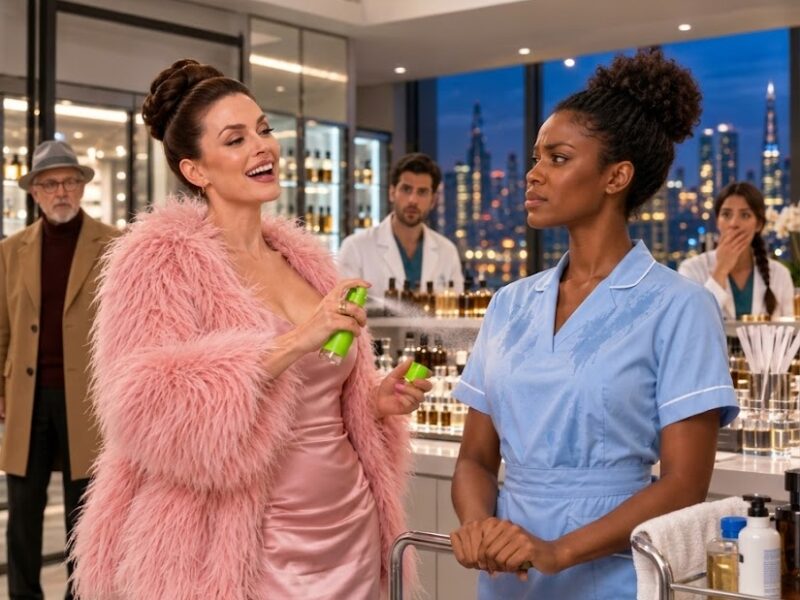
A Perfume House Director Humiliated a Black Cleaner by Spraying Cheap Cologne on Her—Unaware She Was the Brilliant Nose Behind His Company’s $40 Million Bestseller
The bench was all hers after seven, and the night crew knew it.
Noema straightened the mop against the wall of the seventh-floor lab, the one with the frosted glass and the little brass plate that read *Maison Lisieux — Noses Only*.
She had exactly forty minutes before the security guard made his first round.
Long day, a voice said from behind her.
Noema did not turn around. Long year, she said.
The woman laughed, a small, practiced laugh that belonged in a boardroom, not a hallway at eight at night.
You’re lost, the woman said. This lab is for noses, not mops.
Somebody took a wrong elevator, Noema said, and kept wiping.
—
The woman sniffed the air, and her face folded like a cheap napkin.
What is that smell. Oh. Bleach. It clings to you.
Lemon oil and bleach, Ms. Kessington, Noema said. I just did the hallway.
—
Ravenna Kessington, creative director of Maison Lisieux, tilted her head at the woman pushing the bucket.
She can name her own bleach, Ravenna said to no one in particular.
—
The lab assistants laughed on cue, three of them, like wind chimes in a storm.
The new sample is wrong at the top, one of them said, holding a paper strip. Too much musk. The vetiver is gone.
—
The cleaner has notes on vetiver now, Ravenna said, and the room laughed again.
Noema kept her eyes on the floor, because the floor did not lie.
These go in the bin, Ravenna said, flicking a stack of paper strips toward the trash. Like your opinions.
—
Clean up on aisle seven, someone called out.
And what is this, Ravenna said, lifting a small leather-bound notebook off the bench. A grocery list?
The room laughed.
—
Twelve notes of rain, Ravenna read, her voice going high and theatrical. How sweet.
She writes poems for the soap, an assistant said.
—
Ms. Casbury, please, said a younger woman near the window, her face pale. That is her book.
Stay at your bench, Noema, Ravenna said without looking up. You know what this house sells? Dreams. You smell like a hallway.
—
Everyone, come and meet our newest nose, Ravenna said, spreading her arms. Marjorie, the bargain bag.
The gas station one, someone said.
Perfect, Ravenna said. Every nose deserves a signature scent.
—
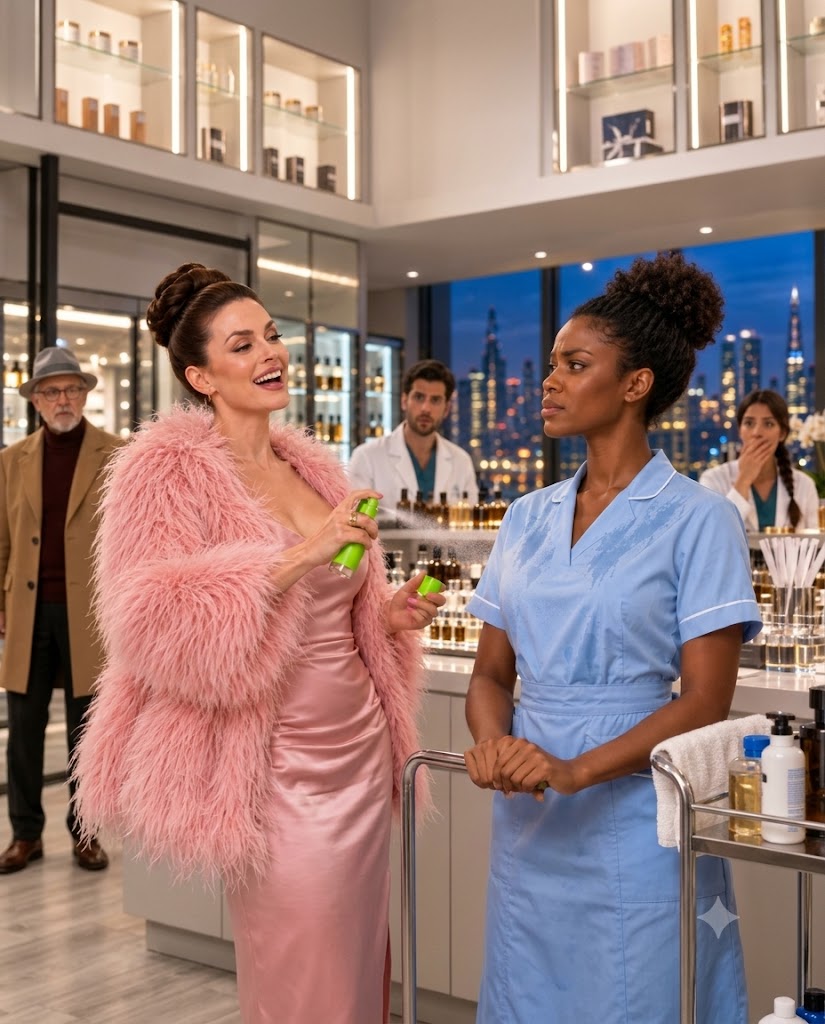
She produced a small glass bottle from her pocket, the kind you buy at a gas station register for $4.99, and sprayed it at Noema’s collar.
There, Ravenna said. Now you finally smell like something.
—
The room gasped, then laughed, a bright ugly sound that bounced off the frosted glass.
Ooh, that is strong, an assistant said, waving a hand in front of her face.
Everyone, meet the nose of a mop bucket, Ravenna said.
—
Miss Caspary, that is enough, said the young woman by the window, stepping forward. She knows more about scent than any of us.
Does she, Ravenna said, turning slowly.
—
Then she can teach the boxes, Ravenna said. Noemi, from tomorrow you sort crates in the warehouse.
Basement level, sweetie, an assistant sang.
—
Cheap cologne fades by morning, Miss Cassington, Noema said quietly, lifting her bucket. So will you. And take your bucket with you.
Bye-bye, nose, someone called.
—
Every scent tells the truth in the end, Miss Cassington, Noema said, and walked out with her head up.
Did the mop just warn me, Ravenna said to the room. I think she did.
—
Sadie, I am so sorry, the young woman said, catching Noema at the elevator. I should have said something sooner.
You stood up, Noella, Noema said. That cost you something tonight.
—
That book, Noella said. What is in it?
Everything I have ever smelled, Noema said. Keep it. The night air will carry the cologne away.
—
Somebody put cheap cologne on my daughter, the older woman said the moment Noema walked through the door of the flower stall on the corner of Ninth and Marigold.
You can smell it through two showers, Mama, Noema said, almost laughing.
—
I can smell it through the wall, honey, her mother said, hands on her hips. Who did it?
A woman who has never once been told no.
Then the world will tell her, Mama said. The world always does.
—
Thirty years I sold flowers on that corner so you could go to that perfume academy, Mama said, sitting down heavy on her stool.
And they said no, Mama, twice, Noema said. They said I did not look like a nose.
—
They said no to the paper, Mama said. Never to the nose. Eyes closed. What is this one?
Noema closed her eyes and breathed in the bucket of stems her mother pushed toward her.
—
Orange blossom, gardenia, and wet pavement, Noema said.
That last one is the street, honey, Mama said, and laughed until she coughed.
—
I gave you that book the day you named every bucket on this stall with your eyes closed, Mama said.
Every flower on this corner is still inside it, Noema said.
—
Reven Abel wants the launch crates counted, all 400, by tonight, said the warehouse foreman the next morning, clipboard in hand.
Tell her the crates smell wrong, Margarine, Noema said.
Crates do not smell, Noema, the foreman said.
—
Burnt sugar, Noema said, frowning at the pallet. This is not what left the seventh floor.
Look at her, Ravenna said from the loading dock, watching Noema wipe down a crate lid. Wiping my floor like it is a prayer.
—
It is already on 400 phones in this building, Ravenna said, holding up her phone.
Lucious sent down a formula from his secret nose, she said. I made it mine. More musk, less vetiver.
Should we not ask the lab first, an assistant asked.
—
On Friday night, Lucious names who runs this house, Ravenna said. It will be me.
And if No. 7 finds out, the assistant said.
No. 7 is a rumor in a fedora, Ravenna said. Nobody in this building has ever met them.
—
The rain is gone, Ravenna said, sniffing a paper strip. Friday, then.
You walked all the way down here for me, Noema said, looking up from the crate she was counting.
You stood up for me, Noella said, holding out a coffee. I can carry a coffee down four floors.
—
The crates smell like burnt sugar, Noema said, taking the cup.
Musk doubled, Noella said. Vetiver cut by half.
How do you know that from across the room, Noella asked.
—
My mother sold flowers, Noema said. I grew up inside a perfume.
Then why clean at night with a nose like that, Noella asked.
My mother needs me in the daytime, Noema said. And the lab is quiet at night.
—
The cleaner was caught sniffing the launch samples, Ravenna said the next afternoon, standing in the middle of the lab. She shouted at me. If anyone asks, that is what happened. Understood?
Understood, the assistants mumbled.
—
It is everywhere, Ravenel, an assistant said, scrolling her phone. And people are not laughing.
Then we give them a better story on Friday, Ravenna said. Ladies and gentlemen, I created After the Rain.
—
You created it, a reporter asked at the preview.
I improved it, darling, Ravenna said. That is what creating is. And keep the cleaner on for Friday. I want her mopping the hall while I take my bow.
In front of the reporters, the assistant whispered.
—
They know the scent, Ravenna said. That has always been enough for me.
It is not enough for me, said a man in the back of the room, folding his newspaper. I want your name on a bottle.
Maybe one day, Ravenna said, and laughed.
—
Good morning, Honore, the man said, stopping at the flower stall on Ninth and Marigold. Gardenias for the office, please.
Mr. Pemberton, Mama said, straightening up. Back from the flower fields already?
I took the first flight home, he said. Hello, Seven.
—
You said Friday, Noema said, nearly dropping her bucket of roses.
I watched the video on the plane, Lucius Pemberton said. Friday was too far away.
—
Six years ago, he said, I found you on the seventh floor fixing a formula none of my noses could fix.
I was only wiping the board, Noema said.
You wiped off one line and wrote a better one, he said. That line sold $40 million. Let me tell them today. Let me stop this.
—
No, Noema said. Let the room smell it first. Then they will listen.
Listen to her, Louis, Mama said, laughing. She gets her patience from me.
And the chemist who stood up for you, Lucius asked.
—
No, me, Noema said. They sent her down to the basement.
Every formula you ever sent me, I kept them all, Lucius said. On Friday, we bring her back up.
—
She signed it herself, Noema said, sliding a folded pink sheet across the counter. She signed the change order herself, Sadie. Keep it safe. Bring it on Friday night.
What happens on Friday night, Sadie asked.
—
Are you touching my blending bench, Ravenna said, appearing in the doorway of the lab that evening.
Only cleaning it, Ms. Keston, Noema said.
Where did you copy this, Ravenna said, snatching a paper strip from the bench. This formula belongs to this house.
—
It belongs to the one who wrote it, Noema said.
Everyone, Ravenna shouted down the hall. The cleaner has been copying our formulas.
Marjorie, lock this in my safe, she said, holding up the pink sheet. It is evidence.
—
You will mop this hall tonight while I launch, Ravenna said, her face inches from Noema’s. Then you are let go. And smile for the reporters. They love a mop.
I will be here tonight, Ms. Kessington, Noema said. I would not miss it.
—
I am sorry, Noella whispered, catching her in the stairwell. I really am.
Then read page one before you lock it away, Noema said.
—
Tonight, they will smell the future, Ravenna announced from the stage of the Maison Lisieux flagship on Fifth Avenue.
Ravenne, an assistant hissed, the crates from the basement smell nothing like the lab sample.
—
Then spray them on paper strips, not skin, Ravenna said. Nobody smells paper twice.
What if the cleaner is No. 7, the assistant asked.
No. 7 would never touch a mop, Ravenna said. Tonight, I am the nose of this house.
—
Wear your uniform tonight, honey, Mama said, pressing a kiss to Noema’s forehead. Let them see exactly who you are.
They will see a cleaner, Mama, Noema said.
Then they will learn what a cleaner can do, Mama said. Whatever happens, you come home and tell me how it smelled.
—
I will, Mama, Noema said. I promise.
Mrs. Arietta, Lucius said, stepping into the flower stall that afternoon. I hear you stood up for my nose.
Your nose, Mr. Pemberton, Mama said.
—
Bring that pink sheet upstairs tonight, Lucius said, and bring your lab coat. Tonight, you will smell the future of Maison Lisieux.
Service entrance is around the side, nose, a security guard said that evening, blocking Noema at the velvet rope.
—
Close your eyes, Noema whispered to herself in the service hallway. Breathe in the rain.
Ravenida, a silver-haired critic said, holding a paper strip to her nose on the showroom floor. I have reviewed this house for 20 years. This smells like burnt sugar and wet cardboard.
—
It opens with time, Solene, Ravenna said, her smile tightening. Give it a moment. Our master perfumers will adjust it live, right here on the blending bench.
Worse, Solene said. Fix it.
—
Nobody in this room knows the original Ravenna, Ravenna said, turning to the crowd.
Somebody in the basement ruined these crates, an assistant said.
No, Era, Noema said, stepping out of the service door in her uniform. The crates are fine, Ms. Kessington. The formula is not. May I, Ms. Kessington?
—
The room gasped. A reporter’s camera flashed.
The nose of a mop guppie wants to help, Ravenna said, recovering. Go mop something.
Let her try, Solene said. Nobody else in this room can.
—
Let her, Ravenna, said a voice from the back of the room. Lucius Pemberton stepped into the light. You were not due back until midnight.
Ms. Cormac, Lucius said, gesturing to the blending bench. The bench is yours.
—
She is a cleaner, Lucius, Ravenna said.
I started in this house washing bottles, Ravenna, Lucius said. Mind the company you mock.
—
Noema closed her eyes. Twelve notes, she said. Bergamot, pink pepper, wet stone, green fig, orris, neroli, cedar, smoked tea. Vetiver, ambergris, musk, and petrichor, the smell of rain on warm earth.
—
The musk was doubled, she said. The vetiver was cut by half. Someone wanted it to be theirs.
She is right, Solene said, her voice sharp. That is exactly what is wrong with it.
—
Noemie, I need you, Lucius said. Vetiver, 11 drops.
Eleven drops, Noema said, her hands moving over the bottles like a pianist’s.
Musk back to four, Lucius said.
—
The room went silent as she worked, the only sound the soft clink of glass and the hush of the crowd.
Noema lifted the vial and let a single drop fall onto a paper strip, then held it up.
—
It smells like the street after a summer storm, Solene said, and the room applauded.
There, Noema said quietly. The rain is back.
—
Six years ago, Lucius said, a woman cleaning our seventh floor fixed a formula my finest noses could not. I called her Nose Seven. Seventh hour.
He held up a bottle. The scent in every window of this city. $40 million last year. She wrote every note.
—
That is impossible, Ravenna said. Where is the proof, Lucius?
The proof was in your safe, Ravenna, Lucius said. Marjorie.
Marjorie stepped forward, the pink sheet trembling in her hand. I read page one, she said. I am done lying for you.
—
In her own hand, Lucius said, holding the sheet up to the cameras. Six years ago. Before any of us had smelled it.
And this, he said, holding up a second page, is the change order for tonight. Signed by Ravenna Kessington herself.
—
Lucius, Ravenna said, her voice cracking. I made this house famous. I gave it a voice.
You sprayed cheap cologne on my nose, Ravenna, Lucius said. In front of my whole lab.
—
Every scent tells the truth in the end, Ravenna, Noema said, her voice steady. Tonight yours did.
You are let go, Lucius said. Effective tonight. And this house will never be yours.
—
Ms. Cormell, Ravenna said, turning to Noema as the security guards approached. I called you the nose of a mop bucket. I was wrong about everything that night.
Thank you for saying it in front of everyone, Noema said.
—
Ms. Arrieta, Lucius said, turning to Noella. The seventh floor needs a head of lab. Will you come back up?
I never wanted to leave it, Noella said, and the room applauded.
—
And you, Seven, Lucius said, turning to Noema. Will you finally put your name on a bottle?
Only if my mother’s name is on it, Noema said.
—
Well, Mama said when Noema walked through the door of the flower stall at midnight. How did it smell?
Like rain, Mama, Noema said. Like our corner after the rain.
—
Good morning, a man said the next week, stopping at the soap counter of a department store on Broadway. I am looking for Ms. Cormier.
You are the cologne, Noema said, looking up.
—
Yes, ma’am, Ravenna’s former assistant said, his hands in his pockets. I am the cologne. I work a soap counter now. Every day I smell what people really want. I wanted to say it without cameras. I am sorry.
I heard you the first time, Noema said. This time I believe you. Tell me what you smell.
—
Gardenia and something like wet pavement, he said.
That one is the street, honey, Noema said, and laughed. Come back on Saturdays. These buckets do not lift themselves.
I would like that very much, he said.
—
Daytime in the lab, your mother on a stool, Lucius asked at the launch of the new fragrance. What will you call it?
Honor Eight, Noema said.
After me, Mama said, her hand flying to her chest. On a real bottle?
—
Ladies and gentlemen, Lucius said, raising his glass. The nose of Maison Lisieux.
A year ago, Noema said, standing at the microphone in a simple black dress, someone called me the nose of a mop bucket. Every nose starts somewhere. Mine started on a flower stall with my eyes closed.
—
This one is for the woman who taught me every flower on her corner, Noema said, her voice catching. Mama, come up here.
Mama climbed the steps in her Sunday hat, and the room stood up for her.
—
It smells like my corner, Mama said, holding the bottle to her nose. It smells like you.
The room applauded, and outside on Fifth Avenue, the rain began to fall.
—
**Part 2**
—
Six months later, the flower stall on Ninth and Marigold had a new awning, blue and white, and a small brass plate that read *Honor Eight — Est. by Noema Cormier*.
Mama still opened at six, because some habits are not about money.
—
You think you can just put a sign on a flower stall and call it a perfume house, said the man from the city licensing office, squinting at the plate.
No, Noema said, handing him a cup of coffee. I think I can put a sign on a flower stall and call it a flower stall. The perfume is upstairs.
—
The upstairs was two rooms over a laundromat on Ninth, a lab that smelled of bergamot and bleach, because old habits are not about money either.
Lucius had offered her the seventh floor again, the frosted glass, the brass plate.
She had said no, politely, twice.
—
You do not look like a nose, the licensing man said, writing something on his clipboard.
I have heard that, Noema said, and smiled at him until he left.
—
The first bottle of Honor Eight sold out in four days, 900 bottles at $180 each, which was $162,000, which was more than the flower stall made in three years.
Mama did the math on a napkin and then sat down and did it again.
—
It smells like our corner, Mama said, for the hundredth time, holding the bottle up to the window light.
It smells like you, Noema said, and meant it.
—
Ravenna Kessington, meanwhile, had opened a boutique in a strip mall in New Jersey, between a nail salon and a vape shop.
She called it *Maison Ravenne*, and she sold candles.
—
The candles were $48 each and smelled, according to one online review, like burnt sugar and regret.
The review got 4,000 likes by Friday.
—
I made this house famous, Ravenna told the reporter from the local paper, her arms crossed in front of a shelf of unsold candles.
Which house, the reporter asked.
Ravenna did not answer.
—
Noema heard about it from Noella, who had become head of the lab and who still called every Sunday.
She is not doing well, Noella said. She has been calling the old assistants. She wants the formula files back.
—
She can have the files, Noema said. She cannot have the nose.
—
The letter arrived on a Tuesday, a lawyer’s letter, thick and cream-colored, the kind that costs $600 to write.
It said Ravenna Kessington was claiming co-authorship of the After the Rain formula, and therefore a share of the $40 million, plus damages, plus interest.
—
She signed the change order herself, Noema said, holding the letter up to the light of the flower stall.
Signing a change order is not the same as creating a formula, the lawyer said on the phone. She is claiming she directed the creative process.
—
She sprayed cheap cologne on me in front of a room full of people, Noema said.
That is not relevant to the intellectual property claim, the lawyer said.
—
Lucius flew back from the flower fields in three days flat, which was the fastest he had moved since the night of the launch.
He sat on an overturned bucket in the flower stall, his suit jacket folded over his knees, and read the letter twice.
She wants $2.4 million, he said. Plus interest.
—
She wants to be somebody again, Mama said, trimming a rose. That is all this is.
She wants the nose, Noema said. She cannot have the nose.
—
The deposition was in a conference room on the 14th floor of a building on Lexington Avenue, all glass and gray carpet and a view of a parking garage.
Ravenna wore a cream suit and a string of pearls that were, Noella whispered, definitely real.
Noema wore a navy dress and the same $12 earrings she had worn to the launch.
—
The lawyer asked about the notebook, the leather one, the one Ravenna had once called a grocery list.
Do you recognize this, Ms. Kessington, the lawyer asked, holding up a photocopy of a page.
Ravenna looked at it for a long time.
—
It is a grocery list, Ravenna said, and the room laughed, but not the way her room used to laugh.
The page was dated six years earlier, and in the margin, in Noema’s handwriting, was a single line: *12 notes of rain — try vetiver 11, musk 4.*
—
Where did you get this, Ravenna said, her voice thin.
From the notebook you threw toward the trash, the lawyer said. It did not make it in. My client picked it up.
—
The second exhibit was the pink sheet, the change order, signed by Ravenna Kessington, dated the night of the launch.
The third exhibit was a video, 40 seconds long, taken by an assistant who had since left the company.
In the video, Ravenna sprayed a small glass bottle at a woman in a cleaning uniform.
—
The room watched it twice, because the lawyer played it twice.
Ravenna’s pearls rose and fell, rose and fell.
—
The fourth exhibit was a witness, Noella Arrieta, head of the seventh-floor lab, who testified that she had seen the original formula in Noema’s handwriting six years earlier, and that Ravenna had ordered the musk doubled and the vetiver cut.
Did you sign the change order, the lawyer asked Ravenna.
—
I signed a lot of papers, Ravenna said.
Did you sign this one, the lawyer asked.
Ravenna did not answer.
—
The settlement was $2.4 million, paid by Ravenna Kessington personally, plus the return of the formula files, plus a written statement, four sentences long, that ran in the trade press on a Thursday.
It did not mention a mop.
—
Noema used the $2.4 million to buy the building above the laundromat and turn the two rooms into four.
Mama used her share to buy a new awning, blue and white, and a stool with a cushion.
—
You did not have to do that, Noema said, watching her mother test the stool.
I did, Mama said. My back has been telling me for 30 years.
—
The second fragrance, *Corner*, launched on the first day of summer and sold 1,200 bottles in a week, at $180 each, which was $216,000, which was more than the flower stall made in four years.
Mama did the math on a napkin and then did it again.
—
Ravenna’s boutique in the strip mall closed in September, between the nail salon and the vape shop.
The candles went on clearance, $8 each, then $4, then free with a manicure.
—
Noema heard about it from Noella, who heard about it from an old assistant, who heard about it from the landlord.
She did not call. Some scents tell the truth in the end, and some scents just fade.
—
The reporter who had asked *which house* called Noema in October, wanting to do a profile.
I do not want a profile, Noema said.
It is not about you, the reporter said. It is about the woman who sprayed you. She is selling her story to a podcast.
—
Noema was quiet for a moment, standing in the four rooms above the laundromat, surrounded by bottles and paper strips and the smell of rain on warm earth.
Tell her I hope she finds something that smells like hers, Noema said.
—
The podcast came out in November, eight episodes, and in the third episode Ravenna Kessington said the word *mop* 14 times.
In the fifth episode she said the word *genius* 22 times, all of them about herself.
In the eighth episode she apologized, four sentences long, and did not mention a name.
—
Noema listened to the eighth episode on a Saturday, in the flower stall, with her mother on the new stool and a bucket of gardenias between them.
Well, Mama said, when it was over. How did it smell?
—
Like burnt sugar, Noema said. Like something left too long.
Mama nodded, and trimmed a rose, and said nothing else, because some things do not need to be said twice.
—
The following spring, the perfume academy that had said no to Noema’s paper, twice, invited her to give the commencement address.
She wore the navy dress and the $12 earrings.
—
I was told I did not look like a nose, she told the graduates, 400 of them in black gowns under a white tent.
I was told that twice.
—
But the nose is not a look, she said. The nose is a memory. It is the corner where you grew up. It is the bucket your mother filled with stems. It is the street after the rain.
—
She held up a paper strip, one drop of Honor Eight on the end.
Close your eyes, she said. What do you smell?
The tent was silent, 400 people breathing in at once.
—
Gardenia, someone called out.
Wet pavement, someone else said.
That last one is the street, Noema said, and the tent laughed, and somewhere in the back row, a woman in a cream suit and pearls stood very still.
—
Ravenna Kessington had not been invited, but she had come anyway, and she stood in the back with her hands folded, and when the applause started, she clapped too, slowly, twice, before she turned and walked out into the spring rain.
—
Noema saw her go. She did not follow.
Every scent tells the truth in the end, she said to the graduates. Even the ones we did not want to smell. Especially those.
—
After the ceremony, Mama found her by the flower buckets, the ones the academy had set up as a decoration, and laughed.
They put out buckets for the perfume lady, Mama said. Somebody finally got it right.
—
Noema put her arm around her mother and breathed in: gardenia, orange blossom, wet pavement, and underneath it all, the lemon oil and bleach of a hallway at eight at night, which was, she had decided, its own kind of perfume.
—
**Part 3**
—
The offer came in June, on a Tuesday, from a conglomerate in Paris with a name Noema could not pronounce and a portfolio that included 14 perfume houses and one brand of luxury soap.
They wanted to buy Maison Cormier for $40 million.
Mama did the math on a napkin and then sat down and did it again.
—
Forty million, Mama said. That is the same number.
I know, Noema said.
That is the same number as the scent, Mama said.
I know, Noema said.
—
She did not sell. She told the lawyer to send back a counteroffer: a partnership, not a purchase, her name on the door, her mother’s name on the first bottle of every line.
The conglomerate said they would think about it.
—
They thought about it for six weeks, and in that time, Noema opened a second shop on Ninth, a small one, with a counter and three stools and a sign that said *Smell First, Buy Second*.
Mama ran it on Tuesdays and Thursdays.
—
You are not a perfume lady, Noema said, watching her mother hold a paper strip under a customer’s nose.
I am a flower lady, Mama said. Same thing.
—
The conglomerate came back in August with a yes, mostly, and a contract that was 84 pages long and used the word *waive* 11 times.
Noema read all 84 pages on the flower stall, with a red pen, and wrote *no* in the margin 23 times.
—
The lawyers met in a conference room on the 14th floor of the same Lexington Avenue building, the one with the view of the parking garage.
Noema wore the navy dress.
Ravenna Kessington was not there, but her lawyer was, sitting in the corner, taking notes.
—
What is she doing here, Noema asked Lucius.
She is representing a minority shareholder, Lucius said. It is a long story.
It is always a long story, Noema said.
—
The long story was this: Ravenna Kessington had bought, through a shell company, 2 percent of the conglomerate’s beauty division, which made her, technically, a minority shareholder, which meant she could attend meetings, and ask questions, and sit in corners, taking notes.
She had spent $80,000 on the shares.
She had spent the last year doing nothing else.
—
She wants to be in the room, Noella said, when they read the terms.
She wants to be in the room when they read my mother’s name, Noema said.
—
The meeting started at 9 a.m. and by 9:40 the conglomerate’s lawyer had used the word *waive* four times.
Noema said no four times.
At 10:15, the conglomerate’s lawyer said the word *non-negotiable*.
Noema said no.
—
At 11, the conglomerate’s lawyer said the deal would not happen without the waiver.
Noema stood up, and the room went quiet, and she said the sentence she had been practicing for six years, in hallways, in basements, in the flower stall at midnight.
—
The nose is not for sale, she said. The nose was never for sale. The nose was borrowed from a corner on Ninth and Marigold, and it will go back there when I am done with it.
She walked out.
—
She got as far as the elevator, and the doors opened, and Ravenna Kessington was standing inside, holding a paper cup of coffee, wearing a cream suit and no pearls.
—
I bought the shares, Ravenna said, before Noema could speak. I bought them so I could be in the room. I wanted to hear them say your name.
You could have heard it from the audience, Noema said.
I did not want to be in the audience, Ravenna said.
—
The elevator doors started to close. Ravenna put her hand out and stopped them.
I have been in the audience for a year, Ravenna said. It smells terrible.
—
Noema looked at her for a long moment, at the cream suit and the paper cup and the face that had once called her a mop bucket, and she did not smile, and she did not forgive her, and she did not walk away.
What do you want, Ms. Kessington, she said.
—
I want to smell it again, Ravenna said. The first one. The original. I want to know what it smelled like before I touched it.
Noema reached into her bag and pulled out a small glass bottle, unlabeled, one of the six she had made six years ago in a basement with a mop in her hand.
She held it out.
—
Ravenna took the bottle and sprayed it on a paper strip, and closed her eyes, and breathed in.
She stood there for a long time, in the elevator, with the doors held open, and when she opened her eyes, they were wet.
—
It smells like the street after the rain, Ravenna said.
It smells like the corner, Noema said. The corner where I grew up.
Ravenna nodded, and handed back the bottle, and stepped out of the elevator.
—
I will vote for the partnership, Ravenna said, walking away. All 2 percent.
Noema watched her go, down the gray carpet, past the parking garage view, and then she got in the elevator and went down to the street.
—
The partnership closed in October, 84 pages, 23 no’s, and one signature that was not in the margin but at the bottom, where it belonged.
The first bottle of the new line was called *Ninth and Marigold*, and the label said, in small letters under the name, *for the woman who taught me every flower on her corner.*
—
Mama cried when she saw it, and then she did the math on a napkin, and then she cried again.
It is not about the money, Mama said.
It is a little about the money, Noema said.
It is a little about the money, Mama agreed.
—
The launch party was in the flower stall, because Noema insisted, and the reporters stood between the buckets and the awning and took pictures of a 72-year-old woman in a Sunday hat holding a bottle of perfume.
What does it smell like, a reporter asked.
—
Gardenia, Mama said. Orange blossom. And the street.
The street, the reporter said.
The street after the rain, Mama said. That one is mine. I gave it to her.
—
In the back of the crowd, near the buckets of roses, a woman in a cream suit stood very still, and then she turned and walked down Ninth toward the avenue, and the rain started, and she did not have an umbrella.
Nobody offered her one. Some scents tell the truth in the end, and some scents just fade, and some scents walk away in the rain and are not seen again for a long time.
—
The following spring, a small envelope arrived at the flower stall, no return address, postmarked from a town in Vermont Noema had never heard of.
Inside was a single page, handwritten, four sentences long.
—
*I have been growing flowers. I am not good at it. But the soil smells like rain on warm earth, and I finally understand what you meant. I am sorry, four sentences long, and this is the fourth. — R.K.*
—
Noema read it twice, standing in the stall, with her mother on the stool and a bucket of gardenias between them.
Well, Mama said. How did it smell?
—
Like burnt sugar, Noema said, folding the letter. Like something left too long.
She put it in the drawer under the counter, with the notebook and the pink sheet and the 23 red no’s, and she did not throw it away.
—
Some things you keep, she said to her mother, because they are evidence.
Evidence of what, Mama asked.
Evidence that the nose was always here, Noema said, tapping her chest. And evidence that some people finally learn to smell.
—
Outside, the rain started, and the corner of Ninth and Marigold smelled like gardenia and orange blossom and wet pavement, which is to say, it smelled like everything, which is to say, it smelled like home.
And the sign above the stall, blue and white, read *Honor Eight*, and under it, in small letters: *Est. by Noema Cormier, nose.*