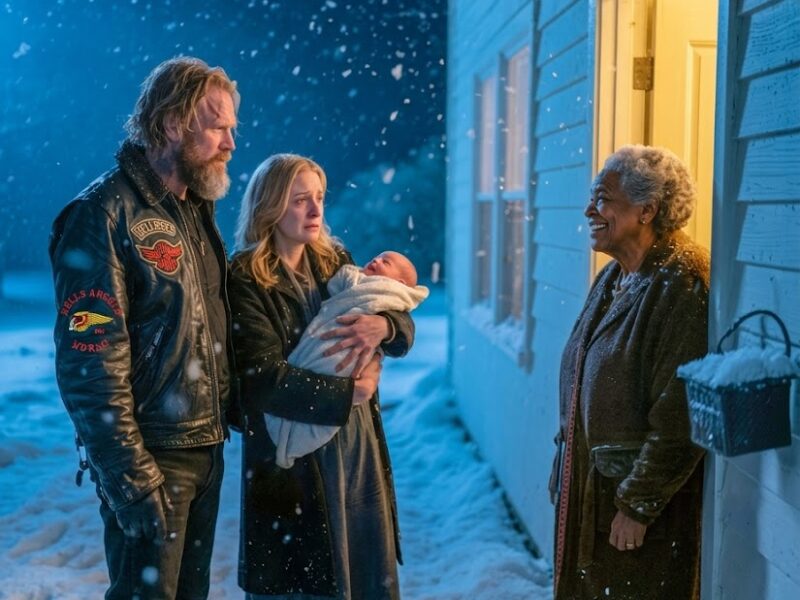
A Black woman sheltered a freezing Hells Angel’s family for one night. Days later, dozens of bikers arrived at her door.
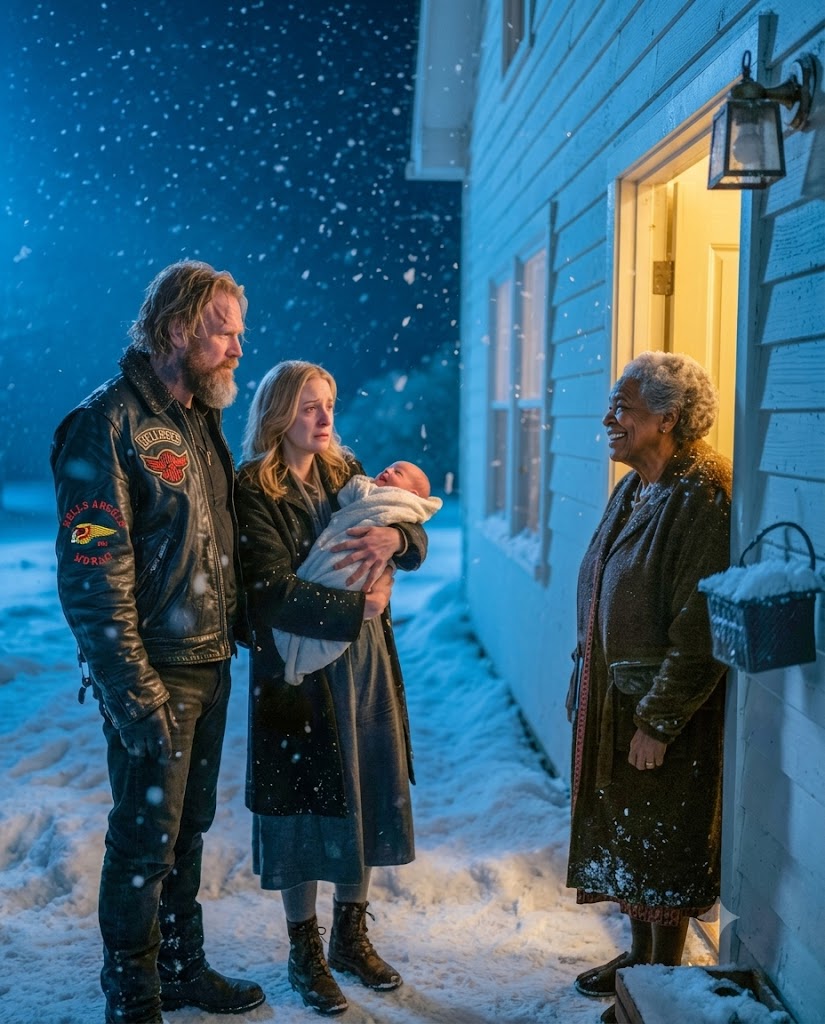
The blizzard hit Pine Ridge, Missouri, like a fist against a screen door, swallowing streetlights whole and burying every parked car under a white so heavy the plows gave up by nine. Transformers popped along Maple Street, and the whole block went dark except for one amber glow pulsing against the frost—Martha Bennett’s wood stove, her salvation through seven winters of widowhood. At seventy-three, she moved through the kitchen with the deliberate grace of a woman who knew that rushing only led to regret, her silver hair pinned back in the same neat bun she’d worn since her teaching days. The house felt impossibly quiet without Samuel’s warm presence filling the gaps between her thoughts, and the silence had only deepened since their son Marcus chose his wild life over family dinners, showing up only when his wallet ran dry. His wife Tiffany would stand behind him during those visits, making snide comments about backwoods living while appraising every piece of furniture.
Martha’s gaze drifted to the mantel, where Samuel smiled back at her from their wedding photo, his arm wrapped around her waist. Beside it sat a small wooden jewelry box he had carved by hand, and inside, wrapped in tissue paper, lay a tiny pair of knitted booties in pale yellow—the only tangible reminder of the grandchild she had held for three precious days before fever took him. The sudden pounding on her front door cut through the storm’s howling like a desperate prayer, followed by the unmistakable wail of an infant that seemed to pierce straight into her soul. Through the frost-covered window she made out two figures huddled against the wind, and the voice that cut through the gale was deep and gravelly, raw with a desperation that made her chest tighten. “Please, ma’am—my baby can’t take much more of this cold. We just need somewhere warm for her.”
The man was enormous, his broad shoulders straining against a leather jacket covered in patches she couldn’t make out in the dark, and cradled against his chest was the source of that crying that was tearing at her heartstrings. Behind him stood a young woman who couldn’t have been more than twenty-five, her thin frame shaking violently, her inadequate coat soaked through. “We knocked on four other houses already,” the woman called out, her voice breaking with exhaustion and fear. “One man saw Jack’s jacket and slammed the door before we could even ask. Please, I’m begging you—my daughter is only six weeks old and she’s so cold I can barely feel her breathing.”
Martha’s hand hovered over the deadbolt, her mind racing through every warning about strangers in the night, but as the baby’s cries grew weaker, every maternal instinct that had lain dormant since her grandson’s death came roaring back to life. The deadbolt turned with a click that echoed through the house, and Martha pulled the door wide, letting the warmth spill out into the night. “Get inside, all of you, right now,” she said, her voice carrying the gentle authority she’d used with countless students. “No child should be out in weather like this.” The man stepped across her threshold first, immediately unwrapping the layers of blankets from around the infant. “Thank you so much, ma’am. I’m Jack Morrison, and this is my wife Anna, and our daughter Lily. We were coming back from a motorcycle rally when this storm came out of nowhere.”
Anna stumbled inside behind him, her teeth chattering violently, but her eyes never left the baby as Jack placed her into Martha’s waiting arms. Martha cradled little Lily against her chest, feeling the child’s tiny body gradually stop shivering as the warmth seeped into her bones. “Sweet little angel,” she murmured, automatically beginning the gentle swaying motion that came as naturally as breathing. “You’re safe now, precious girl.” As Anna positioned herself close to the wood stove, Martha began the familiar ritual of caring for others—heating water, preparing a bottle with formula she kept stocked for church members with young children.
“Most people see Jack’s jacket, see those Hell’s Angels patches, and they assume we’re trouble,” Anna said, accepting the cup of hot tea Martha pressed into her hands. “They don’t see that he’s the gentlest man I’ve ever known, that he works sixteen-hour days at the garage to support us.” Martha settled into her favorite rocking chair, adjusting her hold on Lily so she could feed the baby while keeping her warm. “People are too quick to judge based on appearances,” she said softly. “They see leather and tattoos and think they know a person’s whole story, but they miss the love in a father’s eyes when he’s protecting his child.”
As Martha looked down at Lily’s tiny face, watching the baby’s eyes grow heavy with contentment, she felt something shift deep inside her chest, like a door that had been locked for seven years suddenly creaking open. The baby’s features reminded her so strongly of her grandson. “I had a grandson once,” Martha found herself saying, her voice quiet. “He was the most beautiful baby, with eyes just like your Lily’s. I only had him for three days before the fever took him. I couldn’t save my grandson, but I can make sure your little girl stays warm and safe tonight. Sometimes God gives us second chances to do right by the children who need us.”
Anna reached for Martha’s hand, her fingers cold as bone. “You didn’t have to do this,” she said, her voice breaking. “But you did. I don’t even know how to thank you.” Martha smiled faintly, brushing a damp curl from the baby’s forehead. “Don’t thank me. Just keep her warm.” The fire crackled, filling the room with a steady living light, and Martha sat back holding the baby against her chest, and for a moment the years folded in on themselves. Outside the blizzard raged on, but inside the warmth held—and that warmth was the first promise, the quiet wager that kindness offered in the dark would somehow find its way back home.
The storm had burned itself out by dawn, leaving Pine Ridge buried under a heavy quilt of snow, and pale sunlight pressed weakly through the frost on Martha’s window, casting a thin gold stripe across the warm wood floor. Jack was the first to stir, unfolding his tall frame from the chair where he’d kept watch, while Anna lay curled on the couch with the baby against her chest, the wool scarf still wrapped snug around the child. They packed their few things with unhurried hands, pausing often to glance out at the dazzling white world beyond, where the snow was piled knee-deep against the steps and glittered under the pale light. As they stepped outside, the silence of the morning was broken only by the crunch of boots on snow, and Jack paused, his breath rising in quick bursts, then walked back to Martha and closed his rough, cold hand firmly around hers.
“Most of this town shut their doors on us,” he said quietly, his voice edged with both gratitude and disbelief. “But you opened yours. Hell’s Angels don’t forget that. I’ll come back for you—that’s a promise.” Anna stepped forward and drew a small woven bracelet from her coat pocket. “I made this for her,” she said, nodding at the baby. “But I want you to have it.” Martha slipped it over her wrist, the colors standing out against her dark skin, and watched as they made their way down the street, their figures shrinking against the endless white until the snow and light swallowed them from sight.
One week later, Martha heard the familiar rumble of motorcycles turning onto Maple Street, a sound that now made her heart skip with anticipation rather than fear. Jack Morrison walked up her front path with a confident stride, but today he looked nothing like the desperate father from that storm night—gone was the intimidating leather jacket, replaced by a simple button-down shirt that made his dark eyes seem warmer. Behind him, Anna carried little Lily, the baby now plump and rosy-cheeked, vibrant with health. “Mrs. Bennett,” Jack called out as he reached her front steps. “We wanted to come see you properly, to explain some things that might help you understand why what you did meant so much to us.”
Martha opened her door wide, ushering them into her kitchen with bustling hospitality, and as Anna settled Lily into the old high chair that had been gathering dust since Marcus was small, Martha noticed how much the baby had grown in just seven days, her cheeks fuller and eyes brighter with alert curiosity. Jack cleared his throat and reached into his shirt pocket, withdrawing a small white envelope. “Before we say anything else, I need to explain something about who we really are,” he began. “The Hell’s Angels aren’t what most people think we are—at least not our chapter. We’re motorcycle enthusiasts who love the freedom of the open road and the brotherhood that comes from sharing that passion.”
Anna nodded, bouncing Lily gently on her knee. “We’re not criminals or troublemakers,” she said, her eyes meeting Martha’s with direct honesty. “Jack works as a mechanic at Morrison’s Garage downtown, and I teach piano lessons to children in our neighborhood. We ride with the Angels because they’re our family, because they share our values about loyalty and helping people who need it.” Jack gestured toward the envelope with reverence. “That night during the blizzard, when you opened your door and saved our daughter’s life, you didn’t just help one family,” he explained, his voice thick with emotion. “You helped our entire extended family, because every member of our chapter considers Lily to be their niece. When word got out about what you’d done, the whole group wanted to find a way to thank you properly.”
Inside the envelope, Martha found more money than she had seen in one place since Samuel’s life insurance policy seven years ago—seven thousand four hundred dollars in cash, along with a handwritten note explaining that the money had been collected during a charity ride, with every member contributing whatever they could afford. “This is too much,” Martha whispered. “I didn’t help you because I expected any reward. I helped because it was the right thing to do.” Jack shook his head with gentle stubbornness. “This isn’t about what you expected or what we owe,” he said firmly. “This is about what our community values and how we choose to honor people who embody those values. You showed us that there are still people who judge others by their actions rather than appearances.”
Anna leaned forward earnestly. “Besides the money, we’d like to do some work around your house if you’ll let us,” she said, gesturing toward the window where Martha could see several motorcycles parked along the street, their riders dismounting with toolboxes and equipment. “We’ve got carpenters and painters and electricians in our group—all professionals who are eager to donate their time and skills.” Little Lily began to crawl across the kitchen floor with determined focus, pulling herself up using Martha’s skirt for support, her bright blue eyes sparkling with delight as she reached tiny hands toward the woman who had saved her life. Martha’s heart melted completely as she lifted Lily into her arms, feeling the solid weight of a healthy baby settling against her chest. “My goodness, sweet pea,” she murmured. “Look how big you’ve gotten in just one week.” The baby’s response was a delighted giggle that filled the kitchen with pure joy, and Martha found herself laughing along with tears of happiness streaming down her cheeks as she realized how much she had missed having a child in her arms.
Three days later, Martha stood in the lobby of Sunshine Children’s Home with two large shopping bags and a heart full of purpose, the orphanage sitting on the outskirts of town, housing dozens of children with limited funding. She had called ahead to speak with director Carol Henderson, who had been running the facility for over a decade with more love than resources. “Mrs. Bennett!” The chorus of young voices that greeted her arrival made Martha’s face light up with genuine happiness. “Grandma Martha!” called out a boy of about seven whose missing front teeth gave his words a charming lisp that made Martha’s heart skip with recognition of Marcus at the same age. Martha unpacked warm blankets in bright colors, cases of baby formula and children’s vitamins, educational toys and books, and at the bottom of the second bag was an envelope containing enough money to repair the ancient heating system—nineteen hundred dollars, every penny of what remained after she’d set aside a small cushion for herself.
“This is going to save us all, Martha,” Carol said softly, her voice thick with emotion. “This is going to save the whole winter for these babies.” But even as Martha basked in the satisfaction of helping people who truly needed it, she couldn’t shake the awareness that her generous actions were being discussed in less flattering terms throughout the rest of Pine Ridge. The sight of Hell’s Angels motorcycles parked outside her house for three days running had not gone unnoticed by neighbors who believed that associating with the wrong sort of people reflected poorly on one’s character, regardless of circumstances. The gossip that had floated through town like smoke on a still night eventually found its way into a cramped, dimly lit apartment on the far side of the county, and Tiffany was the one to deliver it, her voice sharp with that peculiar kind of satisfaction that comes from wounding without lifting a hand.
“Your mother’s been keeping cozy with a bunch of bikers,” she said, leaning against the kitchen counter with her arms folded. “They fixed up her roof, gave her money, too, I hear. Probably hiding it somewhere in that old house of hers.” Marcus was sitting slouched at the table, a half-empty bottle in front of him, his eyes dull until her words seemed to strike something deep. He poured himself another drink, the liquor sloshing against the rim, and downed it in one motion while Tiffany smirked at the way his jaw tightened. Later that night at the low-ceilinged bar where Marcus spent most evenings, the haze of cigarette smoke wrapped around the smell of spilled beer, and Tiffany leaned close to him in their corner booth, her nails drumming lazily against the table. “Funny, isn’t it?” she murmured. “Those bikers get to play hero, and her own son gets nothing. Nothing.”
Marcus stared at the scarred wood of the table, then slammed his palm against it so hard the glasses rattled. “That’s my house,” he growled. “Everything in it is mine.” Tiffany’s eyes glittered as if she’d been waiting for exactly that. It was well past midnight when they reached Martha’s street, the air cold and still, the moonlight pale against the patched-up roof that gleamed faintly from the repairs. Tiffany stepped through the front gate first, her heels clicking on the path, and looked up at the little house and let out a laugh that was more like a sneer. “This is it? This is what you’re so proud of?” she said loudly, glancing at Marcus as if daring him to disagree.
Inside, the smell of wood smoke lingered in the air, and Marcus moved through the narrow hallway opening drawers, pushing aside boxes, his movements clumsy from drink. He stopped when his eyes fell on a framed wedding photo sitting atop the old wooden cabinet—his father in a dark suit, his mother in white, both smiling in a way Marcus had not seen in years. His hand hovered above it, fingers curling in hesitation, and Tiffany came up behind him, snatched the frame before he could decide, and with a swift motion tore the photograph clean down the middle. The sound of paper ripping seemed to cut through the air like a blade. “Don’t go soft now,” she said coldly. “You need money, not memories.”
Marcus stared at the pieces in her hand, something unreadable flickering in his face before the liquor drowned it again, and he turned and drove his fist into the cabinet door, splintering the wood with a sound sharp and final. From the doorway, Martha’s voice was low but steady. “Marcus,” she said, stepping into the light, her nightgown brushed with the shadow of the fire behind her, and she knelt to gather the torn pieces of the photo, cradling them in her hands as though they were something living. “That was your father and me, our wedding day. It’s all I have left of him.” Marcus looked away, jaw set, and she straightened, holding the photo to her chest. “I kept only a little of what they gave me,” she said quietly. “The rest went to the orphanage, to children who have no one.”
Marcus let out a short bitter laugh. “The orphanage. Your old ma, still dreaming like you can save the world.” Her eyes softened despite the sting in his voice. “I only want you to live well, Marcus. Like you used to, when you were a boy who’d run home to tell me every little thing.” But Marcus was already shaking his head, the moment slipping past him. “This place is mine,” he said flatly. “One way or another.” Tiffany’s hand slipped into the crook of his arm, her smirk returning as if the conversation had been decided, and when they left, the door hung slightly ajar, the cabinet’s broken door yawning open like a wound.
Martha stood alone in the living room, the torn photo pieces still pressed against her chest, and lowered herself into the chair by the fire, the wood crackling softly, and let her tears fall without sound. In the dim light, her fingers traced the faces in the photograph, lingering on Samuel’s eyes before moving to the boy Marcus had once been. Her voice trembled in the quiet. “I sold everything I had to raise you,” she whispered. “And now you stand here a stranger.” The morning after the storm between mother and son had left its wreckage in splintered wood and torn memories, and Martha moved slowly through her kitchen trying to put the room back in order. She had barely set the kettle on the stove when the sound of motorcycles rolled up the road—a low familiar rumble that made her heart lift in spite of herself.
She looked out the window and saw Jack dismounting his bike, followed by three other members of the Hell’s Angels, none of them in their leather jackets today, just worn flannel shirts and jeans, each man carrying something in his hands. Jack had a box of fresh pastries from the bakery in the next county, the one Martha had always said was too far to justify the trip, and she opened the door before they knocked, the smell of cinnamon and sugar coming in with the cold air. “We were nearby,” Jack said with a slight grin, setting the box on her table. “Figured we owed you another visit.” Martha smiled, about to offer them coffee, when a crash echoed from the living room, and Jack’s expression changed instantly.
They stepped into the room to see Marcus tossing books onto the floor, Tiffany kneeling by the old cabinet and yanking out drawers, the fire in the stove barely alive because a piece of kindling had been kicked across the floor. Tiffany glanced over her shoulder, her voice dripping with mockery. “Look at this,” she said to the newcomers. “Your mother here, too good for her own son. Lets bikers fix her house, feed her, and who knows what else.” Jack walked forward until he stood between Martha and Tiffany, his jaw tight, his eyes fixed not on the woman but on Marcus, his voice steady, almost quiet, but with steel in it. “This woman saved my family when your town slammed every door in our faces. You put a hand on her, you go through me first.”
Marcus started to puff up his chest, his shoulders squaring as if to step forward, but something in Jack’s eyes made him pause—Jack didn’t shout or move closer, he just stood there solid and unmoving the way a tree holds its ground in a gale. Without breaking his gaze, Jack reached into his pocket and pulled out his phone, made a short call, no more than a few words. Minutes later, the sound of engines grew in the distance—one, then three, then more—until the entire street vibrated with the deep rolling thunder of over a dozen bikes. Headlights cut through the thin winter sunlight, flooding the front yard with harsh beams, and the rest of the Hell’s Angels, who had been preparing for a charity ride nearby, arrived now in a formation that spoke of discipline and purpose.
The man at their head was older, with silver streaks in his beard and eyes that missed nothing, and he stepped forward, removing his gloves, his voice carrying over the idling engines. “Mrs. Martha is our friend,” he said, looking from Marcus to Tiffany. “She’s an honored name in our club. You’d be wise not to test the strength of that.” From across the street, curtains shifted as neighbors peeked out, some with their mouths open in disbelief—no one had seen this side of the bikers before, this tight-knit almost ceremonial solidarity. It was not the image the town’s gossip had painted, but the commotion had drawn other attention, and a police cruiser turned the corner, its lights flashing blue against the snow-dusted ground, because someone—perhaps the same neighbor who had been quick to judge before—had called in a noise complaint.
Two officers stepped out, their eyes scanning the crowd, the torn cabinet, and Marcus still holding one of the drawers in his hand. “What’s going on here?” one officer asked, and Martha opened her mouth to speak, but Tiffany cut in, her voice high and defensive. “We’re just visiting,” she began, but Jack stepped back, letting the room be seen as it was, and the younger officer’s gaze took in the overturned furniture, the damage to the cabinet, and the ripped photograph lying on the hearth. He glanced at Marcus, then at Martha, who stood silently with her hands folded, and Marcus tried to protest, but his words slurred, the smell of alcohol heavy in the air. Within minutes, he was being led toward the cruiser, Tiffany following behind under the watchful eye of the second officer, who told her she’d need to answer some questions downtown. The engines outside idled lower now, the bikers waiting quietly, their presence a wall between Martha and the chaos that had invaded her home.
When the cruiser pulled away, Jack turned to her, his voice softened, the edge gone. “I’m sorry you had to see that,” he said, and Martha reached out and took his hand, her fingers warm despite the chill in the air. “Thank you, Jack. You’ve done more for me than I can say.” But she looked toward the empty road where her son had just disappeared. “I still hope one day Marcus will come back to me the way he used to be.” Jack nodded slowly, his thumb pressing gently against the back of her hand. “You’re his mother,” he said. “I get it. You don’t stop hoping. No matter what.” The men outside began to shut off their engines, the sudden quiet settling over the house like a blanket, and for the first time that day, the fire in the stove flared back to life, and the smell of cinnamon from the pastries seemed to linger, mingling with the warmth as if trying to push the cold away.
That winter settled in heavy and slow, the kind that painted the windows in frost and made every step outside crunch underfoot, and weeks turned into months, and true to their word, Jack and Anna came by often. Sometimes it was to drop off groceries—fresh bread still warm from the oven, jars of homemade preserves, a basket of apples—and other times it was just to help Martha with the small things that had become harder for her hands to manage, stacking firewood neatly by the stove, fixing the hinge on the kitchen cabinet, sweeping the porch so the snow wouldn’t ice over. One evening, the three of them found themselves sharing a simple supper around the small wooden table beside the stove, the fire crackling softly and throwing a golden light that made the worn wallpaper seem warmer than it was. Martha ladled stew from the old cast-iron pot, the savory smell filling the room, and Jack took his seat across from her, Anna beside him, and the baby—now bigger and sturdier—gurgled happily in Anna’s lap.
They talked quietly about nothing urgent—the weather, the stubborn rooster at the farm down the road, the way the snow seemed to fall slower when the moon was bright—and at one point Jack set down his spoon and reached across the table, taking Martha’s hand in both of his. His voice was steady, but his eyes held a weight she hadn’t seen before. “That night,” he began, “when the whole town turned away from us, you opened your door. You didn’t ask who we were or what trouble we might bring. You just let us in. I can’t be your son—not in the way Marcus is—but”—he paused, searching her face—“if it’s all right with you, I’d like to call you mom.”
The words came so simply, without ceremony, but they caught in Martha’s chest like a sudden gust of wind, and she felt her eyes sting, and before she could stop herself she was out of her chair, leaning forward to wrap her arms around him. Jack held her tightly, one hand pressed against her back, and in that moment the years of distance and cold that had grown between her and her own son seemed, for a breath, a little less heavy. Anna rose quietly, her smile soft, and placed the baby in Martha’s arms. “This,” she said, “is the child you saved that night. One day she’ll call you grandma.” The baby’s tiny hand closed around Martha’s finger, her skin warm and impossibly soft, and her laugh—pure, unguarded—filled the space between them. Martha felt the heat of the stove on her back, the faint weight of the knitted bracelet Anna had given her still on her wrist, and for a moment the little house felt like the heart of the world.
They ate the rest of their meal in a quiet kind of happiness, the kind that doesn’t need to be named, and laughter rose now and then, the firelight dancing over their faces, and even the wind outside seemed to ease its constant tapping against the walls. When Jack and Anna left that night, the baby bundled close to her mother, Martha stood at the door and watched the faint glow of their taillights fade into the dark. Later, when the house was silent again, she settled into her chair by the stove, the fire burned low, its light flickering against the worn floorboards, and in her lap lay the small creased photograph of Marcus from years ago—his smile unguarded, his hair a little too long, the boy he had been before life’s harder edges found him. She traced the outline of his face with her fingertip and whispered, “My son, I’m still waiting for you.”
She didn’t hear Jack come back in until his hand was resting gently on her shoulder, and he didn’t speak right away, and she didn’t look up. They stayed like that for a moment—her eyes on the photograph, his steady presence behind her—until the fire popped and sent a small ember skittering across the grate, and only then did she lift her gaze and meet his, seeing in his expression an understanding that didn’t need words. The months that followed carried the quiet rhythm of a life rebuilt, and Jack, Anna, and sometimes a few of the other Hell’s Angels made it a point to stop by regularly. They brought food, fixed small repairs, or simply sat with her, filling the house with easy conversation and the occasional burst of laughter, and word in town began to shift slowly, unevenly, as people saw the bikers not as the dangerous outsiders they’d imagined but as loyal friends to a woman who had shown them kindness when no one else would.
Martha kept her door open, not just for them but for anyone who knocked—a traveler caught in bad weather, the young couple from down the road whose heater had broken, even the postman when the snow was too deep for his van, who found a cup of coffee waiting for him by her stove. The fire never went out for long, and it became more than warmth for her—it was a quiet symbol that there would always be a place in this world where kindness was not conditional. One crisp morning in early spring, the town woke to the sound of engines—not one or two but a whole chorus, low and steady, rolling in from the highway—and more than a dozen Hell’s Angels rode in formation, their bikes glinting in the pale sunlight, passing through the main street without hurry, the echo of their engines carrying far beyond the edge of town.
People stepped out of shops, paused on porches, and watched as the line of riders disappeared into the distance, and to some it was still a strange sight, but to others it was now a reminder. In Martha’s little house at the edge of town, the sound reached her before the riders did, and she stepped onto her porch, pulling her shawl tighter around her shoulders, and listened as the engines drew near. When they passed, several riders lifted a hand in greeting, and she smiled, feeling the steady beat of their presence in her chest even after the last bike had gone. Inside, the stove burned brightly, casting long shadows on the walls, and the room was simple—the table set for one, yet it felt full. The firelight glowed on the bracelet around her wrist, the baby’s laughter still lived in her memory, and in that moment she knew the warmth she kept alive here would outlast even the coldest winter.
The town might still whisper, and the road might still take people away, but as long as the fire burned, the door would stay open. And somewhere in the distance, the low thunder of motorcycles would remind them all that one act of kindness can carry farther than anyone ever expects—farther than gossip, farther than judgment, farther than the long cold miles of any winter. Martha Bennett had opened her door on the worst night of the year, and in return the world had opened back—slowly, imperfectly, but truly—and that was the promise the storm had never been able to bury.









