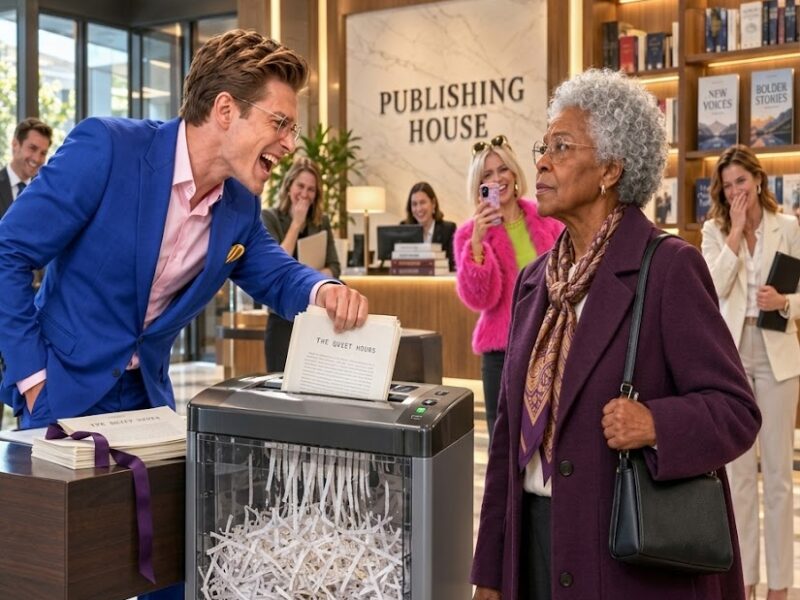
A Publisher Threw an Elderly Black Woman’s Manuscript Into the Shredder—Unaware She Was the Anonymous Bestselling Author Who Had Built His Entire Empire
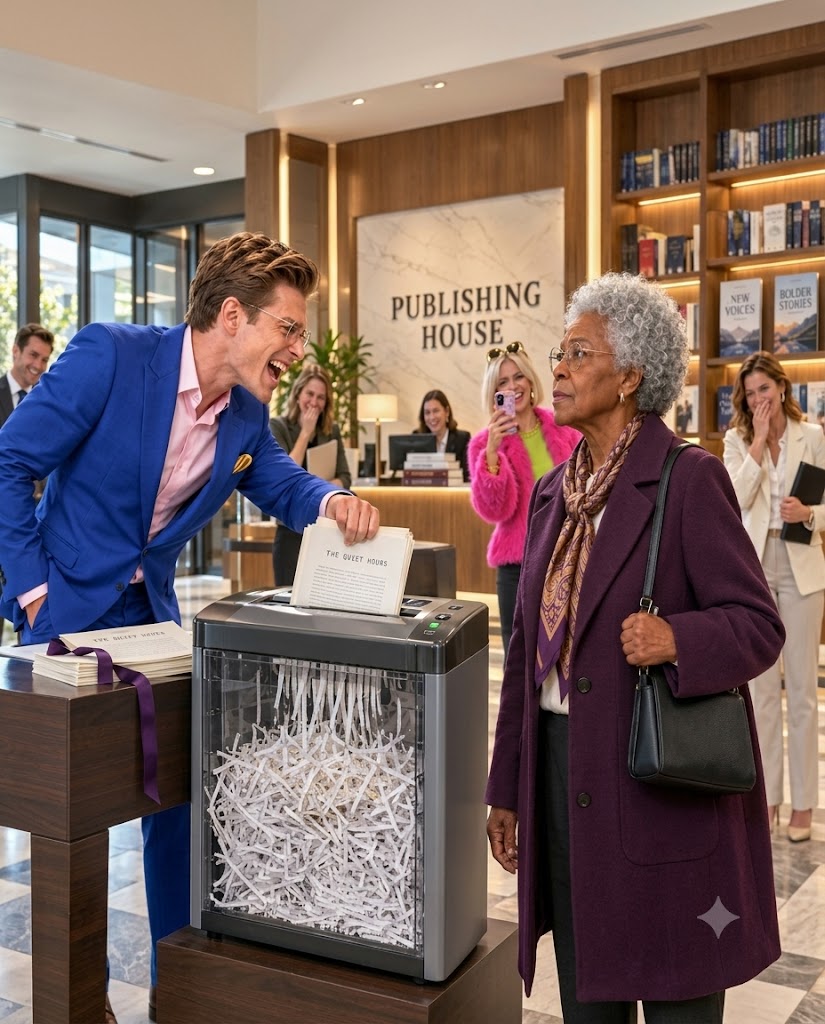
The rain in Baltimore came down like it had something to prove that Tuesday morning, hard enough to turn the gutters on North Charles Street into little rivers of coffee-colored water.
Odalis Kimbrin stood under the awning of Raven’s Vault House with a manuscript box pressed to her chest like a newborn, her badge still warm from the printer.
She had been an intern for eleven months, long enough to learn that the publishing house ran on cold brew, quiet cruelty, and the kind of institutional memory that forgot everyone except the man whose name was on the door.
Cassius Thornhill had been running Raven’s Vault since before she was born, and he had a smile that could sell a book to a brick wall.
He also had a habit of calling the reading club “the public library” and the interns “the help,” which was why Odalis had stopped correcting him around month three.
Today, though, she had something that made her hands shake.
An old woman in a wool coat the color of wet leaves had walked in from the rain carrying a typewriter case and a box of pages tied with kitchen twine.
She had asked for Mrs. Ravenswell, the founder’s widow, and when Cassius told her Mrs. Ravenswell had retired, the old woman had simply nodded and said, “Then I am in the right place, dear.”
Cassius had laughed.
Odalis had not.
—
The old woman’s name was Mrs. Beatrice Beaumont, and she smelled like attic dust and lavender sachets and something older than the building itself.
She set her typewriter on the reception desk with the care of a woman laying flowers on a grave, and she said she had brought her fifteenth novel.
Cassius Thornhill looked at the typewriter, then at the box of pages, then at Odalis, and his smile sharpened into something that belonged in a hunting lodge.
“A novel?” he said. “Adorable.”
He pointed at the glass case behind him, the one that held a first edition of J.M. Lincoln’s *The Quiet Ledger* and a brass plaque that read *14 Best Sellers. One House. One Legacy.*
“See that case?” Cassius said. “J.M. Lincoln, fourteen best sellers. That is a writer. You, ma’am, are a hobby.”
The room went quiet the way rooms do when someone has said something that cannot be taken back.
Odalis stepped forward before she could stop herself.
“Mr. Thornhill, she has a number. She is next in line.”
Cassius did not even look at her.
“Back to your table, Odalis. Interns do not decide.”
—
Mrs. Beaumont did not flinch.
She untied the twine on her manuscript box with fingers that had been typing for sixty years, and she set the first page on the desk like a card player laying down a winning hand.
“Read the first page, Mr. Thornhill,” she said. “Only the first one.”
Cassius picked up the page between two fingers, the way a man might pick up a receipt he did not ask for.
“I do not need to read a page to know what it is worth,” he said. “Typewriters belong in museums.”
“Those are her only pages,” Odalis said.
Cassius turned to her then, and his eyes were flat and pleasant and entirely without mercy.
“Then she should have made a copy,” he said. “Oh, wait. She cannot.”
Someone behind Odalis laughed.
Then someone else held up a phone, and the little red recording dot blinked on, and Odalis felt the morning tilt like a table with one short leg.
“Iconic,” the phone-holder said. “I am posting this.”
“Saffron, show her the door,” Cassius said.
Mrs. Beaumont gathered her pages and her typewriter case with the dignity of a woman who had been shown doors before.
“No need,” she said. “I know the way out. I have walked past that door for thirty years.”
Cassius called after her, because men like him always need the last word.
“Next time, bring the typewriter. We will put it in a museum.”
The door closed.
The rain kept falling.
And Odalis Kimbrin stood in the middle of the lobby with her badge warm against her chest and a thought forming in her head that would not leave.
—
The video hit four million views by eight o’clock that night.
Odalis watched it in her studio apartment in Hampden, sitting on the floor with her back against the radiator, eating cold lo mein straight from the container.
The caption read *#typewritergramma*, and the comments were a landslide.
*Grandma really brought a typewriter to a digital publisher, I’m crying.*
*The way he said “adorable” should be a crime.*
*Someone get this queen an agent.*
Odalis watched Mrs. Beaumont walk out the door eleven times.
Then she watched Cassius Thornhill laugh, and she felt something in her chest go hard and cold and useful.
She called her mother in Atlanta.
“Mama,” she said, “what do you do when your boss throws away something that does not belong to him?”
Her mother was quiet for a moment.
“You open the bin,” she said. “Nobody opens the bin, baby. Watch me.”
—
The bin was collected first thing the next morning.
Odalis knew this because Cassius Thornhill had announced it at the staff meeting with the satisfaction of a man who had solved a problem by ignoring it.
“Nobody opens it,” he said. “Nobody reads it. We are a publishing house, not a charity.”
Odalis nodded along with everyone else.
Then she went down to the basement at 6:45 a.m. with a flashlight and a pair of winter gloves and a heart that was beating so loud she could hear it in her teeth.
The bin was a green industrial shredder receptacle, the kind that smelled like toner and old coffee and the inside of a neglected filing cabinet.
She opened it.
The pages were there.
Not shredded, not yet, because the collection truck was late and the universe occasionally has a sense of humor.
Odalis lifted the manuscript out page by page, and she did not know what she was looking at until she saw the E’s.
Every E leaned to the left.
Every single one.
She had seen that lean before, in the archive room on the third floor, in the boxes marked *J.M. LINCOLN — ORIGINAL MANUSCRIPTS — DO NOT REMOVE.*
—
She carried the pages upstairs in a canvas tote bag and set them on the conference table in the empty office she was not supposed to be in.
Then she called the only number she had for Mrs. Beaumont, the one from the submission form, and she said, “I believe these are yours.”
The old woman was quiet for a long time.
“You opened that bin for me,” she said.
“Every E leans to the left,” Odalis said. “Just like every Lincoln manuscript in our archive.”
Mrs. Beaumont laughed, and it was a soft, cracked, beautiful sound.
“My mother bought this typewriter with her first month of wages,” she said. “The E has leaned since 1961.”
Odalis sat down in Cassius Thornhill’s leather chair because her legs had stopped working.
“You are J.M. Lincoln,” she said.
“I wondered if anyone would read far enough to find out,” Mrs. Beaumont said.
—
The next morning, Odalis was called into Cassius’s office and told that her services were no longer required.
“You carried it out,” he said. “You gave up a job for a stranger.”
“Then you gave up a job for a stranger,” Mrs. Beaumont said later, when Odalis called her from the sidewalk outside the building with her badge in her pocket and her eyes stinging from the cold. “That is worth more than any book.”
Odalis laughed because otherwise she would have cried.
“Why carry it in yourself this time?” she asked. “After all these years?”
The old woman was quiet for a moment.
“This is the last one,” she said. “I wanted to walk in the front door with it. Just once. As myself.”
Then she said, “Now, would you like to be the first one to read it?”
—
Odalis read it on the bus.
She read it in the laundromat.
She read it sitting on the floor of her apartment with a mug of tea going cold beside her, and by the time she reached the last page, she understood something that Cassius Thornhill had built a career on not understanding.
J.M. Lincoln had never been a brand.
She had been a woman.
And the house had been mailing her pages back unopened for thirty years.
—
Thirty-one years ago, Mrs. Beaumont had mailed her first book with her name and her photograph and a letter that said *I hope you will consider my work.*
It had been returned unopened.
So the next time, she had mailed only the pages.
Mrs. Ravenswell had read every one.
And the house had published fourteen best sellers under a name that belonged to a woman who had never once been invited to the launch party.
—
The press launch was scheduled for Friday.
Cassius Thornhill had announced it with a press release that called the final Lincoln novel “the crown jewel of Raven’s Vault’s legacy,” and he had told the board that the manuscript was “bound and ready.”
But he did not have the manuscript.
Odalis did.
And the video of Mrs. Beaumont walking out of the building had four million views and a comment section that had turned on a dime.
*They are calling me cruel,* Cassius said in a staff meeting that Odalis watched through the glass door because she still had friends inside. *Thank you for reading past the first page. Most people never do.*
Odalis did not feel sorry for him.
She felt sorry for the twenty-nine years of letters that Mrs. Beaumont had sent to a house that had never once written back.
—
On Thursday night, Odalis called Mrs. Beaumont.
“He is launching something with your name on it that you never wrote,” she said. “And the video has four million views.”
“A million people are laughing at me,” Mrs. Beaumont said.
“Let them watch, dear,” Odalis said, and she heard the old woman’s smile through the phone. “People can change their minds in one afternoon.”
—
Friday morning arrived with a cold front that made the windows of Raven’s Vault House sweat.
The lobby was full of reporters and photographers and a table of canapés that nobody touched because the tension was better than food.
Cassius Thornhill stood at the podium in a suit that cost more than Odalis’s rent, and he said, “Larkin trusted the final pages to me. Personally.”
A voice from the back of the room said, “Did she, Cassius?”
Everyone turned.
Mrs. Beatrice Beaumont stood in the doorway in her wool coat the color of wet leaves, and beside her stood Leonora Ravenswell, the founder’s widow, who had not been seen in public in seven years.
“Larkin never appears in public,” Cassius said, and his voice had gone thin and high. “Larkin never will. Who let her in? Somebody get her out of here.”
Leonora Ravenswell did not move.
“Nobody touches her, Cassius,” she said. “Let her speak.”
—
Mrs. Beaumont walked to the front of the room with her typewriter case in one hand and a box of pages in the other.
She set them on the podium like a woman laying down a burden she had carried for thirty years.
“Good morning,” she said. “I am here for J.M. Lincoln. I have been for thirty years. I signed in this very building in 1995, witnessed by Mrs. Ravenswell. That is my signature beside hers.”
She opened the box.
“This is the final Lincoln novel. I took it out of that shredder bin where he dropped it.”
Cassius laughed, and it was the laugh of a man who had run out of other options.
“She is a bitter intern I let go.”
“You let me go for saving it,” Odalis said from the doorway.
“So she has an old typewriter,” Cassius said. “Anyone can buy one.”
Mrs. Beaumont turned to the room and said, “Every E leans left. The same since 1995.”
Then she looked at Leonora Ravenswell and said, “Clarist, would you read us the first page?”
Leonora Ravenswell read the first page in a voice that shook and then did not shake.
*My mother typed her letters at dawn so the neighbors would think it was rain.*
When she finished, she looked up and said, “It is her. I would know that voice anywhere.”
—
Cassius Thornhill did not go quietly.
He called the board. He called his lawyer. He called a reporter from the *Baltimore Sun* who had been his college roommate and who had, it turned out, been waiting fifteen years for a story like this one.
But the board had already met.
And the board had already voted.
“Cassius,” Leonora Ravenswell said, “you are let go effective today.”
“You cannot do this,” he said. “This launch is mine.”
“There is no Lincoln without her,” Leonora said. “There never was.”
—
Mrs. Beaumont stood at the podium for a long moment after Cassius left the room.
Then she said, “I wrote you letters for thirty years. And the one day you walk through my door, my house put you in a bin. I am so sorry.”
Leonora Ravenswell wiped her eyes with the back of her hand.
“You opened my first envelope, Leonora,” Mrs. Beaumont said. “That is why I walked back in.”
—
The final Lincoln novel was published that spring under the name Beatrice Beaumont.
The dedication page read: *For my mother, who typed her letters at dawn so the neighbors would think it was rain. And for Odalis Kimbrin, who opened the bin.*
The first printing was 250,000 copies.
The second printing was 400,000.
The audiobook was narrated by Beatrice Beaumont herself, because she had a voice like a porch swing and a story like a hurricane, and because Odalis had said, “You have been ready since page one, dear.”
—
Odalis Kimbrin was hired as an editor at Raven’s Vault House three weeks after the launch.
She had her own office now, with a window that looked out on North Charles Street and a desk that had never belonged to Cassius Thornhill.
The first thing she did was install a reading box by the front door.
A wooden box with a brass latch and a sign that said *EVERY PAGE GETS A READER.*
The second thing she did was hire Saffron, the intern who had filmed the video, as her assistant.
“I am sorry,” Saffron said on her first day. “I laughed. I posted it. I did not think.”
“You posted it,” Odalis said. “That is why four million people know her name.”
—
The City Museum called in June.
They wanted the typewriter for their new hall of Baltimore history, the one with the exhibit on women who built things that men took credit for.
Beatrice Beaumont said no.
“Typewriters belong in museums, I was told once,” she said. “Not this one. It is still working.”
She was sitting in the reading room of Raven’s Vault House at the time, at a small table by the window, with a line of people waiting to meet her.
The line went around the block.
Every person in it was holding a book, and every book had her name on the cover.
—
The last person in line that afternoon was a young woman with a manuscript box and a typewriter case and hands that would not stop shaking.
“I typed it at night after my shifts,” she said.
Beatrice Beaumont looked at her for a long moment.
Then she smiled and said, “Sit down, dear. I have all afternoon.”
The young woman sat.
“Would you read the first page?” she asked.
Beatrice Beaumont took the page and read it slowly, the way she read everything, and when she finished, she said, “This is good. This is very good.”
The young woman started to cry.
“Nobody ever read past my name before,” she said.
“Every page deserves one re-reader,” Beatrice Beaumont said. “Today, it is me.”
—
Odalis Kimbrin stood in the doorway of the reading room and watched the line move.
She thought about the green bin in the basement and the sound of the shredder truck and the way the light had come through the window that morning in 1995 when a woman with a typewriter had walked in the front door for the first time.
She thought about the thirty years of letters and the fourteen best sellers and the one page that had changed everything.
Then she walked to the front of the room and said, “Next reader, please.”
The line moved forward.
The typewriter sat on the table by the window, still working, its E still leaning left.
And outside on North Charles Street, the rain came down like it had something to prove, and the city went on reading.
—
**Part 2**
The spring signing was held at the City Museum, in the hall with the exhibit on women who built things that men took credit for.
Beatrice Beaumont sat at a long table with a pen in her hand and a stack of books beside her that went all the way to the ceiling.
She had signed 1,200 copies by noon and had not once complained about her wrist.
“My mother signed her name on my birth certificate with a fountain pen that leaked,” she told the woman from the *Baltimore Sun* who had come to write a profile. “I have been practicing ever since.”
The profile ran on a Sunday.
The headline was *THE GHOST IN THE GLASS CASE.*
The subhead was *For thirty years, Baltimore’s biggest literary name was a woman who typed her letters at dawn.*
—
Cassius Thornhill read the profile in his apartment in Towson, where he had moved after the board let him go.
He read it twice.
Then he called his lawyer and said, “I want to sue.”
His lawyer was quiet for a moment.
“Cassius,” she said, “you threw her manuscript in a shredder bin. On camera. There are four million witnesses.”
“She signed a contract,” Cassius said. “The name belongs to the house.”
“The name belonged to her mother’s typewriter,” the lawyer said. “And the house belongs to Leonora Ravenswell. And you belong to a very expensive defamation suit if you keep talking.”
Cassius hung up.
He sat in his apartment and looked at the wall where his fourteen best-seller plaques had hung before he took them down.
He had not taken them down, actually.
The board had.
—
Leonora Ravenswell had known the truth since 1995.
She had been the one who opened the envelope with the photograph and the letter and the name *Beatrice Beaumont*, and she had been the one who read the first page and said, *This is the best thing I have read in ten years.*
But she had also been the one who was twenty-nine years old and terrified of her own board, and when the board said *we cannot publish a woman under her own name, the market will not support it*, she had done what people do when they are young and scared and want to keep their jobs.
She had sent the pages back unopened.
She had let the house publish them under a name that belonged to no one.
And she had spent the next thirty years trying to make it right in ways that never quite reached the woman who had typed them.
“I should have walked out,” Leonora said at the signing, when Beatrice asked her why she had done it. “I should have walked out and started my own house.”
“You were twenty-nine,” Beatrice said. “I was thirty-four and I did not walk out either. I mailed the pages again.”
“You mailed them for thirty years.”
“I had a typewriter,” Beatrice said. “And a mother who typed her letters at dawn. What else was I going to do?”
—
Odalis Kimbrin kept the reading box by the front door of Raven’s Vault House for the next five years.
Every manuscript that came in went into the box.
Every page got a reader.
Some of them were good.
Some of them were not.
All of them got read, because Odalis had hired a staff of six readers and a rotating group of interns who were paid in actual money and not in the promise of experience, and because she had made a rule that no manuscript could be rejected until two people had read the first page out loud.
The rule was called *Bea’s Rule*, and it was printed on a card that hung above the box.
*Every page deserves one re-reader.*
—
The first book published under Bea’s Rule was a novel called *The Shredder’s Daughter*, by a woman named Clarice Mbeki who had written it at night after her shifts at a hospital in East Baltimore.
It sold 90,000 copies in its first month.
The second was a memoir by a retired schoolteacher named Harold Winslow who had been sending manuscripts to Raven’s Vault for twenty-two years.
It sold 40,000 copies and won a regional book award.
The third was a cookbook by a woman named Dorothea Price who had been told by three different publishers that no one wanted to read about African American church suppers in Baltimore.
It sold 300,000 copies and was reprinted six times.
—
Beatrice Beaumont came to the office every Thursday.
She had a small desk in the corner of Odalis’s office, and she read the first page of every manuscript that came in through the front door.
She was 81 years old and she read like a woman who had been waiting her whole life for a room full of pages.
“This one is good,” she would say, and she would set the page on the left side of her desk.
“This one needs work,” she would say, and she would set it on the right.
“This one is not ready,” she would say, and she would set it in the middle, which meant she would read it again next week.
Odalis learned to read the piles.
Left meant *yes.*
Right meant *not yet.*
Middle meant *I see something in this person, and I am not going to let them disappear.*
—
The first anniversary of the press launch was a Friday in October.
The reading room was full of people, and the line went around the block again, and Beatrice Beaumont sat at the table by the window with her typewriter in front of her and a stack of books beside her that went all the way to the ceiling.
A young woman came to the front of the line with a manuscript box and a typewriter case and hands that would not stop shaking.
“I typed it at night after my shifts,” she said.
Beatrice Beaumont looked at her for a long moment.
Then she smiled and said, “Sit down, dear. I have all afternoon.”
The young woman sat.
“Would you read the first page?” she asked.
Beatrice Beaumont took the page and read it slowly.
When she finished, she said, “This is good. This is very good.”
The young woman started to cry.
“Nobody ever read past my name before,” she said.
“Every page deserves one re-reader,” Beatrice Beaumont said. “Today, it is me.”
—
Odalis Kimbrin stood in the doorway and watched the line move.
She thought about the green bin in the basement and the sound of the shredder truck and the way the light had come through the window that morning in 1995 when a woman with a typewriter had walked in the front door for the first time.
She thought about the thirty years of letters and the fourteen best sellers and the one page that had changed everything.
Then she walked to the front of the room and said, “Next reader, please.”
The line moved forward.
The typewriter sat on the table by the window, still working, its E still leaning left.
And outside on North Charles Street, the rain came down like it had something to prove, and the city went on reading.
—
**Part 3**
The call came on a Tuesday in January, from a woman named Marian Holloway who worked for the Maryland State Archives.
She said she had found something in a box of papers donated by a retired editor who had died in 2011.
The box was labeled *RAVEN’S VAULT — CORRESPONDENCE — 1994-1996.*
Inside the box were thirty-one letters.
All of them were addressed to Mrs. Beatrice Beaumont.
None of them had been opened.
“We thought you might want them,” Marian said. “They belong to her.”
Odalis drove to Annapolis the next morning with a cardboard box in the back seat and a knot in her stomach that would not go away.
She brought the letters to the office and set them on Beatrice’s desk.
Beatrice looked at the box for a long time.
Then she said, “I wrote those.”
“I know,” Odalis said.
“They mailed them back.”
“I know.”
Beatrice opened the first one.
It was dated March 1995, and it said: *Dear Mrs. Beaumont, Thank you for your submission. We regret to inform you that we are unable to publish your manuscript at this time. We wish you the best in your future endeavors. Sincerely, Leonora Ravenswell.*
Beatrice read it twice.
Then she laughed.
“She did not even sign her own name,” she said. “She signed the house’s name. The house did not exist yet.”
Odalis looked at the letter.
The signature was a stamp.
—
Beatrice opened the second letter.
It was dated June 1995, and it said the same thing.
The third letter was dated September 1995.
The fourth was dated December 1995.
By the time she reached the thirty-first letter, dated November 1996, she had stopped laughing.
“Thirty-one letters,” she said. “And not one of them says why.”
Odalis had read the letters too, in the car on the way back from Annapolis, and she had noticed something that Beatrice had not.
The stamps were different.
Some of them were from Baltimore.
Some of them were from New York.
Some of them were from a post office in Delaware that had closed in 1997.
“They were mailing them from different places,” Odalis said. “Someone was trying to make it look like they were reading them.”
Beatrice set the last letter on the desk and looked out the window at North Charles Street.
“They were reading them,” she said. “They just were not reading them to me.”
—
The letters became an exhibit at the City Museum that spring.
The exhibit was called *THIRTY-ONE LETTERS*, and it was displayed in the hall with the typewriter and the first edition of *The Quiet Ledger* and the brass plaque that had once said *14 Best Sellers. One House. One Legacy.*
The plaque had been changed.
It now said *15 Best Sellers. One Writer. One Typewriter.*
The letters were displayed in a glass case, each one opened and pressed flat, the stamps visible in the corner like small flags of a country that had never existed.
The first letter was dated March 1995.
The last letter was dated November 1996.
Between them was a story that Odalis had come to think of as the real Raven’s Vault legacy: a woman who had typed her letters at dawn, a house that had mailed them back, and a girl who had opened a bin.
—
Cassius Thornhill came to the exhibit on a Sunday afternoon in April.
He came alone, in a raincoat, with his hands in his pockets and his collar turned up.
He stood in front of the glass case for a long time.
Then he walked to the reading room, where Beatrice Beaumont was sitting at a table with a stack of books beside her, and he said, “I read the first page.”
Beatrice looked up.
“Which one?” she said.
“The one you brought to the office,” he said. “The one I threw away.”
“It was not the first page,” Beatrice said. “It was the first page of the last one.”
“I know,” Cassius said. “I read it.”
He stood there for a moment, and then he said, “It was good.”
Beatrice nodded.
“It was,” she said.
Cassius Thornhill turned and walked out of the reading room, and he did not come back.
—
Odalis found Beatrice at her desk the next morning, reading a manuscript with her glasses on the end of her nose.
“He read it,” Odalis said.
“He read it,” Beatrice said.
“Does that make it better?”
Beatrice set the manuscript down.
“No,” she said. “But it makes it finished.”
—
The second book published under Bea’s Rule was a novel by a woman named Yolanda Reyes who had been writing in secret for eighteen years because her husband had told her that no one wanted to read stories about Dominican women in Baltimore.
The book was called *The Cartographer’s Wife*, and it sold 120,000 copies in its first three months.
Yolanda came to the office on a Thursday to meet Beatrice.
She brought her manuscript box and her typewriter case and her hands would not stop shaking.
“I typed it at night after my shifts,” she said.
Beatrice smiled.
“Sit down, dear,” she said. “I have all afternoon.”
—
The reading box by the front door of Raven’s Vault House was joined by a second box in the spring of the following year, and a third box the year after that.
By the fifth year, there were boxes in eleven cities, all of them made of wood with a brass latch and a sign that said *EVERY PAGE GETS A READER.*
The boxes were Beatrice’s idea.
The readers were Odalis’s.
The money came from the 15 best sellers that a woman named Beatrice Beaumont had written on a typewriter whose E leaned left, and from the 1.4 million copies of *The Quiet Ledger* that had been sold since 1996, and from the 400,000 copies of *The Shredder’s Daughter* that had been sold in the first year under Bea’s Rule.
The money went to pay readers.
Every page got a reader.
Every reader got paid.
—
Beatrice Beaumont died in her sleep on a Thursday in October, at the age of 87.
She had been reading a manuscript the night before, and the page was still on her desk the next morning, with a note in her handwriting that said: *This one is good. Read it again.*
The manuscript was published six months later under the title *The Last Page*, by a woman named Anna Kowalski who had written it at night after her shifts at a hospital in Chicago.
It was the 16th best seller in the history of Raven’s Vault House.
It was dedicated to Beatrice Beaumont.
The dedication page read: *For the woman who read the first page when nobody else would.*
—
Odalis Kimbrin stood in the reading room on the day of the dedication, in front of the typewriter that sat on the table by the window.
The typewriter was still working.
The E still leaned left.
A young woman came to the front of the line with a manuscript box and a typewriter case and hands that would not stop shaking.
“I typed it at night after my shifts,” she said.
Odalis smiled.
“Sit down, dear,” she said. “I have all afternoon.”
The young woman sat.
“Would you read the first page?” she asked.
Odalis took the page and read it slowly.
When she finished, she said, “This is good. This is very good.”
The young woman started to cry.
“Nobody ever read past my name before,” she said.
“Every page deserves one re-reader,” Odalis said. “Today, it is me.”
The line moved forward.
The typewriter sat on the table by the window, still working, its E still leaning left.
And outside on North Charles Street, the rain came down like it had something to prove, and the city went on reading.