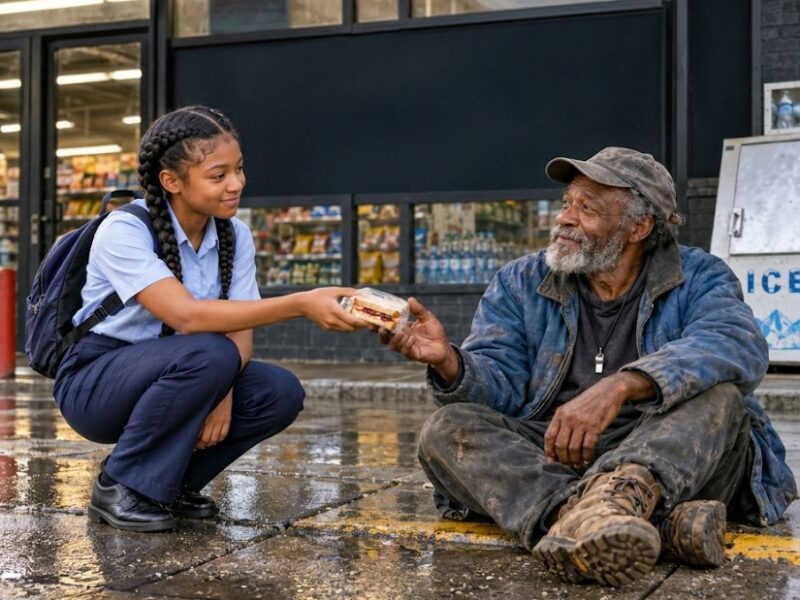
A Little Black Girl Gave Her Last Sandwich to a Starving Stranger—The Next Morning, 50 Police Officers Appeared at Her Door With an Unexpected Message
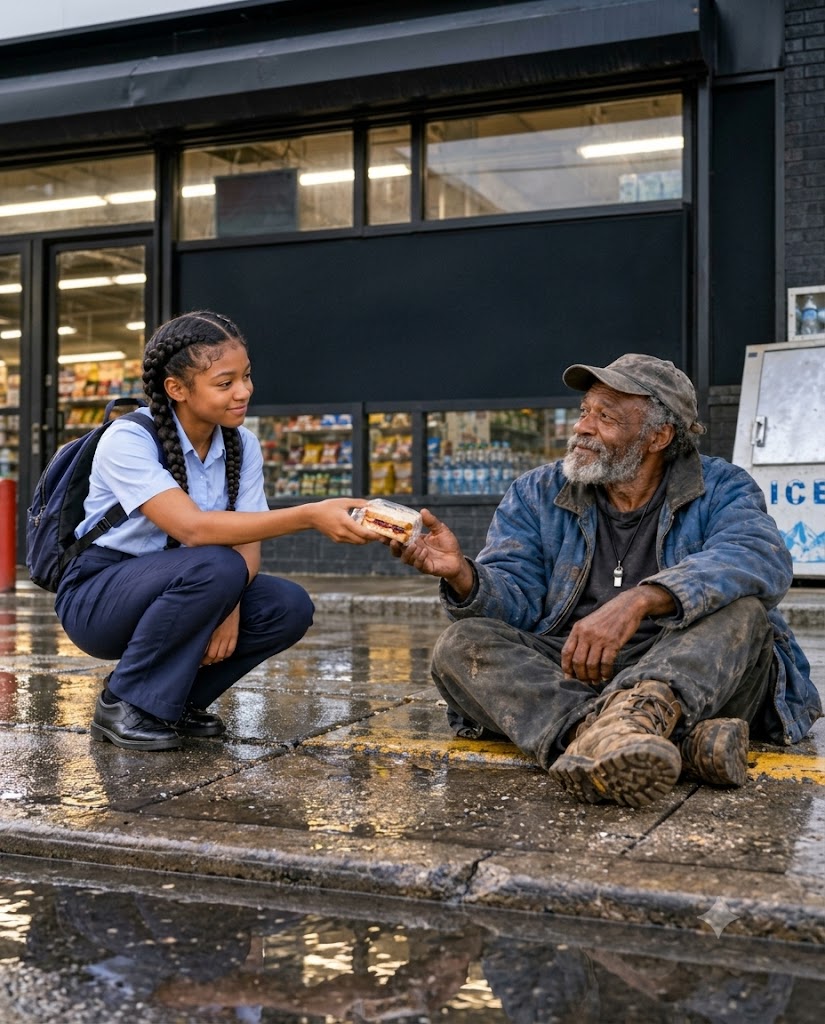
Selah Hardaway had $2.85, one sandwich, and a dinner problem she had already solved. The sandwich was in her bag. The $2.85 was bus fare home. It was a Thursday in April, raining sideways off Rents Avenue, and she was fifteen years old in school clothes. She gave the man on the curb outside the Quick Serve both.
Then she sat down next to him.
She walked home after. Four miles. In the rain. In school shoes. Bus fare is $2.50, and she had given it away, so the math was simple. He hadn’t eaten in three days, or said a whole sentence to anybody in twenty-two. He took the sandwich. Then he tore it in half.
Then he held one half out into the empty air beside him and said, “Bo, come on now. It’s all right.”
There was no dog.
Selah said, “Sir, is Bo your dog?” He didn’t answer. He kept his hand out. She noticed one thing sitting there that nobody had noticed in twenty-two days. A stainless steel whistle on a boot lace around his neck. In thirty-one hours, a man who couldn’t remember his own name would say it out loud to her.
Before I tell you who that man turned out to be, you need to know why a fifteen-year-old had exactly one sandwich in her bag on a Thursday afternoon. And why out of a whole neighborhood, she was the only person in three weeks who sat down on that curb instead of walking around it.
Selah Hardaway is fifteen and she lives in a two-bedroom on the second floor of a building on Rents Avenue with her mother and her brother. Her mother is Annis Hardaway. Thirty-eight. She is a home health aide. Four clients. Six days a week. On Saturdays and Sundays, she picks up shifts at a distribution center off the county road, which is the job that pays and also the job that is taking her back apart one disc at a time.
Annis has a rule about the refrigerator that she has never said out loud and that both her kids understand perfectly. The last of anything belongs to whoever is going to be out the longest.
Her brother is Calvin. Nineteen. He works at a tire shop on 14th, and he is saving for a truck. He is exactly the kind of tall, quiet, nineteen-year-old Black man this country has decided to be nervous about. I want that on the table now instead of later, because it matters at the end of this.
The money for that week ran out on a Wednesday. That is not a tragedy, and Selah would be annoyed with me for framing it as one. It is arithmetic. Annis gets paid on the 15th and the 30th. The rent went out on the 1st. The light bill was behind from February. By Wednesday afternoon there was bread, peanut butter, half a jar of jelly, two eggs, and a bag of rice.
So on Thursday morning, Selah made herself one sandwich and put it in her bag. That was the plan for the day. It was fine. She has said in three separate interviews that she was not hungry and not sad and did not think about it once. I believe her, because she also said, “That’s just Thursday,” and then looked at the reporter like she’d asked a strange question.
Here is what else was in that bag. A physics notebook. A library copy of a book about emergency medicine. And a folded printout of the application for a hospital-based youth emergency medical services program that takes twenty-two students a year from the county, ages fifteen to eighteen, and puts them through basic emergency care training on Saturdays and a supervised ride-along in the summer.
The program costs $400. It also requires an adult sponsor from the medical or emergency field who will sign a form saying they know you. Selah Hardaway had neither of those things.
She had wanted to be a paramedic since she was eleven years old, for a reason she will tell you flatly and without any drama. When she was eleven, her grandmother went down in their kitchen, and the person who came through that door and fixed it was a woman about twenty-six years old with a bag. Selah stood in the hallway and watched her work. She had that application in her bag for nine weeks. She looked at the sponsor line every few days the way you check a bruise.
Annis knows about the application. She has known for nine weeks. She has also been asking around at two of her clients’ houses, at church, and once at the distribution center, whether anybody knows a nurse or a medic who’d sign a form for a fifteen-year-old they’d never met. Every time, the answer has been some version of a person being kind and not being able to help. $400 was the smaller of the two problems. Annis could have gotten $400. She could not manufacture a paramedic out of nothing.
The bus Selah takes is the 14. It runs down Rents, across 14th, past the tire shop where her brother works, past a laundromat, past a corner store called the Quick Serve, and then out to the high school. She rides it twice a day. She knows that route the way you know the ceiling over your own bed.
And she knew that man was there. That is the part I want to be honest about, because the version of this story that went around the internet has her spotting a stranger and swooping in. Selah has corrected it in public twice. She had seen him for weeks. She saw him from the window of the 14 on the way to school and again on the way home. Sitting on the low wall outside the Quick Serve or on the curb near the ice machine.
She saw him the way you see a thing that has become part of a street. She did not do anything for nineteen days, either. She has said that out loud, and she gets uncomfortable when people rush to tell her it’s fine. She is right to.
What changed on the twenty-second day was small, and it was not noble. The bus was running late, and she got off two stops early to make her connection. Instead of watching him through a window at fifteen miles an hour, she had to walk past him at three. That’s it. That’s the whole difference between nineteen days of nothing and the thing that happened next.
She got close enough to hear him. What she heard was a grown man saying a name quietly over and over to nobody, in the tone you use on a good dog when you are trying not to scare it.
Twenty-two days. That is how long a fifty-eight-year-old man sat within forty feet of the same corner store, on a street with a bus line on it, in a city of 200,000 people, and nobody found out who he was. I want to walk you through those twenty-two days from the sidewalk’s point of view, because everybody watching this is in it somewhere.
Casimir Bello owns the Quick Serve and has for nineteen years. He is sixty-two. He saw the man on day one and did what a lot of decent people do. He brought him a coffee. Twice, in the first week. Then stopped, because his wife pointed out that once you start, you can’t stop, and there are three of them on 14th already.
Mr. Bello did not call anybody. He has said why, and it is the most human sentence in this whole story. He wasn’t bothering anybody. If I call, they come and they take him somewhere. And then that’s a thing I did.
Verlie Sample drives the 14 in the afternoons. She is fifty-seven. She saw him from the same seat twice a day for three weeks. She thought about it. She mentioned it once to a supervisor in passing in a hallway, and the supervisor said something about outreach services, and they both moved on.
Two women from the church on Rents brought him a plate on a Sunday in the second week. They prayed with him. They did not ask his name, because he did not seem to want to talk, and they did not come back, because that Sunday there were four other plates to deliver.
A high school boy who runs cross country went past him four mornings a week and crossed the street to do it, and has said on camera at sixteen, with his mother next to him, that he was scared. That he isn’t proud of it and that nobody ever taught him what else to do.
Nobody ever teaches anybody what else to do. That’s the actual problem. We hand people a rule that says don’t stare and don’t stop, and then we act surprised.
A city sanitation crew worked that block eleven times in twenty-two days. A code enforcement officer wrote up the vacant lot two doors down. Two patrol units from that same police department, the same department, the same city, the same twenty-two days, drove past that corner a combined ninety-odd times. One of them stopped once on day fourteen and had a two-minute conversation. The officer’s own report says subject calm, declined services, no violation.
Read that again. Subject calm, declined services. That officer was looking at a man his own department had a missing person case open on. There was a flyer for him in the roll call room. The officer had seen the flyer. He was fifteen days into a twelve-day rotation, and he did not connect a bearded man on a curb with a photograph of a clean-shaven sergeant in a dress uniform.
I want to be careful here, because that officer has never once tried to defend himself and has said publicly that he thinks about it every day.
His daughter, Wren, called that department every single day. Twenty-two calls. She lives four states away with two small children, and she called at the same time every evening and asked the same question. A very tired sergeant answered it honestly every time, which was that they were looking. They were looking. That is true. They ran his phone, which was off. His truck was in his own driveway. They checked hospitals, shelters, three counties and a lake. Nobody checked the curb outside a corner store on 14th, because that is not where anybody looks for a police sergeant.
Forty pounds. That is the number that explains most of it. A man who loses forty pounds in three weeks and stops shaving does not look like the photograph anybody has of him.
So nineteen people, by the count Selah’s own account eventually produced, had a real interaction with that man in twenty-two days. Coffee, a plate, a dollar, a nod, a two-minute conversation with a badge on. Nineteen people were kind to him. Not one of them sat down.
That distinction is the entire point of this story, and it is going to be the whole reason a county changed a policy. So hold on to it. If you hand a man a coffee, you are standing and he is sitting, and the whole thing takes eleven seconds and you can leave whenever you want. Nobody who is standing has ever gotten a name out of somebody who can’t find it, because finding it takes longer than eleven seconds and it takes the other person not being in a hurry.
On day twenty-two, at 4:40 in the afternoon, a fifteen-year-old missed a bus.
He was sitting on the curb by the ice machine with his back against the wall and his boots in the gutter. Beard down to his collarbone. A canvas jacket that had been navy once. Both hands loose in his lap. He was not asking anybody for anything, and he had not asked anybody for anything in twenty-two days, which is one of the reasons this went the way it went. A man who does not ask does not get processed.
And he was talking. Not loud. Not to himself either, which is the thing Selah says she noticed first and could not explain at the time. There is a difference between a man muttering and a man talking to somebody, and she could hear the difference from nine feet away.
“Come on,” he was saying. “It’s all right. Come on now.”
Selah Hardaway stopped walking. She has been asked about 1,100 times what made her stop, and she has never given a satisfying answer. The closest she has come is this. He wasn’t talking crazy. He was talking to somebody who wasn’t there. That’s different.
She stood there for a few seconds. Then she took the sandwich out of her bag. Peanut butter and jelly on white bread in a fold-over sandwich bag. It had been in a backpack since seven in the morning, and it was warm, and the bread had gone soft the way it does.
She said, “Sir, are you hungry?”
He looked up. His eyes were fine. That is the thing people get wrong about this. There was nothing wrong with his eyes. He looked at her the way anybody looks at anybody. He said, “Yes, ma’am. Yes, ma’am.” To a fifteen-year-old. Twenty-six years on a police department will do that to a man, and it does not wash out.
She handed him the bag. Then she did the thing that had not happened in twenty-two days, and she did it without deciding to. It cost her nothing, and it changed everything.
She sat down on the curb. Not next to him, about four feet down, with her bag between them, which is what a fifteen-year-old girl on a street she knows does automatically. But she sat. Her knees were up. Her school shoes were in the gutter. It was starting to spit rain.
He got the bag open on the third try. His hands were not steady. He ate half a sandwich in about forty seconds, which is the pace of a man who has not eaten in three days and is trying very hard not to look like it.
Then he stopped. He looked down at the other half. He tore it carefully along the crust into two smaller pieces. He held one of them out to his left into the empty air beside him, about eighteen inches off the concrete, at exactly the height of a dog’s mouth.
“Bo,” he said. “Come on now. It’s all right.”
Selah did not say anything for a second. Then she said, “Sir, is Bo your dog?”
He kept his hand out. He was watching a spot on the sidewalk with real patience. “He won’t come to nobody else,” he said.
That is the first full sentence that man had said to another human being in three weeks.
Selah said, “Where’s Bo at?”
He said, “I don’t know.” And something happened in his face. And he put his hand down.
She has said this was the worst part. Not the hunger. Not the smell. The part where he put his hand down.
I want to sit on that for a second, because it is the hinge of everything. A man had been on that corner for three weeks. Nineteen people had spoken to him. Every single one of them asked him some version of, “Are you okay? Do you need anything? Can I call somebody?” Which are all standing-up questions. And all three of them are questions he could not answer, because he did not know if he was okay, he did not know what he needed, and he could not think of a single name to call.
Selah asked him about a dog. She asked him about the thing he was already talking about.
That is the whole method. There is no other method. Every social worker and crisis clinician and memory care nurse in this country would tell you the same thing, and most of them have to be trained into it for six weeks. A fifteen-year-old on a curb did it in nine seconds because she was not trying to solve him.
She stayed eleven more minutes. She asked him easy things. What he liked to eat. Whether it was going to rain. Whether he was cold. She did not ask him his name, because, and this is a fifteen-year-old’s instinct that a lot of trained adults have to be taught, she could tell it was the one question he was going to fail. She did not want to make him fail a question.
He answered about half of what she asked. Some of it made sense and some of it didn’t. He said Nola once and did not explain it, and she did not push.
While she sat there, she looked at him properly, which nineteen other people had not done. She cataloged three things and she remembers all three. His boots were expensive. Not new, beat to death, but good boots, the kind with a real welt, and they had been resoled at some point. His jacket had a hole in the left sleeve where something had been unstitched. Not torn. Unstitched. Deliberately. The way you take a patch off. And around his neck, on a boot lace, was a whistle. Stainless steel. Not a toy. The kind with no pea in it that makes a sound most people can barely hear.
At 5:15 she had to go, because her mother would be home at six, and if Selah wasn’t there, Annis would start calling. She stood up and got her bag. Then she stopped. She took $2.85 out of her front pocket. A dollar bill. Three quarters. A dime and coins. She put it on the concrete next to his boot.
“That’s for tomorrow,” she said. “Don’t let nobody take it.”
Bus fare was $2.50. She walked four miles home in the rain in April in school shoes. She got there at eleven minutes after six. Her mother asked her where she’d been. Selah said the bus was late. She did not tell her mother about the man.
She lay in bed that night and could not sleep. She thought about the boots. She thought about the unstitched place on the sleeve. She thought about a man holding a piece of bread at exactly the right height, over and over, for a dog that was not there. And about how sure he was. And about how he did not seem crazy to her. Not once. Not for a second.
Around one in the morning, she figured out what the whistle was. A whistle with no pea in it is not a toy whistle. Selah Hardaway did not know the phrase silent whistle, and she did not know anything about working dogs. But she had watched enough of the internet at one in the morning to get to the right place. A whistle you can barely hear is for a dog that has been trained on it. And a dog that has been trained on it belongs to somebody who trains dogs. Also the boots. Also the sleeve. Unstitched where a patch used to be.
She got up at 5:40 and made a sandwich out of the last four slices of bread and the bottom of the jelly. She wrapped it in a paper towel because the sandwich bags were gone. Her mother was in the kitchen putting her scrubs on.
Annis said, “Who’s that for?”
Selah said, “A man.”
Annis Hardaway has told this part in public exactly once, and she got about nine words into it before she had to stop. What she said is that she looked at her daughter for a second and thought about eleven different things she could say. Be careful. Don’t sit down. You don’t know him. That’s the last of the bread. And what came out of her mouth was, “Take him a water, too. It’s going to be hot.”
Selah caught the 14 at 6:10 and got off at 14th at 6:22, which is an hour and a half before she needed to be at school. He was there. He was awake, sitting the same way. The $2.85 was still on the concrete by his boot, exactly where she’d left it. Untouched. Sixteen hours later, he had not picked it up. He had not moved it.
She sat down four feet away again and gave him the sandwich and the water. Then she asked the question she had worked out at one in the morning. She did not ask him his name.
She said, “Sir, Bo’s out there looking for you. When I see him, what do I tell him your name is?”
He stopped chewing. He looked at her for what she says was a long time and was probably four seconds. He said, “Deacon.”
Selah said, “Deacon what?”
And that man sat on a curb outside a corner store on 14th Street and worked at it. Out loud. In front of a fifteen-year-old. The way you work at a word that’s right behind a door.
“Deacon,” he said. “Deacon Yarbrough.”
She wrote it on the back of her left hand with a pen out of her physics notebook. D-e-a-c-o-n. Then, underneath, because she was not sure of it, Yarbrough with a question mark. That question mark is on a photograph that about forty million people have now seen. She is embarrassed about the handwriting. She should not be.
Casimir Bello was opening the store and came out with a coffee, because he had seen a schoolgirl sitting on his curb and did not like it. He got about four feet away and heard the two of them talking and stopped. Then he went back inside and came out with a second sandwich. A real one. Off his own rack. And a banana.
He put them down next to Selah and said, “Go on, baby. That’s on me.”
Selah Hardaway said, “No, sir. Thank you. Give it to him, mister.”
Bello has told that part at two city council meetings, and he tells it the same way every time. He always says the same thing at the end of it, that he had been standing over that man for twenty-two days and a child had to sit down on his sidewalk before he saw him.
Selah was thirty-one minutes late to school. She got a tardy slip. It is her only one that year. She still has it.
She sat through first period with a man’s name on the back of her hand and did not type it into anything, because phones go in a bin at the front of the room at that school. She got her phone back at 11:15, in the hallway between third and fourth period, and she typed the name off the back of her hand into a search bar standing up against a locker. It took less than four seconds.
The first result was a post from the Bexley City Police Department, dated twenty-two days earlier. Shared 11,000 times. Missing endangered adult. Retired Sergeant Deacon Yarbrough. Wishawba. Last seen leaving his residence on Aubrey Lane. Yarbrough retired in 2022 after twenty-six years of service, fourteen of them as a K9 handler, and has a medical condition affecting memory. He may appear confused and may not respond to his name. Please call.
There was a photograph. Clean-shaven. Dress uniform. Forty pounds heavier. If you put that picture next to the man on the curb and asked a hundred people whether it was the same person, a real number of them would say no.
There was a second photograph further down in the same post, and it is the one that made Selah Hardaway sit down on the hallway floor of her high school. Deacon Yarbrough in a field jacket, kneeling with one arm around a Belgian Malinois. The caption under it said, “Sergeant Yarbrough and K9 Bo retired 2022.”
Selah has said she read the whole post three times, and then she read the last line of it four more times, because it did not say what she expected it to say. It did not say the dog was missing. It said, “Sergeant Yarbrough’s dog, Bo, is safe and is being cared for by family.”
She sat on that floor with her back against a locker in a hallway full of people and worked out at fifteen, in about a minute, the thing a whole department had not gotten to in twenty-two days. That man had not been calling for a dog he lost. He had been calling for a dog he could not remember was safe.
Twenty-two days on a curb, tearing his food in half, holding it out at the right height, over and over, for an eight-year-old Belgian Malinois who was at that exact moment asleep on a screened porch nine miles away in the house of a retired sergeant named Farrell Nunez.
She did not go to fourth period. She went into a bathroom and locked herself in a stall and called the number on the post. When a woman answered, she said, “Ma’am, I know where Sergeant Yarbrough is.”
The woman said something polite and careful, because that number had taken about 400 calls in twenty-two days.
Selah Hardaway said, “He’s got a whistle on a shoestring around his neck. Stainless. No pea in it.”
And the line went completely quiet.
Here is why the line went quiet. The whistle was not in the post. It was never in any post, on any flyer, or in any news story. That was on purpose. Departments hold back one or two identifying details. A scar, a tattoo, an object. Because an appeal that gets 11,000 shares also gets 400 calls, and most of them are wrong. You need something in your pocket that sorts a real one from a sincere one in nine seconds. The holdback detail on Deacon Yarbrough was a stainless steel silent whistle on a boot lace.
A fifteen-year-old in a bathroom stall said it out loud without being asked.
The woman on that phone was a records clerk named Odessa Bly, sixty years old, and she has said she put her hand flat on her desk. She asked Selah where she was. Selah told her. Odessa Bly said, “Baby, don’t hang up.” Then she reached across the aisle and grabbed the sleeve of a lieutenant walking past.
Now here is what did not happen next, and it is the reason nobody got hurt. They did not send fifty cars.
That department has a written policy for a missing endangered adult with cognitive impairment. The policy says quiet, minimal units, no lights, no sirens, no more than two officers in the approach, because a confused man surrounded by uniforms runs. And a fifty-eight-year-old man who runs into 14th Street at one in the afternoon is a different story with a different ending.
They sent two cars. But there was a third one, and it was not dispatched, because the man driving it had not been on duty in twenty-two days.
Farrell Nunez is forty-nine. He rode with Deacon Yarbrough for nine years, and he retired eighteen months after Deacon did. When Nola Yarbrough died in January, he was at that funeral in the second row. And Bo, an eight-year-old Belgian Malinois with a bad hip and 140 pounds of opinion, had been living on Farrell Nunez’s screened porch since the day Deacon went missing. Because when a K9 handler disappears, there is exactly one place his dog goes.
Farrell Nunez had spent twenty-two days driving the county. Rest areas. Boat ramps. The lake. Every place a man who wanted to stop might go. He had been afraid of one specific thing the entire time, and he has never said it out loud in an interview, and he does not have to.
There is one more thing about Farrell Nunez that came out later, and I think about it more than anything else in this story. On day nine, he had driven down 14th Street. Not looking. Just driving, on the way to the lake in the afternoon. He has said he does not remember seeing anybody on that curb. He is not sure whether he did or didn’t. He has stopped trying to work it out. A therapist has told him to stop trying. He has not stopped trying.
He got the call at 11:51, and he was there in nine minutes.
Selah Hardaway got there first. She walked out of that school at 11:40, which she was not allowed to do and got a day of in-school suspension for, caught the 14 at 11:50, and was back on 14th Street at eight minutes past twelve. She has been asked why she went back. Her answer is four words long, and it is the most fifteen-year-old sentence in this entire story.
He didn’t know anybody.
Annis Hardaway found out her daughter had left school when the automated call hit her phone at 12:04. She stood in a stranger’s bedroom listening to a robot tell her that her child was not where she was supposed to be. She has said that in that second, she was not scared of anything happening to Selah. She was scared of what happens to a Black girl who is somewhere she isn’t supposed to be when the police show up. That is not paranoia. That is a mother doing arithmetic she has been doing since 2011.
She called Selah eleven times. Selah did not pick up, because Selah’s phone was in her lap on silent, and she was talking to a man about the weather.
She sat down on that curb next to him for the third time in eighteen hours, and she did not tell him anything. She did not tell him his name. She did not tell him about the dog, because she was not sure. She had decided on that bus that if she was wrong, she was not going to be the person who said a dog’s name to that man and then took it back. So she sat there and talked about nothing for eleven minutes.
Then a gray Tahoe came up 14th and parked at the hydrant. A big man in a fishing shirt got out and walked over. He did not run, and he did not call out. He got about six feet away and went down on one knee on the sidewalk.
He said, “Deacon.”
Deacon Yarbrough looked at him. Nothing. Twenty-six years. Nine of them in the same car. And there was nothing in that man’s face.
Farrell Nunez did not push it. He has said he had about four things ready to say, and he threw all of them out. What he said was, “Bo’s at my house. He’s on the porch. He’s fine.”
And Deacon Yarbrough put both hands over his face.
Selah Hardaway stood up to get out of the way. That man reached out without looking and took hold of her left wrist, the hand with a name written on the back of it in blue pen and a question mark after it, and he did not let go. Farrell Nunez, kneeling on a sidewalk, read that handwriting upside down.
They took Deacon Yarbrough to the hospital that afternoon and kept him nine days. Severe dehydration. Two infected pressure sores. Malnutrition. A urinary tract infection that on its own, in a man with his diagnosis, will produce confusion so complete that people mistake it for a psychiatric emergency, and which is one of the reasons he had gotten as far down as he had. He had been off his medication for four weeks. His wife Nola managed it. Nola died in January.
That is the whole story of how a retired police sergeant with a mortgage, a pension, and a dog ended up on a curb. A fifty-eight-year-old man with a traumatic brain injury from a 2019 crash and early-onset cognitive decline lost the one person on Earth who was running his life. There was no system underneath her. Because there almost never is.
Now. About Saturday.
Nine days after they found him, on a Saturday morning at 8:40, the police cars started coming down Rents Avenue. Annis Hardaway was at the window of a second-floor apartment with a cup of coffee. She counted eleven of them before she put the cup down. She called her son’s name.
I want everybody watching this to understand what that moment actually was in that apartment. Calvin Hardaway is nineteen. He came out of his room in a T-shirt with his hands already up around chest level. Without thinking. The way you’d flinch. He said, “What did I do?”
Annis has told this part on camera, and it is the only time in any interview she has cried. She said, “I know how that sounds to some people. I know they’re going to say we should have known. But I’ve raised a boy in this country for nineteen years, and I have never one time in my life looked out that window and seen eleven police cars and had it be good news.”
There were not eleven. There were fifty-one.
They filled Rents Avenue from the corner of 14th down past the church. They were from four agencies. Bexley City, the county, the state police, and a K9 unit from two counties over. About forty of them were off duty and had driven in on their own time in dress uniform on a Saturday. Nobody had told the Hardaways. That is a real failure, and the chief has apologized for it twice publicly. Annis has accepted it once and has also said out loud at a podium, next time call the mother first. They put that in the department’s general order. Number nine, paragraph four. Notify the family before the honors detail arrives.
Chief Odalie Bristor came up those steps first, alone, with her hat under her arm, and knocked on the door and said, “Ma’am, I’m sorry. I should have called you. We’re here for your daughter and it’s a good thing.”
Then they lined the walk. Fifty-one officers, both sides, from the bottom of the steps to the curb, and every one of them stood there. The street came out. The whole street. Mr. Bello walked up from the Quick Serve in his apron. Verlie Sample was off that day and came. Two hundred people on Rents Avenue on a Saturday morning.
Then a Tahoe came down the middle of it and parked. Deacon Yarbrough got out of the passenger side. Shaved. Twelve pounds back on. In a jacket that had fit him a month ago and did not fit him that morning. His daughter Wren had flown in on the Wednesday, and she was holding his left arm and she was not doing a good job of holding herself together. Farrell Nunez opened the back door and let out an eight-year-old Belgian Malinois on a short lead.
Selah Hardaway came out onto the top step in a hoodie and socks, because nobody had told her either.
Deacon Yarbrough walked up that sidewalk between fifty-one officers, and he stopped at the bottom of the steps. He looked up at a fifteen-year-old girl.
Here is the thing that everybody gets wrong when they tell the story. He did not remember her. He does not remember that curb. He does not remember the sandwich, or the money, or the two hours, or any of it. And he never will. Those twenty-two days are gone and they are not coming back. They had told him what she did. He had read it. He knew it the way you know a thing about yourself from a document.
He stood at the bottom of those steps and said the only thing he could honestly say, which was, “They tell me you sat down.”
Selah Hardaway said, “Yes, sir.”
That is the entire exchange. Twelve words. There is video of it from about nine phones, and it is fourteen seconds long, and it has been watched more times than anything else that has ever come out of that county.
Then the dog.
Bo would not go to anybody that morning. Forty minutes in a truck. Fifty-one strangers in uniform on that street. Eight years old with a bad hip. He was done. Deacon Yarbrough took the bootlace off over his head. He held it out up the steps to a girl in a hoodie and socks, and he said, “You blow it, he’ll come to you. He won’t come to nobody else.”
Same seven words he had said on a curb on 14th Street twenty-three days earlier. To the only person who sat down. In a sentence he does not remember saying.
Selah Hardaway put a stainless steel whistle to her mouth on the top step of a second-floor apartment on Rents Avenue and blew it. Nobody on that street heard a sound.
And a 140-pound Belgian Malinois came up those steps like he was four years old.
The department’s benevolent association wanted to give Selah Hardaway money. They had about $9,000 in a fund inside a week, unprompted. From officers. From strangers. From a woman in Oregon who sent $11 with a note that said, “This is what I have.” Nobody organized it. It just showed up.
Selah said no. She said no on a Tuesday, in a conference room, at fifteen years old, to a room of adults. And her mother let her. Which is the part I find most remarkable about Annis Hardaway.
What Selah asked for instead took her about two minutes to explain, and it is now a county ordinance. She asked how many other people there were. Nobody in the room understood the question. So she said it again. How many other flyers are there right now? For people like him. In this county.
The answer that week was eleven. Eleven missing adults with dementia, brain injury, or serious mental illness. In one mid-sized county. At one time. Eight of them had been missing longer than Deacon Yarbrough. Not one of them was a retired police sergeant. Not one of them had fifty-one officers looking. Most of you have never heard of any of them. Neither had I.
Then Selah Hardaway told a room full of law enforcement why their flyers do not work. She said the flyers are on light poles. At eye level. Facing the road. Which means they are for drivers. And the people who actually see a man sitting on a curb for twenty-two days are not drivers. They are bus riders. And kids walking to school. And the man opening a store at 6:20. And the woman who cleans the laundromat. And the guy who does the sanitation route eleven times a month. Those people are looking at the sidewalk. Nobody had ever put a flyer where they look.
That is the entire idea. It is not complicated, and it took a fifteen-year-old who does not own a car about ten seconds. I would like everybody who works in any system anywhere to sit with that for a minute.
There was one more piece, and it came from the same fifteen-year-old, and it is the one professionals argued about for four months before they put it in. Selah said the card should not just have a photograph and a name on it. It should have one line about how to talk to the person. Not approach with caution. Not may be confused. One line that says, “Ask him about the thing he is already talking about.”
It is on every card. Bottom right. In bold. Four words. Ask about what he’s saying.
It is called Bo’s List. It is a printed card. Four by six. Laminated. With a photograph, a name, a holdback description, and one phone number. It goes to the people who are on foot. Transit operators. Sanitation crews. Corner stores. Laundromats. Barbers. School crossing guards. Meter readers. The parks department. Mail carriers. Not the road. The sidewalk.
It went live in that county eleven months later. Four other counties in that state have adopted it. Two states away, a transit authority runs a version of it on the back of every operator’s clipboard. In its first two years, Bo’s List is credited in nine recoveries. Nine people. Six of them found by somebody who was on foot and who had a card in a drawer or taped inside a door.
Selah has been asked whether she is proud of that, and she gives an answer that has annoyed at least two interviewers, which is, “I’m proud of the nine. I think about the ones before.”
After all of that was decided and written down and voted on, somebody in that room finally asked her what she wanted for herself. She said she wanted somebody to sign a form. She had it in her bag. It had been in her bag for eleven weeks by then. The line said sponsor, medical or emergency services professional. $400 and a signature.
Nine people in that room reached for a pen at the same time. The one who got there first was a fire captain nobody in this story has mentioned before. The association covered the $400. The whole thing that a mother had been trying to solve for two months was over in about forty seconds.
Deacon Yarbrough is sixty now, and he is not better. That is not what his diagnosis does. He lives with his daughter Wren and her family four states away. He has a schedule. A pill organizer somebody else fills. A fenced yard. He has good weeks. He has weeks where Wren is the lady who lives here. Bo went with him. Bo is ten and mostly deaf and sleeps nineteen hours a day. When Deacon has a bad afternoon, the thing that settles him is not a person and not a medication. It is 140 pounds of retired Belgian Malinois putting his head in a man’s lap. Farrell Nunez drives out there twice a year. He has said he does not go for Deacon.
Casimir Bello keeps a stack of Bo’s List cards under the register at the Quick Serve. He has called that number twice. One of them was somebody. Verlie Sample keeps hers clipped above the fare box on the 14. She has called once. It was not. She says she’d rather it be nothing ninety-nine times.
Annis Hardaway went down to four clients and dropped the weekend distribution shifts, because the light bill got caught up and because her daughter asked her to. She is still in the same apartment on Rents Avenue and has no intention of moving. Calvin Hardaway got the truck. He also, at twenty, took a Bo’s List card into the tire shop and taped it inside the door of the bay. There is no story attached to that. I think it might be my favorite thing in this whole account.
Selah Hardaway finished the youth emergency medical program the summer she turned sixteen. Forty-eight hours of classroom, sixteen of ride-along, and one call she does not talk about. She is seventeen now. She graduates in the spring. She has applied to two paramedic programs and one nursing school, and she will get in somewhere. She still rides the 14. She still gets off two stops early on 14th Street every single day on purpose. She has the whistle. He gave it to her on the steps and never asked for it back, and she has never once put it away in a drawer. It hangs on the same bootlace on a hook by her door, next to a tardy slip and a folded application form with a fire captain’s signature on it.
On the third of April every year, Selah Hardaway makes one peanut butter and jelly sandwich on white bread, puts it in her bag, and rides the 14 down 14th Street. She has never once found anybody who needed it. She says she is going to keep doing it anyway, because the whole point is that you have to already be carrying it.
Nineteen people were kind to that man in twenty-two days. Coffee. A plate. A dollar. A nod. Every one of them was a good person doing a good thing, standing up. One person sat down. That’s the whole difference. It did not cost her money. It did not take courage. It is available to every single one of us tomorrow morning.
So tell me who the person is you’ve been walking past. Not a stranger on the news. On your street. In your building. At your job. The one who’s become part of the furniture. Say something about them.
And if this one landed, send it to whoever taught you to stop.
One final line. Write it down. Nineteen people asked him if he needed anything, and the only one who got an answer was the one who asked him about his dog. He was calling a dog that was safe on a porch nine miles away. He tore his food in half for twenty-two days for a dog that wasn’t lost. She asked about the dog instead of asking if he was okay. That’s the whole thing.
Also, the flyers being at driver eye level. A fifteen-year-old on a bus solved that.