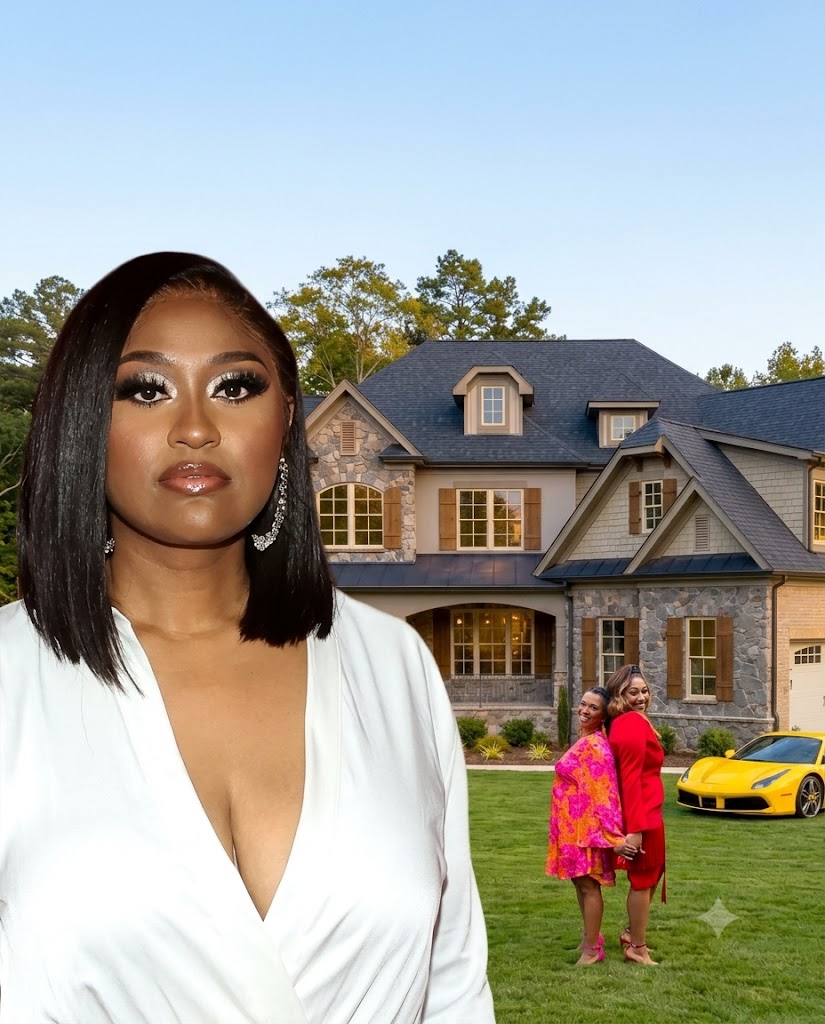
The Lifestyle of Jazmine Sullivan 2026 ★ House Tour, Tragic Miscarriage, Partner, Cars, Net Worth
The rain hit the windshield of a black Mercedes G-Wagon like handfuls of gravel, and Jazmine Sullivan kept both hands on the wheel, eyes fixed on the wet ribbon of I-75 North. Atlanta in late March had no manners. The storm came out of nowhere, the way trouble always did. Seven million dollars sat in her accounts, a number her younger self would have called a fantasy, and still her chest tightened when the phone rang twice and stopped. Two rings. That was the signal. Her mother’s old ringtone, saved by mistake, kept by choice, haunting her every time a stranger dialed a wrong number. She let the wipers slap the glass and told herself the call was nothing. The city lights smeared into gold streaks across the hood, and somewhere behind those lights, in a house she’d bought with money she’d earned from telling the truth in three-minute increments, a kettle was waiting to whistle. She didn’t know yet that a different kettle was about to boil over.
Here is what a seven-million-dollar net worth does not buy. It does not buy a clean conscience at two in the morning. It does not buy back the people you lost while you were busy becoming a legend. And it does not buy silence from the internet, which had recently decided that Jazmine Sullivan’s face was a public referendum. She had lost weight. She had gained peace. The comment sections had gained pitchforks. She pulled the G-Wagon into the driveway of the Atlanta sanctuary, a two-and-a-half-million-dollar spread that the listing agent had called “warm modern,” and she sat there with the engine idling, listening to the rain, before she finally killed the motor and walked inside to face the music. Not the industry kind. The family kind.
The house greeted her the way it always did, with a foyer of wide-plank hardwood and a stone fireplace that ran floor to ceiling like a stubborn opinion. She dropped her keys in the bowl her mother had bought at a church fundraiser in Philadelphia, a chipped ceramic thing worth four dollars and every memory she had left. The kettle screamed. She made tea she didn’t drink and sat on the oversized sofa in the formal living room, the one designed for intimate conversations, and had one with herself. “You can either answer the phone or you can keep hiding,” she said out loud, and her voice bounced off the vaulted ceiling. The phone lit up again. This time it was her manager, and this time she answered.
“Jaz, the blog ran the story,” her manager said. “The one about the miscarriage. It’s trending.”
Jazmine closed her eyes. The rain hammered the floor-to-ceiling windows, and for a second the whole room felt like the inside of a drum. There it was, the thing she had buried under three platinum albums and a shelf of trophies, dug up by someone with a keyboard and a deadline. She had never told that story publicly. Not once. Not even in the songs, not really, only in the spaces between the lines where the truth hides from the melody. “How bad?” she asked, and her manager’s pause was the answer. “Bad enough that we need to decide what you say before someone decides for you.”
That is the part nobody puts in the highlight reel. The G-Wagon, the Panamera, the Escalade, the three houses, the awards, the streaming numbers, the empire, all of it sat in the garage or the bank or the trophy case, and none of it could stand in front of her and say, “It’s going to be fine.” Only her mother could have done that, and her mother was gone, taken by breast cancer in a fight that had turned Jazmine’s grief into a cause and her cause into a mission. She picked up the chipped ceramic bowl, turned it over in her hands, and set it back down like a judge’s gavel. “Get me the reporter’s number,” she said. “I’m not hiding. Not anymore.”
**PART 2**
The first thing you need to understand about Jazmine Sullivan is that Philadelphia raised her, and Philadelphia does not raise soft people. She grew up in a working-class neighborhood where the row houses leaned shoulder to shoulder like old friends arguing, where the block was loud and the church was louder, and where a girl with a voice too big for the choir loft learned early that talent buys you nothing unless you also learn to take a punch. Her mother, Pam, a former backup singer who knew every trap in the music business the way a mechanic knows every rattle in an engine, recognized the gift before the girl could read music. Pam sat her down at eleven years old after a show-stopping performance on a national television stage, a performance so clean that industry insiders started circling like hawks, and said the words that would define her life. “They’re going to try to change you. Don’t let them.”
That is the promise, and this is the debt. Everything that follows, the awards, the money, the stunning homes, the garage full of German engineering, is the interest paid on that one promise kept. But promises cost money, and the bill came due in her twenties, when the industry told her to sand down her edges and she refused, and when a toxic, emotionally abusive relationship told her she was worthless and she believed it for a while. There was a stretch of years when she could not step into a recording booth. The microphone felt like a witness. Her confidence had been strip-mined, and the woman who came out the other side had to rebuild herself from the studs up, leaning on faith and her mother’s voice and the stubborn Philadelphia refusal to quit. The music she made after that rebuilding, raw and unfiltered and honest to the bone, became her signature. Pain is a terrible teacher, but it does not give partial credit.
So when the blog ran the story about the miscarriage, the cruelest chapter of her private life dragged into daylight, she did something that surprised everyone except the people who knew her best. She did not issue a polished statement from behind a publicist’s desk. She went home to Philadelphia, to the twelve-hundred-thousand-dollar haven with the polished concrete floors and the sunken tub and the clean, minimalist lines that her mother would have called “cold” and her therapist would have called “clarity,” and she sat in the sunroom of the eight-hundred-thousand-dollar suburban retreat instead, the rustic one with the hand-scraped floors and the brick hearth, because the rustic one felt like Pam. She called her sister. She called her pastor. She called the three friends who had known her since before the first Grammy nomination, the inner circle she guarded with the ferocity of a junkyard dog, and she told them the truth over a pot of coffee that went cold in the pot. “I’m going to talk about it,” she said. “My way.”
Her way meant a conversation, not a confession. It meant choosing the room, the reporter, the words, the boundaries. It meant the thing that her entire career had taught her, that control over your own narrative is the only real luxury, worth more than the G-Wagon’s hand-stitched leather and the Atlanta infinity pool combined. The reporter met her at a diner off Broad Street, and Jazmine ordered sweet tea and told her, “You can ask me anything, but I decide what goes in.” The reporter, to her credit, agreed. That is the detail the gossip sites skipped. They wanted the tragedy. They got the woman who had survived it.
**PART 3**
The conversation lasted two hours and eleven minutes, and Jazmine Sullivan did not cry until minute ninety-four. “I lost a pregnancy,” she said, and the diner seemed to go quiet around the sentence, the way rooms do when someone tells the truth too plainly for small talk. “And I lost the relationship that came with it. And for a long time I thought that loss was the end of me, that my body had failed me, that I had failed myself. I didn’t sing for a year. Not one note.” The reporter’s pen stopped moving. “What changed?” she asked, and Jazmine laughed, a short, dry sound. “My mother’s voice in my head. She used to say, ‘Baby, you don’t owe anybody a performance of your pain. But you do owe yourself a life after it.'” That was the hinge the whole story swung on, the sentence that turned grief into architecture.
She went home that night to the Atlanta sanctuary and walked the floors, the wide-plank hardwood cool under her feet, and she did the math out loud like a woman balancing a checkbook. “Three hundred and sixty-five days without singing,” she said to the empty kitchen, the multi-tiered quartzite island gleaming under the lights. “Two hundred missed calls from people who meant well. One mother who is gone. Seven million dollars that can’t buy her back.” The numbers landed like dropped dishes, one after another, and then she opened her laptop and wrote the first song she had written in a year. Not for an album. Not for a label. For the woman who had sat in a diner and said the word miscarriage out loud without breaking. That song would become the seed of the record that would sweep the major award ceremonies, the conceptual project about female empowerment and vulnerability and self-worth that the industry would call her masterpiece and that she privately called her receipt. Proof of payment. Proof that the pain had been used for something.
The backlash was not finished with her, though. It never was. When she stepped onstage at a festival that summer, glowing and healthier than she had been in years, the internet lit up with the usual cruel arithmetic, the commentary about her body, the speculation dressed up as concern. She stood in the wings of the stage, looked out at fifty thousand people holding up their phones like small fires in the dark, and remembered the promise. “They’re going to try to change you. Don’t let them.” She walked out, took the microphone, and addressed it head-on in the middle of her set. “I hear some of y’all been talking about my body,” she said, and the crowd roared with the strange, beautiful anger of people who had been talked about too. “I didn’t lose weight for you. I didn’t gain peace for you. I did it so I could tour without running out of breath, so I could live long enough to spoil my nieces. Radical self-love. Look it up.” The clip went viral within the hour. This time, for once, the noise was on her side.
**PART 4**
The houses tell the rest of the story, if you know how to read walls. The Atlanta sanctuary, that two-and-a-half-million-dollar warm modern fortress, is the house of a woman who wants to be found by the people she chooses and no one else, a chef’s kitchen with custom-milled cabinetry built for a family that gathers on her terms, a primary suite with vaulted ceilings and sliding glass doors that open onto a terrace where the phone stays inside. The Philadelphia haven, sleek and minimalist, polished concrete and handleless cabinets, is the house of the woman who never forgot the neighborhood, close to her roots, a sunken tub built into the floor like a baptism. The suburban retreat, eight hundred thousand dollars of distressed hardwood and butcher block and a massive weathered dining table in place of an island, is the house of Pam’s daughter, the one where the kitchen table is the beating heart because that is where her mother held court. Three houses. One woman. Three ways of saying the same thing, that home is not square footage, it is the people who know your ringtone by heart.
The garage tells the story of the journey. The Mercedes G-Wagon, one hundred and forty thousand dollars of hand-stitched leather and commanding height, is the vehicle of a woman who has spent her life commanding rooms and refuses to sit low in traffic. The Porsche Panamera, one hundred thousand dollars of German engineering, is the vehicle of the woman who occasionally needs to outrun her own thoughts on an open road, the acceleration a clean, smooth line from anxiety to clarity. The Cadillac Escalade, eighty-five thousand dollars of climate-controlled, massage-seated, panoramic-roofed practicality, is the vehicle that carries her entourage and her nieces and the groceries and the church hats, because even legends need to make a grocery run without the paparazzi knowing what cereal they eat. She has been seen, more than once, at a red light on Peachtree Street, singing at the top of her lungs in the Escalade, alone in a nine-passenger vehicle built for a crowd. That is the image to keep. The empire is real, but the woman in it is still the girl from the block who loves a song too much to care who sees.
And then there is the cause, the one her mother’s illness lit inside her like a fire that has never gone out. She works with breast cancer organizations, raises money for early detection, shows up in clinics in marginalized communities where the mammogram van runs once a month and every appointment is a gamble. She has been honored for it more than once, and every time she has accepted the award and said the same thing backstage, “This is Pam’s award. I’m just holding it.” That is the ledger nobody audits. Seven million dollars in net worth, three houses, three cars, a wall of trophies, and the only number she actually keeps track of is how many women got screened this month. She has said it plainly in interviews, that her grief is not a brand, it is a battery, and she intends to run it until it dies.
**PART 5**
The rest of the year moved the way her years always moved now, in wide arcs between the stage and the kitchen table. She headlined festivals across the country and overseas, sold out arenas, collaborated with the biggest names in music, and came home to Atlanta to sit by the infinity pool with a glass of iced tea and stare at the water going over the edge and quietly disappearing, which she found soothing in a way she never bothered to explain. The blog post became a footnote. The reporter’s article, when it ran, was the most-read piece of the month, and it was, by some miracle, fair. Jazmine read it twice on her phone, in the kitchen, standing at the quartzite island, and then she printed it out and put it in the box with her mother’s old church programs and the chipped ceramic bowl from the fundraiser. Evidence. The case for her own life, filed and closed.
But the kettle always comes back to a boil, and in the fall it did. A young artist, barely twenty, sat across from Jazmine in that same diner off Broad Street, trembling, and told her she was being told to change her sound, her image, her self, and Jazmine looked at her the way Pam had once looked at an eleven-year-old on a national television stage and said the words like a hand held out across the years. “They’re going to try to change you. Don’t let them.” The artist cried. Jazmine didn’t. She paid the check, walked out into the Philadelphia dusk, and got into the Escalade, and drove the long way home past the old neighborhood, past the row houses leaning shoulder to shoulder like old friends arguing, past the church where her voice had first been too big for the room. The streetlights came on one by one, the way they always had, and the phone in the cupholder lit up with a call from her sister, and this time she answered on the first ring.
That is the lifestyle, if you want the real accounting. Not the house tour, though the houses are real and beautiful, and not the car collection, though the cars are fast and fine, and not the seven-million-dollar number, though it is accurate and hard-earned. The lifestyle of Jazmine Sullivan in 2026 is a woman who lost her mother and kept her voice. It is a woman who lost a pregnancy and refused to lose the life that came after it, who turned a diner booth into a pulpit, a chipped bowl into an altar, a garage into a story about motion, and three houses into three different ways of being home. It is a woman who took the cruelest thing that ever happened to her and used it to fund a mammogram van in a neighborhood where nobody gets screened, because grief is a battery and she intends to run it until it dies. The rain had stopped by the time she pulled into the driveway, and the Atlanta sky was that particular washed, luminous blue it gets after a storm, and Jazmine Sullivan sat in the Escalade for a minute with the engine off, listening to the silence, and then she went inside, where the kettle was waiting to whistle, and she let it.