A Black girl spent her last $8 helping a stranded Hells Angel. The next day, 100 bikers showed up at her door.
The rain had just stopped, leaving the Detroit asphalt slick and gleaming under the orange streetlights like a road paved with wet copper.
Emily Johnson pulled her thin coat tighter and walked faster, her last eight dollars folded in her pocket and her mind already three steps ahead—rent, inhaler, Friday’s paycheck that never seemed to stretch far enough.
The laundromat shift had ended an hour late, and her feet throbbed inside shoes that had given up on being shoes months ago.
The gas station on the corner of Palmer and Chene was the only light for three blocks, its fluorescent hum a tired lullaby for night workers and lost souls.
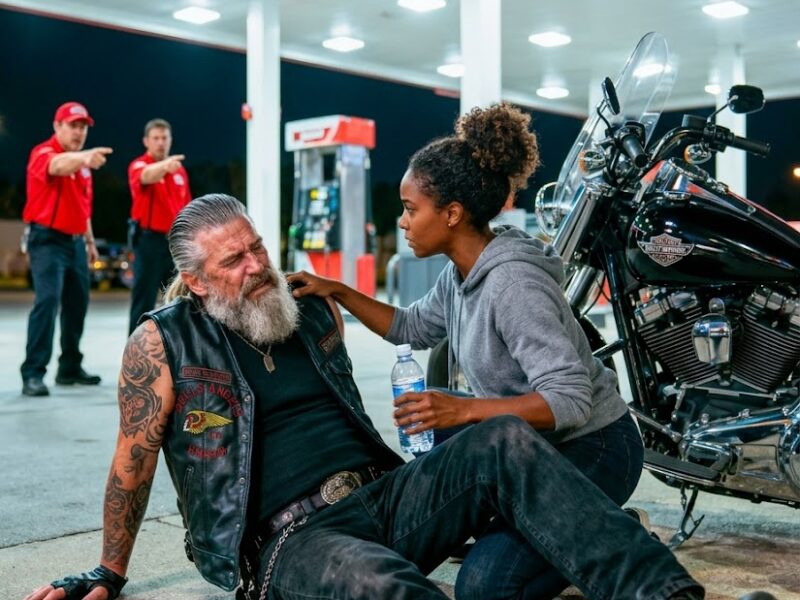
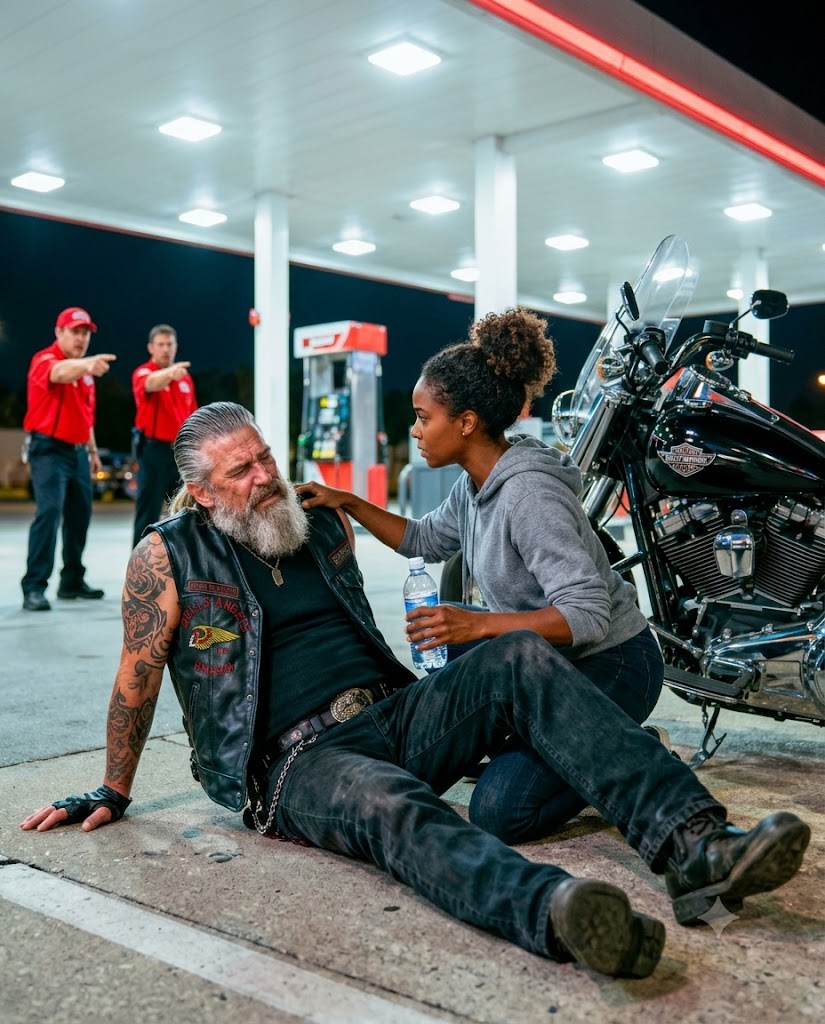
That’s when she heard it—a heavy thud, the sickening scrape of metal on pavement, then a muffled scream that sounded more animal than human.
A massive man had collapsed beside a fallen motorcycle, his leather jacket twisted, his face the color of wet cement.
A trucker leaned out of his cab and shouted, “Leave it, lady! Those bikers bring trouble!”
The clerk inside the station was frozen behind the register, one hand hovering over the phone, the other waving Emily away through the glass.
Emily thought of her grandmother, crumpled on a bus station floor twenty years ago, surrounded by people who just stared.
She ran.
The man’s name, she would learn later, was Jace McAllister, and he was fifty-two years old with a gray beard, a winged-crown patch on his jacket, and a heart that had decided to quit on a Tuesday night.
His lips were gray, his breath gurgling, and his eyes rolled back so far only the whites showed.
Emily dropped to her knees, tore open her wallet, and shoved her last eight dollars at the clerk. “Aspirin and water—now!”
“Ma’am, he’s a Hell’s Angel, you don’t—”
“I don’t care if he’s the devil himself—he’s dying!”
She crushed the aspirin between her fingers, tilted Jace’s head, and slipped the bitter powder past his lips with a splash of water.
“Stay with me,” she said, her voice steady even as her hands shook. “You’re not going anywhere tonight.”
Jace’s eyes fluttered open for just a second, confused and glassy, and he gripped her wrist with a strength that surprised them both.
“Tell them,” he rasped, “tell them Jace sent you.”
The ambulance came with lights that turned the puddles red and white, and Emily stepped back, her palm scraped raw from the asphalt, her last dollar gone.
A second biker roared up, tall and long-haired, and knelt beside the paramedics. “Jace! Stay with me, brother!”
Jace’s eyes moved toward Emily one last time before the doors slammed shut, and the tall biker turned to her with something shifting behind his eyes.
“You helped him?” he asked, stunned. “He was alone.”
She nodded, and he pulled a wad of bills from his pocket. “At least let me repay you.”
“No,” she said softly. “I didn’t do it for money.”
He stared at her for a long moment, then reached into his jacket and handed her a black card with a silver winged crown. “If you ever need anything, call this number. My name’s Cole.”
She slipped the card into her pocket without knowing why, and as the ambulance pulled away, the rain began to ease, leaving the street glistening under the lights.
Back home, Emily peeled off her wet clothes and hung them over a chair, the apartment quiet except for the steady hum of the fridge.
Ila was asleep, curled under a blanket, her small chest rising and falling with effort.
Emily knelt beside her bed and listened to the breathing, each wheeze a reminder of what still needed to be done.
She brushed Ila’s hair back from her forehead. “You’re okay, sweetheart.”
Then she sat at the table and opened her notebook, her hand trembling as she wrote her three nightly gratitudes: Ila breathing steady tonight. The man is alive. There is still good to be done.
She closed the book and let her forehead rest on her hands, her palms still smelling faintly of rain and aspirin.
The next morning, the world seemed oddly quiet, a weak sun fighting through the clouds.
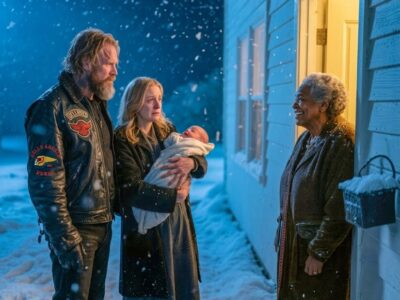
“Mrs. Johnson,” the older woman from downstairs called from her stoop, wrapped in a shawl. “I heard about last night. You shouldn’t go helping strangers like that. Folks like him bring nothing but trouble.”
Emily forced a polite smile. “He needed help, that’s all.”
“Kindness is good, dear, but too much of it can hurt you.”
“I’ll take my chances.”
Mrs. Johnson shook her head but smiled faintly. “You’ve got your grandmother’s stubborn heart.”
That evening after work, Emily sat by the window watching snow fall under the streetlight, the black card lying on the table beside her teacup.
She traced the embossed crown with her thumb, feeling not fear but a strange curiosity, like something was quietly changing direction inside her life.
The phone buzzed—just the pharmacy reminding her about the inhaler refill—and she pressed later, looking toward Ila asleep again, her small hands curled like petals.
“Grandma was right,” Emily whispered. “Kindness doesn’t cost much, but it sure does ask a lot.”
The clock ticked toward midnight, and act one closed quietly on a woman who had given her last eight dollars and unknowingly started a story that would change her life forever.
The next morning began with the pale sound of tires hissing over wet pavement, the world rinsed clean after the rain, carrying that thin chill that seeps into your bones before you notice.
Emily woke before the alarm and lay still for a while, watching the soft gray light creep across the ceiling.
Ila’s breathing was easy now, light little sighs between dreams, and for a moment everything was calm.
Then the clock clicked to six, and the familiar rush began—toast in the old toaster, lunch in a paper bag, scarf around a small neck.
Emily moved on instinct, her body remembering the steps even when her mind lagged behind.
Her wallet lay on the counter, nearly empty, the only thing inside besides her bus pass that black card with the winged crown.
At the laundromat, the fluorescent lights buzzed and the machines droned like a low song, steady and endless.
Mr. Klein greeted her with his usual half smile. “You look tired this morning, Miss Johnson.”
“Just one of those weeks.”
“They all are lately.”
She helped him load his laundry and watched the bright fabric spin behind the glass, the hum filling the silence in a way that was almost comforting.
But behind the rhythm, her thoughts wouldn’t stop circling—the man she’d helped, the look in his eyes, the way his hand had clutched hers before the ambulance doors shut.
Tell them Jace sent you. The words had stayed with her like a faint echo.
By noon, she’d earned another few dollars in tips, her feet aching as she walked to the small cafe down the block for lunch.
Mrs. Johnson’s voice from that morning played back in her head—too much kindness can hurt you—and Emily smiled to herself. “Maybe,” she whispered, “but it’s the only thing I’m any good at.”
She bought the cheapest sandwich on the menu and ate it slowly, watching cars pass through the rain-streaked window.
When she checked her phone, there was a voicemail, the number unsaved but the voice making her sit straighter.
“Hi, this is Cole, the guy from the gas station about Jace. He’s awake now. He wanted me to reach out. Said you should call. I’ll be at Murphy’s Diner around three if you can make it.”
Emily froze with half a bite of bread in her hand and replayed the message twice before setting the phone down.
Her first thought wasn’t about curiosity—it was about Ila, who would watch her, would the neighbors judge, what if these men weren’t what they seemed?
She pushed the sandwich aside and stared out at the drizzle. He’s awake, she thought. He lived. That should have been enough.
But something deeper, quieter tugged at her, something about the way Jace’s voice had cracked when he thanked her.
That afternoon, she took Ila’s hand and walked her home from school, the little girl chattering about a new reading game and a classmate’s birthday cupcakes.
Emily smiled and nodded, though her mind kept drifting back to the card.
When they turned the corner, Mrs. Johnson was waiting on her porch. “You heard them bikes this morning? Two of them big fellas woke up the whole block.”
Emily kept her expression steady. “Maybe they were just passing through.”
Mrs. Johnson’s eyes narrowed. “You be careful, Emily. Those men remember faces.”
Emily nodded politely, but inside her chest tightened.
That evening, she took the bus to the pharmacy, the hum of the engine and the faint smell of diesel and the chatter of strangers all part of her daily landscape.
She went straight to the counter and handed over the prescription, waiting as the pharmacist, a kind woman named Helen, frowned slightly.
“Your insurance hasn’t gone through yet,” Helen said gently. “It’ll be sixty-two dollars today.”
Emily’s stomach dropped, and she took out her wallet and counted. “Fifty-two.”
Helen leaned forward, lowering her voice. “I can give you half the supply to get through the week.”
Emily hesitated, then shook her head. “I can’t even cover that right now. Thank you, though.”
She left with her hands empty and her throat tight, the wind picking up outside and carrying a sharp wet smell of snow not far off.
She stood on the curb watching cars glide through puddles, their headlights streaking gold on the wet asphalt, her reflection in the glass window looking older than she remembered.
You should have kept the money last night, she thought. At least then Ila would have her medicine.
But another voice, her grandmother’s, rose softly in her memory: Kindness costs nothing, darling, and sometimes that’s all we have to give.
She pressed her lips together and walked home, clutching her coat against the cold.
The next morning came too early, the sky white and heavy, and Emily barely slept as she packed Ila’s lunch with tired hands.
Then she heard a faint cough from the bedroom, and Ila stood in the doorway, hair messy, holding her inhaler. “It’s almost out.”
“I know, sweetheart. Can we get more soon?”
“Yes,” Emily said, forcing a smile. “Soon.”
When she walked Ila to school, she noticed two motorcycles parked across the street from their building, the men sitting on them wearing dark jackets with the same winged crown she remembered.
Her heart beat faster, and one of the riders raised a hand—just a simple wave—and then looked away.
Emily guided Ila quickly down the sidewalk.
By late afternoon, the worry had grown too heavy to ignore, and she sat on the edge of her bed holding the black card between her fingers, the number gleaming faintly in the light from the window.
Finally, she took a deep breath and sent a text: This is Emily, the woman from the gas station. You said to call.
The reply came almost instantly: Hey, Emily. Jace has been asking about you. Meet us at Murphy’s Diner around five. Just a short talk. Promise.
She stared at the message for a long moment, then typed back: Okay.
The sky had already begun to darken when she dropped Ila off with Mrs. Johnson, who reluctantly agreed to watch her for an hour. “Don’t stay long, and keep your phone on.”
“I will.”
The bus ride to Murphy’s felt longer than usual, the window glass rattling softly with every bump, the city light smearing into ribbons of yellow and red.
She got off one stop early and walked the last few blocks, her shoes squelching through shallow puddles.
Inside the diner, the warmth hit her like a gentle wave—coffee, grease, the sweet smell of pie—and the same bell jingled overhead.
Cole sat in a booth near the window, his jacket draped over the seat, and he looked up and smiled when she came in. “Emily. Didn’t think you’d actually come.”
“I almost didn’t,” she admitted.
He gestured for her to sit. “I get that. Not every day someone helps a guy like Jace and then hears from his crew the next morning.”
Emily glanced around. “How is he?”
“Better. They said you probably saved his life.”
She looked down at her hands. “Anyone would have done the same.”
Cole’s voice softened. “No, they wouldn’t.”
He took a sip of coffee and studied her. “You got kids, right?”
Emily hesitated, then nodded.
“You remind me of my mom,” he said. “She used to say kindness is the only thing that grows when you give it away. I didn’t believe her till I met Jace.”
She smiled faintly. “Your mom sounds wise.”
“She passed five years ago.”
There was a quiet moment between them filled only by the sound of clinking dishes, and then Cole reached into his jacket and slid a small white envelope across the table. “He wanted me to give you this.”
Emily frowned. “What is it?”
“Just a thank you.”
She pushed it back gently. “I can’t take money for helping someone.”
“It’s not money,” he said. “Just an invitation. He wants to see you.”
She studied him, his eyes steady and kind even. “Why?”
“You’ll have to ask him yourself.”
Outside, thunder rumbled far away.
By the time she returned home, the wind had picked up, and she found Mrs. Johnson sitting in the hallway knitting, her radio playing old country songs.
“Everything all right?” Mrs. Johnson asked.
“I think so,” Emily said.
The older woman looked at her closely. “You got a good heart, Emily. But people take advantage of that.”
Emily smiled wearily. “Maybe. Or maybe they just need someone to trust first.”
“You’re too much like your grandma.”
“I hope so.”
That night, long after Ila had fallen asleep, Emily sat by the window again, the city lights twinkling like scattered coins, her reflection in the glass calmer now though the worry hadn’t left her eyes.
On the table lay the envelope Cole had given her, and inside was a business card—white with the same winged crown logo and a handwritten note: Tomorrow, Murphy’s, noon.
She read it twice, then set it down, sitting in silence and listening to the hum of the radiator and the faint rhythm of Ila’s breathing from the other room.
Her heart was a tangle of fear and curiosity, but under it all was a quiet certainty, like a small light refusing to go out.
She whispered to herself, barely audible, “Kindness isn’t safe, but it’s worth it.”
And somewhere in the distance, she thought she heard the low, steady roar of a motorcycle fading into the night, and the sound didn’t frighten her this time—it only made her wonder what tomorrow would bring.
The next morning, Emily woke to a soft drizzle tapping against the window, the world gray again, quiet, suspended, like it was waiting for something to begin.
Ila still slept, her hand curled under her cheek, and Emily brushed a kiss across her daughter’s forehead before slipping out of bed.
She dressed slowly, feeling a kind of nervous energy humming beneath her ribs, and on the kitchen counter the white card with the winged crown lay exactly where she’d left it.
The handwriting on the back—tomorrow, Murphy’s, noon—looked simple enough, but it made her pulse quicken each time she saw it.
She poured herself a cup of coffee and stood by the window, staring at the empty street. “You don’t owe them anything,” she told herself. “You helped, that’s all.”
And yet, she knew she would go.
By the time she reached Murphy’s Diner, the rain had stopped, leaving the world glazed and shining, puddles reflecting the sign’s red neon glow like streaks of fire across the asphalt.
She paused outside the door, taking a breath before stepping in, and the bell jingled and every head turned.
There were at least two dozen bikers scattered around the diner, men and women in leather jackets, all with the same emblem stitched across the back.
But instead of rowdy noise or harsh laughter, there was quiet—the kind of silence filled with respect.
Then, as she stood uncertainly in the doorway, they all rose, chairs scraping softly against the floor as they stood in unison.
Emily froze, her heart thudding.
Cole stepped forward, smiling. “Emily Johnson. Come on in. We’ve been waiting for you.”
She walked slowly toward him, her eyes darting from face to face—none looked unkind, just weathered, strong, and sincere.
At the far corner of the diner, in a booth by the window, sat Jace, his gray beard trimmed now, his skin pale but alive, a blanket folded over his lap.
He smiled when he saw her. “There she is—the woman who saved an old fool’s life.”
Emily sat across from him, her hands clasped in her lap, and Cole slid into the seat beside Jace and nodded to the waitress. “Coffee for our guest, please.”
When the mug was set in front of her, Emily wrapped her fingers around it, grateful for the warmth. “I don’t know why all this attention. I only did what anyone should do.”
Jace’s eyes met hers. “That’s where you’re wrong, sweetheart. Not everyone does.”
He took a slow sip of water before setting the glass down. “When I hit the ground that night, I thought, well, this is it. I saw the lights, heard the engines, but no one moved. Then I felt someone grab my hand—you. You didn’t think about who I was. You just acted.”
He smiled faintly. “Reminded me of someone.”
Emily tilted her head. “Who?”
“My daughter,” he said, the words coming out quiet and heavy.
Cole looked down at his hands.
“She was seven when we lost her,” Jace continued. “Leukemia. We did everything we could, but the bills, they came faster than the hope. I was working two jobs, riding nights just to clear my head. By the time we found a clinic that could take her, it was too late.”
He stared at the mug in front of him. “She used to say, ‘Daddy, people need to be brave for each other.’ I didn’t understand that until after she was gone.”
Emily swallowed hard, the air in the diner feeling still, like even the walls were listening. “I’m sorry. I can’t imagine.”
He shook his head gently. “You don’t have to. You already understand.”
He reached into his jacket and pulled out a worn photo, faded at the edges—a little girl with bright eyes and two missing front teeth standing beside a pink bicycle. “Her name was Lily. She’d be about Ila’s age now.”
Emily took the photo carefully, her throat tightening. “She’s beautiful.”
Jace smiled, eyes glistening. “Yeah, she was light in every room.”
After a long silence, Jace leaned back. “After she passed, I made a promise. I couldn’t save Lily, but maybe I could save someone else. So I started Lily’s Legacy.”
Emily looked up. “The name on the card.”
He nodded. “Yeah, we’re not a gang, Miss Johnson. Not anymore. We’re a family of folks who’ve been through rough patches. We help where we can—medical bills, food, shelter, sometimes just a shoulder. The jackets throw people off, but that’s all right. We’re used to earning trust the long way.”
Cole smiled. “We figured if we ride for something good, maybe Lily rides with us.”
Emily sat back, the pieces beginning to fit. “So that’s why you wanted to see me.”
“In part,” Jace said. “But mostly I wanted to thank you in person. You reminded me why we started this. Sometimes even good men forget.”
She lowered her eyes. “I didn’t mean to start anything.”
He chuckled softly. “That’s how the best things begin.”
The waitress refilled their coffees, the smell of it mixing with rain drifting in from the open door, and Jace studied her quietly. “You got a little girl, right about six.”
Emily nodded.
“How’s she doing?”
“She’s strong,” Emily said. “But her asthma’s been hard lately. I’ve been behind on her medicine.”
Jace’s brow furrowed. “You paying for that out of pocket?”
“Trying to,” she said with a tired smile.
Cole exchanged a glance with Jace, and the older man’s jaw tightened. “That shouldn’t be a choice any mother has to make,” Jace said softly.
For a moment, no one spoke, and outside, thunder rolled low and slow.
Then Jace leaned forward, his voice firm. “I want you to come tomorrow morning. There’s something I need to show you. Don’t worry—it’s safe. You’ll understand when you see it.”
Emily hesitated. “What is it?”
He smiled faintly. “Call it faith in motion.”
Later, as she walked home, the rain had stopped completely, the city smelling of damp earth and fresh air, the puddles reflecting the streetlights like tiny mirrors.
Her heart felt oddly light, though her mind was crowded with thoughts—Lily’s photo, the missing teeth, the pink bicycle, the bright grin—and her own little girl sleeping at home, the same innocence, the same courage in a small frame.
Maybe kindness wasn’t just about what you gave. It was about what you carried forward.
That night, after putting Ila to bed, Emily made herself a cup of tea and sat by the window, the city below glowing faintly gold through the mist, her grandmother’s photo on the shelf—an old woman with kind eyes and a wide, steady smile.
Emily spoke softly to her memory. “You’d like them, Grandma. They’re rough around the edges, but they mean what they say.”
She stared at her reflection in the glass. “I don’t know where this is going,” she whispered, “but it feels like something real.”
Her thoughts drifted back to the bus station years ago—the sound of her grandmother falling, the strangers who just watched, the panic in her own young heart.
That moment had shaped her, carved something deep, and it was the reason she never walked past someone in need.
She remembered kneeling beside her grandmother, crying, whispering, “Please, someone help.” No one had.
The memory still burned even now, and maybe that’s why she had run toward Jace that night—because in her heart she’d been running toward her grandmother, too.
A tear slid down her cheek, and she let it fall unashamed. “You can’t change the past,” she thought. “But maybe you can answer it with something better.”
The next morning, she met Cole outside the diner, the sun out now and bright against the wet pavement, and he wore sunglasses and a smile. “You ready?”
“I think so.”
He handed her a helmet. “Hop on.”
She hesitated. “I haven’t been on a bike since high school.”
“You’ll be fine. Trust me.”
As they rode through the city, the wind caught her hair and the cold air rushed against her face, and it felt like the world widening again after being closed for too long.
They turned down a quiet street lined with small houses and stopped in front of a large warehouse painted white, with a simple sign over the door: Lily’s Legacy Outreach.
Inside, the air smelled of coffee, oil, and new paint, and volunteers moved among tables stacked with boxes of food and donated clothes.
A banner on the wall read, “Kindness is a road that never ends.”
Emily stood there speechless, and Jace appeared from behind a desk, walking slowly with a cane. “Welcome. This is what we do.”
He guided her through the space—rows of shelves labeled food drive, medical aid, children’s supplies—and photos pinned to a board: families smiling, houses rebuilt, letters of thanks in careful handwriting.
Emily felt something deep inside her shift. This wasn’t charity. It was dignity, rebuilt one small act at a time.
Jace stopped beside her. “You belong here, Emily. You’ve got the heart for it.”
She turned to him, startled. “Me? You think we build this by muscle alone?” He smiled. “We build it by heart, by people like you.”
Her eyes filled. “I don’t know what to say.”
“Say you’ll think about it,” he said. “And tomorrow, no matter what happens, don’t be afraid. Some folks in your neighborhood might not understand us yet, but we’ll show them.”
She nodded slowly. “Okay.”
That night, back home, she couldn’t sleep, the house feeling alive with quiet energy, the city lights flickering through the window.
She thought about all the lives connected by invisible threads of help and trust—Jace’s tired smile, Lily’s bright photo, Cole’s steady kindness.
And then she thought of her grandmother’s words again: Kindness costs nothing, but it can change everything.
Emily whispered into the dark, “Maybe it’s time it changed me, too.”
She looked toward Ila’s bed, where her daughter slept soundly, and felt her chest swell with something she hadn’t felt in years—hope that tomorrow might be better.
She didn’t know what awaited her, but she knew one thing: whatever it was, she would face it with open hands.
Because kindness, she finally understood, wasn’t a single act. It was a way of living, a light you carried, even when the road ahead was still uncertain.
And with that thought warming her heart, Emily closed her eyes and let the night hold her gently until morning.
Morning came soft and cold, the kind that makes the world look freshly washed, a low sun climbing over the rooftops and spilling pale gold light across the street.
Emily woke to the sound first—a deep rumble that trembled through the floorboards like distant thunder.
For a moment, she thought it was another storm rolling in, but when she pulled aside the curtain, she froze.
The street below shimmered with chrome. Dozens—no, hundreds—of motorcycles lined both sides of the block, their riders standing beside them in neat rows, leather jackets, black boots, silver helmets catching the light, the winged crown glinting on every back.
Ila ran to the window, eyes wide. “Mom, there’s a parade!”
Emily’s heart pounded as she glanced toward the street where neighbors were gathering—Mrs. Johnson with her shawl clutched tight, Mr. Rodriguez shaking his head in disbelief—and fear hung thick in the air.
“What are they doing here?” Mrs. Johnson called, her voice sharp. “You see, Emily, I told you—”
But Emily didn’t answer. She slipped on her coat, took Ila’s hand, and stepped outside.
The cold air bit at her cheeks, and the engines idled in a slow, steady growl that somehow didn’t sound threatening—more like a heartbeat, powerful but steady.
At the far end of the street, a familiar figure stepped forward—Jace, leaning on his cane, his leather jacket zipped halfway, standing tall against the wind.
Cole flanked him, holding a folded banner under one arm.
Jace raised his voice. “Folks, I know this looks like something out of a movie, but we’re not here to cause trouble. We’re here to return a favor—to repay kindness with kindness.”
The murmurs from the crowd quieted, and Mrs. Johnson took a step forward, her voice trembling. “You scared us half to death.”
Jace nodded. “I’m sorry for that, ma’am. We don’t mean fear. We mean help.”
He turned toward Emily. “Miss Johnson, would you come here, please?”
Emily hesitated, feeling every eye on her, and then she walked forward, Ila clutching her hand.
Jace smiled at the little girl. “You must be Ila.”
“Yes, sir,” she whispered.
“Your mama’s a brave woman,” he said gently.
Cole stepped forward and unfurled the banner, the wind catching it for a moment before it straightened: Lily’s Legacy Community Day of Thanks.
Gasps rippled through the crowd, and Jace’s voice carried strong now. “A few weeks back, I had a heart attack at a gas station. Everyone there looked away except this woman. She spent her last eight dollars to save me. Didn’t ask who I was, didn’t care what I wore—just acted out of kindness.”
He turned to face the neighbors. “That kind of goodness deserves more than words.”
He nodded to Cole, who handed him a thick envelope. “This,” Jace said, holding it out to Emily, “is a small start—twenty-five thousand dollars to cover your rent, your car, your daughter’s medicine, whatever you need.”
Emily’s eyes filled instantly. “I can’t—”
“You already did,” Jace interrupted gently. “Now, let us.”
A hush fell over the crowd, and then from the far end of the street, two riders wheeled forward a freshly repaired sedan—Emily’s car, gleaming and whole, a big red ribbon tied across the hood.
Ila squealed. “Mom, it’s fixed!”
Emily covered her mouth, tears spilling down her cheeks, and Cole grinned. “Got a new transmission and tires, too. She’s good as new.”
Jace wasn’t done. He nodded again, and another rider brought forward a simple white envelope. “In here,” Jace said, “is an offer of employment—community outreach coordinator for Lily’s Legacy. Full salary, benefits, insurance. We’d like you to help us connect with families in need the way you connected with me.”
Emily could barely speak. “I don’t know what to say.”
“Say yes,” Jace said softly. “Then you can spend your days helping others without worrying how to keep the lights on.”
She pressed a hand over her heart. “Yes,” she whispered. “Yes, I’ll do it.”
The crowd erupted in applause, Mrs. Johnson wiping her eyes with her shawl, Mr. Rodriguez clapping her on the shoulder, and the tension that had hung in the air all week melted like frost in sunlight.
As the applause quieted, Jace lifted his hand for silence. “There’s one more thing.”
He gestured toward a flatbed truck parked nearby, and workers pulled off a tarp, revealing a large wooden sign with painted letters: Johnson House, Community Resource Center.
Emily stared, stunned, and Jace’s voice wavered just slightly. “This block’s got a lot of heart. We want to build something here to honor that—to honor you. Johnson House will be a place for job training, food distribution, medical support, and shelter for families in crisis. All free. No judgment.”
A collective murmur swept through the neighbors, and then slowly, Mrs. Johnson began to clap again, soft at first, then louder, and others joined until the sound filled the street.
Emily turned to Jace. “You didn’t have to.”
He smiled. “Neither did you.”
By afternoon, the neighborhood had transformed—riders setting up tables of food and coffee, volunteers carrying in boxes of groceries, winter coats, and children’s toys, laughter mingling with the deep purr of engines.
Ila helped pass out apples with two of the riders, giggling as she handed each one over like a prize.
Mrs. Johnson stood beside Emily, shaking her head in wonder. “I’ll admit it, dear. I was wrong about them.”
Emily smiled. “Maybe we all were.”
Mrs. Johnson chuckled. “You know, my heart hasn’t felt this full in years.”
Cole came by, handing out cups of cocoa. “Turns out kindness makes pretty good noise, doesn’t it?”
Emily laughed. “The best kind.”
That evening, the crowd began to thin, the sun slipping behind the buildings and turning the sky a soft peach, and the riders started their engines one by one, waving goodbye to the neighbors who’d once eyed them with fear.
Jace lingered a little longer, taking Ila’s small hand and pressing a folded photograph into it. “This was Lily,” he said gently. “She’d be about your age now.”
Ila studied the photo and smiled. “She looks happy.”
“She was,” Jace said softly. “And she’d be proud of your mama.”
Then he looked at Emily. “Keep the chain going. That’s all I ask.”
She nodded, eyes bright. “I will.”
Weeks passed, and the sound of construction filled the neighborhood—trucks coming and going, framing and brickwork rising where an old lot had stood, the sign House mounted at last in bright blue letters gleaming in the morning sun.
Inside, shelves were lined with canned goods, a small clinic room took shape, and a computer lab waited for job training classes.
Emily worked every day organizing volunteers, filling out forms, learning to lead, her voice once hesitant growing sure.
People came to her with problems, and she found ways to help—sometimes with money, sometimes just with time and care.
One afternoon, she sat with Mrs. Patterson, an eighty-year-old woman whose heart medication had run out, and Emily filled out the assistance paperwork herself and handed her the bottle later that week.
Tears welled in the older woman’s eyes. “You saved my life, dear.”
Emily smiled. “No, ma’am. Just keeping the circle turning.”
Spring came, and with it, the grand opening—a banner stretched across the front steps reading Johnson House, One Year Strong, balloons bobbing in the breeze, children running in the yard, the scent of grilled corn drifting through the air.
Emily stood at the podium, her heart full and her hands steady, Jace sitting in the front row with his cane across his knees, Cole leaning on a rail nearby and smiling proudly.
She looked out at the crowd—neighbors, friends, strangers who had once kept their distance.
“Last year,” she began, “I had eight dollars to my name. I didn’t know what would come next, but I did know one thing: kindness is never wasted. That night at the gas station, I didn’t think about what it might cost me. I just remembered my grandmother’s words—kindness doesn’t cost a thing, and sometimes it’s all we have to give.”
Her voice wavered, but she continued. “Since then, I’ve learned that kindness isn’t just something we give once. It’s something we build together—every day, every person, every open door.”
She smiled down at Ila, standing proudly in the front row. “This place isn’t mine. It’s ours. Johnson House is proof that compassion can turn fear into trust, and strangers into neighbors.”
The crowd applauded, the sound rolling through the spring air like music, and when it quieted, Emily stepped down from the podium and walked to the edge of the crowd where a man stood off to the side, nervous, his coat too thin, a cardboard sign tucked under his arm that read, “Need help. Anything helps.”
Emily reached into her pocket and pressed a fifty-dollar bill into his hand. “Here. Just make sure you pass it on when you can.”
The man looked stunned. “Thank you, ma’am. I will.”
She smiled. “I know you will.”
That evening, as the celebration wound down, Emily stood outside Johnson House watching the sun sink behind the city skyline, the air filled with laughter, clinking cups, and the faint sound of engines starting somewhere far away.
Jace joined her, leaning on his cane. “You did good today.”
“We all did,” she said, and he nodded.
“Lily would have liked this.”
Emily smiled. “Then it’s perfect.”
They stood in companionable silence for a while, and then Jace looked at her with a half grin. “You know, I think your grandma and my Lily are probably swapping stories somewhere right now.”
Emily laughed quietly. “Probably about how stubborn we are.”
“Yeah,” he said. “The good kind of stubborn.”
Later that night, after the lights were out and the volunteers had gone home, Emily locked up and walked down the block with Ila’s hand in hers, the air smelling faintly of rain again but the sky clear, stars bright against the dark.
Ila looked up at her. “Mom, what does ‘pass it on’ mean?”
Emily squeezed her hand gently. “It means when someone gives you something kind—a hand, a smile, a bit of help—you don’t keep it. You find someone else who needs it and you give it to them.”
Ila thought about that for a moment. “Like a gift that never runs out.”
“Exactly,” Emily said, smiling. “A gift that keeps the world warm.”
They turned the corner toward home, the sound of laughter from Johnson House fading behind them, and for the first time in a long time, Emily felt completely at peace—no fear, no worry, just quiet gratitude.
She glanced down at Ila and whispered, “Kindness is never a mistake.”
Ila smiled sleepily. “I know, Mom.”
The streetlights flickered softly as they walked hand in hand into the calm glow of evening—two small figures carrying the light forward, one act of kindness at a time.