The Lifestyle of RJ Mitte ★ House Tour, Cause of Death, Wife, Cars, Net Worth
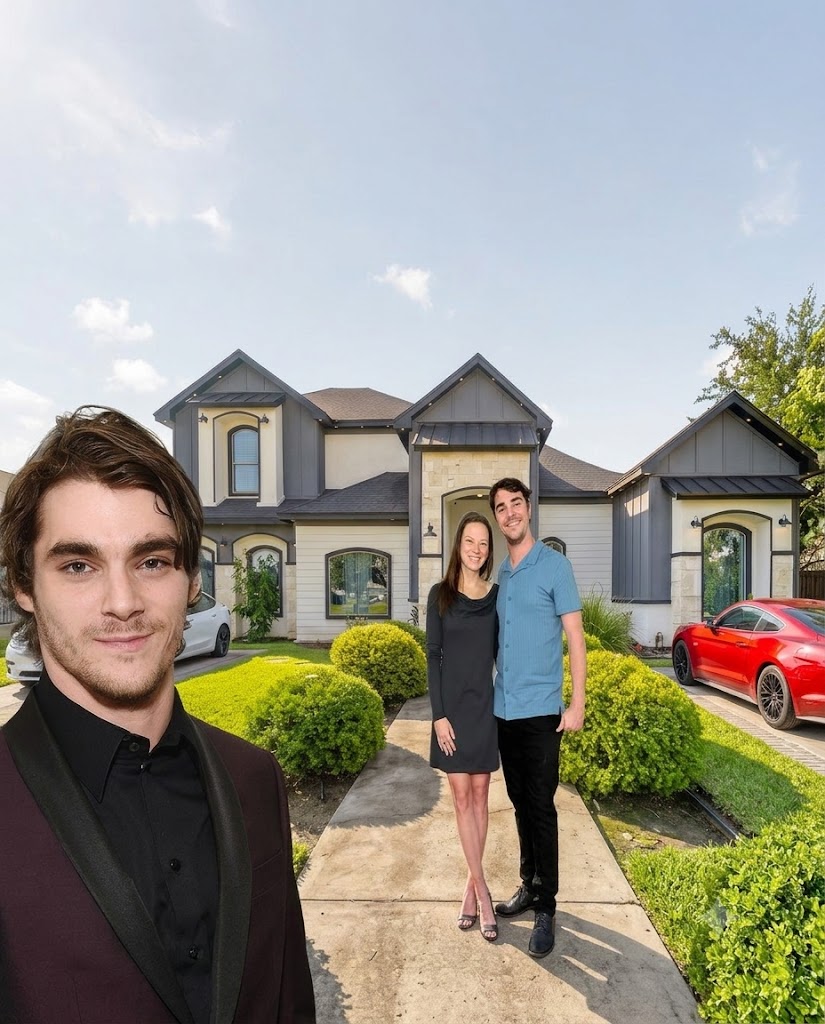
The first thing you notice about the house on the quiet Brownsville street is not the price tag or the architecture.
It is the silence.
On the afternoon of October 12, 2026, police responded to a call at 12:50 p.m. local time and found RJ Mitte dead inside the home he had once shared with the woman he planned to marry . He was thirty-four years old. The representative who had helped guide his career confirmed the unthinkable days later: the actor who played Walter White’s son, the young man who had turned a wheelchair and a speech impediment into a platform for millions, had died by suicide .
But to understand how a life that looked so full from the outside could end in such quiet devastation, you have to go back to the beginning.
And you have to understand the mother.
Dyna Mitte did not raise a victim. She raised a fighter. When her son was delivered by emergency cesarean section and came into the world not breathing, the doctors prepared her for the worst. By the time he was three, the diagnosis was official: mild cerebral palsy, a neurological condition affecting muscle control and movement. The world saw limitations. Dyna saw a boy who needed to learn how to run anyway.
She put him in soccer. She made him wear the leg braces and endure the casting, the physical therapy that felt more like torture than treatment. She told him, again and again, that his condition was a reality to be managed, not a tragedy to be mourned. What she could not protect him from was the outside world.
School was a gauntlet. The leg braces made him a target. The speech pattern made him a punchline. There was a period in his youth when a group of older students decided he was prey, cornering him after school until he had to physically defend himself, a fight that ended with his hand broken. He could have retreated. He could have let the bitterness swallow him whole.
Instead, he learned to weaponize his differences. Humor became armor. Self-belief became a shield. His mother’s voice stayed in his head, a constant refrain: you are destined for something greater than the narrow minds of this town. It was a promise he carried with him all the way to Los Angeles.
The climb was not glamorous. It was Disney Channel background work, the kind of uncredited extra roles where you are little more than scenery. He stood in the background of *Hannah Montana* sets, watching, learning, studying how veteran actors moved through a scene and how a massive production operated under pressure. No lines. Minimal pay. A master class in patience.
Then came the audition that changed everything.
The casting directors for a new AMC drama were looking for a young actor to portray a teenager with cerebral palsy. Mitte walked in and brought something no acting coach could manufacture: authenticity. His own condition was milder than the character’s, so he relearned how to walk with crutches. He deliberately adjusted his speech patterns. He built Walter “Flynn” White Jr. from the inside out, and in doing so, he did something television had rarely done before. He put a disabled actor in a role that demanded genuine representation on a global stage .
*Breaking Bad* became a cultural juggernaut. Five seasons. Sixty-two episodes. Mitte appeared in fifty-six of them . The show won awards, dominated ratings, and cemented its place in the pantheon of great television. In 2014, Mitte stood on stage with his castmates and accepted the Screen Actors Guild Award for outstanding performance by an ensemble in a drama series. The kid who had been mocked for his braces was now a SAG Award winner.
But the money was not what the world assumed.
“I’ve paid more in taxes than I got from *Breaking Bad*,” Mitte said during a 2025 podcast appearance, and he was not exaggerating . He had been paid the SAG minimum for his first episode, his first professional speaking role. When he was around seventeen or eighteen, he hired a business manager, a person he trusted to handle the money he was setting aside for taxes. That manager allegedly diverted the funds, sent him falsified tax filings, and left him with a debt to the IRS that would take him a decade to pay off . The net worth websites would later estimate his fortune at five million dollars. The reality was far more complicated. Celebrity Net Worth placed the figure closer to five hundred thousand . The gap between perception and truth was enormous.
He diversified. He invested in stocks and index funds. He bought property in Texas. He worked. He kept working.
The real estate portfolio became a reflection of a man who had spent his childhood in sterile medical rooms and wanted, finally, to control his own environment. The Calabasas estate, valued at two million dollars, was the crown jewel, a contemporary masterpiece with retractable glass walls that disappeared into the stonework and a backyard pool with a sunken fire pit lounge in the middle of the water, accessible only by a submerged walkway. The Austin retreat, one and a half million, offered a different kind of sanctuary: vaulted ceilings, hand-hewn timber beams, a negative-edge pool that created the optical illusion of water cascading directly into the lake beyond. And then there was the Brownsville sanctuary, one million dollars, the minimalist home in his hometown, the one with the poured concrete floors polished to a mirror finish and the floating staircase made of tempered glass and brushed steel.
That was the house where it ended.
The cars were another story entirely. The Porsche Panamera Turbo S, two hundred thousand dollars, a machine of hand-stitched leather and carbon fiber that he drove when he wanted the thrill of the Pacific Coast Highway. The Tesla Model S Plaid, one hundred thirty thousand, his daily driver, silent and instantaneous, a nod to the future. But the car that mattered most was not in the luxury collection at all. It was a 1969 Mercury Cougar, a forty-year-old American muscle car he bought during the *Breaking Bad* years simply to get to set . He had considered a Vespa. He chose the Cougar instead. It was not new. It was not flashy. It was his.
The public advocacy was relentless. He served as an ambassador for United Cerebral Palsy and Shriners Children’s. He became president of his own charity, the Mitte Foundation. He visited hospitals, sat with young patients, and told them his story not as a fairy tale but as a blueprint. He commanded stages worldwide, earning substantial speaking fees, campaigning for performers with disabilities to be considered for any role, not just the ones written with a wheelchair in mind. When critics debated whether disabled actors should only play disabled characters, he navigated the conversation with a grace that belied his age. Representation is crucial, he said. But true equality means talent is the only metric that matters.
And then there was Kennedy.
Her name was Kenedy Suarez, and she had been his friend for years before the friendship turned into something else. In October 2025, on her thirtieth birthday, at a fundraiser for United Cerebral Palsy in Carlsbad, California, he got down on one knee . “I’m thrilled to have found my person,” he said afterward, “my partner in life who makes me want to be better, no matter what we’re doing” . The engagement was a bright spot, a promise of stability in a life that had rarely offered any.
But the months that followed were not simple. Reports would later emerge that the relationship had become strained, that there were ultimatums, that the family had grown concerned. Kenedy was not invited to his memorial service, a detail that leaked to the tabloids and painted a picture of a private life fracturing even as his public smile held firm . Whether the couple was still together at the end remains unclear. What is clear is that the man who had spent his entire life fighting for visibility, for representation, for the right to be seen as whole, was fighting something else entirely in the quiet of that Brownsville home. And this time, he did not win.
The tributes came fast. Bryan Cranston, Aaron Paul, Dean Norris, the men who had stood beside him on that SAG stage, all expressed a devastation that felt visceral and raw. Marlee Matlin, a fellow trailblazer, said her heart was shattered. The Mitte Cultural District in Brownsville called him a beloved friend, a partner, someone who genuinely believed in the power of arts and culture to bring people together .
But it was Dean Norris who put it most simply: “I am heartbroken. Though RJ didn’t play my TV son, I always looked out for him as a young kid on set. He was a sweetheart of a young man and will be greatly missed” .
The net worth was never five million dollars. The house in Calabasas was beautiful, and the Porsche was fast, and the SAG Award sat on a shelf somewhere. None of it was enough to quiet the thing that had been chasing him since he was three years old, since the doctors said cerebral palsy, since the bullies broke his hand, since the business manager stole his future, since the spotlight made everything brighter except the parts that mattered most.
The silence in that Brownsville house is the last thing he left behind.
But it is not the only thing. There is the boy in the hospital bed who watched him speak and believed, for the first time, that his own body was not a prison. There is the young actor with a disability who auditioned for a role without mentioning the wheelchair, because RJ Mitte had already proven that the door could be opened. There is the mother in Louisiana who taught her son that his condition was a reality to be managed, not a tragedy to be mourned, and who now has to manage the unmanageable grief of outliving him.
He changed the way the world viewed ability.
He just could not change the way he viewed himself.
If you or someone you know is struggling, call or text 988. The Suicide & Crisis Lifeline is available 24 hours a day, seven days a week.