“My Stepmother Left Me Nothing but an Old Car,” She Laughed—But When I Opened the Hidden Compartment, I Discovered My Father’s Biggest Secret
**Part 1**
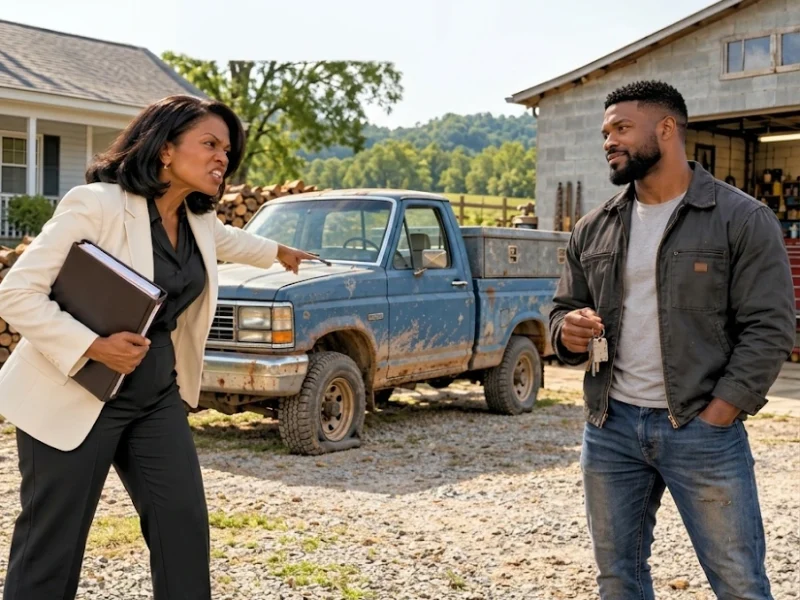
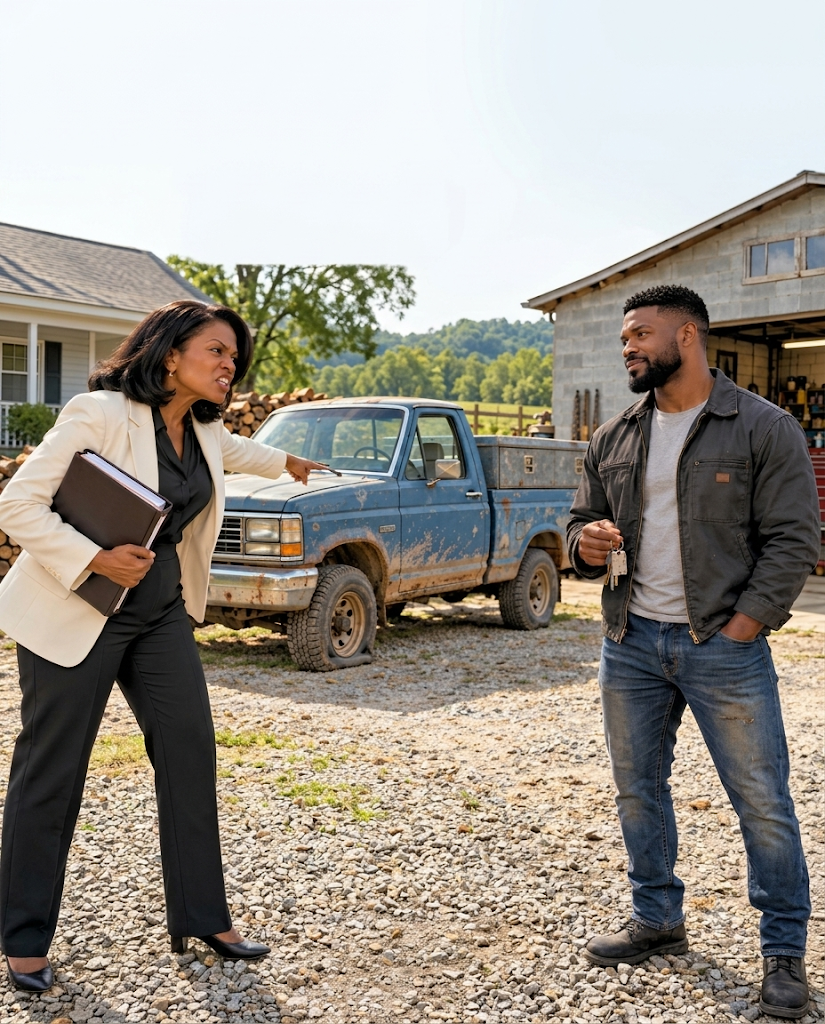
That old truck is all you inherit, she said, like she was reading off a receipt for something she wanted returned. Gordon left debts, more than this place was ever worth, and keeping the lights on had been a charity she’d apparently financed out of her own pocket. Get it off the property soon, because Curtis needs that space, and sign the release before you go, since it would make this whole thing easier.
She handed me those keys like she was discarding something she’d already written off in her mind. The truck was worthless to her, a rusted liability, proof of everything my father had failed to build in a county that measured men by what they left standing. She’d counted every asset and decided what to keep, and in that cold calculation the one thing she passed over without a glance was the one thing she never once looked inside.
My father didn’t leave me money. He left me something harder to argue with. Standing in that yard with keys in hand, I couldn’t help wondering how much she was going to pay for what she’d just thrown away.
My name is Nolan Rusk, and I’m thirty-one years old. At the time my father passed, I was living in a rented room above a tire shop in Harlem, working as a mechanic at a garage that specialized in fleet vehicles, delivery trucks, county equipment, the occasional school bus. It wasn’t glamorous work, but I was good at it, and the pay was steady enough that I’d managed to save a little over four years without touching it.
I had a plan, the same plan I’d had since I was about sixteen, sitting in the passenger seat of my father’s truck watching him back it down a dirt road toward some farmer’s broken combine at seven in the morning. I wanted to do exactly what he did, mobile repair, driving to the equipment instead of waiting for the equipment to come to you. Serving the farms and timber operations and cattle ranches that couldn’t afford to lose a machine for a week while it sat in somebody’s shop queue.
Gordon Rusk ran his shop out of a cinder block building beside the house he’d lived in since before I was born. The place wasn’t much to look at from the road, but walk inside and you’d find a man who knew exactly where every tool was, who could tell you from memory which of Hal Pritchard’s three tractors had the wiring problem that came back every other spring, and who kept records of every job he’d done going back nearly two decades. His customers weren’t wealthy, mostly families who had been farming the same land for generations, people who fixed things because buying new wasn’t an option, and who paid when they could because Gordon never made them feel like criminals when they couldn’t.
He was that kind of man. Lenora came into his life when I was nineteen, and she was practical, organized, and she moved through a room with the efficiency of someone who’d been managing things her whole life. At first that felt useful, since Dad was never comfortable with paperwork. Having someone take over the billing and the scheduling seemed like it freed him up to do the work he was actually good at, and for a while I think that’s genuinely what it was.
But things shifted slowly enough that it was hard to point to the exact moment it changed. The customers who’d been paying in installments for years started getting calls, and the long-distance jobs, the ones where Dad would drive forty minutes out to some property that didn’t have the equipment to haul a broken machine into town, those got cut back. Lenora called them money losers, and she wasn’t wrong about the math. She was wrong about what those jobs meant to the people who needed them and to the reputation my father had built over two decades.
The argument that ended with me leaving happened over a man named Earl Combs, a tobacco and cattle farmer who’d been a customer of my father’s since before Lenora was in the picture. Earl had fallen behind on a repair bill during a bad season, and Lenora wanted to refuse the next service call until the balance was cleared. Dad went quiet in the way he did when he didn’t want to fight but also didn’t want to agree, and I said what I thought, which was that treating a man who’d paid faithfully for fifteen years like a credit risk because of one hard winter was exactly the wrong way to run a business built on trust.
The fight that followed wasn’t really about Earl Combs. Dad told me I didn’t understand how a business worked, and I told him I understood it better than someone who’d only been around for two years. Lenora didn’t say anything, because she didn’t need to. She’d already won that argument before it started.
I drove back to Harlan that night. I told myself I’d come home when I had enough money to stand on my own ground, when I could walk in without needing anything from anyone. It felt like a decision at the time. Looking back, it was just a way of not admitting that I didn’t know how to cross back over what I’d said.
We still talked, Dad and I, phone calls maybe once every few weeks. He’d ask about the shop, I’d ask about the shop, and we stayed in the shallows. Neither of us mentioned that night. I think we both assumed there would be time to get to it eventually, when things were less raw, when we were both ready.
He got sick in the fall of the year before he died. By the time I understood how serious it was, things had already progressed further than he’d let on. There was a week in January when I knew from his voice that something had shifted. He was slower, quieter, choosing his words more carefully than usual.
I told myself he needed rest, not a visitor who would show up looking frightened. I sent a card instead of driving down, and the honest version of that decision is less flattering than the one I told myself at the time. I wasn’t protecting him from worry. I was protecting myself from having to see how bad it had gotten.
He died on a Tuesday in March. I drove down the same day I got the call. The service was small. The people who showed up were mostly his customers, men in work boots standing at the edge of the parking lot of a church that had seen better days, holding their hats and not saying much.
That was its own kind of tribute. Gordon Rusk wasn’t a man who collected admirers. He collected people who kept coming back because he’d never once steered them wrong.
Two days after the funeral, Lenora called a family gathering. She had the binder ready when we walked in, thick and professionally tabbed, and she set it on the kitchen table like it was evidence. She walked through the numbers with the calm efficiency of someone who’d rehearsed the presentation, and she explained that the shop carried debt, a secured loan, overdue supplier invoices, back taxes that had gone unaddressed.
She’d been covering the gap, she said, out of her own personal funds. Without her contributions, the doors would have closed long before Gordon had the chance to pass anything along to anyone.
Curtis Vail sat in the corner near the window, dressed better than anyone else in the room, with the look of a man who had driven a long way and expected the trip to be worth it. He and Lenora exchanged exactly one glance during the entire presentation, the kind of glance people exchange when they’ve already agreed on something and are just waiting for the formality to finish.
Then she dropped the keys on the table. I picked them up, and I didn’t look at her when I did it. I looked at the keys, which were worn smooth from years of use, and at the keychain, a small metal rectangle with the initials GR stamped into it, something I’d given my father as a birthday gift when I was eleven years old and thought it was the most useful present I could come up with.
She slid a document across the table before I reached the door, a release form. She explained it would allow the estate administration to proceed without dispute, would help the debts get resolved faster, would help everyone move forward. It was framed entirely as a practical measure, and she delivered it in the tone of someone doing me a favor by offering me the simple way out.
I asked to see the complete financial records before I signed anything. She looked at me for a moment, and the expression on her face wasn’t anger. It was the composed, slightly pitying look of someone who believes they’ve already thought ten moves ahead and can afford to be patient with the person still figuring out how to begin. She said the records were available through the estate attorney, and she was sure I’d find everything in order.
I took the release form with me when I left. I didn’t sign it.
**Part 2**
The truck was exactly where it had been since before the funeral, parked at the side of the house next to the wood pile, one rear tire flat, the door handles filmed with a winter’s worth of dried mud. In the fading afternoon light, it looked like something that had been waiting.
I know that sounds like the kind of thing a person says to make a story feel more meaningful than it is, but that’s genuinely what I thought when I stood there looking at it. Like it had been sitting there specifically waiting for me to come and open it.
I got the floor jack from inside and set to work on the flat. That’s when I saw the lock. It was on the lower storage compartment built into the bed of the truck, a steel box my father had welded in himself years ago, long enough back that I barely remembered him doing it. He’d used it for storing tools he wanted to keep separate from the main bed, the ones he used most often, the ones he didn’t want sliding around on rough roads.
I’d seen him open it a hundred times. I’d never once seen it locked. The padlock was a small one, the kind with a short shackle, the kind you’d use when you weren’t worried about a dedicated thief but wanted to make sure something didn’t open on its own.
I went through the envelope of personal effects the funeral home had returned. His wallet, his watch, a folded piece of paper with a phone number written on it that I didn’t recognize, and a small key on a plain ring. It fit inside the compartment, wrapped in an oilcloth and then placed inside a ziplock bag with the air pressed out.
A set of hand tools my father had modified himself over the years, handles re-wrapped, certain pieces ground down to fit into spaces standard tools couldn’t reach, things a person builds over a lifetime of working on equipment that wasn’t designed to be easy to fix. Beneath the tools, several notebooks, each one sealed individually in its own plastic sleeve. They were labeled by year, going back more than a decade, and I recognized the handwriting before I even opened the first one.
And under the notebooks, a brown envelope with my name on it in the same handwriting. I sat on the truck’s rear bumper and opened it.
My father was not a man who wrote letters. He was not comfortable with that kind of communication, and nothing in what he’d written tried to pretend otherwise. The letter was short, and it was honest in the blunt, uncomfortable way of a man who knows he’s not good with words but has run out of other options.
He wrote that the truck had kept his business running for more than twenty years. He wrote that he’d thought about what I’d said all those years ago about starting a mobile service, and that he’d believed for a long time that I’d come back and we’d talk about it properly. He wrote the names of a handful of customers he thought would give me work if I reached out to them. He wrote about the roads he’d driven so many times he could navigate them without thinking, and how he figured I still remembered most of them.
Then he wrote the line I had to read twice before I could take it in. He wrote that he’d kept waiting for me to come back so we could settle what had happened between us, and that he’d let that waiting go on longer than a father should. He said he was sorry, not for being wrong or for being right, but for letting silence become the answer when it shouldn’t have been.
Below that, a smaller notebook, different from the repair logs. This one contained financial entries, not service records but payment tracking, amounts received, amounts outstanding, notes on transactions he couldn’t reconcile with the summaries Lenora had shown him. Several entries had question marks beside them, and a few had names attached with instructions to follow up.
The handwriting in the last several pages was smaller and less steady than in the earlier ones. He’d been writing in it while he was sick. The final entry on the last written page had been underlined twice, and it said, “Check where the money actually came from before you trust the summary.”
He didn’t know I’d find this in time. He didn’t know if I’d find it at all. He put it here anyway, in the one place he was certain would end up with me, locked with the key he kept on his person until the day he couldn’t anymore.
I sat there for a long time. When I drove back to Harlan two days later, I submitted a request for unpaid leave. My supervisor wasn’t happy, but he agreed to hold the position for a limited time. I called a woman named Marin Cole, an attorney in the county seat who’d been recommended by one of my father’s long-time customers, and I explained the situation as plainly as I could and asked if there was a case worth examining. She said she needed to see the documents, and I said I’d bring what I had.
Then I drove back to Breathitt County and knocked on the door of Della Boone, a widow who lived three miles from my father’s property and whose farm equipment Gordon had serviced for the better part of fifteen years. I asked if she had a room to let for a few weeks. She said she had one and that she’d charge me fairly if I was willing to help with a few things around the property that needed attention since her husband passed. I said that was fair.
I paid her the first week in advance from what I had saved. Then I went back to the truck, opened the locked compartment, and started reading every notebook my father had left me from the beginning.
The truck needed three things before I could trust it on the road. New brake lines, a charging system repair, and a section of the bed floor that had rusted through badly enough that I wasn’t comfortable putting weight on it. None of those were small jobs, but none of them were beyond what I could do myself if I bought the parts carefully and worked in the right order.
I sourced what I needed from a salvage yard two towns over and from a parts supplier in Hazard who gave me a modest discount when I told him whose son I was. I didn’t ask for the discount. He offered it without prompting, and that told me something about the kind of credit my father had built in this county, the kind that doesn’t appear on any balance sheet.
While the truck was still grounded, I worked through the notebooks. My father’s repair logs were methodical in a way I hadn’t fully appreciated when I was young. Each entry noted the date, the customer, the machine, the presenting problem, what he found on inspection, what he repaired, what parts he used and what they cost, and critically, what he suspected might come back.
There were marginal notes written in smaller handwriting, sometimes years after the original entry, tracking whether his predictions had been correct. Reading them felt less like reading a service record and more like reading the accumulated judgment of a man who had paid very close attention for a very long time.
I cross-referenced the logs against the list of names my father had written in his letter. Most of those customers were still active in the area. I called each of them and introduced myself. The majority said they’d be willing to give me a try. One said he’d already found someone closer and wished me luck.
That was a fair result. I hadn’t earned anything yet.
My first job came from a man named Dale Weston, who ran a cattle operation about twelve miles east on a road that turned to gravel for the last three miles. His irrigation pump had been losing pressure, and the previous repair done by someone other than my father hadn’t held. I read Dad’s notes on the Weston property before I drove out. The pump had a history. Gordon had serviced it four times over six years and had noted each time that the impeller housing showed wear consistent with drawing in fine sediment from the water source.
I arrived confident, too confident. The pressure loss presented exactly the way my father had documented it, and I made the same preliminary assessment he’d made on his second visit, worn shaft seals. I had the parts. I replaced them. When I primed the system and ran a test, the pressure stabilized, and I thought I was done.
Dale Weston came out of the barn to check on the progress, and I told him the pump was back in service. Forty minutes later, it was losing pressure again.
I went back under the housing and spent another hour working through the system methodically, the way I should have done the first time. The seal replacement had been necessary, but it wasn’t the cause. The suction line had a hairline separation at a coupling joint that was only visible when the line was under load. It was drawing air on every cycle. Simple fix, twenty minutes once I found it, but I’d already used parts that weren’t necessary.
The seals had needed replacing eventually, but not that day, and not as the primary repair. I covered the cost myself. By the time I packed my tools, I’d made back about thirty percent of what the job should have paid.
Dale Weston didn’t raise his voice. He stood by the fence and watched me load up, and just before I got back in the truck, he said that Gordon always ran a full line check before recommending parts. He wasn’t trying to wound me. He was just telling the truth. That made it worse.
**Part 3**
I drove back to Della Boone’s property and sat in the truck for a while before going inside. I’d known the notebooks weren’t a substitute for experience. I’d told myself that before the first job. Apparently, I hadn’t believed it deeply enough to change how I worked. My father’s records could show me what to look for. They couldn’t look for it for me.
I didn’t make that mistake again.
Marin Cole called twice that week with updates that weren’t encouraging. The financial records Lenora had provided through the estate attorney were internally consistent, which meant that to challenge any of the claimed reimbursements, we needed external corroboration. Payment records from suppliers, bank statements from the business account going back several years, confirmation from customers regarding specific transactions. The notebook was useful as a navigation tool, but it wouldn’t hold up as evidence on its own. We needed people who could confirm what the numbers actually said.
Meanwhile, word was moving through the county in the way that word moves in small communities, selectively, along lines of loyalty and relationship, and not always accurately. I heard secondhand that Lenora had told at least two people that I was contesting the estate out of spite, that I’d abandoned my father for years and had come back only when there was something to claim. One family I’d approached about potential work told me politely that they didn’t want to get involved in a family situation.
I didn’t blame them. Reputation in a county this size was everything, and she’d been working hers for years while I’d been absent.
I took what work I could find. Small jobs, mostly, a tractor with a stuck hydraulic valve, a hay baler with a broken shear bolt assembly that had been jury-rigged badly and needed to be done properly, a feed auger motor that had been wired incorrectly after a previous repair. Each job I completed on time and priced fairly and documented clearly. It was slow work, rebuilding trust from zero, but it was the only kind of work that would last.
The job that changed things came from Hal Pritchard. Hal was a third-generation cattle farmer who had known my father since they were both young men. He ran a modest operation, a hundred and twenty head, some hay ground, a small equipment line. His main workhorse was a mid-size utility tractor he used for everything from pulling feed wagons to clearing fence lines, and it had been acting up for about a week. Intermittent power loss, sometimes a full stall under load.
I pulled my father’s notebooks before I drove out and found three separate entries on Hal’s tractor going back seven years. The third entry was the one that stopped me. Gordon had noted a wiring fault, a harness segment near the rear of the engine compartment that had been rubbing against the frame on rough ground, slowly wearing through the insulation. He’d repaired it, but he’d written in the margin that the routing left the repaired section under recurring stress, and that it would likely present again.
He’d been right. It just took seven years.
I used his notes to identify the section of harness worth examining first, tested continuity at the suspect joint, and found exactly what he’d predicted, intermittent contact failure from a worn-through segment rubbing on the frame again, a few inches from the original repair. I rerouted the harness with proper clearance and secured it at three points so it couldn’t work back into contact with the frame under vibration. Total time on site, just under two hours. No unnecessary parts.
When I was packing up, Hal came over and leaned against the rear of the truck. He told me Gordon had done essentially the same diagnosis years ago. Then he said something else. He said my father had mentioned, more than once over the past couple of years, that he expected I’d be coming back. That Gordon had asked him and a few other customers whether they’d use a mobile service if his son set one up locally.
I kept my hands busy with the tool case while Hal talked. He went inside and came back with a folder. Inside were copies of old invoices and handwritten payment receipts going back several years. He said he kept records of everything because his father had taught him to. He laid them out on the tailgate and pointed to two transactions.
One of them appeared in Lenora’s records as an outstanding debt, a balance she claimed had never been collected. Hal had the receipt, Gordon’s handwriting, the amount, the date, and the notation paid in full underlined once at the bottom. I photographed everything he had and forwarded the copies to Marin that evening.
It was the first documented discrepancy with a living witness who could confirm it. Not a suspicion, not a question mark in a notebook, a specific amount, a specific date, and a man willing to attest to the facts.
But the conversation that stayed with me longer than any of that was what Hal said as I was leaving. He told me Gordon had talked about me with a kind of stubborn, patient pride that Hal had recognized because he’d felt the same way about his own son during difficult years. He said Gordon never once described our situation as permanent. He always talked about it like it was a temporary misalignment that would correct itself when conditions were right.
I drove back to Della Boone’s slowly that night. I thought about two men who had each been waiting for the other to walk back through the door first. Both too proud or too uncertain to simply be the one who reached out. Both assuming the other one knew the affection was still there even when neither of them was saying it.
The truck had not been an accident. The notebooks, the locked compartment, the letter, my father had assembled those things over time with a specific person in mind, a specific future in mind, and he had done it quietly while two years of phone calls stayed carefully in the shallows. He had not stopped believing I would come back. He had just run out of time before I did.
I understood then what I was actually carrying in that truck. Not an inheritance in any legal sense. A conversation that one side had prepared for and the other side had never arrived for. And now the only way to answer it was to finish what he’d started.
Three weeks later, Marin filed a formal challenge to Lenora’s claimed reimbursements and requested an independent review of the estate accounts. Lenora responded by withdrawing my access to the shop property for tool storage, citing the ongoing dispute as grounds to treat all assets as contested until formally inventoried and separated. I moved my equipment to a corner of Della Boone’s barn that she cleared out for me. It was cramped and the lighting was poor, but it was dry and it was mine.
I was on my way back from a job the next morning when the oil pressure gauge dropped. Not gradually, directly from normal to low in the span of about a mile on a straight road. I pulled off immediately and shut the engine down. I checked the level. It was fine. That meant the problem was internal.
Pressure loss with correct fluid level pointed to something inside the engine, a failing pump, a spun bearing, something I couldn’t diagnose on the roadside and couldn’t safely drive on without risking turning a repairable problem into a destroyed engine. I called Marin from the side of the road and told her I was temporarily out of service. She said the timing was unfortunate. The independent review process had been initiated but would take time, and during that time the estate secured creditors were becoming impatient.
Curtis Vail had submitted a formal offer for the shop and its contents. Lenora was advocating for acceptance on the grounds that further delay would result in forced liquidation at worse terms. I asked Marin if we had enough to stop the sale. She was quiet for a moment. Then she said the documented discrepancy from Hal Pritchard was significant, but one confirmed entry wasn’t sufficient to block a sale proceeding through legitimate creditor pressure. We needed the full accounting review to find a pattern, and that review was not going to be completed before the sale timeline Lenora was pushing.
The shop sold three weeks later. I drove over on the morning of the final transfer to collect what had been formally designated as personal property under the estate separation. The sign above the door, the one my father had hung when he first opened, simple black letters on a painted wood plank, was gone. The building was already in the process of becoming something else.
Inside, on the floor near the workbench, was the name board that had sat on the front counter for as long as I could remember. A small wooden rectangle, hand-routed letters, Gordon Rusk Mobile and Shop Repair. It was face down on the concrete. I picked it up and put it in the box with his logbooks and the small wooden chair he’d kept at the back of the shop for doing close work on small components.
I drove back to Della Boone’s and parked. A man had come by earlier in the week asking about the truck. He’d seen it from the road, knew the model, said he was interested in it for parts rather than running it. He’d offered me enough to cover two months of the room, a bus ticket back to Harlan, and a small cushion. He’d left his number.
I sat in the passenger seat with the envelope from the locked compartment open on my lap and read my father’s letter again. Not to find something new in it, just to hear his voice one more time through the words he’d chosen. The truck was a liability. It couldn’t work, and I couldn’t afford to fix it fast enough to keep the jobs I needed to survive. The man’s offer was honest and fair and would solve a real problem. Signing that paper would end the problem.
I held the paper for a long time. Then I put it on the dash without signing it, got out, and walked to the nearest farm on the road to ask if they had any labor they needed done. I needed to buy parts the same way my father had built his entire business, one job at a time, starting with whatever work was in front of me.
That night, I came back to the barn where the engine sat in pieces on a tarp on the floor. Della had left the exterior light on for me. I sat down in front of the disassembled block, and my hands were shaking from a day of physical work on top of everything else, and I said out loud to nobody in particular in a voice that came out quieter and more uncertain than I intended, “I don’t know if I can still do this, Dad.”
The light buzzed overhead. The parts lay in the order I’d arranged them. Outside, the road was quiet. I didn’t have an answer, but I didn’t get up, either.
**Part 4**
I made a list the next morning. Not a motivational exercise, a practical one. I wrote down every part the engine needed, the cost of each, and what I could earn per day doing manual labor at the farms within walking distance. I divided the total by the daily rate and got a number of days. It was longer than I wanted. It was shorter than I’d feared. That was enough to work with.
I spent the following two weeks doing the kind of work I hadn’t done since I was a teenager, loading hay bales, clearing brush along fence lines, helping a family two properties over pour footings for a new equipment shed. None of it used the skills my father had spent years teaching me. All of it paid in cash at the end of each day.
I kept a running total in the back of the same notebook I’d been using to track my repair jobs, and each evening I crossed off whatever I’d bought for the engine and updated the balance. Della Boone brought coffee out to the barn some nights when she saw the light still on. She didn’t say much. She’d known my father for a long time, and I think she understood that what was happening in that barn wasn’t just a mechanical repair. She never made me feel like a charity case, which was the thing I needed most from her and the thing she seemed to understand without being told.
I worked on the engine in sections, the same way my father’s notebooks organized every complex repair. Identify the confirmed damage, assess adjacent components before reassembling anything, replace only what the inspection justified. I’d made the mistake once of skipping that sequence on Dale Weston’s pump. I didn’t make it twice. When I wasn’t certain about a measurement, I drove to the machine shop in town and asked them to verify it rather than assuming I was right. That cost me time and a small fee each visit. It saved me from two errors that would have cost more than either.
Marin called on a Thursday morning while I was walking back from a neighbor’s property. She said the independent accounting review had made significant progress. The reviewer had identified a pattern in the business account transactions that matched what the notebook had suggested, multiple transfers to an account under Lenora’s sole control. Each one logged in the business records under descriptions that characterized them as operating expenses or supplier payments. When the reviewer contacted those suppliers directly, several of the payments couldn’t be confirmed. The money had moved out of the business account but hadn’t arrived where the records said it went.
What it had done instead was cycle back into the estate as claimed personal loans from Lenora to Gordon, the very reimbursements she was demanding repayment for from the estate. Marin said it plainly. Lenora had been taking money from the business, then presenting that same money as her own personal contribution that the estate owed her back.
I asked Marin what we needed from me to complete the record. She said she needed the full history of my relationship with my father, including the years I wasn’t present, the nature of the disagreement that had separated us, any financial support he’d provided during that time, and the extended period of limited contact. She needed it because Lenora’s defense would likely include characterizing me as an absent estranged son with no legitimate stake in contesting the estate’s administration.
I gave her everything. The argument over Earl Combs, the years of short phone calls, the times I had planned to go back and found a reason not to, the week in January when I knew from his voice that something had shifted and I sent a card instead of driving down. The truth was less flattering than the story I’d been telling myself, and I gave Marin the truth.
She thanked me and said it would actually help, not hurt, because it was consistent and verifiable, and because courts are skeptical of adult children who present themselves as having been perfect and present all along. That conversation cost me more than any of the physical labor had. Sitting with the honest version of my own history, written out and submitted as a legal document, required me to look directly at the parts I’d spent four years not thinking about too carefully.
My father had apologized in his letter for letting silence become the answer. He’d been right to apologize, but the silence had required two people. I was the other one. I didn’t go back and change what I submitted to make myself look better. The whole point of what my father had left me in that truck was that the truth had to stand as it was, not the version that served you best, but the version that was actually true. Protecting his memory meant keeping that standard for myself, too.
The engine went back together on a Saturday morning in early May. I filled the oil, primed the system, and let it idle for twenty minutes in the barn with the doors open while I stood close and listened for anything wrong. Nothing was wrong. The pressure held. The temperature stayed normal. I drove it half a mile down the road and back, parked it, checked beneath it for anything weeping, and found nothing.
I drove it the following Monday to a farm nine miles east where a tractor had been down for two weeks with a hydraulic leak. I diagnosed it, quoted the repair clearly, and explained exactly what I was going to do and what I wasn’t going to do and why. The farmer, a man named Roy Caldwell, asked if I was Gordon Rusk’s boy. I said I was. He said my father had done right by his family more than once, and he was glad I was back in the county.
I replaced the hydraulic line, tested the system under load, and confirmed the repair before I cleaned up. Roy paid me that afternoon. On the drive back, I let myself feel what I hadn’t let myself feel in a long time. Not triumph, not vindication, something quieter and more durable than either of those. The sensation of doing work I knew how to do and doing it correctly in the place where I’d learned to do it, using the skills of a man who had believed I’d come back to use them.
It was the first money I had earned in Breathitt County on the basis of my own reputation, not my father’s name. Roy had mentioned that, and it mattered, but my own work, my own diagnosis, my own repair, those were mine.
Two weeks later, Marin notified me that the estate court had ruled on the accounting review. The findings supported the challenge. The reimbursement claims Lenora had filed without documentary basis were denied. She was removed from her role as estate administrator and replaced by a court-appointed independent party. The portion of funds identified as improperly transferred was subject to recovery, including applicable interest. Several documents she had submitted to the estate attorney were flagged for further review by the county prosecutor’s office.
The arrangement between Lenora and Curtis Vail was also examined as part of the process. The undisclosed fee she had expected to receive following completion of the sale was documented and entered into the record. Curtis was required to account for his role in the transaction. The fee was withheld pending resolution of the broader dispute. Curtis, who had sat in the corner of that kitchen looking like a man waiting to collect, ended up answering questions under oath about what he had known and when he had known it.
Lenora retained a personal attorney. The recovery obligations extended to her individual assets. The house where she had lived, the house where she had dropped those keys on the table in front of the family, was listed among the assets subject to liquidation to satisfy the outstanding amounts.
Before the final papers were signed, her attorney requested a settlement meeting at Marin’s office. Lenora came herself. She looked smaller than I remembered from the day of the keys, not physically, but in the way a person looks when the story they’ve been telling has finally run out of room to hold them. She sat across the table and proposed a reduced settlement. Less money, less documentation of the specific conduct, and a mutual agreement that neither party would discuss the details publicly.
I told her my position hadn’t changed. The findings had been established through a legitimate process. I wasn’t interested in a number that required obscuring how it was reached. She was quiet for a moment. Then she looked past me toward the window and said she hadn’t known Gordon kept papers in the truck.
I looked at her directly when I answered. “That’s the point,” I said. “And you didn’t know what he taught me, either.”
She didn’t respond to that. Her attorney moved the conversation along, but I think she understood what I meant, whether she wanted to or not. The truck had been valuable to her only as a way of dismissing me with something that appeared to have form without substance. She had evaluated it by what she could see, the flat tire, the mud on the doors, the age of the paint. She hadn’t considered that the man who drove it for twenty years might have been more careful than she understood, or that what he kept inside it might outlast everything she had tried to build over the top of him.
**Part 5**
After the final accounting was complete and the genuine creditors were paid from the estate, there was a remaining distribution. It wasn’t enough to buy back the shop. It wasn’t enough to undo the months of lost income or replace the time I hadn’t spent with my father when I still could have. But it was enough to establish a stable foundation, a small leased workspace, a proper tool inventory, insurance, and working capital to survive the slow months.
That fall, I signed a lease on a small repair bay attached to the back of a farm supply store on the county road. The owner gave me reasonable terms in exchange for servicing the store’s own equipment at a discounted rate. It was a straightforward agreement that suited both sides, which was the only kind of agreement worth making.
The bay gave me covered space for jobs that required a lift or a controlled environment. The truck remained the operational center of the business. Three days a week, sometimes four, I loaded the bed with whatever the week’s jobs required and drove out to the farms and timber operations and cattle properties that couldn’t easily bring their equipment in. Same roads my father had driven. Same kind of work. Different handwriting in the logbook.
I established terms at the beginning of every new customer relationship, travel fees disclosed up front, parts authorization required before ordering, payment schedule agreed on before the first visit. Not because I didn’t trust people, because my father had trusted people without the structure to support that trust. The gap between his generosity and his bookkeeping was part of what Lenora had been able to exploit. I could honor what he had built for people and still run it in a way that would last.
A retired mechanic named Frank Sellers started coming around in October asking if I needed a second set of hands on larger jobs. Frank had worked at a dealership for thirty years and had more knowledge in his hands than most people accumulate in a lifetime. I paid him fairly for the days he worked and made no promises about what was permanent. He seemed to prefer it that way.
The truck still wore its original paint, a faded steel blue with surface rust along the lower panels that I treated but not covered. The welds my father had made to the bed and the tool storage compartment were still visible if you knew where to look. I repaired what needed repairing for function and safety and left the rest alone. The storage compartment stayed fitted with the same tools Gordon had left there plus the ones I’d added since. The notebooks stayed in their plastic sleeves held in place by the wooden bracket my father had built into the compartment wall so they wouldn’t shift on rough roads.
I started adding to them. Each repair I completed I entered in the same format my father had used. Date, customer, machine, problem as presented, findings on inspection, what I did, what I used, what I suspected might return. And I began marking entries to distinguish between what I’d learned from the notebooks and what I’d worked out on my own, so that whoever came after me, if anyone did, would know exactly whose knowledge was whose.
The keychain on my truck keys, the small metal rectangle with GR stamped into it, had worn down to almost nothing over the years, the letters barely legible. I’d had it restamped at a hardware store in town. Still GR. I wasn’t ready to change it. The notebooks had been his. Now they were becoming ours.
On a Tuesday evening in late November, I drove back from a job at a poultry operation about fifteen miles north. The job had run long and the light was already gone by the time I turned onto the county road. The toolbox my father had fabricated was on the passenger seat, the one from the locked compartment, the one he’d wrapped carefully and placed in the plastic bag, the one he’d built and rebuilt and modified over the course of a working life until it was exactly what he needed.
I pulled over at the end of Hal Pritchard’s long driveway to check my log before I lost the light entirely. I noted the day’s earnings, updated the customer record, and wrote a brief note about a secondary issue on the equipment I hadn’t addressed yet but would need to flag for the next visit. Then I closed the notebook and looked out the windshield for a moment.
The road in front of me was the same road I’d ridden down as a boy, sitting in this same passenger seat, holding a flashlight at whatever angle my father needed. It looked the same in the dark. The fields on either side, the tree line in the distance, the specific quality of quiet that belongs to rural Kentucky on a cold November night.
I started the truck and pulled back onto the road. She handed me those keys thinking she was giving me the least she could. My father put everything he had left to give into a locked box inside it. And somewhere between the flat tire and the first morning I drove it out of Della Boone’s yard with a full day’s work ahead of me, I finally understood the difference between what a thing is worth and what a thing is.
He didn’t leave me an empire. He left me a method. He left me the knowledge of what honest work looks like when it’s done right, what it costs to do it that way, and what you build when you refuse to do it any other way. I knew how I was going to live. I’d known for a long time. I just had to come home to remember it.
The real things people leave us aren’t always easy to recognize at first. They don’t always look like much from the outside. Sometimes they’re worn down, a little muddy, sitting beside a wood pile with a flat tire. But inside them, if the person who left them loved you enough to be careful, is everything you need to find your way.