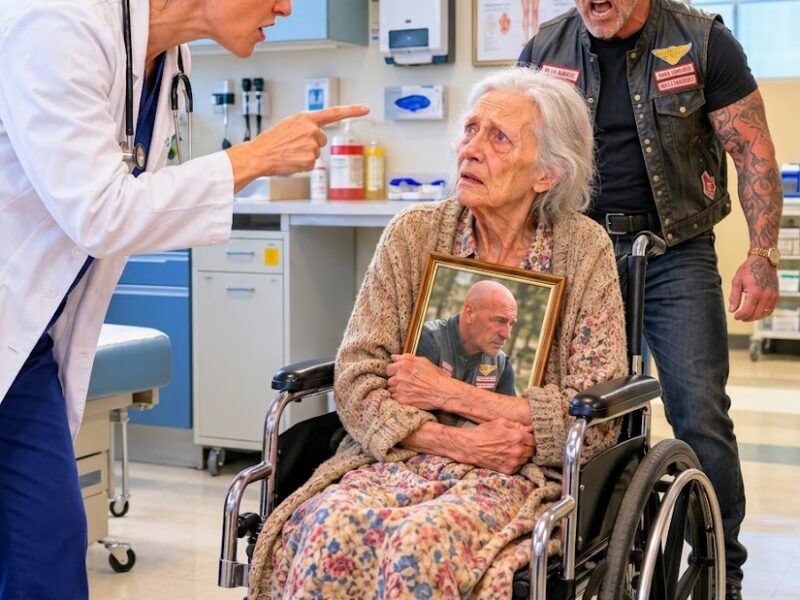
“Your son’s a liar,” the doctor mocked. Then a Hells Angels boss walked in—and changed everything.
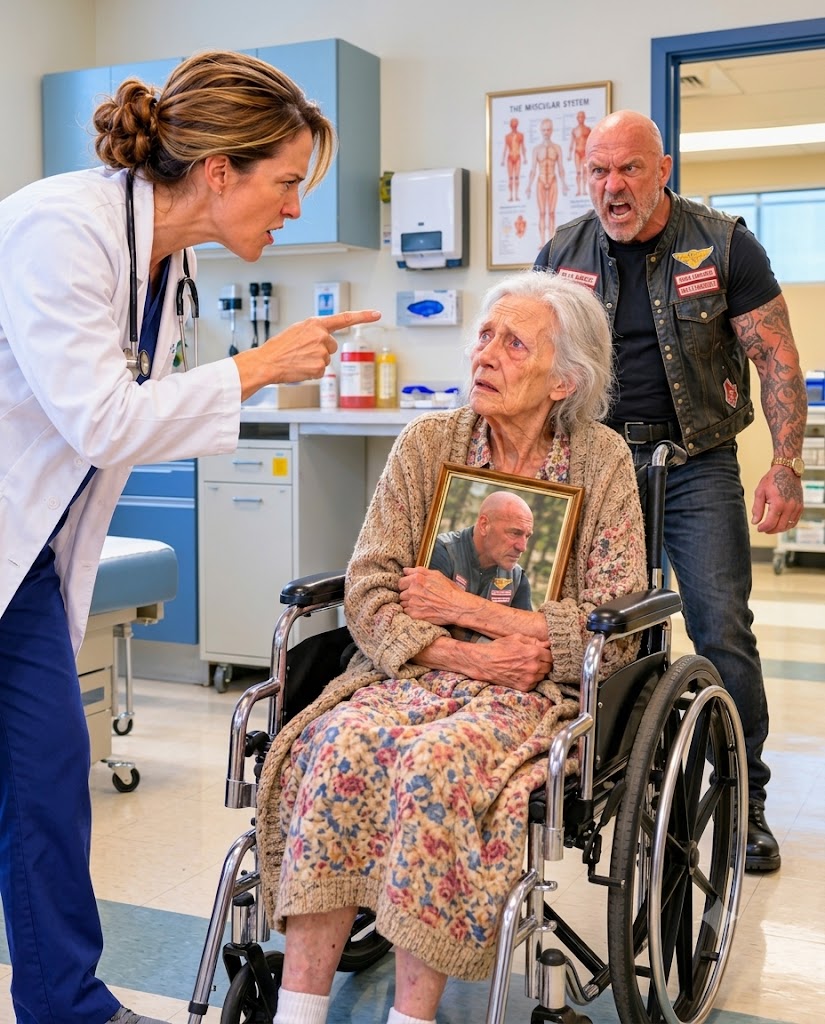
A small fist pounded against a hospital bed rail.
The boy’s scream tore down the hallway, high and raw, the kind of sound that makes strangers freeze.
His leg twisted under the thin blanket.
His mother grabbed his shoulders and tried to hold him still, but he kept thrashing, kept crying that it hurt, that something deep in his leg was burning.
A nurse looked away.
A doctor rolled his eyes.
Out in the parking lot, a motorcycle engine cut off.
Boot heels hit the pavement.
A dog’s nails clicked across the concrete.
The boy’s name was Danny C.
He was six years old, and three adults in that building had already decided he was lying.
What none of them knew was that the man now walking through those doors would not leave until somebody looked again.
So, what did that one scan reveal?
Stay with me on this one.
Marie Castalano hadn’t slept in two days.
She cleaned offices downtown at night and raised a boy alone during the day, and for six years that had been enough.
Tired, but enough.
This was different.
Three weeks ago, Danny had stopped running.
A week later, he stopped walking without a limp.
And for the last two nights, he’d woken up screaming, clutching his left leg below the knee, begging her to make it stop.
She’d carried him into the Reno emergency room at 11 that night with his arms around her neck, thinking, “Finally, somebody here will help.”
She was wrong, and it didn’t take long to find out.
She signed in and sat down with Danny on her lap.
He was burning up, not high, but the kind of warm a mother notices before any thermometer does.
She told the triage nurse about it, about the limp, the three weeks, how he’d stopped eating much.
The nurse wrote some of it down.
Not all of it.
They waited an hour and forty minutes.
The room they finally got wasn’t really a room.
It was a curtain.
And behind that curtain, after another thirty minutes, came Dr. Howard Prout.
Now, here’s the thing about Dr. Prout.
He was good at his job the way fast people are good at fast jobs.
Nineteen years in emergency medicine.
He could clear a waiting room and spot a drug seeker from across the hall.
He had a sense for who was really sick and who just wanted a bed.
And he was proud of it.
Proud enough that he’d stopped questioning it a long time ago.
He pulled back the curtain, glanced at Danny, and barely looked at the chart.
“What seems to be the problem?”
Marie started again.
The limp, the pain, the waking up screaming.
Prout pressed two fingers against Danny’s shin, and Danny jerked back and howled, and Prout looked at Marie like that proved something.
“Does it hurt here?”
He pressed the other leg.
Danny cried anyway, because he was scared now, because a stranger was hurting him and his mom wasn’t stopping it.
“Both legs,” Prout said flatly.
“Interesting.”
He straightened up.
“Mrs. Castalano, kids this age, they feel one thing and it spreads.”
“He sees you’re worried, so he’s worried, so everything hurts.”
“You following me?”
“He can’t walk,” Marie said.
“He walked in here.”
“I carried him in here.”
Prout gave a little smile.
Not a mean one exactly, a patient one.
The smile of a man who’s had this conversation a hundred times and believes he’s on the right side of it every time.
“Look, a lot of kids learn that pain gets them attention, gets them a day off school, gets mom to themselves.”
“I’m not saying your son’s doing it on purpose.”
“I’m saying it’s real to him without there being anything actually wrong.”
“Give him some children’s ibuprofen.”
“Let him rest.”
“And if he’s not better in a week, follow up with his pediatrician.”
Marie’s jaw tightened.
“I don’t have a pediatrician.”
“I have a copay I can barely make and a kid who screams in his sleep.”
“I’m asking you to look.”
“I did look.”
“Then look harder.”
And that was when Prout’s patience thinned out and showed what was underneath.
He lowered his voice.
“Ma’am, we’re slammed tonight.”
“I’ve got a real emergency in bed four and a possible heart attack coming through the doors.”
“I can’t order a thousand dollars of imaging because a six-year-old cries when I touch him.”
“That’s not how this works.”
He clicked his pen.
“I’ll have the nurse bring you ibuprofen.”
“Discharge papers after.”
He was gone before she could answer.
The curtain swung shut.
Danny looked up at her with wet eyes and asked in that small voice, “Are we going home?”
Marie didn’t answer.
She was doing the math.
She’d been doing it her whole life.
No money for a second opinion.
No car that would make it to another city.
No husband, no mother, no one she could call at midnight who’d know what to do except one person, and she hadn’t spoken to him in four years.
She scrolled to a number she’d told herself she’d never call again.
Her thumb hovered over it.
Danny whimpered and grabbed his leg, and that was enough.
She pressed call.
It rang twice.
Then a low gravel voice answered, wide awake even though it was past midnight.
“Marie?”
“Russ,” she said, and her voice broke on it.
“I need you.”
“I’m sorry.”
“I need you.”
The gravel voice didn’t ask why she disappeared for four years.
It didn’t bring up the fight or their father or any of it.
It asked one question.
“Where are you?”
Russell Castalano was fifty-one years old, and most people who met him made the same assumptions Dr. Prout would make the second he saw him.
Big man, gray in the beard, leather vest heavy with patches that told you exactly what he was: a president of a Hells Angels chapter out in the high desert, two hours north.
He’d done time years ago, the kind he didn’t talk about.
He had a scar through one eyebrow and knuckles that had been broken and reset more than once.
People crossed streets to avoid him.
What those people didn’t know was that Russ had raised Marie after their mother died when he was nineteen and she was ten.
That he’d read her to sleep.
That the thing that broke them apart four years back wasn’t anything cruel.
It was pride.
Both of theirs.
A stupid argument about the life he lived and the distance she wanted from it, and neither one had been willing to pick up the phone first until now.
He hung up and didn’t waste a second.
Boots on.
Keys.
He whistled once, low, and from the corner of the room a German Shepherd lifted his head.
The dog’s name was Diesel.
Nine years old, gray in the muzzle, stiff in one hip from a wreck two winters back.
He’d been a working dog once, trained for search and tracking before Russ ever had him.
And even old, he had that stillness trained dogs have, always listening to something you couldn’t hear.
He got up.
He didn’t need to be told twice.
Wherever Russ went, Diesel went, and had for nine years.
Russ tore through the dark desert, headlight cutting the black.
Diesel in a padded sidecar he’d built himself.
Two hours of empty highway.
He didn’t think about the fight or the four years.
He thought about a six-year-old nephew he’d met exactly twice and a sister who only called when she had no one else, which meant it was bad.
He opened the throttle.
By the time he hit the Reno city limits, the sky was still full dark.
He pulled into the hospital lot, the engine cut off, boot heels hit pavement, and Diesel climbed down, shook himself once, and fell in at the man’s left boot.
Nails clicking across the concrete, exactly where this story started.
Russ walked through the sliding doors and the whole waiting room went quiet.
You know how it is.
A man like that walks in, people look, then pretend they’re not looking.
The triage nurse stood up halfway, like she wasn’t sure whether to greet him or call security.
Russ didn’t notice or didn’t care.
He scanned the room once and found what he was looking for: his sister standing in the hallway with her arms wrapped around herself, and behind her, through a gap in a curtain, a small boy on a bed.
Marie saw him and something in her face came apart.
Four years of distance and he’d ridden through the night without a single question.
She crossed the floor and he caught her.
And for a moment, this huge, frightening man just held his little sister while she shook.
“Hey,” he said.
“Hey, I got you.”
“Tell me.”
So she told him.
The limp, the three weeks, the screaming, and the doctor, especially the doctor, the smile, the “coached,” the “wasting our time,” the discharge papers waiting at the desk.
Russ listened to all of it without a word.
His face didn’t change much.
That was the thing about him.
He got quieter when he got angry, not louder.
By the time she finished, he was very quiet indeed.
“Which doctor?” he said.
“Russ, don’t.”
“I’m not going to touch him.”
“I’m going to talk to him.”
He looked down at her.
“Which one?”
A nurse had already called for the charge nurse, who’d already thought about calling security, because that’s what you do when a Hells Angels president walks into your ER at one in the morning with a dog.
But before any of that could happen, Dr. Howard Prout came around the corner holding a clipboard, ready to sign off on a discharge, and he stopped dead.
He took in the vest, the patches, the scar, the dog, and he made every assumption he always made in about half a second.
“Sir, you can’t have an animal in here,” Prout said.
“And visiting a minor patient, we have rules.”
“He’s my nephew,” Russ said.
“And this dog’s a service animal.”
That last part wasn’t exactly true and wasn’t exactly false.
Diesel had papers for it.
Russ had made sure of that years ago, because a man who travels with a dog learns which doors stay closed without them.
“You’re the one who saw him.”
Prout’s chin came up.
“I’m the attending, and I’ve examined your nephew thoroughly.”
“There’s nothing.”
“You order any scans?”
“I don’t need a scan to recognize—”
“Yes or no?”
Russ hadn’t raised his voice.
He’d lowered it.
“Did you put that boy in a machine and look inside his leg?”
“Yes or no?”
The hallway had gone silent.
Two nurses had stopped.
Prout felt all of it, and he did what men like Prout do when they feel cornered in front of an audience.
He reached for authority.
“I’m not going to be interrogated by a—” He gestured vaguely at the vest, the beard, the dog.
“—by someone who walked in off the street.”
“Clinical decisions are mine.”
“If you have a problem, there’s a complaint process.”
Here’s where it could have gone bad.
Everybody in that hallway was braced for it.
The charge nurse had her hand near the phone.
Marie had her hand on her brother’s arm.
But Russ Castalano had learned something in fifty-one hard years that Dr. Prout had never had to learn.
He’d learned that the loudest man in the room usually loses.
So he didn’t shout.
He didn’t step forward.
He pulled out a chair in the waiting room, turned it to face the nurse’s station, and sat down.
Diesel lay down beside him with a grunt, muzzle on paws.
“Okay,” Russ said.
“Here’s how this goes.”
“I’m not leaving.”
“That boy’s not leaving.”
“And nobody signs any paper sending him home until somebody in this building puts his leg in a machine and looks.”
“You can call the cops.”
“They’ll come.”
“They’ll see a man sitting in a chair with a sick kid’s mother, and they’ll ask you why you won’t do one scan.”
“I’ll wait for that conversation.”
He folded his scarred hands in his lap.
“I’ve got all night.”
“I’ve got all week.”
And then he did the thing that unsettled Prout more than any threat could have.
He smiled.
A small, patient smile.
The exact same smile Prout had given Marie an hour before.
Then Russ went quiet, and he waited.
The waiting room got very, very still.
For a long minute, nothing moved.
Danny had stopped crying.
And for just a moment, it looked like the storm had passed.
Like maybe this big quiet man in the chair had somehow, without a single raised voice, made the whole thing stop.
Marie actually let herself breathe.
She sat down next to her brother, reached over, and scratched Diesel’s gray ears, and the old dog sighed.
It felt, for about thirty seconds, like it might all be okay.
It wasn’t.
Because that’s exactly when a pager went off at the nurse’s station, and a voice came over the intercom calling a full trauma to bed four.
And in the sudden rush of running feet and shouted orders, Dr. Howard Prout saw his chance to make the man and the dog and the whole embarrassing problem disappear.
He leaned over the desk, lowered his voice, and said four words to the charge nurse that changed everything.
“Call security.”
“Discharge the kid.”
Here’s the thing about those four words.
Up until that moment, this was a story about a doctor being lazy and a man being stubborn.
Pride against pride.
But the second Prout decided to use the chaos to shove a sick child out the door before anyone could prove him wrong, that’s when it stopped being about pride.
That’s when it became about a six-year-old’s leg and whether the people paid to protect it were going to actively throw him out to protect themselves instead.
The charge nurse, a woman named Gloria Ray, who’d been doing this twenty-two years, looked at Prout, then at the little boy behind the curtain, and something in her face said she didn’t like this.
But she had a trauma coming and a doctor giving an order, so she picked up the phone.
Russ heard it all.
He had ears like the dog did.
He stood up slow, and Diesel rose with him.
And for the first time that night, the big man’s calm had an edge under it.
“You’re going to throw a crying kid out at one in the morning,” he said, “so you don’t have to admit you missed something.”
“I didn’t miss anything,” Prout snapped, and now his voice was loud because he was rattled.
“There’s nothing to miss.”
“Soft tissue, growing pains, a mother who can’t set a boundary, and a—a biker playing tough guy.”
“I’ve got a real patient dying in bed four.”
“Security.”
Two security guards came around the corner.
Big guys, but young.
They looked at Russ and they looked at the dog, and you could see them doing the same math everyone did.
And this is where it turned.
Because of Diesel.
The old shepherd had been calm all night.
But as the guards approached, as the voices rose, Diesel didn’t bristle at them.
He did something else.
He pulled hard toward the curtain, toward Danny, and started to whine.
Low, urgent.
He pressed his nose against the boy’s dangling left foot, and he would not stop.
Russ had worked with this dog nine years.
He’d seen Diesel do this exact thing twice before.
Once over a man having a silent heart attack at a rally.
Once over a woman nobody knew was bleeding inside.
“Hey,” Russ said, and his voice cut through the whole hallway.
“Hey, everybody, stop.”
Something in it made them stop.
“This dog,” Russ said, “is a trained alert dog.”
“He’s pointing at the kid’s left leg.”
“Not the right.”
“The left.”
“The same leg the boy’s been screaming about.”
“You want to explain how a dog that never met this kid knows which leg is sick when the doctor who examined him couldn’t even tell me which one?”
Silence.
Prout opened his mouth.
Nothing came out.
And Gloria Ray put the phone down.
“Dr. Okafer’s on tonight,” she said quietly.
“Pediatric.”
“She’s between cases.”
She looked at Prout, and twenty-two years were in that look.
“I’m going to get her.”
“Gloria—” Prout started.
“I’m going to get her, Howard.”
If you’re still with me, and I hope you are, because this next part is why I wanted to tell you this one.
Do me a favor and hit that subscribe button.
Stories like this, about the people everybody writes off, are the whole reason this channel exists, and it genuinely helps more than you know.
Okay, back to that hallway.
Dr. Amara Okafer was thirty-eight, pediatric trained, and she’d been on shift nine hours.
She came around the corner tying her hair back, took one look at the standoff—the biker, the dog, the terrified mother, the red-faced attending—and did the one thing nobody else had done all night.
She walked past all of them and knelt down next to the little boy.
“Hi, Danny,” she said.
“I’m Amara.”
“I’m a kid doctor.”
“That means I only work on people under about four feet tall.”
“So you’re perfect.”
Danny gave her a wet, uncertain look.
“Can I see your leg?”
“I promise I’ll be gentle.”
“And if it hurts, you tell me to stop, and I’ll stop.”
“Deal?”
Danny nodded.
She didn’t press it like Prout had.
She rolled up the pajama leg slow, and she looked.
Really looked.
And her face changed.
“How long has this been warm?” she asked Marie.
“Three weeks, the limp.”
“Warm a few days.”
“Fevers, night sweats?”
“Low fevers.”
“Not eating much.”
Okafer felt the shin with the backs of her fingers, not the tips.
She measured one calf against the other with her hands.
She pressed a spot above the ankle, just slightly, and Danny gasped, and she stopped immediately and said, “Good job telling me, buddy.”
“You did great.”
Then she stood up and walked straight to the nurse’s station and started typing.
“I want an X-ray of the left tib-fib, stat,” she said.
“And labs: CBC, ESR, CRP, the works.”
“And page radiology, because depending on what that film shows, I want an MRI tonight.”
“Amara—” Prout found his voice.
“This is a soft tissue—”
“Howard,” she said, not even turning around.
“A six-year-old with three weeks of limp, localized bone pain, warmth, low-grade fever, and weight loss gets imaged every time.”
“That’s not a judgment call.”
“That’s a med student exam question.”
She finally looked at him, and there was nothing cruel in it, which made it worse.
“You know that.”
Russ carried Danny to radiology himself, because the boy wouldn’t let go of him, and Diesel walked at his heel the whole way, and nobody tried to stop the dog this time.
Marie walked on the other side, holding her son’s hand.
The tech, a kid barely out of school, positioned the leg as gently as he could while Danny whimpered, and shot the film.
Then they waited.
And this time, the whole night shift waited with them, because everybody knew now.
A dog had pointed at a leg, and a tired pediatrician had believed a six-year-old.
And now they were all going to find out together whether the man in the leather vest had been right to refuse to leave.
The film came up on the screen.
Dr. Okafer looked at it for a long time without saying anything.
Then she pulled Dr. Prout over quietly and pointed at a spot on the image of the boy’s lower leg.
There, in the long bone below the knee, was something that should not have been there.
A ragged area in the bone, moth-eaten at the edges, with a strange reaction along the shaft where the body had been trying for weeks to wall something off.
New bone laid down in layers, like rings on a tree.
The way bone responds when something is eating at it from the inside.
“That’s not growing pains,” Okafer said softly.
“That’s a lesion.”
“Howard, look at the periosteal reaction.”
“Look at it.”
Prout looked, and the color went out of his face.
He’d been doing this nineteen years.
He knew exactly what he was looking at, or at least what it could be.
And he knew the list of things that make a child’s bone look like that at six years old is short.
And every single thing on that list is the kind of thing where weeks matter.
Where the difference between catching it tonight and sending the kid home with ibuprofen could be the difference between a course of treatment and an amputation.
Between a childhood and a funeral.
“We need an MRI,” Okafer said.
“Tonight.”
“And I’m calling pediatric oncology and ortho, and I want this kid admitted now.”
“Right now.”
Nobody argued.
Nobody mentioned security.
Nobody mentioned the dog, or the vest, or discharge papers.
Russ stayed with Danny right up to the door of the machine, and when they made him step back, he crouched down to the boy’s level and said, “You hear me?”
“You’re the toughest guy in this whole building.”
“Tougher than me.”
“You hold still for the loud machine, and when you’re done, I’ll be right here.”
“Me and Diesel both.”
“We ain’t going anywhere.”
“Promise?” Danny said.
“On everything I got,” Russ said.
And he kept it.
He sat in that hallway, a fifty-one-year-old outlaw with a gray-muzzled dog at his feet.
Through the whole scan.
Through the images coming up.
Through Dr. Okafer making four phone calls in a row in a low, fast voice.
Marie sat beside him.
At some point, without really deciding to, she put her head on her brother’s shoulder, the way she had when she was ten and he was nineteen and the whole world had just fallen out from under them both.
He put his arm around her and didn’t say anything, because there wasn’t anything to say yet.
When Okafer finally came back, she pulled a chair over and sat down in front of them, which is how you can always tell the news is serious.
When the doctor sits down to your level instead of standing over you.
“I’m going to be straight with you,” she said, “because you’ve earned straight.”
“Danny has what we call an osteosarcoma.”
“A bone tumor.”
“It’s in the tibia, the big bone in his lower leg.”
“It’s aggressive, and it’s been growing a while.”
“Weeks, maybe a couple of months.”
“That’s the bad news, and I’m not going to soften it.”
Marie made a sound.
Russ took her hand.
“But,” Okafer said, and she leaned in, “here’s the part you need to hold on to.”
“The scans are clean everywhere else.”
“We don’t see it anywhere but the leg.”
“That matters more than almost anything.”
“Caught like this, localized, in a kid his age, the survival numbers are good.”
“Not perfect, but good.”
“Chemotherapy first to shrink it, then surgery, then more chemo.”
“It’s a long road.”
“Months.”
“It’ll be brutal.”
“But kids beat this.”
“They beat it a lot.”
“And if we’d gone home tonight,” Marie asked, “with the ibuprofen?”
Okafer was quiet for a second.
“If you’d come back in another month or two, when the pain got unbearable, it might have spread to his lungs by then.”
“And that’s a different conversation.”
“A much worse one.”
She looked at Russ.
“You didn’t leave.”
“That’s why we’re having the good version of this talk instead of the bad one.”
Russ didn’t say anything.
He just looked down at Diesel and reached a scarred hand to the old dog’s head, and the dog leaned into it.
Now, you might expect the story to end there.
Diagnosis made.
Family vindicated.
The big man a hero.
But there were two more things that happened that night, and they’re the reason I remember this one.
The first was Dr. Howard Prout.
He’d stayed at the edge of the hallway through all of it.
And most men in his position would have found somewhere else to be, would have let the shift change, let the shame fade, filed it away as a near miss and never spoken of it.
But something had broken loose in him when he saw that film.
Nineteen years of a sense he was proud of, and it had almost sent a boy home to die because the boy’s mother was poor and tired and the boy’s uncle wore the wrong jacket.
He walked over slow.
He looked like a man walking to his own hanging.
He stopped in front of Marie first, not Russ.
“Mrs. Castalano,” he said, and his voice wasn’t steady.
“I was wrong.”
“Not—not a little wrong.”
“Completely wrong.”
“You told me the truth, and I decided I knew better, and I almost—”
He stopped.
Started again.
“There’s no version of this where I apologize enough, but I’m sorry for every word I said to you.”
“You fought for your son when I wouldn’t.”
“I’ll carry that the rest of my career.”
Marie looked at him for a long moment.
She could have torn him apart.
She had every right to.
Instead, she said very quietly, “You almost killed my baby because of how we look.”
“Yes,” Prout said.
“I did.”
“Then you make sure you never do it to anybody else’s.”
“I won’t,” he said.
“I swear to you I won’t.”
Then he turned to Russ, and he put out his hand, and for a second it hung there in the air, because an offered hand from a man like Prout to a man like Russ was not a small thing, and both of them knew it.
Russ looked at the hand.
Then he looked at the man, and he took it.
“You looked when it counted,” Russ said.
“Took you too long, but you looked.”
“That’s more than most.”
He didn’t let go right away.
“There’s going to be a review of tonight.”
“A complaint.”
“My sister’s going to file it, and I’m going to help her, because the next kid who comes through those doors looking like we look needs it on the record.”
“That’s not personal.”
“You understand me?”
“I understand,” Prout said.
“I’ll tell the truth in it.”
“All of it.”
And he did.
That was the second thing.
When the formal review came, and it came because Marie filed it and Gloria Ray backed every word and Dr. Okafer wrote a statement that didn’t spare anyone, Dr. Howard Prout sat in front of the hospital board and told them exactly what he’d done.
He didn’t blame the workload.
He didn’t blame the mother.
He said, on the record, that he had looked at a frightened family and a child in pain and decided, based on nothing but how they appeared to him, that they weren’t worth a scan.
He asked to be the one to redesign the department’s pediatric pain protocol so that no complaint of localized bone pain in a child could ever again be waved off without imaging.
They let him.
He spent the next two years building it.
They named it, eventually, the Castalano Protocol, after a boy who almost got sent home.
Danny Castalano started chemotherapy that week.
It was every bit as brutal as Dr. Okafer had promised.
He lost his hair.
He lost weight he didn’t have to lose.
There were nights he was so sick he couldn’t lift his head, and one terrible week in the second month when his counts dropped so low that an infection put him in intensive care and nobody slept.
Marie was there for all of it.
She quit the night job.
Russ wouldn’t hear otherwise.
And for the first time in four years, she let her brother carry something for her.
The chapter took up a collection.
Leather-vested men who scared people in parking lots passed a helmet around and filled it, and then did it again.
And a biker charity ride that summer put Danny’s medical bills to rest in a single Sunday afternoon.
Nineteen thousand five hundred dollars, gone in one afternoon of roaring engines and good men doing quiet work.
Diesel came to visit.
The hospital bent its own rules, because by then everyone on that pediatric floor knew the story of the old shepherd who’d pointed at the right leg.
Danny would be curled in his bed, pale and bald and small, and the old dog would be lifted up carefully beside him, and the boy would wrap his thin arms around that gray neck and just breathe.
The nurses said his pain scores dropped on the days the dog came.
Dr. Okafer wrote that down, too, in her own quiet way.
The surgery came in the fall.
They saved the leg.
That’s the part Marie says she’ll never stop being grateful for.
They didn’t have to take it.
They cut out the tumor and the bone around it and rebuilt what was left.
And Danny spent months learning to walk again on a leg that was his own.
There was a long scar.
He was proud of it.
He showed it to everyone.
He called it his tough-guy stripe, because his uncle had told him the toughest guys always have the best scars.
And Danny believed every word his uncle said.
He rang the bell at the end of treatment eleven months after the night this all started.
If you don’t know, there’s a bell on a lot of children’s cancer wards, and when a kid finishes their last treatment, they get to ring it, and everybody comes out to cheer.
Danny rang it so hard they thought he’d pull it off the wall.
Marie cried.
Dr. Okafer cried.
Gloria Ray cried.
And standing in the back of that hallway, too big for the little chairs, was Russ Castalano, with a gray-muzzled German Shepherd sitting at his left boot.
And when the bell rang, the old outlaw who everybody crossed streets to avoid put his scarred hand over his mouth and wept like a child.
Danny’s in remission now.
He runs again.
He races the dog in the yard, and even old and stiff, Diesel still beats him, which makes the boy furious and delighted in equal measure.
Marie and Russ talk every week.
The four years of silence are gone, like they never happened, burned off by one long night.
And here’s the thing I keep coming back to now that it’s earned.
That first scream in the hallway, the one that made strangers freeze.
Three trained adults heard it and decided it was a lie.
It took a tired mother who wouldn’t quit, a doctor willing to kneel down and listen, and a worn-out old dog who couldn’t be fooled by a leather vest or a hospital gown to hear what that scream actually was.
It was the truth.
It was a little boy telling the truth with everything he had and almost nobody believing him.
So the next time somebody tells you something hurts—a kid, a stranger, anybody—and every instinct you’ve got says they’re exaggerating, they’re faking, they’re not worth the trouble, do me one favor.
Do what Russ did.
Don’t leave.
Look again.
Because sometimes the person everyone’s written off is the only one in the room telling the truth.









