“You’ll Never Give Me a Family,” He Told His Wife in a Wheelchair—Seven Years Later, He Begged at Her Door
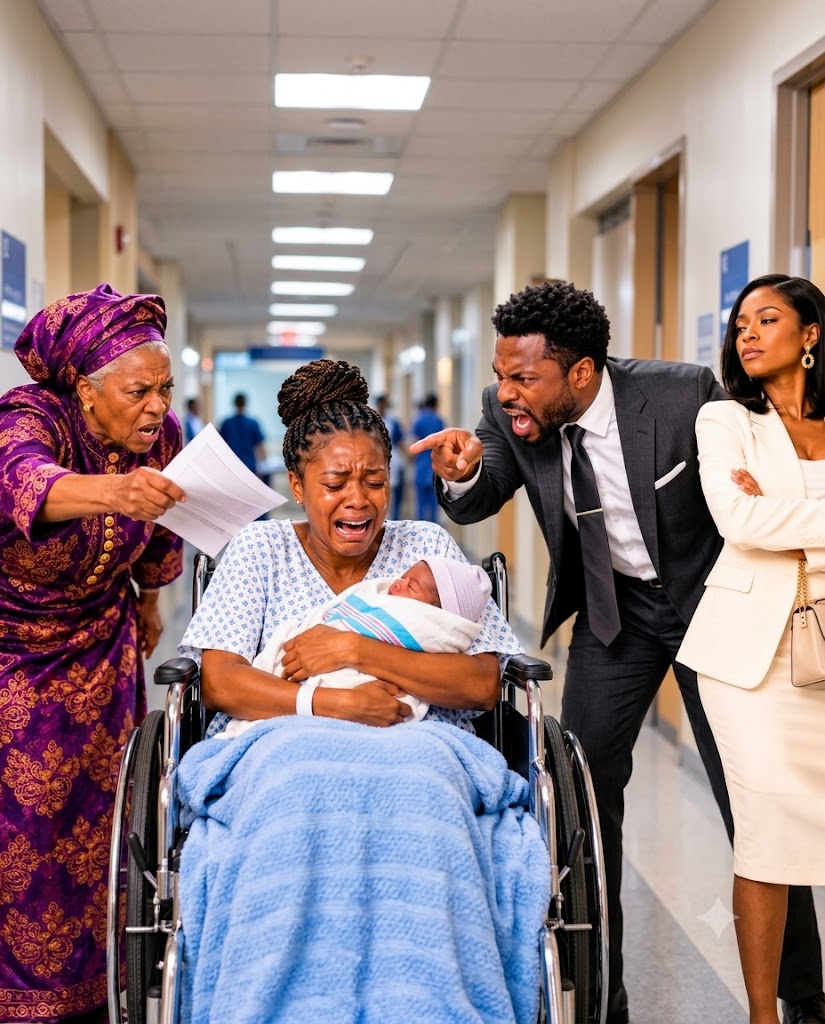
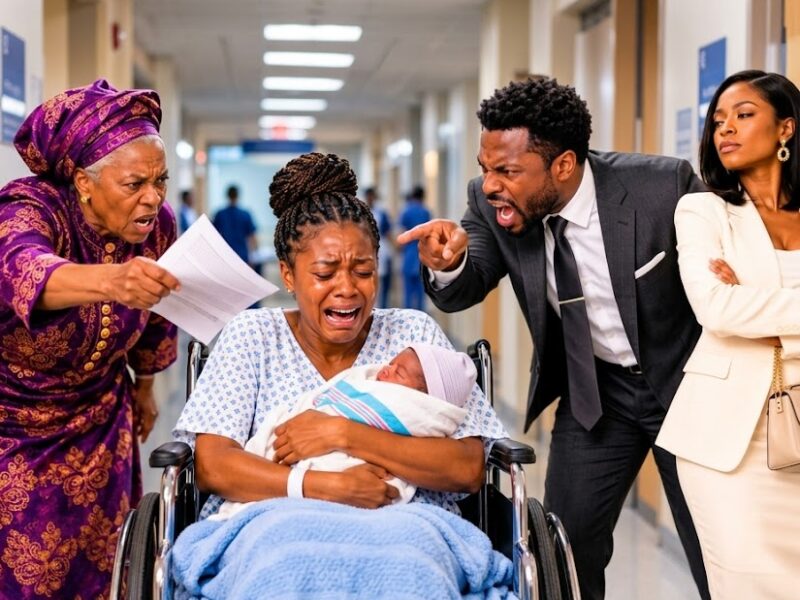
The rain hit the hospital windows like small fists, and Macy counted the drops instead of the contractions because counting the contractions made them real. Her wheelchair squeaked every time she shifted, a sound that reminded her of the old sewing machine back in her aunt’s workshop, the one that never quite sat level on the floor. She had come to this ER alone at 2:47 a.m., her phone at 3% battery, her bag holding nothing but a toothbrush, a granola bar, and the ultrasound photo she had folded so many times the crease had gone soft as cloth.
A nurse with kind eyes and a name tag that read “Deborah” knelt beside her and said, “Honey, you’re fully dilated. We’re going to have this baby tonight.”
Macy nodded. She had known it would be tonight. She had felt it in her bones since morning, the same way she felt a design coming together before she ever touched a pencil.
“No partner coming?” Deborah asked gently, not prying, just checking.
“No,” Macy said. “There is no one.”
That was not entirely true. There was Yao, whose name meant “low but not zero,” though he had never understood what that meant. There was her mother, who had said *feelings are cheap* like it was scripture. There was a man in a Dubai penthouse who had signed a contract worth 2 million USD and had promised to triple everything, and who had disappeared when the accounts came up empty.
But none of them were here. And Macy had learned long ago that *here* was the only word that mattered.
—
She had met Yao in Kumasi, in the Adum district, where the fabric market smelled like dye and dust and possibility. She was nineteen, drawing jackets on the backs of receipt paper because she couldn’t afford a sketchbook. He was twenty-two, carrying boxes for a textile trader, and he stopped when he saw her drawing.
“That’s beautiful,” he said. “One day, I’ll wear your name.”
She laughed. “Only if you promise to model it.”
“Only if it comes in gray.”
“Come home early,” she said, testing him.
“Always,” he said, and she believed him.
They married six months later, in a small ceremony with her auntie’s blessing and her mother’s silence. The silence was the loudest part. Her mother had said, years before, *They told me never. They all told me never.* And Macy had grown up under that word like a roof that leaked.
When she and Yao started trying for a child, she waited for the same verdict. She went to three doctors, then four. The last one, a man with gray temples and a clipboard he never looked up from, said, “Medicine is never certain, but you should prepare yourselves.”
Yao squeezed her hand. “We’ll keep trying.”
But there was a night, six months later, when Macy stood in the bathroom holding a test she had bought at a pharmacy two towns over, so no one would know. She saw the second line appear, faint as a pencil smudge, and she whispered, “Hello, little one.”
She told Yao that night. She held out the test like an offering.
He stared at it for a long time.
“You’re smiling too much,” he said. “What are you hiding?”
“Close your eyes,” she said. “Open your hand.”
She placed the test in his palm.
“The doctor said never,” he said slowly.
“Then the doctor was wrong.”
“Everyone said never, Macy.”
“Then everyone was wrong.”
He looked up at her, and for a moment—just a moment—he looked like the boy in the market who had promised to wear her name.
“Our child,” she said. “Yao, we’re having our child.”
—
Her mother heard the news and said nothing for eleven seconds, which was the longest Macy had ever known her to pause.
“I’ll take you to your appointments,” her mother said finally. “But I would like you to be careful.”
“I’m always careful.”
“No,” her mother said. “You’re hopeful. There’s a difference.”
The pregnancy was hard. She was put on bed rest at twenty-six weeks. Her auntie came from Kumasi and stayed in the spare room, cooking jollof rice and telling stories about the old weaving days. Yao worked double shifts at the warehouse. At night, he would sit beside the bed and read to her from a book of Ghanaian folktales, and she would fall asleep to the sound of his voice.
At thirty-four weeks, the doctor said, “Any day now.”
Macy called Yao. “Will you come with me? To the hospital, when it’s time?”
“I have meetings,” he said.
“Mama will take you,” her mother said from the doorway.
“I would like you there,” Macy said. “Yao.”
“The doctor said never, Macy.”
“What does that have to do with anything?”
“Who changed their mind?” he asked.
She went quiet.
“Mama, not now,” she said.
“I can hear you, Mama,” Yao said.
“Then hear this,” her mother said. “The truth does not fear questions.”
—
The labor came at 1 a.m. on a Tuesday. Her auntie drove her to the hospital while her mother stayed on the phone, calling Yao, who did not answer. Macy’s wheelchair was the first thing she saw when they arrived—a nurse had already prepared it, because the contractions were coming so fast she couldn’t stand.
She pushed for two hours. And then there was a cry, sharp and furious, and a nurse said, “It’s a boy.”
They placed him on her chest. He was red and wrinkled and perfect, with a shock of black hair and a tiny crescent-shaped birthmark on his neck, just below the ear.
“Look at him,” Macy whispered.
Yao arrived forty minutes later. He had come straight from a meeting, his tie loose, his eyes bloodshot.
“Yao,” Macy said. “Come and meet your son.”
He walked to the bedside and looked down at the baby. The baby opened his eyes, dark and curious.
“Say it again,” Macy said. “Say this child is mine.”
He did not speak.
“Yao, look at him.”
“The doctor said never,” he said. “You heard it yourself.”
“I heard it,” she said. “And I heard the doctor say he was wrong.”
“You cannot have children,” he said. “Whose baby is this?”
The room went silent. Even the baby seemed to hold his breath.
“Yao,” she said. “He is yours. I have never lied to you. Not once.”
“Take your things,” he said. “Find his father yourself.”
“Yao.”
He walked out. The door swung shut behind him, and the sound of it was like a book closing.
—
Her auntie arrived the next morning with a bag of clothes and a look that could crack stone.
“It is only you and me now, my son,” her auntie said to the baby, who was sleeping in Macy’s arms. “I am so sorry.”
“I saw everything,” a nurse said quietly. She was young, with a name tag that read “Amara.” “He will not believe me.”
“A paternity test would settle this,” Macy said. “I can arrange it today.”
“A man who needs paper to believe me does not deserve the answer.”
“Where will you go?”
“Kumasi,” Macy said. “My auntie’s house. We don’t need his belief to know who you are.”
—
Her auntie’s house was small, but it was full. Full of fabric scraps, full of the smell of dye, full of cousins and neighbors who came and went and never asked a single question about the baby’s father.
“Auntie,” Macy said one evening, holding up a jacket she had made from scraps. “Do you think this will sell?”
“Use them,” her auntie said. “Scraps can still be beautiful.”
“This will sell before the dye dries,” Macy said.
“Then tomorrow we eat well.”
She named the baby Kofi, which meant “born on Friday,” because he had been born on a Friday, and because she wanted him to have a name that was his own, not a name that belonged to anyone else.
“You carry his mark, Kofi,” her auntie said, touching the crescent birthmark on the baby’s neck. “But never his doubt.”
—
The years passed. Macy sewed. She sewed jackets, then dresses, then a full collection. She sold at the market, then to boutiques, then to a department store in Accra. When Kofi was four, she opened a small workshop with three employees. When he was five, she got a contract to supply 20 jackets to a boutique in Adum by Friday.
“Twenty?” her auntie said. “Then we need more thread and more hands.”
“We will find them,” Macy said.
She found them. She found seven women who needed work, and she taught them to sew, and she paid them fairly, and she never once asked them to believe in her. She only asked them to work.
“Why the crescent?” one of them asked, pointing to the logo on the jacket.
“It is my son’s mark,” Macy said. “It brings me luck.”
—
When Kofi was seven, a newspaper called her the finest designer in Kumasi.
“The newspaper has not seen my accounts,” Macy said.
“Hush and let a woman be proud,” her auntie said.
That same year, a man named Aqua came to her workshop with a contract. He was tall, polished, and spoke in the language of big risks.
“We began with scraps, my son,” he said. “Trust me. The Dubai contract will triple everything.”
“It is a big risk,” Macy said.
“Big risks are for big men.”
She signed. She invested. She gave him everything.
And then the money disappeared.
“Where did the 2 million USD go?” she asked.
“Investments,” Aqua said. “Darling, these things take time.”
“Time? We have none.”
She came home one day to find him packing a suitcase.
“Where are you going with that?”
“I did not sign up for a man with nothing.”
“After everything I gave you—”
“You gave me a name that is now worthless.”
He left. And Macy sat on the floor of her workshop, surrounded by fabric and thread and the crescent logo that meant her son, and she did not cry. She had learned long ago that crying was a luxury she could not afford.
—
Kofi grew. He drew. His teachers said his drawings were the best, and Macy hung them on the wall next to the crescent logo, and she told him, “You were born under a lucky moon.”
“Why does my neck have a moon?” he asked.
“Because you were born under a lucky one.”
He was seven when he asked the question that changed everything.
“Mama, the doctor said never. Did they say it to you?”
Macy went still. “Why do you ask this now?”
“Because I saw a boy with my mark.”
She turned. “Do not touch that trunk.”
“Why not, Mama?”
“Yao.”
The name slipped out before she could stop it. Kofi’s eyes went wide.
“Who is Yao?”
“No one.”
“Then you will not mind.”
He opened the trunk. Inside were letters, photographs, and a single ultrasound photo, folded so many times the crease had gone soft.
“Low, but not zero,” Kofi read from a note in the trunk.
Macy sat down. “I hid it. I wanted you free of her.”
“Free of my wife?” A voice said from the doorway.
Macy turned. Yao stood there, older, grayer, his eyes fixed on the trunk.
“Free of my son,” he said.
“Yao.”
“I stole seven years from my son.”
“You stole them from yourself, too.”
“Where is she?”
“Mama, tell me everything.”
“Tonight she opens Fashion Week. Here in Accra. Everyone knows.”
“Please let me be in time.”
—
Kofi stood backstage at Accra Fashion Week, his heart pounding. He was wearing a jacket his mother had made, gray, with a crescent on the collar.
“Mama, what if I trip on the runway?”
“Then you get up like we always do. Her cloth is on your back. Walk like a little king.”
He walked. The lights were bright, the crowd was loud, and for a moment he forgot to breathe.
And then he saw her. Macy. Standing at the end of the runway, her hands clasped, her eyes shining.
“This collection is called Crescent,” she said into the microphone. “It is for my son.”
The applause was deafening.
—
Afterward, Yao found her.
“AC,” he said. “I was wrong. I was wrong about everything.”
“You were Yao for seven years.”
“My mother hid it. I never knew.”
“And you never asked.”
“You see, I took your seven years. I have no right to ask forgiveness.”
“No, Mama,” Kofi said, stepping between them. “You do not. But I will not carry hatred for you.”
He turned to Yao.
“He has my moon,” Kofi said. “He has my moon.”
“Yes, Kofi,” Macy said. “He does.”
“I cannot give you yesterday, Yao. Tomorrow you must earn.”
“I will spend my life earning it.”
“Auntie,” Kofi said, “I am still learning to trust again.”
“A lie can hide the truth for a season,” Macy said. “Never make it a stranger.”
“Then we wait and we weave,” her auntie said. “Every thread has a story. Stay with us for the next one.”
—
The rain had stopped. The hospital windows were dry. And Macy, sitting in her wheelchair with her son in her arms, understood something she had not understood before.
The word *never* was not a verdict. It was a question. And she had answered it.
Seven years later, Yao came back. He begged. He pleaded. He said he would spend his life earning her trust.
And Macy, who had learned to weave cloth from scraps, who had built a business from nothing, who had raised a son alone, looked at him and said, “Then we wait and we weave.”
She did not forgive him that day. But she did not close the door.
Because every thread has a story. And some stories are not finished yet.
—
Kofi grew up. He became a designer, like his mother. He wore gray jackets with crescent moons on the collar, and when people asked him why, he said, “Because I was born under a lucky one.”
And Macy, who had once been told *never*, who had once been asked *whose baby is this*, who had once sat in a wheelchair in an ER at 2:47 a.m. with no one by her side, watched her son walk down runways in cities she had never dreamed of, and she smiled.
Because the doctor had said never. Everyone had said never. But they had been wrong.
And the truth, as her mother had said, does not fear questions.
It only fears silence.









