“You Lied About My Mother,” the Boy Said—That Night, a Billionaire Discovered the Son He Thought Was Dead
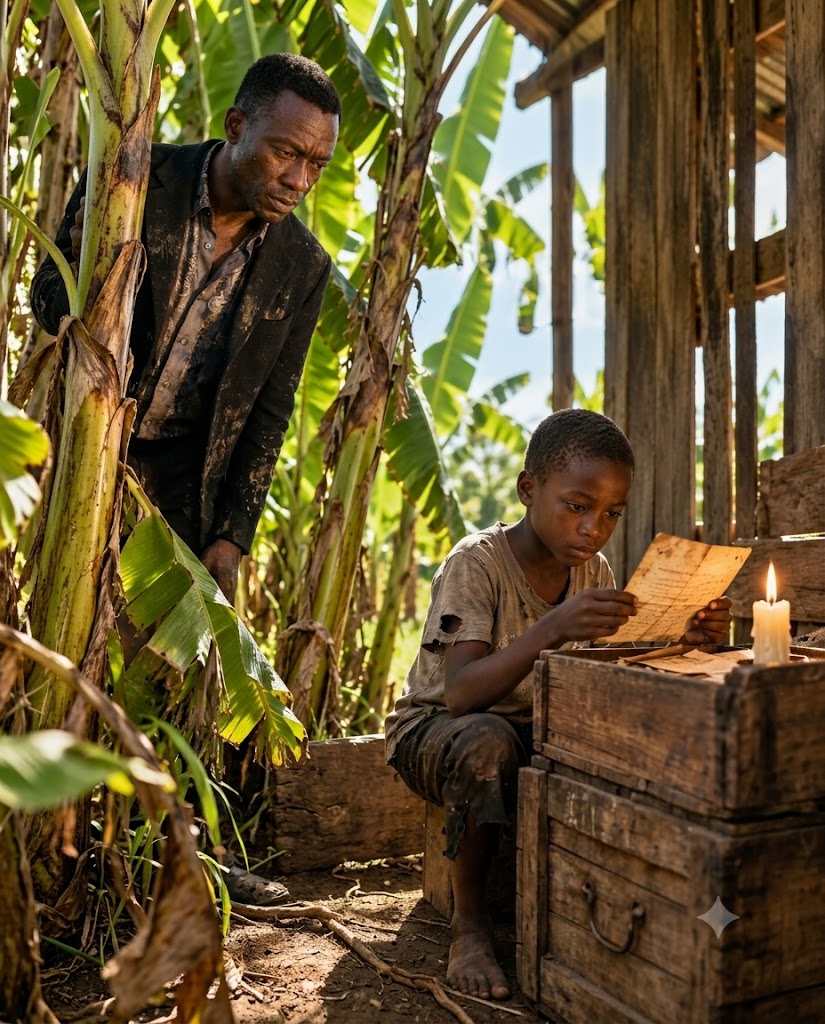
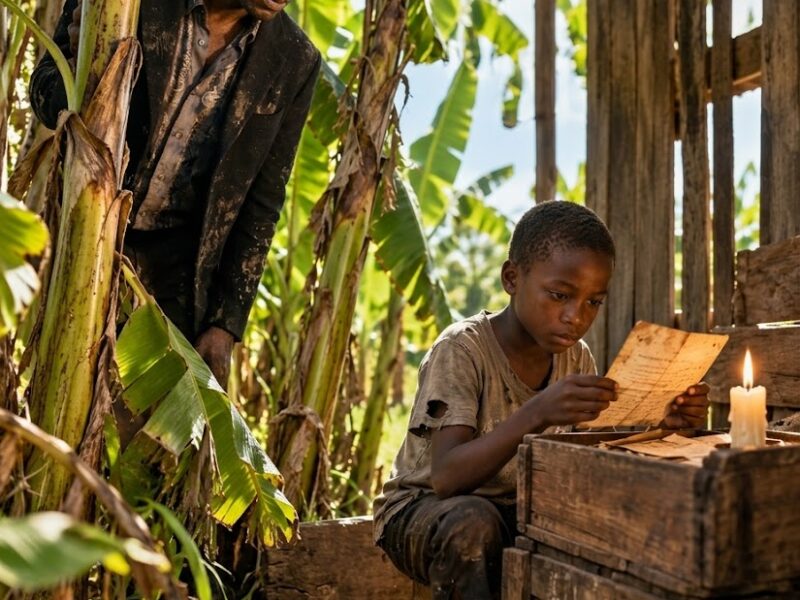
The rain had been falling for three hours when the boy lit the candle.
He lit it the way a thief strikes a match—his whole body curved around the small flame so the light wouldn’t spill under the door.
It was 11 minutes before midnight.
He knew the time because the rooster two compounds away was still silent, and the rooster never lied.
He set the stub of candle on an upturned tin and worked his fingers into the gap at the edge of the plank floor.
He began, for the 400th night, to search for the letters he had been told did not exist.
His name was Nira, and it meant blessing.
Nobody in that house called him that.
Outside, past the wet mouth of the doorway, past the three oil drums and the broken cocoa dryer, a man was standing inside the plantain grove with rain running off the brim of his hat.
He had been standing there long enough that the water had found its way through his collar and down the groove of his spine.
He had told himself he would knock.
He had told himself many things—on the flight, in the car, on the last red mile of road that the headlights could not straighten.
Now he could not move.
Through the leaning planks of the shed, he could see a boy of ten bent over a candle, lifting a floorboard.
The sight reached into his chest and closed a hand around something he did not know was still beating.
A voice came from the main house, thick with sleep and old anger.
“Nira, put out that fire before you burn my farm down. You think wax grows on trees?”
A pause heavy as a dropped sack.
“I feed you and you waste my candles, ungrateful goat.”
The boy blew out the flame so fast the dark seemed to slap the man in the grove across the face.
He heard the small sounds a frightened child makes when he is pretending to sleep.
He heard the boy slide the loose board back into place.
He heard, under the drumming of the rain on the corrugated roof, a thin whisper that was not meant for anyone living.
“I’m still keeping them, Ma. I’m still waiting.”
The man in the grove pressed his wet knuckles against his mouth.
He did not go in.
Every muscle in his body wanted to cross that yard, break the door, lift the boy out of that shed, and burn the rest of it to the ground.
But fear had been in the child’s voice, not shame.
And fear is a different animal.
Fear tells you that going in loud will cost you the one you came to save.
So Kevin Darko—who three days earlier had cut the ribbon on a 400 million dollar container terminal while cameras called him the richest son the Eastern Region had ever produced—stood in the mud behind a stranger’s house and wept without making a sound.
Because he had just learned that the woman he loved had not lied to him after all.
And that he had been the one who believed the lie.
—
Ten years earlier, Kevin had left the village of Jefferson with one bag, 41 dollars, and a promise he had failed in every way a man can fail a promise.
He had been poor then—poor in the specific grinding way that makes a young man ashamed of the shape of his own hands.
He loaded plantain and cocoa onto trucks for men who did not learn his name.
And he loved a girl named Esi, who sold kenkey near the lorry station and laughed like someone who had decided, against all evidence, that the world was mostly good.
When Esi told him she was carrying his child, Kevin had been happy for exactly one afternoon.
Then his father—a hard old catechist who measured people by what they owned—had taken him aside and told him the truth as the old man saw it.
A kenkey seller’s daughter.
No people of standing.
A chain on the ankle of a boy who could go far.
“Marry that one,” his father said, “and you will carry her family on your back until you die in this same red dust.”
And Kevin did not marry her.
He told himself he would send for her once he had something.
He got on a bus to Tema, then onto a ship, and the ship became a contract, and the contract became a company, and the company became an empire of steel and salt water.
The afternoons turned into years the way afternoons do when you are busy proving your father wrong.
In his second year away, the letter came.
It was in his father’s hand.
Esi had died in childbirth, the old man wrote, and the baby with her.
There is nothing left in Nkwanta for you now, son. Mourn and move on and build.
Kevin had mourned the way rich men mourn—which is to say, he poured the grief into the thing he was building, and the thing grew monstrous and beautiful.
And he did not come home.
He did not come home for the funeral he was told had already passed.
He did not come home when his father died four years later.
He sent money for the burial and a wreath with his name on it.
And he stayed in London, signing papers.
And he let the village become a word instead of a place.
—
Everything arrived on an ordinary Tuesday in an envelope so old the gum had long since died and been replaced by a strip of cellotape gone amber with age.
His personal assistant almost binned it.
It had been forwarded four times, chasing his name across three countries, and the handwriting on the front belonged to no one he employed.
Inside was a single page in a careful country schoolteacher’s hand and a second, smaller, sealed envelope that he did not open for two full days because his hands would not stop shaking when he held it.
The letter was from a retired midwife named Ma Grace.
I do not know if this will ever reach you, she wrote.
I saw your face in the graphic newspaper beside the new port.
I have waited 10 years to be sure it was the same Kevin Darko who used to load Yuma Atta’s trucks, and if it is you, then you must know that Esi did not die for nothing.
The child did not die at all.
He is alive.
He is in Jefferson, and the people who have him have told him his father is dead and his mother was nobody.
I am old.
I kept my promise to her as long as my legs allowed.
Now the promise is yours.
Kevin read it 11 times.
Then he canceled a board meeting in Rotterdam, and he flew home, and he told no one in the village he was coming—because he had learned one thing in 10 years of contracts.
When you want the truth from people, you do not let them prepare for you.
He arrived in the rain.
He left the car two bends down the road with his lawyer—a sharp, unsmiling woman named Africoma—and he walked the last stretch alone with a torch.
He did not switch it on.
He found the compound of a man called Arthur Kumi, a plantain and cocoa farmer whose land, people in the nearest town had told him, had grown in the last few years in a way nobody could quite explain.
And behind the good house, in a shed with no window, he found a boy with a candle.
That was the first night.
And he did not sleep.
—
He sat in a guest house room in the junction town of Adukrom—a room with one fan, one plastic chair, and a ceiling stain shaped like the Volta—and he had Africoma spread everything they had so far across the thin mattress.
“Walk me through the land,” he said.
She did.
Arthur Kumi had been, 11 years ago, a middling farmer with four acres and a reputation for working harder than he was lucky.
Then his fortunes had turned.
He had absorbed a small, good plantain plot that bordered his own—a plot of just under two acres with a spring on it.
The kind of spring that, in a dry year, is worth more than the land around it.
There was no sale recorded.
There was no transfer.
The plot had simply, over three seasons, stopped being spoken of as separate.
“Whose was it?” Kevin asked.
Africoma turned the page.
It was registered to an S. Mensah, deceased.
Kevin sat very still.
The fan turned.
Outside, a dog argued with the night.
“She owned land,” he said at last, and his voice did something it had not done in front of staff in 15 years.
It cracked.
“She owned land, and I was ashamed of her.”
The plot, Africoma went on—gentle in the way of people who have decided to be kind only in private—would have passed to any surviving child.
And if there were a surviving child, and if that child had no one to speak for him, then whoever held the child would effectively hold the land.
Especially if everyone agreed the child was an orphan with, as the midwife put it, no people.
Kevin looked at the sealed envelope on the bed—the one from Esi, the one he still had not opened.
“He has people,” he said.
He had people the whole time.
And his people were just too busy being rich to count.
—
In the morning, he watched the boy leave the compound at 10 minutes past six.
Nira did not go the way children go to school.
He went the way a worker goes.
He carried a cutlass taller than his arm and a head pan.
He turned not toward the junction and the little school with the blue gate, but up the farm path into the plantain.
And Kevin followed at a distance, with his hat low and his expensive shoes ruined by the mud.
And he watched his son work.
The boy weeded.
He disuckered plantain stools with a precision that made something ache behind Kevin’s eyes.
Because it was skilled work—the kind that takes years to learn—which meant the boy had been doing it since he was small enough that the cutlass must have dragged.
At half past eight, an older man came up the path—heavy through the shoulders, with a face that had once been handsome and was now mostly jaw.
He did not greet the boy.
He inspected the rows, found a stool the boy had not yet reached, and his voice came down flat and cold in the way that had long ago taught the child to flinch before the words even landed.
“You eat like a man,” Arthur Kumi said.
“Work like one.”
Kevin’s hand closed around the trunk of a plantain until the sap ran.
He did not move. Not yet.
A man who had negotiated with dock unions and customs men and ministers had learned the most expensive lesson of patience—that the loud move and the right move are almost never the same move.
And that the gap between them is where you lose everything or win it.
—
At noon, the boy did not eat with the household.
He went down to a kenkey seller at the junction—an old woman with a blue umbrella and silver in her hair—and Kevin sat at the far end of the shed with a bottle of minerals.
He did not drink.
He watched the woman press a ball of kenkey and a piece of fried fish into the boy’s hands and refuse his coins.
“Your money is no good here,” she told him, the way you tell a child a thing you have told him a hundred times.
“Eat and bring me the bowl back clean.”
“Yes, Auntie Yaa,” the boy said.
When the boy had gone back up the hill, Kevin crossed to the umbrella.
“That boy,” he said. “Who feeds him when you are not here?”
The woman looked at him for a long moment.
Poor people learn to read expensive men faster than expensive men ever learn to read anyone.
“Nobody,” she said.
“That is the answer you are looking for, and you will not like it. I feed him when he comes. His mother used to sell here, right where you are standing. And she had a laugh you could hear from the river.”
She wiped her hands.
“You are not from the town. You are asking a lot of questions for a stranger who is not hungry.”
Kevin set a note on her table that was worth more than her whole day.
She looked at it and did not touch it.
“If you are from the welfare,” she said, “you are nine years late. And if you are from the church, ask your catechist why a woman’s son sleeps with the cocoa. And if you are the thing I think you might be—”
She stopped, and her eyes went wet and furious all at once.
“Then you are the latest of a long line, and the longest. You sent money, and you called it love.”
He had heard hard things said about him in boardrooms, by men paid to be ruthless.
None of them had ever gone in as clean as that.
He did not defend himself.
“Did she talk about me?” he asked.
“At the beginning. Less, after. A child stops knocking on a door that never opens.”
She finally covered the note with her hand.
Not for herself, he understood.
For the boy.
“His name is Nira. She named him that the day she knew she was dying—blessing, as if daring God. And that man up the hill calls him the goat and the servant and worse. You want to know the cruelest thing?”
She leaned in.
“The boy still thinks his father is coming. Ten years, and he has never once stopped believing it. Arthur Kumi tells him his father is dead. The boy nods and says, ‘Yes, sir.’ And then he lights a candle at night to read letters nobody is supposed to know he has.”
The grove behind Kevin’s eyes went very quiet.
“Letters,” he said.
—
That evening, he went to see the midwife.
Ma Grace lived in a two-room house at the edge of Jefferson with a yard swept so clean it shone.
When she opened the door and saw him, she put her hand over her heart and sat down heavily on her own doorstep, as if her legs had been waiting 10 years to be allowed to fail.
“You came,” she said.
“I came.”
“I thought you would send a man. Rich people send men.”
“I came,” he said again, because he had nothing else to offer that was worth more than that.
And she told him the rest slowly, the way you pour something that must not be spilled.
Esi had come to her when the pain started two weeks early, in the small hours, alone.
The birth was long, and it broke her from the inside in the way that even now, even in good hospitals, sometimes cannot be stopped.
Esi had held her son for four hours.
In those four hours, she had done three things.
She had named him Nana Hayford.
She had made Ma Grace promise to carry him to the catechist for baptism, and to see that the father’s name went into the register—the true name, Kevin Darko—so that no one could ever say the boy was nobody’s child.
And she had written letters.
“She could barely hold the pencil,” Ma Grace said, “but she wrote to you. Not one letter. Many. And she said, ‘He will come. He is not a bad man. He is a frightened one, and frightened men come home late, but they come.'”
She was writing to a man she thought would read them.
The old woman’s voice bent.
“I did not have the heart to tell her you had been told she was dead. I did not know it myself until later. She wrapped the letters in her cloth and she said, ‘Keep these for my son. And when his father comes, my son must give them to him with his own hands. Not you. Him. So his father will know the boy kept faith, even when the boy had nothing.'”
“And the letters,” Kevin said. “Where?”
“That is the part that will break you,” Ma Grace said.
“I kept them safe for three years. Then Kumi’s farm began to swallow Esi’s plot, and I understood what he was doing, and I was afraid. An old woman alone. So I did a foolish, loving thing. I gave the letters to the boy himself. I told him they were from his mother, that they were the most precious thing he owned, and that he must hide them where no grown person would look, and never give them up except to the one man they were written for. He was six.”
She wiped her face with the heel of her hand.
“I made a six-year-old the keeper of the only proof his mother ever lived. God forgive me, but I was right about one thing. In four years, that man has torn that shed apart looking for whatever Esi left, and he has never found them. A child can hide a thing better than a lawyer—because a child hides it like his life depends on it.”
His life did.
Kevin thought of the floorboard, the candle, the whisper.
“I’m still keeping them, Ma.”
He had to put his hand flat on the old woman’s clean table to stay in the chair.
“There is more,” Ma Grace said. “The register.”
—
Catechist Ofori Atta entered the baptism exactly as Esi asked.
Nira Darko, father Kevin Darko, mother Esi Mensah, the date.
It is in the church book, in ink, witnessed.
Kumi does not know it exists—or he has forgotten, because he was not there, and because the church book is not a thing a farmer thinks to burn.
That book is the one thing in this story no one can rewrite.
A land paper can be forged.
A dead woman cannot defend her name.
But that book names your son and names you.
And it was written before any man had a reason to lie.
Three things, then.
The letters hidden by a child.
The register written in ink before the greed began.
And the woman in front of him who had carried a promise on failing legs for 10 years.
Three ordinary things.
Kevin had built his fortune on the understanding that the ordinary, properly stacked, outweighs the grand.
He had just never imagined the ordinary could save his life instead of his balance sheet.
“Why now?” he asked her. “Why write to me after so long?”
Ma Grace looked at him with the flat honesty of the very old.
“Because Kumi has stopped pretending the boy will grow into a son,” she said.
“He has started to treat him like a cost. Last month he told the boy that when the Chinese company finishes the new road and land prices come, he will settle the boy somewhere. Do you know what settle means from a man like that? It means he is tired of a witness. I did not write to you to give a child back his father.”
Her voice dropped.
“I wrote because I was afraid I was about to bury a second blessing in the same red ground, and I could not do it alone again.”
—
Kevin did not sleep that night, either.
He opened Esi’s sealed letter—the one that had come to him in the amber-taped envelope, the one she had somehow, through some chain of kind and ordinary hands, managed to send ahead of the rest.
It was short, and her hand was weak in it.
She must have written it very near the end.
Kevin, it said.
They will tell you I am gone. They may tell you worse. Believe this instead.
I was not ashamed of us. Not for one day. And you must not be ashamed of him.
His name is Nira. He has your stubborn chin.
If you are reading this, then you have come.
And that is all I ever asked—that one day you would come.
Be late if you must, but come.
Esi.
He read it until the candle in his own room guttered.
And then he sat in the dark with it, the way his son sat in the dark three miles away.
Two men on either end of a dead woman’s faith.
Both of them finally, unbearably awake.
—
The next days, he spent building the thing that cannot be argued with.
Africoma pulled the church register with Catechist Opoku’s blessing and photographed every page around the entry, so no one could claim it was inserted.
She took a sworn statement from Ma Grace.
She found the land office record of Esi’s plot and the absence of any transfer.
She traced the way Kumi had been quietly selling plantain from the spring plot as his own for seven seasons.
And she found a cocoa purchasing clerk named Kwadwo, who had grown up alongside Nira and who, it turned out, had wanted for three years to say something and had never had anyone powerful enough to say it to.
Kwadwo came to the guest house after dark, turning his cap in his hands.
“They tell people in the town that the boy is slow,” he said. “That he is a charity case Kumi keeps out of pity.”
“But Nira taught himself to read from a torn primer he found in the rubbish, because he said his mother’s letters were waiting and he would not meet his father unable to read what his mother wrote.”
The young man’s jaw worked.
“I used to carry him on my back to the stream when he was small. Last Christmas I bought him a bottle of Fanta, and he cried—because he said no one had ever bought him something he did not have to earn. He is not slow, sir. He is the cleverest person I know. He is just never once in his life been allowed to be a child.”
Kevin turned away to the window so the boy’s friend would not see his face.
The rain had started again.
It would not stop for the rest of the week.
It was that season when the hills ring the sky out over the plantain like a cloth.
“Will you stand up and say what you have told me?” Kevin asked. “In front of the chief? In front of Kumi? It will cost you. He buys your cocoa. He can end you in this town.”
Kwadwo was quiet for a moment.
Then he said the thing that told Kevin the tide had turned—because the tide always turns in a person quietly before it turns in a town.
“He can end me,” Kwadwo said.
“He cannot make me carry it anymore. I have been carrying that boy up a hill my whole life. I would rather carry him into a courtroom.”
—
The first crack did not come from Kevin.
It came as these things do—because the guilty man reached for more than he could hold.
Kumi, sensing nothing but the coming road and the money, moved to formalize what he had taken.
He went to the land office to put Esi’s plot into his own name at last, now that the price was about to climb.
He brought with him a story so old and so comfortable he had stopped hearing how thin it was.
The woman died childless. The land reverted. He had farmed it in good faith for a decade. Let the record catch up to the truth.
But the clerk he spoke to was a careful woman two years from her pension.
And she did what careful people do.
She checked.
The check turned up a baptism register entry flagged only the day before by a lawyer named Africoma—naming a living child as heir to the deceased Esi Mensah, and naming the child’s father as one Kevin Darko.
The clerk looked at the name.
Everyone in the Eastern Region had seen that name on the side of the new port that month.
She put down her stamp.
“Mr. Kumi,” she said, “this land has an heir, and the heir has a father, and the father is not a man you want to have stolen from.”
Kumi laughed, because men like Kumi laugh when they are first afraid.
“The boy is nobody,” he said. “He is a servant I took in from pity. He has no father. His father is dead. Everybody in Jefferson knows this.”
“Then everybody in Jefferson,” the clerk said, “is about to be corrected by a book older than their lies.”
—
Kumi went home and tore the shed apart for the fourth time that year.
This time he did it in daylight.
This time he did it with his hands shaking.
He did not find the letters.
Because Nira, hearing the man’s heavy step on the path, had already done what he always did at the first sign of a search.
He had taken the small bundle from beneath the board, slipped out the back, and carried it up into the fork of a dead cocoa tree at the edge of the spring plot.
The plot that had been his mother’s.
Where no grown man ever climbed.
He sat in the rain in the tree with the letters inside his shirt against his skin, and he waited.
The way he had waited his whole life for the storm to pass.
And it was there—in the tree, in the rain—that his father finally spoke to him.
—
Kevin had come up to see the plot, to stand on the two acres that Esi had owned and he had been ashamed of.
He had seen the small figure in the dead cocoa tree.
His legs had carried him to the base of it before his mind had caught up.
He looked up.
The boy looked down.
For a long moment, neither of them moved, and the rain fell between them like a curtain that had hung there for 10 years and was only now finally being drawn.
“You’ll fall,” Kevin said, and it was a stupid thing to say.
It was the only thing that would come.
“I don’t fall,” the boy said. “I’ve been climbing this tree since I was five.”
“What are you keeping in your shirt?”
The boy’s hand went to his chest—instant, fierce.
“Nothing.”
“Nira.”
The name came out of Kevin broken in the middle.
The boy went very still.
Nobody said his name that way.
Nobody said his name at all.
“I’m not going to take it from you. I would never take it from you. I just want to know if you’ll come down. It’s raining. You’ll get sick.”
“Everybody wants to take them,” the boy said, and there it was—the whole of his life in one sentence.
“They’re not for you. They’re for my father. My mother said, only him, with my own hands.”
His chin lifted, stubborn.
Esi’s letter was right.
“My father is coming. People say he’s dead, but they’re liars. He’s coming. And when he comes, I’m going to give them to him, and he’s going to read what she wrote, and he’s going to know I kept them.”
Kevin Darko, who owned ships, stood at the bottom of a dead tree in the rain and discovered that there is a kind of wealth that makes a man feel like the poorest creature God ever made.
“What if,” he said, and he had to stop and start again.
“What if he already came? What if he came late—much too late? What if he believed a lie a wicked old man told him, and he stayed away, and he only found out three days ago that you were alive? Would you still give them to him, even though he was late? Even though it was his own fault he was late?”
The boy stared down at him.
The rain ran off the dead leaves.
Somewhere below them, the spring that made the land worth stealing muttered to itself over the stones.
“Are you?”
The boy’s voice failed.
He tried again.
“Who are you?”
Kevin took off his ruined hat so the boy could see his face in the gray light.
The stubborn chin.
The shape of a man 10 years and one ocean too late.
He did not say, I am rich.
He did not say, I am your father and I have come to save you.
He said the only true thing—the small thing, the thing a child could weigh.
“My name is Kevin Darko,” he said.
“I loved your mother, and I was a coward, and I let them send me away. I have her last letter in my pocket. I have carried it for three days, and I have read it so many times I can say it with my eyes closed.”
He closed his eyes there in the rain and he said it.
“Kevin, they will tell you I am gone. They may tell you worse. Believe this instead. I was not ashamed of us, not for one day. And you must not be ashamed of him. His name is Nira. He has your stubborn chin.”
When he opened his eyes, the boy was climbing down.
He came down the way he did everything—carefully, giving nothing away—until his bare feet were in the mud a yard from the man.
He was so thin.
He was so unbearably thin.
He reached into his shirt and brought out the bundle wrapped in a scrap of faded cloth that Kevin would learn later had once been part of Esi’s own kaba.
He held it against his chest for one more second.
Ten years of waiting compressed into one more second.
Then he put it into his father’s hands.
“You’re late,” the boy said.
It was not forgiveness.
It was an account read out plainly by someone who had every right to read it.
“I know,” Kevin said.
“You were supposed to come when I was small.”
“I know.”
“She waited at the end. She kept saying you were coming.”
“I know.”
The man was on his knees now, in the mud.
The bundle in one hand, the other hand hovering—not daring—over his son’s shoulder.
“I can’t give those years back. I can’t. I will spend the rest of my life and every dollar I own, and it will not buy back one of them. I am not going to pretend to you that I can. But I am here. I am never leaving again. And whatever you decide about me—whether you ever call me father or never do—that land is yours. This spring is yours. That man is going to answer for every day he made you small, and you are never sleeping in that shed again.”
The boy looked at the bundle in his father’s hands.
Then he did a thing that undid Kevin completely.
He stepped forward and put his thin arms around the kneeling man’s neck.
Not because he had forgiven him—Kevin understood that—but because he had been holding something heavy for 10 years, and his arms at last were allowed to put it down.
—
They did it properly.
That was Africoma’s word, and Kevin’s, too.
Not a raid, not a rich man’s revenge.
They did it in the open, in the light, in front of the people—because a thing done in secret can be denied, and they were done with denial.
The chief of Jefferson held court in the forecourt of his palace on a Saturday morning, under a sky that had finally briefly cleared.
Arthur Kumi came in his best cloth, broad and certain, because he had spent a decade being the biggest man on his own hill, and he had come to believe his own size.
He had rehearsed his story.
He was a benefactor.
He had taken in an orphan no one wanted.
The boy was difficult, slow, ungrateful.
This stranger with his lawyer and his newspaper fame had come to steal a child’s affection with money, as the rich always did.
Let the elders see who had done the work and who had merely arrived.
He was good. Kevin would give him that, even later.
For the first 20 minutes, the forecourt wavered—because the story Kumi told was comfortable, and the story Kevin told was not.
A man who abandons a pregnant girl and does not come home for 10 years is not a clean hero.
The elders knew it.
The town knew it.
A woman near the back said, loud enough to carry: “He is only here now because the boy’s land is about to be worth something.”
And the terrible part—the part that made Kevin’s face burn—was that no one could prove she was wrong about the timing, and he could not even be sure, in the deepest room of himself, that she was.
So he did not pretend to be clean.
When the chief turned to him, Kevin stood and said, “She is right to ask. I will answer her first.”
He turned to the woman.
“I left. I believed I was told the truth—but I did not come to check. And a man who loves does not take a death on another man’s word. I missed 10 years. That is my sin, and I will carry it in front of God and in front of all of you and in front of my son for the rest of my life. I am not standing here because I am good. I am standing here because I was shown three days ago that I was lied to, and because a child I did not know existed has been sleeping with the cocoa and worked like a hired hand while this man sold my son’s inheritance as his own.”
He let that settle.
Three sentences.
Then the short one—the one that dropped into the forecourt like a stone into the spring.
“I was absent. He was cruel. Those are not the same crime.”
And then he stopped talking.
He let the ordinary thing speak—because he had learned that the ordinary, properly stacked, outweighs the grand.
—
Catechist Opoku brought the church register and read the entry in his old carrying voice.
“Nira Darko, father Kevin Darko, mother Esi Mensah. The date, 10 years and some months gone, written.”
The catechist said, in his own hand: “At the request of the midwife, before this boy could walk, and before any man in this forecourt had a reason to lie about whose son he was.”
Ma Grace rose and told the forecourt about the four hours, the naming, the promise, the letters.
She was old, and her voice shook, and nobody breathed.
Kwadwo, the cocoa clerk, stood up in front of the man who bought his living and said: “I have carried that boy up the hill his whole life, and he is not slow. He taught himself to read so he could read his mother’s letters when his father came. Call him slow again in front of me, and I will walk out of this town and sell my cocoa somewhere else and tell everyone why.”
And then Africoma—quiet and merciless—laid out the land.
The plot registered to Esi Mensah.
No sale.
No transfer.
Seven seasons of plantain sold from the spring plot by a man who had no paper to it.
And the visit to the land office, where Kumi had tried only last week to put a dead woman’s land into his own name on the grounds that she had died childless.
A claim he could only make, Africoma said, turning so the whole forecourt could see him, if he first insisted that this boy, Nira, did not exist as anyone’s son.
“That is the trap he built himself,” she said.
“For 10 years, he has told this child and this town that the boy is nobody—no father, no mother worth naming, no claim. He had to say it to keep the land. But hear what it cost him.”
She let the silence stretch.
“If the boy is nobody’s son, then Mr. Kumi has worked and starved and silenced a nobody’s child for 10 years, and that is a crime. And if the boy is somebody’s son—which the church book, written in ink before the greed began, says he is—then Kumi has stolen that somebody’s land, and that is also a crime. There is no story in which he is innocent. He wrote both halves of his own judgment, and he wrote them with his own greed, and neither half will let him go.”
—
The forecourt had gone very still, and Kumi felt it.
Men like Kumi always feel the room turn half a second before they are willing to admit it.
He did the thing cornered men do.
He reached for the child.
“Nira,” he said, and his voice tried for warmth and found only gravel.
“Tell them. Tell them who fed you. Who gave you a roof when your mother’s people would not. And tell them I was good to you.”
He turned to the elders, spreading his hands.
“Children forget. He has been turned against me by money. Nira, tell them the truth.”
And the whole forecourt looked at the thin boy standing beside his father.
For a moment, Kevin was afraid—because he saw the old reflex move across his son’s face.
The flinch.
The trained readiness to say whatever the big man needed said.
Ten years of yes, sir does not leave a body in three days.
The boy looked at Kumi.
He looked at the ground.
And then—Kevin would remember this until he died—the boy looked at the bundle of letters he had insisted on carrying into the court inside his shirt.
His hand pressed flat against them.
The way it always did.
And he found something in there that was stronger than 10 years of fear.
“You did feed me,” Nira said.
His voice was small, but it did not waver.
“That part is true. You fed me.”
The forecourt waited.
“But you told me my mother was nobody. You told me every day. And she wrote me these.”
He pulled the bundle an inch out of his shirt—just enough for the light to touch the faded cloth—and then pushed it back, because it was not for them.
“A nobody doesn’t write letters to her son and make a promise and keep it from the grave. You lied about her so you could take her land. That is worse than not feeding me. You can be hungry and still know your mother’s name. I was hungry for 10 years, and you tried to starve me of her.”
Nobody in that forecourt had taught the boy to say it.
He had taught himself, the way he had taught himself everything—up a hill, in the dark, by the light of a candle he was always being punished for.
—
The elders conferred.
The chief spoke.
The case went beyond the palace, as it had to, into the hands of the district authorities—because land fraud and the treatment of a child are not matters a forecourt can close with a handshake.
But the forecourt could do one thing, and it did it that morning.
The chief rose, and in front of the town, he restored the plot and the spring to Nira Darko, son of Esi Mensah.
He placed the boy formally in the care of his father.
And he turned to Arthur Kumi and said, in the old language, a sentence that does not translate cleanly but means roughly: A man who bears another’s name to grow his farm will find the harvest eats him.
—
The reckoning came slowly, the way real reckonings do—not in a single thunderclap, but in a long drought.
The district office took up the land fraud.
The seven seasons of plantain sold from a dead woman’s spring became a figure, and the figure became an order to repay, and the repayment ate into the good house and the lorry and the second farm Kumi had bought with money that was never his.
The matter of the child—the labor, the hunger, the shed—went where such matters go now: slowly, imperfectly, but it went.
It followed him.
The town that had called him the biggest man on his hill began—the way towns do—to cross the road when they saw him coming.
Not out of fear anymore.
Out of the particular contempt a community keeps for a man who starved a child of his mother’s name to water his plantain.
He fought it at first, loudly, the way he had done everything.
He told anyone who would listen that he was the victim, that the rich man had bought the town, that he had been a father to the boy when no one else would.
But each time he said it, someone would ask the question that had no good answer—the question Africoma had planted in the forecourt and that grew in the red soil of Jefferson like a weed no cutlass could kill.
If you were his father, why did he sleep with the cocoa?
And Kumi had no answer.
Because there was none.
Slowly, even he stopped asking the mirror to give him one.
—
Kevin did not gloat.
He had thought he would.
He had flown home imagining the moment he would stand over the man who had stolen his son’s childhood and feel the clean, cold justice of it.
Instead, he felt only tired and sad and strangely close to the man.
Because he had seen, in the land office record and in the long slide of Kumi’s turning fortunes, how it had probably begun.
A bad cocoa season.
A debt.
An orphan who happened to come with two acres and a spring.
A small theft. That was easy to explain to yourself.
Then a larger one.
Then the lie that made the larger one safe.
And then the lie that protected that lie.
Until one day you looked up and you had built a whole life on the back of a child you had decided, for your own convenience, was nobody’s son.
Kevin knew that architecture.
He had built a version of it himself, in glass and steel.
A tower of good reasons for not coming home.
He had just been rich enough that his version had a better view.
—
He went to see Kumi once near the end, before the man left Jefferson for good.
He found him smaller than he remembered, sitting outside a house that was no longer his.
Kevin sat down beside him without being asked.
Two men who had each, in his own way, decided that a child was a cost.
“You came to watch me fall,” Kumi said.
There was no fight left in it.
“No,” Kevin said.
“I came to ask you one thing, and then I will never trouble you again. Why did you tell him his mother was nobody? Take the land—I can almost understand the land, God help me. But why did you have to take her name from him every day? Why that?”
Kumi was quiet for a long time.
A hen walked between them.
When he spoke, his voice had lost the gravel and found something underneath it that was almost human.
The thing that is left when the performance is finally too expensive to keep up.
“Because a boy who knows his mother’s name,” he said, “looks for his father. And a boy who looks for his father is a boy who might one day be found by one.”
“I could take the land in a season. But to keep it, I had to make sure no one ever came for him. So every day I made him smaller. I told myself it was to protect my farm.”
He looked at his empty hands.
“I did not understand until that forecourt that I had not been protecting my farm. I had been raising a witness I was afraid of, and starving him so he would be too weak to testify. And I made the strongest thing in that boy into the one thing I could not break.”
“He kept those letters through everything I did. I tore that shed apart a dozen times. I never found them. Do you know why?”
“Why?”
“Because I was looking for paper,” Kumi said, “and he was not hiding paper. He was hiding his mother. You cannot find a man’s mother by tearing up his floor.”
The old farmer’s face finally broke.
Ten years of it, all at once.
“I turned a dead woman’s last act of love into the evidence that ruined me, and I did it with my own greed, one day at a time. And I called it taking care of him. God forgive me. I was the richest I had ever been, and I did it over the body of the one child who had less than me. That is the thing I cannot wash. Not the land. The boy. I knew his mother’s name the whole time. I used it against him instead of giving it to him.”
He did not ask Kevin for forgiveness, and Kevin did not offer it.
It was not his to offer.
The only person who could forgive Arthur Kumi was a thin boy with a stubborn chin, and that boy was 10 years old.
And he had earned the right to take as long as he needed—or to never do it at all.
That was the thing Kevin could not fix with money, and he had stopped trying.
—
They did not stay in the glass towers.
That surprised everyone, including Kevin.
He had imagined scooping the boy up and flying him to a life of marble and drivers.
In the first weeks, he tried—and the boy went silent and small in the big hotel rooms, the way he had never gone silent on the farm.
Because a child who has only ever owned a secret does not know what to do in a room where nothing can be hidden and nothing needs to be.
So Kevin did the second hardest thing he had ever done, after coming home.
He slowed down.
He moved the headquarters nonsense to people who were paid to carry it.
And he built a plain, good house on the edge of Jefferson, within sight of the spring, with a mango tree in the yard and a room with blue walls that was only for sleeping—no cameras, no staged piano, no clothes with the tags still on.
And they rebuilt the shed.
That was Nira’s idea, and Kevin fought it, because he hated the sight of the thing and wanted it torn down and burned and the ground salted.
But the boy was stubborn.
He had his father’s chin, and he said the shed was not the enemy.
The dark was not the enemy.
He had done his best waiting in that shed.
He had kept his mother alive in that shed by candlelight when everyone was trying to kill her a second time, and he did not want to forget that he had been strong there.
So they put a window in it—a real window—and they mended the roof, and they ran a light out to it, an electric light with a switch the boy could reach.
And the boy kept the stub of the last candle on the sill, next to the window, where he never again had to hide a flame from anyone.
—
The letters—all of them—Kevin finally read on a quiet evening with his son beside him, translating the places where Esi’s weak hand had faded, because the boy knew them by heart and had read them a thousand times by a light he was punished for.
They were not grand.
They were a young woman writing to a man she believed would read them—telling him about the baby’s weight and the price of fish and the way the plantain was coming in, and how she hoped he was eating, and how she was not ashamed, had never been ashamed, and how he must not be ashamed either.
On the last page of the last letter, in a hand so faint it was almost a ghost, she had written: “Whatever took you from us, I hope you fought it.”
Then: “And if you did not fight it, I hope you come home one day and fight for him instead. That will be enough. That will be more than enough.”
Kevin put the page down and could not speak for a long while.
And his son—who had spent 10 years comforting no one, because no one had ever let him—put a thin hand on his father’s shoulder and said: “It’s all right. You came late, but you came.”
Then: “She said you would.”
And Kevin understood that the boy was not only forgiving him.
He was keeping the last promise his mother had made on his behalf—the promise that his father was not a bad man, but a frightened one, and that frightened men come home late, but they come.
—
A year on, the spring plot was heavy with plantain again.
Good fruit. Honest fruit. Sold under the boy’s own name through Kwadwo, who had been made manager of the whole venture and had bought himself a motorbike and a loud, delighted opinion about everything.
Ma Grace—who had carried a promise on failing legs for 10 years—lived out her days in a good room in the plain, good house and complained that they fussed over her, and let them.
Auntie Yaa still sold kenkey at the junction under her blue umbrella and still refused the boy’s money.
Except now the boy came down the hill—not as a servant on a stolen lunch hour, but as a schoolboy with a blue-gated school behind him and ink on his fingers.
And he brought her bowl back clean every time, because some debts you pay not because you owe them, but because paying them is how you remember who was kind to you when kindness cost them something.
—
Arthur Kumi left Jefferson.
Some said he went north to a brother.
From wherever he was, he sent—almost a year after the forecourt—a single letter.
It was addressed to the boy.
Kevin carried it up to the mended shed and gave it to his son, and did not ask to read it, because the boy, of all people, understood that letters are sacred and that they belong only to the one whose name is on the front.
Nira read it alone, by the window, in the light he no longer had to hide.
His father never learned exactly what it said.
But that evening, the boy came and sat under the mango tree and said—not asking permission, just stating it, the way he stated everything:
“He says he knew Ma’s name the whole time. He says the worst thing he did wasn’t the land. It was teaching me to believe I didn’t have a mother worth naming.”
The boy turned the single page over in his hands.
“Do I have to answer it?”
“No,” Kevin said. “You don’t have to answer it. You don’t have to ever answer it. Some things need the truth before they can be forgiven. Some things need time.”
And some things, he said carefully—because he was speaking about himself as much as about the farmer up north—”you forgive not for the other person at all, but because carrying it is too heavy, and you have carried enough.”
The boy thought about that.
Then he folded the letter and put it deliberately into the bundle with his mother’s, in the faded cloth.
The keeper of letters, keeping one more man.
“I’ll decide when I’m older,” he said—which was the wisest thing anyone said in the whole affair, and he said it at 11.
—
On the night that was exactly one year from the night a man had stood weeping in a plantain grove, there was rain again.
The hills wrung the sky out over Jefferson the way they do that season, and the roof of the mended shed drummed.
Kevin, lying awake in the plain, good house the way he still sometimes did, got up and looked out toward the farm.
And saw a small light burning in the shed window.
He walked out into the rain, and he did not hide this time.
There was nothing left to hide from.
He came to the window and looked in.
His son was there, bent over the sill.
But he was not searching the floor.
He was not hiding the flame.
The electric light was on, bright and unafraid.
The stub of the old candle sat on the sill, unlit—a kept thing, a remembered thing.
And the boy was not reading his mother’s letters, because he knew them by heart.
He was writing in a new exercise book with a school pen, his tongue between his teeth the way children’s tongues go when the work matters.
“What are you writing?” Kevin asked through the window, and he was smiling, and the rain was on his face, and this time it was only rain.
The boy looked up.
He had his mother’s stubborn refusal to be ashamed, and his father’s stubborn chin, and somewhere in the middle of the two of them, he had become entirely his own.
“A letter,” he said.
“To who?”
“To nobody yet,” the boy said. “For later. In case I ever have a son.”
He turned the book so his father could see the careful country schoolboy hand—the same hand—and Kevin realized with a jolt that went all the way down that it was the same careful ink that had entered a name in a church book 11 years before, the same ink that had refused to let a boy be nobody.
“I’m telling him,” Nira said. “To come home even if he’s late. Especially if he’s late.”
He bent back over the page, into the light he would never again have to earn.
“Somebody told me once that frightened men come home late, but they come. I want to make sure my son knows the second part. People always remember the late. They forget the coming.”
Kevin Darko stood in the rain outside a mended shed and understood, finally and completely, the only lesson his fortune had never been able to buy him.
He had spent 10 years believing that to provide was to love, that money sent was care received, and that the size of what you build can cover the size of what you abandon.
His son had taught him, in a single year, by the light of a candle he no longer needed, the truth that the richest man in the Eastern Region had somehow reached middle age without learning.
You cannot send yourself in an envelope.
You have to come.
And when you have been a coward, and you have been late, and you have missed the years you can never buy back, there is still exactly one thing left that you are allowed to do.
The smallest thing. The only thing. The thing a dead woman asked for and a living boy waited 10 years in the dark to receive.
You show up.
You stay.
And you keep the light on.
So the next one who is waiting never has to hide the flame.









