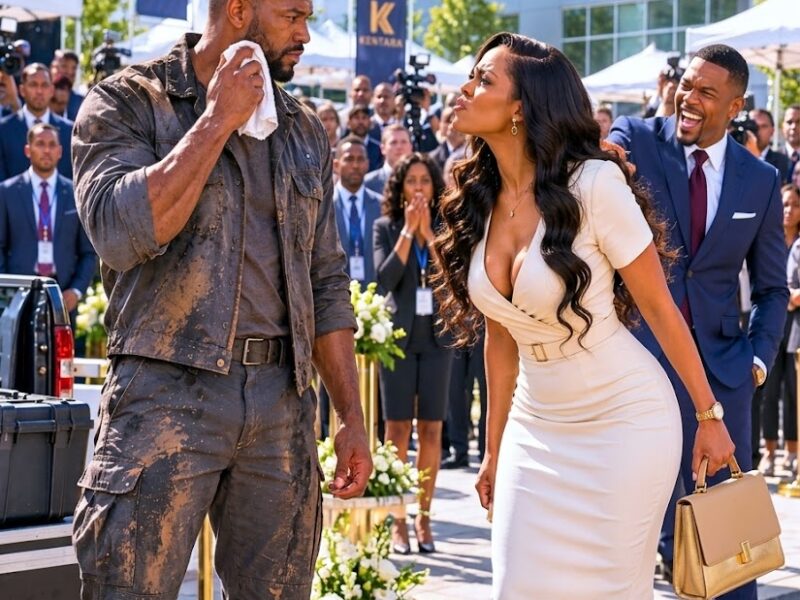
“You Filthy Scrap Collector!” My Wife Humiliated Me—Ten Minutes Later, the Chairman Offered Me His Seat
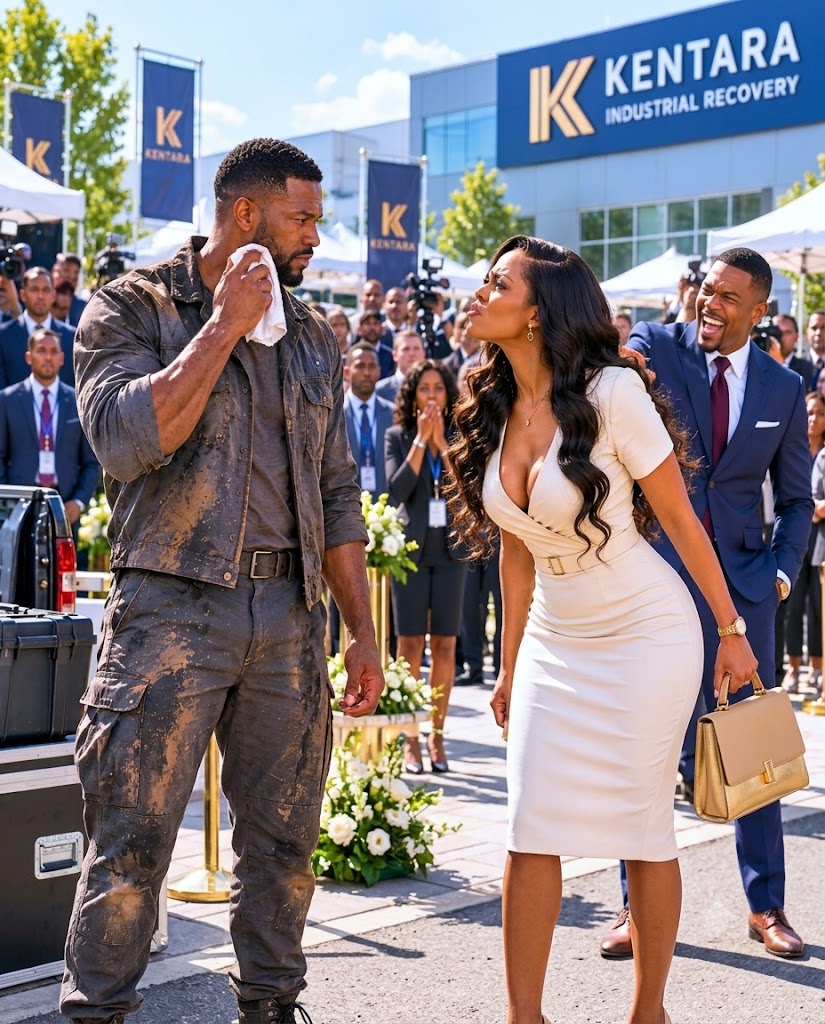
You actually showed up here looking like that today of all days.
I need two minutes with you. Two minutes.
Eight years. And you can’t tell the difference between a job site and a formal event.
People are watching.
Good. They should see this. They should all see who I’ve been making excuses for.
Don’t do this. You filthy scrap collector.
She didn’t wait until we were somewhere private. She looked at my jacket, at the grease still on my hands, and decided that was all she needed to know. I’ve been in rooms where people underestimate me before.
I know how it sounds. The voice that starts controlled and gets louder until others turn to watch. What I didn’t expect was the silence after. Not hers. Mine. I reached into my breast pocket for the folded handkerchief I always carry. A habit I’d picked up years ago working around copper machinery because clean hands matter more than people expect in this industry.
And I wiped my face without looking away from her. She chose that moment in front of every person she’d ever wanted to impress. And I let her finish. The question isn’t whether she went too far. The question is what does she think happens next now that she’s made that decision in front of exactly the wrong audience.
If you’re new here, welcome, hit subscribe, and stick around because this story is just getting started. What happens in the next ten minutes changed everything.
I still remember the morning I decided to stop explaining myself.
It was a Tuesday. Nothing remarkable about it. I was up before five, the way I always am, moving through the kitchen quietly so I wouldn’t wake Rochelle.
I made coffee in the old steel thermos I’d been carrying to work sites for six years, the one with the dent on the side from the time I dropped it on the warehouse floor during the early days when everything we owned fit in a space the size of a decent garage.
I filled it to the rim, screwed the lid on, and walked out to the driveway without turning on the porch light. The truck was where I’d left it. Nine years old, a little rust creeping along the wheel wells, a crack in the passenger mirror I kept meaning to fix and never quite got around to. I got in, backed out onto the empty street, and drove toward the south end of the city while the roads were still clear and the sky was still deciding what color it wanted to be that morning.
What I didn’t know then, or maybe what I was refusing to think about too directly, was that Rochelle had been standing at the bedroom window watching me leave. Not because she was worried about me.
Not because she’d thought of something she wanted to say before the day got away from both of us. She was watching the way you watch something you’ve grown tired of but haven’t yet figured out how to stop looking at. We’d been married eight years. I knew the difference between her silences by then, even the ones I wasn’t present for.
People who know me well will tell you I’m not a man who talks much about himself. That’s partly habit and partly something I learned early, when you grow up watching people get sized up by the shape of their hands before anyone bothers to hear what they have to say.
You start to understand that words don’t carry the weight most people think they do. What carries weight is the work, the thing you hand someone when you’re done, and you let them figure out what it cost you to build.
I spent fourteen years as an operations engineer at a metal processing plant on the eastern side of Louisville. Good work. Honest work. I understood the machinery the way some people understand language.
Not just what each component was designed to do, but what it sounded like when something was three days away from failure, where the breakdowns would appear before they appeared.
What a structural weld looked like when it wasn’t going to hold under the kind of pressure it would eventually meet. By the time I was thirty-four, I was running the floor. By thirty-six, I had started noticing something that nobody else at that plant seemed to be paying attention to. The equipment we were throwing away was worth more than the contracts we were signing.
Every quarter, we’d decommission machines. Industrial motors, compressors, copper-wound generators, drive shafts from systems that had been in service for twenty years. Equipment that was too expensive to repair under the current maintenance budget, but not actually broken in any fundamental sense.
Still carrying every bit of the material value it was built with. We’d haul it all to a regional scrap dealer and collect whatever the going rate was per ton of mixed metal. The scrap dealer would then do what we should have been doing. Disassemble each machine component by component.
Recover the copper windings and aluminum housings and specialty alloys inside and sell those materials directly to manufacturers at prices three and four times what they’d paid us for the whole unit. I watched that transaction play out for years. I watched us be on the wrong side of it every single time. And at some point, I stopped wondering why someone hadn’t fixed it and started asking myself why that someone hadn’t been me.
Six years ago, I took seventy-two thousand dollars out of savings. Everything I’d managed to put aside since my mid-twenties, accumulated slowly and without any help from anyone, and I rented a warehouse on the south end of the city.
I bought two trucks from a company that was shutting down its regional operation. I hired four people I’d worked alongside for years and trusted because I’d seen how each of them handled problems at two in the morning when nobody senior was watching.
And I started Forge Loop Materials with no press release, no ribbon cutting, no investor presentation, and no intention of telling anyone about it until there was something concrete enough to show.
The model was simple, which is probably why it hadn’t been done at scale before. Instead of acquiring industrial equipment by the ton and selling it by the ton the way every competing scrap operation in the region was doing, we’d purchase decommissioned machinery.
Break it down component by component with the precision of people who genuinely understood what they were handling. Sort the recovered materials by grade and composition. Extract the highest-value metals. Copper, specialty steel alloys, certain aluminum composites.
The manufacturing market was actively seeking, and sell those directly to the manufacturers who needed them. No middlemen, no mixed-grade lots forcing buyers to do additional sorting before anything was usable. Just the right material, graded correctly, delivered where it was needed.
In those early months, I was at the warehouse more than I was at home. There were nights I drove back at ten o’clock because a piece of sorting equipment wasn’t calibrating right, and I was the only person in the building who understood the fix. There were months in the first two years when I didn’t draw a salary, reinvesting everything back into equipment and capacity.
But by year four, we had eleven facilities running across six states, contracts with manufacturers I’d been studying in trade journals since my twenties, and a team of more than a thousand people doing work I could point to and say mattered in a real and measurable way.
One habit I’d developed in those early warehouse years, I started carrying a folded handkerchief. Working with copper leaves a particular residue on the hands, a faint greenish tint under the fingernails that regular soap doesn’t fully cut. And there were moments when you needed to be presentable without having a sink nearby.
It became automatic, something I stopped thinking about the same way you stop thinking about most things that become part of the daily rhythm. I mention it only because it becomes relevant later.
I brought Celeste Rowan in at the end of year two when the operation had grown past what one person could responsibly manage from a financial and operational standpoint. She’d spent fifteen years running numbers for a heavy industrial firm in Ohio and understood exactly what we were building without needing me to explain it more than once.
From that point forward, she became the face of Forge Loop in every room where I preferred not to be the face of Forge Loop, which was most rooms. Board presentations, bank negotiations, press briefings, investor conversations. I stayed on the floor.
She stayed in front of the cameras. It worked because we trusted each other completely, and neither of us needed the other’s credit to feel good about the work.
Rochelle knew I’d started a recycling company. That was how she referred to it on the occasions she mentioned it at all, which became less frequent as the years moved on. She knew the hours were long. She knew the truck was old, and the clothes I wore to the facilities weren’t appropriate for the events she cared about.
What she didn’t know, and what I had for a long time simply not gotten around to correcting, was the scale of what I’d been building while she watched me leave before sunrise every morning and wrote whatever story she needed about what that meant.
I should be honest about when not gotten around to became something else entirely. The early years of the marriage had been good, or good enough that the gaps in it didn’t register as gaps yet. Rochelle was sharp and driven, and she cared about things with a completeness I found genuinely admirable. She was the kind of person who walked into a room and immediately understood its geometry, who held the actual leverage, what was being negotiated underneath what was being said, where the real decisions were being made versus where people just liked to think they were being made. Those instincts had served her well in commercial real estate. Over time, they also became the primary lens through which she evaluated everything in her life, including the man she’d married.
In the early years, she’d been curious about what I was building. She came with me once to the second facility we opened, walked the floor for an afternoon, asked real questions, listened to the answers. That version of Rochelle, present, engaged, genuinely interested in what I was doing and why, is someone I still think about. She was worth knowing. At some point, the curiosity ran out. I can’t pinpoint the exact moment because it didn’t happen in a single conversation or a single argument. It happened the way erosion happens, continuously and quietly, until one day you look at what’s left and realize significantly more has gone than you’d noticed going.
What replaced the curiosity was a kind of accounting. Rochelle had started measuring the life she had against the lives she saw at work. The clients with multiple properties, the colleagues whose husbands were partners at law firms or directors at investment banks, the networking events where every conversation ran through stock options and board positions and deals that moved in the hundreds of millions. Against all of that, she measured me. The old truck, the work clothes with the metal dust embedded in the fabric. The way I sometimes came home with my hands stained from the copper work and had to scrub twice at the kitchen sink before I could touch the countertops. She’d stopped inviting me to the professional events that mattered most to her about two years before the Canara announcement. She did it gently at first. You’d find it boring. It’s mostly work people. And then simply stopped mentioning them, the way you stop trying to bring something into a space where it consistently doesn’t fit.
I’d tried a few times in the early years to bring her into the Forge Loop operation. Asked if she wanted to see the third facility, asked again for the fourth. She was always busy. After a while, I stopped asking, not because I decided to hide anything, but because there is a specific kind of fatigue that settles in when you realize the person across the table has already assigned you to a chapter, and nothing you say is going to change which chapter that is. I still believed for a long time that the work itself would eventually say what I couldn’t, that the scale of what we were building would become visible in a way that couldn’t be miscategorized. What I miscalculated was how completely she’d stopped looking.
Gavin Sloan had been at Hian Properties for about six years by then. I’d met him twice. Once at a company event, once at a client dinner, and both times he’d been the specific kind of polite that only works if the other person doesn’t look closely at what’s underneath it. Attentive, slightly too warm, the courtesy of a man who has already ranked you and is performing graciousness from a position of comfortable superiority. I noticed both times. I didn’t say anything because there was nothing useful to say in either setting. What he’d been saying to Rochelle in the weeks leading up to the announcement, I could only partially reconstruct from what she told me later and what I observed and how she changed. But the shape of it was legible enough. He’d been telling her she was better than what she was settling for, that she was wasting years she couldn’t recover, that the man she’d married was someone you felt sorry for rather than someone you built a future with. He said it, I suspect, with the reasonable and patient tone of someone who had identified an opening and was taking his time arriving at a conclusion he’d already reached on her behalf.
Rochelle started going quiet at dinner in a particular way. Not the quiet of distraction or tiredness, but the quiet of someone who has spent all day thinking about something and has decided the current company isn’t the right place to say it. She started coming to bed after I’d fallen asleep. The easy, half-distracted conversations we’d always had about nothing in particular dried up, and what replaced them was a contained contempt that didn’t require words to communicate itself clearly. She was looking at the truck differently, at my hands, at the clothes I wore to work. Not with the affection those things had carried in the early years. She’d said once, back when we were still learning each other, that she liked that I actually knew how to do things, that I wasn’t the kind of man who needed someone else to fix what was broken. She wasn’t looking at them that way anymore. She was looking at them like evidence, like confirmation of a verdict she’d already reached and was just waiting for the right occasion to deliver.
I found out about the lawyer by accident. I’d come home early one afternoon because a meeting had been cancelled and I’d decided to work from the house for a few hours. Rochelle was in the living room on the phone, her voice low in the specific way it gets when she doesn’t want to carry through the house. The house was quiet enough that I could hear her clearly from the kitchen without trying. She was asking about the process for separating financial accounts held in one spouse’s name, whether the length of the marriage affected the division of independently held assets, what documentation she’d need to establish her own financial standing separately from her husband’s. I poured a glass of water and stood at the counter for a moment. Then I went upstairs to my home office, closed the door behind me, and sat at my desk without turning on the light.
I want to be honest about what I felt sitting there because it would be easy to make it simpler than it was. There was real hurt in it. I’d be lying if I said otherwise. Eight years is not a short time. And whatever the marriage had become by that point, it had not always been what it was in that season of her phone calls and his carefully placed commentary. But underneath the hurt was something colder and more clarifying. Because what Rochelle was doing on that phone, she was making a calculation. And the calculation was built on a misunderstanding so total that it had the effect, sitting alone in that dark room, of making everything suddenly very simple. She thought she was protecting herself from a man with a rented warehouse and an old truck. She thought she was getting ahead of a financial reality she’d already decided was the shape of our future. I sat with that knowledge for a long time before I moved.
The question I kept returning to was not about assets or legal strategy. It was about what would happen if I walked downstairs right now and told her everything. Showed her the portfolio, the revenue figures, the equity structure, the acquisition closing in three weeks. I’d learned that she stayed. I’d learned that she reconsidered. But I’d spend the rest of my life not knowing what she actually thought of the man who drove the old truck and came home smelling like metal, because I’d have given her a reason to see him differently before she’d had to answer that question honestly. Eight years deserved the truth about what those eight years had been built on. I couldn’t get to that truth by making it easier for her to avoid answering. So I said nothing. I went back to work the next morning the way I went back every morning, and I let the weeks move forward toward a November morning when everything that had been kept separate would finally occupy the same space at the same time.
A few weeks before the announcement, Rochelle came home one Friday evening with the particular energy she carries when something at work has gone well. The lifted shoulders, the glass of wine before she’d taken off her shoes. She told me her company had been selected to coordinate a major business announcement at the Canara Industrial Recovery Facility on the south side of the city. A large acquisition coming in, new ownership being revealed. The kind of deal, she said, that you only see once or twice in a decade in a market this size. She talked about it for nearly twenty minutes. The logistics, the guest list, the caliber of people she’d be in the room with. She mentioned the scale of the transaction, a figure in the hundreds of millions. And the way she said it, I could hear the reverence in her voice, the genuine excitement of someone who understood that proximity to that kind of announcement could open doors she’d been working toward for years.
I sat across from her at the kitchen counter and listened to every word. I refilled her glass when she gestured toward it. I didn’t say anything about Forge Loop or Canara or the fact that I’d spent the better part of six months in quiet negotiations to make that acquisition possible. What she said next wasn’t cruel exactly. I don’t think she meant it to carry what it carried. She looked at me, at my work shirt, at the faint copper mark on the side of my left hand that I hadn’t quite gotten off. And she said I should come to the event, that it would be good for me to be around people operating at that level, that maybe seeing it up close would give me a different sense of what was actually possible. I told her I might stop by. She turned back to her phone. I sat there knowing she was right. I would be there. And what happened when I arrived was going to answer a lot of questions at once for both of us.
Three days before the event, Celeste called to run through the announcement sequence one final time. Everything was ready. Speaker order confirmed, financial disclosures cleared by legal, press materials staged. She asked, in the careful way she asks things she’s already thought through, whether there was anything she should know going into the morning. Any complicating factors. I told her to run it exactly as we’d planned. What I didn’t tell her was that by then I already knew the marriage was over. The only thing I didn’t yet know was what shape the ending was going to take.
The call came in at 6:17 in the morning while I was still sitting in the driveway. I’d been there for a few minutes letting the engine warm up the way you do on cold November mornings when the heater takes time to reach the back of the cab. My phone was in the cup holder. When it rang and I saw the name of my floor supervisor at the Canara site, I knew before I answered that the day had already changed. The problem was specific and serious. A shipment of forty-three decommissioned electric motors, each one containing copper windings worth recovering at a significant margin, had been logged incorrectly during the overnight intake and routed to the primary shredding line instead of the disassembly bay. The morning crew was twenty minutes from starting the first cycle of the day. If those motors went through the shredder whole, we’d recover maybe a third of their actual material value. The rest would come out as mixed-grade fragments that couldn’t meet the spec our buyers required. On a normal day, that would be a costly mistake. On the day we were formally announcing ownership of the facility to the city, it was something I needed to handle myself.
Before I backed out of the driveway, I did one other thing. I called Celeste and told her I was going directly to the floor and might be arriving at the event without having been home to change. I asked her to make sure the blazer she’d recommended keeping on site was ready in the administrative office. She’d suggested it weeks earlier with the foresight she brings to anything that involves me being in a room with cameras. She’d said, without any editorial comment, that it might be useful to have something clean available on the day. I told her I’d need it. I also told her the bank’s final signature, the last document required to formally complete the transfer of ownership, had to be executed before the public announcement. That was the hard deadline. Signed before I stepped on that stage. She confirmed everything would be ready.
I drove south. It took close to three hours to resolve the motor situation. The units had to be pulled from the shredding queue by hand and moved to the disassembly bay manually because the overhead crane on that side of the floor was locked out for a scheduled safety inspection. My supervisor had four people on it and I worked alongside them. I’m faster at the disassembly sequence for that type of motor than anyone else on the crew, and we were running out of morning. By the time we’d cleared all forty-three units, corrected the routing in the intake system, and signed off on the verification, it was past 9:30. The event was at eleven. My work jacket had grease on both sleeves. My hands carried the copper residue that doesn’t fully wash off with one pass at the sink, the faint tint under the fingernails that people who work with this material recognize on each other. My pants had dust from the warehouse floor. In the bed of the truck, where I’d thrown the cables and components I’d pulled for spot inspection, there were coils of copper wire and a couple of motor housings I hadn’t had time to return to the bay. The clean blazer was in the administrative office at the back of the facility. The event was starting at the front entrance.
When I drove around to the front parking area, the most direct route between where I’d been working and where I needed to be, there was no statement being made. It was simply the fastest path, and I had a hard deadline to meet. The front of the facility had been transformed by weeks of preparation. Tent structures along the perimeter, rows of chairs on the paved area near the main entrance, a raised platform with a podium, and professional sound equipment. The parking area was already filling. The banking representatives, the city’s economic development staff, journalists from two local outlets, people with adjacent interests in the deal who wanted to be in the room when it was confirmed. The kind of assembled crowd I’d been working toward for six years without ever quite imagining it would also contain my wife, standing near the entrance in a dark dress and heels, clipboard in hand.
Gavin was a few feet away from her, talking to someone I didn’t recognize, positioned in the particular way that people position themselves when they want to be included in whatever the nearest important conversation turns out to be. He was the one who saw the truck first. I watched him say something to Rochelle, and I watched her turn and look across the lot. The distance between us was forty yards. Even at that distance, I could read the layers moving across her face. Confusion first, then recognition, then something that had been accumulating for a long time and had apparently decided this was the right occasion to surface.
I walked toward her because I needed less than a minute. Just enough to tell her I’d be going backstage before the program started, and she shouldn’t be surprised not to see me in the audience. That was the entire message I had for her. Thirty seconds, maybe less. I didn’t get thirty seconds. She started before I’d covered half the distance, loud enough that the people nearest to her turned. She wasn’t asking questions. She wasn’t pulling me aside to have a private word. She was making a declaration in front of everyone within range of her voice, which by then was most of the assembled crowd.
I kept walking and asked her to step somewhere quieter. She said there was nothing to talk about, that what I looked like said everything that needed saying. When I got close enough to speak at a normal volume, she told me I had always been this way, that I had no sense of what an occasion required, that she had spent eight years making accommodations for a man who couldn’t manage to look the part for a single important morning. I said her name quietly. It didn’t land the way I meant it. Gavin had moved closer, not close enough to intervene in any meaningful way, but close enough to be visible to Rochelle, to function as the contrast she could orient herself against. The people around us had gone still in the way that crowds go still when something has crossed from awkward to serious and nobody can predict what the next several seconds are going to produce.
I’m not going to recount everything she said in those few minutes because most of it wasn’t really about me. It was about the image she needed the people around her to hold of her, and about Gavin being three feet away as evidence of a better alternative, and about all the years of something neither of us had ever named directly finally finding a form it could take in public. When I stepped closer to bring the volume down, she moved back, and then, with the precision of someone who had been somewhere near this point for longer than just that morning, she leaned forward and spat in my face.
The sound around us went flat. Not silent. There was still ambient noise from the equipment at the far end of the lot, from the road beyond the facility perimeter, from the sound crew doing checks on the platform. But the immediate circle had stopped producing anything. That particular stillness that happens only when something crosses a line that everyone present recognizes simultaneously and no one is entirely sure what the next moment holds. I reached into the breast pocket of my jacket, took out the folded handkerchief, and wiped my face. I looked at her directly. Her chin was up. Her jaw was set. She had the look of someone who had expected a reaction and was only now beginning to understand that the one she’d anticipated wasn’t coming. I asked her quietly whether she was certain this was how she wanted to end things between us. She said she only regretted not doing it sooner. I looked at my watch. 10:47. Thirteen minutes to the hard deadline. Okay, I said, and I walked away.
I went around the side of the building to the administrative entrance. The back hallway was a different world. Quiet. The sounds of the event reduced to a murmur somewhere beyond the walls. Celeste was in the small conference room we’d been using as a staging area, standing at the table with her reading glasses on and a folder open in front of her. My assistant had the blazer on a hanger near the door. Celeste looked up when I came in. She looked at my jacket, my hands, my face. Her expression didn’t shift dramatically, but I’ve worked alongside her long enough to read the small variations. I saw some of what happened outside, she said. I took the blazer off the hanger and set my work jacket over the back of a chair. The bank needs the final signature. She turned the folder toward me and pointed to the line.
I read the full page. I always read the full page. Picked up the pen and signed. The transfer of Canara Industrial Recovery was complete. All sixty acres, all three warehouses, the internal rail system. Everything formally part of Forge Loop’s portfolio, executed with six minutes to spare on the deadline that had been following me since the driveway at 6:17 that morning. Celeste slid the folder back and then, in the careful way she phrases things she’s prepared in advance, asked whether I wanted her to contact the event coordinator and arrange for a particular guest to be redirected to a different area of the venue for the duration of the announcement. She didn’t say Rochelle’s name. She didn’t need to. I thought about it genuinely. Then I shook my head.
Hian Properties had a contract and had honored every term of it. Rochelle had put weeks of work into the logistics of a morning she didn’t yet fully understand. Whatever was happening between us had nothing to do with the two hundred and eighty workers from the Canara facility who were going to learn in the next hour whether their jobs were secure. I wasn’t going to let the worst ten minutes of my marriage reach into the most significant professional announcement I’d ever made. Run it exactly as planned, I told her. Celeste took her reading glasses off and looked at me for a moment with the expression she gets when she’s deciding something. Most people in your position, she said, would have at least asked for time to think about it. I did, I said. That was the time. She almost smiled. She pulled out the announcement summary, the speaker sequence, the figures she’d be reading at the podium, the press release timing, and we went through it one more time. Not because I didn’t have it memorized, but because going through it kept me grounded in what the morning was actually for.
The program opened on schedule. The director walked the history of the Canara facility and its place in the regional industrial economy. A representative from the city’s economic development office spoke about what the investment represented for the manufacturing corridor. The lead banker gave a brief and precise statement about the transaction structure. Each of these took between two and four minutes, and the crowd gave them the patient attention of people who know the main event is still to come. I stood just off stage during these remarks, behind a partial partition, not thinking about the crowd on the other side, thinking about the floor supervisor I’d been working alongside that morning, about the forty-three motors now correctly staged in the disassembly bay, about the rail spur at the back of the property that was going to change how we moved material through this region once the upgrades were complete.
When Celeste stepped to the podium, the room shifted in the way rooms shift when the person at the front of them has genuinely earned the space. She walked through the acquisition structure, the investment commitment, the workforce retention figures, the timeline for modernization. She has a quality when she speaks in public that I’ve always found difficult to describe. Precise, not performing, not working for a response, just steady in the specific way that comes from saying things you know to be true in front of people you’re not trying to impress. Then she read the revenue figure. Six hundred eighty-three million dollars in the most recently completed fiscal year. Eleven processing facilities, six states, fourteen hundred employees. I heard the specific quality of the silence that followed. Not the silence of inattention. The silence of an audience recalibrating what they thought they had come to attend. The particular collective adjustment that happens when information arrives that’s significantly larger than the frame people brought with them.
Then Celeste said it was her privilege to introduce the founder and controlling shareholder of Forge Loop Materials. The man who had built the company from a single rented warehouse in this city six years ago and would be overseeing the Canara integration directly. She said my name. I walked out from the side of the platform at the pace I walk everywhere. I’ve never adjusted how I move based on who’s watching, and I wasn’t going to start on that particular morning. I crossed to the podium and looked out at the assembled room. I found Rochelle in the third row in approximately one second. She was the only person in the audience who wasn’t moving. Not applauding, not leaning toward a neighbor, not shifting in her seat. She was completely still, clipboard in both hands, looking at me. The way you look at something when the mind is working faster than the body, and the body doesn’t yet know what to do with the information it’s receiving. I held her gaze for exactly as long as it took me to reach the podium. Then I looked at the rest of the room and started speaking.
I kept my remarks short because the people who most needed to hear what I had to say were the Canara workers gathered at the back of the tent, some still in their work clothes, most of them having spent months in the specific uncertainty that comes when the ownership of the place you’ve given years to is under negotiation and nobody is telling you what the outcome will mean for you. I told them directly. Every position was being retained. The investment in the equipment was also an investment in the people who would operate it. The modernization plan was about building capacity, not reducing it. I meant everything I said, and I think it registered the way things register when they’re simply true, and the person saying them isn’t asking for anything in return.
During the Q&A segment that followed, a journalist asked about the ownership structure. Celeste, back at the podium for questions, confirmed that I held seventy-four percent of Forge Loop’s equity. The journalist asked a follow-up about public offering plans. Celeste said, We don’t comment on financing strategy, and moved on. Brief exchange, easily missed, but I was watching, and I saw the senior banker two rows in front of Rochelle lean toward his colleague and say something quietly. The colleague nodded with the specific nod of someone whose suspicion has just been confirmed. Rochelle was close enough to have heard it if she was listening.
Another journalist near the back asked a question I hadn’t anticipated about how Forge Loop had started. What the early days had looked like. I answered honestly. A rented warehouse on the south side of Louisville. Two used trucks from a company closing down. Four people I trusted. Seventy-two thousand dollars of personal savings six years ago in this city. Rochelle looked down at her hands. Not at her clipboard. At her own hands. The specific gesture of a person who has understood something and doesn’t know where else to put their eyes. She held that position for a long moment while the Q&A continued around her, and I watched it from the podium without being able to do anything about it, which was appropriate. Some things need to arrive without help from the person who caused them.
After the formal portion ended and the crowd began its organized dispersal, I moved through the room on the conversations I’d planned. The operations leads, the facility managers, the city representatives whose support the next few years of development would require. I was talking with the economic development director about the rail upgrade timeline when I became aware at the edge of my vision of Gavin Sloan standing near the far side of the tent. He was looking at me with an expression I recognized. The face of someone who has been working with an incomplete picture and has just received the piece that changes the meaning of every other piece. Not quite embarrassment. Closer to the look of a person realizing that the board they’ve been playing on is a fundamentally different board than the one they thought. He didn’t approach me. Didn’t say anything. Stood there for a moment, and then went somewhere else. I didn’t track where.
What happened to Gavin in the weeks that followed had nothing to do with me. From what filters back in an industry where people know each other and the commercial real estate and industrial sectors in Louisville overlap more than most people expect, the director at Hian Properties had a separate conversation with him about the conduct that had been visible at an event of that size in front of that particular audience. The outcome of that conversation was that Gavin moved to a different department. I didn’t arrange that. It arranged itself the way things do when someone miscalculates the size of the room they’re performing in and the memory of the people watching.
She found me in the late afternoon when the event staff had mostly finished breaking down the tent structures and the lot had returned to a handful of vehicles. I was in the administrative wing going through the initial facility assessment with two operations leads when my assistant knocked and said there was someone asking to speak with me privately. I told the leads we’d pick up in the morning and asked them to leave the assessment folder on the table. Then I said to send her in. Rochelle looked different from how she’d looked that morning. Not just the event presentation fading. The heels were off. She was carrying them in one hand. It was something in how she was holding herself. A quality I hadn’t seen from her in a long time. The particular stillness that arrives when the ground beneath someone has shifted and they’re still figuring out where to put their weight.
She came in and looked around the room for a moment. The folders on the table, the facility maps on the corkboard, the whiteboard with capacity projections written in green marker. Reading the room the way she always reads rooms. Then she looked at me. Why didn’t you tell me? She asked. I’d been turning that question over for a long time. I knew every version of the answer. The ones that were partially true, the ones that were simply convenient, the ones that made me look better than I’d actually been in the situation. So, when she finally asked it directly, I didn’t reach for any of those. I just told her what was accurate. She’d always known I was building a company in materials recovery. That wasn’t hidden. The work was in front of her every morning when I left before five and every evening when I came back after dark. What she hadn’t known was the scale, because at some point she’d stopped asking questions about my work, and I’d stopped offering information to someone who had made it clear, not in words but in every small and legible way, that she’d already decided what chapter I belonged in and wasn’t interested in new information that might complicate that assessment.
Rochelle said that wasn’t fair. That a man doesn’t build something of that size without telling his wife. That there had to be a reason and she deserved to understand what it was. She wasn’t wrong. So I told her the rest of it. I told her about the Friday evening three weeks before the announcement. Her excitement about the Canara event, the twenty minutes she’d spent describing the deal to me, while I sat across the kitchen counter, knowing exactly what deal she was describing, and what she’d said at the end about how I should come see how people at that level actually operated. I told her about the afternoon I’d come home early and heard her on the phone with the lawyer, asking about separating accounts and establishing her own financial standing. And I told her what I decided sitting alone in that dark upstairs office. That the only way to get an honest answer about what those eight years had been built on was to not correct the picture she had of me until she’d shown me, without knowing she was being asked, what she actually thought.
She was quiet for a long time after that. Not the contained, calculating quiet of recent months. Something different. The quiet of a person who is genuinely sitting with what they’ve heard. Then she said that what she’d done that morning was wrong. She knew it was wrong even as it was happening. She said the pressure of the event, the weeks of Gavin’s commentary, the years of something she’d never properly named to herself or to me, none of that was an excuse, but she wanted me to understand the context. She said she was sorry. She said it more than once, with the steadiness of someone who means it and isn’t trying to use the apology to get somewhere specific. I told her I believed her, and I did.
What I didn’t say was that the apology, genuine as it was, couldn’t address the specific thing that had broken. An apology speaks to what a person did. It doesn’t change what the action revealed about what was already present and had been present, building in the texture of our daily life for long enough that it had become the texture. You don’t do what she did to someone you respect. You do it to someone you’ve quietly reduced over time to the least flattering version of what they appear to be. Someone whose full dimensions you’ve stopped accounting for, because accounting for them would require revising a story you’ve already decided on. That reduction had been happening for years. The morning at the Canara facility hadn’t created it. It had only made it visible in a way that couldn’t be unseen.
I didn’t say any of that because she already knew it. Part of what made her apology real was that she understood what she was covering with it, and she was carrying the full weight of that without asking me to lighten it. She asked what I wanted to do, whether there was a path through it. I told her I was going to move out for a while. She didn’t argue. I’d expected some version of the negotiation. The framing of the situation as an overreaction, the case for everything we’d built together over eight years, the suggestion that what had happened that morning was exceptional and didn’t represent the whole of what the marriage was. I’d prepared, without realizing I was doing it, for the conversation where the central question becomes whether I’m being reasonable. Instead, she just asked if there was anything she could say that would change my thinking. I told her that wasn’t really the right question. I wasn’t moving out because she hadn’t known about Forge Loop, and I wasn’t moving out because she’d been on the phone with a lawyer preparing to leave me. I was moving out because the contempt that had built in the marriage for years had finally found a form that neither of us could pretend hadn’t happened, and I had let it build by not addressing it directly when it was still small enough to address. The morning at the Canara facility hadn’t broken the marriage. It had been the honest statement of a marriage that was already broken, said in front of the wrong audience at the worst possible moment.
She asked whether I thought it was salvageable, whether with time and space there was something worth returning to. I told her honestly that I didn’t know. That I wasn’t closing a door. I was stepping back far enough to see clearly what I was actually looking at. There’s a difference between a marriage that has gone through something difficult and a marriage that has gradually become something neither person should want to be inside. And I wasn’t certain yet which of those was ours. I needed the distance to figure that out without the weight of daily proximity making honest thinking impossible. Rochelle nodded. She looked at the shoes she was carrying, set them down, and slid them on. When she looked back up, there was something in her expression that I recognized from the early years of the marriage. A directness she’d had before the accumulation of whatever it was that had built between us had worked its way into how she moved through the world.
She told me she needed to say something honestly. She said Gavin had been filling a space in her daily life that she hadn’t been truthful with herself about. That she hadn’t crossed any line with him, but she’d let him become something closer to an anchor than a colleague. And looking back on it with the morning between them, she understood that he’d been working a real unhappiness in her marriage to position himself, and she’d allowed it because it was easier than confronting the actual problem directly. She said she was telling me not to make excuses, but because she thought I deserved to know. I thanked her for saying it. What I didn’t say, because it would have sounded like keeping score, was that Gavin’s usefulness as any kind of anchor had already diminished significantly through nothing I’d arranged. The commercial real estate and industrial sectors in Louisville overlap in ways that make certain mornings very long in the memory of everyone who was present for them.
She left around six o’clock. I walked her to the exit and watched her car pull out of the lot and disappear down the road toward the highway. Then I went back inside and sat in the empty conference room with the lights off for a few minutes. Not thinking about anything specific. Just letting the day settle into the shape it had taken. The easy version of what I felt in that room would be something like vindication. The satisfying narrative where the person who dismissed you finally understands the full scale of what they couldn’t see, and everything becomes clear and clean. I’ve heard people tell that version about situations like mine. People find it compelling. That’s not what sitting in that dark room felt like. It felt like the specific exhaustion that follows a long, sustained effort. The kind that doesn’t hurt exactly, but sits in the body in a way that lets you know something real was required of you. Eight years is not a short time. Whatever the marriage had become by that November, it hadn’t always been what it was in that season of lawyers and accumulated contempt and a parking lot full of the wrong witnesses. I’m not built to look at the full span of something and feel only relief that it’s finished. That would require a coldness I don’t have and wouldn’t want.
What I knew clearly was that I’d made the right choices. Not the easy ones, and not the satisfying ones in the way that word usually gets used. The ones I could stand behind when I examined them in a quiet room with nobody watching how I reacted. I moved into a furnished apartment on the east side of the city the following weekend. Two bedrooms, a kitchen that worked, a view of a parking structure that I found, unexpectedly, I didn’t mind at all. I’ve never needed much from a living space. A place to sleep and a place to think. That apartment provided both without asking anything else of me, which was exactly the right situation for that particular stretch of time.
The legal process started in January. Both sides handled it professionally. Once Rochelle’s attorneys had a complete picture of what the asset landscape actually looked like, there was no realistic path to a prolonged dispute. And to her credit, she didn’t attempt to construct one. The house was addressed. The accounts were separated. The proceedings moved at the pace these things move when two people have arrived without bitterness at the understanding that they’re no longer going to be married. Celeste asked me once, on a long drive back from a facilities review in Cincinnati, whether I was doing all right. Not in the obligatory way people ask. She asked it the way she does everything. Directly, and with the actual intention of hearing the answer. I told her I was fine in the ways that mattered and still working through the rest. She said that seemed accurate based on what she could observe, and went back to the briefing notes she’d been reading. That’s one of the things I’ve always valued about her. She asks when she needs to, trusts you with the answer, and doesn’t require you to perform a tidier version of yourself than the one that’s actually present.
The Forge Loop Riverbend Recovery Campus opened formally in the spring, six months after the acquisition announcement. We’d moved fast on the modernization. The automated sorting system was operational ahead of schedule. The copper recovery line was running at one hundred twelve percent of projected capacity within its first month. And the electric motor disassembly bay, the same bay where I’d spent three hours on the morning of the announcement pulling forty-three motors off the wrong queue in clothes I hadn’t had time to change, had become one of the highest output units in the entire Forge Loop network. I find that detail appropriate in a way I don’t think needs explanation. Every position from the Canara transition was retained. We added forty-three more in the first quarter alone. The workforce training program launched in March enrolled thirty-one people in its first cohort, and twelve of them were on the floor by the time the campus formally opened in May. I made a point of learning their names before opening day. Not for appearances, but because people who show up to build a skill from scratch when they don’t have to deserve to be known by the people they’re building it for.
I still drove the same truck. I know that became a detail the press picked up after the story started circulating. A trade publication spent several paragraphs on the old truck and what it might signal about management philosophy. I hadn’t given that piece an interview. Celeste handled it with a brief statement. The truck still ran. I’ve never replaced something that still runs. It was a morning in late May when I had the exchange I’ve thought about more than any other from that whole season. I was in the disassembly bay working through a batch of industrial compressors that had come in from a decommissioned plant in Tennessee. Good material that requires careful handling to recover properly, which is why I’d come down to the floor rather than reviewing the intake numbers from the office. One of the newer crew members was working a station nearby. He’d come through our workforce training program, one of the twelve from the first cohort who had moved directly onto the floor. Methodical, attentive, the kind of careful hands you develop when someone has taught you why the care matters rather than just telling you to follow the procedure.
He’d been watching me work for a while with the expression of someone deciding whether to ask something. You still come down here and do this yourself, he said finally. Even though you own the whole place. It wasn’t quite a question, but it had a question in it. I picked up a coil of copper wire from the batch I’d been sorting. The kind that comes out of compressor windings, dense and warm-colored, the material that makes the margins work on a significant portion of what we do. I held it for a moment, feeling the weight of it. People call this scrap, I said. They call it that because they don’t know what it is. They look at something old, something that’s been used hard, something that doesn’t look like much in the state it’s in, and they decide it’s done. They write it off. I set the coil in the recovery bin and looked toward the processing line at the far end of the bay, where sorted material moved through the grading system and came out the other side ready to go back into something new. They’re wrong almost every time. He nodded slowly, turning that over. Same goes for people, I said. More often than most people expect. He held on to that for a moment in the way people hold something when they’re not sure they’ve gotten all of it yet, but know it’s worth keeping. Then he picked up his tool and went back to work. I went back to the compressors.
There’s a question I have been asked in different forms since the story started circulating. Whether I regret waiting. Whether, if I could go back to that Friday evening in the kitchen and make a different choice, I would. Whether what I eventually learned was worth what it cost to learn it. I’ve thought about it honestly, which means sitting with the parts of the answer that don’t resolve neatly. There was real loss in what happened. Not just the end of a marriage, but the recognition that the distance between what it had been and what it had become was larger than I’d let myself fully see while I was inside it. I carry that. I’m not pretending otherwise. But when I come back to the question of whether I’d do it differently, I keep arriving at the same place. What I saw in that parking lot was not new information about Rochelle. It was the honest statement of something that had been true long enough to shape the texture of our daily life in ways neither of us had named. If I had corrected her understanding of who I was on any of the hundred occasions when I could have, the information would have changed. What I saw in her face on that November morning would not have appeared. And I would have spent the rest of my life not knowing whether I was living inside a marriage or a performance of one. Not knowing whether the thing holding us together was real or whether it was just a number she’d never been given the chance to discover was wrong. That knowledge cost something real. I believe it was worth the price. Both of those things are simultaneously true, and I’ve made my peace with carrying both of them.
On the last morning of May, I arrived at the campus before six. The lot was quiet, just the overnight crew finishing the shift handoff. The Louisville sky still gray and soft, the way it gets before the day’s heat settles in. I parked in my usual spot. No reserved parking. I’ve never seen the point of a reserved space when you’re asking people to show up alongside you every morning. Picked up the dented steel thermos from the cup holder and sat for a moment before going in. The facility in front of me was the same sixty acres that had been sitting in slow decline for years before we acquired it. The same warehouses, the same rail spur, the same bones of something that had once been significant and had been allowed to become something lesser by people who couldn’t see past what it looked like in the state they’d found it in. We’d put back what neglect had taken out. Not by changing what it fundamentally was, but by understanding what it was actually worth and treating it accordingly. That’s the only approach I’ve ever known. It’s the one that works on metal, and it’s the one that works on everything else.
I got out of the truck and walked through the main entrance into the sound of the floor. The machinery running, the ventilation moving air through the bay, the particular rhythm of a space where people are doing real work at six o’clock in the morning because the work is worth doing. The work was already underway. It always is. If this story stayed with you, the part about what gets missed when people only look at the surface, the part about what gets built in silence, or just the part where ten minutes changed everything, I’d ask you to subscribe and pass this along to someone who might need to hear it. Every story on this channel is about people who kept working when no one was paying attention. The scrap that most people walk past is often the most valuable thing in the room. If that’s the kind of story worth your time, we’ll see you in the next one.









