
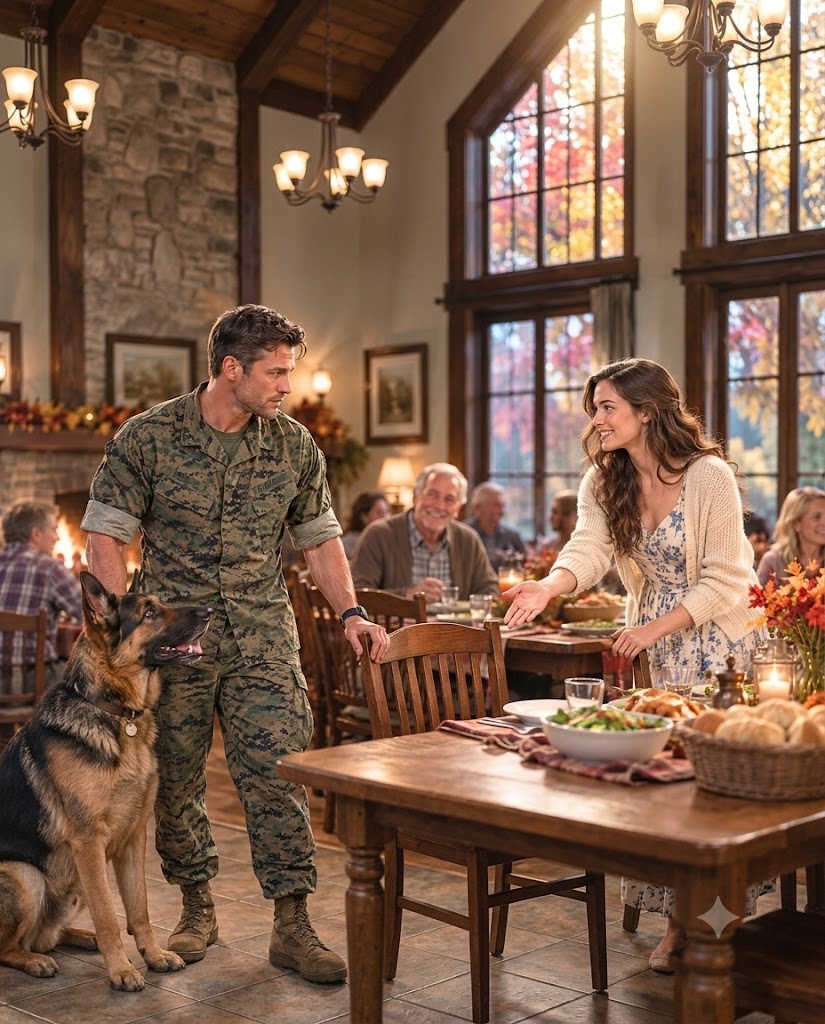
“You can sit with us,” she told the Marine—not knowing why he always ate alone.
**Part 1**
The question hit him like a sucker punch to the gut.
“Do you still eat with the Marines you served alongside?”
Staff Sergeant Becket Lauren froze mid-reach for his water glass. His face drained of color so fast that Cesily Harrow noticed from across the table.
Only minutes earlier, she had invited him to stay for dinner at the old farmhouse. His German Shepherd, Cobalt, had already claimed a spot near the fireplace.
For the first time in years, Becket had almost felt like he belonged somewhere.
But Cesily had no idea that an empty chair at her table reminded this Marine of a promise he had never found the courage to keep.
—
Late October winds swept across the rolling hills outside Galina, Illinois, scattering crimson maple leaves along the gravel driveway of Brier Glenn.
The old farmhouse glowed warm against the gray afternoon sky, kitchen lights promising shelter from the approaching winter.
Inside, Cesily Harrow arranged mismatched dinner plates along a long oak table that had welcomed more lonely people than she could count.
At twenty-eight, she possessed a graceful figure, long chestnut hair that fell in soft waves past her shoulders, and clear blue-gray eyes framed by fair skin lightly dusted with freckles.
Her beauty was quiet and natural.
But her kindness had been shaped by experience rather than innocence.
She had once worked as a ceramic designer in Chicago, where professional success gradually taught her how easily a person could become valued for what they produced instead of who they were.
Nearly two years earlier, she had moved to Galina, rented a pottery workshop at Brier Glenn, and begun coordinating The Common Table.
A weekly community dinner where nobody was required to pay.
She believed loneliness could become unbearable when people stopped expecting anyone to notice their absence.
—
That morning, Staff Sergeant Becket Lorn arrived to complete a scheduled heating system inspection.
Thirty-three years old, Becket was a Marine serving in the Marine Corps Reserve and worked as an agricultural equipment maintenance technician in civilian life.
Standing six-foot-two, he had broad shoulders, a lean muscular build, neatly trimmed dark brown hair, and striking gray-blue eyes beneath strong brows.
His handsome face carried a sharply defined jaw, a straight nose, and the faint shadow of carefully maintained stubble.
There was something quietly romantic about his rugged appearance, though his disciplined posture and guarded expression discouraged unnecessary familiarity.
Years of military service had taught him composure.
One devastating loss had taught him to mistake emotional distance for safety.
Beside him walked Cobalt, a seven-year-old retired military working German Shepherd with a thick black-and-tan coat and intelligent amber eyes.
The dog moved with the powerful, balanced build of a properly trained working animal.
Becket had legally adopted him after retirement.
Cobalt remained alert without being restless, preferring positions where he could watch his owner and nearby doorways.
While Becket examined the heating equipment, the dog rested on an approved mat in the adjoining hallway, well away from food preparation.
Cesily brought Becket coffee twice that afternoon.
He thanked her politely, explaining inspection findings with patient precision.
But whenever conversation drifted toward his personal life, his answers became shorter.
She recognized the difference between an unfriendly man and one who had learned to keep certain doors closed.
—
By early evening, the farmhouse smelled of roasted chicken, warm bread, and cinnamon apples.
Becket had finished his work and was carrying his toolbox toward the entrance when Cobalt stopped beside the dining room.
The German Shepherd lifted his nose toward the delicious smells, investigated the leg of an empty chair, and settled onto a small rug nearby.
“Cobalt, come on, buddy.”
The dog looked up, ears forward, but remained comfortably settled until Becket repeated the command.
Cesily appeared, carrying a basket of bread.
“I think your partner has already made dinner plans.”
Becket smiled faintly. “He has questionable manners around roasted chicken.”
“Then perhaps you should stay and supervise him.”
“I appreciate it, ma’am, but I should get going.”
Cesily set down the basket and pulled out the empty chair.
“You can sit with us. Nobody has to earn a place at this table.”
For reasons he could not explain, Becket found himself staring at the chair.
There was nothing remarkable about its worn wooden arms or faded cushion.
Yet the simple invitation touched something he had spent years protecting.
Finally, he placed his toolbox against the wall and sat down.
—
Dinner unfolded with easy conversation.
Walter Bellamy, a seventy-two-year-old volunteer with thinning silver hair, a weathered face, and a cheerful mischievous smile, entertained everyone with stories about his disastrous attempts at cooking.
Cesily spoke about her pottery workshop and the stubborn kiln that seemed determined to retire before she could afford another.
Becket listened, occasionally answering questions about machinery, and surprised himself by laughing when Walter described mistaking salt for sugar in an anniversary cake.
Under the table, Cobalt rested quietly near Becket’s boots.
For a little while, the Marine forgot to measure every word before speaking.
He noticed Cesily’s laughter, the gentle way she included quieter guests, and how she remembered who preferred extra potatoes.
The warmth unsettled him because he wanted more of it.
Then Walter turned toward him.
“Tell me, son, do you still get together for dinner with the Marines you served alongside?”
Becket’s hands stopped halfway toward his glass.
A photograph flashed through his memory.
A family dining table, carefully arranged plates, and one empty chair waiting beneath a yellow kitchen light.
Daniel Prior, his closest Marine friend, had sent it years earlier with a handwritten message on the back.
*Mom saved you a seat. Don’t make her wait forever.*
Daniel had promised they would share that dinner after deployment.
Daniel never came home.
Becket lowered his glass.
The voices around him seemed suddenly distant.
“Excuse me,” he said quietly. “I need to leave.”
Cesily saw the color drain from his face.
She wanted to ask what had happened, but something in his expression warned her that kindness sometimes meant allowing a person to leave without explanation.
—
Outside, Cobalt followed Becket toward his aging pickup truck.
Before climbing inside, the German Shepherd glanced back at the glowing farmhouse windows.
Becket rested a hand against the dog’s thick neck.
Through the glass, he could see Cesily gathering plates beside the chair he had abandoned.
He had spent years avoiding family dinners because every empty seat reminded him of someone who would never return.
Yet tonight, for the first time, leaving had hurt almost as much as staying.
Later, inside his modest house, Becket opened a drawer and removed Daniel’s photograph.
He studied the empty chair, then turned the picture over and read the faded handwriting.
Cobalt settled beside his feet.
Becket placed the photograph next to his untouched coffee.
He could still hear Cesily’s gentle invitation, but beneath it was another voice belonging to a man who had never made it home.
And for the first time in years, Becket wondered whether the chair waiting for him had ever truly been taken away.
—
**Part 2**
Cold November rain darkened the country roads outside Galina, leaving the fields silver beneath a low sky.
At Brier Glenn, water dripped steadily from the farmhouse gutters while the scent of damp timber mingled with fresh coffee.
A week after leaving dinner without explanation, Becket Lauren returned to finish the maintenance work scheduled during his previous visit.
He had spent several evenings remembering Cesily Harrow’s invitation, embarrassed by how abruptly he had abandoned the table.
Yet when she greeted him at the workshop entrance, she offered neither questions nor sympathy.
Only a steaming mug and a familiar smile.
She asked whether he could examine the long dining table, whose uneven joints had begun making it wobble.
After receiving authorization for the additional repair, Becket knelt beside its weathered legs while Cobalt settled near the pottery studio doorway.
Cesily worked nearby on a cracked ceramic vase, carefully examining whether its damaged structure could safely be restored.
“Why not make another one?” Becket asked.
“Because someone loved this one enough to bring it back,” she answered. “But I won’t pretend every broken thing can be repaired.”
He glanced toward her.
There was no hidden judgment in her voice, only the practical wisdom of someone accustomed to working with fragile materials.
Becket returned to tightening the table’s joints, unexpectedly grateful that she had not treated his departure as another damaged thing requiring immediate attention.
—
Over the following days, his visits gradually became less formal.
He still maintained his civilian job repairing agricultural machinery and fulfilled his Marine Corps reserve obligations.
But on free afternoons, he helped Walter Bellamy reinforce chairs, organize equipment, and replace worn hardware.
Walter’s easy humor often drew a reluctant smile from him.
Cesily noticed something more revealing.
Becket accepted difficult work without hesitation but became uncomfortable whenever someone thanked him too warmly.
He could carry heavy crates through freezing rain without complaint.
Yet a simple question about whether he had eaten lunch seemed to leave him defenseless.
One afternoon, Cesily found him watching her pottery wheel with the concentration he usually reserved for machinery.
“Would you like to try?”
“I’ve rebuilt hydraulic pumps,” Becket replied. “How difficult can a bowl be?”
Twenty minutes later, his confidence had vanished.
The clay leaned beneath his broad hands, collapsing whenever he tried to straighten it.
Cesily stood beside him, guiding his fingers toward a gentler pressure.
Their shoulders nearly touched, and Becket became acutely aware of her quiet laughter and the faint scent of lavender soap on her sleeves.
Cobalt, curious about the unfamiliar earthy smell, approached from his resting place and touched his nose to Becket’s clay-covered wrist.
Becket instinctively shifted his hand.
The spinning bowl developed a spectacularly uneven rim.
For one astonished second, both adults stared at it.
Then Cesily laughed so freely that Becket found himself laughing too.
“I believe your dog has artistic opinions,” she said.
“He’s usually more qualified than I am.”
Becket reached to collapse the clay and begin again, but Cesily gently stopped him.
“Wait, the walls are still strong. We can shape it into something useful.”
She explained that the piece would need careful drying, firing, glazing, and another firing before anyone could safely use it.
Becket studied its crooked outline.
He had spent years believing mistakes should be corrected immediately, preferably before anyone noticed.
Watching Cesily preserve something imperfect felt strangely unfamiliar.
—
Their growing ease changed several days later when Becket arrived to find her alone with the community program’s financial records.
Rising grocery prices, heating expenses, and increased attendance had stretched the approved budget.
Cesily admitted she had occasionally contributed money from her pottery sales to cover small shortages, recording those donations properly, but postponing equipment purchases for her own studio.
Becket studied the figures.
“I could cover some of this.”
Cesily shook her head. “That’s generous, but it doesn’t solve the problem. People need these dinners.”
“Exactly. Which means they can’t depend on whether one person can afford to rescue them.”
His jaw tightened. “I’m trying to help.”
“And I’m asking you to understand what needs helping.”
The words landed harder than she intended.
Becket withdrew, remembering too many occasions when offering practical assistance had seemed easier than admitting helplessness.
Cesily immediately regretted her sharpness, but she also knew she could not build a lasting community program on private sacrifices and improvised generosity.
Their disagreement remained unresolved when Margaret Finlow arrived for her scheduled review.
Fifty-five, tall and spare, Margaret wore her iron-gray hair in a precise shoulder-length bob.
Her pale complexion, narrow features, and steady brown eyes gave her a stern appearance, softened only by the careful courtesy she showed every volunteer.
Years managing nonprofit accounts had made her wary of good intentions unsupported by reliable numbers.
After reviewing the records, she warned Cesily that winter expenses could exhaust the remaining reserves.
“If we cannot establish a sustainable plan,” Margaret said, “the board may have to reduce the dinners.”
—
That evening, Becket found Cesily sitting among unfinished pottery pieces, her hands motionless in her lap.
He had returned to collect a tool he had left behind, but the exhaustion on her face stopped him.
She spoke about Chicago, where her successful design career had slowly become a life spent satisfying everyone else’s expectations.
She had come to Galina to recover her love of making things, only to discover that she was again measuring her worth by how much she could give away.
“I don’t regret helping people,” she whispered. “I’m afraid I’ve forgotten how to leave anything for myself.”
Becket sat opposite her.
He wanted to promise that he could fix everything, but remembered how carefully she had defended the program’s independence.
“Then maybe we stop treating every problem like it’s yours alone,” he said. “I can help draft a maintenance schedule. Walter knows people who might volunteer. You decide what the program needs, and we work from there.”
Cesily looked at him, surprised by the difference between this offer and his earlier one.
“I’d like that.”
She reached into a cabinet and brought out the crooked bowl.
After allowing it to dry thoroughly, she had fired it, glazed it in muted blue-gray, and fired it again over the intervening days.
Its rim remained imperfect, but the finish was smooth and beautiful.
Becket accepted it carefully.
“I think this might be the finest thing I’ve ever made.”
“Cobalt deserves partial credit.”
Outside, the rain had finally stopped.
As Becket descended the porch steps, Cobalt paused beside Cesily, accepting a gentle scratch behind his ears before following his owner.
Becket watched them together, feeling an unfamiliar reluctance to leave.
For the first time, he understood that he was no longer returning to Brier Glenn simply because something needed repairing.
—
**Part 3**
By mid-November, frost had begun gathering along the wooden fences surrounding Galina.
At Brier Glenn, the last autumn leaves clung to bare branches while preparations for Friday’s community dinner filled the old farmhouse with purposeful activity.
Becket Lorn had grown accustomed to the rhythms of the place.
The creaking floorboards, the stubborn dining chairs, and Cesily Harrow’s habit of humming while she worked.
Between his civilian maintenance job and scheduled Marine Corps reserve duties, he continued spending occasional free afternoons helping with repairs.
Cobalt had acquired a resting mat near the hallway, away from the food preparation area.
Walter Bellamy greeted the dog with cheerful remarks about his distinguished military bearing, occasionally receiving an attentive tilt of Cobalt’s head in return.
Nothing about those ordinary afternoons suggested how suddenly a familiar place could become dangerous.
That Friday, Walter volunteered to retrieve additional folding chairs from a rear storage room.
At seventy-two, the silver-haired widower still moved with the determined independence of a man who had spent decades repairing fences, raising children, and refusing unnecessary assistance.
His humor concealed a stubborn pride.
Since losing his wife, he had become particularly protective of his usefulness to others.
When he discovered a heavy supply box obstructing the chairs, he decided to shift it himself.
His shoe caught against a loose floor mat, and he fell sideways onto the hard surface.
A sharp, sickening pain shot through his hip.
He tried to push himself upright but could not.
The storage door had swung shut behind him, and his increasingly weak calls disappeared beneath conversation and clattering dishes in the adjoining rooms.
—
Cobalt had been resting beside Becket while the Marine checked a maintenance inventory.
At the distant thud, the German Shepherd raised his head sharply, ears erect.
A faint, strange sound followed.
Cobalt stood, moved toward the rear hallway, and paused at the storage door.
When Becket continued examining his notes, the dog returned, watching him intently before moving toward the door again.
His body remained tense, his attention fixed on the unfamiliar noise.
“What is it, buddy?”
Cobalt turned back toward the hallway.
Becket knew the difference between ordinary curiosity and sustained alertness.
He followed immediately, hearing a faint groan as he approached the storage room.
Opening the door, he found Walter lying on his side, his face pale and damp with perspiration.
“Walter, don’t try to move.”
“I think I’ve done something foolish,” the older man whispered through clenched teeth.
Becket crouched beside him, checking that he was conscious and breathing normally without attempting to reposition his injured leg.
“Cesily, call 911. Tell them we have an elderly man with a possible hip fracture.”
Cesily appeared moments later, her face draining of color when she saw Walter.
She made the emergency call, providing the farmhouse address and describing his condition.
Becket kept Walter still, covered him with a nearby blanket, and continued speaking calmly while they waited.
Cobalt remained outside the doorway under Becket’s direction, watchful but safely clear of the narrow passage.
“You’re not getting rid of me that easily,” Walter muttered.
“Good,” Becket replied. “I’ve still got three chairs you promised to help me fix.”
The emergency medical team arrived and carefully transferred Walter for hospital assessment.
Later that evening, Cesily received confirmation that he had fractured his hip and would require surgery, followed by rehabilitation.
She stood motionless after ending the call, shaken by how long he might have remained undiscovered.
—
Margaret Finlow immediately requested a review of storage room procedures.
Her concern was firm rather than accusatory.
Older volunteers should never be expected to handle heavy objects alone.
Access routes needed to remain clear.
The loose floor mat had to be removed, and tasks required safer assignments.
Cesily agreed, though guilt settled heavily upon her.
Becket helped document practical changes, reminding her that responsibility meant improving what had failed, not punishing herself for every accident.
After the remaining work was finished, Cesily found him seated outside the pottery studio.
Cobalt lay beside his boots, his thick coat catching the porch light.
Becket’s hands were clasped tightly together, and the distant expression she had seen during their first dinner had returned.
“You knew exactly what to do today,” she said softly.
“I knew what needed doing.”
“That isn’t always the same thing.”
For a long moment, Becket said nothing.
Then he removed a worn photograph from his wallet and handed it to her.
It showed a modest family dining room, carefully laid plates, and an empty chair.
On the back, faded handwriting read: *Mom saved you a seat. Don’t make her wait forever.*
“Daniel Prior sent me that,” Becket said. “He was a Marine I served with. My closest friend.”
His voice grew quieter as he explained that Daniel had possessed an extraordinary talent for making miserable circumstances bearable.
During one deployment, Cobalt had supported their unit under the control of his assigned military working dog handler, not Becket or Daniel.
Daniel had adored the German Shepherd, joking that the dog listened better than every Marine in their section.
“Daniel was always talking about home,” Becket continued. “His mother’s cooking, the noise around their table. He promised he’d take me there when we got back.”
He stared across the darkened yard.
“But he didn’t come back.”
Cesily waited without interrupting.
“His mother, Evelyn, wrote to me afterward. She invited me anyway. She never blamed me. I couldn’t even answer her.”
Becket rubbed his palms together, searching for words that had resisted him for years.
“Every time I thought about sitting at that table, all I could see was the person who should have been there instead. I kept replaying the moment I learned he was gone, wondering what I could have done differently, even though I had no answer. Eventually, so much time had passed that answering felt impossible.”
Years later, when Cobalt retired from military service and became eligible for adoption, Becket had completed the necessary process to bring him home.
The dog gave structure to otherwise empty evenings, but companionship had never erased the silence surrounding Daniel’s family.
—
Cesily studied the photograph before carefully returning it.
“What was Daniel like when he wasn’t being a Marine?”
Becket looked surprised.
Then a small smile appeared.
“He was a terrible cook. Once burned toast so badly we thought he’d set off an equipment alarm. Insisted it was a special recipe.”
Cesily laughed softly, and Becket joined her.
The sound startled him.
For years, remembering Daniel had felt like opening a wound.
Tonight, for a few precious seconds, he remembered a living man instead of only the circumstances of his death.
“Maybe someday,” Cesily said, “you could write Evelyn a letter. Not to explain away the years, just to tell her something true.”
Becket nodded, though he made no promise.
At home, he placed Daniel’s photograph beside the crooked blue-gray bowl Cesily had given him.
Cobalt settled beneath the table, breathing steadily.
Becket read the handwritten invitation once more, then opened a drawer and removed a clean sheet of paper.
He sat for a long time with a pen in his hand.
No words came, but when he finally turned out the lamp, the blank page remained on the table beside the photograph, waiting.
—
**Part 4**
Late November brought freezing rain and the season’s first snow to Galina, Illinois.
Bare branches rattled against Brier Glenn’s old farmhouse, and thin ice gathered along the gravel paths where volunteers had walked beneath golden autumn trees only weeks earlier.
Cesily Harrow stood in the dining room before sunrise, studying a volunteer schedule covered in crossed-out names and handwritten changes.
Walter Bellamy was recovering from hip surgery and would need weeks of rehabilitation before returning to the farmhouse.
His absence was felt everywhere, from the empty space beside the storage shelves to the cheerful voice that once filled the room with laughter.
Cesily had rearranged shifts, recruited additional helpers, and taken on several unfinished tasks herself.
Her chestnut hair was gathered into a loose braid, and exhaustion had settled beneath her blue-gray eyes.
Still, every Friday mattered.
She knew elderly neighbors who planned their weeks around these dinners and families for whom one warm meal offered both practical relief and a moment of belonging.
That morning, the dining room’s heating system stopped working.
Becket Lauren arrived after receiving a call from Brier Glenn’s management.
He made a preliminary check of the equipment and control readings, which pointed to a component that had failed since his earlier inspection.
Nothing in the previous maintenance findings had indicated this new fault.
A qualified heating contractor would need to confirm the diagnosis, obtain the correct replacement, complete the repair, and perform the necessary safety checks before the room could reopen.
“Can we get through tonight with portable heaters?” Cesily asked.
“Not safely in a room this size with this many people,” Becket answered. “I won’t tell you otherwise.”
She looked toward the long dining table already arranged for Friday supper.
“Then we cancel.”
Becket heard how much those two words cost her.
—
By afternoon, Margaret Finlow had convened an emergency board meeting.
The fifty-five-year-old chairwoman sat upright behind a stack of financial reports, her iron-gray hair immaculate despite the miserable weather.
She had spent much of her career protecting nonprofit organizations from the consequences of poor planning, and her stern manner concealed a genuine concern for the people those organizations served.
“The heating repair is only part of this,” Margaret explained. “Our reserves are shrinking. Walter’s accident exposed weaknesses in volunteer safety. We cannot continue operating on emergency decisions.”
Cesily leaned forward. “People depend on these dinners. Some of them have nowhere else to go.”
“I know,” Margaret replied. “But we must consider suspending the program through winter until we can demonstrate that it’s safe and financially sustainable.”
“You’re asking us to close the one place where some of these people feel welcome?”
Margaret’s expression softened, but her voice remained steady.
“A good heart can fill a table for one night, but it takes responsibility to keep that table standing for years.”
Cesily had no immediate answer.
She wanted Margaret to be wrong.
More painfully, she knew the warning contained a truth she had been avoiding.
—
That Friday evening, Brier Glenn’s dining room remained dark and cold.
The chairs stood neatly around the oak table, untouched plates stacked in the cupboards.
Cesily lingered beside the place where Becket usually sat, remembering how reluctantly he had accepted her first invitation.
She had believed that if she worked hard enough, she could prevent anyone from feeling forgotten.
It was the same belief that had exhausted her in Chicago, where every achievement had merely created another expectation.
Now, surrounded by silence, she wondered whether her determination had become another form of fear.
Becket arrived after work with Cobalt walking calmly beside him.
The German Shepherd shook melting snow from his black-and-tan coat before settling on his familiar mat in the hallway.
“I don’t know how to save this,” Cesily admitted.
Becket placed his toolbox near the door.
“Then let’s figure out what we can do tonight, not what we wish we could do.”
Together, they contacted volunteers and reached a nearby community kitchen that had previously partnered with Brier Glenn and maintained a contingency arrangement for canceled meals.
Its staff confirmed they had suitable facilities and could accept the ingredients that had already been prepared.
With permission from those responsible for the food, properly stored supplies were transferred for safe preparation and distribution.
Volunteers organized transport, checked which regular guests needed deliveries, and helped provide meals without reopening Brier Glenn’s unsafe dining room.
It was not the gathering Cesily had imagined.
There were no shared stories beneath the farmhouse lights, but when she learned that the last meal had reached its intended recipient, she finally allowed herself to sit down.
—
Over the following days, Cesily began rebuilding the program on paper before attempting to reopen it in practice.
Becket helped document equipment maintenance needs and obtain repair estimates within his civilian technical expertise.
Other volunteers agreed to clearly define duties, with heavy lifting restricted to those physically able and properly assigned.
Cesily prepared realistic food budgets, donation records, emergency procedures, and a schedule that did not depend upon her working every waking hour.
She also made a decision that frightened her almost as much as the threatened closure.
She would begin offering paid pottery workshops.
Her art deserved a place in her life beyond whatever income remained after everyone else’s needs were met.
Any contribution she made to The Common Table would be voluntary, recorded, and limited to what she could genuinely afford.
At the next board meeting, Margaret questioned nearly every assumption in Cesily’s proposal.
What happened if donations declined?
Who would authorize repairs?
How would volunteers be protected?
What if the building became unusable again?
This time, Cesily answered with figures, written responsibilities, and contingency arrangements.
She did not promise that nothing would ever go wrong.
“I can’t guarantee we won’t face another emergency,” she said. “But I can promise we won’t keep pretending kindness is a substitute for preparation.”
After a lengthy discussion, the board approved a conditional reopening.
The heating system would require professional repair and safety clearance.
Expenditures would remain within an approved limit, and operations would undergo regular review.
Cesily left the meeting without the certainty she once demanded, but with something stronger.
A workable path forward.
—
That evening, she and Becket sat on the pottery studio porch as fine snow settled over the stone steps.
Cobalt rested near Becket’s boots, occasionally lifting his ears at distant sounds.
“I used to think people needed me because I could always do something for them,” Cesily confessed. “If I stopped being useful, I was afraid there’d be nothing left worth keeping.”
Becket studied her profile beneath the porch light.
“I’ve spent years afraid of something different,” he said. “If I let someone matter too much, I might lose them, so I leave before they can.”
The honesty unsettled him.
Almost immediately, he stood. “I should probably get going.”
Cobalt rose with him.
At that moment, Cesily’s scarf slipped from her lap onto the porch.
As she bent to retrieve it, the German Shepherd stepped closer, briefly sniffing the fallen fabric before accepting her gentle touch behind his ears.
Becket watched them.
The familiar impulse to escape was already carrying him toward the steps, but the small interruption gave him time to recognize what he was doing.
He remembered the first dinner, the empty chair, and the loneliness waiting on the other side of his own decisions.
Slowly, he sat down again.
Cesily looked at him without speaking.
“Nothing good comes with a guarantee,” she finally said. “But if we refuse it because we’re afraid of losing it, haven’t we already given it away?”
Becket reached across the narrow space between them and took her hand.
Her fingers closed gently around his.
Snow continued falling beyond the porch light.
For once, Becket had no excuse prepared, no destination demanding his attention, and no desire to disappear.
He stayed.
—
**Part 5**
By mid-December, fresh snow blanketed the wooden fences surrounding Brier Glenn.
Warm light glowed through the farmhouse windows again, and beneath the quiet winter sky, the old building was preparing to welcome its neighbors home.
The dining room’s heating system had been professionally repaired, inspected, and cleared for use.
After the temporary suspension of gatherings inside the farmhouse, The Common Table was reopening with a special dinner honoring everyone who had helped preserve it.
Cesily Harrow moved between the kitchen and dining room, checking volunteer assignments rather than attempting every task herself.
Her chestnut hair fell in loose waves beneath a knitted cream cardigan, and a brightness had returned to her blue-gray eyes.
When Walter Bellamy arrived with a relative, moving carefully behind a walker as he continued recovering from hip surgery, Cesily hurried to greet him.
“I brought my working hands,” Walter announced.
“And you’re keeping them firmly around your dinner plate,” she replied.
Walter chuckled, accepting a chair near the end of the table.
For once, he seemed content to let others do the lifting.
During the temporary closure, Cesily had begun offering small paid pottery classes and accepting commissions from local customers.
Two nearby shops had agreed to display a selection of her handmade pieces.
The income was modest, but it belonged to a future she was building deliberately.
She still loved the community program, yet she had stopped treating exhaustion as proof of devotion.
Her volunteers now had defined responsibilities, and she had learned that protecting her own dreams did not diminish the kindness she offered others.
—
Becket Lauren had witnessed those changes during their increasingly familiar afternoons together.
His civilian work repairing agricultural machinery remained demanding, and his Marine Corps reserve responsibilities continued on schedule.
But he made time for walks along snow-dusted country roads and quiet conversations over coffee in Cesily’s studio.
Sometimes they talked about childhood memories or ordinary frustrations.
Sometimes they simply watched Cobalt settle beside the pottery wheel and follow the movement of Cesily’s hands with mild curiosity.
Becket no longer felt compelled to fill every silence with an excuse to leave.
Yet one unfinished obligation remained.
The evening before the reopening, Becket sat at his kitchen table with Daniel Prior’s photograph, the crooked blue-gray bowl, and the clean sheet of paper.
Cobalt lay beneath his chair, his black-and-tan coat rising and falling with steady breaths.
Becket had tried writing to Daniel’s mother several times, abandoning each attempt when the words seemed inadequate.
Tonight he finally understood that waiting for the perfect explanation had become another way of avoiding her.
He began slowly.
*Dear Mrs. Prior,*
*I owe you an apology for not answering your letters.*
*You welcomed me when you had every reason to be grieving, and I answered your kindness with silence.*
*I have carried guilt about Daniel’s death for years, and I did not know how to sit across from you when he could not.*
Becket paused, remembering Daniel’s laughter, his ridiculous confidence in the kitchen, and the photograph of a chair waiting at home.
*I still remember the good things, too.*
*Daniel could make the worst day bearable.*
*He once burned toast so badly that everyone thought something important had caught fire.*
*He laughed harder than anybody.*
*I should have told you these things long ago.*
*I don’t expect you to forgive the years I stayed away, but if you would still welcome a visit someday, I would be grateful for the chance to remember him with you.*
He signed his name, folded the letter, and placed it inside an envelope.
The following morning, he mailed it.
There was no sudden relief, no certainty that Evelyn Prior would answer.
But as he drove away from the post office, Becket realized he had finally stopped asking his fear for permission.
—
That evening, Brier Glenn filled with the comforting aromas of roasted chicken, winter vegetables, warm bread, and baked apples.
Pine branches decorated the windowsills, while handmade pottery brightened the long oak table.
Margaret Finlow, her iron-gray hair neatly arranged and her expression as observant as ever, reviewed the completed safety documentation before accepting Cesily’s invitation to stay for dinner.
She chose a seat among the volunteers rather than standing apart as the board chairwoman.
When Becket arrived, Cobalt walked beside him with the calm confidence of a dog who knew the familiar building.
Becket carried the imperfect bowl he had made weeks earlier, its uneven rim catching the amber light.
Cesily approached him with a smile.
“I was hoping you’d bring that.”
“I thought it deserved its first proper dinner.”
She guided him toward his usual place.
Becket set the bowl beside his plate, then noticed a small handwritten card Cesily had left at his seat.
*You never have to earn your place here.*
Becket read the words twice.
For a moment, he saw another table in another home, photographed years before with a chair waiting for someone who had been too frightened to accept the invitation.
Daniel’s message had once felt like an accusation.
Tonight, he understood that an offered place was not a debt that had to be repaid.
He pulled out the chair and sat beside Cesily.
Cobalt settled on his designated mat near Becket’s feet, safely away from the serving area.
No one had to persuade Becket to stay.
He had made that choice before entering the room.
—
Dinner unfolded with laughter, passing plates, and the familiar warmth of people grateful to be together.
Becket used his uneven blue-gray bowl for a helping of winter vegetables, smiling when it proved perfectly serviceable.
Walter entertained the table with exaggerated accounts of his rehabilitation exercises until someone asked Becket whether military life had taught him to cook.
“Not successfully,” Becket admitted. “A friend of mine, Daniel, once claimed he could make breakfast for an entire unit. He burned the toast so badly we had to open the doors to clear the smoke.”
Walter grinned. “Sounds like my kind of chef.”
Everyone laughed, and Becket laughed with them.
He still missed Daniel.
He suspected he always would.
But remembering his friend no longer meant remembering only the day he died.
—
After the final guest departed, Cesily and Becket cleared the remaining plates together.
Snow drifted beyond the dark windows, and the farmhouse had grown peaceful again.
“I mailed the letter,” Becket told her.
Cesily turned toward him. “To Evelyn?”
He nodded. “I don’t know whether she’ll answer.”
“You gave her the chance,” Cesily said gently. “And you gave yourself one, too.”
Becket looked at the empty chairs around them.
For years, he had mistaken solitude for the safest place to live.
Now he understood that home could also be somewhere another person genuinely hoped he would return.
“Will you come next Friday?” Cesily asked.
“I’d like that.”
He took her hand.
“Although, if you’re willing, I’d rather not wait until Friday to have dinner with you again.”
She laughed softly and rested her head against his shoulder.
Beneath the table, Cobalt lifted his ears at their voices, then settled back to sleep.
Outside, winter had arrived in earnest.
Inside Brier Glenn, Becket had finally discovered that coming home did not require forgetting those he had lost.
Sometimes home was simply the place where someone kept a chair for you and where at last you found the courage to sit down.
—
Sometimes God’s greatest miracles don’t arrive with thunder or extraordinary signs.
Sometimes they come quietly through an unexpected invitation, a faithful dog, a helping hand, or an empty chair waiting for someone who has forgotten what it feels like to belong.
Becket’s journey reminds us that healing doesn’t mean forgetting those we’ve lost.
It means finding the courage to love again while carrying their memories in our hearts.
Perhaps God places certain people in our path not to erase our pain, but to remind us that our story isn’t over.
In everyday life, we never know who is silently struggling.
A simple act of kindness, a warm meal, or a few compassionate words might become the miracle someone has been praying for.









