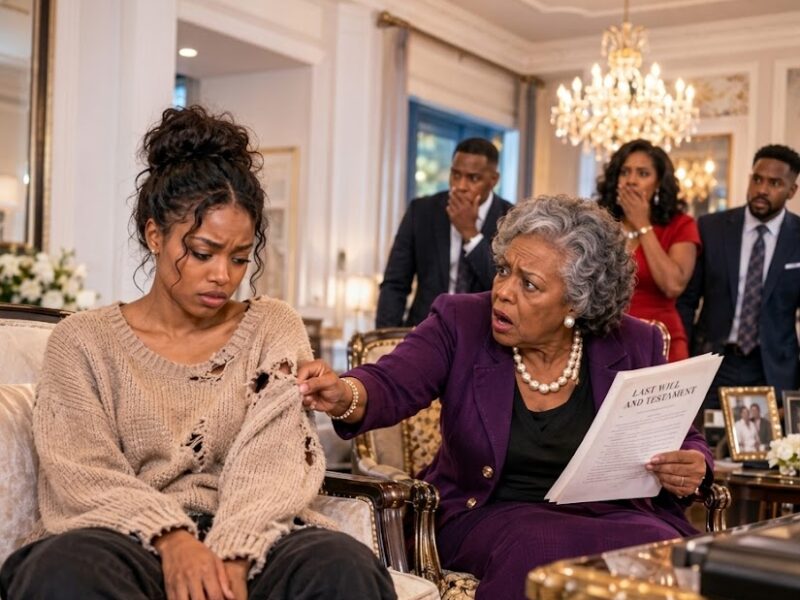
“Where’s the $900,000 I Gave You?” Grandma Asked—My Answer Changed Her Will Before Sunrise
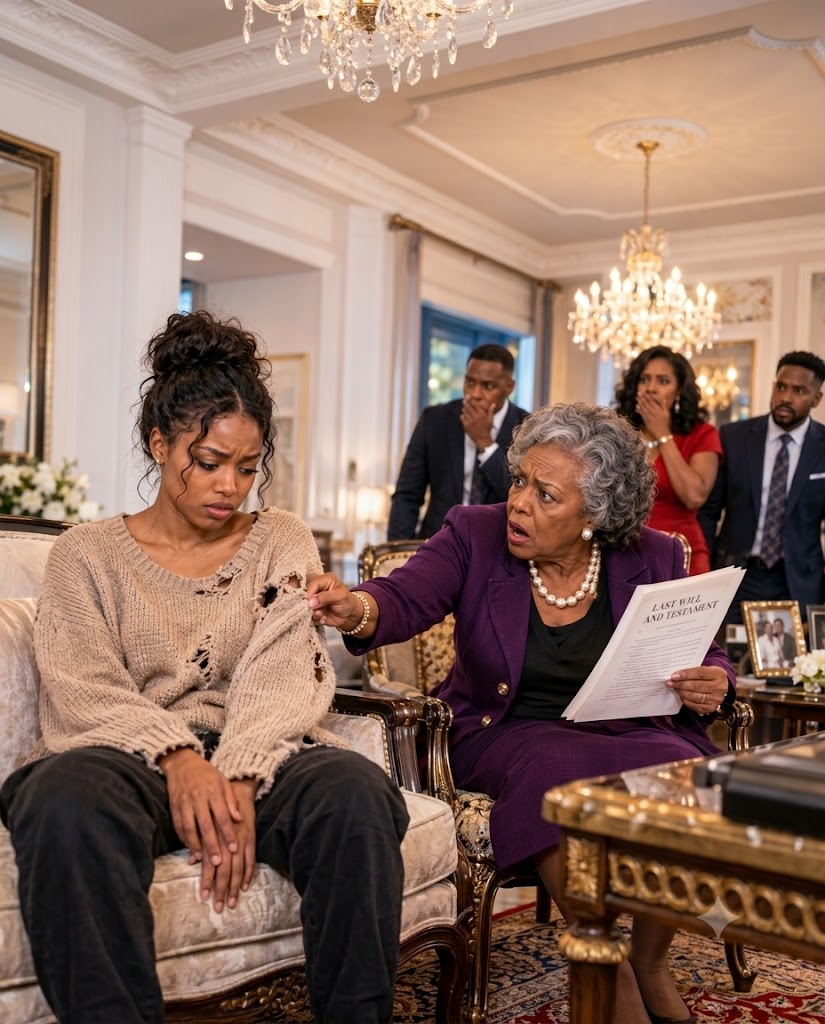
The automatic doors slid open with that tired pneumatic hiss I’d heard a thousand times, and I stood there holding a piece of white poster board I’d painted with a black marker, feeling like the biggest failure in Richmond, Virginia.
My sign said “Nursing student between homes. Anything helps. Thank you.” in letters that had started strong and gotten shaky by the end.
I was 21 years old, sleeping in my aging Toyota Corolla, showering at the campus gym, and standing outside a supermarket on a Thursday afternoon hoping strangers would give me enough money for food and gasoline.
Then I saw her.
Grandma Evelyn stood frozen beside her silver Buick, staring at me as if the ground beneath her feet had cracked open.
She was 76 years old, but she still moved with the straight-backed confidence of the hospital administrator she’d been for almost four decades.
Her gray hair was twisted into a neat bun, her church coat buttoned perfectly despite the cold, and even from 20 yards away I could see the disbelief in her face.
Heat rushed into my face when our eyes met across the parking lot.
“Naomi,” Grandma Evelyn called. “Sweetheart, what are you doing out here?”
I tried to answer, but shame tightened around my throat.
Tears blurred the rows of parked cars.
This was never how she was supposed to learn the truth.
Nobody was supposed to know I had been sleeping in my car, showering at the campus gym, and standing outside a supermarket on a Thursday afternoon hoping strangers would give me enough money for food and gasoline.
“Grandma, I can explain.”
But the sentence collapsed before I finished it.
She reached me and took both of my arms.
Her grip was gentle, but there was steel beneath it.
“Where is your education money? The trust I put aside for you and Cameron. There was nearly $900,000 in those accounts. Why are you standing here asking strangers for $5?”
Nearly $900,000.
The number seemed to hover between us.
I watched confusion harden into fear and then into something far colder as she waited for me to respond.
People kept walking around us.
One man dropped $2 into the plastic cup beside my backpack without looking at my face.
The coins hit the bottom with a metallic clatter that made me want to disappear.
“It’s gone,” I whispered. “Almost all of it.”
—
Three years earlier, my life had looked completely different.
I was 18, sitting in Grandma Evelyn’s sunroom, where everything smelled faintly of lemon polish, tea, and the lavender hand cream she’d used for as long as I could remember.
My parents, Leonard and Denise, sat together on the sofa.
My older brother, Cameron, leaned against the window, scrolling through his phone like the conversation had nothing to do with him.
“I spent most of my adult life working,” Grandma Evelyn said, folding her hands over a yellow legal pad.
“Thirty-eight years in hospital administration, then twelve more consulting after I retired. Your grandfather and I saved because we knew what it was like to grow up without choices.”
She placed two folders on the coffee table.
“$440,000 for each of you. Education first. Graduate school if you want it. Professional licensing, housing while you study, and anything left can help you begin your adult lives. But until you finish an accredited program, this money is not for cars, vacations, weddings, businesses, or showing off.”
Cameron glanced at the folder.
“That’s generous, Grandma.”
I walked around the table and hugged her so tightly she laughed.
“I’m going to use every opportunity you gave me,” I said. “I’m going to become a physical therapist. Maybe work with stroke patients.”
She rubbed my back.
“Your grandfather would have loved hearing that.”
Then she looked at my parents.
“Leonard, Denise, because Naomi and Cameron are still young, you’ll have limited authority over the accounts until they turn 22. I expect you to protect the money, not treat it as yours.”
My mother smiled with practiced innocence.
“Mama, you know us better than that. We would never interfere with their future.”
I wish I had paid closer attention to the way she stared at those folders.
—
The first warning came about nine months later when Cameron arrived home with his new girlfriend, Bianca Laurent.
She was 28.
Cameron was 21.
Bianca drove a white Range Rover, wore expensive perfume, and introduced herself as a luxury lifestyle consultant, although nobody in the family could ever explain exactly what that meant.
She spoke constantly about networking, status, branding, influential people, and being seen in the right rooms.
My mother adored her almost instantly.
“This woman understands ambition,” Mom whispered to me after their second visit. “Cameron finally found somebody who knows how to move upward.”
We were sitting in the townhouse my parents had rented for years.
The kitchen cabinets were peeling.
The upstairs bathroom leaked whenever someone used the shower.
But suddenly my mother had begun talking about society weddings, exclusive neighborhoods, private clubs, and family image.
Six weeks later, Cameron walked into Sunday dinner holding Bianca’s hand.
“We’re getting married.”
He held up her left hand before anyone even responded.
The diamond was an enormous 4.2 carats, Bianca announced.
Nobody had asked.
Dad jumped up and hugged Cameron.
Mom screamed loud enough for the neighbors to hear.
I stood too and hugged my brother.
Whatever I thought of Bianca, I wanted him to be happy.
“Congratulations,” I said. “Have you picked a date?”
“We’re thinking October,” Cameron said.
“October?” I laughed. “That’s five months away.”
“That’s plenty of time,” Mom said.
There was something in her voice that made me look at her.
“My son is getting one wedding,” she continued. “I want people to remember it.”
At the time, I thought she meant flowers, good food, maybe a beautiful hotel ballroom.
I had no idea she meant burning through generations of savings for one night.
—
That summer I was taking anatomy and chemistry classes at a local college before transferring into a competitive physical therapy track.
My world consisted of lectures, lab reports, flashcards, and making Grandma proud.
Then two weeks before my 20th birthday, Mom called me into the dining room.
She had made peach cobbler.
That should have warned me.
She only baked peach cobbler when she wanted something.
“Sit down, Naomi,” she said. “We need to discuss Cameron’s wedding.”
I took the glass of lemonade she placed in front of me.
“What about it?”
“Bianca found the perfect venue. It’s an estate outside Charlottesville. Private gardens, ballroom, guest cottages, beautiful.”
“That sounds nice.”
“It is. They’re inviting around 350 people. There’ll be a string quartet for the ceremony, live jazz during dinner, custom lighting, imported flowers.”
I stared at her.
“Mom, that sounds insanely expensive.”
She folded her hands.
“It’s going to be around $300,000.”
I nearly knocked over my glass.
“Three hundred thousand dollars?”
“Maybe slightly more after everything is finalized.”
“Where are you getting $300,000?”
For several seconds she said nothing.
Then she looked directly at me.
Not like a mother.
Like someone calculating how much resistance she was about to face.
“That’s why I wanted us to talk.”
My stomach tightened.
“You aren’t entering the graduate phase of your program for almost two years,” she said. “Your trust money is just sitting there.”
“No.”
She blinked.
“Naomi.”
“No. Absolutely not.”
“You haven’t even heard me.”
“I heard enough. That money is for school.”
“And nobody is saying you won’t go to school. We would replace it before you need it.”
“With what money?”
Her mouth tightened.
“That isn’t the point.”
“It is exactly the point.”
She leaned toward me.
“Your brother is getting married once. This is a major moment for our family.”
“So he should have the wedding he can afford.”
Her expression changed instantly.
“Don’t be ugly.”
“I’m not being ugly. I’m saying Grandma saved that money for my education.”
“Your grandmother does not need to know every financial decision this family makes.”
My heart started beating harder.
“She specifically told you not to use it for weddings.”
“She’s old-fashioned.”
“She was very clear.”
Mom’s voice dropped.
“Naomi, family means sacrifice. Cameron has always looked out for you.”
I laughed because I genuinely thought she was joking.
“That attitude is exactly what I’m talking about. I’m not giving away my degree so Bianca can have imported flowers.”
“You’re being dramatic, and you’re talking about taking money that doesn’t belong to you.”
Her eyes went cold.
“You still live in our house. You eat food we buy. You use our electricity. You drive a car your father helped repair. Maybe think about how much this family has done for you before you start calling everything yours.”
That should have been the moment I called Grandma Evelyn.
I should have left the table, driven directly to her house, and told her what Mom had said.
But I was 19.
I still believed parents might say awful things when stressed and then come to their senses.
I thought refusing would be enough.
I was wrong.
—
Twelve days later, I logged into the trust account from my laptop.
I checked it almost every week.
Seeing that balance calmed me.
It reminded me that no matter how difficult school became, my future had a foundation.
$440,000.
That number meant graduate school, housing, clinical placements, licensing, freedom.
Except that night, the number on my screen was $1,600.
I stared at it for so long my laptop dimmed.
I refreshed the page.
$151.
I logged out, logged back in.
Same number.
More than $288,000 was gone.
I ran downstairs carrying the laptop.
“What did you do?”
Dad was watching television.
Mom was organizing envelopes at the dining table.
“What did you do to my account?”
Mom barely looked up.
“We paid the deposits.”
“You took almost $300,000.”
“We discussed this.”
“No, you discussed stealing it. I said no.”
Dad muted the television.
“Lower your voice.”
“My money is gone.”
“It isn’t your money to worship,” Mom snapped. “It’s family money.”
“No, it is not.”
“We’ll replace it.”
“How?”
“The wedding will be over soon. We’ll figure it out.”
“You said the wedding was $300,000 total. You took almost all of that from me alone.”
“Prices changed.”
“What prices?”
“Naomi, weddings are complicated.”
I stared at her.
She sounded irritated.
Not guilty.
Not ashamed.
I had imagined that if they ever crossed that line, they would at least understand they had betrayed me.
Instead, they behaved as though I had inconvenienced them by noticing.
“Put it back.”
Dad stood.
“That’s enough.”
“Put my money back.”
“You need to remember who you’re talking to.”
“I’m talking to the people who stole almost $300,000 from me.”
His face hardened.
“We gave you everything growing up.”
“You were my parents. Feeding your child doesn’t buy ownership of her future.”
Mom stood so quickly her chair scraped backward.
“Go ahead, then,” she said. “Call Evelyn. Tell her we used some money to help her grandson have the wedding of his dreams. Tell her you refuse to help your own brother. Let’s see whether she admires that selfishness.”
I wish I had understood that sentence for what it was.
They were counting on my silence.
And they knew exactly which button to push.
Grandma had always been proud of me.
I couldn’t bear the idea of being the reason she turned against her own daughter.
So I said nothing.
—
Cameron and Bianca’s wedding happened beneath a ceiling covered with thousands of suspended crystal lights.
There were fountains lit from underneath, towers of white orchids, gold-edged menus, custom table linens, champagne imported from France, and a 16-piece orchestra during dinner.
Guests arrived in chartered coaches.
Bianca wore two wedding dresses.
The first cost more than some houses in the neighborhood where we grew up.
The second was covered in hand-sewn pearls.
I stood beside them as one of the attendants, wearing a custom lavender gown that had cost $2,300, paid for from my trust.
I smiled in photographs.
I held Bianca’s bouquet while she adjusted her dress.
I gave a speech about love and family while my stomach twisted so badly I could barely breathe.
During the reception, Mom walked over and hooked her arm through mine.
“Look at this,” she whispered proudly. “People are going to talk about this wedding for years.”
I looked around the ballroom.
“At least somebody will remember where the money went.”
She frowned.
“What?”
“Nothing.”
The celebration lasted until nearly two in the morning.
There had been a fireworks display that cost more than my first year of community college.
An eight-foot champagne wall.
A custom dance floor with Cameron and Bianca’s initials projected across it.
The floral installation alone had cost $31,000 and would be thrown away by morning.
Dinner had cost almost $400 per person.
I spent half the night unconsciously adding numbers.
$10,000 here.
$26,000 there.
$14,000 for transportation.
$9,000 for favors.
Thousands more from monogrammed napkins, engraved glasses, imported caterers, drone footage, hair stylists, makeup artists, and decorative furniture nobody would ever use again.
Every detail seemed to translate itself in my head.
One semester.
Two semesters.
Rent for a year.
Books.
Clinical fees.
Licensing exams.
My future had become centerpieces and champagne bubbles.
Still, part of me tried to believe the damage had stopped.
Maybe they really would repay me.
Maybe they would refinance something.
Maybe Cameron would eventually understand.
Maybe I could still rescue enough of my education.
—
Four months later, Mom approached me while I was studying neuroanatomy at the dining table.
I was working mornings at a rehabilitation clinic and evenings at a coffee shop just to save extra money.
“We need to talk about Cameron and Bianca.”
My hands stopped moving.
“No.”
“You don’t even know what I’m going to say.”
“Yes, I do.”
“They found a condo.”
I closed my textbook.
“No, Naomi. No.”
“It’s in a beautiful new development downtown. Two bedrooms, rooftop pool, concierge—”
“No.”
“They need help with the down payment.”
I pushed back from the table.
“You already took almost $300,000 from me for their wedding.”
Dad appeared in the doorway.
“This isn’t only your decision.”
I looked at him.
“My name is on the account.”
“So is ours until the trust restrictions expire.”
“The restriction says education, and you’re still going to get an education.”
“With what?”
Mom gave me the same soothing smile people use on angry children.
“You’re 20. You have time. Cameron is married now. He and Bianca need stability.”
“With my money?”
“Don’t start.”
“My money.”
“Stop being selfish,” she snapped.
There it was.
The word they used whenever I defended myself.
Selfish.
“You have always competed with your brother,” she said. “Even when you were little. Now he finally has something beautiful, and you can’t stand seeing him happy.”
I felt my chest tighten.
“You stole from me.”
“We raised you.”
“You keep saying that like parenthood was a loan.”
Dad pointed toward the stairs.
“You are crossing a line.”
“No, you crossed it months ago.”
But arguments no longer mattered.
—
Four days later, I checked my balance during my lunch break at the rehabilitation clinic.
$151,000.
Refresh.
$49,200.
Refresh.
$49,200.
Another $102,400 gone.
I sat in a staff bathroom stall and cried silently for 20 minutes.
That night I transferred every remaining dollar into an account at another bank that only I could access.
Two weeks later, I moved out.
Everything I owned fit into the backseat and trunk of my aging Toyota Corolla.
Clothes, textbooks, a lamp, three boxes of childhood photographs, a blanket Grandma had crocheted when I was 12.
I rented a room from a woman named Mrs. Holloway who owned an old house near campus.
There were four tenants upstairs sharing one bathroom.
The heating barely worked.
My room had one tiny window and a closet door that wouldn’t close.
It was perfect.
Because nobody there could steal from me.
Mom called 47 times during my first week.
Dad came to my coffee shop and demanded I stop humiliating the family.
Cameron sent me a long message accusing me of ruining Mom’s health with stress.
Bianca wrote, “I hope one day you learn money isn’t more important than family.”
I stared at that one for several minutes before blocking her too.
Then I entered survival mode.
I picked up more shifts at the rehabilitation clinic.
I worked nights restocking shelves at a 24-hour pharmacy.
On weekends, I served brunch at a crowded restaurant.
Four hours of sleep became normal.
Sometimes three.
I studied muscle groups while standing at bus stops.
I listened to recorded lectures while folding towels at the clinic.
I ate instant oatmeal, canned soup, rice, and whatever food the restaurant staff was allowed to take home after closing.
My grades slipped.
Not catastrophically, but enough to scare me.
I had always been an A student.
Now I was getting B-minus grades because I would read the same paragraph five times and still not remember it.
The $49,200 I had rescued sounded like a lot until I calculated graduate tuition, housing, health insurance, transportation, lab fees, and the semesters when clinical rotations would make full-time work nearly impossible.
It wasn’t enough.
It would never be enough.
My remaining prerequisites cost nearly $8,000 a year.
I bought used books.
I borrowed older editions.
I stopped going anywhere that required spending money.
I stretched groceries until the refrigerator looked almost empty.
But the graduate program itself was expensive.
Two and a half years.
Intensive coursework.
Clinical rotations.
There was no realistic way to work 60 hours a week and complete it.
I wrote budgets until two in the morning, changed numbers, cut food, cut transportation, imagined impossible scholarships.
Nothing worked.
Every calculation ended the same way.
Not enough.
My dream of becoming a physical therapist had once felt inevitable.
Now it felt like something I could see through a locked window.
And the worst part was knowing why.
Not because I failed.
Not because I was lazy.
Not because I made some reckless decision.
Because my own family decided Cameron’s wedding photographs mattered more than my future.
—
Fourteen months after that wedding, Mrs. Holloway told me she had to sell the house.
The new owner wanted everyone out.
I had just lost several shifts at the rehabilitation clinic because their budget was cut.
My savings were almost gone.
For the first time in my life, I had nowhere to sleep.
I moved into my Corolla.
The driver’s side window did not close completely.
It was January.
At night, I wrapped myself in two blankets and slept in 20-minute stretches because the cold kept waking me.
I had $614 in my checking account.
I applied for scholarships, emergency grants, university hardship funds, anything I could find.
But my parents’ income complicated financial aid, and because I was still considered dependent under several aid rules, I needed information from them.
Mom refused.
“Come home,” she said during the only phone call I answered. “Apologize for everything you’ve put this family through, and then maybe we can discuss helping you.”
“I’d rather sleep in my car.”
“That’s your choice.”
Student loans were no easier.
Several private lenders wanted a cosigner.
There was exactly one person in my life who would have signed without hesitation.
Grandma Evelyn.
And she was the one person I could not bring myself to tell.
How could I explain what her lifetime of saving had purchased?
Champagne towers.
Fireworks.
A luxury condo.
A wedding dress Bianca wore for four hours.
How could I tell Grandma that while she believed she had secured my education, I was sleeping beneath a fleece blanket in a Toyota with frost forming inside the windshield?
I thought the betrayal would break her heart.
So I hid it until I couldn’t.
—
That afternoon outside the supermarket, I had made $11, enough for gasoline and something warm to eat.
I stood there holding my ridiculous sign while strangers avoided my eyes.
Then Grandma Evelyn’s Buick turned into the lot.
My first instinct was to run.
I stepped backward toward the wall, hoping a delivery truck would block me.
It didn’t.
She saw me.
And suddenly every lie of omission, every night in my car, every unpaid bill, every sacrifice I had hidden from her was standing there in the cold with me.
“Tell me everything,” she said.
Her voice was quiet.
That frightened me more than yelling would have.
“Every detail. Right now.”
We sat inside her Buick for almost two hours.
I told her about Mom’s first conversation, the wedding withdrawals, the condo, the threats, the financial aid forms, the jobs, Mrs. Holloway selling the house, the nights in my car.
I told her things I had spent more than a year convincing myself did not hurt anymore.
When I finished, Grandma Evelyn was staring through the windshield.
Her hands were locked around the steering wheel.
“My daughter did this.”
It wasn’t a question.
I said nothing.
“Denise stood beside me at that wedding,” she whispered. “She thanked me for raising her to value family.”
Her voice broke.
“And she had already emptied your account.”
“Grandma, I’m sorry.”
Her head snapped toward me.
“Do not apologize.”
“I should have told you.”
“You were 19 years old. I knew what they were doing. And you were scared.”
“I didn’t want you to think I was ungrateful.”
“Ungrateful?”
She made a sound that was somewhere between a laugh and a sob.
“Look at me.”
I did.
There were tears running down her cheeks.
“My granddaughter has been sleeping in a car in winter because she was afraid of disappointing me.”
I started crying again.
“I thought if you knew what they did, it would destroy you.”
“What destroys me is knowing you carried this alone.”
She wiped her face with one hand.
Then something changed in her expression.
I had seen that look before.
When a contractor tried to overcharge her after Grandpa died.
When hospital executives underestimated her because she was a Black woman from a working-class neighborhood.
When somebody assumed age made her weak.
Grandma Evelyn had a particular stillness when she had finished being hurt and started making decisions.
“Where are your parents living now?”
I hesitated.
“They bought a house last summer.”
“With what? Cameron’s trust.”
Her eyes closed.
“All of it?”
“Almost. He let them use what remained after the wedding. Mom said it was a family investment.”
Grandma Evelyn reached into her purse and took out her phone.
Her first call was to an attorney named Malcolm Reeves.
“Malcolm, it’s Evelyn Carter. I need you at my home tonight.”
She listened.
“No, tomorrow is not acceptable.”
Another pause.
“I am changing my estate plan before I go to sleep.”
Then she called her financial advisor.
After that, her accountant.
Each conversation was brief.
Controlled.
Final.
Then she turned toward me.
“You are coming home with me.”
“Grandma—”
“No discussion.”
“I don’t want to be a burden.”
Her eyes flashed.
“You are my granddaughter, not a utility bill.”
Despite everything, I almost laughed.
“We are getting you food, a hot shower, clean sheets. Tomorrow we’ll deal with school.”
“You don’t have to fix everything.”
“Yes,” she said. “I do.”
She stared toward the supermarket entrance for several seconds.
“And tonight, your parents are going to hear from me.”
—
I tried to talk her out of confronting them immediately.
Grandma Evelyn was not interested.
At 8:30 that evening, we pulled into the driveway of my parents’ new house.
It was a five-bedroom brick colonial in a gated subdivision 20 minutes outside Richmond.
A curved driveway.
Three-car garage.
Landscape lighting.
Everything my parents had spent my childhood claiming they could never afford.
The porch glowed warmly.
Through the front window, I could see Mom sitting on a large sectional with a glass of wine.
Dad answered the door.
His expression changed the second he saw us.
“Evelyn.”
Then he noticed me.
“Naomi.”
Grandma walked past him.
“Get Denise. Get Cameron. If Bianca’s here, get her too.”
“Hold on—”
“Now, Leonard.”
Five minutes later, all of us were in the living room.
The place looked staged for a real estate advertisement.
New furniture.
Huge television.
Marble coffee table.
Professional family portraits.
Several photographs from Cameron’s wedding.
Bianca and Cam sat beside each other.
Mom stood near the fireplace.
Her face was pale.
“What is she doing here?” Cameron asked. “I thought we agreed nobody was chasing after her until she apologized.”
Grandma turned slowly.
“Apologized for what?”
Cameron looked at Mom.
“For abandoning everybody.”
“For being selfish,” Mom added.
Grandma stared at her daughter.
“Selfish.”
The room went silent.
“For refusing to let you drain the last dollar from her education fund.”
Mom’s mouth opened.
“Because that is what happened, Denise.”
“Mom, let us explain.”
“No. You had more than a year to explain.”
Dad stepped forward.
“You’re getting only one side.”
“I created those trusts.”
Grandma’s voice rose.
“I know exactly what they were for.”
“We had legal access,” Dad said.
“You had fiduciary responsibility.”
“That money helped the family.”
“That money was for their futures.”
Grandma’s shout shook the room.
I had heard her angry before.
I had never heard her roar.
“I worked for decades. Your father worked until his back gave out. We saved because our grandchildren were supposed to have choices we never had. I trusted you to protect those choices.”
Mom crossed her arms.
“Cameron needed a wedding.”
“No human being needs a $300,000 wedding.”
“He deserved something special.”
“Then you should have paid for it.”
Bianca stiffened.
Grandma turned toward Cameron.
“Did you know where the money came from?”
Cameron’s face changed.
“That was enough,” Mom said. “Naomi was okay with contributing.”
“I was not,” I said.
My voice trembled, but I forced myself to continue.
“I told them no.”
Cameron looked at me.
“I thought you changed your mind.”
“They never asked me again.”
Bianca shook her head.
“This is being exaggerated. The money stayed in the family.”
Grandma looked at her.
“My granddaughter slept in a freezing car.”
Bianca stopped speaking.
Grandma stepped closer.
“She begged strangers for food while you lived in a luxury condo purchased with money stolen from her education.”
Dad raised both hands.
“Nobody intended for that to happen.”
“Intent does not erase consequences.”
Cameron stood.
“Grandma, come on. We can fix this.”
“With what money?”
Nobody answered.
Grandma reached into the leather folder she had brought inside.
“You’re right about one thing. Something needed fixing.”
She removed several documents.
“I changed my estate plan tonight.”
Mom’s face drained of color.
“Mom—”
“My house, investment accounts, retirement funds, consulting shares, insurance proceeds, and remaining business interests were previously divided between you, your brother Anthony, and the grandchildren.”
She placed the documents on the coffee table.
“That arrangement no longer exists.”
“Mom, don’t do something emotional.”
Grandma laughed once.
“Emotional?”
She tapped the papers.
“My attorney spent three hours making sure this was anything but emotional.”
Dad stepped closer.
“What exactly are you saying?”
“I am saying Denise receives nothing.”
Mom stared at her.
“Nothing.”
“Nothing.”
Grandma pointed toward Cameron.
“Cameron receives nothing directly.”
His mouth fell open.
“Grandma—”
“Bianca receives nothing.”
“Leonard receives nothing.”
Dad looked stunned.
“You can’t punish everybody forever for one mistake.”
“One mistake?”
Grandma turned to him.
“You took money twice after Naomi explicitly told you no. Then you refused financial aid paperwork while she was homeless. That is not one mistake. That is a pattern of choices.”
Mom began to cry.
“How much are we talking about?”
Grandma’s expression became almost disappointed.
“Interesting question.”
Mom looked away.
“My current estate is valued at approximately $4.6 million.”
Nobody spoke.
“Half will go to Anthony’s children through protected trusts. The other half will go to Naomi.”
Cameron stood completely still.
Then Bianca said, “That isn’t fair.”
Grandma turned toward her.
“Fair?”
Her voice was soft again.
“You spent Naomi’s fairness on orchids.”
Mom sank onto the sofa.
“We can repay her.”
“With what?”
“We’ll sell things.”
“The damage is not only money.”
Grandma pointed at me.
“She delayed school, worked three jobs, lost her housing, slept in her car, begged outside a grocery store.”
Her voice broke again.
“My granddaughter thought she had to hide hunger from me because you taught her that defending herself made her selfish.”
Dad swallowed.
“We got carried away.”
“You chose appearances.”
Grandma looked at Mom.
“You chose Cameron’s image over Naomi’s future.”
Then she turned to me.
“Go upstairs if there is anything here you still want.”
“I took almost everything when I moved.”
“Then there is no reason to stay.”
Mom stood abruptly.
“Naomi, please.”
I looked at her.
For months I had imagined that moment.
I thought I would scream.
I thought I would tell her how many nights I cried in parking lots, how humiliating it felt to use gas station bathrooms, how terrified I had been every time someone knocked on my car window after midnight.
Instead, I felt exhausted.
“We love you,” Mom whispered.
Grandma answered before I could.
“Love without protection is just a word.”
Mom began sobbing.
“We made a terrible mistake.”
Grandma took my hand.
“No. You made repeated choices.”
She looked at me.
“Come home, sweetheart.”
As we reached the doorway, Cameron called my name.
I stopped.
“I didn’t know you were homeless,” he said.
I looked back at him.
“You never asked where I went.”
He had no answer.
So I left.
—
For the next six months, life became something I barely recognized.
Grandma paid the tuition balance I owed.
She helped me transfer into the university program I had nearly abandoned.
She refused to let me work more than 10 hours a week.
When I argued, she pointed at my textbooks and said, “Your job is to become the woman you promised your grandfather you’d be.”
I moved into the guest room of her small brick house, the same room where I had spent childhood weekends.
For the first few weeks, I woke up at night confused because I was warm.
Sometimes I would lie under the blankets and cry simply because there was a ceiling above me.
Mom called Grandma constantly.
I knew because Grandma never hid it.
“She says she is sorry,” Grandma told me once.
“What did you say?”
“That being sorry is a beginning, not a refund.”
I smiled despite myself.
Then one afternoon during my second semester, my phone vibrated while I was reviewing orthopedic assessment notes.
A message from Mom.
“Grandma is in the hospital. Heart attack. She asked for you.”
My stomach dropped.
For one irrational second, I thought it might be another manipulation.
Then I called the hospital directly.
“Yes,” the receptionist said. “Evelyn Carter was admitted earlier today.”
My hands started shaking.
“Is she alive?”
“She is stable. Are you Naomi?”
“Yes.”
“You are listed as her primary emergency contact.”
I don’t remember most of the drive.
I remember praying at red lights.
Please.
Not yet.
Give me more time.
I still need her.
When I entered the cardiac unit, she was awake.
She looked smaller than I had ever seen her.
An oxygen tube rested beneath her nose.
Machines blinked beside the bed.
But when she saw my face, she managed to smile.
“Stop looking at me like I’m already dead.”
I laughed and cried at the same time.
“You scared me.”
“I scared myself.”
I sat beside her and took her hand.
After a while, she said, “Your mother has been calling.”
I looked at her.
“How often?”
“Every week.”
“What does she want?”
“You know what she wants. The will.”
“She says she wants forgiveness.”
Grandma gave me a look.
“And then usually mentions the will within five minutes.”
Despite everything, I laughed.
Grandma became serious again.
“She says they regret what happened.”
“What do you tell her?”
“That regret does not give you back the months you lost.”
She coughed softly.
A nurse came in, checked the monitor, adjusted one of the lines, then left.
“I’ve been thinking about forgiveness,” Grandma said.
My stomach tightened.
“Grandma, you don’t have to change anything. I’m not talking about my will.”
She squeezed my fingers.
“I’m talking about you.”
I looked down.
“You carry them around with you.”
“I barely speak to them.”
“That isn’t what I mean.”
She touched her chest.
“You carry the anger here.”
I swallowed.
“They almost destroyed everything.”
“I know.”
“They would have let me quit.”
“I know.”
“They knew I was struggling and still wouldn’t help unless I went back and apologized.”
“I know.”
My eyes filled.
“So why should I forgive them?”
“I didn’t say you should.”
She lifted one hand and touched my cheek.
“Forgiveness is not permission. It is not pretending something didn’t happen, and it does not mean letting dangerous people back into your life.”
She took a slow breath.
“But do not let their greed finish the job.”
“What job?”
“Taking your future.”
I shook my head.
“They already took money.”
“Then don’t let them take your joy too.”
Tears slid down my face.
“I’m trying.”
“I know.”
She smiled.
“And I am so proud of you.”
My throat tightened.
“You haven’t even seen me graduate.”
“I already know the woman you’re becoming.”
Her eyes grew wet.
“Your grandfather would have been impossible about this, you know.”
I laughed.
“He would have told everyone at church. Everyone at the grocery store too.”
She smiled again.
“You are going to help people walk again. You’re going to sit beside patients on the worst days of their lives and remind them that the body can heal slowly.”
Her fingers tightened around mine.
“Do the same thing with your heart.”
—
Grandma Evelyn died five days later.
She went peacefully just before sunrise.
I was sitting beside her.
Her favorite jazz station was playing softly from my phone.
One moment she was breathing, the next she wasn’t.
There was no dramatic final sentence, no movie-perfect goodbye, just stillness.
And my hand wrapped around hers.
Her funeral filled the church.
Former nurses, hospital administrators, neighbors, patients who remembered her from decades earlier, women she had mentored, young professionals she had quietly helped with tuition.
People I had never met stood in line to tell me stories about what she had done for them.
Mom and Dad came.
They sat three rows from the back.
Cameron came alone.
Bianca did not.
None of them approached me.
Two days later, we met at Malcolm Reeves’s office for the formal reading of Grandma’s estate documents.
Everything was exactly as she told us.
Mom received nothing.
Dad received nothing.
Cameron received nothing directly.
Anthony’s children received protected trusts.
And I inherited Grandma’s house, a large investment portfolio, her remaining consulting interests, and several accounts totaling just over $2.3 million after taxes and obligations.
Inside the estate file was an envelope.
“Naomi” in Grandma’s handwriting.
My hands shook when I opened it.
“Sweetheart, if you are reading this, I suppose I finally lost an argument with time. Use what I left you to rebuild what others tried to take. Finish your education. Create a home where you feel safe. Help people when you can, but never confuse generosity with surrender. Family is not determined by a last name. Family is made by people who protect your future even when protecting it costs them something. Do not spend your life proving your worth to people who benefited from making you doubt it. You were worthy before the degree, before the money, before anyone chose you. Your grandfather and I always knew that. Live boldly. Love carefully. And please buy yourself groceries without checking the price of every single apple. I love you. Grandma.”
I cried so hard Malcolm quietly left the conference room.
—
I graduate from my doctoral physical therapy program next spring.
I work part-time now at a rehabilitation center that serves uninsured patients.
On Saturdays, I volunteer with a nonprofit that helps young adults dealing with financial abuse inside their families.
You would be shocked how many people believe theft stops being theft when the person taking from you is related to you.
I bought a modest two-bedroom townhouse near the hospital where I hope to work.
Nothing extravagant.
No marble foyer.
No gate.
No champagne wall.
But the deed has my name on it.
And every month when I pay the mortgage, I feel something I never expected to feel about a house.
Safe.
Grandma’s home stayed in the family too.
I kept her sunroom exactly the way she left it.
Her books are still lined across the shelves.
Her tea tins are still in the cabinet.
One bottle of lavender hand cream remains beside her chair.
Sometimes when school overwhelms me, I sit there and study.
If I close my eyes, I can almost hear her saying, “Stop highlighting everything. If everything is important, nothing is important.”
Mom still sends messages on birthdays and holidays.
I respond sometimes, briefly, politely.
I have not moved back into the relationship we had before.
Maybe I never will.
Dad’s contracting business failed the year after Grandma died.
They sold the five-bedroom house and moved into a smaller rental.
Cameron and Bianca lasted 22 months.
Apparently, a wedding costing hundreds of thousands of dollars cannot create compatibility.
Their condo was sold during the divorce.
Cameron contacted me afterward.
He apologized, not perfectly, not dramatically, but for the first time, he admitted that he knew enough to question what was happening and chose not to because he benefited from it.
I haven’t decided what our relationship will become.
Maybe something can grow from honesty.
Maybe not.
I no longer force answers before I’m ready.
—
People sometimes ask whether Grandma cutting everyone out made me feel victorious.
The answer is complicated.
There are moments when I remember standing outside that supermarket holding a sign while my parents sat in a house purchased with money meant for my education.
In those moments, yes, part of me feels vindicated.
But mostly I feel grief.
I grieve the family we could have been.
I grieve the mother I trusted before money revealed what mattered most to her.
I grieve the brother I loved before entitlement became easier than loyalty.
I grieve the years when I believed being a good daughter meant accepting harm quietly.
But bitterness would be another inheritance from them.
And Grandma taught me to choose what I carry.
So I carry her instead.
Her stubbornness.
Her humor.
Her discipline.
Her certainty that education creates choices.
Her belief that dignity does not mean suffering in silence.
Most of all, I carry what she taught me in that hospital room.
The best revenge is not watching someone else collapse.
It is rebuilding so completely that their betrayal no longer controls the shape of your life.
I spent years believing my worth depended on whether my family recognized it.
It doesn’t.
I was worthy when my account was full.
I was worthy when it had $49,000.
I was worthy when I had $6 and slept in my car.
I was worthy while strangers dropped coins into a plastic cup.
And I am worthy now.
Money never created that truth.
It only exposed who was willing to forget it.
Sometimes I sit in Grandma Evelyn’s sunroom with my notes spread across the table and sunlight coming through the old lace curtains.
The room still smells faintly like tea, paper, and lavender.
And I imagine her sitting across from me, pretending not to watch while I study.
I hope she knows I made it.
More than that, I hope she knows she taught me something bigger than how to survive betrayal.
She taught me that the future somebody tries to steal from you can still be rebuilt.
Different.
Scarred.
Later than you planned.
But yours.
And that is exactly what I intend to keep building.









