Washington’s 1991 Cold Case Was Solved—Her Killer Had Escaped Detection for 28 Years
**Part 1**
The morning of December 14, 1991, arrived in Federal Way, Washington, with a hard freeze that turned every puddle into a sheet of glass.
Two thirteen-year-old boys, Drew Miller and his friend Adam, cut through the grounds of Federal Way High School on their way to a grocery store parking lot where they planned to skateboard.
They had taken this shortcut dozens of times before, hopping the fence at the edge of campus and walking straight through the quiet grounds.
The air was cold enough that the puddles from the night before had frozen solid, and the boys stomped on the ice as they walked, laughing as it cracked under their shoes like breaking glass.
Then Drew looked up.
Thirty or forty yards ahead, a man stepped out of the bushes near an old dugout, a low area surrounded by thick brush tall enough to hide a person completely.
The man stood up straight, looked directly at the two boys, and then turned and started walking in the same direction they were heading.
He didn’t say a word.
Drew felt something wrong, but couldn’t name it, and he told himself the guy had probably just been hiding in the bushes to smoke.
They kept walking.
When they reached the spot where the man had come from, they looked down into the low area and saw a girl lying in the dirt.
She wasn’t moving.
Her eyes were open.
She was wearing a drill team uniform, and curlers were still in her hair.
The scene made clear that she had been attacked with extreme violence.
Drew looked back up.
The man had stopped further ahead near a vehicle, and he had turned around.
He was staring directly at the two boys.
Drew would later call that look the most terrifying thing he had ever experienced, and he called the man the boogeyman, a real one, standing in the morning light watching two thirteen-year-old boys who had just found what he had left behind.
The boys ran.
They sprinted back across the campus, over the fence, and into Drew’s house, and his mother saw their faces and called 911 immediately.
Drew’s stepfather drove back to the scene with him, but there was nothing anyone could do.
She was gone.
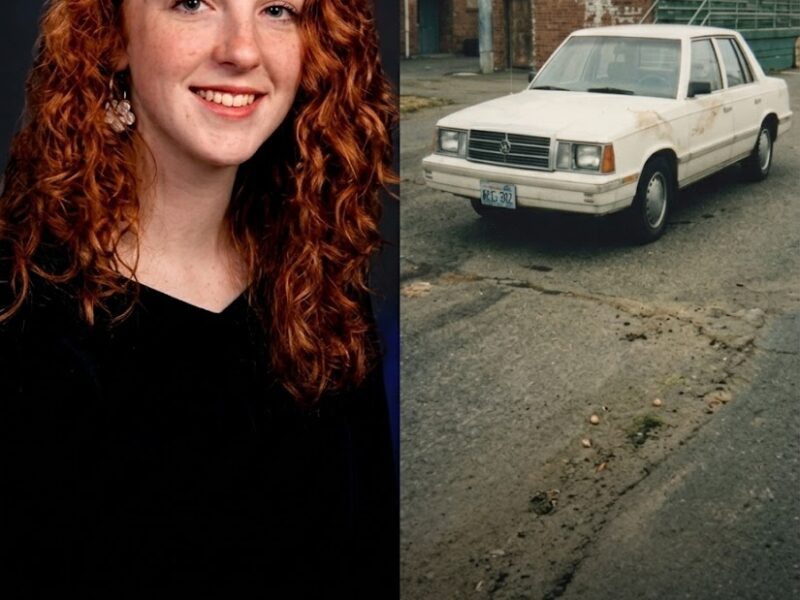
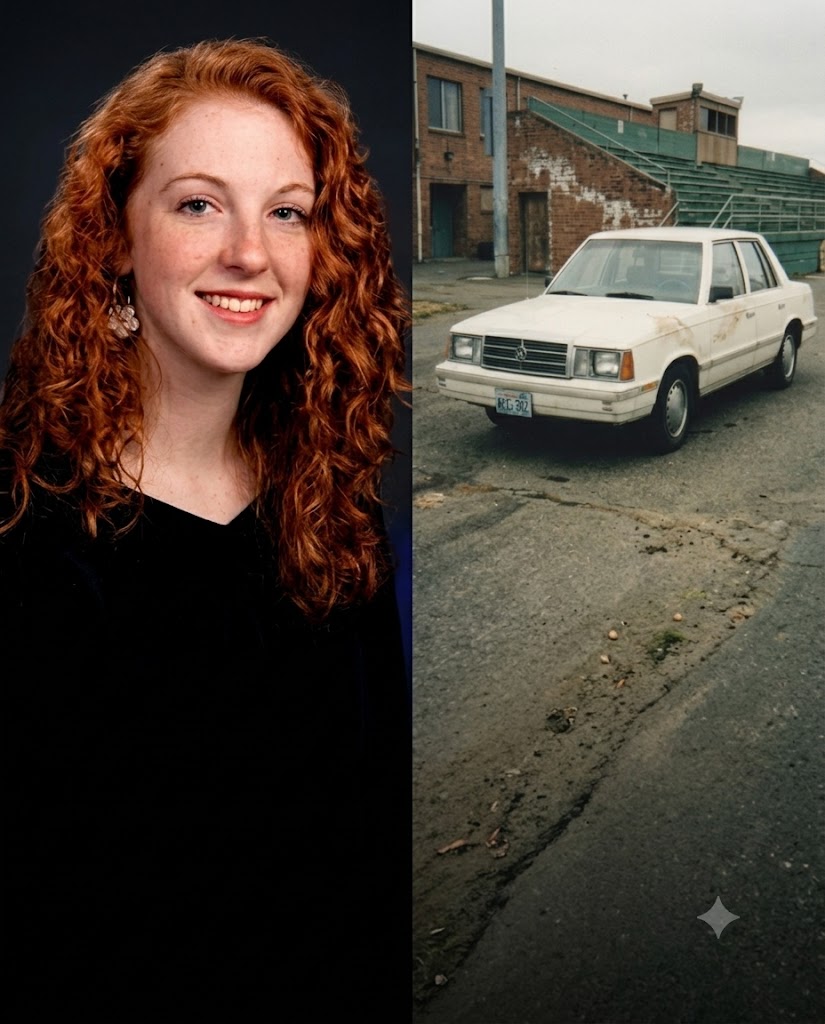
Her name was Sara Yarborough, and she was sixteen years old.
She was an honor student who had traveled to New Zealand at fifteen, and she kept a two-word motto written everywhere she could put it.
Carpe diem.
Seize the day.
It would take twenty-eight years, a DNA trail that stretched back to a man who arrived on the Mayflower in the 1630s, and two cigarette butts discarded on a sidewalk outside a laundromat to finally put a name to the face in the sketch.
But before any of that, before the genetic genealogy and the undercover surveillance and the courtroom verdict, there was just a girl in a parking lot on a freezing Saturday morning, sitting alone in her father’s car with a container of orange juice on the seat beside her.
That orange juice would sit upright and untouched for hours, a small, ordinary detail that detectives would return to again and again, because it told them something about the violence that followed.
Whatever happened to Sara Yarborough did not start at her car.
There were no signs of a struggle anywhere near the vehicle, no broken glass, no scuff marks, no marks on the ground.
She had walked or been forced to walk a hundred yards into the bushes, away from the lot, away from the empty school, away from anyone who might have seen.
The medical examiner determined the cause of death was strangulation, and the evidence made clear that she had been sexually assaulted.
DNA was recovered from her clothing, and a full male profile was developed from the evidence.
DNA was also found beneath Sara’s fingernails, and it matched the profile from her clothing.
She had scratched her attacker.
She had fought back.
A sixteen-year-old girl in a drill team uniform had fought with everything she had, and in doing so, she left a piece of her attacker behind, evidence that would sit in a lab for twenty-eight years waiting.
Sara lived with her parents and two younger brothers in Federal Way, Washington.
She was a member of the school’s drill team, active in her church youth group, and danced with a traveling performance group called The Safety Kids that had taken her to New Zealand the year before.
She hadn’t decided what she wanted to be yet, and she was choosing between museum curator and engineer.
Her mother was secretly hoping for the museum curator.
On Friday, December 13th, Sara’s family left town for her younger brother’s soccer game in Ocean Shores, about two hours away.
Sara stayed behind.
She had her drill team competition the next morning, and her weekend was already mapped out.
Her parents agreed to let her stay on one condition: a friend had to come over and sleep at the house.
Sara and the friend went to a basketball game that Friday night, stopped for fast food on the way home, and stayed up the way sixteen-year-old girls do on a Friday.
Nothing about the evening felt wrong.
Saturday morning, Sara looked at the clock and panicked.
She thought she was late.
She threw on her drill team uniform, left the curlers in her hair, said a quick goodbye to her friend, and drove her father’s car to Federal Way High School.
She pulled into the back parking lot just after 8:09 a.m. and parked.
The drill team wasn’t scheduled to meet until 9:00.
She was almost an hour early.
The parking lot was empty.
The school was quiet.
It was a Saturday morning in December, and the temperature was below freezing.
Ice had formed in the puddles overnight.
Sara sat in the car alone, waiting, with a container of orange juice on the seat beside her.
Somewhere nearby, someone was already there.
Two blocks from the school, Drew Miller had spent Friday night at his house with his friend Adam.
Saturday morning, they did what every kid did in 1991.
They watched cartoons, ate cereal, and eventually decided to go skateboarding.
To get to a grocery store parking lot nearby, they took a shortcut they had used dozens of times before.
They hopped the fence at the edge of the school campus and walked straight through the grounds.
The air was cold enough that the puddles from the night before had frozen solid.
The boys stomped on the ice as they walked.
It cracked under their shoes like breaking glass.
They were laughing.
Then Drew looked up.
Thirty or forty yards ahead, a man stepped out of the bushes.
He came up from a low area near what had been a dugout, surrounded by thick brush tall enough to hide a person completely.
The man stood up straight, looked directly at the two boys, and then turned and started walking in the same direction they were heading.
He didn’t say a word.
Drew felt something wrong, but couldn’t name it.
He told himself the guy had probably just been hiding in the bushes to smoke.
They kept walking.
When they reached the spot where the man had come from, they looked down into the low area and saw a girl lying in the dirt.
She wasn’t moving.
Her eyes were open.
The scene made clear that she had been attacked with extreme violence.
Drew looked back up.
The man had stopped further ahead near a vehicle.
He had turned around.
He was staring directly at the two boys.
Drew would later call that look the most terrifying thing he had ever experienced.
He called the man the boogeyman, a real one, standing in the morning light watching two thirteen-year-old boys who had just found what he had left behind.
The boys ran.
They sprinted back across the campus, over the fence, and into Drew’s house.
His mother saw their faces and called 911 immediately.
Drew’s stepfather drove back to the scene with him.
There was nothing anyone could do.
She was gone.
But the boys were not the first people to see something wrong that morning.
Earlier, before Drew and Adam had even left the house, a jogger running near the tennis courts on campus had looked over and seen a girl lying on the ground with a man kneeling over her.
He assumed they were a couple.
He kept running.
By the time he understood what he had actually seen, it was too late.
Police arrived within minutes.
They identified the victim from her clothing.
Sara Yarborough.
Her car was still sitting in the lot, three hundred feet from where her body was found.
The orange juice on the passenger seat hadn’t been touched.
No signs of a struggle anywhere near the vehicle.
No broken glass, no scuff marks, no marks on the ground.
Whatever happened to Sara, it didn’t start at her car.
She had walked or been forced to walk a hundred yards into the bushes.
The medical examiner determined the cause of death was strangulation.
She had been sexually assaulted.
DNA was recovered from her clothing.
A full male profile was developed from the evidence.
DNA was also found beneath Sara’s fingernails, and it matched the profile from her clothing.
She had scratched her attacker.
She had fought back.
A sixteen-year-old girl in a drill team uniform had fought with everything she had, and in doing so, she left a piece of her attacker behind.
Evidence that would sit in a lab for twenty-eight years waiting.
Within hours of the murder, police had a composite sketch.
Drew Miller and Adam sat with an artist and described the man in detail.
White, around six feet tall, medium build.
But the feature both boys remembered most was his skin.
Rough, uneven, textured, like acne scarring or like something was visibly wrong with the surface of his face.
It was noticeable even from a distance.
Both boys said the sketch was highly accurate.
The drawing was released to the public immediately.
It went up in store windows, on telephone poles, in every business in Federal Way.
It ran on the news and in the papers.
The tips started coming in.
Hundreds at first, then thousands.
By the time the full investigation was underway, more than three thousand tips had been submitted to the King County Sheriff’s Office.
The volume was so large that Sara’s own grandfather facilitated the donation of a computer system to the department just so they could track all of it.
Detectives canvassed the area around Federal Way High School on foot.
They interviewed students, teachers, neighbors, delivery drivers.
They ran fingerprints found at the scene against every available database.
They checked known violent offenders and sex offenders in the King County area.
They pulled records, cross-referenced names, and followed up on every call that came in.
None of it produced a viable suspect.
Three thousand tips and not one of them led to an arrest.
The DNA from Sara’s clothing was submitted to CODIS, the FBI’s national database of genetic profiles from convicted offenders.
If the man who left the DNA had been convicted of a qualifying offense and had his sample collected, the system would flag a match automatically.
Nothing came back.
Detectives ran it again every time the database expanded.
Every time a new state added mandatory DNA collection.
Every time the technology improved, they resubmitted.
The result was always the same.
The unknown male was not in the system.
Federal Way was living in fear.
Parents tightened curfews.
Families double-bolted their locks.
People looked at their neighbors differently because the man in that sketch could have been anyone.
The sketch stayed pinned to bulletin boards and taped to windows across the city for years, but the face never got a name.
Laura Yarborough described the years after the murder plainly.
She said she and her husband lost about three years of their lives that they don’t even remember.
She could barely get out of bed.
Their world went from full color to a fuzzy gray.
Andrew, Sara’s youngest brother, was eleven when she died.
What he remembered most was the pain in his father’s voice over the phone telling him Sara was gone.
He remembered lying in bed at night listening to his parents cry through the walls.
On June 12th, 1993, a memorial was unveiled in the courtyard of Federal Way High School.
A stone bench inscribed with two words: carpe diem.
Encased in bronze around it were some of the things Sara had loved: her ballet shoes, her books, a small replica of her dog Gibby.
A family friend named Bill Fuller had led the effort to build it.
His daughter had been in Sara’s class.
He stood beside Sara’s brother Andrew as it was unveiled.
That same day, the class Sara was supposed to graduate with walked across the stage.
It was also what would have been Sara’s eighteenth birthday.
A year passed, then five, then ten.
The sketch stayed on the walls, but the calls slowed down.
The detectives who had worked the original investigation moved to new assignments or retired.
New officers inherited the file.
The evidence sat in storage.
The DNA profile sat in CODIS, running automatically against every new entry, returning the same result every time: no match.
Laura kept waiting.
There were times she gave up hope, times she thought the case would never be solved.
But the detectives working it kept telling her the same thing, that the technology would catch up eventually, that one day science would do what traditional investigation couldn’t.
In 2011, twenty years after Sara’s death, a detective named Jim Allen made a phone call that would eventually change the course of the case.
He reached out to a woman named Colleen Fitzpatrick.
Fitzpatrick ran a company called Identifinders International, and she was doing something that almost no one in law enforcement had heard of.
She was using consumer DNA databases, the kind ordinary people use to trace their family history, to generate investigative leads for unsolved crimes.
The field didn’t have a proper name yet.
Forensic genetic genealogy was in its infancy.
Fitzpatrick herself would later say that police thought she was crazy.
She described being almost laughed out of the room when she tried to explain what she could do.
But the King County Sheriff’s Office had been working Sara’s case for two decades.
They had tried everything else.
When Fitzpatrick offered to look at the DNA from the crime scene for free, they said yes.
Fitzpatrick took the crime scene profile and compared it against profiles in public genealogy databases, focusing on the Y chromosome, the genetic marker passed from father to son virtually unchanged across generations.
She found a match, not to the killer himself, but to his family line.
The Y chromosome from Sara’s crime scene matched a group of people who were all descendants of the same man.
Robert Fuller, who had lived in Salem, Massachusetts, in the 1630s.
His family had come to North America on the Mayflower.
It was the first time in history that a cold case had generated investigative leads using consumer DNA databases.
But Robert Fuller had lived nearly four centuries ago.
He had thousands of living descendants.
The family name was a start.
It wasn’t enough.
Then the name Fuller triggered something with detectives because they already knew a Fuller.
Bill Fuller, the family friend, the man who had built the memorial bench in the school courtyard.
Detectives asked Bill Fuller for a DNA sample.
He didn’t hesitate.
He walked in and gave it willingly.
His DNA was not a match to the crime scene.
Bill Fuller did not kill Sara Yarborough.
But his Y chromosome, the part that traces the paternal line, was a match.
He and Sara’s killer shared the same ancestry.
They were both descendants of Robert Fuller from the 1630s.
Distant paternal cousins.
Too distant to narrow down a suspect, but the connection was real.
Other people with the Fuller surname in the area were investigated.
None were tied to the case.
The lead dried up and the case went cold again.
But Fitzpatrick didn’t stop.
She kept working in the background year after year, and the technology kept evolving around her.
In 2018, the Golden State Killer was identified and arrested using the same kind of DNA database comparison that Fitzpatrick had pioneered on Sara’s case.
That arrest changed everything.
It proved to the world that genetic genealogy worked.
Fitzpatrick’s team went back to Sara’s case with better tools and bigger databases.
In September 2019, eight years after Fitzpatrick first started working the case, her team identified two brothers, Edward Nicholas and Patrick Nicholas.
Both were distant cousins of Bill Fuller.
Both were descendants of Robert Fuller from Salem.
But their last name wasn’t Fuller.
Their grandfather had been adopted.
Born into the Fuller bloodline, but raised under a different name.
The genetic connection had been hidden behind a legal name change that happened generations ago.
That was why no one had ever found them.
Edward Nicholas was a convicted offender.
His DNA had been in CODIS since 2005.
Detectives compared it to the crime scene profile.
It wasn’t a match.
That left one person, his younger brother, Patrick Leon Nicholas.
Patrick was not in CODIS.
Despite a history of violent offenses stretching back to his teenage years, his DNA had never been entered into any criminal database.
Three separate times the system had an opportunity to collect it.
Three times it didn’t.
Detectives believed they had their man, but believing wasn’t proof.
They needed his DNA without him knowing.
On September 29th, 2019, a team of undercover detectives began following a fifty-five-year-old man through the streets of a small town south of Seattle.
Nicholas was living alone in a building with no working electricity in Covington, Washington.
He worked at an auto parts store and took the bus everywhere.
He had no children, no friends, no connections to anyone.
His bus route passed directly by Federal Way High School.
They trailed him to a laundromat near a strip mall in Kent.
He went inside to do his laundry.
After a while, he stepped outside, pulled out a cigarette, and lit it.
He smoked it slowly.
Then he lit another one.
When he was finished, he dropped both butts on the sidewalk.
A paper napkin slipped from his pocket and fell beside them.
He didn’t pick any of it up.
He walked back inside.
The moment he was out of sight, the undercover team moved in.
They collected both cigarette butts and the napkin.
Three pieces of garbage that a man had thrown away without thinking twice.
They bagged them, sealed them, and sent them to the Washington State Patrol Crime Lab.
The DNA on the cigarette butts matched the DNA found on Sara Yarborough’s clothing in 1991.
The odds of it being anyone else were 1 in 120 quadrillion.
Twenty-eight years of dead ends, and the answer came from two cigarette butts on a sidewalk outside a laundromat.
Patrick Leon Nicholas was fifty-five years old when detectives arrested him at a sports bar in Kent on October 2nd, 2019.
He was living alone in a run-down building in Covington, Washington, with no working electricity.
He worked at an auto parts store and took the bus everywhere because he didn’t drive.
He had no children, no close friends, no connections to anyone.
From the outside, he was invisible.
A man living on the edges of society in the same part of Washington state where he had killed a sixteen-year-old girl twenty-eight years earlier.
His bus route passed directly by Federal Way High School.
But Patrick Nicholas was no stranger to law enforcement.
His record began before Sara was born.
As a juvenile, he was convicted for attacking two women and the attempted assault of a third.
His method was the same every time.
He would approach a woman near her vehicle.
He would make small talk to get her comfortable.
Then he would pull a knife.
He would force her to walk to a secluded area where no one could see them.
That was his pattern.
That was who he was before he turned eighteen.
In June of 1983, eight years before Sara’s death, a twenty-one-year-old woman named Ann Cronin was sitting by the Columbia River in Richland, Washington.
A young man walked up and struck up a conversation.
He said his name was Pat.
He was friendly.
He told her he had just moved to the area.
Ann asked if he had been water skiing on the river yet.
He said no, he couldn’t swim.
They talked for a few minutes.
Then Ann noticed his voice changing.
Something underneath the surface was shifting.
She told him she had to go.
She turned toward her car and he put a knife to her neck.
He started walking her down toward the riverbank, away from the road, away from anyone who might see.
Halfway down the bank, Ann remembered one detail from their conversation.
He couldn’t swim.
She ran for the water and dove in.
She swam as hard as she could.
He stood on the bank and watched.
He couldn’t follow.
People at a nearby dock pulled her out and called the police.
Nicholas was arrested.
During the interview, he told investigators something they would never forget.
He said he realized he had dangerous impulses toward young women and that his intent that day was to commit a serious assault.
He told them it wasn’t right.
He said he wanted help.
The judge sentenced him to ten years.
Ann walked out of that courtroom believing he would serve every day of it.
He served three and a half.
By 1987, he was out.
An evaluation had described him as someone who would be safe to be at large.
No one tracked where he went or what he did after that.
Ann didn’t know he had been released.
She thought the system had done its job.
If Patrick Nicholas had served his full ten-year sentence, he would not have been released until 1993.
He would have still been in a cell on the morning of December 14th, 1991.
Sara Yarborough would have driven to school, realized she was early, waited for her teammates, boarded the bus to Kirkland, and competed with her drill team that afternoon.
When detectives told Ann about Sara’s murder in 2019, she said something she would repeat many times in the years that followed.
She said it had never occurred to her that what she escaped from was a murderer.
In the interrogation room after his arrest, Nicholas didn’t react the way an innocent person would.
He didn’t say they had the wrong man.
He asked the question.
He asked what year this happened, as if there were multiple years it could have been.
As if there were multiple girls.
That question hung in the room and it made detectives wonder whether Sara was the only one.
He spoke with them for about ninety minutes.
He didn’t confess.
Then he asked for a lawyer and shut down completely.
When detectives searched his home, they found stacks of old newspapers covering almost every surface.
Among them was a newspaper from 1994 with an article about Sara Yarborough’s case on the front page.
He had kept it for twenty-five years.
In a kitchen drawer, they found a photograph of a young woman in a cheerleading outfit torn carefully from a magazine and placed there by itself.
The trial began on April 17th, 2023, more than thirty-one years after the murder.
The judge ruled that Nicholas’ criminal history, the juvenile convictions, the attack on Ann Cronin, a later offense against a child, could not be presented to the jury.
The twelve people deciding his fate would never know about the pattern.
The prosecution built their case on the DNA.
Thirteen out of thirteen genetic markers matched from Sara’s clothing.
The probability of it being someone else, 1 in 120 quadrillion.
The DNA from under Sara’s fingernails, the DNA she had torn from her attacker as she fought for her life, was 590 billion times more likely to have come from Nicholas than from any unrelated person.
The defense attacked the genetic genealogy as untested.
The defense attorney called the technology wacky.
He also pointed to the boys’ description of the man having rough, uneven skin on his face, arguing that Nicholas had clear skin.
The prosecution’s response was direct.
Sara had scratched her attacker.
The DNA under her fingernails proved it.
What the boy saw on the man’s face that morning may not have been acne scarring.
It may have been fresh scratch marks left by a sixteen-year-old girl who fought until she couldn’t fight anymore.
The jury deliberated for a day and a half.
Not guilty on premeditated first-degree murder.
Guilty on first-degree felony murder.
Guilty on second-degree murder.
Special verdict: sexually motivated.
The courtroom broke.
Sara’s family and friends sobbed openly.
Drew Miller, the boy who found her body at thirteen, looked across the room and made eye contact with a juror.
The juror nodded at him.
Thirty-two years, and that small gesture carried the weight of all of it.
At the sentencing two weeks later, Laura stood at the podium and called Sara the delight of her life.
Andrew told the court that Nicholas does not possess the ability to feel remorse the way normal people do.
Then Ann Cronin stood up.
The woman who had escaped Patrick Nicholas by jumping into the Columbia River forty years earlier.
The woman whose testimony the judge had barred from the trial.
She had come to say what she had not been allowed to say before.
When she rose from her seat, Nicholas, who had shown zero emotion through the entire trial, who hadn’t moved during the guilty verdicts, who had sat blank-faced through nine days of testimony, did a double take.
His body visibly shuddered.
He recognized her.
After forty years, he never expected to see her face again.
Ann told the court what he had done to her.
The knife, the river, the swim.
Then she said, “We rely on a system of justice designed to protect us from predators like Nicholas. And this system failed. It failed Sara, her family, her friends, and countless others.”
She asked the court not to make the same mistake.
Judge Josephine Wiggs sentenced Patrick Nicholas to 548 months, forty-five years and eight months.
He was fifty-nine years old.
He would almost certainly die behind bars.
Before she delivered the sentence, Wiggs spoke about Sara.
She called her a child.
She said, “When I think about this poor child, what she experienced fighting for her life.”
And as she said it, she brought her fist down on the bench.
The sound carried through the courtroom like a verdict of its own.
Sara Yarborough was sixteen years old.
She was an honor student who had traveled to New Zealand at fifteen and wanted to see more of the world.
She had two younger brothers and a dog named Gibby and a two-word motto she kept written everywhere she could put it.
On a freezing December morning in 1991, she drove to school with curlers still in her hair because she thought she was late.
She wasn’t.
She was early.
And in that empty parking lot with a container of orange juice sitting on the seat beside her, she was completely alone.
Carpe diem, seize the day.
She seized every one she had.
And thirty-two years later, the people she left behind seized the one that mattered most.
**Part 2**
The orange juice container became a quiet anchor for the detectives who worked the case in those first weeks.
It sat on the passenger seat in photographs of the car, a small plastic bottle with a bright label, untouched and upright, and it told them that Sara had not been drinking when she was taken.
She had not been distracted.
She had not spilled anything in a struggle.
She had simply been waiting, and then she had been gone.
Detective Jim Allen thought about that bottle more than he ever told anyone.
He thought about it when he drove past the school on his way home, when he saw teenage girls in drill team uniforms practicing on a field, when he pulled the file after a new tip came in and found the same photographs staring back at him.
The bottle was a reminder that the case was not abstract.
It was a girl, a car, a Saturday morning, a life that had been interrupted in the middle of an ordinary errand.
The investigation in the early years was exhaustive and, in the end, fruitless.
Detectives interviewed more than three thousand people, and they followed every lead until it died.
They looked at known offenders, at men who had been seen in the area, at anyone who matched the sketch.
The sketch itself became a kind of local icon, a face that people in Federal Way saw so often they stopped seeing it.
It was taped to the window of the hardware store, pinned to the bulletin board at the grocery store, printed in the newspaper on slow news days.
And still no one called with the right name.
The DNA profile sat in CODIS, and every year the database grew.
New states passed laws requiring DNA collection for convicted offenders.
New technology made it possible to extract profiles from smaller and smaller samples.
Detectives resubmitted the evidence again and again, and every time the answer came back the same: no match.
The man who killed Sara Yarborough was not in the system.
He had never been convicted of a qualifying offense, or if he had, his sample had never been collected.
That gap, that absence, became the central mystery of the case.
How could a man commit a murder like this and leave no trace in the one place the system was designed to find him?
The answer, when it finally came, was almost absurd in its simplicity.
He had been arrested before.
He had been convicted before.
But the system had failed to collect his DNA three separate times, and each failure had allowed him to remain invisible.
The first failure happened in 1983, when Patrick Nicholas was sentenced for the attack on Ann Cronin.
DNA collection for convicted offenders was not yet routine, and no sample was taken.
The second failure happened after his release, when he was supposed to be monitored but wasn’t.
The third failure happened in the years that followed, when he committed other offenses and slipped through the cracks again.
By the time the technology caught up, he had been free for decades, living in the same county, riding the bus past the school where he had killed a girl.
The break in the case came not from a tip but from a family tree.
Colleen Fitzpatrick had spent years building out the branches of the Fuller family, tracing descendants of Robert Fuller from Salem, Massachusetts, through generations of births, marriages, adoptions, and name changes.
The Y chromosome match had given her a surname, but the surname was only the beginning.
She needed to find the specific branch that led to the killer, and that meant mapping the family forward instead of backward.
It was slow, painstaking work, the kind that required patience and a tolerance for dead ends.
Fitzpatrick had both.
She had been told she was crazy, and she had kept working anyway.
When the Golden State Killer was arrested in 2018, the phone at Identifinders started ringing more often, and the databases grew larger, and the tools became more powerful.
Fitzpatrick’s team returned to Sara’s case with new energy.
They uploaded the crime scene profile to a larger database and found a closer match.
The match led to two brothers, Edward and Patrick Nicholas, who were distant cousins of Bill Fuller.
The name was different because their grandfather had been adopted, which meant the genetic connection had been hidden for generations.
Edward Nicholas was already in CODIS, and his profile did not match.
That left Patrick.
Detectives learned that Patrick Nicholas had a long record, that he had been convicted of violent offenses as a juvenile, that he had attacked women near their cars, that he had used a knife, that he had forced them to walk to secluded places.
The pattern was so similar to what had happened to Sara that it made the detectives stop and read the file twice.
He had approached Ann Cronin by the Columbia River in 1983, made small talk, pulled a knife, and walked her toward the water.
He had done the same thing to other women, and he had done it to Sara.
The difference was that Sara had fought back hard enough to leave DNA under her fingernails, and Ann had escaped by swimming, and the other women had survived to testify.
Patrick Nicholas had been invisible because no one had ever connected the pattern to a name.
The surveillance operation in September 2019 was carefully planned.
Detectives knew they needed a DNA sample, and they knew they couldn’t just walk up and ask for one.
They followed Nicholas for days, learning his routine, his bus route, his habits.
They watched him do laundry at the laundromat in Kent, and they saw him smoke cigarettes outside, and they saw him drop the butts on the sidewalk.
It was the kind of carelessness that comes from years of getting away with things.
He had no reason to think anyone was watching.
He had been invisible for so long that he had stopped looking over his shoulder.
The cigarette butts went to the lab, and the lab returned a match.
The odds were 1 in 120 quadrillion, a number so large it was almost meaningless, but the detectives understood what it meant.
It meant they had him.
It meant the case was solved.
It meant Sara’s family would finally have an answer.
The arrest happened at a sports bar in Kent on October 2nd, 2019.
Nicholas was fifty-five years old, living alone, working at an auto parts store, riding the bus everywhere.
He had no children, no close friends, no connections to anyone.
He was the kind of man who could disappear into the background of a thousand different towns, and he had chosen to stay in the one where he had committed his worst crime.
When detectives searched his home, they found the newspaper from 1994 with Sara’s case on the front page.
They found the photograph of the young woman in the cheerleading outfit.
They found the evidence of a man who had been living with his crime for twenty-five years, keeping it close, remembering it, maybe even reliving it.
The trial in 2023 was a strange kind of reckoning.
The prosecution had the DNA, which was overwhelming, but they also had the challenge of explaining genetic genealogy to a jury that had never heard of it.
The defense called the technology wacky and untested, and they pointed to the sketch, arguing that Nicholas didn’t match the description of the man with rough, uneven skin.
The prosecution countered with the scratch marks, the DNA under Sara’s fingernails, the fact that she had fought back and left a piece of her attacker behind.
The jury deliberated for a day and a half and returned a mixed verdict.
Not guilty on premeditated first-degree murder.
Guilty on first-degree felony murder.
Guilty on second-degree murder.
Special verdict: sexually motivated.
It was not the perfect verdict, but it was a conviction, and it meant Nicholas would never walk free again.
At the sentencing, Ann Cronin stood up and faced the man who had attacked her forty years earlier.
She told the court about the knife, the river, the swim.
She said the system had failed Sara and her family and countless others.
She asked the court not to make the same mistake again.
Nicholas, who had shown no emotion throughout the trial, shuddered when he saw her.
He recognized her.
He had not expected to see her face again, and for a moment, the mask slipped.
Judge Josephine Wiggs sentenced him to 548 months, forty-five years and eight months.
She called Sara a child, and she brought her fist down on the bench when she said it, and the sound carried through the courtroom like a verdict of its own.
The case was over, but the aftermath was not.
Laura Yarborough had spent twenty-eight years waiting for an answer, and when it came, it was not the answer she had wanted.
It was the answer she had needed.
She had known, somewhere in the back of her mind, that the man who killed her daughter might never be found.
She had prepared herself for the possibility that the case would remain open forever, that the sketch would stay on the wall, that the DNA would sit in a lab with no name attached to it.
But the detectives had kept telling her the technology would catch up, and they had been right.
The technology caught up, and it caught Patrick Nicholas, and it did so because of a family tree that stretched back to the 1630s and two cigarette butts on a sidewalk outside a laundromat.
Sara’s brother Andrew spoke at the sentencing about the pain of losing his sister, about the nights he had listened to his parents cry through the walls, about the way his family had lost three years of their lives to grief.
He said Nicholas did not possess the ability to feel remorse the way normal people do.
He said the family had waited thirty-two years for justice, and they had finally gotten it.
Drew Miller, the boy who found Sara’s body when he was thirteen, attended the trial and the sentencing.
He had carried the memory of that morning for three decades, and he had carried the sketch in his mind, the face of the man who had looked at him and Adam and then walked away.
He had identified the man in the courtroom, and he had made eye contact with a juror after the verdict, and the juror had nodded at him.
It was a small gesture, but it meant something.
It meant the system had worked, even if it had taken far too long.
The memorial bench in the courtyard of Federal Way High School still stands, inscribed with the words carpe diem.
The bronze encasement still holds Sara’s ballet shoes, her books, the small replica of her dog Gibby.
Students walk past it every day, and some of them know the story, and some of them don’t.
But the bench is there, and the words are there, and the memory of a girl who seized every day she had is there.
The orange juice container is gone, of course.
It was logged as evidence and stored away, and eventually it was returned or discarded or lost in the vast bureaucracy of a decades-long investigation.
But in the photographs, it is still there, sitting upright and untouched on the passenger seat, a small plastic bottle with a bright label, waiting for a girl who never came back.
It is the detail that detectives return to when they tell the story, because it captures something about the case that the DNA and the sketch and the cigarette butts cannot.
It captures the ordinariness of the morning, the stillness before the violence, the life that was interrupted in the middle of an ordinary errand.
Sara Yarborough drove to school early because she thought she was late.
She parked in an empty lot.
She sat in her father’s car with a container of orange juice beside her.
She waited.
And somewhere nearby, a man who had been invisible for years was already there, hiding in the bushes, watching, waiting for his moment.
He had been invisible because the system had failed to collect his DNA three times.
He had been invisible because his name was hidden behind an adoption that happened generations ago.
He had been invisible because no one had connected the pattern of his attacks to a single person.
But he was not invisible forever.
The DNA trail stretched back to the 1630s, and the cigarette butts lay on the sidewalk outside a laundromat, and the detectives who had worked the case for twenty-eight years refused to give up.
And in the end, the man who hid in plain sight for twenty-eight years was found, and arrested, and convicted, and sentenced to spend the rest of his life behind bars.
Sara Yarborough was sixteen years old.
She wanted to see more of the world.
She kept a two-word motto written everywhere she could put it.
Carpe diem.
Seize the day.
She seized every one she had.
And thirty-two years later, the people she left behind seized the one that mattered most.
**Part 3**
The story of how Patrick Nicholas was caught is, in many ways, a story about the things that don’t happen.
The DNA sample that wasn’t collected in 1983.
The monitoring that didn’t happen after his release.
The database match that didn’t come back for twenty-eight years.
Each of those absences allowed him to remain free, to live his life, to ride the bus past the school where he had killed a girl.
And each of those absences was a failure of a system that was supposed to protect people like Sara Yarborough.
Ann Cronin understood that failure better than anyone.
She had escaped Nicholas by jumping into the Columbia River, and she had spent forty years believing that the system had done its job, that the man who attacked her had been locked away for ten years, that he had been punished for what he did.
She didn’t know he had been released after three and a half years.
She didn’t know he had been evaluated as safe to be at large.
She didn’t know he had gone on to attack other women, and eventually to kill Sara.
When detectives told her about Sara’s murder in 2019, she said it had never occurred to her that what she escaped from was a murderer.
That sentence, more than any other, captures the tragedy of the case.
The system had a chance to stop Patrick Nicholas, and it didn’t.
It had a chance to collect his DNA, and it didn’t.
It had a chance to monitor him, and it didn’t.
And because of those failures, a sixteen-year-old girl drove to school early one Saturday morning and never came home.
The detectives who worked the case knew this, and they carried it with them.
They knew that the DNA evidence had been sitting in a lab for twenty-eight years, waiting for a match that never came.
They knew that the sketch had been on the wall for twenty-eight years, waiting for a name that never came.
They knew that Sara’s family had been waiting for twenty-eight years, and that some of them had given up hope.
But they kept working.
They kept resubmitting the DNA.
They kept following up on tips.
They kept telling Laura Yarborough that the technology would catch up, that one day science would do what traditional investigation couldn’t.
And eventually, they were right.
The science caught up in the form of genetic genealogy, a field that didn’t even have a name when Colleen Fitzpatrick started working on Sara’s case.
Fitzpatrick had been laughed out of rooms when she tried to explain what she could do.
She had been told she was crazy.
She had been ignored by law enforcement agencies that didn’t understand the potential of consumer DNA databases.
But she kept working, and eventually the world caught up with her.
The Golden State Killer arrest in 2018 changed everything.
It proved that genetic genealogy worked, that it could identify suspects in cold cases that had been unsolved for decades.
And it gave Fitzpatrick’s team the tools and the credibility they needed to go back to Sara’s case and finish what they had started.
The identification of Edward and Patrick Nicholas was the result of years of painstaking work, tracing the Fuller family tree through generations of adoptions and name changes and migrations.
The fact that their grandfather had been adopted was the key that unlocked the case.
It explained why the surname didn’t match, why no one had ever connected the Nicholas brothers to the Fuller family, why the genetic connection had been hidden for so long.
Once the brothers were identified, the rest was relatively straightforward.
Edward was in CODIS, and his DNA didn’t match.
Patrick was not in CODIS, and his DNA did match.
The cigarette butts on the sidewalk outside the laundromat provided the confirmation, and the arrest followed, and the trial followed, and the conviction followed.
But the story doesn’t end with the conviction.
It ends with the aftermath, with the family members who had waited thirty-two years for justice, with the friends who had never forgotten Sara, with the detectives who had worked the case for decades.
It ends with Laura Yarborough standing at a podium and calling Sara the delight of her life.
It ends with Andrew Yarborough telling the court that Nicholas does not possess the ability to feel remorse the way normal people do.
It ends with Ann Cronin standing up and facing the man who had attacked her forty years earlier, and telling the court that the system had failed, and asking them not to make the same mistake again.
It ends with Judge Josephine Wiggs bringing her fist down on the bench and calling Sara a child, and the sound carrying through the courtroom like a verdict of its own.
And it ends with a stone bench in the courtyard of Federal Way High School, inscribed with two words, carpe diem, and a bronze encasement holding ballet shoes and books and a small replica of a dog named Gibby.
The bench is still there.
Students walk past it every day.
Some of them know the story, and some of them don’t.
But the bench is there, and the words are there, and the memory of a girl who seized every day she had is there.
The case of Sara Yarborough is a cold case that was solved, but it is also a story about the things that don’t happen, and the people who keep working anyway.
It is a story about a family that waited thirty-two years for an answer, and a detective who made a phone call in 2011 that changed the course of the investigation, and a woman named Colleen Fitzpatrick who was told she was crazy and kept working anyway.
It is a story about two cigarette butts on a sidewalk outside a laundromat, and a DNA trail that stretched back to the 1630s, and a man who hid in plain sight for twenty-eight years and thought he would never be found.
But he was found.
He was found because the technology caught up, and because the detectives never gave up, and because a sixteen-year-old girl fought back hard enough to leave a piece of him behind.
Sara Yarborough seized every day she had.
And thirty-two years later, the people she left behind seized the one that mattered most.
The orange juice container is gone now, but the story remains, and the bench remains, and the words remain.
Carpe diem.
Seize the day.
It is a motto that Sara kept written everywhere she could put it, and it is a motto that the people who loved her have carried with them for more than three decades.
It is a reminder that life is short, and that every day is a gift, and that even in the darkest moments, there is hope.
The case of Sara Yarborough was solved, and the man who killed her will spend the rest of his life behind bars, and the family that waited thirty-two years for justice finally has an answer.
It is not the answer they wanted, but it is the answer they needed.
And it is a testament to the power of persistence, and the promise of science, and the courage of a girl who fought back until she couldn’t fight anymore.
Patrick Leon Nicholas was fifty-nine years old when he was sentenced to forty-five years and eight months in prison.
He will almost certainly die behind bars.
He will never ride the bus past Federal Way High School again.
He will never smoke a cigarette outside a laundromat and drop the butts on the sidewalk without thinking twice.
He will never hide in plain sight again.
Sara Yarborough was sixteen years old.
She was an honor student who had traveled to New Zealand at fifteen and wanted to see more of the world.
She had two younger brothers and a dog named Gibby and a two-word motto she kept written everywhere she could put it.
On a freezing December morning in 1991, she drove to school with curlers still in her hair because she thought she was late.
She wasn’t.
She was early.
And in that empty parking lot, with a container of orange juice sitting on the seat beside her, she was completely alone.
But she was not forgotten.
She was never forgotten.
And thirty-two years later, the people she left behind made sure the world knew her name.
Carpe diem.
Seize the day.
She seized every one she had.
And the people she left behind seized the one that mattered most.
The end.









