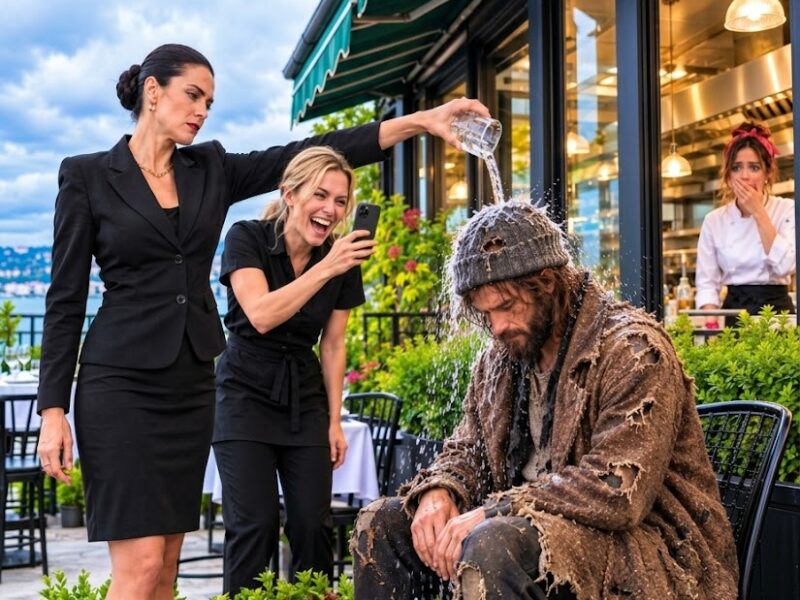
Two managers laughed at a beggar asking for food. They had no idea he was the billionaire who owned the entire company.
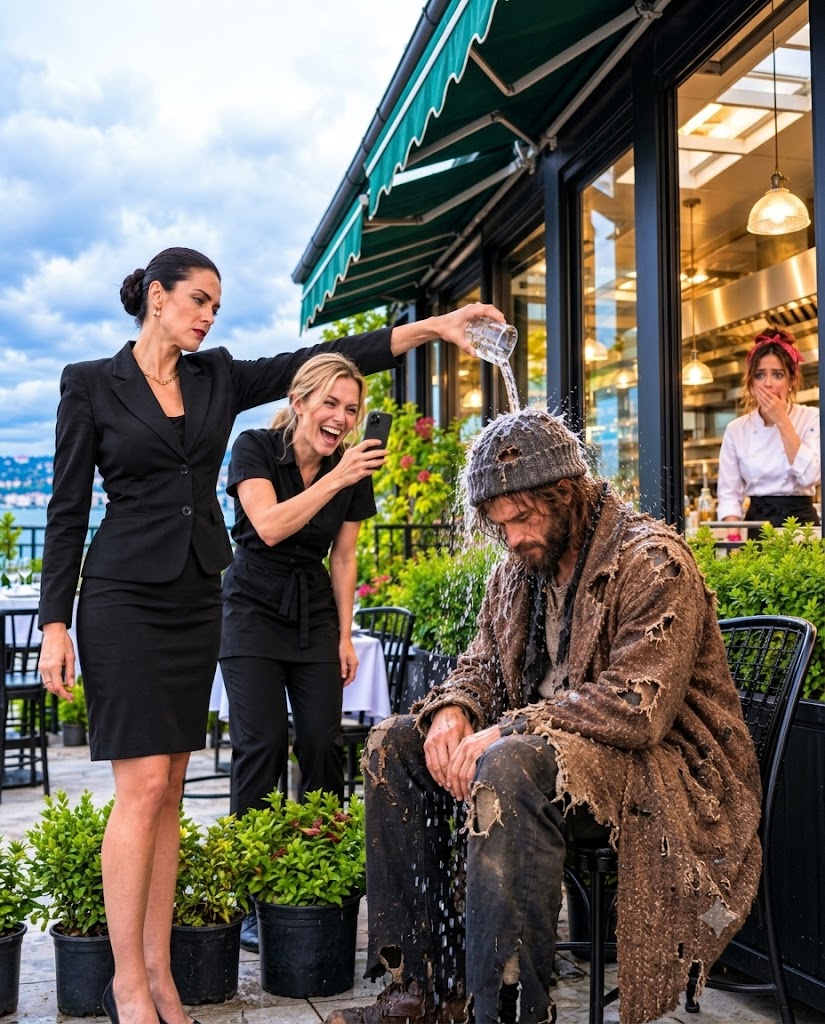
The evening rush at The Copper Fork was in full swing, and every table on the terrace had a view worth photographing.
Waiters moved between white tablecloths like chess pieces, and the kitchen exhaled steam into the alley behind the building.
I stood at the service entrance with a dish rag over my shoulder, watching the sunset paint the Hudson River in shades of copper and blood orange.
That was when I heard her voice cut through the clink of silverware.
“Sir, you’re blocking my guest’s view.”
I turned toward the terrace railing, where a woman in a black blazer stood with her arms crossed.
A man in a frayed coat had wandered up from the street and stopped near the edge of the patio.
He wasn’t asking for anything. He was just standing there, staring at the food like a man reading a language he used to speak.
“I’m sorry, ma’am,” the man said, his voice sandpaper-soft.
“Could you spare some bread? Just a little. I haven’t eaten in two days.”
The woman’s name was Vanessa Cole, and she had been the general manager of The Copper Fork for three years.
She looked at him the way you’d look at a stain on a new couch.
“This isn’t a shelter,” she said.
Then she turned to the table and smiled for a phone camera, because everything in her life was content.
“Vanessa, smile. This is going straight on my page.”
Her friend Chloe angled the phone toward the man in the coat, catching him in the frame like a prop.
“Get his good side, Chloe.”
I watched from the service door with my hands deep in soapy water, and I felt something turn over in my chest.
The man didn’t beg again. He just nodded like he understood.
“Can someone call security?” Vanessa asked, loud enough for the whole terrace to hear.
“Already done, sir,” a waiter said.
I don’t know why he called her sir. Maybe he was nervous. Maybe he was just tired.
The man in the coat looked at the bread baskets on the tables, then at the people who were laughing behind their wine glasses.
“I understand,” he said. “Thank you anyway.”
That was when I stepped out of the kitchen door with a trash bag in my hand, because Tuesday was dumpster day and nobody else would do it.
I was thirty-four years old, and I had been washing dishes at The Copper Fork for eleven months.
My name is Lily Bell, and I knew exactly what it felt like to be invisible.
I walked past the man, dropped the bag, and whispered, “Meet me around the side in five minutes.”
He looked at me like I’d spoken a foreign language.
Then I went back inside and pretended I hadn’t said anything at all.
—
Vanessa was still posing for Chloe’s phone when I returned to the dish pit.
“Lily, eyes on the dishes,” she called without looking at me.
“Move along before I call the police.”
I kept my head down and my hands in the water.
The man was gone when I glanced through the window, and my heart sank because I thought he’d given up.
But five minutes later, when I carried the trash out to the alley, he was standing by the service door with his hands in his pockets.
“I didn’t think you’d come,” he said.
“I wasn’t sure I would.”
I pulled the foil-wrapped sandwich from my apron pocket and handed it to him.
It was my lunch. Turkey on rye with mustard, the same thing I brought every day because it was cheap and I knew how it tasted.
“It’s not much,” I said.
“It’s everything,” he said.
He ate it standing up, fast but not desperate, like a man who had learned to enjoy food while it lasted.
I watched him and thought about my mother, who used to say that nobody is too poor to be fed and nobody is too rich to feed someone.
“Thank you,” he said when he finished.
“Don’t thank me. Just don’t tell anyone.”
He smiled, and something about his face looked familiar, but I couldn’t place it.
“I’m Sam,” he said.
“Lily.”
“Same time tomorrow?”
I laughed because it sounded like a joke.
“I’ll bring dessert,” he said.
“You don’t have to.”
“I know. I want to.”
I went back inside and finished my shift with soap up to my elbows, and for the first time in months, I felt like I’d done something that mattered.
I didn’t know that Sam was already planning to come back.
I didn’t know that he had a bell in his pocket that he couldn’t bring himself to ring.
And I didn’t know that Vanessa had been looking for a reason to fire me since the day I started.
—
The next day, Sam was waiting by the service door when I came out with the trash.
He was wearing the same coat, and he had a small paper bag in his hand.
“I brought dessert,” he said.
“You weren’t kidding.”
“I never kid about pie.”
He opened the bag and pulled out two slices of apple pie wrapped in wax paper.
“Where did you get this?”
“I have my sources.”
We sat on the back steps and ate pie with our fingers, and I told him about my mother and her bad knees and the rent that was due on Friday.
He told me about his father, who had died the year before.
“He fed everyone,” Sam said. “Even people who couldn’t pay.”
“He sounds like someone I would have loved.”
“He would have loved you.”
I didn’t ask where Sam slept, because I was afraid of the answer.
I didn’t ask why he looked familiar, because I was afraid of what I might find out.
I just ate my pie and watched the sun go down and pretended that life was as simple as a shared dessert on a back step.
But Vanessa saw us.
She was standing at the second-floor window with her phone in her hand, and she was already typing.
—
The next morning, Vanessa called me into her office.
She was sitting behind her desk with a coffee cup in one hand and her phone in the other.
“Company food on company time for a bum,” she said.
“It was my food. My lunch.”
“Doesn’t matter. You’re done here. Get your things.”
I felt the floor drop out from under me.
“You’re firing me? For a sandwich?”
“Oh my god, the dishwasher has a boyfriend.”
“Please, she was only being kind,” I said, but I didn’t know who I was defending anymore.
Vanessa’s eyes went flat.
“Nobody asked you.”
Sam was standing in the hallway when I came out with my apron in my hand.
He looked at my face and understood.
“I’m sorry, Lily. She’s been looking for a reason.”
“Well, she found one.”
I walked past him and out the front door, and I didn’t look back because I didn’t want him to see me cry.
But he followed me.
“Lily, I’m so sorry. This is my fault.”
“No, Sam. Kindness isn’t a fault.”
“Where will you go?”
I stopped at the corner and looked at the sky.
“Home. My mom’s soup fixes everything.”
—
I took the bus to my mother’s apartment in Queens, and I told her everything.
She listened with her hands wrapped around a mug of tea, and when I finished, she didn’t say anything for a long time.
Then she said, “Then I raised you right.”
“But the rent, Mom. And your knees.”
“My knees have survived worse than one mean manager.”
She reached into her pocket and pulled out a small brass bell.
“What’s this?”
“Found it in the trash at work. I couldn’t leave it there.”
“Somebody threw away a bell?”
“The same people who throw away people, Mom.”
She turned it over in her hands and saw the letter W carved into the side.
“When I was a school cook, I fed 300 kids a day,” she said. “And you still had soup left for me.”
“Want to know my secret?”
“Too much garlic?”
“Love, smart mouth. And garlic.”
I laughed for the first time in two days.
“Someday I’ll have my own kitchen, Mom. A real one.”
“You will. I’ve watched you cook.”
“Right now, I can’t even keep a job washing plates.”
“Then wash plates for people who need you. St. Agnes needs volunteers. They feed the hungry every night.”
“That’s unpaid, Mom.”
“So was every meal I ever made you.”
I looked at the bell in her hand and thought about Sam and his father and the pie on the back steps.
“Okay. Tomorrow I’ll go.”
“And take this with you. Every kitchen needs a bell.”
—
That night, Chloe posted the video.
She titled it “Dishwasher feeds bum on company time,” and within three hours it had 200,000 views.
I didn’t see it until the next morning, when my mother handed me her phone with a look I couldn’t read.
“Mom, please. Don’t read the comments.”
“Somebody says you should be ashamed. I’d like to meet that somebody.”
I scrolled through the video and saw my face, blurry and small, handing Sam a sandwich.
I saw Vanessa laughing in the background.
I saw the comments calling me a joke, a bleeding heart, a dishwasher who didn’t know her place.
I put the phone down and went to St. Agnes because I had promised my mother I would.
The soup kitchen was in the basement of a church on 5th Street, and it smelled like onions and old coffee.
A woman named Dot was in charge, and she looked me up and down like she was reading a book she’d already finished.
“You must be Lily. Your mother called me three times.”
“That sounds like her.”
“Can you cook, honey?”
“I make soup that makes grown men cry.”
“Then you’re hired. For free.”
I started that night.
I chopped onions and carrots and celery, and I stirred a pot that was bigger than my bathtub.
And when the first hungry man came through the door, I remembered the bell in my pocket.
I hung it by the kitchen door, just like Sam’s father had done.
“For anyone who’s hungry,” I said. “They ring it, we feed them.”
Dot looked at the bell and then at me.
“Well, I’ll be.”
—
Sam found me three days later.
I was ladling soup into bowls when I heard the bell ring, and when I looked up, he was standing in the doorway.
“I heard the soup here makes grown men cry,” he said.
“Sit. Eat first, then I’m putting you to work.”
“Is that how you treat your guests?”
“Only the stubborn ones.”
Dot appeared at my elbow with a knowing smile.
“She’s single, you know. And she can cook. Marry her before I do.”
“Noted, ma’am.”
I rolled my eyes and went back to the soup.
But I couldn’t stop smiling.
—
Sam volunteered at St. Agnes every night that week.
He washed pots and carried boxes and mopped the floor without being asked, and he never once complained.
“You’re terrible at this,” I said when he dropped a stack of bowls.
“I’m a fast learner.”
“Where do you sleep, Sam?”
“Here and there.”
“That’s not an answer.”
“Dot lets volunteers sleep in the back on cold nights.”
“If you need—”
“Me and I keep owing you.”
“Nobody owes anybody here, Sam. That’s the whole point.”
He looked at me like I’d said something important, and I guess I had.
—
On Friday night, we walked home together through the rain.
We shared an umbrella that was too small, and by the time we reached my mother’s building, my left side was soaked.
“You’re soaked on that side,” I said.
“Worth it.”
“Tell me one thing you dream about, Sam.”
He was quiet for a moment.
“A kitchen that feeds anyone who’s hungry.”
“And you?”
“My own little restaurant. Small, warm, nobody ever turned away.”
He stopped walking and looked at me.
“Lily, what if someone wasn’t who you thought?”
“Then I’d want to know who they really are.”
“Lily, I need to tell you something.”
My phone buzzed before he could finish.
“It’s my mom. She wants to meet you.”
“Any friend of mine eats at her table.”
“I’d be honored.”
—
My mother took one look at Sam and knew something was different.
“Eat,” she said, pushing a plate toward him. “You’re far too thin for a man that tall.”
“Your daughter tells me the same thing.”
“Funny. These aren’t the hands of a man who sleeps outside.”
“I haven’t always been where I am now, ma’am.”
“None of us have, son.”
Sam hung his coat by the door, and when he turned around, he saw the bell on my mother’s shelf.
The one I’d found in the trash.
The one with the W carved into the side.
“Where did you find this?” he asked, and his voice sounded strange.
“In the trash behind the restaurant. The day before they fired me.”
“There’s a W carved on it.”
“I noticed. I always wondered who W was.”
Sam sat down slowly, like his legs had stopped working.
“I knew a man who had a bell just like this.”
“Who was he?”
“A cook. He hung it by his kitchen door. Anyone hungry could ring it and he’d feed them. No questions asked.”
“That’s beautiful. What happened to him?”
“He died. And someone threw his bell away.”
My mother looked at Sam with new eyes.
“Was he someone you loved?”
“More than I ever told him.”
He stood up and walked to the door.
“I’m sorry. I have to go.”
“Sam, wait.”
But he was already gone.
“That boy is carrying something heavy,” my mother said.
“I know, Dot.”
—
The next morning, a man in a suit knocked on my mother’s door.
“Miss Lily Bell, an invitation from Wren Restaurant Group.”
“From the restaurant that fired me?”
“The owner would like to meet you tomorrow, 10:00 a.m.”
“The owner? Why would he want to meet me?”
“Owners don’t send men in suits to dishwashers, baby.”
“Then why is he sending one to me?”
I took the envelope and opened it.
Inside was a single card with an address and a time.
And a note that said, “I owe you the truth.”
—
I walked into The Copper Fork the next morning with my head high and my heart pounding.
Vanessa was standing by the hostess stand, and when she saw me, her face twisted.
“Security should have stopped her. You don’t work here anymore. Leave.”
“I was invited.”
“By who?”
“By me.”
I turned around, and there was Sam.
But he wasn’t wearing the frayed coat anymore.
He was wearing a suit that cost more than my rent, and he was standing next to a man named Thomas who looked like he’d been ironing napkins his whole life.
“Everyone, this is Mr. Sebastian Wren. The owner.”
Vanessa’s face went white.
“Mr. Wren, what an honor. We had no idea.”
“No, you had no idea a beggar could own this place.”
He walked toward her slowly, and the whole restaurant went quiet.
“Two weeks ago, a hungry man asked you for bread.”
“Sir, that man was just a—”
“Me.”
The word landed like a hammer.
“Sir, the video was just a joke.”
“300,000 people laughed at a woman for feeding me. You threw away my father’s bell, Vanessa. And his rule with it.”
He turned to Thomas.
“Walk them out. They won’t need their aprons.”
Vanessa opened her mouth, but nothing came out.
Chloe was already crying.
And I was standing in the middle of it all, trying to understand what I was seeing.
“Lily, I wanted to tell you so many times.”
“Then why didn’t you?”
“Because you were the only one who saw me, not my money.”
“I saw Sam. Sam was hungry. Sam was alone. You let me feel sorry for you. You let me give you my lunch. I cried for you, Sebastian, for a man who never existed.”
“He existed, Lily. He still does.”
“I came to tell the owner what his managers did. Guess he already knew.”
“Not today, Sebastian.”
I walked out of the restaurant and didn’t look back.
—
Thomas found my mother’s address the same day.
I was sitting at the kitchen table with a cup of tea when the knock came.
“Mrs. Bell, I’m Sebastian Wren. Or Sam.”
“I know who you are. Come in before the neighbors talk.”
He sat down across from me, and my mother poured him a cup of tea.
“To tell you why I needed to be Sam.”
“Sit. Talk. I’ll make tea.”
“My father fed every hungry person who rang that bell for forty years. I was always too busy to sit with him. Then he was gone. I put on that coat to see if his kindness still lived in his kitchen. It didn’t. It lived in you.”
My mother looked at the bell on the shelf.
“That bell you saved, baby, it was his father’s.”
“I found your father’s bell in the trash.”
“And you hung it where hungry people could find it.”
She reached across the table and took my hand.
“Baby, look at me. You planted something at that back door. Don’t dig it up just because it grew somewhere you didn’t expect.”
“Why did you really invite me to that meeting?” I asked.
“To offer you a job. Head chef.”
“Head chef? I washed dishes.”
“You cook like my father did, with your whole heart.”
“If I say yes, I have conditions.”
“Name them.”
“The bell goes back on the kitchen door.”
“Tomorrow, done.”
“Anyone who rings it gets a hot meal. Every night.”
“That was his rule exactly.”
“And I’m still mad at you, Sam.”
“I’d expect nothing less.”
—
The bell went back on the kitchen door the next morning.
Sam hung it himself, standing on a ladder while Thomas held the tools.
“A little higher, like in your father’s photo.”
“Yes, chef.”
“Welcome home, Dad.”
We opened the doors at six o’clock, and by six-fifteen, the first hungry man walked in.
He was old and thin and had the same look in his eyes that Sam had worn that first night on the terrace.
“Could take weeks,” Sam said.
“It’s true. Anyone who rings gets fed?”
“Anyone. Come in.”
The man rang the bell, and I filled a bowl with soup.
He took one bite and started to cry.
“This tastes like my mother’s.”
“This is where you told me your name was Sam,” I said.
“Worst lie I ever told.”
“And the best thing that ever happened to me.”
“I’d ring that bell every day if it meant seeing you.”
—
My mother came to the restaurant a week later.
She walked in like she owned the place, which she sort of did, because she’d raised the woman who ran the kitchen.
“Mom, you came.”
“I drove her here.”
“Badly. She hit two curbs.”
“I told you you’d have your own kitchen.”
“You did, Mom. You always did.”
Sam came out of the office and shook her hand.
“Mrs. Bell, thank you for raising her.”
“Thank me by feeding her. She forgets to eat.”
“I told you to marry her before I did,” Dot said from the corner.
“I’m working on it, Dot.”
—
A year later, the restaurant was still open, and the bell was still on the door.
We fed anyone who rang it, no questions asked, and nobody ever left hungry.
“Order up. Rule one in my kitchen, nobody leaves hungry.”
“Yes, chef. We’re in service, Mr. Wren.”
“I’m only here for the soup, chef.”
“One year and she still won’t let me in her kitchen.”
“Smart girl.”
—
On our anniversary, Sam closed the restaurant for a private dinner.
He wore the frayed coat one more time and stood outside the service door with his hands in his pockets.
“Excuse me, ma’am. Could you spare some bread?”
“Sam?”
“I heard the chef here feeds anyone who rings.”
“Nobody is too poor to be fed.”
“And nobody is too rich to feed someone.”
He got down on one knee and pulled a small box from his coat.
“Lily Bell, you fed me when I was nobody. Will you marry me?”
“Yes. Yes, Sam.”
“Finally.”
“I told him to do it a year ago.”
—
The wedding was small, just family and friends and a few of the regulars from St. Agnes.
Dot cried. My mother cried. Thomas pretended he didn’t.
And when it was over, we went back to the restaurant and opened the doors.
A man came in and rang the bell.
“I can’t pay, ma’am.”
“Nobody is too poor to be fed. And nobody is too rich to feed someone.”
“Why are you doing this?”
“Because someone once rang that bell, and I answered.”
“Eat slowly. There’s plenty more.”
“Thank you, sir.”
“Your dad would be proud.”
“Of you, Lily. Always of you.”
“Two bells in one kitchen now. Three if you count the real one.”
—
Every night, before we close, Sam rings the bell one time.
Not because he’s hungry.
Because he wants to remember.
He wants to remember the night he stood on the terrace in a frayed coat and a stranger gave him her lunch.
He wants to remember the woman who saw a man instead of a beggar.
He wants to remember that kindness isn’t a fault.
And he wants to remember that nobody is too poor to be fed.
Nobody is too rich to feed someone.
And nobody, no matter how invisible they feel, is ever truly alone.
—
*This video took me 6 hours to make. If you’d like to support me for free, please subscribe and leave a like. Thank you so much for watching.*









