Two Managers Humiliated a Hungry Beggar—Unaware He Secretly Owned the Entire Restaurant
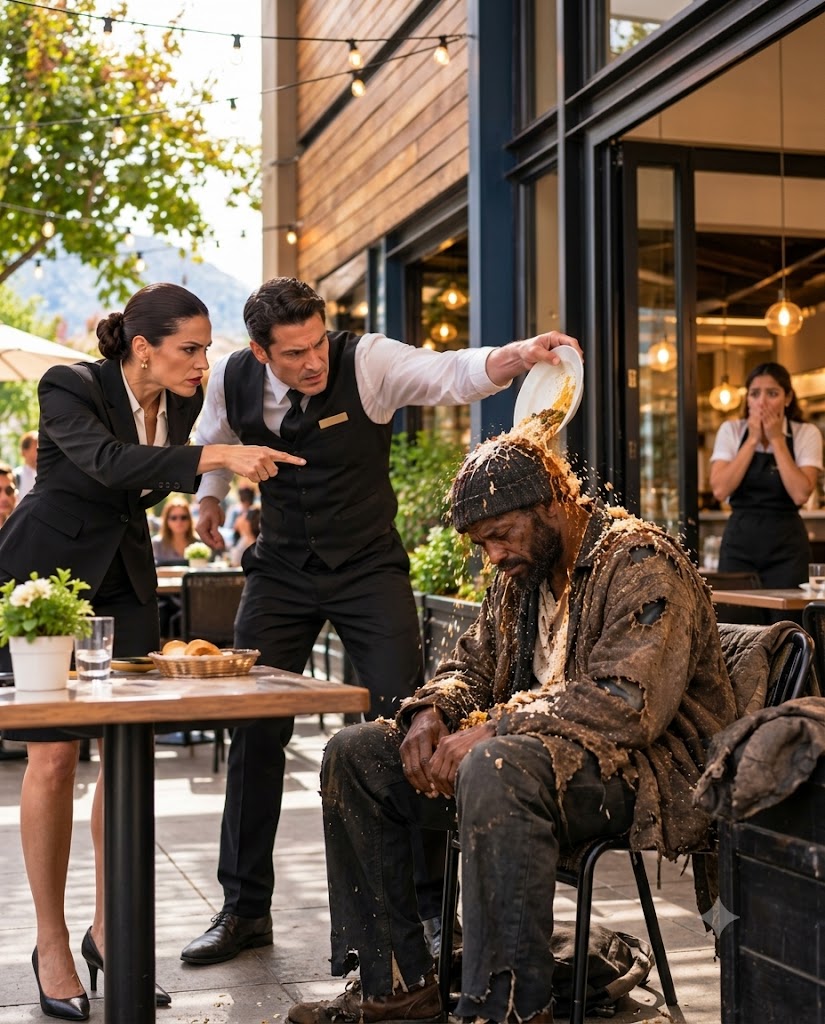
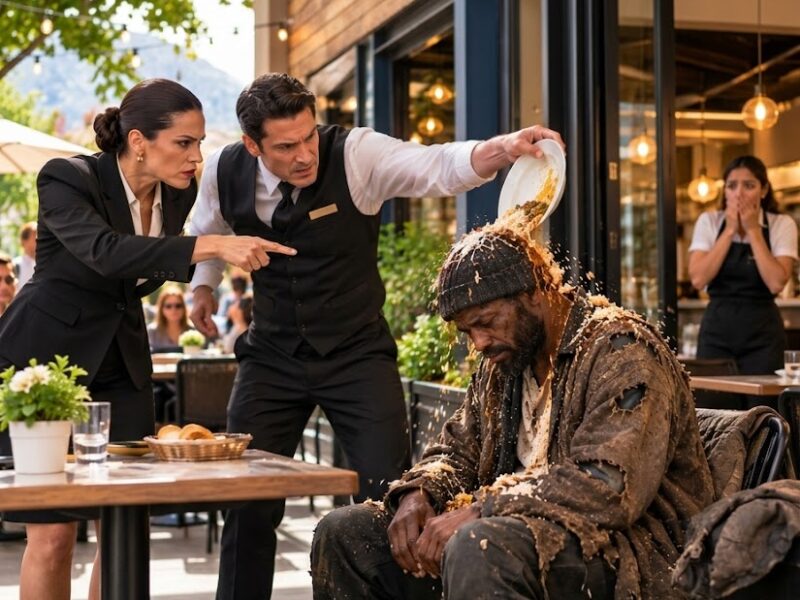
The bean soup was still warm when it slid down Salvador Nogueira’s forehead.
It dripped past his eyebrows, stung the corners of his eyes, and fell from his chin onto the restaurant floor.
Bits of rice came with it, a gnawed rib bone, and a few wilted collard greens.
For one instant, the entire dining room went silent.
Then came the first laugh from a table near the window, and it opened the door for all the others.
“There you go. You didn’t want food,” said Hector Brandão, still holding the empty tray. “There’s food. Now you can leave satisfied.”
Salvador didn’t move.
He stood frozen, hands open at his sides, feeling the rest of that meal slide down his neck.
He was sixty-two years old and couldn’t remember the last time someone had looked at him that way.
Or rather, he remembered.
He remembered very well, except it had been more than fifty years ago.
On the other side of the counter, Patricia Farias crossed her arms and spoke loudly enough for everyone to hear.
“I’ve warned you more than once that these kinds of people don’t come in through the front door. This is a family restaurant. There are customers eating. Where’s security? Someone get this man out of here now.”
A young man from the kitchen appeared awkwardly, unsure whether to obey or apologize.
A man in a polo shirt raised his phone and started filming.
An elderly woman with white hair turned her face away in shame but said nothing.
And in the back, near the kitchen door, a young woman in an apron—she couldn’t have been older than twenty-two—pressed a dish towel against her mouth.
She was crying.
Crying silently, like someone afraid of being seen crying.
Salvador looked at her.
She was the only person in that entire dining room he truly looked at.
“I just asked for a plate of food,” he said, his voice low and hoarse. “The sign outside says no one goes hungry here.”
Hector laughed.
A short, contemptuous laugh.
“The sign says a lot of things, old man. A sign is a sign. Get out of here before I call the police.”
Salvador lowered his head, turned his back, and walked away slowly.
Behind him, he still heard Patricia say, “Wipe this floor, Livia, and stop crying. This isn’t a soap opera.”
What neither of those two managers knew, what none of those laughing customers could imagine, was that the man who had just been thrown out, covered in food scraps, owned that restaurant.
He owned that one and forty-six others spread across three states.
And he hadn’t been there by accident.
To understand how one of the most respected businessmen in the food industry ended up in the middle of that dining room, humiliated in front of everyone, you have to go back three weeks.
Back to a letter.
A letter written in pencil with trembling handwriting on a notebook page folded in four.
The letter arrived at Nogueira House headquarters in Columbus, Ohio, on a Monday.
It arrived in the middle of a pile of correspondence—bills, supplier proposals, and event invitations.
Salvador’s secretary, Mrs. Ivone, almost threw it away.
But something about that envelope—no complete return address, just the name Antonio, or Tonico, and the town of San Joaquin Springs—made her stop.
San Joaquin Springs was the town where everything had begun.
She carried the letter to Salvador’s office and placed it on his desk.
“Mr. Salvador, I think you’ll want to read this yourself.”
He opened it, read it once, read it again, and then a third time.
He took off his glasses and rubbed his eyes.
The letter said something like this:
“Mr. Salvador, you don’t know me, but I knew your mother, Mrs. Benedita. I ate a lot of food from her hands when I was young and worked as a day laborer. When you opened the restaurant here in town and started giving meals to those who had nothing, I thought your mother’s spirit had returned to this land. That’s how it was. We’d come to the back door in the late afternoon and there was always something. But about eight months ago, it stopped. The new managers say the meal program is over, the company cut it, there’s no more funding. They send us away. Some have even been kicked. I don’t know if you know about this. I don’t think you do, because I knew your mother and I know she wouldn’t allow it. That’s why I’m writing. Sorry for the handwriting. God bless you. Antonio, Tonico.”
Salvador sat in silence for a long time.
Then he picked up the phone and asked for his son, Rafael, who was director of operations, and the company’s chief financial officer, Octavio Mendes.
When the two walked in, he simply held out the letter.
Rafael read it first, then passed it to Octavio.
“Dad, this doesn’t make sense,” Rafael said. “The Benedita’s Table program is active in every unit. In San Joaquin Springs, we just approved a budget increase for them.”
“An increase?” Salvador asked.
Octavio opened his laptop, typed something, and turned the screen toward him.
“Yes, Mr. Salvador. The San Joaquin Springs unit logs 120 meals per day for the program. It’s the unit with the best social performance in the chain. In fact, about six months ago, the regional director, Marcelo Arruda, requested an increase in the quota, claiming demand had grown because of the coffee harvest, that a lot of outsiders were arriving in town with nothing. We approved it. Today the unit receives funding for 150 daily meals.”
“150 per day,” Salvador repeated slowly. “And this man is telling me it’s been eight months since a single one went out.”
“It could be someone confused, Dad,” Rafael said carefully. “An elderly man who got into an argument with an employee. Didn’t receive one day. He’s saying he got kicked.”
No one answered.
“Octavio. How do we verify these meals are being delivered?”
“There’s a signature log, Mr. Salvador. Every beneficiary signs or leaves a fingerprint. The unit sends the scanned list every week. It’s all here. Name, date, signature.”
“Show me.”
Octavio opened the files—pages and pages of names.
Salvador leaned toward the screen and stared for a long time.
Then he pointed.
“This signature here. And this one. And this other one, three lines down. Do you see?”
Rafael moved closer. “What about it?”
“The A is the same in all of them. The way the J is made is the same. Different names, but it looks like the same hand.”
Octavio frowned and began flipping through the pages faster.
Page after page, he grew pale.
“It could be a coincidence,” he said, but he didn’t sound like he believed it.
“150 coincidences a day,” Salvador replied.
Rafael sat down.
“All right. So here’s what we do. I’ll send an audit tomorrow. Full team—accountant, legal. We show up unannounced, tear everything apart, and fire whoever needs firing.”
Salvador shook his head.
“No.”
“What do you mean, no?”
“If you send an audit, they’ll know in ten minutes. Someone calls, someone tips them off, someone hides paper. And then you’ll find a nice little list, a fridge full of meals, and a manager smiling, saying it was a misunderstanding. This kind of thing isn’t seen from above, son. It’s seen from below.”
“What are you saying?”
Salvador looked at the letter again.
“I’m saying I’m going there. The way Tonico comes in through the back door.”
Rafael stood up from his chair. “No. Absolutely not, Dad. You’re sixty-two. You had blood pressure problems last year. You want to dress up like a homeless man and wander around? What if something happens? What if someone recognizes you?”
“No one will recognize me. I haven’t set foot in San Joaquin Springs in fifteen years. The employees there have never seen me in person. They know a photo of me in a suit, hair cut, smiling in a brochure. Nobody looks at the face of a man asking for food. Rafael, believe me. Nobody looks.”
“You’re talking like you know.”
Salvador stared at his son for a long moment.
“I know. You’re the one who never had to know.”
Rafael fell silent.
He knew his father’s story. Of course he did. From hearing it told. The mother who cooked for farmers. The boy who ate what was left over. The first food stand on the side of the highway.
But knowing from hearing it told is different from having gone hungry, and he never had.
“At least let me send someone with you,” he said finally. “Josias will go. He’ll stay in town, at a hotel, with the car ready. And Dr. Helena will be on standby. If I find what I think I’m going to find, I’ll need a lawyer and maybe a sheriff.”
Octavio, who had been quiet until then, asked, “And Marcelo Arruda, the regional director? Should I warn him?”
Salvador thought for a few seconds.
“Don’t tell anyone. Not even him.”
“But he’s trustworthy, Mr. Salvador. He’s been with us for eleven years. He’s the one who requested the quota increase, isn’t he?”
Octavio didn’t answer.
And in that silence, all three of them understood the same thing without needing to say it.
In the days that followed, Salvador stopped shaving. Stopped cutting his hair.
Ivone canceled all his appointments with the excuse of a rest trip.
He set aside some old clothes that were in a bag for donation.
He left his wallet, his watch, and his phone with Rafael and took only a simple, cheap device hidden in the lining of a cloth bag, with Josias’s number written on it.
The night before the trip, Rafael went to his father’s house and found him sitting on the porch, looking at an old photograph.
“Is that Grandma?” he asked.
“Yeah. That photo was taken in the kitchen at Boa Esperança Ranch. I was seven. You see that boy hiding behind her skirt? That’s me.”
Rafael sat down beside him. “You never really told me what it was like.”
Salvador stayed quiet for a moment before speaking.
“It was like this. She cooked for the rancher’s family and for the hired hands. She woke up at four in the morning, made food for thirty, forty men. And we couldn’t eat from the pot. It was forbidden. The boss counted the portions. What was left on other people’s plates, she’d scrape off secretly and give to me behind the stove. Sometimes there was a bone, sometimes there was a peel. I ate a lot of scraps, Rafael. A lot of other people’s leftovers.”
His son said nothing.
“One day, the rancher’s son caught me eating a piece of meat that had fallen on the floor. He grabbed the plate of scraps and dumped it on my head in front of everyone. The hands laughed. My mother cried secretly all night. The next day, she told me something I never forgot. She said, ‘Salvador, one day you’ll have food to give. When that day comes, never let anyone eat scraps at your door.’ That’s why the program is named after her. That’s why it’s called Benedita’s Table. It’s not marketing, son. It never was. It’s a promise.”
Rafael rubbed his face. “And now someone is using her name to steal.”
“Now someone is taking the plate out of the mouths of the hungry and using my mother’s name to do it. And I’m going to find out who.”
Salvador arrived in San Joaquin Springs on a Wednesday afternoon, getting off an intercity bus with a cloth bag over his shoulder.
Josias had arrived a day earlier with the car and was staying at a small hotel on the edge of town.
The two had agreed not to speak except by message and only in case of necessity.
The first night was the hardest.
Salvador found shelter under the awning of a closed store near the bus station.
The ground was hard and cold. He barely closed his eyes.
In the early hours, a man approached and sat about six feet away.
“You’re new here,” the man said.
“I got in today.”
“Where from?”
“Far away.”
The man laughed softly. “Everyone here is from far away. I’m Juninho. If you want some advice, don’t sleep here. The sprinklers come on at five and soak you. Go to the church square, behind the bandstand. Nobody bothers you there.”
“Thanks.”
“You hungry?”
Salvador hesitated. “I am.”
Juninho pulled a half-empty pack of crackers from his pocket and held it out. “Here. It’s what I’ve got.”
Salvador looked at those crackers for a second too long.
A man who had nothing was sharing the little he had.
He took them. “God bless you.”
“Don’t bother. God’s got a lot of debts around here,” Juninho said and laughed again.
The next morning, Salvador went to the church square.
There he met others.
A woman named Sida, who had lost her job as a housecleaner after knee surgery and ended up on the street when she couldn’t pay rent.
A quiet young man whose name nobody knew, whom they called “Mute,” though he wasn’t mute—he just didn’t like to talk.
And sitting on a bench, wrapped in a plaid blanket even in the sun, a thin old man with light eyes and thick hands that had worked the land his whole life.
“That’s Mr. Tonico,” Juninho said. “He’s the oldest one here. Respect him.”
Salvador felt his heart beat faster.
He approached slowly. “Good morning, Mr. Tonico.”
The old man looked him up and down. “Good morning. You’re not from here?”
“I’m not, but I was, a long time ago.”
“Were you? What family?”
Salvador thought fast. “Family of people who worked on ranches. My mother was a cook.”
“A lot of people here had mothers who were cooks,” the old man replied. “The best of all was Benedita from Boa Esperança. You didn’t catch her time. You’re too young.”
Salvador swallowed hard. “I heard about her. Everyone did. Her son got rich. Opened the restaurant. The first one was here, you know? That big one on the highway exit—Nogueira House. It used to give food to us. Now it doesn’t.”
“Why?”
Tonico shrugged and pulled his blanket tighter. “They say they cut it, that the owner doesn’t want to anymore. I don’t believe it. I even sent him a letter.”
“And he answered?”
“Nothing. Rich people don’t read letters from old men.”
Salvador looked away to keep what he was feeling from showing on his face.
During that week, he heard a lot.
He heard Sida tell how, at first, the new managers still gave meals, but only to those who arrived early, and how gradually the line was pushed later, then to the back door, then to nowhere.
He heard Juninho say that one day he tried to insist, and a tall manager with a loud voice had security remove him by force.
“That was Hector,” Juninho said. “That man hates us. Says we scare off customers. One time he threw a bucket of dirty water on us in the alley behind the restaurant.”
“And the woman, the manager?” Salvador asked.
“Patricia? She’s worse. She doesn’t even yell. She looks, looks, and speaks softly so others do it. She’s the one really in charge in there.”
He also heard something that put him on alert.
“But there is food,” Sida said one afternoon. “That I guarantee. There’s plenty. I’ve seen it.”
“Where?”
“At night, around ten, ten-thirty, a white pickup truck pulls up in back. In the alley. People come out of the kitchen with cooler boxes and load them into the bed. Box after box. I saw it because I sleep nearby sometimes when it rains.”
“And where does that truck go?”
“That I don’t know. It takes the road toward the farms.”
That night, Salvador sent a short message to Josias.
“White pickup. Alley behind the unit. Around 10 p.m. Don’t get close. Just observe. If you can, film the plate.”
The next night, Josias replied with three videos.
In them, you could clearly see the back door of the restaurant open, two employees carrying thermal boxes, and a man in a baseball cap leaning against the pickup, counting the boxes and writing in a small notebook.
After loading everything, the man tapped the side of the truck twice and got in.
Josias followed from a distance.
The pickup left town, took a dirt road, and stopped at a rural bus stop near a coffee farm, where two other vehicles were waiting.
The boxes were divided among them, and the plate was legible.
Salvador sent the plate to Dr. Helena.
In less than two hours, she replied.
The vehicle was registered to Valdir Brandão.
Brandão—the same last name as the manager.
Helena sent more information.
Valdir was known in the region. He worked as a labor recruiter, the man who hires and transports rural workers for harvests and organizes food, transportation, and payment for the crews.
And he was Hector’s brother-in-law.
Salvador sat on the park bench and stared at the ground for a long time.
So that was it.
The meals paid for by the company, meant for hungry people, were going out the back door and being sold as food for day laborers in the fields.
The same workers Salvador’s mother had fed for free decades earlier.
Someone was making money twice off hunger.
Once by taking from the poor who asked, and again by charging the poor who worked.
Juninho appeared beside him. “You look like you’ve seen a ghost.”
“I’ve seen worse.”
“What?”
“People.”
Juninho didn’t understand, and Salvador didn’t explain.
He knew he already had enough to send an audit, call the police, and fire everyone.
But one thing was still missing.
He needed to go in.
He needed to see with his own eyes how those people treated someone asking for food inside the restaurant that carried his family’s name.
Because theft is proven with paper, but character is only proven by looking someone in the face.
That’s why, on that Friday, during lunch hour, with the dining room full, Salvador Nogueira pushed open the front door of the first Nogueira House unit and walked in.
He stopped near the entrance.
The smell of home-style cooking hit him in the face, and for a second he was seven years old again.
A few people looked. A child tugged at his mother’s sleeve and pointed.
A waiter froze mid-step with a tray in his hand.
Salvador walked to the counter.
“Good afternoon. I wanted to know if there’s a plate of food. The sign outside says there’s Benedita’s Table, that no one goes hungry here.”
The cashier looked around nervously. “Sir, I—I think you’d better talk to management.”
He didn’t need to call.
Hector was already crossing the dining room with long strides.
He was a man in his forties who walked like the restaurant belonged to him.
“What’s going on here?”
“He’s asking for food, Mr. Hector,” the cashier said.
“Food?” Hector looked at Salvador like he was looking at a stain on the floor. “My friend, you walked into the wrong place. This is a restaurant. Here people pay.”
“The sign outside talks about the Benedita’s Table program.”
“The program’s over.”
“Over since when?”
Hector narrowed his eyes. “Since when do I have to explain myself to you? It’s over. There’s no more. Now get out.”
“I just want one plate. It can be leftovers. It can be whatever’s left. I haven’t eaten since yesterday.”
Salvador’s voice didn’t tremble, but he noticed some people at the tables had stopped eating to pay attention.
An elderly woman opened her purse as if to offer money, and her husband held her hand.
That’s when Patricia appeared behind the counter.
She was a woman with a calm, almost sweet way of speaking, and that was exactly what made her frightening.
“Hector, handle this quickly, please. We have customers complaining.”
“I’m handling it.”
“You’re not. He’s still here.”
Salvador looked at her. “Ma’am, are you the manager?”
“I am.”
“Then you know this company pays for 150 meals a day for people who are hungry in this town.”
The entire dining room heard it.
Patricia’s expression didn’t change, but Salvador saw something pass through her eyes for a tenth of a second.
It wasn’t guilt. It was calculation.
“Who told you that?”
“Everyone on the street knows there used to be.”
“Used to. Now there isn’t. The company cut it. If you have a complaint, call the main office. Now, please, leave.”
“I’m not leaving without eating.”
He hadn’t planned to say that. It just came out.
And it was that sentence that made Hector lose his patience.
“Oh, you’re not leaving? Then wait right there.”
Hector went to a cart a waiter was pushing, loaded with plates collected from tables.
He grabbed a large tray where leftovers had been gathered to be thrown away.
He came back with it, stopped in front of Salvador, and without saying another word, dumped it all on his head.
That’s when the soup slid down his forehead.
That’s when the laughter came.
That’s when Patricia ordered the man removed.
And the kitchen boy, embarrassed, took Salvador by the arm and led him to the door.
And that’s when Salvador saw Livia, the girl who was crying.
Outside, the midday sun felt stronger.
Salvador walked a few yards, turned the corner, and leaned against a wall in the side alley.
He wiped rice from his hair with his hand.
He took a deep breath once, twice, three times.
He didn’t cry, but his whole body was shaking.
Not from shame—from rage.
A rage he hadn’t felt since he was a boy, and now it had a different weight.
Because this time, the person who dumped the plate on his head was wearing a uniform with his mother’s last name embroidered on the chest.
He was about to grab the phone hidden in his bag when he heard hurried footsteps.
“Sir, sir, wait.”
It was Livia.
She was coming with a plastic bag in her hand and her eyes still red.
She looked back to see if anyone had followed her and stopped in front of him.
“Take it. It’s my meal. It’s my lunch. I didn’t touch it, it’s clean.”
Salvador looked at the bag, then at her. “And what are you going to eat?”
“I’ll figure it out. I’ll eat something later. Please take it.”
He took it. His hands were still dirty with soup.
“Thank you. What’s your name?”
“Livia.”
“Why were you crying in there?”
Livia lowered her head, stayed quiet for a moment, then spoke in a voice almost without sound.
“Because it wasn’t supposed to be like this. You had a right. Everyone who asks has a right. That food exists. It’s made every day. I make it. I’m the one who puts the meals together.”
Salvador felt everything inside him go silent.
“You put them together?”
“Every day starting at 4 p.m. 150 of them. Rice, beans, a protein, salad, lid, label for Benedita’s Table, all proper.”
“And where do they go?”
Livia looked back again, frightened. “I can’t say. If they find out I talked, I’m on the street and I can’t lose this job. My mom is sick. My brother is little.”
“Livia, look at me.”
She looked.
“I won’t tell anyone it was you. You have my word.”
She spent a moment measuring that dirty man with the big beard and eyes too steady for someone in his situation.
Then she said everything at once, like someone throwing a weight off her back.
“They sell the meals. They sell them to Mr. Hector’s brother-in-law, Valdir. He takes them to the farms, to the harvest crews. Eighteen dollars each. It’s a lot of money. And then Mrs. Patricia makes the list. She signs the names herself. Sometimes she has me help sign with a different handwriting so it doesn’t all look the same. I refused. She said if I refused again, I was an accomplice anyway because I put the meals together. She said if anyone found out, it would fall on me, that I’m the youngest, that no one would believe me.”
“And do you have any proof of this?”
Livia hesitated.
Then she reached into her apron pocket and pulled out a small blue notebook. Worn.
“I’ve been writing it down since the beginning. How many meals I make. How many leave in the truck. The time. There are photos on my phone too. I took them secretly a few times. I didn’t know what I was going to do with it. I just knew that one day someone would need to know.”
Salvador held the notebook with both hands, like he was holding something sacred.
“Why did you do this, girl? Why did you risk it?”
She took a while to answer.
“Because when my dad left and my mom got sick, we ate from Benedita’s Table for almost a year. I was twelve. I was the one who came to get it every day at the back door. And there was a cook, Mrs. Zezé, who always put an extra little dessert in for me. I came to work here because of that. I thought I’d be doing the same for others. And then I get here and I see this.”
Her voice faltered.
“I see this food going out every night and I see Mr. Tonico, who’s known me since I was little, being shooed away from the door. And I can’t do anything.”
Salvador closed his eyes for an instant.
“Yes, you can. You just did.”
He handed the notebook back. “Keep this with you. Don’t show it to anyone. Tonight, when the truck comes, act normal. Don’t look at anyone differently. Tomorrow morning something’s going to happen at this restaurant, and I want you to be there.”
“What thing?”
“You’ll see.”
“Who are you?”
Salvador smiled for the first time that day.
“Someone who’s eaten a lot of meals at the back door.”
Livia went back to the restaurant with her heart pounding, and Salvador, as soon as she disappeared around the corner, pulled the phone from his bag and called.
“Josias, come get me. It’s over.”
Half an hour later, the car stopped in the alley.
Josias got out, looked at his boss covered in dried food, and clenched his jaw.
“Mr. Salvador, who did this to you?”
“I’ll tell you later. Right now I need a shower, a pair of scissors, and a phone. And I need to talk to Dr. Helena, Rafael, and Octavio. All at the same time.”
In the hotel room, while hot water washed his hair, Salvador thought.
He thought about the tray. He thought about the laughter in the dining room. He thought about the girl who cried.
And he thought, more than anything, about what he would do the next day.
When he came out of the shower, the video meeting was already set up on Josias’s laptop.
Rafael appeared first, frantic. “Dad, for God’s sake, are you okay?”
“I’m fine. Better than ever.”
“Josias said you were assaulted—”
“I was humiliated. That’s different. But it doesn’t matter now. Dr. Helena, did you receive the videos of the truck?”
The lawyer nodded. “I received them, Mr. Salvador, and I’ve already cross-referenced them with company data. There’s more. In the last eight months, the San Joaquin Springs unit increased its purchase of disposable packaging and protein by 40%. That was approved by the Regional Directorate without question. All invoices were authorized by Marcelo Arruda.”
Octavio joined the conversation. “And there’s something else, Mr. Salvador. I checked Marcelo’s travel. He went to San Joaquin Springs eleven times in that period, far more than any other unit in his region. And on every visit, his reports praise the unit. He even nominated Hector and Patricia for manager of the year.”
Salvador sat on the edge of the bed with the towel around his neck.
“So he knows.”
“We don’t have direct proof yet,” Helena said, “but it’s very hard for him not to know.”
“Then let’s give him a chance to show himself.”
Rafael frowned. “What do you mean?”
“Octavio, I want you to call Marcelo right now. Tell him the board has decided to make a surprise visit tomorrow morning at 9 a.m. to the San Joaquin Springs unit to honor the management. Tell him it’s because of the social performance. Tell him to notify both managers and be there.”
“An honor.” Rafael almost laughed.
“You want them to come thinking they’re getting an award.”
“I want them to come relaxed. Relaxed people talk too much.”
Helena smiled on the other side of the screen. “And I’ll bring the sheriff. I’ll talk to the local sheriff, explain everything, show what we have, and ask him to be available. If necessary, he comes in. If not, we handle it on paper, but I want him close.”
“And the girl, this Livia, she has a notebook. She wrote everything down for months—dates, quantities, times. She has photos. Tomorrow she’ll be there, but I don’t want her exposed before the right moment. First they get a chance to tell the truth. If they lie, then we show it.”
Rafael was quiet for a while, then said, “Dad, can I come? Can I be there tomorrow?”
Salvador looked at the screen, at the son he had raised far from all of this, far from hunger, far from the back door.
“Can you? I think it’s good for you to see.”
That night, Octavio called Marcelo Arruda.
Josias, sitting in the corner of the room, heard the call on speaker.
“Marcelo, good evening. Sorry for the hour. It’s Octavio.”
“Octavio, my friend, what a surprise. Did something happen?”
“Something good happened. The board is making a visit tomorrow to the San Joaquin Springs unit, at 9 a.m. A special meeting to recognize the unit’s social work. You know, Benedita’s Table is the best result in the chain.”
There was a two-second silence on the other end.
Two seconds that said a lot.
“Tomorrow? Just like that?”
“Yeah. Decision from above. Mr. Salvador insisted.”
“Mr. Salvador is coming?”
“He is. He wants to see it personally.”
Another silence.
Then Marcelo’s voice came back, too cheerful. “Wonderful. What an honor. I’ll notify Hector and Patricia right away. You can count on everything being impeccable.”
“I’m sure it will be,” Octavio replied and hung up.
Salvador, sitting in the armchair, smiled slightly.
“Everything impeccable. You’ll see—tonight there’ll be people running around fixing paperwork.”
And that’s exactly what happened that night.
Around 10 p.m., Josias returned to position near the alley behind the restaurant, but the white pickup didn’t show.
Instead, a black car appeared.
A man in a dress shirt got out and entered through the back door.
Josias recognized him from the photo Octavio had sent.
It was Marcelo Arruda.
Inside the restaurant, the office lights stayed on until almost 1 a.m.
Livia was there. She had been called in to stay late to help with the setup.
She stayed in the kitchen wiping counters that were already clean and heard pieces of the conversation through the half-open office door.
“Are you sure there’s nothing strange?” It was Marcelo’s voice.
“Absolutely sure,” Patricia replied. “The lists are all here, all signed, all nice and neat. And today we didn’t send anything. Valdir didn’t come. I called and told him not to. The 150 are in the cold room. Tomorrow morning we’ll hand out some at the door, take some photos to show the old man, and that’s it. He’ll leave here crying with emotion.”
Hector laughed. “The old man’s sentimental. I’ll even have a banner made with his mother’s name. He’ll love it.”
“Don’t overdo it,” Marcelo said. “Salvador is sentimental, but he’s not stupid. And one more thing—that homeless guy today. What’s this about you throwing food on a man’s head inside the dining room?”
Livia stopped wiping the counter.
“Ah, it was nothing,” Hector said. “Some drunk who came in asking for a plate and started talking about Benedita’s Table. I gave him a scare. There were people filming. A customer filmed it, but I told him to delete it.”
“He deleted it?”
“He asked or I told him. Same thing.”
Patricia spoke lower, but Livia could still hear.
“What worries me is Livia. She was crying in the middle of the dining room and then disappeared for a long time during lunch. I think she went after the homeless guy.”
“After the homeless guy for what?” Marcelo asked.
“I don’t know. That girl is soft, feels sorry for everyone, and she knows too much.”
“Then take care of it. After tomorrow’s meeting, fire her. Make up a reason. Say she was caught stealing food. No one will doubt it.”
Livia gripped the cloth so hard her fingers went white.
She left the kitchen without making a sound, grabbed her bag, and left without saying goodbye.
On the street, hands shaking, she pulled out her phone and searched for a number.
The bearded man had left it with her, written on a piece of paper before he left that afternoon.
“If you need to, call.”
She called.
A different voice answered, but deep. “Hello? Hello?”
“Hi, I wanted to talk to the man who was at the restaurant today, the one with the beard.”
There was a silence.
Then Salvador’s voice. “Livia, it’s me.”
“Sorry for the hour. I needed to tell you. They know someone’s coming tomorrow. A director showed up here tonight. They’re getting everything ready. They’re going to pretend to hand out the meals and they’re going to fire me. They’re going to say I stole food.”
“Calm down, girl. Breathe.”
“I’m scared.”
“I know. Listen to what I’m going to tell you. Tomorrow you go to work normally. At 9 a.m. there’ll be a meeting. You’ll be there and no one is going to fire you. No one. You have my word.”
“But you don’t even work there. How can you promise that?”
Salvador was silent for a second.
Then he said slowly, “Livia, do you trust me?”
She thought about the man covered in food, head held high, looking at her in the middle of the dining room. She thought about the way he held the notebook.
“I trust you.”
“Then sleep. Tomorrow you’ll understand.”
She hung up, didn’t sleep, but she didn’t cry anymore either.
The next morning, at 8:30, the front of the restaurant was unrecognizable.
A new banner hung at the entrance with big letters: Benedita’s Table. Where no one goes hungry.
A table had been set up on the sidewalk with stacked meal containers.
Two employees had been placed there to hand out food to anyone who passed.
And for the first time in eight months, some homeless residents were in line.
Mr. Tonico was among them.
Juninho and Sida had found out early because the news spread fast in the square.
“They’re giving out meals again at Nogueira.”
Tonico took his and looked at the banner.
“Funny,” he said to Juninho. “Eight months with nothing and suddenly a new banner. Someone important is coming.”
“You think?”
“I do. This is theater. But theater food I’ll take.”
Juninho laughed and looked around. “And the bearded guy, the new one, disappeared since yesterday.”
“He probably left,” Sida said. “After what they did to him at the restaurant, I would too.”
“What did they do?”
“You didn’t hear? They dumped food scraps on his head inside, in front of everyone.”
Tonico stopped chewing. “Who did that?”
“Who do you think? Hector.”
The old man slowly closed his meal container and looked at the restaurant door.
He said nothing, but his gaze hardened.
Inside, in a meeting room at the back of the restaurant, everything was arranged.
A long table, white tablecloth, bottles of water, coffee, warm cheese bread.
At the head, an empty chair.
Hector and Patricia arrived at 8:45, well dressed, smiling, with a thick folder of documents.
Marcelo arrived soon after.
“Everything ready?” he asked.
“Everything,” Patricia replied. “Beneficiary list for the last six months. Distribution photos. Social impact report. Beneficiary testimonial. It’s all here.”
“Testimonial?”
“We recorded a video last night with a young man thanking us for the food.”
“What young man?”
“A kitchen helper. We put old clothes on him. It turned out great.”
Marcelo rubbed his forehead. “Patricia, for God’s sake, relax. No one’s going to know.”
Hector helped himself to coffee. “I don’t understand why you’re so worried, Marcelo. The old man comes, looks at the banner, hears a few numbers, cries about his mother, and leaves. That kind of owner doesn’t want details. He wants to feel good.”
“You don’t know Salvador.”
“And you do?”
Marcelo didn’t answer. He looked at his watch. 8:55.
At 9 sharp, the door opened.
Octavio and Rafael entered first.
Marcelo stood up immediately. “Octavio, Rafael, what a joy. Welcome. These are Hector and Patricia, the ones responsible for this marvelous result.”
Rafael shook hands without smiling. Octavio did the same.
Then a woman in a dark suit entered with a leather briefcase under her arm.
“This is Dr. Helena Bastos, from our legal department,” Octavio said.
Patricia frowned slightly. “Legal? For an honor?”
“Mr. Salvador insists that all recognition be formalized,” Helena replied with a polite smile.
“Ah, of course, of course. And Mr. Salvador?” Marcelo asked. “Has he arrived?”
“He has,” Rafael said. “He’s coming.”
And then the door opened again.
Salvador Nogueira entered slowly.
Beard shaved, hair cut short, a well-pressed gray suit, dark tie.
He walked with the straight posture of a man who had spent a lifetime learning not to bow his head.
He didn’t look at anyone in particular.
He walked to the head of the table, pulled out the chair, and sat down.
Behind him came Josias and a young woman in a kitchen uniform who stood against the wall, not knowing what to do with her hands.
It was Livia.
Hector looked at her, surprised. “Livia, what are you doing here? Go back to the kitchen.”
“She stays,” Salvador said.
His voice cut through the room.
Hector turned to look at the company owner for the first time, really look.
For a second, he didn’t understand anything.
Then something about that voice began to bother him.
He had heard that voice before. Not long ago.
Patricia noticed too.
She looked at Salvador’s face, then at his hands, then back at his face, and went pale.
“Good morning,” Salvador said. “Thank you for the coffee, the cheese bread, the banner outside. It turned out very beautiful. My mother would have loved to see her name written so large.”
“It was a tribute from us, Mr. Salvador,” Hector said, his voice less steady than he would have liked. “We’re very proud of the program.”
“Are you?”
“We are.”
“Good. Then you can explain a few things to me.”
He signaled to Octavio, who opened the laptop and turned the screen toward the table.
“According to the unit’s reports, in the last eight months more than 35,000 meals have been distributed here through Benedita’s Table. Is that correct?”
Patricia opened the folder. “It is, Mr. Salvador. We have the signature lists for all beneficiaries.”
“Good. Can I see?”
She handed over the folder.
Salvador didn’t open it. He passed it to Helena, who flipped through a few pages and placed it beside other papers she already had.
“Dr. Helena, can you explain what we found in these lists?”
Helena spoke with the calm voice of someone who had done this many times.
“A forensic handwriting analyst examined samples of the lists sent by the unit over the last eight months. In more than 90% of the pages, the signatures were made by only two or three different people, imitating different names. Additionally, we cross-referenced the names with public records. We found eleven people listed as beneficiaries who had already died before the dates they supposedly signed. One of them died four years ago.”
The silence in the room grew heavy.
Marcelo tried to speak. “Mr. Salvador, I didn’t know about any of this. If there’s an irregularity in the list, it’s the doing of employees, of the distribution people—”
“Easy, Marcelo. You’ll have your turn.”
Patricia took a deep breath and tried to keep her voice steady. “Mr. Salvador, it’s possible that some employees signed on behalf of beneficiaries who didn’t know how to write. Many people here are illiterate. To speed up the line—”
“Sometimes,” Salvador said, “sometimes they sign on behalf of dead people.”
She went quiet.
“But that’s fine. Let’s suppose it was a paperwork mess. Let’s suppose. The food still went out, right? 150 a day.”
“It did,” Hector said, too quickly. “It did, every day.”
“It went out the front door or the back door?”
Hector opened his mouth and closed it.
Salvador made another signal.
Josias approached and placed his phone in the center of the table.
He pressed play.
On the screen, the back door of the restaurant. At night. Thermal boxes being loaded. A man in a cap writing in a notebook. The truck’s plate clearly visible.
Then the dirt road, the rural stop near the coffee farm, the boxes being divided among other vehicles.
A man opening one and showing the meal with the Benedita’s Table label.
Hector turned red, then white.
“That doesn’t prove anything,” he said. “It could be anything. It could be leftovers. It could be a donation to rural workers. We also help the field workers. That’s social action.”
“Social action?” Salvador asked.
“Yes, social action.”
Helena opened another folder. “Funny you say that, because yesterday afternoon I spoke with Mr. Valdir Brandão, your brother-in-law, if I’m not mistaken.”
Hector stopped breathing for an instant.
“You spoke with Valdir?”
“I did, in the presence of Sheriff Ferraz from the local sheriff’s office. Mr. Valdir was very cooperative. After he understood he could be charged as an accomplice, he explained that he pays you $18 per meal, that he receives between 100 and 150 boxes per night, that he resells each one to farmers and harvest crews for $25, and that payment is made in cash every Friday at a gas station on the edge of town. He also handed over some transfer receipts he made when he didn’t have cash to the account of Mrs. Patricia Farias.”
Patricia stood up. “That’s a lie. That man is trying to save himself. I never received anything from anyone.”
“The transfers are here,” Helena said, sliding the papers across the table with her name, her Social Security number, and her account.
Patricia stood frozen, looking at the pages as if they might disappear.
Octavio did a quick calculation, speaking almost to himself. “150 meals a day, $18 each. That’s $2,700 a day. In eight months, more than $600,000. That’s just from your side, not counting what the company paid for ingredients, packaging, and labor to produce that food.”
“It wasn’t all that,” Hector said loudly, and immediately realized what he had said.
Rafael, who had been quiet until then, looked at him with disgust. “It wasn’t all that? Then how much was it?”
Hector didn’t answer.
Salvador leaned back in his chair.
“Do you know why this program exists?”
No one said anything.
“I asked if you know.”
“It’s, it’s the company’s social responsibility,” Patricia risked, her voice weak.
“No. That’s what’s written in the brochure. I’ll tell you why this program exists.”
And he told them.
He told them about Boa Esperança Ranch, about the mother who woke at 4 a.m., about the boy who ate scraps behind the stove, about the rancher’s son who dumped a plate of leftovers on his head in front of the hands.
He told the promise.
He told it slowly, without raising his voice, looking at each of them.
And as he spoke, Hector sank into his chair.
“Fifty-five years later,” Salvador said, “I walked through the front door of the restaurant that carries my mother’s name and asked for a plate of food. And a man wearing a uniform with her name on the chest took a tray of scraps and dumped it on my head in front of everyone.”
The silence was absolute.
Hector looked at Salvador with wide eyes.
Now there was no doubt. That voice, those eyes, that way of standing still without bowing his head.
“No!” he murmured. “It can’t be.”
“It can. It was me.”
Patricia brought her hand to her mouth. “Mr. Salvador. We—we didn’t know. If we had known it was you—”
Salvador slapped the table with an open hand.
It wasn’t hard, but the sound echoed through the room.
“That’s exactly the problem, Mrs. Patricia. If you had known it was me, you would have treated me like a king, served me at the best table, apologized on your knees. But because it was just a hungry man, you thought you could do whatever you wanted. You didn’t humiliate the company owner. You humiliated a human being. The fact that human being was me is just a detail. Yesterday it was me. Last week it was Juninho. Last month it was Mr. Tonico, who is seventy-eight years old and wrote a letter asking for help because he had no one left to ask.”
Livia, against the wall, was crying again, but now it was a different kind of crying.
Hector tried one last exit.
He pointed at her. “It was her, Mr. Salvador. She put the meals together. She knew everything. She was part of it. If you’re listening to this girl, you’re listening to an accomplice.”
Livia went pale.
But before she could say anything, Salvador held out his hand to her.
“Livia, give me the notebook, please.”
She took the small blue notebook from her apron pocket and handed it over.
Salvador opened it and turned it toward the table.
“This notebook was written by her over eight months. Every day. How many meals she made. How many left in the truck. The time, who loaded them, who authorized it. A twenty-two-year-old girl, with a sick mother, a little brother to raise, afraid of losing her job, writing down secretly every single day the proof of what you were doing, because she knew that one day someone would need to know. And there’s one more thing she told me—that you, Mrs. Patricia, asked her to help falsify the signatures, and she refused. And you threatened her. Said if anyone found out, you’d pin it on her.”
Patricia opened her mouth, but no sound came out.
“And last night,” Salvador continued, “she heard the three of you in this room, planning to fire her after this meeting, planning to say she stole food.”
He turned slowly to Marcelo Arruda.
“The three of you.”
Marcelo raised his hands. “Mr. Salvador, I swear, I came here last night just to check that everything was in order for your visit. I didn’t know about any scheme. I’m the regional director, I oversee fifteen units. I can’t control what each manager does.”
“Fifteen units. And you visited this one eleven times in eight months?” Octavio said.
“Because it was the model unit.”
“A model you nominated for an award. A model for which you requested the quota increase. A model whose packaging purchases you approved without asking anything.”
Marcelo swallowed hard.
And that was when Patricia, standing, cornered, looked at Marcelo and made a decision.
The decision of someone who realizes they’re going down and doesn’t want to go down alone.
“He knew,” she said in a low voice.
Then, louder: “He knew everything. He was the one who came up with the idea to request the quota increase. He was the one who said we could take more. He kept a third. Every Friday. Hector took the envelope in his car.”
“Patricia!” Marcelo shouted.
“I’m not paying alone, Marcelo. I’m not. You said no one would ever look, that the old man only cared about his mother’s name in the brochure, that no one reads social program reports.”
Hector slammed the table. “Shut up, Patricia.”
“You shut up. You’re the one who threw food on the man’s head. I told you not to make a scene. I said—”
“You told me to get rid of him.”
“I told you to get rid of him. I didn’t tell you to dump food on him.”
The two started shouting at each other, one accusing the other, while Marcelo tried in vain to talk over them.
Salvador stayed silent, watching.
Rafael looked at his father, then at that scene, unable to believe it.
For almost a full minute, the three people who had stolen food from hungry people destroyed each other in front of everyone, without anyone needing to say a word.
Until Salvador raised his hand and silence returned.
“Enough.”
He looked at Helena. “Dr. Helena, you can call.”
Helena picked up her phone and made a three-word call.
Less than a minute later, the door opened and Sheriff Ferraz entered, accompanied by two deputies.
“Good morning,” the sheriff said. “Hector Brandão, Patricia Farias, and Marcelo Arruda. You’ll come with us to the station to give statements regarding evidence of embezzlement, document forgery, and conspiracy to commit a crime. Mr. Valdir Brandão is already there and available. You have the right to an attorney.”
Marcelo tried to argue.
Hector looked at the door as if he thought about running, but the deputies were there.
Patricia simply sat down again and hid her face in her hands.
Before leaving, Hector stopped in front of Salvador.
His eyes were red. “Mr. Salvador, what I did yesterday—I didn’t—”
Salvador looked at him for a long time.
“You want to know the worst part, Hector? It wasn’t the food on my head. I’d already lived through that. I survived it when I was seven. I’d survive it again at sixty-two. The worst part was seeing the dining room laughing. Seeing that you did it because you knew you could, because you knew no one would stop you, that no one would defend a hungry man. That’s what hurts. And that? No police can fix.”
Hector lowered his head and was escorted out.
When the room emptied, Salvador sat for a while with his eyes closed.
Rafael approached and put a hand on his shoulder.
“Dad—”
“I’m fine, son.”
“I didn’t know. I never really understood what you went through.”
Salvador opened his eyes. “You don’t have to have gone through it to understand. You just have to look. Today you looked.”
He stood and turned to Livia, who was still against the wall, frozen.
“Livia.”
“Sir?”
“You told me yesterday you didn’t know who I was.”
She smiled nervously, through tears. “Now I know.”
“And are you mad at me for not telling you?”
“No. I don’t think I would have believed you if you had.”
He laughed. “Probably not. Do you know what you did?”
She shook her head.
“You gave your meal to a man everyone was throwing out. You didn’t know who I was. You didn’t know if I would help you. You didn’t know if I would turn you in. You just saw someone hungry and did what my mother would have done. That, girl, can’t be taught in a management course.”
Livia couldn’t answer.
“Starting today,” Salvador continued, “you’re not putting meals together in secret anymore. You’re going to coordinate Benedita’s Table here in San Joaquin Springs, with a coordinator’s salary, with a team, with autonomy, reporting directly to headquarters—not to a manager, not to a regional director. To me and to Rafael.”
Her eyes went wide. “Me? But I don’t know how to coordinate anything. I only have a high school diploma.”
“You know what matters. The rest we teach. The company will pay for your college if you want. Business, nutrition, social work, whatever you choose.”
“Mr. Salvador, I—I don’t know what to say.”
“You don’t have to say anything. You just have to help me with one thing right now.”
“What?”
“Walk me to the door. There are some people outside I need to meet.”
Outside, the meal line was still formed.
The new banner swayed in the wind.
The two employees who had been placed there to hand out food stopped as soon as they saw the door open.
First, the sheriff came out, leading Hector, Patricia, and Marcelo to the patrol cars.
The homeless residents watched in silence.
Juninho took a step back. Sida covered her mouth with her hand.
Then Salvador came out.
Mr. Tonico, who was sitting on a stool on the sidewalk, squinted, looked once, looked again.
Juninho came close to him. “Mr. Tonico, that guy in the suit—is that the bearded guy, the new one?”
The old man didn’t answer.
He stood slowly, leaning on his cane, and watched Salvador approach.
Salvador stopped in front of him.
“Good morning, Mr. Tonico.”
“You. You’re—”
“I am. I’m Benedita’s son.”
The old man stood still for a few seconds.
Then his chin began to tremble.
“Did you read it? Did you read the letter?”
“I read it three times. And I came.”
Tonico dropped his cane and hugged Salvador.
An awkward old man’s hug, thick hands patting the back of the suit.
Salvador hugged him back.
The two stayed like that for a while in the middle of the sidewalk, while the town passed around them.
“I’m sorry,” Salvador said, his voice breaking. “I’m sorry for the eight months. I’m sorry for the kick, I’m sorry for every day you came here and were sent away. This never should have happened at the door of a house with my mother’s name on it.”
“It wasn’t your fault,” Tonico said.
“It was. I trusted too much and looked too little. Whoever has the duty to care can’t just trust. They have to look.”
Juninho approached, still suspicious. “So that night, under the awning, the crackers—”
Salvador turned to him and smiled. “The best crackers I ever ate.”
Juninho laughed, half in disbelief, and rubbed his head. “If I’d known I was giving crackers to a millionaire, I would’ve charged you.”
“You can charge me now,” Salvador said. “But I’d rather pay another way.”
He turned to Rafael and Octavio, who had come out behind him.
“I want this sidewalk today to become what it should always have been. No one is going to get a meal standing on the street. Open the dining room, set the tables. Today, the first ones to eat here are them—with plates, silverware, glasses, and napkins, the same as any customer.”
Octavio hesitated. “The dining room opens to the public at 11, Mr. Salvador. The customers—”
“The customers will wait. And anyone who doesn’t want to wait or doesn’t want to eat next to them can find another restaurant. This one belongs to Benedita.”
Livia was already organizing the line.
And that’s how, on that Saturday morning, for the first time in many years, the main dining room of the first Nogueira House unit served a full lunch to more than forty people living on the streets of San Joaquin Springs.
People who had never sat there. People who only knew the back door.
Salvador insisted on serving. He took off his jacket, rolled up his shirtsleeves, and went behind the counter.
He served rice, beans, stewed chicken, collard greens, farofa. He served juice, served dulce de leche for dessert, and with every plate he handed over, he looked the person in the eye and asked their name.
Sida cried when she sat at the table. She said it had been more than two years since she’d eaten sitting in a chair.
The young man everyone called Mute ate two plates without saying a word.
And when he got up to leave, he stopped in front of Salvador and spoke softly: “My name is Daniel.”
Salvador shook his hand. “Nice to meet you, Daniel.”
Around 11:15, some customers began arriving for lunch.
Some stopped at the door, startled by what they saw.
One family turned around and left, but others came in and sat down awkwardly.
And among them was the white-haired woman who, the day before, had turned her face away so she wouldn’t see the humiliation.
She recognized Salvador immediately, stood frozen in the middle of the dining room, then walked to the counter.
“Young man, were you that man from yesterday?”
“I was, ma’am.”
She clutched her purse to her chest. “I wanted to apologize. I saw everything. I wanted to do something. I opened my purse to give you money. My husband wouldn’t let me. He said not to get involved. And I didn’t. I stayed quiet and spent the whole night unable to sleep thinking about it.”
Salvador came out from behind the counter and went to her.
“Do you know what’s hardest in a moment like that?”
“What?”
“It’s not being humiliated. It’s looking around and seeing that everyone is watching. And no one does anything. Yesterday only one person in that dining room did something. A twenty-two-year-old girl who had everything to lose.”
The woman looked at Livia, who was serving juice at one of the tables.
“Her?”
“Her.”
The woman was quiet for a moment, then said, “I want to help however I can. I’m retired, I have time. Can I come help here? Serve, wash dishes, whatever.”
Salvador smiled. “Livia will love having a volunteer. Talk to her.”
The news spread through the whole town before the end of the afternoon.
The video from the customer who had filmed the humiliation—the one Hector thought had been deleted—appeared on the internet.
The man had kept a copy.
When he learned who the homeless man was, he posted it with a public apology, admitting he had been there and had felt ashamed of himself afterward.
The video spread.
In two days it had been viewed millions of times.
Along with it, another video began circulating—Salvador, sleeves rolled up, serving plates in the dining room to dozens of homeless people.
Journalists called. TV programs requested interviews.
Salvador refused almost all of them.
He accepted only one, from a small radio station in San Joaquin Springs—the same one his mother used to listen to in the ranch kitchen—and said one thing that many people in town repeated for a long time afterward.
“I didn’t do anything special. I just went to see. Most injustices keep happening because those who could fix them never see them up close. If every person with some power, even a little, would go down one day to the back door, the world would be different.”
In the weeks that followed, the investigation advanced.
Hector, Patricia, and Marcelo were indicted.
Valdir made a plea deal and gave up the names of two farmers who bought the meals knowing where they came from.
The company filed a lawsuit to recover the stolen money, and by Salvador’s decision, all recovered funds would be applied to a new project—a community kitchen in San Joaquin Springs, open every day, with meals served at tables, not on the sidewalk, and with space to connect people to documentation, healthcare, and job openings.
But Salvador didn’t stop in San Joaquin Springs.
At the first board meeting after all of it, he arrived at the Columbus headquarters, sat at the head of the table, and announced changes no one expected.
“From now on, Benedita’s Table no longer reports to the Regional Directorate. It will have its own independent coordination, with quarterly audits done by people outside the company. The signature lists are gone. In their place, each unit will partner with a local institution—a church, a neighborhood association, a shelter—that will monitor and confirm distribution. And one more thing: no Benedita’s Table meal will ever again be handed out at the back door. In every unit, there will be a time when the dining room opens for those who need to sit and eat with dignity.”
One of the directors raised his hand. “Mr. Salvador, with all due respect, this could drive customers away. Some people won’t want to share space.”
Salvador looked at him calmly.
“Then those people can eat somewhere else. Nogueira House was born from a food stand on the side of the highway to feed day laborers who had nowhere to eat. If we forget that, we lose the reason we exist. I’d rather have fewer customers and still be who I am.”
The silence in the room was one of agreement.
“And there’s one more decision,” he continued. “Every director and every manager in this company, including me and Rafael, will spend at least one day a year working at Benedita’s Table distribution—serving, talking, listening, without a badge, without a suit. No one will manage this program by spreadsheet alone anymore.”
Rafael, sitting beside his father, was the first to agree. “I’ll start next week in San Joaquin Springs.”
Salvador looked at his son with a pride that didn’t need words.
Months later, on an afternoon with weak sun, the community kitchen in San Joaquin Springs was inaugurated.
There was no ribbon cut by an official, no long political speech.
The one who unveiled the plaque was Mr. Tonico, with a trembling hand, beside Livia, who was already in her first semester of social work at a regional college, at night, paid for by the company.
On the plaque it said: “Benedita Nogueira Kitchen. Here no one eats scraps.”
Juninho, who now worked at the community kitchen as an assistant, with a signed work card for the first time in his life, stood looking at the plaque for a long time.
“‘Here no one eats scraps,’” he read aloud. “I like it.”
“It was my mother who said that,” Salvador said beside him. “She told me when I was seven. After they dumped a plate of leftovers on my head.”
Juninho was quiet, then looked at him. “It happened again, didn’t it? Fifty-something years later.”
“It did.”
“And you didn’t get full of hate?”
Salvador thought before answering. “I did at the time. I did. But hate is like hunger, Juninho. If you let it, it eats you from the inside. What I did was take that hate and turn it into work. Because if I had just gotten revenge, fired those three, and walked away, nothing would change. Another Hector, another Patricia, another Marcelo would show up. What changes things isn’t punishment. Punishment is necessary, but it isn’t enough. What changes things is looking. It’s being close.”
Sida, who now lived in a rented room with help from a city program secured with the support of the kitchen team, came over with a piece of cake on a plate.
“Mr. Salvador, I made cornmeal cake. My mother’s recipe. Try it.”
He took the plate, took a bite, and closed his eyes. “It’s just like mine.”
Sida laughed, emotional.
Across the room, Livia organized the volunteers.
Among them was the white-haired woman, who now came three times a week.
And also, to everyone’s surprise, the man who had filmed the humiliation that day.
He had shown up weeks earlier, ashamed, asking to help.
Livia accepted him, telling him everyone deserves a chance to do better after they’ve done wrong.
It was already late afternoon when Salvador prepared to leave.
Josias waited in the car.
Before getting in, he stopped at the door of the community kitchen and looked inside.
He saw the tables full, people eating seated, talking, laughing.
He saw Livia serving a plate to a child.
He saw Mr. Tonico sitting in a corner, drinking coffee calmly, like someone finally at peace.
Rafael approached him. “What are you thinking about, Dad?”
“My mother.”
“And what do you think she would say if she saw this place?”
Salvador smiled with misty eyes. “She’d say I took too long, but that I made it.”
He got in the car, and as it pulled away down the dirt road that led to the highway, passing the coffee fields where his mother had once cooked for day laborers, Salvador Nogueira thought that maybe the greatest wealth he had built in life wasn’t in any of the forty-seven restaurants.
It was there in that kitchen, at those tables, in those names he now knew by heart.
Tonico, Juninho, Sida, Daniel, Livia.
Because a man can be humiliated, can be covered in scraps, can be thrown out the front door, but whoever knows where they came from and doesn’t forget who was left behind never loses their dignity.
And sometimes it’s precisely when they try to make us feel small that we discover the true size of what we carry inside.
Hector Brandão, Patricia Farias, and Marcelo Arruda answered in court for what they did.
They lost their jobs, their names, the reputations they had built on the hunger of others.
But their greatest loss—the one no court could measure—was something else.
They had every day, for eight months, the chance to do good.
The food was there. The people were there. All they had to do was open the door.
And they chose to close it.
Salvador, on the other hand, chose to open—and he opened not only the back door but the front door too, forever.
And you who followed this story to the end, tell me one thing.
If you had been in that dining room, at the moment they dumped a tray on the head of a man who was only asking for a plate of food, what would you have done?
Would you have stayed quiet like the majority, or would you have done what Livia did?
Leave your answer in the comments, because I read every single one.
If this story touched your heart, subscribe to the channel, leave your like, comment what you thought, and turn on the notification bell so you don’t miss any videos.
That helps our channel grow more and more and continue bringing stories like this to you.
And don’t forget to comment where you’re watching from.
I want to know what city, what state, what country you’re following us from.
Until the next story.









