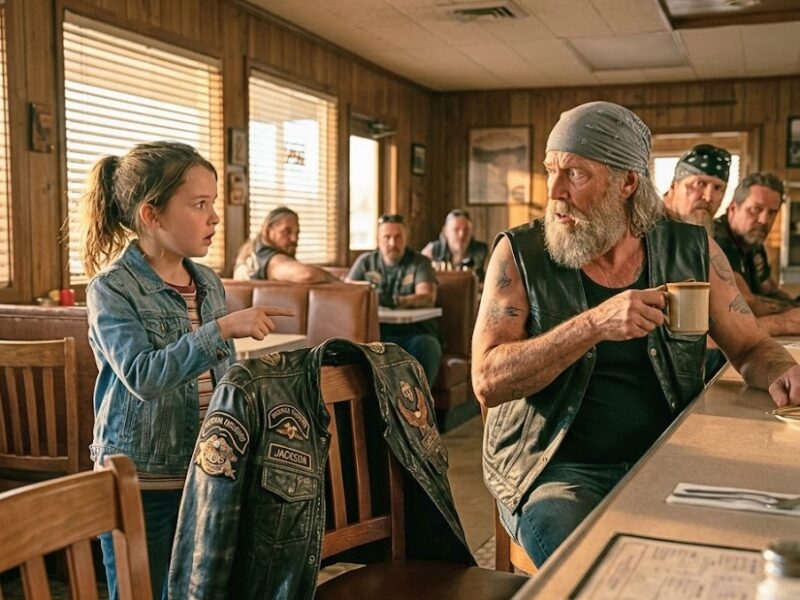
“This Was My Dad’s Jacket,” the Lost Girl Told a Biker—Then 191 Riders Recognized the Patch
**Part 1**
The heat came off the asphalt in waves thick enough to taste. Ash Creek, Arizona.
A town of 1,100 people, two gas stations, one traffic light that hadn’t worked since February, and a diner called Maggie’s that survived on truckers, lost tourists, and once a year, the Steel Saints. The annual memorial ride had been running for 14 years.
Every July, brothers from chapters across four states rolled into Ash Creek to remember the ones who didn’t make it home. Crashes, cancer, overdoses, combat wounds that took their time. The club kept a leather-bound ledger in a locked case bolted to the road captain’s saddle bag.
Every name in that book had been read aloud at least once under open sky, while engines idled and grown men said nothing because nothing was the only honest thing left to say. Mason Ror sat on the edge of a concrete parking barrier with his boots in the dirt and a cup of black coffee going cold in his hand.
53 years old, road captain for the past nine, two tours in Fallujah before that, and a marriage that ended somewhere between his second deployment and his third surgery. He had a scar that ran from his left ear down beneath his collar, a titanium plate holding his jaw together, and a way of watching people that made most of them look away first.
He didn’t talk much, hadn’t in years. The men who rode with him understood that silence was its own language, and Mason spoke it fluently. Around him, the parking lot churned with motion.
Brothers shaking hands, slapping backs, trading road stories across state lines, chrome flashing in the sun, the smell of exhaust and hot leather and cheap sunscreen, and the particular dust of a place that had been drying out since before anyone alive could remember. 191 bikes, Harleys mostly, a few Indians, a couple of older Triumphs that belonged to men who’d rather wrench on something British than admit the world had moved on.
Jericho Dunn, the chapter president from Flagstaff, stood near the diner’s front door, arguing with the owner about how many tables they could push together. Jericho was 6’4″, 260, with a voice like a diesel engine at idle and a patience for logistics that contradicted everything about the way he looked.
He’d been running the Flagstaff chapter for 11 years and had buried more brothers than he could count on both hands. “We’ll eat in shifts,” Jericho said. “Same as last year.”
“Last year you broke three chairs,” the owner said. “And I paid for four. You came out ahead.”
Mason watched. He always watched. It was the thing about him that made people either trust him completely or avoid him entirely.
There was no middle ground with a man who saw everything and commented on nothing. The heat pressed down. Somewhere east, thunder rolled across a sky that wouldn’t deliver rain for another month.
A hawk circled above the fuel station across the road, riding thermals, patient and silent and utterly indifferent to the noise below. Mason almost missed her. She came around the corner of the fuel station’s cinder block wall like something the desert had spit out.
Small, thin, brown hair matted against her skull. No shoes, a t-shirt underneath that was gray or had been white once, and over everything, a black leather jacket that hung past her knees like a coat stolen from a dead man’s closet. She stopped at the edge of the lot.
She didn’t cry. She didn’t run. She stood there with her arms straight down at her sides and the jacket sleeves covering her hands completely. And she watched the bikes the way a dog watches a door it’s been trained not to walk through.
Mason set his coffee down. He didn’t move fast. Didn’t stand up suddenly or call out.
He just shifted his weight forward and looked at her. And something in his chest did the thing it always did when the geometry of a situation didn’t add up. A kid alone in the middle of nowhere wearing leather that didn’t belong to her.
“Jericho,” he said, quiet enough that only the men closest to him heard. Jericho turned, followed Mason’s gaze, his face changed.
“The hell?” “Yeah,” Mason said.
He stood up slowly, the way you stand up when you don’t want to spook something. His knees complained. His back complained louder.
He crossed the lot with his hands visible and his steps deliberate and the conversations around him died one by one as other men noticed what he was walking toward. The girl didn’t run. She tilted her head and watched him come.
And there was something in her eyes that Mason recognized from places he never talked about. Not fear exactly, something past fear. The flat, still surface of a child who had already learned that being afraid didn’t change anything.
He stopped 10 feet away, knelt down on one knee. The asphalt burned through his jeans. “Hey,” he said.
“You okay?” She didn’t answer. “You out here by yourself?”
Nothing. “My name’s Mason. Those are my friends back there. Nobody’s going to hurt you.”
The girl looked past him at the rows of motorcycles, at the leather, at the patches. Her eyes moved across the men the way someone reads a page, searching for a specific word.
Then she looked down at the jacket she was wearing. She touched one of the patches on the chest with her fingertips. A slow, careful touch, the way you touch something that belongs to someone you love and can’t find.
“My dad wore this jacket,” she said. Her voice was small and dry and matter-of-fact, and it carried across the parking lot in the silence the way a gunshot carries across a canyon.
Mason looked at the patch. His hands stopped moving. Behind him, he heard Jericho’s boots on the asphalt, then nothing.
Then the particular silence of a man who has just seen something impossible. The patch was a Steel Saints center rocker, custom embroidered. Chapter designation, Prescott, Arizona, and beneath it, a name tab stitched in white thread on black cross.
Elijah Cross. Mason’s throat closed. Elijah Cross had been dead for 6 years, drowned in the Verde River during a solo ride in November.
His bike was pulled from the water 3 days later. His body never surfaced. The sheriff’s office ruled it an accident, closed the case in under two weeks, and the Steel Saints added his name to the ledger and read it aloud every July in this exact parking lot.
Mason had read it himself three times. He’d stood in this heat and said Elijah’s name and felt the weight of it and moved on because that’s what you did. You carried the dead.
You didn’t question them. But the girl was wearing Elijah’s jacket and she was alive. And she was standing in front of him with desert dirt on her face and a calm that no 8-year-old should have.
And she was waiting for him to understand something he wasn’t ready to understand. “What’s your name?” Mason asked. His voice came out wrong.
Too rough. Too low. “Autumn.”
“Autumn. What?” “Autumn Cross.”
Jericho was beside him now. Mason could hear the man breathing. Could feel the tension radiating off him like engine heat.
“Elijah didn’t have a daughter,” Jericho said. Not to the girl, to Mason. To the air, to the impossibility standing in front of them.
“He didn’t tell you,” Autumn said. The words landed like a slap. Mason studied the jacket.
The leather was worn but not rotted. The patches were intact. The zipper pull was the same custom skull that Elijah had machined himself in his garage in Prescott.
The one he’d shown off at a rally in Sedona years before anyone started wondering where he went. This wasn’t a replica. This wasn’t a theft.
This was Elijah’s cut. And it had been maintained by someone who knew what it meant. “Where’d you come from?” Mason asked.
Autumn pointed north toward the mountains, toward nothing. “How’d you get here?”
“Walked.” “From where?”
“The camp.” “What camp?”
She didn’t answer that one. Her jaw tightened and her eyes went flat again. And Mason recognized the shutdown. He’d done it himself a thousand times in rooms with VA therapists who asked questions he wasn’t ready to answer.
He pulled his phone out. No signal. Ash Creek sat in a dead zone between two cell towers that the county had been promising to fix since the previous election cycle.
“Jericho, we need water, food, shade.” Jericho was already moving. The big man’s hands were shaking, which was something Mason had never seen before and hoped never to see again.
Jericho barked orders and brothers responded and within 3 minutes there was a table cleared inside the diner and a glass of water and a plate of scrambled eggs in front of a girl who ate like she hadn’t seen real food in days. Mason sat across from her.
He didn’t push, didn’t ask more questions, just sat there with his hands folded on the table and waited because waiting was the only thing he’d ever been good at that actually worked. The diner was quiet.
191 men either stood outside in the heat or crowded the doorway or sat at nearby tables pretending not to stare. The air conditioning wheezed and rattled and barely moved the air.
A ceiling fan turned slowly above them, casting a shadow that swept across the girl’s face in rhythmic intervals. She ate everything on the plate, drank two glasses of water.
Then she sat back and pulled the jacket tighter around herself, even though the diner had to be 85 degrees inside. “Can I see the jacket?” Mason asked.
Her eyes snapped to his. “Just to look. I’ll give it right back.”
She shook her head fast, hard. The kind of no that comes from the body, not the brain. “Okay,” Mason said.
“Okay, you keep it.” He waited. “My dad said find the writers on the patch,” Autumn said.
“He said if anything happened to him, find the writers and show them the jacket. He said they’d know what to do.”
“When did he tell you that?” “Before he went away.”
“How long ago?” “I don’t know. Before the snow melted.”
Mason did the math. 4 months, maybe five. Elijah Cross, dead for 6 years, had been alive and talking to his daughter as recently as last winter.
The room seemed to tilt. He looked at Jericho, who stood near the counter with his arms crossed and his face carved from something harder than stone. The president’s eyes were wet, but his jaw was set.
And Mason knew that look. It was the look of a man assembling a war in his head. “I need to see the jacket,” Mason said again.
Not to Autumn, to himself, to the situation. He reached across the table slowly. Autumn flinched, but didn’t pull away.
He lifted the collar and turned it, and there on the inside, beneath the lining, where the leather had been carefully restitched by hand, he felt something. Paper, thin, folded tight, and sealed with what felt like wax.
“Can I open this?” Autumn nodded. He pulled a folding knife from his pocket, slit the stitching with surgical precision, and extracted a single sheet of paper folded into a square no bigger than a matchbook.
The paper was yellow, brittle at the edges, but the handwriting on it was small, precise, and unmistakable. Mason had seen Elijah’s handwriting a hundred times on ride logs, on parts orders, on a birthday card Elijah had slipped into Mason’s saddle bag the year Mason’s divorce went final.
A card that said nothing but “still here, brother,” and that Mason still carried in his wallet because some debts you don’t pay off. You just carry them. The note read, “Mason, if you’re reading this, Autumn found you. She’s mine.
She’s real. Everything they told you about me is wrong. Voss has the kids. Compound north of Mingus Mountain.
I couldn’t get out. I couldn’t get word out. The jacket is the only thing I could send.
Don’t trust Yavapai County. Don’t trust the sheriff. Don’t come alone.”
Mason read it twice. Then he handed it to Jericho without a word. Jericho read it.
His face didn’t move, but his hands crushed the edges of the paper before he caught himself and smoothed it flat. “Who’s Voss?” Jericho asked.
“Randall Voss,” Autumn said. “He runs the camp.”
“What kind of camp?” Autumn looked at her empty plate.
“The kind you can’t leave.” The silence in the diner had a weight to it now, a physical pressure. Mason could feel it on his shoulders, in his ribs, behind his eyes.
191 men who came here to honor the dead were now learning that the dead might still be breathing and that the world they thought they understood had a trapdoor they’d never seen. Mason stood up, his chair scraped against the floor and the sound cut through the room like a blade.
“Jericho. Outside.” They stepped into the heat.
The parking lot was a wall of chrome and leather and men who were already talking in low voices, passing fragments of information back and forth the way soldiers share intelligence before a briefing nobody’s called yet. “We call the police,” Jericho said.
“Note says don’t trust the sheriff.” “Then state police and tell them what? A dead man left a note in a jacket on a kid we can’t verify. They’ll take the girl, put her in the system and we’ll never see her again.”
“So what do you want to do?” Mason looked north. The mountains sat on the horizon like a jagged wound in the sky.
Purple and brown and utterly silent. “I want to find Elijah.”
“He’s been dead 6 years, Mason.” “That note’s 6 years old.”
“The ink’s fresh. The paper’s weathered, but the writing’s recent. He wrote that within the last year, maybe the last 6 months.”
Jericho ran a hand over his face. Sweat tracked through the dust on his skin and left pale streaks. “We don’t even know if it’s really his handwriting. We don’t know if the girl is really his kid. We don’t know if this whole thing is a setup to pull us into the mountains where somebody’s waiting.”
“You’re right,” Mason said. “We don’t know any of that.”
“So?” “So when is not knowing ever stopped us?”
Jericho stared at him. The big man’s chest rose and fell once, slow, and then something shifted in his eyes. Something that had been holding back stepped forward.
“I need to make calls,” Jericho said. “Don’t use the phone. Not yet.”
Elijah said, “Don’t trust the county. That means someone in the system is connected to whatever this is.”
“You’re talking about a conspiracy, Mason.” “I’m talking about a little girl who walked out of the desert wearing a dead man’s jacket with a note addressed to me by name. Whatever word you want to put on that is your business.”
Jericho turned and looked at the rows of bikes, at the men, at the leather and chrome and the years of loyalty standing in the Arizona sun waiting to be told what they were loyal to today. “All right,” Jericho said. “We do this quiet, small team, recon only.
I need Tank. I need Deacon. I need Whistler for navigation. He did mountain reconnaissance with the Marines for 8 years. Take Felix, too.
He’s a paramedic. Five men.” “Five men.” “The rest stay here with the girl. Nobody leaves. Nobody talks to anyone outside the club.”
Mason nodded. He walked back into the diner and knelt beside Autumn’s chair. The girl looked at him with those still, flat eyes, and he wondered what those eyes had seen in the mountains.
What kind of world makes a child this quiet? “I’m going to go look for your dad,” he said.
“He’s not at the camp anymore,” Autumn said. “Where is he?”
“Voss took him somewhere after the last snow. The men came at night and put him in a truck. He didn’t fight.
He told me to run, so I ran.” “How did you know to come here?” “He drew me a map. It was inside the jacket, too.
I ate it.” “You ate the map?” “He told me to. After I memorized it, he said, ‘Don’t let anyone find it.'”
Mason looked at this girl, this small, starved, sunburnt child who had memorized a map and eaten it and walked out of the mountains alone and found 191 men in a parking lot in a town that barely existed. And he understood something that settled into his bones like cold water. Elijah Cross had spent years preparing for this moment.
Every stitch in that jacket, every word in that note, every instruction given to a daughter who was too young to understand why her father was teaching her to survive. This wasn’t a cry for help. This was an operation.
And Mason had just been activated. He stood up, looked at Jericho. The president’s eyes were already hard, already calculating, already past the point where doubt was useful.
“One more thing,” Mason said. “What?” “The memorial. We still do it tonight.”
“Why?” “Because if someone in the county is connected to this, they might be watching. They need to see us doing exactly what we came here to do.
Nothing more, nothing less.” Jericho nodded slowly. That evening, as the sun dropped behind the western ridge and the sky turned the color of a bruise, 191 Steel Saints stood in a circle in the parking lot of Maggie’s Diner.
Mason held the leather-bound ledger and read the names of the dead. Every name, every year, every brother who didn’t make it home.
When he reached Elijah Cross, he paused. The name sat on his tongue like a lie. He read it anyway.
And every man in that circle understood that reading a dead man’s name while knowing he might still be alive was the most dangerous secret any of them had ever carried. Inside the diner, Autumn sat alone at the corner table with the jacket pulled around her like armor.
The waitress had brought her a piece of pie she hadn’t touched. The ceiling fan still turned. The air conditioning still wheezed.
She watched the door. She was waiting for something she couldn’t name. Or maybe she was waiting for the sound of a truck engine in the dark.
The same sound that had taken her father away on a night when the snow was still falling and the world was nothing but cold and black and the taste of fear in her mouth like metal. Outside, the memorial ended. Men wiped their eyes and said nothing and climbed onto their bikes and sat in the dark, and the desert stretched out around them in every direction like a silence that had been waiting for exactly this moment to reveal what it had been hiding.
Mason closed the ledger. He looked north toward the mountains. Somewhere up there in the dark, in whatever prison Randall Voss had built from paranoia and cruelty and the silence of a county that had stopped asking questions years ago, a man named Elijah Cross was either alive or he wasn’t.
And Mason was going to find out. But he didn’t know. None of them knew that the moment Autumn walked into that parking lot, a call had already been made.
Not from the club, from inside the diner. The waitress who brought the pie had stepped into the kitchen, pulled a prepaid phone from beneath the register, and dialed a number she’d memorized 3 years earlier. The phone rang twice.
A voice answered. “The girl showed up,” the waitress said. “She found them.”
The line went dead. And 200 meters north, in a room with no windows and no name, a man named Randall Voss set down the phone, walked to the door, and looked at the figure chained to a pipe in the corner.
“Your daughter’s smarter than I gave her credit for,” Voss said. Elijah Cross raised his head. Blood had dried on his temple.
His wrists were raw. His eyes were sunken and his body was wrecked. And his breathing came in shallow, careful pulls that suggested broken ribs.
But when he heard those words, something moved across his face that wasn’t pain. It was hope. And Voss saw it.
And that terrified him more than any army on any road ever could.
**Part 2**
Mason left before dawn. The desert was still black, the air cold enough to sting the inside of his throat with every breath.
Four bikes idled in the parking lot behind Maggie’s Diner. Not out front, not where the road could see them. Tank, Deacon, Whistler, Felix.
Four men who said yes without asking why, which was either loyalty or stupidity. And at 3:00 in the morning, the difference didn’t matter.
Jericho stood at the back door with his arms folded, his frame filling the doorway like a wall. “You’ve got 48 hours,” Jericho said.
“Might need more.” “You don’t get more. After 48 hours, I call the state police and I tell them everything, including the note.”
“If someone in the county is dirty, state police aren’t county.” “48 hours, Mason. After that, this stops being a club operation and starts being a missing person’s case with a federal angle. And I’d rather be the one making that call than the one explaining why I didn’t.”
Mason pulled his gloves on. The leather was stiff with cold. “The girl?”
“She’s sleeping. Two brothers on the door, two on the lot. Nobody in or out without my say.”
“The waitress.” Jericho’s eyes narrowed.
“What about her?” “She was the only one in the kitchen when Autumn came in. And she brought that kid pie without being asked. Nobody brings a stranger’s kid pie in a place like this unless they’re either the kindest person in town or they’re watching.”
“You’re paranoid.” “I’ve been paranoid since Fallujah. Hasn’t killed me yet.”
Jericho said nothing for a moment. Then he nodded once, the slow, deliberate nod of a man filing something away. “I’ll handle it.”
Mason swung his leg over the bike. The engine caught and settled into the low, familiar rumble that had been the closest thing to a heartbeat he’d trusted in 20 years. He looked at his four men.
Tank, 280 pounds of scar tissue and silence. A former Army Ranger who’d done three tours and come home to find his wife had sold the house and moved to Portland with a man who sold real estate. Deacon, lean, quiet, a recovering alcoholic who kept his seven-year chip in his vest pocket and his rage in a place nobody could reach.
Whistler, the navigator, a Marine reconnaissance specialist who could read terrain the way most people read street signs, who’d lost two fingers on his left hand to an IED in Helmand Province and never once mentioned it unless someone asked why his grip looked wrong. Felix, the youngest, 31, a paramedic who joined the club after watching his partner bleed out on a highway shoulder because the ambulance dispatcher sent them to the wrong mile marker. Every one of them carried damage.
Every one of them had learned to carry it quietly, and every one of them understood that what they were riding into wasn’t a rescue mission. It was a question, and the answer might be worse than not knowing. They rode north.
The highway was empty. No headlights, no trucks, no signs of anything alive between the diner and the mountains, except a coyote that crossed the road at mile marker 47, its eyes flashing green in the bike’s headlight before it vanished into the scrub. Mason kept his speed at 65.
Fast enough to cover ground, slow enough to think. And he needed to think because something about Elijah’s note was wrong. Not wrong like a lie.
Wrong like a puzzle piece that fit perfectly into a hole he didn’t know was there. Elijah had addressed the note to Mason by name. Not to Jericho, the president.
Not to the club. To Mason. Six years ago, when Elijah disappeared, Mason had been the one to push for a longer search.
He’d argued with the sheriff’s office for 3 weeks, driven to the river himself four times, walked the banks with a flashlight and a dog he’d borrowed from a rancher east of Camp Verde. Everyone else had accepted the drowning. Mason hadn’t, not because he had evidence, because something in his gut had turned sideways and wouldn’t straighten out.
But eventually, even Mason stopped looking. The weather turned. The river rose.
The sheriff’s office boxed up Elijah’s file and stored it in a basement somewhere. And Mason let the silence win because silence always wins if you let it. He’d carried that failure for 6 years.
And now Elijah’s note was telling him the failure was bigger than he knew. The mountains grew in the darkness ahead. Black shapes against a sky that was just beginning to gray at the edges.
The air temperature dropped 10 degrees as they climbed, and Mason felt the cold settle into his knuckles, his shoulders, the places where the titanium plate in his jaw conducted the chill straight into his skull. They stopped at a pullout 12 miles south of Mingus Mountain. Whistler killed his engine first and pulled a topographic map from his saddle bag.
Actual paper, actual ink, because Whistler didn’t trust anything that needed a battery. “Mingus Mountain,” Whistler said, flattening the map on his tank.
“14 miles of forest, old mining roads, a few decommissioned fire lookouts. If someone built a compound up here, they’d want water access and road access that doesn’t show up on GPS.”
“What are we looking for?” Tank asked. “She said the camp,” Mason said.
“North of Mingus Mountain. Autumn said she walked south to reach Ash Creek, which means she came down the mountain’s east slope. That’s the only route a kid could navigate on foot without climbing gear.”
Whistler traced a line on the map with his remaining index finger. “There’s an old logging road that runs along the east ridge. Decommissioned in the ’90s.
If you follow it far enough, it hits an old copper claim that was abandoned back when the price of copper dropped.” “How far?”
“About 9 miles from here, unpaved, rough.” “Can the bikes make it?”
“Halfway. After that, we’re on foot.” Mason looked east.
The first edge of sunlight cracked the horizon like a wound. Gold on black, bleeding into the sky. “We go now,” he said.
“Daylight gives us visibility, but it gives them visibility, too. We get as close as we can, glass it from a ridge, and get out.”
“And if we find the compound,” Deacon asked, “then we know it’s real, and we go back and figure out the next step.”
“And if we find Elijah?” Mason didn’t answer that one because the answer was the kind of thing you don’t say out loud before you know if you can keep the promise. They rode.
The logging road was worse than Whistler’s map suggested. Ruts deep enough to swallow a tire. Washouts that had carved new channels across the path and rocks the size of skulls scattered like shrapnel from a blast that happened 50 years ago.
The bikes crawled. Engines groaned. Branches scraped against saddle bags and handlebars.
And somewhere above them, a woodpecker hammered at a dead pine with a rhythm that sounded mechanical and hostile. Four miles in, Tank’s rear tire caught a root and the big man went down.
The bike landed on his leg and he didn’t make a sound. Just laid there in the dirt with the engine still running and the exhaust pipe hissing against a wet patch of ground. Mason and Deacon lifted the bike off him.
Tank stood, tested his weight, nodded once. “Anything broken?” Felix asked, already reaching for the med kit strapped to his tank.
“Pride,” Tank said. They kept going.
At the 5-mile mark, Whistler raised his fist. Everyone stopped. “Listen,” Whistler said.
Mason killed his engine. The others followed. The forest went quiet.
Then not quiet. Beneath the wind and the birds and the creak of old trees, there was something else. A hum.
Low, mechanical, constant. “Generator,” Whistler said.
Mason felt the hair on his arms rise. A generator in a forest this remote meant someone was living out here full-time, not camping, not hunting, living, and running equipment that needed power. “How far?” Mason asked.
“Half a mile, maybe less. Sound carries weird in these canyons. We walk from here.”
They hid the bikes in a stand of scrub oak 50 yards off the road, covered them with branches and dead brush, and moved on foot. Mason led. Whistler navigated.
Tank brought up the rear with a pair of binoculars he’d carried since Afghanistan, and a silence that made him nearly invisible despite his size. The forest thickened, ponderosa pine, juniper, a few Douglas firs at the higher elevation. The ground was soft with needles, and the air smelled like resin and cold water and something else, something chemical, faint, but present, like diesel fuel or solvent.
Whistler stopped at a ridge overlooking a narrow valley. He pointed. Mason lay flat on the ground and pressed the binoculars to his eyes.
Below them, in a clearing that had been cut from the forest with chainsaws and bulldozers, sat a compound. Not a camp, a compound. Eight buildings arranged in a rough square around a central clearing.
Chain-link fencing topped with razor wire. Two guard towers, improvised, built from lumber and corrugated metal, but functional. A generator shed with a fuel tank.
Three trucks parked in a row. A smaller building set apart from the others, half buried in the hillside with a reinforced door and no windows. Men with rifles walked the perimeter.
Mason counted four, maybe five, moving in patterns that suggested training or at least instruction from someone who understood how to set a watch. “That’s military,” Deacon whispered.
“It’s something,” Mason said. “You see kids?”
“No.” “Then how do we know?”
“See the note says kids. The girl says kids. We see the compound. That’s enough for now.”
Mason scanned the buildings one more time. The windowless structure set apart from the others held his attention. Reinforced door, half buried.
If you wanted to hide people or keep them, that was the building you’d use. He lowered the binoculars. “We’ve seen enough.
Let’s go.” “Just like that?” Tank asked.
“Just like that. We came to confirm. It’s confirmed.
Now we need a plan that doesn’t get everyone killed.” They retreated down the ridge. Slow, quiet, every footstep deliberate, every breath measured.
The generator hummed behind them like a pulse that wouldn’t stop. And Mason felt it in his chest the way you feel a warning you can’t name but can’t ignore. They reached the bikes.
They rode back down the logging road in silence. By the time they hit the highway, the sun was fully up and the desert had returned to its familiar brutality. White light, dead heat, the shimmer of asphalt stretching south toward Ash Creek.
Mason’s mind was already working, already building the architecture of what came next. But behind the tactical thinking, behind the logistics and the terrain analysis and the headcount, there was something else. A feeling he hadn’t had since the night he received the call that told him his best friend was dead.
The feeling that he’d failed Elijah once, and that failure had cost years, years that couldn’t be returned. They pulled into the back lot of Maggie’s Diner at 11:14 in the morning. The heat was already unbearable.
Brothers milled around the lot with the restless energy of men who’d been told to wait without being told why. Mason walked into the diner. Jericho was at the back table with a cup of coffee and a face that looked like it hadn’t slept.
“Found it,” Mason said. “Tell me.”
Mason told him. The compound, the fencing, the guards, the windowless building, all of it. Jericho listened without interrupting, which was how Mason knew the man was already past surprise and into calculation.
“How many men?” Jericho asked. “At least five on watch. Could be 20 inside. Could be more.
Armed. Rifles, long guns. Nothing I could identify from the ridge, but they carried them like they knew how.”
Jericho leaned back. The chair creaked under his weight. “We take this to the state police and say what?
We were trespassing on private land and found a compound. They’ll want to know how we found it, which means they’ll want to talk to the girl, which means the system gets involved. And the moment the system gets involved, someone makes a phone call.
The same way someone made a phone call 6 years ago when Elijah went missing and the sheriff closed the case in 2 weeks.” “You don’t know the sheriff was involved.”
Elijah’s note says, “Don’t trust Yavapai County. A man who spent years inside that compound wrote those words for a reason.”
“That’s not proof, Mason. That’s a dead man’s suspicion.”
“He’s not dead.” The words came out harder than Mason intended.
Jericho’s eyes changed. Not anger. Something more dangerous.
Doubt. “You don’t know that either,” Jericho said quietly.
“You know what you want to believe. I watched you push for three extra weeks of searching 6 years ago while every other man in this club accepted what the river told us. You couldn’t let it go then, and you can’t let it go now, and I need to know if what you’re telling me is intelligence or grief.”
The accusation landed. Mason felt it in his sternum. The old wound, the one that had nothing to do with shrapnel or titanium or surgeries, the wound of knowing you stopped looking because the world told you to.
“The compound is real,” Mason said. “The guards are real. The razor wire is real.
Whatever Elijah found out there 6 years ago is still running, and his daughter walked out of it 5 days ago barefoot and half starved. You can call that grief if you want. I call it a situation.”
Silence. Jericho picked up his coffee, set it back down without drinking.
“Where’s the girl?” “Booth three, sleeping.”
“She say anything else?” “She said Voss took Elijah after the last snow, put him in a truck at night, told her to run.”
“Why would Voss tell her to run?” “He didn’t. Elijah told her.”
“How does a prisoner tell his daughter to run?” Mason had been asking himself the same question since 3:00 in the morning. “Because he knew what was coming.
Because he’d planned for it. The jacket, the note, the map she memorized and ate. None of that was improvised.
He spent years building an exit strategy for his kid. And not for himself.” “No, not for himself.”
Jericho closed his eyes, opened them. Something in his face cracked. Just a fraction.
Just enough for Mason to see the man behind the president. The man who’d known Elijah Cross since they were both 19 and broke and sleeping on the floor of a garage in Prescott that smelled like motor oil and ambition. “I patched him in,” Jericho said.
“Did you know that? I was the one who gave him his cut. I was the one who told him what it meant and what it would cost and what he’d carry for the rest of his life.
And then I read his name out of that ledger for 6 years straight and never once—” He stopped. His jaw worked.
“Never once questioned it. None of us did.” “You did.
Not long enough.” They sat with that for a moment. The diner’s air conditioning wheezed.
Outside, someone kicked a bike into life and then killed it. The engine barking once and going silent, and the sound was like a question nobody answered. “Jericho, there’s something else.”
“What?” “The waitress.” Jericho’s hand tightened on the coffee mug.
“What about her?” “She’s gone.”
“Gone where?” “That’s the question. I told you to watch her.”
“Where is she?” Jericho stood. The chair fell backward.
He moved to the counter and looked at the kitchen. Empty. The back door was open.
The screen door swung in a breeze that smelled like grease and dust. “Razor,” Jericho called.
A brother appeared. Shaved head, throat tattoos, eyes that tracked everything. “The waitress.
When did she leave?” “Shift ended at 6:00. She drove east.”
“You let her leave?” “She works here. I didn’t know I was supposed to.”
“Did she make any calls?” Razor hesitated. That hesitation was the answer.
“I saw her on a phone in the kitchen last night,” Razor said. “After the girl came in. Figured she was calling family.”
The room went cold. Mason looked at Jericho. Jericho looked at Mason.
And between them, in the space where trust lived, something shifted that couldn’t be shifted back. “They know,” Mason said.
“They know the girl’s here,” Jericho said. “They know we’re here.
191 bikes in a parking lot isn’t subtle. And if that waitress has been reporting to Voss for years, she told him everything. How many of us there are, what the girl said.
Maybe even that I left this morning.” “Which means they know you found the compound.” “Which means they’re either running or fortifying.
Either way, we just lost the element of surprise.” Jericho turned to the room. Brothers were gathering now, drawn by the tone, by the body language, by the instinct that tells a man when the air has changed.
“Listen up,” Jericho said. His voice dropped into the register he used for church. Not the building.
The moment. The moment when a president stops managing and starts commanding. “We have a situation.
I need every man in this lot. Full turnout. Now.”
Within 5 minutes, 191 members of the Steel Saints stood in the parking lot of Maggie’s Diner under a sun that hammered down like a judgment nobody had asked for. Jericho told them. Not everything.
Enough. The girl, the jacket, the note, the compound in the mountains, Elijah Cross, maybe alive, maybe imprisoned, definitely not dead in the way they’d been told. And a network that had been operating in these mountains for years, while the county looked the other way.
The reaction wasn’t noise. It was silence. The particular silence of men who have been lied to and are deciding what to do about it.
Then the voices started. “We ride up there and take it apart.”
“That’s not how this works.” “The hell it isn’t.”
“We don’t know what’s in there. Could be 50 armed men.” “There’s 191 of us.”
“And how many of us have body armor? How many of us have anything other than a pocketknife and a bad attitude?”
“We call the feds.” “We call nobody.”
“Elijah’s note said—” “Elijah’s note said, ‘Don’t trust the county.’ The FBI isn’t the county.”
“You trust the FBI? Since when?” Mason stepped forward. He didn’t raise his voice.
He didn’t have to. “We’re not storming anything,” he said. “And we’re not calling anyone yet.
What we are doing is moving the girl right now, today. If Voss knows she’s here, this diner is the worst place she can be.”
“Where do we take her?” Jericho asked. “Split the chapters. Flagstaff takes the girl south.
Prescott chapter stays here as a screen. Everyone else disperses to their regular routes, so it looks like the memorial ride ended normally.”
“You want us to run?” A voice from the back, angry, young. Mason found the face.
A kid, maybe 24, with more patches than experience and a jaw set at an angle that said he’d never been hit hard enough to learn what hitting back actually cost. “I want us to survive,” Mason said. “Running and surviving look the same from the outside.
The difference is what you do after.” “And what do we do after?”
Mason looked at the mountains. The heat haze made them shimmer, made them look like something painted on glass that could shatter at any moment. “After,” Mason said, “we come back.”
The lot erupted into controlled chaos. Jericho barked orders, chapters organized, engines fired. The sound of 191 Harleys coming to life at staggered intervals filled the desert air with a rolling thunder that scattered birds from the telephone wires and made the windows of the diner vibrate in their frames.
Mason walked inside one more time. Autumn was awake, sitting in the booth with the jacket zipped to her chin, watching the movement through the window with eyes that understood more than they should. “We’re going to move you somewhere safe,” Mason said.
“There isn’t anywhere safe,” Autumn said. The words were flat. Not dramatic, not scared, just factual.
The way a child states a fact she’s learned from experience rather than from being told. Mason knelt. He put his hand on the table, palm up.
The way you offer something to someone who’s been taught that hands are dangerous. “Your dad spent years making sure you could find us,” he said. “He didn’t do that because there’s nowhere safe.
He did it because he knew where safe was and it was here with us.” Autumn looked at his hand. She didn’t take it.
“Voss will find me,” she said. “Maybe.”
“He always finds people.” “He hasn’t found us yet.”
“He’s not looking for you. He’s looking for me and for what my dad hid.” Mason went still.
“What did your dad hide?” Autumn’s hand moved inside the jacket. She touched something against her chest, something beneath the leather, beneath the lining, in a place Mason hadn’t searched because he’d found the note and stopped looking.
“Everything,” she said. And in that single word, in the way her fingers pressed against the hidden shape beneath the leather, Mason understood that the jacket wasn’t just a message. It was evidence.
Elijah hadn’t just sent his daughter out of the mountains with a plea for help. He’d sent her out with the entire case. Names, dates, records, whatever he’d spent years collecting inside that compound.
He’d sewn it into the lining of a jacket he put on an 8-year-old girl and sent walking into the desert. Mason stood. His hands were shaking.
Not from fear, from the weight of understanding what was at stake. Not just Elijah’s life, not just the compound, but a record of every crime Randall Voss had committed, hidden inside a child’s jacket, carried by a child who didn’t fully understand what she was carrying. He looked out the window.
Bikes were already pulling out. Dust rose in columns. The desert swallowed the sound of engines the way it swallowed everything.
Slowly, completely, without judgment. Somewhere north, in a compound on a mountain, men with rifles were making decisions. Somewhere in the county, a phone was ringing.
And somewhere in a room with no windows, Elijah Cross was listening to the silence and wondering if the jacket had found its way home. Mason took a breath. “Jericho,” he said, stepping outside.
His voice cut through the engine noise like a blade through cloth. “Change of plans. Nobody leaves.
Not yet.” Jericho stopped mid-stride. “What?”
“The jacket. There’s more in it. Elijah hid evidence inside the lining.
The girl’s been carrying it the whole time.” Jericho’s face went white beneath the sunburn.
“If Voss knows the girl is here,” Mason said, “he doesn’t just want her back. He wants what she’s carrying, and he will send everything he has to get it.”
The engines idled, the dust settled. 191 men stood in a parking lot in a town that didn’t matter, holding a secret that could bring down an empire built in the mountains. And from the north, moving fast on the old highway, a convoy of three black trucks kicked up a dust cloud that caught the light like smoke from a fire that hadn’t started yet, but was about to.
**Part 3**
The trucks came fast. Mason saw the dust before the vehicles, a brown column rising against the white sky, like a signal nobody had asked for.
Three trucks, black, no plates visible at this distance, moving in formation on the old highway, spaced 50 yards apart. The way men drive when they’ve been taught to keep separation in case the lead vehicle hits something that explodes. “Jericho.”
Jericho was already looking. His hand went to the small of his back where he kept a .45 he’d carried since his 20s and had never once fired outside a range. “Could be nothing,” Jericho said.
“Could be everything. Get the girl inside.” Mason moved.
He crossed the lot in four strides, pushed through the diner’s front door, and found Autumn exactly where he’d left her. Booth three, jacket zipped, eyes on the window. She’d already seen the dust.
“They’re coming,” she said. “Maybe, maybe not, but we’re moving you to the back.”
“There’s a walk-in cooler. I saw it when the waitress went in the kitchen.”
Mason looked at this child who mapped exits the way other children mapped playgrounds. He took her hand, she let him, the first time she had allowed contact, and led her through the kitchen to the walk-in cooler. The air inside hit them like a wall.
40 degrees. Shelves of lettuce and eggs and milk cartons with dates that had already passed. “Stay here.
Don’t open this door for anyone except me or Jericho. You understand?”
“What’s the password?” “What?”
“My dad always used passwords, so I’d know it was really him and not someone pretending.” Mason’s chest tightened.
A father teaching his 8-year-old daughter password protocols in a compound run by a criminal. The kind of childhood that leaves marks you can’t see and can’t fix. “Copper,” Mason said.
“The password is copper.” “Okay.” He closed the heavy door.
The seal hissed. He stood in the kitchen for 3 seconds breathing grease-scented air and then he walked back out into the heat. The trucks had stopped.
They sat on the highway shoulder 200 yards north of the diner. Engines idling, dust settling around them like fog. No doors open.
No one got out. They just sat there. Three black shapes against the pale desert, watching.
191 bikes filled the lot. Brothers stood among them in clusters, some leaning against tanks, some standing with arms crossed, all of them facing north. The atmosphere had shifted from confusion to something older and more fundamental.
The instinct of men who recognize a threat before the threat announces itself. “Anybody know those trucks?” Jericho asked, his voice carried across the lot without effort. Silence.
“Razor, binoculars.” Razor handed them over. Jericho pressed them to his eyes and studied the trucks for a long moment.
“Tinted windows. Can’t see inside. No plates on the front.
Commercial-grade Ford F-350s, maybe new.” “How many men can an F-350 carry?” Tank asked.
“Cab seats five. Bed could hold another four or five if they’re not worried about comfort.”
“So up to 30,” Mason said, “against 191.” “Against 191 men standing in an open parking lot with no cover, no weapons beyond what they’re carrying in their pockets, and a child in the building behind them.”
Jericho lowered the binoculars. “What do you want to do?”
“I want to know who’s in those trucks.” “So go ask.”
Mason looked at him. “You serious?” “You’re the one who reads people for a living.
You walked point in Fallujah. You’re telling me three trucks on a highway scare you?”
“Everything scares me. That’s why I’m still alive.” Mason started walking.
He heard Jericho’s voice behind him. “Tank, Deacon, give him 50 yards and hold.” And then just his own boots on asphalt, the crunch of gravel at the road’s edge, and the distant idle of diesel engines that grew louder with every step.
He covered 100 yards, 150. The sun burned the top of his head and the sweat ran down his spine and collected at his belt. The truck sat there, silent, patient.
The tinted windshields reflected the desert back at him like dark mirrors. At 75 yards, the driver’s door of the lead truck opened.
A man stepped out. He was tall, lean, mid-50s, wearing a khaki shirt tucked into canvas work pants, boots that had seen actual dirt, and a belt with a holster that held a sidearm he made no move to touch. His hair was gray and cut short, and his face had the weathered, angular quality of someone who’d spent decades outdoors and hadn’t enjoyed most of them.
But it was the badge that stopped Mason cold. Yavapai County Sheriff’s Office. The man walked toward Mason with the easy, measured stride of someone who owned the ground he walked on.
He stopped at 20 feet. “That’s a lot of motorcycles,” the man said.
“Annual memorial ride. We do it every year.” “I know what you do.
I’m Sheriff Dean Harlo. I’ve been getting calls about your gathering since yesterday.”
“Calls from who?” “Concerned citizens.”
“Nobody in Ash Creek is concerned about us. We spend money here. Tip well.
Leave the place cleaner than we found it.” Harlo smiled. It was the kind of smile that had nothing to do with warmth and everything to do with control.
“You’ve got a girl with you,” Harlo said. Mason’s blood went cold. Not cool.
Cold. The temperature of a river in November. “Excuse me?”
“A young girl, 8, maybe nine, showed up yesterday. I got a report this morning from a woman who works at the diner. Says the girl appeared out of nowhere, looked like she’d been living rough, and your club took her in without contacting authorities.”
“We were about to contact authorities.” “Were you?”
“We were trying to figure out the situation first. She was scared. She needed food and water.”
“I appreciate that, but an unaccompanied minor is a law enforcement matter. You know that.”
Mason studied the man’s face. Harlo held the look without blinking. Behind him, the two other trucks sat with their engines running and their windows dark.
And Mason couldn’t stop counting. Two trucks, 10 to 15 men he couldn’t see, weapons he couldn’t assess, and a sheriff who’d shown up 30 minutes after the waitress could have made a call. “The waitress called you,” Mason said.
“She filed a report. That’s what citizens do.” “She filed a report with the county sheriff’s office about a girl in a diner.
And you personally drove out here with three trucks. How many deputies are in those vehicles?”
Harlo’s smile stayed, but his eyes changed. The pupils contracted, a micro-expression most people would miss. Mason didn’t miss it.
“I brought adequate personnel for a situation involving 191 members of a motorcycle club and a missing child.” “She’s not missing. She’s right there.”
“Then you won’t have any problem handing her over to child protective services. I’ve got a CPS liaison in the second truck. We’ll take the girl, process her through the system, find her family, and everyone goes home.”
Mason heard Jericho’s boots on the asphalt behind him. The president had closed the distance. He stood 4 feet to Mason’s left, arms folded, his massive frame casting a shadow that reached the sheriff’s boots.
“Sheriff,” Jericho said. “I’m Jericho Dunn, chapter president. What’s the problem?”
“No problem. Just here to collect the girl.” “She’s not a package.
She’s a child.” “Exactly. And she belongs with the proper authorities, not with a motorcycle club in a parking lot.”
Jericho glanced at Mason. Mason gave the smallest shake of his head. A movement so slight that only someone watching for it would see.
“We’d like to cooperate,” Jericho said. “But the girl is frightened. She hasn’t told us much.
Maybe we could bring her out and do this calmly.” “I’d rather do it now, Mr. Dunn.”
“It’s just Jericho.” “I’d rather do it now, Jericho.” The smile was gone.
What replaced it was something flat and professional and utterly without patience. And Mason recognized it the way you recognize a weapon when someone stops hiding it. “Give us an hour,” Mason said.
“Let us talk to her, explain what’s happening, get her comfortable with the transition.” “You’ve had her overnight. How much more time do you need?”
“She walked out of the desert wearing a dead man’s jacket. She’s traumatized. An hour isn’t going to—”
“A dead man’s jacket.” Harlo’s voice changed. Not louder, sharper.
“Whose jacket?” Mason caught himself. Too late. The information was out, and the sheriff’s reaction, the sudden focus, the forward lean, the way his hand drifted 2 inches closer to his belt, told Mason everything the note had already warned him about.
Don’t trust Yavapai County. “One of our former members,” Mason said. “Elijah Cross.
He passed away 6 years ago.” “I remember the Cross case. River accident.”
“That’s right. Sad business. Body never recovered.”
“No.” Harlo studied Mason for a long moment.
The desert wind pushed a tumble of dust across the road between them. Somewhere behind the trucks, a radio crackled and went silent. “I’ll need the jacket,” Harlo said.
“It belongs to the girl.” “It may be evidence in an open case.”
“You just said it was a closed case. Sad business. River accident.”
Harlo’s jaw tightened. Just a fraction. Just enough. “The girl and the jacket,” he said.
“30 minutes. Then I come back with a warrant and we do this the hard way.” He turned and walked back to his truck.
The door closed. The three vehicles sat on the shoulder, engines running, dust settling, and the desert went quiet the way it does when something underground is about to shift. Mason and Jericho walked back to the lot.
Neither spoke until they were surrounded by brothers and chrome and the smell of hot engines. “He knows,” Mason said. “He knows something.”
“We don’t know what.” “He asked for the jacket by name. I mentioned it once and he immediately wanted it. That’s not a sheriff doing a welfare check.
That’s a man looking for something specific.” “Or it’s a sheriff who remembers an open case and recognizes potential evidence.”
“Jericho. The waitress called him. He showed up with three trucks full of men.
He wants the girl and the jacket. And Elijah’s note said, ‘Don’t trust the county.'”
Jericho’s face was stone. But behind the stone, something was cracking. Mason could see it in the way the big man’s hands opened and closed at his sides.
The rhythm of a man trying to hold something together that was pulling apart. “If we don’t give him the girl,” Jericho said, “he comes back with a warrant. He brings state police.
We’re obstructing. Every man in this lot catches a charge.” “If we give him the girl, she disappears into the system and whatever Elijah hid in that jacket goes with her.
And we never see either of them again.” “You don’t know that.”
“I know that a man spent 6 years in a compound, couldn’t escape, couldn’t get word out, and the only thing he trusted enough to carry as evidence was his 8-year-old daughter. He didn’t send that jacket to the sheriff’s office. He didn’t send it to the FBI.
He sent it to us.” “Why?” “Because he trusted us. Because he didn’t trust anyone else.
And the first person who shows up after the girl arrives is the county sheriff with three trucks and a demand for the jacket.” The parking lot was silent.
191 men stood in the heat and listened to two men argue about a choice that would define everything that came after. And every one of them understood that there was no version of this that ended clean. Deacon stepped forward.
He’d been quiet since the mountains. He was always quiet, but when he spoke, people listened because Deacon’s words were rationed and each one arrived fully loaded. “I ran the sheriff’s name,” Deacon said.
He held up his phone. “Dean Harlo, appointed sheriff four years ago after the previous sheriff retired. Before that, he was a county commissioner for Yavapai.
Before that—” Deacon paused, and the pause carried the weight of what came next. “Before that, he was a property manager for a land trust called High Desert Holdings. And High Desert Holdings owns 37 parcels in the Mingus Mountain area, including a 60-acre parcel on the east slope that was purchased 8 years ago from a defunct copper mining company.”
The math hit Mason like a fist. 8 years ago, 2 years before Elijah disappeared, a land purchase on the same mountain where the compound now sat. And the man who managed that land was now the county sheriff.
“Harlo isn’t just dirty,” Mason said. “He’s part of it.”
“We don’t know that for certain,” Jericho said. But his voice had changed. The doubt was gone.
What replaced it was the cold, mechanical tone of a man who has accepted a reality he was hoping to avoid. “We know enough,” Mason said. “Harlo connected to the land, the compound on the land, Elijah inside the compound, and Harlo showing up the moment the girl appears, asking for the one piece of evidence that ties it all together.”
“So, what do we do? We’ve got 30 minutes.” Mason turned and walked into the diner, through the kitchen, to the walk-in cooler.
He knocked twice. “Copper,” he said. The door opened from inside.
Autumn stood there with frost on the jacket’s shoulders and her breath coming in small clouds. “I need to see what’s inside the jacket,” Mason said.
“All of it.” Autumn looked at him. Her eyes were steady and ancient in a way that no child’s eyes should be.
And for a moment, Mason saw Elijah in her face. The same stubborn jaw, the same quiet intensity, the same willingness to hold a secret until the right moment arrived. She unzipped the jacket.
Beneath it, taped to her skin with surgical tape in rows that must have taken Elijah hours to apply, were 17 micro SD cards, each one the size of a fingernail, each one labeled in handwriting so small it required a magnifying glass to read. Mason stared. “He put them on me before the men came,” Autumn said.
“He said the jacket was the decoy. He said if they took the jacket, they’d think they had everything, but the real stuff was on me.” “What’s on these cards?”
“Videos of the camp? Of the trucks? Of the kids?”
Mason’s hands trembled. Not a shake, a tremor deep in the muscle. The kind that comes from adrenaline and horror combining in a ratio the body wasn’t designed to process.
“Of the kids,” he repeated. “The ones Voss brings in. My dad filmed them at night with a phone he stole from one of the guards.
He filmed everything for years.” Mason knelt in front of her. The cold from the cooler burned his knees through his jeans.
His breath came out in clouds that mixed with hers. “Autumn. How many kids?”
“I don’t know. A lot. They come in trucks at night and they leave in different trucks.
I never saw where they went.” “Did your dad tell you what was happening to them?”
“He said bad people were selling them. He said that’s why he couldn’t leave, because if he left, nobody would know.” The cooler hummed.
The compressor cycled on and the walls vibrated and Mason knelt on the cold floor with 17 pieces of evidence taped to a child’s chest and understood with a clarity that felt like falling what Elijah Cross had actually done. He hadn’t infiltrated the compound as a mission. He’d stumbled into it.
A man running from something or toward something who found a horror he couldn’t walk away from. And instead of escaping, instead of saving himself, he’d stayed for years, filming, documenting, building a case that nobody had asked him to build in a place nobody knew existed, while the county sheriff owned the land and the system that should have protected those children protected the men who were selling them. Mason stood up.
“I’m going to take these cards,” he said. “And I’m going to make copies, and then I’m going to put the originals back on you, because you’re the safest place they can be right now. Is that okay?”
Autumn nodded. He carefully peeled the tape from her skin. She didn’t flinch, not once.
And that absence of flinching told Mason more about what this child had endured than any words could. He brought the cards to Deacon. Deacon had a laptop in his saddle bag.
He always did. A habit from his previous life as an IT contractor before the drinking took the job and the sobriety took the drinking and the club took everything that was left. “Copy all of these,” Mason said.
“Every card, two backups. One goes in your saddle bag, one goes with Whistler.” “What am I copying?”
“Evidence. Video evidence of trafficking operations in the Mingus Mountain compound.”
Deacon’s hand stopped moving. He looked at Mason and in his eyes, Mason saw something break. Not a bone, not a structure, but a boundary.
The line between the world Deacon thought he lived in and the world that actually existed. “Trafficking,” Deacon said.
“Children,” Mason said. Deacon’s jaw locked. His seven-year chip was in his left hand.
He’d pulled it from his pocket without realizing it, the way other men pull a trigger without thinking. He held it tight enough to leave a mark on his palm. “How long do I have?”
“20 minutes.” Deacon opened the laptop. Mason walked back outside.
Jericho was at the edge of the lot watching the trucks on the highway. The sheriff hadn’t moved. “We have a problem bigger than Harlo,” Mason said.
“How much bigger?” “Children. Being moved through that compound.
Elijah spent 6 years filming it. The girl’s been carrying the evidence on her body.” Jericho’s face went white.
Not pale, white. The blood drained from his skin the way water drains from a cracked vessel, all at once and without recovery. “How many children?”
“She doesn’t know. A lot. Coming and going in trucks.”
Jericho turned away. He walked six steps toward the diner wall, put both hands flat against the cinder block, and stood there with his head down and his back heaving. Mason watched and said nothing because some things you can’t help a man carry.
You just stand there and let him feel the weight. When Jericho turned back, his eyes were red, but his voice was iron. “Harlo doesn’t get the girl.
Harlo doesn’t get the jacket. Harlo doesn’t get a single thing from us.” “He’ll come back with a warrant.”
“Let him, Jericho. I said, let him. By the time he gets a warrant, we’ll have the evidence distributed across four states.
Every chapter president gets a copy. Every copy goes to a different federal agency. FBI, US Marshals, Homeland Security.
If Harlo is part of this, we go over his head so far, he’ll need a telescope to see us.” “And the girl?”
“The girl stays with us until we can hand her to someone we trust. And right now, the list of people I trust is standing in this parking lot.”
Mason looked at the clock on his phone. 14 minutes until Harlo’s deadline. “We need to move now.
All of us.” “Where?” “South. Flagstaff Chapter’s clubhouse. It’s a fortress, fenced, gated, cameras.
Harlo’s jurisdiction ends at the county line.” Jericho nodded.
He turned to the lot and raised his voice for the last time. “Mount up! Every man.
We ride south in 5 minutes. Flagstaff chapter leads. Prescott chapter rear guard.
The girl rides with Mason. Nobody stops. Nobody breaks formation.
If those trucks follow us, we do not stop.” The response was immediate, not chaotic, disciplined, practiced, the product of years of road formations and group rides and the understanding that when the president says move, you move.
And you ask questions at the next stop. Engines fired. The parking lot shook.
Mason went inside and brought Autumn out, the jacket back on, the SD cards retaped to her skin beneath her shirt, the original evidence invisible, and the copies already distributed, one with Deacon, one with Whistler, both in separate saddle bags on separate bikes. He put her on the back of his bike. She was so small that he barely felt the weight.
He handed her his spare helmet, too big, but it would do, and she put it on without hesitation, as if she’d ridden before. “Hold on to me,” he said. “Don’t let go.”
“I won’t.” The formation assembled. 191 motorcycles in three columns, stretching the length of the diner’s lot and out onto the road.
Chrome caught the sun and threw it back in blinding arcs. The thunder of idling engines was a physical force, a vibration that lived in the chest and the teeth and the pavement. Mason was third in line behind Jericho and the Flagstaff road captain.
He could feel Autumn’s hands gripping the sides of his vest, her knuckles pressing into his ribs, her body leaning into his back the way someone leans into a wall they’re afraid will move. Jericho raised his fist, dropped it. They moved.
The formation rolled out of the lot and turned south on the highway. And as they passed the three black trucks, Mason turned his head and looked directly at the sheriff’s windshield. He couldn’t see through the tinted glass, but he felt the eyes behind it.
The trucks didn’t move. For one mile, 2 miles, 5 miles, they sat on the shoulder and watched the column of motorcycles disappear into the heat shimmer, and Mason kept checking his mirror, kept waiting for the dust cloud that would mean pursuit. At mile 7, the trucks moved.
They didn’t follow. They turned north toward the mountains. Mason’s stomach dropped.
“Jericho,” he said into the wind, knowing the man couldn’t hear him, but the realization was forming anyway, building in his mind like a structure he didn’t want to complete. Harlo wasn’t chasing the girl. Harlo was going to the compound, not to shut it down, to clean it up, to move the evidence, move the children, burn whatever needed burning before the Steel Saints could bring anyone who mattered.
Because Harlo had seen the jacket and understood what it meant, and he knew that if Elijah’s recordings existed, the compound was a crime scene that needed to disappear. Mason pulled alongside Jericho and screamed over the wind. “The trucks went north!”
Jericho’s head turned. His face behind the visor was unreadable. “He’s cleaning the site,” Mason yelled.
“He’s going to destroy everything!” “We have the copies!”
“The children, Jericho. Whatever kids are in that compound right now, he’s going to move them. Or worse.”
The formation roared down the highway at 70 mph. The desert blurred. The wind tore at their jackets and their faces and the chrome.
And in that wind, in that noise, in that moment of speed and sound, and the terrible knowledge that somewhere behind them, children were being erased from a place that would soon cease to exist, Jericho made a decision that would define the rest of his life. He raised his fist. The formation slowed.
He pulled to the shoulder. 191 bikes followed, stretching back along the highway like a steel spine. Jericho killed his engine, pulled off his helmet, looked at Mason.
“How many men at the compound?” “Five visible. Could be 20. Harlo’s bringing more.”
“So, we’re looking at 30. Maybe 40. Against 191.”
“Against 191 men who are not soldiers, not police, and not equipped for an armed confrontation on a mountain.” “We’re not going for a confrontation.
We’re going for the kids.” “That’s the same thing.”
Jericho looked at the men behind him. Rows and rows of leather and chrome and faces that watched him the way soldiers watch a commander who hasn’t given the order yet, but has already made the decision. “No,” Jericho said.
“It’s not. A confrontation means we go in to fight. We’re not going to fight.
We’re going to block every road on and off that mountain with 191 motorcycles. And we’re going to call every federal agency with a phone number while Harlo sits inside his own crime scene with nowhere to go. And if he tries to run—”
Jericho’s eyes went hard. Not angry, not violent, something beyond both. The eyes of a man who has just learned that the world contains a darkness he hadn’t accounted for and who has decided, not hoped, not wished, decided that the darkness ends today.
“Then 191 men will be standing in his way.” He turned to the formation. He didn’t need to raise his voice.
The silence carried it. “We’re turning around. We’re going north.
Every man who rides with me rides knowing what we’re riding into. If anyone wants out, ride south. No shame.
No judgment. This isn’t what you signed up for.” Nobody moved.
Not one engine started. Not one man turned south. Jericho put his helmet on, kicked his bike to life.
The engine roared, and the desert flinched, and the highway stretched north toward the mountains like a line drawn in blood. Mason felt Autumn’s hands tighten on his vest. “Are we going back?” she asked.
“Yeah.” “To the camp?”
“Yeah.” “My dad’s there.”
“I know.” “Voss will kill him. If he knows you’re coming, he’ll kill my dad first.”
Mason’s throat closed. The words sat in his chest like stones. Heavy, jagged, immovable.
Because the girl was right. And the decision they just made meant that every minute counted. And every minute they spent on this highway was a minute Harlo had to reach the compound first and eliminate the one witness who could tie everything together.
Elijah Cross, chained to a pipe in a room with no windows, was running out of time, and 191 motorcycles turned north into the heat, riding toward a mountain that held a prison, a sheriff who was part of the crime, and a father who had sacrificed six years of his life to protect children who weren’t his own. The engines thundered. The desert shook, and somewhere on that mountain, Randall Voss heard the sound carrying on the wind, distant, growing, impossible to mistake.
And he walked to the window of the compound’s main building and looked south and saw nothing yet, only heat and dust, dust. But the sound kept building. And for the first time in his life, Voss felt something he hadn’t felt in years.
Not fear, something worse. The knowledge that the thing he’d built, the compound, the network, the silence that had protected him for a decade, was about to meet something it couldn’t buy, couldn’t threaten, and couldn’t outrun. 191 men who had nothing to lose except the one thing they’d already decided they would never lose again: a brother.
**Part 4**
They hit the mountain road at 4:17 in the afternoon. 191 motorcycles climbing in a single column through switchbacks that weren’t built for this kind of traffic.
The engines echoed off canyon walls and bounced back like the mountain itself was answering. The sound was enormous. Primitive.
The kind of sound that reaches into the chest and grabs something you didn’t know was there. Mason rode third in line with Autumn pressed against his back, her hands locked onto his vest so tight he could feel her knuckles through the leather. The girl hadn’t spoken since they turned north.
She just held on, her face buried between his shoulder blades, her body small and rigid against the vibration of the engine. Behind him, the column stretched back so far that the last bikes were still on the highway when the first ones reached the tree line. Chrome and leather and dust and noise filling the road like a river that had found a new channel and refused to be turned.
Jericho led. He took the turns without hesitation, his big frame leaning into each curve with a precision that contradicted his size. Behind him, the Flagstaff road captain held the pace.
And behind him, Mason. And behind Mason, 188 men who had chosen this. At the 4-mile mark, Whistler pulled alongside Mason and pointed.
Tire tracks. Fresh, heavy vehicles. The dirt on the logging road had been turned into ruts that were still damp in the shadows, which meant the trucks had passed through less than an hour ago.
“Harlo’s ahead of us,” Mason shouted over the engine. Whistler nodded. His face was carved from something harder than stone, the face of a man who’d spent 8 years reading terrain for threats and had never stopped.
They pushed deeper. The ponderosa pines closed in overhead, filtering the sunlight into scattered coins on the road. The air cooled.
The smell changed from desert dust to pine resin and damp earth and the faint chemical undertone Mason had noticed that morning. Diesel fuel, solvents, the particular stench of a place that runs on generators and secrets. At mile 6, Jericho stopped.
The road ahead was blocked. A truck, one of Harlo’s black F-350s, sat sideways across the logging road with its engine off and its doors open. Empty.
No driver, no passengers. Just a truck placed like a barrier, deliberate and obvious. Jericho killed his engine.
The column behind him died bike by bike, the silence spreading backward like a wave until 191 engines were quiet and the only sound was the wind in the trees and the tick of cooling metal. “Ambush,” Tank said. He’d moved to the front, his bulk filling the space beside Jericho’s bike like a wall.
“No,” Whistler said. He was studying the trees on both sides of the road, his eyes moving in the systematic pattern of a man who’d been trained to identify kill zones. “No positions, no sight lines.
This is a delay, not a trap.” “They’re buying time,” Mason said.
“For what?” “To move everything out of the compound before we get there. Kids, records, anything that proves what happened up here.”
Jericho dismounted. He walked to the truck and looked inside the cab. Keys in the ignition, a radio on the dash turned off.
A coffee cup in the holder, still warm. “They left in a hurry,” Jericho said. “Or they wanted us to think they did.”
“Mason, we don’t have time for both options. Pick one.” Mason looked at the truck, at the road ahead, at the trees, at the three miles of rough terrain between here and the compound he’d seen that morning from the ridge.
“Move the truck. Keep going.” Tank and four brothers pushed the F-350 to the road’s edge.
The tires dug trenches in the soft dirt. The truck rolled into a ditch and settled at an angle, its empty cab staring at the sky like a dead eye. The column moved.
2 miles. The road narrowed to a track. Bikes slowed to walking speed.
Engines growling in first gear. The exhaust pooling in the low spots between the trees like fog. Branches scraped against handlebars and mirrors and the faces of men who ducked too late.
1 mile. Mason smelled smoke. Not wood smoke.
Not campfire. Something sharper. Chemical.
The smell of burning plastic and paper and whatever else you feed a fire when you need to destroy evidence fast. “They’re burning it,” he said. Jericho didn’t respond.
He accelerated. The column surged forward. Bikes bouncing over ruts and rocks.
The formation breaking as men pushed through gaps in the trees, abandoning the road for the shortest line to the smoke. They burst out of the tree line and into the clearing. The compound was burning.
Not all of it. The main buildings were intact, but the smaller structures on the north side, storage sheds, a communications hut, what looked like a records room, were fully engulfed. Orange flames climbed into the afternoon sky and black smoke rolled across the clearing in sheets that stung the eyes and coated the throat.
Men ran between the buildings. Not soldiers, not organized. Panicked.
Carrying boxes, laptops, armfuls of documents, throwing them into truck beds, into fires, into anything that would make them disappear. And in the center of the compound, standing beside the second black F-350 with a radio in his hand and a sidearm on his hip, was Sheriff Dean Harlo. He saw the bikes.
His face changed. Not fear. Recognition.
The recognition of a man who calculated the odds and lost, who built a 30-minute head start into his plan and didn’t account for 191 men who could cover ground faster than his arithmetic allowed. Jericho rode into the compound. He didn’t stop at the gate.
He rode through it. The chain-link fence was already open. The razor wire pulled back.
The entrance cleared for the trucks that were supposed to carry everything away before anyone arrived. He stopped his bike 10 feet from Harlo and killed the engine. The silence lasted 3 seconds.
Then 190 bikes rolled in behind him, filling the clearing, blocking the roads, forming a wall of chrome and leather and men that sealed the compound like a lid on a coffin. Harlo looked at the bikes, at the men, at the smoke rising from his burning evidence. At Jericho.
“You’re making a mistake,” Harlo said. “I’ve made a lot of them. This isn’t one.”
“This is private property. You’re trespassing. Every man here is looking at criminal charges.”
“Call it in,” Jericho said. “Go ahead. Pick up that radio and call for backup.
Tell them what’s happening. Tell them you’re standing in a compound with burning buildings and armed men and 191 witnesses. Go ahead, Sheriff.
Make that call.” Harlo’s hand tightened on the radio. He didn’t lift it.
“Where are the children?” Jericho asked. The question hit the clearing like a bullet.
The men who were running between buildings stopped. The smoke kept rising. The fire kept eating.
“There are no children here,” Harlo said. “There are. Or there were.
And you’re burning the evidence right now.” “You don’t know what you’re talking about.”
Mason dismounted. He lifted Autumn off the bike and set her on the ground beside him. And the girl stood there in her father’s jacket with her eyes locked on the compound she’d escaped from.
And her face showed nothing. Nothing at all. The kind of nothing that’s worse than screaming.
“Autumn,” Mason said quietly. “Where were the kids kept?” She pointed.
The half-buried building, the one with the reinforced door and no windows, the one Mason had seen through binoculars that morning and knew in the part of his brain that processed threat without conscious thought was the building that mattered most. “That one,” she said. “Under there’s stairs.”
Mason started walking. “Stop right there,” Harlo said.
His hand moved to his sidearm, not drawing, touching, the threat before the action. Tank stepped between them. 280 pounds of scar tissue and silence, positioning himself between Mason and the sheriff’s gun with the casual precision of a man who had walked into gunfire before and decided years ago that being shot was not a sufficient reason to stop moving.
“You’re going to want to take your hand off that,” Tank said. “I am an officer of the law.”
“You’re standing in a burning compound destroying evidence of child trafficking. ‘Officer of the law’ is not what you are right now.”
Harlo’s eyes darted, counting, calculating. His men, a dozen, maybe 15, stood among the buildings with their arms full of boxes and their faces slack with the particular paralysis of men who have just realized they are outnumbered by a factor of 10. “Nobody has to get hurt here,” Harlo said.
His voice had changed. The authority was gone. What replaced it was negotiation.
The sound of a man looking for a door. “You’re right,” Jericho said. “Nobody does.
Stand down. Tell your men to stand down. Put whatever they’re carrying on the ground and show us where the children are.”
“There are no—” “Sheriff.” Jericho’s voice dropped.
Not louder. Lower. The frequency that bypasses the brain and speaks directly to the survival instinct.
“We have copies of everything Elijah Cross recorded. Videos, documents, financial records. 17 SD cards’ worth of evidence documenting every child who came through this compound and every dollar that changed hands.
Those copies are in four different locations right now, and in approximately 45 minutes, they will be delivered to the FBI field office in Phoenix, the US Marshals Service, and Homeland Security Investigations.” Harlo went still. Not the stillness of thought, the stillness of a man watching the ground open beneath him.
“You have a very small window,” Jericho said, “to decide which side of this you’re on when those agencies arrive.” The compound was quiet except for the fire. Flames chewed through the last of the storage buildings, sending sparks into the sky that drifted and died.
Smoke lay across the clearing in bands that shifted with the wind. One of Harlo’s men set down the box he was carrying. Then another.
Then a third. The sound of cardboard hitting dirt repeated in sequence like a surrender conducted one box at a time. Harlo’s hand came off his sidearm.
“Voss,” he said. His voice was hollow, scraped out. “This was Voss.
All of it. I just—” “Save it,” Mason said. He walked past the sheriff, past Tank, across the clearing to the half-buried building with the reinforced door.
Two of Harlo’s men stood near the entrance, and Mason looked at them, and they stepped aside without a word, because whatever loyalty Harlo had purchased was evaporating in real time, burning off like the smoke above them. The door was steel, heavy. A padlock held it shut.
Industrial-grade, the kind you use on shipping containers. “Bolt cutters,” Mason said. Deacon was behind him.
The bolt cutters appeared from somewhere, a toolbox on one of the abandoned trucks, and Deacon cut the lock with a single squeeze that made the muscles in his forearms stand out like cables. The door swung open. Stairs, concrete, going down into darkness that smelled like damp earth and sweat and urine and fear.
The particular smell of a place where people have been kept against their will for long enough that the walls have absorbed it. Mason pulled the flashlight from his belt. Felix was beside him with the paramedic kit.
“Stay here,” Mason told Autumn. “No.” “Autumn—”
“My dad is down there.” Mason looked at her. The jacket hung to her knees.
The helmet was still on her head, too big, making her look even smaller than she was. But her eyes were Elijah’s eyes. Stubborn, certain, already past the point where argument mattered.
“Stay behind me,” he said. They went down. The stairs descended 12 feet into a corridor lined with cinder block.
The flashlight beam bounced off moisture on the walls and through shadows that moved and shifted like things alive. The air was cold. Not cooler cold, earth cold, the temperature of a place that never sees sunlight.
Three doors on the left, two on the right, all closed, all padlocked. Mason’s hands were shaking. He gripped the flashlight harder and moved to the first door on the left.
Bolt cutters. Deacon cut the lock. Mason opened the door.
A room, 10 by 12. A mattress on the floor. A bucket in the corner.
A blanket. No window. No light fixture that worked.
And on the mattress, pressed against the far wall with their knees drawn up and their eyes wide against the flashlight beam, two children. A boy and a girl. Maybe 10 and 12.
Thin, dirty, alive. Felix pushed past Mason and knelt beside them. His hands were steady, the hands of a man who’d been trained to function when everything inside him was screaming.
And he spoke to them in a voice so gentle it didn’t sound like it could come from a man with a skull patch on his vest. “You’re safe. Nobody’s going to hurt you.
We’re getting you out.” Mason moved to the next door, cut the lock, opened it.
Three children, younger, huddled together on a single mattress, sharing body heat in the underground cold. The next door, two more. The next, empty.
But the mattress showed the impression of a body, and the wall had scratches in the cinder block. Small tally marks. Someone had been counting days.
Mason reached the last door on the right. The lock on this one was different. Heavier, newer.
A chain wrapped through the handle and secured with a padlock that took Deacon three attempts to cut. The door opened. The room was smaller than the others.
No mattress, no bucket. Just concrete floor and concrete walls and a steel pipe running along the ceiling. And chained to that pipe with handcuffs that had worn the skin away to raw tissue, a man sat slumped against the wall with his chin on his chest and his breathing so shallow it was barely visible.
Mason stopped. The flashlight trembled in his hand. The man was emaciated.
His clothes hung off his frame like they belonged to someone twice his size. His hair had gone gray. Not salt and pepper.
Gray. The gray of a body that has been under stress for so long that it has stopped pretending anything is normal. His wrists were dark with dried blood where the handcuffs had cut into flesh and been left to heal and cut again.
His face was bruised. Old bruises over older bruises, the layered yellows and purples of sustained, repeated impact. But his hands.
Mason recognized his hands. Long fingers, scarred knuckles, a machinist’s hands. The hands that had built a custom skull zipper pull in a garage in Prescott.
The hands that had stitched a message into the lining of a jacket. The hands that had taped 17 SD cards to a little girl’s body and sent her walking into the desert to find the only people he still trusted. “Elijah,” Mason said.
The man didn’t move. “Elijah, it’s Mason.” Nothing.
Mason knelt. He put his hand on Elijah’s shoulder, gently, the way you touch something that might break. And the contact traveled through the man’s body like an electrical current.
Elijah’s head came up slowly. The muscles in his neck worked against gravity as if lifting his skull was the hardest thing he’d ever done. His eyes opened.
They were the same eyes. Brown, steady. The eyes that had looked at Mason across a campfire in Sedona 12 years ago and said, “You ever feel like you’re living somebody else’s life?”
The eyes that had watched a sunset from the back of a Harley and said nothing because nothing needed saying. But they were different, too. Deeper, hollowed.
The eyes of a man who had seen the bottom of human cruelty and kept looking because looking away would have meant the children in the other rooms didn’t matter. “Mason,” Elijah said. His voice was a rasp, a scrape.
The sound of vocal cords that hadn’t been used for speaking in weeks, maybe months. “Yeah, brother. It’s me.
Autumn. She’s here. She’s safe.
She found us.” Elijah’s face did something that Mason would carry for the rest of his life. It crumbled.
Not inward, outward. Every wall, every defense, every year of holding himself together in a place that was designed to take him apart, all of it let go at once. And the sound that came out of Elijah Cross was not a word.
It was the sound a man makes when he has been holding his breath for 6 years and finally, finally exhales. “Get these off him,” Mason said. Deacon worked the bolt cutters on the handcuffs.
The metal resisted. Deacon’s arms shook. The cutters bit through the first cuff with a sound like a bone snapping and Elijah’s right arm dropped to his side with a weight that said it hadn’t been down in days.
The second cuff. Deacon cut. The metal broke.
Elijah fell forward into Mason’s arms. And Mason held him. Held this man who weighed nothing and had given everything.
Held him on a concrete floor in an underground room that smelled like suffering. Held him the way you hold someone who has been lost so long that the word lost doesn’t cover it anymore. “I got you,” Mason said.
“I got you, brother.” “The kids,” Elijah whispered. “The other rooms.”
“We found them. Felix has them. They’re coming out.”
“How many?” “Seven so far.” Elijah closed his eyes.
“There were more. Voss moved them last week when Harlo told him the girl had been spotted.”
“Where?” “I don’t know. Different trucks, different routes.
He keeps them moving.” “We have your recordings. All 17 cards.
Autumn carried them.” Elijah made a sound that might have been a laugh if his ribs weren’t broken.
“She ate the map.” “She told me.” “I taught her that.
I taught her—” His voice broke. The sentence dissolved into a cough that brought blood to his lips.
And Felix was there now, kneeling beside them, cutting away Elijah’s shirt to assess the damage. “Broken ribs,” Felix said, his hands moving with clinical speed. “At least three.
Possible internal bleeding. Dehydration, severe. We need to get him to a hospital.”
“Not County,” Elijah said. His hand grabbed Felix’s wrist with a grip that shouldn’t have been possible from a man this broken. “Not County.
Not Yavapai. Harlo owns—”
“We know,” Mason said. “We know about Harlo.” “It’s not just Harlo.”
Elijah’s eyes were urgent now, the pain overridden by something stronger. “A judge. Judge Whitfield, family court.
He processes the kids into the system through fake foster placements, signs the paperwork, makes them disappear legally. And a contractor, Pace, Darren Pace. He builds the holding sites.
There are three more compounds, not just this one.” “Three more.”
Mason looked at Deacon. Deacon was writing in a small notebook he kept in his vest pocket. The same pocket as the sobriety chip.
Writing fast. “Three more compounds,” Mason repeated.
“Northern Arizona, Southern Utah, Western New Mexico. Same setup, same network. Voss runs the operations.
Harlo provides cover. Whitfield processes the paperwork. Pace builds the infrastructure.
They’ve been doing this for a decade.” The weight of it settled over the room like the ceiling lowering. A decade.
Three more compounds. A judge, a sheriff, a contractor, and a man who ran it all from a mountain in Arizona. “Autumn,” Elijah said again.
“Where is she?” “Right here, Dad.” Mason turned.
Autumn stood in the doorway. She’d come down despite being told to stay. She stood there in the oversized jacket with her hands at her sides and her face showing the first emotion Mason had seen from her since she walked into the parking lot in Ash Creek.
She was crying. Silently, without sound. The tears ran down her dirty face and dropped from her chin onto the leather jacket and she didn’t wipe them and she didn’t look away and she didn’t move until Elijah raised one shaking arm toward her.
Then she ran. She crossed the small room in two steps and hit Elijah’s chest and his arms closed around her. And the sound he made was beyond language, beyond words, beyond anything Mason had the right to witness, but witnessed anyway.
Because some moments require witnesses to prove they happened. Mason stood. His knees ached.
His eyes burned. He walked out of the room and up the stairs and into the daylight where the smoke had thinned and the fires were dying, and 191 men stood in a compound they’d seized with nothing but numbers and noise and the refusal to look away. Jericho met him at the top of the stairs.
“Elijah?” Jericho asked. “Alive. Broken, but alive.”
“The children.” “Seven down there. Elijah says more were moved last week.
And Jericho, there are three more compounds. Arizona, Utah, New Mexico. A judge named Whitfield, a contractor named Pace.
This is a network.” Jericho absorbed it. His face didn’t change, but his hands, those massive hands that had patched Elijah in 20 years ago, clenched into fists so tight the knuckles went white.
“Did you make the calls?” Mason asked. “FBI Phoenix, US Marshals, Homeland Security. Deacon’s copies went out 20 minutes ago via every brother with a phone signal.
It’s done. They can’t put this back in the box.” “How long until they get here?”
“FBI said 90 minutes. Marshals said 2 hours. Harlo—” Jericho pointed.
The sheriff sat on the ground beside his truck with his hands cuffed behind his back with his own handcuffs. A detail that would have been funny under any other circumstance. Tank stood over him.
Harlo’s face was gray. Not the gray of fear, the gray of a man watching the architecture of his life collapse one beam at a time. “His men?” Mason asked.
“Disarmed, sitting against the fence. Razor and 12 brothers watching them.” Mason nodded.
He walked to the center of the clearing and stood there in the smoke and the fading light, and he looked at the compound, the buildings, the fencing, the guard towers, the reinforced door that led to the underground rooms where children had been kept in darkness. And he felt something he hadn’t felt since the last time he stood in a place that had been built to hold human beings against their will. That had been Fallujah.
A different compound, a different war, the same darkness. He’d carried that weight for 20 years. Now he carried more.
The sun was going down. The sky behind the mountains turned the color of rust and then blood and then something darker. The smoke from the dying fires rose into the evening air and joined the clouds, and the compound sat in its clearing like a wound in the forest that would take years to heal, if it healed at all.
Felix brought the children up one by one. Seven kids, ages ranging from maybe 6 to 14, all thin, all quiet in the way that Autumn was quiet. The silence of children who had learned that silence was safer than sound.
Brothers wrapped them in jackets, gave them water, spoke to them in voices stripped of everything except gentleness. Elijah came up last, carried by Mason and Deacon, his arms over their shoulders, his feet dragging on the stairs. They sat him against a tree at the edge of the clearing, and Autumn sat beside him with her head against his arm and his hand on her hair, and neither of them spoke because six years of separation doesn’t end with words.
It ends with presence. With the physical confirmation that the person you’ve been surviving for is real and breathing and here. Mason walked back to Jericho.
“When the feds arrive,” Mason said, “this stops being ours.” “I know.”
“Elijah goes to a hospital. The kids go into federal custody. We give our statements and we go home.”
“I know.” “And three more compounds keep operating until someone shuts them down.”
Jericho looked at him. The big man’s eyes were red, his face streaked with smoke and sweat, his voice raw from a day of shouting and silence. “We did what we could, Mason.
We did what we had to.” “What we could is bigger than this.”
“What are you saying?” Mason looked at the compound, at the children, at Elijah and Autumn sitting beneath a tree in the fading light. Father and daughter together for the first time in six years, surrounded by 191 men who had ridden into the mountains because a little girl walked out of the desert wearing a dead man’s jacket.
“I’m saying this isn’t over,” Mason said. From the south, distant but growing, the sound of helicopter rotors chopped through the evening air.
FBI, coming fast. And from the east, on a frequency that Deacon picked up on the confiscated radio, a transmission crackled through static that made every man in the clearing go still. A voice, calm, controlled, unmistakably in command.
“Harlo, this is Voss. I’m at the secondary site. If you’ve lost the compound, burn the bridge at mile marker 9.
Nobody gets off that mountain tonight.” The radio went silent.
Mason looked at the single road leading down the mountain. The same road they’d ridden up. The same road the FBI helicopters would need ground access to reach.
The same road that crossed a wooden bridge at mile marker 9 over a ravine 200 feet deep. And from that direction, in the last light of the dying day, a thin column of smoke began to rise.
**Part 5**
The smoke at mile marker 9 wasn’t thin for long. Mason saw the glow before the flames. An orange pulse against the darkening tree line, growing brighter by the second, feeding on the creosote-treated timbers of a bridge that had been standing since the 1940s and was now being erased from the mountain like a word scraped off a page.
“How long until that bridge is gone?” Jericho asked. Whistler didn’t hesitate.
“Creosote-soaked wood, dry conditions, no suppression. 20 minutes, maybe less.” “And without the bridge?”
“The ravine’s 200 feet across and 150 feet deep. No vehicle crossing, no foot crossing without climbing gear. We’re cut off from the south access road.
And the FBI’s ground teams can’t reach us.” “Helicopters.”
“They can land in the clearing, but they can’t evacuate 198 people plus seven children plus a critically injured man by air. Not tonight. Not with the smoke.”
Mason was already moving. He crossed the clearing to where Deacon sat with the confiscated radio, the laptop balanced on his knees, his face lit by the screen’s pale glow. “Can you raise anyone on that radio?” Mason asked.
“It’s a closed frequency, Voss’s network. I can listen, but they’ll hear me if I transmit.” “Then listen.
Find out where he is.” Deacon adjusted the frequency. Static hissed and popped, and through it, fragments of conversation bled through like signals from a sinking ship.
Voices, calm, professional, men coordinating movement across multiple locations with the efficiency of an organization that had practice disappearing. “Secondary site clearing in 40 minutes,” a voice said. “Utah is dark.
Vehicles en route to the crossing.” “Confirm Mingus Bridge is burning. South access closed.”
“Confirmed.” “North access.” A pause.
Then Voss’s voice, steady and unhurried, the voice of a man who had built an empire on patience and was now dismantling it with the same quality. “North access stays open until I’m through. Then drop the trees.”
Deacon looked at Mason. “He’s running,” Deacon said. “He’s clearing every site and running.”
“The North Road,” Mason said. “Where does it go?” Whistler was beside them now.
The paper map unfolded on the hood of an abandoned truck. His remaining fingers tracing lines in the fading light. “North road exits the mountain on the backside.
Drops into a valley, connects to a forest service road, and hits the I-17 corridor 30 miles north. If he reaches the interstate, he’s gone.”
“How far from here to the north exit?” “7 miles. But the road’s rough.
He’ll need 20 minutes in a truck.” Mason looked at Jericho.
The president stood in the center of the clearing with smoke drifting past him and the last light dying on the mountain and his face held the expression of a man doing arithmetic with lives. “The bridge,” Jericho said. “Can we save it?”
“Not without equipment.” “Then we go north. All of us.”
“Not all of us. The kids stay. Elijah stays.
Felix stays with them. The FBI helicopters will reach the clearing in—” He checked his phone. “40 minutes.
They can hold until then. And the rest of us, the rest of us ride north. We block the exit.
Voss doesn’t reach that interstate.” “Jericho, he’ll have armed men.” “And I’ll have 185 bikers who just pulled seven children out of a hole in the ground.
You want to tell me which side has more to lose?” Mason didn’t argue. There was no argument left.
The mathematics of the situation had collapsed into something simpler than numbers. A man was running, and if he reached the interstate, the three remaining compounds would vanish. The children inside them would vanish.
And the network that Elijah had spent 6 years documenting would dissolve into the kind of silence that doesn’t break because no one is left to break it. He walked to Elijah. The man sat against his tree with Autumn asleep against his chest, her breathing steady for the first time since Mason had met her.
Elijah’s hand rested on her hair. His eyes were open, watching the sky through the canopy, watching the smoke drift east. “We’re going after Voss,” Mason said.
“North Road.” Elijah nodded slowly. The movement caused him pain he didn’t show.
“He’ll have Garrett with him,” Elijah said. “His second. 6’2″, beard, neck tattoo, ex-military, but discharged for conduct.
He’s the dangerous one. Voss gives orders. Garrett carries them out.”
“How many men?” “Core team is eight. The rest are hired contractors. They’ll scatter when it goes bad.
Garrett won’t.” “Anything else?” Elijah looked at him.
Those brown eyes, exhausted and broken and still burning with something that 6 years of captivity hadn’t managed to extinguish. “Come back,” Elijah said. “I will.”
“I mean it. I didn’t send my daughter into the desert to find you just so you could die on a mountain road in the dark.” Mason put his hand on Elijah’s shoulder.
He left it there for 3 seconds. Then he stood and walked to his bike and kicked it to life. And the engine roared and the compound shook and 185 motorcycles fell in behind him as he rode north into the darkness.
The north road was worse than the logging road. Narrower, steeper, cut into the mountainside at angles that sent gravel sliding off the edge into blackness. The headlights carved tunnels through the dark, and the trees pressed in from both sides, and the sound of the engines bounced off the rock faces and came back distorted, multiplied, a rolling thunder that filled the canyon like something alive.
Mason rode point, not because he was the bravest, because he’d walked point in Fallujah and the muscle memory was still there. The hyper-awareness, the scanning, the way his eyes tracked movement in the peripheral darkness with an efficiency that civilian life had never fully erased. 3 miles.
4. The road switchbacked twice, and on the second switchback, Mason’s headlight caught something on the road ahead. A fallen tree.
Cut, not blown down. The stump was fresh, the wood pale and raw in the light. They’d already started blocking the road.
Tank and four brothers dismounted. They grabbed the trunk and heaved, and the tree slid to the edge and tipped into the ravine, and the sound of it crashing through branches echoed for a long time before the silence came back. They kept going.
At mile 5, they found the second tree. Same setup, same fresh cut. This one was bigger, 2 feet in diameter, a ponderosa pine that had been standing for a century before someone with a chainsaw decided it was more useful on the ground.
It took 12 men and 4 minutes to clear it, and Mason stood in the road with his flashlight pointed into the darkness ahead and listened for engines. He heard them. Distant, moving, the growl of heavy trucks climbing the north side of the mountain, heading for the exit.
“He’s close,” Mason said. “Move.” The formation surged forward.
The road leveled out as they approached the north saddle, a wide, flat section where the mountain spine dipped before rising again. Whistler had identified it on the map as the only point where the road widened enough for vehicles to pass. If Voss was going to reach the interstate, he had to come through here.
Mason stopped at the center of the saddle. The road was 40 feet wide, a clearing carved from the forest decades ago by logging crews who needed room to turn their equipment. To the east, the mountain dropped away into darkness.
To the west, the forest wall stood thick and impenetrable. “Here,” Mason said. 185 motorcycles spread across the road, three deep, handlebar to handlebar.
An iron wall of chrome and leather that stretched from the east drop-off to the western tree line, sealing the road like a dam. Engines idled, headlights blazed south, pointing down the road Voss would have to use. They waited.
The night was cold. Mountain cold, the kind that gets into the joints and the sinuses and the spaces between the ribs where old injuries live. Mason’s breath came out in clouds.
His hands ached inside his gloves. The titanium plate in his jaw conducted the cold into his skull with a fidelity that made his teeth hurt. Around him, men sat on their bikes in the dark and said nothing.
Some smoked. The orange glow of cigarettes dotted the formation like signal fires, small and steady and defiant against the immensity of the dark. Some just breathed.
Some watched the road with the patience of men who had spent lifetimes waiting for things they couldn’t control. 7 minutes. The truck lights appeared.
Two vehicles coming around the last switchback. Their headlights sweeping across the trees in arcs that lit the forest like searchlights. They were moving fast.
Too fast for the road. Too fast for the conditions. And the engines were high and straining in a way that said the drivers knew something was behind them and something might be ahead.
They came around the final curve and saw the wall. The lead truck braked. Tires locked.
Gravel sprayed. The vehicle slid to a stop 60 feet from the formation, its headlights blinding against the wall of chrome. The second truck stopped behind it.
And for a moment everything was still. Just light and darkness and the idle of engines and the sound of 185 men breathing in the cold. The door of the lead truck opened.
A man stepped out. Not tall, not imposing. Mid-60s, thin, wearing a canvas jacket and work boots and the face of someone who had spent his life convincing people he was less dangerous than he was.
Randall Voss looked at the wall of motorcycles the way a man looks at a locked door. With calculation, not fear. “Move,” Voss said.
Nobody moved. “I have armed men in these trucks. There are 12 of you for every one of mine, but mine have rifles and yours have motorcycle helmets.
Move aside and nobody gets hurt.” Jericho stepped off his bike. He walked forward until he stood in the no man’s land between the trucks and the formation, his massive frame backlit by the headlights of 185 motorcycles.
“You’re done,” Jericho said. “I’m leaving.”
“You’re done, Voss. The FBI is on the mountain. Your compound is seized.
Harlo is in handcuffs. We have Elijah’s recordings. Every card, every file, every name.”
Voss’s face didn’t change, but something behind his eyes shifted. A recalculation, a redrawing of a map that no longer matched the territory. The passenger door of the lead truck opened.
A man stepped out. 6’2″, bearded, neck tattoo, carrying a rifle with the casual competence of someone who’d carried one professionally. Garrett.
He moved to Voss’s side and raised the rifle to his shoulder, the barrel tracking across the formation with a steadiness that said he was looking for a target, not making a threat. “Put it down,” Mason said. He’d stepped forward beside Jericho, his hands empty, his voice flat.
“You shoot one of us, 184 men will be on you before the brass hits the ground.” “I only need one shot,” Garrett said.
“And then what? You drive through a wall of bikes. You outrun the FBI.
You disappear from a mountain that’s surrounded.” “I’ve disappeared before.”
“From a mountain with federal helicopters in the air and 185 witnesses? No, you haven’t.”
Garrett’s eyes moved to Voss. Waiting. The rifle held steady, the barrel pointed at Jericho’s chest, and the moment stretched like a wire being tightened toward its breaking point.
Then, from the south, from behind the trucks, from the direction of the compound, a sound rolled through the forest that changed everything. Helicopter rotors. Not distant.
Close. Getting closer. The trees shook, the air pressure changed, and over the saddle, climbing the north face of the mountain with a spotlight that turned the forest white, an FBI helicopter crested the ridge and hung in the air above the road like a mechanical judgment.
The spotlight found the trucks, found Voss, found Garrett with his rifle raised and 185 men on motorcycles blocking the road. A voice boomed from the helicopter’s PA system, distorted and enormous. “This is the Federal Bureau of Investigation.
Drop your weapons. Get on the ground. Hands visible.
Do it now.” Garrett looked up. The spotlight hit his face and he squinted and the rifle wavered. And in that moment, that single second of hesitation, Tank moved.
280 pounds covered 20 feet in three strides. Tank hit Garrett at the waist, drove him into the gravel, and the rifle discharged into the air with a crack that split the night open. The sound echoed off the canyon walls and came back and came back and came back.
And by the time it faded, Garrett was face down on the road with Tank’s knee between his shoulder blades and the rifle 6 feet away in the dirt. Voss didn’t run. He stood beside his truck and watched his empire end with the same expression he’d worn when it began.
Calculated, controlled, empty of anything that resembled a human response to human suffering. Men came out of the trucks with their hands up. One by one, eight of them, then four more.
Hired men, contract workers, people who had participated in a decade of trafficking because the pay was good and the questions were few. The helicopter landed in the clearing behind the formation. FBI agents in tactical gear poured out and secured the vehicles, the men, Voss, Garrett, all of it.
And the mountain that had held so many secrets for so many years was suddenly loud with radios and commands and the mechanical efficiency of a federal operation that would take months to fully execute. Mason stood in the road and watched. Jericho stood beside him.
Neither spoke. There was nothing to say that the moment wasn’t already saying. The next 6 hours were chaos and procedure and the slow, grinding machinery of justice engaging its gears.
Federal agents processed the compound. Medical helicopters evacuated Elijah and the seven children to a hospital in Phoenix. Not County, not Yavapai, exactly as Elijah had demanded.
Statements were taken from every Steel Saints member on the mountain. A process that required 14 agents and lasted until 3:00 in the morning. Harlo was transported in federal custody.
His men were separated, isolated, processed one by one. The recordings from Elijah’s SD cards were received by three separate federal field offices before midnight, and by dawn, warrants had been issued for Judge Whitfield, Darren Pace, and 11 other individuals across three states. The three remaining compounds were raided simultaneously at 6:00 in the morning in a coordinated operation involving FBI, US Marshals, and Homeland Security Investigations.
Federal agents entered facilities in northern Arizona, southern Utah, and western New Mexico. 23 additional children were recovered. 41 arrests were made.
The network that Randall Voss had built over a decade, the network that had operated in the silence between jurisdictions, in the gaps where county lines met federal authority and nobody looked too closely, collapsed in a single morning. Mason didn’t sleep. He rode down the mountain at 4:00 a.m. on a road that had been cleared by federal engineers who’d bridged the ravine with a temporary steel span.
The night air was bitter, and his body ached in places he’d forgotten could ache, and the road unwound beneath his wheels like a story reaching its final page. He reached the hospital in Phoenix at 6:30. The lobby was quiet.
Fluorescent light hummed overhead. A television mounted on the wall played news footage of the raids. Helicopters, compound gates, agents in body armor, the particular visual grammar of a law enforcement operation that would dominate the news cycle for weeks.
Mason took the elevator to the fourth floor. A federal marshal stood outside Elijah’s room. Protection, not custody, though the distinction felt thin at this hour.
“He’s awake,” the marshal said. “The girl’s with him.” Mason pushed the door open.
The room was small and bright and smelled like antiseptic and clean sheets and the particular warmth of a hospital room where someone is being put back together. Elijah lay in the bed with an IV in his arm and bandages around his ribs and the gray pallor of a man whose body was running on reserves it didn’t have. But his eyes were open and Autumn was asleep in a chair beside the bed, curled into a ball with the leather jacket draped over her like a blanket.
Elijah looked at Mason. “You look terrible,” Elijah said. “You’ve been chained to a pipe for 6 months.
I think I win.” “Fair enough.”
Mason sat down. The chair was hard plastic, the kind that hospitals buy because comfort is not the priority. He sat there with his elbows on his knees and his hands hanging between them.
And the silence between the two men was the kind of silence that doesn’t need filling. The silence of people who have been through something that doesn’t fit into language and have agreed without saying so to let it exist without trying to name it. “They got Voss,” Mason said.
“I heard.” “Whitfield, Pace, the whole network.” “I heard that, too.
Nurse had the news on.” “Three more compounds. 23 more kids.”
Elijah closed his eyes. His throat moved. When he opened them, they were wet, but his voice was steady.
“I kept count,” he said. “In my head. Every kid who came through, every truck, every date.
I couldn’t write it all down because they searched my space, but I kept it here.” He tapped his temple with a finger that trembled.
“94. Over 6 years, 94 children that I saw.” Mason’s jaw tightened.
The titanium plate hummed with the pressure. “You stayed,” Mason said. “You could have run early on, before they watched you so closely.
You could have gotten out and told—” “Who? Harlo was the sheriff. Whitfield was the judge.
I tried once. Second year, got a letter out with a supply driver I thought I could trust. He gave it straight to Voss.
That’s when they moved me to the underground room. That’s when I stopped trying to leave and started trying to build a case that couldn’t be ignored.” “6 years.
6 years, Elijah.” “Not my whole life.” “Your whole life.”
“Not my whole life. My whole life is asleep in that chair wearing my jacket.” Mason looked at Autumn.
The girl slept with the stillness of someone who had finally, after years of sleeping with one eye open, found a place where closing both was safe. “She’s remarkable,” Mason said. “She’s eight.
She shouldn’t have to be remarkable. She should be unremarkable. She should be worried about school and cartoons and whether her dad will let her stay up late on weekends.
Instead, she ate a map and walked 30 miles through the desert and found 191 men in a parking lot because her father told her to.” “She found us.”
“She found you.” “The note was addressed to you, Mason. Not the club.
You. Why?” Elijah was quiet for a moment.
The heart monitor beeped. The IV dripped. “Because you’re the one who didn’t stop looking,” Elijah said.
“Six years ago, when everyone else accepted the river story, you kept going back. Three weeks, four trips. You walked the banks with a flashlight and a borrowed dog.
I know because Harlo’s deputies reported it to Voss, and Voss told me. Trying to break me. Trying to show me nobody was coming.
But all it showed me was that you were still looking. And that you’d look again if I gave you a reason.” Mason’s chest hurt.
Not the dull ache of fatigue or the sharp complaint of overworked muscle. Something deeper. The hurt of learning that the thing you carried as failure, the search you abandoned, the friend you stopped looking for, was the thing that saved him.
That the looking mattered even when it didn’t find anything. That sometimes the act of refusing to accept a lie is enough to keep someone alive in a place designed to make them want to die. He didn’t say any of this.
He couldn’t. The words weren’t built for the shape of what he felt. He just sat there.
And Elijah just lay there. And Autumn slept. And the morning came up through the hospital window in shades of gold and orange and the particular clarity of an Arizona dawn that makes everything look new, even things that are old and broken and will take a long time to heal.
3 months later, the parking lot of Maggie’s Diner was full again. Not with urgency this time. Not with fear or confusion or the controlled chaos of men making decisions that could end in disaster.
This time it was full with something simpler. Something that required no tactical planning, no terrain analysis, no headcount of enemies. 191 motorcycles, polished chrome catching the October sunlight that slanted through the Arizona sky like something poured from a bucket.
The air had turned. Summer was gone. The heat had broken the way a fever breaks.
Suddenly, completely, leaving behind a clarity that felt like forgiveness. Mason leaned against his bike and drank coffee from a paper cup. His body still ached.
It probably always would. The mountain had added injuries to a collection that was already extensive, and the VA doctor had told him, with the particular bluntness of military medicine, that his knees would need replacing within 5 years. He’d said thank you and walked out and gotten on his bike because some futures you deal with when they arrive.
The diner had a new waitress. The old one, the one who’d made the call, the one who’d been reporting to Voss for three years, had been arrested the day after the compound raid. Her name was in Elijah’s recordings.
She’d been paid $400 a month to watch the highway and report anything unusual. She’d cried when they cuffed her. Mason didn’t think about her anymore.
Brothers arrived in waves. Chapters from across four states rolling in on the same roads they’d ridden in July, parking in the same lot, shaking the same hands. But the energy was different.
The weight of the memorial, the annual ritual of reading names and carrying the dead, had shifted. This year, the ledger would be different. Jericho stood near the entrance with a paper bag from a bakery in Flagstaff and a face that had aged 10 years in 3 months.
The federal investigation had consumed him. Statements, depositions, meetings with prosecutors who needed the club’s cooperation and didn’t always know how to ask for it. He’d handled it the way he handled everything, with a patience that contradicted his size and a stubbornness that didn’t.
“How’s he doing?” Jericho asked. Mason knew who he meant.
“Better. Walking, talking, still underweight, ribs healed, but the left lung has some scarring. He’s not riding yet.”
“Will he?” “Try to stop him.” Jericho almost smiled.
It didn’t quite land, but the attempt was there, and that was enough. At 11:00, a van pulled into the lot. Not a truck, not a government vehicle.
A van, blue, scratched, the kind that families buy used and drive until the transmission gives out. It parked at the edge of the lot and the passenger door opened and Elijah Cross stepped out. He was thinner than Mason remembered.
Not the skeletal figure from the underground room. 3 months of hospital food and Autumn’s relentless insistence that he eat everything on his plate had restored him to something approaching human, but thin in the way of a man whose body was still catching up to his freedom. He wore jeans and boots and a flannel shirt with the sleeves rolled to the elbows, and his forearms still showed the scars where the handcuffs had lived for months.
He stood in the parking lot and looked at the bikes, at the men, at the leather and chrome and the faces of brothers he hadn’t seen in 6 years. Brothers who had read his name from a ledger and mourned him and moved on and then ridden into the mountains when a little girl told them he was still alive. Nobody rushed him.
Nobody shouted his name or ran across the lot. They just stood there and looked at him and let the moment exist on its own terms because some returns don’t need fanfare. They need witness.
Then Autumn came around the van. She wasn’t wearing the jacket. She was wearing something new.
A vest, cut and sewn by the Flagstaff chapter’s road captain, who had spent 6 weeks building it by hand from pieces of Elijah’s original cut. The patches had been carefully transferred. The Steel Saints center rocker, the chapter designation, the name tab.
Cross stitched in white on black. The vest fit her perfectly, which meant someone had measured her without her knowing, which meant the brotherhood had been paying attention in the quiet way that brotherhoods do. Autumn walked across the parking lot with the vest on her shoulders and her chin up and her father beside her, and she stopped in front of Mason and looked at him with those brown eyes that were still too old for her face, but were finally, slowly, beginning to hold something other than survival.
“Thank you,” she said. Two words. That was all.
And Mason knelt down. The way he’d knelt on the hot asphalt 3 months ago when a dirty, barefoot girl walked out of the heat shimmer and said five words that changed everything. “You did the hard part,” Mason said.
“All I did was listen.” She shook her head. “You believed me.”
She was right. And the simplicity of it, believing a child, taking a story that shouldn’t have been possible and acting on it instead of dismissing it, was the thing that mattered most. Not the ride, not the compound, not the confrontation on the mountain road.
The decision to believe. Elijah put his hand on Mason’s shoulder. The same shoulder, the same gesture, the same weight.
“Thank you, brother,” Elijah said. Mason stood. He looked at Elijah, and for a moment neither of them spoke, and the parking lot was quiet, and the October sun was warm, and the desert stretched out around them in every direction like a world that was exactly the same as it had been 3 months ago, and entirely different.
Jericho stepped forward. He held the leather-bound ledger in his hands, the same ledger Mason had read from every July, the same book that held the names of every brother who hadn’t made it home. He opened it to the page where Elijah’s name was written.
He uncapped a pen and he drew a single line through the entry. Not erasing it, not removing it, but crossing it out the way you cross out a mistake, a correction that acknowledges what was wrong without pretending it didn’t happen. Beneath the crossed-out line, he wrote in fresh ink: “Returned.”
He held the book up so the men in the lot could see it, and the sound that came from 191 men was not a cheer. It was something lower, something that came from the chest rather than the throat. A rumble, a vibration, the sound of an engine idling in unison, the sound of men acknowledging a truth that doesn’t need to be shouted because it’s already loud enough.
The memorial ride began at noon. 191 motorcycles rolled out of the parking lot and onto the highway, the formation stretching half a mile in the afternoon light. Elijah rode in the center, not on his own bike, not yet, but on the back of Jericho’s, his arms around the man who’d patched him in 20 years ago and read his name from the dead ledger for 6 years and never forgave himself for believing it.
Autumn rode with Mason. She sat behind him with her hands on his vest and her feet barely reaching the passenger pegs, and the wind caught the patches on her new vest and made them flutter, and she watched the desert pass with eyes that were learning, slowly, what it looked like when the world wasn’t something you had to escape from. They rode for two hours through Ash Creek, past the fuel station where Autumn had appeared, past the mile markers and the dead grass and the fence posts that stretched to the horizon like a sentence that never ends. They rode through towns that barely existed and past ranches that had been there forever and along highways that cut through the desert like scars that had healed into something useful.
Nobody spoke. The engines spoke for them. At 4 in the afternoon, the formation returned to Maggie’s Diner.
The new waitress had set up tables outside. Long tables borrowed from the community center in the next town, covered in paper tablecloths that the wind kept trying to steal. Food appeared.
Burgers, ribs, coleslaw, corn, pie. The kind of food that doesn’t require explanation or apology. The kind you eat standing up with a paper plate bending under the weight and grease on your fingers and the sun going down behind you.
Mason sat on the same concrete parking barrier where he’d been sitting 3 months ago when a girl walked out of the desert. His coffee was hot this time. He held it in both hands and watched the lot fill with the noise of men eating and talking and laughing.
Actually laughing. The real kind. The kind that comes from somewhere that hasn’t been touched by the weight of what they’d been through.
Elijah sat beside him. The two men watched the sunset. It was the color of copper.
The color of a password spoken through a cooler door. The color of a word that meant safety in a world that hadn’t provided much of it. “What happens now?” Mason asked.
“Autumn starts school next month. Third grade. She’s terrified.”
“Of school?” “Of kids her own age. She’s never been around them. Not normal ones.”
“She’ll figure it out.” “I know. She figures everything out.
That’s what scares me.” “What about you?” Elijah looked at his hands.
The scars on his wrists had faded from red to pink. And in another year, they’d be white. And in another year after that, there’d be lines on a map that told a story he’d never fully share.
“Prescott Chapter offered me my spot back,” Elijah said. “You going to take it?”
“Thinking about it. I need to get a bike first. And an apartment.
And a bank account. And a life.” He paused.
“Turns out being dead for 6 years does a number on your credit score.” Mason laughed. The sound surprised him.
It had been months since he’d laughed, and the feeling was strange and familiar at the same time, like finding a tool in a drawer you’d forgotten you had. “I need to tell you something,” Elijah said.
“Okay.” “In the room, in the underground room, there were days I wanted to quit. Not escape.
Quit. Stop eating. Stop breathing.
Let it end.” The words hung in the air between them, heavy and honest. “The only thing that kept me going was knowing Autumn was upstairs and that she needed me alive. Even if alive meant chained to a pipe in the dark.”
Mason said nothing. He listened. Because some things don’t need a response.
They need a witness. “And on the worst nights,” Elijah said, “when I couldn’t hear her footsteps above me and I didn’t know if she was safe, I thought about this lot. This diner.
The stupid parking lot where we read names out of a book every July. And I thought about you walking the riverbank with a flashlight and a borrowed dog, looking for a body that wasn’t there. And I told myself that if you look that hard for a dead man, you’d look harder for a living one.”
Elijah turned to Mason. His eyes were dry. His voice was steady.
And the thing he said next was the simplest and heaviest thing Mason had ever been told. “You’re the reason I stayed alive.” Mason held the coffee cup.
The warmth seeped through the paper into his palms. The desert cooled around them. The voices of brothers drifted across the parking lot like music from a radio in another room.
He didn’t say, “You’re welcome.” He didn’t say, “I’m glad.” He didn’t say anything that would turn the moment into something smaller than it was.
He just sat there. Beside his brother. Alive.
The sunset faded. The sky went dark. Stars appeared over the desert, not slowly, not gently, but all at once, as if someone had drawn a curtain back from a window that had been covered for a long time.
The October air carried the smell of cooling engines and coffee and mesquite, and the faint, lingering trace of leather from a jacket that had traveled 30 miles on the shoulders of an 8-year-old girl and carried a message that saved lives. One by one, the brothers said their goodbyes. Handshakes, embraces, the brief, rough contact of men who show affection the way they show everything: through action, not language.
Engines started. Headlights found the highway. The formation dispersed into the night, heading north and south and east and west, back to lives that had been interrupted by something none of them expected and none of them would forget.
Autumn fell asleep in the booth where she’d eaten scrambled eggs 3 months ago. The same booth, the same seat. But this time, her father sat across from her, awake, watching her sleep with the attention of a man who had missed six years of watching his daughter dream and intended to make up every second.
Mason was the last to leave. He stood in the parking lot with his helmet in his hand and his bike idling beside him, and he looked at the diner, the cracked windows, the buzzing neon, the flickering sign that read “Maggie’s” in letters that had been losing their glow for decades. And he understood that this place, this unremarkable building in an unremarkable town on an unremarkable stretch of Arizona highway, had become the most important place in his life.
Not because of what happened here. Because of who was found here. He put on his helmet, climbed on the bike.
The engine settled into its rhythm, the heartbeat he’d trusted for 20 years. Steady and low and honest in a way that people rarely managed. He rode south.
The highway opened before him, empty, dark, infinite. The headlight cut a path through the night, and the stars moved overhead, and the desert held its silence the way it always had, not as absence, but as presence. The silence of a place that has seen everything and judges nothing and waits, with a patience that has no end, for whatever comes next.
In his mirror, the lights of Maggie’s Diner grew smaller and smaller and then disappeared, and the road ahead stretched on. And Mason Ror rode into the darkness with the weight of everything behind him and the simple, stubborn certainty that the road, sooner or later, always brings you home. It brought Elijah home.
It brought Autumn home. And tonight, finally, it was bringing Mason home, too. The engine hummed, the stars burned, the desert breathed, and somewhere behind him, in a diner in a town the world had forgotten, a father watched his daughter sleep.
And neither of them was afraid.









