This K9 was labeled “Not Suitable” and scheduled to be put down. Then a wounded Navy SEAL gave him a chance—and everything changed.
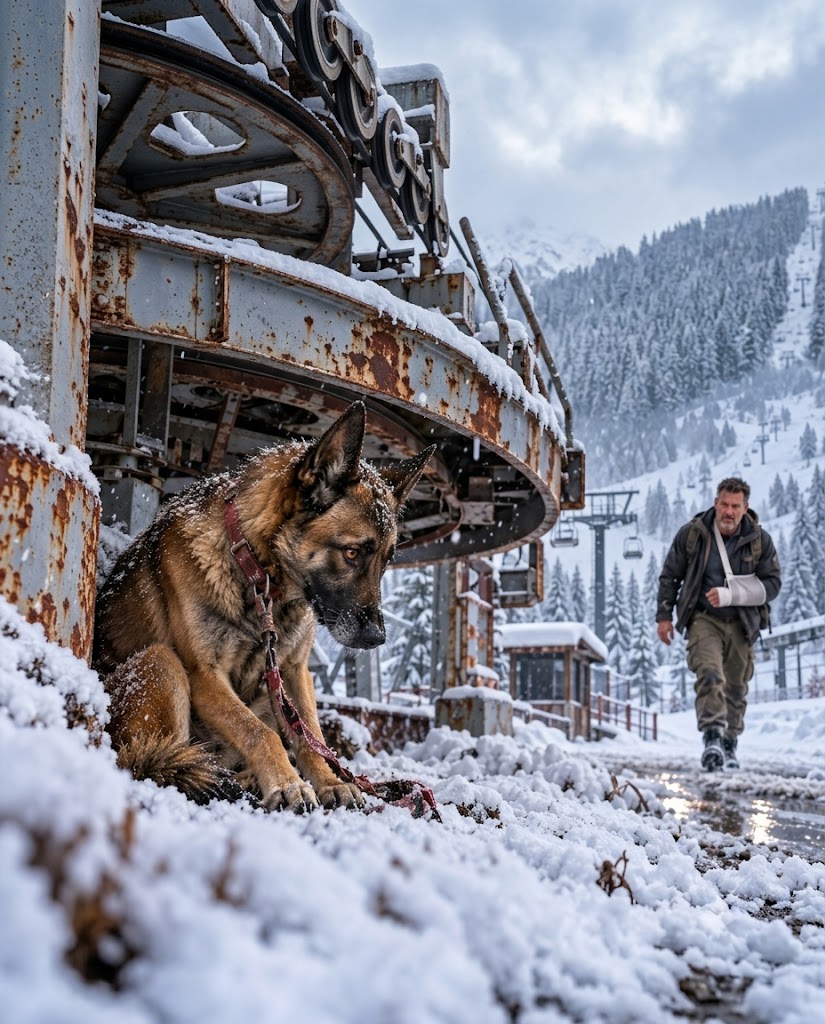
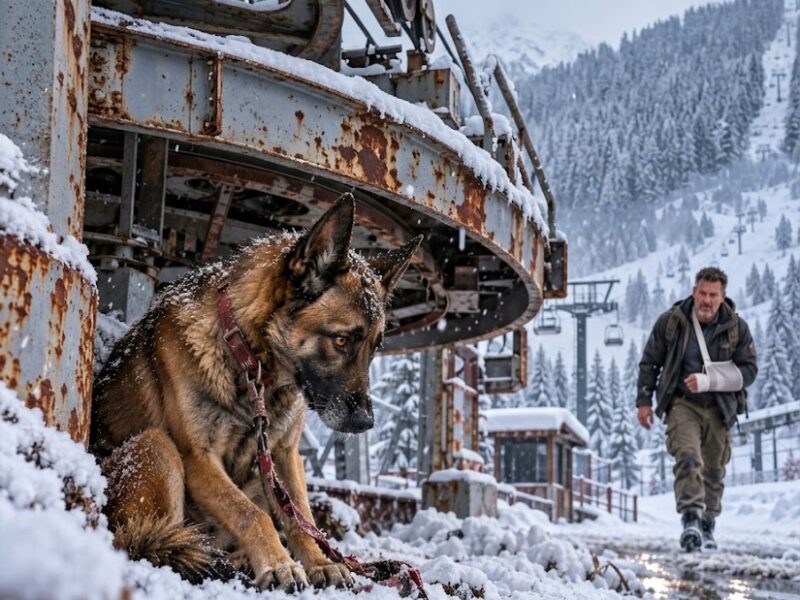
Beneath the rusted chairlift of an abandoned ski resort in upstate New York, a lean Belgian Malinois stood alone in the snow.
A torn red leash dragged behind him, and frost clung to his dark muzzle like tiny crystals of forgotten time.
He did not bark for food.
He did not run when the wounded former Navy SEAL stepped closer.
Instead, the dog turned toward the forest, ran twenty yards, stopped, and looked back.
Ryland Beckett understood that look before he understood why.
At fifty-two, after nearly twenty-seven years as a Navy SEAL, Ryland had survived things most men never had to imagine.
But one training accident had left his right arm damaged, his grip unreliable, and his confidence in his own body shaken in ways he would never admit out loud.
He had spent eighteen months making his world smaller, convincing himself that needing less from life was the same as healing.
Then this dog appeared.
The Malinois led him through the snow to an injured man trapped beside an overturned snowmobile.
Hours later, after the rescue was over, Ryland drove home and told himself the dog was no longer his problem.
But that night, the temperature dropped to eleven degrees Fahrenheit, the snow thickened, and Ryland could not stop seeing those amber eyes beneath the abandoned lift.
So he went back.
—
The doctor had used the word *adaptation* again, and Ryland Beckett was beginning to hate it more than pain.
At fifty-two, the retired senior chief had spent nearly twenty-seven years as a U.S. Navy SEAL, long enough to develop the habit of entering every room already knowing where the exits were.
He was six-foot-two, broad through the shoulders, with the hard, economical build of a man who had never entirely stopped training.
His dark brown hair was clipped short and heavily silvered at the temples, while a neat salt-and-pepper beard sharpened an already angular face.
His eyes were an unusual gray-green, quiet and constantly measuring—doors, vehicles, wind direction, ice on pavement, the distance between strangers.
Eighteen months out of uniform had done nothing to erase those instincts.
It had only taken away his certainty that his body would obey them.
His right hand rested on the steering wheel of his old dark pickup as he drove north through Iron Hollow, New York.
Beneath the glove, his last two fingers felt half asleep.
Cold weather made the damaged nerves in his right shoulder and arm flare like electricity beneath the skin.
Eighteen months earlier, a rigid-hulled inflatable boat had rolled during rough-water training.
Ryland had been thrown against metal hard enough to injure his shoulder and brachial plexus.
He could walk normally.
He could drive.
He could lift groceries.
To anyone watching from across the street, he looked fine.
That was almost worse.
Fine did not explain why a coffee mug sometimes slipped from his fingers.
Fine did not explain why buttoning a heavy winter cuff could take thirty seconds on a bad morning.
Fine did not explain why a man who had once trusted his hands with other people’s lives now watched his own right hand as though it were an unreliable employee.
The therapist had told him that morning, gently, “You may continue improving, Ryland, but you also need to build a life around the function you have now.”
He had nodded, thanked her, and left.
Building around damage still sounded too much like surrender.
—
Snow began falling harder as he passed the northern edge of town.
Instead of taking the main highway toward his cabin, Ryland turned onto the older road running below North Peak.
The ski area had closed eight years earlier.
Rusted chairlift towers stood over the mountain like abandoned sentinels, cables disappearing into a gray winter sky.
The lower terminal sat behind a drift-covered parking lot, windows boarded and roof buried beneath old snow.
Something moved beneath it.
Ryland slowed.
At first he thought fox.
Then the animal stood—Belgian Malinois, male, adult, maybe four years old.
Even under the exhaustion, the dog’s build was unmistakable: lean, athletic, deep fawn to mahogany coat darkening along the back, black mask across the muzzle, upright ears, and dark amber eyes that tracked Ryland’s truck without panic.
Snow clung to his ribs and shoulders.
His belly looked too narrow.
His paw pads had left faint spots of blood in the packed snow, and a faded red collar circled his neck.
From it hung a torn length of nylon lead.
Ryland parked but left the engine running.
“Of course,” he muttered.
Responsibility had apparently learned his route home.
He stepped out with a piece of dried beef from the truck console and placed it on the snow several yards away.
The Malinois watched his right hand carefully.
He didn’t rush the food.
“Smart,” Ryland said.
“Suspicious is healthy.”
The dog sniffed the air, took two steps toward the meat, then abruptly looked toward the trees.
He ran—not away.
Twenty yards down an old service road, he stopped and turned.
Ryland remained beside the truck.
The dog came back one short bark, then he ran toward the service road again.
Ryland frowned.
The Malinois repeated the behavior a third time, and suddenly the pattern became impossible to misunderstand.
“You’re not hungry enough to be doing this for dinner.”
The dog stared at him.
Ryland pulled his phone out, reported his location and intended direction to county dispatch, then retrieved a flashlight and compact first aid pouch from behind the seat.
He told himself this was caution, not attachment.
Halfway into the trees, the Malinois stopped so suddenly that Ryland nearly walked past him.
The dog wasn’t looking ahead anymore.
He was looking directly at Ryland’s right hand.
The fingers had begun trembling from the cold.
For one strange second, man and dog simply studied each other’s weakness.
Then a faint sound carried through the snow.
“Help!”
The Malinois exploded forward.
Ryland followed.
—
The old service road curved behind a stand of spruce where a snowmobile lay half-rolled into a drainage ditch.
An older man was pinned beside it, one boot trapped beneath the rear frame.
“Don’t move,” Ryland called.
The man gave a weak laugh.
“Wasn’t planning a dance.”
His name was Arthur Lennox, sixty-eight, a retired utility technician who still inspected several privately maintained power lines around North Peak.
Arthur was tall but narrow with age, his weathered face framed by a thick white mustache and sparse gray hair beneath an orange knit cap.
He had the stubborn humor of a man accustomed to fixing problems himself and resenting any circumstance that prevented it.
His left wrist was swelling badly.
His lips had begun losing color.
Ryland crouched beside him, careful not to jostle the machine.
“Any head impact?”
“No.”
“Neck?”
“Fine.”
“Can you feel your trapped foot?”
Arthur moved his toes inside the boot.
“Unfortunately.”
Ryland almost smiled.
The Malinois paced several feet away, watching both men.
“Your dog?” Ryland asked.
Arthur followed his gaze.
“Never saw him before today.”
Ryland looked over.
“He showed up on the road maybe an hour before I wrecked.”
“Skinny thing. Gave him half my sandwich.”
Arthur breathed carefully through a wave of pain.
“When the machine rolled, he stayed here, then disappeared.”
“Thought he’d finally decided I wasn’t worth the trouble.”
Ryland looked at the dog.
The Malinois stood completely still.
“No,” Ryland said quietly.
“He went looking.”
That knowledge landed somewhere uncomfortable.
Ryland called for rescue and covered Arthur with the emergency blanket from his kit.
He checked circulation in the trapped leg and resisted the impulse to grab the snowmobile frame.
Years earlier, he would already have been calculating leverage.
He still was.
That was the problem.
He could see exactly where to lift, where to brace his boots, how another strong man could help rotate the machine enough to free Arthur.
But his right hand was shaking harder now.
If his grip failed while the machine shifted, Arthur’s trapped leg would pay for Ryland’s pride.
Ryland sat back.
“We wait.”
Arthur looked at him.
“You could probably lift it.”
“Probably gets people hurt.”
It cost Ryland more to say than Arthur could possibly understand.
Twenty-three minutes later, the first county rescue vehicle reached the service road.
Two responders stabilized the snowmobile before freeing Arthur.
His wrist appeared broken, but his trapped leg remained intact.
They loaded him onto a sled for transport.
Before leaving, Arthur pointed at the Malinois.
“Don’t let that dog disappear.”
Ryland turned.
The dog already had.
—
He found him back beneath the abandoned chairlift terminal.
Ryland placed food and water under the overhang.
The Malinois ate only after Ryland stepped away.
“You’ve survived this long without me,” Ryland said.
“Animal control can deal with you in the morning.”
The dog’s amber eyes followed him.
Ryland hated that look because there was no begging in it.
Begging would have been easier.
He drove home.
By nine that night, wind pushed snow against the windows of his small cedar cabin.
A narrow lake-effect band had shifted south toward Iron Hollow, and the temperature was dropping rapidly.
Ryland stood in his kitchen with a mug of coffee in his right hand.
His fingers twitched.
Coffee spilled across the counter.
“Damn it.”
He set the mug down harder than necessary.
Silence returned.
Then he pictured the red collar beneath the abandoned lift.
The torn leash, snow collecting across a mahogany back.
Ryland stared at his hand.
“I don’t need something depending on me.”
The words sounded wrong the instant he heard them because underneath them was another sentence, something he had been telling himself for eighteen months.
*Maybe nobody should have to depend on me anymore.*
Ryland grabbed his coat.
—
Forty minutes later, headlights swept across North Peak.
The Malinois was still beneath the terminal.
Snow had gathered so heavily across him that for a moment he looked like part of the drift.
Ryland opened the passenger door.
He did not call, did not whistle, did not promise anything.
“You can stay here,” he said, “or you can get warm.”
The dog raised his head.
For a long time, nothing happened.
Then he stood.
He crossed the snow slowly, stopped beside the truck, sniffed the open doorway, and looked once toward the dark mountain behind him.
Finally, he climbed inside.
Ryland closed the door.
The Malinois curled tightly against the passenger seat, still watching him as though warmth might have conditions.
Ryland started the engine.
“This is one night.”
One black ear tilted toward him.
Ryland drove away from North Peak.
Neither of them knew yet that the mountain was not finished with them.
—
By morning, Ryland Beckett had already learned two things about the Belgian Malinois sleeping in his house.
First, the dog did not believe beds were for sleeping.
Second, he did not trust closed doors.
Ryland had found an old wool blanket in the hall closet and folded it near the wood stove.
The Malinois inspected it once, circled the living room, then chose a strip of hardwood floor about six feet from the front entrance.
He lay facing the door, body curled tightly enough to conserve warmth, one ear lifting whenever the wind pushed snow against the porch.
Even asleep—if what he was doing could be called sleeping—he seemed to keep part of himself on duty.
“You know that’s a terrible place,” Ryland said over his coffee.
The dog opened one amber eye.
“Fine. You’re stubborn.”
By nine, the road into Iron Hollow had been plowed well enough to drive.
Ryland took the dog to Warren Veterinary Clinic, a narrow brick building between the hardware store and a pharmacy.
Doctor Elise Warren met them in an exam room lined with faded posters about vaccinations and canine nutrition.
Elise was forty-six, medium height, and wiry, with light brown skin, dark auburn hair threaded with early silver and tied into a practical knot.
Fine lines gathered around hazel eyes that missed very little.
She had the calm temperament of someone who had spent twenty years working with frightened animals and learned that force usually revealed more about the human using it than the animal resisting it.
Instead of reaching for the Malinois, Elise sat on a low stool several feet away.
“He have a name?”
“No.”
“He have a home?”
“Hopefully.”
Elise glanced at Ryland.
“That’s not the same answer.”
“He’s not staying permanently.”
The dog was standing beside Ryland’s left leg, watching Elise without growling.
Elise smiled faintly.
“Of course not.”
The examination revealed no major injury.
Mild dehydration, low body weight, paw pads worn and cracked.
Several small scars along his shoulders and flank, all old.
Elise moved slowly, allowing the dog to smell every instrument before touching him.
“He’s been worked before,” she said.
Ryland had already suspected it.
The dog followed hand motion too cleanly, watched thresholds, and understood the difference between invitation and pressure.
But there was something unfinished about him.
He seemed trained around people rather than bonded to them.
Elise scanned the microchip.
A record appeared.
Sentinel Ridge Canine Services.
Ryland looked over her shoulder.
“Local. Private training facility outside Lowville.”
“Protection work, obedience, some scent programs.”
“Closed about eleven months ago.”
Owner information linked to the chip was outdated.
Two phone numbers were disconnected.
A third belonged to someone who claimed never to have owned the dog.
Elise called county animal control while Ryland waited.
The result was simple enough.
A found dog report would be entered into the county registry.
The chip history would be investigated.
Because the shelter was already overloaded after the storm and because Ryland had brought the dog in voluntarily, animal control approved a temporary foster hold at his cabin pending ownership verification.
“Temporary,” Ryland repeated.
Elise printed the form.
“Yes. You’ve mentioned that.”
—
On the drive home, the dog sat upright in the passenger seat, looking through the windshield as if memorizing the road.
Ryland looked at him once.
“You need a name if I’m supposed to yell at you for destroying something.”
One ear shifted.
“That wasn’t an invitation.”
The problem solved itself two days later.
Ryland had taken an old steel fire striker from a survival kit and was sorting equipment at the kitchen table when it slipped from his right hand.
The metal struck the floor with a sharp crack.
The Malinois sprang upright.
Ryland expected him to bolt.
Instead, the dog froze.
Ryland bent down, picked up the tool, and returned it to the table.
The dog remained standing.
“It’s fine.”
The ears lowered slightly.
Then Ryland noticed something unusual.
The dog’s attention was not on the object.
It was on him.
Watching his face, watching his hands, waiting.
The realization bothered Ryland, although he could not yet explain why.
That evening, the answer arrived.
Ryland was replacing a loose hinge on the mudroom door.
His right hand had been unreliable all day, the cold working its way into the damaged nerves from shoulder to fingertips.
Twice the wrench slipped.
On the third attempt, it fell and struck the floor.
“Damn it.”
Ryland grabbed it again.
His fingers refused to close properly.
He tried once more.
The wrench slipped.
Something hot and old moved through him.
Not pain exactly, but humiliation wearing Anger’s face.
He kicked the toolbox.
It slammed into the wall.
The Malinois vanished from the mudroom.
Ryland immediately regretted it.
He found the dog at the front door—not scratching to get outside, not pacing, not hiding.
Sitting.
Head slightly lowered.
Body perfectly still.
Waiting.
And suddenly Ryland understood what the dog had been watching after every loud sound.
Not the noise.
What came after.
His anger disappeared so completely it left him hollow.
“Hey.”
The dog did not turn.
Ryland took a step forward.
The Malinois’s shoulders tightened, so Ryland stopped.
For almost a minute, neither moved.
Then Ryland slowly lowered himself to the floor, his back against the wall.
“I wasn’t mad at you.”
The dog remained near the door.
Ryland stared at his right hand.
“You wouldn’t know that.”
Silence filled the cabin.
The wood stove clicked softly behind him.
Ryland flexed his fingers.
The last two barely responded.
“I guess you and I both spend a lot of time waiting to see what happens after something goes wrong.”
The Malinois finally looked over.
Ryland swallowed.
“No one gets thrown out of this house because of one bad day.”
The sentence came out before he realized how much of it was meant for himself.
He looked away first.
Five minutes passed.
Then ten.
Soft nails touched the hardwood.
The Malinois left the door, crossed half the room, and laid down about three feet from Ryland.
No touching, no dramatic forgiveness.
Just three feet instead of the doorway.
Ryland smiled without meaning to.
“Well. That’s something.”
—
The next morning, the dog ate nearly an entire bowl for the first time.
By the end of the week, Ryland had bought a proper leash, food formulated for an active adult dog, a new blanket, and a chew toy.
The Malinois showed absolutely no gratitude for the county.
The investigation continued, but no valid owner came forward.
Ryland also found himself walking farther than usual.
That was how they met Noah Hollowell.
The boy sat alone on a bench outside the Iron Hollow Community Center, studying a laminated trail map spread across his knees.
He was ten, small for his age, with pale freckled skin, straight dark-blonde hair falling untidily over his forehead, and thoughtful blue-gray eyes that seemed to take in details before deciding whether they deserved comment.
His navy winter coat looked one size too large, and a pencil was tucked behind one ear.
He noticed the Malinois and immediately went still.
“Can I pet him?”
Ryland looked at the dog.
“He doesn’t know yet.”
Noah nodded as if that made perfect sense.
Instead of approaching, he stayed seated.
The dog watched him.
Noah returned to the map.
A minute passed, then another.
The Malinois moved closer.
He sniffed the boy’s boots first.
Noah kept his hands in his lap.
The dog smelled the edge of his glove, then looked up.
Noah whispered, “Hi.”
Only then did the boy extend two fingers.
The Malinois touched them with his nose.
Ryland felt something unexpected loosen in his chest.
The community center door opened.
A woman stepped outside carrying a canvas bag full of folders.
June Hollowell was forty-one, tall and slender, with fair skin reddened slightly by winter air, shoulder-length chestnut hair escaping from beneath a knitted cream hat, and warm brown eyes that carried both patience and fatigue.
She taught fourth grade at Iron Hollow Elementary and had the composed, practical manner of someone who spent her days solving twenty small emergencies before lunch.
Raising Noah largely on her own had sharpened that practicality without making her hard.
She saw her son beside the dog.
“You ask first?”
“Yes.”
“You waited?”
“Yes.”
June looked at Ryland.
“He’s been training me since kindergarten.”
“No. Or the dog.”
A quiet smile appeared.
“Both, probably.”
She recognized Ryland’s name from around town but did not mention the Navy or his injury.
Instead, she pointed at the canvas bag.
“Actually, you’re the person I hoped I’d run into.”
Ryland immediately became suspicious.
“That usually ends badly.”
“The school has six emergency radios for winter activities. Half won’t hold charge, and one has terrible range.”
“Someone told me you know communications.”
Ryland almost said no.
The old refusal was ready.
*Don’t depend on me. Don’t make me responsible.*
Then the Malinois shifted closer to Noah and sat down.
The boy’s entire face brightened, although he was careful not to celebrate too loudly.
Ryland looked at the dog, then at June.
“I can take a look.”
June handed him the bag.
“No rush.”
Ryland nearly laughed at the irony.
—
That afternoon, his kitchen table held six radios, two batteries, a voltage tester, and a Belgian Malinois sleeping underneath it.
For nearly an hour, Ryland forgot to measure what his right hand could no longer do.
He simply adapted grips, used his left hand where necessary, cleaned battery contacts, checked antennas, and found one damaged connector.
The dog woke when Ryland tested a radio.
Static filled the room.
His ears lifted, but he did not go to the door.
Ryland noticed.
The dog noticed Ryland noticing.
“Don’t make a thing out of it.”
A dark tail tapped the floor once.
Ryland considered the static echoing from the radio.
Then he looked at the dog.
“Flint.”
Both ears came forward.
The name felt right.
Something that could survive pressure.
Something small capable of starting warmth if given the right conditions.
Ryland pointed at him.
“Don’t get attached to it.”
Flint lowered his head onto his paws.
Outside, evening snow began dusting Iron Hollow again.
Inside, Ryland went back to repairing the radios while Flint slept under the table instead of beside the door.
Neither of them understood yet how important those radios, that quiet boy, and the dog’s memory of Noah’s scent would soon become.
—
By the first week of February, Flint had learned that Iron Hollow was not one place but a collection of smells.
Coffee from the diner, diesel from the town garage, wood smoke trapped beneath low winter clouds, children’s mittens, road salt, pine sap.
The particular scent of Noah Hollowell, who always carried graphite from the pencils he tucked behind one ear and usually smelled faintly of wool, cold air, and the peppermint gum June bought in bulk.
Ryland had noticed Flint memorizing the boy without appearing to try.
Whenever Noah came near, Flint’s ears changed first—not dramatically, just a slight forward angle followed by a softened posture and a small shift of weight toward him.
Noah never abused the privilege.
He still waited for Flint to close the final distance.
That Saturday, Iron Hollow held its annual Winter Lantern Day at the community center beside the lake.
The event was small enough that almost everyone recognized everyone else.
Folding tables covered in thermoses, children painting paper lanterns, parents talking near portable heaters, volunteers marking the edge of the snow-play area with reflective stakes.
Ryland had not intended to stay long.
June had only asked whether he could look over the emergency radios one final time before the outdoor activities began.
He had repaired five completely and replaced the damaged connector on the sixth.
Now the radios sat clipped to volunteer jackets throughout the event.
Dean Cormac carried one.
Dean was forty-eight, a broad-shouldered man with a compact, powerful build that came from decades of winter work rather than a gym.
His dark hair was cut close beneath a black wool cap, and a short iron-gray beard covered a square jaw weathered by wind and reflected snow.
He had spent seventeen years supervising ski patrol before taking over Iron Hollow Volunteer Search and Rescue.
Years of seeing preventable mountain accidents had given him a temperament that was neither dramatic nor forgiving of carelessness.
Dean rarely raised his voice.
He did not need to.
When he said something once, people usually understood that repeating it would mean somebody had ignored something important.
He and Ryland had met only twice.
Their relationship was cordial but cautious.
Dean respected Ryland’s military background enough not to mention it every five minutes, which Ryland appreciated.
He also appeared completely unimpressed by it, which Ryland appreciated even more.
“You fixed the dead zones?” Dean asked, checking his handheld.
“One damaged antenna connector. Two batteries that should’ve been thrown away last winter. Channel three is still ugly near the north parking lot.”
Dean keyed the radio.
Static crackled.
“Better than last year.”
“That’s not a difficult standard.”
Dean gave him the smallest hint of a smile.
“You planning to stay?”
Ryland looked toward Flint.
The Malinois sat near Noah, who was kneeling in the snow with a laminated trail map spread over his thighs.
The sky had been pale all morning, but something about it had changed.
Ryland looked west.
A darker band had formed beyond the low ridge line.
Not a storm wall exactly—more like the horizon had been erased with charcoal.
He checked the weather app, then the wind.
The temperature had dropped four degrees in less than an hour.
“Dean.”
The SAR leader followed his gaze.
“You seeing that?”
“Lake bands shifting farther south than they called this morning.”
Dean checked his own phone, then looked toward the lake.
“How fast?”
“Fast enough that I’d end the lantern walk early.”
Dean did not ask whether Ryland was sure.
He looked once more at the western sky, keyed his radio, and began quietly moving the schedule forward.
That decision would matter less than twenty minutes later.
—
The sound came from the road.
A snowplow descending toward the community center braked hard when a minivan pulled unexpectedly from a side entrance.
Metal groaned.
The blade struck packed ice with a violent clang.
Several children jumped.
Flint’s body tightened, but he stayed beside Noah.
Across the activity area, a small terrier panicked.
His name was Milo—a wiry tan-and-white dog with oversized ears, short legs, and the frantic confidence of an animal convinced he was much larger than he actually was.
He belonged to seven-year-old Sophie Reed, a petite girl in a purple snowsuit with round cheeks, dark curls escaping from her hood, and the earnest seriousness children often develop when entrusted with something they loved.
Sophie tried to hold the leash.
Milo twisted.
The loop slipped from her mitten.
He ran.
“Milo!”
Sophie immediately started after him.
Noah caught her sleeve.
“Wait—he’ll get lost. I’ll get him.”
Before June could reach them, Noah ran toward the tree line.
Ryland saw it happen.
At the time, it did not look dangerous.
Milo was visible between the trunks.
Noah was perhaps thirty yards behind him.
Then fifty.
Ryland turned toward June.
“Tell him not to go farther than the trail marker.”
June cupped her hands.
“Noah!”
The boy looked back and waved.
Then the snow arrived.
Not gradually.
One moment the far shore of the lake existed.
The next it dissolved.
Wind swept loose powder across the event grounds in sheets.
Visibility collapsed with startling speed.
Dean’s voice snapped over the radios.
“Everybody inside the marked area. Volunteers confirm children by group. Shut down outdoor activities now.”
Ryland looked toward the trees.
Noah.
No Milo.
Only white.
Flint stood so abruptly that the leash pulled tight in Ryland’s hand.
The Malinois was not looking toward the community center.
He was staring into the storm.
Then he made a sound Ryland had never heard from him before.
Not a bark, not a growl—a low, tight whine held in the chest.
Ryland followed his gaze toward the place Noah had disappeared.
Something in his stomach dropped.
Flint already knew someone was missing.
And for the first time since North Peak, Ryland saw the same look in the dog’s eyes that had appeared before Flint led him to Arthur.
Not fear.
Purpose.
—
The first count took less than three minutes.
Noah was missing.
Sophie was crying so hard she could barely speak.
June knelt in front of her, keeping her voice steady despite the panic gathering behind her eyes.
“How long ago?”
“Just—just when Milo ran.”
“Which way?”
Sophie pointed north.
Dean stepped in immediately.
“No civilians leaving the grounds. We search organized.”
June stood.
Her face had gone pale.
“My son is out there.”
“I know.”
“You don’t understand—”
“I do.” Dean’s voice stayed controlled. “And the fastest way to turn one missing child into five is letting everybody run into a whiteout.”
June shut her eyes for half a second, then nodded.
The discipline in that nod impressed Ryland more than panic would have.
Dean began assigning sectors.
The search would start close to the community center and expand toward the access roads.
Ryland looked at Flint.
“Dean.”
The other man glanced at him.
“He knows Noah.”
Dean looked from Ryland to the dog.
“He certified?”
“No. Tracking trained. Some scent work. Not SAR certified.”
“Then he’s not a search dog.”
“I didn’t say he was.”
Dean studied him.
Ryland continued, “But if he gives us a direction, it’s information.”
That answer seemed to satisfy Dean.
“Fine. Information. Nothing more.”
June hurried over carrying one dark-blue glove.
“He left this on the hot chocolate table.”
Ryland crouched and held it near Flint’s nose.
The Malinois inhaled once, then again.
Ryland did not command him immediately.
He allowed Flint to investigate.
The dog sniffed the glove, then snow near the table, then the edge of the parking area.
He moved toward one path, stopped, circled back, checked another.
Nothing theatrical, no miraculous certainty.
Ryland preferred that.
Flint was working, not performing.
After several minutes, the dog moved toward the northern service lane.
He stopped at the tree line, sniffed a reflective stake, then pulled.
Dean saw it.
He keyed his radio.
“Team two, North Sector. Price with me.”
A man detached from the equipment trailer.
Evan Price was thirty-one, tall and rangy with the quick balance of someone accustomed to unstable ground.
His sandy-brown hair showed beneath a red sarong—no, a red winter cap—and short stubble darkened a narrow angular face.
His gray eyes were alert without being restless.
Evan worked as an EMT in town and held ice rescue certification through the county.
He was capable, fast, and still young enough to distrust men who carried old reputations into new situations.
He looked at Ryland’s right hand before looking back at Dean.
Ryland noticed.
“Problem?”
Evan shook his head.
“No.”
Dean did not bother pretending he had missed the exchange.
“Ryland goes with you because the dog knows him. Your team lead in the field, Evan.”
Ryland felt an old reflex rise.
He let it pass.
“Understood.”
Dean’s eyes stayed on him.
“Good.”
—
They entered the trees.
The snow muffled everything.
Within minutes, the lights of the community center vanished.
Flint moved ahead on a long lead, stopping often to test the air and ground.
Evan carried navigation and medical gear.
A third SAR volunteer followed behind to maintain radio contact.
Ryland’s right shoulder began aching almost immediately.
Cold always found the damaged nerves faster than he ever found them.
Evan moved quickly.
Ryland matched him for several minutes.
Then his finger started going numb.
Flint reached fifteen feet ahead.
Stopped.
Looked back.
Ryland caught up.
Flint continued.
A few minutes later, the same thing happened.
Then again.
Ryland felt irritation rising—not toward Flint, but toward the humiliating fact of being waited for.
“Go,” he muttered.
Flint did not.
Evan glanced back.
“You need to slow it.”
“No.”
The answer came too fast.
Ryland hated that.
He looked at Flint.
The dog was not staring at his arm, not pitying him, not impatient—just waiting because they had started together.
And then Ryland understood something almost painfully simple.
Flint had never known the man who could move faster.
He had never seen Ryland at thirty.
Never watched him climb ladders one-handed, haul men through surf, or run until other people asked to stop.
To Flint, this was not a damaged version of Ryland.
This was simply Ryland.
“Fine,” he said quietly. “Our pace.”
They slowed.
The search became better almost immediately.
Ryland stopped wasting energy competing with the memory.
—
Nearly an hour later, Flint veered sharply toward a spruce.
Something dark blue lay half-buried near its roots.
A knit cap.
Ryland picked it up with his left hand.
Noah’s.
Evan photographed it and radioed command.
June confirmed the description.
They had direction now.
Beyond the spruce, faint impressions crossed the snow.
Small boots.
Beside them, the broken pattern of a little dog’s tracks.
Ryland looked ahead.
The ground began descending.
His expression changed.
“What?” Evan asked.
“Black Creek.”
Evan’s face tightened.
Everyone in Iron Hollow knew the name.
A narrow mountain stream that froze unevenly, especially where faster water ran beneath snow-covered shelves.
Ryland keyed the radio.
“Dean, we have tracks moving toward Black Creek. Recommend ice rescue standby now.”
Dean answered immediately, already moving them.
Flint suddenly stopped.
His ears shot forward.
The storm swallowed every other sound.
Then somewhere ahead came a faint bark.
High. Rapid. Milo.
Flint barked once in return.
All three men froze.
For several seconds, there was only wind.
Then a small voice came through the white.
“Help!”
Ryland felt every nerve in his body sharpen.
Evan looked at him.
Noah was alive.
And somewhere beyond the trees, the creek was between them.
—
Noah’s voice came again through the storm, thinner this time.
“Help!”
Ryland moved first, but only three steps.
Then he stopped.
The trees opened ahead, revealing Black Creek as a broken ribbon of white and black beneath the snowfall.
Snow covered both banks and much of the ice, disguising the places where current still ran beneath thin shelves.
Roughly forty yards downstream, a narrow gravel bar rose above the water like a small island.
Noah was crouched there with Milo pressed against his chest.
The boy’s navy coat was crusted with snow.
One pant leg was dark from the knee down, and his boots were visibly wet.
His face looked unnaturally pale against wind-reddened cheeks.
Milo trembled beneath Noah’s arms.
The little terrier’s tan-and-white fur soaked along the belly and legs.
Flint lunged forward.
Ryland caught the long lead with his left hand.
“No!”
Flint pulled once more, then froze at the edge of the bank, whining deep in his throat.
Noah saw him.
“Flint!”
The Malinois barked sharply.
Something changed in Noah’s expression.
Not relief exactly—more like proof that the world outside the white had not disappeared.
Ryland crouched at the edge of the safer ground.
“Noah. Look at me.”
The boy turned.
“Don’t stand up. Stay where you are.”
“I tried to come back.”
“I know.”
“Milo fell through.”
“Is he breathing?”
Noah nodded.
“Keep him inside your coat. Hold him against your chest.”
Ryland studied the creek.
A section of ice behind Noah had already collapsed.
Dark water moved between fractured plates.
Another shelf extended from the gravel bar toward shore, but the snow covering it made thickness impossible to judge.
Years of operational training began running calculations through his mind automatically.
Distance, anchor points, approach angle, weight, current, exposure.
And just as automatically, another thought followed.
*I could get across.*
He hated that thought because part of him still wanted it to be true.
Evan moved beside him.
“Don’t.”
Ryland looked over.
“I didn’t say anything.”
“You didn’t have to.”
The younger man’s tone held no disrespect.
That made it harder to resent.
Ryland looked back at Noah.
The right shoulder was already burning from the search.
His last two fingers had lost nearly all sensation.
Without proper cold-water gear, crossing unstable creek ice would have been reckless even before the injury.
The rational answer was obvious.
The emotional answer was louder.
A child was sitting in freezing water conditions less than fifty yards away, and Ryland’s entire former life had trained him to move toward the problem.
His radio crackled.
Dean’s voice.
“Team two, ice rescue unit is two minutes out. Do not commit to the creek.”
Ryland closed his eyes for half a second.
“Copy.”
It felt like admitting something.
He hated that, too.
Flint suddenly stopped whining.
The dog sat beside Ryland and looked up at him.
Not toward Noah.
At him.
His amber eyes were steady.
For a strange second, Ryland thought of the first night beneath North Peak, the dog choosing whether to climb into his truck.
Ryland had not dragged Flint into safety.
He had opened a door and let the dog decide.
Now the lesson had turned around.
Maybe helping did not always mean being the one who crossed the distance.
Maybe sometimes it meant knowing who should.
—
The ice rescue team arrived through the trees less than two minutes later carrying specialized equipment.
Dean came with them.
No wasted words.
He assessed Noah, the creek, the broken shelf.
Evan was already stripping off his outer jacket.
Dean pointed.
“You’re my swimmer.”
Evan nodded.
Another rescuer opened a pack containing a cold-water rescue suit, harness, and tether system.
Ryland shifted toward the gear instinctively.
“I can help rig.”
Dean looked at him.
“Fine. Shore side only.”
Ryland found a heavy spruce thirty feet back from the bank with a broad root flare exposed above the snow.
“Primary there. Secondary, left side.”
Dean checked both.
“Good.”
Ryland took a locking carabiner from the rope bag.
His right thumb pushed against the gate.
Nothing.
He adjusted his grip.
Tried again.
The metal slipped from his fingers and dropped into the snow.
For one second, nobody moved.
The sound was tiny.
To Ryland, it felt louder than the snowplow blade at Winter Lantern Day.
He bent immediately, grabbed the carabiner with his left hand, and tried transferring it back.
The right hand shook.
Evan, half inside the rescue suit, extended his palm.
“Give it to me.”
Ryland stared at him.
Not angry.
Worse.
Ashamed.
Behind them, Noah coughed.
That sound decided it.
Ryland placed the carabiner in Evan’s hand.
“Secondary anchor. Left spruce. Back it up before you load it.”
Evan clipped it cleanly.
“Got it.”
No ceremony, no sympathy, just work.
Ryland felt something inside him loosen, even though another part still resisted.
—
The rescue system came together quickly.
Evan sealed the suit, clipped into the tether, and attached the rescue sled.
Two rescuers handled the shorelines.
Dean monitored the whole operation.
Ryland moved back to the creek edge.
“Noah.”
The boy looked at him.
“You’re going to see a man coming out to you. His name is Evan.”
Noah’s teeth were chattering hard now.
“Okay.”
“Do not stand when he reaches you.”
“I won’t.”
“Talk to me. What did you put on the trail map last week?”
Noah blinked.
“What?”
“The symbols. Creeks. What else?”
“Old roads.”
“Keep going.”
Noah started listing them.
Trail junctions, elevation marks, shelter points.
Anything that kept his brain working.
Flint stood beside Ryland, ears locked on the boy’s voice.
Evan lowered himself onto the unstable surface and moved carefully, distributing his weight.
The sled followed behind.
Ten yards.
Twenty.
The ice flexed.
No one spoke.
Evan reached the gravel bar.
Noah immediately tried to move.
“Stay!” Ryland shouted.
The boy froze.
Evan crawled onto the bar and checked him quickly.
“Cold, responsive,” he called. “Wet lower legs. Terrier conscious.”
He wrapped Noah in an additional thermal layer, secured him onto the sled, then tucked Milo beneath the boy’s chest and clipped the child into position.
“Ready.”
Dean raised one hand.
“Slow pull.”
The shore team began taking in line.
At first, everything worked.
Then the ice failed.
—
A fracture shot across the surface with a sound like a rifle crack.
The outer edge of the shelf collapsed.
The sled dropped sideways.
Noah screamed.
One rescuer instinctively pulled harder.
Ryland saw the line angle change.
The sled began rotating broadside toward the broken ice.
“Stop. Pull.”
The command came out in the voice he had not used in eighteen months.
Everyone froze.
Dean turned.
Ryland pointed.
“Current’s dragging the sled sideways. Move hauling load to the secondary anchor. Pull from higher left.”
Dean followed the geometry for less than a second, then nodded.
“Do it.”
The shore team transferred the hauling line.
Evan braced one arm against the sled.
Dean checked the system.
“Pull.”
This time the angle changed.
The sled straightened.
One foot.
Three.
Five.
Then the front crossed solid snow.
Hands grabbed the sled.
Noah was lifted clear.
Evan crawled in behind him.
—
June had been brought to the outer staging area under escort once Noah’s location was confirmed.
When she saw the sled, she broke every bit of composure she had maintained until then.
She ran forward only after Dean signaled the area was safe.
“Noah.”
The boy raised one shaking hand.
“Mom.”
June fell to her knees beside him as the medical team wrapped him in dry blankets and warming packs.
Milo was removed from Noah’s coat and immediately began trembling so violently that one medic wrapped the terrier in his own fleece.
Flint pulled toward Noah.
Ryland loosened the lead.
The Malinois approached slowly.
No jumping, no frantic licking.
He pressed his nose into Noah’s exposed hand.
Noah’s fingers moved weakly against Flint’s black muzzle.
“I knew you’d find me.”
Ryland looked away.
His throat tightened in a way he refused to examine too closely.
When the medics moved Noah toward evacuation, Flint turned back toward Ryland.
Only then did Ryland realize he had sat down in the snow.
His right arm hung uselessly against his side.
Pain pulsed from shoulder to fingertips.
Dean walked over.
“You okay?”
Ryland almost gave the automatic answer.
*Fine.*
Instead, he said, “Arm’s done for the day.”
Dean nodded as if Ryland had told him the temperature.
“Then leave it done.”
Ryland looked toward Evan, who was pulling off the rescue suit.
“He brought the kid back.”
Dean followed his gaze.
“Yes.”
Ryland waited.
Dean added, “And you caught the line angle before we turned that sled sideways.”
“Anyone could’ve seen it.”
“But you did.”
Ryland looked down at Flint.
The dog sat beside him, snow collecting on his shoulders.
Dean’s voice softened just slightly.
“That’s how teams work, Beckett. Nobody has to be the whole rescue.”
For once, Ryland had no answer.
—
The ambulance lights glowed red through the falling snow as Noah and Milo were taken toward Iron Hollow.
Flint leaned against Ryland’s left leg.
Ryland rested his good hand on the dog’s neck.
The boy was going home.
And Ryland had not crossed the creek.
He had not hauled the sled himself.
He had not even clipped the carabiner.
Noah was going home.
For the first time since the injury, that truth did not feel like proof of what Ryland had lost.
It felt like evidence that there might still be more than one way to matter.
—
Noah came home three days after Black Creek with nothing worse than mild hypothermia, bruised shins, and a story June suspected would become more dramatic every time he told it.
Milo recovered even faster.
The terrier spent one day wrapped in blankets at Sophie Reed’s house, then resumed barking at delivery trucks as if nearly freezing in a mountain creek had taught him absolutely nothing.
Flint, by contrast, became quieter after the rescue.
Not fearful.
Thoughtful.
Whenever Noah visited, the Malinois would walk directly to him, sniff his coat, then settle nearby as though confirming something only he understood.
Ryland noticed another change, too.
People in Iron Hollow had stopped asking him questions about his injury.
Instead, they asked about winter.
A man at the hardware store wanted to know what should go in a vehicle emergency kit.
A mother outside the school asked how long chemical hand warmers actually lasted.
Someone at the diner wanted to know whether leaving a route with a family member mattered if the hike was only a few miles.
Ryland answered because the questions had answers.
That was all.
He told himself it meant nothing.
Then Dean Cormac showed up at his cabin one Tuesday afternoon.
Flint barked once from the living room, then relaxed when he recognized the SAR leader through the window.
Dean stepped inside carrying a cardboard box filled with laminated maps, emergency blankets, and old training binders.
Ryland looked at the box.
“No.”
Dean set it on the kitchen table.
“I haven’t asked anything yet.”
“You brought binders. That’s never good.”
Dean removed his black wool cap.
His iron-gray beard was still damp from snow.
“We’re starting winter readiness nights at the community center.”
“Good.”
“I want you to teach part of it.”
“No.”
Dean nodded as though this answer had been predicted.
“Cold-weather preparation. Communications. Route planning. Decision-making.”
“I’m not an instructor.”
“You trained people for twenty-seven years.”
“That was different.”
“How?”
Ryland looked at his right hand.
Dean noticed, but unlike most people, he did not soften his expression.
“I’m not asking your hand to teach.”
Ryland looked up.
Dean continued, “I’m asking the guy who knew when not to step onto bad ice.”
That sentence stayed longer than Ryland wanted.
He agreed to one night.
Only one.
—
The first session took place a week later in the rear room of the community center.
Fifteen folding chairs faced a long table covered with maps, radios, emergency blankets, traction devices, and first aid gear.
Noah sat in the front row with June.
Sophie sat beside her mother, Milo safely at home after June had declared that one Reed family rescue per month was enough.
Dean stood near the wall.
Evan leaned against the cabinet, arms folded, wearing the expression of a man who had come partly to help and partly to see whether Ryland would survive public speaking.
Flint lay beneath the table.
Ryland stood in front of the group.
For the first ten minutes, he hated it.
Not because he did not know what to say.
Because he did.
He knew too much.
And every piece of knowledge seemed connected to a version of himself he had spent eighteen months mourning.
Then Noah raised his hand.
“What’s the first thing people do wrong when they get lost?”
Ryland looked at him.
“Usually? No one nods. They keep moving because stopping feels like failure.”
The room went quiet.
Ryland heard his own words.
So did Dean.
Ryland continued, “They convince themselves the right trail is probably just ahead. Then ten minutes becomes thirty. Thirty becomes distance. Distance becomes exposure.”
A woman in the second row asked, “So stopping is the right choice sometimes?”
Ryland glanced down at Flint.
“Stopping isn’t quitting if it keeps a bad situation from becoming worse.”
By the middle of the session, his shoulder began to ache.
His right hand had started tingling.
There was a stool beside the table.
Ryland stared at it.
For months, sitting down in public had felt like announcing weakness.
Tonight, he simply sat.
No explanation.
Nobody reacted.
A teenager asked how to preserve phone battery in cold weather.
Someone else asked about coordinates.
Life continued.
The absence of judgment was almost irritating.
Ryland had imagined other people noticing his limitations so intensely that he had forgotten most people were busy noticing their own.
At the end of the session, Noah stayed behind.
He was rolling up a trail map when he looked at Ryland’s hand—not the damaged one, the left hand resting on Flint’s neck.
“Mr. Beckett.”
“Yeah.”
“When you couldn’t clip that thing at the creek—”
Ryland’s body went still.
Noah continued, “I saw Evan do it.”
Ryland waited for the question he expected.
*Were you scared? Did it hurt? Were you embarrassed?*
Instead, Noah asked, “How did you know which tree to use?”
Ryland stared at him.
Noah was not interested in what Ryland had failed to do.
He was interested in what Ryland had still known.
Something deep inside Ryland shifted without making any noise at all.
“Roots,” he said finally.
“You look for the tree that’s anchored better than it looks.”
Noah nodded, satisfied.
Then he left.
Ryland remained seated for several seconds after the room emptied.
Flint placed his muzzle across Ryland’s left boot.
“You’re all making this very inconvenient,” Ryland murmured.
—
Two days later, Elise Warren called.
“I found the rest of Flint’s file.”
Ryland drove to the veterinary clinic that afternoon.
Elise met him in her office carrying a thin folder printed with the faded Sentinel Ridge logo.
Flint sat beside Ryland’s chair.
Elise opened the file.
“There was never a cruelty investigation. Nothing criminal. Sentinel Ridge just collapsed financially. Dogs were transferred quickly. Records were incomplete.”
Ryland nodded.
That matched what they already suspected.
Elise turned a page.
“This is his training evaluation.”
She slid the document across the desk.
Ryland read.
*Strong scent interest. Good environmental awareness. Moderate obedience.*
Then the line:
*Not suitable for protection certification.*
Below it:
*Hesitation after correction. Delayed recovery following pressure drills. Insufficient defensive drive.*
Ryland read it twice.
His jaw tightened.
“They washed him out because he hesitated.”
Elise leaned back.
“They washed him out of protection certification.”
“That’s what I said.”
“No, it isn’t.”
Ryland looked at her.
Elise tapped the paper.
“This does not say *bad dog*.”
She pointed to another line.
“It says *wrong job*.”
Ryland said nothing.
Flint rested quietly near his knee.
Elise continued, “Someone wanted a certain kind of dog. Flint wasn’t that dog.”
Ryland looked down.
A dog that had found Arthur.
A dog that had recognized Noah’s absence before half the adults did.
A dog that had followed scent through a snow squall.
A dog that had sat quietly beside a frightened child after rescue instead of losing control.
*Not suitable.*
The phrase felt familiar.
Not because anyone had ever written it across Ryland’s medical file.
Because he had written it across himself.
*Not suitable for the old team. Not suitable for the old missions. Not suitable for the body he remembered.*
Somewhere along the way, he had turned that into something uglier.
*Not useful. Not needed.*
Elise watched him carefully.
“You know, those are different sentences.”
Ryland almost laughed.
“You veterinarians are getting dangerously philosophical.”
“I charge extra for that.”
Flint’s tail tapped once.
Elise closed the folder.
“There’s something else. The legal ownership search has expired. No valid claimant has come forward. The former Sentinel Ridge records confirm that Flint entered an informal foster transfer before disappearing, but no individual currently holds an enforceable claim.”
She paused.
“He can be adopted.”
Ryland looked at Flint.
The Malinois looked back.
Months earlier, that stare would have been cautious.
Now it was simply familiar.
Elise pushed the paperwork toward him.
Ryland signed.
Name, address, veterinary authorization, emergency contact, final signature.
Nothing dramatic happened.
No music, no revelation.
Flint yawned.
Ryland put down the pen.
“Guess we’re both washed out.”
Elise smiled.
“Or reassigned.”
Ryland laughed once.
He did not argue.
—
By the end of February, snow still covered North Peak, but the sky had cleared into a hard blue.
Ryland took Flint there on a cold Sunday morning.
No rescue, no emergency—just a short trail.
They passed beneath the abandoned chairlift terminal.
Flint stopped.
Ryland stopped too.
The Malinois sniffed the snow where he had once curled beneath the structure.
He walked around the support post, nose low.
Ryland waited, half expecting something meaningful.
Flint lifted one hind leg and urinated on the post.
Ryland stared, then laughed so hard his shoulder hurt.
Flint looked at him as though confused by the reaction.
“That’s your big emotional moment?”
Flint sneezed and continued up the trail.
Ryland watched him go.
The place had not changed.
The cold had not changed.
The past had not disappeared.
Flint simply no longer needed any of it to mean something.
Ryland looked at his right hand.
Two fingers tingled.
The grip was still weaker than before.
For once, he did not test it.
Did not close his fist.
Did not compare.
Flint moved farther ahead.
Months earlier, he would have stopped and looked back every few yards.
This time, he kept walking.
Ryland felt no panic, no humiliation, no sense of being left behind.
He knew the dog would remain somewhere ahead on the same trail.
And Flint apparently knew Ryland would come.
Ryland started walking again.
Not at the speed he once could.
Not at the speed Flint could run.
Just the speed the day allowed.
For the first time, it did not feel like less.
It simply felt like forward.
—
Sometimes the miracle is not that God gives us back the life we had before.
Sometimes the miracle is that He shows us there is still a life worth living after everything has changed.
Ryland never got his old strength back completely.
Flint never became the kind of dog someone once expected him to be.
But somehow in the middle of winter, two lives that had both been labeled by what they could no longer do found a new purpose in each other.
And maybe that is how grace often works in our own lives.
We pray for the pain to disappear, for the door to reopen, for the old version of ourselves to return.
But sometimes God answers in a different way.
He sends a person, an animal, a second chance, or a quiet opportunity that reminds us we are still needed, still loved, and still capable of moving forward.
Not every miracle looks dramatic.
Sometimes it looks like having the courage to ask for help.
Sometimes it is choosing not to give up on someone after one bad day.
Sometimes it is realizing that being different from who you used to be does not make you less valuable.
If you are carrying something difficult in your own life right now, I hope this story reminds you that your next chapter may already be forming in ways you cannot yet see.
Keep your heart open.
Keep walking.
Even if your pace has changed, God may still be leading you toward something you never expected to find.
If this story touched your heart, please share it with someone who may need a little hope today.
Tell us in the comments where you are watching from and what part of Ryland and Flint’s journey stayed with you the most.
And if you believe stories of loyalty, faith, courage, and second chances still matter, please subscribe to the channel and help us continue sharing them.
May God bless you and your family.
May He give you strength for the things you cannot change, peace for the burdens you have been carrying, and faith to recognize the new doors He may be opening in your life.
And wherever your road leads next, may you never forget that sometimes what feels like the end of one life is only the beginning of another.









