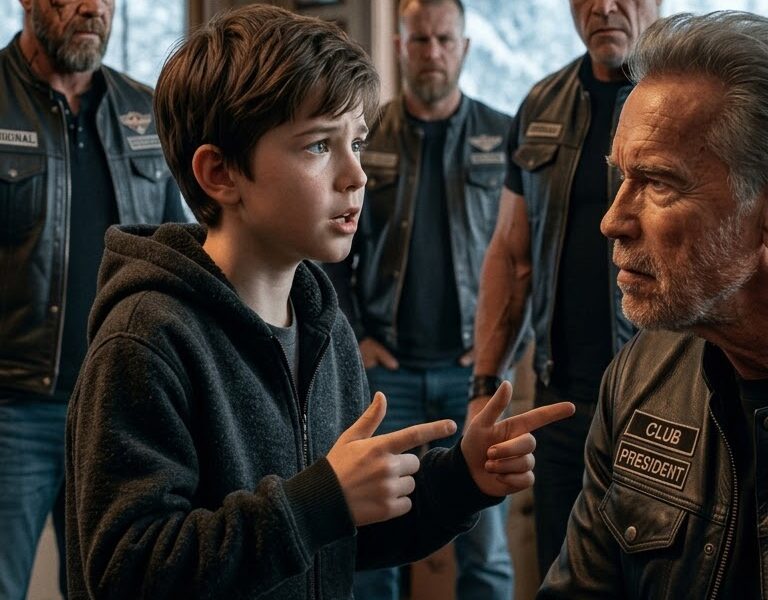
“They’re Stealing Your Donations,” an 11-Year-Old Warned—Then the Bikers Found Proof
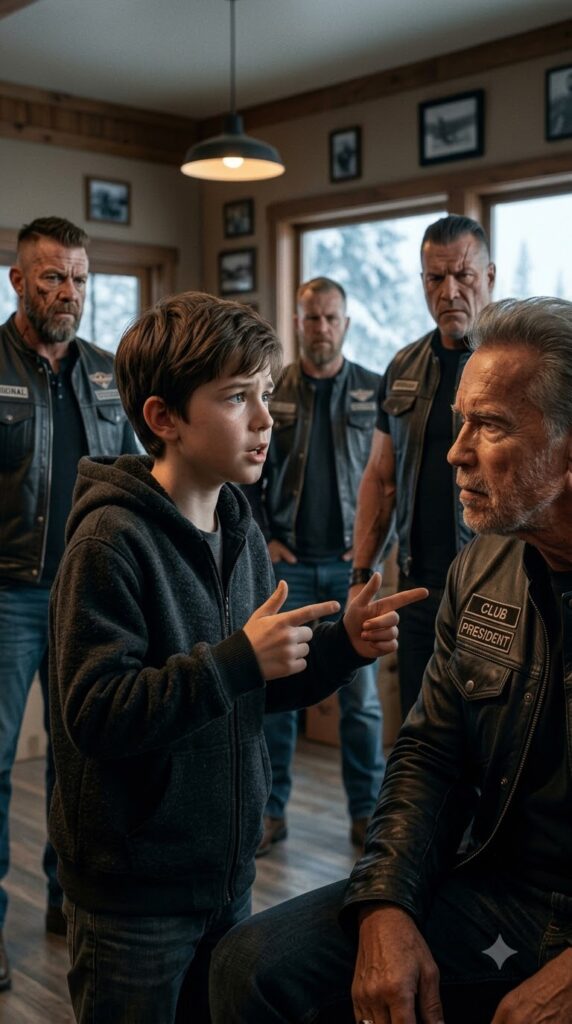
The sky over Millbrook, Ohio, couldn’t decide between raining and just making everything gray, the kind of Tuesday that made adults walk faster with their shoulders hunched and their eyes low.
But Adam Reyes, eleven years old and thin as a pencil, was looking up.
His hoodie sleeves always hung too long over his hands, and his second-hand sneakers squelched on the wet pavement as he helped his mom, Laura, sort cans and dried goods behind the old municipal building.
Every Tuesday and Thursday, they volunteered at the community donation site, stacking boxes labeled with masking tape: *For Families. Elderly Care. Emergency Only.*
Laura worked double shifts at the laundromat, and this was her way of feeling useful, of giving Adam something to do after school besides sitting in their too-quiet apartment.
That afternoon, Adam noticed something strange.
A white cargo van idled longer than usual by the loading zone, its windows tinted, its plates dusty, and the two men loading it weren’t wearing the bright orange volunteer vests everyone else wore.
They moved fast, efficient, not rushing but intentional, stacking box after box until the van sagged on its axles.
Then they drove off without a word.
“Isn’t that the fourth van today?” Adam asked, pointing toward the street.
Laura wiped sweat from her brow and squinted. “They’re probably doing a big delivery.”
“But the families only got two bags each this morning. We’re running out again.”
She gave him a tired half-smile. “There’s always more going out than coming in, baby. That’s how these drives go.”
But Adam kept watching.
—
The van came again on Thursday, same time, same drivers, same quiet loading.
By the next week, he was counting boxes, keeping a crumpled notepad in his hoodie pocket and scribbling numbers when no one was looking.
On some days, as many as ninety boxes went into that van, but the shelves at the outreach center never looked full.
When he asked the volunteer supervisor, a slick-haired man named Carl, about it, Carl just chuckled and rested his hand on Adam’s shoulder a moment too long.
“You always notice things, huh?” Carl said, friendly but final. “We’re lucky to have you. Don’t worry about the grown-up stuff.”
That was the end of it.
No one asked questions they didn’t want answers to, so Adam made a choice.
He started biking.
Every time the van left the lot, Adam waited a few minutes, then quietly followed on his old red BMX, its chain squeaking and its handlebars rusted at the grips.
The first few trips led nowhere, just loops through side roads and warehouse alleys.
But on the third try, he struck gold.
The van didn’t go to the community center like it was supposed to.
Instead, it turned off the highway exit toward the industrial edge of town, past shuttered factories and empty lots, before finally backing into a squat, windowless building that looked like it hadn’t been painted since Adam was born.
There were no signs or logos, only a lone security camera mounted on one corner and two men in dark jackets unloading boxes inside.
Adam stopped half a block away, hiding behind a wall of overgrown brush and a stack of old tires.
He slid off his bike, dropped to a crouch, and pulled out his phone.
He hit record.
—
The footage was shaky but clear enough: men unloading clearly labeled donation boxes into a place that looked nothing like a shelter.
One of them even looked around nervously before shutting the doors.
That was weird enough, but then came the part that didn’t make sense at all.
When the van pulled away, it didn’t head back downtown.
It turned the opposite direction toward the East End, toward the old garage that locals whispered about—the Iron Circle Clubhouse.
Adam’s heart thudded.
He’d never been that close to the biker compound before, just seen it from the bus window: low buildings, a few motorcycles parked outside, a rusted metal sign with a gear and skull logo.
Everyone said it was trouble.
His teacher once warned students not to walk past it alone.
The van slowed just enough when passing it, just enough for anyone watching to take note, like it was leaving breadcrumbs.
When Adam got home that night, he didn’t tell his mom what he saw, not yet.
She was already stressed, rubbing her temples and trying to make cheap noodles feel like dinner.
Instead, he locked himself in his room and watched the video five more times.
—
The next day, after volunteering, he waited by the loading dock again.
This time, Carl noticed.
“You like vans, huh?” Carl said, raising an eyebrow.
Adam just shrugged. “I think I saw that one yesterday, near the biker place.”
Carl paused.
Then he laughed, but not like before—this laugh was tighter, more forced.
“You’ve got an active imagination, Adam, but don’t say things like that too loud. Those guys, they’d love an excuse to sue for slander.”
*Slander.*
Adam had to look that word up later.
That night, he couldn’t sleep.
He lay awake thinking about the look on Carl’s face, about the men in the warehouse, about the way the van slowed by the biker clubhouse like it wanted to be seen.
The next afternoon, after school, he made a decision.
He biked to the Iron Circle.
—
The clubhouse looked like it had once been a mechanic shop: tall garage doors, concrete walls stained with oil and weather.
A few bikes sat outside, and music played from somewhere inside—classic rock, loud but not angry.
He stood at the edge of the lot for ten full minutes before working up the nerve.
Then he crossed.
Inside, the smell of motor oil, leather, and grilled onions hit him all at once.
Men sat around a long wooden table, some eating, some working on engine parts.
They looked up, and everything went quiet.
One man stood, gray at the temples, hands like tree roots, a faded army patch on his jacket.
“You lost, kid?”
Adam’s throat felt dry, but he stepped forward anyway, holding up his phone.
“I think someone’s trying to blame you for something you didn’t do.”
The man—Rudd Durant—stared at him for a long moment, then gestured toward a stool.
“Show me.”
—
Adam climbed up and hit play.
The bikers crowded around in silence.
No one spoke when the video ended.
Durant took the phone, rewound it, and watched again.
Behind him, someone muttered, “That’s not the city warehouse.”
“No,” Durant said, voice low. “It’s not.”
Adam swallowed hard. “I think they want people to think you’re stealing the food. But you’re not, right?”
Rudd Durant looked at the boy, then at the faces around him—weathered, tired, but alert now.
“No, son,” he said slowly. “We’re not. But someone sure wants us to look like we are.”
Outside, the wind picked up, whistling through the cracks in the garage door.
And just like that, the smallest voice in the room had started something no one could ignore.
—
Rudd Durant stood in the center of the Iron Circle’s garage, arms folded, eyes fixed on the frozen frame of Adam’s video playing for the fifth time on the old TV they used for parts diagrams.
Around him, Jerome, Devon, and a few other club regulars stood silently.
The grainy footage of men unloading boxes at the warehouse played again.
And again, the van slowing outside their gate gave everyone a bitter taste in the mouth.
“No identifying marks anywhere,” murmured Jerome, narrowing his eyes. “They’re moving fast because they know what they’re doing.”
Durant exhaled through his nose, jaw clenched. “And because they think we’ll take the fall.”
He turned to Adam, who sat on an upside-down milk crate near the back wall.
The boy was small, his hoodie a little frayed, but his expression was sharp.
“You said you’ve been following them for how long?”
“Four times. I have two more videos. One where they unload boxes in the rain. One where they stop twice. Like they’re trying to be seen.”
Devon knelt beside him, voice low and calm. “Kid, you know how dangerous this could have been, right?”
Adam nodded slowly. “I didn’t get too close. But nobody else was paying attention.”
Durant gave a grunt. “He’s not wrong.”
—
That night, Durant made a call he hadn’t made in years.
Lena Morgan answered on the second ring.
Her voice still had that edge—fast, clipped, all signal, no noise.
“What is it?”
“I’ve got something,” Durant said. “And it’s big.”
She arrived the next morning wearing a battered leather jacket and aviators that hadn’t left her glove box in months.
Lena had once been a top investigative journalist, sharp enough to dig into city contracts and pull out worms.
But after exposing corruption involving a powerful councilman’s real estate deals, she found herself blacklisted from every major outlet.
No one would print her stories, so she left, found the club, and eventually peace.
Now, she was pacing the garage floor like a bloodhound back on the trail.
“They’re staging it,” she muttered after reviewing the footage and Adam’s notes. “And they’re clever. Driving past your lot puts you at the center of every lazy theory in town.”
Jerome chimed in, pulling out an old city zoning map. “That warehouse is owned by a dummy LLC tied to a dissolved charity. If we track the filings, we might get a name.”
Devon was already on his laptop, cross-checking delivery van plates from Adam’s footage with public DMV databases. “I’ve got one—registered to a nonprofit that closed down last year. They never updated it.”
Lena smiled. “Sloppy. Perfect.”
—
As they dug deeper, patterns began to emerge.
Each time a food drive collected donations, vans were dispatched by the same group of volunteers, none of whom had ever appeared on the official sign-in rosters.
Every one of them wore unmarked clothes, and each trip ended at the same unregistered warehouse—not the community center as publicly listed.
Back at Adam’s apartment, Laura was facing a different kind of revelation.
She stood in the narrow kitchen, flyer in hand.
Her name had been removed from the schedule, quietly, without warning, like she’d never been there at all.
She called the center and got Carl’s voicemail.
When she stopped by that afternoon, he was unavailable.
Another volunteer whispered to her near the loading dock. “They said you’d become a disruption, that your kid was asking the wrong questions.”
Laura’s face flushed. “He’s eleven.”
“Exactly,” the woman said with a tight smile. “And apparently too curious.”
—
That evening, Laura sat across from Adam, eyes glassy.
“Why didn’t you tell me you followed them?”
He looked down. “You didn’t believe me the first time.”
Silence.
She reached for his hand. “I didn’t listen when it mattered. That won’t happen again.”
She didn’t sleep much that night.
Instead, she went back through her old texts, volunteer emails, calendar notes.
She remembered things—offhand comments, extra pallets no one accounted for, new boxes showing up without being logged.
She’d brushed them off, trusted the system, and now her son was doing what she hadn’t.
Questioning it.
The next day, she showed up at the Iron Circle.
Durant raised an eyebrow as she entered the garage.
“I want to help,” she said, voice firm.
Durant nodded once. “Then let’s get to work.”
—
Over the next few days, the unlikely group assembled a portfolio of evidence.
Lena drafted timelines.
Jerome built a visual map showing the supply trail.
Devon cross-referenced charity permits, tracing the van routes.
Adam, surprisingly organized, added timestamps and still frames from his footage.
Laura, meanwhile, contacted other parents and volunteers, collecting statements about discrepancies—lost boxes, missing pallets, changes in protocol.
In the middle of it all, Laura found herself sitting with Lena on the back steps of the garage.
“I believed in it,” Laura said quietly. “The charity, the work. I needed to. After Adam’s dad left, this place gave me a purpose.”
Lena nodded. “We all needed something to believe in. But when belief becomes blind, that’s when people like Carl slip through.”
Laura exhaled, eyes damp. “I just didn’t want to see it.”
“You see it now,” Lena said. “That’s what matters.”
—
Back at the garage, Durant watched Adam explaining his observations to Jerome.
The boy pointed to a printed photo of the van’s route, using a red marker to show where it always paused.
“He does it right at the corner, like he wants the camera to see him.”
Jerome looked at Durant. “He’s not just guessing. He’s paying attention.”
Durant gave a half-smile. “He’s one of us.”
But for all the proof they were gathering, there was still a problem.
None of them had the power to get the story out.
Not officially.
The city paper wouldn’t touch anything from Lena.
The council wouldn’t take meetings with the club.
And Carl? He had allies—quiet ones.
“We need to go louder,” Laura said.
Lena agreed. “But not just yet. We need to make it undeniable. We’re close.”
By the end of the week, they had nearly everything.
Everything except someone willing to listen.
Until Adam asked, “What if we didn’t wait for them to listen?”
They all turned toward him.
He lifted his phone. “What if we show everyone all at once?”
And in that moment, surrounded by old tools, grease-stained floors, and eyes once filled with doubt, the spark of a plan took hold.
The truth was ready.
Now they just had to decide how loud it needed to be.
—
The plan was simple, but nothing about it was easy.
Lena sat at the corner table in the Iron Circle’s garage, stacks of printouts in front of her, laptop open, brows furrowed.
Across the concrete floor, Adam and Jerome went over delivery logs and highlighted van routes with color-coded markers.
Devon scanned boxes of old city permits, cross-referencing names of defunct charities.
And Laura, once hesitant, now moved between calls, setting up quiet meetings with former volunteers and a local parent group.
Every piece was lining up.
Every document backed the next.
But none of it mattered without a way to make people care—and make them listen.
Lena rubbed her temples. “Even with all this, they’ll find a way to bury it.”
“Then we don’t let them,” Durant said, stepping forward.
He looked exhausted but focused.
“We’re not waiting for approval. We’re bringing it straight to the people.”
It wasn’t just about truth now.
It was about timing.
Because that morning, the local paper ran a front-page story: *”Community Drive Struggles Amid Rumors.”*
*”Biker Group Denies Involvement.”*
Carl had gone on record, accusing certain disruptive elements of threatening the good work of the food campaign.
Photos of the Iron Circle’s clubhouse—dark, low-lit, with bikes lined up like shadows—ran under the headline.
The implication was clear.
They were setting the narrative.
Fast.
—
Lena slapped the paper against the table. “They’ve already written the ending. They just need a face to fit the story.”
Durant didn’t flinch. “Then we speak louder.”
That afternoon, the Iron Circle cleaned up the garage, cleared workbenches, set up folding chairs and portable heaters.
Jerome brought in a used projector.
Devon patched up the broken speaker they used for club meetings.
Laura organized refreshments and printed flyers.
And Adam—he rehearsed, standing by the projector, his voice shaky but steadying with every sentence.
He walked through his footage, explained the routes, the stops, the moment he realized something was wrong.
Lena guided him gently. “Keep it simple, honest. You’re not here to accuse. You’re here to show.”
Meanwhile, behind the scenes, Lena scheduled an email blast to every contact she still had—old reporters, bloggers, watchdog groups.
She prepared a shared drive of every file they’d compiled: timestamps, permit records, routing logs, screenshots, statements from volunteers.
In a sea of data and signatures, Adam’s quiet footage spoke the loudest.
—
Still, Carl wasn’t sitting still.
Word reached Laura through a friend at the donation center.
Carl had called an emergency board meeting for Monday morning.
Rumors said he was pushing to relocate operations, supposedly for security concerns.
In truth, they knew what that meant.
Bury the evidence, silence the questions, reshuffle the staff.
“Then we go before he does,” Durant said. “We take the shot before they close the window.”
They set the event for Saturday afternoon.
Open invite, free food, no speeches—just facts shown on a screen in the place the city had tried to condemn.
But even as they prepared, tension thickened.
Two days before the event, Jerome came back from the DMV office looking grim.
“They flagged me,” he said. “Someone reported unauthorized access. Told me I shouldn’t come back.”
That night, Devon’s house was egged.
The next morning, a code compliance officer showed up at the Iron Circle with a clipboard and a vague complaint about improper use of commercial space.
Durant handed him a coffee and told him to get in line.
But the message was clear.
Someone knew they were getting close.
—
Still, no one backed down.
Laura doubled down on community calls.
Lena posted teaser clips online—short caption videos from Adam’s footage.
The van. The warehouse. The labels on the boxes.
Comments poured in.
Some angry, some suspicious, some shocked.
But most of them said the same thing: *”Why haven’t we seen this before?”*
And in the middle of it all, Adam stayed steady.
He updated the presentation every day, trimming unnecessary frames, adding maps, adjusting the voiceover.
He even asked Jerome to help him animate a van route over the city map—a line that curved clearly toward the warehouse and, more chillingly, right past the Iron Circle each time.
When Durant saw the final slide—a side-by-side of the charity’s official delivery claims and the actual GPS tracks—he just nodded.
“No one’s going to talk over that.”
—
The night before the event, the club stayed late.
Devon swept the floor twice.
Laura arranged tables with drinks and sandwiches.
Lena checked the projector settings.
Adam stood by the entrance bouncing his foot nervously.
Durant clapped a hand on his shoulder. “You did more than most adults ever do.”
Adam looked up. “What if they don’t believe me?”
Durant’s voice was steady. “You’re not asking them to believe you. You’re showing them the truth. What they do with it, that’s on them.”
That night, Laura tucked Adam in, something she hadn’t done in years.
He stared at the ceiling. “Do you think they’ll actually listen?”
She brushed his hair back gently. “I don’t know. But I do know this—if they don’t, they’ll have to explain why.”
Outside, the wind shifted.
Inside the garage, the lights flicked off one by one.
And somewhere across town, Carl stared at his own inbox, now flooded with clips, screenshots, and links from people asking questions he thought no one would dare say out loud.
—
Saturday came quiet.
Nothing stirred but the wind, clouds thick and low over the Iron Circle’s lot, threatening rain but never delivering it.
The street felt empty and quiet, as if the city, too, were waiting.
Adam stood near the garage entrance, clutching a folded-up clipboard like it was a shield.
He wore a plain gray hoodie and jeans, clean but wrinkled, and a name tag that Laura had insisted on: *Adam—Volunteer.*
Behind him, the projector was warming up, casting a glow onto the wrinkled tarp they had hung up as a screen.
The first people arrived—a woman with two kids, then a teenager in a scout uniform, then a retired school janitor who nodded at Durant but didn’t say a word.
By 1:00 p.m., over forty folding chairs were filled.
Parents stood in the back.
A few people pulled up in their cars just to watch from across the street.
No one clapped.
No music.
Just quiet curiosity and uncertainty, and in some faces, suspicion.
—
Lena stood off to the side, arms crossed.
Laura was in the back nervously offering coffee.
Devon and Jerome managed the speaker system and slideshow.
Durant stepped up to the mic first.
“We won’t take much of your time,” he said. “Just watch. Decide for yourself.”
He stepped aside.
Adam walked up.
He didn’t clear his throat.
Didn’t fake confidence.
He just pressed play.
The footage began—shaky, filmed from behind a stack of tires.
A cargo van rolled into view, packed with donation boxes clearly marked for distribution, emergency aid.
The men unloading wore ordinary clothes, moved with practiced speed, and said nothing as they carried the boxes into a windowless warehouse that offered no hint of its purpose.
Then the screen cut to another clip—the same van, different day, slowing just slightly as it passed the Iron Circle’s lot.
Then came the overlays.
A map with moving red dots, timestamps, arrows connecting sites.
A second window showing Carl giving a speech at a fundraiser, claiming full transparency and praising the “trusted distribution system.”
Then Adam’s footage again—same day, boxes leaving, not arriving.
The audience stayed silent.
—
Next, Lena narrated over scanned forms: expired nonprofit licenses, ghost directors, three different charity names registered to the same warehouse address.
Then came the real blow.
A clip of Carl shaking hands at the donation center with a man Lena had identified as the warehouse property owner.
The two laughing in front of a truck half-covered with a donation tarp.
Without any edit—just raw truth.
By the time the slideshow ended, Adam’s voice was steady.
“I didn’t do this to get anyone in trouble. I just wanted to know why the food wasn’t getting where it was supposed to, and I didn’t want people to blame the wrong ones.”
He looked toward Durant and the others, then back to the crowd.
“I just wanted the truth to matter. That’s all.”
He handed the mic back and walked down without looking up.
—
A woman in the back—one of the early volunteers who’d been quietly dismissed months ago—raised her hand.
“I remember seeing that man, the one in the video. He told me not to log a whole pallet of diapers. Said it had already been recorded somewhere else.”
Another voice: “They told us the van GPS was broken. Said we couldn’t track routes.”
Then came murmurs, nods.
Someone clapped once, hesitant, then stopped.
But the spell had broken.
People were talking now—not shouting, talking.
Lena stepped forward holding a printed dossier.
“This is everything. It’s available online and will be submitted to the city and state authorities this evening. We’ve also contacted independent media outlets. The full documentation is public. This can’t be walked back.”
Then she held up a small folder.
“But we didn’t just come here to expose something. We came to build something better.”
Laura took the mic.
“We’ve been meeting with other parents, organizers, community kitchens. We want to rebuild the donation network—but this time with full visibility. Anyone can audit the process. Anyone can volunteer. And the first place we’ll operate out of—” she turned— “is right here.”
There were murmurs again, surprised ones.
A few people looked around the garage with its grease-streaked walls, exposed beams, and fading toolboxes.
“But that’s a biker garage,” someone said.
Durant nodded. “Sure is. Also happens to be the one place no one wanted anything to do with, which makes it perfect. No politics—just work. You don’t have to trust us. Just see what we see.”
Someone in the back spoke up. “What about security? Donations?”
Devon answered from the tech table. “24/7 livestream. Inventory logs open to the public. You’ll see everything we see.”
Slowly, the resistance started to fade.
—
Later that evening, just before sunset, the garage was nearly empty.
Lena had finished posting the documentation, and Laura was speaking with two local teachers who wanted to join the initiative.
Durant sat on the concrete steps sipping weak coffee from a paper cup.
Adam sat beside him, tired but lighter somehow.
“Did it work?” he asked.
Durant gave a half-smile. “We’ll see. But you did your part—and people saw it.”
Adam leaned back against the wall. “You think they’ll remember me as the kid who started all this?”
Durant looked out at the street, then back at him. “I think they’ll remember you as the one who didn’t stay quiet. That’s more than most ever do.”
Across town, Carl’s phone buzzed endlessly.
The charity’s official accounts were suspended.
A formal investigation had begun.
And a dozen calls had gone unanswered.
But none of that mattered here.
Here, in this patch of concrete and sweat and second chances, a boy’s questions had pulled a thread—and the whole thing unraveled.
—
**Epilogue**
Three weeks later, the Millbrook Community Distribution Network reopened inside the Iron Circle’s garage.
A new sign hung above the door, painted by Adam himself: *Everyone Eats. Everyone Sees.*
The livestream camera mounted in the corner fed directly to a public website where anyone could watch boxes being packed, logged, and loaded onto trucks with GPS trackers.
Donations doubled within a month.
Volunteers—many of them former skeptics—signed up in droves.
And Carl?
He was arrested on fraud and embezzlement charges, along with two board members and the warehouse owner.
Authorities recovered nearly **$47,000** in misappropriated funds and donations.
The story made national news.
Lena Morgan, once blacklisted, was offered a job by an independent investigative outlet.
She turned it down—said she liked working with people who actually gave a damn.
Laura kept volunteering, now as the network’s coordinator.
And Adam?
He still rides his old red BMX.
But now, when he pedals past the Iron Circle, the men wave.
Sometimes they even let him help fix up the bikes.
Durant once told a reporter, “That kid saw what grown-ups didn’t want to see. And he didn’t stay quiet. That’s the whole story right there.”
On a quiet Tuesday afternoon, Adam sat on the garage steps, scribbling in a new notepad.
His mom walked up, smiling. “What are you writing?”
He shrugged. “Just ideas. For next time.”
Laura laughed. “Next time?”
Adam looked up, eyes bright.
“There’s always a next time.”
And somewhere in the distance, the wind picked up—whistling through the cracks, carrying the truth a little farther than before.
—
**The End**









