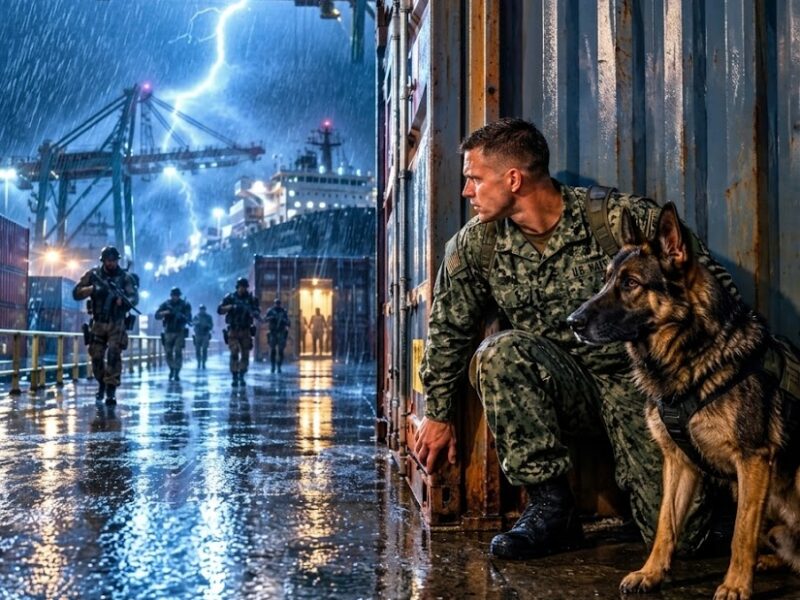
They tried to silence a man and his dog on a cargo ship — they had no idea they were dealing with a Navy SEAL.
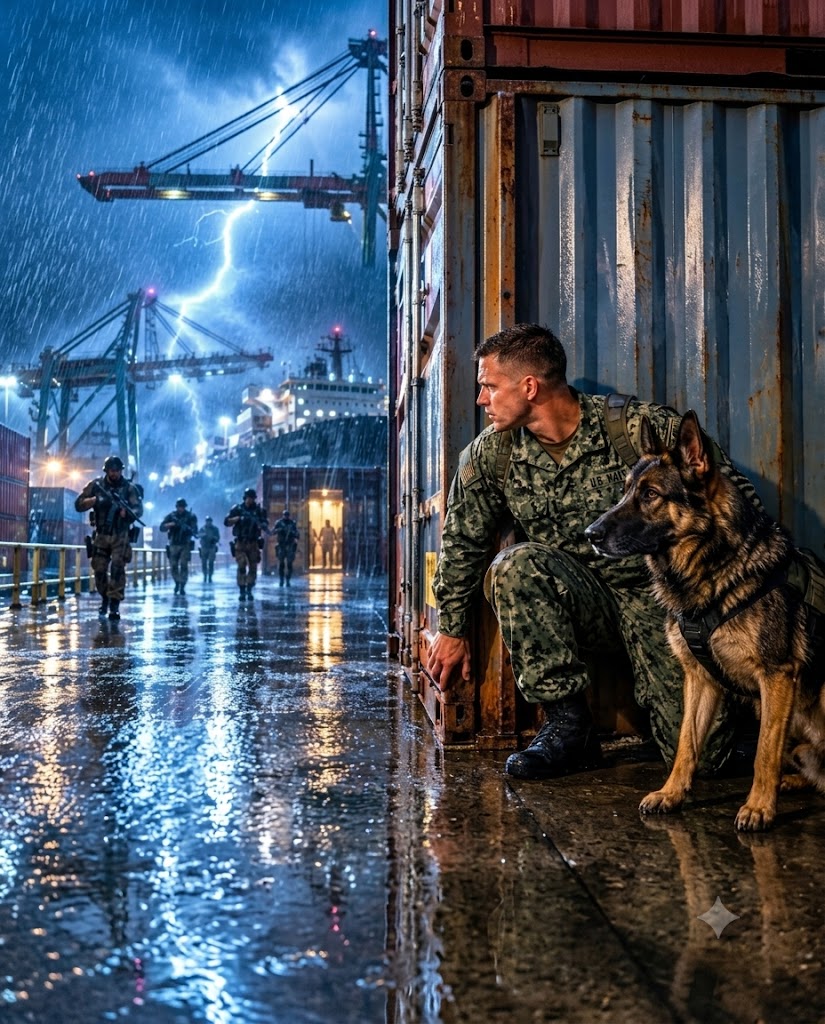
The body of Leon Puit had been in the ground for five days when his cousin finally walked back into Charleston.
Dalton drove in silence. He did not turn on the radio. He did not stop for food.
He rolled the windows down because the South Carolina air was warm and smelled like salt and low tide.
And that smell meant Leon. They used to fish these inlets as kids. They used to talk about staying in this city forever.
Leon actually did it. Dalton joined the Navy instead and eight months later became a SEAL.
That life had taken him to places he was not allowed to name. It had trained him to read situations the way other men read books — fast, thorough, and looking for what the author was trying to hide.
Something about Leon’s death was hiding something.
Phantom sat in the back seat. The German Shepherd was 82 pounds of dark sable fur, calm amber eyes, and military precision.
He had been through Kandahar, through three rotations that Dalton still could not fully sleep through. Phantom watched the passing highway through the window and said nothing.
He was good at that.
The official report called it a fall. Leon had been working as a maritime safety inspector for the Port of Charleston for two years.
Conscientious, careful — the kind of man who triple-checked load ratings and never skipped a safety walkthrough.
According to the port authority, Leon had been conducting a night inspection on a service platform above Pier 11 when the railing gave way. He fell 40 feet onto the concrete below.
Case closed.
Dalton read the report twice in a gas station parking lot outside Savannah. Then he folded it and put it in his jacket pocket and did not look at it again.
He did not need to. He had already found the thing that did not fit.
Leon had reported the Pier 11 railing as sound in his last inspection two weeks before his death. The railing was not defective.
Somebody had made it that way after Leon filed his report. That was not an accident. That was a murder scene dressed up to look like one.
Port Authority Commissioner Douglas Farwell ran his office out of a converted brick building on the edge of the waterfront district.
He was a trim man in his early 60s with silver hair combed flat and small reading glasses pushed down on his nose. He offered Dalton water when Dalton sat across from him.
Dalton declined. He had learned a long time ago that men who offer you things when they owe you nothing usually want something in return.
Farwell expressed condolences in the smooth practiced cadence of a man who had expressed condolences before. He called Leon a valuable member of their team.
He called the accident a tragedy that the port took extremely seriously. He mentioned a full internal review. He used the word closure twice in four minutes.
Dalton watched his eyes the whole time. There was nothing there. Not grief. Not even the performance of grief.
Just a man waiting for the conversation to end.
“Leon’s personal locker at the inspection station,” Dalton said. “Has it been cleared out yet?”
Farwell hesitated. Half a second too long. “We sent his belongings to his mother last week,” he said.
Dalton nodded. “Of course.”
He left. He sat in the truck outside for a moment with both hands on the wheel. Phantom pushed his heavy head through the gap between the seats and rested his chin on Dalton’s shoulder.
“I know,” Dalton said quietly.
They waited until midnight. The Port of Charleston at night was a different country. The cranes stood like giants, frozen mid-reach. The containers were stacked into iron cities that swallowed the light.
The perimeter fence ran for miles, topped with razor wire, interrupted by security cameras at 60-foot intervals. Dalton had spent 20 minutes earlier in the day walking the public waterfront across the channel with binoculars, mapping the camera arcs, identifying the blind spots, counting the guards at the main gate.
He had done harder infiltrations in worse conditions with worse gear. He was on leave, carrying a sidearm and a combat knife, wearing civilian clothes. It was enough.
He boosted himself over the fence at the dead zone behind a cluster of transformer units. Phantom cleared it clean beside him, landing soft on all four paws, shaking himself once and looking up at Dalton like they did this every day.
They had done it every day, just not usually in Charleston.
The inspection station was a low metal building near the base of Pier 9. Dalton picked the lock on the side door in under 30 seconds.
Inside, rows of gray lockers lined the wall. Leon’s was marked with a strip of blue tape and the number 12 — the same number he used to wear in Little League.
Dalton crouched in front of it. The lock was a standard combination type, and Leon had used their grandmother’s birthday since high school.
Dalton spun the dial and it opened first try. The locker smelled like machine oil and cedar shavings. Leon’s rain jacket still hung on the hook. His work boots sat on the bottom shelf.
Dalton pushed aside a folded thermal shirt and felt around the back panel of the locker. His fingers found a strip of industrial tape along the seam.
He peeled it back. Taped to the inside of the rear panel was a slim waterproof case no bigger than a paper bag.
Inside was a micro SD card, a folded piece of paper with a file name, a six-digit PIN written in Leon’s handwriting, and a cheap card reader.
Dalton connected the card reader to his phone. He typed in the PIN. A folder opened.
Forty-seven photographs, all taken at night, with a port-issue inspection camera. The first image was a wide shot of Pier 14.
Three containers sat on the dock, separated from the main stack, surrounded by men in tactical gear carrying weapons that had no business being on a civilian cargo dock.
The next image was closer. One container door was cracked open an inch. A hand reached through the gap — a child’s hand, small fingers reaching out toward nothing.
Dalton sat very still.
The remaining images showed the same containers being loaded onto a cargo vessel. The ship was large, dark-hulled with faded white letters along the bow.
Meridian Star.
Dalton checked the port schedule on his phone. The Meridian Star was registered out of a shell company in the Cayman Islands. It was scheduled to depart Charleston tonight in four hours, bound for a port in the Dominican Republic.
Leon had found a human trafficking operation moving through Charleston. He had gathered evidence to prove it. Before he could do anything with it, they found out and killed him.
Dalton looked at the photograph of the child’s hand. He put the phone in his pocket. He looked at Phantom.
“We have to go,” he said.
Phantom was already at the door.
They reached Pier 14 with 40 minutes to spare before departure. The Meridian Star sat at the dock under massive floodlights, gantry cranes making the final lifts.
Dalton counted eight armed men visible from his position behind a stack of intermodal units. More would be below deck and on the gangway.
Walking aboard the normal way was not an option.
He found the mooring lines. He rigged Phantom into the tactical harness from his bag and clipped it to his own chest rig with a steel carabiner. He tested the weight.
It was going to hurt. That was fine.
The climb up the mooring line took four minutes and felt like 40. The synthetic rope was slick with brine. Phantom’s weight pulled hard against Dalton’s hips with every upward reach.
His arms burned steadily the way they had burned on the combat diver obstacle course years ago. The burn that meant progress, not failure. He fixed on that and kept moving.
He pulled them both over the railing and onto the deck with a single controlled motion. They landed behind a steel ventilation housing and stayed flat.
A guard walked past 10 feet away, eyes forward, torch beam cutting the dark. He did not look down.
Dalton moved. Phantom followed. They went below.
The lower cargo hold was vast and cold and smelled like rust and diesel and something else — something human and frightened and stale.
Dalton pulled out his red lens light and moved carefully between the container rows, checking stenciled numbers. The containers from Leon’s photographs used the prefix MRS.
He found MRS308 and MRS309 side by side, secured with heavy padlocks.
Phantom stopped in front of MRS309 and held position, one front paw raised, ears forward.
Dalton took out his bolt cutters. The lock on MRS309 snapped. He caught it before it hit the floor. He pulled the door open slowly, keeping the red light low.
Thirty-one people sat pressed against the container walls. Men and women and four children. Their eyes caught the red light and reflected it back like animals in the dark.
One woman in the front flinched backward and covered her mouth to stop from making noise. The children buried their faces into the adults beside them.
Dalton went to one knee and lowered the flashlight completely.
“I am here to help you,” he said, very low, very steady. “My name is Dalton. This is Phantom. We are not with the men who put you here.”
One man near the back spoke quietly in Spanish. A young woman near the front answered him, then looked at Dalton.
“I speak English,” she said. Her voice was controlled even though her hands were shaking. “My name is Sophia. How did you find us?”
“My cousin found you,” Dalton said. He let that sit for a second. “He paid for it. I am going to finish what he started.”
Sophia translated in a whisper. The group did not make noise, but something shifted in the room. Some collective coil of tension loosening slightly, just enough.
Dalton told Sophia what he needed them to do. Stay in the container. Latch the door from the inside. Lie flat at the first sound of gunfire. Open for no one until they heard him say Phantom’s name twice.
She nodded once sharply. She turned to the group and spoke. An older man at the back gave one firm nod.
Dalton respected that nod. It was the nod of someone who had already made their peace with the worst and was choosing to trust him anyway.
He pulled the container door shut. He heard the internal latch slide home. He felt the deck vibrate beneath his boots. The engines had come to full power.
The Meridian Star was moving. There was no going back.
The ship’s mercenary team was professional, but not extraordinary. Dalton had operated against men far better trained than these in places that did not appear on unclassified maps.
What these men had was numbers and familiarity with the terrain.
What Dalton had was Phantom, the ability to control his heartbeat in moments of extreme stress, and the absolute clarity that comes from having nothing left to lose — except the one thing he came here to protect.
He took the first guard alone from behind in the narrow corridor outside the engine room. Clean and quiet, he secured him with zip ties from his pack and took his radio and his sidearm.
Phantom handled the second one when the man came around a container row and stopped short, reaching for his rifle. Phantom was faster.
He hit the man’s center mass and drove him into the bulkhead before the rifle barrel came level. Dalton was there in two steps.
The radio crackled. A voice asked for a status check. Dalton did not answer. He had maybe 60 seconds before they sent someone to look.
He moved fast through the hold, working upward, level by level. On the second deck, he came around a corner and heard two men talking in a small crew compartment.
He caught a fragment of conversation through the metal wall.
“Krauss wants the hold sealed before we hit the shipping lane.”
A pause.
“What does that mean for the cargo?”
“Same thing it always means.”
Another pause. Shorter, heavy with implication.
Dalton did not need the implication explained. If they sealed the hold and cut the air to those containers, 31 people would be dead before morning.
He had to reach the bridge. Not in two hours now.
He pulled the second flashbang from his vest.
The fight for the bridge lasted six minutes and felt much longer. Krauss was waiting for him, which meant someone on the radio had warned him.
The mercenary leader was a wide, pale-eyed man with a neck like a structural column and a tactical shotgun braced against his shoulder before the door finished opening.
He got one shot off. Dalton was already moving, cutting left hard, the blast tearing through the air where his chest had been.
He drove into Krauss from the side, shoulder into ribs, and they crashed across the navigation console together. Krauss got an elbow into Dalton’s jaw that lit his vision white for a half second.
Dalton answered with a knee to the man’s thigh and a headbutt that snapped Krauss’s chin up and bought two inches of separation.
Krauss pulled a knife.
Phantom came through the bridge door at a dead run. He cleared the distance in a straight line and locked onto Krauss’s weapon hand, clamping down with the full force of trained military bite pressure.
Krauss roared. The knife went to the floor. Phantom dragged him sideways, off-balance, and Dalton closed the gap and hit him hard twice at the temple.
The big man folded.
Captain Holly of the Meridian Star made his choice quickly. He ran for the door and made it three steps before he realized Dalton had secured the bulkhead.
He turned around and put his hands up.
Dalton secured him to a pipe fitting with zip ties and moved to the communications console. The security lockout on the navigation system took 11 minutes to bypass.
He had done harder things in less time.
The radio opened on the Coast Guard emergency frequency and he transmitted everything in 30 seconds flat. Position. Heading. Number of armed hostile personnel. Number of civilians in the cargo hold.
The name of the mercenary operations shoreside coordinator — the man who made it possible, the man whose voice he had heard on the intercepted radio call two hours ago.
Commissioner Douglas Farwell, Port Authority, Charleston, South Carolina.
There are moments in these situations when the noise stops. Not literally. The ship engine still ran. The storm that had been building since they left port now threw rain hard against the bridge windows, and Dalton could hear Krauss breathing on the floor.
But something inside went quiet. The mission had one objective remaining, and the objective was done.
He looked at Phantom. The dog sat beside the helm console, coat dark with rain from the deck fight, watching Dalton with those amber eyes.
“Good boy,” Dalton said.
Phantom’s tail moved once.
The Coast Guard cutter came out of the storm 40 minutes later. The helicopter hit them with its spot earlier than that, and Dalton stood on the forward deck in the rain with a flare burning orange-red in his fist, Phantom at his left knee, 31 people safe in the container hold below.
The boarding team came over the rail with rifles and purpose, and Dalton raised his hands and said his name and his branch and his rate in a calm voice, and they lowered their weapons and got to work.
It took 40 minutes to bring everyone out of the containers. Sophia came up last, shepherding the four children ahead of her, one hand on each shoulder of the smallest one.
She looked at Dalton when she reached the deck. She did not say anything. She did not need to.
The FBI met the Meridian Star when the Coast Guard cutter brought her into port the following morning.
Dalton walked off the boat with the micro SD card in his jacket pocket, the audio recording on his phone, and a federal agent walking beside him who listened without speaking for the entire length of the pier.
Douglas Farwell was arrested at his home in Mount Pleasant at 7:42 in the morning. He was still in his bathrobe.
He had nothing to say while they cuffed him. He had nothing to say that would change what came next.
The news ran the story for three days. Human trafficking ring dismantled. Port official charged. Twenty-seven federal counts.
The names of the shell companies. The network of transport routes. The faces of the mercenaries in handcuffs.
All of it built on 47 photographs taken in the dark by a maritime safety inspector named Leon Puit, who had done his job until someone decided that doing your job was too dangerous.
Dalton went back to the port two days after the arrests. Not to the pier where the Meridian Star had docked.
He went to Pier 11.
He stood in the morning sun beneath the platform where Leon had died, and looked up at the railing they had replaced. The new steel was a brighter shade than the old.
Phantom sat beside him and watched the water below. Ears relaxed the way he got when the situation was resolved and there was nothing left to guard against.
Grief does not resolve the way missions do. It does not reach a point where the objective is cleared and the team stands down. It keeps moving below the surface long after the action stops.
Dalton had known that before today. He knew it differently now.
He had lost men overseas and carried that weight in ways he had never found the right words for. But losing Leon felt like something breaking in the part of him that still believed home was safe.
That some places and some people were outside the reach of the darkness he spent his professional life fighting.
He had learned the hard way that there was no such place. The darkness did not stay in the designated zones. It went wherever there was profit and silence and someone willing to look the other way.
What changed things was not silence. It was the people willing to speak. Even when speaking cost them everything.
Leon had known the risk. He gathered the evidence anyway. He hid it where someone would find it. He trusted that someone would come.
Dalton exhaled slowly. He reached down and rested his hand on Phantom’s broad back. The German Shepherd leaned into it, warm and steady.
“Okay,” Dalton said.
He turned away from the water and walked back through the port, past the cranes and the container stacks and the morning shift workers starting their day. Phantom walked beside him in perfect step, unhurried, head level.
They had a flight to catch in two days. Whatever came after, it would come.
They would be ready.
This is where the narrator has to step in and say something plainly. Sometimes justice does not come in a courtroom. Sometimes it moves on the water in the middle of the night.
Carried by a man who refused to accept the story he was handed and a dog who never once broke faith with the person beside him.
Leon Puit spent his life doing his job in good faith. The system around him failed. But one piece of that system — the part that could not be corrupted — showed up when it mattered.
It did not matter that Dalton had no backup and no orders and no guarantee that any of it would work. He knew what was right.
He went toward it anyway. That, more than any title or training, is what it means to protect people.
The ones who are gone deserve no less. The ones still here deserve far more.









