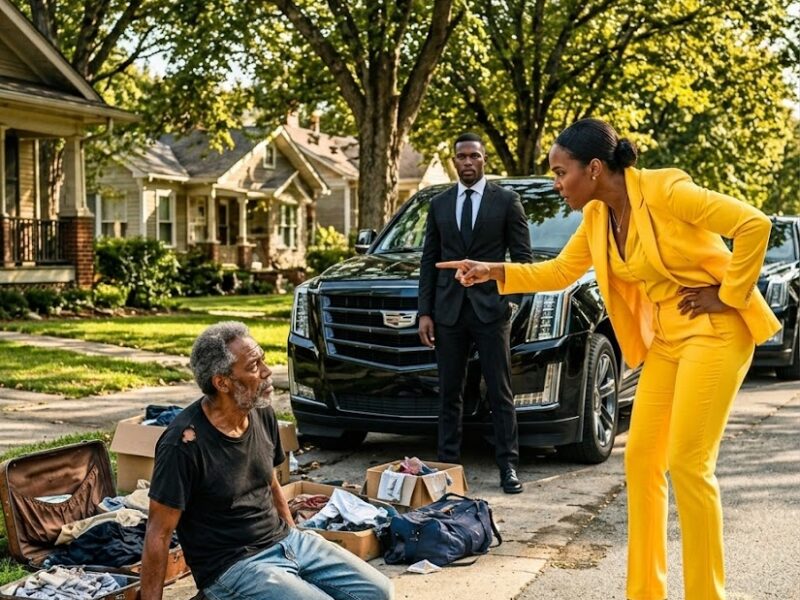
They Threw My Father Out for Looking Poor—Unaware His Billionaire Son Had Sent 10 Black SUVs for Him
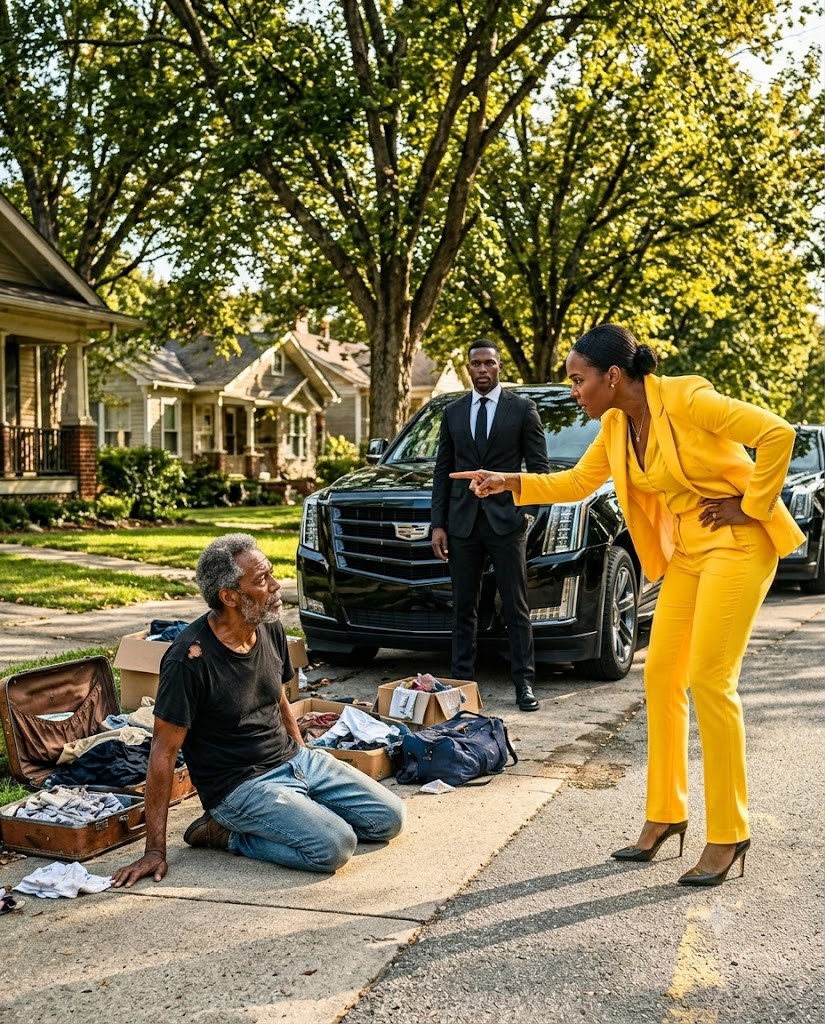
The man in the worn brown jacket stood quietly in the marble lobby of the Kesler Grand, holding a folded note from his son that said, “Table is reserved for you, Dad. I’ll be there by 7.”
He had driven 40 miles for this.
He had pressed his best shirt the night before, the dark blue one he saved for funerals and the occasional wedding, and he had shaved twice because the first pass hadn’t felt close enough.
And when the woman in the sharp blazer looked at him—really looked at him—the only thing she said was, “Sir, I’m going to have to ask you to step outside.”
—
Harold Webb had been drinking coffee alone in his kitchen in Mil Haven, Ohio, reading the same note for the third time.
He had read it enough times by now that the words were already memorized, but he kept unfolding it anyway.
The paper had softened at the crease from handling, the way paper does when it has been opened and closed by hands that aren’t quite ready to let something go.
Nathan’s handwriting was the same as it had always been—slightly slanted, the letters even and careful, the kind of penmanship that came from a kid who had been taught to take his time.
Harold had kept every note Nathan ever sent him.
They were in a shoe box on the shelf above the workbench in the garage, organized by year, each one folded the same way, each one still carrying whatever it had carried when it first arrived.
He was not sentimental by nature.
He just didn’t throw things away.
—
The drive from Mil Haven to Cleveland took just under an hour on a clear evening.
Harold left at 4:30.
He didn’t want to be late.
He also didn’t want to depend on anyone else to get him there.
Nathan had mentioned something about sending a car—maybe more than one—but Harold hadn’t fully followed that part of the conversation.
He had his truck.
He knew the route.
That was enough.
—
The Kesler Grand occupied the corner of a block Harold didn’t recognize.
He’d been downtown once or twice over the years, but not recently, and the city had a way of rearranging itself when you weren’t looking.
The building was glass and stone, polished in a way that made the street feel quieter than it was, as if the noise of the world had been politely asked to wait at the curb.
A uniformed man near the entrance watched Harold’s truck slow and ease into the circular driveway without expression, then looked away when Harold parked and climbed out.
Harold wore his best dress shirt, dark blue, ironed that morning, tucked into the same dark trousers he had worn to Margaret’s memorial service 12 years ago.
The jacket was brown, slightly faded at the elbows, but it fit.
He had his good shoes on.
He had shaved twice.
He walked through the front entrance with the note in his hand.
—
The lobby was tall and quiet in the way that expensive places are quiet—not empty, but controlled.
Marble floors, soft lighting, the distant sound of a piano from somewhere deeper in the building.
People moved through in pairs and small groups, all of them dressed in a way that Harold noticed without being troubled by.
He had been in places like this before, once or twice over the years, for things Nathan had been involved in.
You just kept your hands to yourself and looked for the right person to talk to.
—
He approached the front desk.
A young woman looked up from her screen with a practiced smile.
“Good evening. Checking in?”
“No, I’m here for dinner,” Harold said. “My son made a reservation. The name is Webb—Nathan Webb.”
Something changed in her expression, almost imperceptibly.
Her eyes moved briefly to somewhere behind Harold, then back to him.
The smile returned, slightly different.
“One moment, sir.”
—
He waited.
Around him, the lobby moved at its own pace.
A man in a dark suit crossed behind him.
A group of women in evening dresses passed, trailing perfume.
Harold held his note and stood still.
He heard heels on marble before he saw her.
—
The woman was in her mid-30s, dark blazer, dark hair pulled back cleanly.
She moved with the kind of certainty that came from owning a room—or from managing one for long enough that it amounted to the same thing.
Her eyes went to Harold immediately, not as a question, but as a confirmation, like she’d already decided something and was walking toward the end of it.
“Sir,” her voice was professional, courteous, and very final. “I’m Diane Kesler. I manage operations here. I’m afraid there’s been a bit of confusion.”
She tilted her head just slightly toward the entrance.
“This evening is a private event. We’re going to need to keep the lobby clear for arriving guests. If you’d like to wait outside—”
“I’m here for dinner,” Harold said.
He kept his voice even.
He was not a man who raised his voice easily.
“My son reserved a table. Nathan Webb.”
—
The name landed in the air.
He watched her face and saw nothing change in it.
Not surprise, not recognition, not even a flicker of reconsideration.
Whatever she felt, she had already decided before she walked over here.
“I understand,” she said, “but I’m not seeing your name on our guest list for this evening’s event. Perhaps there was a mix-up with the date.”
She gestured again toward the entrance, patient, smooth, designed to not look like what it was.
“We do have other dining options in the vicinity. I’d be happy to—”
“There’s no mix-up,” Harold said. “I have a note from my son.”
He held it out.
She didn’t take it.
“Sir.” Her voice softened in a way that made it harder, not easier. “I’ll need to ask you to step outside. Our security team will assist you.”
—
A man in a dark uniform appeared at Harold’s left elbow.
Ray Cortez, head of security, broad-shouldered, gray at his temples, uncomfortable in a way he was working hard to hide.
He didn’t touch Harold.
He just stood there as a presence, waiting.
Harold looked at the man, then at the woman, then he took a quiet breath.
“Is there a manager I can speak with?”
“I am the manager,” Diane said.
Harold nodded once.
There was nothing more to say here.
—
He could feel a few people nearby watching.
A woman in her 70s at a table by the window.
A pair of younger guests paused near the elevator.
He didn’t want to make a scene.
That was not who he was.
He wasn’t going to prove anything to anyone in this lobby.
He folded Nathan’s note back into his breast pocket.
He turned and walked to the exit slowly, with his hands in his pockets, his shoulders straight.
—
The evening air outside was cooler than he expected.
Harold crossed to a stone bench near the hotel entrance—the kind of bench that existed more for decoration than use—and sat down.
The city moved around him.
Cabs passed.
People in good clothes moved in and out of the building without looking at him.
He was not angry.
He was tired in a specific way, the way that came not from the body, but from recognizing something you had hoped not to have to recognize.
—
He reached into his breast pocket and took out Nathan’s note.
Unfolded it again.
Read it again.
*Table is reserved for you, Dad. I’ll be there by 7.*
Then he reached into his inside jacket pocket and took out something else.
A photograph, folded once.
Nathan at 20, standing in the garage in Mil Haven, laughing at something off camera.
The engine of Harold’s old Buick open in front of them.
Grease on Nathan’s forearms.
The happiest Harold had ever seen him look.
—
Harold held the photograph for a long moment.
Then he put it away carefully and settled back on the bench to wait.
He was still there 20 minutes later when the woman from the window table—the one who had watched from inside—came out through the side entrance and walked over without hurrying.
“Mind if I sit?” she said.
Her voice was dry and unhurried, the voice of someone who had seen quite a lot of things.
Harold moved slightly on the bench, though there was already room.
“Be my guest.”
—
The woman’s name was Elaine Drummond.
She was 72.
She said it the way people say numbers they’ve made peace with—as information, not apology.
She had been coming to the Kesler Grand for dinner twice a month for the past six years, ever since she moved back to Cleveland after retiring from Case Western Reserve, political science, 31 years of teaching.
She still had the posture of someone accustomed to standing in front of rooms.
She asked Harold what had brought him here.
He told her simply: his son had invited him.
—
She didn’t ask any follow-up questions about what had happened inside.
She just nodded the way someone nods when they’ve already seen a situation and don’t need it explained.
“Good bones,” she said, looking at the hotel entrance. “Bad management decisions.”
Harold almost smiled at that.
—
The evening settled around them.
The street was still busy—Cleveland on a Thursday, the tail end of the dinner rush, people moving between restaurants and parking garages.
Harold watched a group of men in suits disappear into the hotel entrance without slowing, the door swinging wide for them by a man who stepped out specifically to open it.
He watched and felt nothing complicated about it.
He had spent 40 years watching the world sort itself in these small automatic ways.
It did not bother him in the way it might have bothered someone younger.
—
Elaine said, “You seem very calm for a man who was just asked to wait outside.”
Harold considered this.
“I raised a son on my own for 20 years,” he said. “After a while, you stop expecting things to be fair. You just decide what you’re going to do about them.”
She looked at him with the careful attention of someone who had spent decades assessing what people said and what they meant.
Then she nodded again, as if that answered something.
—
Harold had not planned to talk about Nathan tonight.
But the bench was quiet and the evening was long and Elaine asked questions without pushing.
And somewhere in the space between one answer and the next, he found himself talking.
—
Margaret had died in the spring of 1999.
Nathan was 19, finishing his second semester at community college, working part-time at the hardware store on Sycamore Street.
The plan had always been for him to transfer to a four-year program.
Margaret had been saving for it a little at a time, in an account that barely kept pace with tuition rates.
When she died, the savings went to the funeral and the medical bills and what was left of the mortgage she hadn’t told Harold she’d taken a second on.
It wasn’t much.
Harold didn’t blame her.
She had been trying to hold things together and hadn’t wanted him to worry.
—
Harold kept the house, kept his job at the auto shop.
Nathan worked more hours and took fewer classes.
For two years, it went like that.
The two of them navigating the same house and the same grief at slightly different angles, careful around each other in the way that men are sometimes careful when they don’t have the right words.
But they ate dinner together most nights.
They worked on the Buick together on weekends.
They didn’t fall apart.
—
At 22, Nathan transferred to a state university two hours away.
He came home on holidays and some weekends, called on Sundays, sent small amounts of money when he could—even though Harold always sent it back.
Harold still remembered the first check Nathan wrote him.
$40, paper-clipped to a card that said, *For groceries, Dad. I know you won’t ask.*
Harold had looked at it for a long time before cashing it.
He had not wanted to make his son feel like the money was needed.
—
The business had come later.
Harold had followed it from a distance, the way fathers follow things they can’t fully understand—with pride and a certain humbling awareness of how far the world his son was moving in had gotten from the world where they had started.
Webb Capital Group.
A logistics company at first, then acquisitions, then something Harold stopped being able to describe to people at the shop.
He stopped trying to explain and just said, “He does well for himself,” when anyone asked.
That was accurate enough.
—
The letters had started when Nathan went to Singapore four years ago.
Harold had written back to every one at first—not long letters, but consistent, a few paragraphs about what was happening at the shop, which neighbors had sold their houses, how the weather had been.
Nathan’s responses came less frequently after the first year.
Harold told himself the man was busy.
He was building something.
That’s what Harold had raised him to do.
—
But three letters had gone unanswered in the past 12 months.
Not one or two.
Three.
Harold had written each one to the same address—Webb Capital Group Headquarters in Cleveland, attention Nathan Webb.
He had mailed them at the post office in Mil Haven himself, with stamps he had moistened by hand because he didn’t trust the peel-and-stick ones to hold.
He had not mentioned his health in any of them, which he knew in retrospect was a mistake.
—
Eight months ago, he had spent two nights at the county hospital for what the cardiologist called a minor ischemic event.
It had resolved.
He was on a low dose of aspirin and a blood thinner now, and he walked a mile each morning, and he felt fine.
But he had not told Nathan.
He had not wanted to worry him, and he had not wanted to seem like he was demanding attention.
—
He told Elaine the broad shape of it.
Not the medical part—just the letters, the distance, the way things had gradually become quieter than they used to be.
Elaine was quiet for a moment.
Then she said, “Are you sure he received them?”
Harold looked at her.
He had assumed, without much examination, that Nathan had.
“What else would you assume?” he said. “The address was right.”
“That’s not the same thing,” Elaine said carefully. “I’ve been in administration long enough to know that the distance between something being received and something reaching the right person can be very large.”
—
Harold looked at the hotel entrance.
He thought about the woman in the blazer, the way she had looked at him before he even opened his mouth, the way she had not taken the note from Nathan, the speed of it, the practiced smoothness of someone executing a decision they had already made.
He reached into his jacket and took out the letters Nathan had sent him over the years.
He kept them in a rubber band, the whole stack of them flattened by proximity and time.
He found the most recent one, dated about 10 weeks ago.
Nathan’s handwriting.
*Don’t worry about answering. I know you’re always there.*
He read that line twice.
*Don’t worry about answering.*
Not *why haven’t you written back?*
Not *I got your last letter.*
Just: *I know you’re always there.*
—
Harold sat with that for a long moment.
The traffic moved.
Elaine sat beside him, not pressing.
He thought: *I wasn’t writing.*
Harold said it—wasn’t a question.
Elaine didn’t answer that.
She just looked at the street.
—
Harold folded the letter back into the stack and put the rubber band around them again, carefully, the way he put the band around everything.
Not tight enough to damage, not loose enough to lose.
He settled them back into his breast pocket next to Nathan’s note and the photograph from the garage.
“The dinner is at 7:00,” he said.
“It’s 6:20,” Elaine replied.
“Then I’ll wait here.”
She stayed beside him without being asked.
—
The light along the street turned that particular shade of early evening that made everything look slightly more significant than it was.
Harold watched the hotel entrance and said nothing else for a while.
He was not asking for anything.
He had never been good at asking for things.
But he thought about that line in Nathan’s letter—*I know you’re always there*—and felt something settle in his chest that was not quite relief and not quite grief.
More like recognition.
The kind that comes just before something changes.
—
The conference room on the 31st floor of the Carter Building had been theirs for six hours.
The afternoon light had moved across the table twice over, from the east windows to the west, and the coffee from the last refill was cold.
Nathan Webb sat at one end of the table with his jacket still on and his tie loosened half an inch, which was as casual as he got in rooms like this.
The Webb Capital acquisition had been in motion for eight months.
There were four parties involved, two of which needed each other, and two of which needed to be convinced they did.
Nathan had been the one doing the convincing, as he had been for most of his adult life.
—
It was not a skill he had learned in business school.
It was something older, something he had learned from watching his father in the garage—the way Harold could explain an engine problem to a customer who didn’t know anything about engines without making them feel stupid, without overselling, without letting the transaction become about anything other than what it was.
He thought about Harold sometimes in rooms like this.
Not in a nostalgic way—more the way you think about a tool that works when you reach for it.
—
“Lawson is still holding on the valuation,” said the man to Nathan’s left.
Derek Hale, his senior acquisitions director, had the look of someone who had not slept well in several days.
“He wants another 48 hours to review the comparables.”
“He doesn’t need 48 hours,” Nathan said. “He needs someone to tell him the comparable analysis is sound so he doesn’t have to feel like he made the decision himself.”
Derek looked at him for a second.
“So you want me to call him?”
“I want you to call him and tell him you ran the numbers one more time and they hold up. Don’t explain anything. Just confirm.”
Derek wrote something down.
—
Nathan glanced at his watch.
5:47.
He had told Clara to have the convoy ready at 6:15.
The Kesler Grand was 15 minutes from here on a clear evening.
Harold’s place in Mil Haven was 40 minutes more, less or more depending on traffic.
The convoy would need to leave by 5:30 to get there in time and circle back.
He had already sent that instruction.
He had sent it three days ago and confirmed it yesterday morning.
—
Clara appeared at the side door.
She moved quietly for someone who was always moving, and set a folded note on the table next to his coffee cup without interrupting the conversation.
Nathan picked it up when the room paused for breath.
*Convoy departing for Mil Haven at 5:30 per plan. Kesler dinner confirmation received this afternoon through D. All set for 7:00 p.m. Your father confirmed.*
He read that last line twice.
*Your father confirmed.*
—
He should have been the one to call Harold directly to confirm.
He had meant to.
There had been a motion in the board session around 4:00 that had taken 90 minutes to resolve, and the call had not happened.
He told himself it was fine.
Diane had handled it.
He set the note down.
There was something about the phrase that felt slightly off.
*Your father confirmed.*
Not *Harold called to confirm* or *I spoke with Harold* or any of the formulations that would have made it feel like an actual conversation.
Just: *confirmed.*
Through logistics, through the managed system, through Diane’s desk.
—
He picked up his phone and looked at Harold’s contact.
He had called the number a handful of times in the past six months.
Three times it had gone to voicemail.
Once Harold had answered on the first ring and sounded perfectly well.
Nathan had assumed the voicemails were timing—Harold worked in the garage on mornings, sometimes didn’t hear the phone.
He had not pressed.
He put the phone back down.
There were four people in this room who had been waiting for six hours, and there were 17 minutes left to close whatever today could close.
He would call Harold on the drive over.
He would see him in an hour and a half.
—
Clara was back at his side.
This time she leaned down slightly and kept her voice below the level of the room.
“The convoy lead just checked in. They’re at Mr. Webb’s address in Mil Haven.”
Nathan looked at her.
“He’s not there,” she said. “House is locked. Truck is gone.”
Nathan set his pen down very slowly.
“What time did they arrive?”
“5:28.”
—
The convoy had been there for almost 20 minutes.
If Harold had left Mil Haven at 4:30—a reasonable time, if he wanted to be early—he would have arrived at the hotel well before 6:00, which meant he was already there.
Nathan looked at the front of the room, where the presentation slides were still displayed.
Then he looked at his phone.
He thought about the word *confirmed* in Clara’s note.
He thought about the note from Harold in his own breast pocket.
He carried it everywhere, had been carrying it since the morning it arrived.
A small, deliberate thing.
*Dad, I’ll have the car come for you. Don’t drive all that way alone. Call me if anything changes.*
Harold had not called.
—
Nathan pushed back from the table.
“Derek, the comparable analysis is sound. Call Lawson.”
He stood and straightened his tie completely.
“Clara, I need the convoy redirected to the Kesler Grand, and I need Harold’s number pulled up on my phone by the time I reach the elevator.”
He was already moving toward the door.
“What about Lawson—” Derek called after him.
“You have what you need,” Nathan said without turning.
—
In the elevator, Clara handed him his phone with Harold’s contact already on screen.
He pressed call.
It rang four times and went to voicemail.
Harold’s recorded voice—dry, unhurried, Midwestern, exactly as Nathan remembered it—said, “This is Harold. Leave a message and I’ll get back to you.”
Nathan said, “Dad, it’s me. I’m heading to the hotel now. Call me back when you get this.”
He put the phone in his pocket and watched the floors descend.
—
Clara was quiet for a moment beside him.
Then she said, “There’s something else. I was pulling your correspondence logs while you were in the session. I found an intake record for three pieces of correspondence marked as personal, mailed to your attention at headquarters in the past 14 months.”
Nathan turned to look at her.
“They were logged in the shared household inbox,” she said. “There’s no forward record.”
The elevator reached the lobby.
The doors opened.
Nathan stepped out and kept walking.
“Get me everything in that inbox,” he said. “Now.”
—
Ray Cortez had done a lot of things in 22 years of hotel security that he wasn’t proud of.
Most of them were small—redirecting guests who had too much to drink, telling people the restaurant was full when it wasn’t, managing situations that were really just money problems dressed up as something else.
He had learned early that in a building like the Kesler Grand, his job was less about safety than about image.
The security department existed to protect the feeling that everything was as it appeared—smooth, controlled, effortless.
What had happened in the lobby at 6:15 was not in the category of things he wasn’t proud of.
It was in a different category entirely.
—
He stood near the side door of the hotel, half inside and half out, watching the street.
The man was still on the bench.
Still there.
He had been there for 40 minutes.
He had not made a scene, had not approached the entrance again, had not spoken loudly or tried to flag anyone down.
He was sitting with the posture of someone who had made peace with waiting, which was somehow worse than if he had been agitated.
—
Diane had checked once from the interior window.
Ray had seen her cross the lobby and pause there, looking out.
Then she had moved away without changing expression.
That was the part Ray kept returning to.
Not just the instruction—*handle it, there’s a situation at the front desk*—but the speed of it, and the fact that she had already been watching from across the lobby when Harold first approached the desk.
She had known immediately.
She had moved without hesitation.
—
Ray had handled it because it was his job and because Diane Kesler’s instruction carried the weight of the building’s ownership in it.
But he had not handled it well, in his own estimation.
He had been as gentle as the situation allowed, which was not saying much.
The man had asked once if there was a mistake, and Ray had said no.
And the man had nodded and walked out.
And Ray had watched him go and felt the specific discomfort of someone who knows they have just done something they cannot undo.
—
He went outside at 6:20.
Not under orders.
On his own.
Harold glanced up as Ray approached.
His expression did not change.
No anger, no resentment—just attention.
“Sir,” Ray said.
He wasn’t sure what he’d planned to say after that.
He stood there for a second.
“I wanted to—I’m sorry about what happened inside.”
—
Harold looked at him.
Not testing him, not measuring him—just looking.
“You were doing your job,” he said.
“That doesn’t make it right.”
Harold considered this.
Then he said simply, “No.”
—
Ray stood there another moment.
Then he reached into his shirt pocket and took out a business card—the Kesler Grand Security Line, his direct extension—and held it out.
Harold took it without comment.
“If you need anything,” Ray said, knowing how inadequate that sounded.
Harold nodded once.
Ray turned and went back inside.
—
Harold looked at the card for a moment, then tucked it into his breast pocket alongside Nathan’s note and the photograph and the stack of letters.
Elaine Drummond was still beside him.
She had been quiet while Ray was there, and she was quiet now, watching the street with the same patient attention Harold had noticed when she first sat down.
“That young man felt terrible,” she said.
“He did,” Harold agreed.
“You made it easier on him than you had to.”
Harold thought about this.
“He didn’t make the call,” he said. “Someone inside made the call. He just carried it out.”
He paused.
“I know the difference.”
—
Elaine nodded slowly.
“You’ve been around a long time.”
“Long enough.”
She smiled—dry, not unkind.
“You remind me of a colleague I had for 20 years. Philosophy department. Nothing ever rattled him. He used to say that dignity was the one thing no one could actually take from you. They could take everything else. Not that.”
Harold didn’t respond to that directly.
He looked at his watch.
It was 6:35.
Nathan had said 7.
Harold had been sitting here for nearly an hour.
—
His back was not as young as it used to be, but the bench was solid stone, and he had sat on harder things.
He reached into his pocket and took out his phone.
No missed calls.
He checked the signal—three bars, which was fine.
His phone was not on silent.
He had made sure of that before he left Mil Haven.
He had known Nathan might need to reach him.
He had kept the ringer on the highest setting.
He put the phone away.
—
Elaine asked, “When did you last see him?”
Harold thought.
“Eight months ago,” he said. “He came through Cleveland for a weekend. We had dinner on Saturday night, and he drove out to Mil Haven on Sunday and we had coffee. He stayed for about two hours.”
“Was it good?”
Harold smiled just slightly.
“He fixed the hose on my truck. I didn’t ask him to. He just looked at it and said the fitting was loose and got a wrench out of the bed and fixed it like he was 22 again.”
He paused.
“Yeah. It was good.”
—
Elaine was quiet for a moment.
Then she said, “He sounds like a good man.”
“He is,” Harold said simply, without qualification.
The way people say things about people they know completely.
—
Through the lobby windows, Harold could see the soft interior light, the movement of well-dressed people, the warm glow of the dinner event beginning to fill the hotel.
He could see the edge of a table arrangement—white linens, tall centerpieces.
Whatever event was inside, it was large and expensive and carefully put together.
He wondered if Nathan’s table was in there.
He wondered what Nathan was doing right now.
—
His phone rang.
He looked at the screen.
Unknown number.
He answered.
A woman’s voice, professional and careful.
“Mr. Webb, this is Clara Reeves. I’m Nathan’s chief of staff. We’re trying to locate you. Are you all right?”
Harold sat a little straighter.
“I’m fine,” he said. “I’m outside the hotel.”
A pause.
“The Kesler Grand?”
“Yes.”
Another pause.
Shorter.
“Can you stay where you are? Mr. Webb is on his way.”
“I’m not going anywhere,” Harold said.
—
Inside the Kesler Grand, Diane Kesler stood at the edge of the private dining room entrance and did the only thing she was good at when things shifted unexpectedly.
She recalibrated.
The event was running well.
The tables were set.
The kitchen was ahead of schedule.
And Martin Kesler—her father, the man who had built this hotel into what it was over 30 years of dogged, methodical hospitality work—was talking to two of his oldest board members near the bar, looking satisfied.
He had been looking forward to tonight.
—
The Webb Capital investment had been his priority for eight months—a deal that would shore up the Kesler Group’s expansion plans for the next decade.
Nathan Webb was, as Martin had said at least six times in the past month, exactly the kind of partner they needed.
Capital, vision, and—apparently, according to Diane, who had been managing the relationship—a deep personal investment in the partnership because his fiancée was family.
That was the architecture she had built.
Nathan’s engagement to Diane was supposed to be the thing that made the deal personal, made it more than a transaction.
That was how Martin had framed it to his board.
That was how Diane had framed it to Nathan—though she had done it more subtly, more like breath than like furniture, present everywhere and named nowhere.
—
The problem with architectures was what happened when the wrong person walked through the door.
She had been at the reception desk when Harold arrived.
She had seen him before he reached the front.
The worn jacket, the careful posture, the way he moved through a lobby that didn’t match him—not because he was out of place in any fundamental sense, but because he was not trying to fit.
He had been looking for the desk.
He had been looking for his son.
—
She had known who he was within four seconds of seeing him.
Nathan had shown her a photograph once, early in their relationship.
Harold in his garage, engine parts spread across the floor, grinning at the camera.
*He’s the reason for all of it,* Nathan had said, and his voice had carried something that Diane had recognized and filed away carefully—the way she filed away anything that might complicate the story she was building.
She had given Ray the instruction before Harold reached the desk.
*Handle it. There’s a situation at the front desk.*
She had not said Harold’s name.
She had not needed to.
—
Now Harold was outside.
Her phone showed a draft message, still unsent.
*Nathan, your father called—said he wasn’t feeling up to the drive. He sends his love. I’ll explain when you get here.*
She had written it in the elevator on the way up from the lobby.
She had been about to send it.
Then Nathan’s convoy had been rerouted, and Clara had started pulling correspondence logs, and the message had become suddenly, obviously unworkable.
She deleted the draft.
—
Her phone buzzed.
Nathan’s number.
She answered on the second ring.
“Nathan, I was just about to call you—”
“Is my father there?”
His voice was level.
Too level.
“There was a small confusion at the entrance,” Diane said.
She had the next sentence ready, practiced into smoothness.
“I think he may have gotten the time slightly wrong, or there was a miscommunication about the guest list—”
“He’s outside the hotel, Diane.”
She said nothing.
In the pause, she made several calculations at once, none of which led anywhere useful.
“He’s been outside for almost an hour,” Nathan said. “He drove 40 miles. He was wearing his best jacket.”
“Nathan, I can explain what happened—”
“I’m not asking you to explain right now.”
He stopped.
“I’m telling you he’s outside. I’ll be there in eight minutes.”
The call ended.
—
Diane lowered the phone.
Around her, the dinner event continued its smooth, expensive progress.
Wait staff moved.
Glasses were filled.
Her father laughed at something across the room.
The chandelier above the private dining room cast everything in warm amber—the kind of light that made people feel they were in the right place.
She walked to the interior window overlooking the entrance and looked out.
—
Harold was still on the bench.
The older woman had joined him at some point—Elaine Drummond, one of their regular dining guests.
Seventies, something sharp as a tack, and not someone who missed things.
The two of them were talking.
Harold had his phone to his ear.
Diane watched him for a moment.
He had the same posture in the photograph Nathan had shown her—straight, unhurried, completely unself-conscious about the world around him.
He had not moved from the bench in 50 minutes.
He had not argued with Ray, had not tried to come back inside, had not flagged down a passerby.
He had just sat there as if he had all the time in the world, and the world would eventually come to him.
It probably would.
—
She turned from the window.
Eight minutes.
She needed a version of events that acknowledged what had happened without defining what it meant.
Something that was true in the margins, where everything looked like a mistake.
She had spent 18 months building a structure around Nathan’s life.
Not controlling it—she had never thought of it as controlling.
She had thought of it as curating, smoothing, helping him become the version of himself that belonged in her world.
And that structure was made of a thousand small decisions, none of which had seemed drastic at the time.
—
The letters routed to the shared inbox.
The calls forwarded to her voicemail and logged as handled.
The visit Nathan had wanted to make to Mil Haven last February that she had described as conflicting with a client weekend—until Nathan had sighed and rescheduled, and then didn’t reschedule.
The visit Nathan had planned for June that Diane had told him Harold suggested they push to fall, because summer was too hot for the old man to handle guests.
Harold had never said any of that.
Diane knew that.
She had simply said things that Nathan, who wanted to believe his father was fine, was predisposed to accept.
It had worked for 19 months.
It had worked.
—
Eight minutes.
She put her phone in her pocket and went downstairs to wait by the entrance.
She needed to be there when Nathan arrived.
She needed to be in the right position in the frame.
She crossed the lobby and reached the entrance just as the first black SUV turned onto the street.
Then the second.
Then the third.
She stopped counting.
—
In the lead SUV, Nathan sat in the back seat with his phone on the armrest and the door window down two inches, letting the evening air move through.
Clara was in the front passenger seat with her tablet, reading him items from the shared inbox log as the convoy moved toward the hotel.
“The first letter arrived at headquarters on March 14th,” she said.
Her voice was careful, professional, without inflection.
Clara Reeves had been his chief of staff for six years, and she knew how to deliver bad news without making it into a performance.
“It was logged by the mail room under incoming personal correspondence and transferred to the shared household management system per protocol. The forward chain ends at the shared inbox. There’s no record of it being forwarded to you, printed, or converted to a task item.”
“What date was the shared inbox protocol established?” Nathan asked.
Clara found it.
“October of last year. Diane requested the system configuration in your name. The authorization email uses your name in the header, but the instruction was sent from her device.”
Nathan looked out the window.
—
“The second letter arrived July 2nd,” Clara continued. “Same intake path, same result. The third arrived December 9th. All three are still in the inbox, unread. I’ve pulled them out and scanned them. I can read them to you now, or—”
“No,” Nathan said. “Don’t read them.”
Clara lowered the tablet slightly.
“I want to read them myself,” he said.
She nodded and set the tablet face down on her knee.
—
The convoy was three blocks from the hotel.
Nathan had been in the back of this vehicle for 11 minutes, which was long enough to understand the shape of what had been done.
He did not need more information to understand the shape.
What he needed was to see his father.
He picked up his phone and called Harold’s number.
It rang twice.
“Nathan.”
Harold’s voice was exactly what it always was—that particular Midwestern steadiness, like bedrock, like the kind of thing that didn’t announce itself.
“Dad.” Nathan exhaled. “I’m two minutes out. Are you still on the bench?”
“Still here,” Harold said.
“I’m sorry. I’m sorry it took me this long to get there.”
A pause.
“Don’t worry about it,” Harold said.
Then, after a moment: “It’s a nice evening. Elaine’s been keeping me company.”
“Elaine?”
“A woman I met. She came out from inside to sit with me.”
A beat.
“She used to teach at Case Western. Very smart woman. We talked about a lot of things.”
—
Nathan almost smiled despite himself.
His father could sit on a sidewalk bench for an hour and come away with a new acquaintance and a conversation about academia.
He had always been like that.
Open without being needy.
Present without making his presence a demand.
“One minute,” Nathan said.
“I’ll be here,” Harold said.
And Nathan could hear the slight warmth in it—the thing his father never said directly, but carried in tone.
*I’m always here. I’ve always been here.*
—
He put the phone in his pocket.
“Clara,” he said.
“Yes.”
“When we get back to the office tomorrow—whenever that is—I need you to build me an independent communications line for Harold. No shared systems, no household management access for anyone. Just his number, my number, and a direct channel.”
“I’ll set it up tonight,” Clara said.
“Thank you.”
He paused.
“I also need you to pull the voicemail record. The one I heard in the car. Harold’s call from three months ago.”
“Yes.”
“Save it somewhere permanent.”
Clara was already typing.
—
The convoy turned the last corner.
Through the window, Nathan could see the hotel entrance ahead—the lit canopy, the small cluster of guests arriving, and beyond them, on the stone bench to the left of the entrance, two figures.
One elderly woman, sitting upright with the posture of someone who had been sitting in lecture halls her entire life.
And one man in a brown jacket, who had raised Nathan Webb alone from the age of 19 and never once made him feel like the weight of it.
—
Harold saw the vehicles at the same moment.
Nathan watched through the glass as his father looked up, tracked the first SUV, then the second, then kept looking.
His expression didn’t shift the way most people’s did when they saw something unexpected.
He just looked steadily, as if he were confirming something he already knew.
Elaine Drummond said something to Harold.
Harold nodded once.
Then he stood up from the bench, unhurried, and straightened his jacket with one hand.
—
Nathan felt something move through his chest.
That was not a business calculation.
It was older than that.
It was the thing you felt when you had been away for too long and then you were not away anymore.
He opened the door before the vehicle had fully stopped.
Clara said, “Sir—” but he was already out.
—
The evening air was cool, and he walked toward his father, and Harold walked toward him, and they met in the space between the bench and the first SUV.
Nathan reached out and put his hand on his father’s shoulder, and Harold put his hand on Nathan’s arm, and the two of them stood like that for a moment.
That had nothing to do with vehicles or hotels or deals or anything else.
“You drove,” Nathan said.
“You know I don’t like to be driven,” Harold said.
“I sent 10 cars.”
Harold made a sound that was somewhere between a sigh and a laugh.
“I saw them.”
He looked at the convoy lined along the street.
“You didn’t need to do all that.”
“Yeah, I did,” Nathan said.
He kept his hand on his father’s shoulder.
“Come on. Let’s get you inside.”
—
“Nathan.”
A voice from behind him.
Diane, at the hotel entrance, controlled, precise, prepared.
“I need to explain.”
Nathan turned to look at her.
She was standing at the top of the entrance steps, the light of the hotel lobby behind her.
Her expression composed in that particular way she had—like someone who had worked out all the angles and was confident in the presentation.
He held her gaze for a moment.
Then he said quietly, “I know you do.”
—
He turned back to his father.
“Dad,” he said, “do you still have Ray’s card?”
Harold looked at him.
“The security fellow?”
“Yes. I’m going to need you to keep that for now.”
He looked over his shoulder at Ray Cortez, who had appeared in the doorway behind Diane, already looking like someone who knew what was coming.
“Ray,” Nathan said, “the incident report for tonight. I’ll need a copy.”
Ray Cortez said, “Yes, sir.”
—
Without another word, the hotel guests near the entrance had stopped moving.
Not all of them, and not obviously—it was the kind of stillness that descends on a crowd when something is happening that has no good social script.
Three valets stood at the edge of the circular driveway, no longer pretending to look elsewhere.
A couple in evening wear, who had been about to enter the lobby, had paused on the steps without quite deciding to.
Two of the hotel’s kitchen staff, outside on a break, watched from the side of the building with their arms folded.
Ten black SUVs.
A man in a suit who had climbed out of the first one and walked directly to an old man on a bench.
The old man standing to meet him.
The handshake—or was it more than a handshake, a grip held longer than business—in the space between.
—
Elaine Drummond watched all of it from her seat on the bench, which she had not vacated.
She was not the type to make herself scarce when things got interesting.
She had seen Harold’s face when the vehicles turned the corner.
Had seen the exact moment he recognized what the convoy meant.
Not just that his son was in one of those vehicles, but that his son had sent them specifically for him.
That the whole procession had been arranged as a way of saying: *You are worth bringing to this place properly.*
That the whole evening had been designed around Harold’s arrival being something.
And Harold had stood up quietly, straightened his jacket, and walked to meet his son—the same way he had been sitting on that bench, without performance, without announcement, as if he had known all along it would come out right.
—
Now Diane Kesler stood at the entrance with an expression that Elaine had seen in 30 years of academic administration.
The expression of someone who has run out of workable versions of a story and is looking for the door.
Martin Kesler had appeared in the lobby doorway behind his daughter.
Elaine could see him through the glass—a man in his mid-60s, the kind of bearing that came from decades of running something, currently trying to understand a situation that his instincts were telling him was not going in any direction he had planned for.
His eyes moved from the convoy to Nathan to Harold to Diane and back again in a slow loop that kept returning to Diane longer each time.
—
Nathan spoke to the security man, Ray, who had come outside looking like someone who had just decided to cooperate fully with whatever inquiry was about to begin.
And then Nathan turned back to his father.
“Come on,” he said, and he guided Harold not back toward the hotel entrance, but toward the first SUV, opening the door himself, his hand briefly on Harold’s back as his father got in.
Diane came down the steps.
“Nathan, we can go inside. The dinner is—”
“Diane.”
His voice was not loud.
It carried, though.
“I’ll call you tonight.”
He looked at her for exactly long enough to make clear that the call would not be the kind she was hoping for.
Then he got into the vehicle, and the door closed.
—
The lead SUV pulled away from the curb.
The others followed, one by one, until all 10 had disappeared down the street.
The crowd of onlookers did not immediately disperse.
They stood there another few seconds, the way people stand after watching something end, still arranged around the space where it happened.
Diane stood at the bottom of the steps with her hand resting on the railing and her face perfectly composed, which Elaine thought was the most revealing thing about her.
The woman had a gift for controlling her surface.
What Elaine was less certain of was how much of what lived below the surface Diane had control over.
—
Martin Kesler came outside.
He stopped beside his daughter and did not look at her immediately.
He looked at the empty street where the convoy had been.
“Whose name is on the incident report?” he asked.
His voice was quiet.
Diane turned to him.
“Dad—”
“That’s not what I asked.”
She didn’t answer.
Martin turned toward the entrance.
Ray Cortez was still there at the top of the steps, not quite inside and not quite outside.
“Ray,” Martin said.
“Yes, Mr. Kesler.”
“The incident report from this evening. Can you print two copies?”
“Yes, sir. I can have them for you in five minutes.”
Martin nodded.
He looked at his watch—the old habit of a man who had run large operations and always thought in terms of what could still be managed in the time that remained.
Then he looked at Diane once more.
“Come inside,” he said—not unkindly, but not warmly.
—
Elaine watched Diane follow her father into the hotel.
The couple who had been paused on the steps finally moved, going inside, resuming their evening.
The valet went back to work.
The kitchen staff disappeared around the corner.
The bench was empty now.
Elaine sat on it alone for a moment longer, looking at the street.
She thought about Harold’s stack of letters wrapped in a rubber band, worn soft at the edges from being carried.
She thought about the way he had described Nathan fixing the truck hose—the specific physical detail of it, the wrench from the truck bed, the fitting that was loose.
She thought about the note in Nathan’s handwriting.
*I know you’re always there.*
—
She reached into her small evening bag and took out her phone.
Harold had given her his number before the convoy had arrived, in the easy, practical way that people exchange contact information when they’ve had a good conversation and don’t see any reason not to.
She had put it in without making anything of it.
She typed a short message and sent it.
*He found you.*
Then she put her phone away and went back inside the hotel to have her dinner, because she was 72 and she had been looking forward to the sole for several days, and the evening was still salvageable.
—
The lead SUV moved through downtown Cleveland with Nathan and Harold in the back seat, the city sliding past the tinted windows in long stripes of light.
For the first few minutes, neither of them said anything.
Not because it was uncomfortable—it was the kind of silence that existed between people who had spent enough time together to know that silence was not absence.
Harold was looking out the window with the same calm attention he brought to everything.
Nathan had his phone face down on his knee.
“Where are we going?” Harold asked.
“I booked you a suite at the Marriott,” Nathan said. “Quieter. Better than a dinner party.”
Harold tilted his head slightly.
“You don’t have to do that.”
“I know.”
Harold looked at him.
A beat passed.
Then he looked back at the window.
He understood, in the way he understood most things, without drama, without requiring it to be explained to him.
—
Nathan asked what happened exactly in the lobby.
Harold described it simply.
He had come in, gone to the front desk, told them he was there for a dinner reservation under Nathan’s name.
A woman had approached—the same woman Nathan had seen on the hotel steps.
She had told him there was a confusion, that the event was private, that he should wait outside.
Harold had told her he had a note from his son.
She had not looked at it.
She had asked him to go.
—
He told it without heat—just the sequence of events, as clearly as he would have described a mechanical problem.
This happened, then this, then this.
“Did she say her name?” Nathan asked.
“Kesler,” Harold said. “She said she managed the hotel.”
Nathan looked at his phone.
He turned it over and looked at Clara’s most recent message, which contained the scanned images of the three letters—his own name on the outside of each envelope, Harold’s return address in Mil Haven, the stamps worn and slightly crooked from having been moistened by hand.
He had not read the letters yet.
He would—but not tonight.
Not in the car.
Not in front of his father.
He put the phone down.
—
“The letters you sent,” he said. “I didn’t receive them.”
Harold was quiet for a moment.
“I thought maybe the address was wrong,” he said.
“The address was right. They came to headquarters. They were routed to a shared system that Diane managed.”
He paused.
“She never forwarded them to me.”
Another silence.
Longer this time.
—
“She knew who I was,” Harold said.
“Yes,” Nathan said. “She knew before you reached the desk.”
Harold absorbed this.
He did not react with visible anger.
He did not say anything disparaging.
He just sat with it for a moment, the way he sat with most things—long enough to see it clearly.
“The voicemail, too,” Nathan said. “Three months ago, when you called about the heart thing.”
Harold looked at him.
“You heard that?”
“Clara found it in the managed inbox. I heard it in the car on the way to the hotel.”
He stopped.
“You had a hard episode and you didn’t tell me.”
“It resolved,” Harold said. “It was a minor event.”
“Dad—”
Harold said it in the exact tone he had always used to close conversations he didn’t want to extend unnecessarily.
“I was in the hospital for two nights. They adjusted my medication. I feel fine. I walk every morning. I didn’t want to worry you.”
—
Nathan looked at his father.
Sixty-seven years old, still working in the garage some days—not because he needed to, but because he was not the kind of man who sat still by nature.
Still getting up at 5 in the morning out of habit from 40 years of early shifts.
Still moistening stamps with a sponge because he didn’t trust the new kind.
“You should have told me,” Nathan said.
“You’re right,” Harold said. “I should have.”
That was it.
No argument, no qualification, no revisiting.
Just an acknowledgement, clean and full, the way Harold had always accepted when he was wrong about something.
Nathan had tried to learn that from him for years, with varying success.
—
The SUV pulled up in front of the hotel.
The driver opened Harold’s door.
Harold got out without waiting for Nathan and looked up at the building with the calm assessment of someone who is not impressed or unimpressed by buildings.
Nathan came around the vehicle.
“Clara arranged the room. Dinner tonight—just the two of us. Upstairs.”
Harold nodded.
Then he reached into his jacket pocket.
Nathan expected the letters, or the note, or the photograph.
What Harold took out was a small white envelope.
“I brought you something,” he said.
He held it out.
—
Nathan took it.
Inside was a photograph, printed on regular paper—slightly faded, the kind of quality you got from a drugstore printer.
Nathan, at 20 years old, standing in Harold’s garage in Mil Haven, with both hands on the edge of the open hood of Harold’s old Buick, laughing at something.
The garage was a mess in the background—tools everywhere, oil rags, a portable radio on the shelf.
But Nathan’s face was completely unguarded in the photograph, the way his face was almost never unguarded anymore.
And Harold’s hand was visible at the edge of the frame, reaching for a wrench.
—
He turned it over.
In Harold’s handwriting, which was careful and deliberate and had not changed much since Nathan was in high school:
*Best day. We fixed that engine in two hours.*
Nathan stood in the doorway of the hotel and held the photograph for longer than he had held anything in recent memory.
“I have one like it,” Harold said. “At home. I keep it in the kitchen.”
Nathan looked up.
“I thought you should have one too,” Harold said. “In case you forget what we look like when we’re not working.”
—
Nathan put the photograph back in the envelope, carefully, the way you put something away when you intend to keep it.
“Come on,” he said. “Let’s get you fed.”
They went inside.
—
They ate in Nathan’s suite.
Not the kind of dinner that had been arranged downstairs at the Kesler Grand.
No centerpieces, no ambient lighting calculated to enhance an investment pitch, no wait staff trained to disappear and reappear at precise intervals.
Just room service, ordered from a menu Harold read without his glasses, then gave back and said, “Whatever the steak is,” and coffee.
Nathan ordered the same.
—
While they waited, Nathan read the three letters.
Harold had gone to the window and was looking at the city with his hands in his pockets, giving Nathan the space to read without being watched.
That was Harold.
He always knew when to step back without making it a gesture.
—
The letters were not dramatic.
That was what got Nathan.
They were the letters of a man writing to his son the way he always had—practical, warm, economical with words.
The first one, from March, mentioned a repair he had done on a neighbor’s truck, a film he had watched twice because he couldn’t remember the ending the first time, the fact that the maple in the backyard had come through the winter without losing any more branches.
At the bottom of the third page, almost in passing:
*I’ve been trying to reach you. Your office says you’re traveling. I hope you’re well.*
That was it.
*I’ve been trying to reach you.*
One sentence.
No demand, no recrimination—just information.
He thought Nathan should know.
—
The second letter, from July, was about a summer.
Harold had spent two extra weeks in the same garage where he had started at age 23, helping a retired mechanic restore an old car.
They had gotten it running.
Harold seemed genuinely pleased about this.
Three paragraphs about the car, half a paragraph at the end:
*I haven’t heard back from you. I suppose you’re very busy. The address on this should be right—I’ve checked it twice. Anyway, I’ll write again.*
—
The third letter, from December, was the shortest.
A paragraph about Christmas, one about the neighbor’s dog, one about a small thing he had found in the garage that he thought Nathan might want.
A compass.
Harold had given him as a boy—the kind for drawing circles.
It had come out of a box when Harold was sorting.
He had been keeping it for when he saw Nathan.
At the very end:
*I’m doing all right. Don’t worry about not writing back. I know how it is.*
—
Nathan set the letters down on the bedside table and looked at the wall.
*I know how it is.*
His father had spent 14 months sending letters to an address that took them and buried them, waiting for replies that would never come, and had managed to find a way to give Nathan the benefit of the doubt anyway.
Had managed to assume busyness over negligence, assumption over conspiracy.
It was not something Nathan was capable of feeling good about.
—
Harold turned from the window when the food arrived.
He sat across from Nathan at the small table by the window and poured his own coffee without asking if there was anything else.
They ate for several minutes before Nathan said anything.
“I called Daniel Reeves on the drive over.”
Daniel was his general counsel, a man who had known Nathan for 12 years, who had been in the car tonight and had heard the voicemail the same moment Nathan had.
“I’m ending the engagement.”
—
Harold did not look surprised.
He cut a piece of the steak, which was very good, and said, “That’s a big decision.”
“It’s an easy one,” Nathan said.
Harold looked at him.
There was something evaluating in the look—not disapproving, not approving, just careful.
The look of a man taking the measure of a statement before accepting it.
“Is it what you want?” Harold said. “Or what you think you owe me?”
—
Nathan was quiet for a second.
It was—he recognized—exactly the right question, and exactly the kind of question Harold had always asked, not to make things harder, but because he’d spent a lifetime knowing the difference between actions taken for good reasons and actions taken to manage guilt.
“Both,” Nathan said honestly. “But mostly the first.”
Harold nodded.
“All right, then.”
—
“The Kesler deal is off, too,” Nathan said. “I called Martin Kesler’s assistant and left word. Clara will handle the formal communication in the morning.”
Harold sat with this.
“That’s a lot of money.”
“I’ll find other money,” Nathan said. “I always have.”
Harold almost smiled at that.
“Yes,” he said. “You have.”
He looked at the city through the window for a moment.
“Your mother would have liked the view from up here.”
—
Nathan looked at him.
This was Harold’s way—a pivot toward something true and simple, away from the complicated territory, as a way of saying: *That part is settled. Now we’re just here.*
“She would have,” Nathan said.
They were quiet for a while after that.
Comfortable, quiet—the kind Nathan had been missing without realizing how much, the kind that had a specific texture to it.
His father’s presence across a table, the sound of cutlery, the city outside.
—
After dinner, Harold took out his phone and showed Nathan the text message from Elaine Drummond.
*He found you.*
“She came out to sit with me,” Harold said. “I didn’t ask her to. She just did.”
Nathan thought about that—the woman who had watched what was done and decided to go outside anyway.
“I’d like to thank her,” he said.
“I’ll give you her number,” Harold said.
He pulled up the contact.
Nathan wrote it down in his phone.
—
Then Harold put his phone away and looked at Nathan the way he sometimes did—the steady, unremarkable look that meant: *I have something to say, and I’m going to say it once.*
“I’m not angry,” Harold said. “About tonight. About the letters. About any of it.”
He paused.
“I want you to know that.”
Nathan waited.
“But I’m not going to pretend it didn’t happen,” Harold said. “And I think we should stop treating time like there’s an unlimited amount of it.”
—
Nathan didn’t say anything immediately.
He looked at his father’s hands on the table—the knuckles, the old scar along the right thumb from a blade slip years ago, the way the skin sat differently at 67 than it had at 50.
“Come to Cleveland,” he said. “I’ll get you a place near me.”
Harold was quiet for a long time.
“Let me think about it,” he said finally.
He picked up his coffee.
“But don’t cancel my truck. I’m driving myself wherever I go.”
—
Nathan looked at him.
He was going to laugh—he could feel it coming.
The specific laughter of a man who has just found something he thought was lost.
And he let it happen, quietly, in the suite above a city where nothing had gone the way anyone planned.
And his father sat across from him, looking almost embarrassed to have said something funny.
“Okay,” Nathan said. “I’ll cancel nine of the 10.”
—
Martin Kesler had built the Kesler Hospitality Group over 30 years, one property at a time, starting with a 60-room motor inn off the interstate that he had bought with borrowed money and talked into relevance through sheer consistency of operation.
He was not a visionary in the way that word was used now.
He did not disrupt things or pivot or build ecosystems.
He just ran hotels.
He ran them carefully.
He ran them honestly.
And he ran them with the understanding that the product he was actually selling was the feeling that you were somewhere you deserved to be.
—
He believed in consequence—not the punitive kind, the structural kind.
The idea that actions had shapes, that what you did accumulated into something.
That the hotel he had built was what it was because every decision he had made in it had added to or subtracted from a total.
He had always tried to make it add.
Diane had subtracted tonight in a way he had not seen coming, and in a way that was going to cost more than a deal.
—
He read Ray’s incident report twice.
It was brief—hotel security reports were always brief—but it contained the name of the person who had given Ray the instruction, the time of the instruction, and the name of the person who had been escorted outside.
*Harold Webb, per direction of DK, hotel management.*
Harold Webb.
The same Harold Webb who was the father of Nathan Webb, who had been Martin’s investment partner in progress for eight months, who had just driven away from Martin’s hotel in a convoy of 10 black vehicles that a hotel full of witnesses had watched with their phones out.
—
Martin set the report on the desk in his office on the third floor.
He looked at it for a moment.
Then he called Diane’s mobile.
She came in two minutes.
She had clearly been preparing.
There was a version of events in her eyes—the kind of thing she was very good at assembling.
Martin had watched her do it her whole life and had mostly admired it.
The ability to find the workable frame, to present a situation in the angle that showed it best.
He had thought of it as a business skill.
Tonight it looked like something else.
—
“Sit down,” he said.
Diane sat.
“Did you know who he was,” Martin said, “when you had him removed?”
It was not quite a question.
He had learned over 30 years of managing operations that the most important things you said to people, you said as statements they could agree or disagree with.
You didn’t ask them to incriminate themselves.
You just stated what you knew and let them decide what to do with it.
Diane was quiet for a long moment.
Then she said, “Yes.”
—
Martin looked at the report.
He was 64 years old.
He had seen a lot of people sit on the other side of this desk and give him their version of a thing.
He had learned that what came after *yes* was usually more important than the *yes* itself.
“Why,” he said.
Diane looked at her hands.
“I was trying to manage the evening,” she said. “Nathan and I had spent months building the right context for this partnership. Harold—his father—is a lovely man, but he doesn’t fit the environment we were creating. I didn’t want tonight to be about managing impressions when it should have been about closing the relationship.”
She paused.
“I thought I could explain it to Nathan afterwards. That there had been a confusion, that Harold had arrived early and gotten lost.”
—
Martin was quiet.
“It was a mistake,” she said.
She said it cleanly, without excess.
She did not cry.
She did not try to make Martin feel sorry for her.
These were things Martin had always respected about her, and still did, even now.
“Yes,” he said. “The deal is gone.”
She said it was not a question either.
“The deal was gone when those 10 vehicles pulled away,” Martin said. “You know that.”
Diane nodded.
—
Martin picked up the report.
“This is going to Nathan’s legal team. Ray has already made a copy for them.”
He set it down again.
“I want you to step back from operations.”
Diane looked up.
“Effective immediately,” he said. “I’ll call it a leave of absence. I need you to not be in this building for a while.”
—
She absorbed this.
She could have argued it.
She was an equal partner in the Kesler Group, a co-owner of several properties, a director on the board.
She had standing.
But she didn’t argue.
She just looked at her father.
“The letters,” she said. “Nathan’s father’s letters. I should have—”
“We are not going to itemize it tonight,” Martin said.
He was not cruel about it.
He was just clear.
“Go home, Diane. Rest. We’ll talk later in the week.”
—
She stood.
She crossed to the door.
At the door, she stopped, but she didn’t turn back.
“I thought I was helping him,” she said. “Nathan. I thought his past was holding him back.”
Martin looked at the window.
Outside, the city continued.
Restaurants lit, traffic steady, the normal business of an evening that had been ordinary for everyone not connected to the Kesler Grand.
“His past,” Martin said quietly, “is who raised him.”
Diane left without responding.
—
Martin sat in his office for a while after that.
He looked at the incident report, then set it aside.
He looked at the deal summary on his desk—eight months of preparation, revised projections, legal framework—and set that aside, too.
Then he picked up his phone and called his assistant.
“Reach out to Nathan Webb’s office tomorrow morning,” he said. “Not the legal team. Nathan directly. Tell them I’d like to speak with him personally when he’s ready.”
He paused.
“And tell them I’m sorry.”
His assistant noted it without comment.
—
Martin sat alone for another few minutes.
Then he turned off the light in his office and went to check on his hotel, because it was Thursday night and there were guests in his building who had nothing to do with any of this, and they deserved to have someone paying attention to the evening he had promised them.
That, at least, he could still do right.
—
Harold stayed in Cleveland for four days.
He had not planned to.
He had packed for one night—his good shoes, his pressed shirt, a change of clothes in an overnight bag that he had owned since roughly 1998 and which had a zipper that required some coaxing.
Nathan had been going to take him to the hotel dinner and then drive him home the next morning.
That was the plan.
The plan, as Harold had noted without complaint on the drive from Mil Haven, had not fully survived contact with the evening.
—
By the second day, they had established a rhythm.
Nathan worked in the mornings from the suite he had taken at the same hotel—the Marriott, which was quieter than the Kesler Grand and did not come with the same associations.
Harold walked in the mornings, the same mile he walked at home, along a route he had mapped himself from the hotel block and back.
In the late mornings, they had coffee together.
In the afternoons, Nathan took calls and Harold found things to do.
He had walked down to a hardware store near the hotel, introduced himself to the man at the counter, and spent 90 minutes looking at fasteners and talking about socket sets.
He came back satisfied in the particular way Harold came back satisfied from things—without needing to report on them, just visibly more settled.
—
In the evenings, they ate together and talked about things that were and were not the topic.
On the second evening, Nathan asked about the hospital stay.
Harold told him properly this time—not the abbreviated version he had offered in the car, but the actual account.
The morning it had started, the specific symptoms, the drive to County Hospital in Mil Haven—he had driven himself, which Nathan pointed out was inadvisable, and Harold acknowledged without changing his position on it.
The two nights, the cardiologist, the medication adjustment.
He described the doctor clearly—a woman named Patel, thorough, not one to oversell a crisis or undersell a precaution—and the follow-up appointments he had kept without being reminded.
His current medication, his current routine, the morning walks.
—
Nathan listened without interrupting, which had always been one of the things Harold had appreciated most about his son in adulthood.
The interrupting habit was a young man’s habit.
Nathan had grown out of it.
When Harold finished, Nathan said, “I want you near a good cardiologist. Cleveland Clinic is 20 minutes from where I’m looking for apartments.”
Harold looked at him.
“I’m not asking you to move into my building,” Nathan said. “I know that’s not what you want. But I want you in the same city. I want to be able to drive to you in 20 minutes.”
—
Harold thought about this.
He thought about the house in Mil Haven, the garage, the maple tree, the neighbors whose names he knew, the counterman at the hardware store.
He thought about the bench outside the hotel and the woman who had come out to sit with him without being asked, and the security guard who had apologized and given him his card, and the way the city had felt when the convoy turned the corner and 10 sets of headlights came toward him.
He thought about Nathan’s letter in his jacket pocket.
*I know you’re always there.*
“The house needs work before it sells,” Harold said.
Nathan looked at him carefully.
“Is that a yes?”
“That’s a conditional yes,” Harold said. “I’ll need time to sort things. And I want to drive myself to Cleveland when I come. Not be driven.”
“That’s fine,” Nathan said.
“And I want a garage space. A real one, not underground parking.”
“I’ll find something with a garage.”
—
Harold picked up his coffee.
“I’ve been thinking about the compass,” he said. “The one in the box. I put it in your overnight bag yesterday. I thought you should have it.”
Nathan glanced toward the bag near the door.
He hadn’t opened it since Harold had mentioned the compass on the first night.
“Thank you,” he said.
“It was a good tool,” Harold said. “Good for making circles. I taught you to use it when you were—I don’t know, seven or eight. You made a lot of very precise circles for a while. We still have some of them somewhere. Papers, drawings.”
He looked at his coffee.
“I thought it should be with you.”
—
Nathan said nothing for a moment.
Then he said, “On the third day, I got a call from Martin Kesler.”
Harold looked up.
“He called to apologize. Personally,” Nathan set his own cup down. “He told me Diane has stepped back from operations. His decision, not mine. And he said—”
He stopped.
He said he was sorry for what happened to you. He said it the way people say it when they mean it.
Harold was quiet.
“I accepted the apology,” Nathan said. “I’m not reopening the deal. But I accepted the apology.”
Harold nodded.
“That was the right thing to do.”
“I thought so.”
—
They sat in the quiet hotel suite with the late evening light through the curtains and the coffee cooling between them.
Harold’s overnight bag was by the door with the compass in it, and Nathan’s jacket was on the chair with the photograph inside, and the stack of three letters was on the nightstand, where Nathan had set them after reading them and had not moved since.
—
On the fourth morning, Harold stood in the hotel lobby with his overnight bag and shook Nathan’s hand.
“I’ll drive myself when the house is sorted,” he said.
“I know,” Nathan said.
“It won’t be long. A few weeks.”
“I know.”
Harold looked at him.
“You should come to Mil Haven before then.”
Nathan said, “I will.”
Harold nodded once.
The handshake extended slightly—not formality, just the way they finished things.
Then Harold picked up his bag and walked to where his truck was parked in the hotel garage without asking for it to be brought around, because Harold Webb did not have things brought around for him, and that was one of the things Nathan would never ask him to change.
—
Nathan watched his father go.
Then he turned and went back inside.
He had a great deal to do.
He had always had a great deal to do.
But for the first time in four years, the person who had taught him what mattered when everything else was stripped away was within reach, and Nathan intended to keep it that way.
—
The boxes were stacked near the door.
Not many—Harold had always kept a clean house, not because he was fastidious, but because he had never accumulated things without reason, and reasons had to be maintained, or they ceased to count.
The garage he had sorted the week before.
Tools he would take, tools he would leave for the neighbor whose son was just getting started and would use them properly.
The Buick he had kept running for 22 years was staying, too.
He had sold it to a young man in town who had walked by it four times on different mornings before working up the nerve to ask.
Harold had given him a fair price and the service history, which was complete and handwritten.
—
Nathan had arrived at 8:00 in the morning, driving himself in a plain sedan, no convoy.
He had taken off his jacket before he got out of the car.
By the time Harold came to the door, he was already looking at the maple in the front yard.
“Still standing,” Nathan said.
“We had that storm in April,” Harold said. “I thought we might lose the lower branch.”
“Held on.”
Nathan looked at it a moment longer.
Then he came inside, and they did what Harold had asked Nathan to do and what Nathan had been looking for a reason to do.
—
For a long time, they loaded boxes and carried them to the sedan and drank bad coffee between trips—the same drip machine Harold had owned since 2007, which made a sound like a small internal protest at every cycle but produced coffee consistently enough that Harold saw no reason to replace it.
Nathan said it was the worst coffee he had ever had, as he had said every time he came home.
Harold said he was welcome to make better.
Nathan made no move to do so.
—
Around mid-morning, when most of the boxes were in the sedan and the house was beginning to acquire the stripped-down look of a place that was still a home but was becoming something else, Harold sat down at the kitchen table.
Nathan sat across from him.
The coffee mugs between them, the window over the sink showing the backyard, the maple, the fence that Harold had repaired four springs ago with boards from the lumber yard on Route 11.
—
Harold reached into the drawer by the refrigerator—not the junk drawer, the one next to it, which was more organized—and took out an envelope.
He set it on the table.
“I found this last week,” he said. “In the stack of household mail. It came in December.”
Nathan looked at the envelope.
His own handwriting on the outside.
Return address: Webb Capital Group.
The stamp had not been cancelled properly.
It was slightly askew, which meant it had gone through the automated sorter and somehow landed in Harold’s box, not at headquarters.
Here, in Mil Haven, it had come through after all.
—
Nathan took it.
Inside was a letter, three pages, dated December 10th.
He recognized his own before he had read more than a few lines.
He had written this late at night, sitting in a hotel room in Singapore, which was something he sometimes did when the distance felt like it had actual weight.
He had written it and addressed it and mailed it from the hotel concierge desk, and then spent two months wondering if Harold had received it.
—
He read it at the kitchen table while Harold looked out the window at the maple.
He had written:
*Dad, I’ve been thinking about coming home. I miss the shop. I miss bad coffee. I miss knowing where things are. I miss you.*
He had written about a project he was working on that had made him think of Harold’s approach to fixing engines—the idea that you don’t replace what works. You understand why it stopped working and then you give it what it needs.
He had written three paragraphs about an afternoon in Singapore when he had walked past a hardware store and stood outside for 10 minutes looking in the window for no reason he could explain.
He had written, at the end:
*I know I haven’t been a very good son lately. I’m going to be better at it. I promise.*
—
Nathan set the letter down.
He did not trust himself to speak immediately.
He looked at the kitchen—the clock on the wall that had been there his whole life, the small calendar from a local bank hanging crooked beside the door, the window with the maple outside it.
Harold looked at him.
“You were going to come home,” he said.
“I was going to come in February,” Nathan said. “Something came up.”
Harold nodded.
He had heard that before.
He did not say anything reproachful about it.
He just acknowledged it as a fact among other facts.
—
“You said you missed the shop,” Harold said.
“I do.”
“There’s a space in the building on Route 11,” Harold picked up his coffee. “New owner. He’s been renting bays. I mentioned you once. Not who you were exactly. Just said a friend might want a workspace when he’s in town. He said it was open.”
He looked at the window.
“Thought you might want somewhere to go on Sundays.”
Nathan looked at him.
“You can’t just come to my apartment and drink my coffee every week,” Harold said.
And his voice was dry and entirely without weight—the voice of a man who had been making small jokes for 60 years and had refined the delivery to the point where you almost missed them.
“I don’t want you underfoot every minute.”
—
Nathan laughed.
It came from somewhere low and real—the specific laughter of a man whose father had just made him feel, without any ceremony, completely at home.
Harold almost smiled.
He picked up his coffee and looked out the window.
They sat like that for a while.
The coffee cooled.
The maple stood in the backyard as it had stood for as long as Nathan could remember.
The kitchen was quiet in the way of kitchens that have had a long time to become themselves.
—
Harold set down his mug.
“Ready,” he said.
“Yeah,” Nathan said.
They got up and finished loading the car.
Harold locked the house carefully—twice, in the way he locked things—and stood on the porch for a moment, looking at the front yard.
Nathan stood beside him.
He did not say anything.
This was a thing that needed to be felt, not managed.
—
Harold stepped down from the porch.
He walked to the sedan and got in the passenger side without comment, because the truck was already in Cleveland and because Harold Webb was a practical man, and because some things changed and some things stayed the same, and knowing the difference was the whole of it.
Nathan got in the driver’s side.
He looked at his father once.
Harold was looking out the windshield, already ready.
Nathan started the car.
—
The house receded in the mirror.
The maple, the fence, the porch where Harold had stood every morning for 30 years to look at whether it was going to rain.
Then the houses on either side, then the street, then the corner of Route 11, then Mil Haven, and then the road between it and Cleveland, which was 40 miles, which was nothing.
—
*If you’ve ever had to wait outside a door that should have been open to you, I’d love to hear your story in the comments.*
*Sometimes the people worth waiting for are worth every mile.*
—









