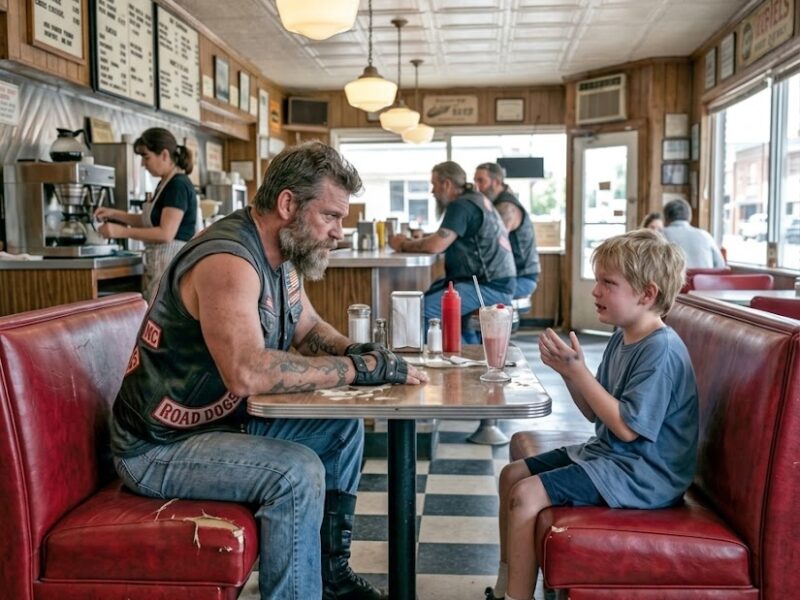
“They Stole My Only Toy,” the Boy Cried—Then 200 Bikers Learned Why It Could Never Be Replaced
Part 1
Asphalt blisters under a July sun don’t usually smell like heartbreak.
They smell like diesel, hot rubber, and the metallic tang of an overworked engine cooling down.
Garrett sat on the curb outside a cinder block diner in the middle of nowhere, peeling the collar of his leather cut away from his sweat-slicked neck.
The heat was a physical weight pressing down on his shoulders, making the arthritis in his left knee throb in time with his heartbeat.
Beside him, Clay hawked and spit a thick wad of phlegm onto the cracked pavement. It sizzled.
“Bikes are running too hot,” Clay muttered, wiping his mouth with the back of a grease-stained glove. “Carbs coughing on the incline.”
Garrett didn’t answer.
He took a drag from his cigarette, letting the cheap tobacco fill his lungs until they burned, then exhaled a thin gray stream into the dead air.
He was fifty-two years old, carrying thirty pounds of bad memories, and an arrest record that read like caution tape.
The red and white-winged death’s head patched on his back wasn’t a fashion statement. It was a warning label.
He wanted a cold beer, an ice pack for his knee, and quiet.
Instead, he got the noise.
It wasn’t loud. If it had been a scream, Garrett would have ignored it entirely.
Screams meant trouble, and trouble usually meant paperwork or blood, neither of which he had the energy for today.
But this was a high, thin, rhythmic hitching, a wet intake of breath followed by a pathetic, choked-off squeak.
It was the sound of something small realizing the world was entirely, profoundly indifferent to its suffering.
Garrett ground his back teeth together until his jaw popped.
He looked past the row of seven chrome and steel machines ticking as they cooled toward the rusted green dumpster at the edge of the lot.
There, half hidden in the shadow of the garbage receptacle, sat a boy.
He couldn’t have been more than seven.
He wore a faded blue T-shirt that hung past his knees and a pair of sneakers with the rubber peeling away from the canvas.
His knees were pulled tight to his chest, his face buried in his dirty arms.
The kid was shaking, trembling so hard his thin shoulders vibrated against the corrugated steel of the dumpster.
“Look at that miserable sack,” Bobby said, leaning against his bike.
Bobby had a jagged scar running from his ear to his collarbone and a laugh that sounded like glass grinding in a garbage disposal.
“Probably dropped his ice cream.”
“Leave it,” Garrett grunted.
He flicked his cigarette butt into a puddle of transmission fluid.
He didn’t want to look. He tried to focus on the heat waves distorting the horizon line of the highway.
But the quiet, broken gasps kept drifting over, cutting right through the smell of stale beer and exhaust.
It was grating. It was an itch under his skin that he couldn’t scratch.
It reminded him violently of a night in a foster home forty years ago when the radiator had hissed and he had cried until he threw up.
Garrett stood up. His knees cracked like a rifle shot.
“Where you going?” Clay asked, narrowing his eyes against the glare.
“To shut him up,” Garrett lied.
He walked over, his heavy engineer boots scuffing against the gravel.
He didn’t try to soften his approach. He was a mountain of dirty denim, scarred leather, and ink.
He stopped a foot away from the boy, casting a long, heavy shadow over the kid’s small, trembling form.
“You’re giving me a headache,” Garrett said. His voice was gravel and rusted pipes.
The boy flinched, his head snapping up.
Garrett expected terror. He expected the kid to scramble backward, scrape his hands on the pavement, and run.
That was the usual reaction.
But the boy just stared at him.
His cheeks were streaked with a mixture of dirt and snot. His eyes, a pale, washed-out blue, were swollen shut, rimmed with furious red.
There was no fear in those eyes, just a hollowed-out, absolute devastation.
“I didn’t—” The boy started, his voice cracking on the dry air.
He swallowed hard, his little Adam’s apple bobbing.
“I didn’t do anything.”
“Didn’t say you did,” Garrett replied, crossing his arms. The leather creaked.
“I said you’re giving me a headache. What’s your problem?”
The boy wiped his nose with the back of his hand, leaving a smear of grime across his upper lip.
He looked away, staring at a crushed soda can near Garrett’s boot.
“He took it.”
Garrett sighed a long, tired exhalation that tasted like dust.
“Who took what?”
“The man,” the boy whispered.
A fresh tear spilled over his lower lid, cutting a clean track through the dirt on his cheek.
“He took my spaceman.”
Garrett stared. “A spaceman? A toy?”
He felt a sudden, sharp spike of irritation.
“A toy?”
He was standing in one-hundred-degree heat, his joints screaming because a kid lost a piece of plastic.
He turned to walk away. This was exactly why he didn’t get involved.
The world was full of bleeding hearts, and he sure as hell wasn’t one of them.
“It was my dad’s,” the boy’s voice drifted after him, barely louder than the rustle of dry weeds against the dumpster.
“Before he died.”
Garrett stopped. His right boot froze mid-step.
He didn’t turn around right away. He stood there staring at the peeling paint on the diner wall.
A drop of sweat traced a slow, agonizing path down his spine.
The heat felt different now. It didn’t feel heavy. It felt suffocating.
He closed his eyes, cursing himself. Cursing the heat.
Cursing whatever twisted piece of his brain had decided to care.
Garrett turned around.
He reached into his pocket, his thick, scarred fingers bypassing his switchblade and his brass knuckles, and pulled out a crumpled, greasy five-dollar bill.
“Get up,” Garrett said.
The boy didn’t move, eyeing the money with a deep, instinctive suspicion.
“I’m not going to bite you, kid. Get up. You’re going to get heatstroke sitting by a metal box in this sun. We’re going inside.”
Garrett didn’t wait to see if the boy followed.
He turned and limped toward the diner doors.
Behind him, he heard the soft, hesitant scuff of worn-out sneakers on the gravel.
Inside, the diner smelled like old frying oil, bleach, and burnt coffee.
The air conditioning was struggling, rattling ominously in the ceiling, but it was ten degrees cooler than outside.
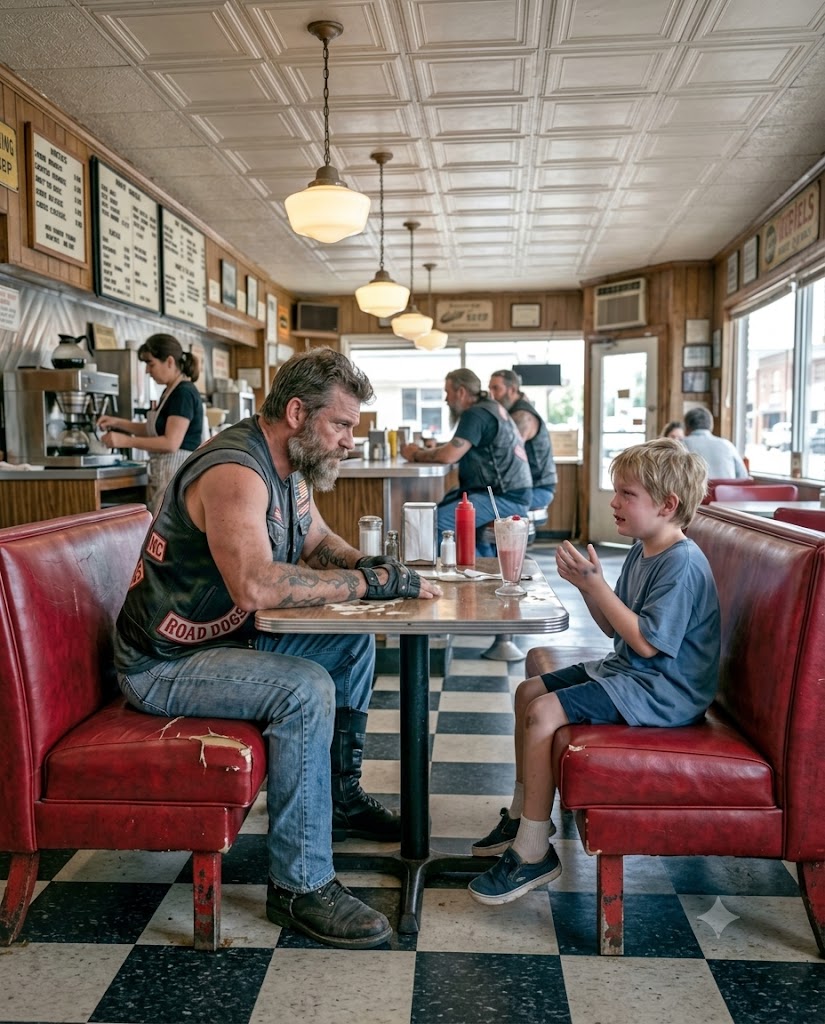
Garrett slid into a corner booth. The red vinyl seat hissed under his weight, the cracks in the material pinching at his jeans.
The boy slid into the other side, looking incredibly small behind the scuffed Formica table.
A waitress with tired eyes and a name tag that read Betty walked over, eyeing Garrett’s club patches with practiced, weary caution.
“What can I get you?” she asked, her pen hovering over a green pad.
“Coffee, black. Motor oil if you have it,” Garrett said, not looking up.
He gestured a thick thumb at the kid. “And a milkshake for him. Strawberry. Make it large.”
Betty nodded and scurried away.
Garrett leaned forward, resting his forearms on the sticky table. He looked at the boy.
Up close, the kid looked worse. He was entirely too thin, his collarbones sharp against the neckline of his oversized shirt.
His fingernails were bitten down to the quick, ringed with dirt.
“Name?” Garrett demanded.
“Toby,” the boy mumbled, picking at a gouge in the table.
“Look at me when I talk to you, Toby.”
Toby looked up. The devastation was still there, but now there was a flicker of something else. Defiance.
“Tell me about the spaceman,” Garrett said.
Toby took a shaky breath. “It’s not just a spaceman, it’s—it’s Major Tom.”
He said the name with a quiet reverence, as if speaking of a deity.
“He’s metal. He has a scratch on his helmet. My dad gave him to me. He said—he said Major Tom explored the dark parts of the universe, so I didn’t have to be afraid of the dark.”
Garrett felt a muscle twitch in his jaw.
It was a stupid story, a childish, sentimental, ridiculous story.
Yet sitting there looking at this broken kid, it felt like the only story that mattered.
“Where did this happen?” Garrett asked, his voice dropping an octave.
“At the bus stop, down the road,” Toby said, pointing a small finger toward the dirty front window.
“I was waiting for my mom to get off her shift at the motel. I had Major Tom in my hand. I was just holding him. And a guy came up. He smelled bad, like—”
Toby wrinkled his nose, struggling to find the words.
“Like medicine and dirty clothes. He asked me for money. I told him I didn’t have any. Then he just—he grabbed my hand. He bent my fingers back.”
Toby held up his left hand.
The knuckles were bruised, a faint purplish-red swelling beneath the dirt.
Garrett stared at the bruised hand.
Something dark and ugly uncoiled in his gut. It wasn’t justice.
Garrett didn’t believe in justice. Justice was a word politicians used while they picked your pocket.
This was something older, something territorial.
You don’t take from a kid. You don’t break a kid’s fingers for a piece of cheap metal.
That violated the feral code that kept men like Garrett from tearing each other apart in the streets.
“Did you get a look at him?” Garrett asked.
“He had a spider,” Toby whispered.
The boy tapped the side of his own thin neck.
“A black spider tattoo.”
Garrett knew that spider.
Every biker, every cop, and every junkie in a fifty-mile radius knew that spider.
It belonged to a low-level meth dealer named Ricky.
Ricky was a bottom feeder, a scrawny, twitchy rat who lived in a decrepit trailer park on the outskirts of the county line.
He made his living fencing stolen copper wire and pawning whatever he ripped from the hands of the weak.
Betty returned, sliding a chipped mug of black coffee in front of Garrett and a towering glass of pink slush in front of Toby.
Toby didn’t touch the milkshake. He just stared at the table.
“He took him,” Toby repeated, his voice hollowing out again.
“He’s gone.”
Garrett took a sip of the coffee. It tasted like battery acid.
He swallowed it down, letting the heat burn his throat.
He looked at Toby, then looked out the window at the parking lot.
Clay, Bobby, and the rest of the crew were lounging by the bikes, sweating, complaining, doing absolutely nothing of value.
Garrett shouldn’t do this.
He was on parole. He had a weapon under his cut.
Ricky’s trailer park was a hive of tweakers and desperate people with shotguns.
It was a stupid risk over a piece of sentimental garbage.
But as Garrett looked at Toby’s bruised knuckles, he realized he wasn’t making a choice.
The choice had already been made the second he heard that kid cry.
“Drink your shake, Toby,” Garrett said, sliding out of the booth.
“Where are you going?” Toby asked, panic flaring in his eyes, thinking he was being abandoned again.
“I got to make a phone call,” Garrett said, standing up.
“Don’t move from this booth. If anyone bothers you, you tell them Garrett said you’re under his patch. You understand?”
Toby nodded slowly, his hands wrapping around the cold glass of the milkshake.
Garrett walked out the diner doors, the heat hitting him like a blast furnace.
He didn’t walk toward his bike.
He walked to the edge of the parking lot, pulling a burner phone from his heavy denim pocket.
He dialed a number he knew by heart. It rang twice.
“Yeah,” a gruff voice answered.
“It’s Garrett,” he said, staring at the shimmering heat waves on the asphalt.
“Call the chapters in Oak Haven and Red Creek. Tell Miller to get his boys. Tell them to drop whatever they’re doing.”
“Garrett, it’s a hundred and two degrees out here. What’s the play?”
“We got a rival crew moving on our territory.”
“No,” Garrett said. He closed his eyes, feeling the sweat drip down his nose.
“Some junkie stole a kid’s toy.”
There was a long silence on the other end of the line. Just the static of a cheap cellular connection.
“You’re out of your goddamn mind, Garrett.”
“Maybe,” Garrett replied, his voice flat, devoid of any emotion.
“Tell them to meet at Rusty’s Diner. We ride in an hour.”
He hung up the phone and shoved it back into his pocket.
He turned back toward the bikes. Clay and Bobby were staring at him.
“What’s happening?” Bobby asked, tossing a crescent wrench into his saddlebag.
“We’re going to a trailer park,” Garrett said, walking past them.
“Check your oil. We’re going to have company.”
—
They didn’t come because they were heroes.
If you asked any of the men who rolled into Rusty’s Diner parking lot over the next hour why they were there, you’d get a different lie from each of them.
Some would say they were bored.
Some would say they owed Garrett a favor.
Some wouldn’t say anything at all, just spit on the ground and rev their engines.
But the truth was dirtier and more complicated.
These were men who lived on the extreme fringes of society.
They were outcasts, violent men. Men who communicated in the language of force and intimidation.
They spent their lives breaking rules, hurting people, and taking what they wanted.
But every predator needs a code, a line in the sand that separates them from mindless beasts.
For the Hells Angels, that code was twisted, often hypocritical, but occasionally it flared up into a blinding, terrifying righteousness.
Taking a toy from a grieving kid—that wasn’t a crime to them.
It was a blasphemy against the unwritten laws of the street.
It was weakness, and weakness had to be punished.
The first to arrive was the Oak Haven chapter.
Twenty bikes crested the hill on the highway, a synchronized wave of black leather and chrome.
The sound hit the diner before they did, a low, guttural vibration that rattled the cheap glass windows in their frames.
They pulled into the lot, the smell of unburned high-octane fuel and hot synthetic oil washing over the baking asphalt.
Toby, sitting in his booth, pressed his face against the window.
His eyes were wide, the strawberry milkshake forgotten.
He watched as giants dismounted their steel horses.
Men with unkempt beards, faces mapped with scars, and arms thick with faded tattoos.
Within thirty minutes, the Red Creek chapter arrived.
Then a nomadic crew passing through from two states over who heard the chatter on the grapevine and decided a ride sounded better than sweating in a motel room.
By six o’clock, the sun was beginning to dip, casting long, bruised shadows across the desert.
Rusty’s Diner parking lot, usually home to three pickup trucks and a stray dog, was entirely consumed.
Two hundred motorcycles.
It was a sensory assault.
The air was thick with the acrid smoke of two-stroke engines and the heavy, masculine scent of sweat, leather, and cheap aftershave.
The noise was a living, breathing entity.
Even at an idle, two hundred V-twin engines created a rattling chorus of loose valves, thumping pistons, and roaring exhaust pipes.
It vibrated in Garrett’s chest cavity. It made the fillings in his teeth buzz.
Garrett stood by his bike, watching them assemble.
Miller, the president of the Oak Haven charter, a man with a missing left eye and a disposition like a cornered badger, shoved his way through the crowd.
“Garrett!” Miller barked over the din, stopping inches from his face.
“This better not be a joke.”
“Do I look like I’m laughing?” Garrett replied, his face a mask of carved stone.
“Two hundred brothers,” Miller said, gesturing to the sea of leather behind him.
“For a plastic toy. The cops are already sitting on the highway overpass taking pictures.”
“Let them take pictures,” Garrett said.
“We aren’t breaking any laws. We’re just going for an evening ride.”
Miller barked a short, harsh laugh.
“An evening ride to Ricky’s trailer park. Place is going to smell like a soiled diaper.”
“Who’s leading?”
“I am,” Garrett said.
He turned and looked toward the diner.
Toby was standing by the glass doors, holding them slightly open.
He looked utterly terrified, a small, fragile twig caught in the path of a hurricane.
Garrett walked over to him.
The noise of the crowd parted slightly as he moved.
He stopped in front of the boy, kneeling down so his bad knee popped violently in protest. He ignored the pain.
“Toby,” Garrett said, his voice loud enough to be heard over the idling engines, but stripped of its usual harshness.
“You done with that shake?”
Toby nodded, his eyes darting frantically to the massive, heavily armed men surrounding them.
“Good. Come here.”
Garrett stood up and guided Toby by the shoulder toward his motorcycle.
He unstrapped a heavy leather jacket from the bar.
It was an old spare, worn, soft, smelling heavily of campfires and motor oil.
He draped it over Toby’s shoulders. The jacket swallowed the boy whole, dropping down to his ankles.
“Roll the sleeves up,” Garrett instructed.
Toby fumbled with the heavy leather, rolling it up until his small, bruised hands emerged.
Garrett reached into his saddlebag and pulled out a spare helmet.
It was matte black, scratched, and much too large.
He slid it over Toby’s head, tightening the chin strap as far as it would go.
“You sit in front of me,” Garrett said, tapping the gas tank.
“You hold onto the handlebars. You don’t let go, and you don’t put your feet down until I tell you. Understand?”
Toby’s voice was muffled by the thick foam of the helmet.
“Are we going to get Major Tom?”
Garrett looked at the two hundred men waiting for his signal.
He looked at the bruised knuckles resting on his gas tank.
He felt the familiar cold detachment settle over his mind, the switch flipping from tired aging man to something entirely different.
“Yeah, kid,” Garrett said, swinging a heavy leg over the seat, trapping Toby securely between his chest and the tank.
“We’re going to get your spaceman.”
Garrett reached down and engaged the clutch.
He kicked the bike into first gear with a heavy metallic clunk.
He rolled the throttle back. His exhaust roared, spitting a gout of black smoke into the fading light.
It was the signal.
Behind him, two hundred engines roared in unison.
It wasn’t a symphony. It was an avalanche. It was the sound of a mountain collapsing.
The ground actually shook.
A flock of crows roosting in the nearby power lines took off in a frantic, panicked cloud.
Garrett let out the clutch and his heavy bike surged forward.
They poured out of the diner parking lot like dark blood from a wound, a massive, unyielding column of iron and fury.
Two by two, they claimed the highway, forcing cars onto the shoulders, stopping traffic at intersections.
They rode in a tight, disciplined formation, an apex predator moving through the twilight.
Toby sat rigid against the gas tank, the wind howling around the oversized helmet, staring through the scratched visor at the road rushing beneath them.
He was surrounded by the deafening roar, sandwiched between the hot metal of the engine and the unyielding leather of Garrett’s chest.
For the first time since his dad died, Toby didn’t feel small.
They pointed their tires toward the county line, toward the rusted, decaying labyrinth of the trailer park, toward Ricky.
—
Gravel gave way to potholed dirt.
The procession slowed, forced to navigate the treacherous, uneven terrain of the county line’s forgotten edge.
Sunlight had finally bled out behind the western ridges, leaving a bruised, purple twilight in its wake.
The temperature dropped a fraction, but the heat radiating from the two hundred V-twin engines kept the air thick and suffocating.
Garrett shifted his weight, his bad knee throbbing a steady, dull rhythm against the gas tank.
Between his arms, Toby was a rigid block of tension, his small hands white-knuckling the thick leather of Garrett’s jacket.
They crossed the invisible boundary into the trailer park.
It didn’t have a name.
It was just a sprawling, rusted scar on the landscape, a place where people ended up when the rest of the world ran out of uses for them.
The smell hit them first.
It was a dense, physical wall of odor.
Stagnant water pooling under sinking foundations, burning trash in rusted oil drums.
And beneath it all, the sharp chemical reek of ammonia and lithium, the unmistakable scent of amateur meth cooks working in poorly ventilated kitchens.
As the column of bikers snaked through the narrow, unpaved lanes, the park reacted to their presence like a disturbed anthill.
Yellow porch lights snapped off.
Flimsy aluminum blinds clicked shut.
Fingers parted the plastic slats just a fraction to peer out in terror.
Feral, mangy dogs that usually guarded chain-link fences with vicious barks took one look at the rolling wave of black leather and slunk away under the rotting skirts of the mobile homes, tails tucked tight between their legs.
Garrett kept his eyes forward, navigating a path around a discarded, rusted-out refrigerator and a pile of sun-bleached tires.
He didn’t look at the eyes peering from the dark windows. He didn’t care about them.
He felt a familiar cold misanthropy settling into his bones.
This was the bottom of the barrel. This was where rats fed on other rats.
Behind him, the low rumble of the pack was a physical force shaking the loose corrugated tin of the roofs they passed.
The sheer scale of their presence was absurd.
Two hundred heavily armed, deeply cynical men riding thousands of pounds of American steel, turning this miserable patch of dirt into a militarized zone.
Miller’s voice cut through the mechanical din as the one-eyed president pulled his heavy bagger up alongside Garrett’s right flank.
He didn’t yell. He just pitched his voice to carry over the exhaust.
“Which one?”
Garrett downshifted, the engine popping in protest.
“End of the next row. The single-wide with the blue tarp on the roof.”
Miller nodded once, a sharp jerk of his chin.
He raised a gloved hand, holding up two fingers, then swirled them in a tight circle.
The hand signal traveled back through the pack.
The column began to fan out.
They didn’t just pull up. They occupied the space.
Bikes rolled onto dead yellow lawns. They blocked the narrow dirt intersections.
They formed a solid perimeter around the rusted, fading white trailer at the dead end of the lane.
Garrett killed his engine.
The silence didn’t happen all at once. It cascaded.
One by one, two hundred engines choked out.
The sudden absence of the deafening roar left a ringing void in the ears.
It was replaced by a different kind of noise.
The ticking of hot exhaust pipes cooling in the evening air.
The crunch of heavy leather boots settling onto gravel.
The metallic clink of belt buckles and chain wallets.
It was a heavy, pregnant silence. The kind of silence that precedes a very bad storm.
Garrett felt Toby shivering.
Despite the oppressive heat radiating from the bike, the kid was trembling so hard his teeth were audibly clicking.
“Hey,” Garrett grunted, keeping his voice low, gravelly but devoid of anger.
Toby tilted his oversized, scratched helmet up.
The visor was smeared with dust, but Garrett could see the wide, terrified eyes beneath it.
“We’re here,” Garrett said. “You stay on the bike. You don’t move a muscle.”
“Clay is going to stand right here with you.”
Clay stepped up to the front wheel, spitting a wad of dark tobacco juice into the dirt.
He was a massive man built like a brick outhouse, his beard a tangle of gray and brown.
He didn’t smile. Clay never smiled. But he gave Toby a single, solemn nod.
“He ain’t going nowhere, Garrett,” Clay rumbled.
Garrett swung his stiff leg over the saddle, groaning quietly as his knee took his full weight.
He rolled his shoulders, feeling the heavy denim of his cut pulled tight against his back.
He didn’t draw a weapon. He didn’t puff his chest out. He just looked tired.
He walked toward the flimsy aluminum door of the trailer.
Miller flanked his left. Bobby flanked his right.
Behind them, one hundred and ninety-seven men stood perfectly still, their arms crossed, their faces carved from stone, watching the door.
The yard was a minefield of bad decisions and neglect.
Garrett’s heavy boots crunched over shattered beer bottles, a child’s plastic tricycle faded by the sun, and the moldering remains of a stained mattress.
The air right outside the trailer was thick, carrying the sour stench of cat urine and unwashed bodies.
Garrett stopped at the bottom of the three cinder block steps that served as a porch.
He didn’t knock. Knocking implied a request for permission to enter.
Garrett wasn’t asking.
He lifted his right boot and drove the heel of it squarely into the center of the door, right below the rusted lock.
The noise was a sharp, violent crack that echoed off the surrounding metal trailers.
The deadbolt didn’t just break. It tore straight through the cheap, rotted wood of the doorframe, sending a shower of splinters into the dark interior.
The door banged wildly against the inside wall, the flimsy hinges screaming in protest.
“Ricky!” Garrett bellowed, his voice rough as sandpaper, filling the suffocating air inside the trailer.
He stepped inside.
The heat in the room was stagnant, trapped by the closed windows and the blue tarp on the roof.
It smelled of sulfur, burnt foil, and stale sweat.
A single bare incandescent bulb buzzed angrily overhead, casting harsh yellow shadows over a room that looked like a bomb had gone off in a garbage dump.
Pizza boxes, dirty clothes, and stripped copper wire covered every available surface.
From the narrow hallway leading to the back bedroom, a chaotic scrambling sound erupted.
A thud, a muffled curse, the scrape of something heavy being dragged across cheap linoleum.
“Get him,” Garrett muttered to Bobby.
Bobby didn’t run. He just walked down the hallway with terrifying, deliberate purpose.
Garrett followed slowly, his eyes scanning the filth on the countertops.
He was looking for a flash of metal, a tiny spacesuit.
He saw glass pipes, a butane torch, a pile of scratch-off lottery tickets, but no toy.
A crash echoed from the bedroom, followed by a high, reedy scream.
“Get off me! I got a knife! I’ll cut you, man, I swear to God!”
Bobby backed out of the bedroom doorway, dragging something with him.
It was a man, if you could use the term loosely.
Ricky was a mess of sharp angles, twitching muscles, and sores.
He was shirtless, his ribs pressing against his pale, translucent skin like the bars of a cage.
His eyes were wide, dilated, spinning with a chaotic cocktail of terror and methamphetamine.
In his right hand, he held a rusted flathead screwdriver, waving it erratically in Bobby’s direction.
“Drop it, tweak,” Bobby said, his tone entirely bored.
He swatted at the screwdriver like it was an annoying gnat.
“Who the hell are you?” Ricky shrieked, his voice cracking, spit flying from his cracked lips.
“I don’t owe nobody! I paid Silas! I paid him last week!”
Garrett stepped into Ricky’s line of sight.
Ricky froze.
His frantic, spinning eyes landed on the death’s head patch on Garrett’s chest, then shifted to Miller’s one dead, milky eye, then to the jagged scar on Bobby’s neck.
The bravado, fueled entirely by chemicals, evaporated instantly.
Ricky looked past them, out the open front door, and saw the sea of black leather and chrome filling his yard, filling the street, blocking out the world.
The screwdriver slipped from his trembling fingers, hitting the linoleum with a pathetic clatter.
“Oh God,” Ricky whimpered.
His knees buckled and he sank to the filthy floor, pulling his knees to his chest.
“Oh man, please. Whatever Silas said, he’s lying. I swear.”
Garrett walked over.
He didn’t kick Ricky. He didn’t punch him.
He just reached down, his massive, calloused hand wrapping entirely around Ricky’s scrawny neck.
He didn’t squeeze to choke. He just clamped down like an iron vise and hoisted the man upward.
Ricky gagged, his dirty bare feet scrambling for traction against the floor as Garrett pinned him to the cheap wood-paneled wall.
“I don’t know who Silas is,” Garrett said, his face inches from Ricky’s.
Garrett’s breath smelled of black coffee and stale tobacco.
“And I don’t care about your debts. I’m here for a boy.”
Ricky’s eyes bulged, a vein throbbing wildly against Garrett’s thick fingers.
“A boy? What boy? I don’t mess with kids, man. I swear on my mother, I don’t touch kids.”
Garrett shifted his grip slightly, his thumb pressing against the blown-out, poorly inked black spider tattoo on Ricky’s neck.
Ricky winced, a wet, choking sound escaping his throat.
“Bus stop,” Garrett said slowly, enunciating every syllable.
“A few hours ago, a kid waiting for his mom. You bent his fingers back. You took his property.”
Ricky blinked, his drug-addled brain struggling to make the connection.
Then a horrifying dawn of realization washed over his face.
“The—the metal thing,” Ricky gasped, his voice thin and reedy.
“The little metal man.”
“Major Tom,” Garrett corrected, his voice a low, dangerous rumble.
“Where is he?”
“You brought—” Ricky choked, his eyes darting frantically toward the open door and the army waiting outside.
“You brought the whole goddamn charter for a toy?”
Garrett finally squeezed. Just a fraction of an inch. Just enough to cut off the airflow entirely.
Ricky’s face turned a mottled shade of purplish-red, his hands desperately clawing at Garrett’s immovable forearm.
“The question,” Garrett whispered, letting Ricky feel the absolute, terrifying finality of the moment,
“was where is he? You don’t have to answer. I can just snap this pencil neck of yours, and we can toss this trailer ourselves.”
Garrett released the pressure just enough for Ricky to drag a ragged, desperate breath into his burning lungs.
“It’s—it’s over there,” Ricky sobbed, tears cutting tracks through the grease on his face.
He pointed a trembling, scab-picked finger toward a pile of garbage in the corner of the kitchen.
“I thought it was silver. I thought I could melt it, but it’s just cheap tin. It’s garbage. I threw it in the corner.”
Garrett shoved Ricky away.
The dealer collapsed against the wall, sliding down to the floor, gasping and weeping into his hands.
Garrett turned toward the kitchen.
The kitchen smelled like spoiled milk and copper.
Garrett approached the corner Ricky had pointed to.
It was a dumping ground for things the dealer had stripped and found useless.
Tangled wires with the copper guts pulled out, empty butane lighter husks, shattered glass, and fast-food wrappers smeared with old grease.
Garrett dropped heavily to one knee, the joint popping in a way that made Bobby wince.
He ignored it.
He began sifting through the filth with his bare hands.
He didn’t care about the grime, the risk of a used needle, or the sheer indignity of digging through a junkie’s trash.
He swept aside a moldy hamburger bun and a pile of cigarette ashes.
There it was.
It was small, barely three inches tall.
Cast in cheap, heavy pot metal that had once been painted silver, but was now flaking and dull.
The specimen was lying face down in a puddle of sticky, dried soda.
Garrett picked it up.
It was cold and dense.
He turned it over in his massive palm.
It was crude, mass-produced in some factory decades ago.
The painted visor was chipped, and yes, there was a deep, deliberate scratch across the left side of the helmet, just like Toby had described.
It wasn’t worth fifty cents.
It was entirely, fundamentally worthless.
Except it wasn’t.
Because a dead man had handed it to his son and told him it would keep the dark away.
Garrett pulled a relatively clean blue bandana from his back pocket.
He carefully wiped the sticky soda and the ash from the metal figure.
He polished the scratched helmet with his thumb.
“You got it?” Miller asked from the doorway, his one eye scanning the room with disgust.
“Yeah,” Garrett grunted, climbing slowly back to his feet.
He slipped the toy into the deep front pocket of his leather cut.
He walked back over to where Ricky was curled on the floor, still weeping quietly.
Garrett stood over him, a towering, dark monolith.
“Look at me,” Garrett commanded.
Ricky slowly uncurled, looking up through terrified, bloodshot eyes.
“I’m not going to kill you,” Garrett said, his voice flat, devoid of the anger he felt.
It was just a statement of fact.
“Killing you means paperwork. It means cops sniffing around my chapter. You aren’t worth the gas it took to ride out here.”
Ricky let out a pathetic, shuddering breath of relief.
“But,” Garrett continued, leaning down slightly,
“you touched a kid. You put hands on a boy. In my world, that makes you a disease.”
“If I ever hear about you touching another kid, if I ever see your face in town, if you even breathe the same air as that boy again, I won’t kill you.”
“I’ll take a pair of bolt cutters to every joint in your hands and feet, and I will leave you in the desert for the coyotes. Do we have an understanding?”
Ricky nodded frantically, his head bobbing up and down.
“Yes. Yes, sir. I’m leaving. I’ll pack tonight. I’m gone. You’ll never see me.”
Garrett held his gaze for three long seconds, ensuring the fear was deeply, permanently embedded in the man’s pathetic soul.
Then he turned his back on him.
“Let’s ride,” Garrett said to Miller and Bobby.
They walked out of the trailer, stepping over the shattered doorframe.
The heat of the evening felt almost clean compared to the stench inside.
As Garrett descended the cinder block steps, the one hundred and ninety-seven men waiting in the yard straightened up.
They didn’t ask questions. They just watched his face.
Garrett gave a single, short nod.
A murmur rippled through the crowd.
Helmets were strapped on. Keys turned in ignitions.
The heavy metallic clunk of gears engaging echoed down the dirt road.
Garrett walked over to his bike. Clay stepped back, giving him room.
Toby was exactly where Garrett had left him, a tiny, frozen statue encased in oversized leather and fiberglass.
He looked down at Garrett, his breath hitching slightly in his chest.
Garrett didn’t say a word.
He reached into his pocket and pulled out his closed fist.
He held it up to Toby, resting his hand on the top of the gas tank.
Slowly, Garrett opened his thick, scarred fingers.
Sitting in the center of his palm, polished clean and catching the faint glow of the distant streetlights, was Major Tom.
Toby stared at it.
The breath he had been holding escaped in a long, shaky exhale.
He didn’t grab for it immediately.
He looked at the toy, then up at the scratched visor of the helmet, then down at Garrett’s face.
Garrett’s expression was unreadable. It was a map of hard miles and bad choices.
But in his eyes, there was a quiet, exhausted softness.
“Told you we’d get him,” Garrett said quietly.
Toby reached out.
His small hand, the knuckles still bruised and purple, picked the metal spaceman up from Garrett’s palm.
He clutched it tight against his chest, right over his heart.
He didn’t cheer. He didn’t smile.
He just closed his eyes, and a single, silent tear slipped out from under the helmet padding, dropping onto the leather jacket.
It wasn’t a fairy tale ending.
The toy was back, but his dad was still dead.
His mom was still working double shifts to afford a motel room.
The world was still a brutal, unforgiving place. Garrett knew that better than anyone.
But for tonight, the monsters had been chased away by bigger, darker monsters.
Garrett swung his leg over the bike.
He settled into the saddle, trapping Toby securely against the tank.
“Hold on tight, kid,” Garrett said, reaching for the ignition.
“We’re taking the long way back.”
He fired the engine.
The roar was instantaneous, a deafening blast of power that swallowed the sounds of the crying meth dealer and the barking dogs.
Around them, two hundred engines roared in answer, a thunderous choir of raw mechanical fury.
They pulled out of the trailer park, leaving the dirt and the rot behind.
They hit the highway just as the first stars began to pierce the bruised purple sky.
The air cooled as they picked up speed, the wind howling around them.
Toby held onto the handlebars with his right hand.
His left hand was tucked safely inside the heavy leather jacket, his bruised fingers wrapped tightly around a cheap piece of pot metal.
Garrett rolled the throttle back, leaning into the curve of the road.
His knee hurt. His back ached. He was tired, and entirely too old for this kind of foolishness.
But as he felt the small, steady weight of the boy leaning back against his chest, and heard the roar of his brothers riding at his back, Garrett smiled.
It was a small, grim smile, a slight twisting of his chapped lips.
It was the smile of a man who had done one decent thing in a lifetime of mistakes.
Major Tom was back.
And as far as Garrett was concerned, the dark didn’t stand a chance.
—
## Part 2
—
Neon bleeds like an open wound against the bruised black sky.
Ahead of them, the highway stretched into an endless ribbon of cracked asphalt swallowed by the darkness.
Nighttime in the high desert doesn’t offer a breeze. It throws a wall of cold, dead air right against your teeth.
The hundred-degree heat of the afternoon had evaporated, replaced by a sharp, biting chill that seeped through denim and settled deep into the marrow.
Garrett didn’t mind the cold. It kept him awake.
It numbed the throbbing in his knee and the dull, persistent ache in his lower back.
He rode point, the spearhead of a two-hundred-man column.
The sheer volume of their exhaust note bounced off the empty desert canyons, a rolling mechanical thunder that warned everything in a ten-mile radius to stay away.
They owned the road. They owned the night.
Between his arms, Toby had finally stopped shivering.
The adrenaline crash had hit the kid hard.
The rigid tension in his small shoulders had melted away somewhere around mile marker forty.
Now Toby was dead weight, his oversized helmet resting heavily against Garrett’s chest, his breathing slow and rhythmic.
The boy had simply passed out, lulled into unconsciousness by the hypnotic vibration of the V-twin engine and the absolute, terrifying safety of being surrounded by an army of monsters.
Garrett kept his left arm wrapped loosely around Toby’s waist, pinning him securely to the gas tank so he wouldn’t slip.
Through the thick layers of leather, he could feel the faint, steady thump of the boy’s heart.
It was a strange, deeply unsettling sensation.
Garrett hadn’t held a sleeping child in—well, never.
His life was solitary by design.
It was a life built on violence, transactional loyalties, and a deep, abiding distrust of anything soft.
Soft things got you killed. Soft things broke when the world inevitably stepped on them.
Yet here he was, doing fifty-five down a desolate stretch of two-lane blacktop, turning his body into a human shield for a kid he didn’t know.
He didn’t want to analyze it.
Analyzing it meant peeling back scabs he had spent thirty years letting harden.
Up ahead, the sickly glow of civilization began to pollute the horizon.
A cluster of sodium vapor streetlights and the stuttering, half-dead sign of a roadside motel.
The Sundowner.
The W and N were burnt out, leaving the sign reading “Sundo Ur.”
It was a miserable, single-story cinder block L-shape flanked by a dirt lot and a chain-link fence topped with rusted barbed wire.
This was where Toby’s mother worked the graveyard shift, scrubbing cheap linoleum and changing stained sheets for minimum wage.
Garrett signaled a right turn.
Behind him, the pack slowed, a synchronized downshifting of gears that sounded like a chorus of angry dogs barking.
They rolled into the dirt lot.
A lone police cruiser was parked across the street in the shadow of a closed gas station.
Garrett saw the cherry light of a cigarette inside the cab. The cop was watching.
The cop wasn’t moving.
Two hundred Hells Angels pulling into a cheap motel wasn’t a noise complaint. It was a tactical situation.
The smart play for a solo patrolman was to sit, observe, and pray they didn’t start breaking windows.
Garrett killed his engine right in front of the main office.
The cascading silence happened again.
It was a heavy, metallic quiet broken only by the ticking of hot pipes and the scuffing of boots.
Garrett nudged Toby’s shoulder.
“Hey, kid. Wake up.”
Toby jerked, his helmet thunking against Garrett’s chin.
The boy gasped, his hands scrambling blindly for a moment before remembering where he was.
He pushed himself up, rubbing his eyes beneath the scratched visor.
“We’re here,” Garrett grunted, kicking his kickstand down.
Before Toby could fully process his surroundings, a scream tore through the parking lot.
It wasn’t a scream of pain.
It was a raw, visceral sound of absolute, unadulterated panic.
Bursting out of room 104, clutching a stack of folded white towels to her chest, was a woman.
She was thin, wearing a faded maroon housekeeping uniform that hung off her frame.
Her blond hair was pulled back into a messy, exhausted ponytail.
Her eyes, wide and terrified, darted from the sea of black leather to the massive, scarred men, and finally landed on the motorcycle parked dead center.
“Toby!”
She shrieked, dropping the towels.
They hit the dirty concrete, instantly soaking up oil and grime.
She ran toward them, her cheap sneakers slapping against the pavement.
She didn’t care about the patches.
She didn’t care about the brass knuckles or the hunting knives clipped to the belts of the men standing in her way.
She was a mother entirely consumed by the primal terror of seeing her child surrounded by predators.
Bobby stepped forward, putting a massive hand up to stop her.
“Hold up, lady—”
“Don’t touch me!” She screamed, slapping his arm away with a frantic, wild strength.
“Where is he? What did you do to him?”
“Bobby, back off,” Garrett barked.
His voice was a whip crack that instantly silenced the murmurs of the pack.
Garrett swung his leg over the bike, wincing as his knee locked up.
He reached down and grabbed Toby beneath the armpits, lifting the boy off the gas tank.
He set him down on the pavement.
The mother collided with Toby, dropping to her knees on the filthy concrete.
She threw her arms around him, burying her face in the oversized leather jacket Garrett had draped over the boy.
She was sobbing violently, her shoulders shaking with dry, ragged heaves.
“Oh my god. Oh my god,” she kept repeating, her hands frantically patting his arms, his back, checking for broken bones, for blood.
“Toby. Toby. I told you to stay at the bus stop. I told you not to move.”
“I’m okay, Mom,” Toby mumbled, his voice muffled by the heavy helmet.
She fumbled with the chin strap, her hands shaking so badly she couldn’t work the clasp.
Garrett stepped forward.
He towered over her, casting a long, heavy shadow.
The woman flinched, pulling Toby tighter against her chest, bracing herself for a blow.
Garrett slowly, deliberately reached down and unclipped the helmet.
He pulled it off Toby’s head.
“He’s fine, Diane,” Garrett said, glancing at her crooked name tag.
Diane looked up at him.
Her face was streaked with tears and mascara, her eyes bloodshot and wide with a mixture of terror and confusion.
“Who are you?” she demanded, her voice cracking.
“Why do you have my son? If you want money, I don’t have anything. I have thirty dollars in my purse. You can take it. Just please don’t hurt us.”
The words felt like a handful of gravel thrown against Garrett’s chest.
She thought they had kidnapped him.
She thought he was ransoming a seven-year-old for thirty bucks.
He tasted bile in the back of his throat.
This was the world he lived in. This was how regular people saw him.
They didn’t see the code. They saw the violence. They saw the dirt.
“I don’t want your money,” Garrett said, his voice flat, exhausted.
He took a step back, putting distance between himself and the panicked mother.
“Kid got robbed at the bus stop.”
Diane froze.
She pulled back, looking at Toby’s face.
“Robbed? Toby, what happened?”
Toby reached inside the folds of the massive leather jacket.
He pulled out his left hand.
The knuckles were still dark purple, swollen tight against the skin.
Diane gasped, her fingers lightly touching his bruised hand.
“Who did this?”
“A bad man,” Toby whispered.
He looked up at Garrett.
“But Garrett got him. He got him back.”
Toby opened his hand.
Resting in his palm, reflecting the sickly neon light of the motel sign, was the cheap, dented metal spaceman.
Major Tom.
Diane stared at the toy.
The air seemed to leave her lungs all at once.
She knew exactly what that toy was. She knew exactly what it meant to her son.
Her eyes darted from the scratched metal figure up to Toby’s bruised hand, and finally, slowly, to Garrett.
The panic in her eyes began to dissolve, replaced by a profound, overwhelming disbelief.
She looked at Garrett.
She looked past him at Miller with his dead eye, at Clay spitting tobacco into the dirt, at two hundred hardened, heavily tattooed criminals idling in her employer’s parking lot.
“You—” Diane choked on the words, her throat tight.
“You brought all of them for this?”
Garrett didn’t answer.
He hated this part.
He hated the raw, bleeding gratitude forming in her eyes.
It made his skin crawl. It felt unearned.
He wasn’t a good man.
He had broken a man’s door down, choked him near to death, and terrorized a neighborhood.
He did it for his own twisted sense of order, not for a halo.
“He needs ice on that hand,” Garrett said gruffly, turning his back on her.
He reached out and tugged the heavy leather jacket off Toby’s shoulders, leaving the boy standing in his oversized T-shirt.
“Keep a better eye on him. This world is full of teeth.”
Garrett threw the jacket over his saddlebag and grabbed his handlebars.
“Wait,” Diane called out.
She stood up, her knees cracking.
She wiped her face with the back of her wrist.
“Wait, I—I don’t know your name.”
“It’s Garrett,” Toby said, his voice carrying clearly in the quiet night air.
Garrett didn’t look back.
He straddled his bike, turning the key in the ignition.
“Have a good night, Diane.”
“Thank you,” she said.
The words were quiet, but they carried a desperate, heavy weight.
“Thank you. Nobody—nobody ever looks out for us. Thank you.”
Garrett hit the starter.
The engine roared to life, a deafening blast of combustion that drowned out her words, drowned out his thoughts, drowned out everything but the vibration of the machine.
He didn’t wave. He didn’t smile.
He just gave Miller a short, sharp nod.
The two hundred engines ignited in a rolling wave of thunder.
The motel windows rattled violently.
The lone police cruiser across the street turned its headlights off, entirely retreating deeper into the shadows.
Garrett kicked the bike into gear and rolled out of the dirt lot back onto the desolate highway.
Behind him, standing in the puddle of oil and dropped towels, a mother held her son tightly.
Toby didn’t watch the motorcycles leave.
He was looking down at his hand, tracing the scratch on the metal helmet of his spaceman.
—
Highway miles blurred together when the mind is trying to compartmentalize.
Garrett rode fast, pushing the Dyna past seventy, letting the frigid desert air strip the warmth from his body.
He wanted the cold. He wanted the physical discomfort.
It grounded him.
It kept him from thinking about the bruised knuckles and the terrified, weeping eyes of the meth dealer.
Behind him, the massive beast of the pack began to shed its scales.
At the junction of Route 9, Miller raised his left fist.
The Oak Haven charter broke off, twenty bikes peeling away, their tail lights fading into the western darkness without a single honk or wave.
They were ghosts returning to their own haunted houses.
Ten miles later, the nomadic crew peeled off at a truck stop, seeking cheap coffee and a place to unroll their sleeping bags.
By the time Garrett hit the city limits of his own territory, the two hundred had dwindled down to a core group of twenty.
His charter. His brothers.
They didn’t ride to the clubhouse.
It was a Tuesday. The adrenaline of the raid had burned off, leaving behind a profound, collective exhaustion.
They splintered at intersections and off-ramps, breaking formation until it was just Garrett riding alone down a cracked industrial street lined with dark warehouses and chain-link fences.
His destination wasn’t a home.
It was a garage bay at the end of a dead-end alley.
He paid cash for it every month.
It smelled like brake cleaner, old grease, and damp concrete.
Garrett hit the remote clipped to his handlebars.
The corrugated metal door groaned upward, spitting flakes of rust onto the cement.
He rolled the bike inside, cut the engine, and hit the button to bring the door back down.
The silence that followed was absolute. It was deafening.
After hours of being enveloped in the chaotic roar of two hundred V-twins, the quiet of the garage was heavy, pressing against his eardrums until they rang.
Garrett didn’t turn on the overhead fluorescents.
He left them off, relying on the yellow glow of a single work light clamped to a workbench in the corner.
He dismounted, moving slowly.
The adrenaline was entirely gone now, leaving him with the bill.
His bad knee was swollen, a tight, throbbing knot of agony that shot sharp pain up into his hip with every step.
He limped over to an old, ripped car seat he had salvaged from a junkyard and collapsed into it.
He unbuttoned his coat, letting the heavy leather slip off his shoulders and hit the floor with a dull thud.
He rubbed his face with his massive, calloused hands.
His skin felt gritty, coated in a fine layer of highway dust and sweat.
He was fifty-two. He felt eighty.
Garrett reached into the rusted mini-fridge next to the car seat and pulled out a tall can of cheap beer.
He cracked it open, the snap echoing sharply in the cavernous room.
He took a long, deep swallow.
It was bitter, cold, and metallic. It tasted exactly like his life.
He leaned his head back against the torn upholstery, staring up at the water stains on the concrete ceiling.
His mind, despite his best efforts, drifted back to the trailer park.
To Ricky’s frail, terrified neck in his grip.
He remembered the sickening ease with which he could have crushed the man’s windpipe.
It wouldn’t have taken effort, just a twitch of the wrist.
Garrett took another drink.
He wasn’t a vigilante. He despised vigilantes.
They were arrogant fools who thought they knew right from wrong.
Garrett didn’t believe in right and wrong.
He believed in power. He believed in the strong eating the weak.
He had spent his entire adult life being the wolf, ensuring he was never the sheep.
So why the hell had he mobilized a private army for a seven-year-old?
He closed his eyes, and the image of Toby sitting by the dumpster flashed behind his eyelids.
The hollow, devastated look. The total absence of hope.
It was a mirror.
Garrett hadn’t been born a Hells Angel. He hadn’t been born a violent man.
He had been a kid once, in a house that smelled like stale liquor and unwashed dishes.
He remembered a night he couldn’t have been older than Toby when a man his mother had brought home decided Garrett’s toy fire truck was too noisy.
The man hadn’t just taken it.
He had smashed it to pieces with a hammer on the kitchen table while Garrett watched, screaming, entirely powerless.
No one had come for him.
No army of leather-clad giants had kicked his door down to make the monsters pay.
He had simply learned the lesson: the world takes. And if you want to survive, you have to learn to take back harder and faster.
Garrett crushed the empty beer can in his fist, the aluminum buckling sharply under his grip.
He tossed it into a dark corner of the garage.
He had sworn he would never be weak again. And he hadn’t been.
But tonight, looking at Toby, he hadn’t seen weakness.
He had seen innocence being dragged out back and shot.
He hadn’t fought for the boy.
He had fought for the ghost of himself sitting in a dark kitchen watching his world get smashed with a hammer.
It was a selfish act dressed up as a noble one.
Garrett leaned forward, resting his elbows on his knees, burying his face in his hands.
The silence of the garage pressed in on him.
He had given the kid his toy back. He had terrorized a junkie. He had played the hero for exactly three hours.
But tomorrow morning, the sun would come up, and nothing would be fundamentally different.
Ricky would still be a junkie, moving to another trailer park to ruin other lives.
Diane would still be scrubbing toilets, praying her paycheck covered the motel rent.
Toby would still grow up in a world designed to crush him.
And Garrett—Garrett would still be an aging outlaw with a bad knee, a rap sheet, and a heart walled off by thirty years of calculated cruelty.
A piece of cheap tin wasn’t going to fix any of that.
—
The next morning, the heat returned with a vengeance.
By ten a.m., the asphalt outside Rusty’s Diner was already shimmering with mirages.
The air was thick, heavy, smelling of diesel and frying bacon.
Garrett sat in his usual booth, the red vinyl warm beneath him.
The diner was quiet.
A couple of long-haul truckers sat at the counter, chewing silently on eggs and toast.
Betty, the tired waitress, was wiping down tables with a damp rag.
Clay and Bobby were sitting across from him.
They looked worse for wear.
Bobby had dark circles under his eyes, and Clay was nursing a massive mug of black coffee, staring blankly out the window.
Nobody talked about last night.
In their world, you didn’t dissect it.
You did the deed, you rode away, and you buried it.
Talking about it made it a vulnerability.
“Carb’s still running rich,” Clay mumbled, finally breaking the silence.
He didn’t look at Garrett.
“Going to have to pull it apart this afternoon.”
“Do it in the shade,” Garrett grunted, stabbing a fork into a rubbery pancake.
“I ain’t dragging your fat ass to the hospital for heatstroke.”
Bobby snorted, a harsh sound.
“Ricky pack up?”
It was a breach of protocol, asking a direct question about a sanctioned action in public, but the diner was mostly empty.
Garrett chewed his food, slowly swallowing before he answered.
“Miller drove by the park at six this morning. Trailer’s empty. Front door left wide open. Ricky took his stash and his clothes. Left the rest of his garbage.”
“Good riddance,” Bobby said, leaning back in the booth.
“Little rat smelled like a chemical fire.”
They fell back into silence.
It was a comfortable, heavy quiet.
The quiet of men who understood each other without needing to fill the air with empty words.
Garrett looked out the window.
The green dumpster at the edge of the lot was baking in the sun.
A stray cat was sniffing around the base, looking for scraps.
He thought about the kid.
He knew, statistically speaking, Toby was doomed.
Kids from cheap motels with dead fathers and overworked mothers didn’t usually grow up to be doctors or lawyers.
They grew up angry. They grew up hard.
Some of them grew up and put on leather cuts, riding loud motorcycles just to feel like they had a voice in a world that ignored them.
Garrett took a sip of his coffee. It was burnt, just the way he liked it.
He couldn’t save the kid.
He couldn’t fix the broken system that put them in that motel or cure the rot that created men like Ricky.
Garrett was a destroyer, not a builder.
But as he watched a semi-truck roar past the diner, kicking up a cloud of hot dust, Garrett felt a strange, unfamiliar settling in his chest.
A microscopic loosening of the knot that lived behind his ribs.
He hadn’t fixed the world, but he had fixed one thing.
He imagined Toby sitting on the edge of a stained motel bed, his bruised hand clutching a piece of scratched pot metal.
He imagined the boy looking at the tiny spaceman, remembering the terrifying roar of two hundred engines, the sight of a private army marching through the dirt just for him.
Toby’s dad had told him Major Tom explored the dark parts of the universe, so he didn’t have to be afraid.
Garrett knew all about the dark parts of the universe. He lived there. He thrived there.
He was one of the monsters that lurked in the shadows.
But last night, the monsters had worked for Toby.
Last night, the boy had learned that sometimes the dark things in the universe can step into the light, just for a moment, to push back the wolves.
It was a cynical comfort, a violent, imperfect grace.
But for a kid living on the edge of the abyss, maybe it was enough.
Garrett slid a ten-dollar bill onto the sticky table.
He stood up, his knee popping loudly in protest.
“Let’s go,” Garrett said to Clay and Bobby.
“I’m sick of looking at this parking lot.”
He walked out the glass doors, the heat hitting him like a physical blow.
He didn’t look at the dumpster.
He walked straight to his bike, threw his leg over the saddle, and fired the engine.
The roar was deafening, a violent, beautiful noise that shook the dust from the diner walls.
Garrett kicked it into gear and tore out onto the highway, leaving the diner, the dumpster, and the memory in his rearview mirror.
He rode straight into the blinding glare of the morning sun, disappearing into the heat waves, just another ghost on a steel horse haunting the broken edges of the world.
—
## Part 3
—
Three weeks passed.
The desert didn’t care about good deeds. It didn’t care about bad ones either.
It just baked everything under the same relentless sun, turning the world into a furnace that didn’t discriminate between saints and sinners.
Garrett’s knee got worse.
The swelling had gone down, but the ache had settled into something deeper, a bone-tired throb that woke him up at night and reminded him that his body was a used-up machine running on borrowed time.
He spent most of his days in the garage, working on bikes that didn’t need fixing, just to have something to do with his hands.
The club was quiet. Summer always brought a lull.
The heat made everyone lazy, and the kind of trouble that required a show of force tended to wait until the weather broke.
Garrett liked it that way.
He liked the silence. He liked the solitude.
He told himself he didn’t think about the kid.
But every once in a while, when he was reaching for a wrench or lighting a cigarette, his mind would drift back to that night.
To the feel of Toby’s small, trembling body pressed against his chest.
To the weight of the cheap metal spaceman in his palm.
To the look on Diane’s face when she realized her son had been returned to her, not by the police, not by a social worker, but by a pack of outlaws.
He would shake his head, crush the memory down, and go back to work.
But it stayed there, a splinter under the skin that he couldn’t dig out.
It was a Thursday afternoon when the letter arrived.
Garrett didn’t get mail.
His garage didn’t have an address, and he paid for everything in cash.
But somehow, a plain white envelope had found its way to the clubhouse, addressed to him in careful, childish handwriting.
One of the prospects had brought it to the garage, looking confused.
“This was on the gate, Garrett. Didn’t see who left it.”
Garrett took the envelope, his brow furrowing.
He didn’t recognize the handwriting. He didn’t recognize the cheap, lined paper.
He slit it open with his thumbnail.
Inside was a single sheet of paper, folded neatly, and a small, crudely drawn picture.
The drawing was done in crayon.
It showed a motorcycle, big and black, with a stick figure riding it.
Behind the rider was a tiny stick figure with a helmet that was clearly too big.
In front of them, drawn in careful, painstaking detail, was a small, silver figure with a scratched helmet.
Major Tom.
Garrett stared at the drawing for a long moment.
Then he unfolded the letter.
The handwriting was shaky, uneven, the letters large and spaced out like a kid who was still learning how to form words.
“Dear Garrett,” it read.
“Thank you for getting Major Tom back. I take him everywhere now. He sits on my desk at school. He watches over me when I sleep. I told my mom what you did and she cried but she said it was a good cry. She said sometimes people surprise you. I hope you are okay. I hope your knee feels better. You are my hero. Love, Toby.”
Garrett read the letter three times.
He didn’t cry. He wasn’t a man who cried.
But something in his chest tightened, a pressure that made it hard to breathe for a second.
He folded the letter carefully, sliding it back into the envelope.
He tucked the envelope into the inside pocket of his cut, right next to his heart.
He didn’t know why.
He just did.
The drawing, he pinned to the wall of the garage, right above his workbench.
It looked ridiculous there, a child’s crayon sketch surrounded by grease-stained tools and engine parts.
But every time Garrett looked at it, he felt that same strange, unfamiliar loosening in his chest.
He finished his beer, crushed the can, and tossed it into the corner.
He picked up his helmet and walked to his bike.
He didn’t know where he was going. He just knew he needed to ride.
He fired the engine and rolled out of the garage, leaving the door open behind him.
The heat hit him like a wall, but he didn’t mind.
He rode through the industrial district, past the warehouses and the chain-link fences, past the places where the city gave up and the desert took over.
He rode for an hour, letting the wind strip the thoughts from his head.
And when he finally pulled over at a roadside bar, a dive with a flickering neon sign and a parking lot full of Harleys, he realized something.
For the first time in years, he wasn’t riding to escape.
He was riding because it felt good.
He was riding because for one brief, improbable moment, the world had made sense.
A kid had been hurt. A wrong had been righted.
And somewhere in the vast, indifferent desert, a little boy was sleeping soundly, clutching a piece of cheap metal, believing in heroes.
Garrett walked into the bar, ordered a beer, and sat in the corner.
He didn’t talk to anyone. He didn’t need to.
He just sat there, nursing his drink, feeling the weight of the envelope against his chest.
It was a small thing, a piece of paper, a child’s scribble.
But it was more than he had ever had before.
It was proof that he had existed, that he had mattered, that his life hadn’t been just a long, slow slide into the dark.
He finished his beer, paid his tab, and walked back out into the heat.
He threw his leg over the bike, fired the engine, and rode home.
The sun was setting by the time he got back to the garage.
He pulled in, shut the door, and stood in the dim light, looking at the crayon drawing on the wall.
Major Tom. The spaceman who explored the dark parts of the universe so Toby didn’t have to be afraid.
Garrett smiled, a real smile this time, not the grim twist of a man who had given up.
He poured himself a drink, sat down in his torn car seat, and let the silence wash over him.
He was still an outlaw. He was still a man with a bad knee and a worse past.
But he wasn’t just that anymore.
He was the monster who had stepped into the light.
He was the wolf who had protected the lamb.
He was Garrett.
And for the first time in a long time, that was enough.
The weeks turned into months.
Summer gave way to fall, the brutal heat of the desert finally breaking, replaced by cooler days and cold nights.
Garrett’s knee didn’t get better, but he learned to live with it.
He learned to move slower, to sit more, to accept that his body was no longer the machine it had once been.
The club settled into its usual rhythm.
There were fights, there were deals, there were the usual brushes with the law.
But nothing that required a show of force like the one Garrett had orchestrated that July night.
The story of the two hundred bikers who had ridden for a child spread through the grapevine, as stories do.
Some people said it was a myth, a tall tale told by old men to make themselves look better.
Others said it was true, that they had heard it from a guy who knew a guy.
But the people who mattered, the ones who lived in the trailer parks and the cheap motels, they knew the truth.
They had seen the column of black leather and chrome rolling through the desert.
They had heard the thunder of two hundred engines.
And they had felt, for one brief moment, that maybe the world wasn’t entirely indifferent to their suffering.
Garrett didn’t care about the stories.
He didn’t care about his reputation.
He just went about his life, quiet and solitary, the way he had always done.
But there was one thing that had changed.
Every few weeks, a new letter would arrive.
Toby wrote about school, about his mom, about the other kids who teased him for having a toy he carried everywhere.
He wrote about Major Tom, about the adventures they had together, about the dark parts of the universe that the little spaceman explored so Toby didn’t have to.
Garrett never wrote back.
He didn’t know what to say.
But he read every letter, carefully, slowly, like a man reading scripture.
And every time he finished, he would fold the letter, tuck it into his pocket, and go back to work.
The letters piled up in a shoebox under his workbench.
He never showed them to anyone. He never talked about them.
But they were there, a secret collection of proof that somewhere, in a cheap motel room, a boy was growing up believing in heroes.
And that, Garrett decided, was enough.
It was more than enough.
It was everything.
—
## Part 4
—
The winter came hard that year.
The desert didn’t get snow, but it got cold.
A biting, bone-deep cold that seeped through leather and denim and settled into the marrow.
Garrett spent most of his time in the garage, a space heater rattling in the corner, working on bikes that didn’t need fixing.
He was fifty-three now. The birthday had passed without fanfare, just another day in a life that had stopped counting.
He was tired more often. His knee was worse. His hands, thick with calluses and scarred from years of violence, had started to ache when the temperature dropped.
He knew he was getting old.
He knew the life he had chosen was a young man’s game.
But he didn’t know how to stop.
The club was his family, his purpose, his identity.
Without it, he was just an old man with a bad leg and a shoebox full of letters.
The letters had stopped coming a few weeks before Christmas.
Garrett told himself it didn’t matter.
Kids grew up. They moved on. They forgot the people who had helped them.
It was the way of the world.
But the silence gnawed at him, a small, persistent worry that he couldn’t shake.
He told himself he was being stupid.
Toby was fine. Toby was probably just busy with school, with friends, with the million small dramas of childhood.
But the worry stayed, a splinter under his skin.
He thought about driving by the motel, just to check.
He thought about calling in a favor, asking one of the prospects to drive by and see if everything was okay.
He didn’t do either.
He didn’t want to be that guy.
The guy who couldn’t let go.
The guy who got attached.
He sat in his garage, staring at the crayon drawing on the wall, and told himself to let it go.
It was a few days before Christmas when the knock came.
Garrett was working on a carburetor, his hands greasy, his mind elsewhere.
He didn’t hear the knock at first. He didn’t hear the second one either.
It wasn’t until the third knock, louder, more insistent, that he looked up.
He wiped his hands on a rag, frowning.
Nobody came to the garage unannounced. Nobody except the club, and the club knew to call first.
He walked to the door, his hand automatically reaching for the knife tucked into his belt.
He opened it a crack, then stopped.
Standing in the doorway, bundled up in a coat that was too thin for the cold, was Diane.
And beside her, holding her hand, was Toby.
The kid looked older.
It had only been a few months, but he seemed taller, thinner, more serious.
He was wearing the same faded blue T-shirt, but now there was a jacket over it, a cheap one that had seen better days.
In his hand, clutched tight against his chest, was Major Tom.
Garrett stared at them, his brain struggling to process.
“What are you doing here?” he asked, his voice rough.
Diane smiled, a tired, nervous smile.
“We came to say thank you. I know it’s late. I know it’s been months. But I never really said it properly. And Toby wanted to see you.”
Garrett looked at Toby.
The kid was staring up at him with those pale blue eyes, the same eyes that had been swollen shut with tears that July afternoon.
“Can we come in?” Diane asked. “It’s freezing out here.”
Garrett stepped back, holding the door open.
Diane and Toby walked into the garage, looking around at the clutter, the tools, the bikes.
Toby’s eyes went wide when he saw the crayon drawing on the wall.
“You kept it,” he said, his voice small and surprised.
Garrett didn’t answer. He just closed the door and walked over to his workbench.
“I don’t have much,” he said, gesturing to the torn car seat and the old folding chair. “Sit wherever.”
Diane sat down on the car seat, pulling Toby onto her lap.
She looked around the garage, her eyes taking in the tools, the bikes, the single light bulb.
“This is where you live?” she asked.
“It’s where I work,” Garrett replied, leaning against his workbench.
“It’s where I sleep when I’m too tired to go anywhere else.”
Diane nodded, a flicker of understanding in her eyes.
“I know that life,” she said quietly. “Working so hard you forget to go home.”
Garrett didn’t respond.
He just looked at Toby, who was still clutching Major Tom, his eyes fixed on the drawing on the wall.
“Why did you come here?” Garrett asked, his voice softer than he intended.
Diane took a breath.
“I got a new job,” she said. “A better one. A friend of mine manages a motel in Red Creek. She offered me a position as the day manager. It’s more money, better hours. Toby can go to a decent school.”
Garrett nodded. “That’s good.”
“We’re moving next week,” Diane continued. “And I wanted to say thank you. Before we left. I wanted Toby to say thank you. For what you did.”
She paused, her eyes meeting Garrett’s.
“I know what kind of man you are. I know what kind of life you live. But that night, you did something that no one else would. You gave my son back his hope.”
Garrett shook his head. “I didn’t do anything special.”
“You did,” Toby said, his voice small but firm.
He slid off his mother’s lap and walked over to Garrett.
He held up Major Tom, the cheap metal spaceman with the scratched helmet.
“You gave me this back. And you showed me that there are people who care. Even when the world is dark, there are people who care.”
Garrett looked down at the toy, then at the boy.
He felt something crack inside his chest, a wall that had been there for decades, a barrier that had kept everyone out.
“Keep him safe,” Garrett said, his voice hoarse.
“I will,” Toby promised.
“I’ll keep him forever.”
Diane stood up, pulling Toby gently toward the door.
“We should go,” she said. “We have a lot of packing to do.”
She paused at the door, turning back to Garrett.
“You should come visit sometime,” she said. “Red Creek isn’t that far. Toby would like it.”
Garrett nodded, not trusting his voice.
Toby waved, a small, hesitant wave.
“Bye, Garrett,” he said.
“Bye, kid,” Garrett replied.
Diane and Toby walked out into the cold, and Garrett closed the door behind them.
He stood there for a long moment, his back against the door, his eyes closed.
He could still smell the faint scent of cheap shampoo and laundry detergent, the scent of a life he had never known.
He walked over to his workbench and picked up the shoebox of letters.
He opened it, looking at the dozens of notes and drawings, the record of a boy’s life over the past six months.
He pulled out the most recent one, the one that had arrived just before the letters stopped.
It was a short note, just a few lines.
“Dear Garrett, I hope you have a good Christmas. I hope you get something nice. I got a new coat. It’s blue. Mom says it makes my eyes look nice. I miss you. Love, Toby.”
Garrett closed the box, sliding it back under the workbench.
He walked over to the drawing on the wall, the crayon sketch of the motorcycle and the spaceman.
He touched it lightly, his thick, calloused fingers brushing against the paper.
Then he turned and walked out of the garage, locking the door behind him.
He threw his leg over his bike, fired the engine, and rode out into the cold.
He didn’t know where he was going. He didn’t know what he was doing.
But he knew one thing.
He wasn’t going to let the dark win.
Not tonight.
Not ever.
He rode into the night, the wind howling around him, the road stretching out before him like a promise.
And somewhere in the distance, he heard the faint, distant roar of two hundred engines, the sound of an army riding for justice.
Or maybe it was just the wind.
It didn’t matter.
Garrett rode on, into the dark, toward a future that was uncertain but no longer empty.
He was still an outlaw. He was still a man with a past.
But he was also something else now.
He was a hero.
Even if he didn’t believe it himself.
Even if the world never knew.
He was a hero.
And that was enough.
—
## Part 5
—
Six months later, Garrett made the ride to Red Creek.
It wasn’t a long trip, just a few hours on the highway, but it felt like a journey to another world.
The motel Diane managed was a small, clean place on the edge of town, with a bright blue sign and a parking lot that was actually paved.
Garrett pulled in on a Saturday afternoon, the sun warm on his shoulders, the air carrying the faint scent of pine from the hills nearby.
He cut the engine and sat there for a moment, wondering if he should just turn around and leave.
He didn’t know why he had come.
He didn’t know what he was looking for.
But he had spent six months thinking about it, and he had finally decided that he needed to see for himself.
He dismounted, his knee creaking, and walked toward the main office.
The door was open, a bell jingling as he stepped inside.
Diane was behind the counter, looking up from a stack of paperwork.
Her face lit up when she saw him.
“Garrett,” she said, a smile spreading across her face.
“You came.”
“I was in the area,” he said gruffly, which was a lie.
Diane didn’t call him on it.
She just came around the counter and gave him a hug, which he endured with the stiff awkwardness of a man who hadn’t been hugged in years.
“Toby’s out back,” she said, pulling away.
“He’ll be so happy to see you.”
Garrett followed her through the office and out a back door, into a small courtyard with a few plastic chairs and a barbecue grill.
Toby was sitting at a small table, a book open in front of him, his brow furrowed in concentration.
He looked up when the door opened, and his face broke into a grin.
“Garrett!” he shouted, jumping up and running toward him.
Garrett braced himself, but Toby didn’t tackle him.
He just stopped a foot away, looking up with those pale blue eyes that were so much brighter now, so much fuller of life.
“You came,” Toby said, his voice full of wonder.
“I came,” Garrett said.
“You’re still carrying him.”
Toby looked down at his hand, where Major Tom was clutched tightly against his chest.
“Always,” he said.
“He’s my good luck charm.”
“Garrett,” Diane said from behind him.
“Would you like to stay for dinner?”
Garrett hesitated.
He looked at Diane, at Toby, at the small, clean courtyard with its plastic chairs and its barbecue grill.
He thought about his garage, with its single light bulb and its torn car seat and its silence.
He thought about the life he had lived, the violence, the loneliness, the walls he had built.
He thought about the shoebox of letters under his workbench, the proof that someone, somewhere, had believed in him.
“Yeah,” he said, his voice rough.
“I’d like that.”
They ate hamburgers and potato salad at the small table in the courtyard, the sun setting behind the hills, painting the sky in shades of orange and pink.
Toby talked about school, about his friends, about the teacher who had read his story about Major Tom to the whole class.
Diane talked about the motel, about the guests, about the crazy things people did when they were on vacation.
Garrett mostly listened.
He didn’t have much to say. He wasn’t a talker.
But he found, to his surprise, that he didn’t mind.
He liked the sound of their voices, the easy rhythm of their conversation, the warmth of being part of something that wasn’t just violence and silence.
After dinner, Diane went inside to clean up, and Garrett and Toby sat in the courtyard, watching the stars come out.
“You’re not as scary as you look,” Toby said, breaking the silence.
Garrett snorted.
“I’m exactly as scary as I look.”
“No,” Toby said, shaking his head.
“Underneath, you’re just a big softie.”
Garrett didn’t respond.
He just looked up at the stars, thinking about the vast, dark universe and all the monsters that lurked in it.
“I looked it up,” Toby said.
“Major Tom. It’s from a song. About a guy who goes into space and gets lost and can’t come home.”
“Yeah,” Garrett said.
“I know the song.”
“My dad used to sing it,” Toby said quietly.
“He said it was about being brave, even when you’re alone in the dark.”
Garrett nodded. “He was right.”
“I think he would have liked you,” Toby said.
“I think he would have thanked you. For what you did.”
Garrett felt something catch in his throat.
He didn’t know what to say.
He wasn’t good at this, at accepting gratitude, at letting people in.
But he was trying.
He was trying to be better, to be more than the sum of his sins.
“I’m glad I met you, Garrett,” Toby said.
“I’m glad I met you too, kid,” Garrett replied.
And for the first time in a long time, he meant it.









