They Removed a Poor Elderly Woman From the Hospital—Then the Director Discovered Who Had Funded the Entire Wing
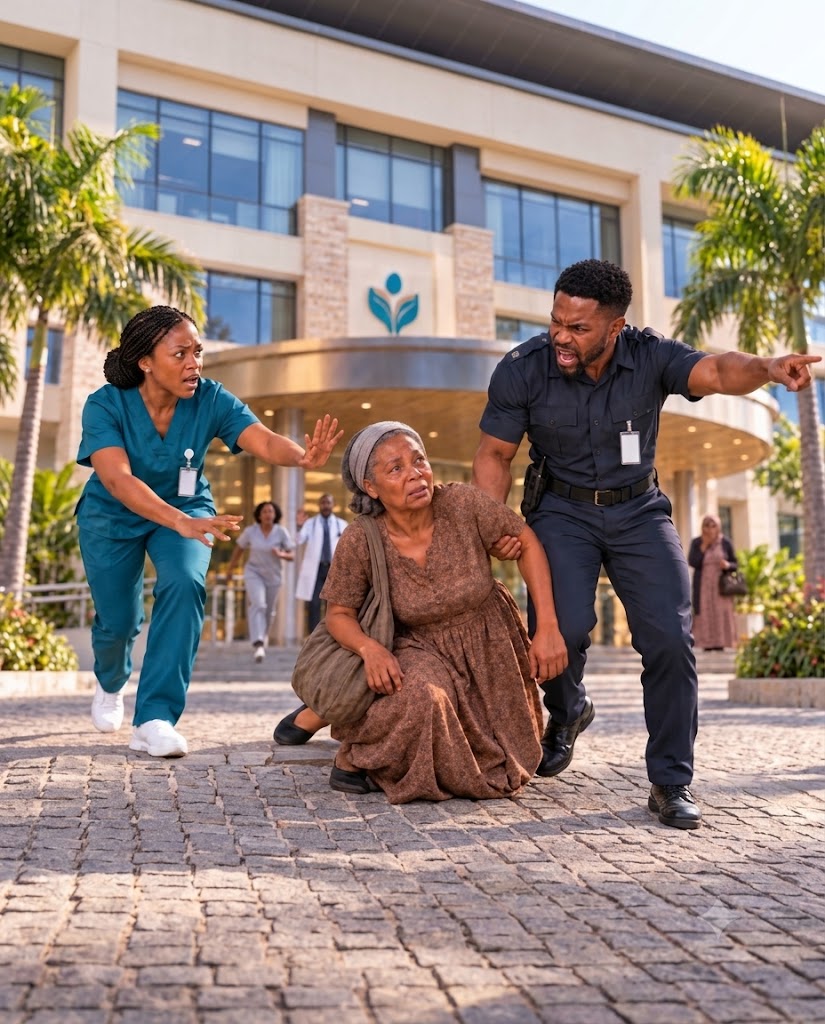
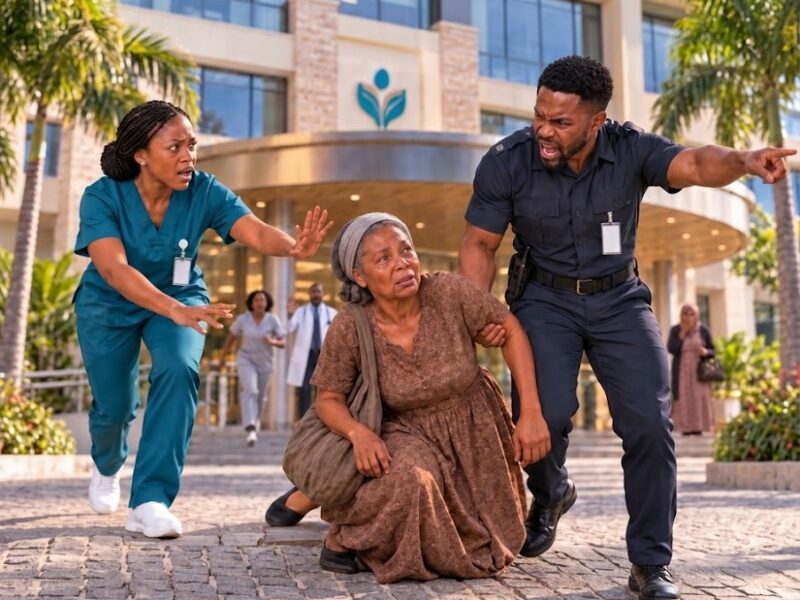
The rain came down in sheets across the parking lot of Hopewell Regional Medical Center, turning the asphalt into a slick mirror that reflected the fluorescent glow of the emergency entrance. A woman in a threadbare gray coat stood at the admissions desk, her hands trembling as she clutched a worn leather purse that had seen better decades. Her breathing came in shallow gasps, each exhale a small battle she was losing. The security guard, a broad-shouldered man named Marcus Webb, positioned himself between her and the automatic doors with the practiced stance of someone who had escorted countless unwanted visitors from the premises. “You were told to leave,” he said, his voice flat and rehearsed. “This hospital is not a shelter. Get off the property now.”
The woman looked up at him with eyes that held something deeper than exhaustion, something that might have been recognition or perhaps a quiet, devastating disappointment. “Please,” she whispered, her voice cracking like old leather. “I’m not asking for charity. I can barely stand.” Her knees buckled slightly, and she gripped the edge of the admissions counter to keep from collapsing onto the polished floor.
A young nurse, Maya Reed, was walking past the reception area on her way to the staff break room when she heard the exchange. She stopped mid-stride, her coffee cup hovering inches from her lips, and turned toward the scene unfolding at the front desk. The woman’s skin had a grayish pallor that Maya recognized immediately from her years in triage. This was not a homeless person seeking shelter from the storm. This was a medical emergency in progress. “Let go of her, Marcus,” Maya said, her voice carrying across the lobby with a authority that surprised even her. “She needs medical attention.”
Marcus turned to face her, his jaw tightening. “My orders are clear. No payment, no treatment.” He gestured toward the woman with his chin. “She has no insurance, no deposit, and no appointment. Director Hail’s policy is non-negotiable.”
“She could die out here,” Maya said, stepping closer. The fluorescent lights buzzed overhead, casting harsh shadows across the woman’s hollow cheeks. Outside, thunder rolled across the night sky like a warning. The woman swayed on her feet, and Maya caught her arm before she fell. “When did you last eat or drink anything?”
The woman’s lips moved, but no sound came out at first. Then, barely audible: “Yesterday morning. I saved my money for transport because I believed this hospital would help me.” She looked up at Maya with tears pooling in her eyes. “I was wrong.”
—
What happened next would become the subject of a hospital board investigation, a police report, and eventually a story that would spread across national news outlets. But in that moment, it was simply one nurse making a choice that would cost her everything she had worked for. Maya Reed had become a nurse to protect life, not bank balances. She had spent seven years at Hopewell, first as a nursing assistant, then as an RN, and finally as a charge nurse in the assessment unit. She had seen patients turned away before, but never one who was actively deteriorating in the lobby. “I’m taking her inside,” Maya announced, her voice steady despite the tremor in her hands. “If you take her inside, every charge goes under your name,” Marcus warned. “Then put it under my name,” Maya replied. “Now move.”
She helped the woman into a wheelchair and pushed her through the double doors toward the assessment unit. The woman’s name, she would later learn, was Rose. Just Rose. No last name, no insurance card, no identification beyond a faded photograph tucked into her purse. The photograph showed a younger woman standing in front of a building that would later be identified as the original Hopewell Hospital, founded in 1962. But that detail would not emerge for another twenty-four hours, after the security footage was recovered and the truth began to unravel.
For now, Maya focused on the immediate crisis. She checked Rose’s vital signs and found that her blood pressure was dangerously low, her pulse irregular, and her glucose levels barely registering. She called for an urgent medical review, but the request was intercepted by the hospital’s director, Victor Hail, who was preparing for the anniversary committee’s arrival that afternoon. Victor had been running Hopewell for fifteen years, and in that time, he had transformed it from a struggling community hospital into a profitable private institution. The transformation had come at a cost, however. Patients without insurance were routinely turned away. Those with Medicaid were directed to other facilities. The emergency room had been downsized, and the admissions policy had been rewritten to prioritize “financial viability” over medical necessity.
Victor’s response to Maya’s request was swift and brutal. “Cancel the review,” he ordered. “If she has no deposit, she has no bed. Move her out before the anniversary committee arrives. I will not have poverty paraded through my lobby.” The message was relayed to Marcus, who appeared in the assessment unit with two other security guards. “Mr. Hail has ordered this patient discharged immediately,” Marcus said, avoiding Maya’s eyes. “Step away, collect her belongings, and bring her to the main entrance now. This is not a request.”
Maya stood between Marcus and Rose, her arms crossed. “She has low blood pressure, low glucose, and an irregular pulse. I requested an urgent medical review. Removing her now would be unsafe, and I will document that.” She pulled out her phone and began typing. “I am documenting her condition, your order, the time, and every person responsible for sending her outside.”
“You will document nothing,” Marcus said, his voice rising. But before he could act, Rose spoke. “Please don’t lose your job because of me,” she said, her voice barely a whisper. “I only came for help. I never imagined a hospital could make a sick person feel this worthless and unwanted.” She began to cry, silent tears streaming down her wrinkled cheeks. “I will not cooperate with an unsafe discharge,” Maya said. “You can suspend me. You can fire me. But I will not abandon a sick woman on the street.”
Victor Hail appeared in the doorway, his face flushed with anger. “Nurse Reed, interfere again and you are suspended. Effective immediately.” Maya looked at him, then at Rose, then back at Victor. “Then suspend me,” she said. “Rose, lean on me. We are leaving together and I will make sure you are safe.”
—
What Victor did not know, what no one at Hopewell knew, was that Rose was not just any patient. She was the founder and principal owner of the hospital, a woman who had built Hopewell from a single-room clinic into a regional medical center. She had stepped away from active management fifteen years earlier, trusting Victor to run the hospital according to the principles she had established. Those principles were simple: no one would be turned away. No one would be denied care because of their ability to pay. Every patient would be treated with dignity and compassion. But Victor had betrayed those principles, and Rose had returned to see the truth for herself. She had dressed in thrift-store clothes, emptied her bank accounts except for a few hundred dollars, and presented herself at her own hospital as a homeless woman in need of care. The result had been exactly what she feared: she had been turned away, humiliated, and left to die in the rain.
But Maya Reed had seen her. Maya had stopped. Maya had risked her career, her livelihood, and her future to help a stranger. And now, as they sat in Maya’s small apartment on the outskirts of the city, Rose realized that she had found something rare: a person who embodied everything Hopewell was supposed to stand for. “Why are you doing this for me?” Rose asked, her voice weak but steady. “That woman said you could lose your job. Everyone else looked through me, but you stopped. You don’t even know who I am.”
Maya was preparing a glucose solution in the kitchen, her hands moving with practiced efficiency. “I became a nurse to protect life, not bank balances,” she said. “If helping you costs me this job, then perhaps this is not the hospital I thought it was.” She brought the solution to Rose and helped her drink it slowly. “Your blood pressure is low. When did you last eat or drink anything?”
“Yesterday morning,” Rose repeated. “I saved my money for transport because I believe this hospital would help me.” She paused, her eyes filling with tears again. “I was wrong about that. But I was right about you.”
Maya’s phone buzzed. It was Dr. Kwame Mensah, a physician she had worked with for years and one of the few people at Hopewell she trusted completely. She had called him from the car, explained the situation, and asked him to come examine Rose at her apartment. “I’m calling Dr. Mensah now,” Maya told Rose. “She still needs a proper medical review tonight.”
Dr. Mensah arrived within thirty minutes, his medical bag in hand and a look of concern etched across his face. He examined Rose thoroughly, checking her heart rate, blood pressure, and oxygen saturation. His expression grew more serious with each reading. “Your pulse is irregular and you are dangerously weak,” he said. “These readings are not safe. You need urgent hospital care tonight. This cannot wait until morning.”
Rose shook her head weakly. “Please, doctor, don’t send me back there. They looked at my clothes before they looked at my condition. I begged them for help and they treated me like dirt. Please let me stay here tonight.” Dr. Mensah hesitated. He knew the protocols. He knew the risks. But he also knew that the nearest hospital capable of providing the care Rose needed was Hopewell, and returning her there would be unconscionable. “Your glucose is dangerously low, but you’re still conscious,” he said finally. “Maya, help her sip the juice slowly. I’ll monitor her blood pressure. If she deteriorates, I am calling 911 immediately.”
—
The next morning, Maya received a phone call that would change everything. It was Marcus Webb, the security guard who had threatened to remove Rose from the hospital the night before. His voice was strained, almost panicked. “Nurse Reed, it’s Marcus. I was wrong about Mrs. Rose. Victor ordered me to delete the security footage and blame you. I saved a copy. Whatever happens, do not return to this hospital alone.” Maya’s heart pounded in her chest. “Marcus, send the footage to my private email now. Do not confront Victor again. Keep the server copy untouched. If he discovers what you’ve done, he will destroy both of us.”
She forwarded the footage to her personal account and made two backup copies on encrypted USB drives. Then she called Dr. Mensah. “I need you to document everything about Rose’s condition,” she said. “Every reading, every observation, every treatment. Victor is going to try to destroy my credibility, and I need proof that I acted appropriately.” Dr. Mensah agreed without hesitation. He had seen enough in his own career to know that hospitals sometimes prioritized profits over patients. He had stayed at Hopewell because he believed he could make a difference, but the events of the past twenty-four hours had shaken that belief to its core.
Meanwhile, Victor Hail was not idle. He had ordered a search of the pharmacy logs and discovered that two boxes of controlled medication were missing. He instructed Marcus to check Maya’s locker first, knowing that she had been suspended and had not cleared out her belongings. When the medication was found inside, Victor summoned a witness, Nurse Zoe Chen, and began building a case against Maya. “Those are the two missing medication boxes,” he announced, pointing to the locker. “Do not touch them. Photograph everything exactly as we found it. Then notify compliance.”
But Marcus had already made his choice. He called Maya and warned her about the setup. “Nobody touches that locker,” he said loudly, stepping between Victor and the evidence. “Marcus, secure this room and preserve every photograph. Zoe, call Maya and instruct her to report for an urgent formal meeting. Do not discuss what was found.”
Zoe Chen was a senior charge nurse who had worked at Hopewell for twelve years. She had seen Victor’s management style evolve from strict but fair to something darker, more vindictive. She had watched as long-time employees were pushed out and replaced with younger, cheaper staff who would not question orders. She had seen patients turned away who should have been admitted. But this was different. This was a direct attack on a colleague she respected, based on evidence that had clearly been planted. “Nurse Reed, this is Senior Charge Nurse Zoe calling from Hopewell,” she said, her voice carefully neutral. “You are required to attend an urgent fact-finding meeting at 10:00 this morning. I cannot discuss the allegation by telephone, but you may bring a representative.”
“An allegation?” Maya repeated. “Zoe, I was suspended before I left the hospital. I have never taken medication from Hopewell. I will attend the meeting, but please preserve everything exactly as you found it.”
—
The board meeting took place in a conference room on the third floor of the hospital, a room that had been the site of countless administrative decisions that had shaped the fates of patients and staff alike. Maya arrived with Dr. Mensah at her side and a lawyer from the state nurses’ association, a sharp-eyed woman named Patricia Okonkwo who specialized in employment law. They were met by Victor Hail, who seemed almost gleeful at the prospect of Maya’s downfall. “You have some nerve returning here,” he said. “The board is waiting upstairs. After what they found in your locker, your career is finished.”
The board consisted of seven members: three physicians, two community representatives, and two members of the hospital’s legal counsel. The chair, Dr. Eleanor Vance, was a retired surgeon who had known Rose personally and had been instrumental in establishing Hopewell’s original mission. She had been concerned about the hospital’s direction for years but had been unable to prove anything. Now, she had a feeling that this meeting would change everything. “Nurse Reed, you are accused of removing controlled medication and abandoning your assigned duty,” Dr. Vance said. “This panel will hear your response before reaching any decision.”
Maya stood, her hands clasped in front of her. “I took nothing,” she said, her voice clear and steady. “Director Victor suspended me before I left with a critically ill patient. Check the pharmacy logs, corridor cameras, and everyone who handled that evidence.”
“The cameras are irrelevant,” Victor interrupted. “The medication was found inside her locker. End this hearing now and terminate Nurse Reed immediately.”
Dr. Vance held up her hand. “Director Victor, this panel decides the outcome, not you. Marcus, bring me the original search report and preserve every recording.”
Marcus stepped forward, his face pale but determined. “Madame Chair, Nurse Zoe ordered us to begin with Maya’s locker. The corridor camera stopped recording eleven minutes before she reported the medication missing.”
Victor’s face reddened. “The camera failure proves nothing. Maya abandoned her post, removed a patient without authorization, and the medication was found inside her locker. Those are the facts.”
Dr. Vance leaned forward. “Your report says Maya was suspended before she left. How could she abandon a post she no longer held? And why did you target her locker first? This hearing is adjourned. Marcus, secure the evidence and obtain the original camera files. Until then, no decision will be made against Nurse Reed.”
—
What Victor did not know was that Marcus had already made copies of the security footage. He had also discovered something else: the camera outside Maya’s locker had been disabled using a director-level access code. The code belonged to Victor’s account, but the login had come from the administration terminal outside his assistant’s office. “Marcos, this was not a system failure,” Marcus told the board’s IT director, a man named Marcos Rivera. “Someone used a director-level access code to disable the locker corridor camera at 7:41. The code belongs to Director Victor’s account, but the login came from the administration terminal outside Celestine’s office.”
Celestine Moore was Victor’s executive assistant, a woman who had worked at Hopewell for twenty years and knew every secret the hospital held. She had been complicit in Victor’s schemes for years, deleting records, manipulating schedules, and ensuring that complaints from patients and staff never reached the board. But now, she was beginning to realize that Victor would sacrifice her the moment it became convenient. “Victor, Marcos is in the control room,” she called him frantically. “If he recovers the audit log, they’ll trace your code back to my terminal. Keep Marcos away from the chairwoman. I’ll deal with the audit log.”
But it was too late. Marcos had already made two secure copies of the audit log, one of which had been delivered directly to Dr. Vance. The log identified Victor’s access code and showed that the login had come from Celestine’s terminal. “Madame Chair, the audit identifies Victor’s access code,” Marcos reported. “The login came from the terminal outside Celestine’s office.”
“Marcos, secure the control room,” Dr. Vance ordered. “Bring Victor and Celestine here separately. Do not tell either of them what we have found.”
—
The confrontation that followed was brutal and revealing. Victor and Celestine were brought before the board separately, each unaware of what the other had said. Victor denied everything, claiming that Celestine had used his credentials without his knowledge. Celestine, when confronted with the evidence, broke down and admitted everything. “You gave me your code and ordered me to plant the medication,” she said, pointing at Victor. “I kept every message. You ordered me to destroy Rose’s file and threatened to blame me. The hospital lawyer will hear every word.”
Dr. Vance listened in silence as the two of them turned on each other, each trying to save themselves at the other’s expense. When they had finished, she made her decision. “Victor and Celestine, you are suspended with immediate effect. Your access is revoked. Remain here until Marcos escorts you from the premises.”
But the story was not over. As Victor and Celestine were being escorted out, Victor made one final attempt to destroy the evidence. He called a technician in the security office and ordered him to delete every recording from the night Rose arrived. “Do it now,” he hissed. “Before the board does.”
The technician, a young man named Derek who had only been working at Hopewell for six months, hesitated. He had heard rumors about Victor’s management style, but he had never imagined he would be asked to destroy evidence. He was about to comply when Marcus burst into the room. “Security control, lock the surveillance room immediately,” Marcus shouted. “Nobody enters and nobody touches the recording system. I’m on my way.”
—
The recordings were preserved. The audit logs were secured. And on the morning of the hospital’s anniversary celebration, the truth was finally revealed. The boardroom was filled with staff, community leaders, and members of the press who had been invited to cover the event. Victor and Celestine were brought in under security escort, their faces pale with fear and anger. Dr. Vance stood at the podium, her expression grave. “Today should celebrate Hopewell’s service,” she said. “Instead, we must confront evidence that a vulnerable patient was denied care and an innocent nurse was framed. Before this meeting ends, this hospital will hear the truth.”
She played the security footage. The room watched in stunned silence as Victor ordered Rose removed from the hospital, as Maya refused to abandon her, as Marcus hesitated before following his orders. They watched as Celestine planted the medication in Maya’s locker, as Victor disabled the camera, as the two of them conspired to destroy the evidence. When the footage ended, Dr. Vance turned to face Victor and Celestine. “You were summoned to answer this board’s questions. Remain under security supervision and speak only when this board addresses you.”
Victor tried to defend himself, but his words were drowned out by the murmurs of the crowd. Celestine broke down and confessed everything, her voice shaking with fear and regret. And then, the doors at the back of the room opened, and Rose walked in.
—
She was not the same woman who had been turned away three days earlier. She wore a tailored navy suit and carried herself with the quiet authority of someone who had spent decades making difficult decisions. Her hair was styled, her posture straight, and her eyes held a fierce determination. Beside her walked Dr. Mensah, who had been caring for her since her admission to St. Anne’s Hospital the night before. The room fell silent as Rose made her way to the front of the boardroom. “Before this meeting ends,” she said, her voice clear and strong, “everyone here will know why I entered Hopewell dressed as a woman with nothing.”
Dr. Vance stepped forward, her face a mixture of shock and recognition. “This is Mrs. Rose, the founder and principal owner of Hopewell Hospital. She entered anonymously to see how this hospital treated patients who appeared powerless.”
A collective gasp rippled through the room. Maya, who had been standing near the back with Dr. Mensah, felt her knees go weak. “Mrs. Rose,” she whispered. “All this time you owned Hopewell.”
Rose turned to face her, her eyes softening. “I never helped you for power or reward,” she said. “I helped because you needed me, and I would do it again.” She turned back to the crowd. “I came without status to see whether Hopewell still protected the vulnerable. Maya saw a patient in need. Victor and Celestine saw someone they believed was disposable.”
Victor stepped forward, his face contorted with desperation. “Mrs. Rose, if I had known who you were, I would never have allowed this. I was protecting Hopewell. Please give me one chance to correct it.”
Rose looked at him with an expression of profound disappointment. “That is exactly why you cannot lead this hospital. Every patient deserves the care you would have given me if you knew my name. Compassion cannot depend on status.”
She turned to Dr. Vance. “Victor and Celestine, your employment is terminated with immediate effect. This evidence will be referred to the police and medical regulators. Marcos, escort them from the hall.”
—
The cheering that erupted in the boardroom was deafening. Staff members who had been afraid to speak out for years finally felt safe to express their relief. Patients who had been turned away found hope that things would change. And Maya Reed, the nurse who had risked everything to help a stranger, stood at the center of it all, overwhelmed by the turn of events. “Maya Reed,” Rose said, her voice carrying across the room. “Your suspension is permanently erased from your record. You will receive full back pay and a formal public apology from Hopewell Hospital.”
Maya tried to speak, but the words caught in her throat. Rose continued: “Beginning today, you are Hopewell’s head of patient advocacy and community outreach. I want the woman who protected one forgotten patient to protect everyone entering these doors.” She paused, a smile spreading across her face. “And I am funding the Maya Reed Community Care Center. You will lead it. No vulnerable family will ever be turned away again.”
“Oh my god, Mrs. Rose,” Maya finally managed. “I don’t know what to say.”
“You don’t have to say anything,” Rose replied. “Your actions spoke for you. This center belongs to everyone who was ever ignored or turned away. Your trust transformed one act of compassion into hope for thousands.”
—
The Maya Reed Community Care Center opened six months later, housed in a renovated wing of the hospital that had once been used for administrative offices. It offered free health screenings, preventive care, and referrals to specialists for patients who could not afford traditional hospital services. It was staffed by a team of nurses, social workers, and community health workers who shared Maya’s commitment to serving the underserved. Within its first year, the center served over seven thousand patients, many of whom had been turned away from other facilities. It became a model for community health programs across the state, and Maya was invited to speak at conferences and share her story.
But the story did not end there. The police investigation into Victor and Celestine’s activities uncovered a pattern of fraud and misconduct that extended far beyond the events of that rainy night. They had been embezzling funds from the hospital for years, diverting money meant for patient care into offshore accounts and luxury purchases. They had falsified records, intimidated staff, and created a culture of fear that had driven away some of the hospital’s most talented physicians and nurses. The evidence Marcus had preserved was instrumental in their prosecution. Both were eventually convicted of multiple felonies and sentenced to prison terms.
Rose remained involved with Hopewell, though she no longer took an active role in day-to-day management. She had learned a valuable lesson from her experience: that the principles she had built the hospital on could be corrupted if the people in charge did not share them. She established a new governance structure that included patient representatives and community members, ensuring that the hospital would remain accountable to those it served. She also created a fund to support patients who could not afford care, seeded with her personal fortune and sustained by donations from grateful patients and their families.
—
Maya visited Rose regularly at her home, a modest house near the hospital that she had lived in for forty years. They would sit on the porch and talk about everything and nothing, about the patients Maya had helped and the changes Rose had made. One afternoon, as the sun set over the city, Rose asked Maya a question that had been on her mind for months. “Why did you stop that night? Everyone else looked through me. You could have walked by. You could have pretended you didn’t see. Why did you stop?”
Maya thought for a moment, watching the colors shift across the sky. “Because I couldn’t not stop,” she said finally. “I became a nurse to help people. If I had walked by, I would have betrayed everything I believe in. I would have become the kind of person I never wanted to be.”
Rose nodded slowly. “That’s what I was looking for,” she said. “Someone who would help without knowing who I was. Someone who would do the right thing even when it cost them something. You are the reason I still believe in this hospital.”
They sat in silence for a while, watching the stars appear one by one. Then Maya said something that surprised them both. “I was so angry that night. Angry at Victor, angry at the system, angry at myself for not being able to do more. But now, looking back, I think that night was the best thing that ever happened to me. It showed me what I was capable of. It showed me who my real friends were. And it gave me a chance to make a difference in a way I never could have before.”
Rose smiled. “Kindness always costs something,” she said. “You paid for mine with your job. But you got something better in return. You found your purpose.”
—
The Maya Reed Community Care Center celebrated its fifth anniversary with a community health fair that drew thousands of people from across the city. There were free screenings, educational workshops, and a mobile clinic that traveled to underserved neighborhoods. Maya stood at the entrance, greeting patients and their families, remembering the night that had started it all. She thought about Rose, who had passed away peacefully two years earlier, leaving behind a legacy of compassion that continued to touch lives every day. She thought about Marcus, who had left Hopewell to work at the care center, using his security experience to help patients feel safe and welcome. She thought about Dr. Mensah, who had become the center’s medical director, bringing his expertise to patients who had nowhere else to turn.
And she thought about the woman in the gray coat, the one who had been told to leave, the one who had been treated like dirt, the one who had turned out to be the most powerful person in the room. Maya had learned something from Rose that she would carry with her for the rest of her life: that every person deserved dignity, regardless of their appearance or their circumstances. That compassion was not a luxury to be rationed but a necessity to be shared. That the true measure of a hospital was not its profit margin but its commitment to those it served.
The band played, children laughed, and the sun shone down on a community that had come together to build something beautiful. Maya took a deep breath, smiled, and stepped forward to greet the next patient in line. There was work to be done, and she was ready to do it. The center belonged to everyone who had ever been ignored or turned away, and it would remain a place of healing for generations to come.









