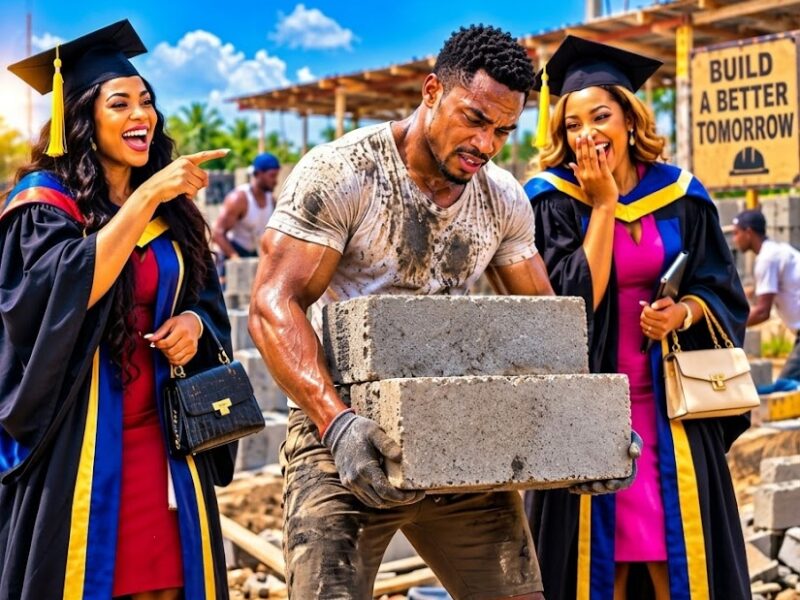
They Mocked Him for Looking Poor—Unaware the Quiet Stranger Owned Half the Town
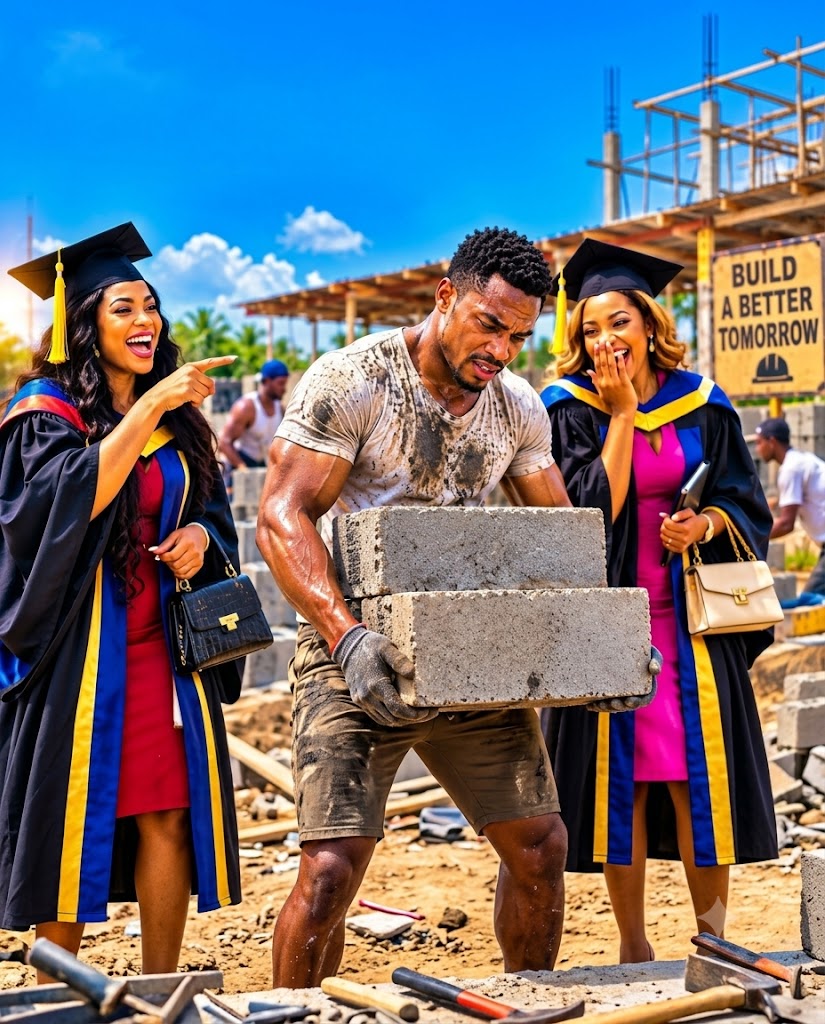
The rain had stopped an hour ago, but the streets of Westbrook still shimmered like beaten silver under the flickering streetlights. Ikenna stood at the edge of the construction site, his work boots caked with dried mud, his hands blistered from hauling concrete blocks all day. He was twenty-six years old, a geology graduate from the University of Houston, and he had exactly forty-three dollars to his name.
His mother, Ada, was waiting for him in their cramped two-bedroom apartment on the south side of town, where the roof leaked every time it rained and the heating only worked when it felt like it. She had sacrificed everything to put him through school. She had sold her wedding ring, taken extra shifts at the laundromat, and borrowed money from relatives who never let her forget it. And now, after all those years of studying rocks and minerals and the earth’s hidden treasures, her son was carrying blocks for a living.
It wasn’t supposed to be this way.
Ikenna had graduated with honors. He had sent out hundreds of applications, sat through dozens of interviews, and heard the same rejection every single time: “You don’t have enough experience.” He had tried to explain that he needed someone to give him a chance before he could get experience, but the HR managers just smiled politely and moved on to the next candidate. The next candidate always had connections. The next candidate always had a father who knew somebody. The next candidate never had to carry blocks under the Texas sun.
His phone buzzed in his pocket. He pulled it out and saw a text from his mother: “Dinner is ready. Don’t be late.”
Ikenna smiled despite the exhaustion. His mother was the only person who still believed in him. She was the only person who looked at him and saw something valuable, even when he couldn’t see it himself. He typed back: “On my way.”
As he walked toward the bus stop, a black Mercedes pulled up beside him. The window rolled down, and a familiar face appeared. It was Chidima, the girl he had dated in college. The girl who had left him when he couldn’t find a job. The girl who had told him she needed “someone with a future.”
“Ikenna?” she said, her voice dripping with surprise. “Is that really you?”
He nodded, not trusting himself to speak. She looked at his dirty clothes, his tired eyes, his calloused hands. And then she laughed.
“I heard you were working at a construction site,” she said. “I thought people were joking. But here you are. The smartest guy in our class, carrying blocks. What an irony.”
Ikenna felt his jaw tighten. “It’s honest work,” he said quietly.
“Oh, I’m sure it is,” Chidima replied, still smiling. “But you used to talk about your future like you had everything figured out. You said you were going to discover something big. You said you were going to change your family’s life. And look at you now.”
She glanced at his worn-out boots, his faded jeans, his tired face. “Some people peak in college,” she said. “I guess you’re one of them.”
Ikenna wanted to respond. He wanted to tell her that she didn’t know anything about his life, that she had no right to judge him, that she had walked away when things got hard. But he was too tired. Too tired to fight. Too tired to explain. So he just nodded and said, “Have a good evening, Chidima.”
She drove away, her laughter echoing in his ears.
That night, Ikenna sat at the small kitchen table with his mother, pushing his food around his plate. He had no appetite. He hadn’t had an appetite for weeks.
“Your eyes are red,” Ada said softly. “You’re hurting yourself.”
“I’m fine, Mama,” he said, not meeting her gaze.
“You said the same thing yesterday. And the day before that.”
Ikenna sighed. “I just… I don’t know what I’m doing anymore. I studied geology. I spent four years learning about rocks and minerals. And now I’m carrying blocks for a living. What was the point of all that education?”
Ada reached across the table and took his hand. Her fingers were rough from years of hard work, but her touch was gentle. “The point,” she said, “is that you have knowledge. And knowledge is never wasted. You just haven’t found your opportunity yet.”
“What if I never find it?”
“Then you keep looking. But you don’t give up. You don’t stop being the person I raised.”
Ikenna looked at his mother. She was tired too. He could see it in her eyes, in the way she moved, in the way she tried to hide her worries. She had been struggling for years, and he had promised her that things would get better. He had promised her that he would take care of her. And he had failed.
“I’m sorry, Mama,” he whispered.
“For what?”
“For not being enough.”
Ada squeezed his hand. “You are more than enough. You are my son. And one day, the world will see what I see.”
Ikenna didn’t sleep that night. He lay in bed, staring at the ceiling, thinking about his life. He thought about the rejection letters, the failed interviews, the people who had laughed at him. He thought about Chidima and the way she had looked at him like he was nothing. He thought about his mother and the sacrifices she had made.
And then he thought about the stone.
He had found it three days ago, while working on a construction site on the outskirts of town. It was buried deep in the ground, hidden beneath layers of dirt and rock. At first, he had thought it was just another piece of debris. But something about it caught his eye. The color was unusual, the texture was different, and his geology training had taught him to pay attention to things that didn’t fit.
He had pocketed the stone without telling anyone. He had brought it home and examined it under the small magnifying glass he kept in his room. And the more he looked at it, the more he became convinced that it was something special.
Something valuable.
The next morning, Ikenna woke up early. He dressed in his best clothes, the ones he had worn to interviews, and he put the stone in his pocket. He told his mother he was going to run some errands, but the truth was that he was going to the one place that might be able to tell him what he had found.
The company was called TerraCore Minerals, and it was located in a sleek glass building downtown. Ikenna had passed by it many times, but he had never been inside. He had never had a reason to. But today, he walked through the front doors and approached the reception desk.
“Good morning,” he said, trying to keep his voice steady. “I’d like to speak with someone in your mineral procurement department.”
The receptionist looked up at him with a bored expression. “Do you have an appointment?”
“No.”
“Then you need to book one.”
“Please,” Ikenna said. “It’s important.”
“What’s the purpose of your visit?”
“I have a mineral sample.”
The receptionist raised an eyebrow. “Are you a registered supplier?”
“No.”
“Then you can’t just walk into the procurement office.”
Ikenna took a deep breath. He had expected resistance. He had expected to be turned away. But he had also learned that sometimes you had to push through the resistance to get what you needed.
“Please forgive my manner,” he said. “It’s just that this is very important and confidential. I would appreciate it if you could allow someone qualified to look at this.”
The receptionist studied him for a moment. Then she picked up the phone and made a call. A few minutes later, a man in a gray suit appeared.
“You said you have a sample?” the man asked.
“Yes, sir.”
“Where did you get it?”
“I found it.”
“Where?”
Ikenna hesitated. “I’d prefer not to say until I know what I have.”
The man frowned. “That’s unusual. Most people who bring samples here always want to tell us everything.”
“I don’t want to make a mistake.”
The man studied him for a long moment. Then he nodded. “Follow me.”
They went into a small laboratory, where the man placed the stone under a machine that hummed and whirred. Ikenna watched as the man’s expression changed from curiosity to surprise to something that looked almost like disbelief.
“Run it again,” the man said to a technician.
“I already did.”
“Run it again.”
The technician ran the test again. And again. And each time, the result was the same.
“Is something wrong, sir?” Ikenna asked.
The man turned to him. “Where exactly did you get this?”
“Why?”
“Because this sample is not ordinary. The results show it’s unique. The composition is consistent with a very high-grade rare earth-bearing mineral.”
Rare earth. The words hit Ikenna like a thunderbolt. He knew what rare earth minerals were. He knew how valuable they could be. He knew that they were used in everything from smartphones to military equipment to renewable energy technology. And he knew that finding a high-grade deposit could be worth millions.
“Rare earth?” he repeated.
“Yes. We need a more comprehensive test before we say anything definite. Can you bring us more?”
“Yes. How much?”
“Enough to confirm the deposit’s quality.”
“I can bring another sample.”
The man leaned closer. “If you really know where this came from, do not tell everybody.”
“Why?”
“Because once people know something is valuable, they stop asking who found it. They start asking where it is.”
Ikenna nodded. He understood. He understood perfectly.
When he got home, his mother was waiting for him. She could see the excitement in his eyes, the hope that he had been trying to hide for so long.
“How did it go?” she asked.
“I think we may have found something.”
“Something good?”
“I don’t know yet. They said the mineral is not ordinary. They believe it may be a high-grade rare earth-bearing mineral.”
Ada’s eyes widened. “How much could it be worth?”
“I don’t know. But they warned me to keep the location secret.”
“Then keep it secret.”
“I will.”
“And don’t tell Chidima.”
Ikenna frowned. “Why did you mention her?”
“Because I know people. And I know what happens when people suddenly hear that somebody they look down on is doing well.”
Ikenna remembered the way Chidima had laughed at him. He remembered the way she had looked at him like he was nothing. And he knew his mother was right.
“Promise me something,” Ada said.
“What?”
“Don’t become the kind of person who made you feel small.”
Ikenna looked at his mother. She had been through so much. She had sacrificed so much. And through it all, she had never lost her kindness, her compassion, her humanity. He wanted to be like her. He wanted to make her proud.
“I promise,” he said.
The next few days were a blur of tests and meetings and negotiations. TerraCore Minerals confirmed that the sample was indeed a high-grade rare earth-bearing mineral. They confirmed that it was commercially valuable. They confirmed that they wanted to do business with him.
But they still didn’t know where he had found it.
Ikenna hired a lawyer, a sharp-eyed woman named Adisa who specialized in mining and business law. She explained everything to him: the land rights, the mining regulations, the environmental requirements, the commercial agreements. She told him that he had information that was extremely valuable, and that he should not throw it away.
“You discovered a mineral deposit on land that you did not purchase,” she said. “You collected samples, and an industrial company has confirmed that the material is commercially valuable. You have not disclosed the exact location to the company. That was the right thing to do.”
“But what happens next?”
“That depends on the land, the mineral, and the laws governing its extraction. Discovering it does not automatically make you the owner.”
“I expected that answer.”
“What you do have is information that may be extremely valuable. You should not throw that information away.”
“That’s exactly what I’m afraid of.”
“Then we proceed slowly. Slowly enough to protect you, but not so slowly that somebody else gets there first.”
Ikenna nodded. He understood. He had been poor for a long time. He didn’t want poverty to make him careless now that he had found an opportunity.
The company offered him fifty million dollars for exclusive access to the material. Fifty million dollars. It was more money than he had ever seen. It was more money than he had ever dreamed of. But his lawyer advised him to wait.
“Independent valuation, proper legal review, a clear development structure,” she said. “Do not sign the first agreement somebody puts in front of you.”
Ikenna listened. He had learned to be careful. He had learned to think about what he was giving away.
The company paid him a small amount for the verified sample and preliminary rights discussion: five hundred thousand dollars. It was the first money he had ever earned from the thing he had found. And he knew exactly what he wanted to do with it.
He took his mother shopping.
They went to a department store downtown, the kind of place they had never been able to afford. He bought her new clothes, a new mattress, new shoes. He bought her things she had never asked for, things she had never even dreamed of.
“You’ve changed,” Ada said, looking at him with a mixture of pride and wonder.
“How?”
“Before, you used to count every dollar before buying anything. Now you’re telling me I deserve better.”
“You do deserve better, Mama.”
“This one is fine.”
“Take three.”
“Three?”
“Yes.”
Ada laughed. “You’re becoming stubborn.”
“You raised me.”
They were walking out of the store when Ikenna saw her. Chidima. She was standing near the entrance with her mother, carrying shopping bags. She looked different. Better. More polished.
“Ikenna?” she said, her voice uncertain.
“Chidima.”
“I didn’t know you were here.”
“I came to shop with my mother.”
She looked at his new clothes, his confident posture, the way he carried himself. “You look different.”
“Do I?”
“Yes. You look good.”
“Thank you.”
“How is your mother?”
“She’s fine.”
There was a long pause. Chidima shifted uncomfortably. “Ikenna, I’ve been wanting to speak with you. About everything. I know I hurt you, and I know you probably don’t want to hear another apology from me.”
“I didn’t say that.”
“But you’re different now. I heard things.”
“What things?”
“That you’re involved in some mineral business.”
Ikenna smiled. “People talk too much.”
“So it’s true.”
“I have to go.”
“Ikenna, please.”
“Maybe.”
He walked away, leaving her standing there with her mouth slightly open. He didn’t look back. He didn’t need to.
That night, Chidima sat in her apartment with her boyfriend, Daniel. She was distracted, her mind elsewhere.
“You’ve been quiet all evening,” Daniel said.
“I saw Ikenna yesterday.”
“Where?”
“At a shopping complex. He looked different.”
“Different how?”
“Better. I heard he’s involved in some mineral deal.”
“So did I. Do you know where the mineral is?”
“No. I asked him, but he avoided the question.”
“He’s being careful. Maybe he has good reason.”
Daniel studied her. “Do you think you made a mistake?”
“What kind of mistake?”
“You made the decision you wanted at the time.”
“That’s not what I asked.”
“I don’t know. You wanted stability. I gave you stability. You wanted a man who could take care of you. Then why are you looking at Ikenna like that?”
“Because I’m beginning to realize something.”
“What?”
“Maybe I judged him by what he had instead of who he was. And now everybody is talking about him.”
“So you want him because other people are talking?”
“I didn’t say that.”
“Then be honest with yourself.”
“I am trying.”
Chidima’s phone buzzed. She looked at the screen and saw a message from an unknown number: “You should find out what Ikenna has discovered before everybody else does.”
She stared at the message for a long time. Then she deleted it.
But she couldn’t delete the thought.
The next morning, Ikenna went back to the place where he had found the stone. He needed to see it again. He needed to understand it better. He needed to know what he was dealing with.
He parked his car, a used Honda he had bought with the money from the company, and walked toward the construction site. The site was abandoned now, the workers gone, the equipment silent. He walked past the half-finished buildings and into the open field beyond.
And then he saw it.
The mineral was everywhere. It was embedded in the rocks, scattered across the ground, hidden beneath layers of dirt. It was more than he had ever imagined. It was more than the company had ever seen.
He knelt down and picked up a piece. It was beautiful, in a strange way. It glinted in the morning light, catching the sun like a promise.
“I found more,” he whispered to himself.
He took out his phone and called his mother.
“Mama, I found more.”
“More what?”
“The mineral. I think the company has only seen the beginning.”
“Then you need to be even more careful than before.”
“I know.”
“Promise me you won’t do anything foolish.”
“I won’t.”
“And you won’t tell anybody exactly where the mineral is.”
“I won’t.”
“Not even people who suddenly become your friends.”
“I understand.”
“Listen to me carefully. You spent months ignored because you had nothing. Now you have something. Don’t forget how quickly attitudes can change.”
“I won’t, Mama.”
He hung up and looked at the field. The sun was rising, painting the sky in shades of gold and orange. He thought about his mother and the sacrifices she had made. He thought about Chidima and the way she had laughed at him. He thought about the company and the fifty million dollars they had offered.
And he thought about the future.
His future.
He walked back to his car and drove home. His mother was waiting for him with a cup of coffee and a worried expression.
“You went back to the place,” she said.
“Yes.”
“What did you find?”
“More. Enough to make me understand why I need to be careful.”
“Are you alone?”
“Yes.”
“Then don’t stay too long next time. Promise me something.”
“What?”
“When all this starts becoming serious, don’t disappear into it. Don’t let the stone become your life. You have been struggling for so long, but money can make people move too quickly.”
“I just want you to stop suffering, Mama.”
“I know.”
“I want to stop begging people for jobs.”
“I know.”
“I want to be able to help people.”
“I know all of that. But I also want you to remain the person I know.”
“I will.”
The company called a few days later. They wanted to move to the next stage. They wanted to evaluate the deposit. They wanted access to the location.
Ikenna sat in the conference room with his lawyer, listening as the executives explained their proposal. They were offering two hundred and fifty million dollars for preliminary rights. It was an astronomical amount. It was more money than he had ever imagined.
But he didn’t sign.
“Independent valuation,” he said. “Proper legal review. A clear development structure.”
The executives exchanged glances. They were not used to dealing with someone like him. Someone who had nothing but refused to be rushed. Someone who had been poor but refused to be desperate.
“You are learning quickly,” one of them said.
“I have had a lot of practice being desperate.”
“This is substantial for your position.”
“My position? You mean because I’m new? Because I don’t have experience?”
“We didn’t mean it that way.”
“I spent months looking for a job. People rejected me because I had no experience. I carried blocks to feed my mother. But I also don’t want to sell my future because I am excited about seeing money in my account.”
The room was silent.
“We can prepare a proper agreement,” the executive said finally. “One that protects your interests.”
“That is what I expect.”
“And Mr. Ikenna?”
“Yes?”
“Whatever you are sitting on, I hope you understand how valuable it could become.”
“I am beginning to understand.”
That evening, Ikenna went home and found his mother in the kitchen. She was cooking dinner, humming softly to herself. She looked up when he walked in.
“How did it go?” she asked.
“I think we may have found something.”
She smiled. “Something good?”
“I don’t know yet. But they said the mineral is not ordinary. They believe it may be a high-grade rare earth-bearing mineral.”
“Rare earth?”
“Yes.”
“How much could it be worth?”
“I don’t know. But they warned me to keep the location secret.”
“Then keep it secret.”
“I will.”
“And don’t tell Chidima.”
“Why did you mention her?”
“Because I know people. And I know what happens when people suddenly hear that somebody they look down on is doing well.”
Ikenna nodded. He remembered the way Chidima had laughed at him. He remembered the way she had looked at him like he was nothing. And he knew his mother was right.
“Promise me something,” Ada said.
“What?”
“Don’t become the kind of person who made you feel small.”
Ikenna looked at his mother. She had been through so much. She had sacrificed so much. And through it all, she had never lost her kindness, her compassion, her humanity. He wanted to be like her. He wanted to make her proud.
“I promise,” he said.
The next few weeks were a whirlwind. The company conducted a full evaluation of the deposit. They confirmed that it was much larger than they had initially thought. They confirmed that it was one of the highest-grade rare earth deposits they had ever seen. They confirmed that it was worth billions.
Ikenna hired a team of lawyers, accountants, and mining experts. He negotiated a deal that gave him a percentage of the profits, a seat on the board, and control over how the land was developed. He made sure that the local community would benefit from the discovery. He made sure that the environment would be protected. He made sure that everything was done legally and ethically.
And he made sure that his mother would never have to worry about money again.
He bought her a new house, a beautiful house with a garden and a view. He bought her a car, a comfortable car that she could drive to church and to visit her friends. He paid off all her debts. He set up a trust fund for her so that she would never have to depend on anyone again.
“Look at this house,” Ada said, her eyes wide with wonder. “This can’t be real.”
“It’s real, Mama.”
“But how? I mean, I knew you found something, but I didn’t know it was this big.”
“It’s big. And it’s only the beginning.”
Ada sat down on the new sofa and looked around the living room. “I don’t know what to say.”
“You don’t have to say anything.”
“I don’t know how to thank you.”
“You don’t have to thank me. You raised me. You believed in me. You never gave up on me. This is because of you.”
Ada’s eyes filled with tears. “I always knew you would make it. I always knew.”
“I know, Mama. I know.”
The news spread quickly. A young man from the south side of town had discovered a rare earth mineral deposit. A young man who had been carrying blocks for a living. A young man who had been rejected by every company he applied to. A young man who had been laughed at and looked down on.
Suddenly, everyone wanted to know him.
His phone rang constantly. Old classmates called to congratulate him. Distant relatives reached out to reconnect. Strangers sent messages asking for money. And Chidima called.
“Ikenna, I’ve been trying to reach you.”
“I’ve been busy.”
“I heard something. That you’re involved in something concerning a mineral. Is it true?”
“Why are you asking?”
“Because I’m concerned about you.”
“You’re concerned about me now? You’re concerned about me?”
“I know what you’re thinking.”
“Do you? Then you know why I find this conversation strange.”
“I know I hurt you.”
“You did more than hurt me. You made me feel like I was worthless because I hadn’t found a job.”
“I was wrong.”
“You didn’t think you were wrong then.”
“I was thinking about my future.”
“So was I.”
“Can we meet? I want to talk to you face to face.”
“There’s nothing we need to discuss.”
“Ikenna, please. I’m not calling to fight with you. I’m calling because I know I made a mistake.”
“I’ll think about it.”
“Thank you.”
He hung up and stared at the phone. His mother walked into the room and saw the expression on his face.
“What did she want?” Ada asked.
“To meet.”
“And what did you tell her?”
“That I’ll think about it.”
“Think very well.”
“I will.”
He thought about it for a long time. He thought about the way Chidima had laughed at him. He thought about the way she had looked at him like he was nothing. He thought about the way she had walked away when things got hard.
But he also thought about forgiveness. He thought about second chances. He thought about the kind of person he wanted to be.
And he decided that he didn’t need to punish her. He didn’t need to make her feel small. He just needed to move forward.
He called her back and said, “We can talk another time.”
“That’s enough,” she said.
And it was.
The months passed. The mining operation began. Ikenna became one of the wealthiest men in the state. He bought a beautiful home, a fleet of cars, and a private jet. He traveled the world, meeting with investors and politicians and business leaders. He became a respected figure in the mining industry.
But he never forgot where he came from.
He never forgot the leaky roof, the empty fridge, the rejection letters, the laughter. He never forgot the way people had treated him when he had nothing. And he never forgot his mother’s words.
“Don’t become the kind of person who made you feel small.”
He didn’t.
He used his wealth to help others. He funded scholarships for students from low-income families. He built community centers in underserved neighborhoods. He invested in renewable energy projects that created jobs and protected the environment. He became known not just for his wealth, but for his generosity.
And he never told anyone exactly where he had found the mineral. He kept that secret, just as his mother had advised. He knew that some things were too valuable to share.
One day, he was walking through downtown when he saw Chidima. She was standing outside a coffee shop, looking at her phone. She looked up and saw him.
“Ikenna,” she said, her voice hesitant.
“Chidima.”
“I’ve been wanting to talk to you.”
“I know.”
“I know I hurt you. I know I was wrong. I know I judged you by what you had instead of who you were. And I’m sorry.”
Ikenna looked at her. She was beautiful, as always. But he didn’t feel anything. Not anger. Not resentment. Not even pity. Just a quiet acceptance.
“I forgive you,” he said.
She looked surprised. “You do?”
“Yes. But I also want you to know something.”
“What?”
“I didn’t become successful because of you. I didn’t become successful to prove you wrong. I became successful because I never gave up. I became successful because I had a mother who believed in me. I became successful because I was willing to work hard and take risks and learn from my mistakes.”
“I understand.”
“Do you?”
“Yes. And I’m happy for you. I really am.”
“I hope you are.”
He walked away, leaving her standing there. He didn’t look back. He didn’t need to.
He went home and found his mother in the garden. She was planting flowers, her hands covered in soil, her face peaceful.
“You look happy,” she said.
“I am happy.”
“Good. You deserve it.”
“So do you.”
Ada smiled. “I have everything I need. I have you.”
Ikenna knelt down beside her and took her hand. “Thank you, Mama. For everything.”
“You don’t have to thank me.”
“I do. You never gave up on me. You never stopped believing in me. You taught me that honest work is never beneath anybody. You taught me that finding something valuable is easier than protecting it. You taught me that money can change people, but it doesn’t have to.”
Ada squeezed his hand. “I’m proud of you.”
“I’m proud of you too.”
They sat in the garden, surrounded by flowers and sunlight and peace. And Ikenna knew that he had everything he needed.
He had his mother. He had his health. He had his integrity.
And he had a future.
A future that he had built with his own two hands.
A future that had started with a single stone.
A stone that had changed everything.
The sun set slowly over the town, painting the sky in shades of gold and orange. Ikenna sat on the porch of his new house, looking out at the view. His mother was inside, cooking dinner. His phone was silent. His life was peaceful.
He reached into his pocket and pulled out a small piece of the mineral. It was beautiful, in a strange way. It glinted in the fading light, catching the sun like a promise.
He held it in his hand and thought about the journey. The struggle. The rejection. The laughter. The pain.
And then he thought about the moment when everything changed. The moment when he had found the stone. The moment when he had realized that his life was about to change.
He smiled.
His mother had been right. Knowledge was never wasted. Opportunity was always waiting. And if you never gave up, if you kept believing in yourself, if you stayed true to who you were, then one day the world would see what you saw.
One day the world would see your value.
One day the world would know your worth.
Ikenna looked at the stone one last time. Then he put it back in his pocket and went inside.
His mother was waiting for him.
And so was the rest of his life.
The next morning, Ikenna received a call from his lawyer, Adisa. She sounded excited.
“We’ve received another offer,” she said.
“From who?”
“A Chinese company. They’re offering three billion dollars for exclusive rights to the deposit.”
Ikenna was silent for a moment.
“Three billion?”
“Yes. That’s three times what TerraCore offered.”
“What do you think?”
“I think you should consider it carefully. But I also think you should remember what you told me.”
“What did I tell you?”
“You said you didn’t want to sell your future because you were excited about seeing money in your account.”
Ikenna smiled. “I remember.”
“Then take your time. Think about what you want. And don’t let anyone rush you.”
“I won’t.”
He hung up and looked out the window. The sun was rising, painting the sky in shades of gold and orange. He thought about his mother and the sacrifices she had made. He thought about Chidima and the way she had laughed at him. He thought about the company and the billions of dollars they were offering.
And he thought about the future.
His future.
He walked outside and found his mother in the garden. She was watering the flowers, humming softly to herself.
“Good morning, Mama,” he said.
“Good morning, my son. You’re up early.”
“I have a lot to think about.”
“What’s on your mind?”
“I received another offer. Three billion dollars.”
Ada looked at him. “Three billion?”
“Yes.”
“That’s a lot of money.”
“It is.”
“What are you going to do?”
“I don’t know yet.”
Ada set down the watering can and walked over to him. She took his hand and looked into his eyes.
“Whatever you decide,” she said, “remember who you are.”
“I will.”
“Remember where you came from.”
“I will.”
“Remember that money is not the most important thing in life.”
“I know.”
“Do you?”
Ikenna looked at his mother. She had been through so much. She had sacrificed so much. And through it all, she had never lost her kindness, her compassion, her humanity. He wanted to be like her. He wanted to make her proud.
“I do,” he said.
“Then you’ll make the right decision.”
“I hope so.”
“I know so.”
She smiled and went back to her flowers. Ikenna watched her for a moment, then he turned and walked back inside.
He had a lot to think about.
But he knew that whatever he decided, he would be okay.
Because he had his mother.
And he had himself.
And that was enough.
The days turned into weeks. The weeks turned into months. Ikenna eventually accepted a deal that gave him a percentage of the profits, a seat on the board, and control over how the land was developed. He made sure that the local community would benefit from the discovery. He made sure that the environment would be protected. He made sure that everything was done legally and ethically.
And he made sure that his mother would never have to worry about money again.
He bought her a new house, a beautiful house with a garden and a view. He bought her a car, a comfortable car that she could drive to church and to visit her friends. He paid off all her debts. He set up a trust fund for her so that she would never have to depend on anyone again.
And he never forgot where he came from.
He never forgot the leaky roof, the empty fridge, the rejection letters, the laughter. He never forgot the way people had treated him when he had nothing. And he never forgot his mother’s words.
“Don’t become the kind of person who made you feel small.”
He didn’t.
He used his wealth to help others. He funded scholarships for students from low-income families. He built community centers in underserved neighborhoods. He invested in renewable energy projects that created jobs and protected the environment. He became known not just for his wealth, but for his generosity.
And he never told anyone exactly where he had found the mineral. He kept that secret, just as his mother had advised. He knew that some things were too valuable to share.
One day, he was walking through downtown when he saw Chidima. She was standing outside a coffee shop, looking at her phone. She looked up and saw him.
“Ikenna,” she said, her voice hesitant.
“Chidima.”
“I’ve been wanting to talk to you.”
“I know.”
“I know I hurt you. I know I was wrong. I know I judged you by what you had instead of who you were. And I’m sorry.”
Ikenna looked at her. She was beautiful, as always. But he didn’t feel anything. Not anger. Not resentment. Not even pity. Just a quiet acceptance.
“I forgive you,” he said.
She looked surprised. “You do?”
“Yes. But I also want you to know something.”
“What?”
“I didn’t become successful because of you. I didn’t become successful to prove you wrong. I became successful because I never gave up. I became successful because I had a mother who believed in me. I became successful because I was willing to work hard and take risks and learn from my mistakes.”
“I understand.”
“Do you?”
“Yes. And I’m happy for you. I really am.”
“I hope you are.”
He walked away, leaving her standing there. He didn’t look back. He didn’t need to.
He went home and found his mother in the garden. She was planting flowers, her hands covered in soil, her face peaceful.
“You look happy,” she said.
“I am happy.”
“Good. You deserve it.”
“So do you.”
Ada smiled. “I have everything I need. I have you.”
Ikenna knelt down beside her and took her hand. “Thank you, Mama. For everything.”
“You don’t have to thank me.”
“I do. You never gave up on me. You never stopped believing in me. You taught me that honest work is never beneath anybody. You taught me that finding something valuable is easier than protecting it. You taught me that money can change people, but it doesn’t have to.”
Ada squeezed his hand. “I’m proud of you.”
“I’m proud of you too.”
They sat in the garden, surrounded by flowers and sunlight and peace. And Ikenna knew that he had everything he needed.
He had his mother. He had his health. He had his integrity.
And he had a future.
A future that he had built with his own two hands.
A future that had started with a single stone.
A stone that had changed everything.
The sun set slowly over the town, painting the sky in shades of gold and orange. Ikenna sat on the porch of his new house, looking out at the view. His mother was inside, cooking dinner. His phone was silent. His life was peaceful.
He reached into his pocket and pulled out a small piece of the mineral. It was beautiful, in a strange way. It glinted in the fading light, catching the sun like a promise.
He held it in his hand and thought about the journey. The struggle. The rejection. The laughter. The pain.
And then he thought about the moment when everything changed. The moment when he had found the stone. The moment when he had realized that his life was about to change.
He smiled.
His mother had been right. Knowledge was never wasted. Opportunity was always waiting. And if you never gave up, if you kept believing in yourself, if you stayed true to who you were, then one day the world would see what you saw.
One day the world would see your value.
One day the world would know your worth.
Ikenna looked at the stone one last time. Then he put it back in his pocket and went inside.
His mother was waiting for him.
And so was the rest of his life.









