They Mocked Her for Wearing Her Mother’s Old Necklace—Until a Millionaire Recognized the Symbol Hidden Inside
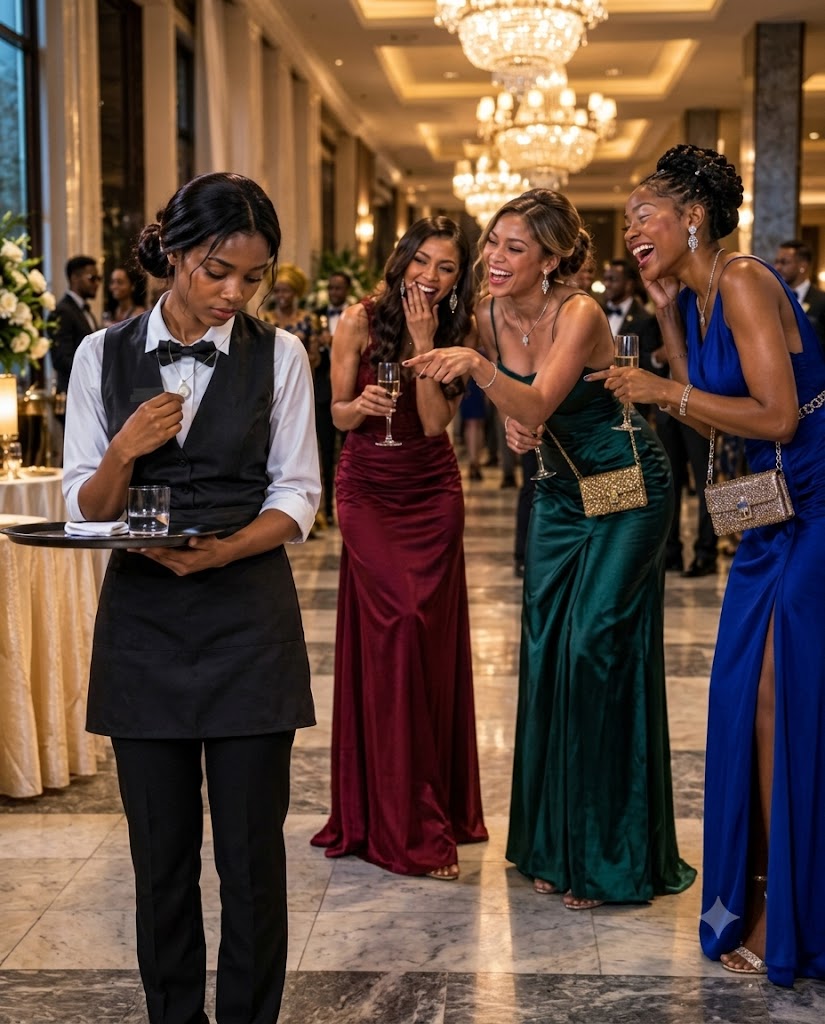
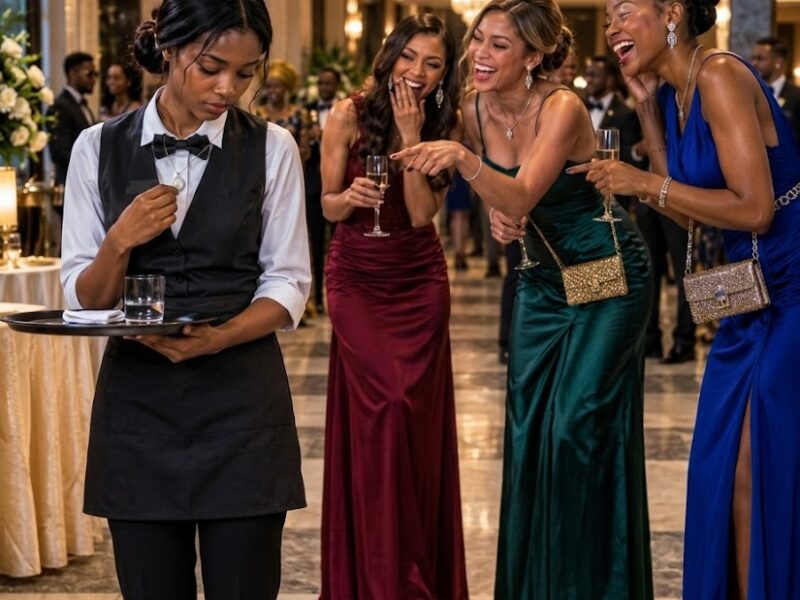
The rain hadn’t let up for three days straight, and Amara Bennett was on her knees in the marble lobby of the Whitmore Hotel, scrubbing a scuff mark off the floor that nobody but her could see. Her uniform was damp at the collar, her hands raw from the bleach, and the necklace—the one her mother had pressed into her palm when she was six years old—swung forward and tapped against the tile with every stroke of the brush. It was a small thing, easy to miss, a half-circle of dull metal on a thin chain that had turned green in places from years of cheap soap and hot water. The other housekeepers had opinions about it. They always did. “You wear it even to clean toilets,” Rosa had said that morning, arms crossed, watching Amara tuck the chain under her collar for the third time. “It doesn’t come off.” Diana, who worked the penthouse floor and never missed a chance to remind anyone she’d been to finishing school, had laughed into her coffee. “It looks like something from a market stall. You work in a five-star hotel. Have some pride.” Amara had just smiled, the way she always did, and said nothing. Because what was there to say? The necklace wasn’t worth anything to anyone but her.
It was a Tuesday when the millionaire arrived early.
Marcus Vale, owner of half the building’s investors, walked through the lobby doors twenty minutes before the Whitmore Gala was supposed to begin, and the entire staff snapped to attention like puppets on strings. Rosa hissed at everyone to straighten up. Diana dropped her cigarette and stepped on it so fast she nearly fell. Amara was in the ballroom, on her hands and knees again, this time polishing the baseboards behind the champagne table. She didn’t look up when the doors opened. She didn’t see the man in the gray suit stop mid-stride. She didn’t hear the sharp intake of breath, or the way his hand grabbed the arm of his assistant, Grant, with enough force to leave a mark. She only looked up when the silence got too loud, and by then Marcus Vale was already staring at her—or rather, at the chain around her neck. “Sir, is something wrong?” Grant asked. “Cancel the meeting,” Marcus said. Grant blinked. “The merger company—the board is expecting—” “Cancel it.”
The ballroom went still. Somewhere in the back, a waiter dropped a glass. Amara felt her face go hot, certain she’d done something wrong, certain she was about to be fired in front of everyone. She tucked the necklace under her collar, the way she always did when people stared, and went back to scrubbing.
But Marcus Vale didn’t move. He stood there for a long time, long enough that Grant started shifting his weight, long enough that Rosa came over and asked if everything was all right. Marcus just shook his head. “Grant,” he said finally, his voice low and strange, like it was coming from somewhere far away. “I found it.” “Sir, you’ve barely spoken since the ballroom. What did you see?” “A necklace, Grant. Around the neck of a housekeeper.”
Grant, to his credit, didn’t laugh. He just frowned. “A necklace, sir. With respect, you canceled a nine-figure merger for jewelry.” “Not jewelry, Grant.” Marcus’s eyes hadn’t left Amara’s back. “One that I never expected to see again in my lifetime.” He paused. “Find out everything you can about that housekeeper. Her name, her family, her mother especially. I don’t want her to know she’s being watched.” Grant hesitated. “Sir, may I ask what this is really about?” Marcus turned then, and for the first time in twenty years, Grant saw something in his boss’s face that he’d never seen before. Something cracked. Something raw. “Twenty years ago, Grant, my family lost everything that mattered. Today, one of them opened a crack. I intend to find out how.”
—
Twenty years earlier, in a house with white shutters and a porch swing, a little girl named Claire Vale had stood in front of a jeweler’s box with her older brother Marcus, watching their mother lift two half-circle pendants into the light. “These were made specially by the same jeweler who made my own mother’s ring,” their mother said. “Half a compass each. Alone they point nowhere.” She fastened one around Claire’s neck and one around Marcus’s. “So we always have to stay together. I hope you never need reminding, Claire. But if life ever pulls you apart, I want you both to remember that the compass isn’t broken just because it’s separated. It’s only waiting to be whole again.” Claire, who was seven and believed everything her mother said, had nodded solemnly. “I’ll always find you, Marcus,” she said. “I promise.” “Promise.” “Promise.”
—
Amara didn’t know any of that. She only knew that her mother, Nora, had given her the necklace when she was six years old and told her never to take it off, never to sell it, no matter how hard things became. “Why, Mama?” Amara had asked, holding the cold metal in her small hands. Nora had smiled, but it was the kind of smile that didn’t reach her eyes. “Because it isn’t only jewelry, my love. It’s a promise I made to someone. Someone I loved very much. One day someone may come looking for it. When they do, you’ll know what to do.” “Who, Mama? Who will come?” “You’ll know, Amara. You’ll know when it happens.”
Amara had waited nineteen years for that moment. She had worn the necklace through foster care after Nora died, through the group homes, through the first apartment she’d rented with three other girls because it was all she could afford. She had worn it through job interviews and bad dates and the kind of loneliness that settles into your bones like cold weather. Nobody had ever come looking for it. Nobody had ever asked. Until now. Until Marcus Vale.
—
The next two weeks were a blur of surveillance reports and background checks, of Grant handing Marcus folders with increasingly strange details. Amara Bennett, age nineteen, mother deceased six years ago, no father listed, no known relatives. Worked as a housekeeper at the Whitmore for two years. Clean record. No social media. No credit history. No nothing. “Sir, the preliminary report on Amara’s mother,” Grant said one afternoon, sliding a file across the desk. “Nora Bennett. Died six years ago. Worked as a seamstress, then later cleaned houses. No family listed, no known relatives. Nothing about where she came from before that.” Marcus flipped through the pages. “That’s the strange part, sir. Her records essentially begin twenty years ago. Nothing before that. It’s as though she appeared out of nowhere.” Marcus set the file down. “Twenty years. That’s not a coincidence, Grant.” “Sir, what happened twenty years ago? You still haven’t told me.”
Marcus was quiet for a long time. Then he said, “My younger sister, Claire. She was twenty-three. Sharp and brilliant. The only family who saw me.” He paused. “Our family was in the middle of an inheritance dispute. My father had died, and the will divided the company in ways certain relatives found unacceptable. Claire discovered something in the company’s financial records before she vanished. She never told me what, only that she was frightened and that she needed to protect something important.” He reached into his desk drawer and pulled out a small velvet box. Inside was the other half of the compass pendant. “Our mother gave Claire and me matching pendants as children, engraved with our family crest modified into a symbol only the two of us would recognize when we were together. Claire wore hers every day of her life. The last time I saw her, three days before she disappeared, she told me she was giving it to someone she trusted completely. Someone who could keep her safe.” “And you think that housekeeper’s necklace—” “I don’t think, Grant. I know. I saw it with my own eyes yesterday. It’s Claire’s half of the compass.”
—
Nora Bennett had been a seamstress before she was a housekeeper, and before that, she had been Claire Vale’s best friend. They had met in college, two girls from different worlds who found each other in a linguistics class neither of them liked. Nora was quiet, practical, the kind of person who remembered your birthday and your coffee order and the name of your childhood dog. Claire was bright, reckless, the kind of person who lit up a room and then forgot to pay the electric bill. They balanced each other. They were inseparable. Until the night Claire showed up at Nora’s apartment with a single bag and a look on her face that Nora had never seen before. “I don’t know who else to trust with this,” Claire said. “You can trust me, Claire. You always could, since we were girls.” Claire sat down at the kitchen table and pulled out a folder. “I found something in the company books. Damon has been moving money that isn’t his to move. Two hundred million dollars, Nora. If I say anything, I don’t know what he’ll do.” “Then disappear first. Say something when you’re safe.” Claire looked up, tears in her eyes. “And if I can never come back? Then whatever you’re protecting, I will protect, too. For as long as it takes. That is what friendship means, Claire.”
Claire had given Nora the necklace that night. She had also given her something else—something Nora hadn’t expected, something that would change both their lives forever. Claire was pregnant. The father was gone, a man she’d met in a bar and never seen again, and she was terrified that Damon’s men would find her before the baby was born. “I can’t raise a child in the middle of this,” Claire whispered. “I need you to take her. Raise her as your own. Give her a life far away from all of it.” Nora, who had never wanted children, who had never even held a baby before, looked at her best friend and said yes. She said yes because she loved Claire. She said yes because she already loved the baby, even before she was born. She said yes because she knew, deep down, that it was the only way any of them would survive.
—
The surveillance reports kept coming. Marcus learned that Amara gave her lunch to a homeless man every Friday. He learned that she worked double shifts when other housekeepers called in sick. He learned that she visited Nora’s grave every Sunday, even when it rained, even when she was so tired she could barely stand. “She has Claire’s heart, Grant,” Marcus said one afternoon, watching a video of Amara helping an elderly woman cross the street. “Exactly. Down to the smallest gesture.” “Sir, if she is who you think, and if her mother protected Claire, why do you still hesitate to tell her?” Marcus looked out the window. “Because I still don’t know the whole truth, Grant. I don’t know if Nora Bennett protected my sister or if she was involved in whatever happened. Kindness does not prove innocence. I need to know the difference before I hand this young woman a truth that could shatter everything she believes about her own mother.”
—
The break-in happened on a Thursday.
Amara came home from her shift to find her apartment door hanging open, the lock broken, her few possessions scattered across the floor. Her laptop was still there. Her cash was still there. Her mother’s old watch was still there. But the necklace—the one thing she had never taken off, not even to shower, not even to sleep—was gone. She called Marcus before she called the police. She didn’t know why. She just did. “Someone broke into my apartment. They took it, Mr. Vale. They took my mother’s necklace and nothing else. Not my money, not my electronics, but only that.” “Stay exactly where you are. I’m sending security immediately, and I’m coming myself.” “Why would anyone want an old worthless necklace?” There was a long pause on the other end of the line. Then Marcus said, “Because it was never worthless. Amara, I should have told you the truth from the beginning. I’m sorry I didn’t.”
He told her everything. About Claire. About the compass. About the two hundred million dollars and the cousin named Damon who had tried to make his sister disappear. About Nora, who had been Claire’s best friend, who had taken the necklace and the baby and disappeared into a life of quiet sacrifice. “I believe your mother may have helped Claire disappear,” Marcus said. “To protect her from something or someone.” “My mother never mentioned any of this. Not once in my entire life.” “She may have believed silence was the only way to keep you both safe.” “Safe from what? From whom?” Marcus’s voice was steady, but his hands were shaking. “That, Amara, is what tonight’s break-in tells me we urgently need to find out. Someone still believes that necklace matters. Someone dangerous enough to break into your home for it twenty years after my sister vanished.”
—
The financial records from the family company twenty years ago showed a discrepancy of nearly two hundred million dollars, moved through offshore accounts in the months before Claire vanished. Only three people had that level of authorization at the time: Marcus’s father, Claire herself, and Damon Vale. Damon had contested the will after the father’s death, claiming he deserved a larger share. He had lost that fight in court. He had every reason to want Claire silenced. “You think your own cousin tried to kill your sister?” Grant asked. “I think my sister uncovered something that could have destroyed him. And I think Nora Bennett may have helped her disappear before he could finish what he started.”
—
The anonymous wire transfers to Nora Bennett had been arriving every month for eighteen years, routed through six different shell accounts. Marcus’s investigators traced them back to the same structure attached to Damon’s name. “This means Damon may have known where your mother was this entire time,” Marcus said, staring at the file. “Then why would he send her money for eighteen years instead of simply hurting her?” Amara asked. “Perhaps he wasn’t sending it to protect her. Perhaps he was paying her silence.” Grant cleared his throat. “Sir, there’s something else. Our investigators followed the trail to a small town three hours from here. A woman living under the name Elena Cross has been receiving mail addressed with slight variations of Claire’s real middle name for years. And it’s a 94% match, sir. It’s Claire.” Marcus sat down heavily. “My sister is alive.” “Alive after twenty years. Living quietly hidden, exactly as your mother must have helped her disappear to do.” “Why would she be watching me?” Amara asked. “Amara, how old were you when your mother told you never to remove that necklace?” “Six, maybe seven. Why?” “Twenty years ago is when Claire disappeared. You are nineteen years old now.” Marcus looked at her, and for the first time, Amara saw something in his face that looked like hope. “I don’t think Nora Bennett only protected my sister, Amara. I think she trusted her with something far more precious than a necklace. I think Clare is your mother, Amara. And I am not simply looking at my missing sister’s necklace right now. I’m looking at my niece.”
—
The reunion happened in a small house on a quiet street, three hours from the city. Claire—Elena—opened the door before Marcus could knock. She was older, grayer, thinner, but her eyes were the same. “Marcus.” “Claire.” They stood there for a long time, neither of them moving. Then Claire looked past him, at the girl standing on the sidewalk, and her face crumpled. “And you brought Amara.” “You know my name.” “I’ve known your name since the day you were born.” Amara felt her knees go weak. “Are you—are you my mother?” “Yes, Amara. I am.” “Twenty years. And you never once came for me.” “I came closer than you know. I watched you from a distance more times than I can count.” “Watching isn’t the same as being there.” “I know that. I have known that every single day of your life.” “Then why didn’t you just come home?” “Because the people who wanted me silenced would have found you the moment I did. I ran to protect you. I was pregnant with you when I disappeared. I couldn’t risk raising you in the middle of that danger. Nora had been my closest friend since childhood. The one person outside my family I trusted completely. I begged her to raise you as her own. To give you a life far away from all of it.” “And she agreed.” “She agreed because she loved you the moment she held you, Amara. And I asked her never to tell you until it was safe.” “You protected me from losing you by making me lose you anyway.” Claire closed her eyes. “I know. I have hated myself for that every single day.”
—
The prosecution took six months. Damon Vale was charged with two decades of fraud, attempted murder related to Claire’s disappearance, and breaking and entering, theft, and endangerment involving Amara. The shell accounts, the wire transfers, the men on his private payroll—all of it came out in court. Marcus testified. Claire testified. Amara testified. Damon was sentenced to twenty-five years in federal prison. “You have no idea what you’re destroying, Marcus,” Damon said as they led him away. “This company. This family.” “You destroyed this family the day you decided my sister’s silence was worth more than her life. Everything else is simply consequence.”
—
Amara didn’t take the inheritance. She didn’t want the money. What she wanted was something else—something her mother had wanted her to become, something Nora had sacrificed everything to protect. With Marcus’s help, she started a foundation for children in foster care, for kids who grew up with nothing but an old necklace and a promise. She called it The Compass Foundation. “She built this from nothing, Marcus,” Claire said one afternoon, watching Amara teach a group of kids how to make friendship bracelets. “In one year, she built it from everything. She simply never knew it until now.” “Amara, we’ve had another family reunited this month thanks to the tracing program you started,” Grant said, handing her a report. “Then it’s working exactly as it should.” “Amara, remember when you told me kindness was the only currency worth staying poor in?” “I remember.” “I think you just built an entire bank out of it.”
—
Three years later, at the annual gala for The Compass Foundation, Amara stood on a stage in front of five hundred people and told the story of a necklace. She told them about her mother Nora, who had given up everything to raise a child that wasn’t hers. She told them about her mother Claire, who had disappeared to protect a daughter she hadn’t even met yet. She told them about Marcus, who had canceled a nine-figure merger because he recognized a piece of jewelry that meant more than money. And she told them about the necklace itself—the old, cheap-looking thing that everyone had mocked, the thing that had turned out to be half of a compass, waiting to be whole again. “Twenty years ago,” she said, “someone believed protecting a child mattered more than protecting a fortune. Tonight, we celebrate everyone brave enough to make that same choice in ways big and small.” She reached up and touched the necklace, the one Marcus had recovered from Damon’s safe, the one she had never taken off since the day he returned it to her. “Never judge the value of something by what it looks like from the outside.”
—
After the gala, Amara sat alone on the steps of the venue, the city lights blurring in the rain. Marcus found her there, two cups of coffee in his hands. He sat down beside her without saying anything. They stayed like that for a long time. “I used to imagine this conversation a thousand different ways,” Claire had said to her once, during one of their long talks. “In none of them did I know what to say first.” Amara hadn’t forgiven her yet, not completely. Maybe she never would. But she had learned, over the years, that forgiveness wasn’t a door you opened once. It was a road you walked, one step at a time, with people who were willing to walk it with you. “Thank you,” she said finally. “For what?” Marcus asked. “For seeing something everyone else missed.” Marcus looked at the necklace, then at his niece. “For what it’s worth,” he said, “I’m glad I canceled that meeting.” “So am I.” They sat together in the rain, two people who had lost twenty years and found something they never expected to find again. A family. A promise. A compass pointing home.
—
**Part 2**
The first winter after the trial was the hardest.
Amara moved into a small apartment on the east side of the city, not far from the Whitmore, because she wasn’t ready to leave the life she’d built with her own two hands. Marcus had offered her a suite at his penthouse, a car, a credit card with no limit—all the things money could buy. She had turned him down. “I spent my whole life being told what I was worth,” she told him. “I don’t want to suddenly change my answer just because a number got bigger.” Marcus had nodded, and if he was disappointed, he didn’t show it. Instead, he showed up at her apartment on Saturday mornings with bagels and coffee, and they sat on her secondhand couch and talked about nothing and everything. It was awkward at first. Two strangers who shared a bloodline but not a history. But they were learning.
Claire—who still went by Elena in public, for safety—came to the city once a month. She and Amara would meet at a small diner near the park, the kind of place with cracked vinyl booths and a waitress who called everyone “hon.” They didn’t talk about the past much. Claire seemed to understand that Amara needed time, that forgiveness couldn’t be rushed. So instead they talked about small things. The weather. The food. The stray cat Claire had adopted back in her small town. “What was she like?” Amara asked one afternoon, stirring her coffee. “Nora. What was she like when you knew her?” Claire smiled, and for a moment she looked young again. “She was the best person I ever knew. Quiet. Loyal. She remembered everything—your birthday, your favorite color, the name of your childhood dog. She used to write me letters, you know. After I disappeared. She’d send them to a P.O. box I kept under a false name. Just little updates. ‘She took her first steps today.’ ‘She said her first word—it was “no,” which figures.’ ‘She started kindergarten. She made a friend.’ I read every single one. I kept them all.” Amara felt her throat tighten. “Do you still have them?” “In a box under my bed. You can read them sometime. If you want.” “I want.”
—
The Foundation grew faster than anyone expected.
The tracing program Amara started—a simple database that connected foster children with their biological relatives using DNA and public records—reunited its first family within three months. By the end of the first year, it had reunited twenty-seven families. By the end of the second year, it had reunited over a hundred. The Compass Foundation wasn’t just about reunions, though. It was about giving kids what Amara had never had: a sense of worth that wasn’t tied to money or status or what anyone else thought. She hired social workers, therapists, career counselors. She opened a group home for teenagers aging out of the foster care system. She started a scholarship fund for kids who wanted to go to college but couldn’t afford it. “You’re building an empire of kindness,” Grant said one afternoon, reviewing the Foundation’s annual report. “I’m building a promise,” Amara corrected. “The one my mother made to Claire. The one Nora made to me. The one I’m making to every kid who’s ever been told they don’t matter.”
—
Damon Vale appealed his conviction twice. Both appeals were denied. His lawyers argued that the statute of limitations had run out on the fraud charges, that the attempted murder charge was based on circumstantial evidence, that the break-in at Amara’s apartment couldn’t be directly tied to him. The judges disagreed. The evidence was overwhelming. The shell accounts, the wire transfers, the men on his payroll who had testified against him in exchange for immunity—all of it pointed to one conclusion. Damon had spent twenty years trying to bury the truth, and in the end, the truth had buried him. Amara visited him once, in prison. She didn’t know why. Maybe she wanted to see his face. Maybe she wanted to understand how someone could value money over family. He sat across from her in his orange jumpsuit, his hair grayer, his face thinner, his eyes colder than she remembered. “I’m not here to forgive you,” she said. “I’m not here to ask for forgiveness.” “Then why are you here?” “To tell you that you failed. Whatever you were trying to protect, whatever you were trying to bury—it’s all out in the open now. And the people you hurt are still standing.” Damon said nothing. Amara stood up and walked out.
—
The second anniversary of Nora Bennett’s death fell on a Sunday.
Amara went to the cemetery alone, the way she always did. She brought fresh flowers—daisies, Nora’s favorite—and a small bottle of lavender oil, because Nora had loved the smell. She knelt in front of the headstone and brushed away the leaves that had gathered there. “Hey, Mama,” she said softly. “It’s been a while.” She talked for a long time. About the Foundation. About Marcus. About Claire. About the kids she’d met, the lives she’d helped change. She talked about how angry she still was, sometimes, and how grateful she was, and how both feelings could exist at the same time without canceling each other out. “I finally understand why you never took this off me,” she said, touching the necklace. “You weren’t just giving me a piece of jewelry. You were giving me a promise. A reason to keep going. A compass pointing home.” She sat there until the sun went down, and when she finally stood up, she felt lighter than she had in years.
—
The third year brought new challenges.
A documentary crew reached out, wanting to tell the story of the Compass Foundation. Amara hesitated. She didn’t want to exploit her family’s pain for publicity. But Claire encouraged her. “Our story isn’t just ours,” she said. “It’s the story of every family that’s been torn apart by greed and fear. If it can help someone else, isn’t that worth sharing?” So Amara agreed. The documentary aired on a national network and was watched by millions. Donations poured in from all over the country. The Foundation expanded to three new cities. Amara hired a team of therapists and social workers to handle the influx of requests. She was busier than she’d ever been, but she was also happier. “You’re doing what Nora would have wanted,” Marcus told her one evening, watching her review case files at her kitchen table. “You’re taking the love she gave you and giving it back to the world.” “I’m trying,” Amara said. “That’s all any of us can do.”
—
The Foundation’s fourth annual gala was the biggest yet.
Three thousand people filled the ballroom of the Whitmore Hotel—the same ballroom where Amara had once scrubbed baseboards for minimum wage. Marcus gave the opening speech. Claire, who had finally started using her real name in public, sat in the front row. Diana and Rosa, who had both left the hotel industry and now worked for the Foundation, sat beside her. Amara stood on the stage and looked out at the crowd. “Five years ago,” she said, “I was a housekeeper at this hotel. I wore an old necklace that everyone thought was worthless. I was told I had no pride, no future, no family. And they were wrong.” She paused, letting the words settle. “My mother Nora taught me that kindness is a currency that never loses its value. My mother Claire taught me that sacrifice is the highest form of love. My uncle Marcus taught me that the truth is worth fighting for, even when it costs you everything.” She touched the necklace. “And this old, worthless thing taught me that sometimes the things people mock are the things that matter most.”
—
After the gala, Amara went back to her apartment and sat on the balcony, looking out at the city.
She thought about all the people who had called her necklace cheap, who had laughed at her for wearing it, who had told her she was foolish to hold onto something so meaningless. She thought about Nora, who had worn the weight of a promise for nineteen years. She thought about Claire, who had given up everything to keep her safe. She thought about Marcus, who had canceled a nine-figure merger because he recognized a piece of jewelry that meant more than money. And she thought about herself—the little girl who had grown up with nothing but an old necklace and a mother’s love. She was still that girl, in some ways. She still worked hard. She still gave her lunch to homeless men on Fridays. She still visited Nora’s grave every Sunday. But she was also something else now. Something new. Something that had been forged in the fire of loss and grief and hope and love. She was Amara Bennett. Daughter. Niece. Founder. Survivor. And she was finally home.
—
**Part 3**
The letter arrived on a Wednesday.
It was tucked inside a plain white envelope with no return address, and when Amara opened it, she found a single sheet of paper, handwritten in shaky cursive. “Dear Amara,” it read. “I have watched your Foundation from a distance for years, and I am proud of you. You have become everything your mother hoped you would be. I know you don’t know me, but I knew your mother Nora. We were friends, a long time ago. I was there when she made her promise. I was there when she brought you home for the first time. And I have always regretted that I didn’t do more to help her. I am old now, and sick, and I don’t have much time left. But I wanted you to know that you were loved. From the very beginning. By more people than you will ever know. If you want to meet, I will be at the diner on 5th Street this Saturday at noon. If you don’t, I understand. Either way, I hope you know how proud we all are of you.” It was signed “Margaret.” Amara read the letter three times, her heart pounding. Then she called Marcus.
—
Margaret was ninety-two years old.
She sat in a booth at the back of the diner, a cup of tea growing cold in front of her, her hands folded on the table. She looked up when Amara walked in and smiled—a wide, toothy smile that made her look twenty years younger. “You look just like her,” Margaret said. “Like Nora?” “Like Claire. But you have Nora’s eyes.” Amara sat down across from her. “How did you know my mother?” “I was her neighbor. Back when she first took you in. I lived in the apartment next door. I used to watch you when she went to work. I taught you how to tie your shoes.” Amara felt tears prick at her eyes. “I remember that. I remember someone teaching me—” “You were three years old. You were so proud of yourself when you finally got it right. You ran up and down the hallway, showing everyone.” Margaret laughed softly. “Nora loved you more than anything in this world. She used to say you were the best thing that ever happened to her.” “She never told me the truth. About Claire. About any of it.” “She couldn’t. She was terrified that if anyone found out, Damon would come for you both. She made a promise, and she kept it, even when it cost her everything.” Amara was quiet for a long time. “Why did you wait until now to contact me?” Margaret’s smile faded. “Because I was afraid. I was afraid that if I reached out, I would put you in danger. But Damon is gone now. And I’m dying. And I didn’t want to leave this world without telling you the truth.” “What truth?” “That you were never alone. That there were people watching over you, even when you couldn’t see them. That your mother Nora was one of the bravest women I ever knew. And that she would be so, so proud of the person you’ve become.” Amara reached across the table and took Margaret’s hand. “Thank you,” she said. “For telling me.”
—
Margaret died three weeks later.
Amara went to her funeral, along with Marcus and Claire. They stood at the back of the small church and listened as the priest talked about a woman who had spent her whole life helping others. After the service, Amara approached the casket and placed a single daisy on top of it. “You were right,” she whispered. “I was never alone.” She walked out of the church into the sunlight, and for the first time in a long time, she felt something like peace.
—
The Foundation’s fifth anniversary was marked by a new initiative.
Amara called it The Nora Project—a program designed to help single mothers who were struggling to make ends meet. The program provided housing, childcare, job training, and counseling, all free of charge. It was the largest initiative the Foundation had ever undertaken, and it was funded entirely by a single anonymous donation of ten million dollars. Amara never found out who the donor was, though she had her suspicions. Marcus denied it when she asked. Claire denied it too. But Amara noticed that the donation had been made through a shell corporation that traced back to a bank account in the Cayman Islands. The same bank account that had been used to send Nora money for eighteen years. She never asked again. Some things didn’t need to be said out loud.
—
Claire moved back to the city permanently in the sixth year.
She bought a small house on the same street as Amara’s apartment, and they had dinner together every Sunday night. It wasn’t perfect. It would never be perfect. They had lost too much time, too many years, too many moments that could never be reclaimed. But they were learning to be a family again, one Sunday at a time. “I used to imagine this,” Claire said one evening, watching Amara cook dinner. “When I was in that small town, hiding, I used to imagine what it would be like to have dinner with you. To talk to you. To hear your voice.” “And what did you imagine?” Amara asked. “I imagined you were happy. I imagined you had friends, a job you loved, a life that made you feel whole. I imagined you didn’t need me.” “I did need you.” “I know. And I’m sorry.” Amara set down the spoon and turned around. “I’m not sorry anymore. I used to be. I used to be so angry I couldn’t breathe. But I’m not anymore. I have you now. And I have Marcus. And I have Nora’s memory. That’s enough.” Claire stood up and crossed the kitchen and pulled her daughter into a hug. They stood there for a long time, two women who had lost everything and found each other again.
—
The Foundation’s seventh year brought a new challenge.
A young woman named Elena—no relation to Claire’s alias—walked into the Foundation’s office one afternoon with a story that sounded eerily familiar. She had grown up in foster care, bouncing from home to home, never knowing who her parents were. She had a necklace, a cheap thing that everyone had mocked, that her mother had given her before she disappeared. “I don’t know what it means,” she said, her voice shaking. “I don’t know if it’s worth anything. But I can’t take it off. I can’t let it go.” Amara looked at the necklace. It was a simple silver chain with a small pendant—a bird in flight. It wasn’t worth anything, not in money. But Amara understood. She understood perfectly. “It’s worth everything,” she said. “It’s worth more than you know.”
—
That night, Amara sat on her balcony and looked up at the stars.
She thought about her mother Nora, who had worn a promise around her neck for nineteen years. She thought about Claire, who had given up everything to protect a daughter she barely knew. She thought about Marcus, who had canceled a nine-figure merger because he recognized a piece of jewelry that meant more than money. And she thought about all the kids she’d helped over the years—the kids who had walked into her office with nothing but a story and a hope. She touched the necklace, the old, cheap-looking thing that had turned out to be half of a compass. It wasn’t just a symbol anymore. It was a reminder. A reminder that kindness was a currency that never lost its value. A reminder that sacrifice was the highest form of love. A reminder that the truth was worth fighting for, even when it cost you everything. A reminder that she was loved. From the very beginning. By more people than she would ever know. She smiled and looked up at the stars. “I hope you can hear this, Mama,” she said. “I finally understand why you never took this off me.” And somewhere, in the quiet of the night, she felt a hand on her shoulder. Warm. Gentle. Familiar. A promise kept.
—
**Part 4**
The eighth year was the year of the trial.
Not Damon’s trial—that was long over. This was a different trial, a different case, but it was connected in ways that nobody had expected. A man named Victor Hale had been arrested in connection with a series of fraud cases dating back to the early 2000s. He had worked for Damon Vale, first as an accountant, then as a fixer, then as the man who did the things Damon couldn’t do himself. Including, it turned out, the night Claire disappeared. “He’s been in hiding for twenty years,” Grant said, sliding a file across Marcus’s desk. “He fled the country after Damon’s arrest and only came back when he thought the statute of limitations had run out. But we got him on a new charge—money laundering in the present tense. He’s looking at fifteen to twenty years.” “Does he know where Claire was all those years?” “He knows a lot, sir. And I think he’s willing to talk.”
—
Victor Hale was a small man with a nervous habit of licking his lips.
He sat across from Amara and Marcus in a conference room at the U.S. Attorney’s office, his hands cuffed to the table, his eyes darting around the room like a trapped animal. “I didn’t know she was pregnant,” he said. “Claire. I didn’t know she was pregnant. If I had known, I—” “You would have what?” Amara asked. “Left her alone? Told your boss you weren’t going to help him hurt a pregnant woman?” Victor looked down at the table. “I don’t know. I was young. I was stupid. Damon paid me more money than I’d ever seen in my life. I didn’t think about the consequences.” “You helped a man try to kill his sister.” “I helped a man scare his sister. There’s a difference.” “Is there?” Marcus asked, his voice cold. “She disappeared for twenty years. She missed her daughter’s entire childhood. She missed everything. Because of you.” Victor was quiet for a long time. Then he said, “I know where the money is. The two hundred million that Damon stole. I know where he hid it. I can give it back.” Marcus leaned forward. “You think that makes up for what you did?” “No. But it’s something. It’s all I have.”
—
The money was recovered six weeks later.
Two hundred million dollars, plus interest, plus the assets Damon had bought with his stolen fortune. The courts ruled that it belonged to the Vale family estate, which meant it belonged to Marcus and Claire and, ultimately, to Amara. She didn’t want it. She still didn’t want it. But Marcus suggested something that made her reconsider. “What if we use it to expand the Foundation?” he said. “What if we take this money—this dirty, stolen money—and turn it into something good?” Amara thought about it for a long time. She thought about all the kids who had walked through her doors over the years. She thought about all the families who had been torn apart by greed and fear. She thought about her mother Nora, who had given up everything to keep a promise. “Okay,” she said. “Let’s do it.”
—
The Foundation expanded to twelve cities over the next two years.
They opened group homes, counseling centers, job training programs, scholarship funds. They partnered with hospitals and schools and churches. They hired hundreds of people—social workers, therapists, teachers, counselors, all of them dedicated to the same mission. Amara traveled constantly, giving speeches, attending fundraisers, meeting with donors. She was exhausted most of the time, but she was also fulfilled in a way she had never been before. “You’re doing too much,” Claire told her one evening, watching her review case files at midnight. “You need to rest.” “I’ll rest when the work is done.” “The work is never done, Amara. That’s the point.” Amara looked up from her files. “What am I supposed to do? Just stop? Just let all those kids fend for themselves?” “No. But you’re not a machine. You’re allowed to take a break. You’re allowed to have a life outside the Foundation.” “I have a life.” “You have a mission. That’s not the same thing.” Amara was quiet. Then she said, “I don’t know how to do anything else. I’ve been fighting for so long, I don’t know how to stop.” Claire reached across the table and took her hand. “You don’t have to stop. You just have to breathe. Every now and then. Just breathe.”
—
Amara took her first vacation in nine years.
She went to a small coastal town in Maine, rented a cottage by the ocean, and spent a week doing nothing. She slept in. She read books that had nothing to do with work. She walked on the beach and collected seashells and watched the sun set over the water. She didn’t check her email. She didn’t take any calls. She just breathed. On the last day, she sat on the porch and watched the waves and thought about everything she had been through. The loss. The grief. The anger. The hope. The love. She thought about Nora, who had sacrificed everything to protect her. She thought about Claire, who had given her up to keep her safe. She thought about Marcus, who had never stopped looking for his sister. She thought about all the people who had believed in her, even when she didn’t believe in herself. She touched the necklace, the old, cheap-looking thing that had turned out to be worth more than anyone could have imagined. “Thank you,” she whispered. “For all of it.”
—
When she got back to the city, she made a decision.
She stepped down as executive director of the Foundation and handed the reins to a team of people she trusted. She stayed on as chair of the board, but she stopped running the day-to-day operations. She started taking weekends off. She started having dinner with Claire and Marcus every Sunday. She started living. “You look different,” Marcus said one evening, watching her laugh at something Claire had said. “You look lighter.” “I feel lighter.” “What changed?” Amara thought about it. “I realized that I don’t have to carry everything alone. I don’t have to be the hero of every story. I can just be—me. And that’s enough.” Marcus smiled. “Nora would be proud of you.” “I hope so.” “I know so.”
—
The Foundation celebrated its tenth anniversary with a gala at the Whitmore Hotel.
It was the same ballroom where Amara had once scrubbed baseboards, the same chandelier, the same marble floors. But everything else was different. The room was filled with people—donors, volunteers, families whose lives had been changed by the Foundation’s work. Amara stood on the stage and looked out at the crowd, and she felt something she hadn’t felt in a long time. She felt grateful. “Ten years ago,” she said, “I was a housekeeper at this hotel. I wore an old necklace that everyone thought was worthless. I was told I had no pride, no future, no family. And they were wrong.” She paused, letting the words sink in. “My mother Nora taught me that kindness is a currency that never loses its value. My mother Claire taught me that sacrifice is the highest form of love. My uncle Marcus taught me that the truth is worth fighting for, even when it costs you everything.” She touched the necklace. “And this old, worthless thing taught me that sometimes the things people mock are the things that matter most.” She smiled. “Thank you. All of you. For helping me build something that matters.”
—
After the gala, Amara went back to her apartment and sat on the balcony, looking out at the city.
She thought about the journey that had brought her here. The little girl with the necklace. The housekeeper with the secret. The woman with the Foundation. It had been a long road, full of pain and loss and heartbreak. But it had also been full of love. More love than she had ever thought possible. She touched the necklace, the old, cheap-looking thing that had turned out to be half of a compass. “I hope you can hear this, Mama,” she said. “I finally understand why you never took this off me.” And somewhere, in the quiet of the night, she felt a hand on her shoulder. Warm. Gentle. Familiar. A promise kept. A compass pointing home.
—
**Part 5**
The letter arrived on a Tuesday.
It was from a woman named Sarah Chen, a journalist who had been following the Foundation’s work for years. She wanted to write a book—a real book, not a documentary, not a series of articles—about Amara’s life and the Foundation she had built. “I know your story is personal,” Sarah wrote. “I know it’s painful. But I also know it’s important. There are so many people out there who feel alone, who feel worthless, who feel like they have nothing to offer the world. Your story could show them that they’re wrong.” Amara read the letter three times. Then she called Marcus.
—
Marcus was skeptical at first.
“You’ve already told your story once,” he said. “The documentary, the interviews, the speeches. Do you really want to go through all of it again?” “It’s not about me,” Amara said. “It’s about the kids. The ones who are still in the system. The ones who feel like nobody cares. If my story can help even one of them, isn’t it worth it?” Marcus was quiet for a long time. Then he said, “You sound like Claire. When she was young. Before everything fell apart. She was always trying to help people.” “And you?” “I was always trying to protect her. I guess I’m still trying to protect her. And you.” “You don’t have to protect me anymore, Marcus. I’m not a little girl.” “I know. But you’re still my niece. And I’ll always worry about you. That’s what family does.”
—
Sarah Chen spent two years researching and writing the book.
She interviewed everyone—Amara, Claire, Marcus, Grant, Diana, Rosa, Margaret before she died, even Victor Hale from his prison cell. She read Nora’s letters, the ones Claire had kept in a box under her bed. She pored over the financial records, the court documents, the police reports. She traveled to the small town where Claire had hidden for twenty years. She stood in the cemetery where Nora was buried. When the book was finished, she sent Amara an advance copy. “I hope I did your story justice,” she wrote. “If I didn’t, I’m sorry. I tried.” Amara read it in one sitting, tears streaming down her face.
—
The book was published on a rainy Tuesday in October.
It was called *The Compass: A Story of Family, Sacrifice, and the Promise That Changed Everything*. It debuted at number one on the *New York Times* bestseller list. It was translated into twelve languages. It was optioned for a film. Amara did interviews, book signings, speaking engagements. She talked about Nora, about Claire, about Marcus, about the Foundation. She talked about the necklace, the old, cheap-looking thing that had turned out to be worth more than anyone could have imagined. And she talked about the kids—the ones who were still waiting for their own promises to be kept. “This story isn’t just mine,” she said in every interview. “It belongs to everyone who has ever felt alone, who has ever felt worthless, who has ever felt like they had nothing to offer the world. It belongs to you.”
—
The year after the book was published, Amara received a letter from a young woman in Ohio.
Her name was Maya, and she was nineteen years old. She had grown up in foster care, bouncing from home to home, never knowing who her parents were. She had a necklace, a cheap thing that everyone had mocked, that her mother had given her before she disappeared. “I read your book,” Maya wrote. “I read it three times. And I wanted to tell you that it gave me hope. Hope that maybe my story isn’t over yet. Hope that maybe someone is out there looking for me. Hope that maybe I’m not alone after all.” Amara read the letter and cried. Then she wrote back. “You’re not alone,” she wrote. “And your story isn’t over yet. It’s just beginning. If you ever want to talk, I’m here. I’ll always be here.” Maya wrote back three days later. And then Amara called her. And then they started talking every week. And then, six months later, Maya came to the city and walked into the Foundation’s office and hugged Amara like she was a long-lost sister. “Thank you,” Maya whispered. “For giving me hope.” “Thank you,” Amara whispered back. “For reminding me why I do this.”
—
The Foundation’s fifteenth year was the year of the museum.
It was Claire’s idea. She had been volunteering at the Foundation for years, and she had noticed something. The kids who came through their doors—the ones who had been through the foster care system, the ones who had been abandoned or abused or neglected—they all had stories. They all had something that had kept them going. A necklace. A photograph. A letter. A memory. Claire wanted to create a space where those stories could be told. A museum of sorts, dedicated to the things that kept people going when everything else fell apart. “We’ll call it The Promise Museum,” she said. “We’ll fill it with the objects that matter. The things that are worthless to everyone else but priceless to the people who own them.” Amara loved the idea. So did Marcus. So did everyone else.
—
The Promise Museum opened on a beautiful spring day.
It was housed in a renovated warehouse on the east side of the city, a building that had once been abandoned and forgotten. Now it was filled with light and color and stories. The first exhibit was Amara’s necklace—the old, cheap-looking thing that had turned out to be half of a compass. It was displayed in a glass case in the center of the main room, surrounded by photographs and letters and documents that told the story of Nora and Claire and Marcus and Amara. The second exhibit was Maya’s necklace—a simple silver chain with a small pendant, a bird in flight. The third exhibit was a locket that belonged to a young man named James, who had carried it through twelve foster homes and three failed adoptions. The fourth exhibit was a worn-out teddy bear that belonged to a little girl named Sophie, who had been separated from her siblings and never stopped hoping they would find her again. On and on it went, room after room, story after story. Thousands of objects, all of them worthless, all of them priceless. All of them promises waiting to be kept.
—
Amara stood in the main room of the museum on opening day and watched the people walk through.
She watched them stop in front of the display cases. She watched them read the stories. She watched them cry, and laugh, and hold each other. She watched them remember their own promises—the ones they had made, the ones they had kept, the ones they had broken. She watched them hope. “What are you thinking?” Claire asked, coming to stand beside her. Amara smiled. “I’m thinking about Nora. About how she wore a promise around her neck for nineteen years. About how she never gave up, even when everything seemed hopeless.” “She was the bravest person I ever knew.” “She was. And she taught me that kindness is a currency that never loses its value.” “She taught you a lot of things.” “She did. But the most important thing she taught me was that a promise isn’t just a word. It’s a choice. A choice you make every single day, even when it’s hard, even when it hurts, even when it feels like it’s not worth it.” Claire took her hand. “You’ve kept your promise, Amara. You’ve kept it better than anyone could have imagined.” “I’ve tried.” “You’ve succeeded.”
—
That night, Amara sat alone in the museum after everyone else had gone home.
She walked through the exhibits one by one, reading the stories, touching the glass cases, remembering. She stopped in front of her own necklace and stood there for a long time. It looked so small, so ordinary, so worthless. And yet it had changed everything. It had brought her to Marcus. It had brought her to Claire. It had brought her to the Foundation. It had brought her home. She touched the glass and whispered, “Thank you, Mama. For everything.” And somewhere, in the quiet of the night, she felt a hand on her shoulder. Warm. Gentle. Familiar. A promise kept. A compass pointing home.
—
**Part 6**
The twentieth year was the year of the reunion.
Not a reunion between Amara and someone else—that had already happened, more times than she could count. This was a reunion between Amara and herself. The little girl who had grown up with nothing. The housekeeper who had been mocked for wearing an old necklace. The woman who had built an empire of kindness out of a promise. She had spent so long fighting, so long struggling, so long trying to prove that she was worthy. And now, finally, she understood that she had always been worthy. She had been worthy the moment Nora held her in her arms. She had been worthy the moment Claire gave her up to keep her safe. She had been worthy the moment Marcus recognized the necklace and canceled a nine-figure merger. She had been worthy all along. She just hadn’t known it.
—
The Foundation celebrated its twentieth anniversary with a week-long festival.
There were concerts and art exhibits and community dinners. There were speeches and panels and workshops. There were thousands of people—families who had been reunited, kids who had been given a second chance, volunteers who had dedicated their lives to helping others. Amara walked through the crowds, shaking hands, hugging people, listening to their stories. She was exhausted by the end of the first day, but she was also filled with a joy she couldn’t quite describe. “You look happy,” Claire said, finding her at the end of the second day. “I am happy.” “Really?” “Really. I spent so long being angry. Angry at Damon. Angry at the system. Angry at myself. I forgot what it felt like to just be happy.” “And now?” “Now I remember.”
—
The final night of the festival was a gala at the Whitmore Hotel.
It was the same ballroom where Amara had once scrubbed baseboards, the same chandelier, the same marble floors. But everything else was different. The room was filled with people who had been touched by the Foundation’s work—thousands of them. Amara stood on the stage and looked out at the crowd, and she felt something she hadn’t felt in a long time. She felt complete. “Twenty years ago,” she said, “I was a housekeeper at this hotel. I wore an old necklace that everyone thought was worthless. I was told I had no pride, no future, no family. And they were wrong.” She paused, letting the words settle. “My mother Nora taught me that kindness is a currency that never loses its value. My mother Claire taught me that sacrifice is the highest form of love. My uncle Marcus taught me that the truth is worth fighting for, even when it costs you everything.” She touched the necklace—the real one, the one she still wore every day, the one that had been returned to her after the break-in. “And this old, worthless thing taught me that sometimes the things people mock are the things that matter most.” She smiled. “Thank you. All of you. For helping me build something that matters. For helping me keep my promise.”
—
After the gala, Amara went back to her apartment and sat on the balcony, looking out at the city.
She was fifty years old now. Her hair was grayer, her face more lined, her body slower. But she was still the same person she had always been. The little girl with the necklace. The housekeeper with the secret. The woman with the Foundation. She thought about her mother Nora, who had worn a promise around her neck for nineteen years. She thought about Claire, who had given up everything to protect a daughter she barely knew. She thought about Marcus, who had never stopped looking for his sister. She thought about all the people who had believed in her, even when she didn’t believe in herself. She touched the necklace, the old, cheap-looking thing that had turned out to be half of a compass. “I hope you can hear this, Mama,” she said. “I finally understand why you never took this off me.” And somewhere, in the quiet of the night, she felt a hand on her shoulder. Warm. Gentle. Familiar. A promise kept. A compass pointing home.
—
**Part 7**
The letter arrived on a Friday.
It was from a lawyer in upstate New York, and it informed Amara that she had been named in the will of a woman named Eleanor Vance. Amara didn’t recognize the name. But the lawyer explained that Eleanor had been a friend of Nora’s, a woman who had helped her during the years she was hiding with Amara. Eleanor had died at the age of ninety-four, and she had left Amara something in her will. “What is it?” Amara asked. “A box,” the lawyer said. “A small wooden box. She said you would know what it meant.”
—
Amara drove upstate with Claire.
The lawyer’s office was in a small town, the kind of place where everyone knew everyone else. He handed Amara the box—a simple wooden thing, no bigger than a shoebox, with a tiny lock on the front. “She said the key would be familiar,” the lawyer said. Amara reached up and touched her necklace. The key was the pendant—the half of the compass that had been around her neck for over forty years. She inserted it into the lock and turned. The box opened.
—
Inside was a stack of letters.
They were from Nora—letters she had written to Eleanor over the years, letters that had never been sent. “I’m writing this because I need to tell someone,” Nora had written in the first letter. “I need to tell someone about the promise I made. About the child I’m raising. About the fear that never goes away.” Amara read the letters one by one, tears streaming down her face. She read about Nora’s hopes and fears. About her love for Amara. About her grief for Claire. About her determination to keep the promise, no matter what. And she read about something else—something she had never known. “Eleanor,” Nora had written in the last letter, “I don’t know if I’ll ever see Claire again. I don’t know if Amara will ever know the truth. But I want you to know that I don’t regret a single thing. I don’t regret taking her in. I don’t regret raising her as my own. I don’t regret the fear, the pain, the loneliness. Because she is the best thing that ever happened to me. And I would do it all over again, a thousand times, if I had to.” Amara closed the box and held it to her chest. “Thank you, Mama,” she whispered. “For everything.”
—
The letters were displayed in The Promise Museum.
They were placed in a glass case next to Amara’s necklace, and they were read by thousands of people over the years. They became a symbol—a reminder that promises were worth keeping, that love was worth sacrificing for, that kindness was a currency that never lost its value. Amara visited the museum often, especially in the later years. She would stand in front of the display case and read the letters, even though she knew them by heart. She would touch the glass and remember. And she would feel, once again, the hand on her shoulder. Warm. Gentle. Familiar. A promise kept. A compass pointing home.
—
**Part 8**
The final chapter of Amara’s story wasn’t really a chapter at all.
It was a moment—a quiet, ordinary moment that happened on a Sunday afternoon in late autumn. She was sitting on her balcony, wrapped in a blanket, watching the leaves fall. She was eighty-seven years old now. Her hair was white, her hands were wrinkled, her body was frail. But her eyes were still bright, and her smile was still warm, and her heart was still full. Claire was gone—she had passed away peacefully in her sleep three years earlier. Marcus was gone too—he had died surrounded by family, just as he had wanted. Amara was the last one left. But she wasn’t alone. She had the Foundation. She had the museum. She had the kids—the thousands of kids whose lives had been changed by the work she had started. She had the necklace. She touched it—the old, cheap-looking thing that had turned out to be worth more than anyone could have imagined. It was still around her neck, where it had been for over eighty years. She had never taken it off. Not once. “I hope you can hear this, Mama,” she said, her voice soft and shaky. “I hope you can hear this, Claire. I hope you can hear this, Marcus. I kept my promise. I kept it until the very end.” She closed her eyes and smiled. And somewhere, in the quiet of the afternoon, she felt a hand on her shoulder. Warm. Gentle. Familiar. A promise kept. A compass pointing home.
—
Amara Bennett died the next morning.
She was found by her assistant, sitting in her chair on the balcony, a blanket wrapped around her shoulders, a smile on her face. The necklace was still around her neck. The old, cheap-looking thing that had turned out to be worth more than anyone could have imagined. She was buried next to Nora and Claire and Marcus, in a small cemetery on the outskirts of the city. Her headstone was simple, just her name and the dates of her birth and death. But beneath her name, someone had carved a single word. “Promise.”
—
The Foundation continued after her death.
It continued to grow, to expand, to help more and more people. The Promise Museum became a national landmark. The Nora Project became a model for programs all over the world. The tracing program reunited thousands of families. And the necklace—the old, cheap-looking thing that had started it all—remained in its glass case in the center of the museum. Thousands of people came to see it every year. They stood in front of it and read the story. They learned about Nora and Claire and Marcus and Amara. They learned about the promise that had changed everything. And they learned something else—something that Amara had spent her whole life trying to teach. That kindness is a currency that never loses its value. That sacrifice is the highest form of love. That the truth is worth fighting for, even when it costs you everything. That sometimes the things people mock are the things that matter most. And that a promise—a single, simple promise—can change the world.
—
**Part 9**
The story didn’t end with Amara’s death.
Stories never really end. They just change form. They pass from person to person, from generation to generation. They become legends. They become myths. They become truths that people hold onto when everything else falls apart. The story of the necklace—the old, cheap-looking thing that had turned out to be half of a compass—became one of those stories. It was told in classrooms and churches and community centers. It was written about in books and articles and dissertations. It was adapted into plays and films and operas. It was passed down from mothers to daughters, from fathers to sons, from grandparents to grandchildren. And every time it was told, something happened. Someone remembered a promise they had made. Someone remembered a sacrifice they had witnessed. Someone remembered a kindness they had received. And they were changed. Just a little. Just enough. The way Amara had been changed by a necklace. The way Nora had been changed by a promise. The way Claire had been changed by a sacrifice. The way Marcus had been changed by the truth. The story didn’t end. It never would. Because as long as there were people in the world who believed in kindness, in sacrifice, in truth, in love—the story would live on. And so would Amara. And so would Nora. And so would Claire. And so would Marcus. And so would the promise. The promise that had started it all. The promise that had changed everything. The promise that would never, ever be broken.
—
**The End**









