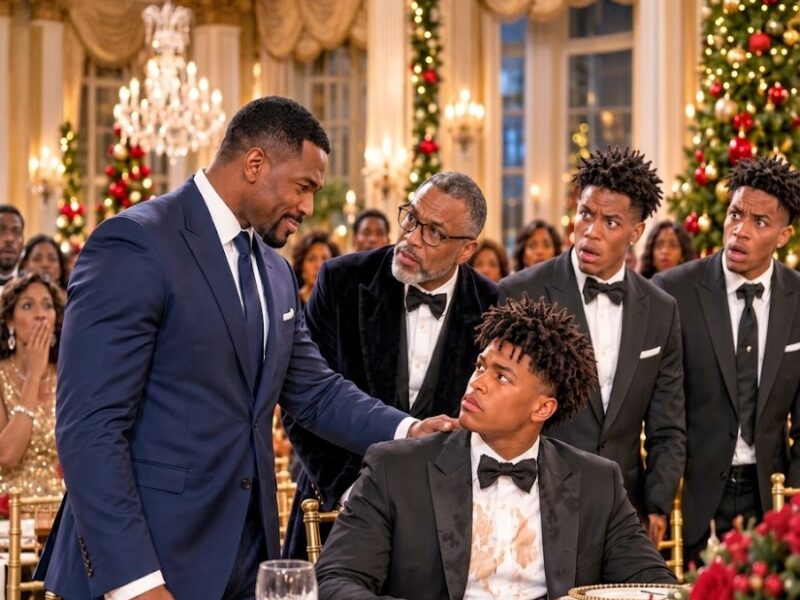
They Humiliated My Son at the Country Club Christmas Gala—Then Their Father Walked Over and Called Me “Boss”
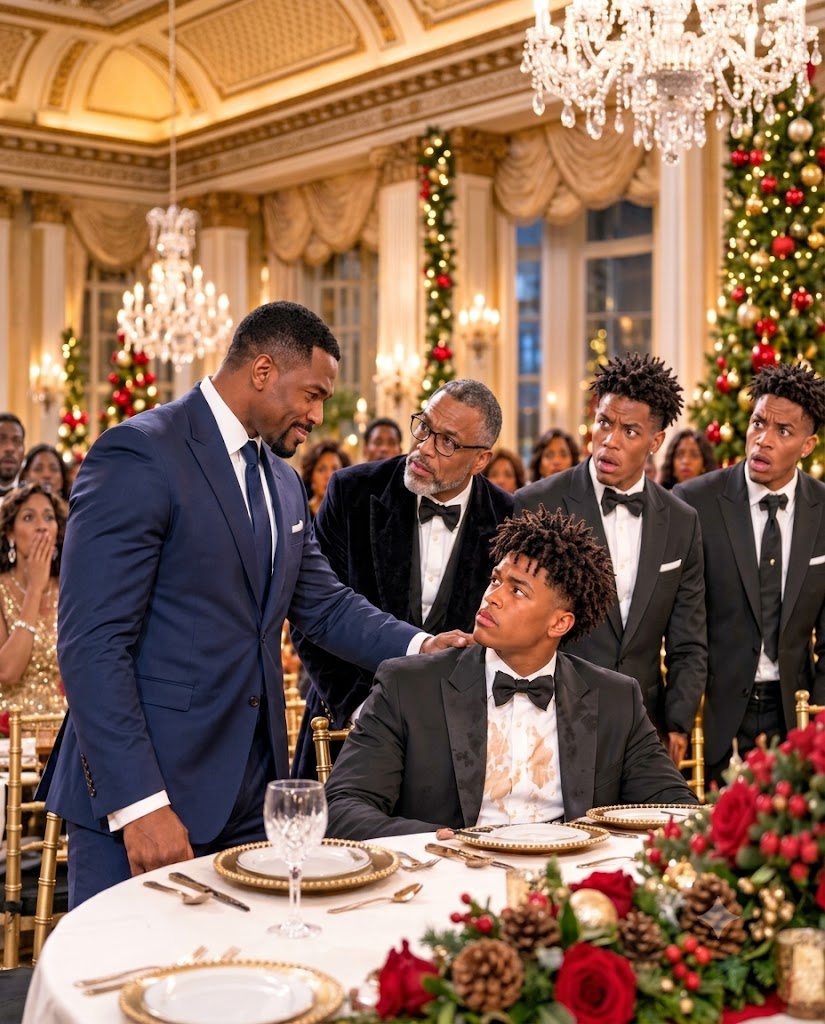
They’re letting scholarship kids in now.
I built something.
Wait—do you work here?
Because you look more like you came with the wait staff.
You belong with them, not us.
From across the ballroom, I watched Tyler Dalton decide what my son was worth in under a minute.
The borrowed tuxedo.
The short sleeves.
That was all he needed.
He didn’t look at the finalist badge sitting on the table in front of Noah.
When Brandon made the comment about the wait staff, and Tyler tipped that glass, and I saw clearly it was no accident, my son didn’t flinch.
He reached for a napkin the way someone does when they’ve already decided the other person isn’t worth the reaction.
Tyler read that quiet as weakness.
I wasn’t so sure.
There was something Tyler couldn’t have found by looking at a jacket or a watch, and it was standing forty feet away, trying very hard to stay exactly where it was.
What exactly did Tyler think would happen when his own father walked through that door?
If you’ve ever had someone decide your worth before they knew a single thing about you, stay with me.
Because what happened after Richard called me boss changed the way I looked at my own son.
I’ve spent twenty years building Mercer Infrastructure Group into one of the largest facilities and infrastructure companies in this region.
And in all that time, the thing I’ve been most careful about isn’t contracts or quarterly numbers.
It’s my son.
Laura and I made a decision early on that Noah would grow up knowing we had money without growing up defined by it.
He went to public school.
He took the city bus.
When his friends asked what his dad did for work, he’d say, “I run a company.”
And if they pressed for details, he’d change the subject.
That wasn’t embarrassment.
It was something closer to principle.
We raised him around one idea.
A last name can introduce you, but it cannot make you worth listening to.
Noah took that more seriously than we ever expected.
Which is why when I offered to buy him a new tuxedo for the country club Christmas gala, he said no without even looking up from his laptop.
His cousin had one he could borrow.
The sleeves were a little short, he admitted, but it fit well enough through the shoulders.
Laura pulled me aside afterward and said I should insist.
I told her I wouldn’t.
There was a version of Noah that would have let me buy the tuxedo because it was easier than arguing, and I was glad we hadn’t raised that version.
When I asked him why it mattered, he said something I laughed off in the moment and couldn’t stop thinking about later.
“If the suit changes their opinion of my work, then I probably shouldn’t care about their opinion.”
The work he was referring to had been almost a year in the making.
Noah had been developing a low-cost smart irrigation monitoring system.
Sensors.
Adaptive software that could detect leaks, pressure failures, and overwatering in real time at a fraction of what commercial systems cost.
The idea came from noticing how much water went to waste at the school’s athletic fields.
Puddles spreading across the track every morning after the sprinklers ran too long.
He started reading.
Then tinkering.
Then testing.
But the real education happened after school at the same country club that would eventually host the gala, where a groundskeeper named Miguel let him inspect broken pumps and aging valve systems once the members cleared out for the evening.
Miguel was sixty-two years old and had been maintaining grounds and irrigation lines longer than Noah had been alive.
He never designed anything for Noah.
He just showed him where real systems failed.
The sounds a leaking valve makes under pressure.
The places where the diagrams on paper had nothing to do with the pipes actually underground.
To Miguel, Noah wasn’t Daniel Mercer’s son.
He was just a kid who asked good questions and showed up when he said he would.
Noah loved that more than anything.
He submitted the project to the Whitmore Youth Innovation Fellowship in the fall.
A national competition for young engineers.
The kind with a fifty-thousand-dollar education grant, professional mentorship, prototype funding, and a network that could open doors for years.
Five finalists were chosen from hundreds of applicants.
Noah was one of them.
At least that was what I believed at the time.
The winner would be announced at the Christmas gala, which meant that the same country club where Miguel had taught my son how pipes actually behave would be the place where his work would either be recognized or passed over.
I decided early that I wouldn’t sit next to him that evening.
I wanted that night to belong to him, not to me.
When I arrived at the gala, Noah was already seated at a large round table with the other finalists and a handful of teenagers who had come as children of major donors.
I recognized two of them from across the room before I registered who their father was.
Tyler Dalton was eighteen.
His older brother Brandon, twenty-one.
And the way they were looking at Noah within minutes of sitting down told me everything about the kind of people they’d been raised to be.
They noticed the sleeves first.
Then the watch.
Then Brandon gestured toward the catering staff and made a comment that landed hard enough to draw a few laughs from the teenagers around them.
Tyler asked how Noah had gotten into the fellowship.
Genuinely curious in the way that people are curious when they’ve already decided the answer won’t impress them.
Noah told him he’d built something.
Tyler smiled and said everybody built something, and some people just knew the right people.
He said that without knowing whose son he was talking to.
I’ve thought about that irony many times since.
I was already moving when Tyler knocked Noah’s glass.
I saw it happen.
The slight shift of the elbow.
The angle of it.
The way Brandon looked away a half second too early.
The drink spread across the front of Noah’s jacket, and Brandon laughed like it was the most natural thing in the room.
I was crossing the ballroom floor before I’d made a conscious decision to do it.
Then Laura’s hand found my arm.
She didn’t raise her voice.
She just asked whether Noah needed his father right now, or whether Daniel needed to feel like a father.
It stopped me cold.
I looked across the room at my son, and he looked back at me with the glass already in his hand and a napkin in the other, and he gave the smallest shake of his head.
So I stopped.
Noah blotted the jacket, set the napkin down, and told Tyler that he knew nothing about him except what his jacket cost and somehow thought that was enough.
It wasn’t loud.
It didn’t need to be.
Several adults nearby turned their heads.
I started moving again, and this time I had no intention of being talked out of it.
And then I heard my name behind me.
Richard Dalton had just arrived from another corporate dinner, still in his overcoat, and he read the situation in about three seconds.
He followed my eyes across the room, saw his sons, saw the spilled drink, saw my face, and walked with me to the table without saying a word.
Tyler saw his father approaching and visibly relaxed, the way a kid does when he expects backup.
Instead, Richard stopped directly in front of me.
Everyone nearby went quiet.
Then he said, quietly and without any performance in it, “Boss.”
Tyler’s expression fell apart.
Brandon went completely still.
Several of the nearby adults turned to look, and you could see the understanding move through them like a current.
The boy in the borrowed tuxedo was Daniel Mercer’s son, and Richard Dalton had just told the entire room what that meant.
Richard started to apologize to me immediately.
I stopped him and pointed at Noah.
Richard turned to my son and began again, but Noah wasn’t looking at him the way I expected.
He wasn’t satisfied.
He looked at Richard for a long moment and asked in a voice that was almost conversational, “Would you be apologizing if my dad wasn’t your boss?”
Richard had no answer.
And standing there watching my son ask the question I hadn’t thought to ask myself, I realized the night wasn’t over.
The biggest danger wasn’t that Tyler had decided Noah was worthless.
It was that the entire room had just decided he was valuable for exactly the wrong reason.
Word travels fast in a room full of people who make their living paying attention to power.
Within twenty minutes of Richard saying that single word, nearly everyone at the gala understood who Noah was.
And the transformation that followed was the kind of thing you could only find unsettling if you’d been watching the room before it happened.
Parents who had spent the first hour of the evening looking past my son suddenly found their way to his table.
Executives I recognized from quarterly meetings materialized beside him with warm smiles and outstretched hands, introducing their own children as though they were presenting credentials.
Donors who hadn’t glanced at the finalist display board all night now wanted a personal explanation of his irrigation project.
One woman leaned down and told Noah with complete sincerity that she had always known there was something special about him.
Noah waited until she moved on before he looked at me.
He didn’t say it cruelly.
He just said it plainly.
“She didn’t know my name thirty minutes ago.”
I tried to make something lighter out of the moment the way fathers do when they don’t have a better answer.
He didn’t let me.
He said that before tonight, people had decided he was worth nothing because they assumed he had nothing.
He looked around the ballroom at the same faces now angling toward him with interest and warmth and said that now they decided he was worth something because he belonged to me.
Then he said the thing that changed the rest of the evening for both of us.
“They still don’t see me.”
I told him to make them.
He nodded, but his eyes were already somewhere else, and I didn’t yet understand what he was looking at.
Tyler and Brandon had gone quiet in the way people go quiet when they’re calculating, not reflecting.
Tyler sat with his hands wrapped around a glass, not speaking, not leaving.
Brandon had his phone out.
Neither of them came to Noah to say anything, and I noticed that Noah noticed.
The apology Richard had delivered on their behalf had cost them nothing personally, and they both seemed to understand that whatever lesson the evening was supposed to teach them hadn’t landed.
Or maybe it had landed and simply hadn’t changed anything.
That distinction mattered, and Noah saw it before I did.
The fellowship ceremony began with the kind of institutional formality those events always carry.
Introductions.
Acknowledgements.
A brief history of the Whitmore Foundation’s mission.
The five finalists appeared on the projection screen with photographs and one-line project descriptions.
Noah’s face came up third.
I had moved to the rear of the ballroom, deliberately staying far enough back that the announcement, whatever it turned out to be, would reach Noah first.
And then he stopped moving.
He was looking down at the event program in his hands.
At the bottom of the page where the sponsor acknowledgments were printed in small type.
I was too far away to read it, but I could see his face, and I could see the moment he found it.
The logo for Mercer Infrastructure Group was listed among the fellowship’s supporting sponsors.
My company.
Noah looked up and found me across the room, and the expression on his face wasn’t anger.
It was something quieter and more difficult than that.
A few minutes later, a member of the organizing committee spoke to him briefly near the edge of the stage.
I watched Noah listen, watch the man walk away, and then stand completely still for several seconds before looking at me again.
I crossed the room to him.
He asked me directly whether I had known my company sponsored the fellowship.
I told him I hadn’t, which was true.
He asked whether anyone at my company had known he applied.
That one I couldn’t answer with the same certainty, and he saw that in my face before I said a word.
The following morning I contacted my chief legal officer and the head of our community investment division.
What I learned was that Mercer Infrastructure had been a quiet sponsor of the Whitmore Foundation for three years, handled entirely through the giving department as part of our regional community investment portfolio.
I had approved the annual contribution at the budget level without ever reviewing individual fellowship activities.
But there was an email sent several weeks before the gala from someone inside my company to a foundation contact.
The line that mattered read, “Merc has a strong interest in the final outcome involving N. Mercer.”
Noah read it over my shoulder at the kitchen table.
He said that I didn’t have to make every phone call myself for people to know what I wanted.
I told him the email hadn’t come from me.
He said he believed me.
Then he walked upstairs and didn’t come back down for the rest of the morning.
When I told Laura I intended to have our legal team clear Noah’s name, pull the documentation, demonstrate that I had never directed anyone to contact the foundation, prove that the sponsorship was arm’s length and procedurally clean, she said no.
I argued that I could prove I hadn’t interfered.
She asked what happened after I proved it.
She explained it slowly.
If the CEO’s lawyers demonstrated that the CEO’s son had legitimately earned a CEO-sponsored award, what did I think people would say?
I sat with that for a long time.
She said I couldn’t use my power to prove that Noah had succeeded without my power.
That was the sentence that stayed with me, because it named the trap exactly.
The one thing I had spent my entire professional life building had become the one thing I couldn’t use without making everything worse.
Then Miguel called Noah.
He explained that weeks before the gala, someone from the foundation had contacted him, asked how long Noah had been testing at the club, whether any engineers had assisted him, whether Noah had genuinely designed the system, whether he’d had access to any corporate-level technology.
Miguel had answered honestly because he’d assumed it was standard verification.
Looking back, it felt different.
And when I traced the communication through my legal team’s review of internal correspondence, what I found didn’t lead to a stranger or another contestant’s parent.
It led inside my own company.
Specifically to the regional operations division.
Specifically to the office of Richard Dalton.
My first reaction was that I had misread something.
Richard had worked inside Mercer for eleven years.
I had trusted him with hundreds of employees and contracts worth tens of millions of dollars.
When I confronted him privately, he denied trying to help Noah.
Then he said something I wasn’t prepared for.
He told me he had been trying to protect the company.
I asked him from what.
From my seventeen-year-old son’s irrigation project.
He wouldn’t say anything more, and the fact that he wouldn’t explain himself told me more than any explanation could have.
We dug deeper over the following days, and what came back through the legal review wasn’t a conspiracy.
It was something more ordinary and more disappointing than that.
Richard’s division had spent nearly two years building the case for a commercial smart irrigation platform that Mercer was considering adopting across several large managed properties.
The contract was worth several million dollars to the vendor, and Richard had positioned himself as the internal champion of the initiative.
Noah’s prototype, running quietly on country club grounds for months with Miguel’s informal cooperation, had been producing efficiency data that overlapped directly with what the expensive commercial system promised to deliver at a fraction of the cost.
Richard had seen preliminary water use reports from the club.
He understood what the numbers implied before I did.
If Noah’s two-thousand-dollar prototype attracted national attention through the Whitmore Fellowship, people inside Mercer would start asking uncomfortable questions about why Richard was recommending a multi-million-dollar alternative.
He hadn’t reached out to the foundation to help my son.
He had reached out to stop him.
The records also revealed something that had complicated Noah’s standing with the committee in ways that weren’t immediately visible.
Noah had disclosed Miguel as a field adviser in his original application, honestly, without hiding it.
But the fellowship’s technical review panel had quietly removed Miguel’s name from the evaluation packet because he held no engineering license.
So on paper, the question of who had assisted Noah became murkier than it actually was.
Richard’s inquiry to the foundation had raised concerns that looked from a distance like legitimate due diligence.
Noah couldn’t easily prove that the challenge had been deliberately constructed rather than sincerely raised.
And because my company’s name was attached to the fellowship’s sponsorship, any move I made to correct the record would only deepen the appearance of interference.
Noah said he was withdrawing.
He said it quietly at the kitchen table on a Sunday morning, and I told him he wasn’t going to do that.
He looked at me the way he sometimes does when he thinks I’m missing the point, and then he laid it out plainly.
If he won, people would say I bought it.
If he lost, people would say he had never been good enough.
Either way, the question of what he had actually built would never get a clean answer.
Then he said the thing that broke something open in me.
He said, “Maybe I only got this far because I was your son.”
That was the moment.
Not Tyler’s cruelty at the dinner table.
Not the spilled drink.
Not the email.
That was the thing that actually landed.
Everything else he had handled.
This was the one he couldn’t see around.
I spent that night in my office gathering everything I could find.
Original submission files.
Code repositories with timestamps going back fourteen months.
Dated photographs of early failed prototypes.
School lab records.
Maintenance logs from the country club showing water use changes over the period Noah had been testing.
Internal emails from Richard’s division.
I built a case that I was fully prepared to walk into a Whitmore Foundation board meeting and present in a way that would leave no room for ambiguity.
Then Noah came into the office around midnight, saw everything spread across the desk, and told me he needed me there the next morning.
I said, “Of course.”
Then he added that he didn’t want me to speak first.
When I asked why, he said that the whole thing had started because people decided what he was worth based on who they thought his father was.
And if it ended with me proving his value because I was Daniel Mercer, then they still would never have actually judged him.
Laura took my hand before we left for the hearing the following morning.
She said to let him own it.
So I sat behind my son and kept my mouth shut, which was the hardest thing I had done in twenty years of making difficult decisions.
Noah stood in front of the Whitmore Foundation’s emergency review board and asked them to remove his name, his surname, his school, my company, every donor connection, every family reference stripped from the record.
Then he asked them to evaluate the work again blind against the other four finalists.
The board looked uncertain.
Noah didn’t wait for them to debate it.
He opened his development record and presented it the way an engineer presents findings.
Methodically.
Without emotion.
Moving through early failed prototypes and the code revision history and the field testing documentation and the school lab notes and the photographs taken months apart showing iterations of a system that had changed substantially between its first version and the one the club had been running.
Then he called Miguel to the front of the room.
I watched a few board members register something when Miguel walked in.
The work clothes.
The absence of a title.
The age.
Noah had anticipated exactly that reaction, which is why he’d wanted Miguel there.
Miguel explained that he had never designed any part of Noah’s system.
He had shown Noah where real systems fail.
He had taught him what a leaking valve sounds like under pressure at two in the morning.
Where pressure drops hide inside pipe joints that look fine from the outside.
Why the engineering diagrams that made sense on paper had nothing to do with the actual ground conditions at a forty-year-old irrigation installation.
Noah had done the engineering.
Miguel had given him reality.
The distinction was clear, and it was the kind of clarity that only lands when it comes from someone with no reason to protect anyone.
Then the foundation produced the complete email chain.
The full correspondence.
Not the single extracted line that had made it look like a Mercer executive was lobbying for Noah’s selection.
In context, what Richard had actually requested was that the foundation raise questions about independent development, delay the evaluation process, and create conditions under which Noah’s project could be challenged before the gala.
My son had not benefited from my company’s name.
Someone inside my company had actively tried to use that name to stop him.
Three independent engineers who had never met Noah received anonymized versions of all five finalist projects.
Methodology.
Cost.
Data.
Engineering approach.
Field results.
Nothing else.
We waited in a side corridor for forty minutes, and I don’t think I said anything during that time that I can remember now.
There was genuinely nothing I could do, and I had spent enough of my life being the person who could always do something that the absence of it felt almost physical.
Project 4 ranked first.
Noah’s project.
The evaluators didn’t know his name.
They didn’t know mine.
The work was simply better.
And when the numbers were stripped of everything surrounding them, that fact had nowhere to hide.
Noah didn’t react the way I expected.
He stood very still for a moment, then closed his eyes briefly, and that was all.
It wasn’t the reaction of someone who had just beaten a rival or embarrassed a room full of people who underestimated him.
It was the specific relief of a person who had needed to know something true about themselves and had finally gotten a clean answer.
One of the engineers pointed out that the club’s maintenance logs showed measurable reductions in water waste and earlier leak detection across the months Noah’s prototype had been running.
Results the foundation had been treating as a student project when the data actually supported something beyond that.
Richard lost his position following the internal review.
I didn’t go after Tyler or Brandon.
They didn’t work for me, and I wasn’t willing to let Noah’s victory depend on punishing two arrogant boys who had simply revealed who they were.
Weeks later, Richard brought his sons to the house on a Sunday afternoon.
No cameras.
No audience.
Just the four of them and me in the backyard.
Tyler told Noah that they hadn’t known who he was.
Noah looked at him for a long moment and said that was exactly the problem.
Tyler had thought he needed to know.
I didn’t add anything.
My son had already said what needed to be said.
Months after that, when investors began approaching Noah about commercializing the system, I offered to fund the company.
He said I could invest.
I said, “Good.”
He said, “Same terms as everyone else.”
Laura laughed, and I agreed.
His first paid field consultant was Miguel Alvarez, the same groundskeeper two board members had looked past when he walked into that hearing room.
Because by then, Noah understood exactly what he owed to Miguel.
And he wasn’t the kind of person who forgot that.
That Christmas, Tyler and Brandon learned I was their father’s boss.
They walked away from the gala thinking that was the part that mattered.
It wasn’t.
The part that mattered came months later in a foundation hearing room where three engineers read my son’s work without knowing his name and ranked it first.
I didn’t teach him that.
He already knew it.
I just had to get out of the way long enough to watch it happen.
If this story reminded you of someone who had to prove their value in a room that had already made up its mind, subscribe.
Because sometimes the strongest thing a person can do isn’t prove people wrong.
It’s already knowing they were wrong long before you ever had to prove it.









