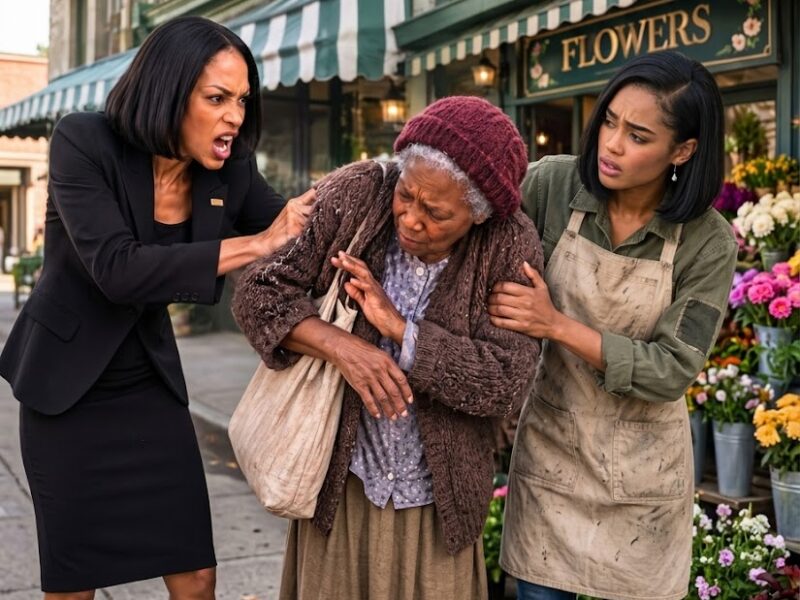
They Humiliated a Ragged Old Woman in the Lobby—Then Her Billionaire CEO Son Walked Through the Door
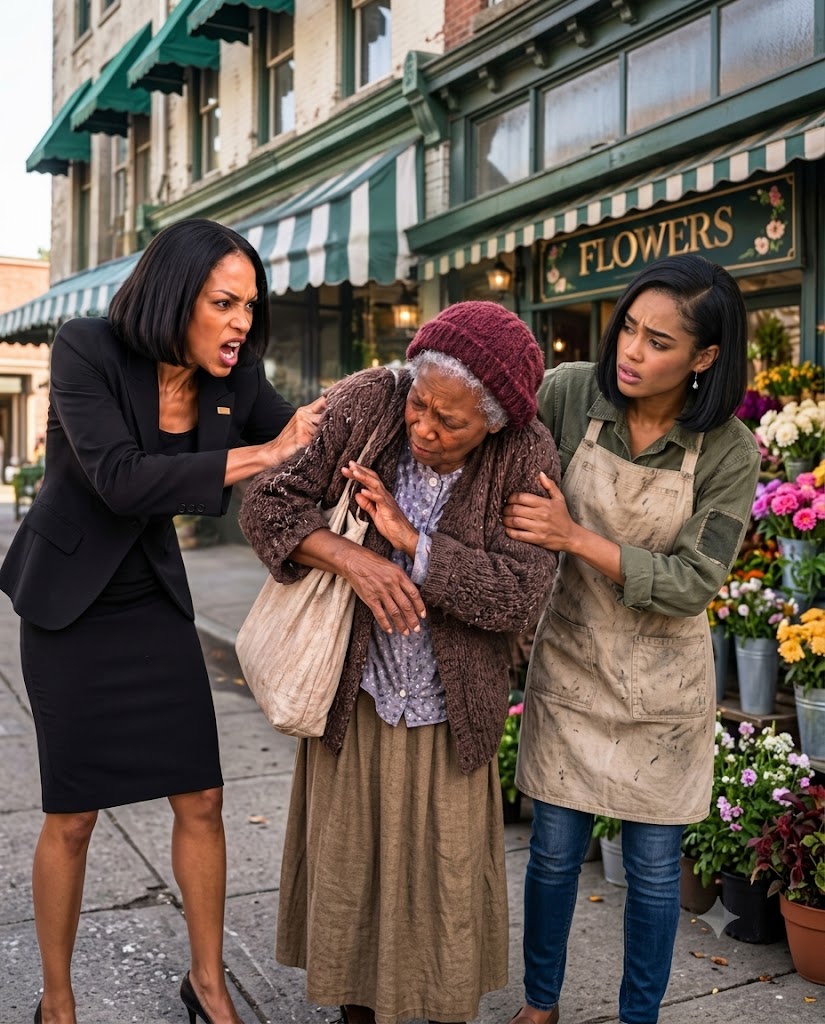
The check was crisp, the kind banks still printed for customers who refused to die quietly. Evelyn Hart held it between two fingers like a small flag of surrender, watching the clerk’s face fold into something between pity and irritation.
“Ma’am, nobody takes checks anymore,” the young man said, sliding it back across the counter. His name tag read BRADEN, and his smile had the plastic sheen of someone who’d practiced it in a mirror.
“I’ve been writing checks at this address for forty years,” Evelyn said. Her voice was soft but carried the weight of someone who’d weathered worse storms than this boy’s indifference. “Mr. Whitaker always took them.”
“Mr. Whitaker retired. New management.” Braden gestured vaguely at the gleaming display cases, the imported tulips wrapped in tissue paper, the arrangement that cost more than her monthly electric bill. “We’re cash or card now.”
Evelyn looked down at the sweater she wore—her husband Harold’s favorite, the salmon-colored cardigan with the elbow patches she’d sewn on herself. She’d worn it every year on this day, the anniversary of his passing, because it still smelled faintly of his pipe tobacco no matter how many times she washed it.
“I see,” she said quietly, folding the check back into her worn leather wallet. “Then I’ll take my business elsewhere.”
Braden’s laugh followed her to the door. “Good luck with that, ma’am. Nobody’s taking paper anymore. It’s 2024.”
Outside, the October wind bit through the thin wool of Harold’s sweater. Evelyn stood on the sidewalk of Whitaker Florals—or whatever corporate name they’d slapped on the sign now—and felt the familiar ache of a world that had moved on without asking her permission.
She’d met Harold here, in this very shop, in 1985. He’d come in to buy flowers for his mother’s birthday and ended up talking to her for three hours while she arranged peonies. He’d paid by check—a check she still had, framed on her wall at home, because Harold kept every check he ever wrote, and she kept every check she ever received.
“No heart building puts a family out,” he used to say, back when he was building homes for Southside families the banks wouldn’t touch. “You give people a door, Evelyn. You give them a door and you watch what they build behind it.”
She’d watched. For forty years, she’d watched.
Now she pulled her collar up against the cold and walked toward the cemetery, the last bunch of white peonies from her own garden clutched in her hands. They were for Harold. They were always for Harold.
—
The gate to Cold Spring Cemetery was open, as it always was on Sundays. Evelyn knew every path here the way she knew the lines on her own palms—intimately, irrevocably, with the kind of knowledge that came from decades of repetition.
She was halfway to Harold’s grave when she saw the girl.
Young, maybe twenty-five, with dark circles under her eyes and a bucket of wildflowers at her feet. She was arguing with a man in a security uniform, her voice carrying across the quiet grounds.
“I’ve been selling here for three years,” the girl said. “My grandmother’s plot is right there. I’m not hurting anyone.”
“New policy,” the guard said. He had the flat affect of someone who’d been given orders he didn’t agree with but couldn’t afford to question. “No vendors. No exceptions.”
“I’m not a vendor. I’m a granddaughter.”
“Ma’am, I need you to leave.”
Evelyn watched the girl’s jaw tighten, watched her hands curl into fists at her sides. Then, slowly, the fight drained out of her.
“Fine,” the girl said. “Fine. I’ll go.”
She gathered her bucket, and that’s when Evelyn noticed something odd—the girl wasn’t walking toward the main gate. She was walking toward Section C, the oldest part of the cemetery, where the paths narrowed and the trees grew thick and the graves were so old their names had worn away.
“Young lady,” Evelyn called out. “That’s the wrong way.”
The girl turned, and for a moment their eyes met. There was something familiar in her face, something Evelyn couldn’t quite place—a stubbornness, maybe, or a quiet dignity that reminded her of herself at that age.
“I know where I’m going,” the girl said.
“Section C is closed after dark. Holes dug for Thursday.”
“I’ll be quick.”
The security guard was already walking away, his radio crackling with some other crisis. Evelyn hesitated, then followed the girl into the shadows of Section C.
—
“Your loved one isn’t getting store flowers this year,” the girl said, kneeling beside a weathered headstone. The name was barely visible: HAROLD HART, 1955-2018. “What’s his name, ma’am?”
Evelyn felt something catch in her throat. “Harold. Harold Hart.”
The girl looked up, and this time Evelyn saw it—the recognition, the quick calculation, the same stubbornness she’d seen in Harold’s eyes when he’d argued with bankers who said his dreams were too big for their ledgers.
“Then I’m paying you,” the girl said, holding out a single wildflower—a white peony, impossibly, growing wild among the weeds. “Harold paid for everything.”
“I don’t sell flowers that go to remembrance.”
“Then hold it for me.” Evelyn pressed the check into the girl’s hand—check 1059, written just that morning, made out to whoever needed it most. “Nobody says Evelyn Hart didn’t pay.”
The girl looked at the check, then at Evelyn, then at the check again. “Ma’am, I can’t cash this.”
“Then don’t. Just keep it safe, child.” Evelyn touched the girl’s hand, felt the calluses there, the evidence of hard work and harder living. “For Harold. Go see him.”
She turned and walked back toward the main path, leaving the girl in the growing dark of Section C.
Behind her, she heard the girl whisper: “A bad check for a wee bouquet. Perfect match.”
—
The house on Delmare Street was quiet when Evelyn returned. She’d lived here for fifty years—first with Harold, then alone—and the silence still surprised her sometimes. She kept expecting to hear his footsteps on the stairs, his voice calling from the kitchen, asking if she wanted tea.
Instead, she heard her own thoughts, loud in the empty rooms.
She sat at Harold’s desk—she still thought of it as his, even after six years—and opened the leather-bound book that held every check she’d ever written. Forty years of paper, forty years of proof that she existed, that she mattered, that her life had been built on something more than the digital ghosts of credit cards and bank transfers.
Page after page, Harold’s careful handwriting in the margins. “First customer, 1985.” “Anniversary dinner, 1992.” “Desmond’s college fund, 2008.”
Desmond. Their son. The billionaire CEO who hadn’t visited his father’s grave in six years.
Evelyn closed the book and pressed her forehead against its worn leather cover. “You stubborn old man,” she whispered to Harold’s ghost. “You promised you’d never leave me alone with him.”
—
The bank was crowded on Monday morning, the kind of crowded that made Evelyn’s joints ache just looking at it. She’d dressed carefully—her good black dress, the pearls Harold had given her for their thirtieth anniversary, and his sweater underneath, because some days she needed the armor of his memory.
“Mrs. Hart,” the teller said, her smile professional but genuine. “How can I help you today?”
“I need to verify a check.”
The teller looked at the check Evelyn slid across the counter—check 1059, the one she’d given to the girl at the cemetery—and her smile flickered.
“This check hasn’t been cashed.”
“I know. I want to know why.”
The teller’s fingers flew across her keyboard. “It was issued three days ago. There’s no stop payment. It’s still valid.”
“Then why hasn’t anyone cashed it?”
“Maybe the recipient lost it? Or forgot?”
Evelyn shook her head. “She didn’t lose it. She didn’t forget it. She’s waiting.”
“For what?”
“For someone to prove it’s real.” Evelyn pulled out her checkbook, the leather cracked with age. “I want to write another one. Same amount. Same recipient.”
“Mrs. Hart, that’s not necessary—”
“It’s necessary.” Evelyn’s voice was steel wrapped in silk. “Nobody believes an old woman in a Salvation Army sweater. So I’ll write another check. And another. Until someone takes one.”
The teller hesitated, then nodded. “I’ll need the recipient’s name.”
“Emani Brooks.”
The name hung in the air between them, and Evelyn felt something shift—some small certainty clicking into place.
“Flowers,” she said quietly. “The check is for flowers.”
—
Emani Brooks lived on the third floor of a walk-up on Southside, in an apartment that smelled like simmering soup and old books. Her grandmother, Hattie, was in a wheelchair by the window, her hands busy with the kind of knitting that had no pattern and no end.
“You’re the check lady,” Hattie said, before Evelyn could introduce herself. “Emani told me about you.”
“I’m sorry I didn’t call first—”
“Don’t apologize. Coffee’s on the stove. Emani’s at the cemetery, selling flowers she shouldn’t be selling.” Hattie’s eyes were sharp, assessing. “You’re Harold Hart’s widow.”
“I am.”
“Then you know what Cornerstone Holdings is doing to this building.”
Evelyn felt the floor shift beneath her feet. “Cornerstone?”
“Taped a notice to our door last week. Fourteen days to vacate. The building’s coming down.” Hattie’s knitting needles clicked in rhythm with her words. “My granddaughter’s been fighting them for months. Doesn’t matter. Cornerstone owns half of Southside.”
“Cornerstone is my son’s company.”
The knitting needles stopped. Hattie looked at Evelyn with something that might have been pity, might have been understanding, might have been the kind of grief that comes from watching generations repeat the same mistakes.
“Then you know better than I do,” Hattie said, “what kind of man your son has become.”
—
The cemetery was quiet when Evelyn arrived, the October light thinning to something softer and sadder. Emani was in Section C again, sitting beside Harold’s grave, the wildflowers in her bucket wilting but not yet dead.
“You came back,” Emani said.
“I came to tell you the truth.” Evelyn sat down on the bench beside the grave—Harold’s bench, the one she’d commissioned with his name and his motto carved into the stone. “I didn’t know about Delmare Street. I didn’t know my son was evicting families from the neighborhood his father built.”
“Now you do.”
“Now I do.” Evelyn pulled out her checkbook. “How much do you need to save the building?”
Emani laughed—a sharp, bitter sound. “Four hundred thousand. Maybe more. Cornerstone’s lawyers have been circling for months, and Grandma’s heart pills alone cost—”
“I don’t have four hundred thousand.” Evelyn wrote another check, her handwriting steady despite the tremor in her hands. “But I have this. And I have Harold’s book. Forty years of checks. Forty years of proof that this family built something good.”
She handed the check to Emani. It was for twenty-four thousand dollars—the same amount that had been withdrawn from her account without her knowledge, the same amount that had been routed to a company called CL Southside LLC.
“I need you to help me find out who’s been writing checks in my name,” Evelyn said. “And I need you to help me stop them.”
Emani looked at the check, then at Evelyn, then at the grave between them.
“Harold would have liked you,” Evelyn said.
“I think I’d have liked him too.”
—
The address was a glass tower downtown, the kind of building that made Evelyn feel small and old and irrelevant. But she walked through the revolving doors anyway, her checkbook tucked under her arm like a weapon.
“May I help you?” the receptionist asked, her smile practiced and empty.
“I’m here to see Desmond Hart.”
“Do you have an appointment?”
“I’m his mother.”
The smile flickered. “One moment.”
Evelyn waited. She waited while the clock on the wall ticked through minutes that felt like hours. She waited while other people—important people, busy people, people with somewhere to be—walked past her without seeing her.
Then the elevator doors opened, and Desmond stepped out.
He was fifty years old, silver at the temples, dressed in a suit that cost more than Evelyn’s monthly pension. He looked like Harold—the same broad shoulders, the same stubborn jaw—but his eyes were harder, colder, the eyes of a man who’d traded his soul for a corner office and a view of the city.
“Mother.” His voice was flat. “What are you doing here?”
“I’m here to ask you why you’re evicting families from the neighborhood your father built.”
Desmond’s jaw tightened. “That’s business, Mother. You wouldn’t understand.”
“I understand that your father wrote ‘No heart building puts a family out’ on every blueprint he ever drew. I understand that he built Cornerstone from nothing, built it on a promise that he’d never become the kind of man who pushed people out of their homes.”
“Dad’s promises are on the balance sheet now.” Desmond gestured at the lobby, the tower, the empire. “This is what he left me. This is what I’ve built.”
“You’ve built nothing.” Evelyn’s voice was quiet but it carried. “You’ve inherited everything. And you’ve spent six years turning your father’s legacy into something he would have hated.”
Desmond’s face went pale. “You don’t know what you’re talking about.”
“I know about CL Southside LLC. I know about the twenty-four thousand dollars that disappeared from my account. I know about the checks signed with your name that you never wrote.”
“What are you talking about?”
Evelyn pulled out her checkbook and opened it to the page she’d marked. “Check 1047. June 9th. Twenty-four thousand dollars. Paid to CL Southside LLC. I never wrote this check, Desmond. And I don’t think you did either.”
Desmond took the book from her hands, his fingers trembling slightly as he scanned the pages. “This can’t be right. I don’t write checks. I sign on a screen—”
“Someone’s been forging your signature. Someone with access to my account and your name.” Evelyn met his eyes. “Someone who works for you. Someone who knows both of us well enough to replicate our signatures without raising suspicion.”
Desmond was silent for a long moment. Then, slowly, he closed the book and handed it back to her.
“I have a board meeting in ten minutes,” he said. “But I’m canceling it.”
“Why?”
“Because you’re right.” Desmond’s voice cracked, just slightly. “Dad would have hated what I’ve become. And I need to fix it before it’s too late.”
—
The investigation took three days. Evelyn, Emani, and Desmond worked together in Harold’s study—the study that hadn’t been touched since Harold’s death, the study that still smelled of pipe tobacco and old paper and the kind of hope that refused to die.
“We need to find who opened the CL Southside LLC account,” Desmond said, spreading bank records across his father’s desk. “The LLC was registered last spring. Whoever opened it had access to your checkbook, Mother—”
“And your signature.” Emani was sitting in the corner, her grandmother’s knitting needles clicking in her hands. “The forged checks were signed D. Hart. Your name, your company, your account.”
“But I didn’t write them.”
“Someone practiced your signature.” Evelyn held up a piece of paper she’d found in Harold’s desk drawer—a page from her checkbook, torn out, with Desmond’s signature practiced over and over in the corner. “Someone sat at this desk and practiced your name until they got it right.”
Desmond stared at the paper. “Who?”
“Grant.”
The name fell like a stone into still water. Grant Yelts, Desmond’s cousin, the man who’d been handling the family’s money for years. The man who’d brought yellow carnations to Harold’s grave every year—carnations that meant disdain.
“Grant’s been stealing from you for years,” Evelyn said. “The twenty-four thousand was just the beginning. He opened the CL Southside LLC account and used it to funnel money from my checks into his own pockets. And he’s been using your signature to sign eviction orders for Southside buildings—including Delmare Street.”
Desmond’s face was white. “Why?”
“Because he wanted what you have.” Evelyn touched her son’s hand. “He wanted the company. The power. The legacy. And he was willing to destroy everything your father built to get it.”
—
The shareholders gala was held in the ballroom of the Cornerstone Tower, the same building where Evelyn had been ignored by receptionists and dismissed by her own son. But tonight, she wasn’t invisible. Tonight, she was the guest of honor.
“Ladies and gentlemen,” Desmond said, standing at the podium with a microphone in his hand. “I’ve called this emergency meeting because I have a confession to make.”
The room went still. Four hundred shareholders, board members, executives—all of them watching Desmond with varying degrees of confusion and suspicion.
“For the past six years, I’ve been signing checks without reading them. I’ve been approving eviction orders for Southside families without knowing their names. I’ve been running my father’s company like a machine, not like a man.” Desmond’s voice was steady, but his hands were shaking. “I’ve been a coward. And I’ve been a thief.”
He gestured to Evelyn, who was sitting in the front row, wearing Harold’s sweater like armor.
“My mother showed me the truth. She showed me the checks I never wrote, the signatures I never signed, the buildings I never meant to destroy. And she showed me the man I’ve become—a man my father would have been ashamed of.”
Desmond reached into his pocket and pulled out a pen—a simple fountain pen, the kind Harold used to use.
“This pen belonged to my father. My mother gave it to me last week and told me to write something real. So here’s what I’m writing: I’m canceling every Southside eviction order. I’m refunding every family that’s been displaced. And I’m resigning as CEO of Cornerstone Holdings.”
The room erupted. But Desmond held up his hand.
“But first, I’m going to tell you who’s really been running this company.” He nodded toward the back of the room, where Grant Yelts was trying to slip out the door. “Grant Yelts, my cousin, the man I trusted with my family’s money, has been forging my signature for years. He’s been stealing from my mother. He’s been stealing from all of you.”
Security guards moved toward Grant, who was already reaching for his phone.
“Grant Yelts, you’re under arrest for forgery, bank fraud, and conspiracy to commit eviction fraud.” The police officer who’d been waiting in the wings stepped forward. “Anything you say can and will be used against you in a court of law.”
Grant laughed—a harsh, ugly sound. “You think this changes anything? Nobody reads paper anymore, Aunt Evelyn. Nobody cares about your little book or your little checks.”
Evelyn stood up. She walked to the podium, took the microphone from her son, and faced the room.
“I care,” she said quietly. “I’ve cared for forty years. I’ve written every check by hand, kept every record, remembered every name. Because paper remembers when people forget. And I will not let you erase my husband’s legacy.”
She held up her checkbook—the leather cracked, the pages yellowed, the handwriting fading but still legible.
“Check 1058,” she said. “Yellow carnations. Paid by Grant Yelts for Harold Hart’s grave. The flowers that mean disdain.” She looked at Grant, her eyes steady. “You’ve been mocking my husband’s memory for years. But you forgot one thing.”
“What’s that?”
“Harold kept every check too.”
—
The courthouse was quiet on the day of Grant’s sentencing. Evelyn sat in the front row, Harold’s sweater wrapped around her shoulders, her checkbook in her lap. Desmond sat beside her, his hand in hers, the way it had been when he was a boy.
“Three months in federal prison,” the judge said. “Restitution of nine hundred thousand dollars. Probation for five years.”
Grant was led away in handcuffs, his face pale, his eyes fixed on the floor.
Outside, the October sun was warm—the kind of warmth that felt like an apology after a long, cold winter. Evelyn stood on the courthouse steps and breathed in the air.
“It’s over,” Desmond said.
“It’s not over.” Evelyn pulled out her checkbook. “There’s still Delmare Street. There’s still Hattie and Emani. There’s still work to do.”
Desmond smiled—a real smile, the kind she hadn’t seen since Harold’s funeral. “Then let’s get to work.”
—
The sign above the corner store on Delmare Street was hand-painted, the letters slightly crooked but proud: CHECKS WELCOME. My handwriting. 40 years of cash only. And I finally win.
Emani had painted it herself, in the same stubborn script she used on her flower buckets. Hattie had lettered the smaller sign below it: Wildflowers for remembrance. Wildflowers for hope.
“You did it,” Evelyn said, standing on the sidewalk with her son. “You saved the building.”
“We saved it.” Emani walked out of the store, a bucket of wildflowers in her arms. “The city declared it a historic landmark. Cornerstone can’t touch it now.”
“Cornerstone is under new management.” Desmond pulled a check out of his pocket—a real check, written in his own hand. “I’m starting a new company. Southside Holdings. We’re going to build affordable housing, the way Dad did.”
Evelyn took the check. It was for one million dollars, made out to the Delmare Street Community Trust.
“What’s this for?”
“For the families,” Desmond said. “For the doors. For every heart building we almost destroyed.”
Evelyn folded the check carefully and tucked it into her book. “This one I’m cashing.”
“Better.” Emani laughed. “Last time you made me look foolish.”
“Last time you made me look foolish.” Evelyn smiled. “Whitaker Florals accepts checks now. Since March. Take it to your father through the front gate.”
—
Harold’s grave was covered in wildflowers when Evelyn visited on the anniversary of his death. White peonies, wild roses, rosemary for remembrance—all of them picked by hand, all of them paid for with checks that would never bounce.
“I brought the whole family,” she said, kneeling beside the headstone. “Desmond’s here. And Emani. And Hattie. Even Otis, the groundskeeper. He’s been keeping your gate for years, you know. I think you would have liked him.”
The wind rustled through the trees, and for a moment, Evelyn could have sworn she heard Harold’s laugh—that deep, warm sound that had filled her life for forty years.
“Daddy.” Desmond knelt beside her, a single wildflower in his hand. “Late and honest. I brought wildflowers.”
“Mrs. Hart.” A man in a suit approached, his face apologetic. “Sloan, bank fraud desk. Your son’s office said Sundays you’re here. I brought the letters to unmask the owner.”
Evelyn stood up, her heart suddenly pounding. “What owner?”
“CL Southside LLC. Grant only signed for the account. The owner of record filed last spring.” Sloan handed her a piece of paper. “Signed Hart.”
Evelyn looked at the signature. It was Harold’s—his real signature, the one he’d used on every check, every blueprint, every love letter he’d ever written her.
“Harold has been gone six years,” she said.
“Yes, ma’am. Somebody’s been signing for him.”
Evelyn looked at the grave, then at the wildflowers, then at the paper in her hand.
“Harold’s name on that wall since 1985,” she whispered. “Now somebody’s writing it again.”
She turned the paper over. On the back, in Harold’s handwriting, was a single line: “No heart building puts a family out. Not for money. Not for paper. Not ever.”
—
The gate to Cold Spring Cemetery was open, as it always was on Sundays. But this time, Evelyn didn’t walk through alone. Desmond was beside her, Emani was behind them, and Hattie was wheeling herself along the path, her knitting needles clicking in rhythm with the wheels.
“Grandma, you’re going to wear out those needles,” Emani said.
“Child, I’ve been knitting since before you were born. These needles will outlast us all.”
They reached Harold’s grave just as the sun was setting, painting the headstones in shades of gold and rose. Evelyn knelt down and placed the check—check 1060, the last check in her book—on the stone.
“I kept it safe,” she said. “1059. You framed my first customer. Man owns a frame and a pen. Progress.”
Desmond laughed. “Dinner Friday. I’ll bring my own pen.”
“Bring the whole family.” Hattie wheeled herself closer. “I have opinions.”
“A bunch of wildflowers, please.” Evelyn looked up at the sky, at the clouds moving slowly across the October blue. “The wildest you have.”
“Cash or check, Mrs. Hart?”
“Check. I write everyone.”
She stood up and took her son’s hand. Together, they walked back toward the gate—the gate that had always been open, the gate that Harold had built for a family that had finally found its way home.
Behind them, the wildflowers swayed in the evening breeze, and the check on the grave caught the last light of the sun.
Check 1060. Paid in full.
—
## Part 2
The three months after Grant’s arrest were the busiest of Evelyn’s life. She’d thought retirement meant quiet mornings and crossword puzzles, but instead she found herself in meetings with lawyers, bankers, and city officials who all wanted a piece of the story she’d uncovered.
“Mrs. Hart, the bank has agreed to freeze the CL Southside accounts pending a full audit,” Mr. Sloan said, spreading documents across Harold’s desk. “But there’s something you should see.”
Evelyn leaned forward. “What is it?”
“The LLC was registered last spring, but the paperwork lists a beneficiary that wasn’t disclosed in the initial filing.” Sloan handed her a single page. “The beneficiary is a trust. The Harold Hart Legacy Trust.”
Desmond, who’d been standing by the window, turned sharply. “That’s impossible. Dad didn’t have a trust.”
“He did.” Evelyn’s voice was barely a whisper. “He set it up the year before he died. I’d forgotten—I didn’t think it mattered.”
“What was it for?”
“Southside families. Emergency housing assistance. He wanted to make sure that if anything happened to him, there would still be money to help people.” Evelyn looked at the paper. “But the trust was supposed to be managed by a board. Not by Grant.”
“The trust was hijacked,” Sloan said. “Grant used the LLC to funnel money from your checks into the trust, then redirected the trust’s funds to himself. He was stealing from your husband’s legacy to fund his own lifestyle.”
Desmond’s hands clenched into fists. “I’ll kill him.”
“No, you won’t.” Evelyn’s voice was sharp. “You’ll help me rebuild what he destroyed. The trust, the buildings, the community. All of it.”
She looked at the paper again. The Harold Hart Legacy Trust. The name her husband had chosen, the promise he’d made, the future he’d believed in even when the banks said no.
“Harold’s name on that wall since 1985,” she said quietly. “Now somebody’s writing it again. But this time, we’re writing it right.”
—
The Delmare Street Community Trust opened its doors in June, six months after the eviction notices had been torn down. Emani had painted the sign herself, and Hattie had knitted a banner that read WELCOME HOME in three different colors of yarn.
“This is for you,” Desmond said, handing Evelyn a small box wrapped in brown paper. “From all of us.”
Evelyn opened the box. Inside was a pen—a fountain pen, the same kind Harold had used, with a gold nib and a barrel made of dark wood.
“It’s from Dad’s desk,” Desmond said. “I had it restored. The engraving says—”
“No heart building puts a family out.” Evelyn ran her finger over the words. “It’s perfect.”
“We’re going to need someone to write the checks,” Emani said, grinning. “The trust’s first payment is due next week. Who’s going to sign?”
Evelyn looked at the pen in her hand, at the sign on the wall, at the family she’d found in the most unexpected place.
“I will,” she said. “I write everyone in here. And I’m not stopping now.”
—
The cemetery was quiet on the anniversary of Harold’s death, the way it always was. But this year, Evelyn didn’t come alone. Desmond was beside her, Emani was behind them, and Hattie was wheeling herself along the path, her knitting needles clicking in rhythm with the wheels.
“Grandma, you’re going to wear out those needles,” Emani said.
“Child, I’ve been knitting since before you were born. These needles will outlast us all.”
They reached Harold’s grave just as the sun was setting, painting the headstones in shades of gold and rose. Evelyn knelt down and placed the check—check 1060, the last check in her book—on the stone.
“I kept it safe,” she said. “1059. You framed my first customer. Man owns a frame and a pen. Progress.”
Desmond laughed. “Dinner Friday. I’ll bring my own pen.”
“Bring the whole family.” Hattie wheeled herself closer. “I have opinions.”
“A bunch of wildflowers, please.” Evelyn looked up at the sky, at the clouds moving slowly across the October blue. “The wildest you have.”
“Cash or check, Mrs. Hart?”
“Check. I write everyone.”
She stood up and took her son’s hand. Together, they walked back toward the gate—the gate that had always been open, the gate that Harold had built for a family that had finally found its way home.
Behind them, the wildflowers swayed in the evening breeze, and the check on the grave caught the last light of the sun.
Check 1060. Paid in full.
—
## Part 3
The Harold Hart Legacy Trust grew faster than anyone expected. Word spread through Southside that there was money available for families facing eviction, for small businesses struggling to stay open, for kids who needed school supplies and warm coats.
“You’re famous, Mrs. Hart,” Emani said, holding up a newspaper. “Front page of the Southside Gazette. ‘The Check Lady Saves Delmare Street.'”
“I’m not famous.” Evelyn poured herself another cup of coffee. “I’m just stubborn.”
“Same thing.”
The office was small—a converted storefront on Delmare Street, with Hattie’s knitting on the walls and Emani’s wildflowers on every desk. Evelyn came in every morning at nine, opened her checkbook, and wrote checks until her hand cramped.
“Mrs. Hart, we have a family in Section 8 housing facing eviction,” her assistant said. “They need four thousand dollars for back rent.”
“Write it.” Evelyn signed the check without hesitation. “And add another thousand for groceries. Kids shouldn’t go hungry.”
“Mrs. Hart, we have a woman who needs help starting a daycare.”
“Write it.”
“Mrs. Hart, we have a young man who wants to go to trade school.”
“Write it.”
By the end of the first year, the trust had helped three hundred families stay in their homes. By the end of the second year, it had funded forty small businesses and fifteen college scholarships.
“You’re changing lives,” Desmond said, sitting across from her in the office. “Dad would be proud.”
“Dad would be furious.” Evelyn smiled. “He always said I was too soft-hearted. He said I’d give away everything we had if someone asked nicely.”
“He said that because he was the same way.”
They sat in silence for a moment, the way they used to before everything fell apart.
“I’m sorry,” Desmond said finally. “For the evictions. For not visiting. For becoming someone Dad wouldn’t recognize.”
“You’re not that person anymore.” Evelyn reached across the desk and took his hand. “You’re your father’s son. And you’re my son. That’s all that matters.”
—
The letter arrived on a Tuesday, in a plain white envelope with no return address. Evelyn opened it at her desk, surrounded by the chaos of a busy morning, and felt the world tilt beneath her feet.
Dear Mrs. Hart,
My name is Marcus Webb. I’m a reporter with the New York Times. I’ve been following the story of the Harold Hart Legacy Trust and the work you’ve been doing on Southside. I’d like to write a feature about you and your family.
But first, I need to tell you something. I’ve been investigating Cornerstone Holdings for the past six months, and I’ve uncovered information that I think you should know.
Grant Yelts wasn’t working alone.
There’s someone else. Someone who’s been signing checks in your husband’s name for years. Someone who’s been using the Harold Hart Legacy Trust to launder money and hide assets.
Someone who works at the bank.
I’ll be in touch.
Marcus Webb
Evelyn read the letter three times. Then she picked up the phone and called her son.
“Desmond, I need you to come to the office. There’s something you need to see.”
—
The investigation took three weeks. Marcus Webb was thorough, meticulous, and relentless—the kind of reporter who didn’t stop until he had every fact, every document, every piece of the puzzle.
“The bank employee is a woman named Patricia Sloan,” Marcus said, spreading documents across Harold’s desk. “She’s been with the bank for twenty years. She’s the one who approved the CL Southside LLC account. She’s the one who signed off on the fraudulent checks. She’s the one who’s been protecting Grant.”
“But why?” Desmond asked. “What did she have to gain?”
“Money. Power. Control.” Marcus shrugged. “The same things everyone wants.”
“She’s Mr. Sloan’s wife,” Evelyn said quietly. “The fraud desk investigator. She’s been working against us the whole time.”
“Not just against you. Against her husband. She’s been feeding him false information, covering her tracks, making sure the investigation never got too close.”
Evelyn closed her eyes. She thought about Mr. Sloan—the quiet, apologetic man who’d helped her at the bank, who’d promised to unmask the owner of CL Southside, who’d brought her the letters that had led to Grant’s arrest.
He’d been a pawn. A useful idiot. And his wife had been playing him the whole time.
“Patricia Sloan is under arrest,” Marcus said. “The FBI picked her up this morning. She’s facing twenty years in federal prison.”
—
The press conference was held on the steps of the courthouse, the same steps where Grant had been sentenced, the same steps where Evelyn had stood with her son and felt the October sun on her face.
“Mrs. Hart, what do you have to say about the arrest of Patricia Sloan?”
“I say that justice is patient.” Evelyn stepped up to the microphone, Harold’s sweater wrapped around her shoulders, her checkbook in her hand. “I say that paper remembers when people forget. I say that no heart building puts a family out—not for money, not for paper, not ever.”
“What’s next for the Harold Hart Legacy Trust?”
“Next is more work. More families. More doors.” Evelyn smiled. “We’re just getting started.”
—
The cemetery was quiet on the anniversary of Harold’s death, the way it always was. But this year, there were more people than ever. Desmond and Emani. Hattie and Otis. Marcus Webb and Mr. Sloan. Three hundred families who’d been saved by the trust. Forty small business owners who’d been given a second chance. Fifteen students who were going to college because a stubborn old woman refused to give up.
“I brought the whole family,” Evelyn said, kneeling beside Harold’s grave. “All of them. Every single one.”
She placed a check on the stone—check 11059, the last check in her new book, the first check of the rest of her life.
“Happy anniversary, you stubborn old man,” she whispered. “I kept my promise. I kept your promise. And I’m not done yet.”
The wind rustled through the trees, and for a moment, Evelyn could have sworn she heard Harold’s laugh—that deep, warm sound that had filled her life for forty years.
“I know,” she said. “I know. You always said I was too stubborn for my own good.”
She stood up and turned to face the crowd—her family, her community, her legacy.
“Let’s get to work,” she said. “There are more doors to open.”
—
## Part 4
The Harold Hart Legacy Trust celebrated its fifth anniversary with a block party on Delmare Street. The street had been transformed—new paint on the buildings, new trees along the sidewalks, new families in the homes that had once been marked for demolition.
“We did it,” Emani said, standing beside Evelyn on the steps of the community center. “We actually did it.”
“We’re not done yet.” Evelyn pulled out her checkbook. “There’s always more work to do.”
“Mrs. Hart, you’re seventy-nine years old. When are you going to retire?”
“Retire?” Evelyn laughed. “Child, I’ve been working since I was fifteen. I wouldn’t know how to retire if I tried.”
Hattie wheeled herself up to them, her knitting needles clicking in rhythm with the wheels. “Emani, stop bothering Mrs. Hart. She’s got more energy than you do.”
“I’m not bothering her. I’m trying to save her from herself.”
“Too late for that.” Evelyn signed a check and handed it to a young mother who’d been waiting patiently. “Here you go, sweetheart. Get your kids something nice.”
“Thank you, Mrs. Hart.”
“Don’t thank me. Thank Harold.”
—
The letter arrived on a Tuesday, in a plain white envelope with no return address. Evelyn opened it at her desk, surrounded by the chaos of a busy morning, and felt her heart skip a beat.
Dear Mrs. Hart,
My name is Sarah Chen. I’m a lawyer with the New York State Attorney General’s Office. I’ve been reviewing the case against Patricia Sloan and Grant Yelts, and I’ve uncovered something that I think you should know.
The forged checks weren’t just about money. They were about control. Someone wanted to destroy your husband’s legacy—not just steal from it, but erase it.
Someone who’s been working against you for years.
The name on the original incorporation documents for CL Southside LLC isn’t Grant Yelts. It isn’t Patricia Sloan. It’s someone else. Someone who knew your husband. Someone who hated him.
I’ll be in touch.
Sarah Chen
Evelyn read the letter three times. Then she picked up the phone and called her son.
“Desmond, I need you to come to the office. There’s something you need to see.”
—
The investigation took six months. Sarah Chen was thorough, relentless, and brilliant—the kind of lawyer who didn’t stop until she had every fact, every document, every piece of the puzzle.
“The original incorporation documents were filed by a man named Richard Whitaker,” Sarah said, spreading documents across Harold’s desk. “He was the owner of Whitaker Florals—the flower shop where you met Harold.”
“He retired,” Evelyn said. “He sold the shop to new management.”
“He didn’t retire. He was forced out. By your husband.”
Desmond leaned forward. “What are you talking about?”
“Richard Whitaker and Harold Hart were business partners in the 1980s. They were going to develop Southside together—build affordable housing, create jobs, transform the neighborhood.” Sarah pulled out a yellowed newspaper clipping. “Then they had a falling out. Harold bought out Richard’s share of the company and forced him into retirement. Richard never forgave him.”
“So he waited thirty years for revenge?”
“He waited thirty years for the right moment. When Harold died, Richard saw his chance. He approached Grant—who was already stealing from you—and offered to help. He provided the LLC, the bank connections, the legal cover. Grant provided the access, the signatures, the information.”
Evelyn’s hands were trembling. “The flower shop. The new management. It was him all along.”
“He’s been watching you for years, Mrs. Hart. Every time you walked into that shop, every time you tried to write a check, he was there. Mocking you. Waiting for you to fall.”
—
The arrest was quiet. Richard Whitaker was seventy-eight years old, a frail old man with a bitter heart and a lifetime of grudges. He didn’t resist when the police came. He didn’t say a word when they read him his rights.
But as they led him past Evelyn, he stopped.
“You think you’ve won,” he said. “But you haven’t. Harold was a thief. He stole everything from me—my business, my future, my life. He deserved what he got.”
Evelyn looked at him—really looked at him—and saw the man she’d once considered a friend. The man who’d sold her flowers on her wedding day. The man who’d laughed with Harold over coffee. The man who’d been consumed by hatred for thirty years.
“Harold didn’t steal from you,” she said quietly. “You gave up. You stopped fighting. You stopped believing. And you spent the rest of your life blaming him for your own choices.”
Richard’s face twisted. “You don’t know what you’re talking about.”
“I know Harold better than anyone. I know he would have forgiven you. He would have given you another chance.” Evelyn’s voice was steady. “But you never asked for one. You just waited. And while you waited, you became the kind of man who could steal from widows and forge signatures and destroy families.”
“I would have destroyed you too,” Richard spat. “If Harold hadn’t died, I would have—”
“I know.” Evelyn stepped closer. “That’s what makes you different from Harold. He built things. You destroyed them. And in the end, that’s all anyone will remember.”
—
The cemetery was quiet on the anniversary of Harold’s death, the way it always was. But this year, there were more people than ever. Desmond and Emani. Hattie and Otis. Sarah Chen and Marcus Webb. Mr. Sloan, who’d divorced his wife and started a new life. Three hundred families who’d been saved by the trust. Forty small business owners who’d been given a second chance. Fifteen students who were going to college because a stubborn old woman refused to give up.
“I brought the whole family,” Evelyn said, kneeling beside Harold’s grave. “All of them. Every single one.”
She placed a check on the stone—check 12059, the last check in her newest book, the first check of the rest of her life.
“Happy anniversary, you stubborn old man,” she whispered. “I kept my promise. I kept your promise. And I’m not done yet.”
The wind rustled through the trees, and for a moment, Evelyn could have sworn she heard Harold’s laugh—that deep, warm sound that had filled her life for forty years.
“I know,” she said. “I know. You always said I was too stubborn for my own good.”
She stood up and turned to face the crowd—her family, her community, her legacy.
“Let’s get to work,” she said. “There are more doors to open.”









