
They Forced Their Unwanted Daughter to Marry a Man in a Wheelchair—Unaware He Was the Millionaire Who Could Save Them
The rain had stopped an hour ago, but the gutters still dripped against the curb like a slow metronome counting down something nobody wanted to name. Grace stood at the kitchen window with her hands wrapped around a mug that had gone cold twenty minutes earlier, watching the neighbor’s dog drag a soaked tennis ball across the lawn. Her mother’s voice carried from the dining room, sharp enough to cut through the wall.
“Your sister is coming with Michael. I expect you to be pleasant.”
Grace didn’t turn around. She’d learned years ago that eye contact only made her mother repeat things louder, as if volume could substitute for logic.
“I’m always pleasant, Mom.”
“Then stop looking like somebody died.”
The front door opened before Grace could answer. Sandra swept in with the kind of entrance that required an audience, her engagement ring catching the hallway light as she peeled off her jacket and handed it to Michael without looking at him. Michael took it. He’d been taking things from Sandra for two years now — her coat, her complaints, her version of every story — and Grace had stopped noticing the way his shoulders sagged under the weight.
“You’re early,” Grace said.
“We’re punctual,” Sandra corrected. “There’s a difference.”
Michael lingered in the doorway, his eyes finding Grace for half a second longer than necessary. She looked away first. That was a habit she’d been trying to break.
—
Dinner was the same performance it had been for three years. Their father ate in silence, his fork moving from plate to mouth in mechanical rhythm, while their mother narrated every detail of Sandra’s engagement like a news anchor covering a royal wedding.
“The venue holds two hundred. Sandra wanted three, but I told her nobody wants to sit through a three-hour reception.”
“I wanted a destination wedding,” Sandra said, “but Michael’s family couldn’t travel.”
Michael’s jaw tightened almost imperceptibly. “They’re older. It made sense to keep it local.”
Grace reached for the bread basket at the same moment Sandra did. Their hands didn’t touch, but the pause was there — that familiar hesitation before one of them decided whether to make it a thing. Grace let go first. She always did.
“Pass the butter, Grace,” her mother said. “And don’t slouch. You’ll ruin your back before you’re thirty.”
The phone in Grace’s pocket buzzed. She ignored it. It buzzed again.
“Are you going to answer that?” Sandra asked. “Or is it another one of your charity cases?”
Grace set down her fork. “I volunteer at the community center. That’s not a charity case.”
“It’s volunteer work. Same thing.”
“It’s not the same thing.”
Her mother sighed the way she did before declaring a topic closed. “Can we have one meal without — ”
The phone buzzed a third time. Grace pulled it out before her mother could finish. The screen showed a number she didn’t recognize, and beneath it, a text message from a name she’d saved three years ago and never deleted.
**Daniel Reyes: I’m sorry to bother you. I know we haven’t spoken since college. I’m in town for a few weeks and wondered if you’d want to get coffee.**
The message sat there, small and unassuming, like a door that had been shut so long nobody remembered what was behind it. Grace stared at it until the screen dimmed.
“Who is it?” Sandra asked.
“Nobody.”
“Then put the phone away.”
Grace slid it back into her pocket. The rain had started again outside, tapping against the window like someone asking to be let in.
—
She didn’t answer him that night. Or the next. The message sat in her phone like a pebble in her shoe — small enough to ignore, sharp enough to notice with every step. On the third day, she typed back.
**Grace: Coffee sounds nice.**
He responded within minutes. **Saturday at 2? There’s a place on Elm Street. I’ll send the address.**
She didn’t tell her family. She told herself it was because they wouldn’t care. She knew that was a lie.
—
The café was small and warm, the kind of place that had mismatched chairs and a chalkboard menu that changed daily. Daniel was already there when she arrived, sitting at a table near the window with a cup of black coffee and a book he wasn’t reading. He looked up when she walked in. He didn’t smile the way people did when they were trying to make you comfortable — he just looked at her, steady and direct, as if she were a question he’d been waiting years to answer.
“Grace.”
“Daniel.”
She sat down across from him. The last time she’d seen him was at a graduation party, standing on the edge of a crowd with a beer he wasn’t drinking and a look on his face that she’d recognized because she’d worn it herself. She’d always meant to say something to him that night. She hadn’t.
“I’m glad you came,” he said. “I wasn’t sure you would.”
“I wasn’t sure either.”
The waitress appeared, and Daniel ordered another coffee without asking what Grace wanted. It should have annoyed her. Instead, she found herself noting it — the way he didn’t assume, didn’t perform, just existed in his own space and let her exist in hers.
“Still volunteering?” he asked.
“Still. You?”
“I run a small business now. Software consulting.”
“That’s vague.”
“It’s on purpose.”
She almost smiled. “Why did you reach out?”
Daniel turned his cup a quarter inch on the saucer. “I was cleaning out my old apartment last month and found a note you wrote me. Junior year. You’d slid it under my door after that party where I — ” He stopped. “You know the one.”
Grace remembered. She’d written three sentences on a piece of notebook paper and spent an hour deciding whether to deliver it. She’d said she hoped he was okay, and that he didn’t have to talk about it, and that she was around if he ever wanted to. He’d never responded.
“I kept it,” he said. “I don’t know why. But I found it, and I thought about you, and I realized I never thanked you.”
“You don’t have to thank me.”
“I know. But I wanted to.”
—
They talked for two hours. The café emptied and refilled. Daniel didn’t ask about her family. Grace didn’t ask about the accident that had put him in the chair — not because she didn’t want to know, but because she understood the difference between curiosity and intrusion. When he mentioned his physical therapist by name, she didn’t flinch. When he reached for the sugar and the jar slid across the table, she didn’t jump up to help. She just watched him, and he let her, and somewhere between the second coffee and the third, something shifted.
“How long are you in town?” she asked.
“A month. Maybe two.”
“Then maybe we can do this again.”
“I’d like that.”
—
The next week passed in a blur of small moments Grace didn’t tell anyone about. Coffee on Tuesday. A walk through the park on Thursday. A phone call on Saturday that lasted until midnight and ended with Daniel saying, “You should sleep,” and Grace saying, “I know,” and neither of them hanging up for another ten minutes.
She didn’t mention him to her family. Not because she was ashamed, but because she’d learned that anything she cared about could be taken and turned into a weapon. Sandra would mock it. Her mother would analyze it. Her father would pretend not to hear it. It was easier to keep Daniel in a part of her life they couldn’t reach.
That changed on a Sunday afternoon in October.
Grace was in the kitchen making tea when Sandra walked in with a stack of wedding magazines and dropped them on the counter.
“I need your opinion on centerpieces.”
“Since when do you need my opinion?”
“Since Michael said he was tired of looking at flowers. You’re the only person in this house who doesn’t have a stake in what I choose.”
Grace poured the tea. “That’s not true. I have a stake in not hearing about it for the next six months.”
Sandra laughed, which was rare enough that Grace almost believed it was real. Then Sandra’s phone buzzed, and she glanced at it, and her expression changed.
“Who’s Daniel?”
Grace’s hand froze over the teacup. “What?”
“Daniel. Mom said she saw you getting out of a car with somebody named Daniel on Elm Street. She didn’t get a good look at him, but she’s been asking questions all morning.”
“Mom saw me?”
“She was at the bakery. She sees everything.” Sandra flipped a page in the magazine without looking at it. “Who is he?”
“A friend.”
“A friend with a car?”
“A friend with a life.”
Sandra’s eyes narrowed. “You’re being weird.”
“I’m being private. There’s a difference.”
—
That night, Grace called Daniel. “My mother saw us.”
There was a pause on the other end. “And?”
“And now my sister wants to know who you are.”
“What did you tell her?”
“That you’re a friend.”
“Am I?”
Grace closed her eyes. “I don’t know what you are yet. But I know I don’t want them to decide for me.”
Daniel was quiet for a moment. “Then don’t let them. We can keep this where it belongs — between us. Until you’re ready.”
“And if I’m never ready?”
“Then I’ll still be here.”
—
The wedding was three weeks away when Sandra found out the truth. It wasn’t Grace who told her. It was their mother, who had done what she always did when she sensed a secret: she’d dug until she found it. A mutual friend from college. A photograph on social media. The fact that Daniel Reyes had been in a car accident six months before graduation and had been in a wheelchair ever since.
“Your sister is dating a cripple,” Sandra announced at breakfast.
Grace set down her fork. “Don’t use that word.”
“What word would you prefer?”
“His name. Daniel.”
Their mother looked up from her coffee. “Grace, is this true?”
“It’s not a secret. I just didn’t think it was your business.”
“Everything about you is my business until you’re married.” Her mother set down her cup. “How serious is this?”
“We’re getting to know each other.”
“He’s in a wheelchair, Grace.”
“I’m aware.”
“And you think that’s a good idea?”
“I think it’s my decision.”
Sandra laughed. “You’re only doing this because Michael chose me. You think if you show up with some broken man, everybody will feel sorry for you and forget that you’re the one who got left behind.”
Grace stood up. Her chair scraped against the floor. “Michael didn’t leave me. He chose you. There’s a difference.”
“Is there?”
“Yes. Because if he’d chosen me, I wouldn’t have spent the last three years watching you pretend to be happy with a man who’s still in love with someone else.”
—
She didn’t tell Daniel about the fight. She didn’t tell him about the way her mother had called the community center where she volunteered and asked whether they knew she was “spending time with someone in his condition.” She didn’t tell him about the way Sandra had looked at her, like she was something to be pitied and ridiculed in equal measure.
But Daniel knew anyway.
“You’re quiet today,” he said.
“I’m tired.”
“You’re always tired when something happens.”
She looked at him. They were sitting on a bench in the park, the leaves turning gold and red around them. He was watching her with that same steady expression he’d had the first day at the café — patient, unhurried, as if he had all the time in the world.
“My family found out about you.”
“And?”
“And they had opinions.”
“I assumed they would.”
“Doesn’t it bother you?”
“Grace.” He waited until she met his eyes. “I’ve been stared at, whispered about, and dismissed for three years. Your family’s opinions are not new. What matters is what you think.”
“I think they’re wrong.”
“Then that’s enough.”
—
The wedding came faster than anyone expected. Sandra moved the date up by two weeks, which meant the venue was booked on a Friday night and the reception would end at midnight. Grace was asked to be a bridesmaid, which she accepted because refusing would have caused more problems than it solved.
Daniel wasn’t invited. He hadn’t been mentioned, hadn’t been introduced, hadn’t been acknowledged. He was the elephant in the room that everybody had decided not to see.
Grace stood at the altar in a pale blue dress while Sandra said her vows. Michael’s voice was steady. Sandra’s was bright. When the officiant pronounced them married, the room applauded, and Grace clapped along with everyone else.
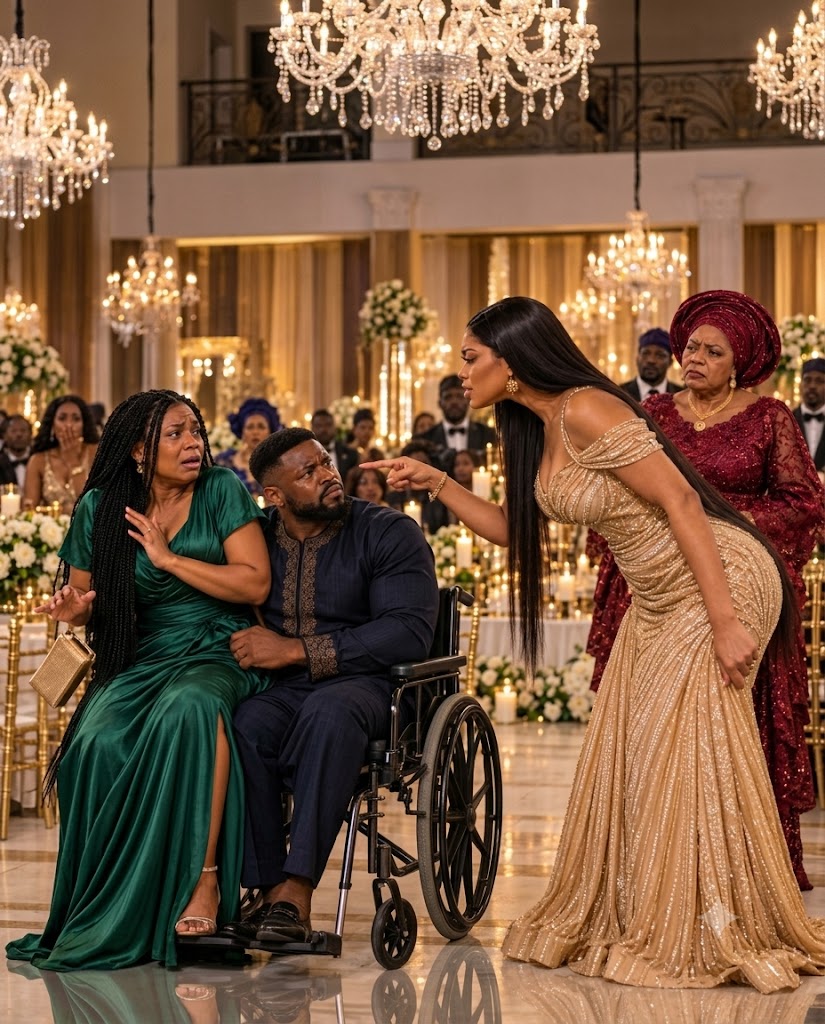
Then Sandra turned to her and said, loud enough for the front row to hear, “I hope you’re not bringing your friend to the reception. The venue has stairs.”
—
The reception was held in a hall with chandeliers and white tablecloths and a live band that played songs everyone knew but nobody remembered. Grace sat at the head table between her mother and an elderly aunt who kept asking when she was going to get married.
“I’m not in a rush,” Grace said.
“Nobody’s ever in a rush, dear. Then one day you’re forty and you wonder where the time went.”
Grace excused herself and walked outside. The night air was cold, and her phone was buzzing in her hand.
**Daniel: How’s the wedding?**
**Grace: Loud. Long. Exactly what you’d expect.**
**Daniel: Are you okay?**
She stared at the question for a long time. Then she typed back:
**Grace: I will be. Can I see you tomorrow?**
**Daniel: I’ll be there.**
—
They met for breakfast at the same café where they’d had their first real conversation. Daniel was already there when she arrived, sitting at the same table by the window, and when he looked up at her, he didn’t smile the way people did when they were trying to make you feel better. He just looked at her.
“How bad was it?” he asked.
“Bad enough.”
She sat down. The waitress brought coffee without being asked.
“I told my family about you,” Grace said. “Not everything. Just that we’re seeing each other.”
“And?”
“They think you’re a phase. They think I’m doing it to get back at Sandra, or because I’m desperate, or because I — ” She stopped.
“Because what?”
“Because they can’t imagine anyone choosing me for a reason that isn’t pity.”
Daniel set down his cup. “Do you want to know why I reached out to you?”
“Yes.”
“Because you were the only person in college who ever saw me. Not the wheelchair. Not the accident. Not the story. Just me. And I remembered that.” He leaned forward. “I’m not asking you to choose me, Grace. I’m asking you to stop letting them choose for you.”
—
The second fight was worse than the first. It happened two weeks later, at a family dinner that Grace had been dreading for days. Sandra and Michael were there. Their father was there. Their mother had made a roast that nobody touched.
“So,” their mother said, “are you still seeing him?”
“Daniel. Yes.”
“And what exactly do you see in him?”
“Kindness. Patience. A sense of humor you’d appreciate if you gave him a chance.”
“I’m sure he’s lovely, Grace. But you have to think about your future.”
“I am.”
“Are you? Because from where I’m sitting, you’re throwing away your life for a man who can’t — ”
“Can’t what, Mom? Love me? Support me? Build a life with me?”
“Can’t give you a normal life.”
Grace stood up. “Define normal.”
Sandra laughed. “Here we go.”
“Shut up, Sandra.”
The room went quiet. Their mother’s face flushed. Their father looked at his plate.
“You do not speak to your sister like that.”
“Then tell her to stop speaking about my life like it’s a joke.”
“Your life is not a joke. But you’re making a mistake.”
“Then let me make it. It’s mine to make.”
—
She left before dessert. Michael caught her in the driveway.
“Grace.”
She turned. He was standing under the porch light, his tie loosened, his face tired in a way she hadn’t noticed before.
“I’m sorry,” he said.
“For what?”
“For all of it. For not — ” He stopped. “For not choosing you.”
“I didn’t want you to choose me, Michael. I wanted you to be honest with me.”
“I know.”
“Then be honest with Sandra. She deserves that much.”
She got in her car and drove away.
—
Daniel was waiting for her at his apartment. He didn’t ask questions. He just opened the door and let her in and made tea while she sat on his couch and tried not to cry.
“I told them,” she said. “Everything.”
“And?”
“And they still don’t get it. They think I’m being stubborn. They think I’m punishing them.”
“Are you?”
“No.” She looked at him. “I’m choosing you.”
Daniel set down the tea. He wheeled over to the couch and stopped in front of her.
“Grace.”
“What?”
“I need you to understand something.” He took her hand. “I didn’t reach out to you because I was lonely. I didn’t reach out because I needed someone to take care of me. I reached out because I remembered you — the real you — and I wanted to know if she was still there.”
“And?”
“She is.”
—
The engagement happened six months later. There was no ring. There was no proposal. There was just a Tuesday morning when Daniel said, “I want to spend the rest of my life with you,” and Grace said, “I know,” and they both laughed because neither of them had ever needed a performance to make something real.
Her family found out through a text message. Sandra called it a phase. Her mother called it a mistake. Her father said nothing, which was the loudest thing he’d ever said.
They were married in a small ceremony at the courthouse. Rebecca, Daniel’s physical therapist, was there. A few friends from the community center. Nobody from Grace’s family.
It was enough.
—
The first year was harder than either of them expected. Not because of the wheelchair — Daniel had been navigating that long before Grace entered the picture — but because of the silence. The way Grace flinched when someone raised their voice. The way Daniel tensed when somebody offered help without being asked. The way they both had to learn that love wasn’t the same thing as knowing how to be loved.
They fought about small things. The dishes. The thermostat. The way Daniel left his books on the kitchen table and the way Grace folded laundry in front of the television. They fought about big things too. Whether to invite Grace’s family to Thanksgiving. Whether to tell Sandra when Daniel’s business started growing. Whether to answer the phone when their mother called.
They learned.
—
Daniel’s business had been quiet for years. Software consulting was a small world, and he’d built a reputation for being reliable and discreet. But in the third year of their marriage, something shifted. A contract with a healthcare company turned into a partnership. A partnership turned into an acquisition. An acquisition turned into a number in a bank account that neither of them had ever expected.
Grace found out on a Thursday afternoon when Daniel came home early and sat down across from her at the kitchen table.
“We need to talk.”
“What’s wrong?”
“Nothing’s wrong.” He slid a piece of paper across the table. “That’s the contract. I wanted you to see it before I signed.”
Grace looked at the number. Then she looked at him. Then she looked at the number again.
“Daniel.”
“I know.”
“This is — ”
“I know.”
“How long?”
“Six months. I didn’t want to say anything until it was final.”
Grace set down the paper. “We promised we wouldn’t keep things from each other.”
“I know.”
“So why did you?”
He was quiet for a moment. “Because I was afraid you’d think I was trying to buy your family’s approval.”
“I don’t care about their approval.”
“I know. But I also knew they’d find out eventually. And I wanted to be sure you’d married me for me — not for what I could give you.”
Grace reached across the table and took his hand.
“I married you because you saw me,” she said. “The money doesn’t change that.”
—
It changed everything else.
The news spread faster than either of them expected. A local business journal ran a profile. A tech blog picked it up. Within a week, Grace’s phone was ringing with calls from numbers she hadn’t seen in years.
Her mother called first.
“I saw the article. Is it true?”
“Is what true?”
“That Daniel — that your husband — is — ”
“Wealthy. Yes.”
There was a long pause. “Why didn’t you tell us?”
“Because it wasn’t your business.”
“Grace — ”
“No, Mom. You spent years telling me I was making a mistake. You told me I was settling. You told me I was throwing my life away. And now you want to congratulate me because he made money?”
“I’m your mother.”
“You’re a stranger who happens to share my DNA. There’s a difference.”
She hung up.
—
Sandra called next.
“So.”
“So.”
“Your husband is rich.”
“Daniel is successful. There’s a difference.”
“Is there?”
“You tell me. You’re the one who rejected him.”
The silence on the other end was sharp enough to cut.
“I didn’t reject him. I rejected the idea of — ”
“Of being married to someone in a wheelchair. I know. I was there.”
“Grace — ”
“I have to go, Sandra. Give my love to Michael.”
She hung up again.
—
The money didn’t fix anything. It didn’t erase the years of being overlooked, or the fights, or the way their mother had looked at her when she’d said she was marrying Daniel. But it did buy them something else: distance.
They moved to a house on the other side of town, far enough that unexpected visits required planning. They hired someone to help with the yard. They traveled — not everywhere, but enough. Daniel bought a car with hand controls and taught Grace how to drive it. Grace started a small nonprofit that connected volunteers with people who needed help but didn’t know how to ask for it.
They were happy.
—
The reconciliation happened slowly. It started with Grace’s father, who showed up at their door one Saturday morning with a box of donuts and an apology he’d been rehearsing for two years.
“I should have said something,” he said. “Years ago. When your mother — when Sandra — when all of it. I should have said something.”
Grace let him in. They sat in the living room and talked for three hours. Daniel made coffee. Her father didn’t flinch when Daniel wheeled into the kitchen. He just asked him how he was doing.
“Better than I deserve,” Daniel said.
“That makes two of us.”
—
Her mother came next. It was a shorter visit, and a harder one. She sat on the edge of the couch and folded her hands in her lap and said, “I was wrong.”
Grace waited.
“I was wrong about Daniel. I was wrong about you. I was — ” She stopped. “I was scared. I thought if I controlled everything, nothing bad would happen. And I hurt you.”
“You did.”
“I know.”
“I’m not going to pretend it didn’t happen.”
“I know.”
“But I’m willing to try.”
Her mother looked up. “That’s more than I deserve.”
“Probably.”
They didn’t hug. They didn’t cry. But they sat together for an hour, and when her mother left, Grace didn’t feel the same weight she’d been carrying for years.
—
Sandra was last. She showed up at the nonprofit office on a Tuesday afternoon, looking like she’d spent the morning deciding whether to come.
“I need to say something.”
“I’m listening.”
“I was jealous.” Sandra’s voice cracked. “I was jealous of you. Not because of Daniel — because of the way you kept going. You didn’t let them break you. You didn’t let me break you. And I hated you for it.”
Grace leaned back in her chair. “I never wanted to be your enemy.”
“I know.”
“I just wanted to be your sister.”
Sandra’s eyes filled. “I don’t know how to do that.”
“Neither do I. But we can learn.”
—
The house was quiet that night. Daniel was reading in the living room, and Grace was in the kitchen, chopping vegetables for a dinner neither of them was hungry for yet. The carrots were uneven. They always were.
“You know,” Daniel said from the doorway, “I used to think I needed to prove something. To my family. To yours. To everybody who looked at me and saw a chair instead of a person.”
“And now?”
“Now I just want to make you dinner. And maybe beat you at chess.”
Grace laughed. “You’ve never beaten me at chess.”
“Yet.”
She set down the knife and walked over to him. The kitchen light caught the silver in his hair, the lines around his eyes, the smile that had been there since the first day at the café.
“I love you,” she said.
“I know.”
“Say it back.”
“I love you too.” He reached up and took her hand. “Even when you chop carrots like a serial killer.”
—
The photograph sat on the mantle in the living room. It was old — taken at a graduation party years ago, when neither of them had known what was coming. Daniel was standing in it. Grace was standing next to him. They weren’t touching. They weren’t even looking at each other. But they were both smiling.
“I found this when we were moving,” Grace said. “I almost threw it away.”
“Why didn’t you?”
“Because it reminded me that we were both there. Before everything. Before the accident. Before my family. Before any of it.”
Daniel looked at the photograph for a long time.
“We were kids.”
“We were.”
“And now?”
Grace leaned her head against his shoulder.
“Now we’re just people who chose each other.”
—
The doorbell rang at seven o’clock. Grace opened it to find her mother standing on the porch with a casserole dish and an expression that was trying very hard to be casual.
“I made too much,” her mother said. “I thought you might want some.”
Grace took the dish. “You made too much on purpose.”
“Maybe.”
“Mom.”
“Yes?”
“Thank you.”
Her mother nodded. She didn’t ask to come in. She didn’t ask about Daniel’s business. She didn’t ask when they were having children. She just stood there for a moment, looking at her daughter like she was seeing her for the first time.
“You’re happy,” she said.
“I am.”
“Good.” She turned to go. Then she stopped. “Grace.”
“Yeah?”
“I’m proud of you.”
Grace watched her mother walk back to the car. The rain had started again — soft, steady, the kind that didn’t demand attention. She closed the door and carried the casserole into the kitchen.
Daniel was at the table, setting up the chess board.
“Who was it?”
“My mother.”
“What did she want?”
“To bring us dinner. And to say she’s proud of me.”
Daniel looked up. “That’s new.”
“I know.”
She set the casserole on the counter and sat down across from him.
“Are you ready to lose?”
“I’m ready to win.”
“You always say that.”
“And one day I’ll be right.”
She laughed. The rain tapped against the window. The house was warm. And for the first time in years, Grace didn’t feel like she was waiting for something bad to happen.
She felt like she was home.









