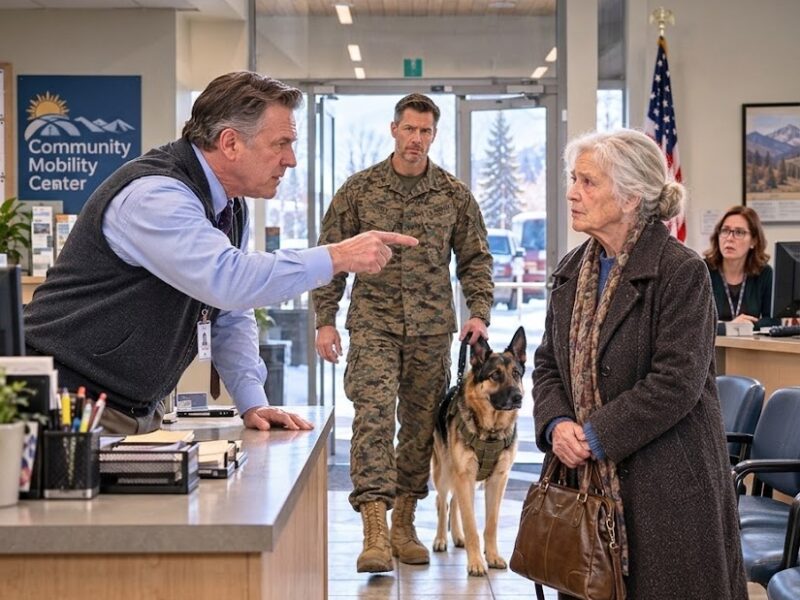
They called an elderly woman a liar for claiming a Marine knew her. Then he walked in with his K9—and the room went silent.
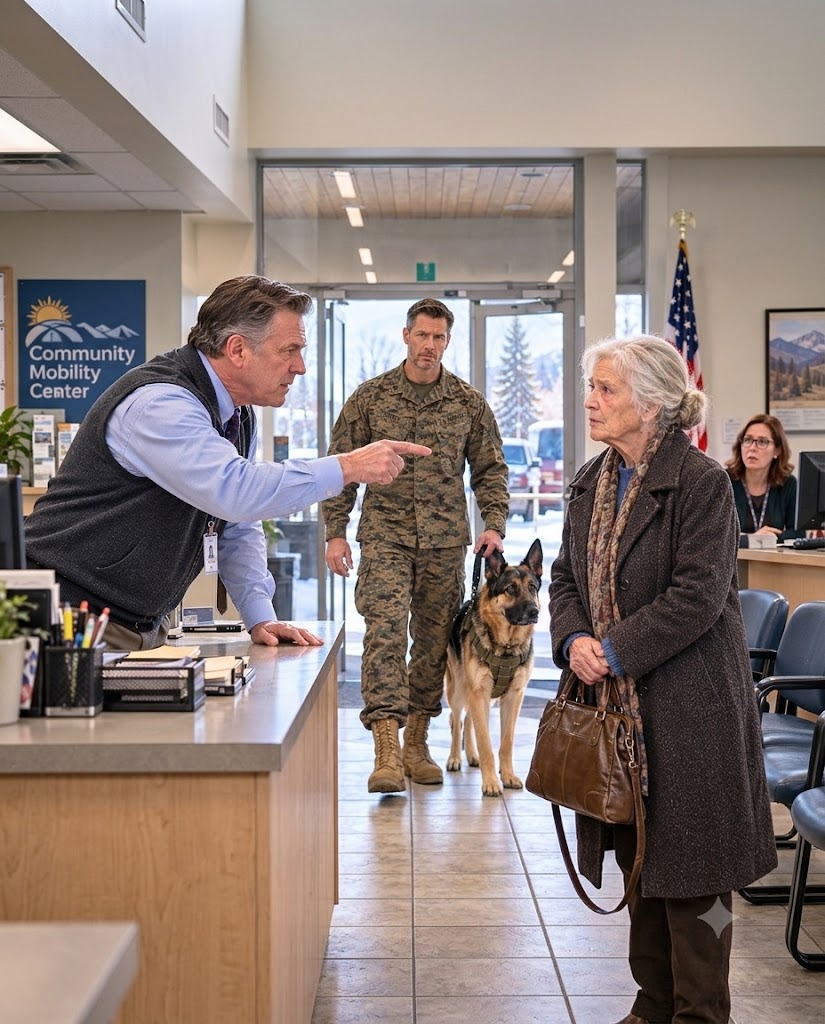
The Montana cold had teeth that morning, the kind that bit through wool and settled in the bones. Lenora Witcom stood at her kitchen window, watching frost creep across the glass in fern-like patterns. At seventy-six, she had learned to read winter’s mood the way other people read faces. This one was mean.
The thermometer outside her back door read eleven degrees, and the sky held that flat, gunmetal gray that promised more snow before noon. She wrapped her fingers around a mug of black coffee, the warmth seeping into knuckles that ached more each year, and tried not to think about the phone call she had made three days ago.
The one that had been met with polite dismissal. The one that had left her feeling like a ghost in her own community. Her late husband, Harold, used to say that getting old in America was like becoming invisible in slow motion. She had never understood what he meant until now.
The community shuttle that served their small development nine miles outside Missoula had been her lifeline for six years. It carried her to doctor appointments, to the grocery store, to the library where she volunteered on Tuesday afternoons. It carried Walter Sloan to his clinic visits and Mrs. Hendricks to her church group and eight other seniors whose names Lenora knew by heart.
The route was scheduled to be suspended the following Monday because, according to the county’s records, ridership was too low to justify winter operating costs. Eleven registered residents. Eleven people whose lives did not fit neatly into average daily ridership columns. Lenora had called the community mobility center twice, written a letter once, and visited in person twice. Nothing had changed. So she had done something she never imagined she would do. She had invoked a promise eleven years old, given by a Marine who probably didn’t even remember her.
The first time she mentioned his name, the woman behind the glass partition had looked at her like she was confused. The second time, a supervisor named Gordon Treadwell had informed her, with the patient condescension of a man who believed he was being kind, that knowing a Marine did not change funding criteria.
The third time, Lenora had quietly said five words that she had never used before. The porch light went out. Gordon had stared at her. The young coordinator, Mallerie Finch, had stared too. Neither understood. Lenora had buttoned her coat and walked out into the cold, her dignity intact but her heart heavy. She had done what she could. The rest was out of her hands.
Thirty-six miles away, wind drove loose snow across a military training lane in pale ribbons. Gunnery Sergeant Silas Pembroke stood beside a parked utility vehicle, his breath clouding the frigid air.
At his left side waited Vesper, a seven-year-old German Shepherd with a black saddle over rich tan fur and amber eyes that missed nothing. The dog’s ears swiveled forward as a young corporal approached, a folded message in his hand. The Marine’s expression was careful, uncertain, as if he suspected the words he carried mattered more than he understood. Gunny, admin got a civilian message for you, he said.
From Lenora Witcom. Silas stopped moving. Vesper lifted his head, ears angling at the familiar name. The corporal checked the paper once more, then read the message aloud. She asked them to tell you. The porch light went out. For several seconds, the only sound was wind scraping snow over frozen ground. Silas’s right hand, which had been resting on the vehicle door, slowly dropped to his side. Eleven years.
He had given Lenora those words eleven years ago. She had never used them. Not when her husband died. Not when a storm damaged her roof. Never. He looked down at Vesper, then reached into the truck for the leash. We’re going.
The drive west toward Missoula was a study in silence. Vesper sat steady in the rear of the truck, shifting his balance naturally through turns, occasionally lifting his nose toward the front when Silas’s breathing changed. The words had opened a door Silas had kept closed for years, not because the memory was shameful, but because some kindnesses became smaller when explained too often.
Eleven years earlier, he had been thirty and several ranks below gunnery sergeant, temporarily assigned to a joint service training program where Lenora worked overnight communications. The call had come shortly after midnight. A Marine named Staff Sergeant Jonah Mercer had died back home, months after returning from an overseas deployment. Jonah had been Silas’s team leader and later his closest friend.
The kind of man who remembered birthdays while pretending he had forgotten them. Silas had finished the call, answered the necessary questions, and walked outside. He had not punched a wall. He had not drunk. He had simply sat on the concrete steps behind the communications building because returning to his quarters meant entering a room where nobody yet knew his world had changed.
Inside, Lenora had noticed him through a narrow window. She had spent enough years around military personnel to recognize the difference between a Marine who wanted company and one who merely needed not to be completely alone. She had not carried him coffee. She had not asked who had died.
She had reached beside the back door and switched on the porch light, warm yellow spilling over the steps. For nearly two hours, that was all they gave each other. Near the end of her shift, she had stepped outside and said five words that Silas had never forgotten. As long as that light’s on, somebody knows you’re still out here.
Years passed. Assignments changed. Lenora retired. Silas eventually lost her number, then found her again when another training assignment brought him back through Montana. Their friendship resumed without ceremony, as if the missing years had merely been a long shift change.
It was during a later visit that he had found her clearing ice from her porch alone and said, Tell me the porch light went out, and I’ll come if I can. She had raised an eyebrow. That isn’t much of a promise. He had smiled. It isn’t supposed to be. I can’t promise I’ll fix it. I can promise you won’t stand there alone.
By the time Silas reached Missoula, Mallerie Finch had asked Lenora to return to the community mobility center. Gordon was there as well, though his expression made clear he still did not understand why a transportation dispute had suddenly drawn a gunnery sergeant away from military training.
Silas parked and brought Vesper down from the truck under control. Together they crossed the snowy lot. Through the glass entrance, Lenora sat in one of the waiting chairs with her gloves folded in her lap. Vesper saw her first. The German Shepherd stopped, ears forward, then looked up at Silas. Silas followed his gaze. For the first time since receiving the message, something in his face softened. Go ahead.
The leash loosened. Vesper walked through the doorway at a quick but controlled pace. Lenora saw him coming and did not reach for him. She waited. Vesper stopped between her knees and lowered his head into her open hand. Only then did Lenora touch him, fingers moving gently behind one ear. Hello, Vesper. His tail swept once against the floor. Gordon watched from several feet away, whatever suspicion he had carried about Lenora invoking a Marine’s name becoming harder to maintain in the quiet certainty of that greeting.
Silas entered behind the dog. Lenora looked up. Neither spoke. Then Silas said, You should have called before the light went out. Lenora’s mouth tightened at one corner. I thought I could manage. I know. Mallerie stood nearby, watching something pass between them that needed no explanation.
Silas pulled a chair across from Lenora and sat. Vesper settled beside his left leg. What happened? Lenora told him about Route 6, about the suspension, about Walter sitting beside the frozen road, about eleven residents whose lives did not fit into average daily ridership. She told him about three visits, the calls, the written appeal, and the difference between having transportation occasionally and being able to depend on it.
Silas listened without interrupting. When she finished, he glanced toward Gordon, then back to Lenora. What do you want me to do? She shook her head. Not what you’re thinking. I haven’t told you what I’m thinking. You have that face. For the first time, Silas almost smiled. Lenora leaned forward.
I don’t need you to order anybody around. I don’t need favors, and I don’t need them changing their answer because of what’s on your collar. Then why am I here? Lenora looked toward Gordon, then Mallerie, before returning her eyes to Silas. Because I need eleven people to be more than eleven names on a report. Her voice remained quiet. Make them listen long enough for eleven people to finish speaking.
Morning came gray and windless over Missoula, the kind of winter cold that settled into metal railings and frozen seams without needing snow to announce itself. Silas arrived at the community mobility center shortly after nine, directly from the training site. He wore his winter digital camouflage blouse and matching trousers, tan combat boots, sleeves down against the cold.
Vesper moved beside his left leg on a working leash, attentive without pulling, ignoring the curious looks that followed them through the lobby. Lenora was already seated at the conference table with Mallerie. Gordon stood near a wall monitor, arranging the Route 6 records.
Two administrators who had not attended Lenora’s earlier visits were suddenly present. Silas noticed that before anyone introduced them. One was Elaine Pritchard, the center’s operation supervisor, a tall, narrow-faced woman with auburn hair cut bluntly at the jaw and thin rectangular glasses.
Beside her sat Thomas Reed, a county transportation liaison with a heavy build and patient brown eyes. Elaine greeted Silas before she greeted Lenora. Gunnery Sergeant Pembroke, we appreciate you coming. Mr. Treadwell tells us you’re concerned about Mrs. Witcom’s case. Silas did not sit. Her case is the Route 6 suspension. Eleven residents use that route. Elaine adjusted her glasses. Of course. What I mean is, given your involvement, we’re prepared to take another look at Mrs. Witcom’s concerns.
Silas glanced at Lenora. He understood immediately. For weeks, she had been a resident with a complaint. Now that a gunnery sergeant stood in the room, the same complaint had become a concern worth assembling supervisors around. No, Silas said. Elaine paused. Silas kept his voice even.
Don’t fix this because of my uniform. Nobody moved. He looked toward the records on the wall monitor. She gave you the same facts before I walked through that door. Lenora’s eyes stayed on him for a moment, then lowered to the papers in front of her. She had not asked him to fight for her.
He had remembered. Gordon cleared his throat. Then let’s start with the facts. This time, Lenora did not tell them about herself. She spoke about the eleven residents, people who could still cook, manage bills, shovel light snow, attend church, care for themselves, and live with dignity, but who no longer all had cars or bodies capable of walking nearly two miles over winter roads. She explained that Route 6 had never been crowded because it did not serve a crowded neighborhood. Its value was reliability, not volume.
Mallerie followed with the service records. She showed the canceled runs, driver shortages, weather interruptions, and occasions when the shuttle had been reassigned. Thomas leaned closer as she demonstrated how only completed trips had entered the primary ridership report.
So the numbers are accurate, he said, but the denominator isn’t telling us how often service was actually available. Exactly, Mallerie replied. Gordon then did something Lenora had not expected. He defended the original decision. Not stubbornly, honestly. Even with corrected reporting, we still have operating constraints. The full-size shuttle costs too much for the volume. The accessible van is committed to medical transportation.
Driver hours are allocated. Insurance coverage and authorization depend on service type. I can’t move a vehicle from one program to another because a calendar shows two empty hours. Silas listened. He could plan training movements, manage Marines, assess terrain, and make decisions under pressure. None of that made him an expert in county transportation finance. And he had no intention of pretending otherwise. So he asked the simplest question in the room. Has anyone here actually walked the route you’re asking them to walk? Silence. Mallerie looked at Gordon. Gordon looked at Thomas. Nobody answered.
Less than an hour later, Gordon was standing beside the road outside Lenora’s community with his coat zipped to his chin. The visit stripped the issue of abstraction almost immediately. Mallerie showed him where Walter had stopped. Lenora pointed toward the replacement transit connection, invisible beyond the rise.
Gordon walked part of the shoulder himself. There was no continuous sidewalk. Snowplows had pushed frozen ridges toward the edge, narrowing the space available to pedestrians. A shallow drainage ditch forced anyone on foot closer to traffic in places. The hill looked insignificant from a map but felt different under boots when a thin glaze of ice covered its shaded side. Vesper moved steadily beside Silas, finding traction without hesitation.
Silas watched Gordon rather than the dog. Halfway up the incline, Gordon stopped and looked back. Lenora was thirty yards behind him. She had not complained. That made it worse. He imagined Walter there with a cane. Then he imagined the same road at seven in the morning before daylight fully settled, with wind pushing snow across it.
For fourteen years, Gordon had believed one of the dangers of public work was allowing the loudest story to overpower the fairest numbers. Standing on that road, he confronted the opposite possibility. That numbers could become unfair when nobody bothered to ask what they had failed to capture. They weren’t wrong, he said quietly. Mallerie stood beside him. The numbers? Gordon nodded. They just weren’t enough.
They returned to the center shortly before noon. Gordon removed his gloves and spread the Route 6 cost sheet across the conference table. I was wrong about the impact, he said. Lenora studied him. But he met her eyes. But being wrong doesn’t magically give me the money to restore the route. There it was. The obstacle nobody could defeat with a speech. The full shuttle remained too expensive. The accessible van had restrictions. Drivers could not be created from goodwill. Insurance requirements did not disappear because Walter’s walk was dangerous. Silas’s phone vibrated. He read the message once. The afternoon cold weather exercise had been moved forward, and his team was required back at the training site. A planning cycle beginning the next morning meant he would also miss the county review meeting where Route 6 would be reconsidered. Lenora saw his expression. You have to go. It was not a question. Silas nodded. I can ask for— No. She stopped him before he finished. You said you’d stand with me. You did. Meetings tomorrow. I know. Vesper looked between them. Silas seemed unwilling to leave the sentence there. Lenora reached down, waited for his small nod, then rested her fingers briefly against Vesper’s neck. You have Marines waiting on you. Silas looked toward Gordon. Gordon did not promise an outcome, but he said, We’ll put the corrected data in front of the review board. It was more than he would have said two days earlier. Silas turned back to Lenora. You sure? No, she said. That answer caught him. Then Lenora straightened her coat. But I wasn’t sure when I came through that door the first time either. Silas gave one slow nod. Minutes later, Lenora watched through the lobby window as he crossed the parking lot with Vesper beside him. The Marine opened the truck, secured the canine, climbed in, and drove back toward the training site. Tomorrow, Lenora would return to the same kind of room where she had once stood unheard. Only this time, there would be no gunnery sergeant beside her, and she would find out whether anyone had actually learned to listen.
The next morning brought weak sunlight over Missoula, turning the ice along the roads briefly bright without making it any less dangerous. At the community mobility center, one chair at the conference table remained deliberately empty. Mallerie had been there since seven-thirty. The answer had come to her not as a way to save Route 6, but as permission to stop trying to save it in its old form. Restoring the full-size shuttle on its previous schedule would recreate the same cost problem Gordon had been warning about from the beginning. But the accessible van already traveled into the surrounding area for scheduled medical transportation. Its calendar showed recurring midday windows between morning drop-offs and afternoon pickups. Mallerie mapped those openings against the times Route 6 residents had historically traveled. Gordon spent the previous afternoon doing what he did best, finding reasons a plan could fail before allowing anyone to depend on it. He checked the van’s insurance classification, operating authorization, driver hour limits, and the transportation funding attached to eligible community access trips. Then he reviewed the center’s existing volunteer driver coverage, normally used to fill limited service gaps. By evening, they had something neither called a solution. They called it a pilot.
Two flex service periods each week for the remainder of winter. Residents would schedule pickups within designated windows. The accessible van would operate between its existing medical obligations, while approved volunteer driver coverage would provide backup when scheduling conflicts occurred. The program would collect not merely completed rides, but requests, cancellations, unavailable service attempts, and reasons trips could not be fulfilled. For once, eleven people would leave more than eleven names in a column. The review meeting began at nine. Silas was not there. Neither was Vesper. Lenora noticed the empty chair, but she did not wish either of them into it. Yesterday, Silas had kept his promise. Today belonged to everyone who would remain after his training assignment ended. Gordon presented first. He did not hide the original numbers or pretend the suspension had been irrational. He explained why the old Route 6 model was financially difficult to justify. Then he showed the cancellation history Mallerie had uncovered and acknowledged that completed ridership figures had been evaluated without enough context about service availability. We measured who rode, Gordon said, but not consistently who tried to ride when we weren’t there.
Mallerie presented the pilot. She explained the accessible van’s unused windows, the existing funding category, volunteer coverage, and the additional data they would collect. Elaine asked about insurance. Gordon answered. Thomas asked whether medical transportation would remain protected. First priority, Gordon said. The pilot uses only confirmed open windows. Then Lenora spoke. She did not mention Silas. She did not mention the porch light. She talked about Walter. Not dramatically. She simply described an eighty-two-year-old man sitting beside a frozen road because missing another routine appointment seemed worse to him than attempting a walk his body could no longer safely make. Then she talked about the others. Eleven people did not need eleven rides every morning. Some might use the service twice a month, some once a week, some only when winter made every other option impossible. We aren’t asking you to pretend eleven people are a hundred, Lenora said. We’re asking you not to pretend eleven are nobody. The room became very still. The Winter Flex Service pilot was approved for the remainder of the season, subject to operational review and re-evaluation using the expanded data at winter’s end. There was no applause. Lenora preferred it that way.
Outside the meeting room, Gordon caught up with her near the lobby. I kept asking you for better numbers. Lenora buttoned her coat. I kept asking you to come look. Gordon lowered his eyes for a moment. You were right about some things. That surprised him. Lenora continued. You were right that knowing the problem doesn’t pay for a shuttle. A faint, tired smile crossed Gordon’s face. And you were right that a spreadsheet isn’t the same thing as a road. He looked through the glass doors toward the winter morning. You shouldn’t have needed to know a Marine for me to listen. Lenora studied him. No, she said. I shouldn’t have. Then she offered her hand. Gordon took it.
Four days later, a small accessible van moved carefully along the road outside Lenora’s community. Silas saw it from her porch. His training schedule had given him several free hours before an evening briefing, and he had driven out with Vesper. The German Shepherd now lay near the porch steps, front paws extended, amber eyes lazily tracking movement along the road. The van slowed at the intersection. Silas watched it pass. You did it. Lenora, standing in the open doorway, shook her head. We did. Silas looked at her. I didn’t do much. Exactly. He laughed once. Then Lenora flicked the porch switch. Nothing happened. Both of them looked up. The bulb above the door remained dark. Silas slowly turned his head toward her. Lenora stared at the dead bulb, then at him. Don’t. I didn’t say anything. Your face did.
Ten minutes later, Lenora stood on the second step of a short household ladder with a replacement bulb in one hand. Silas stood directly below, both hands gripping the ladder rails firmly to keep it steady. Vesper remained stretched across the porch boards several feet away, head resting between his paws. I can hold a ladder, Lenora said. I know. Then why are you holding it? Because I’m here. That silenced her. Lenora removed the burned-out bulb and screwed in the new one. Her fingers were slower than they had once been, but they were steady. Try it. Silas kept both hands on the ladder while Lenora climbed down. Only after both her boots were firmly on the porch did he release it. She reached through the doorway and flipped the switch. Warm yellow light spread across the porch in the middle of the winter afternoon. For a moment, neither of them spoke. Eleven years earlier, another light had burned above another doorway while a thirty-year-old Marine sat outside, believing grief had separated him from the rest of the world. Now, Silas stood beneath this one, while an elderly woman who had refused to disappear into a spreadsheet looked up at the glow. See, Lenora said. Not out yet. Silas smiled. Good. Keep it that way. Vesper lifted his head. At the far end of the road, the accessible van slowed again. Walter stood near his driveway with his cane, waiting. This time he did not begin walking toward it. The van came to him.
Sometimes the miracles that matter most do not arrive as thunder from heaven or as an answer that changes everything overnight. Sometimes the miracle is a light left burning when someone feels forgotten. Sometimes it is a faithful friend who cannot solve the problem but refuses to let us face it alone. And sometimes change begins simply by opening one heart to listen, another to understand, and another to finally act. In our daily lives, we pass people whose struggles may never appear in reports, numbers, or statistics. An elderly neighbor, a lonely veteran, a tired parent, or someone quietly carrying a burden may not need us to rescue them. They may simply need to know that somebody sees them and that their voice still matters. The porch light on Lenora Witcom’s house stayed on that night, and the night after, and the night after that. It burned through January and February and into March, a small yellow beacon against the Montana dark. Silas called every Sunday. Vesper learned the sound of her voice through the phone and would lift his head whenever he heard it. The Winter Flex Service pilot collected data that winter that no spreadsheet had ever captured before. It recorded 247 requests, 203 completed rides, and 44 reasons why trips could not be fulfilled. It recorded the name of every person who called and the reason they called and what happened when they did. When the review board met in April, they voted to extend the pilot through the following winter. Gordon Treadwell cast the deciding vote. He did not mention the porch light. He did not have to.
Lenora Witcom lived in her small house outside Missoula for six more years. She never used the words again. She never had to. But every evening, without fail, she switched on her porch light and let it burn until morning. The neighbors noticed. Some of them asked why she wasted electricity. She would smile and say something about keeping the dark at bay. Only one person ever understood. He was a Marine, and he had a German Shepherd, and he came when the light went out. That was the promise. That was always the promise. Not that he could fix everything. Not that he could change the world. Just that she would not stand alone. And in the end, that was enough. That was everything.
The story spread through Missoula the way stories do, quietly at first, then all at once. A reporter from the local paper heard about the elderly woman who had invoked a Marine’s name to save a shuttle route and decided to write a feature. She interviewed Lenora, who was reluctant, and Gordon, who was honest, and Mallerie, who was proud. She tried to interview Silas, but he declined, saying only that he had done what any Marine would do. The story ran on a Sunday, and by Monday, the community mobility center had received three offers of volunteer drivers and a donation from a local church to cover the pilot’s remaining costs. The headline read: The Porch Light Promise. Lenora framed it and hung it in her hallway. She never told Silas. She didn’t have to. He saw it the next time he visited.
Vesper lived to be twelve years old. He retired from active duty at nine and spent his final years in the quiet comfort of Silas’s home, sleeping on a bed by the fireplace and greeting Lenora with a slow wag of his tail whenever she visited. When he died, Silas drove to her house and sat on her porch for a long time without speaking. Lenora did not ask what had happened. She simply switched on the porch light and sat beside him. They stayed there until the stars came out. The next morning, Silas found a small wooden box on his doorstep. Inside was a photograph of Vesper lying on Lenora’s porch, his head resting between his paws, the yellow light spilling over his fur. On the back, in Lenora’s careful handwriting, were five words. Somebody knows you’re still out here. Silas kept the photograph on his mantle for the rest of his life. And every night, wherever he was, he thought of a porch light burning in Montana and an elderly woman who had refused to be invisible. That was the promise. That was always the promise. Not that the light would never go out. But that someone would always be there to turn it back on.









