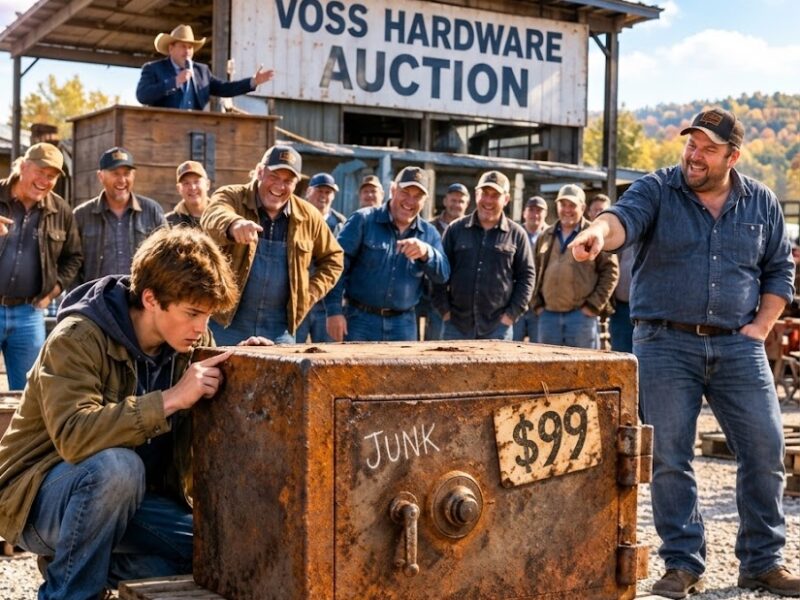
The whole auction laughed when a 15-year-old spent his last $40 on a rusted safe nobody else wanted — then he cut it open, and the laughter died instantly.
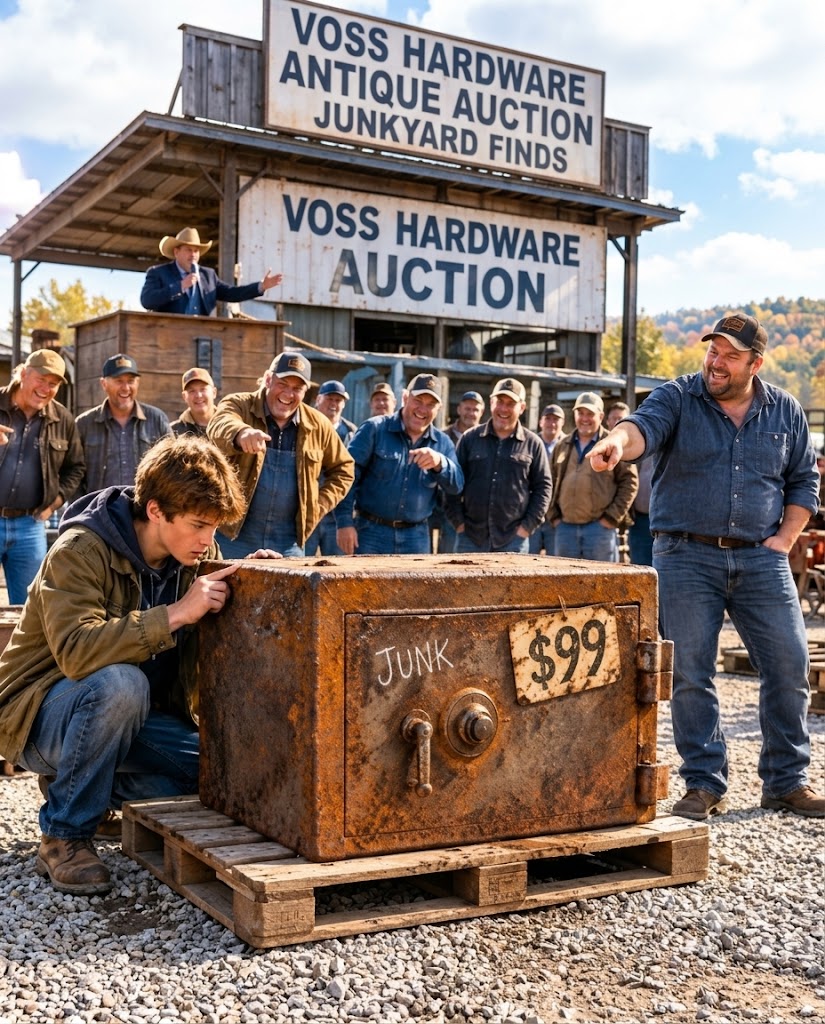
Somewhere in a Pennsylvania valley, seven signatures sat sealed inside a wall of steel for fifty years, waiting for someone to notice they still mattered.
Everyone who saw the safe at auction called it scrap.
Nobody in that gravel lot could have guessed that inside it was a promise their grandparents made, one that could still decide who owned the ground beneath their own homes.
Thirteen-year-old Milo Hail wasn’t looking for a mystery that Saturday morning.
He was looking for something he could afford.
But when he crouched beside a rusted floor safe nobody else wanted, he noticed a weld that didn’t belong there.
A second layer of steel added years after the first, sealing something in that somebody clearly never wanted found.
Months later, in a crowded county hearing room, that same boy would watch grown men argue over a piece of paper he’d pulled out of that safe with his own hands.
A paper that could split a fortune seven ways or hand it all to one man who never expected an $800 piece of junk to stand in his way.
But that Saturday, all Milo knew was the price, $99, and a room full of laughter.
What he didn’t know yet was how close that promise had come to disappearing forever.
The auction started before the frost had burned off the gravel lot.
By nine o’clock, half the county seemed to have found a reason to stand around Voss Hardware’s old loading dock.
The store had closed in March after forty years.
Now everything inside it—shelving, tools, a rusted popcorn machine nobody remembered buying—sat in numbered rows, waiting for someone to want it.
Milo Hail stood near the back with his hands jammed in his sweatshirt pocket.
Not because he was cold, but because it kept him from touching things he couldn’t afford.
He’d come with $99 folded into his jeans, money he’d earned mowing lawns and fixing a neighbor’s bicycle chain all summer.
He had no plan for spending it.
He was just looking.
That was when he saw the safe.
It sat crooked on a wooden pallet near the end of the row, a squat black commercial floor safe scabbed over with rust.
One corner was scorched dark where someone had once taken a torch to it.
A hand-lettered sign leaned against the base: “Scrap. Make offer.”
Nobody was looking at it.
Nobody had bid on it twice.
Milo crouched down anyway.
He’d spent enough afternoons in his grandfather’s shop to know what a clean weld looked like, and what he was staring at wasn’t clean.
The torch scar stopped abruptly, four inches short of the seam, like whoever started cutting had simply changed their mind.
Around that stopping point ran a second bead of weld—newer, rougher, laid down by someone else entirely.
That didn’t make sense.
Nobody reinforced something they’d already decided was worthless.
“You going to marry it, or you going to bid?”
Milo looked up.
The auctioneer had rolled the safe forward with a hand truck, chuckling along with a dozen other men gathered near the dock steps.
Near the front stood a trim man in a pressed shirt Milo didn’t recognize.
Clean boots, calm face, watching the safe the way a man watches something he’s already decided he wants.
“Five dollars to start,” the auctioneer called. “Somebody take this thing home.”
Nobody moved.
Milo raised his hand.
Laughter rippled through the crowd immediately.
Someone said something about a chicken feeder.
The price crawled up anyway—ten, twenty, thirty.
Milo’s hand went up each time the auctioneer looked for a second bidder and found none but the boy.
At forty dollars, the man in the pressed shirt finally spoke, mild and amused.
“Careful, son. Russ doesn’t refund.”
Milo bid ninety-nine.
The gavel came down to more laughter than the auction had heard all morning.
And Milo Hail walked away ninety-nine dollars poorer in cash, owning eight hundred pounds of steel that everyone in that gravel lot had already decided was garbage.
He didn’t mind.
He kept thinking about the weld.
Walter Hail was waiting in the driveway when the truck pulled in, arms crossed, watching his grandson and the neighbor help haul the thing back on a borrowed trailer.
He didn’t say anything until the ramp came down and the safe sat there in the gravel, ugly and enormous, taking up more space than Milo had accounted for.
“Ninety-nine dollars,” Walter said finally. “Not a question. I know how much it cost.”
“That was supposed to go toward your bike tire. Maybe boots.”
Walter rubbed a hand down his face.
“Milo, that’s scrap. Real money gone for something the hardware store couldn’t even sell for parts.”
Milo didn’t argue.
He’d learned a long time ago that arguing with his grandfather rarely worked as well as just being right later.
But it stung anyway, because the money mattered more this year than most.
The Hail place was sixty acres of hay and a few dozen head of cattle.
Between a bad spring and the tractor’s transmission going out in June, his mother Sarah had been picking up double shifts at the clinic in town just to keep the lights predictable.
Walter didn’t say it outright, but Milo knew the number in his grandfather’s head whenever a bill came in the mail.
Knew it because Walter had started leaving the porch light off earlier in the evenings, like darkness was free and everything else wasn’t.
So an afternoon spent hauling home eight hundred pounds of rust didn’t look, from where Walter stood, like anything but a boy wasting what little they had.
It didn’t help that Grant Voss had been coming around all summer.
Milo had seen his truck in half the driveways on their road—the Puits’, the Doyles’, the old Hensley place—always the same pitch delivered the same easy way.
His company wanted to lease mineral rights under the farms for a new round of drilling.
Good money upfront.
No drilling equipment on anyone’s actual land.
Just a signature and a check.
Denny Puit had signed already.
So had two others Milo knew of.
Walter had turned Voss away twice, mostly out of habit.
The Hail land had been leased once before, decades back, and nothing had ever come of it but a dry hole and a scar in the north pasture where the old rig sat.
“Man’s probably going door to door again this week,” Walter muttered, half to himself, looking at the safe like it was somehow related.
“Everybody’s signing something they don’t fully understand. And you’re out there buying junk safes.”
“It’s not junk.”
“It’s got a hole torched in the side of it.”
“Milo, that’s the thing.”
Milo crouched by the scarred corner again, tracing the newer weld with one finger.
“Somebody already tried to get in. And then somebody else came along afterward and made real sure nobody ever would.”
Walter didn’t answer right away.
He looked at the weld line for a long moment, the irritation on his face softening into something more careful.
Not agreement. Not yet.
But the particular quiet of a man who spent his whole life reading machinery and had just noticed something he couldn’t immediately explain.
“That true,” he said slowly, “or is that just something a boy says when he doesn’t want to admit he wasted his money?”
“Come look at it yourself.”
Walter didn’t move for a second.
Then he sighed, the kind that meant he already knew he was going to end up in the barn with a flashlight whether he wanted to or not, and followed his grandson toward the safe.
Walter didn’t touch the safe right away.
He circled it twice with his hands on his hips, the way he circled a tractor engine before deciding where to start, then crouched at the scorch corner and studied it in silence long enough that Milo started to wonder if he’d change his mind about the whole thing.
“Get the flashlight,” Walter said. “The good one, off the workbench. And bring the wire brush.”
They worked under the bare bulb hanging from the barn rafters, Walter scraping away decades of rust with slow, patient strokes while Milo held the light steady.
Beneath the grime, the truth of the weld became clearer.
The original torch cut had eaten a clean four-inch groove into the outer steel before stopping.
Not because the person cutting had run out of fuel or nerve, but because the cut simply ended deliberately mid-motion.
“That’s not somebody giving up,” Walter said, half to himself. “That’s somebody getting interrupted. Or stopping on purpose.”
Around that stopped cut ran the second weld bead Milo had noticed at the auction.
Narrower, rougher, laid down with far less skill than whatever built the safe originally.
Walter ran a thumbnail along it and frowned.
“Factory welds on a safe like this are wide and even. Done by machine,” he said. “This one’s hand-laid. Somebody did this after the fact. Somebody who wasn’t a professional, but who wanted this closed bad enough to do it themselves.”
“So there’s two different things that happened to it,” Milo said slowly, working it out loud.
“Somebody tried to break in first. And then after that, somebody else made sure it could never happen again.”
Walter didn’t answer for a moment.
He was staring at the discoloration in the metal around the old cut, a faint bloom of blue-gray radiating out from the scorch mark.
“Heat does that,” he said finally. “Steel changes color depending on how hot it got and how fast it cooled. That pattern there, that’s old. Older than the safe. Probably sat in that store’s back room, I’d guess. Which means somebody tried to cut into this a long time ago. Not recently.”
“Looks that way.”
Walter sat back on his heels.
And for the first time since the auction, the irritation was gone from his face entirely, replaced by the focused stillness Milo recognized from watching him diagnose a stubborn engine.
“And whatever’s behind that second weld, somebody thought it was worth protecting twice.”
Neither of them said the word treasure.
It felt too easy, too much like something out of a movie.
And Milo had learned enough from his grandfather to distrust easy explanations.
But the shape of the question sat between them anyway, unspoken.
If it wasn’t worth anything, why had two separate people, years apart by the look of it, cared so much about what was on the other side of that door?
Walter stood up slowly, joints cracking, and set the wire brush down on the bench with a decisiveness that told Milo something had shifted.
“We’re not grinding into this tonight,” he said. “Not blind. If there’s paper in there—records, photographs, whatever it might be—heat can ruin it faster than rust ever will. We do this careful, or we don’t do it at all.”
“So we’re doing it.”
Walter gave him a look that wasn’t quite a smile, but was close enough.
“Didn’t say that. Said if we do it, we do it right.”
He nodded toward the house, where the porch light Sarah always complained was too dim had just flickered on.
“Go get your mother. If we’re about to spend three evenings out here cutting steel, she’s going to want to know what her father-in-law let you talk him into.”
Sarah Hail took the news about the safe the way she took most surprises that summer—with a tired exhale and a question about money.
But when Walter explained the weld, the two separate events, the careful way he wanted to approach the cutting, she didn’t argue either.
She just made Milo promise to wear the safety glasses she kept in the kitchen junk drawer for exactly this kind of situation, and went back to folding laundry with the particular quiet of a woman doing math in her head.
It was two days before they touched the grinder, because Walter insisted on doing it right.
And in those two days, Grant Voss found his way to the Hail driveway.
Milo was stacking hay when the truck pulled in—clean, newer, the kind of vehicle that looked out of place next to the dented pickups that usually came up the drive.
Voss got out unhurried, portfolio folder tucked under one arm, and offered a handshake Milo didn’t take because his hands were full.
“Saw you at the Voss Hardware sale,” he said, like they were old acquaintances. “No relation to the hardware store,” he added with a small laugh. “Just a coincidence of names. Walked away with quite the conversation piece.”
“It’s not a conversation piece.”
“No.”
Voss glanced toward the barn, where the safe’s shape was just visible through the open doors.
“Funny thing about old commercial safes. People assume they’re worth something because they’re heavy and locked. Mostly they’re just heavy.”
Walter came around the side of the barn before Milo had to answer, wiping grease from his hands with the rag from his back pocket, his expression carefully neutral in the way Milo recognized as his grandfather deciding to be polite before deciding anything else.
“Mr. Voss. Didn’t expect you back so soon.”
“Just in the area.” Voss smiled easily. “Wanted to see if you’d reconsidered the lease. Same terms as before. Good money. No equipment on your land. Minimal disruption. Denny Puit’s already signed. So has Ruth Doyle.”
“I heard.”
“Most families around here have been glad to get it settled.”
Voss’s eyes drifted toward the barn again, lingering just half a second too long on the safe’s dark shape.
“That old thing came out of the hardware store’s back room, didn’t it? I heard it sat in the basement of the original mill building before that. Voss Hardware bought up half the old mill’s inventory when it closed years back.”
“Didn’t know that,” Walter said, though something in his voice suggested he was filing the information away carefully. “Funny what ends up scattered around a county over the years.”
Voss’s tone stayed light, almost bored.
But Milo noticed he hadn’t actually brought up the lease again since mentioning the safe.
“If you ever do get that thing open, and there’s nothing but rust and cobwebs inside, I’d be happy to take it off your hands. Scrapyard pays by the pound, but I’d give you more than that just to save you the trip.”
“We’ll manage,” Walter said.
Voss nodded, unbothered, and handed over a business card.
Walter didn’t look at it.
“No rush on the lease either. Offer doesn’t expire. Not yet, anyway.”
He got back in his truck, gave a small wave through the windshield, and pulled out the way he’d come, not hurrying the whole way down the drive.
Walter stood there a long moment after the truck disappeared past the tree line.
“He wants that safe,” Milo said. “Before we’ve even opened it.”
“Man wants a lot of things,” Walter said slowly. “Question is why an eight-hundred-pound piece of scrap is worth a special trip out here to ask about.”
He turned the business card over once in his hand, reading nothing on it that seemed to satisfy him, then tucked it into his shirt pocket instead of throwing it away.
“Go get the grinder wheels from the shed. I think we’ve waited long enough.”
They started that evening after Sarah had gone back inside and the barn had cooled from the day’s heat into something closer to comfortable.
Walter laid out the cutting line himself, well clear of the original factory seams, following instead the rougher hand-laid weld that marked where someone had sealed the chamber a second time.
He made Milo put on the safety glasses and gloves before he’d let him near the grinder at all.
“Angle matters,” Walter said, guiding Milo’s hands on the tool before stepping back. “Pressure matters. And we go slow, because if there’s paper behind this wall, too much heat ruins it just as fast as a torch would’ve the first time.”
The grinder screamed against the steel, throwing a fan of orange sparks across the concrete floor, and Milo felt the vibration travel up through his wrists into his shoulders almost immediately.
Walter stood beside him with a rag and a bucket of water, calling for a stop every minute or two so they could press the wet cloth against the heated metal and let it hiss and cool before continuing.
Progress was slow enough that after the first hour, the cut was barely a shallow groove, and Milo’s arms had already started to ache in a way that told him tomorrow would be worse.
It took two more evenings.
The second night ate through three cutting wheels and left Milo’s forearms trembling by the time Walter finally called it enough for the day.
But the groove had deepened into a real channel by then, cutting past the outer wall and into something denser behind it.
A second layer of steel that hadn’t been part of the original construction at all.
“That’s not factory,” Walter said, running his light along the exposed edge. “That’s someone’s addition. Confirms what we figured. Whatever’s back there, somebody built an extra wall around it on purpose.”
On the third evening, the grinder finally broke through.
Milo pulled the tool back and they both leaned in with the flashlight.
And for a moment, neither of them said anything, because the space behind the cut appeared completely empty.
Just dark, hollow air where Milo had half expected—despite himself, despite every lecture from Walter about not getting ahead of the evidence—something. Anything.
“Well,” Walter said slowly. “Maybe the crowd back at that auction knew something we didn’t.”
Milo didn’t answer right away.
He sat back on his heels, turning the disappointment over, but something about it didn’t sit right.
The same instinct that had made him look twice at the weld in the first place refused to let it go.
If somebody had gone to the trouble of sealing an empty chamber, sealing it wouldn’t have mattered.
You didn’t reinforce nothing.
He picked up the small machinist hammer from the workbench and, without really planning to, began tapping along the interior wall of the newly opened cavity, working his way slowly across the steel.
Most of it answered back with a short, sharp ring. Solid metal. Nothing behind it.
But when he reached the lower corner, the sound changed.
Duller. Shorter. Like the impact was landing on something that didn’t want to ring at all.
He tapped it twice more to be sure.
“Walter.”
His grandfather was beside him in an instant, flashlight angled down into the corner Milo was pointing at.
Walter went still, then reached for the chalk on the bench and marked a small square around the spot without a word.
They cut again, smaller this time, taking off no more than an inch or two at a pass, cooling constantly, Walter’s hands steadier than Milo had seen them all week.
When the last piece of steel finally came free, the beam of the flashlight fell across a narrow cavity tucked behind the false wall.
And inside it, wrapped tight in oiled cloth to keep out decades of moisture, sat a small black document box.
Unlike the safe, it opened easily.
Inside the oiled cloth were photographs gone brittle and brown at the edges, a handful of receipts stamped with a decades-old hardware store address, and a thin stack of folded papers that had survived the years far better than anything else in the box.
Beneath them, wrapped separately, sat a heavier document—several pages handwritten, the ink faded to a soft rust brown but still legible under the flashlight.
Walter unfolded it slowly, the way a man handles something he already suspects might matter more than he’s ready for.
It was an agreement dated 1968, drawn up between seven families whose farms bordered one another along the northern end of the valley.
The Hails among them.
Milo read over his grandfather’s shoulder as Walter’s flashlight moved line by line down the page.
The language was plain, almost stubbornly simple—the kind of wording a group of farmers would have insisted on themselves rather than trusting to a lawyer’s phrasing.
If mineral rights beneath any of the seven properties were ever leased or drilled, the resulting royalties would be shared equally among all seven families, regardless of whose specific acreage the gas came from.
At the bottom, seven signatures.
Walter’s flashlight lingered on one of them for a long moment before he spoke.
“That’s my father’s signature,” he said quietly. “Samuel Hail.”
Milo looked at the name, then back at his grandfather’s face, which had gone very still.
“There was a test well,” Walter said, half to himself, like he was working through a memory that hadn’t been touched in fifty years.
“Back in the sixties, whole valley got excited about it. Everybody thought the gas company was going to make them rich. My father was one of the ones who pushed hardest for this agreement, so that whatever came up, everybody shared it fair, instead of whoever’s land the well happened to sit on getting it all and the rest getting nothing.”
“What happened?”
“Well came up dry.”
Walter set the paper down carefully on the workbench, like it had suddenly gotten heavier.
“Nothing down there worth drilling for, or so everybody decided at the time. The whole thing just stopped mattering. I remember thinking my father was foolish for making such a fuss over an agreement that never paid out a dime. Told him so once, when I was about your age. That the whole thing was a waste of paper.”
He exhaled slowly.
“He didn’t argue with me. Just said I might feel different about it someday.”
Milo didn’t say anything.
He’d never heard his grandfather talk about his own father much at all, let alone with the particular quiet weight in his voice.
“Now the well came up dry,” Milo said carefully. “Why would anybody go through the trouble of hiding the agreement afterward? Sealing it up like that?”
Walter didn’t answer right away.
He was staring at the second folded document beneath the agreement—a modern-looking geological survey map, clearly much newer than everything else in the box, showing shading and hatch marks across a stretch of the valley that included, unmistakably, both the old Hail property lines and several of the same farms named in the 1968 agreement.
“That’s not from the sixties,” Milo said, looking closer. “That paper’s new.”
“Knew enough,” Walter said slowly, turning it toward the light.
Company letterhead ran along the top edge, half obscured by a fold.
A name Milo didn’t immediately recognize, but the shale formation marked out beneath the valley was labeled in language he understood well enough, even without the geology.
Reserves. Estimated yield. A drilling target dated within the last two years.
“Somebody’s been back down there,” Milo said slowly. “Recently. And found something the old test well missed.”
Walter looked up from the map, and for the first time all week, Milo saw something in his grandfather’s face that wasn’t skepticism or caution.
It was closer to alarm.
He thought of Grant Voss standing in their driveway, mentioning the mill’s basement, offering to buy the safe unopened, calm and patient the whole time, like a man who already knew exactly what might be sitting inside it.
“He’s been signing people to individual leases,” Walter said quietly. “The Puits. The Doyles. Probably others we don’t know about yet. Every one of them thinking they’re getting their own private deal.”
“But if this agreement’s still good, then none of those leases are worth what anybody thinks they’re worth,” Walter finished. “Because if there’s real gas down there this time, it was never supposed to belong to one family alone.”
He folded the old agreement back along its original creases, careful with the brittle paper, and looked at it for a long moment before speaking again.
“My father knew something might come of this one day. I told him he was wasting his time.”
He shook his head slowly.
“Fifty years, and it turns out he was just early.”
They took the agreement, the geological survey, and the old photographs to the county records office two mornings later.
Walter drove in silence most of the way, with the document box sitting careful and upright on the seat between them.
The clerk who reviewed the papers was patient and thorough, reading each page twice before setting it down.
But when she finally looked up, her expression carried the particular gentleness of someone about to disappoint people who deserve better news.
“This is a real document,” she said. “I don’t doubt that. But a handwritten agreement between private landowners, even signed and dated, isn’t automatically enforceable against current mineral leases unless it was properly filed and recorded at the time, or unless it can be tied to some surviving legal instrument that was.”
She slid the agreement gently back across the counter.
“I’m sorry. I know that’s not what you were hoping to hear.”
Walter didn’t argue.
He just thanked her, tucked the papers back into the box, and didn’t say much on the drive home.
Milo could tell the silence wasn’t defeat, exactly.
It was closer to the quiet of a man recalculating.
That evening, going through the documents again at the kitchen table, Milo noticed what the clerk’s office lighting had missed.
The old agreement’s final page had a second sheet folded behind it, thin and brittle, that had stuck slightly to the back of the main document.
When he peeled it carefully away, he found a short paragraph in different handwriting cramped into the margin.
A note, not part of the original agreement, added sometime later.
“Walter.” Milo turned the page toward the lamp. “Look at this.”
The note was brief—a surveyor’s name, T. Rena, and a line stating that a witnessed duplicate of the agreement, along with the original 1968 survey markers establishing each family’s boundary along the shared mineral tract, had been filed privately with him in case the county copy was ever lost or disputed.
Walter went still.
“Rena surveyed half this valley when I was a boy. Retired years back. Must be what, ninety now, if he’s even still—”
“Is he still around?”
“His son took over the practice. Tom Rena Jr. Lives out past the old mill road.”
Walter was already reaching for his truck keys.
They found Tom Rena Jr. the next afternoon, an easygoing man in his sixties who ran what was left of his father’s surveying business out of a converted garage full of filing cabinets and rolled maps.
When Walter mentioned the 1968 valley agreement, Rena’s face changed.
Recognition, then something more careful.
“Funny,” he said slowly. “Somebody else asked me about that not two weeks back.”
Milo felt his stomach tighten.
“Oh?”
“Fella from an energy company. Didn’t give a name, I remember, but he was polite about it. Asked if my father had ever kept duplicates of old land agreements. Mentioned the valley by name, specifically. I told him I’d have to look, which was true enough. Didn’t much care for how interested he seemed, so I didn’t rush.”
He disappeared into the back of the garage and returned several minutes later with a long cardboard tube, dust thick along one seam.
And inside it, exactly as the margin note had promised, a witnessed duplicate of the 1968 agreement, along with the original surveyed boundary markers laid out across a hand-drawn map of the valley’s shared mineral tract—filed, dated, and notarized in a way the family’s copy alone had never been.
“My father was careful about things like this,” Rena said. “Said people forget agreements exist right up until the moment they matter again.”
Walter looked at the map for a long time before he spoke.
“He was right about that, too.”
Grant Voss came to the Hail farm one final time before the hearing, and this visit had none of the easy patience of the ones before it.
He didn’t get out of the truck right away.
And when he did, his voice had lost the pleasant, unhurried quality Milo had come to expect from him.
“I heard you’ve been to see Tom Rena,” Voss said. No preamble at all.
“Word travels,” Walter said evenly.
“I want to be straightforward with you, Mr. Hail, because I think it’ll save us both time.”
Voss’s jaw was tight in a way it hadn’t been before.
“Whatever paperwork you think you found, my company has already committed significant money to individual leases across this valley. If that old agreement gets treated as binding, it doesn’t just affect you. It unwinds contracts with five other families. Contracts they signed willingly for money they’ve already spent.”
“Then maybe they should have known what they were signing away,” Walter said.
“That’s easy to say for a family that didn’t sign anything yet.” Voss’s voice hardened further. “I can make this simple. A settlement, paid directly to you, quietly, before this ever reaches a hearing room. More than fair, given what you actually have. An old piece of paper and family sentiment.”
“You offered to buy an empty safe once, too,” Walter said. “Funny how much more it’s worth to you now that it isn’t empty.”
Voss didn’t have an answer for that.
He got back in his truck without another word, and this time he didn’t wave on the way out.
The county hearing was held the following Monday, and it drew a bigger crowd than Milo expected.
Denny Puit was among them, along with the Doyles and two other families he only recognized by their trucks.
Voss arrived with two attorneys and a stack of modern lease agreements.
Walter arrived with the original 1968 document, the witnessed duplicate from Rena’s office, and the geological survey Milo had found sealed behind the second wall of the safe.
The hearing officer spent nearly an hour comparing the two agreements line by line, cross-referencing the surveyed boundary markers against current county plats.
Late in the afternoon, he ordered the group out to the field itself.
The old marker stones Rena’s map indicated were still standing, half buried at the valley’s northern boundary, exactly where the sixty-year-old survey said they’d be.
The measurements matched.
By the time the hearing officer returned to the courthouse, the modern lease agreements no longer looked like clean paperwork.
They looked like contracts built on top of a promise nobody remembered existed—until an eight-hundred-pound safe and a boy who noticed a weld that didn’t make sense had made it impossible to forget any longer.
The county’s ruling came three weeks later, delivered in a letter far less dramatic than the hearing itself had felt.
The pending individual leases were suspended pending renegotiation, and the shared mineral agreement from 1968 was formally recognized as binding on all seven original properties, backed by both the witness duplicate and the surveyed boundary markers confirmed in the field.
For Denny Puit and the others, the news landed strangely.
Milo overheard him talking to Walter by the mailbox one afternoon, still working through what it meant that the private deal he’d signed no longer applied—that whatever came from drilling, if it ever happened, would now be split seven ways instead of landing entirely on whoever’s acreage the gas company chose to drill under.
“Feels wrong somehow,” Puit admitted. “Getting less than what I signed for.”
“You’re not getting less than you were promised,” Walter said. “You’re getting what your father agreed to before either of us were paying attention.”
Puit didn’t have much to say to that, but he didn’t argue either.
Grant Voss’s company was forced to renegotiate its position across the entire valley rather than farm by farm.
And the easy, unhurried version of Voss that Milo had first met in the driveway didn’t come back around after that.
When his truck did pass on the county road weeks later, it didn’t slow down.
Milo heard secondhand through Rena that Voss’s company had started asking more careful questions before signing anyone else in the county to a lease—checking for old agreements, old survey markers, old paperwork that might complicate a deal down the line.
Nobody ever said the safe had changed how the company did business, but people who paid attention noticed the difference anyway.
Back at the farm, Walter didn’t celebrate so much as go quiet in a different way than before.
Not the tight, worried quiet of the summer, but something looser, like a held breath finally released.
He spent an evening at the kitchen table with the original 1968 agreement spread in front of him, tracing his father’s signature with one finger.
“He’d have liked knowing it mattered,” Walter said eventually.
Not really to Milo, more to the room.
“Even if it took fifty years and an eight-hundred-pound safe to prove it.”
Milo didn’t say anything.
He just sat across the table watching his grandfather look at a dead man’s signature like it was the first real conversation they’d had in decades.
Forty years later, the safe still sat against the back wall of Hail Repair, exactly where Walter had first set it after cleaning off the worst of the rust.
Milo had kept it there through two shop renovations and one flood that ruined half the paperwork in the office, because moving everything else had felt easier than moving that particular piece of steel.
He’d never touched up the torch scars.
Walter hadn’t wanted him to, all those years ago.
And by the time the choice was fully Milo’s to make, he understood why.
The scars were the whole story, if you knew how to read them.
A version of history nobody could argue with, sitting right there in the metal.
The old auction receipt still hung beside it in its plain wooden frame, ninety-nine dollars in faded ink, looking almost comical next to eight hundred pounds of battered steel.
Cole wandered in on a Thursday afternoon while his grandfather’s tractor sat up on the lift getting a new fuel line.
Phone in hand, barely looking up until he noticed the safe, he drifted toward it the way most kids eventually did.
Studying the scorched corner with the particular curiosity of someone who just realized a machine shop could hold something stranger than tools.
“What happened to it?” he asked.
Milo set down his wrench and walked over, wiping his hands on the same kind of shop rag Walter used to keep in his back pocket.
“Somebody tried to break into it a long time ago. Then somebody else made sure nobody ever could.”
“What was inside?”
“Not what people expected.”
Milo crouched by the corner, tracing the old weld the same way he had at thirteen.
“Wasn’t money. Wasn’t gold either. Before you ask. Everybody asks that first.”
“Then what?”
“A promise,” Milo said. “Some families made an agreement back before I was born about something they figured might matter again someday. Everybody forgot about it except one man who sealed it up anyway, just in case he was right.”
Cole looked at the safe a while longer, then at the receipt in its frame.
“Ninety-nine dollars,” he read. “For that?”
“That’s what everybody at the auction figured it was worth.”
Milo stood, joints protesting the way Walter’s used to.
“Whole crowd looked at the same rust, heard the same joke about scrap, and moved on to the next lot. Took one look, decided, and stopped looking.”
“But you didn’t.”
“I looked twice.”
Milo glanced toward the scarred corner one more time before heading back to the tractor.
“Turns out that’s usually the only difference that matters. Not being smarter. Not being lucky. Just being willing to look again after everybody else already walked away.”
—
The shop phone rang twice before Milo picked it up, grease still thick on his fingers, and the voice on the other end belonged to a woman he hadn’t spoken to in years.
“Mr. Hail? This is Angela Reyes with the county planning commission. I’m calling about a parcel adjacent to your property—the old Hensley tract. There’s been a filing. A rather unusual one.”
Milo leaned against the workbench, watching Cole circle the safe one more time before drifting back toward the tractor.
“Unusual how?”
“A company has submitted a request to drill on the Hensley land. But when our office pulled the chain of title, we found a recorded instrument from 1968 that names seven properties, including yours, as part of a shared mineral agreement. We’re required to notify all parties before any action proceeds.”
Milo closed his eyes.
Fifty years, and the paper was still working.
“I’ll let my family know,” he said. “And Ms. Reyes? There’s a document box in the county records office that goes with that agreement. You might want to pull it before anybody signs anything.”
He hung up and stood there a moment, listening to the compressor cycle on in the back of the shop.
Then he walked over to the safe, rested one hand on its scarred corner, and smiled the way Walter used to smile when a stubborn engine finally turned over.
“Still mattering,” he said quietly.
Cole looked up from the tractor.
“What?”
“Nothing,” Milo said. “Just talking to an old friend.”
He picked up his wrench and went back to work, and behind him the safe sat exactly where it had always sat, holding its scars and its story and its ninety-nine-dollar receipt, waiting—as it had always waited—for someone to look twice.









