
The Wealthy Son Returned From Abroad—Then Found His Elderly Mother Locked Inside the Home She Owned
The rental car sat in the driveway where the old gravel used to be—now clean concrete edged with decorative stone.
Lucas Harmon had pulled up and sat for a moment before getting out, just looking.
The house was beautiful.
New roof with architectural shingles, landscaped beds along the front, the aelas just beginning to turn.
The exterior repainted a deep sage green with white trim.
New front door, solid wood with sidelights.
Every improvement he’d imagined when he started wiring money back when he was twenty-seven years old and sleeping on a cot in a Stuttgart sublet.
Convinced that sacrifice had a shape, and that shape was a better life for his mother.
He had never come home to see it.
Fourteen years of wiring money, of telling himself *soon*, of watching the years stack up while his architectural firm grew and his mother aged and the distance between them hardened into something he stopped examining too closely.
He got his bag from the trunk and walked to the front door.
—
Sandra answered before he could knock.
She must have seen the rental car from a window.
She stood in the doorway in a silk blouse and slim trousers, her hair done, a gold bracelet catching the afternoon light.
Her face—for just a moment before she composed it—showed something that looked very much like alarm.
“Lucas.” Her voice came out too smooth. “We didn’t know you were coming.”
“Wanted to surprise Mom.” He smiled. “Is she here? I can’t wait to see her.”
Sandra’s expression went through another small shift.
Fear. Calculation. A manufactured warmth that arrived slightly too late.
“She’s resting. She’s not been feeling well, and the doctor says she needs her rest. This really isn’t a good time.”
“I flew nine hours,” Lucas said pleasantly. “I think she’ll forgive the interruption.”
He moved forward, and Sandra took a half step back—not quite blocking him, not quite letting him through.
“Neil isn’t home. He should be the one—”
“I’m not here to see Neil.”
Lucas stepped inside.
—
The interior was as impressive as the exterior.
Hardwood floors recently refinished.
New kitchen visible through the archway—granite countertops, stainless appliances.
A chandelier in the entry hall.
Tasteful furniture, the kind that came from a store with a showroom rather than a catalog.
On the mantel above the gas fireplace, a framed photo of Neil and Sandra at what looked like a resort somewhere warm.
He scanned the room for a photo of his mother.
There was none.
“Ruth,” he called.
“Lucas, please.” Sandra moved after him. “She really does need her rest. You can come back tomorrow when Neil—”
“Where is she?”
He was already moving down the hallway, past the guest bath, past what had been the spare bedroom.
The hallway was freshly painted a muted gray-blue, new light fixtures overhead.
“Mom—”
He stopped.
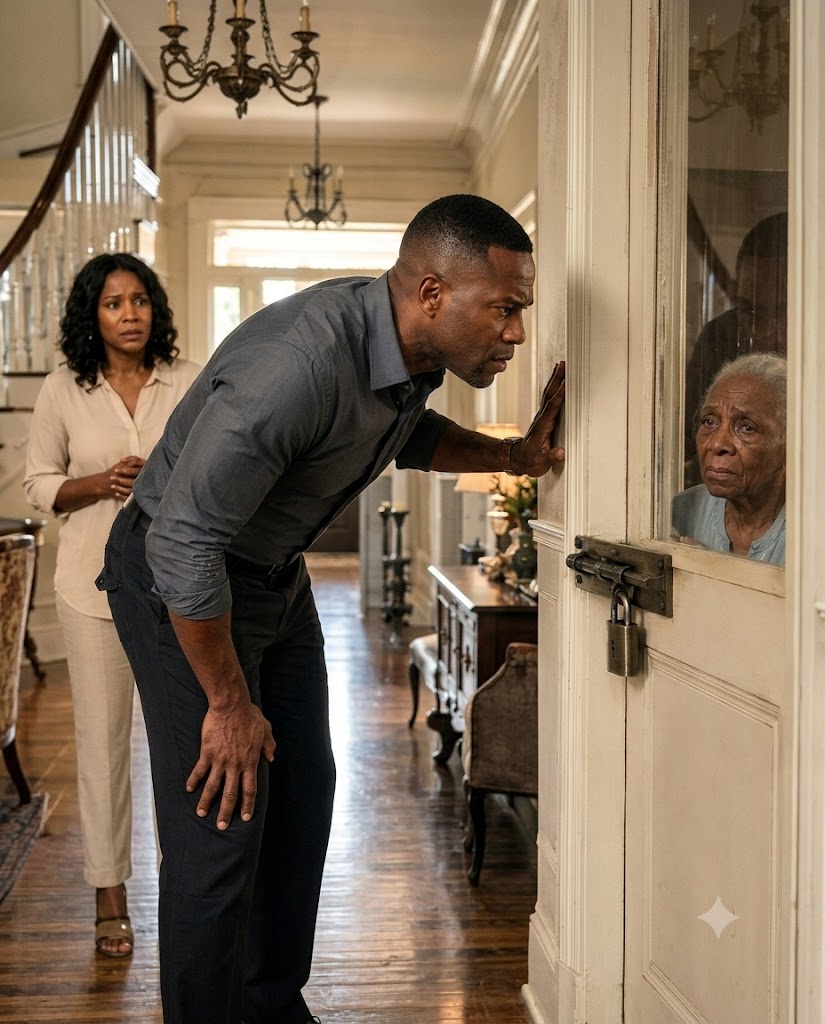
At the end of the hall, his mother’s bedroom door was closed.
That much was normal.
What was not normal was the hardware mounted at eye level on the door frame.
A heavy-duty surface bolt—the kind used on stable doors and outbuildings.
Steel, solid, installed with wood screws that had been countersunk and painted over.
It was mounted on the outside of the door.
Lucas stood and looked at it for three seconds.
“Sandra.” His voice was very quiet. “Why is there a bolt on my mother’s door?”
“It’s for her safety. She was—”
“Why is it on the outside?”
Silence.
He slid the bolt back, turned the handle, and pushed the door open.
—
The room was dark.
The window—he remembered it faced the backyard, looked out on the old oak tree his mother had always loved—had something covering it.
A board or thick cardboard, not a curtain.
He found the light switch and flipped it.
A single overhead bulb came on.
Not enough light.
His eyes adjusted.
Ruth Harmon was sitting in the corner of the room in a wingback chair that had once been in the living room.
She was wearing a cotton house dress, pale blue—the kind she’d always worn around the house on weekends.
She was thin.
Alarmingly, heartbreakingly thin.
Her wrists emerging from the sleeves like something fragile.
Her collarbones visible above the neckline.
Her white hair was clean but flat against her head, like someone who’d been lying down for a long time.
She looked up when the light came on.
She squinted.
She lifted one hand slowly to shade her eyes.
“Lucas.”
Her voice was barely above a whisper—not surprised, more like someone testing the word, making sure it was real before they let themselves believe it.
“Mom.”
He crossed the room and dropped to his knees in front of her chair and took her hands in both of his.
They were cold, and they were thin, and they trembled slightly.
He held them and couldn’t speak.
“You came back,” she said.
Then: “Did Neil tell you about the house?”
—
Lucas didn’t answer her question.
Not yet.
First he got her out of the chair.
It took longer than it should have.
Her legs were unsteady beneath her, not quite trusting the ground the way legs get when they haven’t been asked to do much for a long time.
He held her arm and walked her slowly to the bathroom, and she gripped the towel bar while he found a clean washcloth and ran warm water.
She washed her face and hands and looked at herself in the mirror for a long, still moment—like she was checking to make sure she was still there.
Sandra was not in the hallway when he came out.
He could hear her on the phone somewhere deeper in the house, her voice low and urgent.
He settled his mother in the kitchen—the beautiful kitchen, the granite and the stainless steel that his money had paid for—and made her scrambled eggs, because it was the first thing he could think of that was soft and fast and unlikely to hurt a stomach that had been getting too little for too long.
She watched him cook with an expression he couldn’t name.
Careful, like she was memorizing something.
She ate slowly.
He sat across from her and waited.
“Tell me what happened,” he said when her plate was half clear.
She looked at her fork.
Then she started talking.
—
It had started about three years ago, she said.
Her health had been fine.
She was seventy—not young, but she was walking every morning, cooking her own meals, driving to the grocery store.
Then she had a small cardiac episode.
Nothing serious, a blip on a monitor during a routine checkup.
But Neil had used it as a turning point.
He said the doctors had advised that she stop driving.
He said she needed supervision.
He arranged for her to move into the smaller bedroom closer to the bathroom, he said, and he brought in new locks for the outer doors for her safety.
She hadn’t resisted at first.
It seemed reasonable.
She trusted him.
He was her son.
The changes came in increments—the way the important changes always do.
The phone she’d had for twelve years developed a problem, and Neil replaced it with a new one that he set up.
The number changed.
Lucas’s calls still went through, or so she believed, because Neil would occasionally hand her the phone, and she’d hear a voice that sounded enough like Lucas to satisfy her.
She didn’t realize until much later that those calls were brief and scripted, and that the real Lucas had been getting voicemails that Neil listened to and deleted.
The door lock came about two years ago.
At night, first—Neil said so she wouldn’t wander if she got confused.
Then during the day.
Then all the time, except for twice-daily bathroom breaks and a meal that was sometimes delivered and sometimes not.
“I thought you knew,” she said.
Her voice was flat—not accusatory, just stating a fact that had sustained her for two years and that she was now handing over to someone else to hold.
“Neil told me you had approved the arrangement. He said you’d talked to a care specialist in Stuttgart and this was the recommendation. That it was the best thing for me, given your schedule.”
Lucas put both his hands flat on the table.
He stared at them.
“He showed me a letter once,” his mother continued. “Printed out. Said it was from a neurologist. Said I had early cognitive decline and the locked environment was for containment. I believed him.”
She paused.
“I didn’t want to believe he would lie to me. So I decided the letter was real.”
“How long in the room, Mom? With the bolt.”
“Two winters.”
She said it carefully.
“I kept track for a while. I scratched marks on the wall. The wall by the window, where the board is. I used a hair clip. After about five months, I lost it and couldn’t find another one. But I know it was two winters because I could feel the cold coming through the board on the window, and I felt it twice.”
—
Lucas pushed back from the table and stood up.
He stood at the kitchen window looking at the backyard—the landscaped, beautiful backyard with its stone path and its raised beds—and pressed both hands against the counter until the urge to break something passed.
“Your phone,” he said without turning around. “The one you actually had. What happened to it?”
“Neil took it when he changed the door. Told me the new one would be safer. But the new one—I couldn’t call anyone on it who he hadn’t put in the contact list. I tried to call June once. June Caldwell, next door. She wasn’t in the contacts. The phone wouldn’t complete the call.”
Lucas turned around.
“Did you try to call me on the new phone?”
“Every week for the first year. It would ring and go to a message that sounded like you. Said you were unavailable and to leave a message. I left messages.”
She looked at him steadily.
“I stopped after a while.”
He checked his phone.
He found the voicemails folder.
He rarely checked it anymore—everything was email and texts.
There were over forty voicemails from a number he didn’t recognize.
He played the first one.
His mother’s voice, thin and careful: *”Lucas, it’s Mom. I’m not sure if you’re getting these. I just wanted to hear your voice. Call me when you can.”*
The date on the voicemail was twenty-two months ago.
He stood there for a long time.
“Neil told you I approved this,” he said finally.
“Every time I asked. I asked maybe three times in the first year. He was always very calm about it. He said you were busy, that you felt this was the best arrangement, that you would visit when you could, but that the work in Germany was demanding.”
She paused.
“He knows you well enough to know what would sound like you. He made it sound like you.”
—
Lucas sat back down.
He put his elbows on the table and his face in his hands for a moment.
Then he looked up.
“What did you mean,” he said, “when you asked if Neil told me about the house?”
His mother was quiet for a moment.
She folded her hands on the table.
“He showed me papers,” she said. “About six months ago. He said it was estate planning. I told him I didn’t want to sign anything about selling the house. He told me I didn’t have to—that he had something called a durable power of attorney that I signed years ago, and that it gave him authority to manage my assets.”
She looked at the table.
“He said it didn’t matter what I wanted. He already had what he needed.”
—
Sandra left the house at some point during the second hour.
Lucas heard the garage door open and a car back out.
He didn’t go after her.
He wasn’t ready for that conversation yet.
He settled his mother in the living room with a blanket and the television, which she watched with the careful attention of someone rediscovering a familiar pleasure.
Then he went to find Neil’s office.
It was the third bedroom—the one that used to be the guest room.
The door wasn’t locked.
That at least suggested confidence, or carelessness.
Lucas pushed it open and stood in the doorway looking at the room of a man who had decided at some point that he had nothing to hide because no one was coming to look.
He found the wire transfer records first.
They were in a manila folder in the second drawer of the filing cabinet, organized by year.
Fourteen folders.
Lucas’s monthly deposits going back to the beginning.
Every one recorded: $1,800 arriving on the first of each month, deposited into an account in Neil’s name.
At the bottom of each annual summary, a handwritten notation: *household expenses*.
The amounts varied, but averaged around $1,500 per year.
Under $2,000 in most years.
For a household of two people.
Lucas did the math in his head.
$1,800 times twelve months times fourteen years.
$302,400 total received.
Approximately $22,000 actually spent on his mother’s household needs.
The remainder—over $280,000—unaccounted for in any record he could find.
—
He kept going.
In the bottom drawer, behind a hanging file labeled *Property*, he found what he had been half expecting and hoping he wouldn’t find.
The HELOC documents were on top.
A home equity line of credit—$280,000—taken against the Birchwood Lane property eight months ago.
The lender was a regional bank.
The borrower listed was Ruth Harmon.
Her signature appeared on the signature page.
Neat. Untroubled. The handwriting of a woman with steady hands.
His mother’s hands had not been steady in eight years.
He had noticed it when he held them an hour ago—the slight tremor, the way her fingers moved with that faint, constant quiver that came with the arthritis she’d had since her mid-sixties.
He remembered it from their last video call.
The last real one.
Four years ago, before Neil’s management of her communications became total.
He set the HELOC aside.
Behind it, a real estate purchase contract.
Stonehaven Development LLC as buyer.
The Birchwood Lane property described in full as the subject property.
Purchase price: $420,000.
Scheduled closing date: eighteen days from today.
The contract showed a signature line for Ruth Harmon, seller—signed.
Below it: Neil Harmon, agent under durable power of attorney—also signed.
At the bottom of the stack, a single sheet that wasn’t a formal document.
Just note paper.
Neil’s handwriting—the kind of note you write to remind yourself of something.
Lucas read it twice to make sure he had it right.
*Closing wire to Cayman acct. Sandra thinks FL condo. Done.*
—
Lucas sat down in Neil’s desk chair and looked at the note for a long time.
Neil had planned this.
Not impulsively, not out of desperation—planned it over years, with steps.
Lock Ruth in the room to keep her from talking.
Control Lucas’s access through the phone.
Use the POA to authorize the HELOC.
Pocket $280,000.
Arrange the sale.
Pocket another $420,000.
All told—$700,000.
Wire the money offshore.
Disappear, or at least move to a narrative in which it was all legal.
Sandra apparently didn’t even know the full story.
Lucas photographed every document on his phone.
Then he photographed them again with the bedroom door visible in the background, so there was no question about where the documents had been found.
He went through the rest of the files.
He found receipts for the house renovations—$78,000 in materials and labor, which aligned with what he could see.
He found bank statements showing the HELOC funds received and then distributed: $60,000 to a personal account in Neil’s name alone, $40,000 to an investment brokerage, the rest moving in tranches over eight months to an account he couldn’t identify.
He also found a business card tucked into the real estate contract.
*Garrett Wills, Senior Associate, Stonehaven Development LLC.*
The card had a cell number handwritten on the back.
Lucas put everything back exactly as he’d found it.
He closed the drawer.
He stood in the doorway and looked at the room that had been built with his money—the filing cabinet, the leather desk chair, the monitor on the desk—and thought about the last fourteen years.
He had thought he was being responsible.
He had thought distance with a wire transfer was a form of presence.
He had thought sending money home was the same as taking care of the people he loved.
—
He walked back to the living room.
His mother had fallen asleep in the armchair, her head tilted slightly to one side, her breathing slow and even.
She looked small against the cushions.
The television murmured on.
Lucas sat across from her and watched her sleep and thought about the note in Neil’s desk drawer.
*Cayman account. Sandra thinks FL condo.*
He picked up his phone and searched for elder law attorneys in Asheville.
—
June Caldwell had lived next door on Birchwood Lane for thirty-five years.
She had been at every Harmon birthday party that Lucas could remember, had brought casseroles when his father was sick, had sat with his mother in the weeks after the funeral.
She was one of those people who existed in the background of a childhood and only revealed their true weight later, when you understood what it meant to have someone who stayed.
Lucas knocked on her door at seven o’clock in the morning—before he had slept, before he had eaten.
Ruth was still asleep in the living room, and Sandra had not come back.
June opened the door, took one look at his face, and said, “Come inside.”
She made coffee without asking.
He sat at her kitchen table—a table remarkably similar to the one he’d grown up with, same shape, same height—and told her what he’d found.
She listened without interrupting, her hands wrapped around her mug, her expression going through a series of small, controlled adjustments that he recognized as grief being managed.
“I knew something was wrong,” she said when he finished. “I should have pushed harder. I’ve been telling myself for two years that it wasn’t my place.”
“She’s alive,” Lucas said. “That matters.”
June set down her mug.
“I want to show you something.”
—
She went to the small desk in the corner and came back with her phone.
She sat beside him and scrolled to a folder of photographs.
There were dozens of them, organized by date, going back over fourteen months.
She’d been photographing through her kitchen window, angled across the narrow strip of yard between the two properties.
The first sequence showed Neil’s truck in the driveway alongside a car June had already identified.
She’d looked up the plates after the third time she saw it.
The car was registered to Garrett Wills—a commercial real estate agent with Stonehaven Development.
The photos showed Wills arriving at the house six different times over fourteen months.
Sometimes he carried a briefcase.
Once he carried a rolled document tube.
“Three of those visits,” June said, “were on days when I had just been turned away from the front door. Neil told me twice that Ruth was resting, and once that she was at a therapy appointment.”
She tapped a photo.
“She wasn’t at a therapy appointment. She was in that room. Because that same afternoon, I saw her light flicker through the board on the window. Just once. I think she heard my voice when I was talking to Neil at the door, and she was trying to signal me.”
Lucas looked at the photo—the boarded window visible from June’s angle, and the faintest variation in the light behind it.
“What did you do when you saw that?”
“I started leaving food at the back corner of the fence,” June said. “Just things that wouldn’t draw attention. Bread in a paper bag, apples, a bottle of water. Sometimes it was gone the next day. Sometimes not.”
She paused.
“I don’t know how she got to it. The window is on the wrong side. But something got to it.”
The bolt on the door, Lucas thought.
Twice-daily bathroom breaks.
Maybe on the days when Neil wasn’t watching closely, she found the back door unlocked for a window of time, and she moved fast.
“I also called Adult Protective Services,” June said quietly. “Eight months ago. I told them I hadn’t seen my neighbor in almost a year and a half, and I was concerned. They said they’d send someone.”
She looked at the table.
“A social worker came three days later. I watched from my window. Neil answered the door. He talked to her on the porch for about ten minutes. She never went inside. When she left, her body language was relaxed. He’d satisfied her.”
“What did he tell her, do you think?”
“I walked over to the property line while she was walking to her car and called out. Asked if everything was all right with Ruth.”
June’s jaw tightened.
“The woman told me Mrs. Harmon was currently residing at a care facility in Charlotte, and that the house was being managed by her son. She said the complaint had been resolved. She seemed genuinely to believe it.”
Lucas sat back.
False statement to APS.
Add that to the list.
—
He scrolled through the rest of June’s photos.
The last one had been taken three days ago.
Sandra standing in the driveway alone in the late afternoon, looking at the house.
The expression on her face—Lucas had seen it described once in an architecture critique.
The way a building looked when the owner wanted to leave.
Emptied of the idea that it had ever been a home.
“She knew,” Lucas said. Not a question.
“I think she knew what was being planned,” June said carefully. “I don’t know how much.”
She paused.
“She left last night. You said—took a bag I didn’t see. I just heard the car.”
June was quiet for a moment.
Then: “There’s one more thing. Three weeks ago, I had an odd conversation with Ruth’s doctor’s office. Dr. Hadley. She’d been Ruth’s physician for eleven years. I called to ask if they had a current address for Ruth—said I’d been trying to reach her. The woman on the phone said Ruth had been transferred to a new primary care provider and that their office no longer had current information.”
June looked at him steadily.
“Neil had her medical records transferred to a Dr. Gerald Pros. I looked him up. He’s Neil’s own physician. He does not have a geriatric specialty.”
Lucas thought about what Patricia Vance was going to say when he sat down in front of her in a few hours.
He thought about the incompetency petition that Neil was even now perhaps filing with a court.
A transfer of Ruth’s medical records to a doctor with no geriatric training—a doctor who could, if asked, provide a letter about cognitive decline to support that petition.
He stood up and thanked June and told her he would need her to be willing to make a formal statement.
She said without hesitation that she would say anything that needed to be said in any room that needed to hear it.
—
Walking back across the yard to his mother’s house, Lucas checked his phone.
One new email.
Subject line: *Harmon Inquiry – Patricia Vance Elder Law.*
She could see him at nine.
—
Neil came home at 6:37 that evening.
Lucas heard the garage door from the kitchen, where he was making dinner.
Simple things—food that Ruth could eat without discomfort.
Soup, soft bread, a small portion of mashed potato.
His mother was at the table, sitting with her hands around a cup of tea, moving through the slow work of rebuilding an appetite.
She had been eating every three hours.
Her color was better than it had been that morning.
Not good, but better.
When Neil walked through the door from the garage and saw Lucas standing at the stove, he stopped.
He was dressed well—khakis, a button-down, the careful assembly of a man who paid attention to how he appeared.
He was forty-seven, three years older than Lucas, and he had the look of someone who’d spent his forties in comfort rather than exertion.
Heavier than Lucas remembered.
The easy weight of a man with no reason to push himself.
His expression in the first half second was raw.
Then it closed, and he reached for something Lucas recognized—the older brother register, the particular tone of a man who had always assumed he knew more than the room.
“Lucas.” Neil said it warmly. “Why didn’t you call? We would have made plans.”
“Wanted to surprise Mom.”
Lucas didn’t turn away from the stove.
Neil moved to the table, leaned down, and kissed the top of Ruth’s head.
She held very still.
“Mom, you’re up. That’s great.”
He straightened.
“The care team has her on a rest schedule, Lucas. She’s not always supposed to be in the kitchen this late.”
“The care team,” Lucas said.
“Her medical support. I’ve been managing her health situation carefully. You know how it is with the cognitive stuff. She needs routine. Structure.”
Neil opened the refrigerator and took out a beer.
“How long are you staying? I can make up the guest room.”
“Sit down, Neil.”
Something in his tone landed.
Neil paused, beer in hand.
“I want to have a conversation,” Lucas said.
He turned off the burner, turned around, and looked at his brother.
“About the house.”
—
Neil’s eyes moved to the table—to the folder Lucas had placed there.
The photographed documents, printed at the library on the way back from Patricia Vance’s office.
He sat down.
Lucas sat across from him.
He set the real estate contract on top of the folder and slid it across the table.
Neil looked at it.
He picked it up.
He looked at it for a moment longer than was necessary—a beat that told Lucas he was buying time, not reading.
“You’ve been going through my things,” Neil said.
“Why is there a contract to sell Mom’s house?”
“Because it’s the right financial decision. The property taxes on this place have been going up every year. The maintenance costs are significant. Mom doesn’t have the income to sustain this without ongoing support. And you and I both know that my managing it has been a lot to ask.”
He set the contract down.
“I have full durable power of attorney. That’s not a secret. Mom signed it years ago, when she had that cardiac scare. It’s legally valid. I have the authority to manage her assets, and this is a decision I’ve made in her best interest.”
“She told me she never agreed to sell the house.”
A pause.
Neil leaned back in his chair.
“She doesn’t always remember things accurately. That’s part of what we’re dealing with.”
“She remembered every detail about signing the POA eleven years ago. The doctor’s appointment beforehand, the notary’s name, the pen she used. She remembers it.”
“Lucas.” Neil’s voice went gentler, which was somehow worse. “I know this is hard. You’ve been gone a long time. You have a picture of her from before. But she’s declined. The doctors agree. The arrangement we have—the care structure—it’s appropriate for where she is.”
“There is no care structure,” Lucas said. “There’s a bolt on her bedroom door and a board over her window. She’s been in that room for two years.”
Neil didn’t blink.
“For her safety. She was disoriented. Wandering. The doctor recommended a contained environment.”
“Which doctor?”
“Dr. Pros. He’s been managing her care.”
“Dr. Pros is your personal physician. He has no geriatric training. He transferred her records from Dr. Hadley without her consent.”
Lucas tapped the folder.
“I also found the HELOC. $280,000 against this property, eight months ago. Signed by Ruth Harmon. I’ve spoken to my attorney this morning. She would like to see the original signature. She has a question about the handwriting.”
Something shifted in Neil’s face.
Just for a moment—a crack, quickly mortared.
He set down the beer.
“Your attorney. Her name is Patricia Vance.”
“You might want to find your own.”
—
They looked at each other across the table.
Ruth sat between them, her hands around her tea, her eyes down.
She didn’t speak.
She had the demeanor of someone who had long ago learned that being still was safer than participating.
Neil stood up.
“This is my house. I manage this property. Whatever you’ve told your attorney, I have the legal documentation to support every decision I’ve made. You don’t get to come here after fourteen years and tell me I’ve been doing anything wrong.”
His voice was controlled, but his jaw was tight.
“I can call the police and have you removed for trespassing. This isn’t your home.”
“Go ahead,” Lucas said.
Neil didn’t move toward his phone.
They stayed that way for a moment.
Then Neil turned and went to his bedroom and closed the door.
Lucas served his mother her soup.
She ate.
The house was very quiet.
—
At two o’clock in the morning, Lucas was on the fold-out couch in the living room, not sleeping.
He heard Neil’s voice from the kitchen—low, careful, the cadence of a private phone call.
“File it tomorrow morning. Emergency petition. We need to move faster. If she talks to anyone else—the whole timeline—”
A pause.
Then, quieter: “I know. I’ll handle it. Just have the paperwork ready.”
—
Patricia Vance’s office was on the fourth floor of a building downtown—the kind of office that communicated competence without trying too hard.
Bookshelves, a good chair, a window looking out over the river.
She was fifty-two, lean and careful in her movements, with the particular stillness of a person who had spent a career listening to people in crisis and knew that the best thing she could offer usually was not to fill the silence prematurely.
Lucas spread the photographed documents across her desk and told her everything—starting with the bolt on the door and ending with the note he’d found in Neil’s desk drawer.
*Closing wire to Cayman acct. Sandra thinks FL condo. Done.*
Patricia listened.
She asked no questions until he was finished.
Then she picked up the photographed pages one by one and looked at each of them for a measured time.
“The POA first,” she said. “May I see your copies of the signatures?”
Lucas had photographed the POA separately, close up on the signature page.
He’d also photographed the HELOC signature page and the real estate contract.
Patricia set them side by side on her desk.
She looked at them for a long, long time without speaking.
“Your mother has arthritis,” she said finally.
It wasn’t a question.
“Since her early sixties. It’s gotten progressively worse. I noticed the tremor when I held her hands yesterday.”
Patricia pointed to the POA signature.
“This is eleven years old. You can see a tremor—not severe, early stages. The handwriting is identifiably Ruth Harmon, but the letters have that characteristic slight irregularity.”
She moved her finger to the HELOC signature.
“This is eight months old. Look at the baseline. Every letter sits cleanly on the line. The R in Ruth, the looping H in Harmon. No tremor. No irregularity.”
Lucas looked at the two signatures.
Once she pointed it out, it was as obvious as a wrong note in familiar music.
“She can’t do that,” he said. “Not anymore. Her hands don’t do that.”
“No,” Patricia said. “They don’t. I’ll need a handwriting expert to confirm—we need a professional, not my opinion. But I’ve been doing this for twenty-two years, and that signature is not from the same hand.”
She sat back.
“The real estate contract signature has the same quality. Consistent. Smooth. I’d expect the same finding from the expert.”
She looked at him steadily.
“Do you understand what this means for the legal situation? Forgery?”
“Yes.”
“This is no longer a financial dispute between family members over the scope of a POA. This is fraud. Forgery of a legal document. Elder financial abuse. Elder abuse, because of the confinement.”
She paused.
“And based on what you’ve described with the APS social worker, there may be an additional charge related to the false statement he made to that office.”
—
She moved on.
She walked him through the POA itself.
Its scope was genuinely broad—a durable general power of attorney that covered property, finances, healthcare decisions.
But she noted two things.
First, even valid POA authority cannot be used to commit fraud.
And if the signatures on the HELOC and the contract were forged, those transactions were void regardless of the POA.
Second, she flagged a legal principle worth exploring.
A POA obtained through gradually isolating the grantor from outside contact, controlling her information, and manipulating her belief system could be challenged as having been executed under undue influence.
It was a harder argument, but it was a real one.
“Neil filed this morning,” Lucas told her. “An emergency petition to have my mother declared legally incompetent.”
Patricia nodded, unsurprised.
“He’s trying to neutralize her. If a court declares her incompetent, her testimony becomes much less useful. It also potentially gives him legal cover for everything he’s already done. *I was managing the affairs of someone who couldn’t manage herself.*”
She folded her hands.
“We need to move today. I’m going to file a counter motion opposing the incompetency petition and requesting an independent medical evaluation. And I’m going to file for an emergency injunction to stop the real estate closing. The closing is in eighteen days. Eighteen days is enough time if we move quickly.”
She looked at him.
“Lucas, I need you to understand something. This is going to be a real fight. Neil has a lawyer. He has money. And he has been building his narrative for years. Judges are cautious about family disputes. We are going to need evidence that is unambiguous, credible, and documented. Fortunately, what you’ve brought me today is a strong start.”
He told her about June Caldwell—the photos, the APS complaint, the food at the fence.
Patricia wrote quickly.
“One more thing,” Lucas said. “My mother told me that Neil showed her the sale papers and she refused to sign them. He told her it didn’t matter. She said that clearly and unprompted.”
Patricia looked up from her notepad.
“She’ll need to say that in court.”
“She will.”
He didn’t hesitate.
“She’s sharper than Neil thinks she is. She remembers everything.”
Patricia stood and extended her hand across the desk.
“Then let’s get started.”
—
She filed the counter motion and the injunction request that afternoon.
By evening, the judge had granted a temporary stay on the real estate transaction—forty-eight hours, pending a full hearing.
And Dr. Marcus Webb, one of Asheville’s leading geriatric specialists, agreed to conduct an independent evaluation of Ruth Harmon the following morning.
Lucas drove home through the Asheville streets in the early dark, past the storefronts and the restaurants and the neighborhoods he had left at twenty-seven and thought about occasionally and never let himself miss too much, because missing things made the distance harder to live inside.
He thought about his mother’s signature—steady and smooth on a line she never touched.
He thought about two years of wall marks scratched with a hair clip.
He pulled into the driveway on Birchwood Lane.
The lights were on.
Ruth was visible through the front window, sitting in the armchair.
He sat in the car for a moment before going in and thought: Patricia said two things were necessary.
Evidence—unambiguous, credible, and documented.
And a witness they couldn’t discredit.
—
Dr. Marcus Webb arrived at eight the next morning with a structured assessment kit and the unhurried manner of a man who had spent thirty years evaluating the minds of people who were being underestimated.
He was fifty-eight, with silver at his temples and reading glasses he kept pushing up his nose, and he shook Ruth’s hand before anything else and asked her what she’d had for breakfast.
“Scrambled eggs and toast,” she said. “Lucas made them. Too much butter on the toast, but I didn’t tell him.”
Dr. Webb smiled and sat down across from her.
Lucas went to the kitchen.
The evaluation took two and a half hours.
Lucas could hear murmured voices through the wall—not the words, just the rhythm, the way a proper conversation has rhythm, rather than the one-sided sound of someone being talked at.
At one point he heard Ruth laugh—a short, genuine laugh, the kind that surprised her.
Dr. Webb came to find him in the kitchen when it was done.
“She is cognitively intact,” he said without preamble. “Fully. Her scores on the Montreal Cognitive Assessment, the Mini-Mental State Examination, and three additional subtests are all within normal range for her age—actually somewhat above. She recalled six unrelated words in sequence after a distractor period. She performed serial reasoning accurately. She oriented to date, time, and location without hesitation, including providing the exact date of the primary election three months ago.”
He paused.
“She is not experiencing dementia. She is not experiencing mild cognitive impairment. What she has experienced is severe social isolation and the resulting psychological and physical effects of that isolation, which are real and significant—but they are not cognitive decline.”
Lucas put both hands on the counter.
“Good.”
“The physical picture is different.”
Dr. Webb’s voice was level, professional.
“She is severely underweight—98 pounds against an estimated healthy weight for her frame of approximately 130. Vitamin D deficiency, B12 deficiency, mild iron deficiency anemia. Significant muscle atrophy in her legs, consistent with very limited movement over an extended period. Two stage-2 pressure sores on her lower back, consistent with prolonged time in a single position. She will need nutritional support, physical therapy, and monitoring.”
He paused again, as if weighing something.
“She told me about the wall,” he said. “She said she marked the days until she lost the implement she was using. She said she knows it was two winters. She has a very strong internal sense of time, even without external reference. She described the quality of light through the gap in the board, the sound of seasonal changes in the trees outside. She was using environmental cues to track time when the formal marks ran out.”
“She was a teacher,” Lucas said. “For thirty-one years. Her whole career was about paying attention to what was in front of her.”
Dr. Webb set his clipboard on the table.
“I want to see the room,” he said quietly.
—
Lucas took him down the hallway.
The bolt had been removed from the door frame the day before—Lucas had taken it off himself and put it in a paper bag in his car.
The door opened into the room, which was still as Ruth had left it: the chair in the corner, the covered window, the mattress he’d moved off the floor and onto a proper bed frame he’d assembled the evening before.
The room had been aired out.
It no longer smelled the way it had.
Dr. Webb stood in the doorway.
He looked at the room for a long moment—the way people look when they are trying to remember accurately rather than see emotionally.
Then he moved to the far wall, beside the covered window.
He put on his glasses.
He leaned close.
The marks were small—not dramatic, barely visible unless you were looking.
Scratched with something fine-tipped, a pin or the end of a small metal clip, into the drywall surface.
Groups of five, like a prisoner’s tally.
One row, then another below it, then a third beginning and stopping partway through.
He counted quietly.
His lips moved.
He stepped back and looked at Lucas.
“Approximately 160 days,” he said. “Give or take, depending on whether she missed any during the period she was using it.”
He paused.
“She said she lost the clip after about five months. 160 days is consistent with five months.”
He removed his glasses.
He looked at the wall for another moment.
“I reviewed the incompetency petition on your attorney’s request this morning,” he said. “The supporting letter is from Dr. Gerald Pros. He is not a geriatric specialist. His letter states—I’m quoting—*’The patient exhibited signs of confusion and disorientation during our interaction.’* No standardized assessment is cited. No test results. No documentation of the interaction beyond that sentence.”
He turned to face Lucas fully.
“I have no idea what Dr. Pros observed, or when, or whether he ever actually spent time alone with your mother. But what I can tell you clearly and for the record is that based on a comprehensive evaluation conducted this morning, Ruth Harmon does not meet any clinical definition of incompetence. She is a woman who has been isolated, malnourished, and mistreated. Those are not the same thing.”
He picked up his clipboard and moved toward the door.
“I’ll have my full report to Ms. Vance by end of day tomorrow,” he said. “In the meantime, whatever she wants for dinner tonight, let her have it.”
—
After he left, Lucas stood in the hallway for a moment.
Then he went back to the room and looked at the marks on the wall again.
160 small scratches.
Each one a day.
His mother had decided to remember that time was still passing, that she was still in it, that the days still counted.
He put his hand on the wall beside them, palm flat, and stood there for a moment.
Then he went to make lunch.
—
Patricia called at nine the following morning.
Lucas was at the kitchen table with coffee and his laptop, going through emails from Stuttgart—his partner Marit managing things in his absence, asking how long he’d be gone.
He hadn’t answered that email yet.
“The handwriting expert has preliminary results,” Patricia said. “I asked for an expedited review given the timeline. She’s been doing forensic document analysis for twenty-six years, and the POA signature from eleven years ago is consistent with Ruth Harmon’s handwriting across multiple reference samples from that period. Her driver’s license renewal, a notarized gift letter, a health directive from the same year. The characteristic tremor is present throughout. Early, but consistent.”
Lucas waited.
“The signatures on the HELOC and the real estate contract,” Patricia said, “do not match. The baseline pressure is different. The letter forms are different. And critically, there is no tremor. The documents’ own dates would put the signatures after Ruth’s arthritis had progressed significantly. Our expert’s finding is clear: those signatures were not made by the same hand as the known samples. They were made by someone imitating Ruth Harmon’s signature—but not with enough knowledge of her actual current handwriting to replicate the tremor.”
Lucas set down his coffee.
“She’s willing to testify,” Patricia continued. “I’m filing with the DA’s office today. We now have a forgery case, independently. I’m filing a motion to void the HELOC—fraudulently executed, no valid signatory authority—and a motion to void the real estate contract on the same grounds.”
A pause.
“I want to be clear about what this means, Lucas. Once I file with the DA, this is a criminal matter. There will be an investigation. Neil will likely be contacted by law enforcement.”
“Good.”
“You’re sure? He’s your brother.”
“He locked my mother in a room for two years and forged her signature on a mortgage.”
Lucas said it quietly, without heat.
“I’m sure.”
—
That afternoon, Neil left the house early and didn’t come back by dinner.
Sandra had still not returned.
Lucas made dinner for his mother—roast chicken, something she’d requested, something that meant a real kitchen and real food and a real evening at a table.
She was stronger than she’d been three days ago.
She walked from the living room to the kitchen unassisted, moving carefully but under her own power.
She was setting the table slowly with both hands, but she insisted on doing it herself, when Lucas heard a knock at the back door.
He opened it.
Sandra stood in the dim of the back porch, a small bag over her shoulder, a canvas tote in her hand.
Her face was stripped of its usual arrangement.
She looked tired and younger at the same time—the way people look when they stop performing something.
“I need to talk to you,” she said.
He stepped back and let her in.
—
She sat at the kitchen table while Ruth took the soup pot to the counter.
Ruth looked at Sandra for a moment—a careful, assessing look, like someone cataloging a face they’d decided to understand rather than blame—and then turned back to the stove.
Sandra spoke quietly and quickly, like someone who had practiced the words but was afraid of losing her nerve.
“I knew what Neil was doing,” she said. “Not all of it. Not the forgery. I didn’t know about the HELOC. But I knew about the real estate deal. I knew he was planning to sell the house. He told me it was Ruth’s decision—that she’d agreed. I believed him for a while. Then I stopped believing him.”
She set the canvas tote on the table.
“I started keeping records about seven months ago. When I realized he was lying about what Ruth wanted, I started. I don’t know why exactly. Insurance. Something felt very wrong.”
She reached into the tote and took out a manila envelope.
“Photos,” she said. “Fourteen months of Garrett Wills coming to the house. I kept notes with dates. Copies I made of documents Neil thought I hadn’t seen—the HELOC application, the sale contract. And one recording.”
She took out her phone.
She opened an audio file and pressed play.
Neil’s voice came out of the phone, tiny but clear.
He was speaking to someone on the other end—his attorney, Sandra said quietly.
The call had been three months ago, late at night.
She’d been in the hallway, door cracked, phone held up.
*”Once the closing goes through, we wire the money and Ruth won’t be our problem anymore. She’s in there. She doesn’t know what day it is. What’s she going to say? And even if she says something, Pros has the letter. Incompetent. Can’t testify. It’s handled.”*
A pause on the tape.
The other voice, inaudible.
Neil again: *”Lucas doesn’t know anything. He never comes. He sends money and he stays in Germany and he thinks that’s enough. By the time he figures anything out, there’s nothing to figure out.”*
Sandra stopped the recording.
The kitchen was very quiet.
Ruth was at the stove, her back to them, and her spine had gone very straight.
“I was afraid of him,” Sandra said.
She didn’t say it as an excuse.
She said it as a fact she was tired of carrying.
“I’ve been afraid of him for a long time. But I’m not doing this anymore.”
She pushed the envelope across the table to Lucas.
“I’ll sign a sworn statement. I’ll testify if Patricia needs me to. I’m going to my sister’s tonight. I won’t be coming back.”
She stood up.
She looked at Ruth, who had turned from the stove and was watching her with that same careful cataloging expression.
“I’m sorry,” Sandra said to Ruth. “I should have done something sooner.”
Ruth was quiet for a moment.
Then: “You’re doing something now.”
Sandra nodded once.
She picked up her bag and went out the back door.
—
Lucas sat at the table with the envelope in front of him for a moment.
Then he took out his phone and called Patricia.
“Sandra was here,” he said when she answered. “She has the recording, and she says the closing date was moved up. She found a revised document in Neil’s car last week.”
“How far up?”
“Five days.”
Patricia filed the emergency injunction that evening.
By nine the next morning, the judge had granted it—a full stay on the real estate transaction, pending a hearing she scheduled for three days out.
Stonehaven Development would be notified.
The closing was stopped.
Lucas found out by text while he was helping his mother with her morning walk—a slow circuit of the backyard in the early light, her hand on his arm, both of them moving at the pace the yard allowed.
He read the text, put the phone back in his pocket, and kept walking.
He told her when they got back to the kitchen, sitting down at the table for the tea and toast that had become their morning routine.
Ruth listened, nodded, and said simply, “Good.”
She ate her toast.
—
Neil arrived home an hour later.
He walked through the front door and past the living room, and he stopped when he saw Lucas at the kitchen table and read something in his face.
“You filed,” Neil said.
“Patricia filed. The closing is stayed. There’s a hearing in three days.”
Neil was quiet for a moment.
He set down his keys.
He stood very still—the way people stand when they are deciding how to manage something that has already happened.
“You don’t know what you’ve done,” he said.
“I think I do.”
“That house. That money—”
Neil’s voice was controlled, but something underneath it was fraying.
He pulled out a chair and sat down heavily.
He looked like a man who’d been running for a long time and had just stopped.
“I was here, Lucas. For fourteen years, I was here. I managed the property. I dealt with the repairs, the taxes, the medical appointments, the grocery runs—”
“You managed the money I sent,” Lucas said, “and kept nearly all of it.”
“I was compensating myself for my time. That’s not illegal.”
But his voice had less conviction than his words.
“Forging her signature on a HELOC is illegal,” Lucas said. “We have a handwriting expert.”
The color left Neil’s face—not gradually, quickly, like a tide going out.
He looked at the table.
“I want what’s right for this family,” he said, more quietly now. “That’s all I ever wanted.”
“You locked her in a room. For two years.”
Lucas kept his voice level.
“She scratched the days on the wall until she lost the thing she was scratching with. She figured out how to signal June Caldwell through the boarded window so she could get food. She kept track of two winters by the sound of the leaves.”
He looked at his brother.
“She never lost her mind, Neil. She just lost her door.”
—
Neil didn’t answer.
He sat at the table with his hands flat on the wood, looking at something below the surface of things.
“There’s going to be a hearing,” Lucas said. “Patricia has the handwriting analysis, Dr. Webb’s medical evaluation, June’s photos and statement, Sandra’s recording and documentation, and fourteen years of wire transfer records from my Stuttgart account showing every payment I made. She has a sworn statement from Sandra, which she filed this morning.”
Neil looked up.
“Sandra.”
“She cooperated.”
Something moved across Neil’s face—not quite surprise, more like the recognition of a loss he’d known was coming.
“I need you to leave this house, Neil. Today. You can take what’s yours. The house is Mom’s, and Patricia has filed a motion placing an interim restriction on any transactions involving the property while the legal proceedings are active. You won’t be able to do anything with it.”
Neil sat still for a moment.
Then he stood.
He didn’t say anything else.
He walked to the bedroom, and then Lucas could hear drawers opening and closing.
—
Two officers from the Asheville Police Department arrived three hours later—not because Lucas had called them, but because Neil had.
He’d called from the road, claimed that Lucas had threatened him, demanded his removal from the property.
Lucas met them at the front door.
They were professional about it.
One officer walked through the house with Neil, who had come back.
The other stayed on the porch with Lucas and wrote in a notebook.
When the officer who’d been inside came out, he asked Lucas to step in.
Ruth was sitting in the living room.
She had heard everything from there.
The officer—a woman about Lucas’s age, with the manner of someone who made a point of seeing things clearly—asked Ruth a few direct questions.
How was she feeling?
Did she know where she was?
Did she understand what the legal situation was?
Ruth answered each question calmly, with the precision she’d demonstrated for Dr. Webb.
Then she said, unprompted: “I have been in that back bedroom with the door bolted from the outside for two years. My son Neil made the arrangement. I want to be clear about that, because I know he will say otherwise.”
The officer wrote it down.
She asked to see the room.
Lucas took her down the hallway.
She looked at the room for a long time—the marks on the wall, the covered window, the bare overhead bulb.
She took photographs with her phone.
She came back to the living room and told Lucas an Adult Protective Services detective would be in contact within the day.
Neil left the house that afternoon with two suitcases and without looking at anyone.
—
The APS detective called at six.
His name was Marrow, and he had a flat, careful voice and the habit of saying “I see” when he wanted you to keep going.
He told Lucas that a complaint had been filed from Birchwood Lane eight months ago by a June Caldwell—next-door neighbor—and that the responding social worker had documented a contact with Neil Harmon and marked the case resolved.
“He told her Ruth was in a care facility in Charlotte,” Lucas said.
“That’s what she wrote in the file.”
Detective Marrow said: “It’s a false statement made to an APS officer. That’s a separate offense from the elder abuse and financial fraud.”
He paused.
“We’re moving quickly on this. I’ve spoken with the DA’s office. Given the evidence already documented—the medical evaluation, the financial records, the handwriting analysis—they’re prepared to move toward charges. We want the hearing to happen first, so the civil and criminal timelines don’t conflict. But after that hearing, Mr. Harmon, we expect to make an arrest.”
Lucas hung up and went to the living room.
His mother was reading.
June had brought her a stack of library books that afternoon, and Ruth was working through the top one with the focused pleasure of someone returning to a thing they’d been denied.
“Is it almost over?” she asked without looking up.
“Almost,” he said.
She turned a page.
“Good,” she said. “I want to sleep in my bed with the window uncovered.”
“You can do that tonight,” Lucas said. “I pulled the board off this morning.”
She looked up from the book then.
She nodded once—the way she had always nodded when something was simply and finally right.
Then she went back to reading.
—
The two days before the hearing were quiet in the way that days before something large are always quiet.
A held quality to the air, a sense of everything pausing to see what would happen next.
Neil had retained a lawyer named Gerald Fitch, a civil attorney in Asheville who had handled property disputes and estate challenges for twenty years.
Fitch filed two motions the morning after Neil left the house: a motion opposing the property injunction, and an accelerated response to the incompetency petition, arguing that Ruth’s evaluation by Dr. Webb was conducted in a biased environment and should be disregarded.
Patricia read both filings and was unfazed.
She sent Lucas a message: *Neither argument is strong. The incompetency claim without standardized testing is particularly weak. I’ll respond today. See you Thursday.*
Sandra had her formal interview with Detective Marrow on Wednesday afternoon.
Lucas didn’t attend—it wasn’t his meeting—but Patricia sent him a summary that evening.
Sandra had corroborated everything, provided the recording and all documentation, and added one detail that hadn’t come up before: Neil had told her approximately eight months ago that he’d “taken care of the medical record situation” and that Ruth’s doctor “would not be a problem going forward.”
That was when he’d transferred Ruth’s records from Dr. Hadley to Dr. Pros.
—
Lucas sent Marit in Stuttgart a proper email on Wednesday evening.
He explained briefly what was happening.
He told her he didn’t know how long he’d be, and that the Meridian partnership was still proceeding, but that some conversations would need to wait.
Marit replied within the hour: *Take the time you need. The firm will be here.*
He’d been thinking about staying—not thinking about it the way you think about something impractical.
He’d been thinking about it the way you think about something that might actually be possible.
The Meridian merger had been designed partly to establish a US presence.
Asheville had a growing design market, a mix of residential and commercial work that suited Harmon Associates’ portfolio.
The specific reason he’d remained in Stuttgart was that there had been no reason to go anywhere else.
Now there was a reason.
He didn’t tell his mother yet.
Ruth slept with her bedroom window uncovered.
She told him in the morning that she’d lain awake for a while, watching the light change on the ceiling—the street light through the oak tree, the way the shadows moved—and that it had been one of the nicest things she’d experienced in two years.
She said this without drama, as a simple report of what was true.
—
June Caldwell submitted her formal sworn statement to Patricia on Wednesday—four pages, detailed with dates and photograph references.
She identified Garrett Wills by name and described the fourteen months of meetings she documented.
She included the date of the APS complaint and the social worker’s visit.
She also included—and this surprised Lucas when he read the statement—a section she described as “ongoing informal support for the past sixteen months.”
She said she had left food at the property fence line on approximately sixty occasions, and approximately thirty-five of those packages had been taken.
*I don’t know how she reached them,* June wrote, *but she did. I want the court to know that Ruth Harmon was active, resourceful, and trying to survive.*
Patricia called on Wednesday evening with a final update.
“The judge looked at the submitted exhibits tonight,” she said. “I got a call from his clerk. He wants Ruth present at the hearing.”
“She’ll be there.”
“She’ll need to be prepared to testify—not just submit a statement. Testify. Take questions, including cross-examination from Neil’s attorney.”
“I know.”
“Neil’s attorney is going to push on her memory, on her clarity. He’s going to try to demonstrate confusion in real time in front of the judge. That’s their best remaining play.”
“Then he’s going to be disappointed,” Lucas said. “She told me this morning that she’d memorized the route from the parking garage to the courtroom because she didn’t want to ask for directions and look lost.”
He paused.
“She’s ready.”
Silence for a moment.
Then Patricia said one other thing.
“The clerk mentioned that the judge flagged Ruth’s wall markings—the photographs June submitted. He requested that the original photographs be available tomorrow, not just digital copies, with the wall visible.”
Another pause.
“He takes this seriously.”
Lucas looked across the living room at his mother, who was reading again.
She had been reading every evening since June brought the books.
She was almost through the second one.
“We’ll be there,” he said.
—
He didn’t sleep well that night, but it wasn’t anxiety exactly—more like the alertness that comes before something that matters.
He lay in the dark in the guest room and listened to the house, to the sounds of it settling and breathing, and thought about what it meant to have grown up here and left and never come back.
He thought about the money he’d sent and what it had paid for and what it hadn’t.
He thought about the bolt on the door, the board on the window, the marks on the wall.
He thought about his mother lying in the next room, watching the light change on the ceiling and calling it one of the nicest things she’d experienced in two years.
At some point, he slept.
In the morning, Ruth was already in the kitchen when he came downstairs.
She had made coffee—navigating the new machine carefully, but navigating it—and she was sitting at the table in a dress she’d asked Lucas to find in her closet.
Blue with small flowers.
Something she’d always worn on important days.
“Ready?” he asked.
She picked up her coffee.
“I’ve been ready,” she said, “for two years.”
—
The hearing was held at nine in the morning in Courtroom 3 at the Buncombe County Courthouse.
A room with high ceilings and light coming from tall windows on the east side, and the particular silence that courtrooms have—the kind that isn’t peaceful, but is absolute.
Ruth arrived in a wheelchair.
Her leg strength wasn’t sufficient for extended standing, and Patricia had arranged it.
She wore the blue flowered dress and a cardigan Lucas had found in the back of her closet, still neatly folded, untouched for two years.
She sat with her hands in her lap and looked around the courtroom with the expression of a woman taking careful inventory.
Neil sat at the other table with Gerald Fitch.
He was in a suit.
He hadn’t looked at Lucas when they came in, and he didn’t look at Ruth.
He looked at the table in front of him and the wall beyond, and nowhere that had people in it.
Judge Howard was sixty-three, with the measured manner of a man who had seen a great deal and had decided somewhere in the middle of his career that the most useful thing he could do was listen very carefully.
He reviewed the submitted materials before either side spoke.
He had the photographs of Ruth’s wall in print form on his bench, and he looked at them for a long time.
—
Fitch went first.
His argument had the shape of something that had been reasonable at the time it was constructed but had since been outpaced by events.
He submitted that the POA was valid.
He submitted that Neil’s actions as agent were within legal authority.
He submitted that Dr. Pros’s letter represented a legitimate medical opinion.
He submitted that the petition for incompetency was reasonable, given Ruth’s documented health challenges.
He was careful and professional, and the argument had no holes in it except for the fact that the evidence on the other side made it irrelevant.
Patricia did not rebut the opening argument directly.
She began with the handwriting expert.
Dr. Carol Ainsley had spent twenty-six years in forensic document analysis.
She presented her findings in the flat, precise language of a person accustomed to testifying and who understood the value of clarity over flourish.
The signatures on the HELOC and the real estate contract were not consistent with Ruth Harmon’s known handwriting from the same period.
The absence of the tremor present in all reference samples from the past eight years was the primary indicator.
Secondary indicators included baseline pressure inconsistencies and minor letter-form differences.
Her conclusion: the signatures on both documents were produced by a different hand imitating Ruth Harmon’s signature, with incomplete knowledge of her current writing characteristics.
Fitch cross-examined Ainsley for eleven minutes.
She answered every question without moving from her conclusion.
—
Then Dr. Webb presented his findings.
Ruth’s cognitive assessment results—her scores on five standardized tests, all within normal range.
Her precise recall of dates, people, sequences.
The physical evidence of prolonged isolation: the atrophy, the deficiencies, the pressure sores.
He noted the transfer of Ruth’s medical records from Dr. Hadley—her physician of eleven years—to Dr. Pros, Neil’s personal physician, without Ruth’s knowledge or consent.
He noted that Dr. Pros’s letter contained no standardized testing, no documented evaluation, and no specifics.
He stated clearly that Ruth Harmon met no clinical definition of incompetence by any standard he was aware of.
When Fitch cross-examined, he asked Dr. Webb whether it was possible for a person to present well during an evaluation while experiencing cognitive deficits at other times.
Dr. Webb agreed that this was theoretically possible.
He was then asked whether he could rule it out categorically.
He said he could not, with any single evaluation.
Judge Howard looked up at this point.
“Dr. Webb,” the judge said, “in your professional opinion, and based on your evaluation, is Ruth Harmon a credible witness?”
Dr. Webb looked at the judge directly.
“Yes, Your Honor. Without qualification.”
—
Patricia then called Lucas.
He presented the wire transfer records—fourteen years of payments from his Stuttgart account, $302,400 total.
He presented Neil’s own documentation from the filing cabinet, which showed approximately $22,000 in household expenditures over the same period.
He presented June Caldwell’s sworn statement and the sixty photographs, submitted in physical form.
He presented the record of the APS complaint and the false information Neil provided to the social worker.
He presented Sandra’s recording.
The judge listened to it through a speaker on the clerk’s desk.
The whole courtroom, still.
Neil’s voice, clear and unhesitating, explaining that Ruth wouldn’t be a problem, that she didn’t know what day it was, that it was handled.
—
Then Patricia called Ruth.
Ruth wheeled herself partially and was assisted to the witness stand.
She was given the option to remain in the wheelchair, which she accepted without embarrassment.
She was sworn in.
She put her hand on the Bible with the trembling fingers that her signature no longer had.
And she said, “I do,” in a voice that was quiet and completely steady.
Fitch had the first cross-examination.
He asked her to state today’s date.
She did.
He asked her the name of the current governor of North Carolina.
She answered.
He asked her to recall when she had last signed a legal document before the POA.
She described it precisely—a health directive she’d signed in 2009, noting the notary’s name, the doctor’s office where it had been executed, and the month.
He asked her whether her memory was sometimes unreliable.
She said, “Everyone’s memory is sometimes unreliable. Mine is more reliable than average. I was a schoolteacher for thirty-one years. I had to be.”
He asked her whether she had signed any documents related to the HELOC.
She said she had not.
He asked how she could be certain.
She said: “Because I was shown those papers and I refused to sign them. I told Neil I didn’t want to sign. He told me it didn’t matter, because he had what he needed already.”
He asked whether she was certain of this.
She said: “I am certain of everything I have told you today, Mr. Fitch. I spent two years in a room without a clock and without a calendar and without a phone, and I still know exactly what happened and when. I marked the days on the wall until I ran out of what I was marking with. Then I tracked the seasons. I was a teacher. I know how to pay attention.”
—
Then Patricia asked Ruth one question.
“Mrs. Harmon, you said you marked the days on the wall for approximately five months before losing the implement. What did those marks represent to you?”
Ruth was quiet for a moment.
The courtroom was very still.
“Evidence,” she said. “I thought if anyone ever came—if Lucas ever came—they would need to know it was real. I didn’t know if anyone would believe me, so I kept count so there would be something to count.”
Judge Howard looked at the marks in the photographs for a long moment.
Then he set the photographs down.
—
He ruled in sequence.
The incompetency petition was denied.
Ruth Harmon was cognitively competent and capable of managing her own affairs.
The POA was declared invalid on the grounds of undue influence—executed during a period of normal trust, subsequently used to systematically isolate the grantor and eliminate her access to independent information and assistance.
The HELOC was declared void—fraudulent execution by means of forgery.
The real estate contract was void, based on invalid POA authority and fraudulent execution.
An emergency lien was placed on the Birchwood Lane property, confirming Ruth Harmon as sole owner with no current encumbrances.
Neil sat very still through all of it.
He did not stand when his name was called.
Fitch put a hand on his arm.
Detective Marrow stepped forward from the back of the courtroom when the judge concluded.
He read the charges as he crossed the room: elder abuse, elder financial abuse, forgery of a legal document, wire fraud, false statement to an Adult Protective Services officer.
Neil stood up without looking at Lucas or Ruth.
He put his hands out.
He was cuffed quietly, without resistance, and led out through the side door.
Lucas looked at his mother.
She was watching the side door for a moment after Neil had passed through it.
Then she looked forward at the seal of the court on the wall above the judge’s bench, and she was quiet for a long time.
Then she turned to Lucas and said, “Can we go home now?”
—
Three months later, on a Tuesday afternoon in late November, Lucas drove his mother home from the rehabilitation center on the east side of Asheville.
The center had been Ruth’s home for eleven weeks.
Not a lock or a bolt in sight.
Rooms with real windows and staff who knocked before entering and meals at a proper table.
She’d had physical therapy three times a week and nutritional support and a counselor named Diane who specialized in trauma recovery for older adults.
She was 113 pounds now—up fifteen from the day Lucas had found her.
She walked without the wheelchair for short distances.
Her hands had the same tremor, would always have the same tremor, but they were warm.
She sat in the passenger seat of the rental car—Lucas had gotten his own car, eventually, a sensible Subaru he’d bought from a lot downtown—and watched Asheville go past the window.
The trees had lost their leaves.
Late November in western North Carolina was brown and gold and gray-blue at the edges of things, and the mountains were clear on the horizon in the way they only were when the air was cold.
—
June Caldwell was in the driveway when they pulled up.
She had been to the house three times in the past week.
She’d aired it out, brought flowers—chrysanthemums, yellow, in a pot on the porch—and made sure the heat was working and the refrigerator was stocked with things Ruth could actually eat.
She was standing in the driveway in her coat with a pot in her hands.
“Chicken soup,” she said. “From the recipe that’s been in my family for forty years, which I’ve made for Ruth every fall for as long as either of us can remember.”
“Welcome home,” June said.
Ruth looked at her for a moment.
Then she reached out and put her hand briefly on June’s arm—not a hug, just a touch, which was its own language—and said, “It’s good to see you, June.”
—
Lucas got his mother’s bag from the trunk, and they went inside.
Ruth moved through the house the way she’d moved through the courtroom three months ago—deliberately, taking inventory.
The kitchen first, where she ran her hand along the granite countertop.
She’d never chosen it.
Lucas knew it had gone in as part of Neil’s renovation.
Then the living room, where the furniture was different but the proportions of the room were the same.
The window above the front yard, still in the right place to catch the afternoon light.
Down the hallway, she stopped in front of the door to the back bedroom.
It was just a door now.
Lucas had removed the bolt hardware the first day.
The frame had been repaired and repainted.
The door stood open to a room that had been emptied, repainted the same cream as the hallway, the window uncovered and letting in the November light.
It was small and plain and had been turned back into the nothing it was before it became something else.
Ruth stood in the doorway for a moment.
She put her hand on the door frame.
She looked at the wall where the marks had been.
The section of wall had been patched and painted smooth—now no trace.
Lucas had done that too, the week after the hearing, working carefully with plaster and primer.
He hadn’t known if it was the right thing to do or not.
She hadn’t asked him about it.
She stood there for a moment more.
Then she turned around and walked back down the hallway.
—
They sat in the kitchen.
June poured soup.
The chrysanthemums were visible through the window on the front porch, their yellow catching the late light.
They talked about ordinary things.
Diane’s recommendation for a physical therapist Ruth could see locally.
The library books June had held for her.
The fact that the neighbor on the far side had a new dog who barked enthusiastically at the fence every morning.
They talked around the large things by consensus, the way people do when the large things are understood and don’t need rehearsing.
After a while, Ruth looked at Lucas across the table.
“I heard you signed a lease,” she said. “Office space downtown.”
“We’re calling it Harmon Meridian Design. Asheville branch.”
He paused.
“I told Marit the US operation is worth developing. She agreed.”
“You could have run it from anywhere.”
“I know.”
She was quiet for a moment.
“I’m glad you didn’t.”
He reached across the table and put his hand over hers—the way she had put her hand over his that first morning, when he’d been the one who needed it.
Her fingers were warm and trembling slightly and real.
“I should have come back sooner,” he said. “I know that. I’m sorry.”
She looked at him steadily.
“You’re here now,” she said. “That’s not nothing.”
—
Outside, the light was going.
The mountains in the distance were turning the deep blue-purple they turned at dusk in November—the color Lucas had forgotten until he came back and saw it again, and understood that it had been inside him all along, waiting for him to return to the place where it meant something.
Neil’s trial date had been set for the following spring.
Sandra had filed for divorce and was cooperating fully with the prosecution.
The HELOC had been discharged.
The Stonehaven contract was void.
The house was Ruth’s—clear and unencumbered, the way it had been before any of this started.
Lucas drove home that evening through streets that were starting to feel familiar again.
Eight minutes to his apartment.
Eight minutes back.
He would be at Birchwood Lane again on Thursday and Saturday and probably Tuesday, and he was already thinking about which wall of the new office would work best for the elevation drawings he needed to produce for the first Asheville project.
He thought, driving through the dark, about what it had cost.
Fourteen years of wire transfers.
A mother imprisoned in her own house.
A brother he had trusted because trusting felt easier than coming home.
He thought about the difference between providing and being present.
He had learned it the hard way.
And there were things he couldn’t get back.
Two years of marks on a wall—160 days scratched in secret by a woman who refused to stop counting.
But she was home.
He was here.
The window was uncovered.
That was where it started.
—
*If this story stayed with you—if you’ve ever felt the weight of distance or wondered whether what you sent was ever enough—leave a comment below. We’d love to hear from you. And if you’re watching someone you love go through something like this, don’t wait. The time to come home is always now.*









