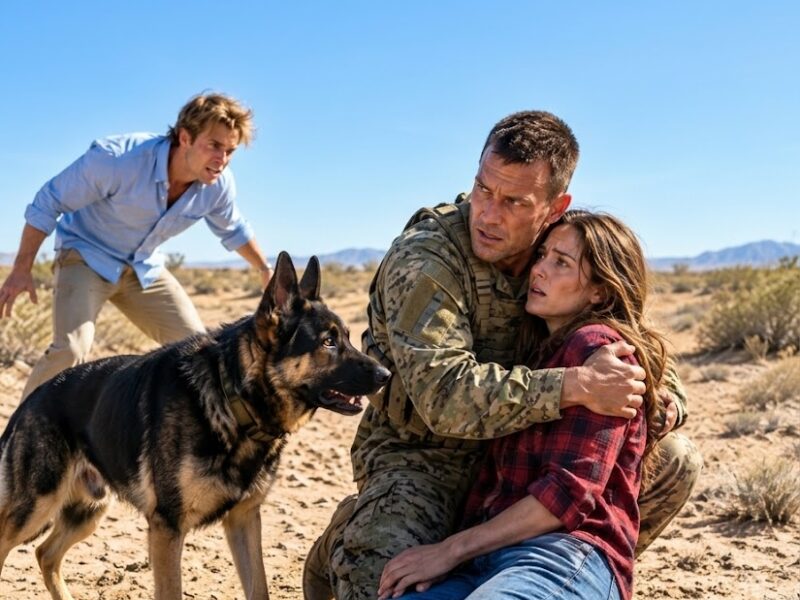
The sheriff’s son shot an innocent woman in broad daylight — he had no idea her husband was a Navy SEAL, or what his dog was about to do.
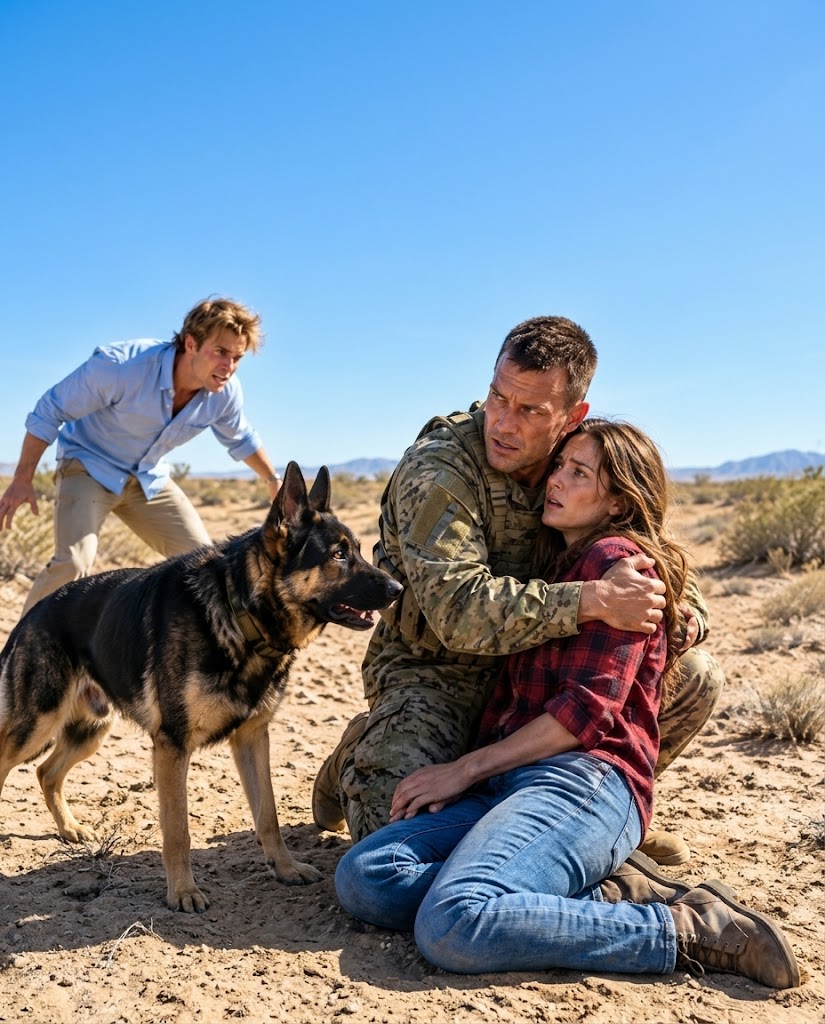
The Arizona desert had no opinion about fair or unfair.
It simply waited.
Troy drove the last tent stake into the cracked earth with a single measured strike, the mallet ringing once against the metal post before he stepped back to survey his work.
He was thirty-eight years old, built like a man who had spent the better part of two decades carrying weight through places most people could not find on a map.
His jaw was tight, his movements deliberate, every action stripped down to what was necessary and nothing more.
A Navy SEAL on approved leave, eight days to do exactly nothing.
He had not figured out how to do that yet.
Alicia sat cross-legged on a folded blanket near the fire ring, threading mesquite kindling into a careful pyramid with the patience of someone who understood that fire, like marriage, required attention before it required fuel.
She wore a dark red flannel shirt, her hair loose around her shoulders, a strand of it catching the last light as she worked.
She had been married to Troy for six years.
She understood his silences.
She was not afraid of them.
Striker sat at the edge of the camp like a sentry no one had posted, a German Shepherd, black and tan, ninety-four pounds of trained muscle and quiet observation.
His ears stood at perfect attention, amber eyes tracking the horizon without urgency, as a professional does.
The Sonoran sun dropped behind the ridgeline and the sky went copper, then violet, then a deep bruised blue.
“It’s quiet out here,” Alicia said, not as a complaint but as a gift.
Troy sat beside her.
“Yeah.”
“You’re actually breathing.”
He looked at her.
“I breathe.”
“You breathe like you’re waiting for something to go wrong.”
She struck the match, and the flame caught, small and certain.
“Not tonight.”
Troy watched the fire take hold, the first curl of smoke rising straight up in the still air.
He put his hand on her knee and left it there.
Striker exhaled and lowered his head to his paws.
They ate without hurry, canned soup heated over the flame, crackers from a Ziploc bag, a shared thermos of coffee that had gone lukewarm an hour ago.
The conversation moved slowly from nothing important to nothing important, the way conversation does when two people have already said the things that matter and are content to let the rest fill the space.
A story Alicia had heard from her sister about a wedding that went sideways.
A memory Troy had of the first time he and Striker ran a training course together four years back, the dog clearing every obstacle without a single repeat command.
Troy had told the trainer that dog wasn’t being trained, he was being confirmed.
The fire popped, sending a spiral of embers into the dark.
Striker raised his head.
Troy noticed.
He did not say anything to Alicia, but he shifted his weight slightly, planting his feet flat on the ground beneath him.
The sound came a few seconds later.
An engine working too hard somewhere to the northwest, moving fast over terrain that demanded slow.
The headlights appeared over a low rise, two white beams bouncing wildly, carving through the brush.
“Company,” Alicia said quietly.
Troy stood.
The truck was a late-model crew cab, lifted, expensive, the kind of vehicle that had never been off pavement until tonight.
It slid sideways in the loose gravel before stopping thirty feet from their fire, killing the engine on a careless skid.
The door swung open hard enough to strain the hinge.
The man who stepped out looked about twenty-two.
His clothes were expensive and wrong for the desert, linen pants, a collared shirt with the sleeves rolled up, leather shoes already ruined by the sand.
He held a bottle of something amber by the neck and moved with the particular confidence of someone who had never once been told no and meant it.
“Hell yes,” he said, raising the bottle toward the firelight.
“I found civilization.”
Troy kept his hands loose at his sides.
“Private camp. You need to turn around.”
The man blinked, processing the words as if they were in a language he had not expected to hear.
His name was Brandon.
He was the only son of Sheriff Roland Vass, the most powerful elected official in Pima County, a man currently running for a seat in the state legislature on a platform of law, order, and personal accountability.
“Turn around.”
Brandon tasted the words like they were funny.
“You know who my dad is?”
“Doesn’t matter out here.”
Brandon’s expression shifted.
The easy grin compressed into something harder, and he was drunk enough that the insult landed clean without the social cushioning that sobriety would have provided.
“Everything matters out here,” Brandon said, taking a step forward.
“My dad owns every deputy from here to the county line. He owns the roads. He owns the air you’re breathing right now.”
He pointed the bottle at Alicia.
“And she doesn’t need to be sitting in the dark with someone boring.”
Striker rose to his feet.
Not a lunge, not a bark, just a slow deliberate standing with full eye contact on Brandon.
Brandon glanced at the dog.
Something flickered behind his eyes.
“Last time,” Troy said.
“Go back to your truck.”
Brandon reached behind his back.
The motion was sloppy, but the intent was not.
He pulled a chrome semi-automatic pistol from his waistband, the kind someone carries for the feeling of it, not for any practiced purpose.
His hand shook slightly.
He jabbed it toward Troy.
“You’re going to tell me what to do?”
His voice cracked on the last word.
Alicia stood.
She raised both hands, palms out.
“We don’t want any trouble. Please, just—”
The gun went off.
It was not intentional.
Even Brandon’s face said so.
The recoil knocked his wrist back and the bottle out of his other hand.
The bottle shattered on a rock.
Brandon stared at the gun.
Then he stared at Alicia.
She had stumbled backward two steps.
Her right hand pressed into the left side of her abdomen, below her ribs.
The flannel shirt began to darken.
Troy moved.
He was already crossing the distance when Brandon scrambled backward toward his truck, eyes white with panic, the gun swinging dangerously.
“My dad,” Brandon shouted, his voice breaking.
“My dad will fix this. Just stay away from me.”
He threw himself into the cab, started the engine, and reversed hard into the dark, fishtailing twice before the tail lights disappeared over the rise.
Troy was already on his knees beside Alicia.
She had not fallen.
She was sitting on the ground, back against the cooler, both hands pressed over the wound.
Her breathing was fast and shallow, the involuntary rhythm of a body processing shock.
“How bad?” she said, not a question exactly, a calibration.
Troy moved her hands gently and cut away the flannel with his multi-tool.
He worked by firelight, examining the entry wound with his fingers.
Left flank, below the floating rib, through and through or close to it.
Bleeding was significant but not arterial.
She was not dying in the next two minutes.
That window could close.
He pulled the trauma kit from the vehicle.
He had packed it the way he packed everything, not hopefully but honestly.
“You’re going to feel pressure,” he said.
“Troy.”
“Eyes open. Talk to me.”
“About what?”
“The house. The one you wanted near Flagstaff.”
She exhaled through her nose.
“It had a porch.”
“Keep talking about the porch.”
He packed the wound.
Alicia’s jaw tightened, and she made a sound she was trying not to make.
Striker pressed his nose into her palm and held it there.
Troy worked fast, controlled bleeding, pressure wrap.
He got a line of her pulse, strong but climbing.
He needed a surgical bay.
He needed it now.
He loaded her into the passenger seat, tilted it back twenty degrees, buckled her carefully.
Striker vaulted into the rear without instruction.
Troy came around the hood, started the engine, and turned for the main access road.
The radio found the frequency seven minutes later.
A recorded alert, cycling every forty-five seconds, flash weather event.
A haboob moving northeast out of Mexico, estimated arrival in the region within the hour.
Wind speeds exceeding sixty miles per hour, zero visibility.
Travelers advised to shelter immediately.
Troy did not change course.
He came over the last rise before the county two-lane highway and stopped hard.
Three cruisers blocked the road, positioned in a deliberate spread.
Not a DUI checkpoint.
The officers behind the doors were in tactical vests with long weapons, their lights off, their faces pointing into the desert.
They were not scanning for traffic.
They were waiting for something to emerge from the brush.
Troy pulled back two hundred yards and cut the headlights.
He had done enough night operations to recognize the difference between law enforcement procedure and a hunting formation.
That was a hunting formation.
His phone rang.
Unknown number.
He answered.
“You see them?”
Brandon’s voice came through flat, the hysteria gone, replaced by something worse.
Calculation.
“County road going north is the same. My dad moved fast. There’s nowhere you can drive out of here.”
Troy said nothing.
“That storm’s going to be here in forty minutes. It’s going to be dark, and it’s going to be ugly, and you’re going to have a dead woman in your front seat when it’s over.”
A pause.
“I didn’t mean for it to happen.”
“I know,” Troy said.
“I’ll remember your voice.”
He ended the call and turned the truck around.
Some storms are weather.
Some storms are cover.
The haboob arrived like a wall.
It did not roll in gradually.
It appeared on the horizon as a vertical brown cliff two thousand feet high, and then it was simply everywhere, a roar of particulate and fury that swallowed the truck and the desert and the sky in under a minute.
Troy stopped the vehicle.
The cruisers behind them would find it.
He had no choice but to abandon it.
He unstrapped Alicia and lifted her carefully from the seat, her arms coming around his neck without being told.
He had the trauma bag across his chest, the sidearm from the center console on his hip, a fixed blade on his belt.
He had a flashlight.
He had Striker.
He kicked the door into the wind and stepped out.
The haboob hit him like a physical thing, a weight that pushed against his chest and filled his mouth with grit before he could draw his first breath.
He pulled his collar over his nose.
Alicia buried her face against his neck.
“Striker,” Troy said, the word barely carried.
The dog was already moving in front of him, head low, using his nose the way Troy used instruments, reading the ground, reading the air, reading what human senses could not access.
The dog did not hesitate at the edge of visibility.
He simply moved forward, trusting his handler to follow.
Troy followed.
He counted his steps.
He measured his breathing.
He calculated their pace against the time Alicia had.
His legs burned.
His lungs worked against the dust.
None of that was relevant.
Pain was information, not instruction.
They had been walking approximately twenty minutes when Striker dropped to his belly without a command.
Troy stopped.
He crouched.
Through the brown dark, three lights moved in a spread.
Not flashlights, tactical spotlights mounted on rail setups moving methodically.
Not stumbling, coordinating with hand signals which Troy could not see but whose results he could infer from the timing of the light movements.
These were not deputies.
He counted three, possibly a fourth concealed.
Troy moved left, putting a dry wash and a cluster of saguaros between himself and the team.
He lowered Alicia to the ground as gently as he could manage.
She was conscious, but only barely.
Her responses reduced to single words.
“Stay low,” he told her.
“Striker,” she whispered.
The dog looked at Troy.
Troy gave a single hand signal.
Striker turned back to Alicia and lay down at her side, pressing his body against hers.
Troy moved into the storm.
What the team had in equipment, they lacked in adaptation.
They had trained in controlled environments.
They were trying to maintain a visual grid in near-zero visibility.
Their formation was too spread to support each other and too close to avoid collateral confusion.
Troy operated as a single variable in an environment that favored ambiguity.
He took the first man from behind.
A controlled choke applied cleanly, and the man went down in eleven seconds.
Troy secured the man’s radio and sidearm.
He left the man breathing, zip-tied face down in the gravel.
The second man turned when the first man’s light went out.
He raised his weapon into the storm and called a name that the wind ate.
Troy came in at an angle, used the man’s own forward momentum against him, and put him down with two strikes.
One to the floating rib, one to the temple.
The man dropped like furniture.
The third man panicked when the second light disappeared.
He swept his rifle barrel in a wide arc, backing toward what he thought was safety.
His boot caught on a root.
He stumbled, went to one knee, and by the time he looked up Troy was already on him.
He did not fight long.
Troy relieved the team of their radios, their water, and a sidearm with a full magazine.
He returned to Alicia.
She was still.
Striker was still beside her, one paw across her forearm.
“Let’s move,” Troy said.
He lifted her again.
The structure emerged from the brown dust like a rumor.
A collapsed ranch outbuilding with three surviving concrete block walls and a tin roof that the wind was slowly separating from its bolts.
It smelled of axle grease and old animal bedding and rot.
It was the most defensible space Troy had seen in forty minutes.
He brought Alicia inside and arranged her in the corner where two solid walls met.
He used his jacket as a pad between her and the concrete.
He checked her wound.
The bleeding had slowed, but the dressing needed replacing.
He worked quietly in the red light of his pocket flashlight, changing the gauze with the last of his sterile supplies.
Alicia’s eyes opened halfway.
“The porch had three steps,” she said.
“Four,” Troy said.
“You counted wrong in the photos.”
“I never count wrong.”
“Stay awake and argue with me about it.”
She almost smiled.
Striker took position at the only opening that faced the storm.
He stood still and breathed the air and waited.
Troy prepared the room the way a man does when he has four rounds, uncertain numbers, and a ground he cannot abandon.
He found an old motor oil drum, rusted through but heavy.
He poured the remaining oil in a wide arc across the entry threshold.
He used collapsed shelving brackets as trip lines at ankle height, set tight across the single interior corridor.
He broke two rusted lantern housings and spread the jagged metal under the window gaps in the east wall.
He was not building a fortress.
He was building a math problem.
The mercenaries arrived in two vehicles.
Matte black, silent, no headlights.
They did not run, they moved from the vehicles in practiced pairs.
Three teams of two flowing toward the structure from three axes simultaneously.
Professional, expensive, not small town.
Striker gave one low rumble, and Troy was already moving to the right side of the threshold.
The first man through the doorway stepped in the oil and went down hard, his weapon skittering sideways across the concrete.
Troy fired once.
The bullet caught the man in the shoulder, and he stayed down, alive but out.
The response was immediate and merciless.
Suppressed automatic fire tore through the tin walls, punching holes in the dark, obliterating the old shelving, sending shrapnel across the room.
Troy hit the floor and crawled.
He checked Alicia.
She was behind the concrete, untouched, still breathing.
“Striker!” he called.
“Street right!”
The dog shot out of the darkness like something fired rather than running.
He hit the second man entering the doorway at forearm height, locking on with the weight of his entire body.
The mercenary screamed and twisted, unable to bring his weapon around.
The third man leveled his gun at Striker.
Troy rose from the floor and fired twice.
Both rounds hit center mass at close range and staggered the man backward through the opening into the storm.
“Striker, return.”
The dog released and vanished back into the interior dark.
Troy took a prisoner the way he took everything else, efficiently.
A man trying to enter through the east window caught the tripwire at the ankle and went face-first into the concrete.
Troy was on him before the man’s hands found purchase.
He secured the man with a belt and checked his neck where the tattoo sat just below his ear.
A stylized double-headed hawk inside a black diamond.
A private military corporation Troy recognized from two separate deployments.
They operated in gray zone contracts.
They completed assignments.
They left no testimony behind.
He put the blade close and asked a single question.
The man answered.
Sheriff Roland Vass had not simply dispatched his own deputies to clean up his son’s mistake.
He had made a call to a number not connected to any official channel and transferred funds that evening.
The mercenary team’s contract covered four targets.
Troy, Alicia, and the dog.
And Brandon.
All four.
Because Brandon was a liability, not a son anymore.
A liability with a face and a criminal act and the capacity to speak.
Vass was eleven days from a primary election.
His entire platform rested on the narrative of his own family as proof of his character.
Brandon, drunk and shooting strangers in the desert, was a story that could not be survived politically.
So Brandon would not survive at all.
The storm would take him.
The same story as the others.
Desert accident, body recovery, brief and tragic news cycle.
Troy stood up.
He had expected corruption.
He had not expected a father doing arithmetic about his son’s life.
Striker was at the east wall, pushing his nose under a gap in the corrugated tin, pulling air into his lungs in deep deliberate pulls.
He made a sound Troy had heard once before, a tight low vocalization the dog used only for blood.
Familiar blood.
Striker was through the gap before Troy could say his name.
Troy went through behind him.
The storm was thinning at its edges now, the worst of it passing east.
Visibility had opened to thirty or forty feet in gusts.
Troy tracked the dog by sound, by shadow, by the intuition that builds over four years of working with the same animal.
Brandon was behind an overturned water tank two hundred yards from the outbuilding.
He was on his hands and knees in the grit, bleeding from his face and one hand.
His expensive clothes in ribbons.
A mercenary stood over him with a suppressed pistol, reciting something in the flat tone of a man completing paperwork.
Troy took the shot from sixty feet.
It was not a kill shot.
It caught the mercenary in the gun hand, spinning him sideways, dropping the weapon.
The man reached for a backup on his thigh.
Troy covered the distance fast and took the backup before the man’s fingers closed on it.
A knee to the back of the knee dropped the mercenary to the ground.
Brandon looked up.
He recognized Troy.
He flinched as if expecting the same.
Troy looked at him for a long moment.
“My wife is bleeding,” Troy said.
“You’re going to carry her the rest of the way. If you drop her, I leave you here. If you run, Striker brings you back. If you try anything else, you already know what I can do.”
Brandon nodded.
He was crying again, the arrogance completely gone, not replaced by anything better, just emptied out.
Raw material, nothing formed yet.
“He sent them for me, too,” Brandon said.
His voice was nothing.
“Yes.”
“He’s my dad.”
Some sentences don’t need an answer.
Troy let that one sit where it landed.
There are things in this world that strip a man down to what he actually is.
Some men discover they are less than they thought.
Occasionally, one discovers something they can still use.
They moved.
Troy on point, Brandon carrying Alicia against his chest, Striker at the rear of the column, close enough to hear every step Brandon took.
The storm had passed.
The desert lay quiet and rearranged under a sky turning gray with early dawn.
The Bureau of Land Management Field Station sat three miles north, a remote satellite post Troy had marked on his topographical map before they left the highway.
The last obstacle was a man in full plate armor carrying a belt-fed weapon.
He stood between them and the station’s perimeter fence, as though he had been placed there to end the equation cleanly.
He may have been.
He had the kind of stillness that comes from finishing contracts without complication.
He raised the weapon and spoke one sentence.
Striker did not wait for a command.
The dog launched from Troy’s left, not at the man, at the weapon.
He hit the barrel at the grip housing with the full weight of his body, wrenching the barrel off its firing line.
The burst stitched a furrow in the desert floor instead of into Troy’s chest.
The mercenary spun, trying to shake the dog free, and in the half second that his attention was divided, Troy closed the distance and drove the man’s weapon arm up and back past the angle at which it would hold.
One controlled break.
The weapon dropped.
The man went to his knees.
It was over in four seconds.
Striker landed hard on his left side and lay still for a moment.
Troy was on his knees beside the dog before the mercenary finished hitting the ground.
He ran his hands along Striker’s ribs.
The dog looked up at him, amber eyes direct and clear.
His tail moved once.
“I know,” Troy said quietly.
“I know. Good boy.”
The soldiers at the field station perimeter had heard the gunfire and were already at the fence in full posture when the three of them emerged from the desert brush.
Troy identified himself before they raised their weapons.
He gave his service number, his unit designation, and his assessment of the situation in under thirty seconds.
An ambulance was rolling within three minutes.
Troy walked beside the stretcher and gave the medics everything they needed.
Wound location, time of injury, blood loss estimate, medications administered, vital signs trend.
He held Alicia’s hand while he talked.
She was not conscious anymore.
Her fingers were cold and still.
He held them anyway.
They took her through the doors of the surgical bay and the doors closed.
Troy stood in the hallway.
He was covered in dust and blood and most of it was not his own.
Striker sat at his feet, leaning his body against Troy’s leg with all his weight, the way he did when he knew the human needed something to push back against.
Brandon sat against the far wall in a chair, both hands on his knees, staring at the floor.
Two military police officers stood near him, but he was not going anywhere.
He had confessed on the walk in, quietly and in sequence, the way a man confesses when the story is already over and all that remains is the saying of it.
He talked for four hours to an FBI field agent who arrived before sunrise.
Seven days later on a bright Tuesday morning in Tucson, Sheriff Roland Vass stood at a podium outside his campaign headquarters speaking into a bank of microphones about values, about community, about the kind of county he wanted to build for the next generation.
The federal vehicles came from three directions at once.
Vass saw them before the crowd did.
His face did not change immediately.
It took three full seconds, time enough for a calculation to run and return no exit before the expression broke.
The lead agent read him his rights against the background of his own campaign banner.
The press photographs showed a man in a tailored suit and handcuffs.
His mouth slightly open.
The banner bright above him.
It ran on every front page that could print it.
In a hospital room with good light and a window facing the Rincon Mountains, Alicia opened her eyes on the fourth morning and found Troy in the chair beside her.
His hand over hers.
He was awake.
He had been awake most of the night as he usually was.
Striker lay on the tile floor with his head on Troy’s boot.
His breathing was slow and even.
The breathing of an animal at rest in a place it trusts.
Alicia looked at the ceiling, then at the window, then at Troy.
“Four steps,” she said.
Troy looked at her.
“The porch. You were right. Four steps.”
She turned her hand over and closed her fingers around his.
“We’re still getting it.”
Troy said nothing.
He did not need to.
Outside, the mountains held their shape in the early light, indifferent and permanent.
The way they had been before any of this happened and the way they would be long after.
The desert does not celebrate survival.
It simply releases you when it is done with you.
This narrator has told stories of people tested by things they did not choose.
What I have come to understand in the telling is that courage is rarely dramatic in the moment it matters.
It is quiet.
It is the next step taken while the body argues against it.
It is a dog who does not wait for a command when a life is in the balance.
It is a man who carries his wife through a storm not because he is certain it will work, but because there is no version of him that puts her down.
May the people you love have someone willing to carry them.
And may you be that someone for someone else.









