
The Salon Owner Fired a Black Barber for Helping a Homeless Man—Unaware the Stranger Controlled the Salon’s Future
The fluorescent lights of Maison Delphine hummed like a trapped insect against the polished marble floor.
Delphine Carr stood behind her reception desk, her manicured finger tapping an impatient rhythm on the granite countertop.
It was 8:58 PM on a Thursday, two minutes before closing, and the last thing she needed was a problem.
Through the glass storefront, she watched the city’s evening foot traffic thin out—consultants in loosened ties, tourists clutching shopping bags, a woman walking three dogs at once.
Then her eyes landed on the figure shuffling toward her door.
A Black man, older, wearing a threadbare coat that had seen better decades, carrying a battered paperback book.
He pushed the door open with a soft chime.
“I’m sorry, I will move,” he said quietly, his voice rough like gravel worn smooth by rain. “I just needed somewhere quiet to read.”
Delphine’s jaw tightened.
This was a high-end salon, not a public library, and her clients paid $200 for a cut—they didn’t pay to sit next to men who smelled like the alley behind the building.
Before she could speak, her barber Jonah stepped forward from his station near the window.
“You’re fine,” Jonah said, gesturing to the empty chair beside him. “Sit. What are you reading?”
The man hesitated, then lowered himself into the chair as if it might collapse beneath him.
“A job interview,” he said. “Tomorrow morning. General manager of a hotel.”
Jonah whistled low, running a comb through his fingers. “That’s a big job.”
The man gave a hollow laugh. “I know. Look at me. They’ll never get past the beard.”
He rubbed his jaw, where two years of stubble had grown into something wild and untamed.
“I ran hotels for twelve years,” he continued, staring at the floor. “Then the company folded and the bills took the rest.”
He paused, swallowing hard. “My daughter lives with my sister until I have an address.”
Delphine watched the exchange from her desk, her arms crossed tightly over her chest.
She didn’t care about the man’s sob story—everyone in this city had one.
What she cared about was the clock on the wall ticking toward 9:00 PM and the fact that Jonah was now offering this stranger his chair.
“Come inside,” Jonah said, pulling his clippers from the drawer. “My shift is over, but my chair is mine for one more hour.”
The man’s eyes widened. “I can’t pay you.”
Jonah shook his head, plugging in his clippers. “My father never asked. Neither do I.”
Delphine felt her blood pressure spike.
Jonah was a good barber—one of the best she’d ever hired—but he had this bleeding-heart problem that was going to get them both in trouble.
“Jonah,” she called out, her voice sharp as a blade. “The VIP night starts at 9:00. If Delphine sees this—”
She caught herself, realizing she was talking about herself in the third person, a habit she hated.
“—then I’ll be done by 9:00,” Jonah finished for her, already draping a cape over the man’s shoulders.
The stranger looked at Jonah with something between gratitude and disbelief. “I haven’t looked in a mirror in two years.”
Jonah picked up his scissors, the silver blades catching the light. “Then let’s give you something worth looking at.”
He smiled—that easy, warm smile that made clients trust him with their teenage sons and their wedding days.
“My father said a good haircut is the one thing you can wear into any room.”
The man’s voice cracked. “Your father sounds like a wise man.”
Jonah began to work, his hands moving with the practiced rhythm of someone who had been cutting hair since he was a boy.
The clippers buzzed, the scissors snipped, and slowly, the wild beard began to disappear.
Delphine watched from her desk, her anger simmering like a pot about to boil over.
She checked her phone—9:02 PM.
The VIP clients would be arriving any minute for the evening’s event, a champagne reception for her most loyal customers.
They would walk in and see a homeless man in her salon’s chair, hair clippings dusting the floor around him like snow.
This was not the image she had built.
This was not Maison Delphine.
At 9:15 PM, Jonah stepped back from his work, his brow dotted with sweat.
“Mr. Hail,” he said, turning the chair toward the mirror, “you clean up nice.”
The man—Mr. Hail—stared at his reflection as if seeing a ghost.
The beard was gone, replaced by a clean, sharp jawline that spoke of authority and experience.
His hair was trimmed close, professional, the kind of cut that said “hire me” without saying a word.
He gasped, his hand flying to his mouth.
“Almost done,” Jonah said, picking up a straight razor. “Just the lineup left.”
The bell above the door chimed.
Delphine’s heart dropped into her stomach.
Three of her VIP clients—Mrs. Ashworth, Mrs. Pendleton, and a woman whose name she could never remember—stood in the doorway, their designer purses clutched tightly to their sides.
Their eyes moved from Delphine’s pale face to Jonah’s workstation to the stranger in the chair.
“Why is the light on in the back?” Mrs. Ashworth asked, her voice dripping with suspicion.
Delphine opened her mouth, but no words came out.
“Jonah,” she finally managed, her voice trembling with rage, “who is that in my chair?”
Jonah didn’t look up from his work. “A friend. I’m off the clock. My clippers, my time.”
Delphine’s laugh was sharp and humorless. “Your time ends when you walk out my door.”
One of the VIP clients—the one whose name Delphine couldn’t remember—squinted at Mr. Hail.
“Wait,” she said, “is that the guy from the alley?”
Another client snorted, her nose wrinkling. “Oh, now I know why it smells like the alley in here.”
Laughter rippled through the group, and Delphine felt a cold satisfaction settle in her chest.
The VIP clients were on her side—of course they were.
They had money, they had power, and they had no patience for the kind of charity Jonah was trying to hand out in her salon.
Jonah finished the lineup, wiped the razor clean, and stepped back.
“Got it,” he said, his voice quiet but steady. “Every bit of it.”
He looked at Delphine, then at the clients.
“Ma’am,” he said, addressing Mrs. Ashworth directly, “I apologize for the trouble. I have a job interview in the morning.”
Delphine’s eyes narrowed. “An interview for what? Sweeping the lobby?”
The clients giggled, and Delphine felt a flare of triumph.
“General manager at Hmer Hotels,” Jonah said, and the room went silent.
Mrs. Pendleton let out a laugh that was more of a bark. “Rory, did you hear that?”
Rory—the client whose name Delphine had forgotten—nodded, her lips curling into a sneer.
“The alley wants to run a hotel.”
Another client clapped her hands together. “Finally, some entertainment.”
The group dissolved into laughter, and Delphine felt the tension in her shoulders begin to ease.
This was how it was supposed to be—her clients, her salon, her rules.
Then Mr. Hail stood up, and the laughter died in everyone’s throats.
He was tall, much taller than he had looked slumped in the chair, and the haircut had transformed him from a broken man into someone who looked like he could command a room.
“Excuse me,” he said, his voice calm and measured. “My only shirt for tomorrow, please.”
He gestured toward the pile of clothes Jonah had set aside—a worn, wrinkled button-down that had seen better days.
One of the clients picked it up with two fingers, holding it away from her body like it was contaminated.
“Cu-te,” she said, drawing out the word. “It still has the thrift store tag.”
Delphine’s patience snapped.
“My chairs are for clients,” she said, her voice rising. “Not charity cases.”
She turned to Jonah, her eyes blazing. “Jonah, wash that chair.”
Jonah stood frozen, his clippers still in his hand.
“The chair is clean, Delphine,” he said quietly. “So is he.”
He looked at her, and for the first time, she saw something in his eyes that she had never seen before—defiance.
“You want him clean, Jonah?” Delphine said, her voice dangerously low. “Let me help.”
She grabbed a towel from the shelf and walked toward Mr. Hail, her heels clicking like a countdown.
“Delphine, don’t—” Jonah started.
But it was too late.
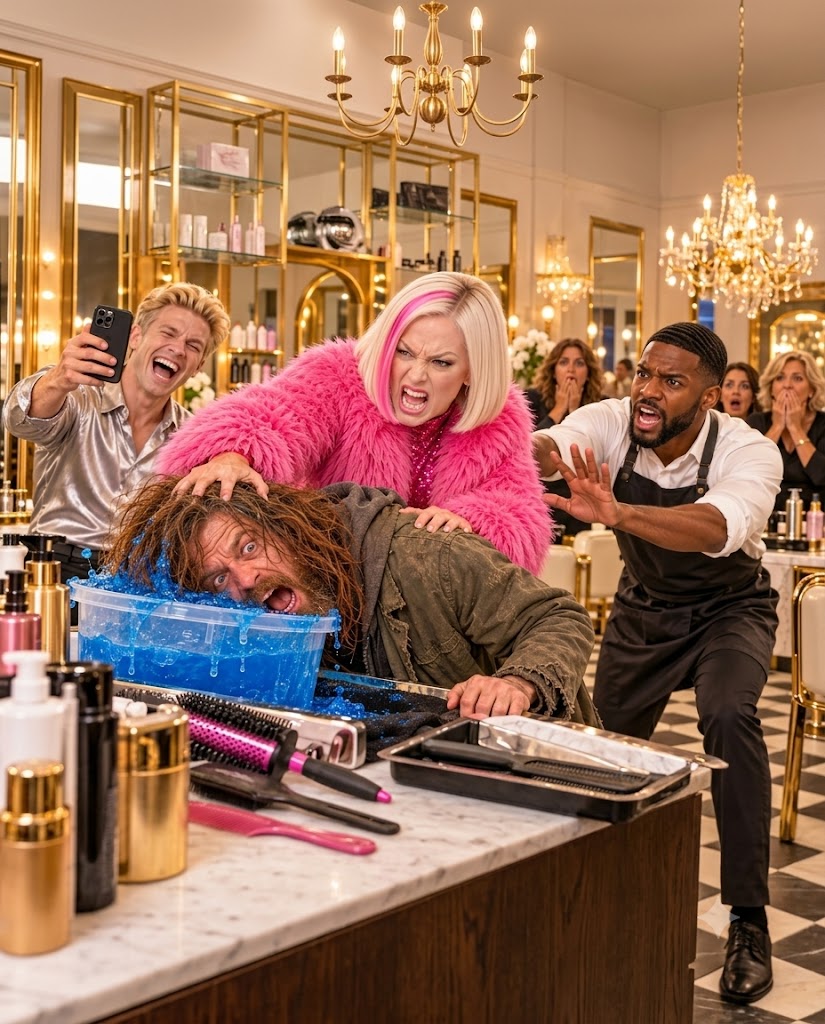
She poured the water over Mr. Hail’s head, the clear liquid streaming down his freshly cut hair, soaking the collar of his shirt, dripping onto the floor.
“There,” she said, her voice cold as ice. “Now you’re clean.”
The room was dead silent.
Mr. Hail sat motionless, water dripping from his chin, his eyes fixed on some point in the middle distance.
Jonah’s face was pale, his hands shaking.
“Delphine,” he whispered, “that was too far.”
The client named Rory—the one who had filmed everything, Delphine realized with a start—took a step back, her phone still raised.
“Delphine,” Rory said, her voice uncertain, “that was too far.”
Delphine whirled on her. “Emani, one more word and you can leave with them.”
The threat hung in the air like smoke.
Jonah removed his apron slowly, deliberately, and set it on his station.
“Thank you for the towel, Jonah,” Mr. Hail said, his voice hoarse but steady.
Jonah nodded, his jaw tight. “Jonah, you’re done here,” Delphine said, her voice cracking. “Leave the apron and the key.”
She pointed at the door. “And take your little stick with you.”
She meant the comb—the cheap plastic comb Jonah always carried in his pocket.
“Out,” she said. “Both of you.”
Jonah picked up his comb and walked toward the door, his head held high.
Mr. Hail followed, water still dripping from his hair, his worn shirt clutched in his hands.
At the door, Jonah turned back.
“Water dries, Delphine,” he said quietly. “What you did tonight will not.”
The door chimed as it closed behind them.
Delphine stood alone in her salon, surrounded by her VIP clients, and for the first time in years, she felt something she had almost forgotten how to feel.
She felt small.
Outside, the night air was cold and sharp, cutting through Jonah’s thin jacket like a knife.
He and Mr. Hail stood on the sidewalk, the sounds of the city swirling around them—car horns, distant sirens, the thrum of a bass line from a nearby club.
“I’m sorry,” Mr. Hail said, his voice barely above a whisper. “I didn’t mean to—”
Jonah shook his head. “Don’t. This isn’t your fault.”
He looked down at the comb in his hand, the cheap plastic teeth worn smooth from years of use.
“My only shirt,” he said, more to himself than to Mr. Hail. “The interview is in ten hours.”
Mr. Hail’s eyes widened. “And you lost your job because of me?”
Jonah looked up, and his smile was tired but genuine. “No. I lost it because I would do it again.”
He paused, studying Mr. Hail’s face. “What size shirt do you wear?”
“Sixteen neck,” Mr. Hail said, confused. “Why?”
Jonah nodded, as if he had expected that answer. “Because I own exactly one good shirt. Come on.”
He started walking, and Mr. Hail had no choice but to follow.
They walked for ten minutes, past closed storefronts and darkened office buildings, until they reached a narrow alley tucked between a laundromat and a pawn shop.
At the end of the alley was a small, cluttered space—a makeshift barber shop, really, with a single chair, a cracked mirror, and a shelf of mismatched supplies.
“Merits,” Mr. Hail said, reading the faded sign above the door. “This was your father’s shop.”
Jonah nodded, running his hand along the worn counter. “Thirty years on the same corner. Then the rent tripled.”
He picked up a pair of old scissors, turning them over in his hands. “He still cut hair for free every Sunday night right up to the last one.”
Mr. Hail looked around the small space, at the photographs on the wall—a young Jonah, a man who must have been his father, a series of customers whose smiles had faded with time.
“He gave me this comb the morning they locked the door,” Jonah said, holding up the plastic comb.
“What did he say when he gave it to you?” Mr. Hail asked.
Jonah’s voice was soft, reverent. “He said, ‘Hands are for helping, son. The rest is just hair.'”
Mr. Hail was quiet for a moment. “Why are you doing all this for a stranger?”
Jonah looked at him, and his eyes were bright with unshed tears. “Somebody did it for my father once. I’m just passing it on.”
He reached into a cabinet and pulled out a shirt—a crisp white button-down, still in its packaging.
“Here,” he said, handing it to Mr. Hail. “It’s the only good shirt I own. But you need it more than I do.”
Mr. Hail took the shirt, his hands trembling. “I can’t—”
“You can,” Jonah said firmly. “And you will.”
He picked up the comb again, pressing it into Mr. Hail’s palm.
“Take it for luck. Bring it back to me.”
Mr. Hail looked down at the comb, then up at Jonah. “I will bring it back. I promise.”
Jonah smiled, and for a moment, the weight of the night seemed to lift.
“Go get your job,” he said. “And wear your best shirt.”
Mr. Hail laughed—a real laugh, the first one Jonah had heard from him all night. “I gave you my best shirt.”
Jonah shrugged. “Then I’ll bring you a better one.”
The next morning, Mr. Hail walked into the offices of Harrow Hotels wearing Jonah’s white shirt and a confidence he hadn’t felt in two years.
The interview was grueling—question after question about his experience, his failures, his plans for the future.
And then, the final question.
“Mr. Hail,” the interviewer said, leaning forward, “your resume stops two years ago. What happened?”
Mr. Hail didn’t flinch. “I lost everything two years ago. I spent those years in your city’s alleys.”
The interviewer’s eyebrows rose. “Then tell me why I should trust you with my hotel.”
Mr. Hail thought about Jonah, about the towel, about the comb in his pocket.
“Because I know what it is to be walked out of a building,” he said. “My staff will never do that to anyone. Not on my watch.”
The interviewer was silent for a long moment.
“Last question,” he said. “Who cut your hair?”
Mr. Hail smiled. “A barber who lost his job for doing it.”
The interviewer—a man named Gideon Harrow, Mr. Hail would later learn—leaned back in his chair.
“Jonah,” he said, and Mr. Hail’s heart stopped. “I got it. I knew it.”
Mr. Hail stared at him. “You know Jonah?”
Gideon laughed. “I’ve known Jonah for years. He cut my hair when I was a kid, before his father’s shop closed.”
He stood up, extending his hand. “The job is yours, Mr. Hail. And I have a feeling Jonah is going to be needing a new chair soon.”
Meanwhile, back at Maison Delphine, Delphine was staring at her phone in horror.
Rory had posted the video—all of it, from the moment Mr. Hail walked in to the moment Delphine poured water over his head.
The video had gone viral.
Three million views in twelve hours.
Her clients were canceling. Her reputation was in shambles.
“Then we tell our side,” Delphine said, her voice desperate. “That man was aggressive. He scared my customers, and my barber let him use my chair without paying.”
Jonah’s face appeared on the screen—someone had tagged him in the comments, and he had responded.
“She’s lying, Jonah,” Delphine said to the empty salon. “And she knows it.”
But the truth didn’t need a ring light.
The next day, a woman named Miss Harrow walked into Maison Delphine with a video on her phone.
“Miss Harrow,” Delphine said, her voice trembling. “Before I sign anything, there’s a video you should see.”
She played the video—the one Rory had filmed, the one that showed everything.
Miss Harrow watched in silence, her expression unreadable.
“He poured that on you,” she said finally.
Mr. Hail—no, Gideon Hail—shook his head. “On the man I was. The man I am still remembers.”
Miss Harrow nodded slowly. “Then it’s your building, Mr. Hail. Your call.”
Delphine’s blood ran cold. “Your building?”
Gideon Hail turned to her, and his eyes were not angry—they were sad.
“You asked for ten more years, Delphine, and the whole arcade,” he said. “But the lease for Maison Delphine will not be renewed. You have thirty days.”
Delphine felt the floor drop out from under her. “Please, Mr. Hail, this salon is my whole life.”
Gideon looked at her, and for a moment, she saw something flicker in his eyes—understanding, maybe, or pity.
“I know what losing everything feels like,” he said quietly. “I hope you learn faster than I did.”
He reached into his pocket and pulled out a small, plastic comb.
“I borrowed this for luck,” he said, handing it to Jonah, who had appeared in the doorway behind him. “Here it is. Right where she dropped it.”
Jonah took the comb, his fingers closing around it like a lifeline.
“Your father was right, Jonah,” Gideon said. “Hands are for helping.”
He turned to leave, then paused.
“Mr. Merrick,” he said, addressing a man who had been standing quietly in the corner—the owner of the building next door. “The corner space on Fifth Street is empty. We’d like a barber shop there.”
Merrick’s eyebrows rose. “A barber shop?”
Gideon nodded. “With your name on the glass. Partners.”
Merrick looked at Jonah, then back at Gideon. “I can’t afford that rent.”
Gideon smiled. “Your first year is paid. You paid it the night you cut my hair.”
The room was silent.
Then Jonah laughed—a real laugh, the kind that came from somewhere deep in his chest.
“Happy opening day, partner,” he said, and Gideon clapped him on the shoulder.
The months that followed were a blur.
The new barber shop—Merits, they called it, after Jonah’s father—opened on Fifth Street to a line of customers that stretched around the block.
Gideon Hail, now the general manager of Hmer Hotels, was a regular, sitting in Jonah’s chair every two weeks for a trim and a conversation.
Delphine Carr, meanwhile, watched from across the street as her former barber became the most sought-after stylist in the city.
She had tried to fight the eviction, but the video—that awful, viral video—had sealed her fate.
Her clients had abandoned her, her reputation was ruined, and her salon was now a pop-up shop for a vegan candle company.
One day, she walked into Merits, her head held low.
“I came to say I’m sorry,” she said, her voice barely above a whisper. “Not for the lease—for what I did to him.”
Jonah looked up from his client, his scissors paused mid-snip.
“The chair is clean,” he said, gesturing to the empty seat beside him. “Delphine, sit down.”
She sat, and for the first time in years, she felt the weight of her actions settle on her shoulders.
“I have an address now,” Jonah said, returning to his work. “My daughter moved in on Sunday.”
Delphine looked at him, confused. “Your daughter?”
Jonah smiled. “She needs a dad with a fresh cut. Sit. Same chair, different ending.”
Delphine sat, and as Jonah’s scissors began to snip, she felt something she hadn’t felt in a long time.
She felt forgiven.
One year later, Merits was named Small Business of the Year by the city’s chamber of commerce.
The award came with a $10,000 prize and a feature in the local paper.
Jonah accepted the award with Gideon by his side, the plastic comb tucked into his pocket like a talisman.
“Four hundred free haircuts,” he said into the microphone, and the crowd laughed.
“Four hundred and twelve,” Gideon corrected, and the crowd laughed harder.
“One year ago,” Jonah continued, his voice thick with emotion, “a barber let a stranger sit in his chair after closing. It cost him his job.”
He paused, looking out at the audience.
“It gave me my life back.”
He looked at Gideon, who was standing in the front row, his eyes bright with tears.
“You never needed a chair, Gideon,” Jonah said. “You needed someone to see you.”
The applause was deafening.
Later that night, after the ceremony, Jonah stood alone in his shop, the award sitting on the counter beside his father’s old scissors.
The bell above the door chimed.
A young man walked in, his clothes worn, his eyes tired.
“Come in,” Jonah said, gesturing to the chair. “Do you have somewhere to be tomorrow?”
The young man shook his head.
“Sit down,” Jonah said, picking up his comb. “Tonight, this chair is yours.”
He smiled, and for a moment, he could hear his father’s voice.
Hands are for helping, son.
The rest is just hair.
Right here.
Yeah.









