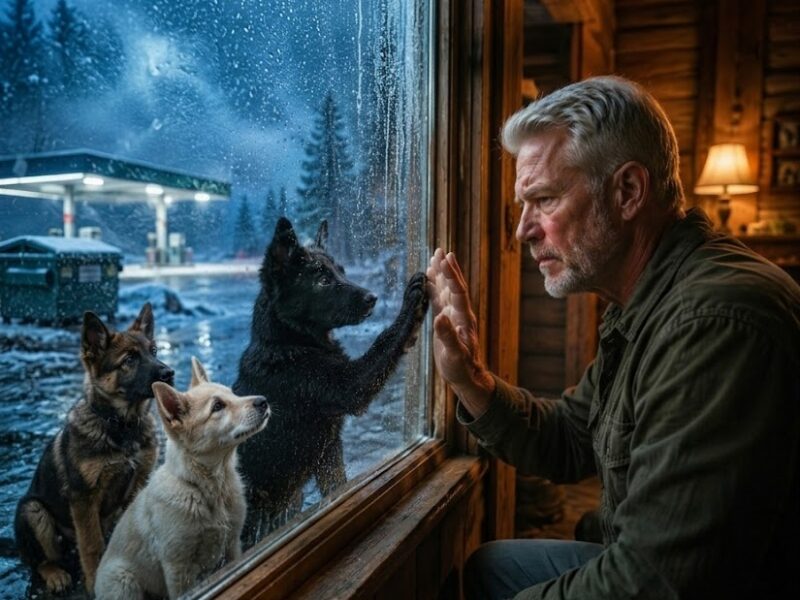
The Retired Navy SEAL Wanted to Feel Nothing—Then God Sent Him Three German Shepherds to Break His Heart Open
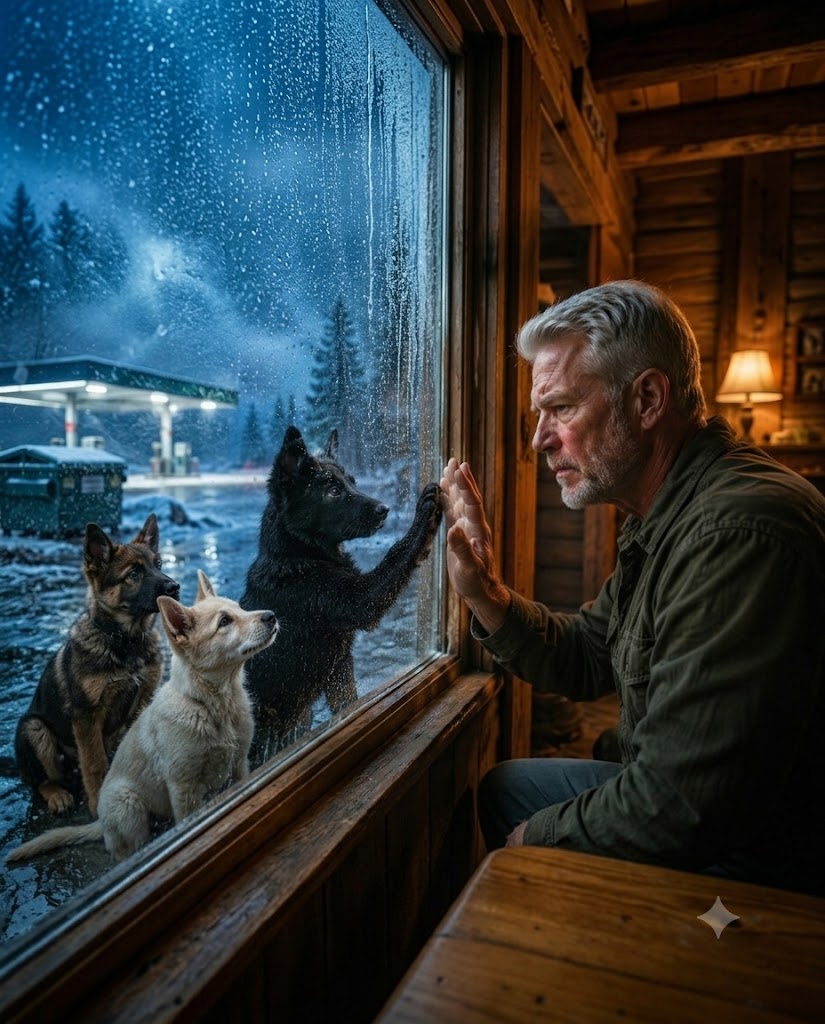
He had trained himself not to look at working dogs.
Not at the Belgian Malinois that swept through airport terminals with their handlers, not at the German Shepherds trotting beside police cruisers on Saturday mornings.
Not at the photographs his former teammates posted of their own dogs, civilian dogs, soft-bellied and couch-comfortable, with captions like “Life is good” and “Never alone.”
Grady Lusk had spent the better part of two years building that discipline, and for the most part it had held.
He lived alone in a cedar cabin at the edge of the Ozark Hills in southern Missouri, far enough from town that working dogs weren’t much of a concern, and close enough to the ridge line that the sound of wind through the pine brakes could, on the right kind of evening, sound almost like something breathing beside him.
That was close enough to company.
It had to be.
Grady was 56 years old.
He stood six feet and a quarter inch, though he no longer bothered saying the quarter, and he had the kind of build that didn’t advertise itself.
Wide through the chest, heavy in the hands, a stillness in the shoulders that came from having learned long ago that the men who fidgeted in dangerous rooms were the ones who didn’t walk out of them.
His dark brown hair had gone silver at the temples, and salt and pepper at the jaw.
A burned scar ran from behind his left ear down along the side of his neck, disappearing beneath his collar.
He rarely thought about it.
When he did, he thought about Arrow.
Arrow had been a Belgian Malinois, 68 pounds of copper and black intelligence, with amber eyes that could track movement in pitch dark, and ears that never missed a sound they weren’t supposed to.
He had been assigned to Grady in the third year of Grady’s second decade of service.
And in the four years they had worked together, Arrow had found 11 IEDs, cleared 14 structures, and once sat with Grady for six hours in a drainage ditch during a communications blackout, perfectly still, perfectly patient, so close that Grady could feel the dog’s warmth against his arm.
Arrow had trusted him the way very few people ever had, completely without condition.
On a Tuesday in late October, in a village whose name Grady no longer spoke aloud, a burning building had been full of sound.
Shouts from inside, the crack of timber, the specific hollow roar of a structure deciding to come down.
Arrow had gone in before Grady could give the command.
He had pulled a wounded Marine by the sleeve through a doorway that collapsed 11 seconds later.
Arrow had not come back out.
Grady came home.
Arrow did not.
There had been a commendation, a ceremony, words spoken by men with clean uniforms who had never been in a drainage ditch at 3:00 a.m. listening to a dog breathe.
Grady shook their hands, said the right things, and drove home.
He stood in his driveway for a long time, looking at the door.
Then he went inside and began quietly and deliberately to learn how to become a man who needed nothing.
He was, by most external measures, successful at it.
The cabin was spare and ordered, a military habit he couldn’t shake and no longer tried to.
He kept the woodpile stacked, the generator maintained, the road graded after storms.
He drove into Branson once a week for supplies and spoke to people the way a man speaks who has not lost the skill, only the appetite.
His neighbor, Opal Kinsey, a 70-year-old widow who lived two miles down the gravel road and ran a small goat operation with the stubbornness of a woman who had outlasted two husbands and one county government, brought him cornbread occasionally and accepted nothing in return.
She was the only person in his life he didn’t feel he owed something to.
He told himself he was fine.
He had been fine for 22 months.
When the ice storm came down from the north on a Thursday in February, glazing the roads and turning the valley into something that looked beautiful from inside and deadly from outside, Grady had been coming back from Branson, a bag of supplies on the passenger seat, the heater working reluctantly.
He stopped at the Crossroads Fuel station on Highway 160, the last one before the long pull up into the hills, and climbed out to fill the tank.
He almost didn’t see the box.
It was wedged between the dumpster and the cinder block wall on the far side of the lot, half collapsed under the weight of ice.
A strip of packing tape gone slack across the top.
He would have missed it entirely if one of the puppies hadn’t cried.
The sound was thin and high and nearly swallowed by the wind, and Grady’s body responded before his mind could argue.
His head turned, his feet moved.
He crossed the lot, telling himself it was nothing, a cat, a bird, something that wasn’t his responsibility on a night when the roads were already getting bad, and the smart thing was to get home.
He pulled back the flap of the box.
Three German Shepherd puppies lay curled against each other, five or six weeks old at most.
The sable one was the largest, broad through the head already, his back paws oversized, his coat thick and dark.
He was shivering in steady waves, but his eyes were open and alert.
The black one, a female with a narrow muzzle and amber eyes that caught the gas station light with strange intensity, lay perfectly still in a way that wasn’t sleep.
The third was white, cream white, pale as February, the smallest of the three by a significant margin.
She was the one who had made the sound.
She was also the one who was in the most trouble.
Her tiny body trembled in broken intervals.
Her nose was cold and dry.
And when she opened her eyes and found Grady’s face above her, she made the sound again.
Not a bark, not even truly a cry.
It was smaller than that.
A question, maybe.
Are you going to help or not?
German Shepherds.
Grady stood up straight.
He looked at them.
He looked at the highway.
The ice was getting worse.
He could hear it ticking against the metal awning above the pumps.
He thought about Arrow in a drainage ditch.
Arrow’s breath against his arm.
Arrow running into a burning doorway and not coming back out.
Working dogs, he thought.
Creatures who gave everything to a person and trusted that the person could bear the weight of it.
He pulled the box flap shut and walked back to his truck.
He got behind the wheel.
He sat there 53 seconds.
He got out of the truck, went back to the box, and put all three puppies inside his coat.
The cabin was warm when he got there.
Grady sat them on the floor near the wood stove on a folded moving blanket and stood back and looked at them the way a man looks at a decision he already knows he’ll have to live with.
The sable male immediately rolled to his feet and pressed his nose against Grady’s boot.
The black female watched from the blanket with those amber eyes, cataloging everything.
The white runt lay where he’d put her, still shivering, her breathing shallow enough to worry.
He didn’t have puppy formula.
He had evaporated milk, a turkey baster, and a memory of a canine handler named Specialist Okafor, who had once kept a litter of orphan shepherd pups alive in a forward operating base using improvised means and the stubborn refusal to accept a different outcome.
Grady warmed the milk, fed the sable male first.
The pup latched onto the baster and sucked so hard he made a sound that was almost comic, a tiny growl of pure determination.
Grady almost smiled.
“You’ve got opinions,” he said.
“I’ll call you Bolt.”
He fed the black female second.
She accepted the milk with quiet precision and then looked at him afterward as if filing the information away for some future use that hadn’t been determined yet.
“Shadow,” he said.
“Fits.”
The white runt was last.
She barely swallowed the first few drops.
Grady worked at it for nearly half an hour, a single drop at a time.
The turkey baster held steady in his scarred hands, the pup’s lips barely moving.
Her breathing was the kind of thin that made a man count intervals.
He pressed two fingers to her chest.
Her heart beat lightly, rapidly, like something trying to stay lit in the wind.
“Don’t quit on me,” he said.
His voice came out rougher than he expected.
“You’re the one who made me stop.”
He did not name her that night.
The name felt like a promise, and Grady had learned to be careful about those.
He sat in the armchair with the white pup laid against his bare chest under his flannel shirt, her cold belly against the warmth of his skin, and told himself it was only biology.
The same calculation he would have made for any hypothermic patient in the field.
He told himself this while he breathed slowly and deliberately, making himself into a living furnace, and felt the tiny heartbeat against his ribs gradually grow steadier and more sure.
Sometime around 2:00 a.m., the white pup pressed her nose into the hollow of his collarbone and exhaled.
The long, soft exhale of something that has decided to stay.
“Light,” he said quietly.
He hadn’t planned it.
The name had arrived on its own, the way things do when they’re true.
It settled like it had always been hers.
Spring came to the Ozarks slowly that year.
By the time Light, Bolt, and Shadow were four months old, the cabin had ceased to be a silent place.
Bolt had decided that the lower shelf of the bookcase was an enemy position and dismantled it across three mornings with focused, joyful violence.
Shadow had learned to open the screen door by pressing the latch with her nose, silently, which Grady only discovered when he looked up from reading to find the door swinging in the evening breeze and Shadow sitting politely on the porch, watching the field with the satisfied expression of a dog who has solved an interesting problem.
Light had developed the habit of stealing one boot, never both, always one, and carrying it to whatever patch of sunlight she had claimed that hour, where she lay on it with the solemn expression of a creature keeping something safe.
Grady told himself this was temporary.
He said it while fishing his right boot from beneath the kitchen table.
He said it while pressing Bolt’s hindquarters to the floor for the 11th sit-stay of the afternoon, the sable pup vibrating with the physical effort of holding still while every instinct screamed that the yard existed to be run across.
He said it while watching Shadow stand motionless at the treeline for three full minutes, ears forward, reading something in the air he couldn’t hear.
What he did not say, not out loud, not even to Opal Kinsey when she came by in May with a jar of blackberry preserves and stood on his porch looking at the three half-grown shepherds wrestling in the yard with the satisfied expression of a woman who has been right about something, what he did not say was that the silence inside the cabin was different now.
Not empty.
Occupied.
The way a house feels different when people are sleeping in it, even if no one is making any sound.
He wasn’t ready to say what that meant.
Arrow’s field vest still hung on a peg near the mudroom door.
Dark green, worn, the Velcro tab soft from years of use.
A small embroidered patch on the chest bearing Arrow’s service number.
Grady never touched it.
He never looked at it for long.
It had become part of the wall, the way some things do, present without being acknowledged, like a wound that has healed around the pain instead of through it.
The morning Bolt found it was a Saturday in early June.
Grady had been splitting wood behind the cabin.
When he came inside to wash his hands, Bolt was standing in the center of the mudroom with the vest hanging from his teeth.
The Velcro strap caught on his lower jaw, his tail wagging with the triumphant energy of a dog who has located a prize of unknowable significance.
Shadow sat in the doorway watching.
Light sat two feet to Bolt’s left, looking at Grady’s face.
The Velcro pulled free.
The vest swung.
The embroidered patch caught the light.
Grady did not move for several seconds.
Inside the stillness, something made a sound he couldn’t name.
Not a feeling exactly, more like a door opening in a room he hadn’t entered in a long time.
The air behind it old and cold and full.
“Drop it,” he said.
His voice was flat.
Bolt wagged harder, misreading the tone.
He had done this before with a dish towel and received a laugh, which had taught him that stolen things were funny.
“Drop it,” Grady said, harder.
Bolt dropped the vest and stepped back, uncertain.
Shadow’s ears angled back.
Light flattened herself low.
Grady picked the vest up.
His hands did not shake.
He was very careful about his hands.
He hung it back on the peg.
He turned to the three dogs.
“You don’t touch that.”
He knew they didn’t understand the words.
He said them anyway.
“You don’t ever touch that.”
He pointed to the back door.
“Out. All of you.”
He waited until they were in the yard.
Then he stood at the kitchen counter with his palms flat on the wood and breathed until the door in the old room closed again.
He told himself he felt better.
He didn’t.
The storm that moved through that evening was the electrical kind.
Quick and loud, cracking the sky over the ridge and blinding white seams.
Grady had been inside a book he hadn’t been reading on his knee when he remembered the dogs were in the yard.
He went to the window.
Bolt was at the edge of the porch facing the treeline, his sable coat dark with rain, his ears sharp.
Shadow was three feet to his right, her body angled toward the field.
Light sat closest to the window, closest to Grady, and when the lightning came again, illuminating the yard in cold silver, he could see she was shaking.
Not from cold.
From the sound.
Light had never liked loud noises.
She pressed close to his leg when trucks backfired on the highway, tucked her chin when anything cracked too suddenly.
She was shaking, and she was still sitting there.
They were all still sitting there.
They were not scratching at the door.
They were not howling or cowering.
They were sitting in the rain in the yard of a man who had pointed at them and told them to get out, and they were facing outward.
Bolt watching the trees.
Shadow watching the field.
Light watching Grady through the glass, her pale eyes finding him exactly where he stood.
She was guarding him.
They all were.
Grady’s throat closed.
He stood there in the warm cabin with the light behind him and the rain coming down in sheets, and he watched three dogs hold their post in a storm for a man who had been angry at an old vest, and something he had kept very carefully in place for two years came loose without making a sound.
He opened the door inside.
“Come on. Right now. Get in here.”
They came in fast, Bolt first, shedding water in great arcs, Shadow behind him, Light last and smallest, her cream coat soaked dark, her body still trembling from the thunder.
She looked up at Grady when she crossed the threshold, and he dropped to one knee on the wet floor and put his arms around all three of them at once.
It was not something he had planned.
The body sometimes knows what the mind is still arguing about.
“I’m sorry,” he said into the wet fur.
“I’m sorry I sent you out.”
None of them moved away.
By late summer, the three dogs were old enough to run the property lines with him in the mornings, both ranging wide and fast, always circling back.
Shadow kept pace on the left like a shadow that had decided to walk alongside instead of behind.
Light matched his steps on the right, her hip against his leg on the downhill stretches, steady as a rail.
It was during one of those mornings in August, on the far side of the ridge where the old fence line crossed a limestone creek, that Grady missed a step on a rain-slick rock and went down hard.
He knew immediately it was bad.
Not broken, but his lower back, where a compression injury from a water jump in 2014 had never fully healed, fired white and absolute.
He went to hands and knees and stayed there.
The world narrowed to the sound of the creek and the gravel biting into his palms and the particular humiliation of a man who had survived combat realizing that a wet rock in a Missouri creek had put him down.
He couldn’t stand.
He tried twice.
The third attempt, his right leg buckled.
Bolt was there first.
The sable dog shoved his broad head under Grady’s arm and leaned, not pulling, just leaning, offering his body as a counterweight.
Shadow arrived at his left side a second later and did the same.
Light pressed herself against his back, low and steady, a warm anchor.
“I’m fine,” Grady said.
None of them believed him.
He made it home in 45 minutes, which should have been 12.
He made it because Bolt walked beside him on the bad side and bore weight when Grady leaned, and Shadow kept herself just ahead on the trail, picking the clearest line through the brush, and Light walked so close that he could feel her warmth against his hip with every step.
By the time he reached the cabin, his shirt was soaked through, and his hands were trembling.
He made it to the bedroom, lay down, told himself he would rest 20 minutes and then call Opal.
He did not call Opal for three days.
The fever came by nightfall.
His phone was in the kitchen across a hallway that had developed the dimensions of a football field.
He drifted in and out of the kind of sleep that isn’t restful.
Heat and memory mixed together.
Arrow running in the dark, the burning doorway, the specific silence that had replaced the sound of a dog breathing beside him.
Bolt took the door.
Grady came back to awareness twice in the night and found the sable dog stretched across the bedroom threshold, head up, watching the hall with the red-eyed exhaustion of someone who has chosen duty over rest.
He had not eaten.
He had not left his post.
Shadow moved through the cabin in quiet circuits, checking the windows, checking the front door, mapping the perimeter of a threat she couldn’t see but understood was real.
Light climbed onto the bed.
She had never been allowed on the bed.
The rule had been clear and consistent.
She knew the rule.
She climbed up anyway, settling herself along Grady’s left side, her white head beside his shoulder, her body a long, warm press against his ribs.
When the fever spiked in the small hours and he couldn’t hold a full breath, she placed her paw flat on his chest, not pawing at him, not demanding anything.
Simply there.
Weight and warmth and presence, the way Arrow had leaned against him in the drainage ditch.
Complete.
Unqualified.
I’m here.
I’m not leaving.
Breathe.
He breathed.
On the third morning, the fever broke.
Grady lay in the gray dawn light, listening to the birds start up outside and understanding that he was going to be all right.
Light was still on the bed, her white coat brilliant against the dark blanket.
Bolt had moved to the foot of the mattress sometime in the night and lay across his feet.
Shadow was at the door.
They were hungry.
Their bowls had been empty since the first morning.
Their eyes were tired.
They had not left him.
Grady reached out and touched Light’s head.
Then Bolt’s.
He looked at Shadow until she came to him, and he put his hand on her narrow skull, too.
“You stayed,” he said.
Light’s tail gave one long, slow sweep.
Bolt put his chin on Grady’s knee.
Grady looked up the hall at Arrow’s vest on its peg.
He looked at it for a long time.
Then he looked back at the three dogs around him.
He had loved Arrow the way a person loves something that has asked nothing and offered everything.
And when Arrow went into the burning building, it hadn’t been because he was commanded to.
It had been because that was what Arrow was, a creature who moved toward the fire when others were inside it.
Grady had spent two years making sure he never loved anything like that again.
He understood now, sitting in the gray morning light with three dogs pressed around him, that he’d had it exactly backwards.
Arrow hadn’t left because Grady had loved him.
Grady had survived because Arrow had.
That was what Arrow had been saying the whole time with those amber eyes that trusted completely.
This is how you stay in the world.
You let things in.
You hold them.
You stay.
“Arrow would have liked you,” Grady told them quietly.
“Especially you, Bolt. He would have thought you were completely ridiculous.”
Bolt wagged.
“He would have been right.”
The confrontation, when it came, was not dramatic.
It was a man named Gerald Mabry from a property two ridges over who showed up in September, claiming the sable pup looked like a dog he’d lost in winter, and that he had every right to take him home.
He stood in Grady’s driveway with the proprietary manner of a man who assumed his want was sufficient.
Grady listened to him.
Bolt stood at Grady’s leg, calm, not growling.
Shadow flanked left.
Light moved to the right and sat, her pale eyes fixed on Mabry with an attention so steady it bordered on unnerving.
When Mabry finished, Grady said, “You have no papers, no vet records, no evidence of ownership. I found these dogs in an ice storm in February, abandoned at the Crossroads Fuel on 160. They were six weeks old and hypothermic.”
Mabry tried again.
The coloring.
The size.
“That dog,” Grady said, meaning Bolt without looking away from Mabry, “sat in the rain outside my door for two hours because I’d been short with him, and he thought his job was to keep watch anyway. That dog walked four miles beside me when I couldn’t stand straight. That dog has not left my side in six months. Not when he was hungry. Not once.”
His voice was quiet.
That was how Grady Lusk was dangerous.
Not loud.
Never loud.
“You’re not taking him. You’re not taking any of them. They’re not strays. They’re not a claim. They’re my family, and family doesn’t transfer.”
Mabry said something about the law.
“You should go,” Grady said.
And Mabry went.
After the truck disappeared into the treeline, Grady stood in his driveway in the September air.
Bolt leaned against his leg, sable shoulder pressing warm against his knee.
Shadow sat behind him, relaxed, watching the road.
Light circled in from the right and put her head against his hip.
He looked down at them.
He thought about Arrow, about the drainage ditch, about the warmth of something breathing beside you in the dark when the dark is the kind that comes with gunfire and fear.
He had thought for a long time that losing Arrow meant he couldn’t afford any of that again.
Couldn’t afford to love something that might leave.
He saw now that he’d had the logic of grief confused with the logic of love.
They weren’t the same thing.
Grief tells you to close the door.
Love is what waits outside in the rain until you open it.
Winter came back to the Ozarks in November.
Not vicious, just present, the way seasons return to country people who have learned to read them.
Grady stacked the woodpile.
He drove into Branson and bought three proper dog beds, which he positioned near the stove with the careful geometry of a man who has given something real thought.
Arrow’s vest still hung on its peg.
Beside it, Grady placed three things.
A photograph of Arrow at the K9 facility, young and alert and fully himself.
Bolt’s first collar, blue nylon, already too small.
And a strip of cream-white fur he had found on his pillow the morning after the fever broke, which he kept for no rational reason and had no plans to explain to anyone.
The morning after the first snow, he stood on the porch in the cold with a mug of coffee.
Bolt was tearing across the field in pursuit of something that probably didn’t exist, his sable body a dark streak against the white.
Shadow sat at the edge of the yard with her face to the wind, listening to news from far away.
Light picked her way across the snow toward the porch, deliberate and unhurried, her cream coat bright against all that white.
She reached the steps and looked up at him.
He reached down and scratched behind her ear.
The pines made their sound.
The ridge lay flat and clean.
Somewhere inside the cabin the wood stove settled, and the smell of cedar came through the open door, and for the first time in two years, maybe longer, Grady Lusk stood in the morning cold and did not feel the particular ache of a man standing in a place built for more than one.
Arrow had gone into the burning building because that was his nature.
Light had made a sound in a gas station parking lot on a February night because that was hers.
The names were different.
The love was the same kind.
The kind that doesn’t wait to be invited.
Doesn’t leave when you tell it to go.
Doesn’t ask whether you deserve it before deciding to stay.
He stood there a long time in the cold, the mug warm in his hands, all three of them moving in the white yard below him.
And he let himself feel what it was.
Not replacement.
Not forgetting.
Something older than both of those.
—
The first real test of the new arrangement came in January, when a nor’easter blew down from the Great Lakes and parked itself over southern Missouri for four days.
Grady had stockpiled enough firewood and canned goods to outlast a siege, but the storm brought something he hadn’t planned for: a power outage that stretched past 72 hours and turned the cabin into a refrigerator with walls.
The generator hummed in the shed, but the line to the house had iced and snapped, and Grady wasn’t about to climb a ladder in a whiteout to fix it.
So he did what any sensible man would do.
He built a fire big enough to heat the main room, dragged his mattress out of the bedroom, and settled in for a long winter’s nap with three German Shepherds who had never been more delighted about anything in their short lives.
Bolt claimed the spot closest to the stove and stretched out like a king surveying his domain.
Shadow curled into a tight black comma near the window, one ear always cocked toward the glass.
Light pressed herself against Grady’s side and sighed the deep, contented sigh of a dog who had finally trained her human to sleep on the floor where he belonged.
Grady woke at 3:00 a.m. to the sound of Bolt growling.
Not the playful growl of a dog defending a dish towel, but the low, steady rumble that came from somewhere ancient and serious.
Grady was awake instantly, the way he had been trained, hand already reaching for the flashlight on the floor beside him.
“What is it?” he whispered.
Bolt’s ears were flat, his body rigid, his gaze fixed on the front door.
Shadow had moved from the window and now stood beside Bolt, her posture identical, her silence more alarming than any bark.
Light was on her feet too, but she wasn’t looking at the door.
She was looking at Grady.
Waiting.
Grady rose, flashlight in hand, and crossed the room.
He didn’t turn on the light.
He didn’t call out.
He simply stood beside the door and listened.
For a long moment, there was nothing but the wind and the tick of ice against the roof.
Then he heard it.
A sound so faint it might have been imagination.
A scraping.
Metal on wood.
Someone was on his porch.
Grady’s mind ran through the possibilities with the speed of long practice.
A lost hiker.
A stranded driver.
A drunk neighbor who’d taken a wrong turn.
Or something else.
He looked at Bolt.
Bolt looked back at him, and in the dog’s dark eyes, Grady saw something he recognized.
Not fear.
Readiness.
The same look Arrow used to get in the moments before everything went sideways.
Grady reached for the shotgun he kept behind the door.
He didn’t rack it.
He didn’t need to.
He just held it, low and quiet, and waited.
The scraping came again, followed by a soft thud.
Then a voice.
“Hello? Is someone in there? I need help.”
A woman’s voice.
Tired.
Cold.
Scared.
Grady’s grip on the shotgun didn’t loosen, but something in his chest shifted.
He looked at the dogs.
Bolt’s growl had stopped, but his ears were still forward, still alert.
Shadow hadn’t moved.
Light had crept closer to Grady’s leg and now pressed her nose against his hand.
He made a decision.
“Who’s out there?” he called through the door.
“My name’s Dana. Dana Reyes. My car went off the road about half a mile back. I walked here. I saw the lights. Please, I’m freezing.”
Grady hesitated.
He had spent two years learning to need nothing and trust no one.
He had built walls so high that even he couldn’t see over them.
But he had also spent the last six months learning something else.
That walls could be doors if you let them.
He opened the door.
The woman on his porch was young, maybe 30, with dark hair plastered to her face and a jacket that had given up trying to keep her warm.
She was shivering so hard she could barely stand.
And she was holding a small, squirming bundle against her chest.
A puppy.
A German Shepherd puppy, maybe eight weeks old, with a splint on its front leg and eyes the color of honey.
“I found him on the road,” Dana said, her voice breaking.
“Someone must have dumped him. I couldn’t leave him. I couldn’t.”
Grady stood in the doorway, the cold air rushing past him, and looked at the woman and the puppy and the storm behind them.
Bolt appeared at his side, sniffed the air, and then, without hesitation, stepped forward and pressed his nose gently against the puppy’s head.
Shadow followed, circling once, then sitting.
Light moved last, her white form slipping past Grady’s legs, and she lay down at Dana’s feet, her head on her paws, watching the woman with those pale, steady eyes.
Grady looked at his three dogs.
Then he looked at the woman and the puppy.
“Come in,” he said.
“You’re going to catch your death out there.”
Dana stepped inside, and Grady closed the door behind her.
The storm raged on outside, but inside the cabin, the fire crackled, and four dogs and two humans settled into the warmth.
Grady didn’t know it yet, but this was the beginning of something he had never planned for.
Something that would test everything he had learned about love and loss and the strange, stubborn ways that healing finds us when we least expect it.
But that is a story for another time.
For now, there was only this: a man, three dogs, a stranger, and a puppy, and the long, dark night ahead.
And for the first time in a very long while, Grady Lusk was not alone.
He was not fine.
He was something better.
He was home.
—
*If you enjoyed this story, please consider sharing it with someone who needs a reminder that love, in all its forms, is always worth the risk.*









