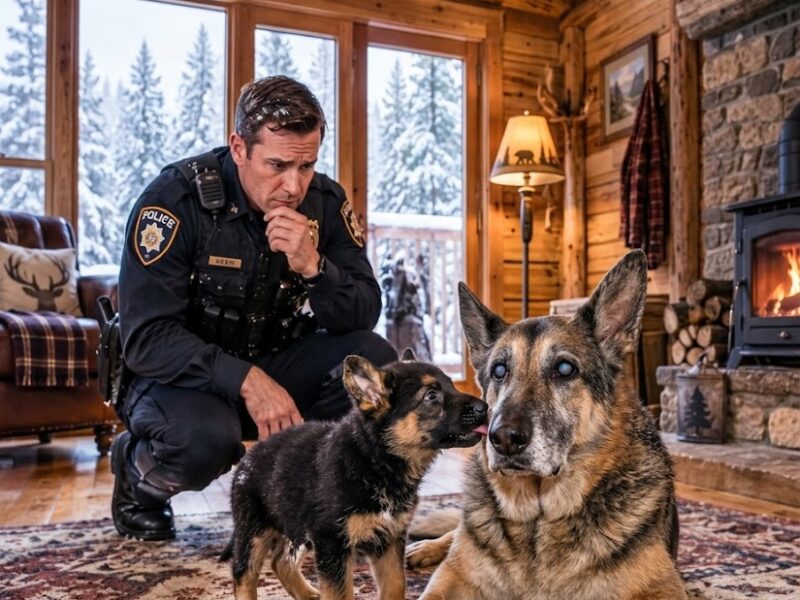
The Puppy Escaped Every Kennel to Reach a Blind Retired K9—Then an Officer Checked Their Records
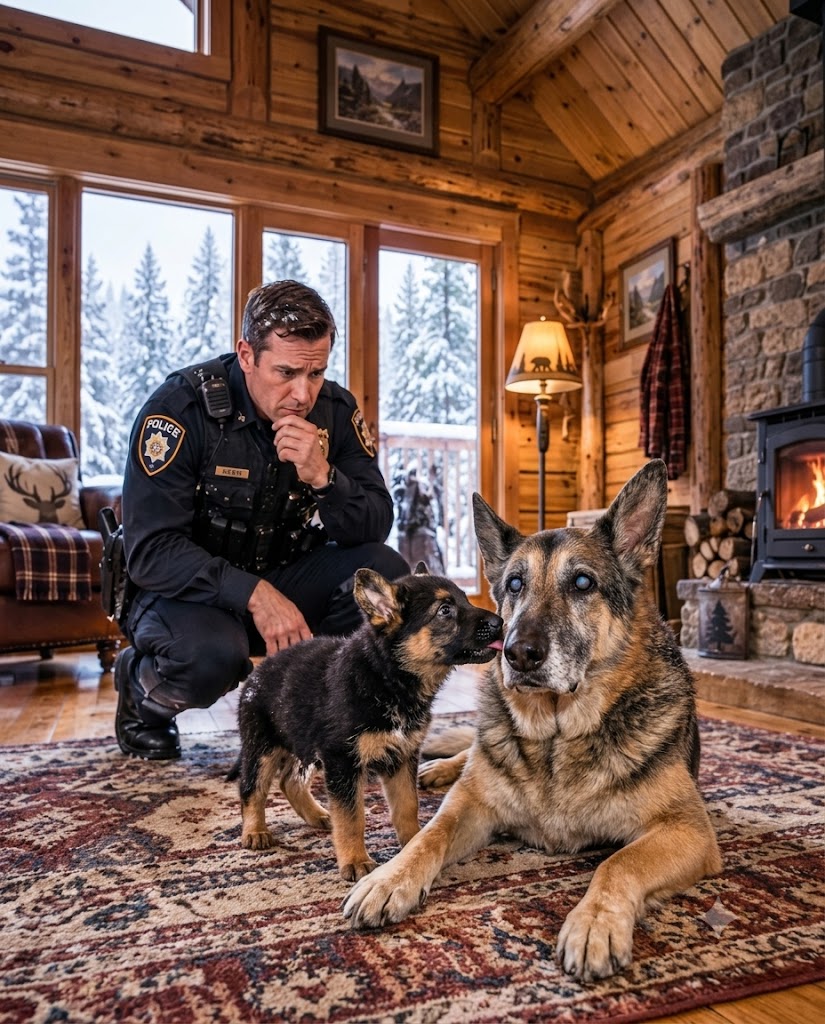
Officer Nathan Mercer entered a snowbound cabin outside Whitefish, Montana, expecting a routine welfare check.
Instead, he froze when he saw a nearly blind 12-year-old German Shepherd named Ranger lying beside a tiny puppy named Scout.
Ranger tried to stand and bumped into a chair.
Before Nathan could help, Scout hurried forward, licked the old dog’s muzzle, then walked toward the door.
Ranger lowered his nose to Scout’s side and followed.
That was when Nathan understood.
The puppy was guiding him.
Ranger had once been a search and rescue canine who led lost people home.
Now he could barely see, and Scout refused to leave his side.
When Nathan learned the two dogs might be separated, he looked at Ranger, then at the puppy waiting beside him.
He had come to check on a cabin.
Now, he wasn’t sure he could walk away.
January had buried the hills outside Whitefish, Montana, beneath fresh snow.
By 8 that morning, the storm had passed, but the narrow mountain roads were still white and almost empty.
Pine branches bent beneath the weight of ice and a pale winter sun barely showed through the clouds.
Officer Nathan Mercer slowed his patrol SUV as a small wooden cabin appeared between the trees.
Nathan was 39, a broad-shouldered patrol officer with short dark brown hair, a clean-shaven face, and the calm expression of someone who had learned not to rush into situations he did not understand.
Nearly 12 years in law enforcement had made him observant rather than suspicious.
He noticed doors left open, lights burning where they should not, and small details other people often passed without seeing.
That morning, he had been sent for a welfare check.
A nearby resident had reported that the woman who lived in the cabin had not been seen for several days.
No one knew whether she had left before the storm or whether something had prevented her from returning.
Nathan parked beside the driveway and stepped into snow that reached above his boots.
The front steps were almost buried.
What caught his attention first was the door.
It was not locked.
It stood open less than 2 inches.
Nathan knocked, announced himself, and waited.
Nothing moved inside.
He pushed the door gently.
The cabin was cold enough that his breath remained visible for a moment after he entered.
A stone fireplace stood along one wall, but the fire had burned out long ago.
A lamp near the sofa was dark.
A blanket had fallen partly onto the floor.
Nathan took another step.
Then he stopped.
Two German Shepherds were lying on a patterned rug near the fireplace.
The larger one was old.
Ranger was 12 years old, though Nathan did not know that yet.
He had once been a powerful working German Shepherd, and traces of that dog were still visible in his heavy shoulders and large frame, but age had softened him.
Gray covered most of his muzzle.
His ears remained upright, though one tilted slightly outward, and both of his eyes had developed a cloudy blue-gray appearance.
Beside him was a puppy.
Scout was barely 12 weeks old, small enough that his paws still looked too large for the rest of his body.
His black and tan coat was thick and slightly uneven, and one ear stood higher than the other.
Unlike Ranger, Scout seemed immediately curious.
His dark eyes followed Nathan carefully, but he did not hide.
Nathan crouched several feet away.
“Easy.”
Ranger’s head lifted.
The old shepherd listened.
Nathan moved slightly to his right.
Ranger turned toward the sound, but his eyes did not follow Nathan accurately.
Then Ranger tried to stand.
His front legs came beneath him first.
He shifted his weight and took one uncertain step.
His shoulder touched the edge of a small wooden table.
Ranger stopped immediately.
Scout was already moving.
The puppy hurried to the older dog’s face and pressed close to him.
He licked Ranger once around the muzzle, then touched his small head against Ranger’s shoulder.
Nathan watched Ranger’s body change.
The stiffness did not disappear, but the uncertainty did.
Ranger lowered his nose toward Scout.
Scout walked several steps toward the kitchen, then he stopped.
He looked back.
Ranger followed slowly, carefully.
His nose remained close to Scout’s side.
Nathan stayed where he was.
Scout moved around the corner of the table instead of taking the shortest path.
Ranger took exactly the same route.
The puppy stopped before the kitchen doorway.
Ranger stopped behind him.
Scout continued.
Ranger followed again.
That was when Nathan looked at the floor.
Small paw prints appeared in the thin dust near the kitchen entrance.
Scout’s tracks moved between the rug, the water bowl, and the back door.
The larger tracks were different.
Most of Ranger’s prints followed almost directly behind Scout’s.
Nathan looked back at the old shepherd’s cloudy eyes.
Ranger was not simply following the puppy because he wanted company.
He was using Scout to understand where he could safely walk.
The puppy was guiding him.
Nathan approached slowly.
Ranger turned toward him and became still, his ears angled forward.
Scout immediately stepped between Nathan and the old dog, not aggressively, but closely enough that Ranger could feel him.
Nathan extended one hand and allowed Ranger to smell it.
The German Shepherd remained cautious.
Then Scout touched Ranger’s front leg.
Ranger relaxed.
Nathan noticed the collar beneath the old dog’s thick fur.
It was worn and faded.
The lettering had almost disappeared, but when Nathan turned the metal plate toward the window, he could still read it.
Canine Search and Rescue.
Ranger.
Nathan looked at Ranger again.
The cloudy eyes, the silver muzzle, the careful steps behind a 12-week-old puppy.
He stood and searched the room for some explanation.
On the wall near the fireplace was an old framed photograph.
Ranger looked much younger in it.
His coat was darker, his body lean and strong, and he stood beside an older woman wearing a heavy outdoor jacket.
She appeared to be in her 60s with short gray hair and a warm, weathered face.
Her hand rested proudly against Ranger’s shoulder.
Beside the photograph hung a red rescue whistle on a faded cord.
Nathan studied it for a moment, then left it where it was.
There would be time for questions later.
Right now, the dogs needed help.
In the kitchen, Nathan found only a small amount of dry food remaining in a container.
The water bowl held barely enough to cover the bottom.
Scout followed him.
Ranger followed Scout.
Nathan filled the bowl with fresh water.
Scout drank briefly, then stepped aside.
Only after Ranger found the bowl did the puppy return.
Nathan watched that, too.
He took out his phone and called the nearest veterinary clinic.
Within minutes, he had arranged for both dogs to be examined.
Getting them outside seemed simple until Nathan tried to lift Scout first.
The puppy twisted gently from his arms, landed on the rug, and hurried straight back to Ranger.
Scout pressed against the old dog’s chest.
Ranger lowered his head immediately, found the puppy by scent, and became calm again.
Nathan stood over them for several seconds.
Ranger could barely see the room around him, but he knew exactly where Scout was, and Scout seemed determined to make sure he stayed there.
Nathan looked once more at the faded canine collar and the photograph on the wall.
A dog that had apparently spent part of his life helping people find their way home was now standing in a cold cabin, depending on a puppy to find his own way across a room.
Nathan still did not know where Ranger’s owner was.
He did not know how long the two dogs had been alone.
He did not know what the red whistle meant or why a retired search and rescue dog had reached this point.
But he knew one thing before he opened the cabin door.
Wherever Ranger went that morning, Scout was going with him.
He was not separating them.
The veterinary clinic on the south side of Whitefish was only 20 minutes from the cabin, but Nathan drove more carefully than usual.
Ranger lay across the back of the patrol SUV on a folded blanket, his head raised whenever the vehicle changed direction.
Scout stayed beside him.
Each time Ranger shifted, the puppy moved with him until some part of their bodies touched.
By the time Nathan pulled beneath the clinic awning, Ranger had stopped trying to understand where the truck was going.
His nose rested against Scout’s back instead.
Dr. Emily Carter met them near the entrance.
Emily was 34, tall and slender, with dark auburn hair tied behind her head, and the steady movements of someone who had spent years working around frightened animals.
She spoke quietly, rarely reached toward an animal before allowing it to notice her first, and had developed that patience after beginning her career at an emergency clinic, where she had learned how quickly fear could make even gentle dogs uncertain.
She crouched several feet from Ranger and waited.
Ranger lifted his muzzle toward her but did not move forward.
Scout sniffed Emily’s hand first.
Only after the puppy remained relaxed did Ranger lean close enough to investigate the same scent.
The examination took longer than Nathan expected because Emily refused to hurry the old shepherd.
She checked Ranger’s heart, joints, teeth, weight, and eyes while Scout remained nearby.
Ranger was approximately 12 years old.
Despite his age and the cold cabin, he was not dangerously underweight, and Emily found no immediate sign that he had gone without basic care for a long period.
The larger concern was his vision.
She dimmed part of the room and moved a small light slowly from one side to the other.
Ranger responded to brightness, but not to movement the way a sighted dog normally would.
Emily explained that the cloudy appearance Nathan had noticed came from advanced cataracts, while the weaker visual response suggested severe retinal degeneration as well.
Ranger could probably distinguish changes between light and darkness, perhaps large shapes at very close range, but very little beyond that.
Nathan looked toward the old dog.
“So he really can’t see where he’s going.”
“Not in the way we think of seeing,” Emily said.
“He’s navigating by memory, scent, sound, and whatever help he trusts.”
That last part became clearer when Emily asked an assistant to hold Scout outside the room for only a few minutes.
Ranger did not panic.
He simply changed.
His head lifted higher.
He turned toward the doorway several times and stopped cooperating with the easy calm he had shown before.
Emily touched his shoulder and spoke softly, but Ranger remained alert, searching the air.
When Scout was brought back, the puppy crossed the room immediately and stood along Ranger’s left side.
Ranger lowered his nose, found him, and relaxed almost at once.
Emily watched the puppy move.
“Look where he stands.”
Nathan did.
Scout had placed himself on Ranger’s left, the same side where the older dog had nearly brushed a cabinet when entering the room.
A few minutes later, when Ranger was encouraged to walk toward a water bowl, Scout moved first.
He stayed slightly ahead and to the left, forcing Ranger to angle away from the wall.
Ranger followed.
Emily gave Nathan a small look of surprise.
“I don’t think anyone trained that puppy to do this.”
Scout stopped near the bowl and looked back.
“He’s become Ranger’s reference point,” she continued.
“Not professionally, not perfectly, but Ranger trusts where he goes.”
Nathan thought about the tracks on the cabin floor.
He had already seen the pattern.
Now someone with years of experience was confirming what had seemed almost impossible that morning.
A 12-week-old puppy had somehow learned that an old dog needed help moving through the world.
Emily found another sign of Ranger’s past while checking his chest.
Beneath the thick fur was a long, old scar that had healed years earlier.
She did not speculate about how it happened.
It was too old to cause Ranger pain now, but its position suggested a serious injury from much earlier in his life.
Ranger’s hind legs told another story of age.
Arthritis had settled deeply into both hips, worse on the left.
It explained why standing sometimes took him several seconds.
Emily recommended shorter walks, stable footing, warmth, and a quieter environment rather than anything demanding.
When she finally placed two food bowls on opposite sides of the room, Scout surprised Nathan again.
The puppy approached his bowl, smelled the food, and looked toward Ranger.
Ranger had not yet located his own.
Scout waited.
Nathan gently tapped beside Ranger’s bowl.
The old shepherd found it and began eating.
Only then did Scout lower his head and begin his own meal.
Later, when Ranger finished, he slowly circled the blanket Emily had placed on the floor.
Before lying down, he raised his nose and searched until Scout moved close enough to touch his shoulder.
Ranger settled immediately.
Nathan stepped into the hallway and called the county shelter.
The woman who answered was Linda Hayes, a soft-spoken shelter coordinator in her early 50s with short blonde hair and a practical manner shaped by years of trying to fit too many animals into too few kennels.
Nathan explained only what he knew.
Two German Shepherds, one puppy, one senior dog with severe vision loss.
Owner unavailable.
Temporary placement needed.
Linda could take Scout that afternoon.
Ranger was more difficult.
The shelter had only two suitable larger kennels open, both already reserved for incoming dogs.
A 12-year-old German Shepherd with limited vision and mobility would need more space, more monitoring, and probably a foster experienced with senior animals.
Linda mentioned a senior dog facility that might have an opening, but it was more than 3 hours away.
Nathan looked through the clinic doorway.
Scout was asleep against Ranger’s shoulder.
Ranger’s chin rested across the puppy’s back.
“So they’d be separated,” Nathan said.
There was a brief silence on the phone.
“For now, probably.”
Nathan thanked Linda and ended the call.
He stood there for almost a minute.
The separation made sense on paper.
Scout was young and adoptable.
Ranger needed specialized care.
Two different placements might have been the easiest solution for everyone involved.
Everyone except the two dogs.
Nathan returned to the examination room.
“Can they stay somewhere together tonight?”
Emily looked at him.
“Do you have somewhere in mind?”
Nathan did not answer immediately.
His house was small, quiet, and certainly not prepared for a blind senior shepherd and a puppy.
But it had heat.
It had a fenced yard.
And it had no reason to separate them.
“Mine,” he said.
That afternoon, while Emily prepared temporary care instructions, Nathan tried to identify Ranger through the faded canine plate.
The number etched beneath the words Search and Rescue did not match anything in the sheriff’s current computer system.
Much of the county’s older volunteer search and rescue information had been moved years earlier.
Nathan called Deputy Ryan Cole.
Ryan was 31, lean, sandy-haired, and usually the first officer in the department willing to spend an extra hour digging through records no one else wanted to search.
He had an easy sense of humor in person, but when given a problem, he became stubbornly methodical.
Nathan read him the number.
Ryan called back 40 minutes later.
“I found something.”
The record was incomplete.
The old database contained a reference to a Ranger search unit and the same identification number from the collar.
One report mentioned a winter rescue almost 8 years earlier, but the detailed pages were missing.
According to the database, the rest of the file had been transferred to county archives.
Nathan looked at Ranger sleeping beside Scout.
That morning, he had known nothing about the old dog except that he could barely see.
Now he knew Ranger had once belonged to a search unit, had carried an old injury, and had been part of at least one rescue important enough to remain in county records years later.
He still did not know what had happened to him.
For the moment, Nathan decided that question could wait.
Ranger needed somewhere warm to sleep.
Scout needed to remain beside him.
And that night, both dogs were going home with Nathan.
Nathan’s house sat on a quiet road several miles outside Whitefish, where the forest opened just enough to reveal a narrow view of the mountains beyond the backyard.
He had lived there for nearly 4 years, and until Ranger and Scout arrived, he had never thought much about the arrangement of the rooms.
The sofa faced the windows.
A low wooden table stood between the living room and kitchen.
Three steps led down toward the mudroom and back door.
To Nathan, none of it had ever been complicated.
To Ranger, almost everything was unfamiliar.
On the first evening, the old shepherd entered cautiously, nose lowered, moving one careful step at a time.
He reached the edge of the living room, turned slightly too soon, and brushed one shoulder against a chair.
He stopped.
Scout immediately came back from several feet ahead and touched his nose to Ranger’s muzzle.
Ranger waited until the puppy moved again, then followed.
Nathan watched the same pattern repeat during the next two days.
Ranger could remember a route after several trips, but any obstacle made him hesitate.
A pair of boots left near the hallway could stop him completely.
The three steps near the back door seemed to trouble him most.
Ranger would reach the edge, sense the change in height, and remain there without moving.
Nathan began changing the house around him.
He pushed unnecessary furniture against the walls and stopped leaving anything in the walking paths.
He bought several inexpensive textured rugs and placed them like markers from Ranger’s bed to the kitchen, then from the kitchen toward the back door.
He also began using the same simple words every time they moved.
“Door” when they reached an entrance.
“Step” before a change in height.
“Left” when Ranger needed to turn.
“Easy.”
Whenever the old dog became uncertain, at first Nathan thought he was teaching Ranger, then he noticed Scout listening, too.
Whenever Nathan said “door,” Scout often moved toward the nearest doorway before Ranger did.
At the back steps, Nathan would say “step,” and Scout began slowing automatically.
The puppy had never received formal working dog training, yet within days, he seemed to connect Nathan’s words with the places that caused Ranger trouble.
One morning, Nathan opened the back door and Scout rushed onto the porch.
He crossed the snow-covered yard with the careless excitement of a puppy seeing fresh snow for the first time.
Ranger remained inside.
Scout reached the edge of the porch, ran nearly 10 feet into the yard, then stopped.
He turned around.
Ranger had not followed.
Scout came back.
He ran to the doorway, touched his nose briefly against Ranger’s face, then turned toward the yard again.
Ranger stepped forward.
Scout moved down the porch steps and waited.
Ranger followed more slowly, feeling for each change beneath his paws.
Once both dogs reached the snow, Scout ran ahead again.
Nathan assumed the puppy would finally lose himself in the yard.
Instead, Scout stopped after another short distance and looked back.
Ranger had paused.
Scout returned once more.
Nathan began noticing that it happened almost every time they went outside.
Scout wanted to explore.
He chased drifting leaves, buried his nose in fresh snow, and investigated every unfamiliar scent along the fence.
But he seemed to keep an invisible distance between himself and Ranger.
If the old shepherd continued moving, Scout continued.
If Ranger stopped for too long, Scout came back.
Sometimes he touched Ranger’s nose.
Sometimes he simply stood beside him until the old dog moved again.
Nathan never gave him a command to do it.
He never rewarded him for returning.
Scout simply came back because Ranger had not followed.
Inside the house, their habits developed in smaller ways.
Nathan bought Scout a soft bed and placed it several feet from Ranger’s larger one.
The first night, Scout slept there for less than an hour.
By midnight, Nathan found him curled beside Ranger’s head with one small paw resting against the old shepherd’s neck.
Ranger did not show much interest in toys.
Nathan tried a rope, a rubber ball, and a soft stuffed animal.
Ranger sniffed each one politely and ignored them.
Scout loved all three.
One afternoon, the puppy pushed the rubber ball beneath the sofa and became frustrated when he could not reach it.
Ranger had been asleep across the room.
The moment Scout began fussing near the sofa, Ranger raised his head and turned toward him.
He could not see what had happened, but he remained alert until Nathan retrieved the ball.
Only after Scout settled again did Ranger lower his muzzle back onto his paws.
Meanwhile, Ryan Cole continued searching the county records.
The file he had found was older than the sheriff’s current digital system, so much of it had been stored under the name of a former volunteer search group.
Three days later, Ryan called Nathan from the records office.
He had found a full name connected to Ranger’s identification number.
Margaret Ellis.
The archived photograph attached to the record showed a woman in her late 50s at the time, tall and lean with short gray-streaked hair, a weathered face, and the practical outdoor clothing of someone accustomed to spending long hours in mountain conditions.
Notes from other volunteers described Margaret as patient, dependable, and unusually calm during searches.
She had joined the local volunteer rescue unit after helping coordinate community responses to several winter emergencies, and years of working around frightened families had reportedly made her careful about giving people promises she could not keep.
Ranger had been her search dog.
The rest of the records changed the way Nathan looked at the old shepherd sleeping in his living room.
Nearly 8 years earlier, Ranger and Margaret had participated in a winter search near Glacier National Park after a 6-year-old boy became separated from relatives during worsening weather.
The official report did not dramatize the rescue.
It simply recorded that Ranger located the child’s trail and led the team to an area where he could be safely brought out.
Three years later, Ranger was listed again during a search for two hikers stranded after a small avalanche blocked their route.
Both were located.
Ryan found several other training reports as well.
For a period of years, Ranger had been one of the more experienced dogs in the volunteer unit.
At the sheriff’s office, Nathan located an old video file attached to a training archive.
The image quality was poor, but Ranger was easy to recognize.
He was younger, darker around the muzzle, powerful through the shoulders, and moving through deep snow with an energy Nathan had never seen from him.
Margaret appeared several yards behind.
She wore a red winter jacket and carried something on a cord around her neck.
At one point, she raised it to her mouth.
Nathan paused the video.
A small red rescue whistle hung from the cord.
It looked exactly like the whistle beside the photograph in the cabin.
Nathan replayed the short clip twice.
Ranger moved ahead through the snow, checking back occasionally for Margaret before continuing forward.
The old dog, now sleeping at Nathan’s house, had once spent years moving first, finding routes through places other people could not easily navigate, and bringing search teams toward people who needed help.
That evening, Nathan stood at the back door and watched Scout race into the yard.
Ranger followed at his slower pace.
Scout reached the snow, went ahead, then turned.
Ranger had stopped at the final step.
Scout ran back.
Nathan felt the contrast more strongly than before.
Once Ranger had been the one others followed through the snow.
Now a 12-week-old puppy was returning to guide him across three porch steps.
Before leaving work, Nathan asked Ryan to keep searching for Margaret.
The answer came later that night.
Margaret Ellis was still living in the Whitefish area, but she was not at the cabin.
A recent local record showed that she had been admitted to the hospital following a serious fall and was still receiving care there.
Nathan did not know the circumstances yet.
He did not know why no one had reached Ranger sooner.
He only knew that the woman in the old photograph had not simply disappeared.
Across the room, Scout settled beside Ranger’s head.
Ranger searched briefly with his nose until he found the puppy, then rested again.
Nathan looked once more at the frozen image of Ranger running through mountain snow 8 years earlier.
A dog who had once helped lost people find their way home could no longer safely cross Nathan’s living room without guidance.
But whenever Ranger stopped, Scout still came back.
And somehow the puppy always knew when to wait.
Nearly 2 weeks after Nathan first carried Ranger and Scout out of the cold cabin, he received a call from the hospital in Whitefish.
Margaret Ellis was strong enough for a short visit.
Nathan arrived that afternoon alone.
Margaret was 67, tall even while sitting upright in the hospital bed, with short silver-gray hair, a narrow face, and the weathered hands of someone who had spent much of her life outdoors.
Before her fall, she had been known among the local rescue volunteers as practical, patient, and difficult to rattle.
Years of working winter searches had taught her not to waste words when people were frightened.
Now recovery had slowed her.
A recent hip surgery kept her movements careful, and for the first time in years, she was the one depending on other people to bring things to her.
Nathan introduced himself and explained why he had come.
He did not get far before Margaret asked the only question that seemed to matter.
“Ranger.”
Nathan nodded.
“He’s safe.”
Margaret closed her eyes.
The reaction was immediate but quiet.
She turned her face slightly toward the window and pressed her fingers beneath one eye before looking back at him.
“And the puppy? Scout’s with him?”
That answer affected her almost as much.
Margaret explained what Nathan had been unable to understand from the cabin.
Her fall had happened suddenly during the worst part of the winter weather.
She had been taken to the hospital and expected to return within a day or two.
A family acquaintance had agreed to check the cabin, but the storm worsened.
Mountain access became unreliable, and the road near her property was closed longer than anyone expected.
Communication had become confused between people who assumed someone else had already reached the dogs.
Nathan did not accuse her.
He had already seen enough to know Ranger and Scout had not been forgotten intentionally.
Margaret looked down at her hands.
“I thought someone was getting to them.”
Nathan told her about finding the door partly open, the water bowl almost empty, and Scout guiding Ranger through the cabin.
Margaret gave a tired smile.
“That sounds like Scout.”
Nathan had assumed Scout belonged to her.
He did not.
Margaret had found the puppy about a month before her accident near a gas station outside Columbia Falls.
Scout had been alone near the edge of the parking area, cold, confused, and too young to be wandering without someone nearby.
She had contacted local shelters and posted notices, expecting an owner to come forward.
No one did.
Her plan had been temporary from the beginning.
Scout was young.
Ranger was old.
Margaret knew the difference between caring for a puppy for a few weeks and committing to years of training and exercise.
But Scout had apparently made his own decision.
“The first night,” Margaret said, “I put a separate bed down for him.”
Nathan almost smiled.
“That didn’t last.”
“No.”
Scout had moved to Ranger before morning.
At first, Margaret thought the puppy simply wanted warmth.
Then Ranger’s eyesight began worsening faster than she expected.
He had already been losing vision gradually, but during the previous months, the change had become impossible to ignore.
Ranger misjudged doorways.
He hesitated at stairs he had used for years.
He began relying more heavily on scent and sound.
Scout noticed before Margaret ever tried to teach him anything.
The puppy started walking slightly ahead.
If Ranger stopped, Scout stopped.
If Ranger drifted too close to furniture, Scout often moved between him and the obstacle.
Margaret had watched it happen exactly as Nathan had.
Neither of them could explain why a puppy so young understood what the old shepherd needed.
Nathan asked about Ranger’s retirement.
Margaret’s expression changed.
Ranger had stopped working rescue missions several years earlier.
Age had been part of it, but not all of it.
Search work demanded endurance, balance, hearing, confidence, and the ability to move safely in difficult terrain.
Margaret had known when it was time to stop asking him to perform the job he had spent years doing.
At first, people from the old team still visited.
Former volunteers brought treats.
Families Ranger had helped occasionally sent photographs or cards.
Then life moved on.
People retired.
Families relocated.
New dogs entered the program.
Ranger’s name remained in old reports and photographs, but fewer people came to the cabin.
When his vision worsened, Margaret noticed he became more sensitive to departure weather.
“He doesn’t fear darkness,” she told Nathan.
“He’s lived with less and less sight for a long time.”
She paused.
“What he fears is being left behind.”
Nathan thought of Ranger searching for Scout before lying down.
He thought of the old dog freezing whenever the puppy disappeared from the room.
Three days later, Nathan returned to the hospital.
This time, Ranger and Scout came with him.
Nathan had brought something else.
The red rescue whistle.
Ranger entered Margaret’s room slowly.
His ears moved toward the unfamiliar hospital sounds.
Scout stayed against his left side, matching the old dog’s pace.
Margaret sat forward.
Ranger stopped several feet from the bed.
He could not see her.
Margaret said his name.
Ranger raised his head, but uncertainty remained.
Then Margaret took the whistle.
She gave one short signal.
Ranger changed instantly.
His ears lifted.
His head turned directly toward the bed.
Nathan loosened the leash.
Scout started forward beside him, then did something Nathan had never seen before.
The puppy stopped.
He stepped slightly back.
Ranger continued alone.
One step, then another.
He reached the bed, lifted his nose, and found Margaret’s hand.
Only then did recognition become complete.
Ranger pressed his muzzle into her palm.
Margaret bent toward him and rested both hands around his face.
For several seconds, neither moved.
Scout watched from behind.
Then he quietly came forward and sat beside Ranger’s front leg.
Margaret laughed once through her tears.
“He remembers.”
Nathan looked at the whistle.
“He remembered before he even smelled you.”
Margaret nodded.
That signal had once meant “return.”
Years earlier during searches, Ranger had learned that one short whistle meant find Margaret again.
The sound had stayed with him long after the work ended.
During the visit, Margaret told Nathan one more story from Ranger’s career.
Several winters earlier, a young deputy had become stranded during a severe snowstorm while helping respond to an accident on a remote road.
Visibility had dropped, communication had become unreliable, and Ranger had helped the search team locate the vehicle.
Nathan asked for the deputy’s name.
Margaret told him.
Nathan stared at her.
“Sheriff Daniel Reeves.”
Daniel was 52 now, a solidly built man with graying dark hair, a square face, and a measured way of speaking that made younger deputies listen without being ordered to.
He had spent nearly 30 years in county law enforcement and had become known for remembering the names of people others forgot.
The winter incident had happened long before Nathan joined the department.
Nathan called him that evening.
Daniel was quiet after hearing the name Ranger.
“I didn’t know he was still around,” he said.
Neither man said much more.
By the end of the week, word had begun moving through the old rescue community.
A few former volunteers called Margaret.
Someone sent Nathan an old photograph.
Another person asked whether Ranger needed anything.
For the first time in years, people who had once followed Ranger through the snow were asking about him again.
But Margaret understood something.
None of those calls could change her recovery.
It would be long.
Even after returning home, she would have limits she had not faced before.
Ranger needed a predictable environment and patient daily care.
Scout needed training, exercise, and years of energy she was no longer sure she could match.
Near the end of Nathan’s next visit, Margaret looked at Ranger resting beside her chair and Scout curled against his front leg.
Then she looked at Nathan.
“I love them both,” she said.
“But love doesn’t automatically mean I’m still the person who can give them what they need.”
Nathan did not answer.
Not yet.
Ranger rested his head against Margaret’s knee.
Scout stayed beside him.
And for the first time, Nathan understood that finding Ranger’s owner had not solved the question of where the two dogs truly belonged.
By the time Margaret was preparing to leave the hospital, the question of what would happen to Scout could no longer be postponed.
Ranger could manage a quiet routine with careful support, but Scout was growing quickly.
He needed training, exercise, veterinary care, and a home prepared for years of responsibility.
Margaret loved the puppy, yet she understood that love alone would not restore the strength or mobility she had before her fall.
After several conversations with Nathan and the local shelter, she agreed that Scout’s profile could be posted for adoption.
The response came almost immediately.
Within 3 days, the shelter received more inquiries about Scout than Ranger had received attention in months.
His photograph showed a bright-eyed German Shepherd puppy with oversized paws, one ear still slightly lower than the other, and the alert expression of a dog interested in everything around him.
Families asked about his age, temperament, training, and whether he liked children.
Ranger’s situation looked very different on paper.
Twelve years old, severe vision loss, arthritis, daily medication, a need for predictable walking paths, and a home where furniture would not constantly be moved.
Nathan noticed the difference without anyone explaining it.
People saw Scout and imagined years ahead.
They saw Ranger and immediately began thinking about limitations.
One application stood out.
Michael and Laura Bennett lived 20 minutes outside Whitefish on a fenced property with a large yard.
Michael was 42, tall and broad through the shoulders with dark hair beginning to gray at the temples and the deliberate manner of someone who preferred asking questions before making decisions.
He worked as an electrical contractor and had grown up with German Shepherds.
Laura, 39, was a middle school librarian with shoulder-length brown hair and a gentle, organized personality.
She had lost an elderly family dog several years earlier, an experience that made her careful about treating pets as long-term commitments rather than temporary excitement.
Their two children, Ethan, 11, and Molly, 8, had been taught to approach animals calmly.
Ethan was quiet and observant, while Molly carried the barely contained enthusiasm of a child trying very hard to follow every instruction adults had given her.
On paper, the Bennetts were difficult to criticize.
That bothered Nathan more than he expected.
If they had been careless, unprepared, or simply interested in a puppy because Scout looked cute, Nathan could have objected.
Instead, they had a secure yard, experience with the breed, veterinary references, and realistic expectations about training.
Scout could have a good life with them.
Nathan repeated that to himself before the meeting.
He brought Ranger anyway.
The shelter used a quiet visiting room with a rug, several chairs, and enough open space for Scout to move without becoming overwhelmed.
Scout noticed the children first.
Within minutes, he was carrying a soft toy between Ethan and Molly, dropping it, retrieving it, and circling back with the kind of restless enthusiasm that seemed almost impossible beside Ranger’s slower movements.
Ranger remained near Nathan.
The old Shepherd could hear Scout moving across the room.
As long as the puppy’s paws tapped regularly against the floor, Ranger stayed relaxed.
Then Scout stopped to investigate something near the far wall.
Ranger raised his head.
His ears moved for several seconds.
There was no sound from the puppy.
Ranger stood.
Nathan had seen the reaction before.
Ranger did not need Scout beside him every second.
But when he could no longer locate the puppy by sound or scent, uncertainty returned quickly.
Scout appeared again.
Ranger settled.
Laura noticed.
“He listens for him,” she said.
Nathan nodded.
“All the time.”
Michael watched the two dogs for a long moment.
The meeting continued.
Nothing went wrong.
Scout liked the children.
The children respected him.
Michael asked thoughtful questions about feeding, training, and veterinary care.
Laura wanted to know what routines Scout had already learned at Nathan’s house.
By the end, everything appeared to be moving toward the obvious conclusion.
Scout had found a family.
Michael clipped a temporary leash to Scout’s collar and started toward the door so they could spend a few minutes walking outside together.
Scout followed.
Three steps, four.
Then he stopped.
He turned around.
Ranger was standing near Nathan at the opposite side of the room.
The old shepherd’s head moved slightly from side to side.
Scout’s footsteps had changed direction, and Ranger no longer seemed certain where the puppy was going.
Scout went back.
He crossed the room quickly and touched his nose against Ranger’s muzzle.
Ranger lowered his head toward him.
Scout turned toward Michael again.
He walked halfway to the door.
Then he looked back.
This time, Ranger had not moved.
Scout returned again.
No one spoke.
Nathan suddenly understood something he had been trying not to name.
Scout was not afraid of Michael.
He was not rejecting Laura or the children.
He had played with them happily.
He simply did not understand why Ranger was not coming too.
Michael seemed to reach the same conclusion.
They tried once more outside.
Scout stepped onto the walkway with the family, but when he reached their vehicle, he stopped and looked toward the shelter entrance.
Ranger was still inside.
Scout sat down.
Michael did not pull the leash.
After a moment, he crouched beside the puppy and looked back toward Nathan.
“I think he already has someone he’s responsible for.”
There was no anger in his voice.
Laura placed a hand on Molly’s shoulder before the girl could become upset.
Michael stood and returned the leash to Nathan.
“Maybe,” he said quietly, “Scout already has his family.”
The Bennetts left without making anyone feel guilty.
Linda offered to keep their application active for another dog, and Laura asked if they could be contacted when another Shepherd or Shepherd mix became available.
Nathan remained behind with Ranger and Scout.
Scout immediately settled beside Ranger’s front legs.
That evening, Nathan called Emily.
He needed facts rather than emotion.
Emily helped him estimate what Ranger’s long-term care could involve.
Arthritis medication, routine examinations, possible mobility support later, and the practical reality that an aging dog’s needs could change quickly.
None of it was impossible, but none of it should be treated casually.
Nathan listened and wrote everything down.
He then looked around his house.
Two bowls stood in the kitchen.
Two leashes hung beside the door.
Scout’s toys had spread beneath the furniture.
The rugs Nathan had placed for Ranger now formed permanent pathways through the rooms.
He had even stopped moving one particular chair because Ranger had memorized its location.
A few days later, Sheriff Daniel Reeves came by.
He had heard about Ranger’s difficulty with the back steps and offered to help arrange a small ramp from the porch to the yard.
Nathan started to object, but Daniel stopped him.
“It isn’t charity,” the sheriff said.
“That dog helped people in this county for years.”
Word about Ranger had spread farther than Nathan expected.
Several former rescue volunteers and people connected to families Ranger had once helped began sending small donations.
Nathan refused to use the money for his own household expenses.
Instead, he asked that it be placed into a separate shelter fund for senior working dogs needing foster care, medication, or mobility support.
That decision stayed with him.
Ranger was not the only old dog whose usefulness had outlived public attention.
There were others.
Former working dogs, senior shepherds, animals whose files contained more medical notes than adoption inquiries.
Nathan had started this by trying to help Ranger and Scout through one difficult winter.
Now he was beginning to wonder whether Ranger’s story could eventually help dogs Nathan had never met.
Late that night, Scout fell asleep with his back pressed against Ranger’s chest.
Ranger lowered his head over the puppy and settled.
Nathan watched them from the kitchen doorway.
For weeks, he had called them foster dogs.
The words suddenly sounded temporary in a house that no longer felt temporary at all.
He still had not made the final decision.
But for the first time, Nathan understood that the question was no longer whether Scout and Ranger belonged together.
The harder question was whether Nathan was finally ready to admit where they both belonged.
Three days after the Bennett family stepped away from Scout’s adoption, Nathan returned to the shelter with both dogs.
He had spent those 3 days doing something he had avoided for weeks.
He stopped asking himself what might happen if Ranger’s needs became harder, if Scout grew into a demanding young German Shepherd, or if caring for both of them eventually changed his routine.
Instead, he looked at the life already happening around him.
Ranger knew the path from his bed to the kitchen.
Scout knew when to wait at the back steps.
Nathan knew which medication bottle belonged beside Ranger’s food and which leash Scout would try to carry in his mouth before every walk.
The house had already adapted to them.
More importantly, Nathan had adapted, too.
The shelter office was quiet that morning.
Linda Hayes had prepared the paperwork before Nathan arrived.
She placed two folders on the desk, Scout’s on top and Ranger’s beneath it.
Puppies usually moved through adoption files first.
They were easier to place, easier to explain, easier for people to imagine growing into the future.
Nathan looked at the folders.
Then he gently moved Scout’s aside.
He placed his hand on Ranger’s file.
“Him first.”
Linda stopped for a second.
Nathan did not need to explain.
For years, Ranger had worked ahead of others.
He had searched snow-covered roads, tracked missing people through mountain country, and helped rescue teams reach people who could not find their own way back.
Then age arrived.
His sight faded.
His pace slowed.
People who once knew his name became fewer.
By the time Nathan found him, Ranger could no longer cross an unfamiliar room without uncertainty.
Now, for once, he would not be the dog waiting while the younger one was chosen first.
Linda pulled Ranger’s file to the center of the desk.
The paperwork was straightforward.
Nathan confirmed Ranger’s medical needs, signed the long-term care agreement, and accepted responsibility for future veterinary decisions.
Margaret had already completed the transfer from the hospital.
She had written a short note on the final page.
“Take care of the old boy. He has already taken care of enough of us.”
Nathan read it twice before signing beneath her name.
When Ranger’s adoption was official, Nathan pulled Scout’s folder toward him.
That signature took less time.
It somehow carried just as much weight.
Ranger first.
Scout second.
Together.
When Nathan came out of the office, both dogs were waiting in the visiting area.
Ranger stood near the wall, listening.
Scout sat beside his front leg.
The moment Nathan approached, Scout stood and hurried toward him, then immediately turned back toward Ranger.
Nathan smiled.
Even now, Scout came back.
Margaret visited Nathan’s house for the first time several weeks later.
She had returned home by then, though she still walked with a cane and moved carefully on uneven ground.
Recovery had changed her pace, but not her attention.
She noticed everything Nathan had done for Ranger.
The rugs, the clear hallways, the fixed position of the furniture, the way the water bowl stayed in exactly the same place every day.
She also noticed something Nathan had not mentioned.
Ranger no longer slept near the front door.
He slept in the living room, usually where Scout could curl against him and where Nathan could reach him without getting out of his chair.
Margaret rested one hand against Ranger’s head.
“He knows.”
Nathan looked at her.
“Knows what?”
“That he’s staying.”
By early spring, the deep snow around Whitefish had begun pulling away from the edges of the roads.
The frozen yard softened.
Patches of brown grass appeared near the porch, then slowly turned green.
Ranger did not become younger.
His vision did not return.
Emily had been clear from the beginning that there would be no sudden reversal.
Ranger still needed time when standing after a long rest.
His hind legs were often stiff in the mornings.
Some walks were shorter than others.
Nathan stopped measuring good days by how far Ranger could go.
A good day was simply one in which Ranger wanted to go.
Sheriff Daniel Reeves kept his promise about the back steps.
One Saturday morning, he arrived with lumber and two volunteers from the old rescue unit.
Nathan tried to help, but Daniel insisted on doing most of the work himself.
By afternoon, a wide wooden ramp connected the porch to the yard with textured strips for safer footing.
Daniel stood at the bottom when Ranger tested it for the first time.
Ranger hesitated.
Scout went down first.
Halfway across the yard, the puppy turned.
Ranger had stopped in the middle of the ramp.
Scout came back.
He sat at the bottom.
Ranger raised his head toward the sound of his movement.
Nathan stood behind the old shepherd but did not touch him.
No one pulled Ranger forward.
No one called for him to hurry.
Scout waited.
Ranger took one step, then another.
His paws reached the bottom.
Scout stood and moved beside him.
Only then did they continue toward the grass.
Nathan watched that small moment longer than anyone else.
It reminded him of everything that had changed.
Scout had grown quickly.
By late spring, the awkward puppy with oversized paws had become a lean young German Shepherd with stronger legs, a darker coat along his back, and ears that finally stood evenly.
Yet the habit Nathan had noticed during the first week never disappeared.
Scout ran ahead.
Scout looked back.
Scout always came back.
The donations people had sent after hearing about Ranger remained separate from Nathan’s household.
With Linda and Daniel’s help, Nathan turned the money into something more useful.
They called it Ranger’s Last Watch.
It was not a large organization.
Not yet.
It began as a simple local program connecting retired working dogs, senior German Shepherds, and dogs with mobility or vision challenges to foster homes willing to understand their needs.
The shelter used the fund for basic medical evaluations, transport, temporary supplies, and accessibility changes when necessary.
Ranger became the reason the idea existed, but Nathan never turned him into a symbol that had to perform for anyone.
Ranger’s job was finished.
He was allowed to simply be old.
Margaret visited often.
Sometimes she brought old photographs.
Sometimes she sat on the porch while Ranger slept near her feet and Scout searched the yard for anything interesting enough to carry inside.
Daniel came by occasionally, too.
The first time he sat beside Ranger, he rested his hand quietly on the old dog’s shoulder and said almost nothing.
Years earlier, Ranger had helped someone find Daniel.
Now Daniel understood that Nathan had done something similar for Ranger.
One mild afternoon, the last dirty patches of winter snow remained beneath the pine trees at the edge of the yard.
Nathan opened the back door.
Scout ran out first.
Ranger followed.
Scout crossed the ramp and reached the grass before noticing Ranger had stopped halfway down.
He turned.
For a moment, the young shepherd simply watched.
Then he went back to the bottom of the ramp and waited.
Ranger listened.
He moved forward carefully.
Scout stayed where he was.
When Ranger finally reached the yard, Scout stepped beside him instead of racing away.
The two dogs crossed the grass together.
Nathan remained on the porch.
Months earlier, he had entered a cold cabin expecting nothing more than a routine welfare check.
He had found a blind old search dog and a puppy too young to understand almost anything about the world, except that Ranger should never be left behind.
Ranger had spent most of his working life leading others toward safety.
In the end, he did not need his eyes back.
He did not need to become fast again.
He only needed someone willing to slow down.
Scout moved a few yards ahead.
Then he looked back.
Ranger was still coming.
Scout waited.
And this time, Ranger no longer had to wonder whether the one waiting for him would still be there.
He had found his way home.
You know what stays with me most about Ranger’s story?
It wasn’t his cloudy eyes or old canine collar.
It was realizing that Scout was always watching him, waiting for him, and coming back whenever Ranger could no longer find the way.
Ranger had spent years helping others get home.
Then age took his speed and almost all his sight, but Scout never cared how slow he had become.
The puppy lived by one simple rule.
If Ranger was still behind, go back.
That was when Nathan understood that family means staying even when love asks you to slow down.
Maybe that was what God wanted Nathan to see in that cold Montana cabin.
Not a blind old dog, but a faithful soul still worthy of being chosen.
Because Nathan stopped, Ranger found a home.
Scout stayed beside him.
Margaret found peace, and other senior dogs were given another chance through Ranger’s Last Watch.
Tonight, I pray God blesses you, protects the people and animals you love, gives strength to those growing tired, and gives you the patience to walk beside someone who can no longer move as quickly as they once did.
If Ranger and Scout’s story touched your heart, write amen in the comments.
And if you believe loyalty does not end with age, that every faithful soul deserves dignity, and that second chances can arrive when we least expect them, subscribe and stay with us.
But Ranger was not the last old canine whose past came back when someone finally stopped to notice.
Wait until I tell you about the police officer who found an aging German Shepherd standing alone beside a snow-covered logging road outside Durango, Colorado.
The dog refused to leave one place, even when the temperature kept falling, and an old identification tag led Nathan to a retired handler who had believed his partner was gone forever.
What happened when that officer followed the dog’s trail into the trees changed three lives before sunrise.
Subscribe now because the next story is one you will not want to miss.









