
The New CEO Fired an Elderly Janitor Before the Entire Office—Then the Board Chairman Walked In and Called Her “Mom”
## PART 1
She took the master key from the chairman’s office at 4:47 in the morning.
That is how she got into his front row—not through deception, not through privilege, but through forty years of knowing exactly which doors opened when the building was still dark and the security guards were still nursing their coffee. Loretta Hale had cleaned this lobby every night for four decades, and the master key card had been in her pocket so long that she no longer thought of it as something borrowed. It was simply part of her, like the calluses on her hands and the ache in her lower back that never quite went away.
The lobby of Hale Tower gleamed under the early morning lights—all marble and glass and the kind of quiet that money buys. Loretta moved through it the way she had moved through it every year on this exact date, pushing her cart with its squeaky left wheel, the one she had refused to replace because she knew its sound the way she knew her own heartbeat. She stopped at the bronze plaque near the entrance, the one that had been there for forty years, and she ran her fingers over the raised letters without needing to read them.
She knew every word by heart.
She had been thirty-two years old when she first pushed a mop through this lobby, a young widow with two children and nothing but a determination that burned hotter than any fire. The building had been smaller then, just twelve floors of office space that nobody wanted to lease, and she had been the only employee on the night shift. She had cleaned the floors, yes. But she had also balanced the books, answered the phones, and made the coffee that kept the few tenants they had from walking out the door.
And when the owner had died and left her nothing but debts and a broken furnace, she had sold her wedding ring to make payroll and told herself that one day, this building would bear her name.
Now it did.
Now it did, and nobody knew.
—
At 7:15 that morning, Loretta stood in a small supply closet on the twenty-third floor of a different building entirely—a nondescript office tower in the Loop where she worked under a different name, with a different set of keys, doing the same work she had done for forty years. She had never stopped cleaning. Not because she needed the money—she had more money than she could spend in three lifetimes—but because the work kept her honest. It kept her close to the people who did the invisible labor that made the visible world run.
It kept her from becoming the kind of person who forgot where she came from.
“Loretta, you are fired.”
The voice came from the doorway, sharp and cold and young. Loretta looked up from the bucket she was filling and found herself staring at the new floor manager, a woman named Denise who had been hired three weeks ago and had spent every day since trying to prove that she belonged in a job she had clearly been given by someone who owed her father a favor.
“Effective right now. In front of everyone.” Denise gestured to the small crowd of office workers who had gathered in the hallway, drawn by the sound of raised voices. “Your name tag. Now.”
Loretta set down the bucket. She did not argue. She did not explain that she had been cleaning this building since before Denise was born, that she had trained three of the people now watching her humiliation with expressions somewhere between embarrassment and relief. She simply unpinned the name tag from her smock and held it out.
“Send officers to the Hale Tower lobby right now,” Denise said into her phone, her voice carrying the particular smugness of someone who has finally found an excuse to exercise power. “We have caught a thief.”
“Ma’am, please do not do this,” someone said—a young woman in the crowd, her face pale with secondhand shame.
But Denise was already walking away, her heels clicking against the floor like a countdown.
—
Loretta did not go to the Hale Tower lobby because she had been summoned. She went because it was the company’s birthday—the fortieth anniversary of the day she had signed the papers that created the Hale Group with nothing but a cleaning cart and a dream that refused to die. She went because every year on this date, she cleaned the lobby floor herself, from the entrance to the elevators, so that she would never forget where she had started.
She went because her son had asked her to be there.
Desmond Hale had been twelve years old when his mother had come home from a late shift and found him awake, drawing pictures of buildings on the back of his school papers. He had asked her, in the way that children ask the questions that matter most, whether she thought he could ever build something real. Something that would last. And she had looked at him—this boy with his father’s eyes and her own stubbornness—and told him the truth.
“You can build anything you want, baby. You just have to be willing to start at the bottom and never forget what it feels like to be there.”
He had never forgotten. And neither had she.
The flight from Chicago to New York had landed late, and the highway had been jammed with the particular cruelty of a city that did not care about your schedule. By the time Loretta reached the Hale Tower, she was still in her work clothes—the simple gray smock that marked her as part of the invisible army that kept the city’s gleaming surfaces gleaming. Her coat was in her daughter’s car, and her daughter was somewhere in the parking garage, fighting with a ticket machine that had eaten her credit card.
“Mom.” Desi’s voice crackled through the phone. “The flight landed late and the highway is jammed. I reserved the front seat next to me. Sit there and wait for me.”
“Desi, I am still in my work clothes. My coat is in your car.”
“Then sit as you are. I want us to watch her first speech together. Nobody will even notice, Mom.”
Loretta looked down at her smock, at the faint stains that no amount of washing could fully remove, and she thought about the bronze plaque near the entrance that bore her name. She thought about the forty years she had spent cleaning floors that belonged to her, and the forty years she had spent pretending they did not.
“All right,” she said. “I will wait.”
—
The lobby was already filling when Loretta walked through the service entrance—the one marked with a sign that said “STAFF ONLY,” the one she had walked through ten thousand times before. She pushed her cart ahead of her, the squeaky wheel announcing her presence the way it always did, and she made her way to the front row of chairs that had been set up for the ceremony.
The chairman’s card was on the seat. She had known it would be. Desmond had texted her that morning—a simple message that said “Front row, Mom. I reserved it for you”—and she had cried in the bathroom of the airport for five minutes before pulling herself together and boarding the plane.
She sat down. She folded her hands in her lap. And she waited.
The first person to notice her was a young woman with a clipboard and the nervous energy of someone who had been given too much responsibility and not enough information. “Good morning,” the woman said, her voice pitched high with confusion. “I have never seen you on this floor before.”
“I only work one morning a year, sweetheart,” Loretta said. “Today is the day.”
“Today is the new chief executive’s first day.”
“And the company’s birthday. Forty years.”
The woman’s frown deepened. “Three years here. And I have never once read that plaque.”
Loretta smiled. “Most people haven’t.”
—
The new chief executive was a woman named Victoria Crane, and she had been hired six months ago after a search that had cost the company nearly two million dollars. She was brilliant—everyone agreed on that—with an MBA from Wharton and a track record of turning around failing companies with the kind of ruthlessness that made investors salivate. She was also, as Loretta had learned from the reports that crossed her desk as the company’s largest shareholder, a person who had never once in her entire career stopped to consider the people whose labor made her success possible.
Victoria Crane did not believe in invisible people. She believed in invisible results.
She walked into the lobby at exactly 9:00 a.m., flanked by her executive team and followed by a photographer from Forbes who was documenting her first day for a profile that would run in next month’s issue. She was wearing a suit that cost more than most people’s monthly rent, and her smile was the kind of careful, practiced expression that photographs well but never quite reaches the eyes.
She stopped when she saw Loretta.
“Tea, Miss Loretta?” A young waiter appeared at her elbow, holding a silver tray with a single cup of Earl Grey.
“Bless you, sweetheart.”
“Who is that?” Victoria’s voice carried across the lobby. “Front row center is Mrs. Crane’s seat—the one where she takes the photo with the chairman.”
“I think she is a guest of the chairman,” someone whispered.
“In a cleaning smock? Not a chance.”
—
The ceremony began the way these things always begin—with applause that was more polite than enthusiastic, and a speech that had been written by a committee and approved by a board that had already forgotten what the company actually did. Victoria Crane stood at the podium, her hands gripping the edges with the particular intensity of someone who had rehearsed this moment in the mirror a hundred times, and she spoke about the future.
She spoke about growth. She spoke about innovation. She spoke about the importance of never settling for second best.
And then she said, “Is everything ready for the photo?”
“Almost,” the photographer said. “There is a small problem in the front row.”
“What do you mean, a small problem?”
“There is someone sitting in the chairman’s seat.”
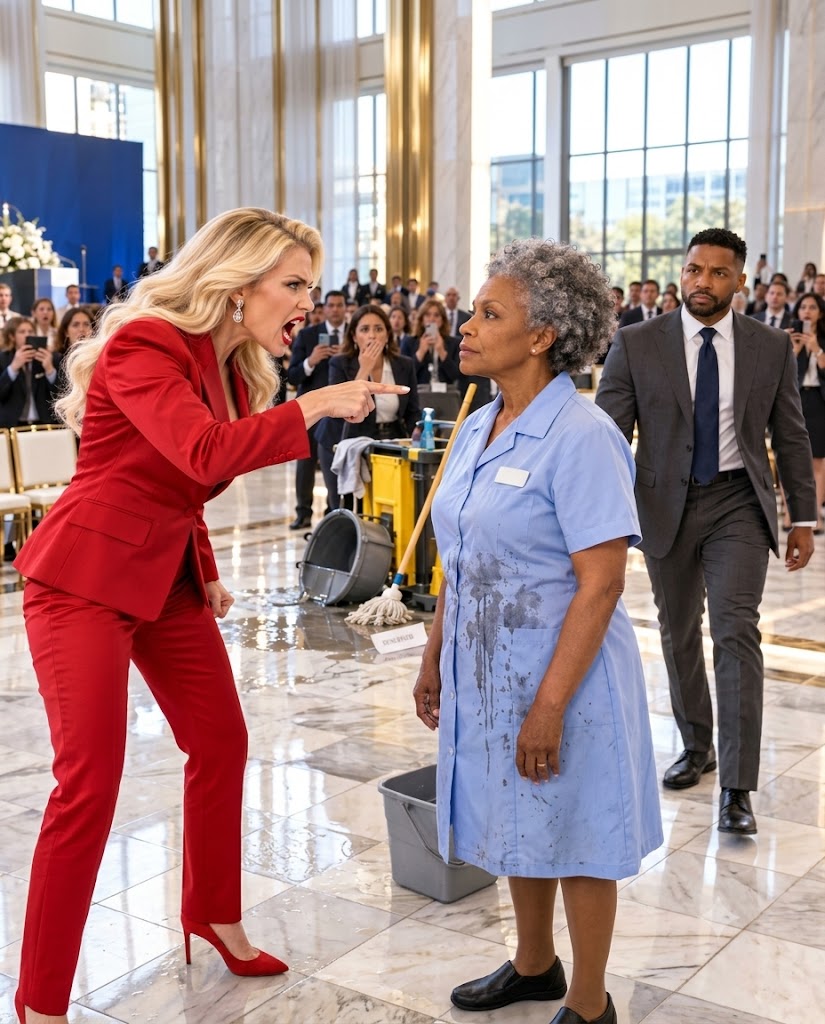
Victoria’s smile did not waver, but something behind her eyes shifted—a flicker of irritation that she had not yet learned to hide. “Hey,” she said, her voice carrying across the lobby with the particular sharpness of someone who was used to being obeyed. “What do you think you are doing in that chair?”
—
## PART 2
Loretta looked up.
She had been expecting this moment—had known, in the way that she knew most things, that the new chief executive would not let a cleaning woman sit in the front row without a fight. She had prepared herself for it. She had told herself that she would be calm, that she would be gracious, that she would remember the promise she had made to her son about not making a scene.
But now, looking at Victoria Crane’s face—at the particular combination of contempt and confusion that rich people wore when they encountered someone they could not immediately categorize—Loretta felt something shift inside her.
“Good morning, ma’am,” she said, keeping her voice steady. “Someone asked me to sit here and wait.”
“Asked?” Victoria’s laugh was short and sharp. “Who asks a cleaning lady to sit in the front row of my ceremony?”
“I would rather not say, ma’am. He will be here soon.”
“He?” Victoria’s eyes narrowed. “Of course. Look at you. Skin like that. A cleaning smock. In the seat for my photo with the chairman?”
A ripple of laughter moved through the crowd—the nervous, sycophantic laughter of people who had learned that the safest thing to do in the presence of power was to agree with it.
“The cameras would love that,” Victoria added, her voice dripping with a contempt that was all the more cruel for being casual.
Loretta felt her hands tighten on the arms of the chair. She had spent forty years learning to absorb this kind of casual cruelty—the small dismissals, the assumptions, the way people looked through her as if she were made of glass. She had learned to smile through it, to nod, to keep her voice soft and her eyes down.
But today, she did not want to be invisible.
“I can move to the end of the row, ma’am, if that helps,” she said, hating herself for the words even as she spoke them.
“The end of the row?” Victoria’s laugh was louder this time. “People of your color do not sit in my rows at all. You stand at the back, behind your cart.”
“I was told to wait in this seat, ma’am. I do not want any trouble.”
“Then stop causing it.” Victoria stepped closer, her heels clicking against the marble like a countdown. “Do you even know who I am?”
“Yes, ma’am. You are the new chief executive. Congratulations.”
“Do not congratulate me. Get up.”
“Ms. Crane.” A young assistant stepped forward, her face pale with anxiety. “The chairman’s reserved card is on that seat.”
“And you are?” Victoria turned on the assistant with the particular viciousness of someone who had been challenged in front of an audience. “Whoever you are, you will not be here long if you keep talking. Guest of the chairman?” She plucked the card from the seat and held it up. “Did you pick this up off the floor while you were mopping?”
“No, ma’am. It was set there for me.”
“Please do not photograph this.” Victoria waved at the photographer, who had been capturing the scene with the particular glee of someone who knew they were witnessing something newsworthy. “The chairman does not have guests who look like her.”
“Ms. Crane, the chairman is due any minute.”
“I will sit very still, ma’am,” Loretta said, her voice barely above a whisper. “You will not even see me.”
“I see you.” Victoria leaned down, her face inches from Loretta’s. “Everyone in this room sees you. That is the problem.”
Loretta’s phone buzzed in her pocket—a text from Desi, probably, asking where she was. She reached for it instinctively, just to check the time, just to see if her son had arrived.
“You are texting while I am talking to you?”
“I was only checking the time, ma’am.”
“Last chance. Out of the chair.”
“Ma’am, please. Only until he comes.”
Victoria’s hand shot out and grabbed the card from the seat. She held it up, her eyes scanning the text, and her expression shifted from contempt to something that looked almost like triumph.
“There,” she said, tearing the card in half and letting the pieces fall to the floor. “Now nobody reserved anything for you. Tanner, the chair.”
A large man in a security uniform stepped forward and grabbed Loretta by the arm, pulling her to her feet with a force that made her stumble. The crowd gasped—a collective intake of breath that was somewhere between shock and satisfaction.
“Up you go, ma’am.”
“Better.” Victoria smiled, a cold, thin smile that did not reach her eyes. “Standing next to the trash where you belong.”
“Yes, ma’am.” Loretta’s voice was steady, but her hands were shaking. She had not been manhandled like this since she was a young woman, since before she had built an empire from nothing, since before she had learned that the only way to survive in a world that wanted to erase you was to make yourself impossible to ignore. “I will stand right here.”
“And this filthy cart right beside my stage.” Victoria gestured to the cleaning cart, and one of her assistants rushed to move it. In the process, the bucket tipped, sending a wave of dirty water across the marble floor and onto Victoria’s shoes. “Oops.” Victoria looked down at the mess, then up at Loretta, and her smile widened. “But you people are used to dirty water. Are you not?”
The laughter that followed was louder this time—the kind of laughter that comes from relief, from the sudden release of tension that had been building since the moment Loretta had sat down in a seat that was not meant for her.
“Good one,” someone said.
Loretta looked at the water spreading across the floor, at the way it reflected the lights of the lobby like a dark mirror, and she felt something inside her go very still.
“Mrs. Crane.” She knelt down, her knees protesting the movement. “I will clean it, ma’am. Nobody should slip.”
Victoria watched her for a moment, her expression unreadable. Then she turned to the woman standing beside her—a young executive with the particular eagerness of someone who had learned to survive by anticipating the whims of power. “Celeste. Stand up. Or you can mop floors with her starting tomorrow.”
The woman—Celeste—looked at Loretta, then at Victoria, and something flickered in her eyes. “Then I will.”
“What?”
“I will mop floors with her.” Celeste’s voice was quiet but steady. “If that is what it takes.”
Victoria stared at her for a long moment. Then she laughed—a genuine laugh this time, the kind that came from genuine amusement. “Go back to your desk, sweetheart. Do not lose your job over me.”
Celeste hesitated. She looked at Loretta, still kneeling on the floor, still wiping up the water with the cloth from her cart, and her face crumpled with something that looked like shame.
“Let this be your first lesson,” Victoria said, turning back to the crowd. “In my company, everybody knows their place.”
—
Loretta finished cleaning the water. She rose to her feet, her knees aching, and looked at Victoria Crane with an expression that was not anger, not fear, but something older and deeper—the patience of a woman who had seen empires rise and fall, who had watched the people who thought they were permanent discover that nothing was.
“Ma’am, may I wait by the wall then? Only for a little while.”
“You may wait outside with the garbage cans.”
“I have to wait here, ma’am. I promised him.”
“Ms. Crane, look at this.” One of Victoria’s assistants stepped forward, holding a small card in her hand. “Master access, all floors. This opens every door in the building. Even the chairman’s office.” She looked at Loretta with wide eyes. “Where does a cleaning lady get a master key?”
Victoria took the card and examined it. Her eyes narrowed. “This is the chairman’s master key. The one that can open every door in this building.” She looked at Loretta, and her expression shifted from contempt to something that looked almost like excitement. “Where did you get this?”
“That card is mine, ma’am.”
“Yours?” Victoria laughed, but there was a nervous edge to it now. “Of course it is. People like her always have a story. Skin like that, a master key, and a seat she never earned.”
“I did not take anything, ma’am. Please, give it back.” Loretta’s voice was still steady, but there was something new in it now—a note of urgency that she could not quite hide. “They are on their way. Do not move.”
“I was not going anywhere, ma’am.”
“Tanner, stand next to her.” Victoria’s voice was sharp. “If she runs, everyone films it.”
“Ms. Crane, please.”
“Wait for the chairman. Let him decide.”
“The chairman will thank me for catching a thief before my very first speech.” Victoria smiled, and it was the smile of someone who had already written the headline in her head. “Now, shall we begin?”
—
The doors at the far end of the lobby opened.
Loretta felt the shift in the room before she saw him—the way the crowd seemed to lean toward the entrance like flowers toward the sun, the way the air itself seemed to change. She had watched her son walk into rooms for forty years, and she had never gotten used to the way people responded to him. The way they parted for him. The way they fell silent.
Desmond Hale was forty-seven years old, and he looked like his father—the same broad shoulders, the same quiet intensity, the same way of holding himself that suggested he was always thinking three moves ahead. But he had his mother’s eyes, and his mother’s stubbornness, and his mother’s absolute refusal to forget where he came from.
He was also, as Loretta saw with a mother’s instant recognition, absolutely furious.
“Mom?”
His voice cut through the silence like a blade. He was staring at her—at her soaked smock, at the water still dripping from her hands, at the way she was standing next to her cleaning cart as if she were a criminal who had been caught in the act.
“Hello, Desi.” Loretta’s voice was calm, but her eyes were wet. “You are late.”
“You are soaking wet, Mom.” He crossed the lobby in three long strides, ignoring the executives who tried to intercept him, ignoring Victoria Crane’s outstretched hand. “Who did this to you?”
“It is only water, sweetheart.”
“His mom?” Someone in the crowd whispered, and the whisper spread like wildfire. “His mom?”
“This is Loretta Hale.” Desmond turned to face the room, his voice carrying to every corner of the lobby. “My mother.”
Victoria Crane’s face went white. “Mr. Hale, I—”
“Read that plaque, Ms. Crane.” Desmond pointed to the bronze plaque near the entrance, the one that had been there for forty years, the one that Loretta had run her fingers over just that morning. “Hale Group. Founded with one cleaning cart. Loretta Hale.”
The silence that followed was absolute.
“Forty years ago, she cleaned this lobby every night.” Desmond’s voice was quiet now, but it carried further than any shout. “She founded this company. She is still its largest shareholder.”
Victoria opened her mouth, but no words came out.
“Every year on our birthday, I clean this floor.” Loretta spoke for the first time, her voice soft but steady. “So I never forget where we started.”
“This cart is my mother’s.” Desmond gestured to the cleaning cart, still standing beside the stage, its squeaky wheel silent for once. “I gave it to her myself. And that seat—” He pointed to the front row, where the pieces of the torn card still lay on the floor. “That seat was reserved by me for her.”
Victoria Crane looked like a woman who had just watched her entire career collapse in front of her. “Mr. Hale, I did not know who she was.”
“You did not need to know who she was.” Desmond’s voice was cold. “You only needed to treat her like a person.”
—
## PART 3
The lobby had gone very still.
Loretta stood beside her cart, watching her son—her boy, the one who had drawn bridges on the backs of his school papers, the one who had asked her whether he could ever build something real—take control of the room the way he had been taking control of rooms since he was old enough to understand that power was not something you were given but something you took.
“Mr. Hale, I recorded everything.” Celeste stepped forward, her phone held out like a weapon. “Show the board.”
Desmond took the phone. He watched the video—Loretta sitting in the chair, Victoria’s contempt, the ripped card, the water, the laughter. And when he looked up, his face was the face of a man who had just discovered exactly what kind of person he had hired.
“‘People of your color do not sit in my rows.'” He read the words from the video, his voice flat. “Your words, Mrs. Crane. In front of the press.”
“It was a misunderstanding.”
“There was nothing to misunderstand, Miss Crane.”
“Mr. Hale, I only followed orders.” Victoria turned to Tanner, her voice rising with desperation. “She told me to pull the chair.”
“Tanner.” Desmond did not raise his voice. “You were laughing while you did it, Mr. Voss.”
Tanner Voss, a man who had spent twenty years as head of security, looked at the floor and said nothing.
“All in favor of ending Miss Crane’s contract today for breach of the conduct clause.” Desmond looked around the room—at the board members who had gathered, at the executives who had watched his mother be humiliated without saying a word, at the people who had laughed. “Unanimous.”
“Mr. Hale—”
“Her signing bonus included.” Desmond’s voice was implacable. “Mr. Voss, you are finished here, as well.”
Victoria Crane’s face crumpled. “You cannot—”
“I can.” Desmond turned to the crowd. “This is Desmond Hale. Cancel that call.” He was speaking to someone on his phone, his voice calm and steady. “There is no thief in this building.”
He walked to his mother and took her arm. “Your seat, Mom.”
Loretta looked at him—at this man who had become everything she had hoped he would become, and more—and she felt tears spill down her cheeks for the first time that morning.
“Ms. Murray.” Desmond turned to a young woman who had been standing near the back, the one who had knelt beside Loretta when nobody else would. “I need you on the top floor. Chief of staff.”
The woman—Ms. Murray—stared at him. “Sir?”
“Say yes, sweetheart,” Loretta said, and her voice was warm with a pride that had nothing to do with money or power and everything to do with the simple act of seeing someone.
“Yes.” Ms. Murray’s voice was barely a whisper, but it was enough.
—
The ceremony went on.
Victoria Crane was escorted from the building by security—not the security she had commanded, but a different team, called in from the parent company to handle what the board was already calling “the incident.” The video of her words—”People of your color do not sit in my rows”—was already circulating on social media, and by the end of the day, it would be the subject of a thousand think pieces and a hundred thousand angry tweets.
But Loretta did not watch any of that.
She sat in her seat in the front row, next to her son, and she watched as the company she had built celebrated its fortieth birthday. She watched as the employees—the ones who had laughed, the ones who had looked away, the ones who had knelt beside her—filed past the stage to receive their anniversary bonuses. She watched as her son gave a speech that was not about growth or innovation or the importance of never settling for second best, but about the people who made the company run.
“The woman who cleaned this lobby every night for forty years,” he said, “taught me that the most important thing in any business is not the product or the profit. It is the people. All the people. The ones you see, and the ones you do not.”
Loretta felt the tears on her cheeks and did not wipe them away.
—
Afterward, when the lobby had emptied and the cameras had been packed away, Loretta found herself standing near the service entrance—the one marked “STAFF ONLY”—with her cart beside her. She had changed out of her wet smock into the spare clothes she kept in the supply closet, but she still felt the weight of the morning on her shoulders.
“Mrs. Hale.”
She turned. Victoria Crane was standing behind her, flanked by two security guards, holding a cardboard box of her personal belongings. Her face was blotchy from crying, and her carefully constructed smile was gone.
“I wanted to say—” Victoria stopped, swallowed. “I wanted to say that I am sorry.”
Loretta looked at her for a long moment. She thought about the plaque near the entrance, the one that said “Founded with one cleaning cart.” She thought about the forty years she had spent cleaning floors, and the forty years she had spent watching people like Victoria Crane walk over them without ever looking down.
“Go home, Ms. Crane.” Her voice was soft. “Think about this morning.”
Victoria nodded. She turned to leave, then stopped. “They said we have to use the service door.”
Loretta said nothing. She simply watched as the woman who had been the chief executive of the Hale Group—the woman who had sneered at her smock, at her skin, at her place in the world—walked through the door marked “STAFF ONLY” and disappeared into the gray afternoon.
—
“Why did you not just tell her who you were?”
The question came from Desi, who had appeared at her elbow with two cups of coffee and the particular expression of a daughter who had watched her mother be humiliated and was still trying to decide whether to cry or scream.
Loretta took the coffee. “Because the woman standing in front of her should not have needed a title to be respected.”
Desi was quiet for a moment. Then she laughed—a small, sad laugh. “You are still mopping next year?”
“Every year, sweetheart.” Loretta smiled. “And next year, you come on time.”
“I was on time! The highway—”
“You were late.”
“I was—” Desi stopped. “Fine. I was late.”
“You do not have to answer her, Mom,” Desi said, gesturing to the empty doorway where Victoria Crane had disappeared. “You do not owe her anything.”
“A real apology deserves a reply, sweetheart.” Loretta took a sip of her coffee. “Even when it comes too late.”
—
The next morning, before dawn, Loretta was back in the Hale Tower lobby.
She had not slept—she never slept well after a day like that—and she had come early, as she always did, to clean the floor before the employees arrived. The marble was cold beneath her knees, and the water in her bucket was clean and clear, and the squeaky wheel of her cart kept time with the rhythm of her heart.
She was halfway through the lobby when she heard footsteps behind her.
She turned. A young woman was standing in the doorway—the same woman who had knelt beside her the day before, the one who was now the chief of staff of the Hale Group. She was holding a bucket and a mop, and her face was a study in determination.
“Next Founding Day,” Ms. Murray said, “before dawn, bring nothing.”
Loretta raised an eyebrow. “I will bring the cart.”
“You are going to teach her to mop?”
“I am going to teach her to see people.”
Ms. Murray was quiet for a moment. Then she smiled—a real smile, not the careful, practiced expression of someone who had learned to survive by pleasing power, but the genuine smile of someone who had just discovered something true.
“Can I come, too?”
Loretta laughed. “Bring your own cloth, sweetheart.”
“I will.” Ms. Murray hesitated. “You said before dawn.”
“You are on time. My son never manages that.”
Ms. Murray laughed, and the sound echoed through the empty lobby like music. Then she grew serious. “Why are you helping me?”
Loretta looked at her—at this young woman who had knelt beside her when nobody else would, who had risked her job to do what was right—and she felt something warm and familiar bloom in her chest.
“Because forty years ago, somebody handed me a mop and a chance.”
She turned back to her work. The floor was clean now—spotless, gleaming, reflecting the lights of the lobby like a mirror. But Loretta knew that it would not stay clean. It never did. People would walk on it, spill on it, track in the dirt of the city. And tomorrow, or the next day, or the day after that, she would be back here, kneeling on the cold marble, cleaning it again.
“Right here,” she said, pointing to a spot near the entrance. “Last year, I—”
“I know.” Ms. Murray knelt beside her, dipping her own cloth into the bucket. “Mop Miss Green. Floors do not remember. Only people do.”
Loretta smiled. “Thank you, Mrs. Hale.”
“Call me Loretta.” She wrung out her cloth and bent back down, her hands moving in the slow, patient circles that she had learned forty years ago. “Down here, everybody mops the same floor. A floor does not care whose hands clean it. Neither should we.”
—
The city woke around them, the way it always did—the lights coming on in a thousand windows, the traffic beginning to hum, the people beginning their daily pilgrimage to jobs that would never know their names. And in the lobby of the Hale Tower, two women knelt on the cold marble floor, cleaning it together, the way it had been cleaned for forty years.
The plaque near the entrance gleamed in the early morning light, its bronze letters raised and proud: “Hale Group. Founded with one cleaning cart. Loretta Hale.”
And somewhere, in an office on the top floor, a man who had learned to see people because his mother had taught him how was already at work—not building an empire, but building something better.
A world where nobody had to be invisible.
A world where everybody got to sit in the front row.
—
**THE END**









