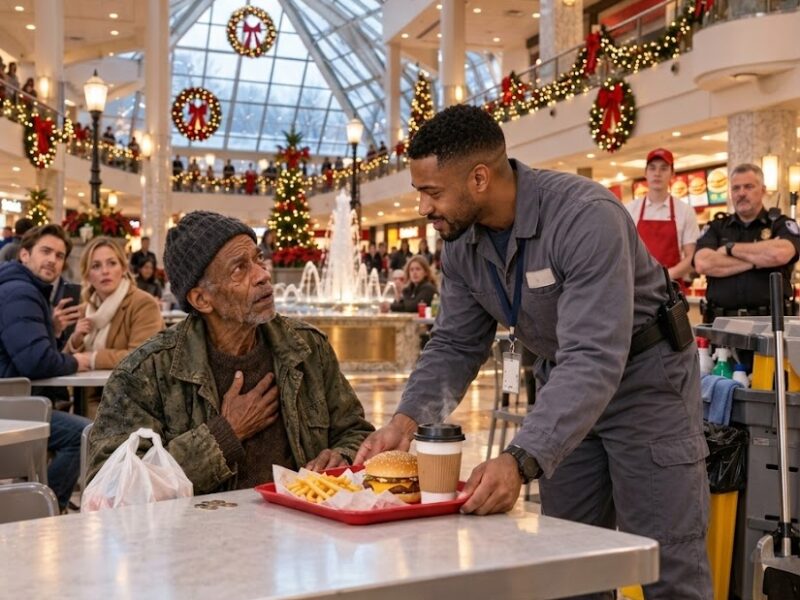
The Mall Owner Sat Hungry in His Own Food Court—Only One Custodian Offered to Buy Him Lunch
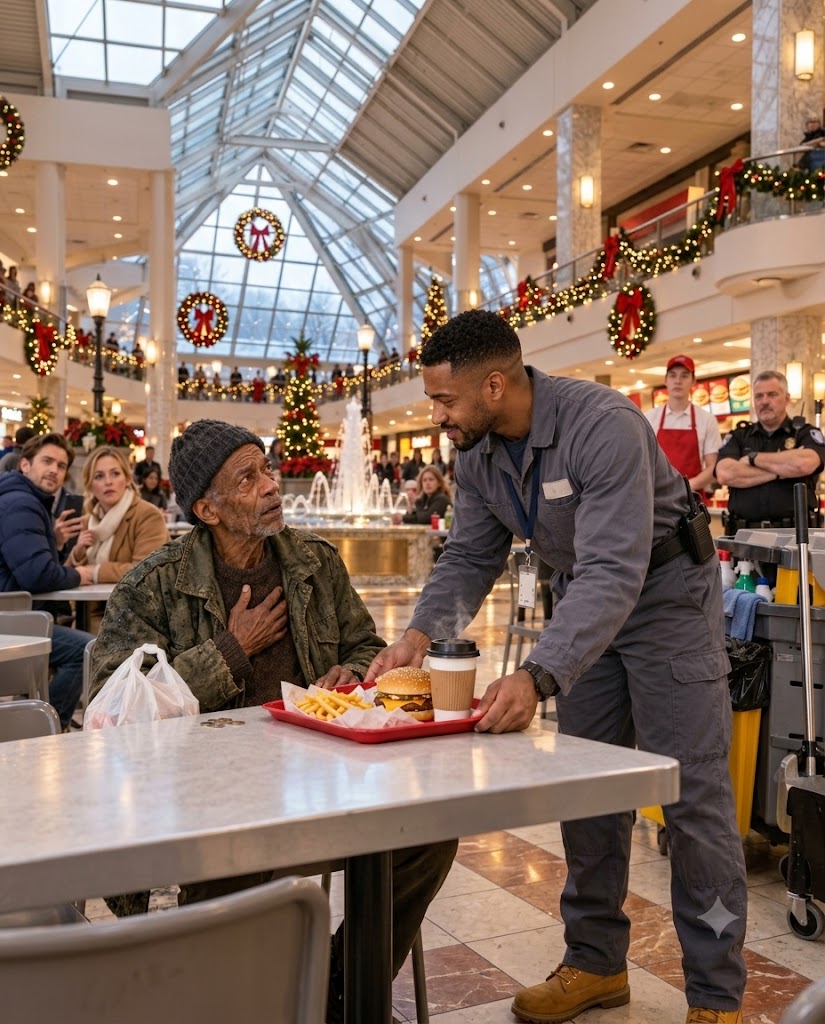
The Mall Owner Sat Hungry in His Own Food Court… Only One Custodian Bought Him Lunch
“Excuse me. You finishing those fries?”
The old man’s voice was thin, barely rising above the hum of the food court’s ventilation system. He stood at the edge of the table, hands clasped behind his back, eyes fixed on the half-eaten tray of food.
“Half a sandwich, anything,” he said. “I’m not picky.”
The young woman at the table looked up, her expression shifting from annoyance to something softer, almost pitying. She shook her head.
“Sorry, no cash,” she said.
“I didn’t ask for cash,” the old man replied. “Ma’am, whatever you don’t want. I’ll take scraps.”
“We’re eating, chief,” a man at the same table said, not looking up from his phone. “Lunch and a show, I guess.”
The old man didn’t flinch. He’d heard worse. He’d heard it all, really, over the past six years of watching this place from the other side of the mop bucket. But today was different. Today he wasn’t watching. Today he was hungry.
He moved to the next table. And the next. Each time the same polite refusal, the same averted eyes. Nobody wanted to be seen talking to him. Nobody wanted to be associated with the man in the worn coat who smelled faintly of rain and old paper.
Finally, he reached the counter at Big Ed’s Burger Shack. The cashier, a teenager with acne and a name tag that read “Denise,” looked at him with a mixture of curiosity and caution.
“What’s the cheapest thing you’ve got?” he asked.
“Number one combo. Eleven forty,” she said.
“Small fries. Three eighty-nine.”
“Cup of water.”
“Cups are for customers,” she said automatically. “Seating too. Sorry.”
He nodded. He’d expected that. He turned away from the counter, his stomach tightening with a hunger that had nothing to do with food. It was the hunger of being invisible. Of being erased while still breathing.
“What are you selling?” a voice asked behind him.
He turned. A man in a gray uniform stood there, holding a mop bucket. The name tag on his chest read “Isaiah.”
“Nothing,” the old man said.
“Everybody’s selling something,” Isaiah said.
“Then I’m bad at it.”
Isaiah studied him for a long moment. Then he turned back to the counter.
“Number one, whatever he wants to drink. For here.”
Denise looked confused. “For here? He’s a customer?”
“He’s a customer,” Isaiah said firmly. “Coffee. Black. Where’s yours?”
“I ate,” the old man said.
“Go sit. It’s getting cold.”
The old man sat. He watched Isaiah move through the food court with the efficiency of someone who’d done this a thousand times. The mop glided across the tile, leaving clean streaks in its wake. Isaiah didn’t rush. He didn’t dawdle. He worked with a quiet dignity that the old man recognized immediately.
“What do they call you?” the old man asked when Isaiah returned.
“Isaiah. It’s on the shirt. Saves time.”
“Isaiah what?”
“Brooks. And you?”
“Walter.”
“Walter, ketchup’s by the napkins.”
“Isaiah, zone B. Soda spill by the pretzel place.”
“On it.”
Isaiah paused. “They do refills on the coffee. Don’t let them tell you different.”
He reached into his pocket and pulled out an envelope. It was plain white, slightly worn at the corners. He slid it across the table.
“That’s your pass money.”
The old man looked at the envelope. “It’s an envelope.”
“December’s thirty-one dollars. Friday’s payday.”
“Today’s Tuesday.”
“I can count, Denise.”
“Still up. Six years I’ve worked here. First Thanksgiving they ever shut the doors.”
“I ate at my mother’s. Sat down for the whole thing.”
“That sounds nice. I remember those.”
“Yeah, it was good. Don’t get used to it.”
Isaiah’s radio crackled. He listened for a moment, then nodded.
“You hear from Ry?” the old man asked.
“Call Sunday. Still looking.”
“Eleven years. Three write-ups in one month and he’s gone.”
“I know.”
“One of them’s from September. Ray was in the hospital in September. They opened up his chest.”
“He told me.”
“And there’s still a paper.”
Isaiah’s jaw tightened. “Labor’s down again. Another four points. No. Same coverage on the floor. Corporate review is next week. They’re going to love this quarter.”
The old man said nothing. He sipped his coffee. It was bitter, but it was hot. That was enough.
A woman approached their table, looking flustered. She was older, well-dressed, clutching a purse with both hands.
“Whose card is this?” she asked, holding up a parking card.
“Mine,” the old man said. “I’m moving it.”
“Sorry. Housekeeping.”
“He reads name patches now,” Isaiah muttered.
“It was right here,” the woman said. “Ma’am, lose something?”
“I parked by a green post. They’re all green down here.”
“Well, mine was special.”
“All right, let’s look.”
“Well, that’s a stupid way to paint a garage.”
“Yes, ma’am. Which door did you come in?”
“By the shoe store with the boots in the window.”
“That’s level three. Let me get those for you.”
“Oh, thank you. My arms are tied.”
“This way. Watch your step.”
“Oh, thank God. My son says I shouldn’t drive anymore.”
“Tell him you found it on level three. He’ll keep quiet. Drive safe. It’s slick out there.”
Isaiah returned to the table. “There you are. Eighteen minutes out of zone.”
“I’m on break.”
“Your break ended seven minutes ago.”
“I had a few minutes left.”
“I’ll make it up at close.”
“It’s not me. Kesler counts the minutes. He gets a printout.”
“You know her?” the old man asked. “Who? The lady with the car.”
“No. Wind’s worse on the north side. Stay on this one.”
Isaiah looked at the old man’s empty cup. “That was your bus.”
“I like to walk in this. Good for the legs.”
“That envelope. It said bus. You paid for my lunch with your bus pass.”
“It’s three miles.”
“It’s fine. Friday’s payday. Take it. Keep it. You’ll need coffee.”
The old man stared at him. “Fifth Street. Grace Baptist. They open the hall at eight. Hot food. CS. Tell them nobody’s on the list. They’ll find room.”
“Why’d you do it?”
“Do what?”
“Me. Out of everybody in there, if I start picking who deserves it, I’ll pick wrong.”
“That man’s been there since you opened.”
“I see him.”
“Yesterday, your janitor bought him lunch. Now he lives here.”
“Which janitor?”
“That one. Isaiah.”
“Isaiah. I’ll take care of it.”
“Thank you for telling me.”
The old man stood. He looked at Isaiah one more time, then walked away. The envelope sat on the table between them, white and unassuming. Thirty-one dollars. Bus fare. Lunch money. It was everything Isaiah had left at the end of a long week, and he’d given it to a stranger without hesitation.
That was the first time the envelope appeared. It was a small thing. A gesture. But it would echo through the halls of Riverside Commons like a thunderclap.
Two days later, the old man returned. He wasn’t wearing the worn coat anymore. He was wearing a suit. A good one. Dark navy, tailored, the kind of suit that cost more than most people’s monthly rent. He walked through the mall with purpose, his eyes scanning everything. The tile floors. The storefronts. The people.
He stopped at the food court. Isaiah was there, mopping the same stretch of tile he’d been mopping for six years. The old man watched him for a long moment.
“Mr. Hayes,” a voice said behind him. “The conference room’s ready.”
The old man turned. A young man in a crisp shirt and tie stood there, holding a tablet. His name tag read “Brad.”
“Hayes, you were polishing that the day we met,” the old man said. “Never asked whose name it was.”
“Sir, yesterday nobody told me he’s not going anywhere.”
“For those who haven’t met him, Walter Hayes, founder and chairman of Hayes Property Group. We own Riverside Commons and forty-one other centers.”
The old man—Walter Hayes—nodded. “Good morning. Sit with me.”
“Yes, sir.”
“Mr. Hayes, if I could walk you through the quarter. Labor is down thirty-one percent year-over-year.”
“I know the number, sir.”
“With respect. That man was on a bench for two days. I had complaints. I had a video going around with our logo in it. I followed policy.”
“Which policy? Three written warnings. Same for everybody.”
“I run the most efficient property you own. You’ve seen the numbers.”
“I’ve seen them. That’s why I came.”
Walter pulled a folder from his briefcase. He opened it and slid a sheet of paper across the table.
“Fourteen terminations in eighteen months. Three warnings each.”
“All documented, signed and witnessed.”
“Tell them what you told me downstairs.”
Brad shifted uncomfortably. “He showed me a warning dated November twenty-seventh, two-fifteen in the afternoon. That’s Thanksgiving. We were closed.”
“And he gave me this yesterday. It says one of three. The software renumbers and dates a typo. The incident happened. It was witnessed. Todd, that’s your signature.”
“I… yeah, I signed it. He was there. I don’t write a man up for nothing.”
“Building access November twenty-seventh. No badge swipes all day. Alarm armed from six p.m. Wednesday to six a.m. Friday.”
“Then Todd wrote the wrong day. Ask him what he saw. Could have been the day before.”
“Open the file cabinet in your office. Those are personnel files.”
“They’re confidential.”
“They’re my files. I’m not opening anything without counsel.”
“Your keys. You can give them to me or Dale can take them off your belt.”
Walter pulled another sheet from the folder. “Another one. Dated Labor Day. We’re closed Labor Day.”
“That’s eleven. Eleven of fourteen have at least one warning on a closed day or approved leave. He pulled the dates off a calendar. Nobody ever checked one.”
“Raymond Toiver. Warning dated September sixteenth. He was in surgery at St. Luke’s that week. His leave form’s in the same folder.”
“He gave me the dates. I signed where he pointed.”
“Mr. Kesler’s bonus last year. Forty-eight thousand dollars. Labor efficiency.”
Walter stood. The room went silent.
“Mr. Kesler, you’re terminated. Effective now. Falsified records. The bonus comes back. These files go to our lawyers and the state labor department today.”
“You’re firing me over a homeless man.”
“Fourteen people. You like numbers. Count them. He’s just the one who read the date.”
“Dale. Conference room.”
“Brad, my coat’s upstairs. Someone will mail it to you. You’re suspended pending review. Leave your radio.”
Walter turned to the man who’d been sitting quietly in the corner. Isaiah Brooks. The custodian. The man who’d bought him lunch with his bus pass money.
“Your termination’s void. You were never let go.”
Isaiah stared at him. “All fourteen get their jobs back. Back pay from the day they left. Somebody should call Ray before he hears it somewhere else.”
Walter looked around the room. “Riverside needs a general manager. You read the date before you signed. Nobody else in this building did that.”
He pulled the envelope from his pocket. The same white envelope. Thirty-one dollars. Bus fare. Lunch money.
“Thirty-one dollars. I looked it up. Two number ones. For here.”
“For here,” Isaiah said softly.
“This is nice.”
“Yeah. Glad we could do it again.”
“Me too. Anytime.”
“Payroll is going to ask about his lunch receipts.”
“Approve them.”
Walter smiled. “Hello.”









