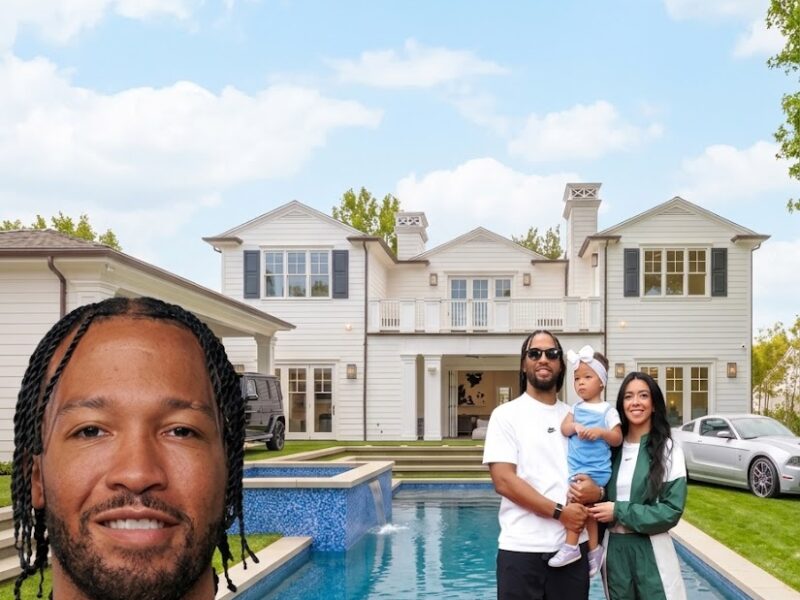
The Lifestyle of Jalen Brunson 2026 ★ House Tour, Daughter, Wife, Cars, Net Worth
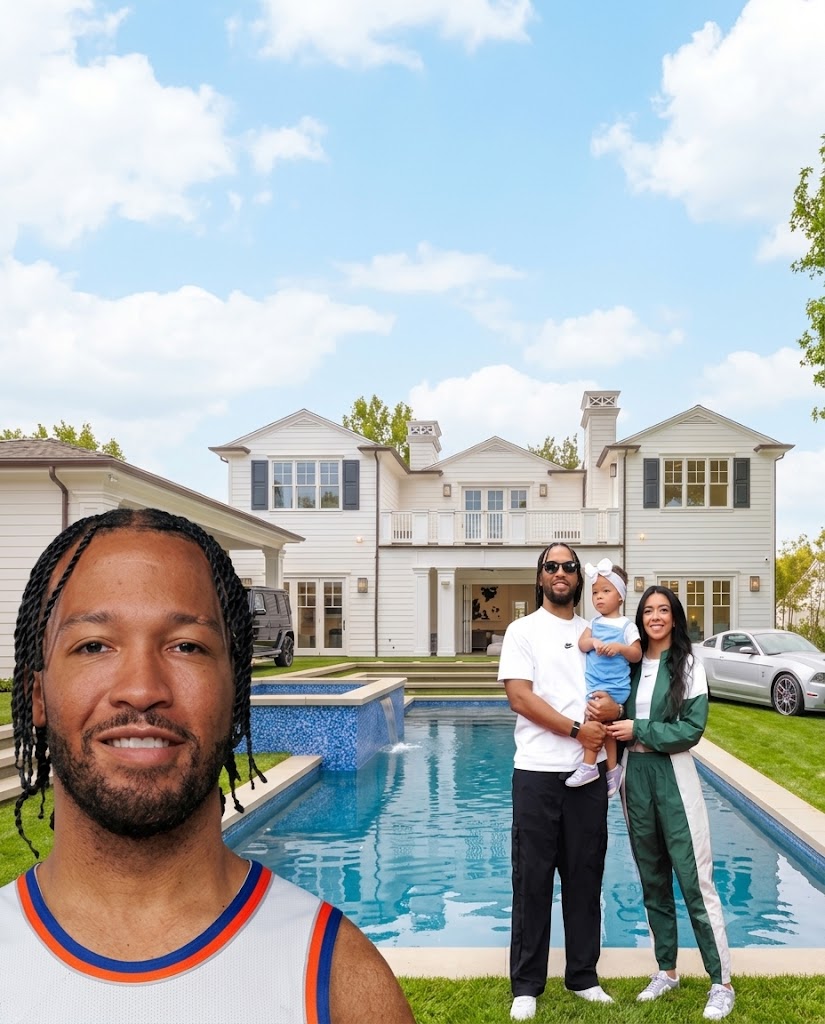
**Part 1**
The December wind off the East River cut like a blade, but inside the Chelsea studio, the only thing that mattered was the hum of a single ring light and the quiet click of a phone being set to record.
A young production assistant whispered into her headset, “He’s here. Two minutes out.”
Jalen Brunson stepped through the freight door not like a man arriving, but like a man returning to a room he’d never left.
He wore a plain gray hoodie, no logos, and carried a paper cup of black coffee that had gone cold somewhere around the Holland Tunnel.
A young sound tech fumbled with a clip mic, and Jalen caught his wrist gently. “Easy, man. It’s just me. You got this.”
The kid exhaled. That was the first thing anyone noticed about him, even now, even after a championship ring and a $156 million extension had made him a permanent fixture in New York’s skyline: he treated a nervous sound tech the same way he treated a nervous rookie in the tunnel before Game 7.
“Alright,” the producer said. “We’re rolling in three, two—”
And the camera caught it.
The championship ring sat on his right hand, heavy as a small stone, catching the ring light with every small gesture.
He set the coffee down and said, “Start wherever you want. I’m not going anywhere.”
That was the promise. The rest of the night was going to be spent keeping it.
—
The first real question came twenty minutes in, after the small talk about the Knicks’ schedule and the weather had burned off.
“People see the ring, the contract, the Hamptons house,” the interviewer said. “What do they not see?”
Jalen laughed, low and genuine. “They don’t see the 5:30 a.m. gym sessions when I was twelve. They don’t see my dad making me do the same dribble drill until my hands were raw.”
He paused, and the ring caught the light again.
“People think there’s a secret. There’s no secret. There’s just a lot of ugly, boring, repetitive work that nobody claps for.”
That was the second time the ring came up—first as an object, now as a counterweight.
The interviewer leaned in. “Your dad played in the league. Did that make it easier or harder?”
“Harder,” Jalen said, without hesitation. “People looked at me and saw my last name before they saw my game. And then they looked at my size and decided the name didn’t matter.”
He held up his hand, palm flat, as if measuring himself against an invisible scout’s clipboard.
“They told me I was too small. They told me I didn’t jump high enough. One evaluator—I remember this—said I projected as a rotational backup at best.”
“And what did you do with that?”
“I wrote it down,” he said. “Not to be dramatic. I just didn’t want to forget how it felt to be told I wasn’t enough.”
The room got very quiet. The sound tech stopped fidgeting.
—
**Part 2**
The interview wasn’t the whole story, of course. No single sitting ever is.
The real story started back in Voorhees, New Jersey, in a house where basketball was less a sport than a household language.
His father, Rick, had spent nine years in the NBA, bouncing from team to team, and the lessons came with a hard edge.
“Every drill had a purpose,” Jalen said. “He’d say, ‘You’re not doing this to be good. You’re doing this so that when you’re tired, you’re still better than the guy who isn’t.'”
His mother, Sandra, provided the counterweight. She taught him to read people, to handle disappointment, to understand that a career could end in a heartbeat and a mind could not.
“She was the one who made sure I could do a math problem while a coach was yelling at me,” he said. “That’s a skill, too.”
By high school, the family had moved twice, and Jalen had learned to walk into a new gym with a target on his back.
At Stevenson High School in Lincolnshire, Illinois, he was the coach’s son’s new teammate, the transfer kid with the famous father and the ordinary body.
Opposing student sections waited for him to fail. He responded by winning two state championships and a national player of the year award.
Then came Villanova, where he became the floor general of a two-time national championship program and won the Naismith and Wooden Awards as the best player in college basketball.
And still, on draft night in 2018, he sat in a room with his family and watched fourteen names go by before the Dallas Mavericks finally called his name at No. 33.
“Second round,” he said, and the smile on his face was not a happy one. “I remember the exact number. Thirty-two players went before me. I didn’t need a motivational speaker after that.”
The chip on his shoulder became a load-bearing beam.
—
**Part 3**
In Dallas, he started at the bottom of the rotation and clawed his way up, season by season, from an overlooked backup to a reliable starter.
Then came the 2022 playoffs, when Luka Dončić went down and Jalen put the Mavericks on his back.
He averaged 27.8 points per game in that first-round series against the Utah Jazz, including a 41-point closeout game, and the league finally had to look at him.
The Mavericks didn’t offer the extension he wanted. The Knicks did, signing him to a four-year, $104 million contract in the summer of 2022.
The criticism was immediate and loud. Rival executives whispered tampering. Talking heads called it an overpay. The investigation followed, and for a while the story was about the front office, not the player.
“I couldn’t control any of that,” Jalen said. “What I could control was what I did at 6 a.m. the next day.”
He did it anyway, and by his second season in New York he was averaging 28.7 points per game and leading the Knicks to the second round of the playoffs.
The doubters got quieter. The Garden got louder. The ring got closer.
—
**Part 4**
Then came the moment that flipped the script for good.
In the summer of 2024, Jalen signed a four-year, $156.5 million extension—roughly $113 million less than the maximum he could have commanded on the open market.
He did it, he said, to give the front office room to build a real contender.
“When you want to win more than you want to be paid,” he said, “the math changes.”
The math changed, all right. The Knicks built around him, and in 2025 they won the franchise’s first championship in over fifty years.
Jalen was named Finals MVP, and the kid who was too small and too slow and too overlooked became the king of New York basketball.
The ring on his hand was no longer just jewelry. It was a receipt.
—
**Part 5**
The money followed the winning, and the houses followed the money.
There’s the Hamptons estate—$15 million, vaulted ceilings, a cascading crystal chandelier in the foyer, a chef’s kitchen with professional-grade appliances hidden behind handcrafted cabinetry.
The primary suite has its own sitting area and a fireplace, and the en suite bathroom is built around a freestanding soaking tub under a skylight.
Outside, a multi-tiered pool with a cascading waterfall provides the soundtrack.
Then there’s the Chappaqua retreat—$10 million, the family home during the season, with a sunken living room anchored by a floor-to-ceiling stone fireplace.
The kitchen has double ovens, a hidden pantry, and an island topped with imported granite. Outside, a pool surrounded by stone decking includes a sunken fire pit.
And there’s the Dallas property—$6 million, his first real foray into luxury real estate, all clean lines, open space, an infinity-edge pool that merges with the horizon, and a covered outdoor kitchen.
The garage is its own curated collection: a $300,000 Lamborghini Urus, a $200,000 Mercedes-AMG G63, and a $130,000 Tesla Model X Plaid, the quiet family car with the falcon-wing doors.
But the real anchor isn’t in any of those houses.
—
**Part 6**
In 2023, Jalen married his high school sweetheart, Ali, in an intimate ceremony surrounded by family and lifelong friends.
In 2024, they welcomed a daughter, and the man who had spent his whole life chasing a ring found something heavier and lighter at the same time.
“She steals the show every time,” he said, laughing. “I’ll be doing an interview and she’ll just walk in and everybody forgets I’m there. That’s fine with me.”
He’s also become a vocal ambassador for organizations fighting youth homelessness, donating both money and time, meeting young people who’ve been told they don’t matter.
“I know what it feels like to be overlooked,” he said. “It’s not the same thing, but it’s a window.”
He’s been honored for that work, and he keeps showing up.
—
**Part 7**
Back in the Chelsea studio, the interview was winding down.
The producer signaled for one last question, and the interviewer asked the obvious one: “What do you want people to take from all of this?”
Jalen picked up the cold coffee, took a sip, and set it down.
“The ring is nice,” he said. “The houses are nice. But none of it happened because I was lucky. It happened because I kept showing up when nobody was clapping.”
He stood up, shook hands with the sound tech, and walked back out into the December wind.
The ring caught the streetlight one last time—not as a trophy, but as a reminder of every morning he got up before the sun.
And the promise he’d made at the start of the night held all the way to the door.









