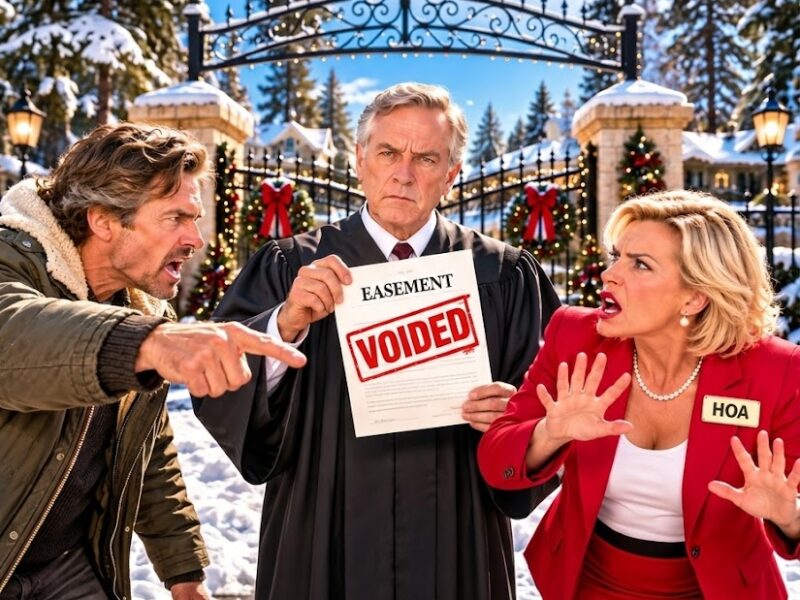
The HOA locked me out of my own home for 9 days at Christmas. They changed the locks. They taped a notice. They said I was “trespassing” on my own property. Then the judge voided their easement—and they lost everything.
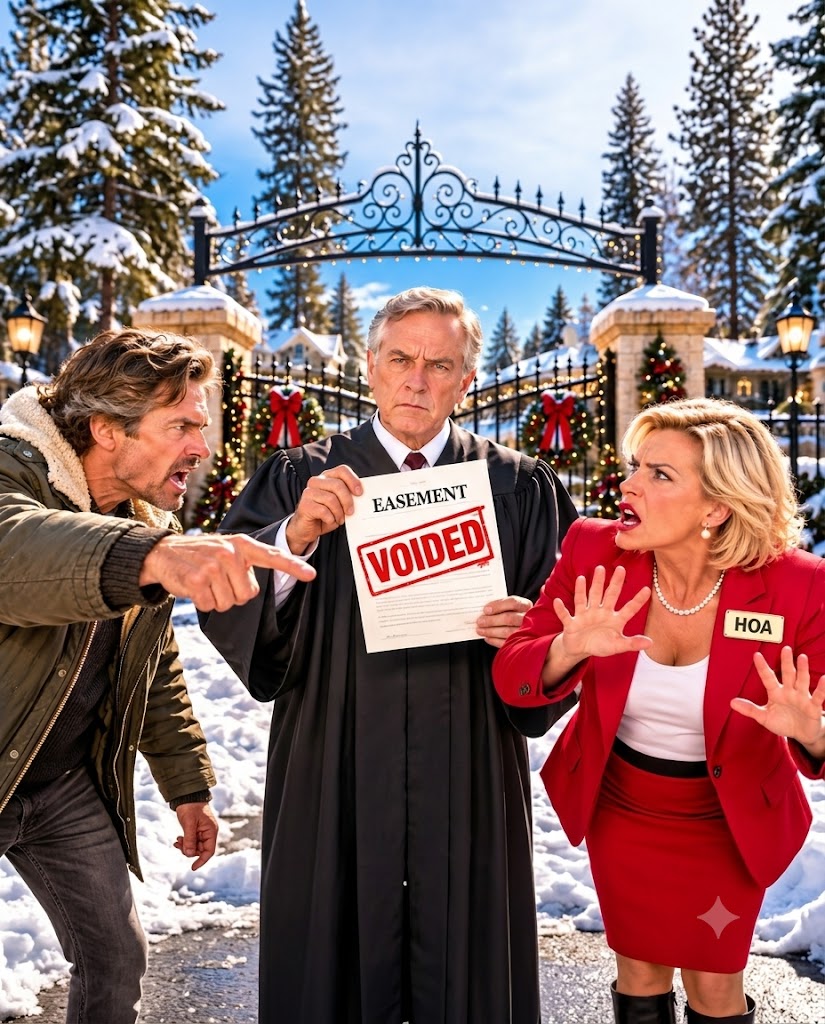
Christmas Eve snow glazed the red gate when Ethan Cole laid a county stamped deed across his truck hood.
Vanessa kept one hand on the keypad, staring at the acreage line as if owning Holly Ridge Road still gave her the final word over Ethan Cole.
I watched her read the number twice because 4,203.7 acres changed the map without changing one line of my old easement.
Behind Vanessa, two board members fell silent as the parcel map opened across Ethan’s snow-dusted hood.
“You bought Red Hollow Ranch today, Ethan, but that does not change who owns Holly Ridge Road or who controls the access gate we installed.”
“It changes what surrounds Cedar Ridge, Vanessa, and it changes which permissions your board has been taking for granted.”
Vanessa looked from the deed to the red gate.
And for once that morning, she left the keypad untouched.
Three weeks earlier, near Bend, Oregon, that gate was survey paint, steel posts, and a contractor’s auger.
I had used Holly Ridge Road since buying my 38 acres, and my father rebuilt its stone turnout there by hand.
The road crossed Martin Keller’s parcel then climbed up past Ethan’s workshop toward the timbered slope.
“I sold the road strip for winter upkeep, Ethan, not so anyone could box you in there at Christmas.”
A transfer notice named Cedar Ridge Homeowners Association as the buyer of Martin’s narrow road parcel.
I checked my deed that morning because owning the ground beneath the road is not the same as owning every right across it.
Three days later, a crew set red posts by the stone turnout and unloaded a motorized gate with a camera.
“We are standardizing winter maintenance and emergency access before Christmas, so every lawful road user will follow the same safety policy.”
“My deed grants recorded access over this road, Vanessa. A new owner cannot simply pretend that right vanished at closing.”
“Your deed grants passage, Ethan, but Cedar Ridge owns the roadway and may set reasonable conditions for continued use of this private asset.”
She had a deed, a board binder, and a contractor schedule.
Enough paper to make the claim look solid.
One detail did not fit.
Ethan’s parcel number sat on the gate plan as a future participating property.
“Why is my parcel listed as participating when I am not in Cedar Ridge, never signed covenants, and never asked to join?”
“Do not sign tonight, Ethan. Send me your deed, the transfer notice, gate plan, and every page Vanessa gave you.”
The packet demanded $14,800 in annual road fees, and future architectural review over Ethan’s land and home.
“This is not a snow plow bill. You are asking me to recognize HOA authority over land that never belonged to Cedar Ridge.”
“I am asking every beneficiary to carry the same obligations because unequal road access created a safety gap our insurer will not ignore.”
Her goal sounded reasonable.
Cedar Ridge faced ice complaints, ambulance delays, and rising plow costs, but the new steel post stood beside a stone turnout Ethan’s father had rebuilt after the blizzard of 1996.
“Your dad laid those stones by hand after that storm, and I should have warned you before the sale. Vanessa said the sale would improve winter plowing. She never said she’d force you into HOA rules.”
“If the purchase is subject to your easement, the fight is not ownership. It is what ownership allows them to do.”
“If an HOA buys the dirt under your access road, can it rewrite the right that was already recorded there?”
Rachel began with Ethan’s deed, the old access plat, and recorded instruments tied to Holly Ridge Road.
“The easement looked plain to me, but I wanted to know whether some later document had narrowed it without my knowledge.”
“Your deed says perpetual ingress and egress, but I want the road parcels chained before I treat it as conclusive.”
The first clue was older than Cedar Ridge.
Ethan’s access easement had been recorded before the HOA existed.
That timing matters since buyers take land with recorded burdens already attached, not with a clean legal slate.
Martin’s sale deed referenced prior rights and exceptions instead of promising Cedar Ridge vacant control.
“Our council reviewed the purchase, Rachel. Cedar Ridge bought this road lawfully, and the board may administer it under private road policy.”
“Then give me a code that works without covenants, because my recorded right did not begin with your purchase, Vanessa.”
Vanessa refused, saying one special code would undermine the policy approved for every lawful road user.
“I never sold your access, Ethan. I sold the road strip, and my deed promised no more than I owned.”
“Martin’s answer helps, but intent is not enough. We still need the deed, plats, and all the recorded gate terms.”
The vendor drawing added one more contradiction.
Ethan’s parcel was marked for membership conversion.
That phrase did not belong on a plowing plan unless someone expected road access to change Ethan’s status.
“I asked Vanessa for the board resolution approving that language, but she sent me the full maintenance policy instead.”
“The wording is administrative, Ethan. The point is simple. Every user of association infrastructure carries enforceable duties under policy.”
“Labels do not create rights. I need the board resolution that authorized conditions on Ethan’s recorded access.”
Rachel sent notice that afternoon citing the easement and asking Cedar Ridge to preserve every gate log.
She offered an easy off-ramp.
Issue Ethan access while both sides reviewed maintenance duties together.
“I would pay a fair share for actual plowing, but I would not trade deed rights for architectural review of my own land.”
“A special exception leaves the same safety gap unresolved, and our insurer expects one enforceable standard before this month’s renewal date.”
“That deadline is real, Vanessa, but an insurance condition cannot expand the property rights Cedar Ridge bought.”
Vanessa skipped that point and moved gate activation forward to the morning of December 20th anyway.
At 8:12 that morning, Ethan’s gate code failed and a heating oil truck backed down the icy approach road.
“I spent half the day hauling fuel below the gate, then canceled our Christmas dinner when nobody could drive in safely.”
“I regret the inconvenience, but the gate is operating as adopted. Sign the road agreement and your credentials can be restored today, Ethan.”
“You were warned in writing that his access is recorded. Keeping his code disabled increases Cedar Ridge’s risk.”
Ethan photographed the failed keypad, oil truck tracks, and the red post beside his father’s old stones.
“I could replace the lost work day. What hurt was watching a private gate turn my father’s road into leverage against me.”
“Your father built a turnout, Ethan, not a legal exemption. Cedar Ridge cannot manage emergency access through personal history or nostalgia.”
That evening, Rachel found a plat note pointing beyond Holly Ridge to Routes Crossing, Red Hollow Ranch.
When Ethan zoomed out, Cedar Ridge looked like a subdivision island almost enclosed by another property.
If ownership controlled access, why was Cedar Ridge using roads across land it did not seem to own at all?
By Sunday, Rachel had the road deed, Ethan’s easement, old plat, and gate policy spread across one table.
“The road deed repeats the easement reference, but I want one more cross-check before I call it scope settled.”
The gate policy treated access as discretionary, while the recorded documents described a lasting right.
The paper pointed one way, but the steel gate told me Vanessa still believed she could make my access conditional anyway.
“I asked the title examiner to compare the road deed, old plat, and Ethan’s easement as one complete title chain.”
“Rachel, you are reading one easement alone. Cedar Ridge owns the road, bears liability, and needs a uniform system our insurer can enforce.”
The final title note arrived Sunday afternoon, closing the gap between road ownership and recorded access.
Cedar Ridge owned the road, but its titles still carried Ethan’s older recorded easement across the parcel.
“So, they bought the ground under my tires, not the power to make my home access conditional on joining their rules at all.”
“Exactly. The record lets Cedar Ridge manage its own road, but not condition Ethan’s passage on HOA membership.”
Vanessa answered by ordering the gate apron widened again for what she called emergency vehicle clearance.
“The wider apron is part of approved safety work, Ethan, and work on Cedar Ridge’s road parcel will continue unless a court orders otherwise.”
The excavator bucket caught the old stone turnout before Ethan reached the crew, scattering hand-set rock.
“Those stones are not debris. The map shows the turnout pre-dates Cedar Ridge, and several blocks lie outside its road parcel.”
The crew stopped after Rachel called, but three stones split, and the curve Ethan’s father built was gone.
“I can rebuild the wall, but I cannot make those broken stones original again. That is when it stopped feeling temporary.”
I manage Red Hollow for the Grady estate.
Rachel called because Cedar Ridge roads and turnarounds cross our ranch boundary.
Owen’s map showed Cedar Ridge surrounded on three sides by Red Hollow Ranch, property Ethan already knew.
He had studied Red Hollow for timber, grazing, water, and conservation value, then passed at that price.
“Red Hollow has allowed those uses for years, and that changes nothing on Holly Ridge Road or Ethan’s duty to follow all adopted access rules.”
“Ethan’s easement is recorded. Several Cedar Ridge uses on Red Hollow appear permissive, not fixed rights at all.”
Owen found estate letters calling those routes neighborly accommodations, each one revocable in writing.
The prior owner allowed emergency passage, plow turnaround, drainage work, and foot trail without creating permanent rights.
“I asked if the ranch was still for sale because I had studied its timber, contracts, and water rights before this fight.”
Red Hollow was not revenge.
Ethan had already modeled the ranch as an investment before the gate dispute.
“Buying thousands of acres to pressure a neighborhood would be reckless, Ethan. It would not change our duty to safe winter access in storms.”
She was right about one thing.
The ranch had to make sense alone, or Ethan would be buying it for spite.
“The ranch has timber income, grazing leases, water rights, and conservation land. So, the purchase stands on its merits alone.”
Ethan reviewed cash flow, title exceptions, taxes, and licenses Cedar Ridge treated as permanent rights.
“I had proceeds from selling most of my company, and the ranch still had to make sense without this fight, or I would walk.”
Rachel found the key risk clue.
Cedar Ridge’s insurer wanted documented secondary access before renewal.
“Our renewal needs reliable emergency routes and winter operations. I won’t apologize for keeping residents insured and reachable in storms.”
That goal made sense, but a board email showed Vanessa planned to solve it by controlling Ethan’s land.
Her email said, “Once I knew I had no practical alternate access, I would cooperate.”
That was leverage, not maintenance.
Ethan signed an offer for 4,203.7 acres, wired earnest money, and set closing for Christmas Eve morning.
If Cedar Ridge knew Red Hollow permissions were fragile, what made Vanessa keep taking this risk anyway?
Christmas Eve began with a title message saying Red Hollow’s documents were ready for county recording.
“You are locked out under board policy, Ethan. Buying a ranch does not excuse refusing shared rules and costs that keep Cedar Ridge secure.”
Before closing, Rachel found the file explaining why Vanessa treated Ethan’s signature like a deadline.
“This engineering memo prices the replacement emergency connector if Red Hollow permissions disappear after sale.”
The estimate strained Cedar Ridge’s reserves, and the insurer wanted a documented route before renewal.
“So, my 38 acres were not just about plowing. Vanessa wanted a backup corridor she could use if Red Hollow sold.”
The gate agreement could put Ethan’s land under road rules broad enough for emergency improvements later.
The estate warned Cedar Ridge that permissions would be reviewed at sale.
So, Vanessa knew some access could then be revoked.
The motive was clear.
Vanessa had a real community problem, but she was solving it beyond HOA authority.
“Yes, I knew permissions could change. I also knew one blocked ambulance route in January mattered more than Ethan’s objection to paperwork.”
Her strongest argument landed.
She was not chasing fees.
She was trying to prevent winter access failure.
“I understand the risk. It still does not let Cedar Ridge condition Ethan’s easement on HOA control of his land.”
At 9:18 a.m., the title company confirmed funding, signatures, and county submission for Red Hollow Ranch.
The deed covered 4,203.7 acres, wrapping Cedar Ridge on three sides, and carrying licenses Owen identified.
“I did not buy the ranch to close roads. I bought an asset I understood, and I will manage every permission in writing.”
“Then you understand my position. Emergency roads and drainage cannot depend on favors that vanish whenever ownership changes hands in winter.”
Ethan understood the goal.
He rejected the belief that necessity could create rights nobody had granted.
“Recording is confirmed. Red Hollow Land Company holds title while Cedar Ridge permissions remain licenses until documented.”
Rachel sent two notices before Ethan drove back toward the red gate keeping both issues legally separate.
Notice one demanded immediate access under Ethan’s easement and preservation of every gate log and camera record.
Notice two said Red Hollow would review trails, turnarounds, drainage routes, and access licenses again.
“Threatening community access on Christmas Eve is retaliation and the board will respond if you interfere with essential safety operations.”
The notice preserved emergency passage and winter operations.
It only ended the assumption of free use.
At the gate, Ethan spread the deed and parcel map across his hood as Christmas Eve snow fell around them.
“You were right about one thing, Vanessa. Property lines matter, which is why I checked every line all around Cedar Ridge.”
“His easement survives your purchase. Red Hollow licenses are not easements because Cedar Ridge relied on them.”
Vanessa traced the acreage line north, east, and south around Cedar Ridge then looked toward Ethan again.
“Red Hollow will preserve emergency access but recreation, marketing, parking, and expansion need written owner permission.”
Vanessa finally saw the symmetry.
Cedar Ridge demanded strict rules while relying on favors from others.
“If you cut off uses residents depend on, you recreate the instability I tried to prevent. Except now you will be holding the leverage again.”
Ethan left the keypad untouched and waited for Cedar Ridge’s board and council to read the same record.
What happens when neutral reviewers compare Vanessa’s gate policy with the rights Cedar Ridge truly owns?
By Christmas night, Cedar Ridge’s council had separated Ethan’s easement from those Red Hollow licenses.
“We filed for narrow relief, restore access, preserve the evidence, and leave road maintenance issues for later.”
An expedited hearing soon put the deed chain, gate logs, and road agreement before a neutral county judge.
“I did not ask the court to punish anyone. I asked for what my deed promised all along, reliable access to my home again.”
A temporary order barred Cedar Ridge from conditioning Ethan’s passage on signing the HOA road agreement.
“I still believe the board had to secure winter access, but I accept the court rejected tying Ethan’s recorded access to our road agreement.”
The keypad reset that afternoon, and Ethan’s permanent credential opened the red gate without a waiver.
“We will license emergency response, drainage repair, and plow turnaround, because those uses protect people, not marketing.”
Ethan did not copy Vanessa’s mistake by treating ownership as permission to control everyone around him.
Trail parking, expansion route, and marketing rights were different because no safety need required them.
“I kept emergency routes open, but Cedar Ridge could no longer advertise my ranch as an amenity or plan around use of it.”
The settlement recognizes Ethan’s easement, cancels the road agreement, and reimburses documented legal costs.
It removed the HOA residents only sign, and required future gate rules to honor recorded access rights.
“I wanted one system before the insurer’s deadline, and I pushed too far when I treated a maintenance problem as authority over Ethan’s land.”
Vanessa did not become Ethan’s friend.
She later resigned after the board recorded a no confidence vote.
Cedar Ridge kept emergency and winter functions by license, while recreation, parking, and expansion needed owner approval.
The result was no speech.
It was a map where every Cedar Ridge use finally matched an actual written right.
That mattered more than revenge.
I wanted the same property rule on both sides of the gate whenever ownership changed.
Two weeks later, a mason rebuilt the stone turnout with surviving pieces and local rock beside the gate.
Three old stones were too fractured to reset, including the corner block Ethan’s father shaped by hand.
“We set the stone beside the rebuilt drain, so the turnout shows what the excavator damaged and what could not be restored.”
The gate stayed because the problem was never the gate.
It was using steel to override recorded access.
The first time I code opened it, I stopped beside dad’s cracked stone, cleared snow from the drain, and drove through.
Cedar Ridge posted a sign saying recorded access rights applied, replacing the old residence only claim.
Ethan could host Christmas dinner next year, but that lost family evening could never be replayed exactly.
Justice restored the boundary and road, but not the original stones or the week Ethan spent locked out.
What remained was quiet, a working gate, written permissions, and a ranch managed by the same clear rules.
Ethan bought 4,203.7 acres because the investment made sense.
The gate only forced him to study the map.
Cedar Ridge learned the lesson the gate blurred.
Ownership is power, but only within its lawful limits.
If evidence beats intimidation in these stories, like, subscribe, and tell me where you draw the line.









