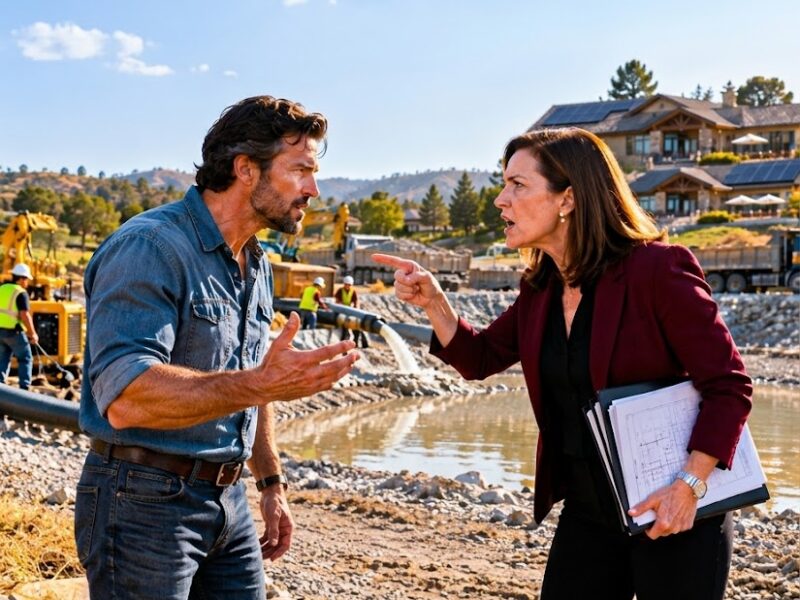
The HOA drained my fire pond to expand their parking lot. They said it was “unsightly” and “wasted space.” Then the wildfire came—and their $4.9M clubhouse was the first thing to burn.
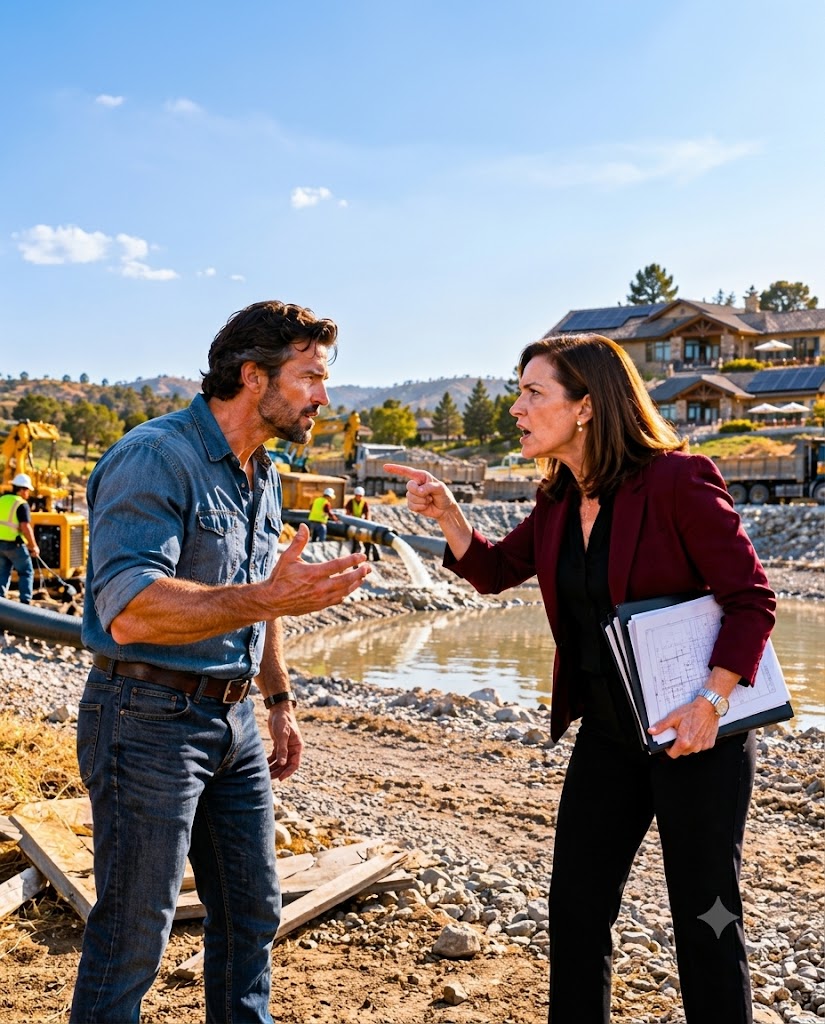
When Tanner Wilcox saw the excavators parked beside his fire pond at 5:40 that July morning, the water was already disappearing through three industrial pumps the size of small tractors.
The diesel roar carried up the slope to his farmhouse like a gut punch, dragging him out of bed before his alarm could even think about going off.
By the time he pulled on his boots and ran down the gravel ranch road, thousands of gallons were already spitting across the dry ground toward a culvert, bleeding into the dust like the land itself was thirsty.
HOA President Cheryl Davenport stood on the bank in white linen and sunglasses, smiling like she was watching a fountain dedicated in her honor.
Behind her, a row of dump trucks idled on the ridge, loaded high with crushed stone, their drivers waiting for the signal to bury what had taken decades to build.
She wanted 72 new parking spaces for her precious clubhouse gala circuit, and she had looked at Tanner’s two-acre pond—the only certified wildfire drafting point for miles—and called it wasted land.
Tanner warned her it was the sole emergency water source for the entire western ridge, the one thing standing between Juniper Ridge and catastrophe if the wrong wind ever came.
Cheryl laughed the way someone laughs at a child who still believes in monsters, waved a folded board resolution in his face, and told him to sue if he didn’t like it.
Eleven days later, a wind-driven wildfire crossed the ridge, and the fire engines that raced toward the $4.9 million clubhouse dropped their hoses toward Tanner’s pond and found nothing but stone.
And hidden inside Cheryl’s parking scheme was a second document that would make the loss far worse than anyone could have imagined.
—
Tanner Wilcox owned 34 acres on the western edge of Juniper Ridge, a gated community of stone-faced homes, manicured lawns that cost more to maintain than most people’s mortgages, and residents who believed every view belonged to them by divine right.
His land held a modest farmhouse with a wraparound porch, a weathered equipment barn that had survived three decades of Colorado winters, a long meadow of summer grass that swayed gold in the afternoon light, and a gravel ranch road that curled toward the hills like a question mark.
But none of that was why firefighters across the county knew his name.
The real treasure sat in a shallow valley below the house, a man-made pond covering nearly two acres, its surface glassy and still in the early morning hours before the wind picked up.
In the worst weeks of August, when every creek in the region shrank to dust and the wells ran warm, that pond still held water.
The previous owner had dug it decades earlier after a wildfire tore through the canyon and burned three ranches to the ground because engines had nothing to pump and crews had been forced to stand at the edge of the flames and watch everything turn to ash.
When Tanner bought the land in 2016, he treated the pond like insurance he could see, something tangible in a world of paper promises and fine print.
He reinforced the banks with rock hauled in from a quarry two counties over, paid out of his own pocket to install a dry hydrant—a red standpipe where fire engines could connect a suction hose and draft water straight from the basin—and every summer he topped it off from his well and the seasonal creek, holding the level near 310,000 gallons.
Beside the access road, a small metal sign read: “Emergency Firewater—County Access Only.”
The arrangement was simple, recorded, and legally bulletproof.
Tanner owned the land, the banks, and every drop of water.
The county held only the right to use that water in an emergency, along with a narrow easement letting fire apparatus travel his northern road to reach it.
A few hundred yards east of his fence rose the Juniper Ridge clubhouse, a sprawling timber and glass building worth roughly $4.9 million with a banquet hall, a restaurant, the HOA boardroom, and a sweeping terrace facing the same hills Tanner looked at every morning.
Cheryl Davenport had been president of the HOA for less than two years, and in that time, she had decided the clubhouse should earn money instead of hosting book clubs and birthday parties.
She wanted weddings, corporate retreats, and charity galas booked every weekend, the kind of events that brought in six-figure contracts and made her name the one people thanked at the podium.
She was decisive, relentless, and convinced that the board’s authority stretched as far as her ambition did.
The only thing standing in her way was parking.
The clubhouse had 118 spaces, and every event planner she courted said the same thing: it wasn’t enough.
Cheryl wanted 72 more.
—
One morning in early July, Tanner walked down to check the water level and found three men driving survey stakes beside his pond.
A heavyset man in a reflective vest introduced himself as Owen Rutledge, owner of a local excavation company, and explained that the HOA was studying a parking expansion.
Tanner assumed they meant the strip of association land along the clubhouse driveway, the useless patch of gravel nobody ever used.
Then Owen unrolled the plans across the hood of his truck.
Seventy-two neat rectangles had been drawn directly across the bed of Tanner’s pond, as if the water had never existed at all, as if decades of preparation and thousands of dollars of maintenance meant nothing.
Tanner called Cheryl that afternoon, and she sounded entirely unbothered, like a woman discussing the weather.
“It’s just an old retention pond,” she said. “Wasted land.”
“The HOA needs it more than you need the water.”
Tanner told her it wasn’t a retention pond.
It was his fire pond, on his property, listed with the county as a critical emergency water source.
Cheryl laughed the way someone laughs at a child, then informed him the board had already voted to classify the basin as common drainage infrastructure, which she claimed gave the association every right to improve it.
That night, Tanner spread his deed, his survey, and his county records across the kitchen table and read every line twice.
Nothing transferred the pond to the HOA.
The only easement on his land belonged to fire services, not the board, and it granted no right to pump water, grade soil, or pave anything.
The next morning, he emailed Cheryl a formal demand that all activity on his property stop immediately.
Her reply arrived within the hour and contained exactly six words: “The board has already approved it.”
—
Three days later, at 5:40 in the morning, the roar of diesel engines dragged Tanner out of bed.
He pulled on his boots and ran down the slope in the gray half-light, his breath visible in the cool air, his heart pounding against his ribs.
Three industrial pumps squatted on the bank, their thick hoses snaking into the pond and spitting water across the dry ground toward a culvert.
Thousands of gallons were disappearing every minute, and lined up on the ridge behind them, engines idling, waited a row of dump trucks loaded high with crushed stone.
Tanner drove straight down to the bank and told Owen to shut the pumps off.
Owen didn’t argue.
He reached into his cab and handed over a work order bearing Cheryl Davenport’s signature, in which she certified that the HOA controlled the entire project area.
Tanner walked him 30 paces east and pointed at an iron survey pin hammered into the ground, its orange cap faded by years of sun.
The true property line sat nearly 40 feet from the nearest edge of HOA land.
Every inch of the pond lay on Tanner’s side.
Doubt crossed Owen’s face, but he explained that the contract was worth nearly $86,000.
The HOA had already paid part of it, and he couldn’t walk away from a signed agreement over a neighbor dispute.
So Tanner called Cheryl down.
She arrived 30 minutes later in white linen and sunglasses, her hair perfect, her expression bored.
She didn’t apologize.
She didn’t ask to see the deed.
She looked at the shrinking water and the exposed ring of mud along the banks, and she smiled.
Finally, she said, “We’re doing something useful with this place.”
Tanner reminded her it was the middle of fire season.
Cheryl waved toward the clubhouse and said Juniper Ridge had hydrants.
Tanner explained that hydrants on a hillside depended on pressure from the shared water system, and that system was never designed to feed several fire engines at full flow for hours.
That was exactly why the pond existed.
Cheryl didn’t bother answering.
She pulled a folded board resolution from her purse and announced that the HOA had determined the open water created a civil liability hazard and removing it was a matter of protecting the community.
Tanner studied the map attached to the back page, and something was wrong with it.
The parcel boundaries had vanished.
Someone had cropped the image so neatly that the line showing the pond inside his property simply wasn’t there.
He photographed every page, then turned his phone on the pumps and recorded the serial plates, the hour meters, the truck license plates, and the falling water line against the dry hydrant pipe.
Cheryl watched with open amusement.
“If you want to collect evidence,” she said, “go right ahead.”
Tanner didn’t look up.
“That’s exactly what I’m doing.”
—
He called the county fire marshal’s office and left an urgent message, then emailed every member of the HOA board, warning them in plain language that an emergency firefighting water supply was being deliberately disabled.
Nobody replied.
Cheryl ordered the pumps to keep running.
By afternoon, the pond had dropped to roughly a third of its volume, and Tanner stared at the one detail that frightened him most.
The intake of the dry hydrant now hung above the surface.
The emergency supply was, for all practical purposes, useless.
Tanner stood there with his phone in his hand and thought about the story the previous owner had told him the day he signed the closing papers.
Three ranches had burned in that canyon because the engines arrived with full crews and empty tanks, and the firefighters had been forced to stand at the edge of the flames and watch.
The pond had been dug so that would never happen again.
For decades it had sat quietly at the bottom of the valley, unremarkable until the one day it mattered.
Now a woman who had never once walked its banks had decided it was worth less than 72 parking spaces.
Before sunset, Owen’s crew backed dump trucks to the exposed sections of the basin and tipped crushed stone into the mud.
Cheryl walked out onto the fresh gravel, turned in a slow circle, and spread her arms like a queen surveying her kingdom.
“Next week,” she announced, “there will be cars parked right here.”
Tanner asked her a single question from the fence.
“And if there’s a fire next week?”
Cheryl turned toward the clubhouse without breaking stride.
“Not my problem.”
Tanner would remember those three words for the rest of his life.
—
Fire Marshal Colleen Mats arrived the next morning in a county pickup, a compact woman with cropped silver hair and a reputation for never raising her voice.
One look at the basin told her everything.
She asked for the project permits, and Cheryl handed over a parking improvement permit with an air of triumph.
Colleen read it in less than a minute and handed it back.
“Where’s your fire protection plan?” she asked.
Cheryl tilted her head and claimed she had no idea what Colleen meant.
Colleen opened a laptop on the hood of her truck.
Juniper Ridge, she explained, sat inside a designated wildland-urban interface zone, which legally required the HOA to maintain a fire protection plan reviewed regularly by the county.
She turned the screen around.
On the official map, a small blue symbol marked a location labeled “Static Water Supply Site 14.”
It sat precisely on Tanner’s pond.
The plan required a minimum of 250,000 gallons throughout fire season.
Colleen glanced at the mudline and estimated what remained.
Less than 90,000.
Cheryl changed tactics instantly, insisting she had never known the pond was part of any county plan.
Colleen didn’t argue.
She flipped to the final page and enlarged the signature block.
The plan had been certified as current and accurate by the president of the Juniper Ridge HOA, and the name beneath the signature was Cheryl Davenport.
The date was four months earlier.
Cheryl had not overlooked the pond.
She had personally confirmed in writing that it was active and ready for emergencies, and then she had paid a contractor to drain it.
Colleen issued a stop-work notice on the spot and ordered the HOA to submit a restoration plan, but the damage was done.
The pond depended on groundwater seepage and a seasonal creek that ran dry by midsummer, and Tanner’s well couldn’t come close to replacing more than 200,000 gallons before autumn.
Cheryl tried one more angle.
“If the pond mattered so much,” she said, “maintaining it was Tanner’s responsibility.”
Colleen looked at her flatly.
“He did maintain it. You’re the one who pumped it out.”
Before she left, Colleen pulled Tanner aside near her truck and lowered her voice.
The long-range forecast, she told him, was the worst the county had seen in a decade.
Months without meaningful rain had left the hillsides packed with dead grass and brittle brush, and the fuel moisture readings were already lower than they usually ran in September.
She would put everything in writing and push the HOA as hard as the law allowed, but paperwork moved slowly, and fire did not.
Tanner asked her how long it would take to bring the pond back.
Colleen looked at the gravel spreading across the basin and didn’t give him an answer.
—
Tanner believed that was the end of it.
He was wrong.
That night, the trail camera on his barn caught headlights sweeping across the basin as two dump trucks returned.
The workers didn’t pump more water.
They unrolled long sheets of geotextile fabric across the mud and dumped stone on top, working fast under portable lights.
Cheryl was racing to finish before the county could act again, betting that a completed parking lot would be harder to undo than a half-drained pond.
Tanner didn’t confront the crew.
He recorded them, logged every plate and timestamp, and sent the footage to Colleen before midnight.
He also sent the HOA’s attorney a formal preservation notice, demanding that no emails, maps, minutes, or contracts tied to the project be deleted or altered.
The response came the next morning, and it wasn’t an apology.
The letter demanded that Tanner stop harassing the association’s contractor.
Tanner set it on the table beside his deed and finally understood who he was dealing with.
Cheryl had no intention of backing down.
She meant to turn what she had already done into a fact nobody could reverse.
—
Cheryl called an emergency HOA meeting.
Tanner wasn’t a member, but because his property was directly involved, the bylaws allowed him to speak.
The boardroom filled with homeowners, retired executives, and young professionals, all of them adults who had heard rumors and wanted answers.
Cheryl stood at the front with a polished slideshow and presented the parking lot as a triumph of vision.
The clubhouse, she explained, was losing event contracts every month because guests couldn’t find parking.
Seventy-two new spaces could bring in hundreds of thousands of dollars a year.
Then she turned to Tanner and described him as an outside landowner who had never contributed a dime to the community and was now sabotaging a project that benefited everyone.
Heads swiveled toward him.
Tanner didn’t raise his voice or defend his character.
He walked to the table and laid down three documents: his deed, his survey, and the county fire protection plan with Cheryl’s signature on the final page.
Then he stepped back.
The room fell silent as homeowners leaned forward to read.
A retired civil engineer named Gary Whitfield was the first to speak.
He adjusted his glasses, studied the survey for a long moment, and then looked up at Cheryl.
“This line runs 40 feet inside our fence,” he said slowly. “The entire basin sits on this man’s land.”
Cheryl smiled tightly and told him the board’s attorney had reviewed everything.
Gary asked whether the attorney had also reviewed the fire plan with her signature on it.
Cheryl ignored the question and called on someone else, but a quiet murmur had started at the back of the room, and it didn’t stop for the rest of the meeting.
Cheryl pivoted without missing a beat, claiming the pond could easily be replaced by tanker trucks in an emergency.
Tanner asked how many tankers.
Nobody answered.
He asked how long they would take to arrive if a fire was already burning across the only western road into the ridge.
Before anyone could respond, Cheryl reached over and switched off his microphone.
The board then voted 4 to 1 to ratify the project after the fact.
The lone dissent came from the treasurer, a quiet, careful woman named April Donaghue, who kept her eyes on her notepad the entire time.
—
After the meeting, April caught Tanner in the parking lot, speaking low and glancing toward the clubhouse doors.
Something wasn’t right with the association’s finances, she said.
Cheryl was desperate for the clubhouse to generate serious revenue, more desperate than anyone understood.
When Tanner pressed her, April shook her head.
She wasn’t ready to say more.
Within days, a striping crew painted crisp white lines across the gravel.
Seventy-two numbered parking spaces now spread across the place that had once held more than 300,000 gallons of water.
Tanner didn’t tear up the lot or block the entrance.
Instead, he built a file day by day with the patience of a man who understood that paper outlasts anger.
He gathered old satellite images of the full pond, dated photos of the water line, the pump videos, his warning emails, the stop-work notice, the contractor’s paperwork, and every letter the HOA had sent.
Then he called the fire district, and Battalion Chief Curtis Bellows drove out that afternoon—a tall, weathered man who had fought fires in those hills for 26 years.
Curtis stood at the edge of the gravel a long time.
“If fire comes from the west,” he finally said, “this is where we plan to draw water.”
Tanner asked what they would do now.
Curtis looked up at the single winding road into Juniper Ridge.
“Now we hope the tankers get here fast enough.”
—
That night, Tanner pulled up the forecast.
Temperatures were climbing, humidity was falling, and winds were expected to strengthen all week.
At the top of the bulletin, in bold red letters, two words appeared: Red Flag.
On the 11th day after Cheryl’s pumps first started, a wildfire ignited in the brush west of Juniper Ridge.
Investigators would later debate the cause, but in those first hours, nobody cared how it began.
What mattered was the wind.
Hot gusts poured down the canyon at 40 miles per hour, driving the flames uphill toward the community and rolling waves of orange.
By noon, the smoke column towered over the ridge like a thunderhead.
Curtis Bellows deployed structure protection crews early, staging engines along the main road and assigning teams to defend clusters of homes.
By early afternoon, the single road out of Juniper Ridge had become a slow river of headlights.
Homeowners loaded their cars with photo albums, laptops, pets, and whatever else they could grab in 10 minutes, then crept down the hill behind one another while deputies waved them through intersections.
Engines climbed the opposite direction, sirens wailing, squeezing past the evacuating traffic on the narrow shoulder.
Every firefighter on that road knew the same uncomfortable truth: there was one way in and one way out, and if the flames reached the road before the residents were clear, there would be no second chance to get it right.
—
Tanner received a voluntary evacuation alert shortly after one, but he didn’t leave right away.
He drove the property and swung open every gate so engines could use his ranch road as an alternate route.
He hauled fuel cans and hay bales away from the barn, closed every door, and parked his tractor on bare gravel.
Then he found Curtis at the staging area and pressed a ring of keys into his hand, one for every lock on the land.
Tanner didn’t try to play firefighter.
A landowner’s duty in a wildfire was simple: get out of the way and make the professionals’ work easier.
Cheryl did the opposite.
That evening, the clubhouse was booked for an adult charity gala with 140 guests, a string quartet, and caterers already arranging centerpieces.
Cheryl insisted it go forward, telling staff the fire would turn north the way fires always did, and that canceling would cost a fortune in refunds.
She was still arguing with the event planner when the county ordered the clubhouse district evacuated.
The gala was canceled, and more than 100 cars began pulling out of the old lot and the 72 brand-new spaces.
The irony couldn’t have been sharper.
The lot Cheryl had built by destroying the pond was now helping people flee the very fire that pond had been designed to fight.
—
Curtis set up a command post near the clubhouse and assigned a strike team to defend it, since it was the largest structure on the ridge and stood right at the edge of the trees.
The original plan for this exact scenario had been simple: park an engine at the pond, connect a suction line, draft hundreds of gallons per minute, and keep the building soaked when the embers arrived.
But Curtis knew the pond was gone.
He radioed for more water tenders.
One got trapped when deputies closed the western road behind a wall of flame.
Another faced a 40-minute round trip for every load it delivered.
The hydrants still worked, but as more engines tapped in, the system pressure sagged, and hoses that should have thrown water 50 feet sputtered at 30.
From the hill above his house, Tanner watched the smoke turn from gray to a dense, bruised black.
Ash drifted down like dirty snow and settled on the hood of his truck.
Footsteps crunched on the gravel behind him.
Cheryl had walked up the ranch road, her face streaked with soot, her phone clutched in one hand.
For the first time, she didn’t mention the board, the lawyers, or the resolution.
She stared at the basin and asked, almost quietly, “Is there any way to get water back into the pond?”
Tanner looked at the 72 white rectangles glowing faintly orange in the firelight.
“You needed to ask that 11 days ago.”
—
An hour later, the alert became a mandatory evacuation.
Then the wind swung hard to the east, straight toward the clubhouse.
The embers arrived before the fire did.
They came over the ridge in a glowing blizzard, thousands of burning fragments landing in gutters, on decks, and in dry landscaping homeowners had spent years admiring.
Engines moved from house to house, knocking down spot fires before they could take hold, while deputies swept every street.
No resident was left behind.
Tanner followed the order and drove to the evacuation point at the high school on the valley floor.
But he kept a county scanner on the seat beside him and listened to every transmission.
Midway through the evening, an engine company from a neighboring district was routed toward the clubhouse.
In the chaos of the shift change, nobody had briefed them that the static water site no longer existed, and their map still showed a blue symbol on Tanner’s land.
Tanner heard the call and pictured it exactly.
The engine rolled down his ranch road to the old drafting point.
Two firefighters jumped out, dragged a heavy suction hose toward the basin, and stopped dead.
There was no water in front of them.
There was only fabric, crushed stone, and a row of crisp white numbers: 59, 60, 61, 62.
Curtis came over the radio, flat and urgent, ordering them out.
The fire had crested the ridge.
—
A water tender arrived minutes later, and Curtis faced a choice no political pressure could change.
Several occupied homes still sat along the evacuation route below the clubhouse, where residents with limited mobility were being loaded into vehicles.
The clubhouse itself was empty.
Curtis made the call every fire commander is trained to make: life safety and occupied structures came first, ahead of a vacant building worth $4.9 million.
Cheryl heard the decision at the checkpoint and lost her composure entirely.
She demanded the engines return to the clubhouse, shouting that it was the heart of the community and that someone would be held responsible.
A sheriff’s deputy took her firmly by the arm and walked her out of the danger zone.
Twenty minutes later, embers lodged beneath the cedar shingles on the western edge of the roof.
The interior sprinklers activated, but they had never been designed to stop a wildfire attacking from outside.
Within minutes, flames were racing across the roofline.
Up on the terrace, a crew of four firefighters dragged a hose line across the stone pavers and opened the nozzle against the burning eaves.
For a few minutes, they seemed to be winning.
Steam hissed off the shingles, and the orange glow along the western wall faded to a sullen red.
Then the stream faltered, coughed, and shrank to a weak arc that barely reached the gutters.
The tender feeding their engine was running dry, and the next load was still 40 minutes away.
The captain keyed his radio and asked for water.
The answer came back in two words every crew dreads hearing: “None available.”
—
Crews fought to hold the eastern wall and drained a tender in under 10 minutes.
Hydrant pressure dropped again.
Then a spot fire erupted beside three homes on the slope below, and one engine had to break away to protect them.
From the evacuation point, Cheryl watched the clubhouse burn against the night sky, its great timber beams glowing like coals.
Tanner saw it, too.
He didn’t smile or whisper, “I told you so.”
This had stopped being an HOA dispute the moment the fire crossed the ridge.
Dozens of firefighters were risking their lives in that smoke, and one of the largest water sources they had counted on lay buried beneath 72 parking spaces.
Just before midnight, the clubhouse roof collapsed in a shower of sparks.
By morning, only twisted steel framing, scorched stone walls, and a blackened concrete slab remained, and the initial damage estimate came in at roughly $4.9 million.
The surrounding homes had survived, saved by crews who fought until dawn.
—
When the evacuation lifted, Cheryl walked to the edge of the ruins and stared at the smoking wreckage.
Then she turned, spotted Tanner at his fence line, and pointed at him.
She didn’t apologize.
“You’re going to pay for this.”
Within days, Cheryl began building a new story.
The pond, she reminded homeowners, was Tanner’s private property, which meant ensuring firefighting water had been his responsibility all along.
She told neighbors he had refused to cooperate.
An official HOA notice even implied Tanner had blocked fire crews from his land, a claim so absurd that Curtis Bellows, who had held the keys to every gate, called it fiction.
Tanner didn’t fight back in public.
He packed every piece of evidence into a single binder and delivered it to Colleen Mats.
Then the insurance investigator arrived.
—
Holly McAdams had spent 15 years examining large commercial losses and had long ago stopped caring who hated whom.
She wanted a timeline, one verified event after another.
Tanner gave her the pump videos, the before-and-after photos, the stop-work order, Cheryl’s emails, the fire protection plan, and the night footage of trucks returning after the county had halted all work.
Holly also interviewed Owen Rutledge, who brought his original contract.
One line stood out: “Owner certifies full authority over project area.”
The signature beneath it was Cheryl’s.
Holly interviewed Cheryl last, in the HOA’s temporary office above a strip mall dentist.
Cheryl arrived with a prepared statement and read it without looking up.
The contractor, she said, should have verified the property lines himself.
The county should have warned the board more clearly.
Tanner should have fenced his pond if he cared so much about it.
Holly let her finish, then slid a copy of the fire protection plan across the table, open to the signature page.
She asked a single question: Had Cheryl read the document before she signed it?
Cheryl stared at her own name for a long moment and said she needed to speak with her attorney.
But the heaviest blow came from April Donaghue.
—
She asked to meet Tanner and Colleen at the fire district office one quiet Tuesday morning, and she arrived with a small flash drive clenched in her fist.
The parking lot, April explained, had never really been about convenience.
The clubhouse was bleeding money.
Cheryl had promised an event management company that Juniper Ridge would add at least 70 spaces before peak season.
If she failed, the association stood to lose a block of contracts worth more than $180,000.
And Cheryl’s presidency rested on the clubhouse turning a profit.
April opened an internal email Cheryl had sent to a fellow board member.
It held one sentence: “Get the pond gone before the county walkthrough.”
She opened a second message: “Do not include the fire map in the contractor packet.”
Colleen read both twice, and Tanner felt something cold settle in his chest.
Cheryl hadn’t made a mistake.
She hadn’t misread a map or misunderstood a property line.
She had known the fire map existed, known exactly what it showed, and deliberately kept it from the man she hired to destroy the pond.
April wasn’t finished.
—
She opened one more file: an insurance renewal questionnaire.
A month before the fire, the association’s insurer had asked the HOA to confirm in writing that there had been no material changes to the community’s fire protection systems.
Cheryl had signed it, certifying that everything remained in place.
Weeks later, she drained the pond, and the HOA never notified the insurer.
The questionnaire sat in the record exactly as she had signed it—a promise that became false the moment the first pump started.
Holly studied that page for a long time without a word, then set it down the way someone handles evidence.
She asked April for the original file and the metadata showing when it was submitted.
She asked Colleen for the date of the stop-work notice and Tanner for the exact morning the pumps began.
When she finished writing, she closed her notebook.
What had started as a wildfire loss had just become something far larger and far more dangerous for the woman who had signed every page.
—
The insurance company suspended processing on most of the clubhouse claim while it examined the statements the HOA had made before the loss.
Without that payout, the association faced a hole of nearly $5 million.
Cheryl panicked and demanded the board hire a new law firm immediately, but April and two other members refused to authorize anything until an independent technician examined the association’s file server.
What the technician found changed everything.
The fire protection plan had once been stored inside the parking project folder, right beside the site drawings.
Then it had been deleted.
The technician walked the three board members through the logs on a conference room screen, one entry at a time.
Each line carried a date, a time, and the name of the account that had performed the action.
Two of the members had trusted Cheryl for years, had voted with her on every major decision since she took office, and had defended her at the emergency meeting.
Now they sat in silence as the evidence filled the screen in neat columns.
One of them finally pushed back his chair and walked to the window.
He said only one thing before he left the room: “She lied to us, too.”
—
The metadata told the rest.
Cheryl’s account had opened the folder and removed the fire plan just hours before the contractor packet was emailed to Owen.
The same account had edited the map attached to the board resolution, cropping out the parcel lines that placed the pond on Tanner’s land.
Colleen forwarded the findings to county investigators.
This was no longer an administrative violation.
There was evidence that private property had been deliberately altered on false claims of ownership, that board records had been manipulated, and that critical safety documents had been hidden from the people doing the work.
Owen protected himself the only way he could, by handing investigators his text messages.
In one sent the day before the pumps arrived, he had asked Cheryl directly: “Are you certain the HOA owns the basin?”
Her reply came back in under a minute: “Yes, proceed. I’ll handle Wilcox.”
—
Days later, Tanner received a new letter from the HOA’s attorney.
This one contained no threats.
It asked, with careful courtesy, whether he would discuss restoring the pond.
Tanner answered that the matter was no longer just between him and the association.
The county had already ordered an emergency water restoration plan before the next fire season.
Homeowners began asking questions of their own.
Who had approved spending $86,000 to pave someone else’s land?
Why had the fire plan been hidden from the contractor?
Why had Cheryl certified ownership of property the association never owned?
And why had the HOA blamed Tanner for a disaster that began the moment the board’s own pumps switched on?
Cheryl tried to get ahead of the anger by calling a meeting to propose a special assessment, charging every household thousands of dollars to cover the clubhouse loss.
The meeting turned into a revolt.
—
Homeowners packed the community center, since the clubhouse no longer had a roof, and lined the walls when the seats ran out.
Cheryl had barely finished her opening remarks when April Donaghue rose from the board table holding a single printed page.
In a clear, steady voice, she read Cheryl’s email word for word: “Get the pond gone before the county walkthrough.”
For several seconds, nobody made a sound.
Cheryl’s face drained of color.
Then one of the board members who had voted with Cheryl only weeks earlier leaned toward his microphone and moved to remove Cheryl Davenport as president, effective immediately.
Another member seconded it before he finished speaking.
Cheryl tried to rule the motion out of order, but nobody listened.
When the vote was called, it wasn’t 4 to 1 this time.
Hands rose across the board table and throughout the room.
Cheryl’s presidency ended in less than a minute by a margin that was nearly unanimous.
—
Losing the presidency was only the beginning.
County investigators confirmed that the map attached to the resolution had been altered before it reached the contractor.
Tanner’s survey proved the HOA had never owned the pond.
Owen confirmed under oath that he would never have accepted the job had he known the truth.
April turned over financial records showing the event contracts and the pressure behind the deadline, and Holly supplied the insurance certifications Cheryl had signed.
Each piece locked against the next until the shape of the hole was impossible to deny.
The insurance company completed its review not long afterward.
It paid only a fraction of the clubhouse claim and denied the rest, citing the false certification Cheryl had signed weeks before the fire.
The association was left to cover the gap through reserves and a long, painful repayment plan.
Homeowners who had once whispered about Tanner at the mailboxes now stopped him on the road to apologize.
Some brought him coffee.
One couple left a handwritten note tucked into his gate, thanking him for refusing to stay quiet.
Tanner accepted every apology with the same simple nod.
He had never wanted their gratitude.
He had only wanted his pond back.
—
When the investigation closed, Cheryl faced charges related to destruction of private property, falsified records, and fraudulent statements tied to the insurance claim.
There would be no dramatic courtroom showdown and no tearful confession.
The weight of the case rested on something simpler.
Every document Cheryl had used to overpower Tanner—the resolution, the work order, the certification of authority, the insurance questionnaire—had become evidence against her.
She had built her power on paper, and the paper had turned on her.
The HOA announced it would not use community funds to defend actions taken outside the board’s authority.
Months earlier, Cheryl had told Tanner the HOA approved it.
Now the board’s official statement said Cheryl misrepresented it.
The new leadership offered Tanner a settlement.
He didn’t ask for the clubhouse lot, Cheryl’s house, or some outrageous sum.
His requests were specific.
The HOA would pay the full cost of restoring the pond.
The property line would be re-surveyed and formally recorded.
And the right to use the water would belong only to emergency services, never to the association.
The county added its own condition: the pond had to reach its minimum required capacity before the next fire season, or the HOA would face daily fines.
—
Soon the excavators returned to Tanner’s land, but this time they weren’t there to destroy anything.
They scraped up the crushed stone layer by layer and loaded it into the same kind of dump trucks that had carried it in.
One by one, the white lines disappeared—59, 60, 61, 62—until the last of the 72 was gone, and only raw, dark earth remained.
Cheryl stood across the road one afternoon and watched the work.
She wore no HOA jacket.
No attorney stood beside her, and no contractor waited for her orders.
Tanner noticed her but said nothing.
He simply watched the trucks haul away the gravel she had once called an improvement.
Behind them, through the trees, the scorched foundation of the clubhouse still lay black against the hillside.
Two structures had stood only a few hundred yards apart.
One, a pond turned into a parking lot.
The other, a $4.9 million clubhouse turned into ash.
And the line connecting them was now something no one in Juniper Ridge could deny.
—
Months passed.
The basin was reshaped, the banks rebuilt with fresh rock, and the dry hydrant reinstalled at the proper depth.
When the spring rains came, water crept back across the bottom of the pond, inch by patient inch.
To guarantee the level would hold through the dry months, the HOA paid to drill a supplemental well strong enough to keep the pond full, even in drought.
The county installed a new sign beside the access road, larger than the old one and impossible to miss: “Emergency Firewater—Protected Source.”
No board would ever quietly redraw it again.
A new easement was recorded with the county in language that left no room for creative interpretation.
Tanner owned the pond.
The fire district held the right to access it in an emergency.
The HOA held no right to build on it, pump it, drain it, or alter it in any way.
Juniper Ridge eventually decided not to rebuild the $4.9 million clubhouse on its old footprint.
Instead, homeowners approved a smaller, fire-resistant community building on a safer site with its own independent water storage.
—
On a clear morning in late spring, Battalion Chief Curtis Bellows drove an engine down Tanner’s ranch road for a drafting test.
Tanner stood on the bank while the crew connected a hard suction hose to the red standpipe and dropped the strainer into the water.
Curtis gave the signal.
The pump roared, and within seconds a thick white stream arced high over the meadow and pattered down across the grass.
The gauge held steady at full flow.
Curtis watched it for a full minute without speaking.
Then he turned to Tanner, shook his hand, and said the words that meant more to him than any settlement: “Site 14 is back in service.”
April Donaghue became one of the leaders of the new board.
Under her guidance, the association rewrote its rules so that any major project required a professional survey, a legal review, and a safety impact assessment before a single dollar could be spent.
Owen Rutledge helped with part of the restoration at cost, taking no profit, and admitted openly that he should have verified ownership before he ever started a pump.
As for Cheryl, she no longer lived on the authority of the HOA.
Her case moved slowly forward, built entirely from the emails, maps, and signatures she had created herself.
Tanner never won a fortune from any of it.
His victory was quieter.
—
On an early summer evening, he walked down the slope to the pond.
The water had risen well past the intake of the red drafting pipe.
Frogs called from the reeds.
A light wind pushed small waves against the new rock banks, and the setting sun turned the surface gold.
Far off through the line of trees, the burned concrete slab of the old clubhouse still hadn’t been completely cleared.
Tanner remembered the word Cheryl had used from the very beginning: “Wasted land.”
He looked out at more than 300,000 gallons of water stretching in front of him, the same water she had traded for 72 parking spaces.
A decision meant to earn a few hundred thousand had helped turn a $4.9 million clubhouse into ash, triggered a criminal investigation, and brought her presidency crashing down under the weight of her own signature.
Cheryl had believed the pond was empty space waiting to make money.
The wildfire proved it was the most valuable piece of land she had ever destroyed.
Tanner stood at the water’s edge until the light faded, listening to the frogs and the wind.
Beside the pond, a bright red sign caught the last of the sun: “Keep Clear—Fire Access.”
Beneath it, there was almost no trace left that the place had ever been a parking lot.









